

Submitted:
09 February 2024
Posted:
12 February 2024
You are already at the latest version
Abstract
The emergence of multidrug-resistant strains of many pathogens is a serious threat and makes chemotherapy more difficult. The main objective of this study was to evaluate the antibacterial activity of Senna singueana and Cyphostemma junceum plant extracts against Staphylococcus aureus and Pseudomonas aeruginosa. The crude extracts of the selected medicinal plants were prepared and subjected to phytochemical screening using standard methods. Antibacterial activity was determined using the disc diffusion method. Therefore, the highest (15.41%) and lowest (0.91%) percentage yields were obtained from ethanol stem bark extracts and chloroform root extracts of Senna singueana, respectively. The maximum (14±1.0 mm) and minimum (7.5±0.5 mm) zones of inhibition were obtained from chloroform and distilled water leaf extracts of Senna singueana against Pseudomonas aeruginosa, respectively. In addition, the highest (13.5±1.0) zone of inhibition was obtained from Cyphostemma junceun root extract at 125 µg/ml. No inhibition zones were recorded in the root extract of Cyphostemma junceun at 500 µg/ml. More rich secondary metabolites, such as flavonoids, tennins, phenols, glycosides, terpenoids and sapnoids, were screened from distilled water leaf extracts, while flavonoids, tennis, phenols, glycosides, terpenoids, sapnoids and coumarins were screened in ethanol root extracts of Cyphostemma junceum. The leaves, stem bark and root of Senna singueana as well as the root of Cyphostemma junceun have strong antibacterial activity against both bacterial species. Thus, the two plant extracts could be used for healing and killing bacterial agents that can be potential sources for drug development.
Keywords:
Cyphostemma junceum
; plant extract
; Senna singueana
; Staphylococcus aureus
; Pseudomonas aeruginosa
1. Introduction
Today, there is a severe concern from the rise of multidrug-resistant strains of numerous pathogens, which complicate chemotherapy for bacterial infections. Furthermore, it has been demonstrated that antibiotic resistance negatively impacts clinical and therapeutic results, leading to treatment failure and increased healthcare expenses [1]. One of the reasons for treatment failures is multidrug-resistant bacteria-caused infectious illnesses, which raises the risk of morbidity and/or fatality [2]. Many of the antibiotics that are now on the market have been found to cause multidrug resistance in gram-negative bacteria [3].
The discovery of antibiotics has created a turning point in medical interventions for pathogenic infections, but unfortunately, each discovery was consistently followed by the manifestation of resistance[4]. The bioactive compounds present in medicinal plants may lead to drug discovery and development [5]. Medicinal plant-derived compounds are specifically targeted against resistant pathogenic bacteria [6]. The widespread use of traditional medicine in Africa and some developing countries can be attributed to its being present on the ground and readily affordable [7]. Traditional medicine of proven quality, safety, and efficacy contributes to the goal of ensuring that all people have access to care. However, in Ethiopia, only a few species have been tested to date for their antibacterial or antifungal properties [8].
Studies on ethnobotany have shown that a greater variety of Ethiopian plants are utilized in the nation's traditional medical system to cure wounds and other ailments [9]. Strong antibacterial properties suggest that these plants can be used to make medications that are efficient against harmful microorganisms [10]. However, the phytochemicals in plants and their products have been utilized for several curative properties in animal and human medicine [5]. Hence, the emergence and spread of antibiotic resistance, as well as the evolution of new strains of disease-causing agents, are of great concern to the global health community. Effective treatment of disease has led to the development of new pharmaceuticals and some potential sources of novel drugs. Commonly used medicinal plants in our community could be an excellent source of drugs to fight this problem. However, in Ethiopia few plants had tested against antibacterial activities through extraction methods. Therefore, the objective of this study was to evaluate the antimicrobial activity of the selected medicinal plants traditionally used for the treatment of wound infection in the study area.
2. Materials and Methods
2.1. Plant Material Collection and Authentication
The root, stem and bark of Senna singueana (local name: Hambo-hambo) and root parts of Cyphostemma junceum (local name: Hamat-Agualat; Etse-zewie, Awi Wukarya) were gathered from Thahtay Koraro woreda, which is located in the Tigray regional state of northern Ethiopia. The study area lies at an elevation of 2,131 meters above sea level with latitude of 14° 07' 15.92" N and longitude 38° 43' 24.13". The collected plant materials were identified both in the field and at the National Herbarium of Ethiopia, and this was confirmed by Zenebe Girmay using taxonomic keys and by comparison with voucher reference herbarium specimens. The climatic zone of the area where the plant samples were collected from areas belonged to 75% Weyna-Dega, 23% Kola and only 2% Dega. The main rainy season of the study area extends from June to September. The mean annual rainfall of the study area is approximately 726-1402.5 mm, and the rainfall distribution of the study area is characterized by a unimodal pattern. The minimum and maximum annual temperature ranges from 15 °C to 25 °C.
2.2. Preparation of Plant Material
The leaves, stem bark and roots of S. singueana and the root part of C. junceum were washed first with tap water to remove dirty soil particles and rinsed with distilled water. Then, they were finely crushed into small pieces and spread on plastic containers. It was air-dried in shaded areas at room temperature for 15 days (Figure 1). Next, the selected plant parts were crushed into powder using a mortar and pestle for further processing. Finally, the powders were kept in a plastic bag for the next maceration process.
2.3. Preparation of Crude Extracts
The extraction was performed according to [11]. One hundred grams of powder from each selected plant sample was successively extracted in 500 ml of chloroform using the maceration technique. Similar techniques were used for 80% ethanol and distilled water extraction. Next, the solvent extraction of crude extract products was filtered using Whatman No.1 filter paper and concentrated to dryness using a rotary evaporator at 400 °C and kept for 3-4 days until the extract materials were concentrated. The dried extracts were stored at -20 ℃ until use.
The percentage yield of the extractive value was calculated as:
2.4. Phytochemical Screening
2.5. Test organisms
The standard bacterial tests Staphylococcus aureus ATCC 25923 and Pseudomonas aeruginosa ATCC 27853 were collected from Mekelle Ayder Referral Hospital Microbiology Laboratory. The samples were transported to Aksum University microbiology laboratory aseptically. The test organisms were grown in 5 mL Brain Heart Infusion at 37 °C, and transferred to Muller Hinton agar medium. Twenty-four hour old pure cultured bacteria were used to prepare a density of 108 cells mL−1 of 0.5 McFarland standards during each test[14]
2.6. Preparation of extract concentration
The stock solutions were prepared by dissolving 0.1 g of each plant part extract in a 100 ml volumetric flask and then filled to the mark of the flask using 50 ml of dimethylsulfoxide (DMSO). From the stock solution, 500 µg/ml, 250 µg/ml and 125 µg/ml were prepared and stored at 15 °C until further use.
2.7. Antibacterial Activity of Plant Extracts
Agar well diffusion Bacterial broth culture was prepared to a density of 108 cells ml−1 of 0.5 McFarland standard. The aliquot was spread evenly onto Muller Hinton agar by sterile cotton swab Prepared media were allowed to solidify and cool for 30 minutes [15]. On each plate, equidistant wells were made with a 6 mm diameter sterilized, cork borer, 2 mm from the edge of the plate. After that, the plant extracts (500, 250 and 125 µg/ml) were taken from a stock solution of Di-methyl-sulfoxide (DMSO) and aseptically applied to each well. Amoxicillin (125 μg/ml) was used as a positive control. The plates were incubated at 37 °C for 24-48h. After incubation, the antibacterial activity was evaluated by measuring the diameter of the inhibition zone around each well. The clear zones around the well were determined in millimeters (mm) using a ruler and recorded in spreadsheets. Based on criteria detailed by [16], the antibacterial potential of the studied extract and the positive control were determined as follows: Zones of inhibition <7 mm were considered not to have any activity; Zones between 8 and 11 mm were considered active, and Zones >11 mm were considered very active.
3. Result
3.1. Percentage yields of crude extracts
The percentage yields of the different crude extracts were prepared from leaves, root and stem bark of Senna singueana (Hambo hambo) and root part of Cyphostemma junceum (Hamat aguallat or Etse zewie). The leaf, stem bark and root percentage yields of S. singueana using chloroform extracts were 3.84%, 9.04 %, and 0.91 %, respectively, while the root extract of C. junceum yield 1.29%. The ethanol extracts of S. singueana had percentage yields for leaves, stem bark, and roots of 13.06%, 15.41%, and 6.75%, respectively, whereas the extract of C. junceum had a root yield of 1.75%. Conversely, S. singueana yielded percentages of 9.42%, 6.21%, and 4.94% for leaves, stem bark, and roots when distilled water extracts were used, whilst C. junceum yielded 7.94% for roots. The ethanol stem bark extract of the chosen plants produced the highest percentage yield (15.41%), while the S. singueana chloroform root extract produced the lowest percentage (0.91%) (Table 1).
3.2. Phytochemical Screening of Crude Extracts
The qualitative phytochemical analysis of S. singueana and C. junceum plant parts was performed. The leaf extracts of S. singueana showed the presence of glycosides and coumarins in chloroform extracts and flavonoids, tannins, phenolics, terpenoids and saponins in ethanol extracts. However, Steroids and Cumarins were not obtained in distilled water extracts. The stem bark extracts of S. singueana showed the presence of tannins, phenolics and coumarins in chloroform extracts and flavonoids, tennins, phenols, glycosides and terpenoids in ethanol extracts, whereas flavonoids, tennins, phenols, glycosides and sapnoids were obtained in distilled water extracts.
The root extracts of S. singueana showed the presence of tennins, phenols, glycosides and terpenoids in chloroform extracts and flavonoids, tennins, phenols and glycosides in ethanol extracts (Table 2). The root extracts of C. junceum showed the presence of tennins, phenols and steroids in chloroform extracts, while flavonoids, tennis, phenols, glycosides, terpenoids, sapnoid and coumarins were obtained in ethanol extracts. However, Steroids and Sapnoids were not detected in distilled water extracts (Table 2)
3.3. Antibacterial activity of plant extract
The chloroform, ethanol and distilled water leaf extracts of S. singueana showed antibacterial activity against Pseudomonas aeruginosa with inhibition zones of 14 ± 1.0 mm, 11 ± 1.0 mm and b10.5 ± 0.5 mm at 500 µg/ml, respectively (Table 3). Moderate (9.5 ±0.5 and 7.5 ±0.5) zones of inhibition were also recorded in the distilled water extraction of Senna singueana at 250 µg/ml and 125 µg/ml, respectively. The tested plant extracts showed a lower zone of inhibition from the standard antibiotics (Amoxicillin 125 µg/ml) (Table 3).
Strong antibacterial activity against S. aureus was demonstrated by Senna singueana stem bark extracts in chloroform at doses of 500 µg/ml and 250 µg/ml, respectively, with mean zones of inhibition of 12±0.0 mm and 11.5±2.5 mm. With mean zones of inhibition of 10.5±0.5 mm, 10±0.0 mm, and 8.5±0.5 mm against P.aeruginosa, ethanol stem bark extracts of S. singueana demonstrated moderate antibacterial activity against P.aeruginosa. Meanwhile, distilled water stem bark extracts of S. singueana demonstrated strong antibacterial activity against S.aureus bacteria at concentrations of 500, 250, and 125 µg/ml, respectively, but no zone of inhibition showed from ethanol and distilled water extracts against both tested bacterial species (Table 3).
The chloroform root extracts of S.singueana showed strong antibacterial activity against S.aureus with an average zone of inhibition 13.5 ± 0.5 mm (500 µg/ml), 12 ± 0.0 mm (250 µg/ml) and ethanol root extracts of S.singueana showed moderate antibacterial activity against S.aureus with mean zone of inhibition of 11.5 ±1.5 mm (500 µg/ml), 10 ± 1.0 mm (250 µg/ml) and 8.5±1.5 mm (125 µg/ml) (Table 3). The distilled water root extracts showed moderate antibacterial activity against P. aeruginosa, with mean zones of inhibition of 11.5 ± 0.5 mm, 9.5 ± 0.5 mm and 10±0.0 mm at concentrations of 500 µg/ml, 250 µg/ml and 125 µg/ml, respectively. The maximum mean zone of inhibition was 12.5±0.5 mm for the chloroform root extracts of S. singueana against S. aureus at 500 µg/ml, and the minimum mean zone of inhibition was 8.5±1.5 mm (125 µg/ml) for the ethanol root extracts of S. singueana against S. aureus (Table 3). Therefore, the solvent extraction of the tested plant showed potential antibacterial activity against the tested standard bacteria. However, their antibacterial activities were significantly lower than that of standard antibiotics (amoxicillin) (Table 3).
The chloroform root extract of C. junceum showed a mean zone of inhibition (8.5±0.5 mm,
10.5±0.5 mm and 13±1.0 mm) against Staphylococcus aureus, and ethanol root extracts showed a mean zone of inhibition (9.5± 0.5 mm), (11±1.0 mm) and (12.5±1.0 mm) against Pseudomonas aeruginosa at concentrations of 500 µg/ml, 250 µg/ml and 125 µg/ml, respectively (Table 3). The antibacterial activity of chloroform extracts against tested gram-positive bacteria and ethanol extracts of the plant root against S. aerus did not show any inhibition. Similarly, the distilled water\ extract of C. junceum root did not show any zone of inhibition against either tested bacteria. The maximum mean zone of inhibition was 13±1.0 mm (125 µg/ml) recorded from chloroform root extracts of C. japonicum against S. aureus, and the minimum mean zone of inhibition was 8.5±0.5 mm (500 µg/ml) recorded from chloroform root extracts against S. aureus. However, at the highest concentration, the root extract of C. junceum did not show a statistically significant difference, but compared to the chloroform and ethanol extracts of S. singueana, the used parts showed statistically significant differences. However, their antibacterial activities were significantly lower than that of standard antibiotics (amoxicillin). The potential antibacterial activities of the tested extracts showed a lower zone of inhibition compared to the standard antibiotic (amoxicillin) (Table 3).
4. Discussion
Plants are an important source of prospective therapeutic compounds for medication development. Numerous plants include molecules that scavenge free radicals, such as flavonoids, tannins, phenolic acids, and other compounds that have been thoroughly researched. When S. singueana stem bark was extracted using ethanol and chloroform, a high percentage yield of crude extracts was obtained; however, the least amount of crude extracts were produced by the chloroform root extracts. Similar results were reported by [17], who reported 1.66 g/100 g in ethanol extracts, but the chloroform extract yield produced less (0.54/100 g) result from S. singueana Leaves. S. singueana and C. junceum plant parts were extracted with chloroform, ethanol, and distilled water for phytochemical analysis. Both plant parts produced flavonoids, tannins, phenolics, glycosides, and terpenoids. When screening flavonoids, tannins, glycosides, terpenoids, and steroids from Senna singueana plant leaf extracts, [18] observed similar findings. On the other hand,[19] noted the presence of tannins, saponins, alkaloids, glycosides, flavonoids, and terpenes in aqueous and ethanol leaf extracts. In addition, [20] screened the aqueous root extracts of S. singueana and reported the presence of alkaloids, carbohydrates, glycosides, phenols, steroids, tannins, and triterpenes. [21] carried out a phytochemical screening and found alkaloids, flavonoids, saponins, tannins, and terpenoids in methanol root extracts of C. junceum. This can be because distilled water has the highest polarity, whereas ethanol has a medium polarity. However, because chloroform is a nonpolar solvent, there were relatively few phytochemicals that could be tested.
In this study, S. singueana and C. junceum extracts exhibited notable antibacterial effects against the tested bacteria. This was noted by the visible inhibitory zones surrounding the discs impregnated with various dilutions of the extract. Strong antibacterial activity was present in the S. singueana chloroform root and stem extracts, which showed the greatest zone of inhibition when tested against gram-positive S. aureus bacteria. Ethanol and aqueous extracts had a substantial inhibitory effect against Staphylococcus aureus, and this was identical to the ethanol leaf extracts of the current study [19]. At extract doses ranging from 25.00 mg/ml to 100.00 mg/ml, S. singueana extract showed a stronger potential action against tested gram-positive (+ve) S. aureus, recording greater than 12 mm of mean zones of inhibition [22]. However, distilled water extracts were found to be inconclusive. Higher zones of inhibition (26.33±0.33) were reported by [22], which disagrees with the current study. The variation in the results of the current study may result from the different plant leaf ages, solvent amounts, and concentrations. The findings of this investigation showed that leaf extracts in chloroform, ethanol, and distilled water had substantial antibacterial activity against P. aeruginosa. However, the result of the current study contradicts the works of [23], where they reported that the roots and leaves of Senna singueana had a microbial effect (ME) of zero at 1000 µg, 500 µg and 200 µg.
Using ethanol and chloroform extraction, the lowest mean zone of inhibition (8.5±0.5 mm) against P. aeruginosa was found at a dose of 125 µg/ml. Nonetheless, at 120 mg/ml in Senna italica leaf extracts, [24] found larger zones of inhibition (20.0 ± 0.82 and 33.0 ± 1.64 mm) for Pseudomonas aeruginosa and Staphylococcus aureus, respectively. Ethanol and distilled water extracts of the stem and leaf of S. singueana did not show any antibacterial activity against either tested bacterium. This result is similar to the findings of [23].The difference might be that the active ingredients did not well extracted and diffused into the agar so that the bacteria did not inhibited.
5. Conclusions
The results obtained in the present study have shown that the ethanolic, chloroform and distilled water extracts of S. singueana and C. junceum produced more secondary metabolites, such as flavonoids, tennins, phenols, glycosides, terpenoids and sapnoids. In the current investigation, S. singueana and C. junceum extracts have antibacterial activity against Staphylococcus aureus and Pseudomonas aeruginosa.
Funding
This research was funded by Aksum University for data collection only.
Data Availability Statement
The data used to support the findings of this study work are included in the article from the corresponding author upon request.
Acknowledgments
We would like to thank Aksum University's Department of Biology, Chemistry and Biotechnology laboratory technicians for their technical support.
Conflicts of Interest
The authors declare no conflicts of interest.
References
- Chinemerem Nwobodo, D., et al., Antibiotic resistance: The challenges and some emerging strategies for tackling a global menace. Journal of Clinical Laboratory Analysis, 2022. 36(9). [CrossRef]
- Voukeng, I.K., V.P. Beng, and V. Kuete, Antibacterial activity of six medicinal Cameroonian plants against Gram-positive and Gram-negative multidrug resistant phenotypes. BMC Complement Altern Med, 2016. 16(1): p. 388. [CrossRef]
- Mondal. S. R., N.M.S. Rehana. M. J., and Adhikary. S. K., Comparative study on growth and yield performance of oyster mushroom (Pleurotus florida) on different substrates. Journal of the Bangladesh Agricultural University, 2010. 8(2): p. 213-220. [CrossRef]
- Karaman, R., B. Jubeh, and Z. Breijyeh, Resistance of Gram-Positive Bacteria to Current Antibacterial Agents and Overcoming Approaches. Molecules, 2020. 25(12). [CrossRef]
- Manjulika Yadav, S.C., Sharad Kumar Gupta and Geeta Watal, Preliminary Phytochemical Screening of Six Medicinal Plants Used in Traditional Medicine. 2014. 6(5).
- Vaou, N., et al., Towards Advances in Medicinal Plant Antimicrobial Activity: A Review Study on Challenges and Future Perspectives. Microorganisms, 2021. 9(10). [CrossRef]
- WHO, Who Traditional Medicine Strategy 2013.
- Biruhalem Taye, M.G., Abebe Animut, Antibacterial activities of selected medicinal plants in traditional treatment of human wounds in Ethiopia. Asian Pac J Trop Biomed, 2011. 1(5). [CrossRef]
- Biruktayet Assefa, G.G., Christine Buchmann, Ethnomedicinal uses of Hagenia abyssinica (Bruce) J.F. Gmel. among rural communities of Ethiopia. Journal of Ethnobiology and Ethnomedicine, 2010. 6(20). [CrossRef]
- Svetlana A. Ermolaeva, A.F.V., Marina Yu. Chernukha, Dmitry S. Yurov, Mikhail M. Vasiliev, Anastasya A. Kaminskaya, Mikhail M. Moisenovich, Julia M. Romanova, Arcady N. Murashev, Irina I. Selezneva, Tetsuji Shimizu, Elena V. Sysolyatina, Igor A. Shaginyan, Oleg F. Petrov, Evgeny I. Mayevsky, Vladimir E. Fortov, Gregor E. Morfill, Boris S. Naroditsky and Alexander L. Gintsburg, Bactericidal effects of non-thermal argon plasma in vitro, in biofilms and in the animal model of infected wounds. Journal of Medical Microbiology, 2011. [CrossRef]
- Jigna PAREKH, S.V.C., Antibacterial Activity of Aqueous and Alcoholic Extracts of 34 Indian Medicinal Plants against Some Staphylococcus Species. Turk J Biol, 2008.
- Prashant Tiwari, B., M.K. Kumar, Gurpreet, and H.K. Kaur, Phytochemicalscreeningandextraction-Areview. Internationale Pharmaceutica Sciencia, 2011. 1(1).
- Vaishali Rai M , V.R.P., Pratapchandra Kedilaya H, Smitha Hegde, Preliminary Phytochemical Screening of Members of Lamiaceae Family: Leucas linifolia, Coleus aromaticus and Pogestemon patchouli. 2013.
- Taye, B., et al., Antibacterial activities of selected medicinal plants in traditional treatment of human wounds in Ethiopia. Asian Pac J Trop Biomed, 2011. 1(5): p. 370-5. [CrossRef]
- Víctor Lópeza, b., Anna K. Jägerb, Silvia Akerretac, Rita Yolanda Caveroc, Maria Isabel Calvoa, Pharmacological properties of Anagallis arvensis L. (“scarlet pimpernel”) and Anagallis foemina Mill. (“blue pimpernel”) traditionally used as wound healing remedies in Navarra (Sp... Journal of Ethnopharmacology, 2011. [CrossRef]
- Mwitari, P.G., et al., Antimicrobial activity and probable mechanisms of action of medicinal plants of Kenya: Withania somnifera, Warbugia ugandensis, Prunus africana and Plectrunthus barbatus. PLoS One, 2013. 8(6): p. e65619. [CrossRef]
- Debes Gerezgher, K.K.C., Zenebe Hagos, K. Devaki, V. K. Gopalakrishnan Phytochemical screening and in vitro antioxidant activities of Senna singueana leaves. Journal of Pharmacy ResearchJournal of Pharmacy Research, 2017. 12(1).
- Gerezgher, D., K.K.C. , and Z.H. , K. Devaki, V. K. Gopalakrishnan, PhytochemicalscreeningandinvitroantioxidantactivitiesofSennasingueanaleaves Journal of Pharmacy Research, 2018. 12(12).
- Olusola Adeyanju, O.O., Afolayan Michael and Khan IZ, Preliminary phytochemical and antimicrobial screening of the leaf extract of Cassia singueana Del. 2011.
- Gebrelibanos, M., In vitro Erythrocyte Haemolysis Inhibition Properties of Senna singueana Extracts. Momona Ethiopian Journal of Science, 2012. 4(2). [CrossRef]
- Jeong, J.Y., et al., In Vitro Synergistic Inhibitory Effects of Plant Extract Combinations on Bacterial Growth of Methicillin-Resistant Staphylococcus aureus. Pharmaceuticals (Basel), 2023. 16(10). [CrossRef]
- Ochieng Nyalo, P., G. Isanda Omwenga, and M. Piero Ngugi, GC-MS Analysis, Antibacterial and Antioxidant Potential of Ethyl Acetate Leaf Extract of Senna singueana (Delile) Grown in Kenya. Evid Based Complement Alternat Med, 2022. 2022: p. 5436476. [CrossRef]
- Isaac Thom Shawa, C.M., John Mponda, Cecilia Maliwichi-Nyirenda, Mavuto Gondwe, Antibacterial Effects of Aqueous Extracts of Musa Paradisiaca, Ziziphus Mucronata and Senna Singueana Plants of Malawi. International Journal of Health Sciences and Research, 2016. 6(2): p. 200-2007.
- Dabai, Y.U., Phytochemical screening and antibacterial activity of the leaf and root extracts of Senna italica. African Journal of Pharmacy and Pharmacology, 2012. 6(12). [CrossRef]
Figure 1.
S. singueana leaf (a), stem bark (b) and root (c); root of C. junceum (d).
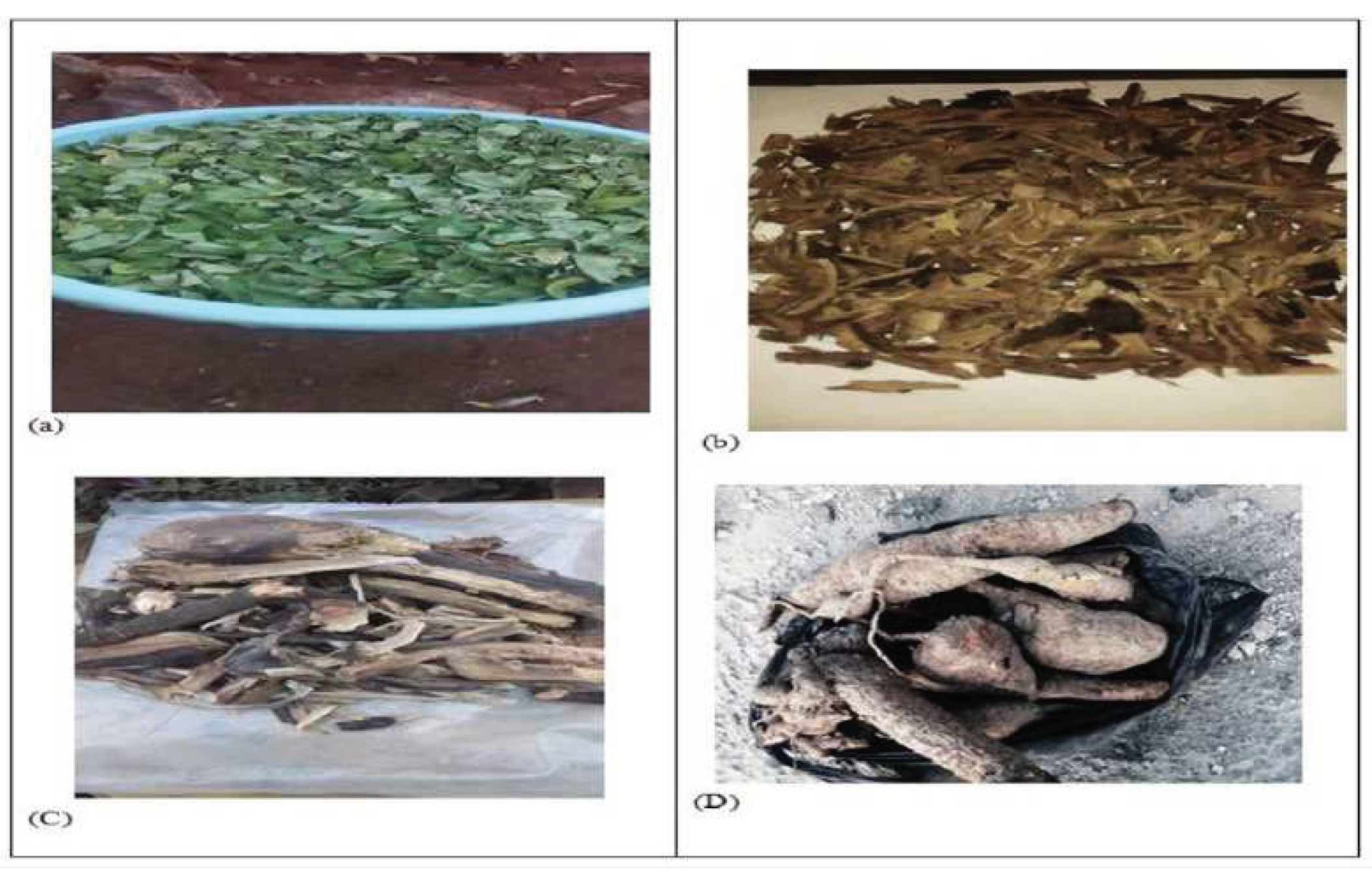

Table 1.
Percentage yields of crude extracts.
| Local name | Scientific name | Parts used | Weight of macerated | % yield of crude extract | ||
| Chloroform | Ethanol | Distilled water | ||||
| Hambo hambo | Senna singueana | Leaf | 100 g | 3.84 | 13.06 | 9.42 |
| Stem Bark |
100 g | 9.04 | 15.41 | 6.21 | ||
| Root | 100 g | 0.91 | 6.75 | 4.94 | ||
| Etse- zewie |
Cyphostemma junceum |
Root | 100 g | 1.29 | 1.75 | 7.94 |
Table 2.
Phytochemical components of S. singueana and C. junceum plants.
| Scientific Name |
Parts used | Solvents | Flavonoids | Tannins | Phenols | Glycoside | Teropenoid | Steroids | Sapnoids | Cumarins |
| S. singueana | leaf | CH | - | - | - | + | - | - | - | + |
| ET | + | + | + | - | + | + | - | |||
| DW | + | + | + | + | + | - | + | - | ||
| Stem bark | CH | - | + | + | - | - | - | - | + | |
| ET | + | + | + | + | + | - | - | - | ||
| DW | + | + | + | + | - | - | + | - | ||
| root | CH | - | + | + | + | + | - | - | - | |
| ET | + | + | + | + | - | - | - | - | ||
| DW | + | + | + | + | + | - | + | - | ||
| C. junceum | root | CH | - | + | + | - | - | + | - | - |
| ET | + | + | + | + | + | - | + | + | ||
| DW | + | + | + | + | + | - | - | + |
Note: Chloroform (CH), Ethanol (ET) and Distilled water (DW) +: present; -: absent.
Table 3.
Antibacterial activity of S. singueana and C. junceum extracts by disk diffusion method.
| Scientific Name |
Parts used | Solvents | Pathogenic bacteria | |||||||
| S. aureus | P. aeruginosa | |||||||||
| 500µg/ml | 250µg/ml | 125µg/ml | Amoxicillin (125µg/ml) | 500µg/ml | 250µg/ml | 125µg/ml | Amoxicillin (125µg/ml) | |||
| S. singueana | leaf | CH | - | 11.5 ± 0.5 | - | 40 ± 0.0 | 14 ±1.0 | 11 ± 1.0 | 10.5 ± 0.5 | 20 ± 0.0 |
| ET | 10.5 ± 1.5 | 10.5 ±1.5 | 10.5 ± 1.5 | 32.5 ± 2.5 | 11 ±1.0 | 8.5 ± 0.5 | 8 ± 1.0 | 25 ± 0.0 | ||
| DW | - | - | - | 30 ± 0.0 | 10.5 ± 0.5 | 9.5 ± 0.5 | 7.5 ± 0.5 | 15 ± 0.0 | ||
| Stem bark | CH | 12 ± 0.0 | 11.5 ± 2.5 | - | 31 ± 1.0 | 10.5 ± 0.5 | 10 ± 0.0 | 8.5 ± 0.5 | 13.5 ± 1.5 | |
| ET | - | - | - | 20.0 ± 0.0 | 10.5 ± 0.5 | 10 ± 0.0 | 8.5 ± 0.5 | 12.5 ± 2.5 | ||
| DW | 11 ± 1.0 | 10.5 ± 0.5 | 9 ± 0.0 | 32.5 ± 2.5 | - | - | - | 13 ± 0.0 | ||
| root | CH | 12.5 ± 0.5 | 12 ± 0.00 | - | 37.5 ± 2.5 | - | - | - | 15 ± 0.0 | |
| ET | 11.5 ± 1.5 | 10 ± 1.0 | 8.5 ± 1.5 | 35 ± 0.0 | - | - | - | 12 ± 0.0 | ||
| DW | - | - | - | 32 ± 2.0 | 11.5 ± 0.5 | 10.00 | 9.5 ± 0.5 | 10 ± 0.0 | ||
| C. junceum | root | CH | 8.5 ± 0.5 | 10.5 ± 0.5 | 13.5 ± 1.0 | 31 ± 1.0 | - | - | - | 10 ± 0.0 |
| ET | - | - | - | 27 ± 0.0 | 9.5 ± 0.5 | 11 ± 1.0 | 12.5 ± 1.0 | 20 ± 0.0 | ||
| DW | - | - | - | 32.5 ± 2.5 | - | - | - | 11 ± 0.0 | ||
Disclaimer/Publisher’s Note: The statements, opinions and data contained in all publications are solely those of the individual author(s) and contributor(s) and not of MDPI and/or the editor(s). MDPI and/or the editor(s) disclaim responsibility for any injury to people or property resulting from any ideas, methods, instructions or products referred to in the content. |
© 2024 by the authors. Licensee MDPI, Basel, Switzerland. This article is an open access article distributed under the terms and conditions of the Creative Commons Attribution (CC BY) license (http://creativecommons.org/licenses/by/4.0/).
Copyright: This open access article is published under a Creative Commons CC BY 4.0 license, which permit the free download, distribution, and reuse, provided that the author and preprint are cited in any reuse.


