

Submitted:
08 February 2024
Posted:
09 February 2024
You are already at the latest version
Abstract
Children—Dependents in Social Construction Theory—are assessed within democracies regarding their ability to self-direct their behavior concerning their associated society. In this regard, childhood represents a lack of self-direction, a life period when people require the guidance and protection of adults. The assumed necessity of adults supervising children in democracies requires substantial social resources, reducing the self-direction of those charged with overseeing children. Given that self-direction defines the optimal experience of people within democratic society, finding ways to increase the self-direction of children is an individual and a social benefit. In this regard, smartphones have improved self-direction in children. How children have become empowered to self-direct their lives with smartphone use considering Social Construction Theory—as Advantaged, Contenders, or Deviants—is the focus of a scoping review conducted on “children, empowerment, smartphones” of the following databases: OVID, JSTOR, ProQuest, PubMed, Scopus, and Web of Science. The result is that children permitted to self-direct their activities aided by smartphone technology have comparable social behavior to adults positioned as Advantaged, Contenders, or Deviants and, as such they should be encouraged to utilize smartphone technology to improve their self-direction, as doing so will augment individual and caregiver self-direction, providing increased social benefit.
Keywords:
children
; Social Construction Theory
; democracies
; childhood
; self-direction
; empowerment
; smartphones
1. Introduction
Children are viewed as social dependents in democracies, unable to self-direct their behavior in the society to which they are associated. From the perspective of Social Construction Theory [1], children are dependent in various ways [2]. Concerning power to effect change in society, they are weak. At the same time, they are viewed as good, innocent, and deserving of help by society. Unlikely to mobilize, they assume the position of Dependent—one of the four social construction positions [1,2]. As Dependents in Social Construction Theory, children have low participation in society and accept that the over-represented burdens they face are “for their own good”—they are not encouraged or given support to devise their own solutions to problems and social policy is designed to deceive them into remaining weak [2]. Another position in this theory—held by middle class taxpayers—is equated with ‘the normal’ and ‘the common good’ and represents the foundation of democracies. This position is labelled the Advantaged [3], defining those who are strong with respect to democratic power and are viewed positively by the society [1]. As such, policies related to them are considered as conferred on the deserving. In contrast, two other social constructions are viewed negatively in democracies [1]. One group is Contenders—those who are seen to strive for more than society considers their fair share [4]. They are able to do so by their accurate understanding how society works—through money, connections, knowledge and/or their skills—taking advantage of loop-holes, and increasing their power when successful; yet, when they achieve power, it is considered by democratic society as a whole to be undeserved, although they are presented with exceptional rewards for their accomplishments [1]. Finally, there are the Deviants of Social Construction Theory. They are those with even less power and fewer resources than Dependents but, unlike them, they are unwilling to accept their powerless position. Although not differentiated by the originators of Social Construction Theory, in the view of this author Deviants can themselves be divided into three distinct categories in relation to their response to rules. They may achieve power acting as disruptors, rationally demonstrating the need for new rules by creating radically new technologies [5]. Alternatively, the actions of Deviants can lack persuasiveness in changing the rules because they offer irrational arguments. These Deviants act as deceivers, representing those who saturate social media with fake news (considered one of the greatest threats to humanity [6]) or exaggerated news [7]. Finally, Deviants can resort to antisocial activities because they are not interested in society’s rules for various reasons [8]. These activities, among others, can result in living unusual lives [9], destroying or stealing property [10], and/or committing violence against themselves [11] or others [12]. If Deviants of any type gain power as a result of their tactics, it is considered undeserved by society. At best, Deviants are left free—attempts to change them are through authoritarian means rather than reconsidering structural inequities in society [1].
The Social Construction Theory that represents these major divisions (those that have been capitalized above) originated with a 1993 publication by Schneider and Ingram [1]. Written with an aim to improving political and policy decisions in democracies (most specifically the United States), these authors argued that the social construction of target populations is an important, overlooked phenomenon deserving of attention as these social constructions influence policy agenda and provide rationales that legitimate policy choices [1]. Schneider and Ingram were considered to respond well to criticisms faced by this theory [13]. Their 1997 book, Policy Design for Democracy, presented their research corpus [14]. By 2008, this book had received the The Aaron Wildavsky Enduring Contribution Award, given for the best public policy book or article published over the preceding twenty-plus years. To receive this award, the publication was evaluated to have had a major impact on the field [15]. By 2014, it was still considered one of the leading theories to understand the policy process [13]. Yet, already as early as 1999, the most influential textbook regarding policy process, Theories of the Policy Process [16], reclassified this theory as a “framework” and it was omitted from consideration in the volume [13]. However, Ingram, Schneider, and Peter deLeon were then invited to write the introductory chapter [3] for the second 2007 [17] and third 2014 [18] edition of the textbook on the theory of social construction and policy design, with the editorial comments lauding their contribution as rising “to the standard of science through clarity, hypothesis-testing, and the acknowledgement of uncertainty” [17] (p. 11). This recognition of their work did not extend to fourth 2018 edition [19] or the fifth edition in 2023 [20] as Social Construction Theory as a framework [21] was now characterized as a worthy but no longer to be highlighted in this influential publication. Recent research has argued that Social Construction Theory should not have been reinterpreted as a framework, decreasing its popularity [3] with a number of current publications making use of Social Construction Theory as it was originally intended [22,23,24]. The work of Schneider and Ingram has been taken up recently as a theory rather than a framework in relation to children [25]. It is in this regard that Social Construction Theory is considered an appropriate lens through which to assess children, empowerment and smartphones.
Empowerment is a process of gaining understanding and control of personal, social, economic, and political status to take action to improve one’s position in society [26,27]. Social Construction Theory is important in considering empowerment because it helps to explain why some groups are more advantaged than others independent of traditional notions of political power in resolving who gets what when [1]. Although children as a group are Dependents, individual children historically have been empowered as each of Deviants, Contenders, or Advantaged. A child who gained power as a Deviant disruptor is Philo Taylor Farnsworth, the inventor of the first television. Farnsworth worked out the principles for television the summer of 1921 while still 14, and demonstrated the first working version at 21, inspired by the back-and-forth motion used to plow a field [28,29]. As a Contender, Swedish climate activist Greta Thunberg was 15 in 2018 when she began protesting in front of the Swedish parliament to draw attention to the climate crisis—later, taking her message across the Atlantic transported by sail power [30]—becoming Time magazine’s Person of the Year for 2019 [31]. At a time when child labor laws banned children from work except for acting, Shirley Temple rose to become the most loved and well-known star during the depression in attractively representing the democratic values of middle class America in her many movies and her yearly birthday parties [32]. Her ability to emulate what was considered good in American society [33] placed her among the Advantaged.
Regarding Social Construction Theory, the author has depicted hierarchically whether or not the rules of society are accepted by its members and the power levels in relation to this. In the power hierarchy, revealed in Figure 1, the first level is regarding the power of making a decision with respect to society’s rules. The making of a decision, whether “yes” or “no”, demonstrates equal power with either response. Next is the type of decision made concerning Social Construction Theory. As each construction defined by the theory is equal in the types of variables considered, the power as a social construction is equal. The level below concerns the rewards and burdens associated with each social construction. Since each construction has both burdens and rewards in either accepting or rejecting society’s rules, the power of each as representative of variables in this regard is equal. However, Deviants can be divided into a number of other categories in relation to how they respond to rules in their interest and ability to convince others that society’s rules should be changed. This way of interpreting Deviants is not part of the original Social Construction Theory. Instead, it is informed by Cohen’s theory on delinquent boys [34]. Although developed in 1955, this theory continues its relevance today [35,36,37]. It is a theory of delinquency particularly relevant to Social Construction Theory in considering the origins of deviance related to the subculture assessment of middle-class rules [34].
In this way, Deviants can be divided into the subclassifications of disruptors, deceivers, and antisocial (not capitalized, as these divisions are not part of the original Social Construction Theory) as seen in Figure 1. Of the Deviants, disruptors remain supportive of rules—but not those accepted by society. They gain their power by an ability to persuade others that the current rules of society are flawed, providing what are deemed to be useful demonstrations that the rules can be productively changed [38,39]. In contract, there are those Deviants who provide irrational reasons to persuade others of their point of view in trying to gain power. They become, for example, the deceivers in social media with fake news [40,41] or merely knowingly exaggerating or under-reporting of the truth [42]. Lastly, there are those Deviants who provide no reasons for why new rules are required because they are uninterested in society’s rules. As a result, they try to achieve power through antisocial means [43], including (among other things) those actions most harmful to society—stealing [44], destroying property [45], or violent behavior (likely against the Advantaged [46] or Dependents [47]). As such, they have reduced power in this hierarchy regarding the acceptance of society’s rules. The way in which they respond against society’s rules further reduces the power level of each classification of Deviants as seen in Figure 1 because policy decisions in democratic societies are directed first and foremost to higher power relations [1]. For this reason, the arguments put forward by Deviants are last to be considered. This is true even when disruptor Deviants can point to rational arguments for considering change. In this way, it takes a significant amount of time for disruptors to convince society that change is needed based on their demonstrations. For example, as a Deviant disruptor, Farnsworth built the first functional television 7 September 1927 [48]. Yet, it wasn’t until 1958 that 86% of Americans owned television [49], making it then a recognized part of middle class life and a normal reward of the Advantaged.
In considering smartphone use by children, it is notable that the results of a 2020 international study found that 95% of 13- to 17-year-olds have smartphones in the United States [50], making their use ubiquitous. Smartphone technology represents and includes portable computer-mediated communication technology [51] that pertains to both the physical equipment and applicable software applications. Smartphones permit individuals to own a personal, hand-held computer for their unimpeded use [52] in exchange for paying a monthly fee to a telecommunications service provider [53] as well as being within the range of a transmission tower [54] operated by a server-specific satellite [55]. Unless users reveal personal information about themselves, other users may be unable to tell the age of a smartphone user. As a result, whether a smartphone user is a child would remain unknown. For democratic society that considers children Dependents, this is a problem as children in this way are unentitled to many forms of social participation. One of the overrepresented burdens that children face is adults’ aim to control their smartphone use [56], guided by medical professionals strongly encouraging parents to prevent their children opening social-media accounts until around age 14 [57], and research emphasizing smartphone addiction in children [58,59]. Yet, it is found that such addiction is not independent to children and is directly related to parents’ own smartphone addiction [60,61].
Yet, self-direction remains the cornerstone of democracy [62]. It is the aim of adults and is associated with their improved health [63]. Regarding Social Construction Theory, in that society continues to place children in the role of Dependents, this involves the necessity of limiting children’s access to smartphone technology—conceivably for their own benefit. Considering children as Dependents gives adults cause for reasons to restrict children’s smartphone use [64]; however, this also decreases children’s self-direction, simultaneously limiting the self-direction of their caregivers as they are charged with supervising children to an extent that, when supervising, they are unable to devote time to their own self-direction. This is a detriment not only for the children unable to self-direct but also for the adults who are kept from their personal self-direction [65,66]—important in producing parental burnout in democratic countries—negatively affecting their mental health [67]. Therefore, with self-direction the aim, finding ways and means to permit greater self-direction in children will aid not only children but also their parents/caretakers who then would have time released from supervising children to self-direct their own lives, longitudinally representing both an individual and social benefit [68].
The question is, under what conditions can children be empowered through their self-direction to move from being Dependents to being repositioned to any of Deviants, Contenders, or Advantaged through the use of smartphone technology? This scoping review will investigate in what ways children’s use of smartphone technology enhances their self-direction by redefining them as Deviants, Contenders, or Advantaged in relation to Social Construction Theory. The hypothesis related to this scoping review is that most research related to the three keywords “children, empowerment, smartphones” will concern children as Dependents; otherwise, they will be considered Deviants next frequently, then Contenders. It is supposed that, since a feature of democratic society is upholding children as less socially competent and in need of protection [69], the fewest studies will admit them as Advantaged. The results of the scoping review surprising find this hypothesis is not upheld, as there are few studies related to Deviants and the number of reports concerning children who are portrayed as Advantaged equals the number related to children who are Contenders. This study is valuable because it represents the first study to conduct a scoping review of “children, empowerment, smartphones” of research published in the last five years regarding democracies a time when smartphone use by children is found everywhere.
2. Materials and Methods
To gather the materials, the methods used pertained to the preferred reporting item for the systematic review and meta-analyses (PRISMA) flow of information process. A diagram specific to scoping review was developed. The PRISMA diagram represented in Figure 2 is based on the most recent PRISMA template [70]. Figure 2 follows the flow of exclusion and inclusion criteria over the four days the searches were conducted from 15-18 January 2024. As well, the PRISMA Scoping Review Checklist is included in a supplementary file (Table S1) outlining the process undertaken in this article. The keywords searched over the four days include “children, empowerment, smartphones”. Additionally, to ensure that only publications from the last five years were returned, the qualifier “2019-present” was added to each search as best practice for referencing scientific research is that it be published within the last five years [71].
The intent of this this scoping review is to investigate research that has been conducted on children who have been empowered by their personal smartphone use. As such, what is not investigated (and is excluded from consideration) is (1) parent/caregiver smart phone use, (2) children’s smart phone use in following a standardized curriculum (teaching and/or learning), (2) a focus on migrants or refugees, (4) how businesses can advertise to children through smartphones, (5) development of smartphone technology in relation to children, (6) statistics gathered about children’s smartphone use for demographic purposes, and (7) the maltreatment of children. The reason each of these were excluded is the research does not relate to empowering children’s self-direction through their smartphone use. The following databases were searched in this regard: JSTOR, OVID, ProQuest, PubMed, Scopus, and Web of Science. There were no registered searched.
2.1. Details of the Individual Searches
As per the requirements of the PRISMA flow diagram [70], the databases searched are differentiated only in relation to from where the Records were identified (see Figure 2). Already, once the Records removed before screening is undertaken, all records returned are added together of each database. As a result, the Duplicate records removed in total were 2. There were no Records marked as ineligible by automation tools. Those that were Not peer reviewed = 11 and those Not in English = 5. This left 151 Records screened. Of these, the Records excluded did not include: Children =17, and Empowerment = 8. There were no records excluded for not including smartphones. This left 126 Reports sought for retrieval with 2 Reports not retrieved. Of the 124 Reports assessed for eligibility, reports were excluded for concerning the following: Parents/caregivers = 42, Business = 9, Teaching/learning = 19, Migrants/refugees = 8, Technology = 7, Demographics = 13, and Maltreatment = 2. This left 24 Studies included in review for a total of 24 Reports of included studies. However, this requirement by PRISMA means that the details of the individual searches are not presented in the flow diagram. These details are thus presented as follows.
15 January 2024—JSTOR: 60 records were identified for a keyword search of “children, empowerment, smartphones”. The records removed before screening included: Not peer reviewed = 6, Not in English = 3. This left 51 records to be screened. The records excluded did not include: Children= 5, Empowerment = 6, producing 40 reports sought for retrieval. One record was not retrieved. Records were then excluded for their focus on: Parents/caregivers = 6, Business = 5, Teaching/learning = 10, Migrants/refugees = 4, Technology = 3, Demographics = 3, Maltreatment = 2. The final number of Studies included = 6. All 6 reports of studies were included.
16 January 2024—OVID: this search included the following databases searched simultaneously—Embase Classic+Embase, APA PsycInfo, AMED (Allied and Complementary Medicine), and Journals@Ovid Full Text. The additional exclusions entered during the search were, “not parents, not adults”. The result was 48 records identified with Not peer reviewed = 3, Records screened = 45. The records then excluded were those that did not include: Children = 3, Empowerment = 2. This resulted in 40 reports sought for retrieval. As all reports were retrieved, the reports assessed for eligibility = 40. Of these reports, those exclude were: Parents/caregivers = 17, Teaching = 3, Migrants/Refugees = 1 Technology = 3, and Demographics = 6. The final number of Studies included = 10.
17 January 2024—ProQuest: similar to OVID, additional exclusions were “not parents, not adults”. From this search, unexpectedly 678 records were identified. It was anticipated that there might be many returns that did not pertain to improving children’s empowerment through personal smartphone use. ProQuest offered a list of possible keywords that might be excluded from the search. Of this list, there were 83 that the author determined were unrelated to the purpose of the search. These are the 83 additional exclusions, “covid-19, pandemics, coronaviruses, education, students, society, technology, families & family life, caregivers, women, learning, data collection, teaching, distance learning, medical personnel, parents & parenting, women’s health, questionnaires, consumers, developing countries, innovations, artificial intelligence, online instruction, design, digital technology, household, poverty, algorithms, databases, disease transmission, low income groups, pedagogy, population, pregnancy, professionals, colleges & universities, educational technology, community, case studies, informational technology, research methodology, sustainability, culture, employees, minority & ethnic groups, qualitative research, research, citizenship, crime prevention, information systems,, job satisfaction, patients, consumption, content analysis, feedback, leadership, neoliberalism, rural communities, sustainable development, teams, adults, ambivalence, big data, certification, citizen participation, civil society, communication technology, crime, cultural heritage, gender, government agencies, health disparities, health education, health research, hypotheses, medical research, participatory research, power, qualitative analysis, race, refuges, religion, research design”. Following these exclusions, there were 42 records identified. Of these, one was Not in English. As such, Records screened = 41. Of these, 10 Records excluded did not include Children, resulting in the Reports sought for retrieval = 31. Of these, the Reports not retrieved = 1, leaving the Reports assessed for eligibility = 30. Of these reports, those excluded concerned: Parents/caregivers = 9, Business = 4, Teaching = 5, Migrants/Refugees = 2, and Demographics = 6. Thus, the final number of Studies included = 7.
18 January 2024—PubMed: for this search, the additional exclusions were, “not parents, not adults, not business, not technology, not teaching, not migrants, not refugees, not technology, not demographics, not maltreatment”, which produced a return of 11. Each of these additional qualifiers were added to the search in an attempt to preempt a similar large, but unrelated, return as occurred with the ProQuest search the day before when a vast number of research reports were retuned unrelated to the intent of the search. The Records removed before screening were, Not peer reviewed = 1, leaving 10 Records to be screened. Records excluded that did not include Children = 1. This resulted in the Reports sought for retrieval = 9. All reports were retrieved, leaving reports assessed for eligibility = 9. Of these, those excluded concerned: Parents/caregivers = 8, and Migrants/Refugees = 1. As a result of these exclusions, the final number of Studies included = 0.
18 January 2024—Scopus: similar to the PubMed search, additional exclusions were made before the search by including the following keywords as qualifiers, “not parents, not adults, not business, not technology, not teaching, not migrants, not refugees, not technology, not demographics, not maltreatment”. This resulted in a return of 7 records. Records removed before screening were as follows, Duplicate record = 1, Not peer reviewed = 1, Not in English, leaving 4 Records to be screened. There were no Records excluded, so Reports sought for retrieval = 4. All reports were retrieved, leaving reports assessed for eligibility = 4. Of these, those excluded concerned: Parents/caregivers = 2, and Technology = 1. The result was that the final number of Studies included = 0.
18 January 2024—Web of Science: in keeping with the searches performed on both PubMed and Scopus, additional exclusions were sought with the keywords, “not parents, not adults, not business, not technology, not teaching, not migrants, not refugees, not technology, not demographics, not maltreatment”. The result was that only one record was returned. As this one record was a duplicate of another, the final number of Studies included = 0.
3. Results
The results of the sequential searches performed January 15-18, 2024, regarding the keywords “children, empowerment, smartphones” of those articles published “2019-present” are presented in Table 1.
The articles and their full titles as they appear in Table 1 are as follows: Disability Rights and Robotics [72], Prosthetic Performances: Artistic Strategies, and Tactics for Everyday Life [73], Privacy in a Pandemic: An Examination of the United States’ Response to Covid-19 Analyzing Privacy Rights Afforded to Children Under International Law [74], Children and Online Privacy Protection: Empowerment from Cognitive Defense Strategies [75], Digital hyperconnectivity and the self [76], Unseen potential: photovoice methods in hazard and disaster science [77], Left to their own devices? A mixed methods study exploring the impacts of smartphone use on children’s outdoor experiences [78], The promises and challenges of clinical AI in community paediatric medicine [79], Assessment of digital risks in child and adolescent mental health services: A mixed-method, theory-driven study of clinicians’ experiences and perspectives [80], What has been done to improve learning for intellectual disability? An umbrella review of published meta-analyses and systematic reviews [81], Adolescents’ experiences of a theory-based behavioural intervention for improved oral hygiene: A qualitative interview study [82], Iranian nongovernmental organizations’ initiatives in COVID-19 pandemic [83], Considerations in pediatric intervention research: Lessons learned from two pediatric pilot studies [84], The effectiveness of web-based mobile health interventions in paediatric outpatient surgery: A systematic review and meta-analysis of randomized controlled trials [85], Developing web-based health guidance for coaches and parents in child athletics (track and field) [86], Controlled trial of an mHealth intervention to promote healthy behaviours in adolescence (TeenPower): Effectiveness analysis [87], Acceptability and Utility of an Open-Access, Online Single-Session Intervention Platform for Adolescent Mental Health [88], Safety.Net: A Pilot Study on a Multi-Risk Internet Prevention Program [89], Effectiveness of mobile health-based self-management application for posttransplant cares: A systematic review [90], Development and feasibility testing of the Comfort Ability Program for sickle cell pain: A patient-informed, video-based pain management intervention for adolescents with sickle cell disease [91], Technological Ecological Momentary Assessment Tools to Study Type 1 Diabetes in Youth: Viewpoint of Methodologies [92], “It’s like a safe haven fantasy world”: Online fandom communities and the identity development activities of sexual and gender minority youth [93], Leveraging the Full Continuum of Care to Prevent Opioid Use Disorder [94], Growing Up with Smartphones: How Stay-behind Filipino and Indonesian Children Exercise Agency in Transnational Families [95].
The number of articles from each year are as follows: 2019 = 1, 2020 = 8, 2021 = 6, 2022 = 4, 2023 = 5, demonstrating that the empowerment of children with the use of smartphone technology is a continuing research concern. Yet, although this is a persisting research interest, the most recent publications from 2023 are from the perspective of children retaining little power with four of those from 2023 investigating children from the perspective of Dependents and one researching children as Deviants as seen from Table 2, which divides the reports assessed into the four categories of Social Construction Theory. The division is in relation to the order of the returns that the databases were searched mid-January 2024. In total, these were the number of reports assessed of the returns for each category of Social Construction: Dependent = 10, Advantaged = 6, Contender = 6, Deviant = 2. Consequently, the hypothesis that Dependent would produce in the most numerous results related to the search was correct. However, all other aspects of the hypothesis did not hold. Deviant was expected to be the next most numerous Social Construction to be represented by research on “children, empowerment, smartphone”; however, it was instead the least frequently studied. As well, the number of studies on Contenders and Advantaged was equal. This unexpected result meant that, regarding smartphone use, children were being considered in these studies as legitimately representing a similar expectation of rewards and burdens as Advantaged middle class taxpayers. The reasons for classifying the studies as has been done in Table 2 are next to be examined in relation to each Social Construction.
3.1. Dependents
Concerning their citations numbers, there are 10 reports that consider children from the pespective of Dependents [72,73,79,80,81,83,84,85,86,89]. All of these except one [89] are healthcare related and regard children as needing special protection beyond what would be required by adults in similar circumstances. The use made of smartphone technology for empowering either physically or mentally disabled children [72,73,79,81,85] is to achieve the level of social participation normally expected of children. There is no argument put forward in these articles that children might display the empowerment of the Advantaged as a result of this technology. Other articles report on the concern that empowering children with smartphone technology presents risks to children as those people requiring special healthcare protection [80,83,84,86]. The one article that is not healtcare related [89] is concerned with the vulnerability of children regarding internet risks. Topics discussed in this report are cyberbullying, sexting, online grooming, cyber dating abuse, problematic internet use, nomophobia, internet gaming disorder, and online gambling disorder. The intent of the article is to present a program found effective in preventing the increase in these risks for children.
3.2. Advantaged
Unexpectedly, there are six reports assessed [75,76,77,82,90,92] that consider children in a manner equating them as part of the Advantaged. As such they are presented as legitimately entitled to the same rewards and burdens as middle class taxpaying adults. In these articles, children are viewed has having a point of view in social decision-making that is merely different, but equivalent, to that of these adults. How children differ is explained and the use of smartphones that can emplower them based on these differences is presented. The first of these articles [75], examines how children can monitor their own use of smartphones to protect their privacy. In examining the qualities of a digital self, children in the second study [76] are equivalent to adults in the fact of having digitable selves. For the third report [77], children are characterized as possibly more important than adult smartphone users in developing photovoice methods for hazards and disasters as children are those more likely to use their smartphones for recording activity in their neighborhoods. Similar to this study, a report on improving oral hygiene in adolescents considered that they are probably more inclined to look after their oral hygiene than adults in similar circumstances as a result of their using a smartphone app to help in this regard. A point of difference is that the teens (unlike the adults) requested reminders to keep with the program [82]. In an article on the effectiveness of a mobile health-based self-management application for managing posttransplant care, children were considered equivalent to adults in managing their posttransplant care through the use of smartphone technology. In the view of these authors, as smartphones are available to almost all children, they can and should be used to “reduce psychosocial consequences and improve self-management skills” [90]. As those who must learn to manage their self-care from the time they are very young, children with type 1 diabetes are viewed as prime candidates for making use of smartphone apps that help with all aspects of controling their disease [92]. Smartphones, in this regard, have greatly empowered children in the successful self-management of individual diabetic consequences in a manner similar to adults.
3.3. Contenders
In the reports where children are presented as Contenders [74,78,87,88,91,95], the authors at some point in the article define that children generally should be protected in a way that is equivalent to categorizing them as Dependents in Social Construction Theory. Yet, the authors of each paper put forward arguments for why, in the special circumstances presented in each study, children should be treated similarly to adults. The first paper [74] presents a position regarding why children are legally entitled to privacy concerning their smartphone use based on the United Nations’ Convention on the Rights of the Child. Yet, although this is the position taken of the authors, they are apologetic about promoting this view, as they recognize that children are considered to have the qualities of Dependents by society. It is under this perceived limitation that the authors explaiin in detail why children must be permitted their privacy. The second report [78] begins from the perspective of understanding and promoting the view that children are Dependents. However, after conducting a study on children’s outdoor experience in relation to smartphone use, these authors alter their position, arguing that smartphone use actually increases and empowers children’s outdoor sociality and children should be “left to their own devises” in using smartphones since smartphones are not “all bad”. Initially presented as part of “vulnerable groups”, adolescents are then found to be significantly and positively impacted by an mHealth intervention (Teen Power) improving their lifestyle in multiple domains in the next report returned [87]. In feeling the need to present an effective open-access, online single intervention platform for adolescent mental health for its acceptability, the authors of this study present various justifications for the value of this intervention in empowering adolescents in ways that they would not consider necessary if they were testing an adult population [88]. In relation to the excrutiating pain that children with sickle cell disease are explained to suffer, these children are described in a study as vulnerable [91]. On the other hand, these same children are presented as those who are able to become empowered to take control of their pain through various means, including using smartphone apps. The final paper that presents children in a style equivalent to Contenders is one focused on how Filipino and Indonesian children of transnational families, instead of being Dependents as these authors had expected, are found to be self-directing their lives empowered with the aid of their smartphones [95].
3.4. Deviants
Unexpectedly, there are only two papers that portray children as Deviants regarding Social Construction Theory in relation to their empowerment with use of their smartphones [93,94]. Furthermore, based on the more detailed division of Deviant by the author presented in Figure 1, the type of Deviant they represent is antisocial, rather than either disruptor, or deceiver. The first of the two papers [93] concerns the identity development of 3,665 sexual and gender minority youth across the United States and Canada. The importance of smartphone technologies in empowering safe and anonymous communication of these youth based on the culture to which they ascribe is the focus of the article. The second article [94] regards the use of smartphone technology to empower youth with Opioid Use Disorder to self-direct to leverage harm reduction programs. It is by tailoring these programs to the young opioid user that they have been found effective.
4. Discussion
This discussion will focus on (1) the implications of the results of the scoping review conducted, and (2) the limitations of the search of “children, empowerment, smartphone” in relation to finding so few reports considering children as Deviants with respect to Social Construction theory. This, when it was hypothesized that viewing children as Deviants would return the next greatest number of results for the scoping review compared with the returns of characterizing them as Dependents.
4.1. Implications of the Scoping Review
One of the most significant problems that comes from considering children as Dependents is that they do not see their interests as coinciding with important public goals. Instead, children are encouraged to believe that their problems can only be solved individually and dealt with privately [1]. They may view the claims of others—especially powerful individuals who are Advantaged—to be more legitimate than their own, agreeing to wait in line until they get what others have. Their participation in society is low and conventional [1]. In this way, for children to assume another position in Social Construction Theory—improving their self-direction and that of their parents/caregivers—they, their parents/caregivers, and society in general need to disassociate from the mental constraint that children must be Dependents. If becoming Deviants, they no longer accept that they should remain powerless by waiting in line for what others have already. If altering to Contenders, they must be considered as having power, but of the type that remains exceptional in order for them to retain this power. To redefine themselves as part of the Advantaged, age would no longer be considered relevant to the benefits and burdens that are socially distributed.
Although it had been hypothesized by the author that when children were viewed as other than Dependents by researchers that the most frequent way they would be considered was as Deviants, this was not the case—particularly in regards to viewing them as either disruptors or deceivers, for which there were no returns. On the other hand, it was also not expected that the number of reports returned viewing children as Contenders would be equal to recognizing them as Advantaged. The reasons for the author not considering that children would be viewed positively is that their usual position in society as Dependents presents them few rewards and leaves them overburdened. Thus, it was thought that researchers would be most likely to study decreasing the rewards to children in their smartphone use. The reason is that there has been recent focus on smartphone addiction in children [96,97], seeing this as a form of deviance [58]. This view persists although good and presently unrefuted reasons were proposed in 2018 for why children’s smartphone use is not an addiction but merely problematic use regarding society’s expectations of children [98].
Still, from the unexpected results of the scoping review, it may be that researchers have generally taken note of the advice in the 2018 article and in the last five years have focused on the benefits to children’s smartphone use. As such, concerning Social Construction Theory, the interest becomes the rewards children are considered entitled to in smartphone use—placing consideration of children in this regard either as Contenders or as Advantaged. That an equal number of the returns recognized children as Advantaged to Contenders means that children are being accepted as smartphone users comparable to normal adult users [99]. In fact, regarding the returns of the scoping review, it is only when researchers hold the position that children rightfully should be Dependents that they are presented as Contenders rather than viewed as Advantaged. This is evident from the returns depicting children as Contenders in this scoping review [74,78,87,88,91,95]. When the reason for children’s competence in using smartphones is studied, it is recognized that children learn to use smartphones competently, on their own, without the help of adults [100]. Furthermore, a decrease is noted regarding specific children’s gaming addiction when the competence of children in using smartphone technology is encouraged [101]. In other words, when children can self-direct their smartphone use, they become empowered in ways comparable to adults and are then not considered smartphone addicted. Furthermore, in becoming more self-directed, time and attention is released from their parents and caregivers to permit these adults to self-direct their own lives—an additional social benefit.
4.2. Limitations
The primary limitation of this scoping review is that the keywords searched, “children, empowerment, smartphones”, were unable to return any results pertaining to Deviants in relation to Social Construction Theory with respect to either disruptors or deceivers and few of antisocial. One reason may be that there is no such research. To test this possibility, a subsequent approach was taken. A limited search of Google Scholar conducted on 4 February 2024 of “deviant crimes against the middle class using smartphones” was undertaken to investigate the widest range of research that this statement might return. As a crawler-based web search engine [102], the order of returns with Google Scholar is the most relevant articles are returned first. Therefore, with 8,610 returns, only the first 40 results were investigated, representing the initial four pages of returns. Eleven of these returns published in peer reviewed journal are with respect to children’s deviance in democratic societies regarding their smartphone use.
The following are the titles of the reports of included studies as seen in Table 3. Impacts of Low Self-control and Opportunity Structure on Cyberbullying Developmental Trajectories: Using a Latent Class Growth Analysis [103], Scrolling and the In-Between Spaces of Boredom: Marginalized Youths on the Periphery of Vienna [104], Cyberbullying Victimization and Perpetration in South Korean Youth: Structural Equation Modeling and Latent Means Analysis [105], Predictors for runaway behavior in adolescents in South Korea: national data from a comprehensive survey of adolescents [106], Associations Between Parental Maltreatment and Online Behavior Among Young Adolescents [107], Understanding deviance from the perspectives of youth labelled as children in conflict with law in Mumbai, India [108], Smartphone Addiction Culminating into Youth Deviance: A Sociological Study [109], The digital divide in the US criminal justice system [110], The Effects of Korean Parents’ Smartphone Addiction on Korean Children’s Smartphone Addiction: Moderating Effects of Children’s Gender and Age [111], Exploring the Role of Self-Control Across Distinct Patterns of Cyber-Deviance in Emerging Adolescence [112], Exploring the Decisional Drivers of Deviance: A Qualitative Study of Institutionalized Adolescents in Malaysia [113].
A reason these publications did not return in the scoping review of “children, empowerment, smartphones” may have been that the focus of the 4 February 2024 limited Google Scholar search was not empowerment. Google Scholar was not searched as part of the scoping review because it has been evaluated as inappropriate as a principal database since the publication of influential 2020 research in this regard [102]. Therefore, there may have been results returned concerning children as disruptors or deceivers if Google Scholar had been searched. Taking this into consideration, a quick search on 4 February 2024 of the keywords “children, empowerment, smartphones” for publications since 2020, returned 54,500 results—orders of magnitude more than any of the primary databases returns from the mid-January 2024 searches. In other words, had Google Scholar been part of the initial scoping review, there may have been returns among all of these that did consider children as disruptors or deceivers.
Examining the 11 returns from the limited Google Scholar search of “deviant crimes against the middle class using smartphones” (see Table 3), there are three points to note. The first is that, of the 11 returns, five are concerning South Korea [103,105,106,107,111], two are regarding India [108,109], and one focuses on Malaysia [113]—all Eastern democracies. There are only three reports concerning Western democracies: one considering Austria [104], another focused on the United States [110], and the third concerning Australia [112]. This is relevant to note because these particular Eastern democracies have a ‘collectivist-hierarchical’ culture while the Western democracies are represented by ‘individualistic-egalitarian’ culture [114,115,116,117]. As such, when children do not do as they are told by parents or caregivers, they are considered deviants in Eastern democracies [118]. Whereas in Western democracies, children are expected and encouraged to act more independently [119]. In Western democracies, this requires self-control, something that those judged as Deviants in Western cultures are seen to lack—mentioned in each of the three articles concerning Western democracies. The second observation is that most of the ways that children are considered Deviant regarding their smartphone use can be viewed as antisocial. There are only three papers that concern deceivers [103,105,112], and the way in which they are deceptive in these cases is regarding cyberbullying—spreading false or misleading information online to negatively affect the mental health of a person [120]. Third, what is most evident is none of the articles concern disruptors. However, the paper reporting scrolling behavior of Viennese youth [104] hints that scrolling behavior may not be merely antisocial. Instead, children who socialize by meeting together to individually scroll through their smartphones, rarely interacting with each other, may be in the process of recreating the norms of how people socialize when together from the point of view of the ethnologist author of this article who, in this respect, does not consider the scrolling behavior of these children a waste of time. Instead, this ethnographer viewed the behavior as a legitimate form of society—one that has been witnessed to grow increasingly attractive to children [121]. However, for a change to happen regarding how people are seen to rightfully interact when they meet together using smartphones, children must first no longer feel guilt concerning what society currently considers their “mindless scrolling” [122] Furthermore, even when such antisocial Deviants move to becoming part of the Advantages as a result of attitudinal changes in society, it has been found that changes from disruptors to Advantaged remain unstable and, as a result of this instability, can be reversed [123].
Beyond the limitations that may have resulted from the particular keywords that were chosen to search, an additional limitation of this work is that this scoping review was conducted by one researcher. This may have resulted in a cognitive bias that went undetected by the author in evaluating the various references. Although this author undertook the present study with the aim of objectivity, it is possible that the author had a cognitive bias that was unrecognized [124]. Various frameworks have been developed to debias research reported [125,126,127]. These frameworks have recently attracted increased research on the efficacy of these models, something that was an area in need of additional research in 2018 [128]. None of these frameworks were used to potentially debias this research; thus, steps were not taken by the author to overcome this limitation.
5. Conclusions
In relation to Social Construction Theory, children are normally viewed in democratic societies as Dependents, overburdened with few rewards. As Dependents, they require supervision and support by society through their parents and/or caregivers. Since a primary component of democratic society is the self-direction of its members, this need for responsible adults to supervise children reduces both the self-direction of children and that of these adults, creating a detriment for democratic society as a whole. To this extent, smartphones have the possibility of empowering children in a way that the self-direction of both the children and their parents/caregivers can be increased. This scoping review of research published within the last five years regarding “children, empowerment, smartphones” has revealed that the almost universal use of smartphones by children has increased their self-direction in a manner equivalent to adults as each of Advantaged, Contenders, and Deviants. Furthermore, what is most surprising, is that when the use of smartphones by children is considered without reference to the age of the user, children are viewed as Advantaged. The result is that as children continue to make use of smartphones in their daily lives their empowerment increases in society. At the same time, this increases their self-direction, releasing the time and attention of their parents and caregivers from supervision to devote to their own self-direction, providing a benefit to democratic society as a whole. The results of this research point to the need for an attitudinal change regarding attitudes to the smartphone use of children from a focus on protecting them from smartphone addiction to encouraging their empowerment through self-directed smartphone use.
Supplementary Materials
The following supporting information can be downloaded at: The following supporting information can be downloaded at the website of this paper posted on Preprints.org, Supplementary Table S1: Preferred Reporting Items for Systematic reviews and Meta-Analyses extension for Scoping Reviews (PRISMA-ScR) Checklist.
Funding
This research received no external funding.
Institutional Review Board Statement
Not applicable.
Informed Consent Statement
Not applicable.
Data Availability Statement
No new data were created.
Conflicts of Interest
The author declares no conflicts of interest.
References
- Schneider, A.; Ingram, H. Social Construction of Target Populations: Implications for Politics and Policy. Amer Polit Sci Rev 1993, 87, 334. [Google Scholar] [CrossRef]
- Schneider, A.L.; Ingram, H.M. Social Constructions, Anticipatory Feedback Strategies, and Deceptive Public Policy. Policy Stud J 2019, 47, 206–236. [Google Scholar] [CrossRef]
- Barbehön, M. Reclaiming Constructivism: Towards an Interpretive Reading of the ‘Social Construction Framework. ’ Policy Sci 2020, 53, 139–160. [Google Scholar] [CrossRef]
- Jabbar, H.; Daramola, E.J.; Marsh, J.A.; Enoch-Stevens, T.; Alonso, J.; Allbright, T.N. Social Construction Is Racial Construction: Examining the Target Populations in School-Choice Policies. Am J Edu 2022, 128, 487–518. [Google Scholar] [CrossRef]
- Hopster, J. What Are Socially Disruptive Technologies? Techn Soc 2021, 67, 101750. [Google Scholar] [CrossRef]
- Bodaghi, A.; Oliveira, J. The Theater of Fake News Spreading, Who Plays Which Role? A Study on Real Graphs of Spreading on Twitter. Expert Sys App 2022, 189, 116110. [Google Scholar] [CrossRef]
- Buchanan, T. Why Do People Spread False Information Online? The Effects of Message and Viewer Characteristics on Self-Reported Likelihood of Sharing Social Media Disinformation. PLoS ONE 2020, 15, e0239666. [Google Scholar] [CrossRef]
- Farrington, D.P. The Integrated Cognitive Antisocial Potential (ICAP) Theory: Past, Present, and Future. J Dev Life Course Criminology 2020, 6, 172–187. [Google Scholar] [CrossRef]
- Turner-Moore, R.; Waterman, M. Deconstructing “Sexual Deviance”: Identifying and Empirically Examining Assumptions about “Deviant” Sexual Fantasy in the DSM. J Sex Res 2023, 60, 429–442. [Google Scholar] [CrossRef]
- Yang, X.; Chen, Q. Property Rights and Theft Wrongs? A Preliminary Analysis of Stealing in the Extractive Industries. Extractive Indus Soc 2023, 15, 101287. [Google Scholar] [CrossRef]
- Lee, J.-S.; Kwon, H.; Park, J.; Hong, H.J.; Kweon, Y.-S. A Latent Class Analysis of Suicidal Behaviors in Adolescents. Psychiatry Investig 2023, 20, 93–100. [Google Scholar] [CrossRef] [PubMed]
- Sender, A.; Morf, M.; Feierabend, A. Aiming to Leave and Aiming to Harm: The Role of Turnover Intentions and Job Opportunities for Minor and Serious Deviance. J Bus Psychol 2021, 36, 449–460. [Google Scholar] [CrossRef]
- Pierce, J.J.; Siddiki, S.; Jones, M.D.; Schumacher, K.; Pattison, A.; Peterson, H. Social Construction and Policy Design: A Review of Past Applications. Policy Studies Journal 2014, 42, 1–29. [Google Scholar] [CrossRef]
- Schneider, A.L.; Ingram, H.M. Policy Design for Democracy; Studies in government and public policy; University Press of Kansas: Lawrence, 1997. [Google Scholar]
- American Political Science Association. Organized Section 4: Aaron Wildavsky Enduring Contribution Award. Available online: https://www.apsanet.org/section-4-aaron-wildavsky-enduring-contribution-award (accessed on 27 January 2024).
- Theories of the Policy Process; Theoretical lenses on public policy; Sabatier, P.A., Ed.; Westview Press: Boulder, Colo, 1999. [Google Scholar]
- Theories of the Policy Process, 2nd ed.; Sabatier, P.A., Ed.; Westview Press: Boulder, Colo, 2007. [Google Scholar]
- Theories of the Policy Process, [new ed., new coll.], 3rd ed.; Sabatier, P.A., Weible, C.M., Eds.; Westview Press: Boulder, Colo, 2014. [Google Scholar]
- Theories of the Policy Process; Weible, C.M., Sabatier, P.A., Eds.; 4th ed.; Routledge: Fourth edition. | Westview Press: Boulder, Colo, 2017, 2018.
- Theories of the Policy Process; Weible, C.M., Ed.; Fifth edition.; Routledge, Taylor & Francis Group: New York London, 2023.
- Srivastava, S. Varieties of Social Construction. Int Stud Rev 2020, 22, 325–346. [Google Scholar] [CrossRef]
- Gándara, D.; Jones, S. Who Deserves Benefits in Higher Education? A Policy Discourse Analysis of a Process Surrounding Reauthorization of the Higher Education Act. Rev Higher Edu 2020, 44, 121–157. [Google Scholar] [CrossRef]
- Nicholson-Crotty, J.; Miller, S.M.; Keiser, L.R. Administrative Burden, Social Construction, and Public Support for Government Programs. JBPA 2021, 4. [Google Scholar] [CrossRef]
- Trochmann, M. Identities, Intersectionality, and Otherness: The Social Constructions of Deservedness in American Housing Policy. Admin Theory Praxis 2021, 43, 97–116. [Google Scholar] [CrossRef]
- Collins, M.E.; Mead, M. Social Constructions of Children and Youth: Beyond Dependents and Deviants. J Soc Pol 2021, 50, 493–510. [Google Scholar] [CrossRef]
- Lindacher, V.; Curbach, J.; Warrelmann, B.; Brandstetter, S.; Loss, J. Evaluation of Empowerment in Health Promotion Interventions: A Systematic Review. Eval Health Prof 2018, 41, 351–392. [Google Scholar] [CrossRef]
- Friska, D.; Kekalih, A.; Runtu, F.; Rahmawati, A.; Ibrahim, N.A.A.; Anugrapaksi, E.; Utami, N.P.B.S.; Wijaya, A.D.; Ayuningtyas, R. Health Cadres Empowerment Program through Smartphone Application-Based Educational Videos to Promote Child Growth and Development. Front. Public Health 2022, 10, 887288. [Google Scholar] [CrossRef]
- Abramson, A. Pioneers of Television — Philo Taylor Farnsworth. J SMPTE 1992, 101, 770–784. [Google Scholar] [CrossRef]
- Schatzkin, P. The Boy Who Invented Television: A Story of Inspiration, Persistence, and Quiet Passion, 1st ed.; TeamCom Books: Silver Spring, MD, 2002. [Google Scholar]
- Lütkes, L.; Tuitjer, L.; Dirksmeier, P. Sailing to Save the Planet? Media-Produced Narratives of Greta Thunberg’s Trip to the UN Climate Summit in German Print Newspapers. Humanit Soc Sci Commun 2023, 10, 242. [Google Scholar] [CrossRef]
- Jung, J.; Petkanic, P.; Nan, D.; Kim, J.H. When a Girl Awakened the World: A User and Social Message Analysis of Greta Thunberg. Sustainability 2020, 12, 2707. [Google Scholar] [CrossRef]
- Ngai, N. The Temptation of Performing Cuteness: Shirley Temple’s Birthday Parties during the Great Depression. Feminist Media Studies 2023, 23, 3091–3105. [Google Scholar] [CrossRef]
- Kasson, J.F. The Little Girl Who Fought the Great Depression: Shirley Temple and 1930s America, First edition.; W.W. Norton & Company: New York, 2014. [Google Scholar]
- Cohen, A. Subculture Theory: Delinquent Boys. In Criminology theory: selected classic readings; Williams, F.P., McShane, M.D., Eds.; Routledge: London New York, 2016; pp. 133–148. [Google Scholar]
- Holt, T.J. Subcultural Theories of Crime. In The Palgrave Handbook of International Cybercrime and Cyberdeviance; Holt, T.J., Bossler, A.M., Eds.; Springer International Publishing: Cham, 2020; pp. 513–526. [Google Scholar]
- Iuliana, A. Subcultural Theories of Delinquency and Crime. Journal of Law and Administrative Sciences 2021, 16, 135. Available online: https://heinonline.org/HOL/LandingPage?handle=hein.journals/jladsc16&div=14&id=&page= (accessed on 7 February 2024).
- Rahman, Md.M. A Theoretical Framework on Juvenile Gang Delinquency: Its Roots and Solutions. BLR 2022, 13, 477–488. [Google Scholar] [CrossRef]
- Baron, D.P. Disruptive Entrepreneurship and Dual Purpose Strategies: The Case of Uber. Strategy Science 2018, 3, 439–462. [Google Scholar] [CrossRef]
- Piazza, A.; Bergemann, P.; Helms, W. Getting Away with It (Or Not): The Social Control of Organizational Deviance. AMR 2023, amr.2021.0066. [CrossRef]
- Al-khateeb, S.; Agarwal, N. Deviance in Social Media. In Deviance in Social Media and Social Cyber Forensics; SpringerBriefs in Cybersecurity; Springer International Publishing: Cham, 2019; pp. 1–26. [Google Scholar]
- Carlson, M. Fake News as an Informational Moral Panic: The Symbolic Deviancy of Social Media during the 2016 US Presidential Election. Information, Communication & Society 2020, 23, 374–388. [Google Scholar] [CrossRef]
- Markowitz, D.M. The Deception Faucet: A Metaphor to Conceptualize Deception and Its Detection. New Ideas Psychol 2020, 59, 100816. [Google Scholar] [CrossRef]
- Mathieu, L. Prostitutes and Their Rescuers: Sociological Dynamics and Public Controversies in French Prostitution; BRILL: Amsterdam, Netherlands, 2023. [Google Scholar] [CrossRef]
- Otto, P.E.; Bolle, F. Power Attitudes and Stealing: Senses of Responsibility. Economics & Sociology 2020, 13, 11–30. [Google Scholar] [CrossRef]
- Lai, T. Political Vandalism as Counter-speech: A Defense of Defacing and Destroying Tainted Monuments. European J of Philosophy 2020, 28, 602–616. [Google Scholar] [CrossRef]
- Kunst, J.R.; Obaidi, M. Understanding Violent Extremism in the 21st Century: The (Re)Emerging Role of Relative Deprivation. Current Opinion in Psychology 2020, 35, 55–59. [Google Scholar] [CrossRef]
- Kaukinen, C. When Stay-at-Home Orders Leave Victims Unsafe at Home: Exploring the Risk and Consequences of Intimate Partner Violence during the COVID-19 Pandemic. Am J Crim Just 2020, 45, 668–679. [Google Scholar] [CrossRef]
- Lipton, L. Farnsworth. In The Cinema in Flux; Springer US: New York, NY, 2021; pp. 645–651. [Google Scholar] [CrossRef]
- Falk, A.J. Reading Between the Lines. Diplom His 2004, 28, 197–225. [Google Scholar] [CrossRef]
- Herrero-Diz, P.; Conde-Jiménez, J.; Reyes De Cózar, S. Teens’ Motivations to Spread Fake News on WhatsApp. Social Media Soc 2020, 6, 205630512094287. [Google Scholar] [CrossRef]
- Yao, M.Z.; Ling, R. “What Is Computer-Mediated Communication?”—An Introduction to the Special Issue. Journal of Computer-Mediated Communication 2020, 25, 4–8. [Google Scholar] [CrossRef]
- Yus, F. Smartphone Communication: Interactions in the App Ecosystem; 1st ed.; Routledge: London, 2021. [CrossRef]
- Oh, M.; Kim, J.; Shin, J. Does the Improvement of Public Wi-Fi Technology Undermine Mobile Network Operators’ Profits? Evidence from Consumer Preferences. Telematics Informatics 2022, 69, 101786. [Google Scholar] [CrossRef]
- Gopi, B.; Logeshwaran, J; Kiruthiga, T. An Innovation in the Development of a Mobile Radio Model for a Dual-Band Transceiver in Wireless Cellular Communication. BIJCICN 2023, 1, 27–32. [CrossRef]
- Liu, Q.; Gao, C.; Peng, Z.; Zhang, R.; Shang, R. Smartphone Positioning and Accuracy Analysis Based on Real-Time Regional Ionospheric Correction Model. Sensors 2021, 21, 3879. [Google Scholar] [CrossRef]
- Buabbas, A.; Hasan, H.; Shehab, A.A. Parents’ Attitudes Toward School Students’ Overuse of Smartphones and Its Detrimental Health Impacts: Qualitative Study. JMIR Pediatr Parent 2021, 4, e24196. [Google Scholar] [CrossRef]
- Haidt, J.; Allen, N. Scrutinizing the Effects of Digital Technology on Mental Health. Nature 2020, 578, 226–227. [Google Scholar] [CrossRef]
- Lee, S.-Y.; Lee, H.K.; Choi, J.-S.; Bang, S.; Park, M.-H.; Jung, K.-I.; Kweon, Y.-S. The Matthew Effect in Recovery from Smartphone Addiction in a 6-Month Longitudinal Study of Children and Adolescents. IJERPH 2020, 17, 4751. [Google Scholar] [CrossRef] [PubMed]
- Al-Amri, A.; Abdulaziz, S.; Bashir, S.; Ahsan, M.; Abualait, T. Effects of Smartphone Addiction on Cognitive Function and Physical Activity in Middle-School Children: A Cross-Sectional Study. Front. Psychol. 2023, 14, 1182749. [Google Scholar] [CrossRef] [PubMed]
- Gong, J.; Zhou, Y.; Wang, Y.; Liang, Z.; Hao, J.; Su, L.; Wang, T.; Du, X.; Zhou, Y.; Wang, Y. How Parental Smartphone Addiction Affects Adolescent Smartphone Addiction: The Effect of the Parent-Child Relationship and Parental Bonding. J Affect Dis 2022, 307, 271–277. [Google Scholar] [CrossRef] [PubMed]
- Mun, I.B.; Lee, S. How Does Parental Smartphone Addiction Affect Adolescent Smartphone Addiction? Testing the Mediating Roles of Parental Rejection and Adolescent Depression. Cyberpsychol Behav Soc Networking 2021, 24, 399–406. [Google Scholar] [CrossRef] [PubMed]
- Loeng, S. Self-Directed Learning: A Core Concept in Adult Education. Educ Res Int 2020, 2020, 1–12. [Google Scholar] [CrossRef]
- Beller, J. Personal Values and Mortality: Power, Benevolence and Self-Direction Predict Mortality Risk. Psychol Health 2021, 36, 115–127. [Google Scholar] [CrossRef] [PubMed]
- Yadav, S.; Chakraborty, P. Child–Smartphone Interaction: Relevance and Positive and Negative Implications. Univ Access Inf Soc 2022, 21, 573–586. [Google Scholar] [CrossRef]
- Hepburn, A. The Preference for Self-Direction as a Resource for Parents’ Socialisation Practices. Qual Res Psychol 2020, 17, 450–468. [Google Scholar] [CrossRef]
- Mone, I.-S.; Benga, O. The Relationship between Education, Agency, and Socialization Goals in a Sample of Mothers of Preschoolers. J Fam Stud 2022, 28, 1074–1094. [Google Scholar] [CrossRef]
- Roskam, I.; Aguiar, J.; Akgun, E.; Arena, A.F.; Arikan, G.; Aunola, K.; Besson, E.; Beyers, W.; Boujut, E.; Brianda, M.E.; et al. Three Reasons Why Parental Burnout Is More Prevalent in Individualistic Countries: A Mediation Study in 36 Countries. Soc Psychiatry Psychiatr Epidemiol 2023. [Google Scholar] [CrossRef]
- Daniel, E.; Weisman, M.B.; Knafo-Noam, A.; Bardi, A. Longitudinal Links Between Self-Esteem and the Importance of Self-Direction Values During Adolescence. Eur J Pers 2023, 37, 20–32. [Google Scholar] [CrossRef]
- Dupont, S.; Mikolajczak, M.; Roskam, I. The Cult of the Child: A Critical Examination of Its Consequences on Parents, Teachers and Children. Soc Sci 2022, 11, 141. [Google Scholar] [CrossRef]
- Page, M.J.; McKenzie, J.E.; Bossuyt, P.M.; Boutron, I.; Hoffmann, T.C.; Mulrow, C.D.; Shamseer, L.; Tetzlaff, J.M.; Akl, E.A.; Brennan, S.E.; et al. The PRISMA 2020 Statement: An Updated Guideline for Reporting Systematic Reviews. BMJ 2021, n71. [Google Scholar] [CrossRef]
- Paul, J.; Lim, W.M.; O’Cass, A.; Hao, A.W.; Bresciani, S. Scientific Procedures and Rationales for Systematic Literature Reviews (SPAR-4-SLR). Int J Consumer Studies 2021, 45. [Google Scholar] [CrossRef]
- Savage, S.; Curran, T. Disability Rights and Robotics. Int J Disabil Soc Just 2023, 3, 26–48. Available online: https://www-jstor-org.myaccess.library.utoronto.ca/stable/48752336 (accessed on 3 February 2024). [CrossRef]
- Zdrodowska, M. Prosthetic Performances: Artistic Strategies, and Tactics for Everyday Life. Icon 2021, 26, 125–146. Available online: https://www-jstor-org.myaccess.library.utoronto.ca/stable/27120658 (accessed on 3 February 2024).
- Richens, R.C. Privacy in a Pandemic: An Examination of the United States’ Response to Covid-19 Analyzing Privacy Rights Afforded to Children Under International Law. Willamette J Int Law Dis Resol 2021, 28, 244–290. [Google Scholar]
- Andrews, J.C.; Walker, K.L.; Kees, J. Children and Online Privacy Protection: Empowerment from Cognitive Defense Strategies. J Public Poli Market 2020, 39, 205–219. [Google Scholar] [CrossRef]
- Brubaker, R. Digital Hyperconnectivity and the Self. Theor Soc 2020, 49, 771–801. [Google Scholar] [CrossRef]
- Schumann, R.L.; Binder, S.B.; Greer, A. Unseen Potential: Photovoice Methods in Hazard and Disaster Science. GeoJournal 2019, 84, 273–289. [Google Scholar] [CrossRef]
- Nielsen, J.V.; Arvidsen, J. Left to Their Own Devices? A Mixed Methods Study Exploring the Impacts of Smartphone Use on Children’s Outdoor Experiences. IJERPH 2021, 18, 3115. [Google Scholar] [CrossRef] [PubMed]
- Singh, D.; Nagaraj, S.; Daniel, R.; Flood, C.; Kulik, D.; Flook, R.; Goldenberg, A.; Brudno, M.; Stedman, I. The Promises and Challenges of Clinical AI in Community Paediatric Medicine. Paedi Child Health 2023, 28, 212–217. [Google Scholar] [CrossRef] [PubMed]
- Lau-Zhu, A.; Anderson, C.; Lister, M. Assessment of Digital Risks in Child and Adolescent Mental Health Services: A Mixed-Method, Theory-Driven Study of Clinicians’ Experiences and Perspectives. Clin Child Psychol Psychiatry 2023, 28, 255–269. [Google Scholar] [CrossRef]
- De Alvarenga, K.A.F.; De Alcântara, W.L.; De Miranda, D.M. What Has Been Done to Improve Learning for Intellectual Disability? An Umbrella Review of Published Meta-analyses and Systematic Reviews. Res Intellect Disabil 2023, 36, 413–428. [Google Scholar] [CrossRef] [PubMed]
- Dimenäs, S.L.; Östberg, A.; Lundin, M.; Lundgren, J.; Abrahamsson, K.H. Adolescents’ Experiences of a Theory-based Behavioural Intervention for Improved Oral Hygiene: A Qualitative Interview Study. Int J Dental Hygiene 2022, 20, 609–619. [Google Scholar] [CrossRef] [PubMed]
- Vameghi, M.; Eftekhari, M.; Falahat, K.; Forouzan, A. Iranian Nongovernmental Organizations’ Initiatives in COVID-19 Pandemic. J Edu Health Promot 2022, 11, 225. [Google Scholar] [CrossRef]
- McGovern, C.M.; Hutson, E.; Arcoleo, K.; Melnyk, B. Considerations in Pediatric Intervention Research: Lessons Learned from Two Pediatric Pilot Studies. J Pediat Nurs 2022, 63, 78–83. [Google Scholar] [CrossRef]
- Rantala, A.; Pikkarainen, M.; Miettunen, J.; He, H.; Pölkki, T. The Effectiveness of Web-based Mobile Health Interventions in Paediatric Outpatient Surgery: A Systematic Review and Meta-analysis of Randomized Controlled Trials. J Advan Nurs 2020, 76, 1949–1960. [Google Scholar] [CrossRef]
- Jacobsson, J.; Ekberg, J.; Timpka, T.; Haggren Råsberg, L.; Sjöberg, M.; Mirkovic, D.; Nilsson, S. Developing Web-based Health Guidance for Coaches and Parents in Child Athletics (Track and Field). Scandinavian Med Sci Sports 2020, 30, 1248–1255. [Google Scholar] [CrossRef]
- Sousa, P.; Martinho, R.; Reis, C.I.; Dias, S.S.; Gaspar, P.J.S.; Dixe, M.D.A.; Luis, L.S.; Ferreira, R. Controlled Trial of an mHealth Intervention to Promote Healthy Behaviours in Adolescence (TeenPower): Effectiveness Analysis. J Adv Nurs 2020, 76, 1057–1068. [Google Scholar] [CrossRef]
- Schleider, J.L.; Dobias, M.; Sung, J.; Mumper, E.; Mullarkey, M.C. Acceptability and Utility of an Open-Access, Online Single-Session Intervention Platform for Adolescent Mental Health. JMIR Ment Health 2020, 7, e20513. [Google Scholar] [CrossRef] [PubMed]
- Ortega-Barón, J.; González-Cabrera, J.; Machimbarrena, J.M.; Montiel, I. Safety.Net: A Pilot Study on a Multi-Risk Internet Prevention Program. IJERPH 2021, 18, 4249. [Google Scholar] [CrossRef] [PubMed]
- Abasi, S.; Yazdani, A.; Kiani, S.; Mahmoudzadeh-Sagheb, Z. Effectiveness of Mobile Health-based Self-management Application for Posttransplant Cares: A Systematic Review. Health Sci Rep 2021, 4, e434. [Google Scholar] [CrossRef] [PubMed]
- Wihak, T.; Burns, M.; Miranda, J.; Windmueller, G.; Oakley, C.; Coakley, R. Development and Feasibility Testing of the Comfort Ability Program for Sickle Cell Pain: A Patient-Informed, Video-Based Pain Management Intervention for Adolescents with Sickle Cell Disease. Clin Pract Pediat Psychol 2020, 8, 150–163. [Google Scholar] [CrossRef]
- Ray, M.K.; McMichael, A.; Rivera-Santana, M.; Noel, J.; Hershey, T. Technological Ecological Momentary Assessment Tools to Study Type 1 Diabetes in Youth: Viewpoint of Methodologies. JMIR Diabetes 2021, 6, e27027. [Google Scholar] [CrossRef]
- McInroy, L.B.; Craig, S.L. “It’s like a Safe Haven Fantasy World”: Online Fandom Communities and the Identity Development Activities of Sexual and Gender Minority Youth. Psychol Pop Media 2020, 9, 236–246. [Google Scholar] [CrossRef]
- Cance, J.D.; Adams, E.T.; D’Amico, E.J.; Palimaru, A.; Fernandes, C.S.F.; Fiellin, L.E.; Bonar, E.E.; Walton, M.A.; Komro, K.A.; Knight, D.; et al. Leveraging the Full Continuum of Care to Prevent Opioid Use Disorder. Prev Sci 2023, 24, 30–39. [Google Scholar] [CrossRef]
- Acedera, K.; Somaiah, B.C.; Yeoh, B.S.A. Growing Up with Smartphones: How Stay-behind Filipino and Indonesian Children Exercise Agency in Transnational Families. Transfers 2022, 12, 8–27. [Google Scholar] [CrossRef]
- Jin Jeong, Y.; Suh, B.; Gweon, G. Is Smartphone Addiction Different from Internet Addiction? Comparison of Addiction-Risk Factors among Adolescents. Behav Infor Techn 2020, 39, 578–593. [Google Scholar] [CrossRef]
- Kim, K.; Yee, J.; Chung, J.E.; Kim, H.J.; Han, J.M.; Kim, J.H.; Lee, K.E.; Gwak, H.S. Smartphone Addiction and Anxiety in Adolescents – A Cross-Sectional Study. Am J Health Behav 2021, 45, 895–901. [Google Scholar] [CrossRef] [PubMed]
- Panova, T.; Carbonell, X. Is Smartphone Addiction Really an Addiction? J Behav Addict 2018, 7, 252–259. [Google Scholar] [CrossRef]
- Vaterlaus, J.M.; Aylward, A.; Tarabochia, D.; Martin, J.D. “A Smartphone Made My Life Easier”: An Exploratory Study on Age of Adolescent Smartphone Acquisition and Well-Being. Comput Human Behav 2021, 114, 106563. [Google Scholar] [CrossRef]
- On My Own: Acquiring Technical Digital Skills for Mobile Phone Use in Chile. Parents-Children Perceptions. Int J Media Infor Lit 2021, 6. [CrossRef]
- Tso, W.W.Y.; Reichert, F.; Law, N.; Fu, K.W.; De La Torre, J.; Rao, N.; Leung, L.K.; Wang, Y.-L.; Wong, W.H.S.; Ip, P. Digital Competence as a Protective Factor against Gaming Addiction in Children and Adolescents: A Cross-Sectional Study in Hong Kong. Lancet 2022, 20, 100382. [Google Scholar] [CrossRef]
- Gusenbauer, M.; Haddaway, N.R. Which Academic Search Systems Are Suitable for Systematic Reviews or Meta-analyses? Evaluating Retrieval Qualities of Google Scholar, PubMed, and 26 Other Resources. Res Syn Meth 2020, 11, 181–217. [Google Scholar] [CrossRef] [PubMed]
- Cho, S.; Glassner, S. Impacts of Low Self-Control and Opportunity Structure on Cyberbullying Developmental Trajectories: Using a Latent Class Growth Analysis. Crime Delinq 2021, 67, 601–628. [Google Scholar] [CrossRef]
- Jovicic, S. Scrolling and the In-Between Spaces of Boredom: Marginalized Youths on the Periphery of Vienna. Ethos 2020, 48, 498–516. [Google Scholar] [CrossRef]
- Kim, D.; Lee, C.S. Cyberbullying Victimization and Perpetration in South Korean Youth: Structural Equation Modeling and Latent Means Analysis. Crime Delinq 2023, 00111287231193992. [Google Scholar] [CrossRef]
- Kim, H.R.; Moon, S.-H. Predictors for Runaway Behavior in Adolescents in South Korea: National Data from a Comprehensive Survey of Adolescents. Front Psychiatry 2023, 14, 1195378. [Google Scholar] [CrossRef] [PubMed]
- Kim, S.; Han, Y. Associations Between Parental Maltreatment and Online Behavior Among Young Adolescents. J Child Fam Stud 2021, 30, 2782–2791. [Google Scholar] [CrossRef]
- Korde, P.; Raghavan, V. Understanding Deviance from the Perspectives of Youth Labelled as Children in Conflict with Law in Mumbai, India. Howard J Crime Justice 2023, 62, 242–263. [Google Scholar] [CrossRef]
- Mohan, V.; Mahanta, R. Smartphone Addiction Culminating into Youth Deviance: A Sociological Study. Intl J Soc Edu 2022, 1, 28–50. [Google Scholar]
- Ramirez, F. The Digital Divide in the US Criminal Justice System. New Media Soc 2022, 24, 514–529. [Google Scholar] [CrossRef]
- Son, H.-G.; Cho, H.J.; Jeong, K.-H. The Effects of Korean Parents’ Smartphone Addiction on Korean Children’s Smartphone Addiction: Moderating Effects of Children’s Gender and Age. IJERPH 2021, 18, 6685. [Google Scholar] [CrossRef]
- Whitten, T.; Cale, J.; Brewer, R.; Logos, K.; Holt, T.J.; Goldsmith, A. Exploring the Role of Self-Control Across Distinct Patterns of Cyber-Deviance in Emerging Adolescence. Int J Offender Ther Comp Criminol 2024, 0306624X231220011. [Google Scholar] [CrossRef]
- Yoga Ratnam, K.K.; Nik Farid, N.D.; Wong, L.P.; Yakub, N.A.; Abd Hamid, M.A.I.; Dahlui, M. Exploring the Decisional Drivers of Deviance: A Qualitative Study of Institutionalized Adolescents in Malaysia. Adoles 2022, 2, 86–100. [Google Scholar] [CrossRef]
- Choo, L.S.; Bakar, H.A.; Connaughton, S.L. Understanding Workplace Culture in Malaysia: Cultural Characteristics of Chinese-Malaysian Ethnic Society. IJBG 2023, 34, 131–151. [Google Scholar] [CrossRef]
- Steffensmeier, D.; Lu, Y.; Kumar, S. Age–Crime Relation in India: Similarity or Divergence Vs. Hirschi/Gottfredson Inverted J-Shaped Projection? Brit J Criminol 2019, 59, 144–165. [Google Scholar] [CrossRef]
- Steffensmeier, D.; Lu, Y.; Na, C. Age and Crime in South Korea: Cross-National Challenge to Invariance Thesis. Just Quart 2020, 37, 410–435. [Google Scholar] [CrossRef]
- You, M. Social Change, Cohort Effects, and Dynamics of the Age–Crime Relationship: Age and Crime in South Korea from 1967 to 2011. J Quant Criminol 2023. [Google Scholar] [CrossRef]
- Zhai, Y. Values Change and Support for Democracy in East Asia. Soc Indic Res 2022, 160, 179–198. [Google Scholar] [CrossRef]
- Green, L. Confident, Capable and World Changing: Teenagers and Digital Citizenship. Comm Res Pract 2020, 6, 6–19. [Google Scholar] [CrossRef]
- Zhang, W.; Huang, S.; Lam, L.; Evans, R.; Zhu, C. Cyberbullying Definitions and Measurements in Children and Adolescents: Summarizing 20 Years of Global Efforts. Front Public Health 2022, 10, 1000504. [Google Scholar] [CrossRef]
- Marek, J. The Impatient Gaze: On the Phenomenon of Scrolling in the Age of Boredom. Semiotica 2023, 2023, 107–135. [Google Scholar] [CrossRef]
- De Segovia Vicente, D.; Van Gaeveren, K.; Murphy, S.L.; Vanden Abeele, M.M.P. Does Mindless Scrolling Hamper Well-Being? Combining ESM and Log-Data to Examine the Link between Mindless Scrolling, Goal Conflict, Guilt, and Daily Well-Being. J Computer-Mediated Comm 2023, 29, zmad056. [Google Scholar] [CrossRef]
- Coppola, E.C. The Social Construction of Transgender Individuals and U.S. Military Policy. J Homosex 2021, 68, 2024–2046. [Google Scholar] [CrossRef]
- Neal, T.M.S.; Lienert, P.; Denne, E.; Singh, J.P. A General Model of Cognitive Bias in Human Judgment and Systematic Review Specific to Forensic Mental Health. Law Human Behav 2022, 46, 99–120. [Google Scholar] [CrossRef]
- Chen, J.; Dong, H.; Wang, X.; Feng, F.; Wang, M.; He, X. Bias and Debias in Recommender System: A Survey and Future Directions. ACM Trans. Inf. Syst. 2023, 41, 1–39. [Google Scholar] [CrossRef]
- Lauscher, A.; Glavaš, G.; Ponzetto, S.P.; Vulić, I. A General Framework for Implicit and Explicit Debiasing of Distributional Word Vector Spaces. AAAI 2020, 34, 8131–8138. [Google Scholar] [CrossRef]
- Yang, K.; Yu, C.; Fung, Y.R.; Li, M.; Ji, H. ADEPT: A DEbiasing PrompT Framework. AAAI 2023, 37, 10780–10788. [Google Scholar] [CrossRef]
- Tricco, A.C.; Lillie, E.; Zarin, W.; O’Brien, K.K.; Colquhoun, H.; Levac, D.; Moher, D.; Peters, M.D.J.; Horsley, T.; Weeks, L.; et al. PRISMA Extension for Scoping Reviews (PRISMA-ScR): Checklist and Explanation. Ann Intern Med 2018, 169, 467–473. [Google Scholar] [CrossRef]
Figure 1.
Based on Social Construction Theory [1], power hierarchy of positions taken regarding whether or not society’s rules are accepted by its members in relation to the rewards and burdens that they are provided as well as different types of Deviants (based on a division made by the author after Cohen [34]) categorized and the types of reasons presented by them for desiring alternative rules to those of society. Constructions of Social Construction Theory are capitalized. Categories of Deviants created by the author are in lower case.
Figure 1.
Based on Social Construction Theory [1], power hierarchy of positions taken regarding whether or not society’s rules are accepted by its members in relation to the rewards and burdens that they are provided as well as different types of Deviants (based on a division made by the author after Cohen [34]) categorized and the types of reasons presented by them for desiring alternative rules to those of society. Constructions of Social Construction Theory are capitalized. Categories of Deviants created by the author are in lower case.
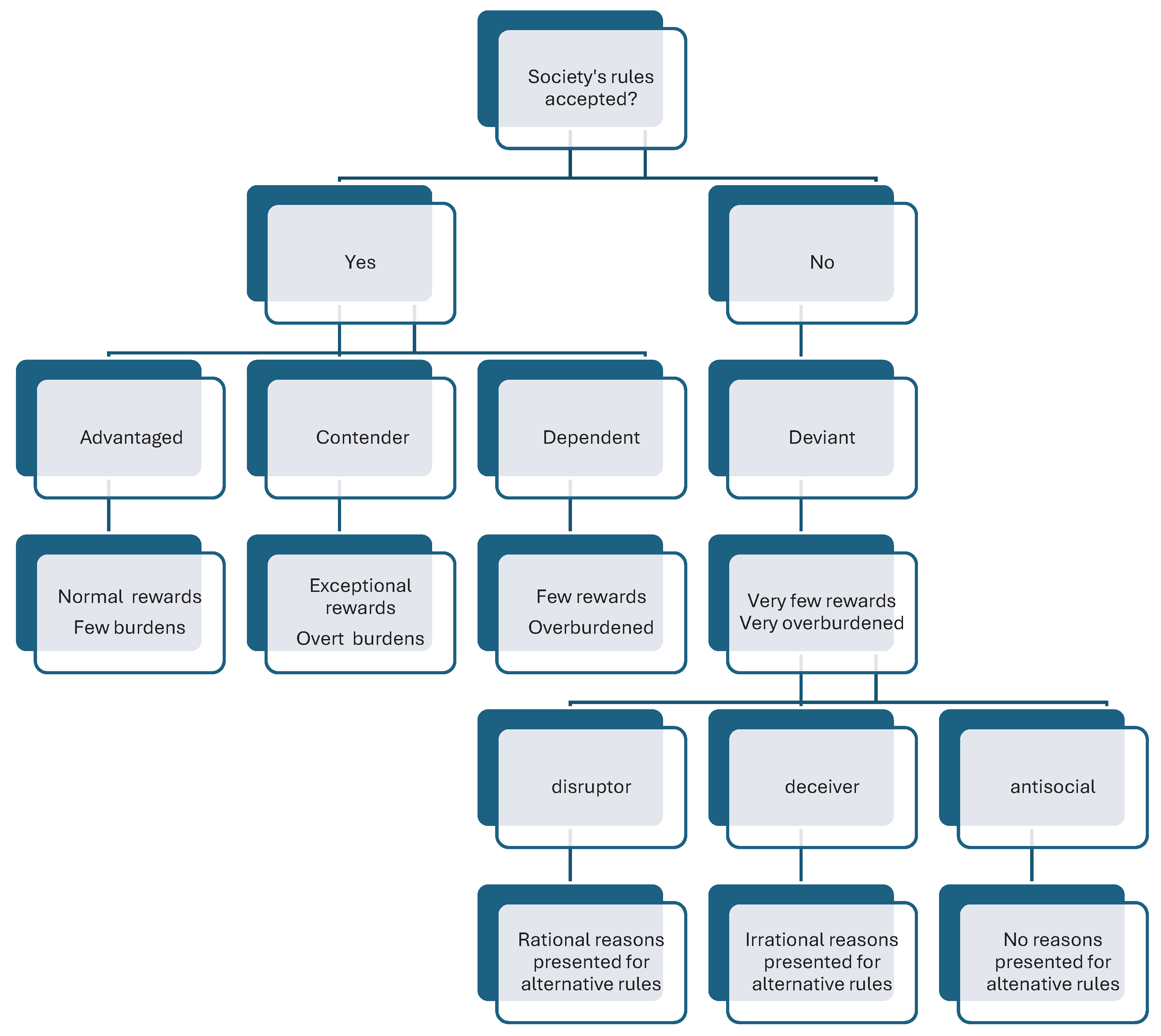
Figure 2.
Mid-January 2024 scoping review of “children, empowerment, smartphones” of JSTOR, OVID, ProQuest, Pubmed, Scopus, and Web of Science, of reports published from “2019-present” with no registers searched, based on PRISMA requirements [70].
Figure 2.
Mid-January 2024 scoping review of “children, empowerment, smartphones” of JSTOR, OVID, ProQuest, Pubmed, Scopus, and Web of Science, of reports published from “2019-present” with no registers searched, based on PRISMA requirements [70].
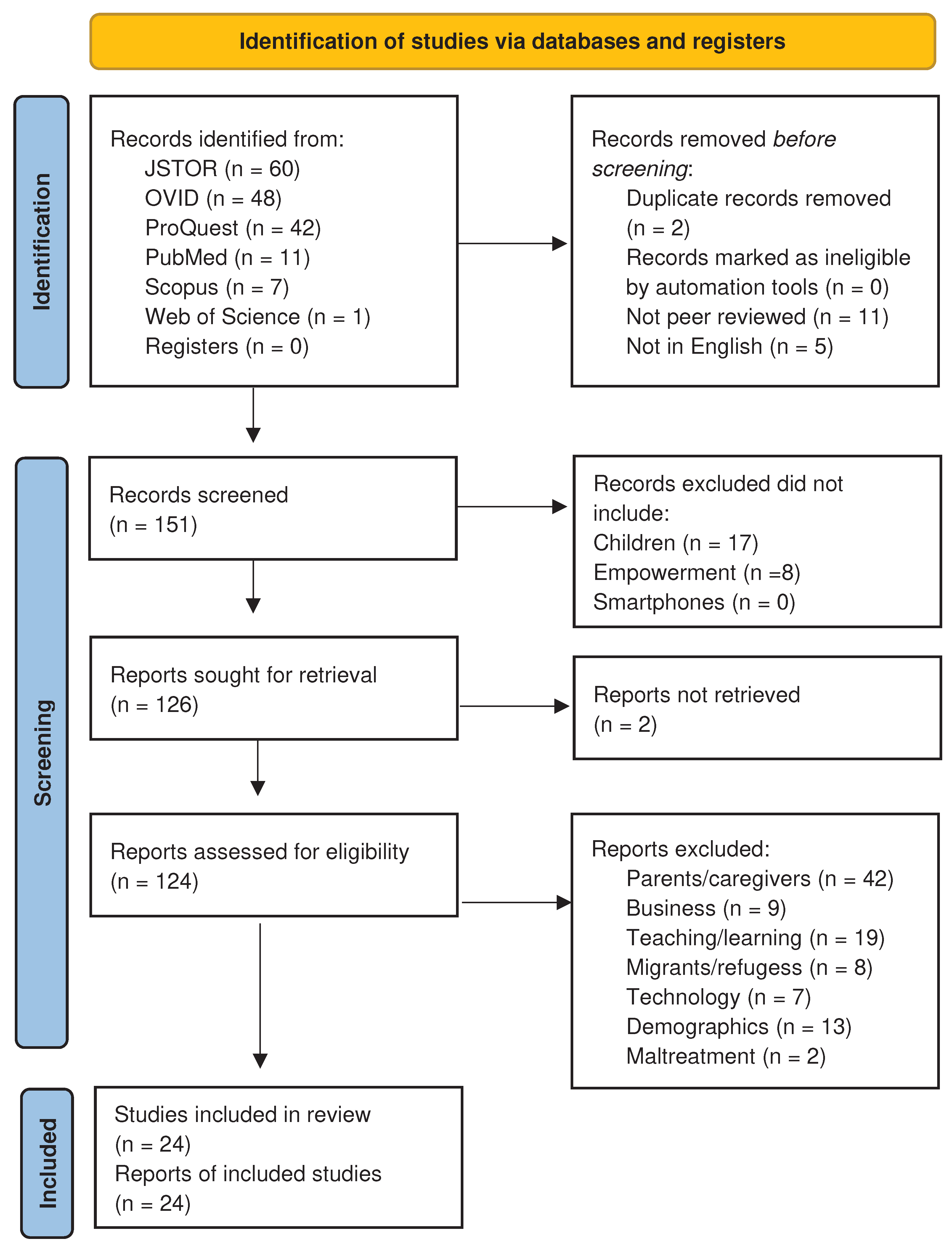

Table 1.
Twenty-four returns for a search of the keywords “children, empowerment, smartphones” of those articles published “2019-present” conducted on the following dates in January 2024 for specific databases (including number of returns): 15th—JSTOR (6), 16th—OVID (10), 17th—ProQuest, (7) 18th—PubMed (0), 18th—Scopus, (1) 18th—Web of Science (0) listed by citation number in this article, the truncated title of each article, and the year of publication. Horizontal lines divide returns ordered by the specific databases.
Table 1.
Twenty-four returns for a search of the keywords “children, empowerment, smartphones” of those articles published “2019-present” conducted on the following dates in January 2024 for specific databases (including number of returns): 15th—JSTOR (6), 16th—OVID (10), 17th—ProQuest, (7) 18th—PubMed (0), 18th—Scopus, (1) 18th—Web of Science (0) listed by citation number in this article, the truncated title of each article, and the year of publication. Horizontal lines divide returns ordered by the specific databases.
| # | Truncated Article Title | Year |
|---|---|---|
| 72 | Disability Rights and Robotics: Co-producing Futures | 2023 |
| 73 | Prosthetic Performances: Artistic Strategies | 2021 |
| 74 | Privacy in a Pandemic: An Examination | 2021 |
| 75 | Children and Online Privacy Protection: Empowerment | 2020 |
| 76 | Digital hyperconnectivity and the self | 2020 |
| 77 | Unseen potential: photovoice methods in hazard and disaster | 2019 |
| 78 | Left to their own devices? A mixed methods study | 2021 |
| 79 | The promises and challenges of clinical AI in community | 2023 |
| 80 | Assessment of digital risks in child & adolescent mental health | 2023 |
| 81 | What has been done to improve learning for intellectual | 2023 |
| 82 | Adolescents’ experiences of a theory-based behavioural | 2022 |
| 83 | Iranian nongovernmental organizations’ initiatives in COVID | 2022 |
| 84 | Considerations in pediatric intervention research: Lessons | 2022 |
| 85 | The effectiveness of web-based mobile health interventions | 2020 |
| 86 | Developing web-based health guidance for coaches | 2020 |
| 87 | Controlled trial of an mHealth intervention | 2020 |
| 88 | Acceptability and Utility of an Open-Access, Online | 2020 |
| 89 | Safety.Net: A Pilot Study on a Multi-Risk Internet Prevention | 2021 |
| 90 | Effectiveness of mobile health-based self-management | 2021 |
| 91 | Development and feasibility testing of the Comfort Ability | 2020 |
| 92 | Technological Ecological Momentary Assessment Tools | 2021 |
| 93 | “It’s like a safe haven fantasy world”: Online fandom | 2020 |
| 94 | Leveraging the Full Continuum of Care to Prevent Opioid Use | 2023 |
| 95 | Growing Up with Smartphones | 2022 |
Table 2.
Citation number and truncated article title from Table 1 regarding how children would be classified in relation to Social Construction Theory as Dependent, Advantaged, Contender, or Deviant based on the analysis presented by each published study.
Table 2.
Citation number and truncated article title from Table 1 regarding how children would be classified in relation to Social Construction Theory as Dependent, Advantaged, Contender, or Deviant based on the analysis presented by each published study.
| # | Truncated Article Title | Dependent | Advantaged | Contender | Deviant |
|---|---|---|---|---|---|
| 72 | Disability Rights and Robotics: Co-producing Futures | ✓ | |||
| 73 | Prosthetic Performances: Artistic Strategies | ✓ | |||
| 74 | Privacy in a Pandemic: An Examination | ✓ | |||
| 75 | Children and Online Privacy Protection: Empowerment | ✓ | |||
| 76 | Digital hyperconnectivity and the self | ✓ | |||
| 77 | Unseen potential: photovoice methods in hazard and disaster | ✓ | |||
| 78 | Left to their own devices? A mixed methods study | ✓ | |||
| 79 | The promises and challenges of clinical AI in community | ✓ | |||
| 80 | Assessment of digital risks in child & adolescent mental health | ✓ | |||
| 81 | What has been done to improve learning for intellectual | ✓ | |||
| 82 | Adolescents’ experiences of a theory-based behavioural | ✓ | |||
| 83 | Iranian nongovernmental organizations’ initiatives in COVID | ✓ | |||
| 84 | Considerations in pediatric intervention research: Lessons | ✓ | |||
| 85 | The effectiveness of web-based mobile health interventions | ✓ | |||
| 86 | Developing web-based health guidance for coaches | ✓ | |||
| 87 | Controlled trial of an mHealth intervention | ✓ | |||
| 88 | Acceptability and Utility of an Open-Access, Online | ✓ | |||
| 89 | Safety.Net: A Pilot Study on a Multi-Risk Internet Prevention | ✓ | |||
| 90 | Effectiveness of mobile health-based self-management | ✓ | |||
| 91 | Development and feasibility testing of the Comfort Ability | ✓ | |||
| 92 | Technological Ecological Momentary Assessment Tools | ✓ | |||
| 93 | “It’s like a safe haven fantasy world”: Online fandom | ✓ | |||
| 94 | Leveraging the Full Continuum of Care to Prevent Opioid Use | ✓ | |||
| 95 | Growing Up with Smartphones | ✓ |
Table 3.
Citation number and truncated article title of a 4 February 2024 Google Scholar search of “deviant crimes against the middle class using smartphones” in relate to the type of Deviant presented in the report based on the author’s classification of disruptor, deceiver, or antisocial.
Table 3.
Citation number and truncated article title of a 4 February 2024 Google Scholar search of “deviant crimes against the middle class using smartphones” in relate to the type of Deviant presented in the report based on the author’s classification of disruptor, deceiver, or antisocial.
| # | Truncated Article Title | disruptor | deceiver | antisocial |
|---|---|---|---|---|
| 103 | Low Self-control and Opportunity Structure on Cyberbullying | ✓ | ||
| 104 | Scrolling and the In-Between Spaces of Boredom: Marginalized Youths | ✓ | ||
| 105 | Cyberbullying Victimization and Perpetration in South Korean Youth | ✓ | ||
| 106 | Predictors for runaway behavior in adolescents in South Korea | ✓ | ||
| 107 | Associations Between Parental Maltreatment and Online Behavior | ✓ | ||
| 108 | Understanding deviance from the perspectives of youth | ✓ | ||
| 109 | Smartphone Addiction Culminating into Youth Deviance | ✓ | ||
| 110 | The digital divide in the US criminal justice system | ✓ | ||
| 111 | The Effects of Korean Parents’ Smartphone Addiction on Korean | ✓ | ||
| 112 | Exploring the Role of Self-Control Across Distinct Patterns of Cyber | ✓ | ||
| 113 | Exploring the Decisional Drivers of Deviance | ✓ |
Disclaimer/Publisher’s Note: The statements, opinions and data contained in all publications are solely those of the individual author(s) and contributor(s) and not of MDPI and/or the editor(s). MDPI and/or the editor(s) disclaim responsibility for any injury to people or property resulting from any ideas, methods, instructions or products referred to in the content. |
© 2024 by the authors. Licensee MDPI, Basel, Switzerland. This article is an open access article distributed under the terms and conditions of the Creative Commons Attribution (CC BY) license (http://creativecommons.org/licenses/by/4.0/).
Copyright: This open access article is published under a Creative Commons CC BY 4.0 license, which permit the free download, distribution, and reuse, provided that the author and preprint are cited in any reuse.


