

Submitted:
06 February 2024
Posted:
07 February 2024
You are already at the latest version
Abstract
During the pandemic, educational digitization experienced a significant increase. In Mexico, social service is a crucial component of technical and professional training, a phase during which individuals apply the knowledge gained throughout their university education. The aim of this study is to standardize a digital model for the management of social service in the health care sector within health care units. This study employed an analytical, observational, retrospective, and longitudinal approach, involving two groups of trainees: Group A (n=133), utilizing a Non-Digital Model, and Group B (n=50), employing a Digital Model. In Stage I. the model design underwent validation through the Delphi method with a panel of three experts. The model was implemented on a Classroom® digital platform with the integration of the elements 1) a monthly rotation rubric 2) care services rubric 3) clinical cases or nursing process rubric, and 4) innovation project rubric. The validation of the model achieved 100% agreement (K=1). The variables measured for each group included the school of origin, career, unit of assignment, timely enrolment, and timely delivery of rubrics on the platform. The difference between the two groups was measured using Chi-Square. To measure the impact, the difference in the timeliness of the products was considered. From the University of Quintana Roo, the difference was 20.3 vs 34%. According to the Unit of Attachment the most frequent was HGR No. 17 with Group A at 22.5 vs 52%. According to the product the least delivered was Product 4, with 69% vs 81%. Timely enrollment was observed in Group A at 89% vs Group B at 80% p=0.001. Overall timely delivery in Group A was 81% vs Group B at 91% p=0.001 in the first 6 months post-implementation. Demonstrating that the implementation of the digital platform was effective, representing a significant advance in the adaptation of medical education to the circumstances imposed by the pandemic, highlighting the feasibility and effectiveness of digital teaching methods in the training of health professionals.
Keywords:
Education Medical
; Education Distance
; Benchmarking
; Health Services.
1. Introduction
The confinement measures implemented and adopted in response to COVID-19 disrupted conventional school-based education nationwide; UNESCO (United Nations Educational, Scientific and Cultural Organization) reported that this affected over 1.2 billion students globally [1,2] While the education profession launched major initiatives to maintain continuity of learning during this period, students had to rely more on their own resources to continue learning at a distance via the Internet, television or radio. Teachers also had to adapt to new pedagogical concepts and ways of teaching, for which they had not received prior training in their education [3].
Social service in Mexico is the set of temporary and compulsory activities undertaken by students of technical and professional disciplines in which they apply their scientific, technical and human knowledge in practical contexts [4]. It is carried out in the final year of the bachelor’s degree or technical career, providing valuable future experience upon entering the workforce.
The IMSS (Instituto Mexicano del Seguro Social) as part of the accreditation of the social service program, interns report monthly on their activities according to their annual program. These reports serve as performance evaluation instruments throughout the rotation year. This procedure is aligned with the Mexican Official Standard, NOM-009-SSA3-2013 [5].
This project aims to implement a digital model to manage previously standardized social service evaluation products, facilitating the process for students, teachers, and coordinators. The objective is to address the problems in the evaluation and accreditation of the social service of trainees in the health area of the Mexican Social Security Institute in Quintana Roo, through the proposal of implementing a standardized digital model using the Classroom platform.
2. Materials and Methods
This is a non-experimental, observational, retrospective and longitudinal design study; considering that the research topic has sufficient theoretical support, we proceeded to carry out a state-of-the-art research that allows us to demonstrate the performance for accreditation and facilitate the management of the evaluation for the coordinators.
Location
The study was carried out in IMSS medical care units in Quintana Roo, involving a total of 13 units distributed throughout the state of Quintana Roo, eight were at primary care and four at secondary care units.
Participants
The sample was made up of health care scholarship holders from undergraduate and related technical careers (medicine, nursing, pharmacy, nutrition, physical therapy and rehabilitation, dentistry, nursing technicians and radiology technicians). The sample selected for the analysis comprised of the trainees enrolled in two specific periods: promotion I, from August 2021 to July 2022, called Group A, which was put into a hybrid model, as it spent six months with the previous non-digital methodology and six months using the digital platform, and promotion II, from February 2022 to January 2023, in which the digital platform was applied from the moment of entry.
Participant selection methods
Participants had to meet the following selection criteria. Inclusion: To be registered as social service trainees within their educational institution, to have an active registration with the Mexican Institute of Social Security, to have a current SIICES (Health Education Coordination Information System) registration, to have a Gmail email address and to be registered on the Moodle platform of the CPEI (Coordination, Planning, and Institutional Liaison). The exclusion criteria were: Being a social service trainee in administrative areas. Elimination criteria: trainees who were discharged from the IMSS for any reason during the study period.
Definition of variables.
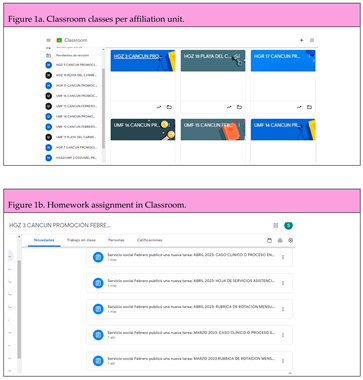
Working variable; Digital Model Standardization: This refers to the digital model for the management of accreditation criteria of social service in the healthcare area within the medical care units of the IMSS in Quintana Roo. The model is composed of a digital manager (Classroom ®®). The process of developing the innovation aimed to manage the products of the social service trainees in their operational program began with the integration of standardized rubrics, which were validated by the Delphi method by a panel of three experts, obtaining a Kappa (K) = 1 on a Likert scale of 0 to 1. a) Monthly rotation rubric, b) assistance services sheet, c) clinical case/nursing process, and d) innovation/education project. Participants were incorporated, specifying the assigned unit, academic degree, career, school, full name, gender, and the promotion to which they belong. To facilitate management, two Google Gmail email accounts were created, one for each social service promotion: serviciosocialagosto@gmail.com and serviciosocialfebrero@gmail.com. These accounts constitute the administration of the Digital Model. Within each account, a class schedule is set up in Google Classroom®® corresponding to the trainees’ assigned unit. This structure allows for the effective organization and administration of information and activities related to each group of trainees. Within each class (unit of assignment), a task was inserted for each product and month according to the schedule of monthly rubric submissions, as shown in Figure 1a,b.
Monthly Rotation Rubric: An evaluation instrument used to measure and document the performance and competencies of trainees in different monthly rotations or assignments, assigned by their clinical tutor. Evaluated monthly.
Assistance Services Rubric: Record of medical, dental, surgical, hospital, pharmaceutical, as well as paramedic and diagnostic and treatment auxiliary services provided by the social service trainee, aimed to preserve, or restore the health of patients.
Rubric. Clinical case (applicable to medicine and related careers): Presentation of a report commenting on a patient’s health problem in which the patient’s illness, history, diagnosis, therapeutic interventions, and evolution are described. Standardized nursing process (applied only to nursing): A critical thinking process used by nurses to apply the best available evidence to their care and to promote human function and responses to health and illness.
Rubric Innovation/education project: Presentation of an innovation through a Canvas methodology that aims to offer high-value solutions with an impact for the population entitled to them.
Sociodemographic variables.
Type of degree: bachelor/technical degree. Academic degree or diploma obtained after completing certain higher education studies of between three to six years’ duration. Technician: Non-university tertiary (higher) education focused on the training of professionals in technical areas.
Institute of origin: School or institution where the participants studied or completed their studies.
For promotion I (Group A), 13 classes were held under the names of: Hospital General De Zona / Medicina Familiar 1 Chetumal, Hospital General De Subzona, Medicina Fami-liar 2 Cozumel, Hospital General De Zona 3 Cancún, Unidad De Medicina Familiar 5 Pucté, Unidad De Medicina Familiar 6 Felipe Carrillo Puerto, Hospital De Gineco Pedia-tría 7 Cancún, Unidad De Medicina Familiar 11 Playa Del Carmen, Unidad De Medicina Familiar 13 Cancún, Unidad De Medicina Familiar 14 Cancún, Unidad De Medicina Fa-miliar 15 Cancún, Unidad De Medicina Familiar 16 Cancún, Hospital General Regional 17 Cancún and Hospital General De Zona 18 Playa Del Carmen.
While for promotion II (Group B) 9 classes were held with the names of: Hospital General De Zona / Medicina Familiar 1 Chetumal, Hospital General De Zona 3 Cancún, Hospital De Gineco Pediatría 7 Cancún, Unidad De Medicina Familiar 11 Playa Del Carmen, Unidad De Medicina Familiar 13 Cancún, Unidad De Medicina Familiar 14 Cancún, Unidad De Medicina Familiar 15 Cancún, Unidad De Medicina Familiar 16 Cancún and Hospital General Regional 17 Cancún.
In each Google Classroom class, they were assigned the corresponding homework, which must be handed in monthly. These assignments vary depending on the trainee’s degree or technical career and is in accordance with the operational program designed and validated by the CCEIS (Clinical Coordinator of Health Education and Research), SJEET (Deputy Head of Nursing Education and Technicians) and the titular professor or clinical tutor of the social service. The deadline for each assignment was set for the 5th of each month.
Sample size
For this study, all subjects enrolled in the social service durinf the study period February 2022 to July 2022 were considered. A total of 183 subjects distributed in two groups Group A with 133 subjects and Group B with 50 subjects.
This study was submitted to and approved by the local health research and ethics committee COFEPRIS (Federal committee for the prevention of health risks) CLEI 2301, re-registered under registration number R-2023-2301-011. After authorization, data was collected and integrated from the CPEI platform.
Statistical methods
For the analysis and interpretation, descriptive statistics were applied. For qualitative variables, frequencies, percentages and 95% confidence intervals were determined. For quantitative variables, inferential statistical analysis was carried out, determining measures of central tendency, range, mean, median, mode and standard deviation. The Chi-square X2 test was applied to assess the impact and differences between the two groups studied. Subsequently, these data were analyzed using SPSS version 24.0 statistical software.
Ethical aspects.
In the ethical aspect of this research, there was no risk to the social service trainees who were part of the research as stipulated in Title Two, Chapter I, Article 17, Section I, risk-free research. Therefore, this research complies with the ethical standards, the Regulations of the General Health Law on Health Research and the Declaration of Helsinki and its amendments.
3. Results
A total of 183 social service trainees were registered in total, belonging to the bachelor’s degree in medicine, pharmacy, nutrition, nursing, physical therapy, and rehabilitation, as well as nursing and radiology technicians from various educational institutions, as detailed in Table 1. Of this total, 133 trainees belong to the I August 2021 promotion (Group A). This promotion includes 16 trainees from the Bachelor`s of Medicine, 36 from the Bachelor of Nursing, 3 from the Bachelor of Pharmacy, 2 from Physical Therapy, 2 from Dentistry and 74 nursing technicians. Promotion II of February 2022 (group B) comprises 50 trainees, distributed as follows: 18 trainees from the bachelor’s degree in medicine, 13 from the bachelor’s degree in nursing, 5 from the bachelor’s degree in nutrition, 3 from the bachelor’s degree in physical therapy, 7 nursing technicians and 4 radiology technicians. Table 1.
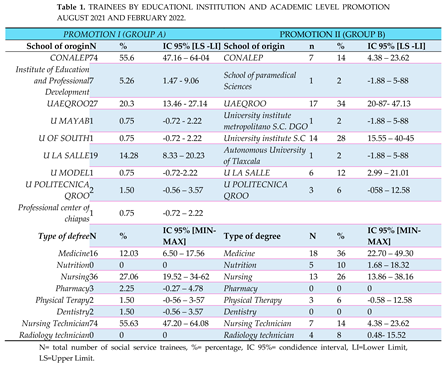
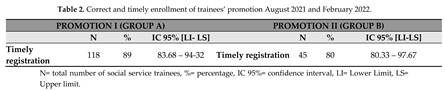
Of the August 2021 promotion I, 11% of the trainees did not enroll correctly in their assigned promotion and unit, as detailed in Table 2. This group included 8 nursing technicians and 7 trainees of the bachelor’s degree in nursing. As for the February 2022 promotion, 20% of the trainees also failed to register correctly, comprising 3 trainees from the Bachelor of Medicine, 4 from the Bachelor of Nursing and 3 nursing technicians, as shown in the same table.
The reason for this error in both promotions was the confusion of the access link to the corresponding promotion, which was notified by e-mail for correction. Therefore, it is estimated that the effectiveness of access to the Classroom platform in both promotions reached 84.5%. Table 2.
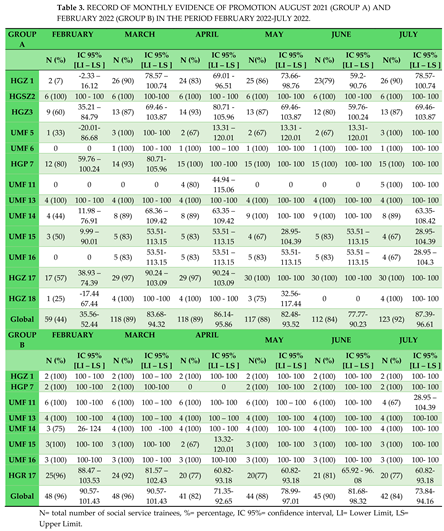
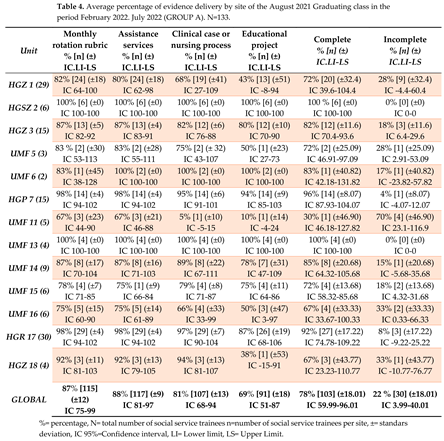
Following the implementation of the Google Classroom platform, a satisfactory evolution in the punctuality of submissions was identified, compared to the previous methodology. Table 3 shows the record of evidence of social service trainees from the August 2021 promotion by site during the February 2022-July 2022 semester. This table shows that in February the vast majority of trainees had problems using this platform, as evidenced by the incomplete delivery of their work, specifically at the General Zone Hospital No 1 in Chetumal, Family Medicine Unit No. 6, Family Medicine Unit No. 11, Family Medicine Unit No. 16 and General Zone Hospital No. 18. However, this situation was reversed in March and maintaining improvement through July.
Regarding the from the February 2022 promotion, as identified in Table 2, the vast majority accessed and submitted their evidence in a timely manner, except for Family Medicine Unit No. 14, a situation that remained consistent through July. It is important to mention that this promotion had better overall accessibility and satisfaction from the beginning compared to the August 2021 promotion.
In the analysis of the punctual delivery of evidence by month, with respect to promotion II February 2022, it is observed that February and March had records of punctual submissions, as shown in Table 3. While promotion I August 2021, showed a notable improvement in July, reaching the highest number of on-time submissions, as reflected in the same table.

The use of the Google Classroom platform was analyzed for each site, focusing on the monthly requested evidence. For the August 2021 promotion, the percentages of evidence delivery in the Classroom were as follows: for the monthly rotation evidence, an average percentage of 87% (±12) was observed, with notable performance at the General Hospital of Subzone 2 and Family Medicine Unit 13, and the lowest performance being Family Medicine Unit No. 11. For the care services, an average percentage of 88% (±9) was identified, with the General Hospital of Sub-area 2 and Family Medicine Units 6 and 13 being the best performing, while Family Medicine Unit No. 11 had the lowest performance. With respect to the clinical cases or nursing process, an average percentage of 81% (±13) was obtained, highlighting the General Hospital of Sub-area 2 and Family Medicine Units 6 and 13 with the best performance, while the General Hospital of Zone 1, Family Medicine Unit No. 11 and 16 had the lowest performance. For the educational project, there was an average percentage of 69% (±18), with the General Hospital of Sub-zone 2 and Family Medicine Unit 13 showcasing the best performance in contrast to Family Medicine Unit No. 11 with low performance, as detailed in Table 4.
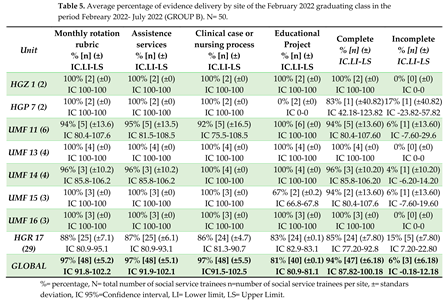
With regards to the February 2022 promotion, the percentages of evidence delivery in the Classroom were: for the evidence of monthly rotation, an average percentage of 97% (±5.2) can be observed, highlighting the General Hospital Zone No. 1, the Gynaecology-Paediatrics Hospital 7, the Family Medicine Unit No. 13, 15 and 16 with the best performance, while the General Regional Hospital No. 17 with the lowest performance. For health care services, an average percentage of 97% (±5.1) was identified, with Zone General Hospital No. 1, Gynaeco-Paediatric Hospital No. 7, Family Medicine Unit Nos. 13, 15 and 16 performing well, while Regional General Hospital No. 17 had a low performance. With respect to clinical cases or the nursing processes, an average percentage of 97% (±5.5) was obtained, with Zone General Hospital No. 1, Gynaeco-Paediatric Hospital 7, Family Medicine Unit Nos. 13, 14, 15 and 16 with outstanding performance and Regional General Hospital No. 17 with poor performance. For the educational project, the average percentage was 81% (±0.1), with the best performing hospitals being Zone 1 General Hospital, Family Medicine Units 11, 13, 14 and 16 and the worst performing Gynecology-Pediatrics Hospital 7, as detailed in Table 5.
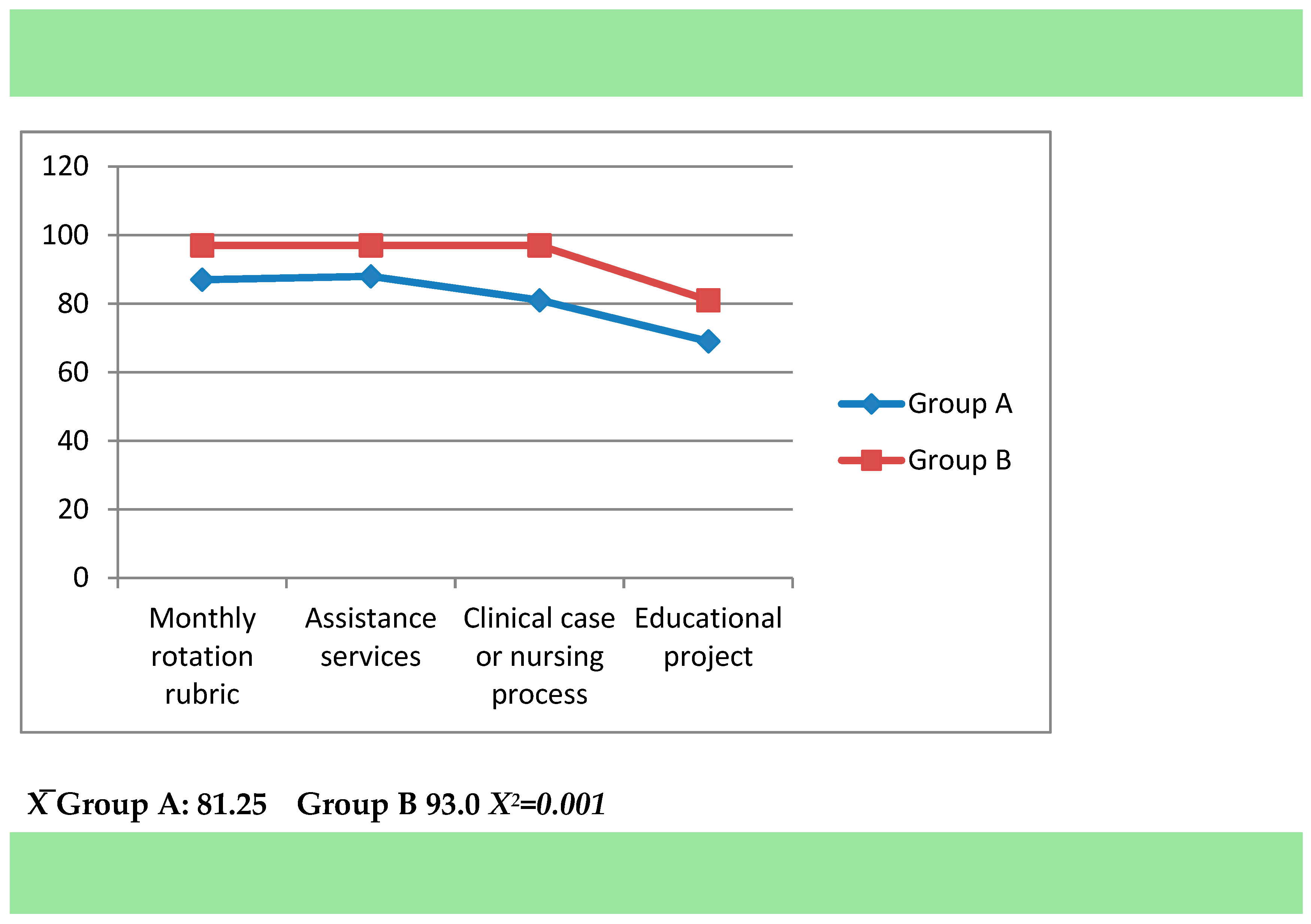
Figure 2.
Difference Between Groups by Evidence.
Statistical analysis using an X2 test revealed a significant difference in the number of submissions between Group A and Group B, with a value of p<0.0001. This indicates that the application of the standardized digital model had a significant positive effect on the rate of evidence submission by trainees in social service.
4. Discussion
The social service at the Mexican Social Security Institute (IMSS) is carried out for the benefit of the country’s community’s health [4], through providing professional services in ordinary health care units. Its purpose is to collaborate and promote participation with educational institutions in the continuity of the educational process for Social Service trainees, fostering a vocation for service, professional and social commitment to the health care of individuals, families, and communities in the country [7].
A rubric is an evaluation tool based on quantitative and/or qualitative scales combined with pre-established criteria to measure the performance of students in the aspects of the activity being evaluated [21,22]. This systematic tool is chosen as it is considered a valuable tool for competence assessment. Urias et al., [23] in their study pointed out that assessment rubrics offer a positive impact on the learning process, due to the standardization of criteria and Morales-López et al., [24] pointed out that rubrics serve as means to convey task quality criteria and thus improve the quality of activities.
In this work, the use of Google Classroom, a virtual platform, is proposed to manage and control the monthly record of the social service trainee`s evidence. This approach facilitates compliance with the requirements, offering easy access and cost reduction for all involved parties. As part of the professional training, different pieces of evidence are requested monthly. These are evaluated through standardized rubrics to objectively record the performance and knowledge of each learner, aligning the evaluator`s educational environment with that of the students.
The rapid development of technology shows that today there is a need to re-evaluate the approach to education and with it the need to rethink the teaching and learning process with a shift in the cognitive process of the facilitator-trainer formerly known as teacher [4].Virtual platforms have become a powerful tool of educational technology, capable of fostering knowledge independence and relationships built between teachers and learners in many cases. Educational technology, as an educational paradigm focuses on the psychological aspects of behavior, considering learning to be primarily based on stimuli and responses, but mainly when sought autonomously it focuses on the actual desire to learn resulting in pre-programmed learning. [17] In these, there are programmed and responsive instructions that involve teachers and learners [17], as in this project where only 15% had problems accessing the platform despite receiving specific instructions, and this was different in group A which had a non-digital model.
Currently, medical education has embraced the digital era due to the democratization, accessibility and demonetization of information. A decisive moment was undoubtedly the global pandemic of SARS CoV 2, thus generating, on one hand, improvements in the quality of care, and, on the other hand, providing professionals with information at any time by seeking solid sources that allow them to build the desired learning [25].
Numerous medical education centers implement their courses with combined teaching methods (traditional and virtual), and in some cases, content is delivered online through interactive learning systems on closed (Blackboard, e-educativa) or open (Moodle) platforms, generating small group learning, problem-based learning, and case presentation [27,28]. Martinot [26] states that e-learning enhances students’ academic performance compared to those trained in traditional learning methods.
Virtual educational platforms integrate into educational institutions as support for task assignment, management of educational resources, assessment, resource sharing, and more. Google Classroom is a free academic-focused tool that allows organization in segments to avoid mixing information and facilitates communication between students and teachers [19]. Therefore, it is one of the most used platforms, according to a study by San Román-López et al. (2020), highlighting its preference because it optimizes time and improves the quality of the learning process..
The use of Google Classroom as a learning environment is important, as mentioned in the research by Sudarsana, et al. [29]. This platform allows teachers to create and store their activities digitally, allowing them to review who performs the activities and who does not, which encourages direct feedback to students who need it, improves real-time communication through questions or comments, keeps folders in the Drive organized by activities and by students, among other features [29,30].
The implementation of this platform resulted in improved organization and control of the assignment and record-keeping of monthly evidence for health service providers participating in social service. It constructs evidence across three fundamental pillars focused on social service: 1) Assistance, 2) Teaching, and 3) Research Innovation. The aim is to guide healthcare professionals in acquiring competencies during this period by fostering a tool that connects assistive practice with the requested evidence. Likewise, conducting academic sessions and dissemination activities, and objectifying these in instruments, allows for the evaluation of progress in the social service program. Finally, and no less important, it encourages social service trainees to contribute to the institution through innovation or research projects in collaboration with tutors and professionals in their field, offering process improvements or conducting clinically relevant research for the organization. Additionally, it achieves a reduction in the time required for the evaluation of social service trainee activities.
The results obtained allow to account for the effectiveness of the virtual platform (initial effectiveness 84.5% in both promotions) as an educational tool and thus po- tentialize the learning space that allows a dynamic and meaningful interaction between teacher and student, optimizing time and resources, which is why it agrees with Urzúa Osorio et al. (2018), where students would save time and eco-nomic resources by generating easy access.
The effectiveness of these results depends primarily on the availability of a reliable internet connection and on the State’s encouragement for this tool to have greater coverage, since the level of connectivity penetration in certain regions of Mexico such as Chiapas, Oaxaca and the Chihuahua highlands is low, which is consistent with what Albertini González (2017) mentioned. Despite being an outstanding tourist destination, Quintana Roo also faces shortcomings in its hospital units as mentioned by Heinze Martin et al. [25] (2017). In a study conducted, approximately 50% of the sites (hospital units) endorsed by the UNAM for medical residencies do not have free wireless internet access, or only have limited internet access in the hospital`s library. In addition, there is a shortage of computer equipment for use by medical personnel. However, health personnel try to overcome these deficiencies by using their own technological resources such as smartphones, tablets, laptops, and even purchasing the external wireless network [27,30,31,32]. In our setting, unfortunately, the aforementioned happens and is often resolved by the merits of the social service trainees themselves, although some choose public spaces to access the virtual platform.
The use of Information and communication technology (ICT) becomes a functional tool for a better understanding of the learning that the student aspires to acquire, as a variety of mediation strategies support educational processes as long as they are designed for academic purposes and fully planned, aimed at improving professional skills and understanding of knowledge. [19,33] At the beginning of the implementation of this platform, it was identified that a minority of social service trainees had a deficiency in its handling, evident in the incomplete submission of assignments or incorrect access to the corresponding promotion. However, after adjusting and refining the methodology, a drastic change in its handling was objectively observed, mostly evidenced by the timely submission of evidence in the subsequent months.
On the other hand, it is mentioned that some studies have shown that one of the obstacles to the use of ICT, aside from technology, is the lack of culture among teachers and students, who must understand and value the concept of ICT [19,33]. It is essential that the concept of virtual education be understood by the dyad (teacher-student), as explained by González Palacios et al. (2019) and Miño Puigcercós et al. (2019). Therefore, the importance of training in the use and functioning of these tools to avoid prejudices against the digital era. This does not overlook that openness, interest, and the willingness to learn necessitate a process of transformation in how various stakeholders perceive education [35,36].
The importance of implementing new educational strategies is emphasized, which is imperative in the face of current technological changes. In this sense, teacher training and therefore student training should be oriented towards innovation and experimentation with the use of ICT, favoring the development and acquisition of various competencies. [20] The implementation of the Google Classroom platform represents an innovation in the management of the monthly activities of social service trainees, offering a new form of administration and monitoring.
The implementation of virtual platforms in the teaching process is a valid, innovative, and effective tool to achieve meaningful learning in today’s digital culture. It is essential to mention that students will not only save costs, remember deadlines, and have access to a variety of materials, but will also be able to capture their ideas and learn creatively, according to their interests and time, fostering meaningful learning.
However, the implementation of these tools faces challenges, primarily technical and connectivity-related, due to limited internet coverage in some regions of Mexico. However, today`s internet coverage is progressively expanding, promising better access to these technologies in the near future throughout the country.
5. Conclusions
The use and standardization of digital models within the educational process with a focus on assessment demonstrate a favorable difference from the beginning of their application due to their ease of use by social service trainees in public institutions in Quintana Roo.
Regarding the teaching aspect, it has proven to be a more economical and efficient solution for organizing and storing monthly evidence, as well as managing evaluations and accreditation products (attendance, teaching, and research). It is noteworthy that products with a practical focus have a higher delivery rate compared to those centered on knowledge generation, emphasizing the importance of balancing practical and theoretical aspects in trainee training.
In conclusion, it is highlighted that the Google Classroom platform is a suitable tool for receiving and storing monthly evidence from social service trainees, thus facilitating their formative process.
There is still much to be done in terms of research on digital environments and learning environments in health human resources. Initiating the evaluation and standardization of rubrics in the social service process is a step, but in qualitative analysis, it is necessary to promote the generation of projects that contribute to and demonstrate the trainees’ integrative competencies for application within the health institution.
Funding
This research did not receive external funding. The feasibility of this project is viable for implementation because the risk of consequences for the study population is null.
Statement of informed Consent
Not applicable.
Conflicts of interest
The authors declare that they have no conflicts of interest.
References
- CEPAL-UNESCO. Education in times of the COVID-19 pandemic. Economic Commission for Latin America and the Caribbean (ECLAC) and the Regional Bureau of Education for Latin America and the Caribbean of the United Nations Educational, Scientific and Cultural Organization. UNESCO Review. 2020, 21(2): pp. 2-22. Available online: https://repositorio.cepal.org/bitstream/handle/11362/45904/1/S2000510_es.pdf (accessed on 10 April 2023).
- García Aretio, Lorenzo. COVID-19 and digital distance education: Preconfinement, confinement and postconfinement RIED. Iberoamerican Journal of Distance Education. 2021, 24(1): pag.9-25. Available online: https://www.redalyc.org/jatsRepo/3314/331464460001/331464460001.pdf (accessed on 10 April 2023).
- Robles Bárcena, M. et al. El servicio social. Sistema Educativo Nacional. 2019. Pag 237-243. Available online: https://www.planeducativonacional.unam.mx/PDF/CAP_09.pdf (accessed on 29 November 2023).
- Flores Hernández, F. Contreras Michel, N. Martínez González, A. Evaluation of learning in medical education. Rev. Fac. Med. (Mex.) 2012, 55 (3): p. 42-48. Available online: http://www.scielo.org.mx/scielo.php?script=sci_arttext&pid=S0026-17422012000300008&lng=es (accessed on 11 April 2023).
- Secretary of the Interior. Mexican official standard nom-009-ssa3-2013, health education. criteria for the use of medical care establishments as clinical fields for the provision of the social service of medicine and stomatology. Official Gazette of the Federation. 2014. Available online: https://www.dof.gob.mx/nota_detalle.php?codigo=5354092&fecha=28/07/2014#gsc.tab=0.
- ONU. Policy brief: Education during covid-19 and beyond. United Nations [Homepage]. 2020. Available online: https://www.un.org/sites/un2.un.org/files/policy_brief_-_education_during_covid-19_and_beyond_spanish.pdf (accessed on 10 April 2023).
- Riande Juárez, N. Digital education in Mexico and the world. Praxis journal of tax and administrative justice. 2019-2020: pp. 1-49. Available online: https://www.tfja.gob.mx/investigaciones/pdf/r27_trabajo-2.pdf (accessed on 10 April 2023).
- Gonzalez, M.A., Perdomo, K.V., Pascuas, Y. Application of ICT in blended learning educational models: A systematic literature review. Sophia. 2017, 13 (1): 144-154. Available online: https://www.redalyc.org/pdf/4137/413750022015.pdf (accessed on 10 April 2023).
- Pérez-Zúñiga, R. et al. Contemporary educational models assisted by information and co-communication technologies. Journal of Education and Development. 2016, 39 (1): p. 91-9. Available online: https://www.cucs.udg.mx/revistas/edu_desarrollo/anteriores/39/39_Perez.pdf (accessed on 10 April 2023).
- Marcillo-Zambrano, S. Tomalá Leal, E. Educational management and its influence on the new challenges of curriculum development in the Bartolomé Garelli Educational Unit. 593 Digital Publisher CEIT. 2021, 6(2-1): p. 76-93. Available online: https://dialnet.unirioja.es/descarga/articulo/7897384.pdf (accessed on 10 April 2023).
- Giménez Giubbani, A. The role of school management in a competency-based learning model. Páginas de Educación Journal. 2016, 9 (1): pp. 5-15. Available online: http://www.scielo.edu.uy/scielo.php?script=sci_arttext&pid=S1688-74682016000100001&lng=es&nrm=iso (accessed on 10 April 2023).
- Javier Murillo, F.; Román, M. Retos en la evaluación de la calidad de la educación en américa latina. Revista Ibe-roamericana De Educación. 2010, 53 (11): p. 97-120. Available online: https://rieoei.org/historico/documentos/rie53a05.pdf (accessed on 11 April 2023).
- Da Silva Bernado, E. Education in integral time: Some challenges for school management. Revista Ibe-ro-Americana de Estudos em Educação. 2020, 15 (1): p. 79-94. Available online: https://www.redalyc.org/journal/6198/619864611006/html/ (accessed on 11 April 2023).
- Heredia-Quito, M. Narváez-Zurita, C. The importance of human talent performance evaluation in health organizations. Koinonía Interdisciplinary Refereed Journal. 2021, 6 (12): p. 213-241. Available online: https://www.redalyc.org/journal/5768/576868967009/html/ (accessed on 11 April 2023).
- Salomón Cruz, J. et al. Evaluation in the Teaching of Medicine in a Public Institution. Rev Perspectivas docentes 59: Acotaciones. 2015, 6 (1): p. 5-12. Available online: https://dialnet.unirioja.es/descarga/articulo/6349203.pdf (accessed on 11 April 2023).
- Guerrero-Aragón, S.C. Chaparro-Serrano, M.F. García-Perdomo, A. Competency-based assessment in health: Literature review. Educación y Educadores. 2017, 20(2): p. 211-225. Available online: https://www.researchgate.net/publication/316871159_Evaluacion_por_competencias_en_salud_revision_de_literatura (accessed on 11 April 2023).
- Guzzetti de Marecos, P. Virtual platform: A didactic tool for the Teaching Learning Process. Revista Ciencia Latina. 2020, 12 (1). Available online: https://ciencialatina.org/index.php/cienciala/article/view/122/105#:~:text=It%20emphasizes%20that%20the%20platform%20and%20resources%20needed%20for%20the%20learning%20process (accessed on 7 December 2023).
- Barrera Rea, V. Guapi Mullo, A. The importance of the use of virtual platforms in higher education. Revista Atlante: Cuadernos de Educación y Desarrollo. 2018. Available online: https://www.eumed.net/rev/atlante/2018/07/plataformas-virtuales-educacion.html (accessed on 7 December 2023).
- Vargas-Cubero, A. Villalobos-Torres, G. The use of virtual platforms and their impact on the learning process in the subjects of Criminology and Police Sciences careers, at the State Distance University of Costa Rica. Educare Electronic Journal. 2018, vol. 22, no. 1, pp. 20-39. Available online: https://www.redalyc.org/journal/1941/194154980001/html/ (accessed on 7 December 2023).
- San Román-Lopez, K. et al. Use of virtual educational platforms in university teaching practice: A case study. Iberoamerican Journal of Science. 2020, Vol. 7 No. 1, pp. 11-19. Available online: http://www.reibci.org/publicados/2020/jul/4000111.pdf (accessed on 7 December 2023).
- Torres Gordillo. J. Perera Rodríguez, V. La rúbrica como instrumento pedagógico para la tutorización y evaluación de los aprendizajes en el foro online en educación superior. Pixel-Bit. Journal of Media and Education. Nº 36 January 2010 pp.141 - 149. Available online: https://www.uaem.mx/sites/default/files/facultad-de-medicina/descargas/la-rubrica-como-instrumento-pedagogico.pdf (accessed on 13 September 2023).
- Cano, E. Rubrics as a competency assessment tool in higher education: Use or abuse? Profesorado. Revista de Currículum y Formación de Profesorado, vol. 19, no. 2, May-August, 2015, pp. 265-280 University of Granada Granada, Spain. Available online: https://www.redalyc.org/pdf/567/56741181017.pdf (accessed on 13 September 2023).
- Urías CM, Rodríguez CL, Zarate NE. The rubric in the evaluation of clinical case presentations: Assessments of dental students. Revista Investigación en Educación Médica. [Internet]. 2017; 8(29). Available online: http://www.scielo.org.mx/scielo.php?script=sci_arttext&pid=S2007-50572019000100085 (accessed on 13 September 2023).
- Morales S, Hershberger R, Acosta, E. Competency-based assessment: How is it done? Rev Fac. Med [Internet]. 2020; 63(3). Available online: http://www.scielo.org.mx/scielo.php?pid=S0026-17422020000300046&script=sci_arttext (accessed on 13 September 2023).
- Heinze Martin, G. et al. Use of information and communication technologies (ICT) in medical residencies in Mexico [Online]. Acta médica grupo ángeles. Volume 15, No. 2, April-June 2017. Available online: https://www.medigraphic.com/pdfs/actmed/am-2017/am172p.pdf (accessed on 13 September 2023).
- Pérez Martinot, M. Current use of information and communication technologies in medical education [Inter-net]. Rev Med Hered. 2017; 28:258-265. Available online: http://www.scielo.org.pe/pdf/rmh/v28n4/a08v28n4.pdf (accessed on 13 September 2023).
- Gonzales-Mendieta Joel Joseph, Váscones-Román Fritz Fidel, Ticse Ray. Virtual platforms in undergraduate medical education during quarantine by COVID-19: A student perspective. Rev Med Hered [Online]. 2020 Oct; 31(4): 290-292. Available online: http://www.scielo.org.pe/scielo.php?script=sci_arttext&pid=S1018-130X2020000400290&lng=es (accessed on 13 September 2023).
- Prado Prado, S. et al. Google Classroom: Educational application as a Learning Environment in rural areas in COVID-19 contexts [Internet]. KOINONIA Interdisciplinary Refereed Journal Year 2020. Vol V. N°5. Special II: Education. [Accessed: 14-09-2023]. Available: File:///C:/Users/Francisco%20Alcocer/Downloads/Dialnet-GoogleClassroom-7696087.pdf.
- Guevara Maldonado, L. et al. El uso de Google Classroom como apoyo para el docente [Internet]. Benemérita Es-cuela Normal Federalizada de Tamaulipas. 2019. Available online: http://www.conisen.mx/memorias2019/memorias/5/P717.pdf (accessed on 14 September 2023).
- Kraús, G. et al. The use of Google Classroom as a complement to face-to-face training for primary level teachers [Internet]. Revista Iberoamericana de Tecnología en Educación y Educación en Tecnología, no. 24, 2019 Universidad Nacional de La Plata. Available online: http://portal.amelica.org/ameli/journal/24/241044010/html/ (accessed on 14 September 2023).
- Sosa-Agurto, J. Application of virtual classroom Google Classroom in the educational environment: A systematic review [Online]. Pol. Con. (Issue No. 54) Vol. 6, No 1, January 2021, pp. 499-519 [Accessed: 14-09-2023]. Available: file:///C:/Users/Francisco%20Alcocer/Downloads/2160-11697-2-PB.pdf.
- Suárez Mejía, L. Google Classroom as a formative tool in teaching safety and occupational health for eleventh grade [Online]. Faculty of Education. Santo Tomas University. Chiquinquirá. Colombia. Available online: https://repository.usta.edu.co/bitstream/handle/11634/34606/2021LeninSuarez.pdf?sequence=1 (accessed on 14 September 2023).
- Chiriguaya Morales, M. et al. Google Classroom: A way to develop the teaching-learning process [Inter-net]. Instituto Tecnológico Superior Bolivariano de Tecnologías. Available online: https://www.pedagogia.edu.ec/public/docs/8cf912237757183f7cb2b574fe60ece2.pdf (accessed on 14 September 2023).
- Fuentes Maturano, R. et al. The use of the Classroom application in the teaching and learning process [Internet]. La Rioja, 2021. Available online: https://ria.utn.edu.ar/xmlui/bitstream/handle/20.500.12272/6585/ (accessed on 14 September 2023).
- Córdova Ventura. M. The virtual Classroom platform and the improvement in the perception of learning of fifth-cycle students of the advertising design career of the Higher Technological Institute of Design and Communication in 2019 [Internet]. USMP academic repository. 2020. Available online: https://repositorio.usmp.edu.pe/bitstream/handle/20.500.12727/6810/c%C3%B3rdova_vl.pdf?sequence=1&isAllowed=y (accessed on 14 September 2023).
- Tarango Ortiz, J. et al. Evaluation according to design and learning of Google Classroom and Chamilo [Online]. IE Revista de Investigación Educativa de la REDIECH, vol. 10, no. 19, pp. 91-104, 2019. Available online: https://www.redalyc.org/journal/5216/521658239005/html/ (accessed on 14 September 2023).
Disclaimer/Publisher’s Note: The statements, opinions and data contained in all publications are solely those of the individual author(s) and contributor(s) and not of MDPI and/or the editor(s). MDPI and/or the editor(s) disclaim responsibility for any injury to people or property resulting from any ideas, methods, instructions or products referred to in the content. |
© 2024 by the authors. Licensee MDPI, Basel, Switzerland. This article is an open access article distributed under the terms and conditions of the Creative Commons Attribution (CC BY) license (http://creativecommons.org/licenses/by/4.0/).
Copyright: This open access article is published under a Creative Commons CC BY 4.0 license, which permit the free download, distribution, and reuse, provided that the author and preprint are cited in any reuse.


