

Submitted:
17 January 2024
Posted:
17 January 2024
Read the latest preprint version here
Abstract
Artistic image completion is fundamental for the preservation and restoration of invaluable art paintings and it has experienced significant progress through the implementation of deep learning methodologies. Despite these advancements, challenges persist, even with sophisticated approaches like Generative Adversarial Networks (GANs), particularly in achieving optimal results for high-resolution paintings. Small-scale texture synthesis and the inference of missing information from distant contexts present persistent issues, leading to distortions in lines and unnatural colors, especially in art paintings with complicated structures and textures. Concurrently, patch-based image synthesis has evolved by incorporating global optimization on the image pyramid to enhance structural coherence and details. However, methods relying on gradient-based synthesis encounter obstacles related to directionality, inconsistency, and the heavy computational burdens associated with solving the Poisson equation in non-integrable gradient fields. This paper introduces a groundbreaking approach, integrating Weighted Similarity-Confidence Laplacian Synthesis, to comprehensively address these challenges and advance the field of artistic image completion. This proposal addresses challenges not only in high-resolution artistic image completion but also makes a significant contribution to the broader field of patch-based synthesis by utilizing the Laplacian pyramid for enhanced edge-aware correspondence search. Experimental result confirms the effectiveness of our approach, offering promising outcomes for the preservation and restoration of art paintings with complicated details and irregular missing regions.
Keywords:
Image Completion
; Image Inpainting
; High-Resolution Art Painting Completion
; Weighted Similarity-Confidence Laplacian Synthesis
1. Introduction
The integration of image completion in the realm of art painting restoration is a central focus in contemporary academic exploration within computer vision and image processing. Image completion, or inpainting, a method aimed at restoring missing or damaged segments in an image, serves as a fundamental element in mitigating the impacts of physical deterioration experienced by art paintings in museums, encompassing issues like scratches, tears, and various forms of degradation. In situations where manual completion methods encounter limitations, the digitization of art paintings into high-resolution images has emerged as a viable alternative. When applied to digital images or paintings, high resolution implies an increased number of pixels per unit of area, resulting in a more refined and detailed representation of artistic elements. In the proposed algorithm for art painting completion, achieving high resolution means ensuring that the completed art painting conserves and reproduces complicated details, nuanced textures, and subtle artistic expressions with remarkable fidelity to the original. Moreover, the shift from physical to digital preservation introduces unique challenges, often compounded by the constraints inherent in established completion methods. Standard approaches, reliant on manual techniques and color matching, encounter difficulties in capturing the complicated details of artistic compositions. This challenge becomes evident in potential distortions, unnatural colorations, and a diminished preservation of the original aesthetic essence when compared to the capabilities offered by advanced inpainting techniques. Furthermore, when dealing with high-resolution images, a common necessity in the completion of art paintings, the intricacies of small-scale texture synthesis and the precise inference of missing information from distant contexts become particularly pronounced. The demand for increased precision and fidelity in the inpainting process for high-resolution art paintings adds an additional layer of complexity to the completion endeavor. Consequently, the ongoing exploration of effective inpainting methodologies for high-resolution art paintings underscores the critical necessity for advancements in computer vision and image processing. This is imperative for addressing the distinctive challenges posed by the elaborate textures and structures inherent in artistic masterpieces. Such research endeavors are essential for ensuring the comprehensive digital completion and preservation of art paintings, surpassing the limitations of physical completion within museum contexts.
In the field of art painting completion, traditional image inpainting methods have significantly contributed to the completion of damaged or missing regions. Patch-based methods, exemplified by Criminisi et al. [1] and Efros et al. [2], have proven effective but face challenges in faithfully replicating complicated artistic structures, such as brush strokes and fine textures. The drawbacks include potential distortions and a loss of aesthetic fidelity when applied to varied textures in art paintings. Bertalmio et al. [3] used diffusion-based techniques, while aiming for smooth transitions, encounter difficulties with abrupt changes and irregular textures, particularly evident when inpainting detailed landscapes in art paintings. Moreover, Darabi et al. [4] faced challenges in merging art paintings with diverse styles or complex compositions. Recognizing these drawbacks underscored the imperative for tailored advancements in inpainting methods to address the unique intricacies of art painting completion.
In enhancing art painting completion through deep learning, several approaches have been explored, each with distinctive advantages and inherent challenges. Yu et al. [5] effectively captured complicated textures and structures, yet faced difficulties when inpainting areas with highly complicated artistic details, potentially resulting in less accurate replication. Xiao et al. [6] originally designed for image colorization and adapted for art painting completion, demonstrated proficiency in capturing nuanced color palettes and complex compositions. However, its application might be limited when faced with irregular structures or unconventional color schemes in diverse art paintings. Yue et al. [7] integrated style transfer techniques, aligning inpainting results more closely with the artistic characteristics of the original painting. Nevertheless, challenges might arise in transferring highly specific or abstract artistic styles, demanding careful consideration for optimal performance. These approaches collectively highlight the evolving landscape of deep learning methods in art painting completion, emphasizing the need for ongoing refinement to address the nuanced intricacies of diverse artistic compositions.
Building upon previous persistent challenges, our innovative methodology addresses these drawbacks by presenting a comprehensive solution to repair damages in high-resolution art painting completion, focusing specifically on torn, worn-out areas with holes. Additionally, the introduction of the Weighted Similarity-Confidence Laplacian Synthesis algorithm ensures the generation of consistent structure and texture while reconstructing missing regions. This forward-looking approach not only delivers satisfying results with a single input image but also guarantees comprehensive digital completion and preservation of art paintings in high resolution, effectively surpassing the limitations of physical completion within museum contexts.
The subsequent sections of this paper are structured as follows. We commence with a discussion on related works in Section 2. Following that, we introduce our proposed method in Section 3. The experimental results are showcased in Section 4, and we delve into the implementation details in Section 5. Finally, we provide a comprehensive conclusion and outline potential future works in Section 6.
2. Related Work
Over the past few years, the field of image completion has witnessed a growing dependence on advanced techniques encompassing both deep learning and traditional methods. Despite their distinct approaches, both methods encountered similar challenges, requiring robust generalization capabilities for effective image completion. Researchers have explored image repair utilizing a spectrum of techniques, ranging from deep neural networks [8,9,10,11,12,13,14,15] to traditional methods [16,17,18,19,20,21,22,23,24,25,26,27,28].
Deep learning methods discerned important semantic context and significant hidden information within an end-to-end model. Liu et al. [15] utilized partial convolutions to compose masks and re-normalized them through a mask-update process for valid pixels. However, this method was the tendency to produce blurriness when repairing large missing regions and its limited effectiveness for images with simple structures. Pathak et al. [36] revolved around the use of context encoder-decoder networks that operated independently. During the encoding process, the model recovered nearest neighbor patches, incorporating segmentation and object detection. Subsequently, the decoder filled in realistic pixel contexts using up-convolutions and nonlinearities based on the information obtained from the encoder. Nevertheless, a limitation of this approach was the potential occurrence of color discrepancies and blurriness, particularly in the receptive fields, due to congestion in fully connected layers. A contemporary learning approach, known as Generative Adversarial Networks (GAN), has gained popularity and demonstrated substantial advancements in producing credible completions for complex images. Masaoka et al. [29] introduced a method that incorporated vanishing points to enhance edges in the inpainting process using GAN. Nazeri et al. [30] focused on generating realistic and coherent completions for missing regions in images by emphasizing the importance of adversarial training in capturing structural edges during the inpainting process. Liu et al. [31] attempted on utilizing probabilistic modeling to enhance diversity in generating plausible and varied completions for missing regions in images during the inpainting process. However, those methods center on the potential challenge of extended running times. Whether incorporating vanishing points for edge enhancement, emphasizing adversarial training for structural edges, or utilizing probabilistic modeling for diversity enhancement, all these approaches may encounter increased computational demands. This collective concern highlights the imperative for further optimization to address the drawback associated with prolonged running times in these deep learning-based inpainting methodologies. Moreover, beyond the specific challenges outlined in these methods, image inpainting in general faces a common weakness related to striking a delicate balance between computational efficiency and the generation of realistic and coherent completions. Optimizing algorithms to produce high-quality inpainted results within acceptable timeframes remains a universal challenge, emphasizing the ongoing need for advancements in the field to achieve an optimal balance between computational resources and the quality of inpainted outcomes.
In the pursuit of overcoming the drawbacks of deep learning, traditional methods emerged as efficient alternatives for restoring single damaged images. Criminisi et al. [32] introduced an exemplar-based image inpainting technique, employing a three-step process involving a data structure for patch matching, confidence-based prioritization, and texture synthesis. While presenting a viable solution, the method faced challenges in handling complex structures and textures, demonstrating sensitivity to patch size, and revealing a vulnerability to variations in illumination. Sun et al. [33], relying on structure propagation, completed missing portions by propagating existing structures, utilizing texture synthesis to ensure visual coherence. However, its effectiveness diminished in scenes with complicated details, struggling with large missing regions, and introducing potential artifacts, particularly in textured areas with varying contrast. Irawati et al. [21] and Horikawa et al. [22] presented distinct image inpainting techniques. Irawati et al. [21] employed orthogonal viewpoints and structure consistency, whereas Horikawa et al. [22] utilized clustered planar structures. While both methods faced common challenges in handling detailed scenes and fine elements, limiting inpainting effectiveness, they also exhibited unique weaknesses. Irawati et al.’s method struggled with large-scale inpainting due to computational constraints, and Horikawa et al.’s approach showed susceptibility to distortions in perspective when dealing with non-planar structures. Urano et al. [25] emphasized automatic structure propagation with auxiliary line construction, while Masaoka et al. [27] introduced vanishing point detection through line segments of a Gaussian sphere. Irawati et al. [23] developed an interactive inpainting method for large-scale missing regions, showcasing the additional weakness of potential inconsistencies in user-guided inpainting. Despite unique approaches, all encountered difficulties with detailed scenes and fine elements, displaying limitations in addressing sizable missing regions and potential artifacts in textured areas.
Several researchers have explored the synergy between deep learning and traditional approaches in the domain of art painting completion. For instance, Chen et al. [34] employed a combination of deep learning and manual sliding windows to identify matching patches in damaged paintings. However, this method faced challenges when dealing with the detailed textures and unique artistic expressions inherent in each stroke and style, leading to the inability to create a robust convolution network model and resulting in blurred restored regions. Taking a different approach, inspired by the physical completion of damaged holes in paintings, Wang et al. [35] introduced user line drawings, such as sketches, to guide the inpainting algorithm during pre-processing. Despite achieving visually satisfactory results, this technique proved time-consuming and excelled primarily in simpler paintings rather than abstract or landscape art paintings with complex structures and brushstroke patterns. Building upon these insights, this paper proposes Weighted Similarity-Confidence Laplacian Synthesis algorithm adept at consistently capturing both structural and textural completion in high resolution. This algorithm accommodates various paintings with distinct structures and textures, even in irregularly missing areas caused by the challenges frequently encountered in the painting process.
3. Methodology
As previously discussed regarding recent image completion algorithms, the challenge lies in addressing blurriness and artifacts when restoring missing regions. Despite extensive efforts to train deep learning models on various datasets, which are known for their reliability, achieving optimal outcomes remains an ongoing challenge. There is a need for more effective methods to overcome existing limitations, particularly in reducing color discrepancies and speeding up the completion process. In this context, traditional inpainting methods, often overlooked by some researchers, emerge as potential enhancements to completion techniques. They offer a quick and straightforward approach, aligning with the proposed method in this paper. Our method is designed to restore arbitrary missing regions in damaged art paintings. The Weighted Similarity-Confidence Laplacian Synthesis systematically addresses missing regions by considering important components of art paintings in high resolution. The Multi-Region Completion combines the Weighted Laplacian synthesis and patch-based propagation into a unified framework, creating authentic paintings that align with the artist’s original intent. This section explains the key aspects of our approach, focusing on Weighted Similarity-Confidence Laplacian Synthesis.
3.1. Weighted Similarity-Confidence Laplacian Synthesis
Addressing a missing region characterized by complicated structures and textures, as commonly encountered in damaged art paintings, presents a formidable challenge in the realm of image completion. Numerous recent research endeavors have endeavored to tackle this complicated issue [37,38]. However, the persistent issues of blurriness and color discrepancies have proven to be substantial impediments. Moreover, when the missing region lies arbitrarily within the boundary of objects, it intensifies the challenge, leading to the generation of unsatisfactory results marked by significant color divergences, especially in the context of complex structures and textures at high resolutions. In response to these challenges, our proposed approach advocates a proficient problem-solving strategy, involving a consistent collaboration on multi-regions of weighted Laplacian synthesis and patch-based completion.
The detailed explanation of our approach is depicted in Figure 1. Commencing the process, we utilize a high-resolution painting with a size of around 1600×2136 pixels, denoted as in Figure 1a, featuring damaged holes. Subsequently, we perform segmentation on and its corresponding mask images, , dividing them into 16 multi-regions through the separation of pixels into distinct patches (Figure 1b). Each region encompasses approximately 400×400 pixels, resembling the standard size of compressed images but exhibiting more homogeneity in pixels. This approach facilitates a more specific and precise completion of the missing regions within the local area.
Initially, the exploitation of a Laplacian pyramid completion technique proves effective for high-resolution paintings, utilizing the abundance of pixels to make consistent completion decisions across various resolutions. Inspired by Lee et al. [39], we integrate Laplacian and upsampled Gaussian pyramids to progressively enhance completion quality from the coarsest to the finest layer, as exemplified in Figure 1c. Furthermore, to address the challenge of structure diffusion involving the segmentation of a non-homogeneous missing region along the object boundary into smaller, homogeneous regions, we employ texture synthesis. This process aims to generate a high-quality surface with similar intensities through the estimation of the Laplacian of a Gaussian (LoG). According to [39], the computation of LoG is costly due to its complicated function. However, the Laplacian of a Gaussian operates similarly to the Difference of Gaussian (DoG), which is integral for considering edge structures in the convolution process. Consequently, our choice is to apply the Laplacian of a Gaussian pyramid at different levels, ensuring consistent performance in edge awareness and base textures with more manageable computations. In the texture synthesis process, the initial step entails constructing a Gaussian pyramid to extract pixel intensities at each level for analyzing the base structure. Following this, the construction establishes the Laplacian pyramid to enhance edge awareness:
Where i is the current level of pyramid. represents a downsampled Gaussian of , while denotes an upsampled Gaussian of . is then transformed into a Laplacian image using and as a basis, following the approach outlined in [39].
Following the construction of Laplacian and Gaussian pyramids, the next step involves identifying matching patches at each level. This is accomplished by improving a nearest neighbor search algorithm that approximates the most similar areas between the source S and target T, denoted as . The basis for this approximation relies on the minimum normalized distance. In the subsequent phase, the algorithm refines the search for the most similar patches between the S and T at different levels. This process aims to achieve a more accurate matching of areas, ensuring a robust foundation for subsequent completion efforts:
Where and represent patches of the and pyramids at level i and location S, while and exhibit patches of the and pyramids at level i and location T. The variable D represents a maximum distance metric between two pixels, p and q.
The pursuit of determining the optimal pixel value for completing a missing region was a critical aspect influencing the overall performance of image completion. The approach proposed by et al. [39] involved a weighted blending of scales between the upsampled Gaussian and Laplacian image , aiming to establish the most effective similarity between the target and source areas. However, this method introduced a voting system sensitive to detecting similarity, assuming that all pixels located outside the current target area at the given level would be considered. Unfortunately, this could lead to challenges, as the current target region might not have been fully propagated from the nearest neighbor of the most recently restored area, resulting in a color discrepancy that failed to blend seamlessly with adjacent patches. In response to this challenge, our method innovates the voting similarity function, enhancing its capabilities by considering the potential overlap of nearest neighbor pixels in color, even across different levels. This improvement is achieved by incorporating the advanced weighted average vote , which not only provides a measure of similarity but also introduces a confidence weight, denoted as . This combined approach leads to a more refined and accurate estimation of optimal pixel values:
Where and are instrumental in characterizing the similarity and distance between the source pixel p and target pixel q at level i. is a nearest neighbor search algorithm based on Equation (2). Additionally, serves as a determinant of the sensitivity for detecting similarity. Further refining the process, introduces a confidence weight at target pixel q, strategically designed to alleviate boundary errors. This confidence weight assigns a higher value to target points closer to the completion boundary, ensuring more robust performance. The culmination of these factors is encapsulated in the weight at the target pixel q. Moreover, the variable denotes the overlapping colors from its nearest neighbor field, while Q represents the total number of . These components contribute to a comprehensive assessment of similarity and confidence, laying the foundation for precise and accurate weighting at the target pixel level.
Completing high-resolution paintings that encompass complicated structures and textures can introduce errors, particularly in the form of ambiguity within the restored pixels. This ambiguity may manifest as color discrepancies and blurriness in the final restored image. To address this challenge, we seamlessly integrate patch-based propagation, employing a locally applied isophote-driven technique to synthesize the complicated details of art painting elements (Figure 1d). The core principle involves ensuring that the matched patches align along the boundary of a hole situated between two distinct colored regions. The optimal-matched patch from the source area is then replicated into the target area, taking into account both the confidence and data terms . The highest priority is accorded to the best match [1].
Where represents the current patch, while delineates the pixel region of . The unit vector orthogonal to point s is denoted as , with the operator ⊥ signifying the perpendicular operation. The normalization factor, , is set to a value of 255. The propagation unfolds systematically, guided by the priority across every pixel along the unknown boundary border, employing a clockwise filling approach.
In the quest for optimal patches, we employ a fused approach that integrates the outcomes of Weighted Laplacian Synthesis and Patch-based Propagation through Pyramid blending [40]. Pyramid blending distinguishes itself among blending methods for its capacity to effectively handle scale differences between images, operating at multiple scales and considering both coarse and fine details. This characteristic ensures a comprehensive blending process that results in smoother transitions between images (Figure 1e,f). The efficacy of pyramid blending extends to its proficiency in managing abrupt changes or discontinuities within images. The hierarchical structure of pyramids facilitates a seamless transition across different levels, preventing artifacts or noticeable seams in the blended result. This proves advantageous, particularly when merging images with diverse content or structures. Moreover, pyramid blending demonstrates computational efficiency. By operating at various levels of resolution, the algorithm can focus on essential details without imposing excessive computational demands, making it suitable for real-time applications or large-scale image blending tasks.
3.2. Our Proposed Algorithm
In addressing the challenging task of completing missing regions in damaged art paintings, our proposed approach stands out as a proficient problem-solving strategy. The method seamlessly integrates weighted Laplacian synthesis and patch-based completion, collaborating consistently across multi-regions. Illustrated in Figure 1a, the process begins with the utilization of a high-resolution painting, denoted as , featuring damaged holes and sized 1600×2136 pixels. Through segmentation of and its corresponding mask images, , into 16 multi-regions, each approximately 400×400 pixels (Figure 1b), our approach ensures a more precise and specific completion of missing regions within the local area.
The exploitation of Laplacian pyramid completion proves effective for high-resolution paintings, employing the abundance of pixels for consistent completion decisions across various resolutions. Inspired by Lee et al. [39], Laplacian and upsampled Gaussian pyramids are combined, progressively enhancing completion quality from the coarsest to the finest layer. To address structure diffusion challenges, texture synthesis is introduced, employing Laplacian of a Gaussian pyramid at different levels. The process involves constructing a Gaussian pyramid to analyze base structure intensities and subsequently establishing a Laplacian pyramid for enhanced edge awareness (Figure 1c). Matching patches at different levels is achieved through an improved nearest neighbor search algorithm, ensuring a more accurate matching of areas for robust completion. The pursuit of determining the optimal pixel value for completing a missing region involves innovating the voting similarity function. Our method enhances this function by considering potential overlap of nearest neighbor pixels in color, even across different levels, resulting in a refined and accurate estimation of optimal pixel values.
To address errors introduced by ambiguity in restored pixels, patch-based propagation is seamlessly integrated, applying an isophote-driven technique locally (Figure 1d). The propagation process ensures that matched patches align along the boundary of a hole between two distinct colored regions, with the best-matched patch duplicated into the target area based on confidence and data terms.
In the quest for optimal patches, our approach employs a fused reaction that integrates the outcomes of weighted Laplacian synthesis and patch-based propagation through Pyramid blending (Figure 1e,f). Pyramid blending emerges as a standout blending method, effectively handling scale differences between images and ensuring smoother transitions. Its hierarchical structure prevents noticeable seams in blended results, particularly advantageous when merging images with diverse content or structures. The computational efficiency of pyramid blending makes it suitable for real-time applications or large-scale image blending tasks.
The proposed Algorithm 1 guides the entire process, beginning with segmentation and progressing through weighted Laplacian synthesis, patch-based propagation, and Pyramid blending until multi-regions are empty. This comprehensive approach, applied to a high-resolution art painting with missing regions sized 1600×2136 pixels, results in the completion of visually pleasing and artifact-free art paintings.
| Algorithm 1: Weighted Similarity-Confidence Laplacian Synthesis |
|
|
| Segmentation |
| Divide the input image and its mask image into 16 multi-regions, each with a size of 400×400 pixels (Figure 2b). |
 |
4. Experimental Results
In the assessment of our proposed approach within the domain of art paintings, particularly those characterized by complicated structures and textures, we conducted experiments using a dataset obtained from https://useum.org/. The methodology is applied to address randomly irregular missing regions, simulating common damages found in paintings. Two scenarios are considered: high-resolution paintings with dimensions around 1600×2136 pixels and low-resolution counterparts with sizes of approximately 400×400 pixels. To establish a comprehensive evaluation, we benchmark our approach against two comparison methods: a deep learning approach represented by EdgeConnect [30] and a traditional method denoted as Criminisi et al. [1] and Laplacian [39]. By adopting this comparative framework, we aim to measure the effectiveness and performance of our proposed method in restoring art paintings with varying complexities and resolutions.
4.1. Qualitative Comparison
In examining the fidelity of our results in accordance with human visual perception, we utilize a qualitative comparison to scrutinize the complicated details of structures and textures. This comparative analysis aims to highlight the distinctions and improvements achieved in our approach compared to previous methodologies.
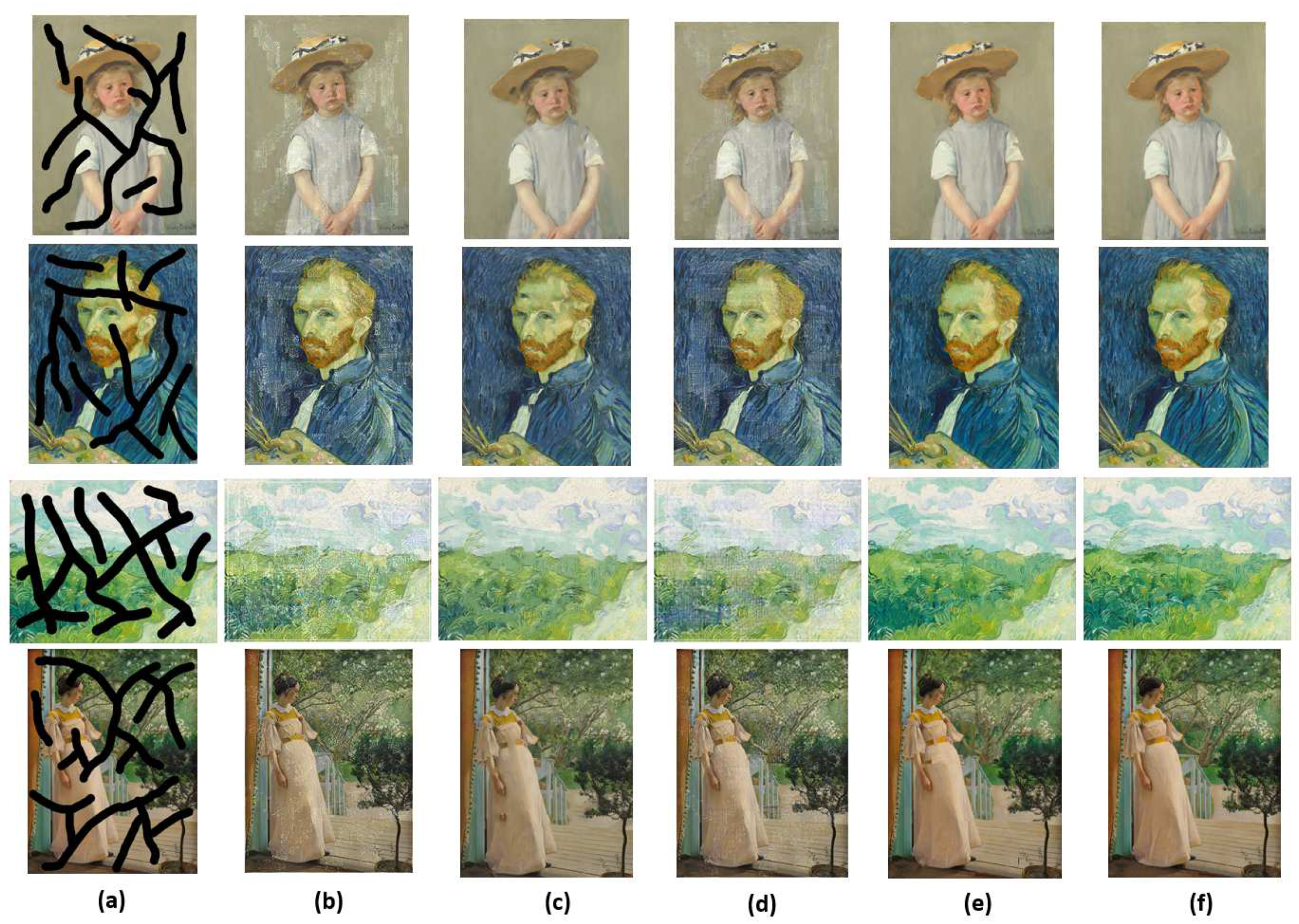
In Figure 3, the limitations of the Criminisi method [1] become apparent, revealing evident color discrepancies in the texture area. This issue persists even in the completion of low-resolution damaged images, as highlighted in Figure 2. The root cause of this problem lies in the drawbacks of the patch-based synthesis following the construction of structure propagation. The method heavily relies on image isophotes, significantly impacting the prioritization of filling and resulting in suboptimal color consistency in the final results.
Meanwhile, the Laplacian approach [39] proposes a strategy involving the construction of a Laplacian pyramid to address the unknown area. This method systematically examines consistent patch similarity at each level and resolves the issue through a weighted vote of scales. However, a notable limitation arises from its exclusive focus on the target area of the current level for filling the missing region. This singular approach contributes to significant color inconsistencies and blurriness, as observed in all images depicted in Figure 2 and Figure 3.
In contrast, the deep learning method EdgeConnect [30] takes a distinct approach by utilizing edge-map guidance to predict a model for recovering missing regions. However, despite its innovative strategy, limitations become apparent in the form of bright colors resulting from miscalculations and opaqueness across all presented results in Figure 2 and Figure 3. These issues appear from long-term memorization and an insufficient model derived from a less extensive dataset of painting images.
Furthermore, our proposed method excels over other approaches based on several key aspects of the proposed methodologies. Firstly, the integration of weighted Laplacian synthesis and patch-based completion across multi-regions allows our method to provide more precise and targeted completion. This approach ensures a focused completion process, addressing specific regions with a higher level of accuracy. Secondly, the comparison with existing methods, such as Criminisi method [1], Laplacian approach [39], and EdgeConnect [30] highlights the superiority of our approach in terms of artifact reduction and minimizing blurriness. While these existing methods struggle with color discrepancies, particularly in texture areas, our method exhibits a notable improvement in maintaining color consistency and sharpness.
In addition, our method employs the advantages of pyramid blending, offering a more effective strategy for combining or blending images. The hierarchical structure of pyramids ensures smoother transitions, preventing noticeable seams and artifacts in the blended results. This is an advantage when dealing with images featuring diverse content or structures.
4.2. Quantitative Comparison
The evaluation of our results incorporates two distinct perceptual metrics: Learned Perceptual Image Patch Similarity (LPIPS) [43] and Deep Image Structure and Texture Similarity (DISTS) [44]. In contrast to commonly used metrics like Structural Similarity Index Measure (SSIM) [41] and Peak Signal to Noise Ratio (PSNR) [42], we opt for LPIPS, a metric rooted in deep feature networks that employs human perceptual similarity judgments. This metric involves the learning of linear weights for perceptual calibration, tuning configuration, and Gaussian weights:
In this equation, represents the distance between the ground truth x and the restored images . The terms and denote feature stacks from l layers, each unit-normalized in the channel dimension. Here, H, W, and C respectively indicate the number of height h, weight w, and channel dimension c of layers, while serves as an activation channel-wise.
Moreover, our evaluation includes the utilization of Deep Image Structure and Texture Similarity (DISTS) [41]. This approach, anchored in a Conventional Neural Network (CNN), seamlessly integrates spatial texture averages and feature structure maps to generate diverse texture patterns. Within this model, quality assessments are harmonized between convolution layers of texture, as expressed by global means , and structure, represented by global correlations . The integration is accomplished through the computation of the weighted sum of different convolution layers, denoted as :
Where i and j refer to the convolution layers of the ground truth image x and the restored images y, respectively. The variables and represent the convolution channels of x and y. The terms m and represent the number of convolution layers for x and y in the i-th layer, respectively. The weights and are learned weights, satisfying the condition . Additionally, denote the global means and variances of and , while represents the global covariance between and . Constants and are introduced for numerical stability.
Furthermore, our method stands out as a superior choice for high and low-resolution art painting completions due to several key factors that address and surpass the limitations of alternative approaches. Firstly, in the case of high-resolution art paintings, our method excels in handling complicated structures and complicated textures. The integration of weighted Laplacian synthesis and patch-based completion across multi-regions ensures a more precise and specific completion of missing regions within the local area. The proposed algorithm guides the entire process, from segmentation to weighted Laplacian synthesis, patch-based propagation, and Pyramid blending. This comprehensive approach results in visually pleasing and artifact-free art painting, as demonstrated in Figure 1.
Moreover, our method employs the abundance of pixels in high-resolution paintings to make consistent completion decisions across various resolutions. Inspired by Lee et al. [39], the use of Laplacian and upsampled Gaussian pyramids progressively enhances completion quality from the coarsest to the finest layer. Texture synthesis, employing Laplacian of a Gaussian pyramid at different levels, addresses structure diffusion challenges, ensuring enhanced edge awareness. The improved nearest neighbor search algorithm, employed for matching patches at different levels, ensures accurate matching of areas for robust completion. Our method innovates the voting similarity function by considering potential overlap of nearest neighbor pixels in color, even across different levels. This refinement results in a more accurate estimation of optimal pixel values for completing missing regions. To address errors introduced by ambiguity in restored pixels, patch-based propagation is seamlessly integrated, applying an isophote-driven technique locally. This ensures that matched patches align along the boundary of a hole between two distinct colored regions, with the best-matched patch duplicated into the target area based on confidence and data terms.
In the context of low-resolution art paintings, our method demonstrates its versatility by handling randomly irregular missing regions effectively. The comparison with deep learning (EdgeConnect [30]) and traditional (Criminisi [1] and Laplacian [39]) methods showcases the robustness of our approach across different resolutions.
5. Discussion
In our evaluation of art painting completion, we utilized a dataset sourced from https://useum.org/. This dataset features art paintings with complicated structures and textures, providing a diverse range of challenges for completion algorithms. Two distinct scenarios were considered: high-resolution paintings with dimensions around 1600×2136 pixels and their low-resolution counterparts with sizes approximately 400×400 pixels. To comprehensively assess the effectiveness of our proposed method, we benchmarked it against two comparison methods: EdgeConnect [30] representing a deep learning approach, and a traditional method denoted as Criminisi [1] and Laplacian [39]. The aim was to measure the performance of our proposed method in restoring art paintings with varying complexities and resolutions.
Qualitatively assessing the fidelity of our results in accordance with human visual perception is fundamental. Figure 2 and Figure 3 showcase the visual comparisons between different methods, providing insights into their strengths and limitations. The Criminisi method [1] exhibits evident color discrepancies in texture areas, even in the completion of low-resolution damaged images. This limitation stems from the drawbacks of the patch-based synthesis, affecting color consistency. The Laplacian approach [39] addresses the unknown area using a Laplacian pyramid but falls short in color consistency and results in blurriness. EdgeConnect [30], while innovative, exhibits issues such as bright colors from miscalculations and opaqueness. Our proposed method excels in several aspects. The integration of weighted Laplacian synthesis and patch-based completion across multi-regions ensures precise and targeted completion, outperforming existing methods. The comparison highlights our method’s superiority in artifact reduction and minimizing blurriness, addressing challenges in color discrepancies observed in texture areas. Additionally, the incorporation of pyramid blending proves advantageous, ensuring smoother transitions and preventing noticeable seams or artifacts in blended results.
Quantitative evaluation is performed using two perceptual metrics: Learned Perceptual Image Patch Similarity (LPIPS) [43] and Deep Image Structure and Texture Similarity (DISTS) [44]. Table 1 and Table 2 present the accuracy of these metrics for different methods and scenarios. Our method consistently outperforms Criminisi [1], Laplacian [39], and EdgeConnect [30] across both high and low resolutions. In terms of LPIPS, our method achieves significantly higher accuracy, indicating better perceptual similarity with ground truth images. The DISTS metric further supports our method’s superiority, emphasizing its ability to synthesize diverse texture patterns and maintain structural quality.
Moreover, our proposed method applies advanced techniques to address challenges in both high and low-resolution scenarios. In high-resolution paintings, the integration of Laplacian and upsampled Gaussian pyramids progressively enhances completion quality. Texture synthesis employing Laplacian of a Gaussian pyramid at different levels ensures improved edge awareness. The nearest neighbor search algorithm is enhanced to consider potential overlap in color, contributing to more accurate completion decisions. In low-resolution paintings, our method showcases versatility in handling randomly irregular missing regions. The comprehensive approach, from weighted Laplacian synthesis to patch-based completion and Pyramid blending, demonstrates the robustness of our method across different resolutions.
6. Conclusions
In conclusion, our proposed methodology, anchored in weighted Laplacian synthesis and patch-based completion across multi-regions, emerges as a robust solution for the complicated task of restoring art paintings with irregularly damaged regions. Through a comprehensive evaluation, including qualitative and quantitative comparisons, our approach showcased its superiority over existing methods. Notably, the integration of hierarchical pyramid blending and advanced nearest neighbor search algorithms contributed to artifact reduction, minimized blurriness, and ensured visually pleasing outcomes in both high and low-resolution art paintings. The comprehensive calibration of perceptual similarity, as demonstrated by the Learned Perceptual Image Patch Similarity (LPIPS) metric, and the synthesis of diverse texture patterns through Deep Image Structure and Texture Similarity (DISTS) further validated the efficacy of our method. Our proposed approach not only addresses the limitations observed in current methodologies but also establishes a new standard for art completion algorithms, particularly in handling complex structures and textures.
While our current methodology presents a significant advancement, future work may delve into enhancing the scalability of the algorithm for real-time applications. Additionally, exploring the integration of machine learning techniques to adaptively adjust parameters based on image content variations could further optimize performance. Collaborations with art conservationists and experts could provide valuable insights for refining the algorithm to cater to specific nuances in diverse art styles. Continuous refinement and validation across a broader range of art datasets will be essential for establishing the broader applicability and robustness of our proposed method in the field of digital art completion.
References
- Criminisi, A.; Pérez, P.;Toyama, K. Object removal by exemplar-based inpainting. In Proceedings of the 2004 IEEE Computer Society Conference on Computer Vision and Pattern Recognition, 2004.
- Efros, A. A.; Leung, T. K. Texture synthesis by non-parametric sampling. In Proceedings of the Seventh IEEE International Conference on Computer Vision, pp: 1033-1038, 1999.
- Bertalmio, M.; Sapiro, G.; Caselles, V.; Ballester, C. Image inpainting. In Proceedings of the 27th Annual Conference on Computer Graphics and Interactive Techniques, pp: 417-424, 2000.
- Darabi, S.; Shechtman, E.; Barnes, C.; Goldman, D. B. Image melding: Combining inconsistent images using patch-based synthesis. ACM Transactions on Graphics (TOG), 31(4), 82, 2012.
- Yu, J.; Lin, Z.; Yang, J.; Shen, X.; Lu, X.; Huang, T. S. Generative Image Inpainting with Contextual Attention. In IEEE Conference on Computer Vision and Pattern Recognition (CVPR), 2018.
- Xiao, H.; Zhang, J.; Zhang, K.; Xiao, C. Deep Exemplar-Based Image Colorization. In International Conference on Computer Vision (ICCV), 2019.
- Yue, Z.; Zheng, Y. Artistic Style Transfer for Image Inpainting. IEEE Transactions on Image Processing, Volume 29, pp: 5142-5157, 2020.
- Zeng, Y.; Lin, Z.; Yang, J.; Zhang, J.; Shechtman, E.; Lu, H. High-resolution image inpainting with iterative confidence feedback and guided upsampling. European Conference on Computer Vision, pp. 1-17, 2020.
- Song, Y.; Yang, C.; Shen, Y.; Wang, P.; Huang, Q; Kuo, C. C. J. Spg-net: segmentation prediction and guidance network for image inpainting, arXiv:1805.03356, 2018.
- Yu, J.; Lin, Z.; Yang, J.; Shen, X.; Lu, X.; Huang, T. S. Generative image inpainting with contextual attention. In Proceedings of the IEEE conference on computer vision and pattern recognition, pp. 5505–5514, 2018.
- Yi, Z.; Tang, Q.; Azizi, S.; Jang, D.; Xu, Z. Contextual residual aggregation for ultra high-resolution image inpainting. In Proceedings of the IEEE Conference on Computer Vision and Pattern Recognition, pp. 7508–7517, 2020.
- Iizuka, S.; Simo-Serra, E.; Ishikawa, H. Globally and locally consistent image completion. ACM Transactions on Graphics (ToG), 36(4):1–14, 2017. [CrossRef]
- Ma, Y.; Liu, X.; Bai, S.; Wang, L.; Liu, A.; Tao, D.; Hancock, E. Region-wise generative adversarial image inpainting for large missing areas. arXiv:1909.12507, 2019.
- Li, J.; Wang, N.; Zhang, L.; Du, B.; Tao, D. Recurrent feature reasoning for image inpainting. In Proceedings of the IEEE Conference on Computer Vision and Pattern Recognition, pp. 7760–7768, 2020.
- Liu, G.; Reda, F. A.; Shih, K. J.; Wang, T. C.; Tao, A.; Catanzaro, B. Image inpainting for irregular holes using partial convolutions. In Proceedings of the European Conference on Computer Vision (ECCV), pp. 85–100, 2018.
- Telea, A. An image inpainting technique based on the fast marching method. J. Graph. Tools, vol. 9, no. 1, pp. 23–34, Jan. 2004. [CrossRef]
- Zuo, W.; Lin, Z. A generalized accelerated proximal gradient approach for total-variation-based image restoration. IEEE Trans. Image Processing, vol. 20, no. 10, pp. 2748–2759, Oct. 2011. [CrossRef]
- Dahl, J.; Hansen, P. C.; Jensen, S. H.; Jensen, T. L. Algorithms and software for total variation image reconstruction via first-order methods. Numerical Algorithms, vol. 53, no. 1, pp. 67–92, Jan. 2010. [CrossRef]
- Chan, T. F.; Shen, J. Nontexture inpainting by curvature-driven diffusions. Journal of Visual Communication and Image Representation, vol. 12, no. 4, pp. 436–449, Dec. 2001.
- Chan, T. F.; Kang, S. H.; Shen, J. Total variation denoising and enhancement of color images based on the CB and HSV color models. Journal of Visual Communication and Image Representation, vol. 12, no. 4, pp. 422–435, Dec. 2001. [CrossRef]
- Irawati, N. S.; Urano, Y.; Du, W. Image inpainting using orthogonal viewpoints and structure consistency in Manhattan World. In the 8th International Virtual Conference on Applied Computing and Information Technology (ACIT), 2021.
- Horikawa, E.; Irawati, N. S.; Du, W. Image inpainting using clustered planar structure guidance. In the 8th International Virtual Conference on Applied Computing and Information Technology (ACIT), 2021.
- Irawati, N. S.; Horikawa, E.; Du, W. Interactive image inpainting of large-scale missing region. IEEE Access, pp(99):1-1, 2021. [CrossRef]
- Irawati, N.S.; Du, W. Structure-texture consistent painting completion for artworks. IEEE Access (11), pp. 27369-27381, 2023.
- Urano, Y.; Sari, I.N.; Du, W. Image inpainting using automatic structure propagation with auxiliary line construction. 23rd ACIS International Summer Virtual Conference on Software Engineering, Artificial Intelligence, Networking and Parallel/Distributed Computing (SNPD Summer), IEEE, pp. 107-112, Kyoto, Japan, 2022.
- Takarabe, J.; Sari, I.N.; Du, W. Depth map estimation of single-view image using smartphone camera for a 3 dimension image generation in augmented reality. Sixth International Symposium on Computer, Consumer and Control (IS3C), IEEE, pp. 167-170, Taichung, Taiwan, 2023.
- Masaoka, K.; Sari, I.N.; Du, W. Vanishing points detection with line segments of gaussian sphere. Sixth International Symposium on Computer, Consumer and Control (IS3C), IEEE, pp. 48-51, Taichung, Taiwan, 2023.
- Sari, I.N.; Masaoka, K.; Takarabe, J.; Du, W. High-resolution art painting completion using multi-region laplacian fusion. Sixth International Symposium on Computer, Consumer and Control (IS3C), IEEE, pp. 48-51, Taichung, Taiwan, 2023.
- Masaoka, K.; Sari, I. N.; Du, W. Edge-enhanced GAN with vanishing points for image inpainting. IEEE/ACIS International Summer Virtual Conference on Software Engineering, Artificial Intelligence, Networking and Parallel/Distributed Computing, 2022.
- Nazeri, K.; Joseph, E. Ng, T.; Qureshi, F. Z.; Ebrahimi, M. Edgeconnect: generative image inpainting with adversarial edge learning, arXiv:1901.00212, 2019.
- Liu, H.; Wan, Z.; Huang, W.; Song, Y.; Han, X.; Liao, J. PD-GAN: probabilistic diverse GAN for image inpainting. Conference on Computer Vision and Pattern Recognition (CVPR), 2021.
- Criminisi, A.; Perez, P.; Toyama, K. Region filling and object removal by exemplar-based image inpainting. IEEE Trans. Image Processing, vol. 13, no. 9, pp. 1200–1212, Sep. 2004.
- Sun, J.; Yuan, L.; Jia, J. Image completion with structure propagation. ACMTransactions on Graphic, 2005. [CrossRef]
- Chen, M.; Zhao, X.; Xu, D. Image inpainting for digital dunhuang murals using partial convolutions and sliding window method. Journal of Physics Conference Series, 1302(3):032040, 2019.
- Wang, H.; Li, Q.; Zou, Q. Inpainting of dunhuang durals by sparsely modeling the texture similarity and structure continuity. Journal on Computing and Cultural Heritage, 2018.
- Pathak, D.; Krahenbuhl, P.; Donahue, J.; Darrell, T.; Efros, A. A. Context encoders: feature learning by inpainting. In Proceedings of the IEEE conference on computer vision and pattern recognition, pp. 2536–2544, 2016.
- Chen, M.; Zhao, X.; Xu, D. Image inpainting for digital dunhuang murals using partial convolutions and sliding window method. Journal of Physics Conference Series, 1302(3):032040, 2019. [CrossRef]
- Wang, H.; Li, Q.; Zou, Q. Inpainting of dunhuang durals by sparsely modeling the texture similarity and structure continuity. Journal on Computing and Cultural Heritage, 2018.
- Lee, J. H.; Choi, I.; Kim, M. H. Laplacian patch-based image synthesis. IEEE Conference on Computer Vision and Pattern Recognition, 2016.
- Anmol, B.; Green, R. K. S.; Sachin, D. L. Spatially variant laplacian pyramids for multi-frame exposure fusion. Computer Vision and Image Processing, (pp.73-81), 2020.
- Wang, Z.; Bovik, A. C.; Lu, L. Why is image quality assessment so difficult. Proc. IEEE Int. Conf. Acoust. Speech Signal Processing,pp. 3313–3316, vol. 4, 2002.
- Qureshi, M. A.; Deriche, M.; Beghdadi, A.; Amin, A. A critical survey of state-of-the-art image inpainting quality assessment metric. Journal of Visual Communication and Image Representation, vol. 49, pp. 177–191, 2017. [CrossRef]
- Zhang, R.; Isola, P.; Efros, A. A.; Shechtman, E.; Wang, O. The unreasonable effectiveness of deep features as a perceptual metric. IEEE International Conference Computer Vision and Pattern Recognition (CVPR), 2018.
- Ding, K.; Ma, K., Wang, S.; Simoncell, E. E. Image quality assessment: unifying structure and texture similarity. IEEE International Conference Computer Vision and Pattern Recognition (CVPR), 2020.
Figure 1.
Weighted Similarity-Confidence Laplacian Synthesis. (a) Input: An art painting with missing regions, (b) Multi-region input and its mask, (c) Weighted Laplacian Synthesis, (d) Patch-based Propagation, (e) Result of Weighted Laplacian Synthesis, (f) Result of Patch-based Propagation, and (g) Output: A restored art painting.
Figure 1.
Weighted Similarity-Confidence Laplacian Synthesis. (a) Input: An art painting with missing regions, (b) Multi-region input and its mask, (c) Weighted Laplacian Synthesis, (d) Patch-based Propagation, (e) Result of Weighted Laplacian Synthesis, (f) Result of Patch-based Propagation, and (g) Output: A restored art painting.
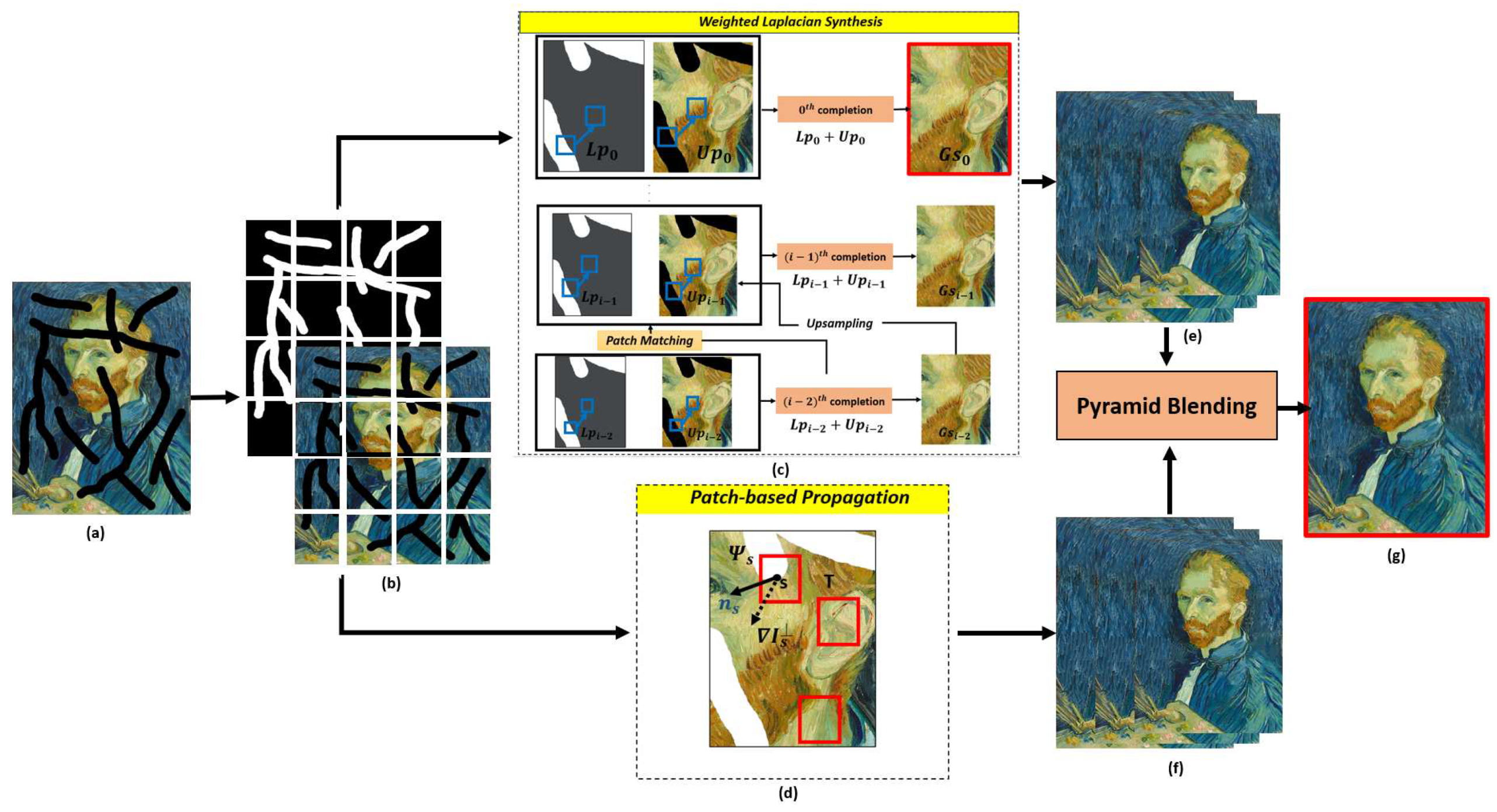
Figure 3.
Low-resolution art painting completion with a size of around 400×400 pixels. (a) Input, (b) Criminisi et al. [1], (c) Laplacian [39], and (d) EdgeConnect [30], (e) Ours, and (f) Ground Truth.
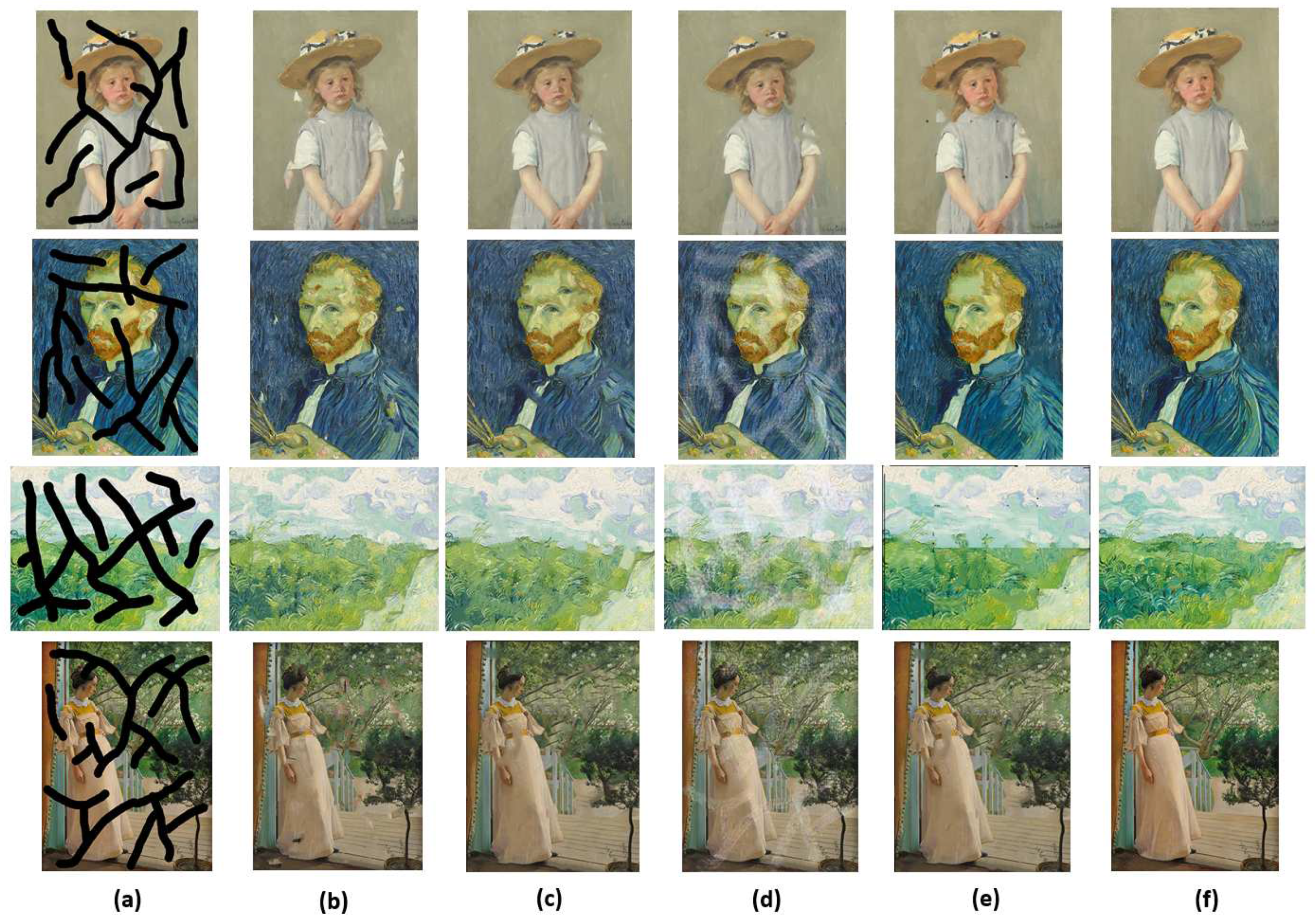

Table 1.
Accuracy of Learned Perceptual Image Patch Similarity (LPIPS)
| Name | Criminisi [1] | Laplacian [39] | EdgeConnect [30] | Ours | ||||
|---|---|---|---|---|---|---|---|---|
| High | Low | High | Low | High | Low | High | Low | |
| Girl | 0.631 | 0.443 | 0.701 | 0.562 | 0.702 | 0.344 | 0.846 | 0.812 |
| Man | 0.642 | 0.531 | 0.719 | 0.407 | 0.745 | 0.307 | 0.897 | 0.808 |
| Scenery | 0.611 | 0.472 | 0.754 | 0.592 | 0.762 | 0.412 | 0.853 | 0.781 |
| Woman | 0.714 | 0.523 | 0.758 | 0.575 | 0.781 | 0.635 | 0.892 | 0.852 |
Table 2.
Accuracy of Deep Image Structure and Texture Similarity (DISTS)
| Name | Criminisi [1] | Laplacian [39] | EdgeConnect [30] | Ours | ||||
|---|---|---|---|---|---|---|---|---|
| High | Low | High | Low | High | Low | High | Low | |
| Girl | 0.721 | 0.543 | 0.899 | 0.661 | 0.895 | 0.618 | 0.951 | 0.786 |
| Man | 0.792 | 0.601 | 0.872 | 0.644 | 0.834 | 0.562 | 0.932 | 0.888 |
| Scenery | 0.710 | 0.592 | 0.888 | 0.691 | 0.842 | 0.512 | 0.921 | 0.834 |
| Woman | 0.812 | 0.611 | 0.878 | 0.655 | 0.852 | 0.615 | 0.932 | 0.891 |
Disclaimer/Publisher’s Note: The statements, opinions and data contained in all publications are solely those of the individual author(s) and contributor(s) and not of MDPI and/or the editor(s). MDPI and/or the editor(s) disclaim responsibility for any injury to people or property resulting from any ideas, methods, instructions or products referred to in the content. |
© 2024 by the authors. Licensee MDPI, Basel, Switzerland. This article is an open access article distributed under the terms and conditions of the Creative Commons Attribution (CC BY) license (http://creativecommons.org/licenses/by/4.0/).
Copyright: This open access article is published under a Creative Commons CC BY 4.0 license, which permit the free download, distribution, and reuse, provided that the author and preprint are cited in any reuse.