

Submitted:
16 January 2024
Posted:
17 January 2024
You are already at the latest version
Abstract
Seafood, especially from the ocean, is now seen as a greener and more sustainable source of protein causing an increase in its demand. This has also led to people making choices towards seafood as a replacement of carbon intensive protein sources. As a result, the demand for seafood is growing, and the Aquaculture industry is required to increase their produce while keeping the produce safe and sustainable. There are many challenges faced by the aquaculture industry in meeting these increased demands. One such challenge is the presence of harmful algal blooms (HAB) in the ocean which can have a major impact on aquatic life. In this paper we look at the impact of this challenge on aquaculture and the mitigating strategies. We will focus on Abagold Limited, a land-based marine aquaculture business that specializes in large scale production of abalone (Haliotis midae) based in Hermanus, South Africa. HABs are considered a threat to commercial scale abalone farming along the South-African coastline and requires continuous monitoring. The most recent HAB was in February-April 2019, the area experienced a severe red-tide event with blooms of predominantly Lingulodinium polyedrum. We present some of the mitigation strategies employing digital technologies for future proofing the industry.
Keywords:
Harmful Algal Blooms
; sensors
; Aquaculture
; South Africa
; marine
1. Introduction
Phytoplankton, also known as microalgae, are like terrestrial plants in that they contain chlorophyll and require sunlight to live and grow. Most phytoplankton are buoyant and float in the upper part of the ocean, where sunlight penetrates the water. Algal blooms are commonly referred to as red tides or harmful algal blooms (HABs), but they occur in a variety of colours depending on the type(s) of algae present. Only a small number of species have the capacity to form harmful blooms, but when they do, the effects can be severe for coastal resources, local economies, and public health. Harmful algal blooms (HABs) occur when algae grow out of control and sometimes produce toxins harmful to aquatic life and in some cases to humans. Hallegraeph [1] categorizes them into three broad groups. Group one is harmless (i.e. non- toxin producing) colourless algae can also form a bloom and deplete a waterbody of oxygen killing aquatic life, an example is dinoflagellates Akashiwo sanguinea. The second group include species which produce potent toxins that can affect humans, causing a variety of gastrointestinal and neurological illnesses, most common example includes paralytic shellfish poisoning (PSP) caused by dinoflagellates Alexandrium catenella [2]. However, the focus here is on the third category of HABs which produces toxins harmful to aquatic life. While the wild aquatic animals have the freedom of moving away when such a bloom occurs, farmed aquatic life are more vulnerable to such HABs.
These types of algae are complex and their ability to devastate aquaculture farms has posed a significant challenge to the industry's sustainability. There are several mechanisms by which HABs threaten the viability of cultured organisms through the dysfunction of the respiratory system by damaging the gill epithelium or by suffocation due to the depletion of dissolved oxygen in the water. Toxin produced by certain algal species can accumulate in cultured organisms leading to public health risks of shellfish poisoning if it exceeds regulatory limits [3]. The frequency and intensity of these blooms have developed into a global concern over the past few years. The impact of blooms is not often quantified except in cases where it has resulted in massive mortalities of cultured animals and significant economic losses. The more notable globally iconic blooming events and their impact on the aquaculture industry are summarised in Table 1 above.
2. Harmful Algal Bloom Mitigation Technologies
Harmful Algal Blooms have been a major cause of concern in aquaculture and their occurrence depends on various factors including temperature, precipitation, wind, surface water conditions, presence of nutrients (eutrophication) etc. Changing climate impacts these parameters, for example, surface water acidification stemming from increased CO2 emissions which directly alters the surface water conditions, and perhaps more importantly their extremes [16]. However, there is no evidence that HAB occurrence will increase with rise in temperature but the composition and spread of HABs will change making their occurrence even more unpredictable [17]. This unpredictability of HABs is a cause of concern for the aquaculture business and there an immediate need to develop suitable digital techniques to that would allow the farms to mitigate their impact.
There are various tools which have been developed to monitor, quantify, or identify them. This section focuses on various digital technologies that have been developed in the last few years that support the monitoring/forecasting HABs.
2.1. Tools and Instruments
The ability to detect HABs without resorting to laboratory-based sample testing is enabled by a range of sensor technologies detecting increasing turbidity and changes in chlorophyll-related spectral responses that result from increasing phytoplankton. The implementation of a specific technology can be dependent on the spatial and temporal requirements for a specific application. For example, satellite-based remote sensors can provide measurements over large areas of the globe and show the development and distribution of HABs at regular intervals, typically measured in days. Commercial aquaculture, by contrast, requires access to real-time data to detect the onset of HAB’s in farming tanks and employ in-situ multiparameter sensors. A brief review of some of the sensor options available currently is presented below.
Satellite remote sensing of HABs employs spectral measurement technologies such as MODIS (moderate resolution imaging spectroradiometer) and the Sentinel-2A/B optical multispectral imaging satellite. Spatial resolution is typically of the order of 10’s of metres. An example of this approach is presented by Bondur et al, where satellite data is integrated with ocean temperature data to identify the causes of HABs in the coastal waters east of Kamchatka, influenced by mineral and biogenic suspensions in river runoff from the Nalycheva River [18]. A further example is provided by Bu et al. where MODIS data has been integrated with meteorological factors and latitude and longitude information to create a general regression dataset for harmful algal bloom detection. The analysis by Bu et al. included data from 192 HAB events from around the world over a 20-year period [19]. One of the challenges with satellite remote sensing is variability and measurement restrictions caused by cloud cover and aerosol conditions. A satellite measurement system that aims to address these issues is the TROPOspheric Monitoring Instrument (TROPOMI) which can observe red solar induced fluorescence (SIF) resulting from HABs. This instrument is mounted on the Copernicus Sentinel-5 Precursor satellite and offers 5.5 km spatial resolution and near-daily global coverage [20]. Luis et al. have recently presented a comparison of HAB assessments from the TROPOMI and MODIS satellites and concluded that: during severe HAB conditions, red SIF was consistent with existing monitoring tools and has potential to provide nearly double the amount of spatiotemporal fluorescence HAB information [20]. Even within satellite based remote sensing, for a given application, there are decisions to make relating to measurement robustness, atmospheric conditions, spatial resolution, and image update rate.
Jordan et al. present an above-water reflectance system capable of monitoring aquatic ecosystems with the addition of a hyperspectral direct-diffuse solar radiation pyranometer [21]. The reported benefit of this integrated approach was an improvement in measurement precision resulting from an algorithm that included a function to account for the atmospheric optical state and the variations in spectral response of the incoming radiation. The characterization of atmospheric properties may also be beneficial in reducing uncertainties associated with atmospheric correction methods employed in satellite observation.
where, D is the Secchi depth in metres.
A recent citizen-science implementation of the Secchi disk [28], that includes water pH and colour measurements (using a mobile phone camera), has been presented on the MONOCLE Project - Multiscale Observation Networks for Optical monitoring of Coastal waters, Lakes and Estuaries (monocle-h2020.eu) [29]. As a result of the legacy of available data, access to citizen science and ease of use, the Secchi disk is still a useful and popular tool for assessing water conditions for HAB detection and monitoring, which can also complement the findings from the more technically sophisticated remote sensing methods [26,37].
Focussing on the needs of commercial aquaculture, in-situ sensors are commercially available such as the FluoroProbe III (https://www.bbe-moldaenke.de/en/ ) and the TriLux sensor from Chelsea Technology Ltd. (as employed in this case study). These digitally connected multi-parameter sensors employ spectral fluorometry methods to detect chlorophyll-a and can provide real-time measurements as well as depth profile responses. Such sensors are suitable for integration with a wide range of surface marine vehicles, platforms and installations including buoys. However, for long-term installations, regular sensor cleaning needs to be performed to remove dirt and biofilms.
The global need for field portable instrumentation or on-site monitoring systems is also driving commercial research and development activities. One example of this type of instrument is the ‘Harmful Algal Bloom Detection Instrument’, from Giner Labs, [42]. This low-cost hand-held instrument employs rapid electrochemical analysis technology to deliver parts-per-billion measurements of HAB related toxins. An example of on-site equipment enabling rapid sample analysis, comes from FlowCam, [43] with a range of products employing flow imaging microscopy with particle counting and analysis software. This technology can identify taxonomic groups and estimate concentration of the dominant organisms, providing proactive and rapid HAB monitoring enabling data-driven water resource management [30]. However, as expected this is a top end instrument which would imply exorbitant cost. Another option to identify specific HAB species is possible through a combination of instrumentation and Artificial Intelligence (AI)/Machine Learning (ML) tools. The next section briefly explores the HAB models to complement the instrumentation.
2.2. HAB AI/ML Models
Tools and instruments explained in the previous section can usually be supplemented with a machine learning model. As the Harmful Algal Blooms continue to challenge the aquaculture industry, different models to predict their occurrence are being developed. Researchers have attempted to develop models based on the functional traits of the HABs or/and using data from either sensors or satellite. These models [52] are essential to develop early warning system using short-term forecast of HAB movement and develop actions to mitigate their impact either by neutralizing them or somehow minimise their impact. David et al [44] have conducted a detailed review of the models developed in the past decade and classified the HAB models into process based, statistical and hybrid models. Process based models like [45] are more suited to study long term impact and prediction, for example the impact of climate change. In comparison, machine learning models based on statistical methods [46] can be used to deliver short term predictions.
The process-based models [48] are usually developed specific to a species as these are mechanistic model and consider the environmental conditions that would favour the growth of a particular species. These models are also much more complex and rely on data collected over few decades, for example, Gobler et al [49] combines sea surface temperature records from 1982 to 2016 were combined with laboratory-based growth rates for two HAB species A. catenella (fundyense) and D. acuminata. Such models are essential for aquaculture industry to understand change in their frequency or impacts which is important for building resilience in the business. Kim et al [53] uses hydrodynamic model, Environmental Fluid Dynamics Code (EFDC) to understand algal dynamics which would help develop HAB management strategies. Litchman [45] explains that trait-based systems would be very useful however there is insufficient data and some gaps in the understanding to develop such a system. They suggest a hybrid system that is by combining data driven model with a trait-based system.
Statistical methods are usually more successful for a short-term forecasting especially when used with in situ sensors. Yu et al [51] develop a ML model for two locations in China and USA using sensor data that demonstrates the versatility of their ML model. They have selected different water quality parameters such as Chlorophyll, Ammonia, Nitrate for each ANN (Artificial Neural Network) model. In [37], authors use another ANN model to predict Chlorophyll a in an aquaculture setting.
Most of these HAB models are usually specific to a river or an estuary with the focus on the environment (including wild fisheries) and public health. There are however some relatively recent initiatives whose focus is on supporting aquaculture, for example Sustainable Aquaculture Innovation Centre (SAIC) project [47], which provides a tool for Scottish finfish aquaculture (see https://www.habreports.org/ accessed 14th January). Similar initiative in South Africa [50], National OCIMS (The National Oceans and Coastal Information Management System)under Council of Scientific and Industrial Research (CSIR), South Africa (see https://www.ocims.gov.za/hab/app/ accessed 14th January) with the aim to support aquaculture operations in the region in addition to marine ecosystems and communities. However, both of these tools, rely on satellite data and the results are not available immediately. Especially if there are clouds than the satellites cannot access the data.
3. Aquaculture in South Africa
Africa, second to Asia, has a major market for fishery products with its current production of marine and freshwater aquaculture species exceeding 1.8 million tonnes per annum. However, the current African aquaculture industry is still not meeting the requirements of its growing population. The South African aquaculture industry specifically, despite a growing trend in moderate quantities produced since 2005, had to import on average 70 000 tonnes per annum of fish and aquatic invertebrates worth R 1.36 billion to augment the demand during the past decade [31]. This is largely due to the African aquaculture industry, in particular South Africa that is still in its infancy and has been hindered by various environmental, economic, social, and technological challenges. This article presents mitigating solutions to address some of these through employing digital technology. We present our results as a case study of Abagold Limited, a land-based marine aquaculture business that specializes in large scale production of abalone (Haliotis midae) based in Hermanus, South Africa. One of the challenges faced by Abagold is threat of harmful algal blooms (HAB). Most recent HAB was in February-April 2019, the area experienced a severe red-tide event with blooms of predominantly Lingulodinium polyedrum. In this article we present mechanisms for early prediction of HABs. To monitor HABs, currently Abagold uses costly and time-consuming manual water sampling and phytoplankton analysis. An early detection of HABs link directly to health and food security in more than one way. We build on well-established correlation between parameters like Chlorophyll, pH, Turbidity, with HABs to establish a framework for an early warning system.
4. Abagold Limited—A Case Study
4.1. Data Site
Abagold Limited (https://www.abagold.com/) cultivates Abalone in Hermanus. Hermanus is nestled in the Walker Bay and the pristine waters of the Atlantic Ocean in the bay provide the necessary nutrients and environment to produce the highest quality Abalone. The Abalone species, Haliotis midae, is farmed on four aptly named farms in Hermanus: Sea View, Amaza (waves), Bergsig (mountain view) and Sulamanzi (clean water).
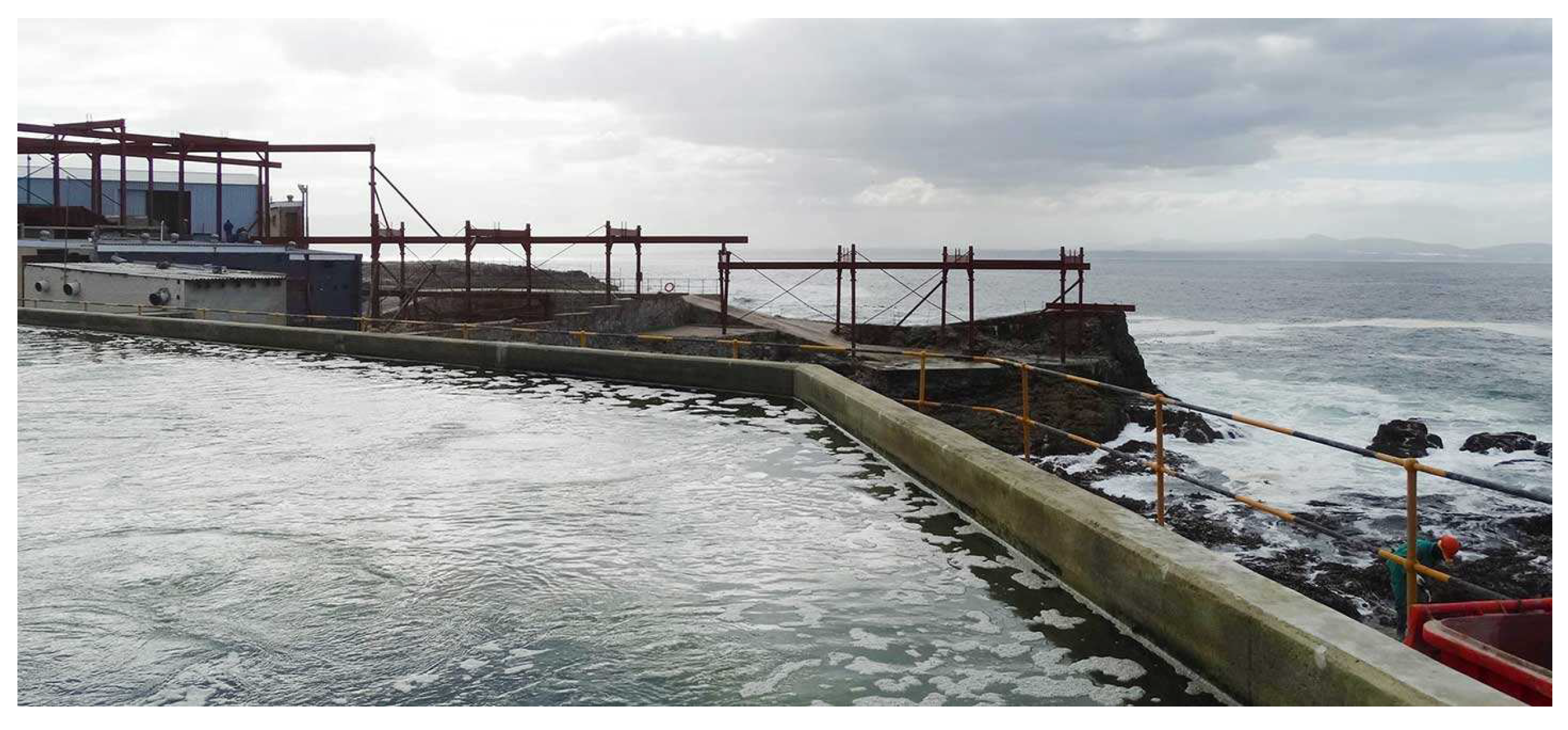
Figure 1.
Primary Sump, Abagold Seaview Farm.
4.2. Water Quality Parameter and Sensor Selection
Algal biomass dynamics are non-linear and non-stationary due to the complex interaction of physical, chemical, and biological parameters affecting the growth and accumulation of biomass and this is a universal problem so various models have been developed for its prediction, these are discussed in 2.2. Algae have unique pigments that they use for photosynthesis, these could be monitored by measuring chlorophyll a, phycocyanin and phycoerythrin. Chlorophyll a has been used for many decades to monitor algal biomass [32]. The pigment phycocyanin is a more specific indicator of blue-green algae in freshwater systems, and a similar pigment called phycoerythrin is a useful indicator of blue-green algae in marine systems [33]. In addition to these parameters, turbidity is also linked with the presence of algae in water. As the selected site uses water from sea, Chlorophyll a (named as CHL1 (470), for ease here), Phycoerythrin (named as CHL2 (530) for ease here) and Turbidity (Tb) were selected to monitor for HABs.
There are various sensors for these parameters, selection was based on cost, ease of availability and delivery to South African site. Following three multi parameter instruments were selected:
The main problem in the project was the long delivery times, this was understood to be due to global shortage of some components necessary for these instruments. Trilux was chosen as CTL are long-term project partners with University of Bedfordshire, so they agreed to lend an instrument for measurements. All the data presented here is collected using Trilux.
Figure 2.
Installation of Chelsea Technology Limited TriLux sensor at Abagold.
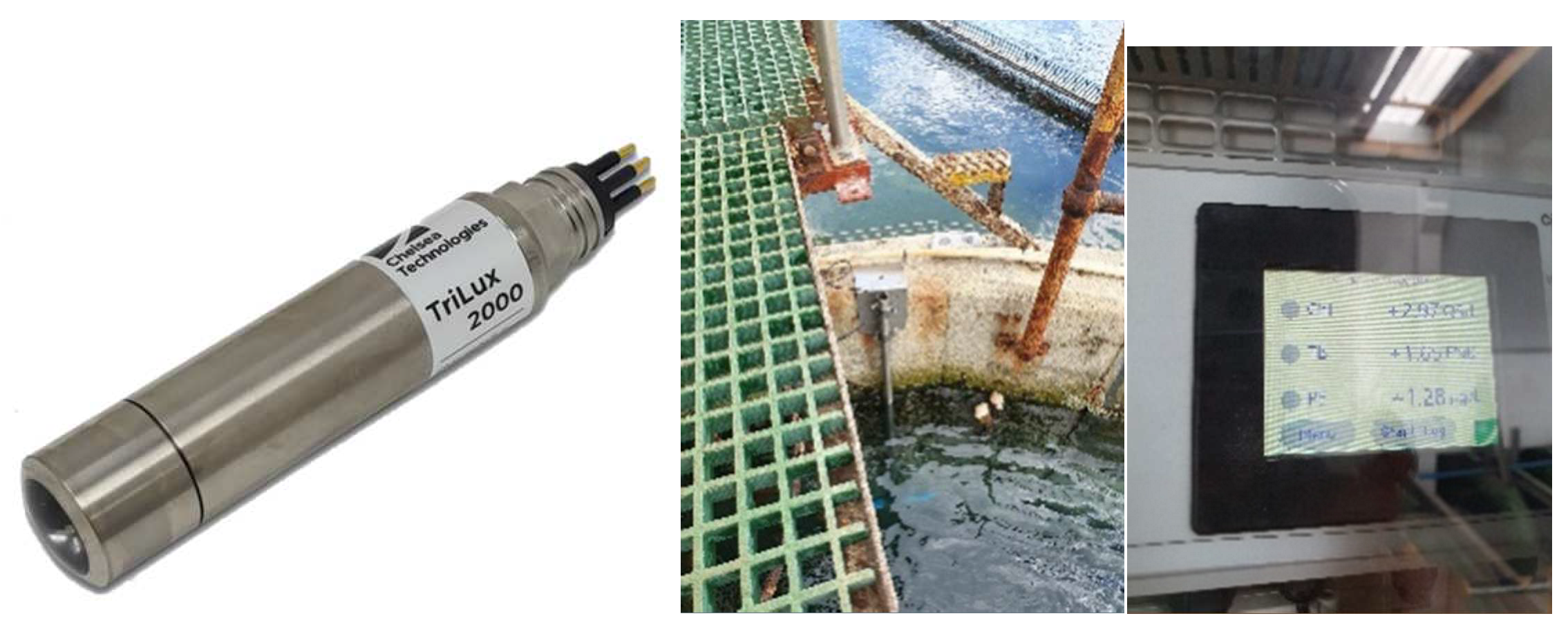
The parameters Chlorophyll a (CHL1 (470)), Phycoerythrin (CHL2 (530)) and Turbidity (Tb) were measured in the units QSU, ug/L and FNU respectively (definitions for these units?). The phytoplankton data were recorded manually at fixed times for the month of January, February, and March. The data from Trilux sensor were recorded throughout the months of, January, February, and March at 1 second intervals. However, the phytoplankton count was recorded at fixed times – usually in the morning at 7.40 am. Thus, to correlate with this data, Trilux data was averaged at a 20 second window for the corresponding date and time on which the phytoplankton count was recorded shown in Table 3 below.
5. Statistical Analysis
The data from Trilux sensor were recorded throughout the months of, January, February, and March. This is presented in Table 3 together with the Phytoplankton count measured each day. Phytoplankton count is a representative of algal biomass, so although it is not actually measuring specific HABs, the expectation is that higher phytoplankton count would imply higher probability of HAB. The TriLux data presented in Table 3 data is already cleaned and pre-processed. Pre-processing involved interpolating any missing data points, this is done before taking 20sec window average. Next step is to conduct a statistical analysis of the collected data to establish correlation.
Pearson’s correlation [34] coefficient technique is used to explore the correlation between the sensor parameters – Chlorophyll, Phycoerythrin, Turbidity- and the Phytoplankton data count. The Pearson correlation coefficient between two variables X and Y is formally defined as the covariance of the two variables divided by the product of their standard deviations (which acts as a normalization factor) and it can be equivalently defined by:
where, = denotes mean of x and = denotes the mean of y. The coefficient rxy ranges from −1 to 1 and it is invariant on linear transformations of either variables.
The table below shows the correlations obtained between the measured Chlorophyll a (CHL1(470)), Phycoerythrin (CHL2(530)), Turbidity and Phytoplankton data count.
Table 4 shows a strong positive correlation between the sensor parameters and the Phytoplankton count. Next step is to develop a regression equation using regression analysis. For the regression analysis, Phytoplankton data is the dependent variable and CHL1(470), CHL2(530) and Turbidity are chosen as independent variables.
The regression analysis of the data of Table 3 gives the following equation.
Phytoplankton= -3596-30.18 Chl1+35.59 Tb+4.613 Chl2
This equation forms the foundation to predict the Harmful Algal Blooms, using an artificial neural network (ANN) forecasting model as described in [37]. The HAB/phytoplankton forecasting model would be an extension of that developed in [37] as it involves three independent variables to predict one dependent variable. The hybrid forecasting model method used merges ensemble empirical mode decomposition (EEMD) method, deep learning long-short term memory (LSTM) neural network (NN), and multivariate linear regression (MLR) method [38],[39],[40]. The ANN model that we developed for reliably forecasting algal biomass is described in [41]. The model would be further strengthened with more data collected over different HAB periods. Final intention is to give at least half a day warning to the business in addition to their continuous access to chlorophyll data. This forms an essential part of their sophisticated risk model which also considers environmental conditions like temperature differential, wind speed and direction, and animal behaviour to determine the likelihood of HAB.
6. Forecasting Advantages and Challenges
The mathematical model developed [37] shows that early forecasting of harmful Phytoplankton (algal blooms) using in-situ measured Chlorophyll-a (470), Turbidity, and Phycoerythrin (530) is possible, this forecasting will undeniably prove to be a useful tool for the aquaculture industry. The data in Table 3 shows phytoplankton count at the initial entry point of water into the farm. Other locations are also monitored but as the intention here was to demonstrate the correlation with chlorophyll data collected using sensors, those measurements are not reported here.
6.1. Advantages
This early warning system will allow farms like Abagold to mitigate the impact of eventualities like HAB more effectively and efficiently. Subsequently, this reduces risk, and ensures long-term sustainability of the company, whilst safeguarding a significant employer in the local community. This model can complement other existing processes that Abagold already has in place. For example, Abagold uses a risk model to determine the probability of getting a HAB. If the probability is high then the farm is on high alert and employs additional mitigation measures, including increased sampling.
The main advantage of developing a forecasting model would be to give farms like Abagold an early warning of upcoming blooms, a tool that can assign a risk category with a level of prediction, will enable action to be taken by the farm to minimize negative impacts of blooms. A system such as this will safeguard the aquaculture industry in South Africa, particularly in the Walker Bay region, where Abagold is based. Early warning allows farms to take remedial actions which includes recirculating its water (i.e. blocking incoming water from ocean), repeated water/abalone sampling and pre-emptive harvesting. Earlier the warning comes less would be the impact on the business so a more robust model using data from various seasons will benefit the industry.
Additionally, there are significant benefits to remote monitoring, without the need to be present on site. It allows for continuous risk management (including on evenings and weekends) and the development of a historical reference database to better understand changes over time.
6.2. Challenges
One of the main challenges in developing a HAB forecasting model is getting access to reliable data. Once a model is developed and established with repeated training and testing, it can be deployed for use with live data. However, during developing the model, we still need to rely on manual phytoplankton counting which could be prone to errors. The Trilux sensors are florescence based and the sensors need to be kept clean and it is prone to debris depositing on its surface. Abagold however has a process of getting the sensors cleaned regularly by a dedicated diver. So, the data quality is ensured.
Although this is a ‘low’ cost system it still requires a capital investment from the businesses. Abagold is a prominent member of Abalone Farmers Association of South Africa (AFASA) which represents the abalone producers in South Africa (of which there are 14), an industry which provides employment for some 2000 individuals. There is the opportunity to disseminate the work completed here through this Association to deliver broader impacts across the sector and region. The model could additionally have further applications in the future, including in the mussel, oyster, and finfish aquaculture industry in South Africa, as well as applications for recreational coastal users.
This project illustrated a need for training in the sector, this is essential not only for developing useful skills among the workforce but also in challenging mindsets through as an example digital and technical literacy campaigns. Reservations regarding digital technologies amongst the general workforce included replacement of manual jobs. However, appropriately implemented digital technologies stand to allow for improved effectiveness and efficiency, whilst upskilling critical workforces.
7. Conclusion and Further work
This article presents the development of a novel hybrid water quality forecasting model based on monitored TriLux multi-parameter sensor water quality parameters through the application of specialised EEMD method, and deep learning LSTM NN. The actual experimental real water quality data from Abagold Limited shows a good correlation as a basis for forecasting model.
The mathematical model developed so far shows that early forecasting of phytoplankton activity with the aid of the actual sensor-monitored Chlorophyll-a (470), Turbidity, and Phycoerythrin (530) contents time-series data is possible. This forecasting will undeniably prove to be a useful tool in the management of HABs in the Aquaculture Industry.
Early prediction of HABs will ensure a reduction in animal health, improving economic turnover for the aquaculture sector. Further, some HABs associated species are also detrimental to human health. Early detection allows for improved food safety and export compliance. There is a confirmed correlation between monitoring parameters like Chlorophyll and Turbidity with phytoplankton count. In seeking solutions to the aforementioned challenges associated with prevailing water quality monitoring in the aquaculture industry, more research must be done in areas of effectivity, efficiency, prediction accuracy, reliability and application of the existing water quality prediction models and management methodologies in the precision aquaculture ecosystem.
Author Contributions
Conceptualization, TA.; methodology, T.A and S.H.; formal analysis, EE. and T.A.; investigation, FM. T.A.; resources, S.H.; writing—original draft preparation, T.A.; writing—review and editing, S.H., M.G.; supervision, T.A., project administration, T.A., and S.H.; funding acquisition, T.A. All authors have read and agreed to the published version of the manuscript.
Acknowledgments
This work has been conducted with the support UKRI KTN GCRF Funding for REDIA (Developing a Resilience framework using Digital Innovations for the Aquaculture industry in South Africa). Authors would also like to acknowledge the support received from Chealsea Technologies Limited for lending TriLux to conduct this study in South Africa.
References
- Hallegraeff, G. M. Harmful algal blooms: a global overview. In Manual on harmful marine microalgae; UNESCO Publishing: 2003; Volume 33, pp. 1–22.
- Lynn, M. Grattan, Sailor Holobaugh, J. Glenn Morris, “Harmful algal blooms and public health”, Harmful Algae 2016, 57, 2–8. [Google Scholar] [CrossRef] [PubMed]
- Díaz, P.A. , Álvarez, G. , Varela, D., Pérez-Santos, I., Díaz, M., Molinet, C., Seguel, M., Aguilera-Belmonte, A., Guzmán, L., Uribe, E., Rengel, J., Hernández, C., Segura, C. and Figueroa, R.I. 'Impacts of harmful algal blooms on the aquaculture industry: Chile as a case study', Perspectives in phycology 2019, 6, 39–50. [Google Scholar] [CrossRef]
- John, U. , Šupraha, L., Gran-Stadniczeñko, S., Bunse, C., Cembella, A., Eikrem, W., Janouškovec, J., Klemm, K., Kühne, N., Naustvoll, L., Voss, D., Wohlrab, S. and Edvardsen, B. (2022) Spatial and biological oceanographic insights into the massive fish-killing bloom of the haptophyte Chrysochromulina leadbeateri in northern Norway Elsevier BV.
- Ross Brown, A., Lilley. Harmful Algal Blooms and their impacts on shellfish mariculture follow regionally distinct patterns of water circulation in the western English Channel during the 2018 heatwave'. Harmful algae 2022, 111, 102166. [Google Scholar] [CrossRef] [PubMed]
- Robinson Matt. (2018) 'Algae bloom decimates two B.C. fish farms', Vancouver Sun. Available online: https://vancouversun.com/news/local-news/algae-bloom-decimates-two-b-c-fish-farms.
- Pitcher, G.C. , Foord, C. J., Macey, B.M., Mansfield, L., Mouton, A., Smith, M.E., Osmond, S.J. and van der Molen, L. 'Devastating farmed abalone mortalities attributed to yessotoxin-producing dinoflagellates', Harmful algae 2019, 81, 30–41. [Google Scholar] [CrossRef] [PubMed]
- Anderson Donald, M. and Rensel Jack (2016) Harmful Algal Blooms. Assessing Chile's Historic HAB Events of 2016. Available at: https://www.globalseafood.org/wpcontent/uploads/2017/05/Final-Chile-report.
- Martino, S. , Gianella, F. and Davidson, K. An approach for evaluating the economic impacts of harmful algal blooms: The effects of blooms of toxic Dinophysis spp. on the productivity of Scottish shellfish farms', Harmful algae 2020, 99, 101912. [Google Scholar] [CrossRef] [PubMed]
- Campbell, A. , Hudson, D., Mcleod, C., Nicholls, C. and Pointon, A. (2013) The 2012-13 paralytic shellfish toxin event in Tasmania associated with the dinoflagellate alga Alexandrium tamarense Tactical Research Fund: A Safe Fish Review.
- Trainer, V.L. and Yoshida, T. (Eds.) 2014. Proceedings of the Workshop on Economic Impacts of Harmful Algal Blooms on Fisheries and Aquaculture. PICES Sci. Rep. No. 47.
- Rodríguez Rodríguez, G. , Villasante, S. and Carme García-Negro, M.d. 'Are red tides affecting economically the commercialization of the Galician (NW Spain) mussel farming?', Marine policy 2011, 35, 252–257. [Google Scholar] [CrossRef]
- Pitcher, G. , Franco, J. , Doucette, G., Powell, C. and Mouton, A. 'Paralytic shellfish poisoning in the abalone Haliotis midae on the west coast of South Africa', Journal of shellfish research 2001, 20, 895–904. [Google Scholar]
- Pitcher, G.C. and Louw, D. C. 'Harmful algal blooms of the Benguela eastern boundary upwelling system', Harmful algae 2021, 102, 101898. [Google Scholar] [CrossRef]
- Treasurer, J.W. , Hannah, F. and Cox, D. (2003) Impact of a phytoplankton bloom on mortalities and feeding response of farmed Atlantic salmon, Salmo salar, in west Scotland Elsevier BV.
- Dale, B. , Edwards, M. and Reid, P.C., 2006. Climate change and harmful algal blooms. Ecology of harmful algae.
- Mark, L. Wells, Vera L. Trainer, Theodore J. Smayda, Bengt S.O. Karlson, Charles G. Trick, Raphael M. Kudela, Akira Ishikawa, Stewart Bernard, Angela Wulff, Donald M. Anderson, William P. Cochlan, “Harmful algal blooms and climate change: Learning from the past and present to forecast the future”, Harmful Algae 2015, 49, 68–93. [Google Scholar] [CrossRef]
- Bondur, V.; Zamshin, V.; Chvertkova, O.; Matrosova, E.; Khodaeva, V. Detection and Analysis of the Causes of Intensive Harmful Algal Bloom in Kamchatka Based on Satellite Data. J. Mar. Sci. Eng. 2021, 9, 1092. [Google Scholar] [CrossRef]
- Bu, X.; Liu, K.; Liu, J.; Ding, Y. A Harmful Algal Bloom Detection Model Combining Moderate Resolution Imaging Spectroradiometer Multi-Factor and Meteorological Heterogeneous Data. Sustainability 2023, 15, 15386. [Google Scholar] [CrossRef]
- Luis, K. , Köhler, P. , Frankenberg, C., & Gierach, M. First light demonstration of red solar induced fluorescence for harmful algal bloom monitoring. Geophysical Research Letters 2023, 50, e2022GL101715. [Google Scholar] [CrossRef]
- Jordan, T.M.; Simis, S.G.H.; Grötsch, P.M.M.; Wood, J. Incorporating a Hyperspectral Direct-Diffuse Pyranometer in an Above-Water Reflectance Algorithm. Remote Sens. 2022, 14, 2491. [Google Scholar] [CrossRef]
- Wu, D. , Li, R., Zhang, F. et al. A review on drone-based harmful algae blooms monitoring. Environ Monit Assess. [CrossRef]
- Secchi, A. 1866. Relazione della Esperienze Fatta a Bordo della Pontificia Pirocorvetta L’lmmacolata Conceziorze per Determinare La Transparenza de1 Mare [Reports on Experiments made on board the Papal Steam Sloop L’lmmacolata Concezione to determine the transparency of the sea]. From Cmdr. A. Cialdi, Sul moto ondoso de1 mare e su le correnti di esso specialment auquelle littorali, 2nd ed., p. 258-288. [Dep. of the Navy, Office of Chief of Naval Operations, ON1 Transl. A-655, Op-923 M4B.
- Holmes, R. W. The Secchi disk in turbid coastal waters. Limnology and Oceanography 1970, 15, 688–694. [Google Scholar] [CrossRef]
- Preisendorfer, R. W. Secchi disk science: Visual optics of natural waters. Limnology and Oceanography 1986, 31, 909–926. [Google Scholar] [CrossRef]
- Lee, Z. ,, Shang, S. , Hu, C., Du, K., Weidemann, A., Hou, W., Lin, J., Lin, G.. Secchi disk depth: A new theory and mechanistic model for underwater visibility, Remote Sensing of Environment 2015, 169, 139–149. [Google Scholar] [CrossRef]
- Boyce, D. G. , Lewis, M. R., & Worm, B. Global phytoplankton decline over the past century. Nature 2010, 466, 591–596 (. [Google Scholar] [CrossRef] [PubMed]
- Brewin, R.J.W.; Brewin, T.G.; Phillips, J.; Rose, S.; Abdulaziz, A.; Wimmer, W.; Sathyendranath, S.; Platt, T. A Printable Device for Measuring Clarity and Colour in Lake and Nearshore Waters. Sensors 2019, 19, 936. [Google Scholar] [CrossRef] [PubMed]
- MONOCLE Project - Multiscale Observation Networks for Optical monitoring of Coastal waters, Lakes and Estuaries (monocle-h2020.eu), see https://monocle-h2020.eu/ accessed on 31st 23. 20 December.
- Barrowman, P. , Adams, H. , Southard, M., Davis, J., Parkhurst, M., Webb, J. and Lee, H. Establish Trigger Levels for Harmful Algal Blooms. Opflow 2023, 49, 12–16. [Google Scholar] [CrossRef]
- Department of Environment, Forestry and Fisheries, 2019. Strategic Environmental Assessment for Marine and Freshwater Aquaculture Development in South Africa. ISBN: 978-0-7988-5646-1. CSIR Report Number: CSIR/IU/021MH/ER/2019/0050/A. Stellenbosch, Western Cape.
- Chapman, D.J.; Chapman, V.J. The Algae; Springer: Berlin/Heidelberg, Germany, 1973. [Google Scholar]
- Monitoring Algal Blooms. Available online: https://chelsea.co.uk/monitoring-algal-blooms-maintaining-water-quality-and-chelsea-technologies-solutions-for-commercial-aquaculture/.
- Razi, M. A. , & Athappilly, K. A comparative predictive analysis of neural networks (NNs), nonlinear regression and classification and regression tree (CART) models. Expert systems with applications 2005, 29, 65–74. [Google Scholar]
- Zhou, H. , Deng, Z., Xia, Y. and Fu, M. A new sampling method in particle filter based on Pearson correlation coefficient. Neurocomputing 2016, 216, 208–215. [Google Scholar] [CrossRef]
- Montgomery, D.C. , Peck, E.A. and Vining, G.G., 2021. Introduction to linear regression analysis.
- Eze, E. , Kirby, S., Attridge, J. and Ajmal, T. Time series chlorophyll-A concentration data analysis: a novel forecasting model for aquaculture industry. Engineering Proceedings 2021, 5, 27. [Google Scholar]
- Abyaneh, H.Z. , Evaluation of multivariate linear regression and artificial neural networks in prediction of water quality parameters. Journal of Environmental Health Science and Engineering 2014, 12, 1–8. [Google Scholar]
- Wu, Z.H.; Huang, N.E. Ensemble empirical mode decomposition: A noise assisted data analysis method. Adv. Adapt. Data Anal. 2009, 1, 1–41. [Google Scholar] [CrossRef]
- Jason Brownlee, Stacked Long Short-Term Memory Networks Develop Sequence Prediction Models in Keras. August 14, 2019. Available online: https://machinelearningmastery.com/stacked-long-short-term-memorynetworks/ (accessed on 19 February 2021).
- Eze, E. , Kirby, S., Attridge, J., Ajmal, T., Aquaculture 4.0: hybrid neural network multivariate water quality parameters forecasting model. Sci Rep, 1612. [Google Scholar] [CrossRef]
- Home (ginerinc.com) (accessed 4th 24) results from a technology transfer programme with the NOAA, see: Low-Cost Instrument for Detection of Toxins in Seawater During Harmful Algal Blooms - Technology Partnerships Office (noaa. 20 January.
- Flow Cam FlowCam | Flow Imaging Analysis for the Life Sciences (fluidimaging. 20 January.
- David, K. Ralston, Stephanie K. Moore, Modeling harmful algal blooms in a changing climate, Harmful Algae 2020, 91, 101729. [Google Scholar] [CrossRef] [PubMed]
- Litchman, E. Understanding and predicting harmful algal blooms in a changing climate: A trait-based framework. Limnol. Oceanogr. Lett 2023, 8, 229–246. [Google Scholar] [CrossRef]
- Lee, S.; Lee, D. Improved Prediction of Harmful Algal Blooms in Four Major South Korea’s Rivers Using Deep Learning Models. Int. J. Environ. Res. Public Health 2018, 15, 1322. [Google Scholar] [CrossRef]
- Sustainable Aquaculture Innovation Centre (SAIC) Project. Available online: https://www.sustainableaquaculture.com/projects/project-list/real-time-modelling-and-prediction-of-harmful-algal-blooms/.
- Qubin Qin, Jian Shen, Kimberly S. Reece, Margaret R. 2021. [CrossRef]
- Christopher, J. Gobler, O. M. Doherty, T.K. Hattenrath-Lehmann, A.W. Griffith, Y. Kang, R.W. Litaker, Ocean warming since 1982 has expanded the niche of toxic algal blooms in the North Atlantic and North Pacific oceans, Proc. Natl. Acad. Sci. 2017, 114, 4975–4980. [Google Scholar]
- South Africa National OCIMS. Available online: https://ocims-dev.dhcp.meraka.csir.co.za/tools/.
- Peixuan Yu, Rui Gao, Dezhen Zhang. Predicting coastal algal blooms with environmental factors by machine learning methods. Ecological Indicators 2021, 123(107334). [Google Scholar] [CrossRef]
- Babin, Marcel; Roesler, Collin S.; and Cullen, John J. (eds) (2008) Real-time Coastal Observing Systems for Marine Ecosystem Dynamics and Harmful Algal Blooms: theory, instrumentation and modelling. Paris, France, UNESCO, 860pp. (Oceanographic Methodology Series). [CrossRef]
- Jaeyoung Kim, Tongeun Lee, Dongil Seo. Algal bloom prediction of the lower Han River, Korea using the EFDC hydrodynamic and water quality model. Ecological Modelling 2017, 366, 27–36. [Google Scholar] [CrossRef]

Table 1.
Harmful Algal Bloom events attributed to known species of harmful algae and their impact on aquaculture.
Table 1.
Harmful Algal Bloom events attributed to known species of harmful algae and their impact on aquaculture.
| HAB | Toxin | Cultured Animal | Location | Impact | Year | Reference |
|---|---|---|---|---|---|---|
| Chrysochromulina leadbeateri | Salmon | Northern Norway | It was estimated to have killed 8 million salmon, a total of 14,000 tonnes with a value of over 80 million EURO. Fish death was sudden with gill damage frequently observed. | 2019 | Bente Edvardsen, 2022 [4] | |
| Karenia mikimotoi | Mussel | St Austell Bay & Lyme Bay English Channel, UK | This led to an 18-week harvesting ban, costing over 1 million GBP in loss of sales. The okadaic acid accumulation in the shellfish exceeds the regulatory limits. | 2018 | Ross Brown et al., 2022 [5] | |
| Noctiluca scintillans | ||||||
| Dinophysis acuminata | pectenotoxins and okadaic acid | |||||
| Dinophysis acuta | ||||||
| Heterosigma akashiwo | Salmon | Canada | Resulted in the deaths of more than 250,000 salmon. | 2018 | Robinson Matt, 2018 [6] | |
| Gonyaulax spinifera | Yessotoxins | Abalone | South Africa | Severe disruption of the gill epithelium is characterised by degeneration and necrosis. The total loss was estimated to have exceeded 250 tonnes. | 2017 | Pitcher et al., 2019 [7] |
| Lingulodinium polyedrum | ||||||
| Pseudochattonella verruculosa | Salmon | Chile | This resulted in the mortality of 39 million salmon and US$800 million loss. Examination showed that gills were the most affected organ with significant tissue damage. | 2016 | Díaz et al., 2019 [3] | |
| Alexandrium catenella | Saxitoxins | Mussel | Chile | Toxins led to harvesting closures of multiple farms in the affected areas. | 2016 | Anderson Donald and Rensel Jack, 2016 [8] |
| Alexandrium fundyense | Saxitoxin | Mussel | Scotland | These toxins result in a yearly average reduction of nearly 15% in production. This is equivalent to a loss of 1080 tonnes of shellfish per year and an economic loss of 1.3 million GBP | 2005-2015 | Martino, Gianella and Davidson, 2020 [9] |
| Dinophysis sp. | Okadaic acid | |||||
| Pseudo-nitzschia sp. | Domoic acid | |||||
| Alexandrium tamarense | Saxitoxins | Mussel | Australia | Toxins led to harvesting closures of multiple fisheries resources in the affected areas. The marine farming sector losses based on reductions in landed catch equated to an estimated $6,308,700. AUD | 2012 | Campbell et al., 2013 [10] |
| Prorocentrum donghaiense | Scallop, Abalone | China | Caused significant loss in the mariculture industries of Zhejiang and Fujian provinces, especially in cultivated abalone. The direct economic loss was more than $US330 million. The blooms caused cessation of feeding and stagnant growth of scallops. | 2010-2012 | Trainer, V.L. and Yoshida, T. (Eds.) 2014 [11] | |
| Karenia mikimotoi | ||||||
| Cochlodinium geminatum | Ichthyotoxins | |||||
| Noctiluca scintillans | Mussel | China | Although this bloom is non-toxic, it accumulates and releases toxic levels of ammonia into the surrounding waters. It caused high mortalities and led to $US 32.6 thousand in economic losses. | 2008 | Trainer, V.L. and Yoshida, T. (Eds.) 2014 [11] | |
| Karenia brevis | Brevotoxins | Mussel | Spain | This led to harvesting banns that reduced production. | 2003-2008 | Rodríguez, Villasante and Carme García-Negro, 2011 [12] |
| Protoceratium reticulatum | Yessotoxins | Mussel | South Africa | This led to a five-month closure of mussel harvesting. | 2005 | Pitcher and Louw, 2021 [13] |
| Alexandrium catenella | Saxitoxins | Abalone | South Africa | The toxin affected the spawning capability of the abalone and larval survival. Mortalities were recorded in the broodstock. | 1999 | Pitcher et al., 2001 [14] |
| Chaetoceros wighami | Salmon | Scotland | Gills showed severe necrosis with focal hyperplasia and oedematous separation of epithelia. The economic cost was a loss of 170 tonnes of production worth £408,000 | 1998 | Treasurer, Hannah and Cox, 2003 [15] |
Table 2.
List of suitable sensor manufacturers.
| Manufacturer/Instrument | Parameters | Distribution point | Cost (£) |
|---|---|---|---|
| In-situ AquaTroll | Chlorophyll a , Phycoerythrin | South Africa | 5109 |
| Chelsea Technology Limited Trilux | Chlorophyll a , Phycoerythrin and Turbidity | United Kingdom | 4070 |
| Xylem EXO3 | Chlorophyll a , Phycoerythrin | South Africa | 7500 |
Table 3.
Phytoplankton count and 20sec averaged TriLux data from the Abagold farm.
| Sample Number | Date | Time | CHL1(470)(QSU) | Tb (FNU) | CHL2 (530)(ug/L) | Phytoplankton count |
|---|---|---|---|---|---|---|
| 2097 | 10/01/2023 | 07:40 | 587.36 | 913.18 | 668.46 | 2650 |
| 2100 | 11/01/2023 | 07:40 | 574.86 | 880.35 | 643.82 | 36475 |
| 2102 | 11/01/2023 | 12:40 | 547.48 | 818.78 | 624.9 | 2450 |
| 2106 | 12/01/2023 | 07:40 | 564.97 | 833.26 | 645.07 | 40900 |
| 2109 | 13/01/2023 | 10:00 | 519.94 | 761.65 | 644.01 | 7475 |
| 2111 | 16/01/2023 | 07:40 | 291.26 | 405.28 | 281.08 | 2725 |
| 2113 | 17/01/2023 | 07:40 | 204.49 | 270.24 | 172.56 | 225 |
| 2115 | 18/01/2023 | 07:40 | 160.14 | 210.47 | 129.87 | 225 |
| 2117 | 19/01/2023 | 07:40 | 181.34 | 227.35 | 125.72 | 200 |
| 2119 | 20/01/2023 | 07:40 | 133.3 | 192.19 | 110.42 | 125 |
| 2122 | 23/01/2023 | 07:58 | 122.24 | 244.26 | 153.84 | 225 |
| 2124 | 24/01/2023 | 07:40 | 76.94 | 149.72 | 107.45 | 725 |
| 2127 | 25/01/2023 | 07:40 | 111.14 | 211.9 | 163.76 | 425 |
| 2129 | 26/01/2023 | 07:40 | 139.19 | 278.49 | 221.26 | 1700 |
| 2131 | 27/01/2023 | 07:40 | 124.53 | 250.56 | 196.03 | 3150 |
| 2133 | 30/01/2023 | 07:40 | 169.16 | 289.41 | 200.6 | 75 |
| 2135 | 31/01/2023 | 07:40 | 170.37 | 286.01 | 204.91 | 950 |
| 2137 | 01/02/2023 | 07:40 | 181.9 | 306.23 | 224.78 | 150 |
| 2139 | 02/02/2023 | 07:40 | 209.94 | 353.66 | 238.66 | 725 |
| 2141 | 03/02/2023 | 07:40 | 185.23 | 333.7 | 243.69 | 2225 |
| 2143 | 06/02/2023 | 07:40 | 193.37 | 361.69 | 295.29 | 925 |
| 2145 | 07/02/2023 | 07:40 | 249.15 | 360.36 | 269.27 | 925 |
| 2147 | 08/02/2023 | 07:40 | 252.34 | 406.9 | 302.79 | 375 |
| 2149 | 09/02/2023 | 07:40 | 359.09 | 611.48 | 468.39 | 1200 |
| 2151 | 10/02/2023 | 07:40 | 273.59 | 377.57 | 281.56 | 800 |
| 2153 | 13/02/2023 | 07:40 | 408.62 | 508.17 | 390.5 | 675 |
| 2160 | 17/02/2023 | 07:40 | 331.44 | 627.11 | 632.65 | 7475 |
| 2162 | 20/02/2023 | 07:40 | 96.68 | 174.63 | 112.45 | 250 |
| 2164 | 21/02/2023 | 07:40 | 141.96 | 186.75 | 99.63 | 575 |
| 2166 | 22/02/2023 | 07:40 | 168.93 | 211.61 | 111.27 | 475 |
| 2168 | 23/02/2023 | 07:40 | 102.61 | 149.74 | 93.1 | 1650 |
| 2170 | 24/02/2023 | 07:40 | 102.34 | 155.05 | 98.27 | 1200 |
| 2172 | 27/02/2023 | 07:40 | 201.81 | 241.64 | 128.54 | 575 |
| 2174 | 28/02/2023 | 07:40 | 275.05 | 312.1 | 155.98 | 750 |
| 2176 | 01/02/2023 | 07:40 | 333.6 | 330.24 | 157.46 | 750 |
| 2178 | 02/02/2023 | 07:40 | 464.66 | 429.99 | 200.13 | 925 |
| 2181 | 06/03/3023 | 07:40 | 904.28 | 1000 | 708.17 | 300 |
| 2183 | 07/03/2023 | 07:40 | 632.79 | 799.17 | 470.68 | 200 |
Table 4.
Correlation table for TriLux data and Phytoplankton count from Abagold Seaview farm.
| CHL1 (470) | Turbidity | CHL2 (530) | Phytoplankton | |
|---|---|---|---|---|
| Chlorophyll (CHL1 (470)) | 1 | 0.94888966 | 0.870610352 | 0.385831796 |
| Turbidity | 0.948889658 | 1 | 0.971641624 | 0.485418681 |
| Phycoerythrin (CHL2 (530)) | 0.870610352 | 0.97164162 | 1 | 0.509433326 |
| Phytoplankton | 0.385831796 | 0.48541868 | 0.509433326 | 1 |
Disclaimer/Publisher’s Note: The statements, opinions and data contained in all publications are solely those of the individual author(s) and contributor(s) and not of MDPI and/or the editor(s). MDPI and/or the editor(s) disclaim responsibility for any injury to people or property resulting from any ideas, methods, instructions or products referred to in the content. |
© 2024 by the authors. Licensee MDPI, Basel, Switzerland. This article is an open access article distributed under the terms and conditions of the Creative Commons Attribution (CC BY) license (http://creativecommons.org/licenses/by/4.0/).
Copyright: This open access article is published under a Creative Commons CC BY 4.0 license, which permit the free download, distribution, and reuse, provided that the author and preprint are cited in any reuse.