

Submitted:
27 December 2023
Posted:
28 December 2023
You are already at the latest version
Abstract
ABSTRACT
Heavy metals have been classified as dangerous environmental pollutants. Interest in feasible ways to reduce heavy metals pollution is a noble goal. Adsorption is an effective method based on its effectiveness and low- cost. Nowadays, low-cost bio-sorbents have been utilized to replace costly expensive adsorbents. Rich cellulose materials are effective heavy metal adsorbents, and their performance can be enhanced via chemical modification. The present work reviews the steady progress in the utilization of agriculture by-product wastes as heavy metal bio-sorbent. The unique advantages of these by-products such as renewability, abundance, simple processing, and low cost, justifier this work. The results confirm that the chemically treated agro-wastes exhibit high- removal efficiency (reaches 95% in most cases). The adsorption isotherm studies indicate that the concentration of the metal ions has a significant effect on the adsorption process. The Freundlich model provides a physical adsorption model of the metal ions on the bio-sorbent surface. Langmuir isotherm offers an estimate of the effect of different factors on the efficiency of the process. The adsorption kinetics studies offer an idea of reaction pathways including the adsorption mechanism and the efficiency of the metal ion removal. Applying the pseudo-first-order and pseudo-second-order models describes the adsorption kinetics. This information can be utilized in developing effective strategies to remove heavy metal ions using chemically treated agro-waste. The data confirmed that chemical modification is a significant parameter in the efficiency of metal ion removal. The feasibility and effectiveness of using these cellulosic by-products as bio-sorbent should be given attention and encouraged.
Keywords:
heavy metals
; aqueous system- toxicity
; agriculture by-products
; agro-wastes
; bio -sorbents
; adsorption kinetics
1. Introduction
1.1. Heavy metals toxicity
Industrial waste stream is mostly contaminated with several toxic heavy metals. Leather tanning, the textile industry, plating metals, fertilizer, pesticide production, batteries, and paper industries are the most common pollutant activities in this regard, Table 1 illustrate the different sources of toxic heavy metals. Heavy metals are environmental un-ecofriendly, they are classified as highly toxic and carcinogenic pollutants [1]. They reach human bodies through foods causing serious diseases such as cancer, blindness, blood diseases……etc. [2]. The metal is considered toxic if its density is greater than 5g / cm3, specific gravity ≥ 5, and has an atomic weight between 36.5 – and 200.6. Unfortunately, these metals are not degradable and also have a great ability to spread in the ecosystem, especially in the aqueous system. They easily reach agricultural soil and find their way to human food. This destructive chain must be broken and the metal ions have to be prevented from reaching the human tissues. High doses of heavy metals cause serious diseases. The data in Table 2 refer to the various humane diseases resulting from poisoning with heavy metals. In detail, Lead and zinc cause brain and bone damage, and some heavy metals cause damage to genetics [3]. A high dose of zinc can cause notable health difficulties, such as stomach problems, skin agitation, puking, sickness, and anemia. Mercury damages the human nervous system. High doses of mercury have a bad effect on the function of the lung and kidneys [4]. Nickel causes serious lung and kidney diseases in addition to gastrointestinal distress, lung fibrosis, and skin diseases. In general, nickel is a human carcinogen [5,6]. According to the U.S. Environmental Protection Agency cadmium is classified as a human carcinogen, it causes severe dangers to human health. High exposure to cadmium causes kidney dysfunction and high-level doses of exposure cause death. Lead is a very dangerous heavy metal for the central nervous system, the kidney, and the liver. Its dangerous effects extend to causing serious diseases such as muscle weakness, insomnia, anemia, dizziness, renal damage, and irritability [7,8]. Chromium reaches in the aqueous environment as Cr+3 and Cr+6. Cr+6 is classified as more toxic. Accumulated Cr+6 in the human body affects the physiology of humans, and its dangerous effect extends to lung carcinoma. Chromium salts are one of the most important causes of cancer and serious skin diseases [9].
1.2. Traditional methods of heavy metals removal
Several methods have been trialed to get rid of toxic heavy metals. Adsorption membrane filtration, ion exchange, and precipitation are favorite traditional methods that have been extensively investigated and widely used. Different traditional methods employed in heavy metal removal are illustrated in Figure 1. These methods have several disadvantages that make them undesirable. The high costs and limited reusability are significant defects [10]. Heavy metal removal using activated carbon as an adsorbent is a commanding technology based on its simple operational process. Activated carbon adsorbents are widely used, they offer high surface area in addition to their high micropores. A great number of works are studying the utilization of activated carbon for heavy metals elimination [11]. However, activated carbon itself is an expensive material, in addition to the harsh conditions of the formulation process which needs high energy and chemicals. Carbon nanotubes are another significant technique discovered by Iijimain 1991 [12]. Carbon Nanotubes have been utilized based on their unique properties. They have been verified to have great potential for heavy metal elimination for several heavy metal ions and show great efficiency in the removal of toxic ions such as lead, cadmium, copper, nickel, and chromium. However, carbon Nanotubes have low removal efficiency for several heavy metals [13,14,15], therefore, they have to be treated with oxidizing agents such as hypochlorite, permanganate, or nitric acid to increase the removal capacity of metal ions [16]. Finding an effective and low-cost sorbent is a noble target. Table 3 illustrates the efficiency of some common agriculture by-products as heavy metal bio-sorbents for different heavy metal ions. The agriculture by-products are a big cellulose and lignin store. Cellulose fiber and lignin are great natural polymers. The reticulated structure of the lignocellulose creates a great affinity to heavy metals absorbance. Considering the abundance, the cheap price, and the ease of obtaining these products as by-products of the farms, employing them is a great advantage. The adsorption techniques using low-cost bio-sorbent from agriculture by-products, based on the great advantages of these by-products. is a promising technique. The high removal efficiency and regeneration are significant advantage. In recent days, a great expansion in the use of agriculture by-products as heavy metals bio-sorbent is greatly observed and become more attractive [17,18,19,20,21]. The heavy metals adsorption based on low-cost biomass involves the utilization of the rich cellulose agricultural by-products in addition to yeasts, algae, and seaweeds.
2. Modification of the agriculture by-product waste
Cellulose, lignin, and hemicellulose are the main constituents of the agriculture bio-wastes, in addition to sugar, proteins, and lipid [22]. Accordingly, the agriculture bio-wastes have shown plenty of polar function groups such as alcoholic, aldehydic, ketonic, phenolic, and carboxylic groups which have great ability to bind with the metal ions forming complexes via lone pairs donating [23]. However, the adsorption efficiency of the untreated bio-sorbent itself is low. Chemical treatment of agricultural waste is considered a factor that has a strong influence on the process of adapting it as an adsorbent surface. The process of chemical modification of these wastes includes some chemical processes. The pretreatment process is an essential process to enhance adsorption performance, the process involves surface modification to introduce some functional groups that can bend with the metal ions [24]. The surface modification of the bio-sorbents involves using some modifying agents. The modifying agents include basic solutions such as sodium hydroxide, acidic solutions such as nitric acid, and hydrochloric acid, oxidizing agents such as citric acid and hydrogen peroxide [25,26,27]. The wall of the plant cell rich of pectin cellulosic compounds (polysaccharides) which can be modified by different chemical reagents to increase the number of function groups on the surface , therefore enhancing the rate of linkage with metal ions [25]. The alkaline treatment is an important treatment in this regard, it ionizes pectin yielding negative ions which bind with metal ions. In general, the alkaline treatment using sodium hydroxide enhance the adsorption efficiency [28,29]. Incorporating of phenolic substances into the bio-sorbent improves binding with the metal ions [30]. Esterification, phosphorylation, methylation and hydrolysis of amide and carboxylate groups are significant modification methods [31]. Al-Qodah et [32]developed an effective bio-sorbent from green algae after modifying it through phosphorylation, according to the author the phosphorylation process increases the phosphate group on the surface and quiescently the binding efficiency of the metal ion with the surface is significantly enhanced. And the modified algae show significant removal efficiency of Cu+2. The acidic treatment by using sulfuric acid has been reported [33,34]. Martin et al found that treatment of sugar bagasse with H2SO4 leads to formation of negative at lower pH and increase the surface area, and the sulfuric acid oxidizes bagasse to carboxylic groups. Transferring agro-wastes into activated carbon has been reported [35,36]. Activated carbon is an effective heavy metal removal due to its highly microporosity and large specific surface, moreover, the high mechanical strength made it an effective heavy metal removal [37,38]. Transferring of the agriculture bio-wastes into activated carbon takes place through pyrolysis treatment which involved heating to convert lignin to activated carbon with high surface area [39]. In details, the Table 4 illustrates the different chemical process for modification of the agro-wastes:
3. Adsorption mechanism
Understanding the mechanism of the adsorption of metal ions on the bio-sorbent offers an opportunity to enhance the efficiency of the process, as it is important to explain the method that linkage with the surface of the adsorbent. The function groups on the surface (-OH hydroxyl, - COOH carboxylic, -O- ether, and -NH2 amines) play a significant role in this regard, therefore, the chemical adsorption involves the interaction between the function groups on the bio-mass surface and the metal ions [40]. In most cases, the process involves irreversible endothermic and selective conations [41], the different available mechanisms can be summarized in Figure 2. On the other hand, several factors strongly affect the adsorption process, such factors include the metal ion concentration (initial concentration), the pH value, temperature, and the bio-sorbent dose. Therefore, different adsorption models have to be well studied, adsorptions models provide details concerning the efficiency of the process and offer possibilities of enhancing the efficiency of the adsorbate. The adsorption process involves the displacement of metal ions to the surface of the adsorbent and binding to it. This process can take place through physical or chemical interactions. The physical interaction is considered weak and cannot be relied upon in the process, but the chemical interaction is considered to be the most effective, as it includes the connection between the adsorbed ions and the adsorbed surface through covalent or electrostatic bonds [42]. physical interference depends on van der Van forces, interference by diffusion, and hydrogen bonds. Figure 3 display the adsorption mechanism via mono and di adsorption process.
4. Adsorption kinetics
The performance of the adsorption process can be defined using appropriate mathematical models. The mathematical models are required for procedure raise and optimization studies. Several kinetic models from previous works have been used to describe the absorption of metal ions. Three types of models are used to describe the metal ions uptake, such models include kinetic, equilibrium, and diffusion models. The kinetic models used to optimize the adsorption process and express bio-sorption of the metal ions [43,44]. Several kinetics models are used. Three types of models can be described kinetic, equilibrium, and diffusion models.
4.1. kinetic models
Adsorption kinetic are utilized to explore the effect of various parameters on the rate of reaction and estimate equilibrium time during metal ions uptake. There are several kinetics models used to describe the adsorption of the metal ions in the bio-sorbent, such models include zero, first, and pseudo-first orders as well as the pseudo-second-order and reversible reaction first-order in addition to other models [44].
However, The most used kinetic models that describe the biosorption of metal ions include second-order, pseudo-second-order, and Elovich models [44,45]. Linear regression is used to study the appropriate kinetic model. The well-known linear least squares method has also been utilized together with the linearization of kinetic rate, the detection coefficient R2, and the amount approximation unity this indicates a good appropriate. However, non-linear optimization modeling was utilized, because the linearization could affect the error variance. In general, the models explain the reaction path to describe the performance of the adsorbents [44,46]. Therefore, the time at equilibrium can be studied in addition to the path of the process to recognize the optimal conditions of the process. However, the nature of the bio-sorbent significantly affects the adsorption process based on the physiochemical process of the agro-wastes [47]. Langmuir model is the most favorable model in this regard. It is a pseudo-first-order, it is used to describe the adsorption in an aqueous solution by a solid sorbent (like metal ions in water) [25]. The pseudo-first-order model can be represented by the equation
Where qt and qe represent the adsorption capacity at any time and the capacity at equilibrium respectively, and ks1 is the first -order rate constant. At limit conditions (t = 0, qt = 0, the equation can be integrated to
Plotting ln (qe – qt) vs. t gives results in a straight line which will detect the applicability of the empirical study of the, and qe and ks1 can be found from the intercept values and the slope of the straight line, respectively, The kinetic model pseudo-second-order assumes the existence of chemisorption via electrons interchange between the hydroxyl groups and or the functional groups of (bio-sorbent) and the metal ions. [25,48]
The differential form of this model is [49]:
where k2 (g mg–1 s–1) represents the model rate constant. By integrating and after separating the variable quantity at the borderline conditions of qt = 0 at t = 0 and qt = qt at t = t the equation become as
Plotting of 1/(qe – qt) against t could bear a straight line which represents the slope of 1/qe and intercept of k2, accordingly qe can be guess and compared by practical results.
4.2. Isotherm models
These models provide an idea of the mechanics of the adsorption process. Moreover, they can be used to study the efficiency of the adsorbent surface. The importance of these models lies in their use in estimating the amount of adsorbed material (the ideal amount), because it is possible to determine the equilibrium state between the amount of adsorbed material and the amount remaining in the solution [22,50]. Several models were reported in this regard, The Freundlich model is the most favorable one in this regard it is used to study the adsorption of metallic ions on the surface of a solid bio-sorbent, according to this model, it is assumed that the surface of the adsorbent is smooth and the adsorbent has no equivalent sites. Freundlich model is described by the following mathematical equation
Where qe is the amount of metal ion (mg/g) adsorbed by one gram of adsorbent, Ce represents the concentration of the remaining metal ion in the solution at equilibrium conditions (mg/L), Kf represents Freundlich constant, and n is the adsorption intensity, it describes the efficiency of the adsorption process. Based on the fact reported by Freundlich states that the adsorption energy decreases to the minimum value when all adsorption sites on the surface of the adsorbent are completely consumed [51].
therefore, the suitability of Freundlich can be estimated by plotting log qe against log
Therefore, this equation is a straight line with a slope = 1/n and intercept Kf
4.3. Adsorption thermodynamics
It is important to emphasize that temperature is a significant parameter in the adsorption of the metal ions on the solid surface of the bio-mass. The process is usually processed via the two common exothermic or endothermic conditions. This can be known by determining the temperature change during the process. Van’t Hoff equation is used to determine the different thermodynamic functions such as free energy, entropy, and enthalpy [52].
Where the equilibrium constant is
The free energy change can be calculated from the following equation
Knowing that Gibbs free energy are related to the equilibrium constant as following
Adding the two equations to each other’s, the result is the following mathematical equation
5. The adsorption properties of the rich cellulose agriculture by-products
Agriculture by-products include leaves, stems, and pods………etc. During the seasons of tree trimming large quantities of these agricultural wastes are produced, as well as the herbaceous trees that are either spent or even disposed of after the fruits are harvested. Although it is a large storehouse of high-value cellulosic materials, it does not find optimal use. The agriculture biomass is built from cellulose, lignin, carbohydrate, and some silica. Lignin and cellulose are the largest natural polymers in the universe in terms of quantity, lignin is the second-largest substance after cellulose. Lignin forms the plant cell wall. It provides the building of the plant. It is an effective material in the adsorption process [55]. It acts as a chelating agent to bind the heavy metal. Therefore, it is act as a reaction sit complexing material and metal ions can be absorbed by complexion. Lignin is the only large-scale biomass source of the cross-linked phenolic polymer, In particular. It is utilized to get rid of toxic chromium ions and other toxic metals [56].Cellulose is a polysaccharide or carbohydrate (complex carbohydrate), it has built-in more than 3000 glucose units. It acts as a cell wall supporting. However, the reticular construction and function groups give these fibers adsorption properties. The presence of some functional groups keeps these bio-wastes ideal adsorption surfaces for heavy metals eliminations. Those function groups include alcoholic, phenolic, acetamido groups, in addition to amino, and sulfhydryl and carbonyl [57]. The adsorption mechanism involves several steps. The process includes chemisorption, complexation, adsorption on the surface, diffusion through pores, and ion exchange. Many by-products of bio-masses were used for the same purpose. Examples include materials such as rice husks, coconut, sugar beet pulp sugarcane bagasse, shells of maize corn cob, walnut shells, coffee grain, grapes, cotton stalks, sunflower stalks, and wheat brans and husks, in addition to trees bark and peels of fruits like apple, orange, banana [58,59,60,61,62,63,64,65,66].
6. Heavy metal removal efficiency of some significant agriculture by-products
The optimal use of each type of agricultural waste to be able to remove metal with high efficiency is an important issue. Athar Hussain et al [67] illustrate the optimal use of different agriculture by-products regarding the type of wastewater and the optimal conditions of processing, Table 2 shows the data cited by the authors. The data in the table confirmed that the operating efficiency of agricultural waste varies according to the type or source and depends on the ideal conditions. However, the main returns of bio-sorption are its high removal efficiency and the use of inexpensive bio-sorbents. Bio-sorbents can be classified into three categories based on their sources. Such categories include non-living bio-masses such as lignin, shrimp, and bark, the second category is algal biomass, and the third one is microbial biomass, yeast, fungi, and bacteria are clear examples [68]. Searching for renewable, low-cost, and effective heavy metal adsorbent is a noble target for many researchers. Hundreds of works have been cited in this regard. Effectiveness and high efficiency even in low metal ion concentration in addition to ease of processing and potential metal recovery is a competitive advantage [69,70]. The chemistry of the metal solution, time of processing, nature of the plant bio-sorbent, and the environment or condition of the sorption process are significant factors that control the removal efficiency. Therefore, studies have been accomplished to define the optimal conditions of the processing for different types of agro-waste. Alalwan et al use coconut waste to remove lead and cadmium with adsorption efficiency of 263 mg/g and 285 mg/g respectively, they also use black oak bark and wheat brans to remove mercury and chromium with an adsorption capacity was 400 mg/g, and 310 mg/g respectively [71]. The performance of removal of copper and zinc ions by Soybean and mustard has been studied by humelnicu, Ignat et al., the products show a remarkable capacity for ion removal and soybean itself exhibits high adsorption capacity towards zinc ions [72]. Lemon peel was utilized as an inexpensive bio-sorbent to remove nickel, cadmium, and lead ions, the ions have been reduced to 67.9%, 96.4%, and 90.11% respectively [73]. The performance of removal of Zn +2, Cd +2, and Fe +2 from wastewater has been studied using wheat straw, sugarcane bagasse, sawdust, and rice hull by Osman et al, the results show that the acidified rice hull and sawdust show a higher capacity for removing the ions from waste waters compared with the other bio-sorbent (Osman, Badwy et al. 2010). Daifullah tested two kinds of bio-sorbents using rice husk, they tested the removal efficiency of Fe, Mn, Zn, Cu, Cd, and Pb ions, the efficiency of removal was approximately 100% [74]. Tartaric acid-modified rice husk has been used as heavy metals bio-sorbent in a batch study, it shows significant removal for lead and copper ions, and the highest adsorption capacity has been recognized at pH from 2 to 3 [75]. Munaf and Zein reported that the modified rice husk has a great ability to remove the chromium, zinc, copper, and cadmium ion with a considerable efficiency reaches to 79 %, 85 %, 80 %, and 85 % respectively [76]. Mulberry leaves were used to remove Pb2+, Ni2+, Cu2+, and Co2+ with considerable efficiency [77]. The performance of corn cob and wheat bran for removal of cobalt (II) and nickel (II) are studied by Magaji and Saleh, the agriculture by-products exhibit great efficiency without chemical treatment [78]. Banana peel removes Pb+2 with removal efficiency reaching 98.146% [79]. Banana peel is also used by Afolabi, Musonge et al. to remove copper and lead ions in a single and binary system, the banana peels were an efficient bio-sorbent for the removal of the two ions. Mariana et al use Gayo coffee for the removal of lead from the waste stream with good performance [80]. Ramos et al remove Co+2, Ni+2, and Cu+2 from the aqueous waste stream using sugarcane bagasse after treatment with phthalic acid [81]. Peternele studied the removal of Cd (II) and Pb (II) using lignin extracted from sugar cane bagasse and functionalized by formic. According to the study, the Pb (II) adsorption process follows Langmuir’s model and Cd (II) presents adsorption in multilayer, especially at temperatures greater than 30ºC [82]. Homagai et al. used charred sugarcane with carbon di-sulfide to remove Cd, +2, Pb+2, Ni+2, Zn+2, and Cu+2, the prepared bio-sorbent exhibits great removal efficiency towards the metal ions [83] Tea waste is widely used as a bio-sorbent, considering that, it contains condensed tannins and some function groups such as hydroxyl, carboxylic, and phenolic and high content of cellulose, lignin, and hemicellulose, it has been utilized for heavy metal removal with considerable removal efficiency. Weng et al. use tea waste to remove Cu +2 after treatment with a basic solution. They reported that the treated tea has a removal capacity greater than activated carbon [84]. Lei Nie et al (2021)al use green tea waste based on the presence of hydroxyl and phenolic groups, they studied the removal of polluting metal ions of Cu2+ and Cr 6+ from an aqueous waste stream by fabricating hydrogels containing waste green tea [85]. Nutshells are a favorite cellulose-rich bio-sorbent. The performance of the shell towards Cr+6 removal was investigated by Pehlivan and Altun, they reported that the shells have a high capacity to remove Cr+6, and the efficiency of removal was pH-dependent, whereas, the highest removal efficiency was recognized at lower pH ≤ 3.5 [86]. The peel by-products are common agriculture by-products produced from the household kitchen and vegetable and/or fruit-based industrial activities. Peels form about 25% of some fruits, accordingly, they have been used as low-cost bio-sorbent. Taha et al use potato peel as a bio-sorbent, they reported that decreasing the pH of the solution is a significant factor for the ion exchange mechanism [87]. Marshall [88] tested the adsorption of Cu2+ by using soybean hulls modified with citric acid, the hulls were extracted by 0.1 N NaOH followed by modification with different citric acid concentrations ranging from 0.1 to 1.2 M at 120ºC and 90 minutes. The results showed that the adsorption capacities of removal for Cu2+ of citric acid-modified hulls were 0.68 to2.44 mmoles/g, while it was 0.39 m moles/g for unmodified hulls. Soybean bio-waste has been investigated for Cr +3 and Cu +2 removal by Witek – Krowiak et al [89], they reported that the process involves three steps exchange, chelating with carboxylic and hydroxyl groups, and precipitation. However, protons of some functional groups in the bio-mass such as hydroxyl and carboxylic are replaceable protons, so they are replaced by heavy metals creating a capacity of removal, it also may add lone pair donner to capture the heavy metals [90]. Pomegranate peel was reported as an effective heavy metal removal. It is a bio-waste of juice making and wine, according to saad et al., its production in Tunisia is approximately reached 71597 tons per year [91], this potential mass production provides a chance to use this bio-waste as an effective low-cost bio-sorbent. Ay et al investigated pomegranate waste as heavy metal removal, they study the removal capacity of lead (II) cations at low temperatures, and they reported that the highest removal efficiency at 353 K was 193.94 mg/g [92]. Silke Schiewer and Santosh B.Patil investigated the removal of Cd+2 using citrus peels. They reported that the performance of the uptake of the peel was particle size-dependent and the uptake was fast with equilibrium gotten after 30–80 minutes [93]. Ricordel et al used acidified peanut husks after treatment with mineral acid and the treated husk shows significant removal efficiency [94]. Netzahuatl-Munoz et al. examine the mechanism of removal efficiency of Cr +3 and Cr +6 by Cupressus Lusitanica, they illustrate that adsorption was the significant process of Cr+6 removal, the process proceeds via four steps, complex formation, reduction chromium hexavalent to chromium tri-valent followed by carboxylic acid formation, and the resulted carboxylic acids complexed with the metal chromium ions, and the mechanism of Cr+3 removal involves ion exchange and electrostatic attraction force [95]. Feng and Gue removed copper, zinc, and lead ions by using orange peel, they study the mechanism of the removal, according to the authors the ion exchange was the mechanism of the removal [96]. Hexa-valent chromium ions are very toxic and carcinogenic. Leather tanning and tannery waste-stream are the main sources of Cr+6. Great efforts have been attempted to study the best utilization of the bio-sorbent to remove chromium from the waste stream. Bio-sorbent from agriculture and cellulosic by-products have been utilized, they show high removal capacity. Jain et al use neem leaf powder, and they reported that the leaf powder shows good efficiency as Hexa-chromium removal, the removal capacity was 58%, and the efficiency of removal was directly proportional to the dose of the bio-sorbent and the contact time [97]. Guo et al tested the removal of Cr +6 using micro - and mesoporous rice husk-based activated carbon. They reported that the rice husk carbon is an excellent sorbent for Cr +6 removal from wastewater ranging from 5 to 60 mg/l at 0.8 g/l adsorbent dose and pH lower than 5 at an equilibration time of two hours [98]. Chand et al. investigated the removal of hexavalent chromium from the waste stream using adsorption based on bagasse and coconut jute. The uptake was most effective at low pH and low Cr+6 dose [99]. Patrizia Janković et al studied the removal of Cr +3 from tannery waste using saccharomyces cerevisiae yeast, they proved that the yeast is great to use for low-budget and highly efficient wastewater tanneries purification [100]. Kalak et al modified biowaste sorbents to remove heavy metal ions from wastewater, they activated the surface of Elderberry, Gooseberry and Paprika residues using acetic acid to develop biosorption of Cu (II), Cd (II) and Fe(III), the modification materials show high performance efficiency [101]. Belamya javanica snail was used to produce shell dust and chitosan, the prepared material used as an eco-friendly bio-sorbent, it shows potential removal of copper, cadmium, and lead ions with an adsorption percentage of up to 95% [102]. Muhammad Aji Pangestu et al prepare an effective bio-sorbent from Tofu Dregs to adsorb total chrome metal from a tannery waste stream, they reported that the removal efficiency was 98% and the level of total chromium residual 0.33 mg/l [103]. Based on all these data, the study confirms the effectiveness of using the agro-waste by-products as heavy metals bio-sorbents, the study emphasizes the importance of making efforts to develop and update research in this direction.
Conclusion
Huge amounts of industrial aqueous waste- streams are daily generated into the eco-system as a result of the progress in industrial activities. Works have been devoted to getting rid of the toxic heavy metals. Searches are focusing on finding cheap and effective methods. Adsorption is an effective method in this regard, because of its effectiveness, low cost, and simple processing. Studies exhibit that the bio-sorbents from agriculture by-products are effective and promising sorbents for heavy metals removal. Agriculture by-products such as maize cope, husk, palm date, …etc. are big cellulose stores. Using these by-products as bio-sorbent is a promising strategy. They exhibit high- removal efficiency. The renewability and the availability in the local environment in abundance, cheapness, and simple processing are attractive features that encourage the use of these agricultural bio-wastes.
Recommendations for future work
The review showed the importance of agricultural by-products as heavy metals bio-sorbents. The cited data confirmed the effectiveness of using these materials depending on their high adsorption efficiency, as well as simple processing and abundant availability. The chemical treatment of agro-waste is a significant factor in enhancing the removal efficiency. The following are some recommendations that can be drawn from the study.
- Future studies to convert agricultural waste into bio-sorbent should focus on searching for the most appropriate treatment methods and optimal conditions for such treatment, as various studies confirm that these factors mainly affect the adsorption efficiency.
- The conversion of these agro-waste wastes into advanced materials such as bio-adsorbent surfaces is considered a promising field that must be paid attention to
- usage of these wastes has to be developed based on its renewability and abundance, especially in light of the environmental challenges and the resources shortage.
Data Availability Statement
All data and materials used or analyzed during the current study are included in this manuscript.
Acknowledgments
The authors extend their appreciation to the Deputyship for Research & Innovation, Ministry of Education in Saudi Arabia for funding this research through the project number IFP-IMSIU-2023115. The authors also appreciate the Deanship of Scientific Research at Imam Mohammad Ibn Saud Islamic University (IMSIU) for supporting and supervising this project.
Conflicts of Interest
The authors declare no conflict of interest.
Declarations
The authors have no competing interests to declare that are relevant to the content of this article.
References
- Mahmood, Q.; Rashid, A.; Ahmad, S.S.; Azim, M.R.; Bilal, M.J.T.p.f.B.c.t.p. Current status of toxic metals addition to environment and its consequences. 2012, 35-69.
- Bahiru, D.B.J.A.J.o.E.P. Assessment of some heavy metals contamination in some vegetables (tomato, cabbage, lettuce and onion) in Ethiopia: A review. 2021, 10, 53-58.
- Wu, G.; Kang, H.; Zhang, X.; Shao, H.; Chu, L.; Ruan, C.J.J.o.h.m. A critical review on the bio-removal of hazardous heavy metals from contaminated soils: issues, progress, eco-environmental concerns and opportunities. 2010, 174, 1-8.
- Song, S.; Li, Y.; Liu, Q.S.; Wang, H.; Li, P.; Shi, J.; Hu, L.; Zhang, H.; Liu, Y.; Li, K. Interaction of mercury ion (Hg2+) with blood and cytotoxicity attenuation by serum albumin binding. Journal of Hazardous Materials 2021, 412, 125158. [Google Scholar] [CrossRef] [PubMed]
- Gujre, N.; Rangan, L.; Mitra, S. Occurrence, geochemical fraction, ecological and health risk assessment of cadmium, copper and nickel in soils contaminated with municipal solid wastes. Chemosphere 2021, 271, 129573. [Google Scholar] [CrossRef]
- Buha, A.; Baralić, K.; Djukic-Cosic, D.; Bulat, Z.; Tinkov, A.; Panieri, E.; Saso, L. The role of toxic metals and metalloids in nrf2 signaling. Antioxidants 2021, 10, 630. [Google Scholar] [CrossRef]
- Kastury, F.; Tang, W.; Herde, C.; Noerpel, M.R.; Scheckel, K.G.; Juhasz, A.L. Plumbojarosite formation in contaminated soil to mitigate childhood exposure to lead, arsenic and antimony. Journal of Hazardous Materials 2021, 126312. [Google Scholar] [CrossRef]
- Bose, S.; Datta, R.; Kirlin, W.G. Toxicity Studies Related to Medicinal Plants. In Evidence Based Validation of Traditional Medicines; Springer: 2021; pp. 621-647.
- Briffa, J.; Sinagra, E.; Blundell, R. Heavy metal pollution in the environment and their toxicological effects on humans. Heliyon 2020, 6, e04691. [Google Scholar] [CrossRef]
- Xu, Y.-N.; Chen, Y. Advances in heavy metal removal by sulfate-reducing bacteria. Water Science and Technology 2020, 81, 1797–1827. [Google Scholar] [CrossRef] [PubMed]
- Wang, B.; Lan, J.; Bo, C.; Gong, B.; Ou, J.J.R.a. Adsorption of heavy metal onto biomass-derived activated carbon. 2023, 13, 4275-4302.
- Ramirez, A.P.J.B.L.T.J. Carbon nanotubes for science and technology. 2005, 10, 171-185.
- Gómez-Pastora, J.; Bringas, E.; Ortiz, I.J.C.E.J. Recent progress and future challenges on the use of high performance magnetic nano-adsorbents in environmental applications. 2014, 256, 187-204.
- Abbas, A.; Al-Amer, A.M.; Laoui, T.; Al-Marri, M.J.; Nasser, M.S.; Khraisheh, M.; Atieh, M.A.J.S.; Technology, P. Heavy metal removal from aqueous solution by advanced carbon nanotubes: critical review of adsorption applications. 2016, 157, 141-161.
- Pasinszki, T.; Krebsz, M.J.N. Synthesis and application of zero-valent iron nanoparticles in water treatment, environmental remediation, catalysis, and their biological effects. 2020, 10, 917.
- Punia, P.; Bharti, M.K.; Chalia, S.; Dhar, R.; Ravelo, B.; Thakur, P.; Thakur, A.J.C.I. Recent advances in synthesis, characterization, and applications of nanoparticles for contaminated water treatment-a review. 2021, 47, 1526-1550.
- Abourriche, A.; Hannache, H.; Oumam, M. Elaboration of novel adsorbent from Moroccan oil shale using Plackett–Burman design. Chem. Int 2018, 4, 7–14. [Google Scholar]
- Osman, H.E.; Badwy, R.K.; Ahmad, H.F. Usage of some agricultural by-products in the removal of some heavy metals from industrial wastewater. journal of Phytology 2010, 2, 51–62. [Google Scholar]
- Kumar, U. Agricultural products and by-products as a low cost adsorbent for heavy metal removal from water and wastewater: A review. Scientific research and essays 2006, 1, 033–037. [Google Scholar]
- Turan, N.G.; Mesci, B. Adsorption of copper (II) and zinc (II) ions by various agricultural by-products. Experimental studies and modelling. Environ. Prot. Eng 2011, 37, 143. [Google Scholar]
- Pellera, F.-M.; Giannis, A.; Kalderis, D.; Anastasiadou, K.; Stegmann, R.; Wang, J.-Y.; Gidarakos, E. Adsorption of Cu (II) ions from aqueous solutions on biochars prepared from agricultural by-products. Journal of Environmental Management 2012, 96, 35–42. [Google Scholar] [CrossRef] [PubMed]
- Bhatnagar, A.; Vilar, V.J.; Botelho, C.M.; Boaventura, R.A. Coconut-based biosorbents for water treatment—a review of the recent literature. Advances in colloid and interface science 2010, 160, 1–15. [Google Scholar] [CrossRef]
- Marín, A.P.; Ortuno, J.; Aguilar, M.; Meseguer, V.; Sáez, J.; Lloréns, M. Use of chemical modification to determine the binding of Cd (II), Zn (II) and Cr (III) ions by orange waste. Biochemical Engineering Journal 2010, 53, 2–6. [Google Scholar] [CrossRef]
- Singh, K.; Singh, A.; Hasan, S. Low cost bio-sorbent ‘wheat bran’for the removal of cadmium from wastewater: kinetic and equilibrium studies. Bioresource technology 2006, 97, 994–1001. [Google Scholar] [CrossRef]
- Al-Qodah, Z.; Yahya, M.A.; Al-Shannag, M. On the performance of bioadsorption processes for heavy metal ions removal by low-cost agricultural and natural by-products bioadsorbent: a review. Desalin Water Treat 2017, 85, 339–357. [Google Scholar] [CrossRef]
- Islam, M.M.; Mohana, A.A.; Rahman, M.A.; Rahman, M.; Naidu, R.; Rahman, M.M. A Comprehensive Review of the Current Progress of Chromium Removal Methods from Aqueous Solution. Toxics 2023, 11, 252. [Google Scholar] [CrossRef] [PubMed]
- Debnath, B.; Purkait, M.K. Sustainable Utilization of Tea Waste. In Agricultural Waste: Environmental Impact, Useful Metabolites and Energy Production; Springer: 2023; pp. 245-275.
- Dar, M.A.; Anas, M.; Kajal, K.; Kumar, S.; Kaushik, G. Adsorptive removal of crystal violet dye by Azadirachta indica (neem) sawdust: A low-cost bio-sorbent. Acta Ecologica Sinica 2023. [Google Scholar] [CrossRef]
- Enache, A.-C.; Samoila, P.; Cojocaru, C.; Apolzan, R.; Predeanu, G.; Harabagiu, V. An eco-friendly modification of a walnut shell biosorbent for increased efficiency in wastewater treatment. Sustainability 2023, 15, 2704. [Google Scholar] [CrossRef]
- Chai, N.; Gao, L.; Li, S.; Cao, Y.; Ma, Z.; Li, L.; Hu, M. In-suit ion-imprinted bio-sorbent with superior adsorption performance for gallium (Ⅲ) capture. Journal of Cleaner Production 2023, 135861. [Google Scholar] [CrossRef]
- Mahato, N.; Agarwal, P.; Mohapatra, D.; Sinha, M.; Dhyani, A.; Pathak, B.; Tripathi, M.K.; Angaiah, S. Biotransformation of citrus waste-II: bio-sorbent materials for removal of dyes, heavy metals and toxic chemicals from polluted water. Processes 2021, 9, 1544. [Google Scholar] [CrossRef]
- Al-Qodah, Z.; Al-Shannag, M.; Amro, A.; Bob, M.; Bani-Melhem, K.; Alkasrawi, M. Impact of surface modification of green algal biomass by phosphorylation on the removal of copper (II) ions from water. Turkish Journal of Chemistry 2017, 41, 190–208. [Google Scholar] [CrossRef]
- Temesgen Abeto, A.; Surafel Mustafa, B.; Abreham Bekele, B.; Worku Firomsa, K. Optimization and Modeling of Cr (VI) Removal from Tannery Wastewater onto Activated Carbon Prepared from Coffee Husk and Sulfuric Acid (H 2 SO 4) as Activating Agent by Using Central Composite Design (CCD). Journal of Environmental and Public Health 2023, 2023. [Google Scholar] [CrossRef]
- Martín-Lara, M.Á.; Rico, I.L.R.; Vicente, I.d.l.C.A.; García, G.B.; de Hoces, M.C. Modification of the sorptive characteristics of sugarcane bagasse for removing lead from aqueous solutions. Desalination 2010, 256, 58–63. [Google Scholar] [CrossRef]
- Habib, M.; Alshammari, A. Valorization of the Agriculture By-product of Palm Date Trees: Preparation of Activated Carbon for Organic Dyes Removal from Tanneries Waste Water. RESEARCH JOURNAL OF PHARMACEUTICAL BIOLOGICAL AND CHEMICAL SCIENCES 2018, 9, 326–331. [Google Scholar]
- El-sayed, M.E.; Ayoub, H.A.; Abdelhafeez, I.A. Agricultural Applications of Activated Carbon. In Activated Carbon: Progress and Applications; The Royal Society of Chemistry: 2023; pp. 134-151.
- Wang, B.; Lan, J.; Bo, C.; Gong, B.; Ou, J. Adsorption of heavy metal onto biomass-derived activated carbon. RSC advances 2023, 13, 4275–4302. [Google Scholar] [CrossRef] [PubMed]
- Rios, R.D.; Bueno, P.J.; Terra, J.C.; Moura, F.C. Influence of the surface modification of granular-activated carbon synthesized from macauba on heavy metal sorption. Environmental Science and Pollution Research 2023, 30, 31881–31894. [Google Scholar] [CrossRef] [PubMed]
- Adeniyi, A.G.; Ogunniyi, S.; Iwuozor, K.O.; Emenike, E.C. Thermochemical conversion of African balsam leaves-cow dung hybrid wastes into biochar. Biofuels, Bioproducts and Biorefining 2023, 17, 510–522. [Google Scholar] [CrossRef]
- Shrestha, B.; Kour, J.; Homagai, P.L.; Pokhrel, M.R.; Ghimire, K.N. Surface modification of the biowaste for purification of wastewater contaminated with toxic heavy metals—lead and cadmium. 2013.
- Tsade, H.; Murthy, H.A.; Muniswamy, D. Bio-sorbents from agricultural wastes for eradication of heavy metals: a review. J Mater Environ Sci 2020, 11, 1719–1735. [Google Scholar]
- Gul, A.; Khaligh, N.G.; Julkapli, N.M. Surface modification of carbon-based nanoadsorbents for the advanced wastewater treatment. Journal of Molecular Structure 2021, 1235, 130148. [Google Scholar] [CrossRef]
- Tran, H.N. Applying Linear Forms of Pseudo-Second-Order Kinetic Model for Feasibly Identifying Errors in the Initial Periods of Time-Dependent Adsorption Datasets. Water 2023, 15, 1231. [Google Scholar] [CrossRef]
- Al-Qodah, Z.; Shawaqfeh, A.; Lafi, W. Two-resistance mass transfer model for the adsorption of the pesticide deltamethrin using acid treated oil shale ash. Adsorption 2007, 13, 73–82. [Google Scholar] [CrossRef]
- Azizian, S. Kinetic models of sorption: a theoretical analysis. Journal of colloid and Interface Science 2004, 276, 47–52. [Google Scholar] [CrossRef] [PubMed]
- Revellame, E.D.; Fortela, D.L.; Sharp, W.; Hernandez, R.; Zappi, M.E. Adsorption kinetic modeling using pseudo-first order and pseudo-second order rate laws: A review. Cleaner Engineering and Technology 2020, 1, 100032. [Google Scholar] [CrossRef]
- Saha, B.; Orvig, C. Biosorbents for hexavalent chromium elimination from industrial and municipal effluents. Coordination Chemistry Reviews 2010, 254, 2959–2972. [Google Scholar] [CrossRef]
- Demirbas, E.; Dizge, N.; Sulak, M.; Kobya, M. Adsorption kinetics and equilibrium of copper from aqueous solutions using hazelnut shell activated carbon. Chemical Engineering Journal 2009, 148, 480–487. [Google Scholar] [CrossRef]
- Ofomaja, A.; Naidoo, E.; Modise, S. Removal of copper (II) from aqueous solution by pine and base modified pine cone powder as biosorbent. Journal of Hazardous Materials 2009, 168, 909–917. [Google Scholar] [CrossRef] [PubMed]
- Cerino-Córdova, F.d.; García-León, A.; Soto-Regalado, E.; Sánchez-González, M.; Lozano-Ramírez, T.; García-Avalos, B.; Loredo-Medrano, J. Experimental design for the optimization of copper biosorption from aqueous solution by Aspergillus terreus. Journal of environmental management 2012, 95, S77–S82. [Google Scholar] [CrossRef] [PubMed]
- Miretzky, P.; Cirelli, A.F. Cr (VI) and Cr (III) removal from aqueous solution by raw and modified lignocellulosic materials: a review. Journal of hazardous materials 2010, 180, 1–19. [Google Scholar] [CrossRef] [PubMed]
- Khrapunov, S. The enthalpy-entropy compensation phenomenon. Limitations for the use of some basic thermodynamic equations. Current Protein and Peptide Science 2018, 19, 1088–1091. [Google Scholar] [CrossRef]
- Crini, G. Non-conventional low-cost adsorbents for dye removal: a review. Bioresource technology 2006, 97, 1061–1085. [Google Scholar] [CrossRef]
- Lima, E.C.; Hosseini-Bandegharaei, A.; Moreno-Piraján, J.C.; Anastopoulos, I. A critical review of the estimation of the thermodynamic parameters on adsorption equilibria. Wrong use of equilibrium constant in the Van't Hoof equation for calculation of thermodynamic parameters of adsorption. Journal of molecular liquids 2019, 273, 425–434. [Google Scholar] [CrossRef]
- Guo, X.; Zhang, S.; Shan, X.-q. Adsorption of metal ions on lignin. Journal of hazardous materials 2008, 151, 134–142. [Google Scholar] [CrossRef] [PubMed]
- Fouda-Mbanga, B.; Prabakaran, E.; Pillay, K.J.B.R. Carbohydrate biopolymers, lignin based adsorbents for removal of heavy metals (Cd2+, Pb2+, Zn2+) from wastewater, regeneration and reuse for spent adsorbents including latent fingerprint detection: a review. 2021, 30, e00609.
- Akter, M.; Bhattacharjee, M.; Dhar, A.K.; Rahman, F.B.A.; Haque, S.; Rashid, T.U.; Kabir, S. Cellulose-Based Hydrogels for Wastewater Treatment: A Concise Review. Gels 2021, 7, 30. [Google Scholar] [CrossRef] [PubMed]
- De Gisi, S.; Lofrano, G.; Grassi, M.; Notarnicola, M. Characteristics and adsorption capacities of low-cost sorbents for wastewater treatment: A review. Sustainable Materials and Technologies 2016, 9, 10–40. [Google Scholar] [CrossRef]
- Ibrahim, B.M. Heavy metal ions removal from wastewater using various low-cost agricultural wastes as adsorbents: a survey. Zanco Journal of Pure and Applied Sciences 2021, 33, 76–91. [Google Scholar]
- Bayuo, J. An extensive review on chromium (vi) removal using natural and agricultural wastes materials as alternative biosorbents. Journal of Environmental Health Science and Engineering 2021, 1–15. [Google Scholar] [CrossRef] [PubMed]
- Yakout, S.; Rizk, M. Adsorption of uranium by low-cost adsorbent derived from agricultural wastes in multi-component system. Desalination and Water Treatment 2015, 53, 1917–1922. [Google Scholar] [CrossRef]
- Çoban, S.A.; Safarik, I.; Denizli, A. Heavy metal removal with magnetic coffee grain. Turkish Journal of Chemistry 2021, 45, 157–166. [Google Scholar] [CrossRef]
- Blagojev, N.; Vasić, V.; Kukić, D.; Šćiban, M.; Prodanović, J.; Bera, O. Modelling and efficiency evaluation of the continuous biosorption of Cu (II) and Cr (VI) from water by agricultural waste materials. Journal of Environmental Management 2021, 281, 111876. [Google Scholar] [CrossRef]
- Lodh, B.K. Biosorbents for heavy metal removal. In Microbial Ecology of Wastewater Treatment Plants; Elsevier: 2021; pp. 377-394.
- Sheth, Y.; Dharaskar, S.; Khalid, M.; Sonawane, S. An environment friendly approach for heavy metal removal from industrial wastewater using chitosan based biosorbent: A review. Sustainable Energy Technologies and Assessments 2021, 43, 100951. [Google Scholar] [CrossRef]
- Janyasuthiwong, S.; Phiri, S.M.; Kijjanapanich, P.; Rene, E.R.; Esposito, G.; Lens, P.N. Copper, lead and zinc removal from metal-contaminated wastewater by adsorption onto agricultural wastes. Environmental technology 2015, 36, 3071–3083. [Google Scholar] [CrossRef]
- Hussain, A.; Madan, S.; Madan, R.J.H.M.T.E.I.; Mitigation. Removal of heavy metals from wastewater by adsorption. 2021.
- Kumar, V.; Dwivedi, S.J.J.o.C.P. A review on accessible techniques for removal of hexavalent Chromium and divalent Nickel from industrial wastewater: Recent research and future outlook. 2021, 295, 126229.
- Jiménez-Cedillo, M.; Olguín, M.; Fall, C.; Colin-Cruz, A.J.J.o.e.m. As (III) and As (V) sorption on iron-modified non-pyrolyzed and pyrolyzed biomass from Petroselinum crispum (parsley). 2013, 117, 242-252.
- Manzoor, Q.; Nadeem, R.; Iqbal, M.; Saeed, R.; Ansari, T.M.J.B.t. Organic acids pretreatment effect on Rosa bourbonia phyto-biomass for removal of Pb (II) and Cu (II) from aqueous media. 2013, 132, 446-452.
- Alalwan, H.A.; Kadhom, M.A.; Alminshid, A.H.J.J.o.W.S.R.; Technology-Aqua. Removal of heavy metals from wastewater using agricultural byproducts. 2020, 69, 99-112.
- Humelnicu, D.; Ignat, M.; Doroftei, F.J.E.M. ; Assessment. Agricultural by-products as low-cost sorbents for the removal of heavy metals from dilute wastewaters. 2015, 187, 1–11. [Google Scholar]
- Razafsha, A.; Ziarati, P.J.B.; Journal, P. Removal of heavy metals from Oryza sativa rice by sour lemon peel as bio-sorbent. 2016, 9, 543-553.
- Daifullah, A.; Girgis, B.; Gad, H.J.M.l. Utilization of agro-residues (rice husk) in small waste water treatment plans. 2003, 57, 1723-1731.
- Wong, K.; Lee, C.; Low, K.; Haron, M.J.C. Removal of Cu and Pb by tartaric acid modified rice husk from aqueous solutions. 2003, 50, 23-28.
- Munaf, E.; Zein, R.J.E.t. The use of rice husk for removal of toxic metals from waste water. 1997, 18, 359-362.
- Mangood, A.H.; Abdelfattah, I.; El-Saied, F.A.; Mansour, M.Z.J.I.J.o.E.A.C. Removal of heavy metals from polluted aqueous media using berry leaf. 2021, 1-17.
- Magaji, M.; Saleh, M.J.C.J. Aqueous Phase Removal of Heavy Metals from Contaminated Wastewater using Agricultural Wastes. 2021, 12, 153-161.
- Afolabi, F.O.; Musonge, P.; Bakare, B.F.J.C.E. Bio-sorption of copper and lead ions in single and binary systems onto banana peels. 2021, 8, 1886730.
- Mariana, M.; Mulana, F.; Juniar, L.; Fathira, D.; Safitri, R.; Muchtar, S.; Bilad, M.R.; Shariff, A.H.M.; Huda, N.J.S. Development of biosorbent derived from the endocarp waste of Gayo coffee for lead removal in liquid wastewater—effects of chemical activators. 2021, 13, 3050.
- do Carmo Ramos, S.N.; Xavier, A.L.P.; Teodoro, F.S.; Gil, L.F.; Gurgel, L.V.A.J.I.C.; Products. Removal of cobalt (II), copper (II), and nickel (II) ions from aqueous solutions using phthalate-functionalized sugarcane bagasse: mono-and multicomponent adsorption in batch mode. 2016, 79, 116-130.
- Peternele, W.S.; Winkler-Hechenleitner, A.A.; Pineda, E.A.G.J.B.T. Adsorption of Cd (II) and Pb (II) onto functionalized formic lignin from sugar cane bagasse. 1999, 68, 95-100.
- Homagai, P.L.; Ghimire, K.N.; Inoue, K.J.B.T. Adsorption behavior of heavy metals onto chemically modified sugarcane bagasse. 2010, 101, 2067-2069.
- Weng, C.-H.; Lin, Y.-T.; Hong, D.-Y.; Sharma, Y.C.; Chen, S.-C.; Tripathi, K.J.E.e. Effective removal of copper ions from aqueous solution using base treated black tea waste. 2014, 67, 127-133.
- Nie, L.; Chang, P.; Liang, S.; Hu, K.; Hua, D.; Liu, S.; Sun, J.; Sun, M.; Wang, T.; Okoro, O.V.J.C.E.; et al. Polyphenol rich green tea waste hydrogel for removal of copper and chromium ions from aqueous solution. 2021, 4, 100167.
- Pehlivan, E.; Altun, T.; Parlayici, Ş.J.F.c. Modified barley straw as a potential biosorbent for removal of copper ions from aqueous solution. 2012, 135, 2229-2234.
- Taha, G.; Arifien, A.; El-Nahas, S.J.T.J.o.S.W.T.; Management. Removal efficiency of potato peels as a new biosorbent material for uptake of Pb (II) Cd (II) and Zn (II) from their aqueous solutions. 2011, 37, 128-140.
- Marshall, W.E.; Wartelle, L.; Boler, D.; Johns, M.; Toles, C.J.B.T. Enhanced metal adsorption by soybean hulls modified with citric acid. 1999, 69, 263-268.
- Witek-Krowiak, A.; Reddy, D.H.K.J.B.t. Removal of microelemental Cr (III) and Cu (II) by using soybean meal waste–unusual isotherms and insights of binding mechanism. 2013, 127, 350-357.
- Wang, H.; Yu, Y.-F.; Chen, Q.-W.; Cheng, K.J.D.T. Carboxyl-functionalized nanoparticles with magnetic core and mesopore carbon shell as adsorbents for the removal of heavy metal ions from aqueous solution. 2011, 40, 559-563.
- Saad, H.; Charrier-El Bouhtoury, F.; Pizzi, A.; Rode, K.; Charrier, B.; Ayed, N.J.I.c.; Products. Characterization of pomegranate peels tannin extractives. 2012, 40, 239-246.
- Ay, Ç.Ö.; Özcan, A.S.; Erdoğan, Y.; Özcan, A.J.C.; Biointerfaces, S.B. Characterization of Punica granatum L. peels and quantitatively determination of its biosorption behavior towards lead (II) ions and Acid Blue 40. 2012, 100, 197-204. 2012, 100, 197–204. [Google Scholar]
- Schiewer, S.; Patil, S.B.J.B.T. Pectin-rich fruit wastes as biosorbents for heavy metal removal: Equilibrium and kinetics. 2008, 99, 1896-1903.
- Ricordel, S.; Taha, S.; Cisse, I.; Dorange, G.J.S.; Technology, p. Heavy metals removal by adsorption onto peanut husks carbon: characterization, kinetic study and modeling. 2001, 24, 389-401.
- Netzahuatl-Muñoz, A.R.; Cristiani-Urbina, M.d.C.; Cristiani-Urbina, E.J.P.O. Chromium biosorption from Cr (VI) aqueous solutions by Cupressus lusitanica bark: Kinetics, equilibrium and thermodynamic studies. 2015, 10, e0137086.
- Feng, N.; Guo, X.; Liang, S.J.J.o.H.M. Adsorption study of copper (II) by chemically modified orange peel. 2009, 164, 1286-1292.
- Jain, R.N.; Patil, S.; Lal, D.J.I.J.o.R.i.E.; Technology. Adsorption of Cr-(VI) from aqueous environment using neem leaves powder. 2014, 3, 25-28.
- Guo, Y.; Qi, J.; Yang, S.; Yu, K.; Wang, Z.; Xu, H.J.M.C.; Physics. Adsorption of Cr (VI) on micro-and mesoporous rice husk-based active carbon. 2003, 78, 132-137.
- Chand, S.; Majumder, C.; Kumar, V.J.I.J.o.E.H. Removal/Recovery of acetic acid from waste water by adsorption on bagasse and coconut jute carbon. 1999, 41, 170-175.
- Janković, P.; Spinosi, R.; Bacardit, A.J.J.o.t.A.L.C.A. Bioaccumulation of chromium (III) from aqueous solutions of a leather wastewater treatment plant by Saccharomyces cerevisiae yeast. 2020, 115, 413-417.
- Kalak, T.; Dudczak-Hałabuda, J.; Tachibana, Y.; Cierpiszewski, R.J.P.J.o.E.S. Surface activation of elderberry, gooseberry and paprika residues with acetic acid to improve quality of biosorption processes of Cu (II), Cd (II), Fe (III). 2021, 30, 2561-2572.
- Hardani, P.T.; Sugijanto, N.E.N.; Kartosentono, S.J.R.J.o.P.; Technology. Heavy metals bioremediation by shells dust and chitosan derived from Belamya javanica Snail, an Eco-friendly biosorbent. 2021, 14, 1555-1560.
- Pangestu, M.A.; Pracesa, Y.A.Y.; Perwitasari, D.S.J.N.S.; Proceedings, T. Biosorption of total chrome metals on leather tannery liquid waste using tofu dregs. 2020, 200-204.
- Leal, M.F.C.; Catarino, R.I.; Pimenta, A.M.; Souto, M.R.S. The influence of the biometals Cu, Fe, and Zn and the toxic metals Cd and Pb on human health and disease. Trace Elements and Electrolytes 2023, 40, 1. [Google Scholar] [CrossRef]
- Jomova, K.; Makova, M.; Alomar, S.Y.; Alwasel, S.H.; Nepovimova, E.; Kuca, K.; Rhodes, C.J.; Valko, M. Essential metals in health and disease. Chemico-biological interactions, 2022; 110173. [Google Scholar]
- Oster, O. The diagnosis of disease by element analysis. In Proceedings of the Trace Elements in Environmental History: Proceedings of the Symposium held from June 24th to 26th, 1987, at Göttingen, 1988; Springer.
- Fernandes Azevedo, B.; Barros Furieri, L.; Peçanha, F.M.; Wiggers, G.A.; Frizera Vassallo, P.; Ronacher Simões, M.; Fiorim, J.; Rossi de Batista, P.; Fioresi, M.; Rossoni, L. Toxic effects of mercury on the cardiovascular and central nervous systems. BioMed Research International 2012, 2012. [Google Scholar] [CrossRef]
- Kazantzis, G. Mercury exposure and early effects: an overview. Medicina del Lavoro 2002, 93, 139–147. [Google Scholar] [PubMed]
- Ozuah, P.O. Mercury poisoning. Current problems in pediatrics 2000, 30, 91–99. [Google Scholar] [CrossRef]
- Genchi, G.; Carocci, A.; Lauria, G.; Sinicropi, M.S.; Catalano, A. Nickel: Human health and environmental toxicology. International journal of environmental research and public health 2020, 17, 679. [Google Scholar] [CrossRef] [PubMed]
- Kasprzak, K.S.; Salnikow, K. Nickel toxicity and carcinogenesis. Nickel and its surprising impact in nature 2007, 2, 619–660. [Google Scholar]
- Cameron, K.S.; Buchner, V.; Tchounwou, P.B. Exploring the molecular mechanisms of nickel-induced genotoxicity and carcinogenicity: a literature review. 2011.
- Nordberg, G.F.; Bernard, A.; Diamond, G.L.; Duffus, J.H.; Illing, P.; Nordberg, M.; Bergdahl, I.A.; Jin, T.; Skerfving, S. Risk assessment of effects of cadmium on human health (IUPAC Technical Report). Pure and Applied Chemistry 2018, 90, 755–808. [Google Scholar] [CrossRef]
- Charkiewicz, A.E.; Omeljaniuk, W.J.; Nowak, K.; Garley, M.; Nikliński, J. Cadmium Toxicity and Health Effects—A Brief Summary. Molecules 2023, 28, 6620. [Google Scholar] [CrossRef]
- Satarug, S. Dietary cadmium intake and its effects on kidneys. Toxics 2018, 6, 15. [Google Scholar] [CrossRef]
- Pandey, G. Heavy Metals Toxicity in Domestic Animal. In Proceedings of the International E-Publication, International Science Congress Association; 2013. [Google Scholar]
- Ungureanu, E.L.; Mustatea, G. Toxicity of Heavy Metals. In Environmental Impact and Remediation of Heavy Metals; IntechOpen: 2022.
- Bandyopadhyay, D.; Ghosh, D.; Chattopadhyay, A.; Firdaus, S.B.; Ghosh, A.K.; Paul, S.; Bhowmik, D.; Mishra, S.; Dalui, K. Lead induced oxidative stress: a health issue of global concern. Journal of Pharmacy Research 2014, 8, 1198–1207. [Google Scholar]
- Baruthio, F. Toxic effects of chromium and its compounds. Biological trace element research 1992, 32, 145–153. [Google Scholar] [CrossRef] [PubMed]
- Hossini, H.; Shafie, B.; Niri, A.D.; Nazari, M.; Esfahlan, A.J.; Ahmadpour, M.; Nazmara, Z.; Ahmadimanesh, M.; Makhdoumi, P.; Mirzaei, N. A comprehensive review on human health effects of chromium: Insights on induced toxicity. Environmental Science and Pollution Research 2022, 29, 70686–70705. [Google Scholar] [CrossRef] [PubMed]
- Wang, Y.; Su, H.; Gu, Y.; Song, X.; Zhao, J. Carcinogenicity of chromium and chemoprevention: a brief update. OncoTargets and therapy 2017, 4065–4079. [Google Scholar] [CrossRef] [PubMed]
- Fan, S.; Zhang, L. Production and characterization of tea waste–based biochar and its application in treatment of Cd-containing wastewater. Biomass Conversion and Biorefinery 2019, 1–14. [Google Scholar] [CrossRef]
- Sreenivas, K.á.; Inarkar, M.á.; Gokhale, S.; Lele, S. Re-utilization of ash gourd (Benincasa hispida) peel waste for chromium (VI) biosorption: Equilibrium and column studies. Journal of Environmental Chemical Engineering 2014, 2, 455–462. [Google Scholar] [CrossRef]
- Pehlivan, E.; Altun, T.; Parlayici, Ş. Modified barley straw as a potential biosorbent for removal of copper ions from aqueous solution. Food chemistry 2012, 135, 2229–2234. [Google Scholar] [CrossRef] [PubMed]
- Kumar, P.S.; Ramalingam, S.; Kirupha, S.D.; Murugesan, A.; Vidhyadevi, T.; Sivanesan, S. Adsorption behavior of nickel (II) onto cashew nut shell: Equilibrium, thermodynamics, kinetics, mechanism and process design. Chemical Engineering Journal 2011, 167, 122–131. [Google Scholar] [CrossRef]
- Feng, N.; Guo, X.; Liang, S. Adsorption study of copper (II) by chemically modified orange peel. Journal of Hazardous Materials 2009, 164, 1286–1292. [Google Scholar] [CrossRef]
- Lu, D.; Cao, Q.; Cao, X.; Luo, F. Removal of Pb (II) using the modified lawny grass: Mechanism, kinetics, equilibrium and thermodynamic studies. Journal of hazardous materials 2009, 166, 239–247. [Google Scholar] [CrossRef]
- Zou, W.; Zhao, L.; Zhu, L. Efficient uranium (VI) biosorption on grapefruit peel: kinetic study and thermodynamic parameters. Journal of Radioanalytical and Nuclear Chemistry 2012, 292, 1303–1315. [Google Scholar] [CrossRef]
- Al-Othman, Z.A.; Ali, R.; Naushad, M. Hexavalent chromium removal from aqueous medium by activated carbon prepared from peanut shell: adsorption kinetics, equilibrium and thermodynamic studies. Chemical engineering journal 2012, 184, 238–247. [Google Scholar] [CrossRef]
- Abdelhafez, A.A.; Li, J. Removal of Pb (II) from aqueous solution by using biochars derived from sugar cane bagasse and orange peel. Journal of the Taiwan Institute of Chemical Engineers 2016, 61, 367–375. [Google Scholar] [CrossRef]
- Iqbal, M.; Saeed, A.; Kalim, I. Characterization of adsorptive capacity and investigation of mechanism of Cu2+, Ni2+ and Zn2+ adsorption on mango peel waste from constituted metal solution and genuine electroplating effluent. Separation Science and Technology 2009, 44, 3770–3791. [Google Scholar] [CrossRef]
- Basci, N.; Kocadagistan, E.; Kocadagistan, B. Biosorption of copper (II) from aqueous solutions by wheat shell. Desalination 2004, 164, 135–140. [Google Scholar] [CrossRef]
- Yu, W.; Hu, J.; Yu, Y.; Ma, D.; Gong, W.; Qiu, H.; Hu, Z.; Gao, H.-w. Facile preparation of sulfonated biochar for highly efficient removal of toxic Pb (II) and Cd (II) from wastewater. Science of The Total Environment 2021, 750, 141545. [Google Scholar] [CrossRef] [PubMed]
- Dai, Y.; Sun, Q.; Wang, W.; Lu, L.; Liu, M.; Li, J.; Yang, S.; Sun, Y.; Zhang, K.; Xu, J. Utilizations of agricultural waste as adsorbent for the removal of contaminants: A review. Chemosphere 2018, 211, 235–253. [Google Scholar] [CrossRef] [PubMed]
- Qiu, B.; Tao, X.; Wang, H.; Li, W.; Ding, X.; Chu, H. Biochar as a low-cost adsorbent for aqueous heavy metal removal: A review. Journal of Analytical and Applied Pyrolysis 2021, 155, 105081. [Google Scholar] [CrossRef]
- Yoon, S.-Y.; Han, S.-H.; Shin, S.-J. The effect of hemicelluloses and lignin on acid hydrolysis of cellulose. Energy 2014, 77, 19–24. [Google Scholar] [CrossRef]
- Balarak, D.; Bazrafshan, E.; Mahdavi, Y.; Lee, S. Kinetic, isotherms and thermodynamic studies in the removal of 2-chlorophenol from aqueous solution using modified rice straw. Desalination and water treatment 2017, 63, 203–211. [Google Scholar] [CrossRef]
- Yanyan, L.; Kurniawan, T.A.; Zhu, M.; Ouyang, T.; Avtar, R.; Othman, M.H.D.; Mohammad, B.T.; Albadarin, A.B. Removal of acetaminophen from synthetic wastewater in a fixed-bed column adsorption using low-cost coconut shell waste pretreated with NaOH, HNO3, ozone, and/or chitosan. Journal of environmental management 2018, 226, 365–376. [Google Scholar] [CrossRef]
- Hokkanen, S.; Bhatnagar, A.; Sillanpää, M. A review on modification methods to cellulose-based adsorbents to improve adsorption capacity. Water research 2016, 91, 156–173. [Google Scholar] [CrossRef] [PubMed]
- Pang, L.; Gao, Z.; Feng, H.; Wang, S.; Wang, Q. Cellulose based materials for controlled release formulations of agrochemicals: a review of modifications and applications. Journal of Controlled Release 2019, 316, 105–115. [Google Scholar] [CrossRef] [PubMed]
- Kong, W.; Li, Q.; Li, X.; Su, Y.; Yue, Q.; Zhou, W.; Gao, B. Removal of copper ions from aqueous solutions by adsorption onto wheat straw cellulose-based polymeric composites. Journal of Applied Polymer Science 2018, 135, 46680. [Google Scholar] [CrossRef]
- Hafshejani, L.D.; Hooshmand, A.; Naseri, A.A.; Mohammadi, A.S.; Abbasi, F.; Bhatnagar, A. Removal of nitrate from aqueous solution by modified sugarcane bagasse biochar. Ecological Engineering 2016, 95, 101–111. [Google Scholar] [CrossRef]
- Jung, K.-W.; Hwang, M.-J.; Ahn, K.-H.; Ok, Y.-S. Kinetic study on phosphate removal from aqueous solution by biochar derived from peanut shell as renewable adsorptive media. International journal of environmental science and technology 2015, 12, 3363–3372. [Google Scholar] [CrossRef]
- Yang, X.; Wan, Y.; Zheng, Y.; He, F.; Yu, Z.; Huang, J.; Wang, H.; Ok, Y.S.; Jiang, Y.; Gao, B. Surface functional groups of carbon-based adsorbents and their roles in the removal of heavy metals from aqueous solutions: a critical review. Chemical Engineering Journal 2019, 366, 608–621. [Google Scholar] [CrossRef] [PubMed]
- Soldatkina, L.; Zavrichko, M. Equilibrium, kinetic, and thermodynamic studies of anionic dyes adsorption on corn stalks modified by cetylpyridinium bromide. Colloids and Interfaces 2018, 3, 4. [Google Scholar] [CrossRef]
- Soldatkina, L.M.; Zavrichko, M. Adsorption of anionic dyes on corn stalks modified by polyaniline: Kinetics and thermodynamic studies. Хімія, фізика та технoлoгія пoверхні, 2017; 44–55. [Google Scholar]
- Dai, J.; He, J.; Xie, A.; Gao, L.; Pan, J.; Chen, X.; Zhou, Z.; Wei, X.; Yan, Y. Novel pitaya-inspired well-defined core–shell nanospheres with ultrathin surface imprinted nanofilm from magnetic mesoporous nanosilica for highly efficient chloramphenicol removal. Chemical Engineering Journal 2016, 284, 812–822. [Google Scholar] [CrossRef]
- Shao, Y.; Gao, Y.; Yue, Q.; Kong, W.; Gao, B.; Wang, W.; Jiang, W. Degradation of chlortetracycline with simultaneous removal of copper (II) from aqueous solution using wheat straw-supported nanoscale zero-valent iron. Chemical Engineering Journal 2020, 379, 122384. [Google Scholar] [CrossRef]
- Amen, R.; Bashir, H.; Bibi, I.; Shaheen, S.M.; Niazi, N.K.; Shahid, M.; Hussain, M.M.; Antoniadis, V.; Shakoor, M.B.; Al-Solaimani, S.G. A critical review on arsenic removal from water using biochar-based sorbents: the significance of modification and redox reactions. Chemical Engineering Journal 2020, 396, 125195. [Google Scholar] [CrossRef]
Figure 1.
The different traditional methods used for heavy metal removal from aquatic system.
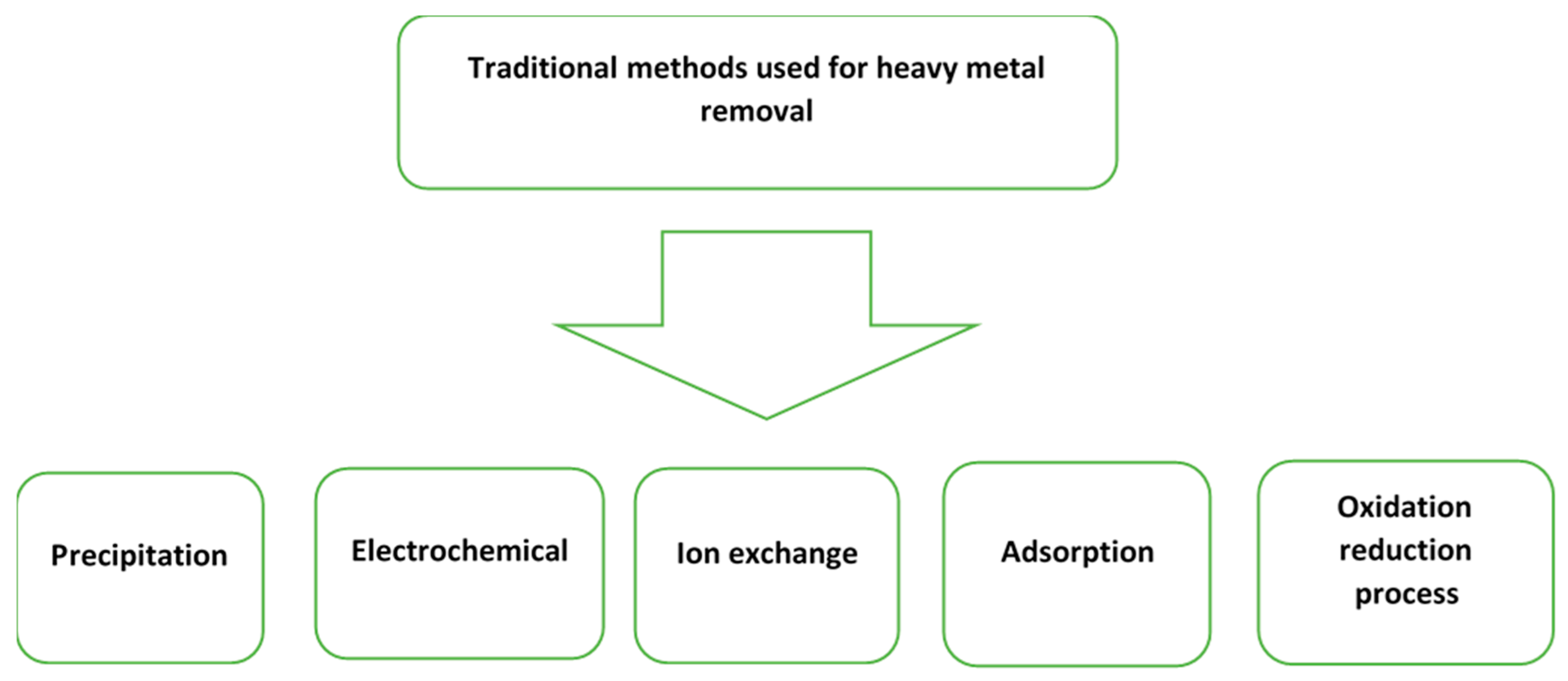
Figure 2.
Different mechanisms of adsorption of heavy metals M+ over the surface of bio-mass.
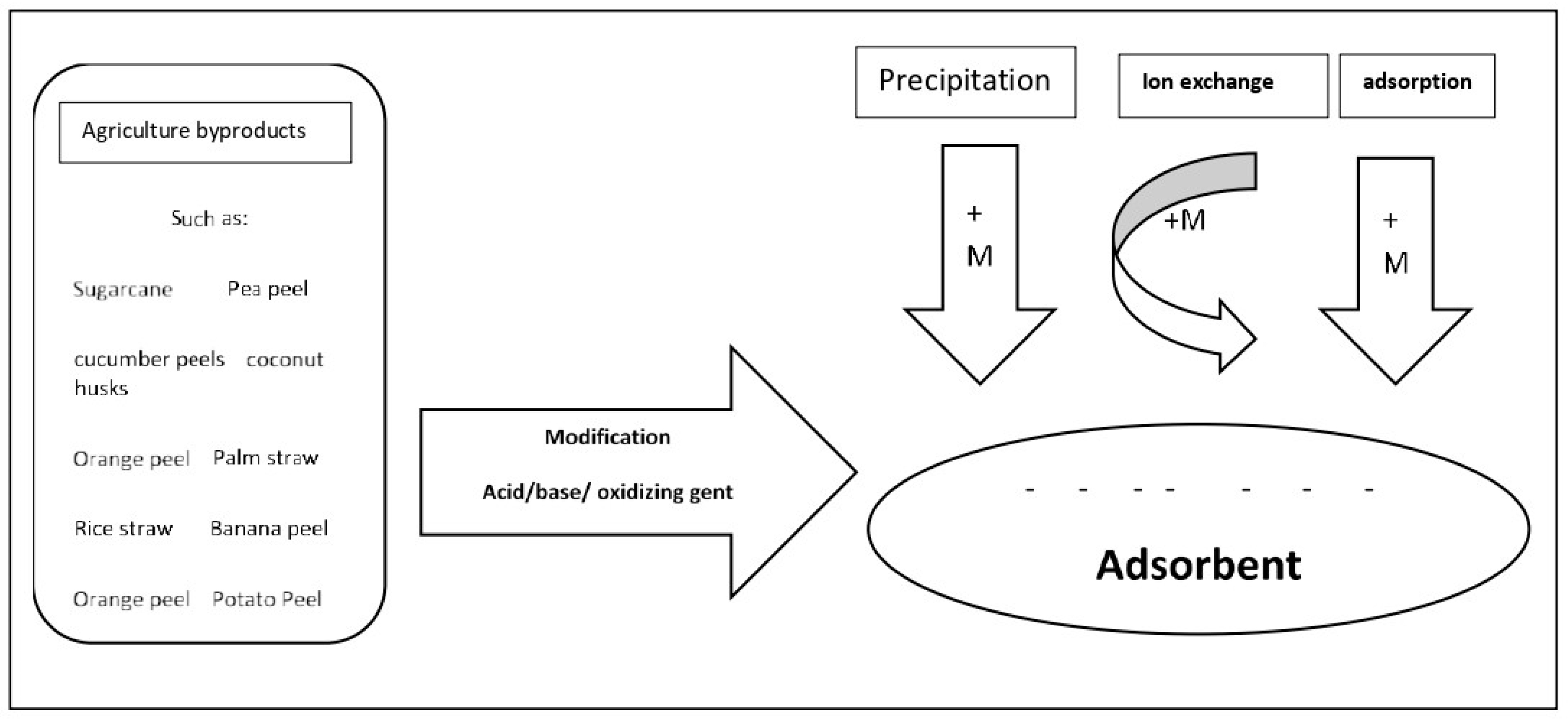
Figure 3.
The adsorption mechanism via mono and di adsorption process.
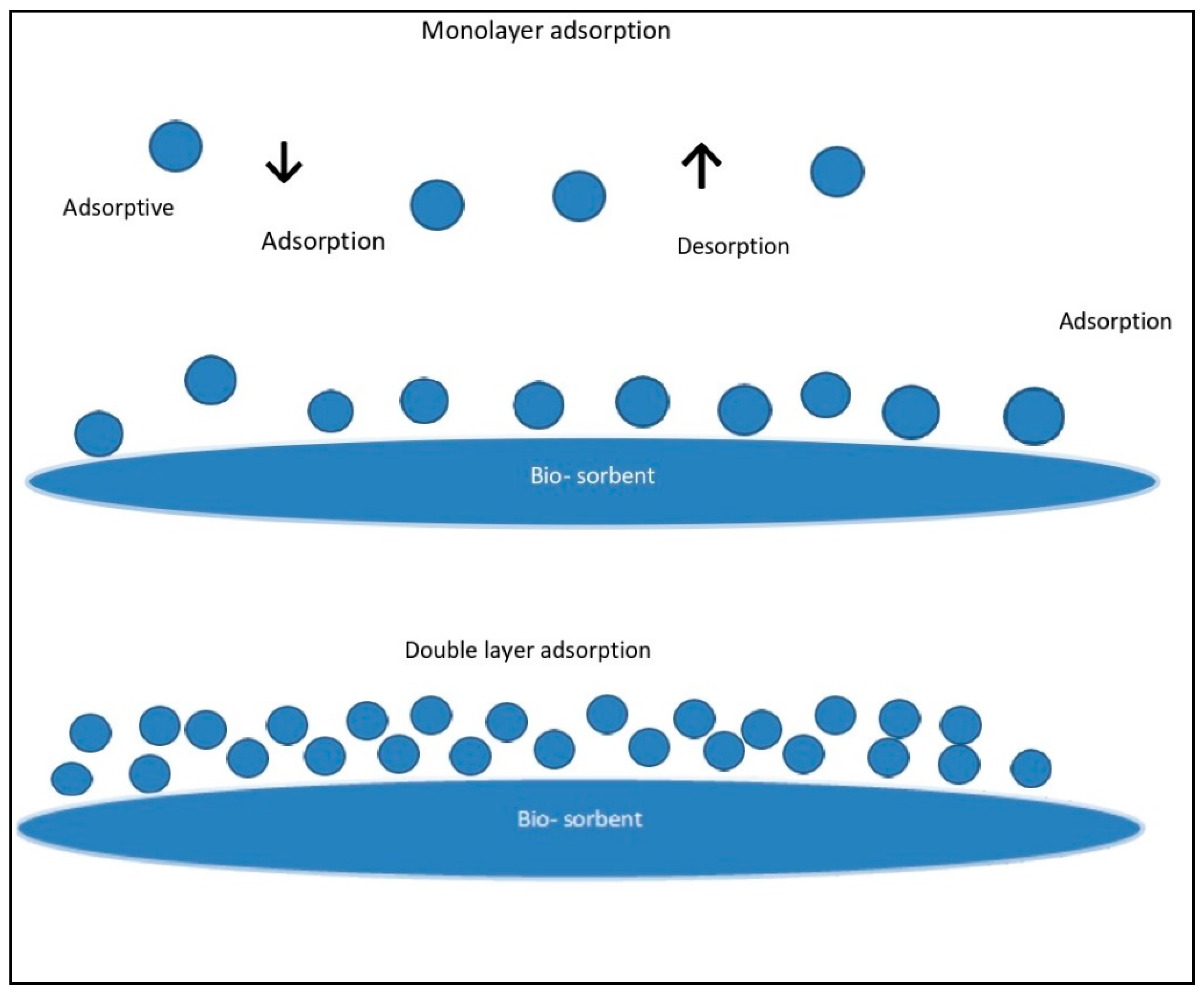

Table 1.
Major sources of heavy metals.
| The industry or activity | Generated Heavy metal |
|---|---|
| Electroplating | Chromium, lead, nickel, cadmium |
| Leather tanning | Chromium, arsenic, lead |
| Pesticide manufacture | Lead, cadmium, arsenic, mercury |
| Paints manufacture | Chromium, lead, nickel |
| Paper industry | mercury |
| Bleaching processes | Cadmium, arsenic, mercury |
| Batteries industry | Lead, cadmium |
Table 2.
Serious diseases caused by heavy metals.
| Heavy metal | Disease | References |
|---|---|---|
| Lead and zinc ions | Brain, bone, and Genetic damage Stomach problems, Skin agitation Puke, Sickness, Anemia. |
[104,105,106] |
| Mercury ions | Nervous system damage. Bad effect of lung and kidney |
[107,108,109] |
| Nickel ions | Lung and kidney diseases, Gastrointestinal distress, Lung fibrosis, Skin diseases, Human carcinogen | [110,111,112] |
| Cadmium ions | Human carcinogen Severe dangers to human health. Kidney dysfunction, High-level doses of exposure cause death |
[113,114,115] |
| Lead ions | Damage the central nervous system kidney, and the liver disease, Muscles weakness, Insomnia, Anemia, Dizziness, Renal damages | [116,117,118] |
| Chromium Cr+6 | Classified as more toxic Disturbance of physiology of humans, Lung carcinoma, Causes of cancer, Serious skin diseases |
[119,120,121] |
Table 3.
Agriculture by-products as heavy metal bio-sorbents (Hussain, Madan et al. 2021).
| S. No. | Type of waste -water | Type of adsorbent | Adsorbent Dosage )g/L) |
Metal ion | Amount of adsorbent )mg/g) | Time (Min.) |
Temperature (°C) |
pH | references |
|---|---|---|---|---|---|---|---|---|---|
| 1 | Hospital waste water | Cassava peels | 10 | Pb+2 Cu+2 |
5.80 8.00 |
20-120 | 39.85 | 8.0 | [122] |
| 2 | Aqueous solutions | Ash Gound peel | 6.0 | Cr+6 | 18.70 | 40-60 | 28.0 | 1.0 | [123] |
| 3 | Aqueous solution | Barly straw | 1.0 | Cu+2 | 4.64 | 12 | 25.0 | 6.0-7.0 | [124] |
| 4 | Aqueous solutioin | Cashew Nut | 3.0 | Ni+2 | 18.86 | 30 | 30.0 | 5.0 | [125] |
| 5 | Electroplating wash water | Chemically modified orangepeel | 2.0 | Cu+2 | 289.0 | 180 | 30.0 | 5.0 | [126] |
| 6 | Aqueous solution | Modified Lawny Grass | 0.5 | Pb+2 | 137.12 | 400 | 29.85 | 6.0 | [127] |
| 7 | Aqueous solution | Grapefruites peel | 2.0 | U+6 | 140.79 | 60-80 | 30.0 | 4.0-6.0 | [128] |
| 8 | Aqueous solutioin | Peaunt Shell | 1.0 | Cr+6 | 4.32 | 360 | 30.0 | 2.0 | [129] |
| 9 | Aqueous solution | Sugar can and orange peel | 1.0 | Pb+2 | 68.69 and 27.86 | 30 | 25.0 | 5.0 | [130] |
| 10 | Electroplating waste water | Mango peel | 5.0 5.0 5.0 |
Ni+2 Cu+2 Zn+2 |
39.75 46.09 28.21 |
120.0 | 25.0 | 6.0 | [131] |
| 11 | Aqueous solution | Whwat shell | 10 | Cu+2 | 17.42 | 60.0 | 25.0 | 7.0 | [132] |
| 12 | Aqueous solution | Sulfonated biochar | 2.0 | Pb+2 | 191.7 85.76 |
5.0 | 180.0 | 4.5 | [133] |
Table 4.
Different process involves agriculture by-product chemical treatments.
| The process | The reagent | Action | The effectiveness of removal | Reference |
|---|---|---|---|---|
| Alkylation | The treatment of the agro-wastes by base , the common bases are sodium hydroxide KOH or potassium hydroxide KOH. | The process involves enhance the surface area and exposing more function groups due to esters hydrolysis and the removal of amorphous fiber such as hemicellulose and lignin | The mechanical properties and thermal stability increase, exposing more function groups, accordingly the interaction between the metal ins and the modified surface is strongly enhanced leading to ease the adsorption of metal ions. | [134,135] |
| Acidification | Treatment the agro-waste with mineral acids such as HNO3, HCl, H3PO4, H2SO4 | Acidification promote the hydrolysis of the cellulose creating more function groups and opening the reticular shape of the cellulosic structure, the process involves increase the oxygen content of the product | Reduce the mineral content leading to increase the removal capacity, and create more adsorption sites. Therefore, the removal efficiency of the bio-sorbent increase, due to improvement of the acidic behavior and hydrophilicity of the surface | [136,137,138] |
| Esterification | The process involves the reaction of hydroxyl group in cellulose forming ester group. The common reagent used are EDTA (Ethylenediaminetetraacetic acid), citric acid and maleic anhydride anhydride | The process adds functional groups to the surface of the agro-wastes. It imparts carboxylic group to the surface. | Esterification enhances hydrophobicity and mechanical properties of the agro-wastes, accordingly the increase the rate of binding of the metal ions with the modified surface. | [139,140] |
| Etherification | The process involves replacing of the hydroxy group in the cellulose with other function groups, ethylene oxide, epoxides are the common reagents used in etherification Diethylenetriamine, ethylenediamine, triethyleneteramine are also utilized. | The process generates positive function groups yielding adsorption sites for holding of anions, such as phosphate, nitrate, and sulfate. |
The process involves the increase of functional groups and enhancement the efficiency of the interaction of metal ions with the surface. Functional groups such as -COO-, S-- and NH- are familiarized to the agro-wate surfaces | [139,141]. |
| Carbonization | Carbonization involves the thermal decomposition of agro-wastes producing a carbonaceous material, as a result, the bio-mass converted into biochar | The mineral constituents in biochar surfaces promote the construction of metal precipitates on the surface | Biochar has a great specific surface area leading to increase the removal efficiency of the bio-surface. The introduction of certain functional groups, heteroatoms into biochar can improve its surface properties and consequently the enhancement of the removal efficiency of the material. | [142,143,144] |
| Grafting | The process involves grafting of the agro - waste with the polymeric material, the backbone of a polymer is connected to a side chain of agro-wastes forming a branched co-polymer, grafting-from is the common treatment used and a appropriate initiator is utilized to introduce the modification process. |
The chemical initiator produces free radicals which react with hydroxyl groups on lignocellulose, it is extensively used owing to its low cost and simple processing. The linkage between backbone of the polymer and the side chain of the lignocellulose in agriculture wastes helps to form copolymer which increase the number of sites on the surface | Grafting change the physiochemical properties of the agro-waste which enhances the adsorption efficiency due to the extra added function groups through forming the copolymer. | [139,145,146] |
| Magnetization | The process involves introducing transition metal or transition metal oxide into the agro-wastes such as FeCl2, FeCl3, Fe2O3 and zero-valent nano metals | Grafting promotes the electrostatic attraction and complex formation between the toxic metal ions and grafted functional. Introducing metal oxides in the surface of agro-waste enhance particular functionalities to increase. Adsorption properties, for example, modification of lignocellulose with magnetic materials enhancing adsorption the efficiency of the surface permitting facile recovery of the agro-wastes | Transition metal and grafted metal-agro-waste displays good adsorption properties for the removal of toxic heavy metals compared with raw agro-wastes | [147,148,149] |
Disclaimer/Publisher’s Note: The statements, opinions and data contained in all publications are solely those of the individual author(s) and contributor(s) and not of MDPI and/or the editor(s). MDPI and/or the editor(s) disclaim responsibility for any injury to people or property resulting from any ideas, methods, instructions or products referred to in the content. |
© 2023 by the authors. Licensee MDPI, Basel, Switzerland. This article is an open access article distributed under the terms and conditions of the Creative Commons Attribution (CC BY) license (http://creativecommons.org/licenses/by/4.0/).
Copyright: This open access article is published under a Creative Commons CC BY 4.0 license, which permit the free download, distribution, and reuse, provided that the author and preprint are cited in any reuse.


