

Submitted:
25 December 2023
Posted:
26 December 2023
You are already at the latest version
Abstract
The increasing importance of batteries in the 21st century and the challenges posed by the anticipated growth in end-of-life batteries, particularly in Europe, are addressed. Projections indicate a significant increase in battery waste, with a specific focus on the recycling of black mass (BM)—a complex and hazardous byproduct of the battery recycling process. The research employs the Preferred Reporting Items for Systematic Reviews and Meta-Analyses (PRISMA) methodology to systematically analyze the hazardousness of BM derived from various types of batteries. The findings reveal the inherently hazardous nature of BM, classifying it under multiple hazardous properties (HPs) according to European regulations. The urgent need for a definitive legislative classification of the hazardousness of BM is emphasized, and the potential of innovative technologies and strategies to improve recycling performance while mitigating risks is highlighted. The research significantly contributes to understanding the complexities of BM recycling, providing a foundation for future advancements in this area and emphasizing the need for further exploration and economic feasibility analysis of recycling technologies.
Keywords:
black mass
; battery waste
; waste classification
; battery recycling
; hazardous properties
; European Regulations
; waste management
; recycling technologies
1. Introduction
The onset of the 21st century marks a significant escalation in the importance of batteries, a trend anticipated to intensify in the ensuing years. This escalation is not merely a reflection of technological progress but also indicates a fundamental shift in global energy dynamics. With the imminent battery boom, it becomes imperative to comprehend its widespread implications, especially concerning sustainability and resource management. Forecasts for the global battery market suggest a rapid expansion, with projections pointing to a market value exceeding 400 billion dollars and a total size reaching 4.7 TWh by 2030 [1]. This growth, predominantly propelled by the mobility sector, underscores not only an economic opportunity but also presents a series of challenges and responsibilities. A critical challenge in this context is the adaptation of the entire supply chain to accommodate this exponential growth. The battery industry, while flourishing, confronts a crucial limitation in the sourcing of raw materials, raising both availability and ethical concerns [2]. Therefore, a shift towards more sustainable, circular strategies is essential. These strategies encompass extending battery life, planning for their second life, and, most importantly, enhancing recycling processes [3]. Projected data for 2030 highlight an expected increase in end-of-life batteries across Europe, estimated to be around 264k tons. This figure presents a significant challenge when compared to the current recycling infrastructure, capable of handling only about 80k tons [4]. A crucial aspect of this challenge lies in the processing of black mass (BM), a complex and difficult-to-recycle powder byproduct resulting from initial processing stages like disassembly and pre-treatment (including mechanical size reduction, thermal processes, and density-based separation), which leads to a critical shortfall of efficient and cost-effective technologies in the following recycling steps [5]. The difficulties in recycling BM exacerbate the existing imbalance between the demand for and the capacity of recycling solutions. Consequently, bridging this gap requires a comprehensive approach that goes beyond logistical and financial strategies. It calls for an integrated response that combines political will and scientific efforts, working in synergy to develop a sustainable and efficient battery recycling ecosystem. Considering BM accounts for 40 to 50% of a battery's total weight [6], projections for 2030 underscore a significant challenge in Europe with the management of an estimated 105 to 132 kton of this material. The current practice of exporting BM to countries with advanced recycling facilities, while effective in handling the material, leads to a loss of potential revenue for Europe, as BM contains valuable elements like Cobalt and Lithium [7]. This exportation trend stands in contrast to the goals of the Critical Raw Materials Act [8], which aims to reduce Europe's reliance on imported raw materials. Additionally, the BM, despite its free transborder movement, is potentially hazardous. The composition of BM includes substances that are classified as hazardous under multiple EU regulations, starting from the Classification, Labelling and Packaging (CLP) Regulation (EU) No. 1272/2008 [9], which adheres to the United Nations' Globally Harmonized System (GHS) for the classification and labelling of chemicals. Additionally, these substances are regulated under REACH (Registration, Evaluation, Authorization and Restriction of Chemicals) Regulation (EU) No. 1907/2006, which is directly applicable in all EU member states [10]. Furthermore, these substances have been identified as hazardous by producers and importers in their notifications to the European Chemicals Agency (ECHA). It is noteworthy that these sources offer slightly different labelling and classifications, with the notifications typically indicating a more extensive range of hazardous aspects. Classifying BM as hazardous waste could potentially restrict its export beyond European borders, thereby ensuring the retention of valuable metals and non-metals within Europe [11]. This approach aligns with the Battery Regulation (EU) 2023/1542, which aims to foster a sustainable internal market by setting specific targets and threshold. Among these, by 2027, the regulation mandates a 50% recovery rate for lithium, escalating to 80% by 2031. For cobalt, copper, lead, and nickel, the targets are set at 90% recovery by 2027, rising to 95% by 2031 [12]. In addressing these challenges, the European Parliament has introduced an amendment, P9_TA (2023)0325, to the proposal for the European Critical Raw Materials Act Regulation. The amendment specifically adds paragraph 7a to Article 25, calling for the development of dedicated waste codes for lithium-ion batteries and their intermediate waste streams, with a particular focus on BM [13].
The primary research objective focuses on a systematic and comprehensive analysis of BM, as sourced from a diverse range of battery types. This involves an extensive collection of BM characterizations available in current scientific literature, assessing their hazardousness in line with the criteria outlined in Regulation (EU) No. 1357/2014, which defines waste classifications as hazardous and non-hazardous, based on the hazardous properties of the substances they contain [14]. This research objective aims to address the notable lack of specific studies dedicated to this topic and to provide orientation and methodologies for the interested stakeholders. In the dynamic field of battery recycling, the second research question targets the identification of advanced technologies and solutions specifically addressing hazardous elements highlighted in the initial research findings. This inquiry is crucial for guiding investments towards comprehensive solutions, not just interim measures. While the industry eagerly anticipates the development of batteries that are efficient, cost-effective, high-performing, and 100% recyclable with minimal effort, aspiring to reach Technology Readiness Level (TRL) 9, it is also imperative to address current challenges. This balance ensures that while striving for future technological breakthroughs, the immediate issues in battery recycling are not overlooked but are effectively resolved with targeted and strategic approaches.
2. Materials and Methods
2.1. PRISMA Methodology
In conducting this Systematic Literature Review (SLR), the Preferred Reporting Items for Systematic Reviews and Meta-Analyses (PRISMA) methodology is meticulously adhered to [15]. PRISMA provides a structured framework for gathering, evaluating, and synthesizing scientific evidence, ensuring the transparency and reproducibility of the research process. The initial stage involves a comprehensive search of relevant literature across two of the main scientific databases, Scopus and Science Direct, were consulted, using the following string (consulted on 02 December 2023): "black mass" AND ("recycling" OR "management" OR "characterization" OR "Europe" OR "hazardous" OR "regulation" OR "legislation" OR "sustainability" OR "waste" OR "technologies"). This allowed to the collect 1045 potentially useful papers for this SLR. Once collected and stored in files (.res format) containing the basic information of each paper and the related abstracts, they were uploaded to the Rayyan platform to facilitate the Appraisal step [16]. This phase opens with the definition of the eligibility criteria to be used for the preliminary inclusion and exclusion of the papers which are:
- Inclusion of peer-reviewed research articles, conference papers, and possibly government or industry reports. Exclusion of non-peer-reviewed sources like blog posts, news articles, or opinion pieces.
- Studies specifically focusing on BM in battery recycling, its characterization, management strategies, or related environmental and hazardous aspects.
- Inclusion of research articles published in English.
- Date Range of last 15 years (since 2008).
Through the eligibility criteria it was possible to proceed to the operational phase of selecting the papers that constitute the basis of the SLR in the Rayyan platform, following the procedure proposed by the PRISMA 2020 flow chart (Figure 1).
At the conclusion of the screening phase, a total of 36 research papers were selected for inclusion in this SLR. Among these, a significant 52.8% were published in the year 2023, followed by 19.4% in 2022, and 13.9% in 2021. To synthesize the findings of this sub-chapter, Table 1 is presented, which serves as a comprehensive repository of the characterizations gathered from the literature. The elements identified in the study are: Lithium (Li), Cobalt (Co), Nickel (Ni), Manganese (Mn), Aluminum (Al), Iron (Fe), Carbon (C), Cadmium (Cd), Potassium (K), Titanium (Ti), Silicon (Si), Calcium (Ca), Magnesium (Mg), Copper (Cu), Zinc (Zn), Lead (Pb), Phosphorus (P), Fluorine (F), Sodium (Na), Tin (Sn), Arsenic (As), and Silver (Ag). This table systematically categorizes the content of various substances found in BM, expressed in percentage terms. It also delineates the initial types of batteries from which the BM is derived, classified into distinct categories: Lithium-ion Batteries (LIBs), Nickel-Cadmium (Ni-Cd), Nickel-Metal Hydride (Ni-MH), and two separate groups of Zinc/Manganese batteries – Zinc/Manganese Carbon (Zn/Mn Mn-C) and Zinc/Manganese (Zn/Mn). The rationale for these distinct categorizations stems from the unique chemical compositions and recycling challenges associated with each battery type:
- Ni-Cd vs. Ni-MH: These batteries are separated due to their differing electrode materials and associated environmental impacts. Ni-Cd batteries contain cadmium, a toxic heavy metal, requiring specific handling and recycling processes. In contrast, Ni-MH batteries, while also based on nickel, replace cadmium with a metal hydride, altering the composition of the resultant BM.
- Zn/Mn Mn-C vs. Zn/Mn: The division between these Zinc/Manganese battery types is based on their distinct internal chemistries. Zinc/Manganese Carbon (Mn-C) batteries typically refer to alkaline batteries with added carbon, affecting their chemical profile and recycling process. In contrast, standard Zinc/Manganese batteries, often used in household applications, present a different composition, influencing the nature of their BM.

Table 1.
Characterization of black mass (BM) samples detailed in scientific literature, expressed as percentages of constituent elements (%).
Table 1.
Characterization of black mass (BM) samples detailed in scientific literature, expressed as percentages of constituent elements (%).
| Sample | 1 | 2 | 3 | 4 | 5 | 6 | 7 | 8 | 9 | 10 |
|---|---|---|---|---|---|---|---|---|---|---|
| Type | Mixed LIBs | Mixed LIBs | Mixed LIBs | Mixed LIBs | Mixed LIBs | Mixed LIBs | Mixed LIBs | Mixed LIBs | Mixed LIBs | Mixed LIBs |
| Li | 3,4 | 9,725 ± 0,055 | 4,39 ± 0,14 | 4,302 ± 0,03 | 3,9 | 2,6 | 3,21 | 3,9 ± 0,1 | 4,95 ± 1,35 | 2,95 ± 0,25 |
| Co | 17,9 ± 0,1 | 7,29 ± 0,02 | 8,34 ± 0,01 | 4,11 ± 0,029 | 17,5 | 5,4 | 5,3 | 31,85 ± 0,45 | 12,65 ± 4,65 | 24 ± 2 |
| Ni | 4,54 ± 0,16 | 21,395 ± 0,005 | 16,485 ± 0,085 | 12,008 ± 0,084 | 5,1 | 12,5 | 14,6 | 11,4 ± 4,1 | 11 | |
| Mn | 5,58 ± 0,08 | 7,37 ± 0,13 | 9,39 ± 0,07 | 6,076 ± 0,042 | 3 | 10,9 | 5,09 | 11,35 ± 3,75 | 0,725 ± 0,185 | |
| Al | 5,405 ± 0,05 | 7,87 ± 0,11 | 1,185 ± 0,075 | 32,815 ± 0,09 | 1,6 | 4,8 | 2,02 | 0,65 ± 0,25 | 0,1 ± 0,1 | |
| Fe | 1,615 ± 0,185 | 0,235 ± 0,145 | > 0 | 1,6 | 2,3 | 0,326 ± 0,234 | ||||
| C | 9,17 ± 1,75 | 36 | 42,1 | 39,9 | 39,6 ± 4,2 | 28 ± 15,2 | ||||
| Cd | > 0 | |||||||||
| K | > 0 | 1,25 ± 0,15 | ||||||||
| Ti | 3,91 ± 0,09 | 0,15 ± 0,03 | 0,91 | |||||||
| Si | 2,115 ± 0,085 | > 0 | 1,6 | 1,15 ± 0,15 | ||||||
| Ca | 0,105 ± 0,045 | > 0 | ||||||||
| Mg | 0,08 ± 0,04 | 0,07 ± 0,02 | ||||||||
| Cu | 3,95 ± 0,05 | 2,135 ± 0,155 | 2,11 ± 0,04 | 5,067 ± 1,403 | 3,9 | 3,1 | 1,83 | 0,5 ± 0,1 | 1,2 ± 0,4 | 6,95 ± 5,05 |
| Zn | 0,894 ± 0,045 | 0,5 ± 0,41 | ||||||||
| Pb | ||||||||||
| P | 0,55 | 0,45 ± 0,05 | 0,5 ± 0,1 | |||||||
| F | 2,5 | 2,35 ± 0,25 | 5,7 ± 0,8 | |||||||
| Na | 0,315 ± 0,015 | |||||||||
| Sn | 0,72 ± 0,28 | |||||||||
| As | ||||||||||
| Ag | ||||||||||
| Source | [7] | [7] | [7] | [5] | [17] | 17 | [18] | [19] | [19] | [20] |
| Sample | 11 | 12 | 13 | 14 | 15 | 16 | 17 | 18 | 19 | 20 |
| Type | Mixed LIBs | Mixed LIBs | Mixed LIBs | Mixed LIBs | Mixed LIBs | Mixed LIBs | Mixed LIBs | Mixed LIBs | Mixed LIBs | Mixed LIBs |
| Li | 2,24 ± 0,02 | 6,96 | 3,4 | 3,69 | 3,9 | 1,81 | 1,65 | 4 | 3,6 | 4 ± 0,4 |
| Co | 22 ± 0,14 | 5,8 | 11,7 | 24,6 | 17,1 | 0,17 | 32,3 | 8 | 26 ± 2,6 | |
| Ni | 2,71 ± 0,04 | 0,01 | 22,2 | 11,5 | 3,9 | 2,22 | 0,14 | 7,3 | 7,3 ± 0,7 | |
| Mn | 0,75 | 0,88 | 7,3 | 8,91 | 2,9 | 4,54 | 0,1 | 7,6 | 3,2 ± 0,3 | |
| Al | 3,88 ± 0,05 | 16,4 | 5,06 | 2,1 | 1,6 | 1,9 | 3,12 | 0,9 | 0,2 | 1,4 ± 0,1 |
| Fe | 6,51 ± 0,12 | 0,2 | 0,54 | 2,5 | 10,72 | |||||
| C | 20,5 ± 0,27 | 33,9 | 33 | 49,33 | 37,1 | 35,4 | 43,2 | |||
| Cd | ||||||||||
| K | 0,12 ± 0,01 | |||||||||
| Ti | ||||||||||
| Si | 0,37 ± 0,07 | 51,1 | 1,6 | 1 | ||||||
| Ca | 1,26 | 0,13 ± 0,01 | ||||||||
| Mg | ||||||||||
| Cu | 4,69 ± 0,02 | 0,11 | 6,9 | 0,88 | 1,1 | 0,68 | 0,82 | 0,6 | 1,6 | 2,8 ± 0,3 |
| Zn | 0,11 | |||||||||
| Pb | ||||||||||
| P | 0,44 | 9,64 | 0,5 | 0,6 | ||||||
| F | 4,1 | 2,6 | 6,5 | |||||||
| Na | ||||||||||
| Sn | ||||||||||
| As | ||||||||||
| Ag | 0,32 ± 0,01 | |||||||||
| Source | [21] | [22] | [23] | [24] | [25] | [26] | [27] | [28] | [28] | [29] |
| Sample | 21 | 22 | 23 | 25 | 24 | 26 | 27 | 28 | 29 | 30 |
| Type | Mixed LIBs | Ni-Cd | Ni-Cd | Ni-Cd | Ni-MH | Zn/Mn Mn-C | Zn/Mn | Zn/Mn | Zn/Mn | Zn/Mn |
| Li | 3,87 | 0,03 ± 0,02 | 0,0515 ± 0,0105 | |||||||
| Co | 26,45 | 1,5 ± 0,1 | 2,55 ± 2,25 | 2,4 ± 0,2 | 7,1 ± 1,2 | 0,03 | ||||
| Ni | 2,74 | 37,4 ± 2,1 | 31 ± 17 | 44,5 ± 4,5 | 62,5 ± 1,5 | 0,28 | ||||
| Mn | 1,67 | 0,88 ± 0,09 | 2,45 ± 1,15 | 43,3 | 38,7 | 28,45 ± 4,35 | 54,7 ± 4,3 | 30,6 | ||
| Al | 1,64 | 0,22 ± 0,02 | 0,675 ± 0,205 | 0,46 | 1,06 | 1,33 ± 0,17 | 0,79 | 0,79 | ||
| Fe | 0,61 | 0,8 ± 0,2 | 37,08 ± 36,92 | 3,4 ± 0,5 | 4,8 ± 1,4 | 1,42 | 9,06 | 8,145 ± 0,055 | 5,76 | |
| C | 33 | 2,4 ± 0,3 | 8,2 | 24,6 | 19 | |||||
| Cd | 27,7 ± 1,6 | 26 ± 15 | 20,9 ± 2,1 | 0,128 ± 0,092 | 0,01 | |||||
| K | 0,05 | 2,4 ± 0,2 | 2,3 ± 1,8 | 2,8 ± 0,3 | 2,75 ± 0,35 | 6,7 | 0,24 | 2,735 ± 2,465 | 0,585 ± 0,085 | 0,35 |
| Ti | 6,35 ± 0,75 | 0,191 | ||||||||
| Si | 1,69 | 5 | ||||||||
| Ca | 0,03 | |||||||||
| Mg | 0,09 | 0,23 | ||||||||
| Cu | 2,72 | 0,13 | 0,15 | 0,08 | ||||||
| Zn | 0,04 | 0,955 ± 0,645 | 2,55 ± 0,45 | 26,88 | 11,1 | 11,05 ± 4,05 | 0,535 ± 0,135 | 34,8 | ||
| Pb | 0,04 | |||||||||
| P | 0,45 | |||||||||
| F | ||||||||||
| Na | 0,06 | 0,515 ± 0,135 | 0,395 ± 0,155 | 0,03 | 0,035 ± 0,005 | 0,19 | 0,09 | |||
| Sn | 2,83 ± 1,97 | 6 ± 1,7 | ||||||||
| As | 0,41 ± 0,19 | |||||||||
| Ag | ||||||||||
| Source | [30] | [31] | [20] | [32] | [20] | [33] | [34] | [35] | [35] | [36] |
2.1. Black Mass Hazardousness Classification
The methodology employed to classify the hazardousness of BM in this study is multifaceted and robust, incorporating various regulatory frameworks and a comprehensive database analysis. The initial step involved attributing Hazard Statement Codes (HSCs) to the elements detected in BM. These codes, as defined by the CLP Regulation, REACH, and company notifications, identify specific types of hazards. For instance, lithium is assigned the HSC "H260 - Water-react. 1" by the CLP, indicating that it releases flammable gases upon contact with water, which may ignite spontaneously. The HSCs associated with the various elements present in BM are comprehensively detailed in Table 2. In addressing the complexity of BM, which contains elements in a variety of compounds and mixtures, the classification process focused on the most fundamental compound form of each element. This methodology was adopted to ensure a precise assessment of the potential hazards, recognizing that the inherent risk of each element can significantly vary depending on its chemical state within the BM.
Subsequently, EU Regulation No. 1357/2014 was consulted. This regulation assigns hazard categories to substances based on the presence or exceedance of certain percentages of substances with specific HSCs. Following this, a cross-referencing of the data was conducted. This process involved excluding hazard categories where the substances present in the BM did not contain the required HSCs and analyzing the remaining relevant hazard categories. Table 3 delineates the criteria used to assign hazardous properties (HP) for waste classification, detailing the elements of BM analyzed. For HP2 – Oxidizing and HP3 – Flammable, the mere presence of specific substances is the determining factor. Other HPs require quantifiable thresholds for each HSC, with some thresholds pertaining to individual substances (Indicated as 'Ind.' in the table), such as HP5 – Specific Target Organ Toxicity (STOT). Conversely, certain thresholds are cumulative, applying to the total sum of substances within a particular HSC category.
The final stage of the methodology involved a detailed analysis of results from two distinct perspectives. It encompassed an evaluation of individual BM samples, assessing both their minimum and average values, and the construction of theoretical Category-Specific BM (CSBM). This theoretical construction is based on the original battery types, considering the average values across different BM samples within a category, such as Mixed LIBs, as well as the lowest values observed in these samples. If a substance's minimum value is zero in any category, it is excluded from that CSBM composition (Table 4). Three distinct scenarios were considered for a multifaceted hazard assessment:
- Scenario One: Focused exclusively on the CLP Regulation classifications, this scenario adheres to the GHS criteria and the labeling rules agreed upon by the United Nations.
- Scenario Two: This intermediate scenario broadens the scope by incorporating HSCs from both CLP and REACH classifications, thus expanding the regulatory purview.
- Scenario Three: The most expansive scenario, it compiles all classifications, including those by manufacturers and importers, to reveal the full potential of HPs associated with the BM. This comprehensive view is inclusive of extra-European legislative considerations and provides the most extensive hazard potential profile.
This structured scenario analysis allows for a discerning and layered evaluation of BM hazards, distinguishing the fundamental HP classification from the extended potential risks across varying regulatory frameworks. The approach underpins a thorough appraisal of the BM's intrinsic and potential hazards within the battery recycling milieu.
Table 4.
Average (Av.) and Minimum (Min.) Category-Specific BM (CSBM) compositions.
| (%) | LIBs | Ni-Cd | Ni-MH | Zn/Mn Mn-C | Zn/Mn | |||||
|---|---|---|---|---|---|---|---|---|---|---|
| Av. | Min. | Av. | Min. | Av. | Min. | Av. | Min. | Av. | Min. | |
| Li | 3,93 | 1,65 | 0,01 | - | 0,05 | 0,04 | - | - | - | - |
| Co | 14,69 | - | 2,15 | 0,30 | 7,10 | 5,90 | 0,03 | 0,03 | - | - |
| Ni | 8,05 | - | 37,63 | 14,00 | 62,50 | 61,00 | 0,28 | 0,28 | - | - |
| Mn | 4,63 | - | 0,29 | - | 2,45 | 1,30 | 43,30 | 43,30 | 38,11 | 24,10 |
| Al | 4,51 | - | 0,07 | - | 0,68 | 0,47 | 0,46 | 0,46 | 0,99 | 0,79 |
| Fe | 1,29 | - | 13,76 | 0,16 | 4,80 | 3,40 | 1,42 | 1,42 | 5,74 | - |
| C | 22,87 | - | 0,80 | - | - | - | 8,20 | 8,20 | 10,90 | - |
| Cd | 0,00 | - | 24,87 | 11,00 | 0,13 | 0,04 | 0,01 | 0,01 | - | - |
| K | 0,07 | - | 2,50 | 0,50 | 2,75 | 2,40 | 6,70 | 6,70 | 0,98 | 0,24 |
| Ti | 0,24 | - | - | - | 6,35 | 5,60 | 0,19 | 0,19 | - | - |
| Si | 2,81 | - | - | - | - | - | 1,69 | 1,69 | 1,25 | - |
| Ca | 0,07 | - | - | - | - | - | - | - | - | - |
| Mg | 0,01 | - | - | - | - | - | 0,23 | 0,23 | - | - |
| Cu | 2,55 | 0,11 | 0,04 | - | 0,15 | 0,15 | 0,08 | 0,08 | - | - |
| Zn | 0,07 | - | 0,32 | - | 2,55 | 2,10 | 26,88 | 26,88 | 14,37 | 0,40 |
| Pb | - | - | - | - | - | - | 0,04 | 0,04 | - | - |
| P | 0,63 | - | - | - | - | - | - | - | - | - |
| F | 1,13 | - | - | - | - | - | - | - | - | - |
| Na | 0,02 | - | 0,17 | - | 0,40 | 0,24 | - | - | 0,09 | 0,03 |
| Sn | 0,03 | - | 0,94 | - | 6,00 | 4,30 | - | - | - | - |
| As | - | - | - | - | 0,41 | 0,22 | - | - | - | - |
| Ag | 0,02 | - | - | - | - | - | - | - | - | - |
3. Results
In the results chapter, an intricate analysis was conducted for each HP as defined in the EU Regulation No. 1357/2014. This analysis cross-referenced the conditions of the regulation with the attributed HSCs in the three scenarios outlined in the methodology. The analysis was applied to both individual BM samples and CSBM, assessing their minimum and average values. The findings are summarized in two distinct tables for each scenario, outlining the classification of BM as hazardous waste:
- Individual Sample Compatibility with HPs: The first table presents the compatibility of individual samples with each HP, categorized by battery type. Each value represents the percentage of samples in a battery category adhering to a specific HP, ranging from 0% (in green), indicating no sample falls under the category, to 100% (in red), denoting all samples fit the category. These percentages are displayed on a color scale to visually represent the increasing likelihood of BM from a specific battery category falling under the respective HP.
- CSBM Analysis: The second table focuses on CSBM, considering the average and minimum values as described in Table 4. It uses a simple 'Y' (Yes) in red to indicate classification under a specific HP, or 'N' (No) in green when it does not fall under that HP.
3.1. Scenario One: CLP Regulation classifications
Scenario One is instrumental in understanding which HPs the BM should be classified under, as it solely considers the substance classification provided by the CLP Regulation. A comprehensive overview, synthesized in Table 5 and Table 6, reveals that all samples are classifiable under HP3 - Flammable due to the presence of Li, K, Na, and Ca, even in the CSBM constructed with the lowest values among the samples. Two other notable categories are HP4 - Irritant and HP8 - Corrosive. The BM derived from LIBs and Nickel-based batteries show significant presence of elements with the H314 code (Skin corr. 1A and 1B) exceeding 1%. Consequently, all samples of these two battery types that do not fall under HP4 - Irritant have a percentage of these elements above 5%, classifying them in the HP8 - Corrosive category. Furthermore, nearly all the LIBs and Nickel-based BM samples are classified as HP7 - Carcinogenic due to more than 0.1% presence of Co, except for Sample 12. They also fall under HP10 - Toxic for reproduction and HP11 - Mutagenic, where the presence of Co must be equal to or exceed 0.3% and 1%, respectively (excluding Sample 17). The analysis reveals that BM originating from LIBs is potentially classified under nine distinct HPs, in contrast to zinc-based BMs, which may be categorized under two HPs. This distinction arises from the LIBs BM samples containing adequate amounts of Li, Co, and F. For BMs from Zn/Mn Mn-C and Zn/Mn, the presence of K and Na results in a definitive classification of the former as HP8 - Corrosive, while the latter is likely to be classified under HP4 - Irritant.
3.2. Scenario Two: CLP Regulation and REACH classifications
Scenario Two extends the analysis to encompass REACH classification, marking a significant divergence from Scenario One (Table 7 and Table 8). Beyond reinforcing the HPs identified earlier, this scenario introduces additional categories. This results in the attribution of additional HPs to the BM from LIBs and Nickel-based batteries. In HP5 - STOT, BM is classified due to the presence of Ni and Cd at or above 1%, recognized as H372 - STOT RE 1, and/or Co at 10% classified as H373 - STOT RE 2 under REACH. For HP6 - Acute Toxicity, while P and As remain under the limits for H300 - Acute Tox. 2 (Oral) and H301 - Acute Tox. 3 (Oral), Co exceeds 25% for H302 - Acute Tox. 4 (Oral), F surpasses 0.1% for H330 - Acute Tox. 1 (Inhal.), and the cumulative presence of Co, Cd, P, and F crosses 0.5% for H330 - Acute Tox. 2 (Inhal.). Furthermore, the addition of Ni as H317 - Skin Sens. 1 by REACH leads to almost all LIBs and Nickel-based samples falling under HP13 – Sensitizing. Ni's classification by REACH as H350 - Carc. 1A and 1B and H3512 - Carc. 2 specifically impacts Zn/Mn Mn-C batteries in terms of HP7 - Carcinogenic. In summary, for LIBs, 10 HP categories are identified, with only one at 100% but the others showing very high percentages. Ni-Cd and Ni-MH batteries are classified under 8 categories, all achieving 100% (alternating between HP4 and HP8 for exceeding 5%). Zn/Mn Mn-C fall under 3 categories, all at 100%, and Zn/Mn under 2. Consequently, under CLP and REACH regulations, Zn/Mn batteries emerge as the least hazardous, although they should still be classified as HP3 - Flammable based on the literature samples analyzed.
3.3. Scenario Three: CLP Regulation, REACH, and Notification classifications
Scenario Three is as critical as its predecessors because it incorporates notifications that fall outside European regulations yet signal the presence of potential additional hazards in BM substances (Table 9 and Table 10). These notifications call for actions to be taken or, at the very least, for a careful evaluation of the reasons behind their issuance. In this scenario, BM from LIBs-based batteries has achieved 100% classification in six categories: HP3 - Flammable, HP4 - Irritant, HP5 - STOT, HP6 - Acute Toxicity, HP8 - Corrosive, and HP11 - Mutagenic. Categories HP7 - Carcinogenic, HP10 - Toxic for reproduction, and HP13 - Sensitizing are near 100% due to specific samples, such as sample 12, which lacks Co and has high levels of Si, and sample 17, which is rich in C and Fe. For Nickel-based BM, there is an increase in percentages for HP8 - Corrosive, while the other HPs remain largely unchanged. Notable changes are apparent in Zn/Mn Mn-C and Zn/Mn categories. Both reach 100% classification in every involved HP, escalating from 3 to 8 and from 2 to 6 categories, respectively, falling under HP5 - STOT, HP6 - Acute Toxicity, HP10 - Toxic for reproduction, and HP11 - Mutagenic.
4. Discussion
A pivotal aspect of this analysis is the comparison of CSBM across different scenarios, with a particular focus on Table 10, which contrasts the minimum values in Scenario One and the average values in Scenario Three for CSBM. Scenario One serves as the baseline of our analysis. Here, the classification is conservative, primarily driven by the flammability risk due to the presence of elements like Li, K, Na, and Ca, which directly contribute to HP3 - Flammable. In this baseline scenario, other substances such as F play a role in HP4 - Irritant and HP8 - Corrosive, while Co influences HP7 - Carcinogenic; HP10 - Toxic for reproduction; and HP11 - Mutagenic. In contrast, Scenario Three is recognized as the most precautionary, given that it considers a wider array of properties. By incorporating average values in each CSBM, Scenario Three takes into account the international concern related to BM elements, revealing a broadened hazard profile. The final line of Table 11 contemplates a generic BM classification based on HPs that appear across all CSBMs. This reveals that, within the baseline scenario, HP3 - Flammable is the sole HP involved, dictated by the aforementioned elements.
To address the flammability issue associated with BM during the recycling processes, the risk mitigation strategies proposed by [37] can be considered. In this work, the author examines various methods to reduce the fire hazard during the preliminary stages of the recycling process. Firstly, discharging the spent batteries is crucial to prevent sparks or explosions during dismantling. This is achieved mainly through three methods: electrolytic discharge using salt solutions, ohmic discharge using an external circuit, and cryogenic discharge with liquid nitrogen or in a vacuum atmosphere. Each of these methods has specific advantages and disadvantages, such as the use of alkali salts to prevent corrosion in electrolytic discharge, or the limited effectiveness and high costs of cryogenic discharge. Secondly, for industrial-scale recycling, the method of shredding the batteries in a protected environment is often preferred to reduce the fire risk. Techniques such as the use of water sprays or nitrogen gas, CO2 atmospheres, or inert gases like argon or nitrogen during shredding have been implemented to prevent oxidation of lithium and other reactive elements in the batteries. Further studies have indicated additional significant innovative pre-treatment that can be integrated to enhance both the safety and efficiency of the process. [38] highlights the significance of crusher grid size and pre-treatment temperature in the processing of BM. It has been observed that finer grid sizes and optimized pre-treatment temperatures can effectively minimize the formation of fine, potentially flammable particles. This approach not only contributes to a reduction in flammability risks but also facilitates the management of particle size distribution, crucial for subsequent processing stages. [39] focuses to the method of discharging batteries using a 5% NaCl solution. This technique serves a dual purpose: it mitigates the risk of hazardous reactions inherent in the recycling process and enhances the recovery efficiency of valuable metals. The reduction of reactive and flammable components within the BM through this method renders the material safer for handling and further processing. [28] introduces the concept of mechanical activation, particularly through milling, as a means to influence the reactivity and reducibility of BM. This process not only advances the energy efficiency of the overall recycling procedure but also impacts the particle size, leading to a more controlled reduction process. The alteration in particle size brought about by mechanical activation plays a pivotal role in managing the flammability risks associated with BM. The preceding sections have provided an in-depth analysis of pretreatment strategies essential for the conditioning of BM from LIBs. These strategies facilitate the separation of materials and enhance the reactivity of the input for recycling processes. Moving forward from pretreatment to the recycling of BM, a detailed synopsis is presented in Table 12, in which a diverse array of BM recycling methodologies, characterized by their distinct operational principles, recovery efficiencies, and inherent limitations.
Among these, methodologies such as direct leaching in H2SO4 with dry digestion method [22] and selective leaching using formic acid and hydrogen peroxide [27] are notable for their high-efficiency rates, achieving up to 100% recovery of lithium. Such rates are indicative of the substantial progress in material recovery from expended LIBs. Nevertheless, these recycling technologies also confront a series of operational and environmental challenges. Technologies like electrolytic junction transfer (ETJ) [40] and early-stage lithium recovery (ESLR) using supercritical CO2 leaching [24] are at the forefront of physicochemical innovation but require further enhancements in energy efficiency and CO2 emission mitigation to align with sustainability objectives. Emerging technologies, including carbothermic reduction and hydrochlorination [26] and electroassisted leaching [45], while promising in recovery rates, necessitate rigorous management of materials and fine-tuning of process conditions. The juxtaposition of high recovery efficacy against the complexity of the processes necessitates a meticulous assessment of trade-offs. The mechanochemical treatment and acid leaching approach [41], despite its reduced energy demand, demonstrates the requirement for process flexibility in the presence of persistent impurities such as fluorides, suggesting that the applicability of recycling technologies may be contingent upon the specific composition of the BM. Within this technological spectrum, methods approaching the cusp of industrial viability, such as solvent extraction for Zn and Mn recovery [44] and the exploitation of organic solvents [42], are classified at a TRL of 5 to 6. These methods underscore a pivotal phase in the transition from experimental to scalable applications. They highlight the need for a judicious equilibrium between elevated operational temperatures and the imperatives of optimization. The strategy of scalable direct recycling of cathode BM [46] advocates for a recycling process with circularity principles, achieving not only high recovery rates but also maintaining the functionality of the material, which is a promising trajectory for sustainable recycling.
5. Conclusions
The present study has delved into the complexities surrounding the recycling of BM in batteries, an area of increasing concern given the surge in end-of-life batteries projected in the introduction. The investigation has highlighted the complex and potentially hazardous nature of BM, deduced from the interrelationships between the various regulations that constitute the European regulatory framework for categorizing and labeling substances and waste. A primary urgency identified is the need for a definitive legislative classification of the hazardousness of BM. This research has significantly contributed to this aspect, answering to the first research question, by demonstrating that all samples of BM should be classified as hazardous, at a minimum under the HP4 category, which pertains to flammability.
Despite the identified hazards, the study also sheds light on the existence of innovative technologies and strategies capable of mitigating these risks while enhancing BM recycling performance, according to the second research question. These advancements suggest that, although the recycling of BM presents significant challenges, they are not insurmountable. The development and implementation of these technologies are essential for transforming the way BM is handled, making recycling processes safer and more efficient.
While this research has made substantial contributions, it also opens up avenues for further exploration. The limited sample size used in the SLR, consisting of 30 samples including two from 2009 (one mixed Lithium-ion and one Ni-Cd), while representative, offers a valuable starting point for more extensive or specific future studies. Expanding upon this initial sample with the study's robust methodology can enrich the understanding of BM recycling, catering to a wider array of BM types and compositions.
Additionally, the variability in BM composition across different battery types, though a challenge, presents an opportunity to deepen research into diverse recycling methods. This can lead to more tailored and efficient recycling strategies, accommodating the full spectrum of BM characteristics.
Amidst the rising battery waste in Europe, the volume of BM increases, there is an impending need to estimate the current European capacities for recycling BM and to identify the existing gaps. Addressing these gaps will require a concerted effort in investing and evaluating the innovative technologies discussed in the previous chapters.
Future studies should aim to conduct a detailed economic feasibility analysis of these technologies, assessing the potential for industrial-scale upscaling, the timeframe required for such advancements, the cost-effectiveness and potential revenues from recovered materials. This approach is imperative for ensuring that the recycling processes are not only environmentally sound but also attractive for financiers and entrepreneurs.
The conducted study establishes a pivotal foundation for future advancements in BM recycling. Bridging scientific inquiry with legislative frameworks, it marks a significant stride towards responsible and effective management in the battery recycling domain. This investigation not only tackles the immediate complexities but also establishes a solid base for future scientific and regulatory developments, which are vital for navigating the environmental challenges ahead.
References
- J. Fleischmann et al., “Battery 2030: Resilient, sustainable, and circular Battery demand is growing — and so is the need for,” McKinsey Co., 2023.
- Q. Dai, J. C. Kelly, L. Gaines, and M. Wang, “Life cycle analysis of lithium-ion batteries for automotive applications,” Batteries, vol. 5, no. 2, 2019. [CrossRef]
- A. Bhuyan, A. Tripathy, R. K. Padhy, and A. Gautam, “Evaluating the lithium-ion battery recycling industry in an emerging economy: A multi-stakeholder and multi-criteria decision-making approach,” J. Clean. Prod., vol. 331, 2022, [Online]. Available: https://www.scopus.com/inward/record.uri?eid=2-s2.0-85120832737&doi=10.1016%2Fj.jclepro.2021.130007&partnerID=40&md5=5e2fa19dcb54dd5c9b970ba340125a31.
- Motus E, Strategy&, and Politecnico Milano, “Il riciclo delle batterie dei veicoli elettrici @ 2050: scenari evolutivi e tecnologie abilitanti,” 2023.
- L. Donnelly et al., “The Recycling of End-of-Life Lithium-Ion Batteries and the Phase Characterisation of Black Mass,” Recycling, vol. 8, no. 4, 2023. [CrossRef]
- AquaMetals, “What Exactly is Lithium Battery ‘Black Mass’?” [Online]. Available: https://aquametals.com/recyclopedia/what-exactly-is-black-mass/.
- M. Dadé, T. Wallmach, and O. Laugier, “Detailed Microparticle Analyses Providing Process Relevant Chemical and Microtextural Insights into the Black Mass,” Minerals, vol. 12, no. 2, 2022. [CrossRef]
- European Commission, COM (2023) 160 final. https://eur-lex.europa.eu/resource.html?uri=cellar:903d35cc-c4a2-11ed-a05c-01aa75ed71a1.0001.02/DOC_1&format=PDF, 2023. [CrossRef]
- European Commission, Regulation (EC) No 1272/2008. https://eur-lex.europa.eu/legal-content/EN/TXT/?uri=celex%3A32008R1272, 2008. [Online]. Available: https://eur-lex.europa.eu/legal-content/EN/TXT/?uri=celex%3A32008R1272.
- European Commission, Regulation (EC) No 1907/2006. https://eur-lex.europa.eu/eli/reg/2006/1907/2023-08-06, 2006. [Online]. Available: https://eur-lex.europa.eu/eli/reg/2006/1907/2023-08-06.
- S. Frédéric, “EU urged to restrict export of black mass from used electric vehicles,” Euractive.
- European Commission, Regulation (EU) No 2023/1542. 2023. [Online]. Available: https://eur-lex.europa.eu/eli/reg/2023/1542/oj.
- European Parliament, P9_TA (2023)0325. https://www.europarl.europa.eu/doceo/document/TA-9-2023-0325_EN.pdf. [Online]. Available: https://www.europarl.europa.eu/doceo/document/TA-9-2023-0325_EN.pdf.
- European Commission, Regulation (EU) No 1357/2014. [Online]. Available: https://eur-lex.europa.eu/legal-content/EN/TXT/?uri=celex%3A32014R1357.
- W. Mengist, T. Soromessa, and G. Legese, “Method for conducting systematic literature review and meta-analysis for environmental science research,” MethodsX, vol. 7, p. 100777, 2020. [CrossRef]
- M. Pellegrini and F. Marsili, “Evaluating software tools to conduct systematic reviews: a feature analysis and user survey,” Form@re - Open J. per la Form. rete, vol. 21, no. 2, pp. 124–140, 2021. [CrossRef]
- E. Mousa et al., “Characterization and Thermal Treatment of the Black Mass from Spent Lithium-Ion Batteries,” Sustain., vol. 15, no. 1, 2023. [CrossRef]
- C. Stallmeister and B. Friedrich, “Influence of Flow-Gas Composition on Reaction Products of Thermally Treated NMC Battery Black Mass,” Metals (Basel)., vol. 13, no. 5, 2023. [CrossRef]
- S. Babanejad et al., “High-Temperature Behavior of Spent Li-Ion Battery Black Mass in Inert Atmosphere,” J. Sustain. Metall., vol. 8, no. 1, pp. 566–581, 2022. [CrossRef]
- I. Vassura, L. Morselli, E. Bernardi, and F. Passarini, “Chemical characterisation of spent rechargeable batteries,” Waste Manag., vol. 29, no. 8, pp. 2332–2335, 2009. [CrossRef]
- M. Sommerfeld et al., “A combined pyro-and hydrometallurgical approach to recycle pyrolyzed lithium-ion battery black mass part 1: Production of lithium concentrates in an electric arc furnace,” Metals (Basel)., vol. 10, no. 8, pp. 1–27, 2020. [CrossRef]
- J. Klimko et al., “A combined pyro-and hydrometallurgical approach to recycle pyrolyzed lithium-ion battery black mass part 2: Lithium recovery from li enriched slag— thermodynamic study, kinetic study, and dry digestion,” Metals (Basel)., vol. 10, no. 11, pp. 1–31, 2020. [CrossRef]
- E. Gerold, R. Lerchbammer, and H. Antrekowitsch, “Evaluation of the Influence Exerted by Increased Silicon Contents on the Leaching Behavior of NMC-Based Black Mass,” Metals (Basel)., vol. 13, no. 4, 2023. [CrossRef]
- L. Schwich, T. Schubert, and B. Friedrich, “Early-stage recovery of lithium from tailored thermal conditioned black mass part i: Mobilizing lithium via supercritical co2-carbonation,” Metals (Basel)., vol. 11, no. 2, pp. 1–30, 2021. [CrossRef]
- D. Amalia, P. Singh, W. Zhang, and A. N. Nikoloski, “The Effect of a Molasses Reductant on Acetic Acid Leaching of Black Mass from Mechanically Treated Spent Lithium-Ion Cylindrical Batteries,” Sustain., vol. 15, no. 17, 2023. [CrossRef]
- B. Makuza et al., “Synergetic carbothermic reduction and selective hydrochlorination of spent Li-ion batteries black mass towards enhanced metal recovery,” J. Clean. Prod., vol. 386, no. December 2022, p. 135831, 2023. [CrossRef]
- T. Zhao et al., “Direct selective leaching of lithium from industrial-grade black mass of waste lithium-ion batteries containing LiFePO4 cathodes,” Waste Manag., vol. 171, no. January, pp. 134–142, 2023. [CrossRef]
- S. Babanejad, H. Ahmed, C. Andersson, and E. P. Heikkinen, “Mechanical Activation-Assisted Recovery of Valuable Metals from Black Mass in the Form of Fe/Cu Alloys,” J. Sustain. Metall., vol. 9, no. 2, pp. 522–536, 2023. [CrossRef]
- A. Łukomska, A. Wiśniewska, Z. Dąbrowski, D. Kolasa, S. Luchcińska, and U. Domańska, “Separation of cobalt, lithium and nickel from the ‘black mass’ of waste Li-ion batteries by ionic liquids, DESs and organophosphorous-based acids extraction,” J. Mol. Liq., vol. 343, 2021. [CrossRef]
- J. Biswas, S. Ulmala, X. Wan, J. Partinen, M. Lundström, and A. Jokilaakso, “Selective Sulfation Roasting for Cobalt and Lithium Extraction from Industrial LCO-Rich Spent Black Mass,” Metals (Basel)., vol. 13, no. 2, 2023. [CrossRef]
- C. Hazotte, N. Leclerc, S. Diliberto, E. Meux, and F. Lapicque, “End-of-life nickel-cadmium accumulators: Characterization of electrode materials and industrial Black Mass,” Environ. Technol. (United Kingdom), vol. 36, no. 6, pp. 796–805, 2015. [CrossRef]
- A. Łukomska et al., “New method for recovery of nickel and cadmium from the ”black mass” of spent Ni-Cd batteries by solvent extraction,” J. Mol. Liq., vol. 357, pp. 1–9, 2022. [CrossRef]
- L. A. Romo, A. López-Fernández, I. García-Díaz, P. Fernández, A. Urbieta, and F. A. López, “From spent alkaline batteries to ZnxMn3−xO4 by a hydrometallurgical route: synthesis and characterization,” RSC Adv., vol. 8, no. 58, pp. 33496–33505, 2018. [CrossRef]
- S. C. Kim, M. K. Kim, S. C. Jung, H. Y. Jung, H. Kim, and Y. K. Park, “Effect of palladium on the black mass-based catalyst prepared from spent Zn/Mn alkaline batteries for catalytic combustion of volatile organic compounds,” Chemosphere, vol. 276, p. 130209, 2021. [CrossRef]
- B. S. Kim, S. C. Jung, H. Y. Jung, M. A. Khan, B. H. Jeon, and S. C. Kim, “The use of black mass in spent primary battery as an oxidative catalyst for removal of volatile organic compounds,” J. Ind. Eng. Chem., vol. 114, pp. 323–330, 2022. [CrossRef]
- Y. K. Park, W. G. Shim, S. C. Jung, H. Y. Jung, and S. C. Kim, “Catalytic removal of volatile organic compounds using black mass from spent batteries,” Korean J. Chem. Eng., vol. 39, no. 1, pp. 161–166, 2022. [CrossRef]
- D. S. Premathilake, A. B. Botelho Junior, J. A. S. Tenório, D. C. R. Espinosa, and M. Vaccari, “Designing of a Decentralized Pretreatment Line for EOL-LIBs Based on Recent Literature of LIB Recycling for Black Mass,” Metals (Basel)., vol. 13, no. 2, 2023. [CrossRef]
- C. Wilke, D. M. Werner, A. Kaas, and U. A. Peuker, “Influence of the Crusher Settings and a Thermal Pre-Treatment on the Properties of the Fine Fraction (Black Mass) from Mechanical Lithium-Ion Battery Recycling,” Batteries, vol. 9, no. 10, 2023. [CrossRef]
- T. Punt, S. M. Bradshaw, P. van Wyk, and G. Akdogan, “The Efficiency of Black Mass Preparation by Discharge and Alkaline Leaching for LIB Recycling,” Minerals, vol. 12, no. 6, 2022. [CrossRef]
- E. Guyot, C. Boulanger, and J. M. Lecuire, “Leaching optimization of battery black mass for lithium recovery by Electrochemical Junction Transfer (ETJ) technology,” Chem. Eng. Trans., vol. 41, no. Special Issue, pp. 67–72, 2014. [CrossRef]
- A. Porvali, T. Mäkelä, and J. Bachér, “Observations on the Leaching of Milled Black Mass with Additives,” J. Sustain. Metall., vol. 9, no. 2, pp. 816–825, 2023. [CrossRef]
- R. Golmohammadzadeh et al., “Removal of polyvinylidene fluoride binder and other organics for enhancing the leaching efficiency of lithium and cobalt from black mass,” J. Environ. Manage., vol. 343, no. May, p. 118205, 2023. [CrossRef]
- N. Vieceli, P. Benjamasutin, R. Promphan, P. Hellström, M. Paulsson, and M. Petranikova, “Recycling of Lithium-Ion Batteries: Effect of Hydrogen Peroxide and a Dosing Method on the Leaching of LCO, NMC Oxides, and Industrial Black Mass,” ACS Sustain. Chem. Eng., vol. 11, no. 26, pp. 9662–9673, 2023. [CrossRef]
- A. Łukomska et al., “Recovery of zinc and manganese from ‘black mass’ of waste Zn-MnO2 alkaline batteries by solvent extraction technique with ionic liquids, DESs and organophosphorous-based acids,” J. Mol. Liq., vol. 338, 2021. [CrossRef]
- C. Hazotte, E. Meux, N. Leclerc, and F. Lapicque, “Electroassisted leaching of black mass solids from Ni-Cd batteries for metal recovery: Investigation of transport and transfer phenomena coupled to reactions,” Chem. Eng. Process. Process Intensif., vol. 96, pp. 83–93, 2015. [CrossRef]
- V. Gupta, X. Yu, H. Gao, C. Brooks, W. Li, and Z. Chen, “Scalable Direct Recycling of Cathode Black Mass from Spent Lithium-Ion Batteries,” Adv. Energy Mater., vol. 13, no. 6, pp. 1–8, 2023. [CrossRef]
Figure 1.
PRISMA 2020 Flow Diagram illustrating the selection process for research papers.
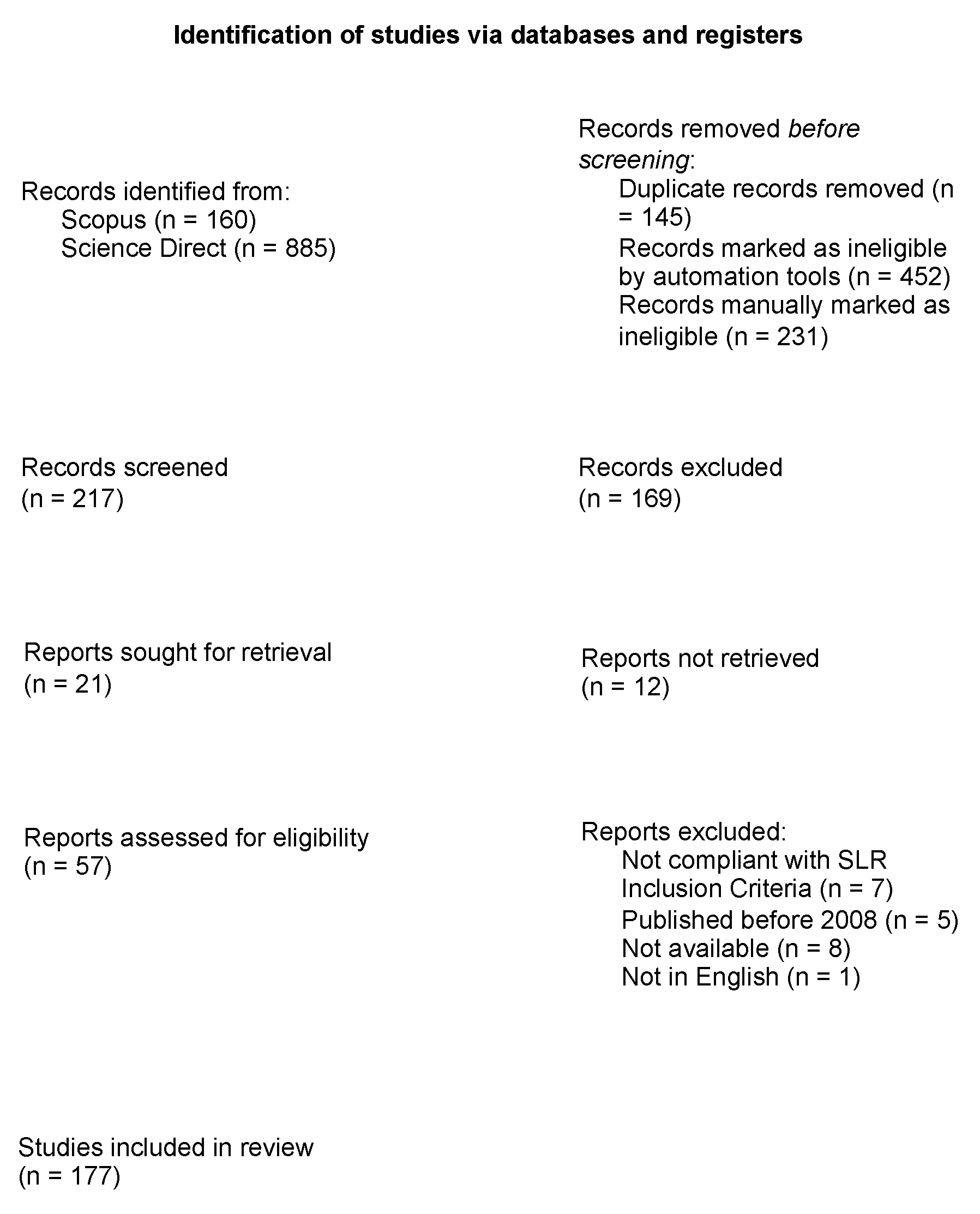
Table 2.
Hazard Statement Codes (HSCs) of the BM elements defined by the CLP Regulation, REACH, and company notifications.
Table 2.
Hazard Statement Codes (HSCs) of the BM elements defined by the CLP Regulation, REACH, and company notifications.
| Element | EC/List no. | CAS no. | CLP Regulation HSCs | REACH HSCs | Notifications HSCs |
|---|---|---|---|---|---|
| Li | 231 102 5 | 7439 93 2 | H314 (Skin Corr. 1B); H260 (Water-react. 1) | H314 (Skin Corr. 1B); H260 (Water-react. 1) | H228; H260; H301; H314; H318; H371; H413 |
| Co | 231 158 0 | 7440 48 4 | H317 (Skin Sens. 1); H334 (Resp. Sens. 1) H341 (Muta. 2); H413 (Aquatic Chronic 4) | H302 (Acute Tox. 4); H317 (Skin Sens. 1); H319 (Eye Irrit. 2); H330 (Acute Tox. 1); H334 (Resp. Sens. 1B); H341 (Muta. 2); H360 (Repr. 1B); H373 (STOT RE 2); H400 (Aquatic Acute 1); H410 (Aquatic Chronic 1); H411 (Aquatic Chronic 2); H412 (Aquatic Chronic 3); H413 (Aquatic Chronic 4) | H228; H250; H260; H302; H315; H317; H319; H330; H332; H334; H341; H350; H351; H360; H361; H372; H373; H400; H410; H411; H412; H413 |
| Ni | 231 111 4 | 7440 02 0 | H317 (Skin Sens. 1); H334 (Resp Sens. 1); H341 (Muta. 2); H350 (Carc. 1B); H350i (Carc. 1A); H351 (Carc. 2); H360F (Repr. 1B); H372 (STOT RE 1); H411 (Aquatic Chronic 2); H412 (Aquatic Chronic 3) | H228; H250; H317; H334; H341; H350; H350i; H351; H360; H370; H372; H400; H411; H412 | |
| Mn | 231 105 1 | 7439 96 5 | H411 (Aquatic Chronic 2); H412 (Aquatic Chronic 3) | H228; H260; H302; H312; H315; H319; H332; H335; H340; H341; H360; H361; H370; H372; H373; H411; H412 | |
| Al | 231 072 3 | 7429 90 5 | H228 (Flam. Sol. 1); H261 (Water-react. 2) | H228; H250; H261; H302; H311; H315; H317; H331; H332; H372; H373; H400; H413 | |
| Fe | 231 096 4 | 7439 89 6 | H228 (Flam. Sol. 1); H251 (Self-heat. 1) | H228; H251; H261; H302; H315; H319; H335; H370; H371; H372; H373; H400; H410 | |
| C | 231 153 3 | 7440 44 0 | H226; H228; H251; H252; H300; H302; H315; H319; H335; H373; H412 | ||
| Cd | 231 152 8 | 7440 43 9 | H250 (Pyr. Sol 1); H330 (Acute Tox. 1); H341 (Muta. 2); H350 (Carc. 1B); H361 (Repr. 2); H372 (STOT RE 1); H400 (Aquatic Acute 1); H410 (Aquatic Chronic 1) | H250; H301; H330; H335; H341; H350; H361; H372; H400; H410 | |
| K | 231 119 8 | 7440 09 7 | H260 (Water-react. 1); H314 (Skin Corr. 1B) | H260 (Water-react. 1); H314 (Skin Corr. 1B); H318 (Eye Dam. 1) | H260; H314; H318; H412 |
| Ti | 231 142 3 | 7440 32 6 | H228 (Flam. Sol. 1) | H228; H250; H251; H252; H260; H315; H319; H335 | |
| Si | 231 130 8 | 7440 21 3 | H228; H315; H319; H335; H373 | ||
| Ca | 231-179-5 | 7440 70 2 | H261 (Water-react. 2) | H261 (Water-react. 2) | H250; H261; H314; H315; H318; H319; H371 |
| Mg | 231 104 6 | 7439 95 4 | H228 (Flam. Sol. 1); H250 (Pyr. Sol 1); H252 (Self-heat. 1 and 2); H260 (Water-react. 1); H261 (Water-react. 2) | H228; H250; H251; H252; H260; H261; H315; H318; H335; H413 | |
| Cu | 231 159 6 | 7440 50 8 | H411 (Aquatic Chronic 2) | H400 (Aquatic Acute 1); H411 (Aquatic Chronic 2) | H228; H302; H315; H317; H319; H331; H332; H335; H361; H370; H371; H372; H373; H400; H410; H411; H412; H413 |
| Zn | 231 175 3 | 7440 66 6 | H410 (Aquatic Chronic 1) | H228; H250; H251; H252; H260; H261; H302; H311; H315; H319; H331; H332; H335; H400; H410; H413 | |
| Pb | 231 100 4 | 7439 92 1 | H350 (Carc. 1A); H360 (Repr. 1A); H362 (Lact.); H372 (STOT RE 1); H400 (Aquatic Acute 1); H410 (Aquatic Chronic 1); H411 (Aquatic Chronic 2) | H302; H311; H315; H318; H332; H341; H350; H351; H360; H362; H371; H372; H373; H400; H410; H411; H413 | |
| P | 231 768 7 | 7723 14 0 | H228 (Flam. Sol. 1); H250 (Pyr. Sol 1); H300 (Acute Tox. 1 and 2); H314 (Skin Corr. 1B); H330 (Acute Tox. 2); H400 (Aquatic Acute 1); H412 (Aquatic Chronic 3) | H228; H250; H251; H300; H312; H314; H318; H330; H370; H373; H400; H412 | |
| F | 231 954 8 | 7782 41 4 | H270 (Ox. Gas 1); H314 (Skin Corr. 1B); H330 (Acute Tox. 2) | H270 (Ox. Gas 1); H280 (Press. Gas Comp.); H314 (Skin Corr. 1B); H318 (Eye Dam. 1); H330 (Acute Tox. 1 and 2) | H270; H280; H310; H314; H318; H330 |
| Na | 231 132 9 | 7440 23 5 | H260 (Water-react. 1); H314 (Skin Corr. 1B) | H260 (Water-react. 1); H314 (Skin Corr. 1B) | H260; H314; H318; H370; H412 |
| Sn | 231 141 8 | 7440 31 5 | H228; H302; H311; H315; H319; H331; H332; H334; H335; H372; H400; H413 | ||
| As | 231 148 6 | 7440 38 2 | H301 (Acute Tox. 3); H331 (Acute Tox. 3); H400 (Aquatic Acute 1); H410 (Aquatic Chronic 1) | H301 (Acute Tox. 3); H315 (Skin Irrit. 2); H318 (Eye Dam. 1); H331 (Acute Tox. 3); H350 (Carc. 1A); H360D (Repr. 1A); H372 (STOT RE 1); H400 (Aquatic Acute 1); H410 (Aquatic Chronic 1) | H228; H251; H300; H301; H315; H318; H331; H341; H350; H360; H361; H371; H372; H373; H400; H410; H411 |
| Ag | 231 131 3 | 7440 22 4 | H360D (Repr. 1A); H400 (Aquatic Acute 1); H410 (Aquatic Chronic 1) | H312; H315; H317; H319; H332; H335; H351; H360; H370; H372; H400; H410; H411 |
Table 3.
EU Regulation No. 1357/2014 hazardousness criteria with corresponding BM elements.
| Hazardous Property | HSCs | Element | Condition |
|---|---|---|---|
| HP2 - Oxidizing | H270 (Ox. Gas 1) | F | Presence |
| HP3 - Flammable | H226 (Flam. Liq. 3) | C | Presence |
| H228 (Flam. Sol. 1-2) | Li, Co, Ni, Mn, Al, Fe, C, Ti, Si, Mg, Cu, Zn, P, Sn, As | Presence | |
| H250 (Pyr. Sol. 1) | Co, Ni, Al, Cd, Ti, Ca, Mg, Zn, P | Presence | |
| H251 (Self-heat.1) | Fe, C, Ti, Mg, Zn, P, As | Presence | |
| H252 (Self-heat. 2) | C, Ti, Mg, Zn | Presence | |
| H260 (Water-react. 1) | Li, Co, Mn, K, Ti, Mg, Zn, Na | Presence | |
| H261 (Water-react. 2-3) | Al, Fe, Ca, Mg, Zn | Presence | |
| HP4 - Irritant | H314 (Skin corr. 1A-1B) | Li, K, Ca, P, F, Na | ≥1%; <5% - Sum |
| H315 (Skin irrit. 2) | Co, Mn, Al, Fe, C, Ti, Si, Ca, Mg, Cu, Zn, Sn, As, Ag | ≥20% - Sum | |
| H318 (Eye dam. 1) | Li, K, Ca, Mg, P, F, Na, As | ≥10% - Sum | |
| H319 (Eye irrit. 2) | Co, Mn, Fe, C, Ti, Si, Ca, Cu, Zn, Sn, Ag | ≥20% - Sum | |
| HP5 - Specific Target Organ Toxicity (STOT) | H370 (STOT SE 1) | Ni, Mn, Fe, Cu, P, Na, Ag | ≥1% - Ind. |
| H371 (STOT SE 2) | Li, Fe, Ca, Cu, As | ≥10% - Ind. | |
| H335 (STOT SE 3) | Mn, Fe, C, Cd, Ti, Si, Mg, Cu, Zn, Sn, Ag | ≥20% - Ind. | |
| H372 (STOT RE 1) | Co, Ni, Mn, Al, Fe, Cd, Cu, Sn, As, Ag, Pb | ≥1% - Ind. | |
| H373 (STOT RE 2) | Co, Mn, Al, Fe, C, Si, Cu, P, As, | ≥10% - Ind. | |
| HP6 - Acute Toxicity | H300 (Acute Tox.2 (Oral)) | C, P, As | ≥25% - Sum |
| H301 (Acute Tox.3 (Oral)) | Li, Cd, As | ≥5% - Sum | |
| H302 (Acute Tox.2 (Oral)) | Co, Mn, Al, Fe, C, Cu, Zn, Sn | ≥25% - Sum | |
| H310 (Acute Tox.1 (Dermal)) | F | ≥0,25% - Sum | |
| H311 (Acute Tox.3 (Dermal)) | Al, Zn, Sn | ≥15% - Sum | |
| H312 (Acute Tox.4 (Dermal)) | Mn, P, Ag | ≥55% - Sum | |
| H330 (Acute Tox.1 (Inhal.)) | F | ≥0,1% - Sum | |
| H330 (Acute Tox.2 (Inhal.)) | Co, Cd, P, F | ≥0,5% - Sum | |
| H331 (Acute Tox.3) (Inhal.)) | Al, Cu, Zn, Sn, As | ≥3,5% - Sum | |
| H332 (Acute Tox.4 (Inhal.)) | Co, Mn, Al, Cu, Zn, Sn, Ag | ≥22,5% - Sum | |
| HP7 - Carcinogenic | H350 (Carc. 1A-1B) | Co, Ni, Cd, As | ≥0,1% - Ind. |
| H351 (Carc. 2) | Co, Ni, Ag | ≥1% - Ind. | |
| HP8 - Corrosive | H314 (Skin corr. 1A-1B) | Li, K, Ca, P, F, Na | ≥5% - Sum |
| HP10 - Toxic for reproduction | H360 (Repr. 1A-1B) | Co, Ni, Mn, Pb, As, Ag | ≥0,3% - Ind. |
| H361 (Repr. 2) | Co, Mn, Cd, Cu, As | ≥3% - Ind. | |
| HP11 - Mutagenic | H340 (Muta. 1A) | Mn | ≥0,1% - Ind. |
| H341 (Muta. 2) | Co, Ni, Mn, Cd, As | ≥1% - Ind. | |
| HP13 - Sensitizing | H317 (Skin Sens. 1) | Co, Ni, Al, Cu, Ag | ≥10% - Ind. |
| H334 (Resp. Sens. 1) | Co, Ni, Sn | ≥10% - Ind. |
Table 5.
Hazardousness classification of Individual BM samples under Scenario One.
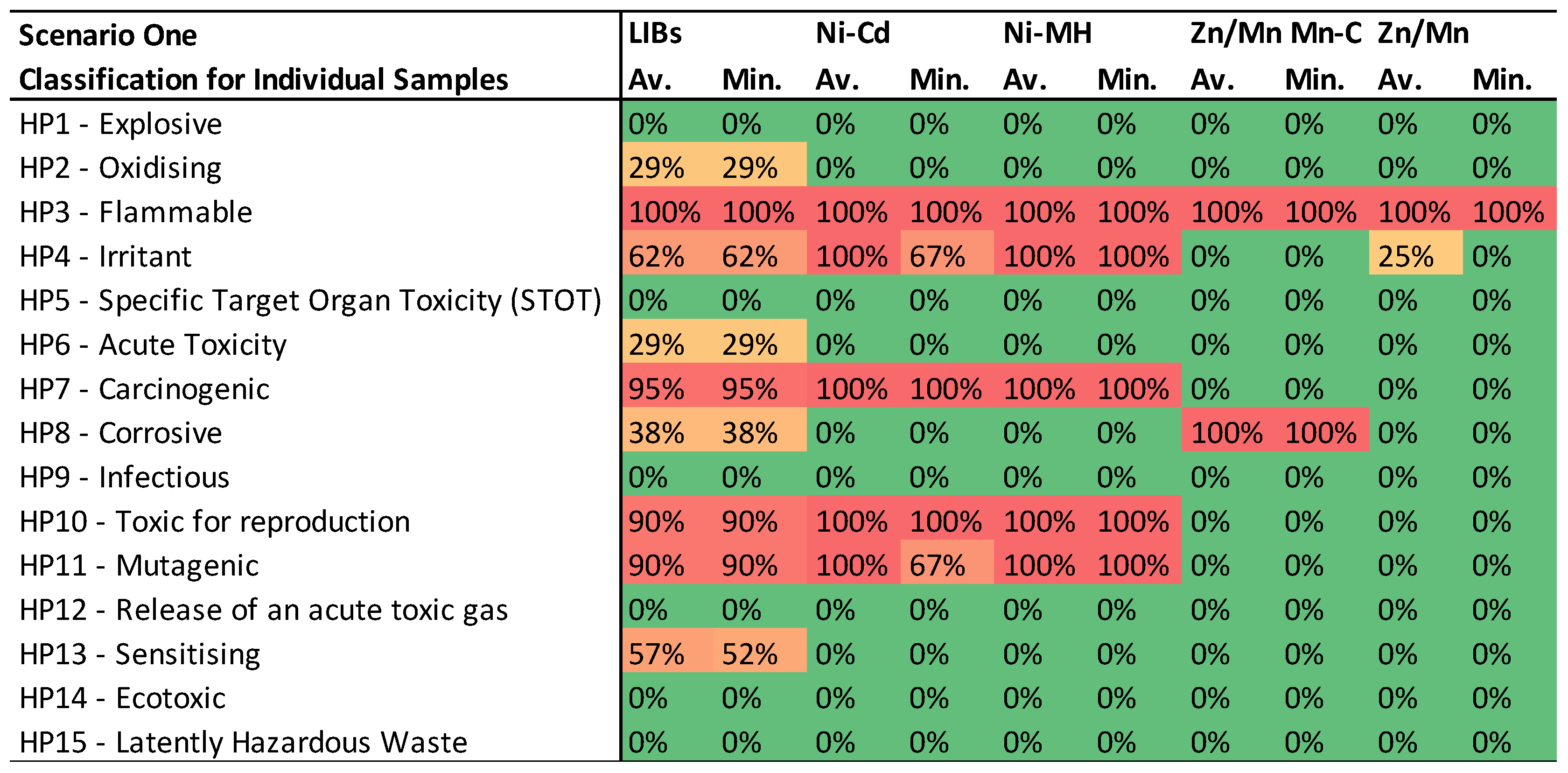
Table 6.
Consolidated hazardousness classification for CSBM in Scenario One.
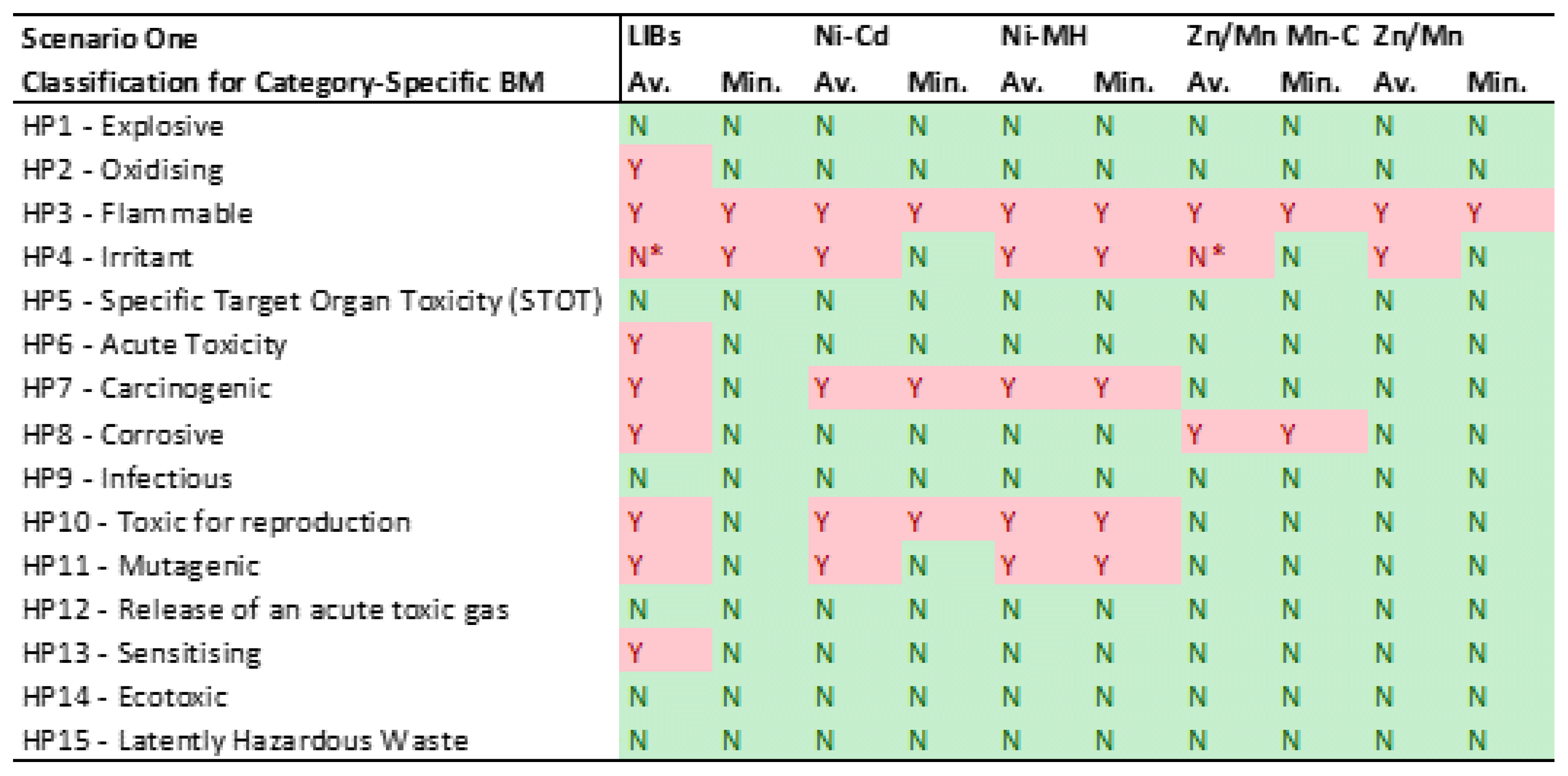
Table 7.
Hazardousness classification of Individual BM samples under Scenario Two.
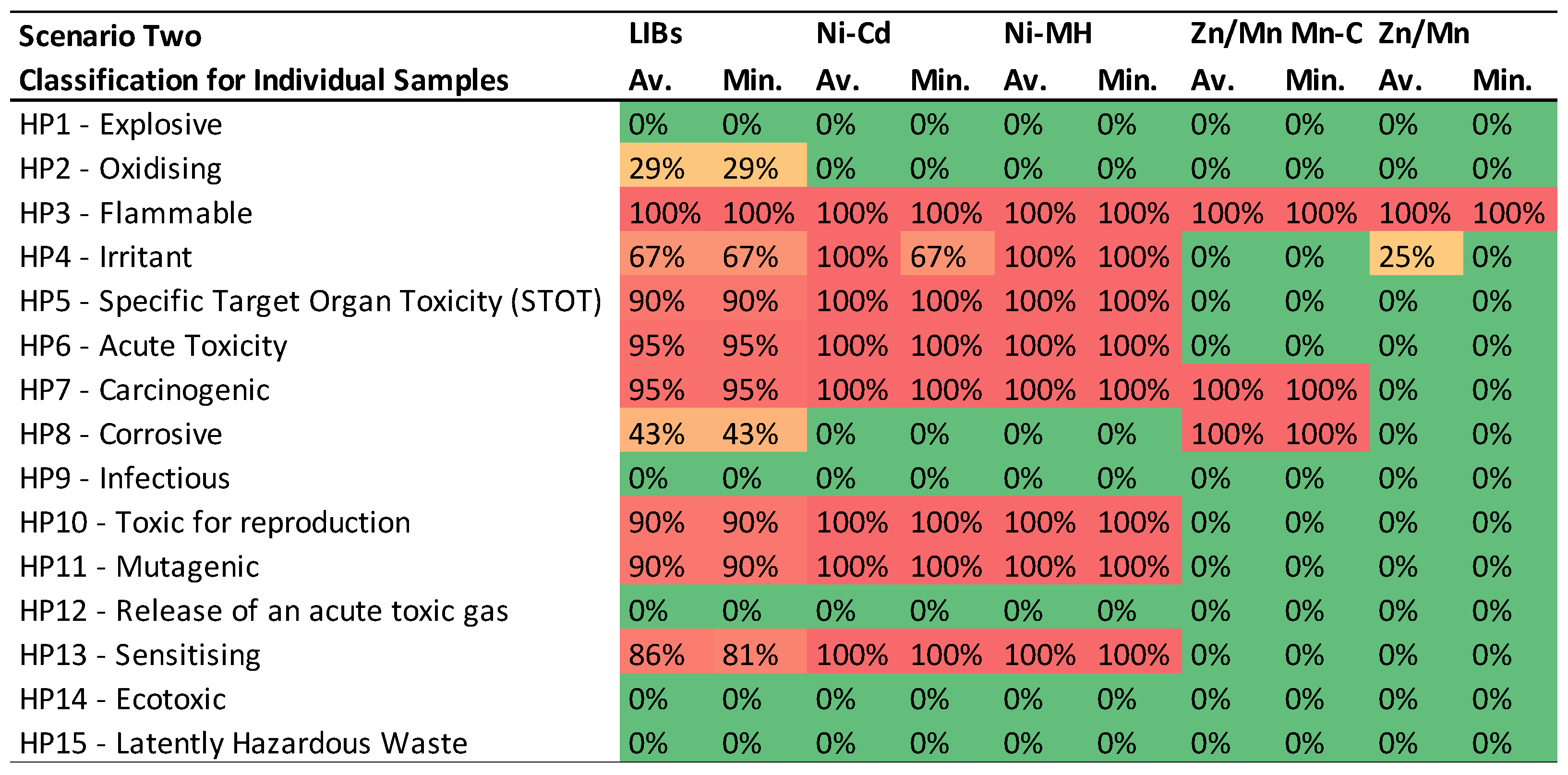
Table 8.
Consolidated hazardousness classification for CSBM in Scenario Two.
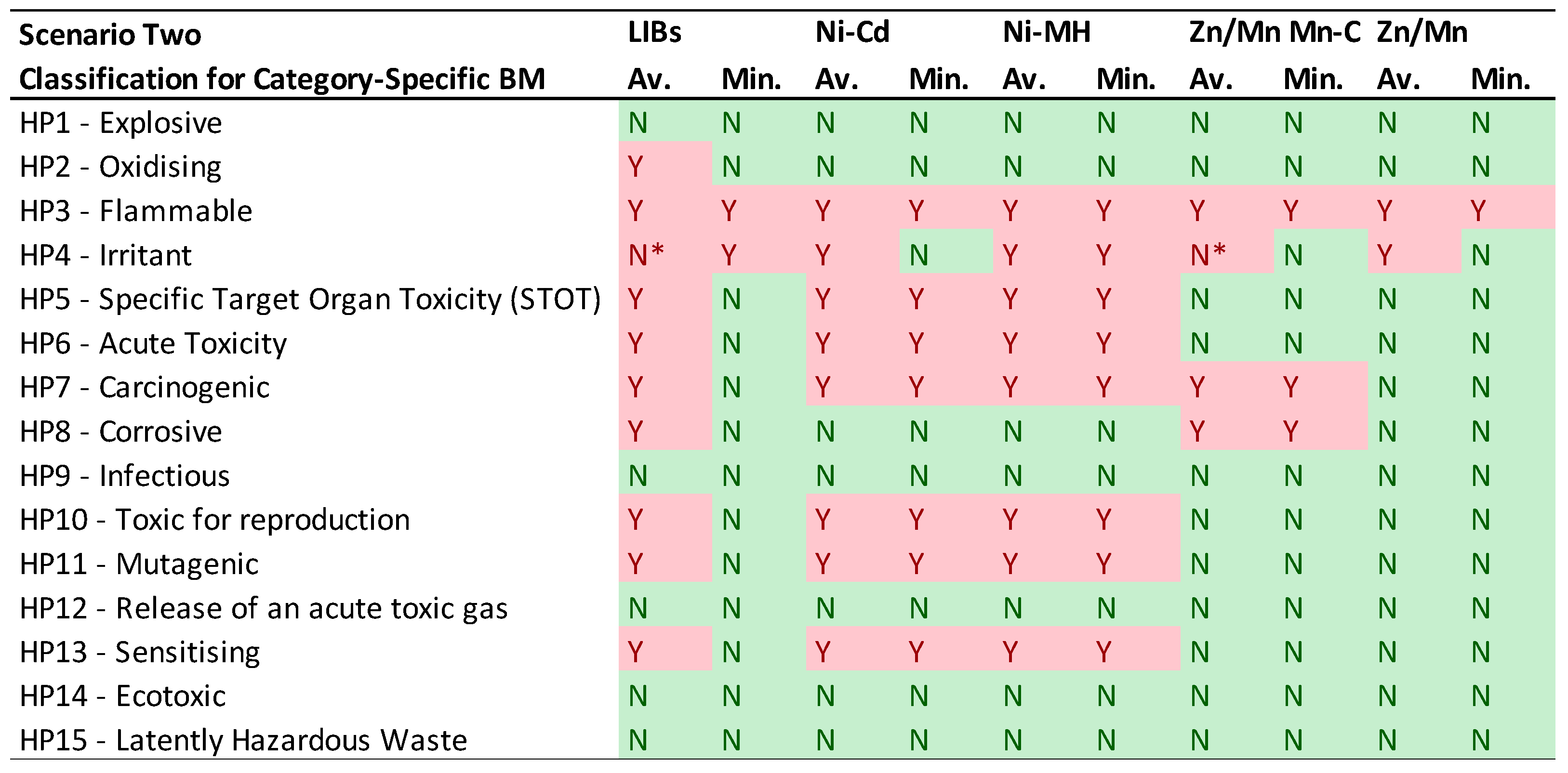
Table 9.
Hazardousness classification of Individual BM samples under Scenario Three.

Table 10.
Consolidated hazardousness classification for CSBM in Scenario Three.
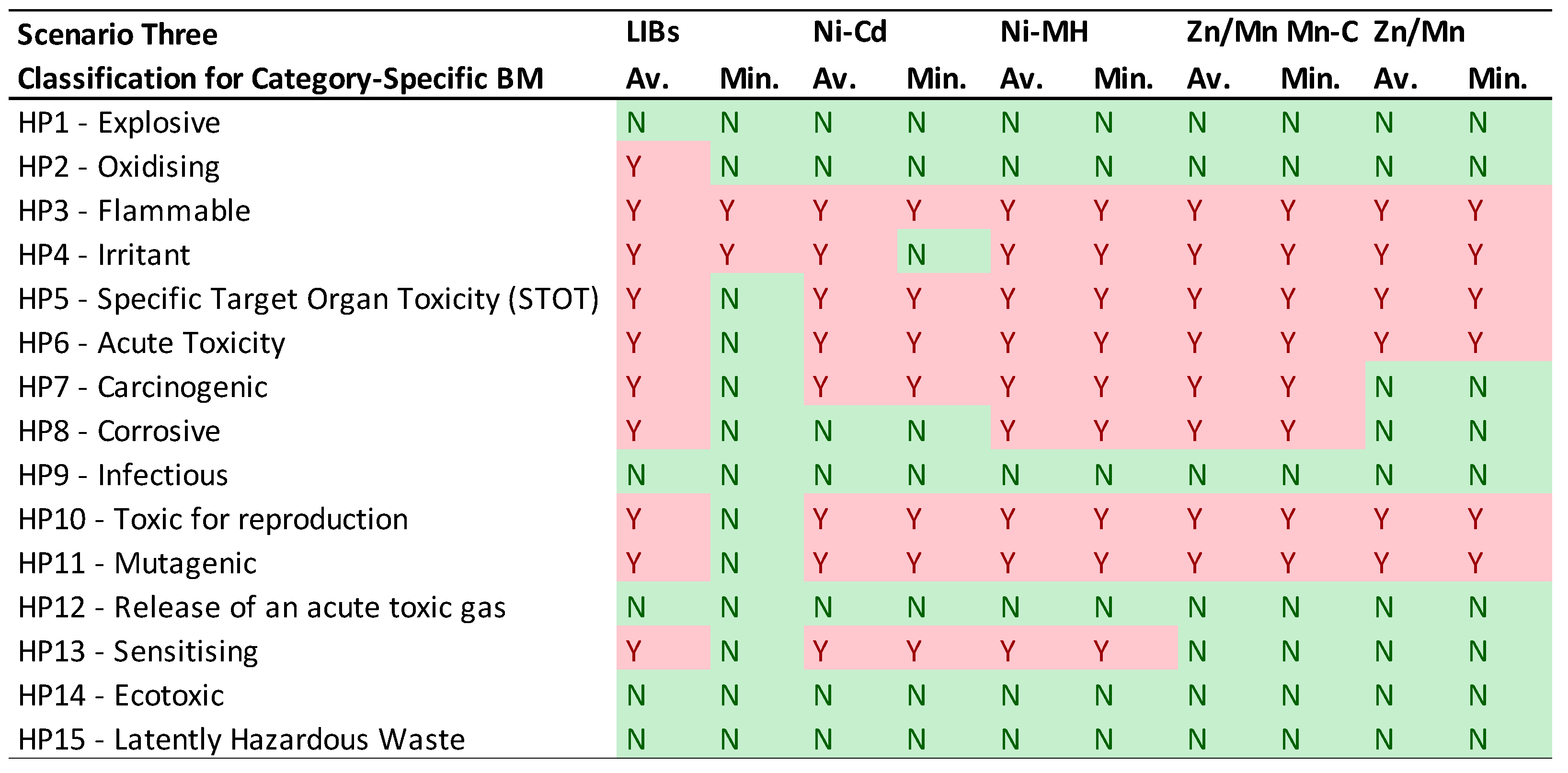
Table 11.
Range of HPs Classification of CSBM and Generic BM.
| CSBM | Baseline Scenario | Comprehensive Scenario |
|---|---|---|
| LIBs | HP3 - Flammable; HP4 - Irritant; | HP2 - Oxidizing; HP3 - Flammable; HP4 - Irritant; HP5 - Specific Target Organ Toxicity (STOT); HP6 - Acute Toxicity; HP7 - Carcinogenic; HP8 - Corrosive; HP10 - Toxic for reproduction; HP11 - Mutagenic; HP13 - Sensitizing |
| Ni-Cd | HP3 - Flammable; HP7 - Carcinogenic; HP10 - Toxic for reproduction; | HP3 - Flammable; HP4 - Irritant; HP5 - Specific Target Organ Toxicity (STOT); HP6 - Acute Toxicity; HP7 - Carcinogenic; HP10 - Toxic for reproduction; HP11 - Mutagenic; HP13 - Sensitizing |
| Ni-MH | HP3 - Flammable; HP4 - Irritant; HP7 - Carcinogenic; HP10 - Toxic for reproduction; HP11 - Mutagenic | HP3 - Flammable; HP4 - Irritant; HP5 - Specific Target Organ Toxicity (STOT); HP6 - Acute Toxicity; HP7 - Carcinogenic; HP8 - Corrosive; HP10 - Toxic for reproduction; HP11 - Mutagenic; HP13 - Sensitizing |
| Zn/Mn Mn-C | HP3 - Flammable; HP8 - Corrosive | HP3 - Flammable; HP4 - Irritant; HP5 - Specific Target Organ Toxicity (STOT); HP6 - Acute Toxicity; HP7 - Carcinogenic; HP8 - Corrosive; HP10 - Toxic for reproduction; HP11 - Mutagenic |
| Zn/Mn | HP3 - Flammable | HP3 - Flammable; HP4 - Irritant; HP5 - Specific Target Organ Toxicity (STOT); HP6 - Acute Toxicity; HP10 - Toxic for reproduction; HP11 - Mutagenic |
| Generic BM | HP3 - Flammable | HP3 - Flammable; HP4 - Irritant; HP5 - Specific Target Organ Toxicity (STOT); HP6 - Acute Toxicity; HP10 - Toxic for reproduction; HP11 - Mutagenic |
Table 12.
Overview of Technologies for Recycling BM.
| Technology | Description | BM Type | Recovered Elements | TRL | Limitations | Sources |
|---|---|---|---|---|---|---|
| Electrochemical junction transfer (ETJ) | A cation recovery process using intercalation into a host matrix, with a focus on lithium recovery from spent Li-ion batteries leachate. | Spent Li-ion batteries leachate. | Lithium (close to 100% faradic yield after thermal treatment and pH adjustment). | TRL4-5 | Presence of organic compounds and leachate acidity can block transfer; requires thermal treatment and pH adjustment. | [40] |
| Mechanochemical treatment and acid leaching | Utilizing reductive reagents in milling for crystal structure modification and subsequent leaching with acid. | From e-bike lithium-ion batteries. | Lithium (maximum extraction of 29.9% in water leaching), nickel extraction improved from 78% to 92% with CoS in acid leaching. | TRL4-5 | No significant improvements in crystal structure post-milling; pervasive fluoride presence. | [41] |
| Combined pyro- and hydrometallurgical process | Electric arc furnace smelting to generate lithium-enriched slag and mixed metal alloys. | From spent LIBs treated pyrometallurgically. | Lithium (82.4% yield in slag), cobalt (81.6%), nickel (93.3%), copper (90.7%). | TRL3-5 | High-temperature processing complexity. | [21] |
| Hydrometallurgical recovery from lithium slag | Direct leaching of lithium slag in H2SO4 and dry digestion method to reduce silicon gel formation. | Pyrolyzed lithium-ion battery BM. | Lithium (close to 100% efficiency after 30 mins at 20°C), Al and Si (variable efficiency) | TRL3-5 | Silicon gel formation complicating filtration and recovery | [22] |
| Early-stage lithium recovery (ESLR) using thermal treatment and supercritical CO2 leaching | Lithium recovery shifted to the start of the chemo-metallurgical process, with CO2 supercritical state enabling selective lithium leaching. | From NCM-based electric vehicle cells, thermally treated. | Lithium (up to 79% yield with supercritical CO2 treatment). | TRL3-5 | Complexity in managing lithium yield influencing factors, such as pyrolysis temperature and autoclave carbonation setup. | [24] |
| Acid leaching using molasses as reductant | Utilizes acetic acid and molasses for metal leaching from BM, reducing higher oxidation states of metals. | From spent cylindrical lithium-ion batteries. | Co, Li, Ni, Mn (96% to 99% recovery efficiency). | TRL5-6 | Balancing molasses concentration and timing; sediment formation management. | [25] |
| Carbothermic reduction and hydrochlorination | Involves reducing metallic oxides to metals, converting Li and Mn into soluble chlorides, and Co and Ni into magnetic alloys. The Al remains in the form of Al2O3 and does not react. | From spent lithium-ion batteries | Li (97.28%), Mn (98.13%), Ni and Co in magnetic fraction (93.03%, 91.37%), Al in non-magnetic fraction (95.28%). | TRL5-6 | Managing material streams, specific separation requirements, precise process condition control. | [26] |
| Direct selective leaching of lithium. | Selective lithium leaching from BM using formic acid and hydrogen peroxide, allowing for targeted extraction while leaving other metals. | Industrial BM from Li-ion batteries with LiFePO4 cathodes. | Lithium >97%; other metals (Fe, Cu, Al, Ni, Co, Mn) <1% leaching. | TRL5-6 | Need for operational condition optimization. | [27] |
| Use of organic solvents (DMF, DMAc, DMSO) and alkaline solutions (NaOH, KOH). | Organic Solvents used are DMF, DMAc, DMSO; Alkaline Solutions are: NaOH and KOH. | Mixed chemistries from Li-ion batteries. | Lithium efficiency improved from 47.2% to 78.7% with DMSO; Cobalt efficiency improved from 28.5% to 61.3% with DMSO; Lithium extraction up to 90.1% with NaOH; Cobalt extraction up to 74.4% with NaOH. | TRL5-6 | High temperatures (>150 °C) for organic solvents; concentrated alkaline solutions pose corrosion and handling risks. | [42] |
| Leaching of industrial BM. | Leaching with a solid-liquid ratio of 1:10 or 1:20 g/mL. | From spent Li-ion batteries. | Co from LCO ~32%; Li from LCO ~63%; Li, Mn, Ni 100%; Co 100% after 60 min; Al 68% after 60 min; Cu 98% after 5 min then decreases to 60%. | TRL5-6 | Operational conditions optimization needed. | [43] |
| Solvent extraction for Zn and Mn recovery. | Solvent extraction using ionic liquids, organophosphorus-based acids, and Deep Eutectic Solvents (DESs). | From spent Zn-MnO2 alkaline batteries. | 100% for Zn (II) with (Cyanex 272 + diethyl phosphite); 100% for Mn (II) using DES. | TRL5-6 | Further studies needed for process optimization and extraction efficiency improvement. | [44] |
| Solid–liquid-liquid extraction | Extraction of heavy metals from Ni-Cd battery BM using Deep Eutectic Solvents (DESs) and other extractants in toluene or naphtha. | From spent Ni-Cd batteries. | Ni (II): 30 wt.%; Cd (II): 100 wt.% | TRL 4-6 | Lower extraction efficiency for Ni compared to Cd; complexity in the extraction process | [32] |
| Electroassisted leaching | Involves electroassisted leaching for metal recovery from BM, followed by electrochemical deposition. | From dismantled Ni–Cd batteries. | Cd: High recovery rate; Ni and Co: Slower dissolution, specific rates not detailed. | TRL 4-6 | Proton generation control at the anode, slower dissolution of Ni and Co compared to Cd, high energy consumption, complex process design and operation | [45] |
| Extraction with Ionic liquids (ILs), deep eutectic solvents (DESs), organophosphorous-based acids | Low-temperature method for extracting cobalt, nickel, lithium, and other metals from spent LIB BM without pre-leaching. | From spent lithium-ion batteries. | Co (II): 90-100 wt.% using DESs; Li(I): Up to 100 wt.; Ni (II): Up to 52 wt.% | TRL 4-6 | Complex extraction process, variability in recovery rates based on methods and conditions | [29] |
| selective sulfation roasting | Extracting cobalt and lithium from LCO-rich BM using selective sulfation roasting, followed by water leaching. | From industrial LCO-rich spent batteries. | Co: Up to 61.21%; Li: Up to 99.51%; Ni: Up to 33.00%; Mn: Up to 68.36%; Cu: Up to 24.53% | TRL 4-6 | Dependency on roasting conditions and carbon presence, complexity in process design and operation | [30] |
| Scalable direct recycling of cathode BM from spent LIBs | Integrates pretreatment and relithiation of cathode BM from EoL LIBs. | From EV batteries, specifically NCM cathode materials. | 100% electrochemical performance recovery, 91% yield rate, regenerated cathode material exhibits 82% ICE with 176 mAh/g discharge capacity, 94% capacity retention after 200 cycles. | TRL 6-7. | Precision control required for hydrothermal and annealing conditions, efficient removal of impurities | [46] |
Disclaimer/Publisher’s Note: The statements, opinions and data contained in all publications are solely those of the individual author(s) and contributor(s) and not of MDPI and/or the editor(s). MDPI and/or the editor(s) disclaim responsibility for any injury to people or property resulting from any ideas, methods, instructions or products referred to in the content. |
© 2023 by the authors. Licensee MDPI, Basel, Switzerland. This article is an open access article distributed under the terms and conditions of the Creative Commons Attribution (CC BY) license (http://creativecommons.org/licenses/by/4.0/).
Copyright: This open access article is published under a Creative Commons CC BY 4.0 license, which permit the free download, distribution, and reuse, provided that the author and preprint are cited in any reuse.