
Submitted:
03 December 2023
Posted:
05 December 2023
You are already at the latest version
Abstract
Space tourism began in 2001 and became popular in 2021 because of commercial operations. With the development of space technology and commercialization, like re-launchable rockets to travel to space in recent years, it has gradually entered the era of space. However, the space industry causes massive emissions, inducing some opposition to its development. It is essential to investigate the attitude of residents toward space tourism and balance the pros and cons of sustainability. Quantitative analysis was adapted to test two models based on duality theory. The data were obtained from 284 samples from various regions of China and analyzed using the partial least squares structural equation modeling (PLS-SEM). The results show that the two-factor model of economic development conflicted with environmental protection. However, study two indicates that educational interventions can facilitate sustainable space tourism because they mediate the relationship between economic and environmental factors.
Keywords:
Sustainable space tourism
; economic development
; environmental protection
; education intervention
; Chinese residents
1. Introduction
"We are living out our childhood dreams." The participant who experienced zero-gravity flight was full of praise [1]. Zero-gravity flights are only a small part of space tourism that can not be experienced in general tourism. Space tourism is commercial space travel that aims to provide travelers with unique experiences such as adventure, leisure, entertainment, weightlessness, and astronomical observation [2]. Not only for fun, this study discusses the economic and environmental sustainability of space tourism. Regarding the possible impact on the Earth's environment, this study excluded virtual and terrestrial space tourism from the broad space tourism market types of Laing and Crouch [3]. The three segments of space tourism were discussed: near space, suborbital, and low orbit/high orbit.
Space tourism began with Dennis Tito's trip to the International Space Station in 2001, and from 2001 to 2009, only eight travelers entered space at a cost of approximately $20 million to $35 million [4]. Since 2021, space tourism has boomed, with Virgin Galactic alone sending three successful flights for space travel from June to September 2023. The company has already sent more than 16 travelers into space. Using conservative business strategy analysis, suborbital space tourism alone has an expected net present value of at least US$2 billion, which will undoubtedly significantly boost economic development [5]. However, space tourism may cause severe environmental impacts as the scale expands. For example, the black soot left behind by insufficient combustion of aircraft fuel may reduce the local temperature by 0.7 degrees Celsius and increase the average temperature in Antarctica by 0.8 degrees Celsius. This black soot will stay in the stratosphere for 5-10 years [6]. Not to mention carbon dioxide (CO2) emissions, also issues caused by the space industry.
Environmental pollution caused by human activities is not irremediable. The satellites we have launched into space have recorded the ecological destruction of melting glaciers, the reduction of forests, the hole in the ozone layer, and the desertification of land caused by various human actions [7]. Before it is too late to take remedial measures, we can minimize the environmental harm by sustainable measures. For example, restricting the use of chlorofluorocarbon chemicals has made the ozone layer return to pre-1980 levels in 2030 [8]. We should be aware of the possible consequences of specific actions earlier. We should prepare earlier to ensure environmental sustainability, including space tourism activities. Although environmental protection and economic development are often a dilemma that cannot have both ends, sustainability education may help to improve this contradictory relationship [9]. The role of education in promoting the spread of sustainable concepts has been quantitatively proven [10].
Sustainable space tourism must be actively discussed scientifically and collaborated among practitioners, government officials, investors, residents, and educators. Thus, this study aims to (a) investigate the attitudes of Chinese residents towards space tourism and sustainability; (b) construct a model for economic development and environmental sustainability in space tourism; (c) explore the intervention effect of education on sustainable development toward a holistic development of sustainable space tourism.
2. Theoretical Foundation and Hypotheses Development
2.1. Duality Theory: Factors of Economic Development and Environmental Protection
Duality theory is applied in the study to interpret the optimization model of the dual factors, economic development, and environmental protection, which is sustainability [11]. Sustainable space tourism is the research objective, moving from the conflict to coherent dual factors. Since 1960, researchers have often discussed economic development and environmental protection with the main arguments on the binary opposition [12,13]. Some claim that GDP growth slows down because of environmental protection measures. Stakeholders then revisit the significance of economic growth. GDP fetishism has been widely criticized as a very narrow way to judge the standard of living concerning the environmental population, and its significance in indicating economic growth is limited without sustainability [14]. Researchers have argued the need to use a more multifaceted approach to understanding economic development, including discussions of residents' attitudes [15]. Residents' perceptions of environmental protection have been studied extensively, and our actions have not always been effective in curbing ecological decline after it was realized that economic development would be damaging to the environment [16].
When we talk about the traditional contradiction between economic development and environmental protection from the standpoint of residents' attitudes, the discussion of balancing the two is missing. Researchers have always used leading dichotomous survey questions such as, "Should protecting the environment be prioritized, even if it inhibits the risk of economic growth, or should economic growth be prioritized, even if the environment is damaged to some degree?"[17]. Kaplowitz, et al. [18] suggest introducing more pluralistic attitudes in studying economic growth and environmental protection. Thus, this paper discusses and advances space tourism development from the sustainability perspective.
2.2. Space Tourism Industry and Environmental Sustainability
The space tourism program was first launched in 2001, and the development of space tourism was initially intended to serve countries' political interests, with the commercialization being secondary [19]. However, as more and more countries enter the space field for cosmological and commercial explorations, people gradually realize the importance of developing the space economy under the premise of non-aggression, and the space tourism industry has become one of the emerging businesses [20]. Space tourism belongs to the category of experiential tourism. It is the use of high-tech technology to send passengers to space or space-related areas for short-term travel activities for leisure purposes. There is no specific destination to stay, and tourists' activities will be limited to the spacecraft so far [21]. Specifically, space tourism mainly includes four types: orbital flight, suborbital flight, high-altitude flight near space, and parabolic aircraft flight [22,23]. The history of the development of space tourism is illustrated in Figure 1 and is described in the Appendix A.
However, we cannot deny that the development trend of space tourism is positive. Cole [26] pointed out in his research that although space tourism will develop slowly in the short term due to the immature level of science and technology and the mismatch of per capita disposable income, it is still in line with the tourism life cycle theory, and will eventually become a mass tourism business to form a maturity market with considerable economic benefits. Launius and Jenkins [27] believed that explorers with great wealth were critical in the early stages of space tourism. However, mass tourists should have affordable and comfortable travel opportunities in the next ten years. With the development of science and technology, space flight will eventually become as popular in human society as airplanes. Considering the potential and influence of space tourism, we can foresee its positive impact on human social and economic development, scientific education, cultural inheritance, and residents' employment in the future [28]. Space tourism literature mainly focuses on space laws, consumers' tourism motivation, and sustainable space tourism [29,30,31,32,33,34].
With current fuel-related technology, space tourism, if scaled up rapidly, would have a rather severe emissions problem. Not to mention the energy consumption of an airplane 100 times the distance traveled for the same flight, the black smoke and fuel from inadequate combustion would affect the regional atmosphere. Propellants used in rockets are also emitted into the atmosphere. SpaceX currently uses the nitrogen tetroxide (NTO)/monomethyl hydrazine (MMH) bipropellant combination as the propellant for Dragon 2. MMH is widely detected in groundwater and is a severe contaminant of water bodies. Qian, et al. [35] use the preparation of composite materials as activators to clean up MMH contamination. The decomposition product of NTO, nitrogen dioxide (NO2), is also a major atmospheric pollutant, and NO2 significantly impacts atmospheric chemistry (formation of tropospheric ozone). The environmental pollution issues then arouse our awareness and encourage us to take action for sustainable space economics. The traditional selective catalytic reduction technology requires high reaction temperatures. New technologies use sponge-like aluminum-based solid porous nanomaterials placed in the center of porphyrin rings to selectively capture and remove NO2 from gas mixtures [36]. As governments and corporations focus on advanced technology, spacecraft also increasingly use fewer polluting fuels. Emissions limits are an advocate for space tourism. Technological advances related to cleaner and harmless fuels are applied. This is not only for environmental conservation but also for the sustainability of the space tourism industry.
In summary, we propose the following hypothesis:
H1: Economic development is a driving force for space tourism development.
H2: Economic development has an adverse influence on environmental sustainability.
H3: Environmental protection has a negative impact on space tourism development.
H4: Environmental protection is a driving force to environmental sustainability
2.3. Sustainable Space Tourism with Two Factors
The space tourism industry includes space tourism hotels, space insurance, space medical care, and other supporting industries that will collaborate to create warfare for human beings. In addition to the environmental awareness for the space industry, risk reduction for passengers is an inevitable issue. When carrying out space tourism, passengers will face psychological risks, physical health risks, and economic risks [37]. Creating a viable and affordable insurance system for future tourists is essential in marketizing space tourism [38]. Commercial satellite data applications may also be a vital stream in the industry [39]. When space tourism is successfully popularized, related space medical activities (including pre-flight physical examination, passenger physical training, and post-flight physical abnormality investigation) are also expected to form a complete industrial chain [40]. It is worth pondering that the space industry development must be responsible for human beings, providing economic output and long-term environmental benefits. A sustainable space economy should resolve ecological issues of commercial satellite operations, space tourism, lunar and asteroid mining, and other development forms of the space industry. When the space economy can operate efficiently and in an environmentally friendly way, the high technological costs of space exploration will benefit generations. Science and technology should play a vital role in promoting co-development of enconmic development and environmental conservation [41].
Pollution emissions from space tourism are not negligible. One of the solutions is to tax the emissions of CO2. The CO2 tax could be levied on any other greenhouse gas and can usually be converted to an amount equivalent to CO2 emissions. For example, aviation kerosene fuel, which is currently used regularly, emits 3.03 tons of CO2 per ton of fuel [42]. Currently, a CO2 tax is the least costly and feasible way to reduce emissions, and revenue from the tax is generally used for low-income groups, which indirectly maintains social equality [43]. Other rockets that use liquid oxygen and liquid hydrogen fuel do not occur, and carbon emissions will not be considered the CO2 tax.
We must realize that the sustainable development of space is not the responsibility of a nation or region but an important topic that all humanity must be involved in. Treating space debris has always been a problem we have not adequately addressed as we develop our space industry. Every satellite sent into space can become space debris when broken or retired, polluting the space environment and threatening the safety of all flying objects in orbit [44]. There are currently two mainstream solutions for space debris mitigation. The first solution is for spacecraft to actively seek to release orbital space by de-orbit after completing the mission. The second is to extend the life of existing spacecraft and reduce the number of spacecraft launches to minimize the generation of new debris [45]. Not only orbital debris, there was the inevitable creation of a large amount of space junk, such as abandoned satellites, remnants of rocket thrusters, and small debris from collisions of various materials in space during human operations in outer space. Leonard and Williams [46] pointed out that the sustainable use of space debris and space junk is feasible, and the development of in-orbit services is the key to solving the problem of such debris. This is based on the fact that the cost of recycling and reusing aircraft launch equipment is gradually decreasing, and the benefits of each launch are higher than the cost of cleaning debris. Heinrich, et al. [47] proposed establishing professional space sustainability rating standards to regulate the growing number of new space operators. This is a plan to limit enterprises' uncontrolled spacecraft launches to regulate the metabolic balance of old and new space debris.
When discussing the protection of the space environment, not only try to solve the problem of space debris but also pay attention to educating the population [48]. Many scholars have suggested different views regarding the sustainable development of space tourism. Toivonen [49] proposed a framework for "social ethics in space tourism," which includes the development of virtual space tourism using VR technology, specialized environmental protection actions, the development of global space laws, and the shaping of Generation Z values. Although virtual reality technology cannot replace real tourism activities, it can go some way to fulfill people's tourism needs and reduce the damage caused by nature-based tourism activities, especially space tourism [50]. Peeters [51] argues that point-to-point, regular space tourism development will be a future direction for sustainable space tourism.
There is a view that space tourism is not inherently compatible with sustainable tourism needs. Instead of developing this elite-class recreational activity at the expense of damaging the environment, the relevant resources should be used to take action for climate change [31]. Meanwhile, as space tourism itself is still in the nascent stage, this tourism activity can only be offered to wealthy tourists to experience, and it is difficult for general people to pay such a high cost. Benjamin [52] points out that in the future, the space tourism industry will likely form an oligopoly and maintain the status quo of high fares, where people only have the right to choose the form of their experience dominated by the suppliers. The legal issues involved in space tourism are fragmented. The international legal system of outer space is still immature, with many deficiencies, and space tourism is controversial because it may violate national airspace security during flight [53].
From a positive point of view, some people believe that if they can experience space tourism, it will be an unforgettable experience of a lifetime, and they may even become heroes in human history [54]. Overall, space tourism is an inevitable direction for the future development of tourism, but it requires the efforts of its development with sustainability. As mentioned above, the challenges of sustainable space tourism are the dual factors of economic growth and environmental conservation to be considered.
So, we propose the following hypothesis:
H5: Economic development is a positive drive to sustainable space tourism.
H6: Environmental protection has a positive influence on sustainable space tourism.
2.4. Educational Intervention for Sustainability
Exploring outer space fulfills the highest needs level of human beings, so developing space tourism has become an inevitable trend [55]. Implementing space tourism activities will inevitably cause a massive amount of environmental pollution. This causes ecological problems involving social, economic, cultural, scientific, and technological factors. Our current science and technology cannot wholly solve the pollution, but we can consciously educate the next generations to be aware of the issues and devote their creativity to sustainable space tourism.
The best way to promote the conscious participation of all humankind in environmental protection activities is education[56]. Education can affect people's behavior, and the influence of pro-environment-related consumption behavior is particularly significant [57]. The implementation of sustainable action can be through education. It can cultivate the concept of personal, environmental, and sustainable development. Educational interventions can attain the goal of sustainability [58]. Through systematic education, students can learn to understand and evaluate a series of sustainable activities in society from a scientific perspective, rethink the relationship between man and nature, and take responsibility for the sustainable development of human society [59]. Environmental education can also guide people to apply replicable ecological research results to their lives and solve stakeholders' environmental problems together [60]. Therefore, education is indispensable to both economic development and environmental protection.
The intervention form of education is often carried out through experimental methods. Through experiments, Miriam Andrea, Jesus, Isaac, and Andrea, et al. [61] demonstrated that professional teaching methods can mobilize people's attitudes and awareness of sustainable development, influencing their willingness to take action in the future. Stevens, et al. [62] found that storytelling during tourism education develops the ethical level of the listener, which in turn helps the learner think better about forms of harmonious coexistence between humans and nature. With space tourism's further development and requirements, pilots must acquire specific tour guide skills [34]. Pilots can carry out corresponding tourism education activities when passengers look at the Earth's landscape and marvel at the fragility and beauty of this blue planet, and deepen tourists' awareness of environmental protection through storytelling. Arslan [63] found that sustainable education fosters students' environmental awareness, promotes the growth of critical thinking, and helps them think about problems from different perspectives. This development of critical thinking help look at the development of space tourism activities correctly so that people can see not only the damage that space tourism causes to the environment but also the various resource returns that space exploration activities bring. This is the significance of the educational interventions as a mediator and why they may influence the inhabitants' perception of sustainable space tourism. So, we can derive the following hypotheses:
H7: Economic development triggers a positive awareness of educational interventions.
H8: Environmental protection triggers a positive awareness of educational interventions.
H9: Educational intervention has a positive effect on sustainable space tourism.
H10: Educational intervention mediates economic development and sustainable space tourism.
H11: Educational intervention mediates environmental protection and sustainable space tourism.
3. Methodology
3.1. Sampling and Data Collection
We construct the competing models from the dual factors of economic development and environmental conservation. Model 1 in Figure 2 shows a general perspective that economic development positively drives the development of the space tourism industry but negatively impacts sustainability. While environmental protection positively influences sustainability, it negatively affects the development of the space tourism industry. Model 2 assumes that educational intervention triggers a mediating effect between the two constructs of space tourism and environmental protection to attain the goal of sustainable space tourism. This means that education plays an essential and positive role in promoting space tourism toward sustainability.
3.2. Measurement Items
The measurement items were derived from the literature and modified according to the research models. We used four items from Drews and van den Bergh (2016) about residents’ views to measure economic development and environmental protection. The classic New Environmental Paradigm (NEP) scale was used to investigate residents' views on environmental protection. These four items were selected and adapted from the scale Dunlap, et al. [64]. To measure the development of the space tourism industry, we combined the views of many scholars on the space tourism economy and industry and proposed four items [28,65,66]. We selected four items from different aspects of the sustainability scale of Haan, et al. [67] to investigate residents’ views on environmental sustainability. We developed four educational intervention items through the United Nations' guidance document on sustainable education development [68]. Finally, based on the literature on sustainable space tourism, we developed four items for sustainable space tourism [49,69]. Each of the four environmental protection and sustainability items uses reverse questioning to screen whether the samples are valid [70]. The measurement items are shown in Table 1.
3.3. Sampling Method
This study uses an online platform (Tencent Questionnaire) to collect samples. Tencent Questionnaire has a high-quality sample database of over 3 million people and high sample validity [71]. It mainly sends questionnaires through WeChat, with over 1.3 billion active users. The responses from Chinese residents will be counted in October 2023, and participants who provide valid answers will be awarded ¥3 RMB. Participants were asked to read a paragraph about space tourism and sustainable space tourism and then answer the questionnaire items. The average completion time was 3 minutes and 36 seconds. A total of 367 samples were collected. After excluding two people with IP addresses outside of China, deleting 16 questionnaires claiming to be minors, deleting questionnaires that took insufficient time to answer (less than 65 seconds), and failing responses to reverse questions, 284 questionnaires remained (77.4%). The research questions in the questionnaire included a total of 24 items. Structural equation modeling was used to validate both models. This study uses structural equation modeling (SEM), and the sample size should be 5-10 times the number of questionnaire items. The sample size is proper according to the data collected [72].
4. Results and Discussion
4.1. Sample Profile
The results of the descriptive analysis are shown in Table 2. In the survey, 41.9% of the respondents were male and 58.1% were female. The ages of the respondents were 18-24 years old (59.9%), 24-30 years old (22.9%), 31-40 years old (11.6%), 41-50 years old (2.8%), 51-60 years old (2.1%), over 60 years old (0.7%). Many respondents completed a college degree (72.9%), with a high school degree or less (11.3%). The number of people with incomes less than 2,500 yuan (26.1%), 2,501-5,000 (28.9%), and 5,001-10,000 (28.2%) is similar and accounts for the majority. The proportion of people with income above 10,000 yuan is not too low (16.9%). There was no bias observed in the sample distribution.
4.2. Measurement Model
In this study, economic development and environmental protection are independent variables. In contrast, space tourism, environmental sustainability, educational intervention, and sustainable space tourism are dependent variables, and educational intervention is the mediating variable. To ensure the credibility and accuracy of the results, the reliability test was conducted using Cronbach α and composite reliability (CR). The factor loadings of all variables in Table 3 and Table 4 are bigger than 0.6 (range from 0.655-0.912), Cronbach α > 0.7 (range from 0.713-0.933), CR > 0.8 (range from 0.823-0.933), with good Confidence level [73]. The validity of the questionnaire was determined through content validity and construct validity. We solicited opinions from space tourism literature and interviews with experts and professors to confirm content validity. Construct validity was measured using confirmatory factor analysis (CFA), convergent, and divergent validity. The average variance extracted (AVE) index was used to test convergent validity. The convergent validity is qualified for AVE> 0.5 (range from 0.538-0.822). The VIF value of EI2 is greater than 5, so this item is deleted. After item analysis, all VIF < 3.3 (range from 1.242-2.661), indicating that there is no (multi) collinearity problem [74].
This study used the Fornell-Larcker criterion and the Heterotrait-Monotrait ratio (HTMT) to verify differential validity. The Fornell-Larcker criterion stipulates that the square root of the AVE should be higher than the inter-structure correlation [75]. Table 5 and Table 6 present the results for Model 1 and Model 2, respectively, with diagonal values higher than those below. The HTMT value (range from 0.139-0.788) is lower than the threshold of 0.85, and overall, the discriminant validity meets the standard [76].
4.3. Structural Measurement Model
Partial least squares structural equation modeling (PLS-SEM) was used to test the research model (Figure 3 and Figure 4 show the results of this study) because PLS can handle small samples and has greater confidence in the normal distribution of the data. Few restrictions [77]. The SmartPLS V.4.0.9.5 software package was used, and bootstrapping was performed using 5,000 samples to evaluate path coefficients [78].
Structural models are evaluated using multiple criteria, including the model's explanatory power (R2), path coefficient (b), t-value, and p-value [77]. As a general guideline, an R2 value of 0.25 is weak, 0.50 is moderate, and 0.75 is substantial. According to Cohen [79], the R2 value can be evaluated as substantial = 0.26, moderate = 0.13, and weak = 0.02. If this criterion is used, the results show that the space tourism industry has an R2 value of 0.147. The R2 value for environmental sustainability is 0.362, indicating that these factors explain 36.2% of the variance. In Study 2, the R2 value for the educational intervention was 0.196, and the R2 value for the sustainable space tourism industry was 0.276. The model explanatory degree is moderate and substantial, and the explanatory power is good. The results of PLS-predict are shown in Table 7. According to the suggestion of Hair, et al. [80], only the prediction errors of endogenous variables are shown, Q2 > 0, the vast majority of RMSEPLS-SEM - LM < 0, and the prediction ability is good.
Table 8 also presents the results of hypothesis testing in Model 1 and Model 2. Hypothesis 1 illustrates the positive impact of economic development on space tourism. H1 was supported (βED→ST = .690, p < .001). Hypothesis 2 describes the negative impact of economic development on environmental sustainability. The results show that economic development significantly negatively impacts environmental sustainability (βED→ES = -.165, p < .01). Therefore, H2 is supported. Hypothesis 3 states that environmental protection harms space tourism. However, from the results, H3 was not supported (βEP→ST = .016, p > .05). In H4, the positive impact of environmental protection on environmental sustainability is supported (βEP→ES =.536, p < .001). In H5, the positive impact of economic development on sustainable space tourism is supported (βED→SST = .189, p < .01). However, in H6, the impact of environmental protection on sustainable space tourism is not supported (βEP→SST = -.085, p > 0.05). In H7 and H8, the positive effects of economic development and environmental protection on educational intervention are supported (βED→EI = .279, p < .001; βEP→EI = .278, p < .001). In H9, educational intervention The positive impact on sustainable space tourism is supported (βEI→SST = .455, p < .001).
4.4. The Mediating Effect of Educational Intervention
Table 9 shows the values of specific indirect effects obtained in the two studies.
In Model 2, educational intervention mediates economic development and sustainable space tourism (βED→EI→SST =.126, t = 3.890, p < .001). Calculate the mediation effect 0.2 < VAFED→EI→SST < 0.8 (VAFED→EI→SST = .395) [81]. Educational intervention plays a partial mediating role between economic development and space tourism. Educational intervention mediates environmental protection and sustainable space tourism (βED→EP→SST =.128, t = 3.741, p < .001). Since the relationship between environmental protection and space tourism is insignificant, educational intervention fully mediates between environmental protection and space tourism. The moderate f2 of EI→SST also proves that educational intervention is important to sustainable space tourism [80].
4.5. Discussion
Based on Duality Theory, this study explores the relationship between two factors, economic development and environmental protection, as well as the relationship between space tourism, environmental sustainability, and educational interventions, with the ultimate goal of achieving sustainable space tourism. We also tried to identify the keys to help develop the concept of sustainable space tourism.
In Model 1, the hypotheses of H1 and H4 were supported, which means that residents recognize the benefits of the development of space tourism for economic development and have sufficient concern for environmental sustainability, consistent with previous research [69]. Hypotheses H2 and H3 demonstrate the conflict between economic development and environmental protection in the traditional view. H2 is supported, but the result of H3 is not significant. The limitations of economic development on environmental sustainability have been widely mentioned in recent years, and many researchers have devoted themselves to solving their conflicting relationship [82]. Because space tourism is small in scale, there is little direct evidence of its negative impact on the environment [83], which may be why H3 was rejected. However, with the rapid development of the space tourism industry, researchers' worries are not unnecessary. More than a hundred years ago, advanced scientists and critics believed that a real flying machine would be built a hundred years later, and two months after that, the Wright Brothers' flying machine took to the skies [84]. Predicting the future from the current perspective is difficult, and we need to approach the conflict between advanced technology and traditional perspectives with a developmental perspective. Researchers should make early assumptions and plan for potential problems regarding environmental impacts, resource use, and other directions.
In Model 2, four of the five hypotheses directly affecting the relationship were accepted (H5-H9, except H6). The reason why the hypothesis test result of H6 is not significant is similar to H3. Space tourism may be nascent, and people may not realize its environmental impact [85]. Residents have yet to think about its practical implications in the context of sustainable space tourism. In verifying the intermediary relationship, both H10 and H11 were accepted. H10 demonstrates the partial mediating relationship between educational intervention and sustainable space tourism. The causality between economic development and sustainable space tourism is explained using sustainable education interventions. When people understand the economically sustainable perspective of sustainable space tourism through education, they will recognize space tourism even when the market is small and the cost is high [66]. In particular, H11 shows us the results of educational intervention as a complete mediating variable. Educational intervention is a way for residents who value environmental protection to re-understand space tourism and is an essential reason for the acceptance of sustainable space tourism [86].
At the end of the questionnaire, we asked Chinese residents about their views on space tourism and sustainable space tourism. Most residents showed a positive attitude towards the development of space tourism (18 of 24) and expressed their thoughts to us. Some participants pointed to the need for environmental protection and sustainability and noted limitations on the population, including costs that only a wealthy few can afford, physical fitness considerations, and safety concerns.
Space-walk is still an activity for the rich, and those without money can only sleep-walk! However, we should adhere to the sustainable development strategy. (LT form Sichuan Province)
Some residents actively offered suggestions and were not shy about expressing their extraordinary expectations for this imaginary journey.
Space tourism must be a development direction in the future and needs to be carried out step by step. It is hoped that the development of the space industry can be promoted by deepening cooperation between the government and enterprises. (Boraemon form Jiangxi Province)
Some residents also hold conservative views, raising questions about the potential dangers of space tourists and questioning the significance of space tourism.
I think space tourism should not be developed. Space is full of unknowns, and we should not explore it at will. It's also dangerous if someone with bad intentions goes into space and causes damage. (Butterfly from Hebei Province)
Interesting conflicting viewpoints from two previous studies express their own views on whether space tourism can be a part of sustainable tourism. Spector, et al. [87] present an attractive viewpoint that space tourism should be viewed across the traditional Earth-biological view of sustainability. Space tourism could be an essential step in our journey to the depths of the universe in search of the future of humankind. Another is countered by Peeters [31], who argues that narrating space tourism as a way to save humanity's future. Cosmic migration has become realistic with advanced technology that is an alternative to protecting the Earth to survive human beings.
5. Conclusions
5.1. Conclusion
This study explores the dual factors of economic development and environmental protection, based on the Duality Theory in the social context, and the relationship between space tourism, environmental sustainability, and educational interventions, with the ultimate goal of sustainable space tourism. We believe the key to sustainable space tourism is the binary coherence of economic and ecological sustainability factors that lie in educational interventions. Education can transform the dual factors from binary opposition to coherent sustainability. It also applies to the space tourism industry toward sustainability.
The models demonstrate the conflict and convergence of perspectives. We attempted to use such contrasts to highlight the importance of educational interventions, which attained the aims of our study. From the traditional viewpoint, economic development and environmental protection viewpoints lead to conflicts between the development of the space tourism industry and sustainability [88]. However, educational intervention makes the dual factors coherent to facilitate sustainable space tourism [85]. The educational intervention serves as an essential mediator to allow space tourism to demonstrate its ability to be both economically and environmentally sustainable by mapping out a sustainable path for space tourism over a longer time. In addition, researchers have expressed their views on the sustainable aspects of space tourism [49,66,69,85]. Collins and Autino [28] affirmed the rationality and feasibility of sustainable space tourism in terms of economic growth, education, culture, and world peace.
Specifically, we have the following recommendations for achieving sustainability in space tourism. In terms of environmental sustainability, we should first rely on the use of mandatory measures. The government should establish a law requiring space tourists to pay a carbon tax when purchasing a space tourism seat to be used for (a) neutralizing carbon dioxide emissions, (b) absorbing the cost of toxic substances, and (c) recycling and inputting space debris. Space tourists can also demonstrate low-carbon behaviors in community life to offset some of the carbon tax on space tourism. We also suggest that corporations refer to this portion of the contribution to reduce space travel queue times for tourists who actively practice low-carbon living. It has also been suggested that virtual space tourism could be considered an alternative [69]. However, this experience may instead increase the demand for real space tourism. And the overview effect evoked in the experience of space tourism may positively impact tourists practicing sustainability and protecting the planet [89].
In terms of economic sustainability, we refer to Peeters [51] view of space tourism as a mode of transportation and the fact that after the earliest days when enthusiasts were driven by huge personal fortunes, space tourism's huge demand, and high price premiums do not require much consideration of economic sustainability soon. We believe that space tourism needs more competitors to maintain a healthy supply market and accelerate growth. Legal and regulatory safeguards are also essential in this regard [90]. Researchers should also consider how to make space tourism attractive and how to design services to make it more appealing. The attractiveness of space tourism can be ensured through the design of suborbital and orbital tourism novelty experiences, including marriage, photography, unique food and drink, sports, and funeral services.
Educational interventions played an essential role in the research model. China has permanently attached great importance to education on environmental protection and sustainable development [91]. The new generation of Chinese residents has made environmental protection an essential code of conduct [92]. Education is a crucial mediator in resolving the conflict between economic development and ecological protection, coherently connecting these two factors toward sustainable space tourism.
The operationalization of educational interventions for sustainable space tourism should start from the very beginning of compulsory education [93]. Education for sustainability as a foundation, using simple, sustainable behaviors from life as demonstrations to help students understand. Education for sustainable space tourism can be supplemented to enhance interest in learning. Sustainable teaching requires demonstrating the current state of the planet's energy resources. Space tourism sustainable education should also illustrate the space industry's necessity, advancement, and irreplaceability regarding resources and energy access. Different sustainable education materials and concepts should be developed based on the local education level. We also found in the recovered responses that there is a difference in the understanding of space tourism among respondents from different regions, regardless of whether they recognize the sustainability of space tourism or not [94]. Sustainable education should be localized and practical. It is impractical to teach space tourism sustainability to students in poor areas, but the cultivation of their sustainable concepts should be persistently carried out. The forms of education can be varied, and education on sustainable themes in space museums or science centers has proven very effective [95]. Theme-based lectures and community outreach are also good, as the content of space tourism is always appealing.
This study also investigated residents' views on space tourism within the context of China's oriental culture. Previous research on space tourism has lacked the views of mainland Chinese residents [37]. In the results, we see that Chinese residents have a strong desire for space tourism, and their thoughts on the significance of space tourism itself, as well as concerns about price, safety, and pre-training, are prevalent. At the same time, it is common for residents to point fingers at space tourists concerning equality in terms of wealth and social status. Like Western respondents, residents' aspirations and concerns about space tourism were common [96].
5.2. Limitations
The sustainable view of space tourism in this study is limited by the traditional perspective and is developed based on the sustainable dimension of conventional tourism. Space tourism significantly differs from terrestrial tourism [23]. We want to establish a sustainable view of space tourism. Suppose we only constrain our cognition to terrestrial tourism. In that case, the sustainable perspective will struggle to encompass sustainable space tourism, which is the difficulty we encountered when conducting the literature review. As Chang [97] pointed out, space tourism renews the boundaries of human activities, and the limits defined by the traditional concept of sustainability should also expand to space.
5.3. Suggestions for Future Research
The sustainability of space tourism requires a practical basis and policy in all relevant industry chains [98], as well as an effective long-term export of pertinent information and ideas to the population. This study also demonstrates the attitudes of residents of China, the largest developing country, towards sustainable space tourism. As sustainable development is the key to humanity's sustainability, we hope that it can be more firmly integrated with education so that we can implicitly make people cautious about space tourism and all kinds of new products and technologies. Systematically and scientifically critiquing the various perspectives of sustainability. Sustainability starts from the understanding of global citizens; thus, we explore how the sustainability of space tourism can be realized, and we and our generations will have opportunities to experience space tourism with its significance for human development [99]. With the vast differences between space tourism and the traditional terrestrial realm objectively presented, it is time to develop the overwhelming perspectives on sustainable space tourism. Researchers have begun to set their sights on the cosmos, and interdisciplinary research is needed to place on our "relationship" with space to allow humans to delve into space with curiosity and hope for the future.
Appendix

Table A1.
Space Travel Records (without agents).
| Year | Operator | Flight Type | Name | Price (US $ / million) |
Flight altitude / Destination | Note |
|---|---|---|---|---|---|---|
| 2001 | Roskosmos (Russian Federal Space Agency) |
Soyuz TMA-32 | Dennis Tito (USA) | 20 | International Space Station | The first space tourist. |
| 2002 | Roskosmos | Soyuz TMA-34 | Mark Shuttle Worth (South African and Britain) |
20 | International Space Station | |
| 2005 | Roskosmos | Soyuz TMA-7 | Greg Olsen (USA) | 19 | International Space Station | |
| 2006 | Roskosmos | Soyuz TMA-9 | Anousheh Ansari (USA, Female) |
20 | International Space Station | First female space tourist. |
| 2007 | Roskosmos | Soyuz ТМА-10 | Charles Simonyi (USA) | 25 | International Space Station | |
| 2008 | Roskosmos | Soyuz ТМА-13 | Richard Garriott (USA) | 30 | International Space Station | |
| 2009 | Roskosmos | Soyuz ТМА-14 | Charles Simonyi (USA) | 35 | International Space Station | This tourist has traveled to space twice. |
| 2009 | Roskosmos | Soyuz ТМА-16 | Guy Laliberte (Canada) | 35 | International Space Station | |
| 2021 | Space X | Falcon 9 rocket & Dragon | Jared Isaacman (USA) Hayley Arceneaux (USA, Female) Chris Sembroski (USA) Sian Proctor (USA) |
35 | 575 km | SpaceX's first purely commercial manned mission (the first to send four ordinary people into space). |
| 2021 | Roskosmos | Soyuz MS-20 | Yusaku aezawa (Japan) Yozo Hirano (Japan) Alexander Misurkin |
-- | International Space Station | Prices are not disclosed. |
| 2021 | Virgin Galactic | White Knight 2 | Richard Branson (Britain) Beth Moses (USA, Female) Colin Bennett (USA) Sirisha Bandla (USA, Female) |
Free | 89.2 km | Richard Branson is the founder of the Virgin Group (So this trip is free). |
| 2021 | Blue Origin | New Shepard | Jeff Bezos (USA) Mark Bezos (USA) Wally Funk (USA, Female) Oliver Daemen (Nederland) |
Free | 107 km | Jeff Bezos founded the Blue Origin (So this trip is free). Oliver Daemen Youngest Space Traveler. |
| 2021 | Blue Origin | New Shepard NS-18 |
William Shatner (Canada) Audrey Powers (USA, Female) Chris Boshuizen (Australia) Glen de Vries (USA) |
-- | 107 km | Prices are not publicized. |
| 2021 | Blue Origin | New Shepard Ns-19 |
Michael Anthony Strahan (USA) Dylan Taylor (USA) Lane Bess and his son Cameron (USA) Laura Shepard Churchley (Female) Evan Dick (USA) |
-- | 108 km | Prices are not publicized. |
| 2022 | SpaceX | Falcon 9 rocket & Dragon | Michael López-Alegría (USA) Larry Connor (USA) Mark Pathy (Canada) Eytan Stibbe (Israel) |
55 | International Space Station | |
| 2022 | Blue Origin | New Shepard Ns-20 |
Sharon Hagle (USA) Marc Hagle (Female) Gary Lai (USA) Marty Allen (USA) Jim Kitchen (USA) George Nield (USA) |
-- | 100 km | Prices are not publicized. |
| 2022 | Blue Origin | New Shepard NS-21 |
Evan Dick (USA) Katya Echazarreta (Mexico, Female) Hamish Harding (Britain) Victor Correa Hespanha (Brazil) Jaison Robinson (USA) Victor Vescovo (USA) |
-- | 106 km | Prices are not publicized. |
| 2023 | Virgin Galactic | VSS Unity | Walter Villadei (Italy) Pantaleone Carlucci (Italy) Lt.Col.Angelo Landolfi (Italy) Colin Bennett (USA) |
25 | 85 km | |
| 2023 | Virgin Galactic | VSS Unity | Jon Goodwin (Britain, Female) Keisha Schahaff (Antigua and Barbuda, Female) Anastatia Mayers (Antigua and Barbuda, Female) |
25 | 85 km |
References
- Henbest, N. Private space travel: Diary of an astronaut in waiting. New Scientist 2013, 220, 41–43. [Google Scholar] [CrossRef]
- Spector, S.; Higham, J.E.S. Space tourism in the Anthropocene. Annals of Tourism Research 2019, 79. [Google Scholar] [CrossRef]
- Laing, J.H.; Crouch, G.I. Australian public interest in space tourism and a cross-cultural comparison. Journal of Tourism Studies 2004, 15, 26–36. [Google Scholar]
- Cater, C.I. Steps to Space; opportunities for astrotourism. Tourism Management 2010, 31, 838–845. [Google Scholar] [CrossRef]
- Guerster, M.; Crawley, E.; de Neufville, R. Commercial viability evaluation of the suborbital space tourism industry. New Space 2019, 7, 79–92. [Google Scholar] [CrossRef]
- Ross, M.; Mills, M.; Toohey, D. Potential climate impact of black carbon emitted by rockets. Geophysical Research Letters 2010, 37. [Google Scholar] [CrossRef]
- Li, J.; Pei, Y.; Zhao, S.; Xiao, R.; Sang, X.; Zhang, C. A review of remote sensing for environmental monitoring in China. Remote Sensing 2020, 12, 1130. [Google Scholar] [CrossRef]
- Singh, A.; Bhargawa, A. Atmospheric burden of ozone depleting substances (ODSs) and forecasting ozone layer recovery. Atmospheric Pollution Research 2019, 10, 802–807. [Google Scholar] [CrossRef]
- Barrier, E.B. The concept of sustainable economic development. In The Economics of Sustainability; Routledge: 2017; pp. 87-96.
- Boeve-de Pauw, J.; Gericke, N.; Olsson, D.; Berglund, T. The effectiveness of education for sustainable development. Sustainability 2015, 7, 15693–15717. [Google Scholar] [CrossRef]
- Botelho, G.; Campos, J.R. Duality theory for generalized summing linear operators. Collectanea Mathematica 2023, 74, 457–472. [Google Scholar] [CrossRef]
- Mishan, E.J.; Mishan, E.J. The costs of economic growth; Staples Press London: 1967.
- Antal, M. Green goals and full employment: Are they compatible? Ecological Economics 2014, 107, 276–286. [Google Scholar] [CrossRef]
- Schneider, F.; Kallis, G.; Martinez-Alier, J. Crisis or opportunity? Economic degrowth for social equity and ecological sustainability. Introduction to this special issue. Journal of cleaner production 2010, 18, 511–518. [Google Scholar] [CrossRef]
- Drews, S.; van den Bergh, J.C. Public views on economic growth, the environment and prosperity: Results of a questionnaire survey. Global Environmental Change 2016, 39, 1–14. [Google Scholar] [CrossRef]
- Zhang, L.; Yuan, Z.; Maddock, J.E.; Zhang, P.; Jiang, Z.; Lee, T.; Zou, J.; Lu, Y. Air quality and environmental protection concerns among residents in Nanchang, China. Air Quality, Atmosphere Health 2014, 7, 441–448. [Google Scholar] [CrossRef]
- Gallup. Americans Again Pick Environment Over Growth. Available online: http://www.gallup.com/poll/168017/americans-again-pick-environment-economic-growth.aspx (accessed on.
- Kaplowitz, M.D.; Lupi, F.; Yeboah, F.K.; Thorp, L.G. Exploring the middle ground between environmental protection and economic growth. Public Understanding of Science 2013, 22, 413–426. [Google Scholar] [CrossRef]
- Lele, A. Security Connotations of Space Tourism. Astropolitics 2013, 11, 218–230. [Google Scholar] [CrossRef]
- Lele, A. Asia and Space Tourism. Astropolitics 2018, 16, 187–201. [Google Scholar] [CrossRef]
- Johnson, M.R.; Martin, D. The Anticipated Futures of Space Tourism. Mobilities 2016, 11, 135–151. [Google Scholar] [CrossRef]
- Peng, K.-L.; Hsu, C.H.C.; Lin, P.M.C.; Su, M. Proposing spacetime scale for space tourism economics. Tourism Economics 2023, 29, 1671–1678. [Google Scholar] [CrossRef]
- Danov, D.G. A review of space tourism services: supply and demand challenges. Journal of Tourism Leisure Hospitality 2020, 2, 29–35. [Google Scholar]
- Goehlich, R.A. A Ticket pricing strategy for an oligopolistic space tourism market. Space Policy 2005, 21, 293–306. [Google Scholar] [CrossRef]
- Spector, S. Delineating acceptable risk in the space tourism industry. Tourism Recreation Research 2020, 45, 500–510. [Google Scholar] [CrossRef]
- Cole, S. Space tourism: prospects, positioning, and planning. Journal of Tourism Futures 2015, 1, 131–140. [Google Scholar] [CrossRef]
- Launius, R.D.; Jenkins, D.R. Is It Finally Time for Space Tourism? Astropolitics 2007, 4, 253–280. [Google Scholar] [CrossRef]
- Collins, P.; Autino, A. What the growth of a space tourism industry could contribute to employment, economic growth, environmental protection, education, culture and world peace. Acta Astronautica 2010, 66, 1553–1562. [Google Scholar] [CrossRef]
- Frost, J.; Frost, W. Exploring prosocial and environmental motivations of frontier tourists: implications for sustainable space tourism. Journal of Sustainable Tourism 2021, 30, 2254–2270. [Google Scholar] [CrossRef]
- Paladini, S.; Saha, K. The quest for sustainability in lower orbit: Conceptual models for space tourism. International Journal of Tourism Research 2023, 25, 333–349. [Google Scholar] [CrossRef]
- Peeters, P. Why space tourism will not be part of sustainable tourism. Tourism Recreation Research 2018, 43, 540–543. [Google Scholar] [CrossRef]
- Crouch, G.I.; Devinney, T.M.; Louviere, J.J.; Islam, T. Modelling consumer choice behaviour in space tourism. Tourism Management 2009, 30, 441–454. [Google Scholar] [CrossRef]
- Giachino, C.; Pucciarelli, F.; Bollani, L.; Bonadonna, A. Is Generation Z ready to fly into the space? The future of tourism is coming. Futures 2023, 145. [Google Scholar] [CrossRef]
- Goehlich, R.A.; Anderson, J.K.; Harrold, N.N.; Bemis, J.A.; Nettleingham, M.T.; Cobin, J.M.; Zimmerman, B.R.; Avni, B.L.; Gonyea, M.D.; Ilchena, N.Y. Pilots for space tourism. Space Policy 2013, 29, 144–153. [Google Scholar] [CrossRef]
- Qian, J.; Ma, R.; Chen, Z.; Wang, G.; Zhang, Y.; Du, Y.; Chen, Y.; An, T.; Ni, B.-J. Hierarchical Co-Fe layered double hydroxides (LDH)/Ni foam composite as a recyclable peroxymonosulfate activator towards monomethylhydrazine degradation: Enhanced electron transfer and 1O2 dominated non-radical pathway. Chemical Engineering Journal 2023, 143554. [Google Scholar] [CrossRef]
- Shang, S.; Yang, C.; Wang, C.; Qin, J.; Li, Y.; Gu, Q.; Shang, J. Transition-metal-containing porphyrin metal–organic frameworks as π-backbonding adsorbents for NO2 removal. Angewandte Chemie International Edition 2020, 59, 19680–19683. [Google Scholar] [CrossRef]
- Olya, H.; Han, H. Antecedents of Space Traveler Behavioral Intention. Journal of Travel Research 2019, 59, 528–544. [Google Scholar] [CrossRef]
- Bensoussan, D. Space tourism risks: A space insurance perspective. Acta Astronautica 2010, 66, 1633–1638. [Google Scholar] [CrossRef]
- Paravano, A.; Locatelli, G.; Trucco, P. What is value in the New Space Economy? The end-users’ perspective on satellite data and solutions. Acta Astronautica 2023, 210, 554–563. [Google Scholar] [CrossRef]
- Chang, E.Y.-W. From aviation tourism to suborbital space tourism: A study on passenger screening and business opportunities. Acta Astronautica 2020, 177, 410–420. [Google Scholar] [CrossRef]
- Crawford, I.A. The long-term scientific benefits of a space economy. Space Policy 2016, 37, 58–61. [Google Scholar] [CrossRef]
- Capaz, R.S.; Guida, E.; Seabra, J.E.; Osseweijer, P.; Posada, J.A. Mitigating carbon emissions through sustainable aviation fuels: costs and potential. Biofuels, Bioproducts Biorefining 2021, 15, 502–524. [Google Scholar] [CrossRef]
- Marron, D.B.; Morris, A.C. How to use carbon tax revenues. Available at SSRN 2737990 2016. [Google Scholar] [CrossRef]
- Nozawa, W.; Kurita, K.; Tamaki, T.; Managi, S. To What Extent Will Space Debris Impact the Economy? Space Policy 2023. [Google Scholar] [CrossRef]
- Palmroth, M.; Tapio, J.; Soucek, A.; Perrels, A.; Jah, M.; Lönnqvist, M.; Nikulainen, M.; Piaulokaite, V.; Seppälä, T.; Virtanen, J. Toward Sustainable Use of Space: Economic, Technological, and Legal Perspectives. Space Policy 2021, 57. [Google Scholar] [CrossRef]
- Leonard, R.; Williams, I.D. Viability of a circular economy for space debris. Waste Manag 2023, 155, 19–28. [Google Scholar] [CrossRef]
- Heinrich, S.; Lucken, R.; Mazieres, F.; Belaud, A.; Giolito, D. Space sustainability in the NEWSPACE Era: NO NEWSPACE without GREENSPACE. Journal of Space Safety Engineering 2022, 9, 464–468. [Google Scholar] [CrossRef]
- Galli, A.; Losch, A. Advances in planetary sustainability. Life Sci Space Res (Amst) 2023, 38, 46–52. [Google Scholar] [CrossRef]
- Toivonen, A. New Space Tourism Sustainability as an Evolving Concept. Highlights of Sustainability 2023, 2, 75–82. [Google Scholar] [CrossRef]
- Hoang, S.D.; Dey, S.K.; Tučková, Z.; Pham, T.P. Harnessing the power of virtual reality: Enhancing telepresence and inspiring sustainable travel intentions in the tourism industry. Technology in Society 2023, 75. [Google Scholar] [CrossRef]
- Peeters, W. From suborbital space tourism to commercial personal spaceflight. Acta Astronautica 2010, 66, 1625–1632. [Google Scholar] [CrossRef]
- Benjamin, S. Exploration to Exploitation: An industry analysis of suborbital space tourism. New Space 2018, 6, 87–98. [Google Scholar] [CrossRef]
- von der Dunk, F.G. Space tourism, private spaceflight and the law: Key aspects. Space Policy 2011, 27, 146–152. [Google Scholar] [CrossRef]
- Weibel, D.L. Following the Path That Heroes Carved into History: Space Tourism, Heritage, and Faith in the Future. Religions 2020, 11. [Google Scholar] [CrossRef]
- Leslie, M. Space Tourism Begins to Take Off. Engineering 2022, 10, 4–6. [Google Scholar] [CrossRef]
- Collado, S.; Moreno, J.D.; Martín-Albo, J. Innovation for environmental sustainability: longitudinal effects of an education for sustainable development intervention on university students’ pro-environmentalism. International Journal of Sustainability in Higher Education 2021, 23, 1277–1293. [Google Scholar] [CrossRef]
- Al-Nuaimi, S.R.; Al-Ghamdi, S.G. Sustainable Consumption and Education for Sustainability in Higher Education. Sustainability 2022, 14. [Google Scholar] [CrossRef]
- Chiang, M.; Chen, P. Education for sustainable development in the business programme to develop international Chinese college students’ sustainability in Thailand. Journal of Cleaner Production 2022, 374. [Google Scholar] [CrossRef]
- Nölting, B.; Molitor, H.; Reimann, J.; Skroblin, J.-H.; Dembski, N. Transfer for Sustainable Development at Higher Education Institutions—Untapped Potential for Education for Sustainable Development and for Societal Transformation. Sustainability 2020, 12. [Google Scholar] [CrossRef]
- Ardoin, N.M.; Bowers, A.W.; Gaillard, E. Environmental education outcomes for conservation: A systematic review. Biological Conservation 2020, 241. [Google Scholar] [CrossRef]
- Andrea, H.-B.M.; Jesús, S.-M.; Isaac, C.-C. Is sustainability an exhausted concept? Bridging the gap from environmental awareness to emotional proficiency in science education through integral sustainability. Heliyon 2022, 8. [Google Scholar] [CrossRef]
- Stevens, Z.M.; Grimwood, B.S.R.; Caton, K. Story and moral development in tourism education. Journal of Teaching in Travel & Tourism 2019, 19, 22–38. [Google Scholar] [CrossRef]
- Arslan, S. The Influence of Environment Education on Critical Thinking and Environmental Attitude. Procedia - Social and Behavioral Sciences 2012, 55, 902–909. [Google Scholar] [CrossRef]
- Dunlap, R.E.; Van Liere, K.D.; Mertig, A.G.; Jones, R.E. New trends in measuring environmental attitudes: measuring endorsement of the new ecological paradigm: a revised NEP scale. Journal of social issues 2000, 56, 425–442. [Google Scholar] [CrossRef]
- Zhang, Y.; Wang, L. Progress in space tourism studies: a systematic literature review. Tourism Recreation Research 2020, 1–12. [Google Scholar] [CrossRef]
- Fawkes, S. Space tourism and sustainable development. Journal of the British Interplanetary Society 2007, 60, 401–408. [Google Scholar]
- Haan, M.; Konijn, E.A.; Burgers, C.; Eden, A.; Brugman, B.C.; Verheggen, P.P. Identifying sustainable population segments using a multi-domain questionnaire: A five factor sustainability scale. Social Marketing Quarterly 2018, 24, 264–280. [Google Scholar] [CrossRef]
- UNESCO Roadmap for Implementing the Global Action Programme on Education for Sustainable Development. Available online: https://sustainabledevelopment.un.org/index.php?page=view&type=400&nr=1674&menu=1515 (accessed on.
- Toivonen, A. Sustainability dimensions in space tourism: The case of Finland. Journal of Sustainable Tourism 2022, 30, 2223–2239. [Google Scholar] [CrossRef]
- Weijters, B.; Baumgartner, H. Misresponse to reversed and negated items in surveys: A review. Journal of Marketing Research 2012, 49, 737–747. [Google Scholar] [CrossRef]
- Umakanthan, S.; Bukelo, M.M.; Bukelo, M.J.; Patil, S.; Subramaniam, N.; Sharma, R. Social environmental predictors of COVID-19 vaccine hesitancy in India: a population-based survey. Vaccines 2022, 10, 1749. [Google Scholar] [CrossRef]
- Ortiz, D.; Greene, J. Research design: qualitative, quantitative, and mixed methods approaches; 2007; Volume 6, pp. 205-208.
- Roberts, P.; Priest, H. Reliability and validity in research; 2006; Volume 20, pp. 41-46.
- Diamantopoulos, A.; Siguaw, J.A. Formative versus reflective indicators in organizational measure development: A comparison and empirical illustration. British journal of management 2006, 17, 263–282. [Google Scholar] [CrossRef]
- Hilkenmeier, F.; Bohndick, C.; Bohndick, T.; Hilkenmeier, J. Assessing distinctiveness in multidimensional instruments without access to raw data–a manifest Fornell-Larcker criterion. Frontiers in psychology 2020, 11, 223. [Google Scholar] [CrossRef] [PubMed]
- Ab Hamid, M.; Sami, W.; Sidek, M.M. Discriminant validity assessment: Use of Fornell & Larcker criterion versus HTMT criterion. In Proceedings of the Journal of Physics: Conference Series; 2017; p. 012163. [Google Scholar]
- Hair, J.; Hollingsworth, C.L.; Randolph, A.B.; Chong, A.Y.L. An updated and expanded assessment of PLS-SEM in information systems research. Industrial management data systems 2017, 117, 442–458. [Google Scholar] [CrossRef]
- Ringle, C.; Da Silva, D.; Bido, D.J.B.; da Silva, D.; Ringle, C. Structural equation modeling with the SmartPLS. Structural Equation Modeling with the Smartpls. Brazilian Journal Of Marketing 2015, 13. [Google Scholar] [CrossRef]
- Cohen, J. Statistical power analysis for the behavioral sciences; Academic press: 2013.
- Hair, J.F.; Risher, J.J.; Sarstedt, M.; Ringle, C.M. When to use and how to report the results of PLS-SEM. European business review 2019, 31, 2–24. [Google Scholar] [CrossRef]
- Wen, Z.; Ye, B. Analyses of mediating effects: the development of methods and models. Advances in psychological Science 2014, 22, 731. [Google Scholar] [CrossRef]
- Omri, A.; Belaïd, F. Does renewable energy modulate the negative effect of environmental issues on the socio-economic welfare? Journal of Environmental Management 2021, 278, 111483. [Google Scholar] [CrossRef] [PubMed]
- Lee, J.W.; Brahmasrene, T. Investigating the influence of tourism on economic growth and carbon emissions: Evidence from panel analysis of the European Union. Tourism management 2013, 38, 69–76. [Google Scholar] [CrossRef]
- Rees, W.E. Economic development and environmental protection: an ecological economics perspective. Environmental monitoring assessment 2003, 86, 29–45. [Google Scholar] [CrossRef]
- Toivonen, A. Sustainable planning for space tourism. Matkailututkimus 2017, 13, 21–34. [Google Scholar]
- Ghazali, A.; Tjakraatmadja, J.; Pratiwi, E. Resident-based learning model for sustainable resident participation in municipal solid waste management program. Global Journal of Environmental Science Management 2021, 7, 599–624. [Google Scholar] [CrossRef]
- Spector, S.; Higham, J.E.; Doering, A. Beyond the biosphere: tourism, outer space, and sustainability. Tourism Recreation Research 2017, 42, 273–283. [Google Scholar] [CrossRef]
- Drews, S.; Antal, M.; Bergh, v.d.; CJM, J. Challenges in assessing public opinion on economic growth versus environment: considering European and US data. Ecological Economics 2018, 146, 265–272. [Google Scholar] [CrossRef]
- Yaden, D.B.; Iwry, J.; Slack, K.J.; Eichstaedt, J.C.; Zhao, Y.; Vaillant, G.E.; Newberg, A.B. The overview effect: Awe and self-transcendent experience in space flight. Psychology of Consciousness: Theory, Research, and Practice 2016, 3, 1. [Google Scholar] [CrossRef]
- Padhy, A.K.; Padhy, A.K. Legal conundrums of space tourism. Acta Astronautica 2021, 184, 269–273. [Google Scholar] [CrossRef]
- Zhou, R.K. Education for Sustainable Development (ESD) in China’s Local Primary Schools: A Pilot Study. European Journal of Sustainable Development 2020, 9, 118–118. [Google Scholar] [CrossRef]
- Liu, P.; Teng, M.; Han, C. How does environmental knowledge translate into pro-environmental behaviors?: The mediating role of environmental attitudes and behavioral intentions. Science of the total environment 2020, 728, 138126. [Google Scholar] [CrossRef]
- Olsson, D.; Gericke, N.; Chang Rundgren, S.-N. The effect of implementation of education for sustainable development in Swedish compulsory schools–assessing pupils’ sustainability consciousness. Environmental education research 2016, 22, 176–202. [Google Scholar] [CrossRef]
- Aikens, K.; McKenzie, M.; Vaughter, P. Environmental and sustainability education policy research: A systematic review of methodological and thematic trends; 2018; pp. 265-292.
- Hansson, P.; Öhman, J. Museum education and sustainable development: A public pedagogy. European Educational Research Journal 2022, 21, 469–483. [Google Scholar] [CrossRef]
- Reddy, M.V.; Nica, M.; Wilkes, K. Space tourism: Research recommendations for the future of the industry and perspectives of potential participants. Tourism Management 2012, 33, 1093–1102. [Google Scholar] [CrossRef]
- Chang, Y.W. The first decade of commercial space tourism. Acta Astronautica 2015, 108, 79–91. [Google Scholar] [CrossRef]
- Kim, M.J.; Hall, C.M.; Kwon, O.; Sohn, K. Effects of Value-Belief-Norm Theory, ESG, and AI on Space Tourist Behavior for Sustainability With Three Types of Space Tourism. Journal of Travel Research 0, 00472875231191514. [CrossRef]
- Tajpour, M.; Hosseini, E.; Mohammadi, M.; Bahman-Zangi, B. The effect of knowledge management on the sustainability of technology-driven businesses in emerging markets: The mediating role of social media. Sustainability 2022, 14, 8602. [Google Scholar] [CrossRef]
Figure 1.
Space tourism history. Note: This figure shows relevant space enterprises (excluding agents) that have used self-developed rockets to go into space. The spacecraft's size represents that trip's cost (non-standard ratio).In the development of the space tourism industry, there are many problems, such as high flight ticket prices, lack of legal protection and uniform regulations, uncertain launch safety factors, high physical fitness requirements for participants, and environmental pollution [24,25]. In addition, there are differences between traditional territorial tourism and current space tourism. The imbalance between supply and demand existed in space tourism due to the high supply-side technology, and capital threshold requirements, as well as corresponding restrictions on consumers' financial and physical conditions.
Figure 1.
Space tourism history. Note: This figure shows relevant space enterprises (excluding agents) that have used self-developed rockets to go into space. The spacecraft's size represents that trip's cost (non-standard ratio).In the development of the space tourism industry, there are many problems, such as high flight ticket prices, lack of legal protection and uniform regulations, uncertain launch safety factors, high physical fitness requirements for participants, and environmental pollution [24,25]. In addition, there are differences between traditional territorial tourism and current space tourism. The imbalance between supply and demand existed in space tourism due to the high supply-side technology, and capital threshold requirements, as well as corresponding restrictions on consumers' financial and physical conditions.
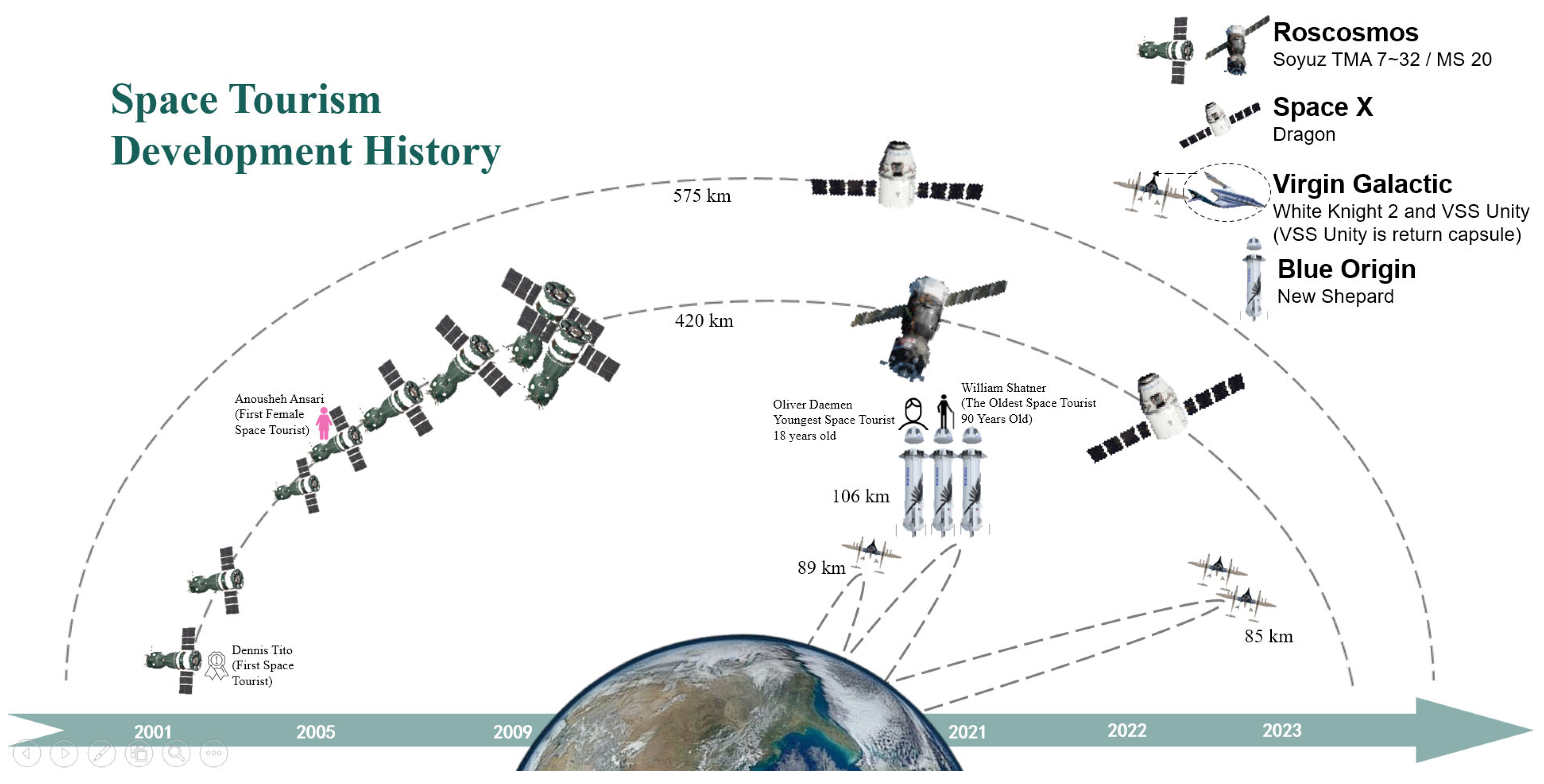
Figure 2.
Conceptual Model (Study 1: Top, Study 2: Dwon).
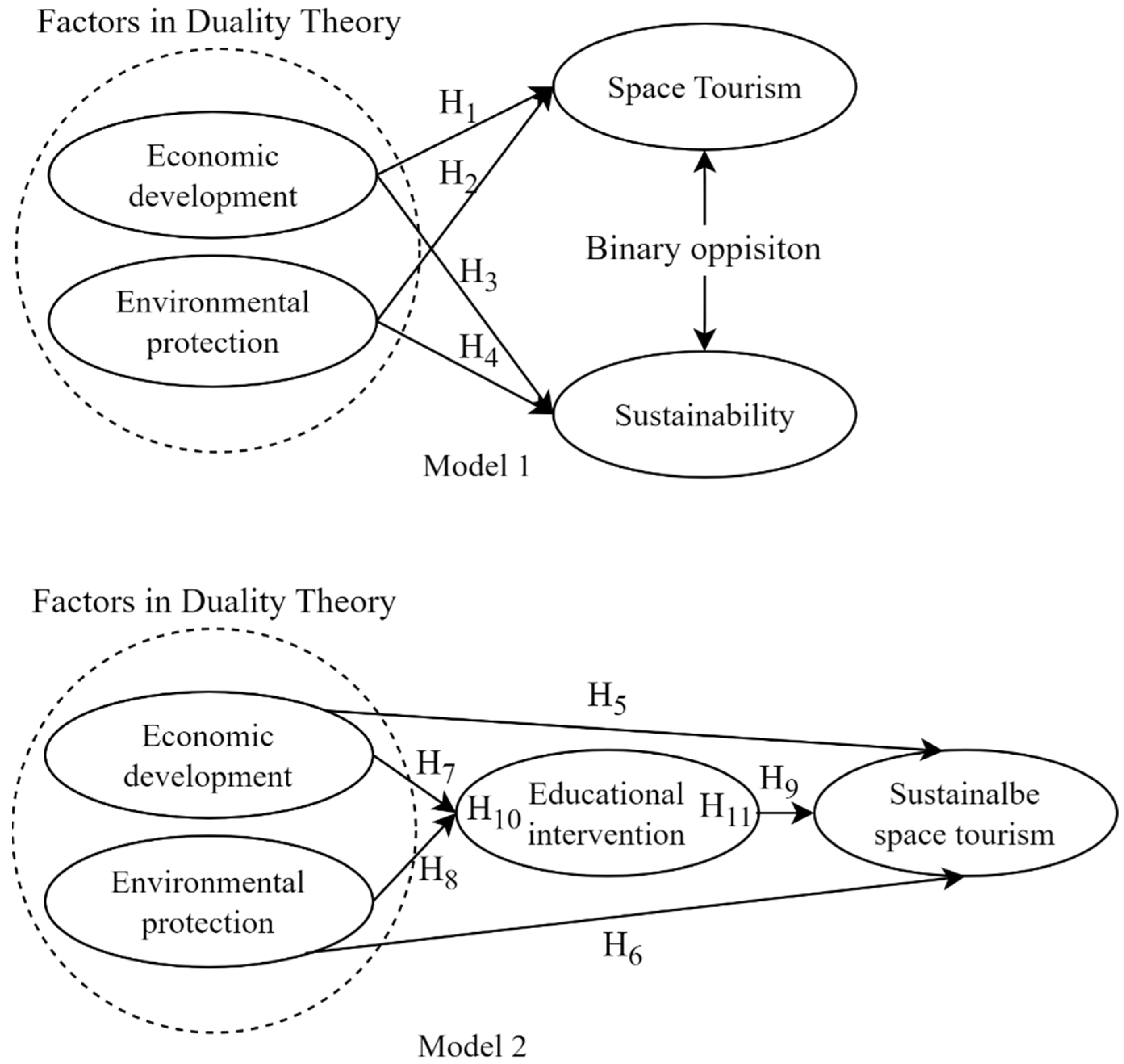
Figure 3.
Result of PLS-SEM (Study 1).
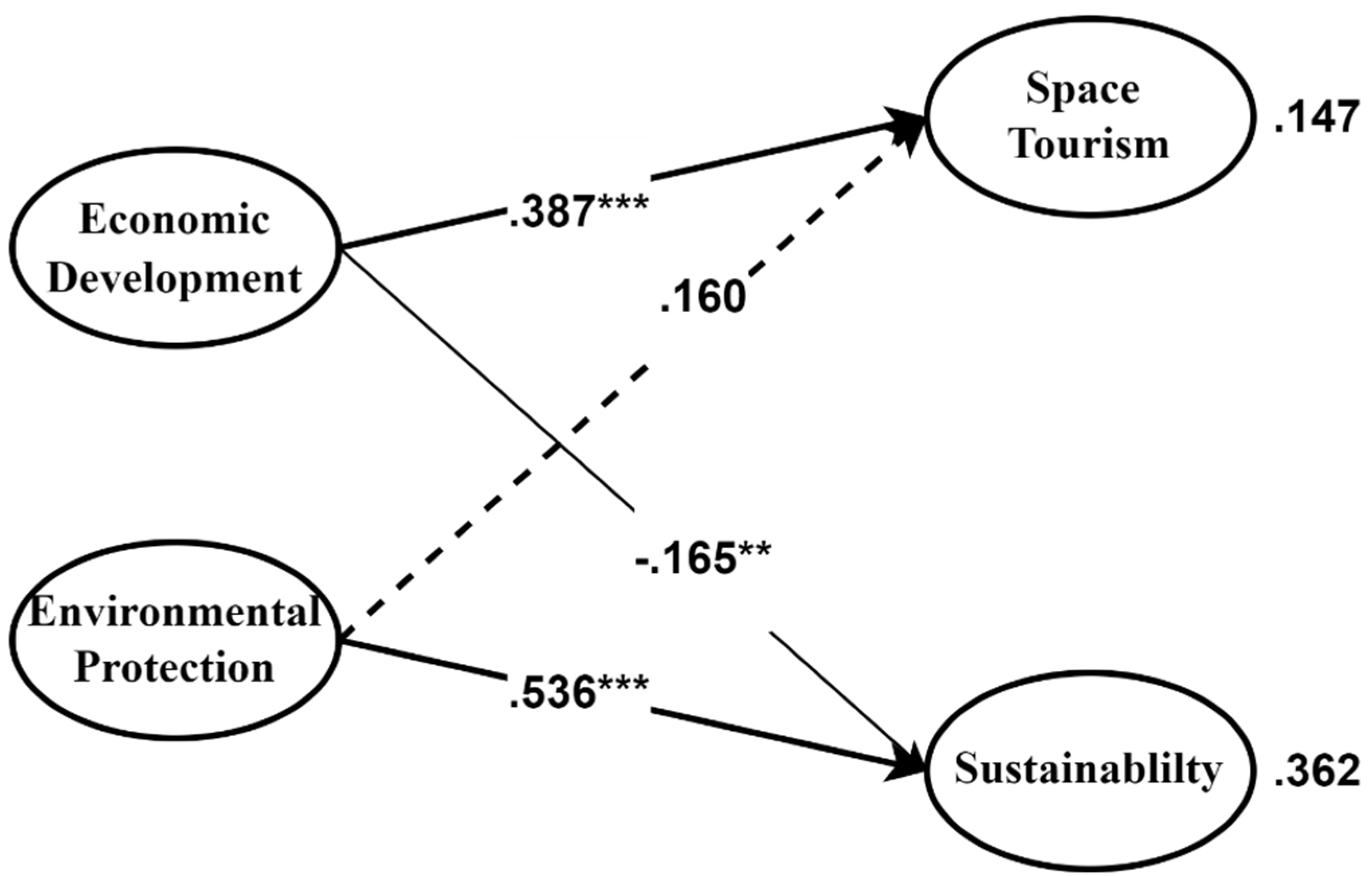
Figure 4.
Result of PLS-SEM (Study 2). Note: *: P < 0.05, **: P < 0.01, ***: P < 0.001, Non: P > 0.05. The number near the construct: R2
Figure 4.
Result of PLS-SEM (Study 2). Note: *: P < 0.05, **: P < 0.01, ***: P < 0.001, Non: P > 0.05. The number near the construct: R2
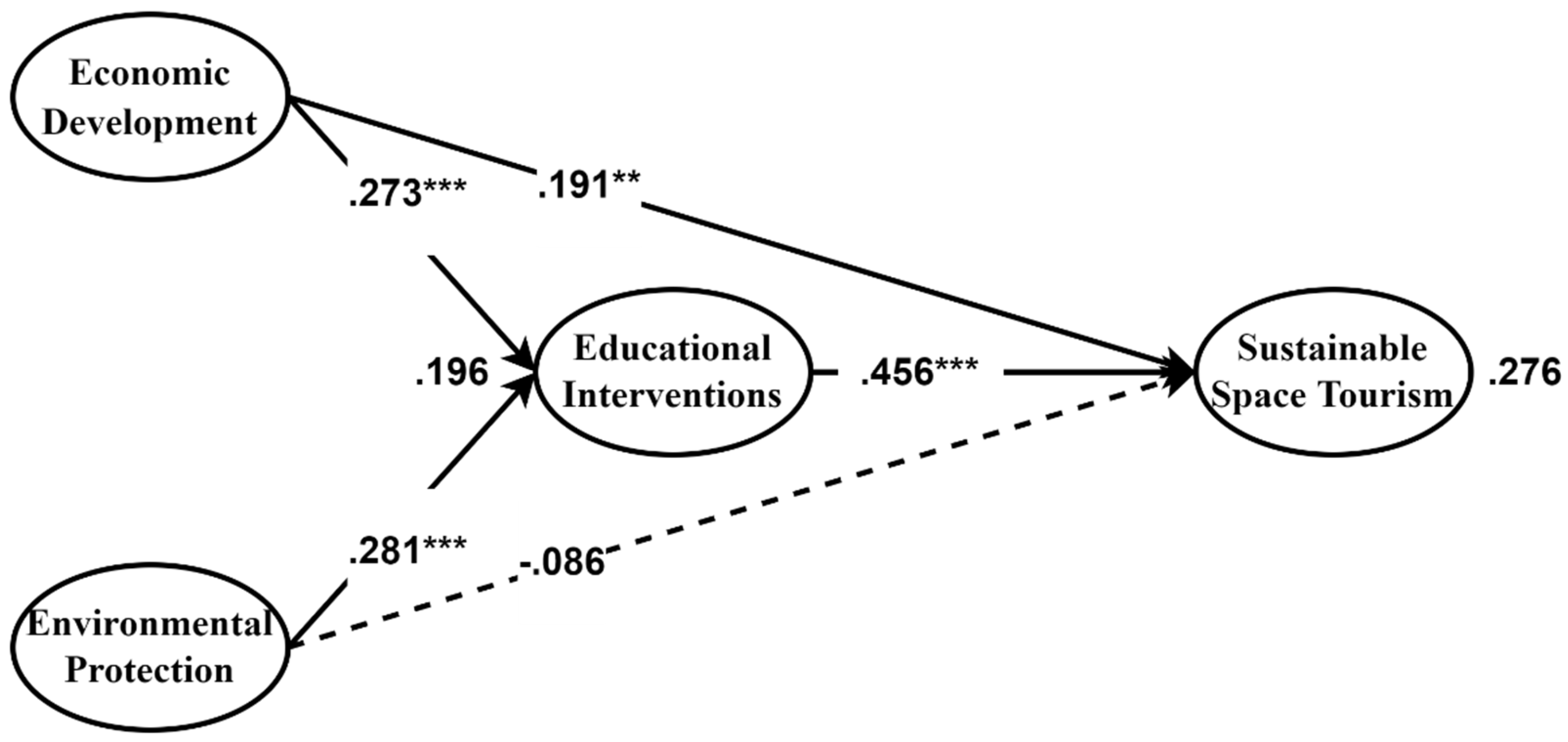
Table 1.
Measurement items.
| Item | |
|---|---|
| Economic Development | |
| ED1 | Economic growth is necessary to increase employment opportunities. |
| ED2 | Without economic growth, a better life is challenging to achieve. |
| ED3 | Sustained economic growth can improve people's life satisfaction. |
| ED4 | Without economic growth, the economy will become less stable. |
| Environmental Protection | |
| EP1 | The Earth has unlimited resources for human use. |
| EP2 | Human intervention will naturally not have disastrous consequences. |
| EP3 | Nature's self-balancing ability can cope with the destruction of modern industry. |
| EP4 | Human beings are special and can transcend all natural laws. |
| Space Tourism | |
| ST1 | Space tourism is a direction of tourism development. |
| ST2 | Space tourism can drive economic development. |
| ST3 | Space tourism can help humanity get out of its resource dilemma. |
| ST4 | Traveling to space is worth my time and energy. |
| Environmental Sustainability | |
| ES1 | Going the extra mile to be environmentally sustainable is unnecessary. |
| ES2 | Humans do not need to care about environmental sustainability deliberately. |
| ES3 | Producing and selling organic food is not environmentally sustainable. |
| ES4 | Companies that maintain environmental sustainability should not deserve additional subsidies. |
| Educational Intervention | |
| EI1 | I am willing to learn about sustainability. |
| EI2 | I want to learn about sustainable practices. |
| EI3 | I learned that I should take responsibility for sustainable development. |
| EI4 | I will apply sustainable knowledge in my life. |
| Sustainable Space Tourism | |
| SST1 | Space tourism enterprises should provide long-term stable business profitability. |
| SST2 | Space tourism should be carbon neutral through various means. |
| SST3 | Space tourism enterprises should provide long-term and stable employment opportunities. |
| SST4 | Space tourism should allow tourists to have an unforgettable space experience. |
Table 2.
Sample profile (n=284).
| Frequency | Percentage% | |
|---|---|---|
| Gender | ||
| Male | 119 | 41.9 |
| Female | 165 | 58.1 |
| Age | ||
| 18-24 | 170 | 59.9 |
| 25-30 | 65 | 22.9 |
| 31-40 | 33 | 11.6 |
| 41-50 | 8 | 2.8 |
| 51-60 | 6 | 2.1 |
| >60 | 2 | 0.7 |
| Education | ||
| Secondary school or below | 32 | 11.3 |
| Diploma & University degree | 207 | 72.9 |
| Master degree | 40 | 14.1 |
| PhD | 5 | 1.8 |
| Income (RMB) | ||
| < 2500 | 74 | 26.1 |
| 2501-5000 | 82 | 28.9 |
| 5001-10000 | 80 | 28.2 |
| 10001-15000 | 30 | 10.6 |
| 15001-20000 | 7 | 2.5 |
| > 20000 | 11 | 3.9 |
Table 3.
Measurement Model Analysis (Model 1).
| Variable | Items | Mean | STDEV | Factor Loadings | VIF | Cronbach α | CR | AVE |
|---|---|---|---|---|---|---|---|---|
| ED | ED1 | 6.08 | 1.043 | 0.802 | 1.458 | 0.775 | 0.853 | 0.593 |
| ED2 | 5.94 | 1.222 | 0.756 | 1.460 | ||||
| ED3 | 5.99 | 1.077 | 0.748 | 1.541 | ||||
| ED4 | 5.4 | 1.417 | 0.773 | 1.624 | ||||
| ST | ST1 | 5.51 | 1.4 | 0.843 | 1.875 | 0.828 | 0.883 | 0.654 |
| ST2 | 4.93 | 1.511 | 0.858 | 1.981 | ||||
| ST3 | 4.88 | 1.488 | 0.811 | 1.672 | ||||
| ST4 | 4.53 | 1.782 | 0.717 | 1.617 | ||||
| EP | EP1 | 1.68 | 1.095 | 0.722 | 1.336 | 0.751 | 0.843 | 0.574 |
| EP2 | 1.72 | 1.173 | 0.718 | 1.345 | ||||
| EP3 | 1.85 | 1.25 | 0.811 | 1.662 | ||||
| EP4 | 1.45 | 0.97 | 0.775 | 1.519 | ||||
| ES | ES1 | 1.59 | 1.196 | 0.799 | 1.483 | 0.713 | 0.823 | 0.538 |
| ES2 | 1.61 | 1.255 | 0.758 | 1.461 | ||||
| ES3 | 2.62 | 1.572 | 0.655 | 1.242 | ||||
| ES4 | 1.83 | 1.157 | 0.715 | 1.323 |
Table 4.
Measurement Model Analysis (Model 2).
| Variable | Items | Mean | STDEV | Factor Loadings | VIF | Cronbach α | CR | AVE |
|---|---|---|---|---|---|---|---|---|
| ED | ED1 | 6.08 | 1.043 | 0.835 | 1.458 | 0.775 | 0.851 | 0.588 |
| ED2 | 5.94 | 1.222 | 0.712 | 1.460 | ||||
| ED3 | 5.99 | 1.077 | 0.768 | 1.541 | ||||
| ED4 | 5.40 | 1.417 | 0.747 | 1.624 | ||||
| EP* | EP1 | 6.32 | 1.095 | 0.732 | 1.336 | 0.751 | 0.842 | 0.571 |
| EP2 | 6.28 | 1.173 | 0.750 | 1.345 | ||||
| EP3 | 6.15 | 1.250 | 0.782 | 1.662 | ||||
| EP4 | 6.55 | 0.970 | 0.758 | 1.519 | ||||
| EI | EI1 | 6.03 | 1.151 | 0.897 | 2.599 | 0.892 | 0.933 | 0.822 |
| EI3 | 5.98 | 1.172 | 0.911 | 2.661 | ||||
| EI4 | 6.04 | 1.103 | 0.912 | 2.656 | ||||
| SST | SST1 | 4.88 | 1.383 | 0.804 | 2.045 | 0.844 | 0.896 | 0.683 |
| SST2 | 5.42 | 1.390 | 0.829 | 1.848 | ||||
| SST3 | 5.08 | 1.473 | 0.883 | 2.649 | ||||
| SST4 | 5.86 | 1.294 | 0.785 | 1.613 |
Note: The construct EP* was reversed in study 2.
Table 5.
Discriminant validity (Model 1).
| ED | EP | ES | ST | |
|---|---|---|---|---|
| ED | 0.770 | 0.321 | 0.389 | 0.445 |
| EP | -0.266 | 0.758 | 0.788 | 0.139 |
| ES | -0.308 | 0.580 | 0.734 | 0.213 |
| ST | 0.383 | -0.087 | -0.168 | 0.809 |
Table 6.
Discriminant validity (Model 2).
| ED | EP | EI | SST | |
|---|---|---|---|---|
| ED | 0.767 | 0.321 | 0.397 | 0.375 |
| EP | 0.274 | 0.756 | 0.425 | 0.155 |
| EI | 0.350 | 0.356 | 0.907 | 0.563 |
| SST | 0.327 | 0.128 | 0.492 | 0.826 |
Note: Underline font: Heterotrait-Monotrait Ratio, Bold font: Square-root of the AVE.
Table 7.
Results for SmartPLS (k=10).
| Model 1 | ||||
| PLS-SEM | LM | PLS-SEM - LM | ||
| Item | Q2 predict | RMSE | RMSE | RMSE |
| ES1 | 0.250 | 1.037 | 1.066 | -0.029 |
| ES2 | 0.170 | 1.146 | 1.172 | -0.026 |
| ES3 | 0.137 | 1.463 | 1.473 | -0.010 |
| ES4 | 0.161 | 1.061 | 1.090 | -0.029 |
| ST1 | 0.100 | 1.332 | 1.317 | 0.015 |
| ST2 | 0.111 | 1.427 | 1.455 | -0.028 |
| ST3 | 0.095 | 1.418 | 1.440 | -0.022 |
| ST4 | 0.008 | 1.778 | 1.786 | -0.008 |
| Model 2 | ||||
| PLS-SEM | LM | PLS-SEM - LM | ||
| Item | Q2 predict | RMSE | RMSE | RMSE |
| EI1 | 0.096 | 1.095 | 1.106 | -0.011 |
| EI3 | 0.157 | 1.078 | 1.104 | -0.026 |
| EI4 | 0.168 | 1.008 | 1.023 | -0.015 |
| SST1 | 0.049 | 1.351 | 1.350 | 0.001 |
| SST2 | 0.031 | 1.371 | 1.379 | -0.008 |
| SST3 | 0.056 | 1.434 | 1.448 | -0.014 |
| SST4 | 0.102 | 1.228 | 1.238 | -0.010 |
Table 8.
Results for PLS-SEM analysis.
| Model 1 | ||||||
| Hypotheses | Path | Standard Beta | t-Value | p-Value | f-squire | Decision |
| H1 | ED→ST | 0.387 | 7.727 | 0.000 | 0.163 | Supported |
| H2 | ED→ES | -0.165 | 3.016 | 0.003 | 0.040 | Supported |
| H3 | EP→ST | 0.016 | 0.275 | 0.783 | 0.000 | Not supported |
| H4 | EP→ES | 0.536 | 8.633 | 0.000 | 0.419 | Supported |
| Model 2 | ||||||
| Hypotheses | Path | Standard Beta | t-Value | p-Value | f-squire | Decision |
| H5 | ED→SST | 0.191 | 3.218 | 0.001 | 0.043 | Supported |
| H6 | EP→SST | -0.086 | 1.652 | 0.099 | 0.009 | Not supported |
| H7 | ED→EI | 0.273 | 4.878 | 0.000 | 0.086 | Supported |
| H8 | EI→SST | 0.456 | 6.558 | 0.000 | 0.231 | Supported |
| H9 | EP→EI | 0.281 | 4.870 | 0.000 | 0.091 | Supported |
Table 9.
Mediation Analysis.
| Study 2 | |||||
|---|---|---|---|---|---|
| Hypotheses | Path | Standard Beta | t-Value | p-Value | Decision |
| H10 | ED→EI→SST | 0.124 | 3.890 | 0.000 | Supported |
| H11 | EP→EI→SST | 0.128 | 3.741 | 0.000 | Supported |
Disclaimer/Publisher’s Note: The statements, opinions and data contained in all publications are solely those of the individual author(s) and contributor(s) and not of MDPI and/or the editor(s). MDPI and/or the editor(s) disclaim responsibility for any injury to people or property resulting from any ideas, methods, instructions or products referred to in the content. |
© 2023 by the authors. Licensee MDPI, Basel, Switzerland. This article is an open access article distributed under the terms and conditions of the Creative Commons Attribution (CC BY) license (http://creativecommons.org/licenses/by/4.0/).
Copyright: This open access article is published under a Creative Commons CC BY 4.0 license, which permit the free download, distribution, and reuse, provided that the author and preprint are cited in any reuse.


