

Submitted:
04 December 2023
Posted:
05 December 2023
You are already at the latest version
Abstract
Globally, between 10% and 15% of couples experience infertility. Given the high demand for Assisted Reproductive Techniques (ART), there is growing interest in exploring modifiable factors influencing their outcomes. In this context, the objective of this review was to investigate the impact of adherence to the Mediterranean Diet (MD), recognized for its benefits in reproductive health, on ART outcomes. Methodology: A systematic review was conducted following the PRISMA methodology. International databases were consulted, selecting studies published between 2010 and 2023, in English and Spanish, involving patients aged 18-55, and examining intermediate and/or clinical outcomes of ART. Systematic reviews, meta-analyses, and animal studies were excluded. Results: Of the 9 included articles, 5 found statistically significant associations between adherence to the MD and positive outcomes in ART, such as a higher number and quality of embryos, clinical and biochemical pregnancy, and live births. However, other studies found no such associations. Conclusions: There is a potential association between adherence to the MD and ART outcomes. The evidence is very limited, necessitating further investigation.
Keywords:
mediterranean diet
; assisted reproductive techniques
; infertility
; in vitro fertilization
; artificial insemination
1. Introduction
Infertility, defined as the inability of a couple to achieve pregnancy after a year of regular unprotected sexual intercourse, has become a public health issue, affecting approximately 10-15% of couples worldwide [1]. Socioeconomic and cultural changes in recent years have led to a growing trend towards delayed parenthood, with couples opting to postpone childbearing until their 30s or 40s [2]. According to fertility indicators from the National Institute of Statistics (INE) of Spain, the average maternal age in 2021 was 32.61 years [3], and in the European Union, it was 29.7 years [4]. This increase in maternal age is associated with a decline in oocyte quality and an increased incidence of concurrent diseases that can worsen reproductive prognosis [5].
In response to this complex issue, Assisted Reproductive Techniques (ART) have become an essential resource to help couples overcome infertility challenges. Various techniques are employed, broadly classified into two groups. Firstly, there are low-complexity ART involving the union of the egg and sperm within the fallopian tube. This group includes timed intercourse, scheduled intercourse, and intrauterine insemination (IUI), which involves placing capacitated sperm into the uterine cavity using a catheter to achieve pregnancy [6]. Secondly, there are high-complexity ART, where the egg-sperm union occurs in the laboratory. Notably, in vitro fertilization (IVF) stands out, further divided into conventional IVF with embryo transfer (IVF-ET) and intracytoplasmic sperm injection (ICSI), which involves introducing a sperm into each egg [6].
Recent data indicate that ART, such as IVF, contributes to approximately 1 in 20 births in developed countries [7]. In 2018, the International Committee for Monitoring Assisted Reproductive Technologies (ICMART) reported around 3.2 million IVF cycles globally, with an average live birth rate ranging between 20-30% per cycle. Moreover, the number of couples undergoing ART is exponentially increasing [8]. It is crucial to emphasize that addressing infertility involves a prolonged and costly therapeutic process, marked by high rates of abandonment and failure. In fact, around 50% of couples initiating this treatment fail to conceive even after multiple attempts, leading to negative consequences in terms of psychological well-being, social impact, and financial situations [9]. All of this underscores the need to investigate factors that may affect the success of ART.
Regarding factors that can influence the outcomes of ART, increasing attention is being paid to the impact of lifestyles and dietary habits in particular [10]. However, interest has shifted from studying isolated nutrients or food groups such as dairy or whole grains to investigating dietary patterns [10]. This is due to the synergistic and/or antagonistic effects that nutrients present with each other and, more importantly, because focusing on dietary patterns better reflects long-term dietary habits [10].
Among the dietary patterns that have attracted considerable interest is the Mediterranean Diet (MD), globally renowned for its cardiovascular and metabolic health benefits [11]. This diet, rich in fruits, vegetables, whole grains, fish, olive oil, and legumes, has been associated with multiple positive health effects, including a reduced risk of chronic and neurodegenerative diseases [10,11,12,13,14]. Additionally, recent studies have also highlighted its relationship with factors associated with reproductive health, suggesting that greater adherence to the MD may improve semen quality or reduce metabolic disorders such as polycystic ovary syndrome and endometriosis [15,16,17]. Some authors explain that the beneficial effects of the MD on reproductive health are grounded in the role of the diet in regulating chronic low-grade inflammation and insulin resistance, both conditions related to multiple pathologies [17].
However, despite the growing attention to the MD and its reproductive health benefits, evidence regarding its association with ART outcomes is limited [10]. In this regard, a study conducted in 2010 that investigated various pre-conception dietary patterns in infertile couples concluded that the “Mediterranean” diet pattern increased the likelihood of pregnancy following IVF [18]. Similarly, a cohort study involving 244 non-obese women found that, among women under 35 years old, higher adherence to the MD was associated with a 2.7 times greater likelihood of achieving clinical pregnancy and live birth after undergoing IVF [10].
Therefore, based on the hypothesis that high adherence to the MD implies better outcomes in ART (fertilization rate, implantation rate, clinical pregnancy, or live birth), the objective of this systematic review is to explore in detail the relationship between adherence to the MD and ART outcomes.
2. Materials and Methods
2.1. Registration
A systematic literature review was conducted following the PRISMA 2020 methodology [19] and was registered in the PROSPERO database (CRD42023471284).
2.2. Eligibility Criteria
Inclusion criteria were as follows: (1) articles accessible in full text, freely available, and with an available abstract; (2) articles written in English or Spanish; (3) articles published within the last 13 years: from January 1, 2010, to October 10, 2023; (4) articles including patients aged 18 to 55 years; (5) articles examining intermediate outcomes (number of retrieved oocytes, fertilization rate, and measures of embryo quality) or clinical endpoints (implantation, clinical pregnancy, and live births) of ART; (6) studies employing validated instruments to assess adherence to the MD (unless they were clinical trials).
Exclusion criteria were: (I) articles unrelated to the study topic or articles that were protocol-only with no results; (II) case reports, reviews, or meta-analyses; (III) documents that were conference abstracts/proceedings; (IV) studies examining ART other than IVF, ICSI, or IUI; (V) animal studies.
2.3. Sources of Information
To obtain the articles, electronic searches were carried out in the international databases MEDLINE (PubMed), ScienceDirect, Embase, Cochrane Library, and Web of Science (WOS). Additional documents were identified by checking the references of other articles to ensure a comprehensive coverage of the literature.
2.4. Search Strategy
The search strategy aimed to identify studies published and available in full text. A comprehensive search strategy was implemented using both Medical Subject Headings (MeSH) and title/abstract terms. The following keywords were transformed into MeSH terms: “diet, mediterranean,” “reproductive techniques, assisted,” “fertilization in vitro,” and “insemination, artificial,” combined with the boolean operators AND and OR. Table 1 shows the search strategy used in the PubMed database.
2.5. Article Selection Process
The selection of articles was carried out by reading the title and abstract of all the articles resulting from the search in MEDLINE (PubMed), ScienceDirect, Embase, Cochrane Library, and WOS. The articles were independently selected by two authors (L.M.M. and A.Z.M.) to confirm inclusion/exclusion criteria. To assess the quality of each included study, the Cochrane Collaboration Risk of Bias (ROB) tool [20] was employed, comprising seven items covering six bias domains. Each item is considered to have a high, low, or unclear risk of bias. The quality of each study was independently assessed by two authors (L.M.M. and A.Z.M.) using the criteria adapted from Crombie by Petticrew and Roberts [21]. Disagreements were resolved by a third author (AM.M.Y.).
2.6. Data Extraction Process
Data extraction was carried out by the lead author (L.M.M.) of the review, considering the publication year (2010-2023), study design and objective, the year the study was conducted, sample size, participants’ age range, country of origin, variables (dietary and clinical) and their measurement, as well as the results and conclusions of the studies.
2.7. Risk of Bias Assessment
The AXIS critical appraisal tool [22] was employed to assess the quality and risk of bias in cross-sectional studies. The quality of cohort studies was evaluated using the Newcastle-Ottawa Scale [23]. Finally, the quality of clinical trials was assessed using the RoB-2 “traffic-light plot” following Cochrane methodology [20].
The first author (L.M.M.) and the second author (A.Z.M.) independently rated each included article, and discrepancies were resolved through agreement with the third author (AM.M.Y.). The Cohen’s Kappa statistic was calculated to assess the reliability between evaluators in determining the risk of bias, excluding elements evaluating participant or assessor blinding, as all studies were rated as high risk of bias by both evaluators when all elements were considered. Inter-rater reliability was analyzed using the Cohen’s Kappa statistic, obtaining a value of ICC = 0.8.
2.8. Methods of Synthesis
Once the data extraction was completed, the results were grouped into three categories: 1) based on the variables used to determine the outcomes of ART, 2) based on the instruments used to measure adherence to the MD (or, if applicable, the intervention performed), and 3) based on the findings in the relationship between adherence to the MD and the outcomes of ART.
3. Results
3.1. Selection of Studies
Figure 1 depicts the flowchart of articles following the PRISMA 2020 methodology [19]. After the search, 189 records were identified. Prior to the selection, 143 articles were excluded. Out of the remaining 46, 37 articles were further excluded based on exclusion criteria. Finally, 9 articles were included in the present review.
3.2. Characteristics of the Studies
Table 2 displays the characteristics of the articles included in the review. Concerning the country of origin, three articles (33.3%) were conducted in the United States (USA) [27,30,31], two (22.2%) in Italy [24,28], one (11.1%) in Greece [26], one (11.1%) in China [29], one (11.1%) in the Netherlands [25], and one (11.1%) in the United Kingdom [32]. The age range of the participants was between 18 and 46 years. Among all the analyzed studies, one was cross-sectional (11.1%) [24], seven were cohort studies (77.7%) [25,26,27,28,29,30,31], and one was a double-blind randomized clinical trial (11.1%) [32]. The total number of subjects analyzed across all included articles was 3090.
3.3. Publication Bias
Table 3 presents the assessment of bias risk in the included cross-sectional studies using the AXIS scale [22]. As can be observed, the study by Noli SA et al., 2023 [24], exhibited a moderate risk of bias since some aspects were not specified, and others, such as non-response bias or conflicts of interest, were not addressed.
Appraisal of Cross-sectional studies AXIS: 1. aims; 2. study design; 3. sample size justification; 4. target reference population; 5. sampling frame; 6. sample selection; 7. non-responders; 8. measurement validity and reliability; 9. risk factors and outcomes. 10. statistics; 11. overall methods; 12. basic data; 13. non-response bias; 14. non-responders; 15. internal consistency results; 16. comprehensive description results; 17. justified discussions and conclusions; 18. limitations; 19. conflict of interest; 20. ethical approval. DK: Doesn’t know; NR: No reply.
Table 4 displays the Newcastle-Ottawa scale [23], which assesses the risk of bias in cohort and case-control studies. In this case, no case-control study was included in the present review. Regarding cohort studies, overall, they all had a low risk of bias. However, 4 out of 7 cohort studies (57.1%) [25,28,30,31] exhibited biases in the adequacy of sample follow-up.
Finally, in Figure 2, the risk of bias assessment for the clinical trial [32] is shown using the RoB-2 “traffic-light plot” following the Cochrane methodology [33]. This study generally exhibited a low risk of bias, as there was only some uncertainty regarding the potential bias due to deviations in the planned intervention.
3.4. Relationship between Adherence to the MD and ART Outcomes
Table 5 outlines how the studies conducted the assessment of adherence to the MD, the variables they analyzed to determine ART outcomes, a summary of the most relevant results, and the conclusions.
Regarding the determination of the degree of adherence to the MD, 7 out of the 9 analyzed studies (77.7%) [24,26,27,28,29,30,31] used a Food Frequency Questionnaire (FFQ), in which they subsequently applied a previously developed index to assess adherence to the MD. Specifically, 4 studies (44.4%) [24,29,30,31] used the DM index developed by Trichopoulou et al., in 2003 (MDS), and among them, one study (11.1%) [24] made modifications to the MDS index to adapt it to Italian eating habits. Another four articles (44.4%) [26,27,30,31] employed the DM index created by Panagiotakos et al., in 2007 (PMD), and the two studies conducted by Salas-Huetos et al., (22.2%) [30,31] also used the Alternative Healthy Eating Index (AMD). On the other hand, the article published by Vujkovic M et al., 2010 [25] used a 195-item FFQ with 22 food groups, adjusted for total energy intake, and subsequently conducted a principal component analysis applied to food groups to construct two dietary patterns, one being the MD pattern and the other called “health-conscious, minimally processed.” Finally, the study by Kermack AJ et al., 2020 [32] did not determine adherence to the MD as it was a clinical trial. This study conducted a 4-week double-blind dietary intervention based on dietary supplementation following the MD model.
As for the variables analyzed to determine the outcomes of ART, they were quite heterogeneous among the different studies. Some studies evaluated intermediate outcomes (number of mature oocytes, fertilization rate, and measures of embryo quality), and others assessed clinical endpoints (implantation, clinical pregnancy, and live births), or both. Among the studies that assessed intermediate outcomes of ART, 5 out of the 9 analyzed articles (55.5%) used embryo quality as a variable (validated morphokinetic parameters of embryonic development) [25,26,28,29,32], 4 of them (44.4%) evaluated the fertilization rate [25,26,27,30], and 3 studies (33.3%) examined the number of mature oocytes [27,28,29]. Additionally, 2 out of the 9 included studies (22.2%) [24,26] took into account the results of ovarian stimulation, and one study (11.1%) [25] considered biochemical pregnancy as an outcome of ART.
Regarding clinical assessment criteria, 6 out of the 9 analyzed studies (66.6%) evaluated clinical pregnancy as an outcome [26,27,28,29,30,31], 3 articles (33.3%) [27,29,30] analyzed the implantation rate, and 5 of them (55.5%) used live birth as a variable [26,27,28,30,31]. Finally, the study by Salas-Huetos A et al., 2023 [31], also utilized total pregnancy loss, defined as a human chorionic gonadotropin (β-hCG) serum level exceeding 6 mIU/mL without confirmation of the presence of an intrauterine gestational sac at 6 weeks of gestation, and clinical pregnancy loss (β-hCG > 6 mIU/mL and confirmation of the presence of an intrauterine gestational sac that did not result in a live birth) as variables to measure the outcome of ART.
In Table 5, the results and conclusions of the studies included in this review are also presented. In conclusion, 5 out of the 9 analyzed articles (55.5%) [24,25,26,29,32] suggested that there is a relationship between the degree of adherence to the MD and the outcomes of ART. Conversely, 4 of the included articles (44.4%) found no statistically significant association [27,28,30,31].
Specifically, among the articles that found associations between the degree of adherence to the MD and ART outcomes, the study by Vujkovic M et al., 2010 [25], concluded that high adherence to the MD increased the likelihood of biochemical pregnancy [Odds ratio (OR): 1.5] after IVF/ICSI. On the other hand, Karayiannis D et al., 2018 [26], observed that non-obese women under 35 years old with low adherence to the MD had a 65% lower probability of achieving clinical pregnancy (p=0.01) and live births (p=0.01). However, this study found no significant associations between the MD and intermediate study outcomes, such as ovarian stimulation results, fertilization rate, and measures of embryo quality. Likewise, Sun HM et al., 2019 [29], concluded in their study that infertile women with higher adherence to the MD were more likely to obtain more available embryos in the IVF cycle (p=0.028). On the other hand, Kermack AJ et al., 2020 [32], observed in their randomized clinical trial that a short period of dietary supplementation based on the MD significantly altered the embryo cleavage rate, improving embryo quality. However, this study emphasized that further research is required to assess whether these effects translate into better clinical outcomes. Finally, the study by Noli SA et al., 2023 [24], found that low adherence to the MD could be a risk factor for poor ovarian response in patients without criteria for it, a crucial aspect for successful IVF.
On the other hand, the study by Gaskins AJ et al., 2019 [27], found no association between adherence to the MD and ART outcomes. However, this study investigated various dietary patterns and concluded that higher adherence to the “fertility-promoting” diet was linearly associated with a significantly higher likelihood of implantation, clinical pregnancy, and live births (trend p<0.001 for all). This diet was very similar to the MD as the study described it as a dietary pattern rich in folic acid, vitamin B12, vitamin D, pesticide-residue-low agricultural products, whole grains, dairy, soy, and seafood. In turn, Ricci E et al., 2019 [28], and Salas-Huetos A et al., 2023 [31], also found no association between adherence to the MD pattern in infertile women and ART outcomes. Finally, in the study by Salas-Huetos A et al., 2022 [30], in which they analyzed the effect of adherence to various dietary patterns, including the MD (determined through various previously validated indices), they found an inverse association between men’s adherence to the MD and the fertilization rate. However, there were no statistically significant associations between men’s adherence to any of the analyzed dietary patterns and the odds of implantation, clinical pregnancy, or live birth.
3.5. Quality of the evidence
In Table 5, the quality of evidence of the included articles was also analyzed based on the Grading of Recommendations, Assessment, Development, and Evaluation (GRADE) model, which is highly relevant in evidence-based medicine [34]. In this regard, 7 out of the 9 included studies (77.7%) [24,25,26,27,29,30,31] had low-quality evidence, one of them (11.1%) [28] had very low-quality evidence, and one (11.1%) [32] had high-quality evidence. As can be seen, almost all studies had low or very low quality because they were observational studies with the presence of some biases. One of the included studies [32] had high quality as it was a double-blind randomized clinical trial with a comprehensive methodology and a low probability of biases.
4. Discussion
The objective of this systematic review was to analyze the influence of adherence to the MD in infertile couples on the outcomes of ART. Among the 9 articles included in this review, 5 of them reported statistically significant associations between adherence to the MD and outcomes (both intermediate and clinical) of ART. Specifically, positive associations were found between higher adherence to the MD pattern and the likelihood of having a greater number of embryos available in the IVF cycle [29], better embryo quality [32], biochemical pregnancy [25], clinical pregnancy [26], and live births [26]. Similarly, low adherence to the MD was statistically linked to a poor ovarian response during the IVF cycle in patients without criteria for it [24].
On the other hand, regarding studies that did not find significant associations between ART outcomes and the MD, several relevant aspects are noteworthy. Firstly, one study [27] determined that higher adherence to a dietary pattern very similar to the MD, the “pro-fertility” diet, was associated with a higher likelihood of live birth after ART. Secondly, in the study by Ricci E et al., 2019 [28], the findings showed that adherence to the MD was not significantly associated with IVF outcomes. However, an exception was observed in women over 35 years with moderate adherence to the MD, who had a lower risk of not achieving clinical pregnancy. Additionally, the only study exclusively investigating the influence of MD adherence in a sample of men also found no association with relevant ART outcomes [30].
After conducting the bibliographic search, it was observed that research in this area was limited, mostly focusing on isolated nutrients or foods, and presenting inherent limitations in accurately measuring dietary patterns. Most of the studies were cohorts, and there was significant heterogeneity in both the instruments used to measure adherence to the MD and the variables employed to determine ART outcomes.
On the other hand, after an exhaustive review of the scientific literature, there were studies evaluating the effect of the MD on various parameters of reproductive health, showing positive results in terms of infertility prevention or endocrine disorders linked to it. For example, a case-control study from the University of Navarra’s Follow-up Project (SUN) [35], analyzing a sample of 485 infertile women and 1669 controls, determined that high adherence to the MD was associated with a higher likelihood of becoming pregnant. Other studies assessing semen quality found that adherence to the MD was positively associated with sperm concentration and total count [36], as well as sperm motility [37]. An inversely proportional association was also found between adherence to the MD pattern and the clinical severity of polycystic ovary syndrome, the most common endocrine disorder linked to female infertility [38,39]. Similarly, a case-control study conducted in Italy concluded that high vegetable consumption, adherence to the MD, and a low dietary inflammatory index (DII) were related to a lower risk of endometrial cancer [40]. This study also emphasized the importance of nutritional status, as excess body fat contributes to hormonal dysregulation and increased endometrial inflammation, increasing the risk of this type of cancer [40]. Overall, most research highlighted that the positive effects of the MD seemed to be mediated by its ability to improve nutritional status and reduce oxidative stress (OS), chronic low-grade inflammation, and insulin resistance, conditions linked to endocrine/metabolic disorders and infertility in both sexes [40,41,42].
In this context, several authors have highlighted that inflammation is an increasingly recognized factor affecting reproductive health and contributing to what is known as “inflammatory infertility” [42,43]. A study conducted in 2023, evaluating the DII in a sample of 4437 participants, concluded that having a proinflammatory diet increased the likelihood of infertility in women by 86% [43]. Likewise, postprandial hyperglycemia, caused by the consumption of large amounts of high-glycemic-index carbohydrates, has been shown to be associated with increased inflammation and OS [44]. Additionally, insulin has a direct influence on ovarian function, and hyperinsulinemia is closely related to hyperandrogenism, aggravating endocrine disorders in women, and making conception more difficult. Similarly, OS, characterized by an imbalance between prooxidative and antioxidative molecules, plays a crucial role in the pathogenesis of infertility in both men and women [44]. In part, this explains why the MD, characterized by its abundance of anti-inflammatory nutrients (omega-3 fatty acids, vitamin C, vitamin E, beta-carotene, selenium, polyphenols...) antioxidants, and low-glycemic-index carbohydrates, has been shown to offer benefits in reproductive health that can be extrapolated to the success of ART [44]. However, as reflected in this review, evidence regarding its positive influence on ART outcomes is still scarce to definitively confirm its clinical benefits in this specific area.
The present systematic review has several limitations that must be considered. Firstly, there may be a loss of scientific evidence since only articles published in English and Spanish and freely accessible were reviewed. Additionally, the included articles exhibit significant heterogeneity in the tools used to measure adherence to the MD pattern, as well as in the variables employed to determine the outcomes of ART. Moreover, almost all studies were observational, with only one randomized clinical trial available. All these factors may influence the external validity of the present review, as the extrapolation of this evidence can be complex. Nevertheless, the most notable feature of this review lies in its research approach, as the combination of multiple studies enhances the statistical robustness of the findings and ensures their external applicability. Furthermore, the impartiality and rigor in the selection of studies and the assessment of their quality using standardized tools are highlights of this review, ensuring the reliability of the presented findings. An additional strength lies in its focus on a comprehensive dietary pattern, specifically MD, in contrast to published reviews that focused on isolated nutrients or foods. This perspective better reflects the actual dietary intake of individuals and provides a more holistic view of the effects of diet on ART outcomes. In summary, this review offers relevant information that can be applied in the clinical practice setting.
5. Conclusions
There is evidence of a possible association between the degree of adherence to the MD and outcomes in ART in most of the included studies. However, the evidence is insufficient to establish a causal association primarily due to the limited availability of studies in this field. Nevertheless, the MD can be a very useful and cost-effective tool, as scientific literature does show its potential to reduce pathologies linked to infertility.
The limited research in this area represents a significant limitation and underscores the urgent need for future studies addressing the relationship between adherence to the MD and ART outcomes. Similarly, it would be interesting to delve into the anti-inflammatory effect of the MD and its connection to physiological mechanisms that may lead to infertility in both sexes, as well as its influence on assisted reproduction.
Author Contributions
Conceptualization, L.M.M., A.Z.M. and A.M.M.Y.; methodology, L.M.M. and A.Z.M.; validation, A.Z.M., A.M.M.Y. and M.S.S.; formal analysis, L.M.M. and A.M.M.Y.; resources, L.M.M.; data curation, A.Z.M.; writing—original draft preparation, L.M.M.; writing—review and editing, L.M.M., A.Z.M., M.S.S. and A.M.M.Y.; visualization, J.A.H.S. and M.S.S.; supervision, A.Z.M. and J.A.H.S. All authors have read and agreed to the published version of the manuscript.
Funding
This research received no external funding.
Institutional Review Board Statement
Not applicable.
Informed Consent Statement
Not applicable.
Data Availability Statement
All data can be found in the article.
Conflicts of Interest
The authors declare no conflict of interest.
References
- World Health Organization. Health topics: Infertility. 2020. Available online: https://www.who.int/es/news-room/fact-sheets/detail/infertility (accessed on 11 September 2023).
- Sociedad Española de Fertilidad. Libro Blanco Sociosanitario de la SEF: La Infertilidad en España: Situación Actual y Perspectivas. Imago Concept & Image Development, S.L. 2021. Available online: https://www.sefertilidad.net/docs/biblioteca/libros/libroBlanco.pdf (accessed on 11 September 2023).
- Instituto Nacional de Estadística. Indicadores de Fecundidad: Edad Media a la Maternidad Por Orden Del Nacimiento Según Nacionalidad (Española/Extranjera) De La Madre. 2021. Available online: https://www.ine.es/jaxiT3/Tabla.htm?t=1579 (accessed on 11 September 2023).
- Eurostat Statistics Explained. Fertility Statistics. 2021. Available online: https://ec.europa.eu/eurostat/statistics-explained/index.php?title=Fertility_statistics (accessed on 11 September 2023).
- Batiza-Resendiz, V.A.; Aguilar-Melgar, A.; Luna-Rojas, R.M.; Pérez-Peña, E.; Gutiérrez-Gutiérrez, A.; Ruvalcaba-Castrellón, L.A.; et al. Preservación de la fertilidad: opinión de un grupo de expertos. Ginecol. obstet. Méx 2020, 88, 767–805. [Google Scholar]
- Ministerio de Salud de la Nación. Guía sobre fertilidad para equipos de atención primaria de la salud. 2015. Available online: https://iah.salud.gob.ar/doc/Documento107.pdf (accessed on 11 September 2023).
- De Geyter, C. Assisted reproductive technology: Impact on society and need for surveillance. Best Pract Res Clin Endocrinol Metab. 2019, 33, 3–8. [Google Scholar] [CrossRef] [PubMed]
- Newman, J.; Paul, R.; Chambers, G. Assisted reproductive technology in Australia and New Zealand. Sydney: National Perinatal Epidemiology and Statistics Unit, the University of New South Wales. 2020. Available online: https://npesu.unsw.edu.au/sites/default/files/npesu/data_collection/Assisted%20Reproductive%20Technology%20in%20Australia%20and%20New%20Zealand%202020.pdf (accessed on 13 September 2023).
- Adamson, G.D.; Zegers-Hochschild, F.; Dyer, S.; Chambers, G.; Mouzon, J.; Ishihara, O.; et al. International Committee Monitoring Assisted Reproductive Technologies. Preliminary World Report, 2018. Available online: https://www.icmartivf.org/wp-content/uploads/ICMART-ESHRE-WR2018-Preliminary-Report.pdf (accessed on 13 September 2023).
- Villani, M.T.; Morini, D.; Spaggiari, G.; Furini, C.; Melli, B.; Nicoli, A.; et al. The (decision) tree of fertility: an innovative decision-making algorithm in assisted reproduction technique. J Assist Reprod Genet. 2022, 39, 395–408. [Google Scholar] [CrossRef] [PubMed]
- Karayiannis, D.; Kontogianni, M.D.; Mendorou, C.; Mastrominas, M.; Yiannakouris, N. Adherence to the Mediterranean diet and IVF success rate among non-obese women attempting fertility. Hum Reprod. 2018, 33, 494–502. [Google Scholar] [CrossRef] [PubMed]
- Rosato, V.; Temple, N.J.; La Vecchia, C.; Castellan, G.; Tavani, A.; Guercio, V. Mediterranean diet and cardiovascular disease: a systematic review and meta-analysis of observational studies. Eur J Nutr. 2019, 58, 173–191. [Google Scholar] [CrossRef] [PubMed]
- Hansrivijit, P.; Oli, S.; Khanal, R.; Ghahramani, N.; Thongprayoon, C.; Cheungpasitporn, W. Mediterranean diet and the risk of chronic kidney disease: A systematic review and meta-analysis. Nephrology (Carlton). 2020, 25, 913–918. [Google Scholar] [CrossRef]
- Singh, B.; Parsaik, A.K.; Mielke, M.M.; Erwin, P.J.; Knopman, D.S.; Petersen, R.C.; et al. Association of mediterranean diet with mild cognitive impairment and Alzheimer’s disease: a systematic review and meta-analysis. J Alzheimers Dis. 2014, 39, 271–282. [Google Scholar] [CrossRef]
- Salas-Huetos, A.; Babio, N.; Carrell, D.T.; Bulló, M.; Salas-Salvadó, J. Adherence to the Mediterranean diet is positively associated with sperm motility: A cross-sectional analysis. Sci. Rep. 2019, 9, 3389. [Google Scholar] [CrossRef] [PubMed]
- Wang, Q.; Sun, Y.; Xu, Q.; Liu, W.; Wang, P.; Yao, J.; et al. Higher dietary inflammation potential and certain dietary patterns are associated with polycystic ovary syndrome risk in China: A case-control study. Nutr Res. 2022, 100, 1–18. [Google Scholar] [CrossRef]
- Szmidt, M.K.; Granda, D.; Madej, D.; Sicinska, E.; Kaluza, J. Adherence to the Mediterranean Diet in Women and Reproductive Health across the Lifespan: A Narrative Review. Nutrients. 2023, 15, 2131. [Google Scholar] [CrossRef]
- Vujkovic, M.; De Vries, J.H.; Lindemans, J.; Macklon, N.S.; Van der Spek, P.J.; Steegers, E.A.P.; et al. The preconception Mediterranean dietary pattern in couples undergoing in vitro fertilization/intracytoplasmic sperm injection treatment increases the chance of pregnancy. Fertil Steril. 2010, 94, 2096–2101. [Google Scholar] [CrossRef] [PubMed]
- Page, M.A.; McKenzie, J.E.; Bossuyt, P.M.; Boutron, I.; Hoffmann, T.C.; Mulrow, C.D.; et al. Declaración PRISMA 2020: una guía actualizada para la publicación de revisiones sistemáticas. Rev Esp Cardiol. 2021, 74, 790–799. [Google Scholar] [CrossRef] [PubMed]
- Higgins, J.P.; Altman, D.G.; Gøtzsche, P.C.; Jüni, P.; Moher, D.; Oxman, A.D.; et al. The cochrane collaboration’s tool for assessing risk of bias in randomized trials. BMJ. 2011, 343, d5928. [Google Scholar] [CrossRef]
- Petticrew, M.; Roberts, H. Systematic Reviews in the Social Sciences: A Practical Guide. Blackwell Publishing. 2006. [Google Scholar] [CrossRef]
- Downes, M.J.; Brennan, M.L.; Williams, H.C.; Dean, R.S. Development of a critical appraisal tool to assess the quality of cross-sectional studies (AXIS). BMJ Open 2016, 6, e011458. [Google Scholar] [CrossRef]
- Wells, G.; Shea, B.; O’ Connell, D.; Peterson, J.; Welch, V.; Losos, M.; et al. The Newcastle-Ottawa Scale (NOS) for Assessing the Quality of Nonrandomised Studies in Meta-Analyses 2013. Available online: https://www.ohri.ca/programs/clinical_epidemiology/oxford.asp (accessed on 19 September 2023).
- Noli, S.A.; Ferrari, S.; Ricci, E.; Reschini, M.; Cipriani, S.; Dallagiovanna, C.; et al. Adherence to the Mediterranean diet and the risk of unexpected poor response to ovarian stimulation in IVF cycles. Reprod Biomed Online. 2023, 47, 77–83. [Google Scholar] [CrossRef]
- Vujkovic, M.; De Vries, J.H.; Lindemans, J.; Macklon, N.S.; Van der Spek, P.J.; Steegers, E.A.; et al. The preconception Mediterranean dietary pattern in couples undergoing in vitro fertilization/intracytoplasmic sperm injection treatment increases the chance of pregnancy. Fertil Steril. 2010, 94, 2096–2101. [Google Scholar] [CrossRef] [PubMed]
- Karayiannis, D.; Kontogianni, M.D.; Mendorou, C.; Mastrominas, M.; Yiannakouris, N. Adherence to the Mediterranean diet and IVF success rate among non-obese women attempting fertility. Hum Reprod. 2018, 33, 494–502. [Google Scholar] [CrossRef]
- Gaskins, A.J.; Nassan, F.L.; Chiu, Y.H.; Arvizu, M.; Williams, P.L.; Keller, M.G.; et al. EARTH Study Team. Dietary patterns and outcomes of assisted reproduction. Am J Obstet Gynecol. 2019, 220, 567. [Google Scholar] [CrossRef]
- Ricci, E.; Bravi, F.; Noli, S.; Somigliana, E.; Cipriani, S.; Castiglioni, M.; et al. Mediterranean diet and outcomes of assisted reproduction: an Italian cohort study. Am J Obstet Gynecol. 2019, 221, 627. [Google Scholar] [CrossRef]
- Sun, H.M.; Lin, Y.; Lin, D.; Zou, C.; Zou, X.; Fu, L.; et al. Mediterranean diet improves embryo yield in IVF: a prospective cohort study. Reprod Biol Endocrinol 2019, 17, 73. [Google Scholar] [CrossRef]
- Salas-Huetos, A.; Mínguez-Alarcón, L.; Mitsunami, M.; Arvizu, M.; Ford, J.B.; Souter, I.; et al. EARTH Study Team. Paternal adherence to healthy dietary patterns in relation to sperm parameters and outcomes of assisted reproductive technologies. Fertil Steril. 2022, 117, 298–312. [Google Scholar] [CrossRef]
- Salas-Huetos, A.; Mitsunami, M.; Wang, S.; Mínguez-Alarcón, L.; Ribas-Maynou, J.; Yeste, M.; et al. EARTH Study Team. Women’s Adherence to Healthy Dietary Patterns and Outcomes of Infertility Treatment. JAMA Netw Open. 2023, 6, e2329982. [Google Scholar] [CrossRef] [PubMed]
- Kermack, A.J.; Lowen, P.; Wellstead, S.J.; Fisk, H.L.; Montag, M.; Cheong, Y.; et al. Effect of a 6-week “Mediterranean” dietary intervention on in vitro human embryo development: the Preconception Dietary Supplements in Assisted Reproduction double-blinded randomized controlled trial. Fertil Steril. 2020, 113, 260–269. [Google Scholar] [CrossRef] [PubMed]
- Higgins, J.P.T.; Sterne, J.A.C.; Savović, J.; Page, M.J.; Hróbjartsson, A.; Boutron, I.; et al. A revised tool for assessing risk of bias in randomized trials In Cochrane Methods. Cochrane Database of Systematic Reviews. 2016, 10. [Google Scholar]
- Aguayo-Albasini, J.L.; Flores-Pastor, B.; Soria-Aledo, V. Sistema GRADE: clasificación de la calidad de la evidencia y graduación de la fuerza de la recomendación. Cir Esp. 2014, 92, 82–88. [Google Scholar] [CrossRef]
- Toledo, E.; López-del Burgo, C.; Ruiz-Zambrana, A.; Donazar, M.; Navarro-Blasco, I.; Martínez-González, M.A.; et al. Dietary patterns and difficulty conceiving: a nested case-control study. Fertil Steril. 2011, 96, 1149–1153. [Google Scholar] [CrossRef] [PubMed]
- Ricci, E.; Bravi, F.; Noli, S.; Ferrari, S.; De Cosmi, V.; La Vecchia, I.; et al. Mediterranean diet and the risk of poor semen quality: cross-sectional analysis of men referring to an Italian Fertility Clinic. Andrology 2019, 7, 156–162. [Google Scholar] [CrossRef] [PubMed]
- Salas-Huetos, A.; Babio, N.; Carrell, D.T.; Bulló, M.; Salas-Salvadó, J. Adherence to the Mediterranean diet is positively associated with sperm motility: A cross-sectional analysis. Sci Rep. 2019, 9, 3389. [Google Scholar] [CrossRef]
- Barrea, L.; Arnone, A.; Annunziata, G.; Muscogiuri, G.; Laudisio, D.; Salzano, C.; et al. Adherence to the Mediterranean Diet, Dietary Patterns and Body Composition in Women with Polycystic Ovary Syndrome (PCOS). Nutrients. 2019, 11, 2278. [Google Scholar] [CrossRef]
- Barrea, L.; Muscogiuri, G.; Pugliese, G.; De Alteriis, G.; Colao, A.; Savastano, S. Metabolically Healthy Obesity (MHO) vs. Metabolically Unhealthy Obesity (MUO) Phenotypes in PCOS: Association with Endocrine-Metabolic Profile, Adherence to the Mediterranean Diet, and Body Composition. Nutrients. 2021, 13, 3925. [Google Scholar] [CrossRef]
- Ricceri, F.; Giraudo, M.T.; Fasanelli, F.; Milanese, D.; Sciannameo, V.; Fiorini, L.; et al. Diet and endometrial cancer: a focus on the role of fruit and vegetable intake, Mediterranean diet and dietary inflammatory index in the endometrial cancer risk. BMC Cancer. 2017, 17, 757. [Google Scholar] [CrossRef] [PubMed]
- Cirillo, M.; Argento, F.R.; Becatti, M.; Fiorillo, C.; Coccia, M.E.; Fatini, C. Mediterranean Diet and Oxidative Stress: A Relationship with Pain Perception in Endometriosis. Int J Mol Sci. 2023, 24, 14601. [Google Scholar] [CrossRef] [PubMed]
- Alesi, S.; Villani, A.; Mantzioris, E.; Takele, W.W.; Cowan, S.; Moran, L.J.; et al. Anti-Inflammatory Diets in Fertility: An Evidence Review. Nutrients. 2022, 14, 3914. [Google Scholar] [CrossRef] [PubMed]
- Moludi, J.; Kamari, N.; Darbandi, M.; Mostafaei, S.; Moradi, S.; Pasdar, Y.; et al. Association between dietary inflammatory index and infertility of women; Results from RaNCD Cohort Study. Nutr J. 2023, 22, 35. [Google Scholar] [CrossRef]
- Łakoma, K.; Kukharuk, O.; Śliż, D. The Influence of Metabolic Factors and Diet on Fertility. Nutrients. 2023, 15, 1180. [Google Scholar] [CrossRef]
Figure 1.
PRISMA 2020 Flowchart. Article Selection.
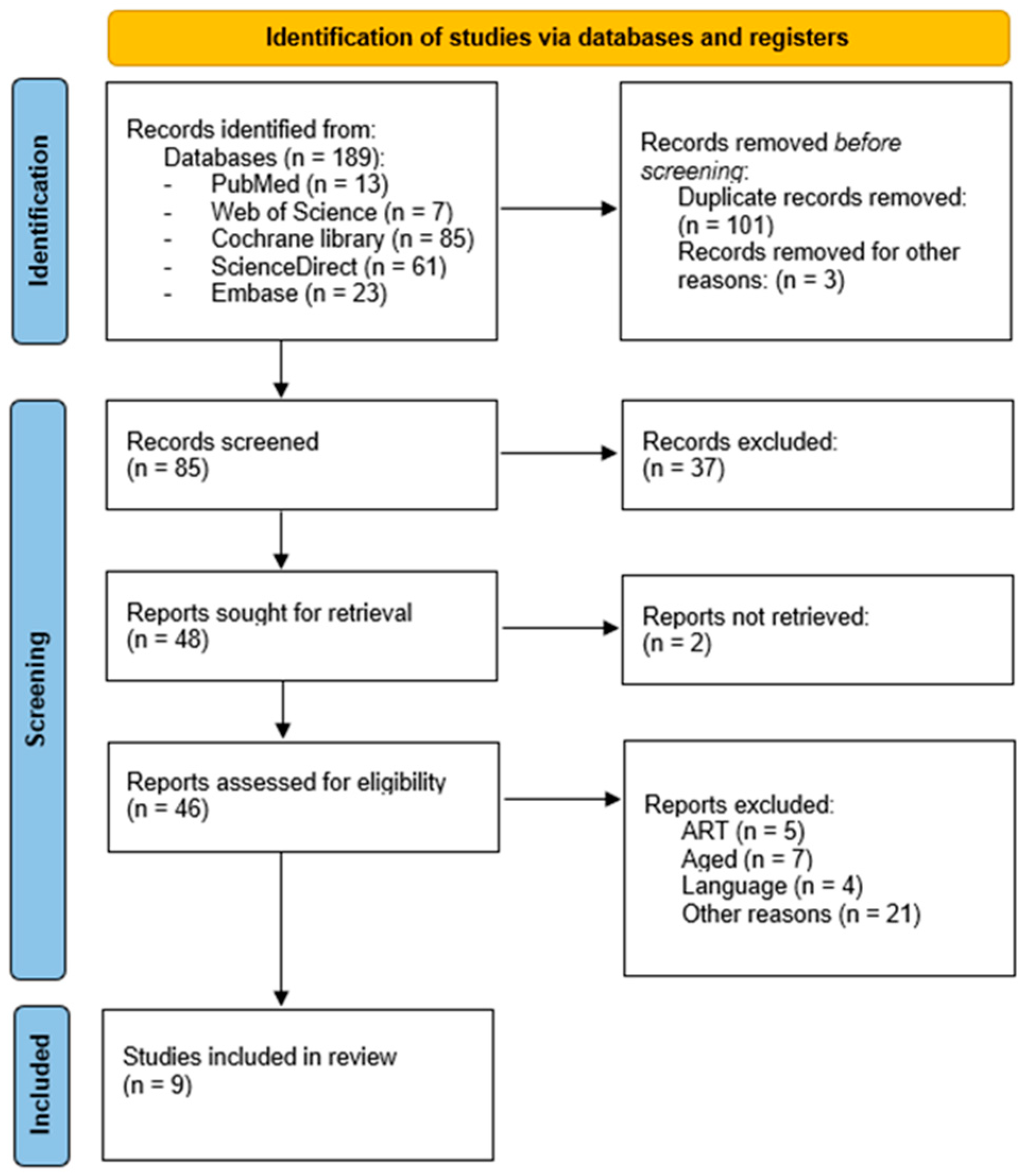
Figure 2.
Risk of bias in randomized clinical trials.


Table 1.
Search strategy for PubMed.
| Search Strategy |
|---|
| #1 (“mediterranean diet” [Title/Abstract] OR “diet, mediterranean” [MeSH Terms]) |
| #2 (“reproductive techniques assisted” [Title/Abstract] OR “reproductive techniques, assisted [MeSH Terms] OR “IVF” [Title/Abstract] OR “fertilization in vitro” [Title/Abstract] OR “fertilization in vitro” [MeSH Terms] OR “insemination artificial” [Title/Abstract] OR “insemination, artificial” [MeSH Terms]) |
| #3 “Outcomes” [Title/Abstract] |
| #4 1 AND 2 AND 3 |
Table 2.
Characteristics of the articles included in the review.
| Authors, Year | Country |
Age Range |
Sample Size (n) |
Objective |
Strengths and Limitations |
Study Type |
| Vujkovic M et al., 2010 [25] | Netherlands | 23-45 years |
161 women |
Investigate associations between preconception dietary patterns and outcomes of IVF/ICSI. | Limitations: Self-reported FFQ, limited external validity. Strengths: Prospective design, analysis of correlation between dietary patterns and biomarkers. |
Cohort |
| Karayiannis D et al., 2018 [26] | Greece | 22-41 years |
244 women |
Explore potential associations between MD and clinical outcomes of IVF among non-obese women from infertile couples. | Limitations: Self-administered dietary questionnaire, possible presence of confounding variables, limited causal inference. Strengths: Non-obese patients, comprehensive follow-up of the sample, assessment of intermediate and final outcomes. |
Cohort |
| Gaskins AJ et al., 2019 [27] | USA | 18-46 years |
357 women |
Evaluate the relationship between pre-treatment adherence to various dietary patterns (including MD) and outcomes of ART. | Limitations: Self-administered FFQ, possible presence of confounding variables, limited external validity. Strengths: Prospective design, comprehensive sample assessment, comparison of various dietary patterns. |
Cohort |
| Ricci E et al., 2019 [28] | Italy | 27-45 years | 474 women |
Study the relationship between MD and outcomes of ART in subfertile couples. | Limitations: Self-administered FFQ, non-validated measurements of some variables, low study power. Strengths: Prospective design, relatively large sample size. |
Cohort |
| Sun HM et al., 2019 [29] | China | 18-40 years | 590 women |
Explore the correlation between the pattern of MD in infertile women and their clinical outcomes in IVF cycles. | Limitations: Low external validity, non-validated FFQ. Strengths: Large sample size, non-obese patients. |
Cohort |
| Kermack AJ et al., 2020 [32] | United Kingdom | 18-41 years | 111 women |
Study the impact of increased dietary intake of omega-3 fatty acids, vitamin D, and olive oil for 6 weeks prior to IVF or ICSI on morphokinetic markers of early embryonic development. | Limitations: Short dietary intervention (6 weeks); limited external validity. Strengths: Study design, double-blind randomization, comprehensive sample follow-up. |
Clinical trial |
| Salas-Huetos A et al., 2022 [30] | USA | 18-45 years | 245 men |
Investigate whether men’s adherence to dietary patterns promoted for the prevention of cardiovascular diseases is associated with semen parameters and outcomes of ART in their partners. | Limitations: Observational design, potential residual confounding factors. Strengths: Prospective design, comprehensive sample follow-up, consideration of intermediate and final outcomes, statistical adjustment for relevant confounding factors. |
Cohort |
| Salas-Huetos A et al., 2023 [31] | USA | 18-45 years |
612 women | Investigate whether women’s adherence to dietary patterns (including MD) is associated with infertility treatment outcomes. | Limitations: Single-center study, potential residual confounding factors, limited external validity. Strengths: Prospective design, analysis of multiple dietary patterns, high standardization level of covariables, exposures, and study outcomes. |
Cohort |
| Noli SA et al., 2023 [24] | Italy | 18-39 years | 296 women | Evaluate whether preconceptional adherence to MD can influence the risk of poor ovarian response in patients without criteria/risk factors for it. | Limitations: Cross-sectional design, self-administered dietary questionnaire, limited external validity. Strengths: Relatively large sample size, comprehensive statistical analysis. |
Cross-sectional |
MD: Mediterranean Diet; ART: Assisted Reproductive Techniques; FFQ: Food Frequency Questionnaire; IVF: In Vitro Fertilization; ICSI: Intracytoplasmic Sperm Injection.
Table 3.
AXIS critical appraisal tool.
| Reference | 1 | 2 | 3 | 4 | 5 | 6 | 7 | 8 | 9 | 10 | 11 | 12 | 13 | 14 | 15 | 16 | 17 | 18 | 19 | 20 |
|---|---|---|---|---|---|---|---|---|---|---|---|---|---|---|---|---|---|---|---|---|
| Noli SA et al., 2023 [24] | yes | yes | yes | yes | yes | yes | dk | yes | yes | yes | yes | yes | no | yes | dk | yes | yes | yes | no | yes |
Table 4.
Quality of cohort studies assessed using the Newcastle–Ottawa Scale.
| Reference | 1 | 2 | 3 | 4 | 5 | 6 | 7 | 8 |
|---|---|---|---|---|---|---|---|---|
| Vujkovic M et al., 2010 [25] | * | * | * | * | * | * | * | - |
| Karayiannis D et al., 2018 [26] | * | * | * | * | ** | * | * | * |
| Gaskins AJ et al., 2019 [27] | * | * | * | * | ** | * | * | * |
| Ricci E et al., 2019 [28] | * | - | * | * | * | * | * | - |
| Sun HM et al., 2019 [29] | * | * | * | * | ** | * | * | * |
| Salas-Huetos A et al., 2022 [30] | * | * | * | * | ** | * | * | - |
| Salas-Huetos A et al., 2023 [31] | * | * | * | * | ** | * | * | - |
Items of Newcastle-Ottawa Scale for cohort studies: 1. representativeness; 2. non-exposed cohort; 3. ascertainment of exposure; 4. outcome; 5. comparability of cohorts; 6. assessment of outcome; 7. follow-up; 8. adequacy of follow-up. A maximum of one star (*) is allocated for each domain within the “Selection” and “Outcome” categories; and a maximum of two stars (**) is allocated for “Comparability”.
Table 5.
Relationship between Adherence to the MD and ART Outcomes.
| Authors, Year | Determination of Adherence to the MD / Intervention |
Variables Analyzed to Determine ART Outcomes |
Results | Conclusions | Quality of Evidence (GRADE) |
|---|---|---|---|---|---|
| Vujkovic M et al., 2010 [25] | A 195-item FFQ with 22 food groups was used and adjusted for total energy intake. This was followed by a principal component analysis applied to the food groups to construct dietary patterns. Two patterns emerged: “health-conscious, minimally processed” and “MD” | 1) Fertilization rate 2) Embryo quality 3) Biochemical pregnancy |
The dietary pattern of the MD correlated positively with red blood cell folate (β=0.13) and vitamin B6 in blood (β=0.09) and follicular fluid (β=0.18). High adherence by the couple to the MD increased the likelihood of pregnancy (OR: 1.4). | A MD before conception by couples undergoing IVF/ICSI treatment contributes to the success of achieving pregnancy. | Low ⊕⊕⊝⊝ |
| Karayiannis D et al., 2018 [26] | A questionnaire was used to assess adherence to the MD (PMD) previously developed by Panagiotakos et al., in 2007. | 1) Ovarian stimulation results 2) Fertilization rate 3) Embryo quality 4) Clinical pregnancy 5) Live birth |
Women in the lowest third of adherence to the MD had at least a 65% lower relative risk (95% CI) of achieving clinical pregnancy (p=0.01) and live births (p=0.01). No significant association of MedDietScore with intermediate study outcomes (ovarian stimulation results, fertilization rate, and measures of embryo quality) was observed. | Higher adherence to the MD is associated with a greater likelihood of clinical pregnancy and live births after IVF/ICSI treatment in non-obese women <35 years of age. | Low ⊕⊕⊝⊝ |
| Gaskins AJ et al., 2019 [27] | Validated 131-item FFQ Subsequently, the Mediterranean Diet Score (MDS) was calculated to assess adherence to the MD. | 1) Fertilization rate 2) Number of mature oocytes 3) Implantation rate 4) Clinical pregnancy 5) Live birth |
Women in the second to fourth quartiles of adherence to the MD had a significantly higher likelihood of live birth compared to women in the first quartile. However, there was no additional benefit of adherence to the MD beyond the second quartile. Higher adherence to the “fertility-promoting” diet was linearly associated with ART outcomes. | No association was found between adherence to the MD and ART outcomes. However, higher adherence to the “fertility-promoting” (rich in folic acid, vitamin B12, vitamin D, pesticide-residue-low agricultural products, whole grains, dairy, soy foods, and seafood) diet was associated with a higher likelihood of live birth after ART. | Low ⊕⊕⊝⊝ |
| Ricci E et al., 2019 [28] | Information was collected using a valid and reproducible FFQ. The FFQ included the average weekly consumption of 78 individual foods or food groups. Adherence to the MD was assessed using the MDS developed by Trichopoulou et al., (2003). | 1) Number of retrieved high-quality oocytes 2) Embryo quality 3) Clinical pregnancy 4) Live birth |
No significant association was found with the components of the MDS. | No clear association was observed between adherence to the MD and successful IVF. | Very low ⊕⊝⊝⊝ |
| Sun HM et al., 2019 [29] | A 69-item FFQ was used, and then adherence to the Mediterranean Diet was evaluated using the Mediterranean Diet Score (MDS) developed by Trichopoulou et al., (2003). | 1) Available embryos 2) Implantation rate 3) Number of fertilized oocytes 4) Clinical pregnancy |
The group with higher adherence to the MD showed a greater number of available embryos (p=0.028). Clinical pregnancy rate and implantation rate were similar between the two groups. In additional correlation tests and multivariate linear regression analysis, the number of fertilized oocytes and embryo production correlated positively with participants’ adherence to the MD. | Infertile women with higher adherence to the MD pattern were likely to obtain more available embryos in the IVF cycle. | Low ⊕⊕⊝⊝ |
| Kermack AJ et al., 2020 [32] | The study group received olive oil for cooking, a spread made from olive oil, and a daily complementary beverage enriched with EPA (800 mg), DHA (1200 mg), and vitamin D (10 μg). | Embryo quality (validated morphokinetic parameters of embryonic development associated with a higher probability of blastocyst development, implantation, and clinical pregnancy). | The 4th cell cycle was accelerated in the study group, and a significantly shorter synchrony of the 3rd cell cycle was observed, along with an increase in KIDScore (known implantation data scores) on day 3, indicating better embryo quality in the study group. | This study suggests that a short period of dietary supplementation alters the embryo’s division rate (improved embryo quality). Further research is needed to assess whether the impact on embryonic development translates into better clinical outcomes. | High ⊕⊕⊕⊕ |
| Salas-Huetos A et al., 2022 [30] | Male pre-treatment dietary intake was assessed using a validated 131-item FFQ, from which three scores were calculated: (1) MDS, (2) AMD, (3) PMD. | 1) Fertilization rate 2) Implantation rate 3) Clinical pregnancy 4) Live birth |
There was a reverse association between men’s adherence to the PMD and the fertilization rate. However, there were no significant associations between men’s adherence to any of the analyzed dietary patterns and the odds of implantation, clinical pregnancy, or live birth in adjusted multivariable models. | Men’s adherence to various a priori defined dietary scores with documented cardiovascular benefits is not related to significant outcomes of ART. | Low ⊕⊕⊝⊝ |
| Salas-Huetos A et al., 2023 [31] | Women’s pre-treatment diet was assessed using a validated FFQ from which three indices were calculated: (1) MDS, (2) AMD, (3) PMD. | 1) Clinical pregnancy 2) Total pregnancy loss 3) Clinical pregnancy loss 4) Live birth |
There was no association between women’s adherence to dietary patterns and the likelihood of clinical pregnancy or live birth after IVF or AI. | The findings of this study suggest that there is no association between adherence to the MD and ART outcomes. | Low ⊕⊕⊝⊝ |
| Noli SA et al., 2023 [24] | A MD index (MDS) developed by Trichopoulou et al., (2003) was used and later modified for Italian dietary habits. | Poor ovarian response (retrieval of three or fewer suitable oocytes) in patients without criteria/risk factors for it | The risk of poor ovarian response was significantly lower for women in the second tertile of MDS compared to the first tertile (OR: 0.29) and for women in the second and third tertiles, grouped together, compared to the first tertile (OR: 0.34). | Low adherence to the MD could be a risk factor for poor ovarian response in patients without criteria/risk factors for it. | Low ⊕⊕⊝⊝ |
MD: Mediterranean Diet; ART: Assisted Reproductive Techniques; FFQ: Food Frequency Questionnaire; OR: Odds Ratio; RR: Relative Risk; IVF: In Vitro Fertilization; ICSI: Intracytoplasmic Sperm Injection; AI: Artificial Insemination; MDS: Mediterranean Diet Score; AMD: Alternative Healthy Eating Index; PMD: Panagiotakos Mediterranean Diet Index; EPA: Eicosapentaenoic Acid; DHA: Docosahexaenoic Acid. GRADE: Grading of Recommendations, Assessment, Development, and Evaluation; ⊕⊕⊕⊕: High quality, randomized controlled trials with few limitations and strong associations. Future research is unlikely to change our confidence in the effect estimate; ⊕⊕⊕⊝: Moderate quality, randomized controlled trials with some inconsistencies and/or a present dose-response gradient. Future research is likely to change our confidence in the effect estimate; ⊕⊕⊝⊝: Low quality, randomized controlled trials with very important uncertainty and/or multiple confounding factors, and observational studies. It is very likely that future research will have an impact on our confidence in the effect estimate; ⊕⊝⊝⊝: Very low quality, observational studies with multiple biases. Any estimate of the effect is very uncertain.
Disclaimer/Publisher’s Note: The statements, opinions and data contained in all publications are solely those of the individual author(s) and contributor(s) and not of MDPI and/or the editor(s). MDPI and/or the editor(s) disclaim responsibility for any injury to people or property resulting from any ideas, methods, instructions or products referred to in the content. |
© 2023 by the authors. Licensee MDPI, Basel, Switzerland. This article is an open access article distributed under the terms and conditions of the Creative Commons Attribution (CC BY) license (http://creativecommons.org/licenses/by/4.0/).
Copyright: This open access article is published under a Creative Commons CC BY 4.0 license, which permit the free download, distribution, and reuse, provided that the author and preprint are cited in any reuse.