

Submitted:
06 November 2023
Posted:
07 November 2023
You are already at the latest version
Abstract
The idea of strong and weak adjacencies between vertices has been generalized into fuzzy graphs and intuitionistic fuzzy graphs (IFGs) and it is an important part of making decisions. However, one or two membership degrees are not always sufficient for making decisions on real-world problems that need an answer of types “yes, neutral, and no". Consequently, in previous work, we generalized the concept into picture fuzzy graphs (PFGs) where each element in the PFG has membership, neutral, and non-membership degrees. Moreover, we constructed the notion of the coloring of PFGs based on strong and weak adjacencies between vertices. In this paper, we investigate some properties of the chromatic number of PFGs based on the concept of strong and weak adjacencies between vertices. According to the properties, we construct an algorithm to find the chromatic number of PFGs. The algorithm is usefull when we work with large PFGs. Further, we improve the method to implement the PFG’s coloring for determining traffic signal phasing at an intersection. A case study has also been done to evaluate the method.
Keywords:
Coloring
; Chromatic Number
; Picture Fuzzy Graph
; Strong
; Weak
; Traffic Signal Phasing.
1. Introduction
The concept of fuzzy graph had been proposed by Rosenfeld [1] to handle indeterminate phenomena on vertices and relation between vertices. Therefore, the vertices and edges have membership degrees to represent the indeterminacy situation. In real-world problems, the degrees of non-membership of elements in a network are needed. For example, in situations that need an answer of types "yes" and "no". To handle this problem, Atanassov [2] proposed an intuitionistic fuzzy set (IFS) and intuitionistic fuzzy graph (IFG). Each element in IFG has membership and non-membership degrees. Numerous studies had been conducted on intuitionistic fuzzy graphs (IFGs), including coloring of IFGs ([3,4]), application of wiener index for IFGs in water pipeline network [5], interval-valued intuitionistic -fuzzy graphs [6], interval-valued intuitionistic fuzzy competition graph [7], and others.
Two categories of memberships are not always sufficient for making decisions. Therefore, Cuong [8] proposed a picture fuzzy set where each element did not only have membership and non-membership degrees, but also had a neutral membership degree. For instance, in an election problem, the committee must count the number of people who choose or did not choose a candidate and how many abstained (the neutral condition). Further, the concept of a picture fuzzy graph (PFG) was developed in [9] wherein the vertices and edges had membership, neutral, and non-membership degrees.
Researchers recently expanded PFGs in numerous types, such as q-rung PFGs [10], balanced PFGs [11], application of PFGs for selecting best routes in an airlines network [12], picture fuzzy soft graphs [13], complex PFGs [14], regular PFGs [15], and so on. Numerous studies had also been conducted on the use of PFGs in practical issues such as application of balanced PFGs [11], decision making under picture fuzzy soft graphs [13], implementation of regular PFGs in communication networks [15], road map design using picture fuzzy multigraph [16], application of PFGs in social network [17], shortest path algorithm in picture fuzzy digraphs [18], site selection problem using laplacian energy of PFGs [19], application of picture fuzzy tolerance graphs [20], genus of PFGs [21], and multiple attribute decision-making via PFGs [22].
The theory of vertex coloring and edge coloring had been generalized in various types of fuzzy graphs. Some researchers proposed various generalizations of graph coloring such as fuzzy graph coloring based on -fuzzy independent vertex set [23], fuzzy fractional coloring of fuzzy graphs [24], fuzzy coloring of fuzzy graphs [25], fuzzy colouring of m-polar fuzzy graph [26], the chromatic number and perfectness of fuzzy graph [27], and edge coloring of fuzzy graphs [28]. Several researchers have also proposed the coloring methods through -cut approach and two forms of adjacencies (strong and weak) in fuzzy graphs and IFGs, as seen in [3,4,29,30]. The fact that a PFG is an extension of an IFG, it inspired us to generalize the vertex coloring from IFGs into PFGs in 2021 [31]. We utilized -cut approach to color PFGs. However, the computation of PFG’s coloring through the cut was complicated since we should use various values of in determining the cut chromatic numbers. Therefore, we need another approach for coloring the PFGs.
Strong and weak adjacencies—two different forms of adjacencies—between vertices in fuzzy graphs and IFGs are crucial in decision-making issues. Hence, we generalized strong and weak adjacencies into PFGs and proposed a concept to color PFGs based on strong and weak adjacencies [32]. When we work with PFGs with many vertices and edges, we need a computational tool to identify the strong and weak adjacencies and find the chromatic number of PFGs. In this paper, we construct an algorithm to handle the problem. In PFGs, we can classify connections between two movements (two vertices) into one of these three situations, i.e., crossing conflict, merging conflict, and non-conflict. The crowdedness of traffic flows in conflicting movements (crossing or merging conflicts) is a phenomenon that needs an answer of types “yes", “no", and “neutral". The situation at an intersection is usually crowded during peak times (06.30 AM-08.30 AM and 04.00 PM-06.00 PM). However, occasionally it is not congested during non-peak hours (06.00 PM-06.00 AM) or neutral conditions about whether it is crowded or not during 08.30 AM - 03.30 PM. Therefore, we need a PFG to deal with this situation and propose a traffic signal phasing wherein there are no traffic flows from merging conflicts that move simultaneously at the same time. In this article, we improve the method to model traffic flows at an intersection using PFGs and to determine the traffic signal phasing. Moreover, we also evaluate the proposed method through a case study. This is a new finding in view of application of coloring of PFGs.
The following is the structure of this paper: The first section explains an introduction and Section 2 discusses research challenges and gaps. Section 3 presents preliminary materials. Section 4 contains the most important findings in this research and Section 5 provides an experimental result. Finally, the conclusions are given in Section 6.
2. Research Challenges and Gaps
- However, one membership degree or two membership degrees of elements in a network are not sufficient for making decision. Therefore, we initiated a coloring method of PFGs based on -cut of PFGs [31]. Since the computation of PFG’s coloring through the cuts was complicated in determining the chromatic number, we propose a coloring method of PFGs based on strong and weak adjacencies between vertices in [32].
- In this paper, we investigate connection between the cut chromatic numbers and the chromatic number of PFGs based on strong and weak adjacencies. Moreover, we construct an algorithm to find the chromatic number of PFGs and evaluate performance of the algorithm using Python and Matlab R2022b. The algorithm is useful when we deal with large PFGs.
- An implementation of coloring method of fuzzy graphs in road networks has been proposed in [33]. However, it did not consider three types of connections between traffic movements and three conditions of crowdedness of traffic flows at an intersection. Sometimes, the traffic flow is crowded during peak times, or sometimes it is not crowded, or a neutral condition about whether it is crowded or not at non peak-times. In this research, we improve the method to implement the PFG’s coloring for determining traffic signal phasing at an intersection and evaluate the method through a case study.
3. Preliminaries
We review some of the key ideas from this study in this part. In the beginning, we are going to discuss intuitionistic fuzzy sets (IFSs) and construction an IFS from a fuzy set.
Given an ordinary finite non-empty set X. An Atanassov IFS in X is a set of the form wherein and for each . Meanwhile, a degree of hesitation of an element x in IFS is defined as .
A method to construct an IFS from a fuzy set is given in Theorem 1 and Corollary 1, which are cited from [34] and [35].
Theorem 1.
Let be a set of all fuzzy set in X. A fuzzy set in is denoted as where . If are two functions defined on X, then
is an Atanassov IFS, where the function with
- If , then for ,
- for ,
- ,
- ,
- ,
- .
Corollary 1.
Furthermore, the notion of a picture fuzzy set (PFS) and construction a PFS from an IFS are discussed.
Definition 1.
A set of the form is mentioned as a PFS on X wherein is a membership degree, is a NeuM degree, and is a non-membership degree of element v in PFS such that .
The value is called a refusal degree of membership of v in [8].
A method to construct a PFS from an IFS is given in Theorem 2.
Theorem 2.
If is an IFS on X and is any function such that and , then
is a PFS on X wherein the mapping defined by with and .
The mapping F satisfies the conditions:
- ,
- , and
The function g is called a neutral or refusal membership function of PFS [36].
We present ideas of an empty PFS and a universal PFS in Definition 2 and Definition 3, respectively, which are cited from [37].
Definition 2.
Let be a PFS on X. The set is called an empty PFS if , and for each . The empty PFS is denoted by [37].
Definition 3.
Let be a PFS on X. The set is named a universal PFS if , and for each [37].
In Definition 4, which is quoted from [8], we provide information on picture fuzzy subset.
Definition 4.
Given two PFSs on X: and , . The PFS is mentioned as picture fuzzy subset of , denoted by , if
for all [8].
The notion of PFS is used as a basis to define a PFG, as described in Definition 5.
Definition 5.
We assume that X is a universal set that contains vertices. We mention a graph as a PFG if is a picture fuzzy vertex set (PFVS) on X with the membership, neutral, and non-membership functions as follows:
in which for each .
Meanwhile, is a picture fuzzy edge set (PFES) on with the membership, neutral membership, and non-membership functions as follows:
such that
and for each .
The value of is membership degree that represents the truth of existence of vertex x in X, is NeuM degree that describes the indeterminacy of existence of x in X, and is non-membership degree that represents falsity condition of the existence of vertex x in X. Meanwhile, the values of represent membership degree that tells the truth of adjacency of x and y, NeuM degree that describes the indeterminacy of adjacency of x and y, and non-membership degree that represents the falsity of adjacency between x and y, respectively [9].
Furthermore, we discuss the concepts of underlying graph, picture fuzzy subgraph, and a complete picture fuzzy graph (CPFG) that will be used in the next section.
Definition 6.
Given a PFG on a universal set X. An underlying graph of , symbolized as , is a graph wherein and for each [38].
Definition 7.
Let and be PFGs on a universal set X. The PFG is said to be a picture fuzzy subgraph of , denoted by , if and [17].
Definition 8.
Given PFG where is a PFS on universal set X. We call x and y as neighbor vertices in if , and
Meanwhile, the set . In addition, denotes the cardinality of neighbors of vertex v in [15].
Definition 9.
3.1. Strong and weak adjacencies between vertices in PFGs
The terms “strong adjacency" and “weak adjacency" have been defined in an IFG by [4]. We expand upon these ideas in terms of PFGs in the previous work [32].
Definition 10.
Given a PFG where is a PFS on The vertices are mentioned as strongly adjacent vertices if
If it is not, we mention u and v as weakly adjacent vertices [32].
3.2. Coloring of PFGs based on strong and weak adjacencies between vertices
In this part, we discuss a coloring of PFGs based on strong and weak adjacencies between vertices.
Definition 11.
Given PFG where is a PFS on , i.e., . Whereas, is a PFS on Let be a family of picture fuzzy (PF) subsets of where
for , and . The family Γ is called as a k-vertex coloring of if
-
, i.e.,for .
-
i.e.,for .
-
For every pair of strongly adjacent vertices with :for .
The minimum value k for which has k-vertex coloring is referred as the chromatic number of , denoted by [32].
We describe the coloring of a PFG in Example 1 for more understanding of the concept.
Example 1.
Let us consider PFG in Figure 1. The set is a PFVS on universal set .
- The pairs of strongly adjacent vertices are and . Meanwhile, are the sets of weakly adjacent vertices.
- Therefore, we get the PF-subsets , , , and the family .
- Thus, the chromatic number of is .
3.3. The chromatic number of PFGs based on cut coloring
In this part, we discuss the concept of cut of PFGs and the cut chromatic number as given in [31].
Definition 12.
Given a PFG and its underlying graph . A level set of is defined as a set . Whereas, a level set of is set . Moreover, a level set of is a set . An cut of is a crisp graph where
and
The cut chromatic number, denoted by , is the chromatic number obtained from crisp coloring of the cut [31].
4. Main Results
In this section, we present some properties of the chromatic number of PFGs and an algorithm to compute the chromatic number.
4.1. Some characteristics of the chromatic number of PFGs
Firstly, we investigate an upper bound for the chromatic number of PFGs in the following theorem.
Theorem 3.
If is a PFG with the underlying graph , then
Proof.
Let Assume is a family of PF-subsets on where , , .
Suppose that
Based on Conditions 1-2 in Definition 11, we have:
- ,
- for .
If all pairs of vertices in are strongly adjacent vertices, then we have (based on third condition in Definition 11). Otherwise, . It is a contradiction. Thus, □
We investigate the connection between the chromatic number of PFGs based on strong and weak adjacencies and the cut chromatic number in Definition 12.
Definition 13.
Let be a PFG. The chromatic number of through the cut chromatic number is defined as follows:
where L is the level set of and .
When , Definition 13 becomes the chromatic number of IFGs. In certain conditions, we prove that the chromatic number of the underlying graph of PFG is equal to the chromatic number concept in Definition 13.
Theorem 4.
Given a PFG with the underlying graph If , and then the chromatic number of :
Proof.
Since , and we have
Further, all vertices and edges of become elements of the crisp graph . It implies and □
Theorem 5.
Let be a PFG with the underlying graph If all edges in connect strongly adjacent vertices, then
Proof.
Assume that . According to Definition 11, we have a family of PF-subsets of such that it satisfies 3 conditions in Definition 11:
- ,
- , for .
- Based on the third condition in Definition 11, we have: where , , and (since all edges in connect strongly adjacent vertices). It shows that each becomes a crisp independent vertex set in for .
Hence, the family becomes a partition of into k-independent vertex set (crisp set). Therefore, □
According to Theorem 5, we obtain the following corollary.
Corollary 2.
If is a complete picture fuzzy graph (CPFG) with n vertices, then .
4.2. An algorithm for finding the chromatic number of PFGs
We create an algorithm to compute the chromatic number of PFGs with the exception for CPFG.
Algorithm 1 can also be used for coloring of IFGs when the inputs are intuitionistic fuzzy vertex set and intuitionistic fuzzy edge set.
We show that Algorithm 1 gives the chromatic number for and prove correctness of the algorithm by using mathematical induction on the cardinality as follows.
Base step
: for and .
If the two vertices in V are strongly adjacent vertices, then Steps 1-11 will produce the set and Further, Steps 12-30 give . In Step 31, we obtain the family and the chromatic number in Step 32. If the two vertices in V are weakly adjacent vertices, then Steps 1-30 will produce one PF-subset Further, Steps 31-32 give the family and . The base step is satisfied.
Inductive step
: Assume that Algorithm 1 is correct for cardinality . Steps 1-11 produce the set of weakly adjacent vertices and the set of strongly adjacent vertices. Furthermore, Steps 12-30 give the PF-subsets:
In Steps 31-32, we get and the chromatic number .
We prove that Algorithm 1 is correct for PFG with cardinality .
Suppose that Algorithm 1 gives output “no". In other words, we cannot get the family such that for . According to Corollary 2 and Theorem 3, if all edges in connect strongly adjacent vertices, then the chromatic number and . Otherwise, there exist some pairs of weakly adjacent vertices in . Hence, we can get the the family such that the chromatic number and it should be It is a contradiction. Thus, Algorithm 1 gives output “yes" and we get the chromatic number for . Thus, the inductive step is true and Algorithm 1 is correct.
Example 2 and Example 3 show determination of the chromatic number of PFGs by employing Algorithm 1 and performance of the algorithm is evaluated using Python and Matlab R2022b.
| Algorithm 1 To find the chromatic number of PFGs |
|
Example 2.
Given PFG in Figure 2 with picture fuzzy vertex set and picture fuzzy edge set .
The output of Algorithm 1 in determining the chromatic number of is presented in Figure 3.
- In Steps 1-11, we obtain the sets of weakly adjacent vertices, i.e., .
-
In Steps 12-30, we get the PF-subsets , with initialization .Other PF-subsets are , , and with initialization .
- In Step 31, we choose and get the family .
- We obtain the chromatic number in Step 32.
5. Experimental Result
In this section, we discuss an implementation of Algorithm 1 in determining traffic signal phasing at an intersection. A phase is defined as any traffic light display that has its own timings and it determines how a specific vehicle or pedestrian will move. Whereas, the term phase set refers to “any distinct combination of concurrent vehicle or pedestrian phases". Conflicting phases are those that cannot both have green indicators at the same time [39]. There are two types of conflicts between traffic movements at an intersection. The first type is crossing conflict that is a collision that occurs when two separate directions of traffic try to cross paths at one spot. The second type is merging conflict, i.e., a conflict happened when vehicles from multiple lanes or directions merge into a single lane traveling in a single direction [40].
Traffic flow is “the number of traffic elements passing an undisturbed point upstream in the approach per unit of time". It is measured by the number of vehicles per hour or passenger car unit (pcu) per hour [40]. In this research, the traffic flow data are presented in pcu per hour where the conversion factors are as follows: 0.2 for motor cycle (MC), 1 for light vehicle (LV) including “passenger cars, pick-up, and micro buses", and 1.3 for heavy vehicle (HV) including “two or three-axle trucks and buses".
5.1. The method to model traffic flows at an intersection using PFGs
We visualize traffic movements from different directions as vertices and connect two vertices with an edge if the two movements are in conflict (crossing conflict or merging conflict). Hence, we get the data of vertex and edge sets V and E, respectively. The degrees of edges and vertices show the following circumstances:
- A vertex’s membership degree () indicates the possibility of the crowdedness of traffic flow on the movement x at the intersection. A vertex’s non-membership degree () shows whether the flow of traffic on the movement x is likely to be free of congestion. The NeuM degree of a vertex () indicates the possibility of an unknown circumstance about the crowdedness of traffic flow on x. We obtain a PFVS .
- Traffic flow on an edge that connects two vertices (traffic movements), is determined through the minimum of traffic flows on both movements. In addition, the membership degree of any edge in , that is , indicates the possibility of the crowdedness of traffic flows on conflicting movements . On the contrary, the non-membership degree shows the possibility of the non-crowdedness of traffic flows on . The NeuM degree represents the possibility of unknown condition of the crowdedness of traffic flows on . We get a PFES .
The degrees of vertices and edges are determined as follows:
- The membership degree is calculated through triangular or trapezoidal membership functions. Whereas, the non-membership degree is calculated through Corollary 1, i.e., and by choosing where stands for traffic flow on movement x.
-
. The NeuM degree of each edge is defined similarly.
-
The membership degree and non-membership degree are calculated through formulas in Corollary 1: , where,by choosing
5.2. Case study
We take a case study at an intersection in Special Region of Yogyakarta, Indonesia, i.e., Pingit intersection. The location of the intersection is depicted in Figure 6 (right side). Tentara Pelajar street is to the South (S) direction, Diponegoro street is to the East (E) direction, Magelang street is to the North (N) direction, and Kyai Mojo street is to the West (W) direction.
Sketch of the intersection is also given in Figure 6 (left side). We collect the data of traffic flows on January 25-27, 2023 in the morning (06.30-07.30 AM) and in the evening (16.30-17.30 PM). There are 12 traffic movements in the intersection, i.e., WN, WE, WS, SN, SW, SE, NE, NW, NS, EN, EW, and ES.
It means that the vertex set V contains 12 vertices.
The next step is to transform the traffic flow data into PFVS wherein the membership degree of each element is determined via triangular and trapezoidal membership functions in Figure 7.
The PFVS of traffic flows in the intersection is displayed in Table 1.
It is shown in Table 1 that traffic flows on WN and EW have a high possibility of being crowded compared to traffic flows on other movements. Conversely, traffic flow on SW has a lower possibility of being crowded.
Further, the picture fuzzy edge sets from crossing and merging conflicts in the Pingit intersection are shown in Table 2 and Table 3, respectively. We observe that most of the edges in both tables connect strongly adjacent vertices. Moreover, the traffic flows on edges WS SN, WS SE, WS NW, WS EW, SW NW, SW EW have a high possibility of being crowded.
The PFG model of traffic flow data is depicted in Figure 8.
5.3. Comparison to the fuzzy graph coloring method
In this part, we compare the result in Table 4 with a traffic signal phasing obtained from the fuzzy graph coloring method based on -fuzzy independent vertices () as given in [33]. The fuzzy graph model of traffic flows in the Pingit intersection is depicted in Figure 10.
For , the sets , , and are the sets of -fuzzy independent vertices since for each pair in the above sets. Therefore, we get 4-phase scheduling as follows:
We observe that some pairs of vertices in (1) are elements of merging conflict in Table 3. Hence, the traffic signal phasing obtained from PFG coloring in Table 4 is safer than signal phasing from the fuzzy graph coloring in (1) since there are no traffic flows from merging conflict that move simultaneously at the same phase.
6. Conclusions
The concept of strong and weak adjacencies between vertices could be implemented in making decision on real-world problems. Therefore, we generalized the concept from intuitionistic fuzzy graph (IFG) into picture fuzzy graph (PFG) in the previous work. In this research, we investigated some characteristics of the chromatic number of PFGs based on strong and weak adjacencies between vertices and its relation to the cut chromatic numbers. Furthermore, we construct an algorithm (Algorithm 1) for determining the chromatic number of PFGs and implement it in Python and Matlab R2022b to assess the algorithm’s performance. The correctness of Algorithm 1 was also proved using mathematical induction.
Additionally, we improve the method to model traffic flows at an intersection using PFGs and to determine an intersection’s traffic light phasing. We took a case study at an intersection in Special Region of Yogyakarta-Indonesia to evaluate the method. The outcome demonstrated that there were no concurrent traffic flows from merging conflict that moved at the same phase. The traffic signal phasing acquired using the PFG coloring method was found to be safer than the signal phasing obtained using the fuzzy graph coloring method.
Further research can be done to improve the method for handling traffic signal phasing at any intersection, such as integrating the algorithm with automatic counting for traffic flow data at the intersection. In the basic theories of PFG’s coloring, we can investigate the chromatic number of certain operations of two PFGs, such as union, join, cartesian product, and composition of two PFGs.
Author Contributions
Conceptualization, I. Rosyida; Methodology, I. Rosyida; Software, I. Rosyida; Validation, I. Rosyida and Ch.R. Indrati; Formal Analysis, I. Rosyida and Ch.R. Indrati; Investigation, I. Rosyida; Resources, I. Rosyida; Data Curation, I. Rosyida; Writing—Original Draft Preparation, I. Rosyida; Writing—Review & Editing, Ch.R. Indrati; Visualization, I. Rosyida; Supervision, Ch.R. Indrati; Project Administration, Ch.R. Indrati; Funding Acquisition, Ch.R. Indrati.
Funding
This research was funded by the Post-doctoral program Universitas Gadjah Mada under grant number 6468/UN1/DITLIT/Dit-Lit/PT.00/2022.
Acknowledgments
The authors express their gratitude to the reviewers for their insightful feedback on how to make the work better.
Conflicts of Interest
The authors declare no conflict of interest.
Abbreviations
The following abbreviations are used in this manuscript:
| IFS | Intuitionistic fuzzy set |
| IFG | Intuitionistic fuzzy graph |
| PFS | Picture fuzzy set |
| PF | Picture fuzzy |
| PFVS | Picture fuzzy vertex set |
| PFES | Picture fuzzy edge set |
| PFG | Picture fuzzy graph |
| NeuM | Neutral membership |
| CPFG | Complete picture fuzzy graph |
References
- Rosenfeld, A. Fuzzy graphs. In Fuzzy Sets and Their Applications to Cognitive and Decision Processes; Zadeh, L.A, Fu, K.S., and Shimura, M. Eds.; Academic Press., 1975; pp. 77–95.
- Atanassov, K.T. On intuitionistic fuzzy graphs and intuitionistic fuzzy relations. Proceedings the VI IFSA World Congress, 1995, 551–554.
- Prasanna, A., Rifayathali, M.A., and Ismail Mohideen, S. Strong intuitionistic fuzzy graph coloring, Int. J. Latest Eng. Res. Appl., 2017,2(8), 163–169.
- Rifayathali, M.A., Prasanna, A., and Ismail Mohideen, S. Intuitionistic fuzzy graph coloring, Int. J. Res. Anal. Rev., 2018 5(3), 734-742.
- Dinar, J., Hussain, Z., and Ur Rehman, S. Wiener index for an intuitionistic fuzzy graph and its application in water pipeline network. Ain Shams Eng. J., 2023, 14(1), 1-10. [CrossRef]
- Rashmanlou, H. and Borzooei, R.A., New concepts of interval-valued intuitionistic (S,T)-fuzzy graphs, J. Intell. Fuzzy Syst., 2016, 30(4), 1893-1901. [CrossRef]
- Talebi, A.A., Rashmanlou, H., and Sadati, S.H., Interval-valued intuitionistic fuzzy competition graph, J. Mult-Valued. Log. S, 2020, 34(3), 335-364.
- Cuong, B.C. and Kreinovich, V. Picture fuzzy sets - A new concept for computational intelligence problems, In Proceedings of 2013 Third World Congress on Information and Communication Technologies (WICT), 2013; pp. 1–6.
- Al-hawary, T., Mahmood, T., Jan, N., and Ullah, K. On intuitionistic fuzzy graphs and some operations on picture fuzzy graphs. Ital. J. Pure Appl. Math., 2018, 32, 1-15.
- Akram, M. and Habib, A. q-Rung picture fuzzy graphs: a creative view on regularity with applications. J. Appl. Math. Comput., 2019, 61, 235–280. [CrossRef]
- Amanathulla, S., Bera, B., and Pal, M. Balanced picture fuzzy graph with application. Artif. Intell. Rev., 2021, 54, 5255–5281. [CrossRef]
- Amanathulla, S. and Pal, M. An introduction to picture fuzzy graph and its application to select best routes in an airlines network. In Handbook of Research on Advances and Applications of Fuzzy Sets and Logic, 2022, pp. 385-411. [CrossRef]
- Chellamani, P.,Ajay, D., Broumi, S., and Ligori, T.A.A. An approach to decision-making via picture fuzzy soft graphs, Granul. Comput., 2022 7, 527–548.
- Shoaib, M., Mahmood, W., Xin, Q., Tchier, F., and Tawfiq, F.M.O., Certain operations on complex picture fuzzy graphs, IEEE Access, 2022, 10, 114284-114296. [CrossRef]
- Xiao, W., Dey, A., and Son, L.H. A study on regular picture fuzzy graph with applications in communication networks, J. Intell. Fuzzy Syst., 2020, 39(3), 3633–3645. [CrossRef]
- Das, S. and Ghorai, G. Analysis of road map design based on multigraph with picture fuzzy information. Int. J. Appl. Comput. Math., 2020, 6(3), 1-17. [CrossRef]
- Koczy, L.T., Jan, N., Mahmood, T., and Ullah, K., Analysis of social networks and Wi-Fi networks by using the concept of picture fuzzy graphs. Soft Comput., 2020, 24(21), 16551–16563. [CrossRef]
- Mani, P., Vasudevan, B., and Sivaraman, M. Shortest path algorithm of a network via picture fuzzy digraphs and its application. Materials Today: Proceedings, 2021, 45(2), 3014-3018. [CrossRef]
- Mahima, P. and Rakesh Kumar, B. On Laplacian energy of picture fuzzy graphs in site selection problem. J. Intell. Fuzzy Syst., 2021, 41(1), 481 – 498. [CrossRef]
- Das, S., Ghorai, G., and Pal, M. Picture fuzzy tolerance graphs with application. Complex Intell Syst., 2022, 8(1), 541-554. [CrossRef]
- Das, S., Ghorai, G., Pal, M. Genus of graphs under picture fuzzy environment with applications. J. Ambient. Intell. Humaniz. Comput., 2021, 12, 10741–10756. [CrossRef]
- Amanathulla, S., Muhiuddin, G., Al-Kadi, D., and Pal, M. Multiple attribute decision-making problem using picture fuzzy graph. Math. Probl. Eng., 2021, 2021, 1-16. [CrossRef]
- Rosyida, I., Widodo, Indrati, Ch.R., and K.A. Sugeng, K.A. A new approach for determining fuzzy chromatic number of fuzzy graph. J. Intell. Fuzzy Syst., 2015, 28(5), 2331-2341. [CrossRef]
- Mahapatra, T., Ghorai, G., and Pal, M. Fuzzy fractional coloring of fuzzy graph with its application. J. Ambient. Intell. Humaniz. Comput., 2020, 11, 5771-5784. [CrossRef]
- Samanta, S., Pramanik, T., and Pal, M. Fuzzy colouring of fuzzy graphs. Afrika Mat., 2016, 27, 37-50. [CrossRef]
- Mahapatra, T. and Pal, M. Fuzzy colouring of m-polar fuzzy graph and its application. J. Intell. Fuzzy Syst., 2018, 35(6), 6379-6391. [CrossRef]
- Raut, S. and Pal, M. On chromatic number and perfectness of fuzzy graph. Inf. Sci., 2022, 597, 392-411. [CrossRef]
- Mahapatra, R., Samanta, S., Pal, M. Applications of edge colouring of fuzzy graphs. Informatica, 2020, 31(2), 313-330. [CrossRef]
- Eslahchi, C. and Onagh, B.N. Vertex-strength of fuzzy graphs. Int. J. Math. Math. Sci.. 2006, ID 043614, 1-9.
- Munoz, S., Ortuno, M.T., Ramirez, J., and Yanez, J. Coloring fuzzy graphs. Omega, 2005, 33(3), 211-221.
- Rosyida, I. and Suryono, S. Coloring picture fuzzy graphs through their cuts and its computation. Int. J. Adv. Intell. Informatics., 2021, 7(1), 63-75.
- Rosyida, I., Indrati, Ch.R., and Kalayathankal, S.J. A method based on picture fuzzy graph coloring for determining traffic signal phasing on an intersection. In Proceedings of the INFUS 2023 Conference, 2023, 1, 293-303.
- Rosyida, I., Nurhaida, Narendra, A., and Widodo. Matlab algorithms for traffic light assignment using fuzzy graph, fuzzy chromatic number, and fuzzy inference system. MethodsX, 2020, 7, 101-136. [CrossRef]
- Jurio, A., Paternain, D., Bustince, H., Guerra, C., and Beliakov, G. A construction method of Atanassov’s intuitionistic fuzzy sets for image processing. In Proceedings of 5th IEEE conference on Intelligent Systems, 2010, pp. 1-6.
- Singh, A., Joshi, D.K., and Kumar, S. A novel construction method of intuitionistic fuzzy set from fuzzy set and its application in multi-criteria decision-making problem. Adv. Intell. Syst. Comput., 2019, 702 (2019), 1-9. [CrossRef]
- Singh, A. and Kumar, S. Picture fuzzy parameterized soft set and its application in decision making. In Research Square, Retrieved on April 13, 2023, 1-13.
- Memis, S. A Study on picture fuzzy sets. In Proceedings of 7th International IFS and Contemporary Mathematics Conference, 2021, pp. 125-132.
- Zuo, C., Pal, A., and Dey, A. New concepts of picture fuzzy graphs with application. Mathematics, 2019, 470(7), pp.1-18. [CrossRef]
- Buckholz, J.W. Introduction to Traffic Signal Phasing, In CEDengineering.com: An Online Continuing Education Provider for Professional Engineers, Retrieved on February 26, 202, 1-27.
- Sumadji, S., Asmoro, D., and Sastrosoegito, S. Urban and semi-urban traffic-facilities. In Indonesian Highway Capacity Manual, Directorate General of Highways, Ministry of Public Works, 1993, pp. 1-76.
Figure 1.
The picture fuzzy graph for Example 1.
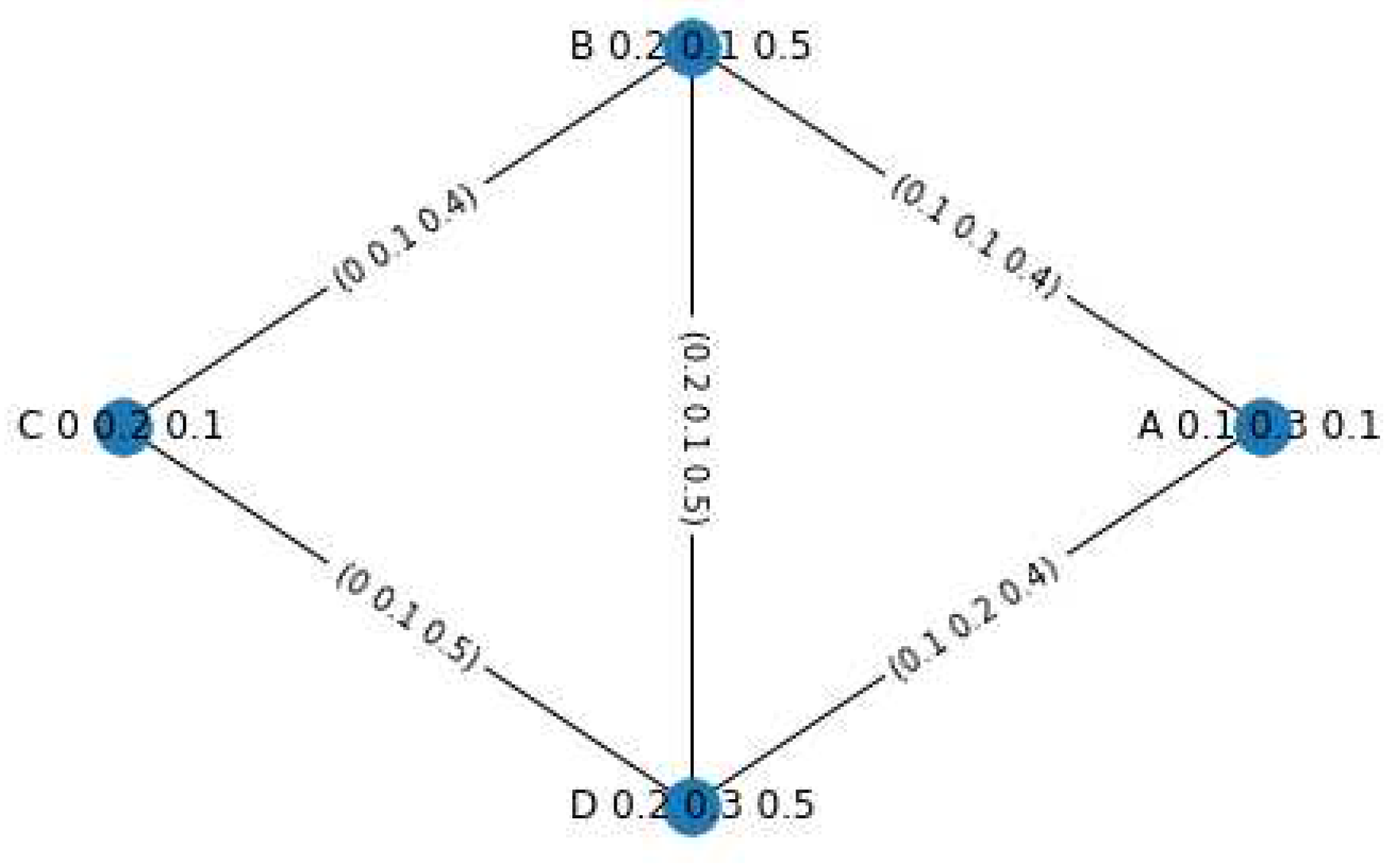
Figure 2.
The picture fuzzy graph for Example 2.
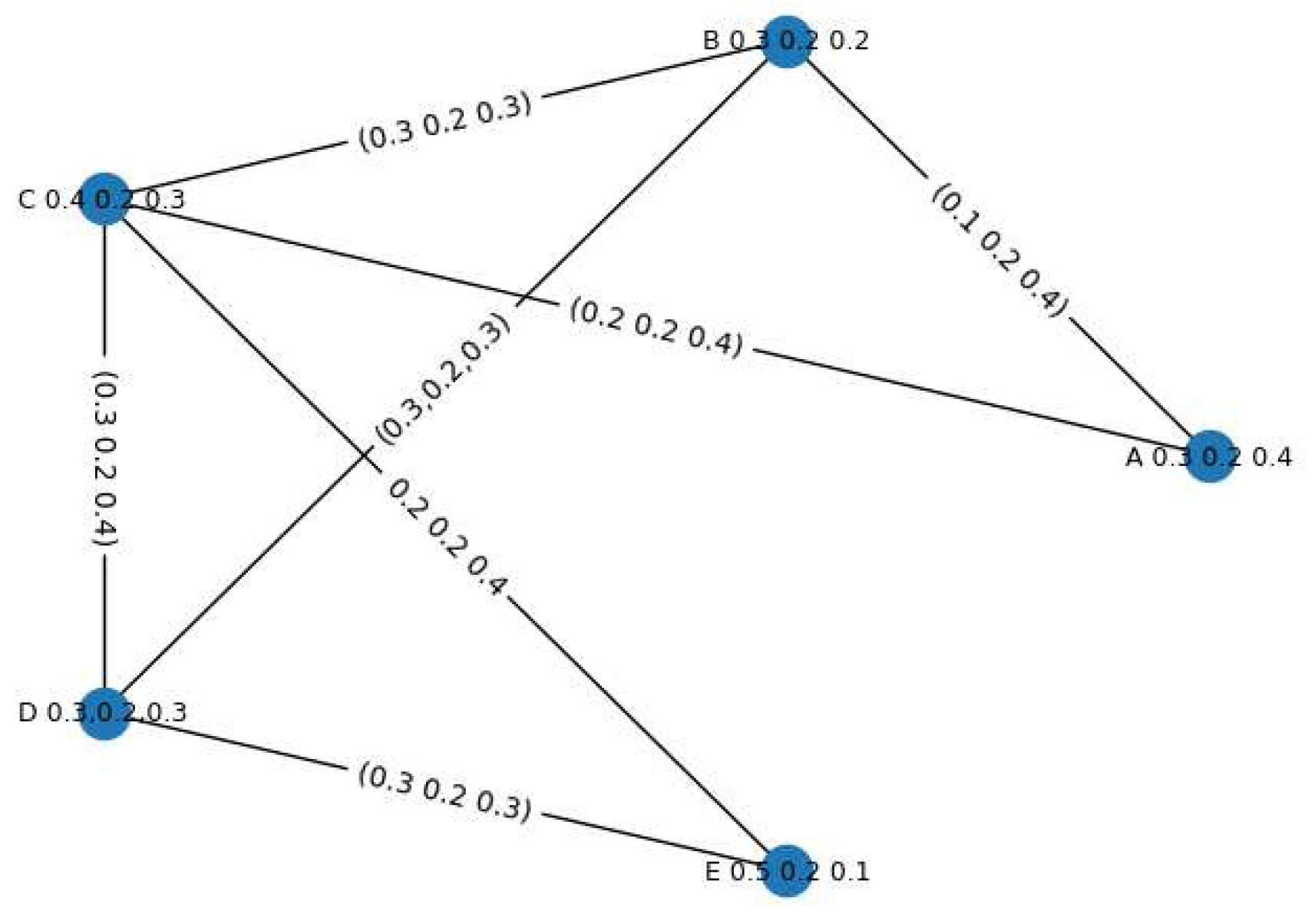
Figure 3.
The output of Algorithm 1 for finding in Figure 2.
Figure 3.
The output of Algorithm 1 for finding in Figure 2.
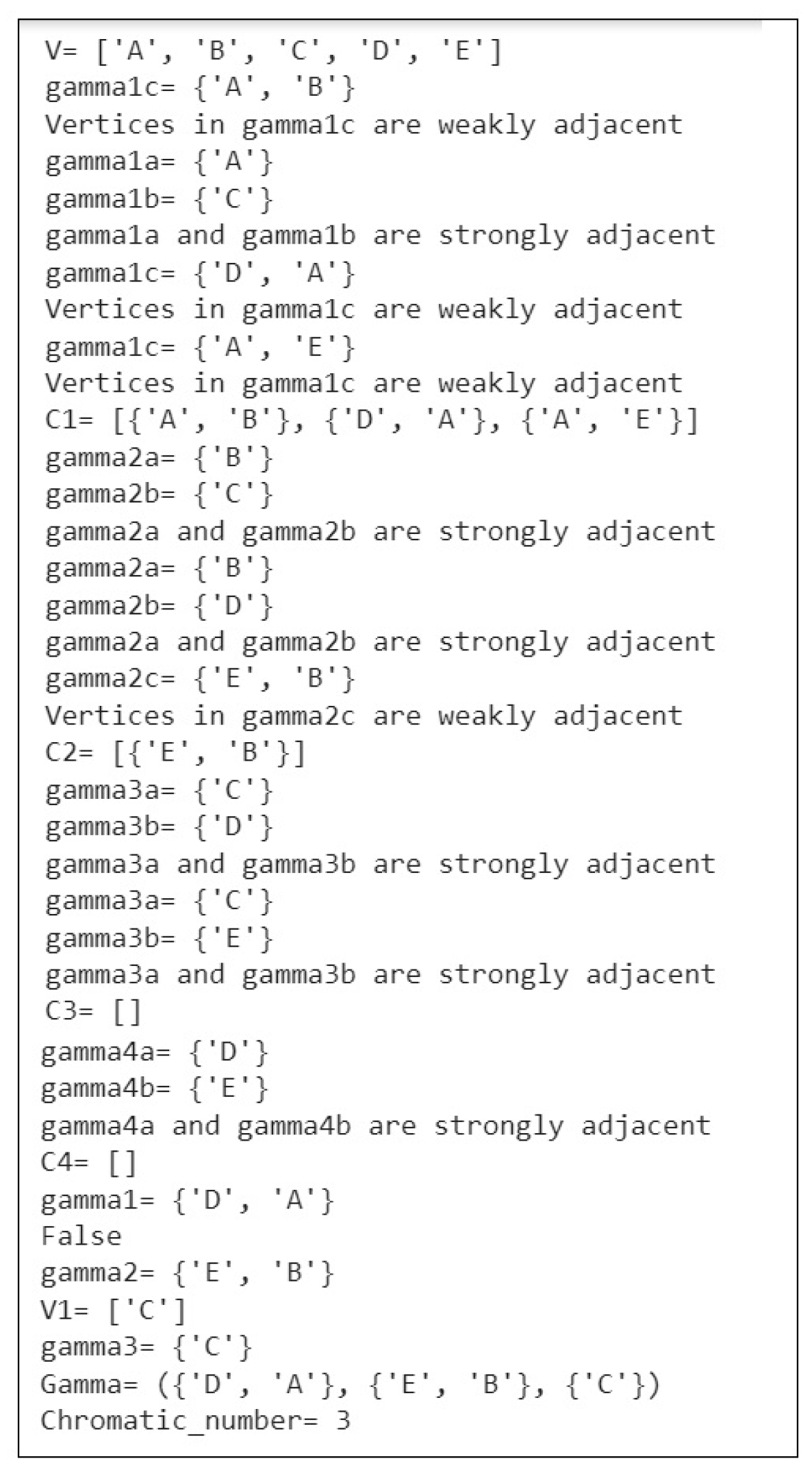
Figure 4.
The PFG for Example 3.

Figure 5.
The output of Algorithm 1 for finding in Figure 4.
Figure 5.
The output of Algorithm 1 for finding in Figure 4.
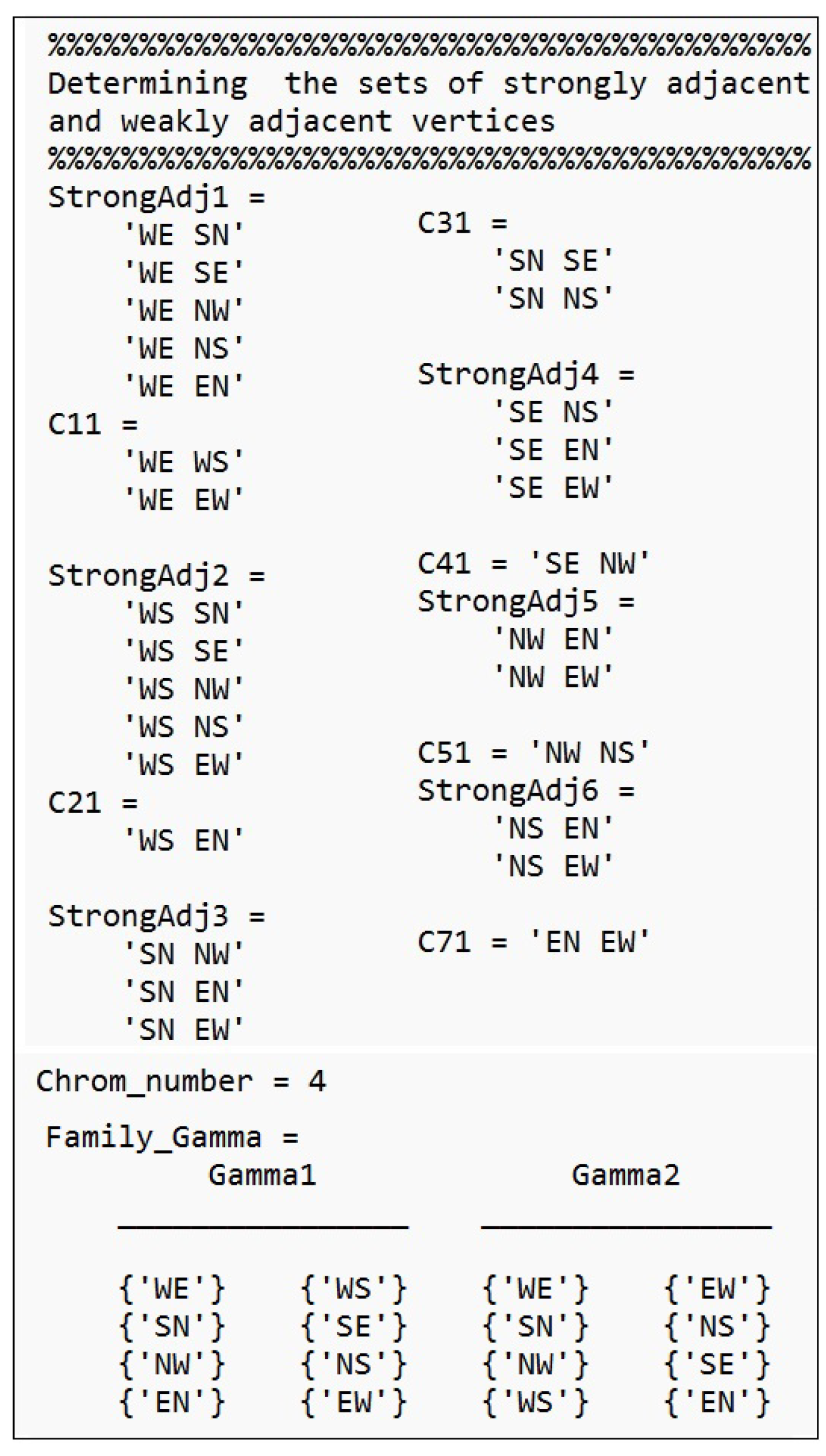
Figure 6.
Location of the Pingit intersection in Special Region of Yogyakarta.
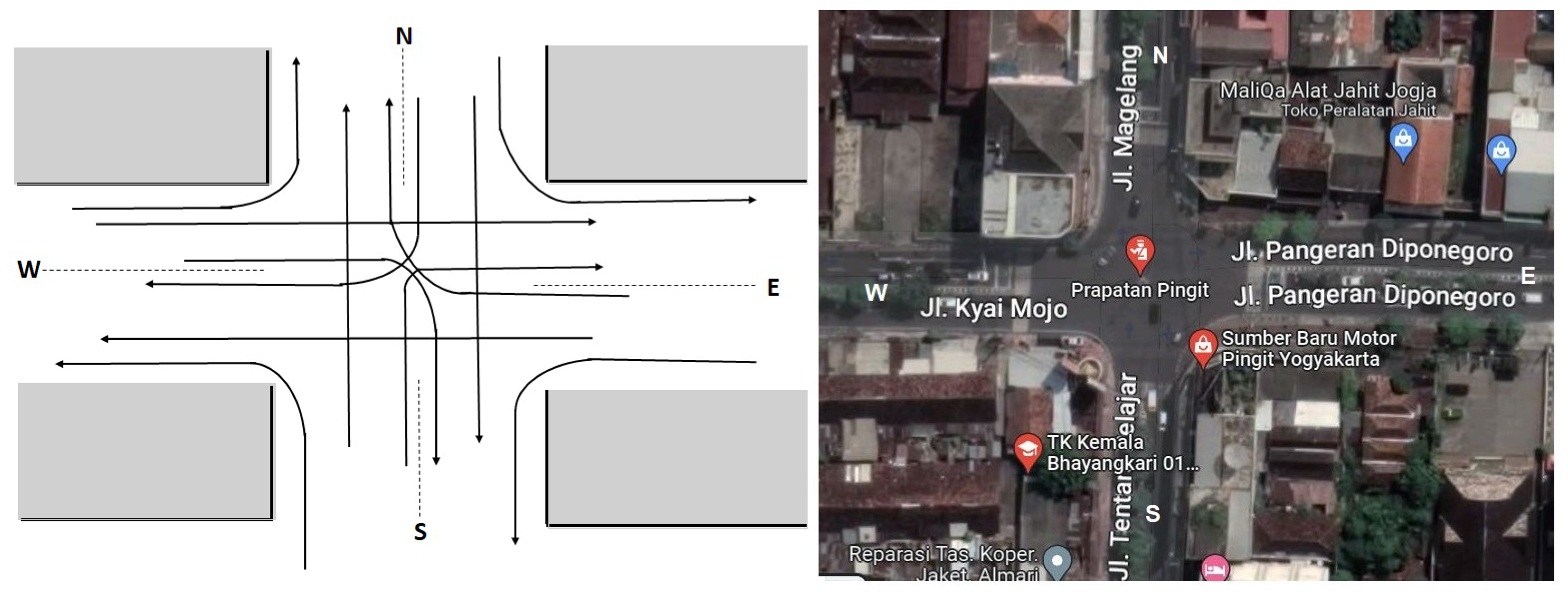
Figure 7.
The function to calculate membership degree in the PFVS .
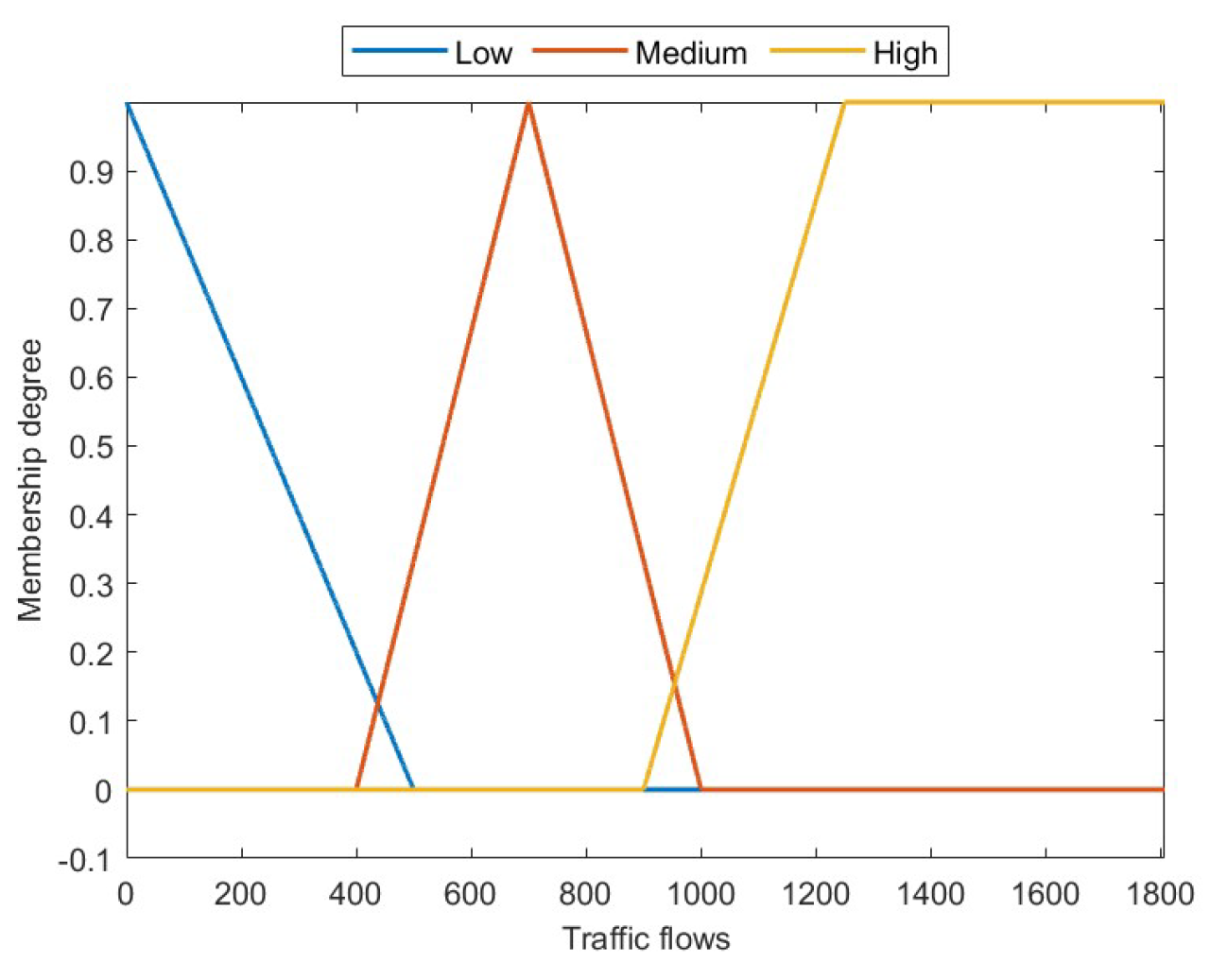
Figure 8.
The PFG model of traffic flows in the Pingit intersection.
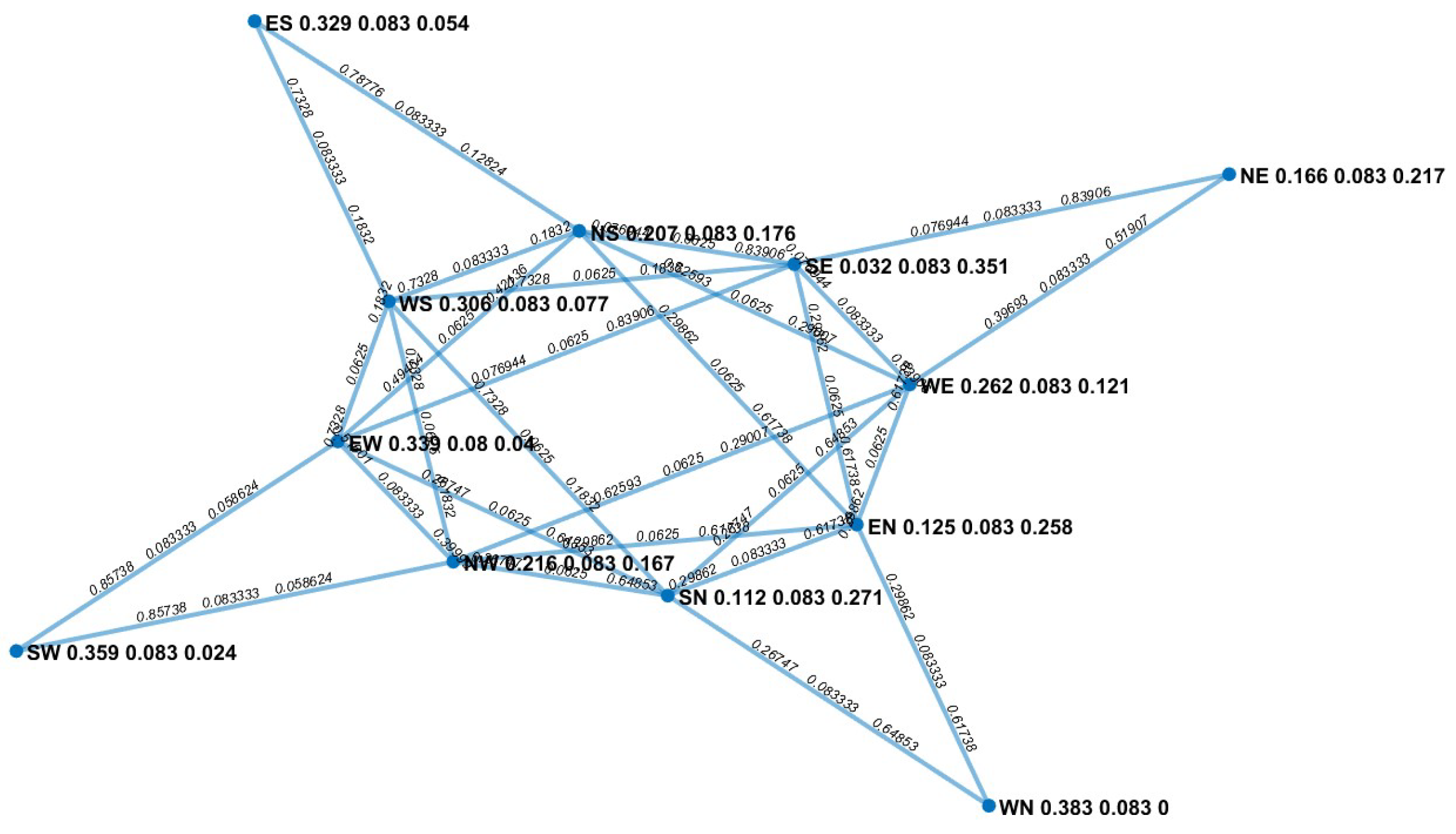
Figure 9.
Determination of the chromatic number of PFG model in Figure 8.
Figure 9.
Determination of the chromatic number of PFG model in Figure 8.
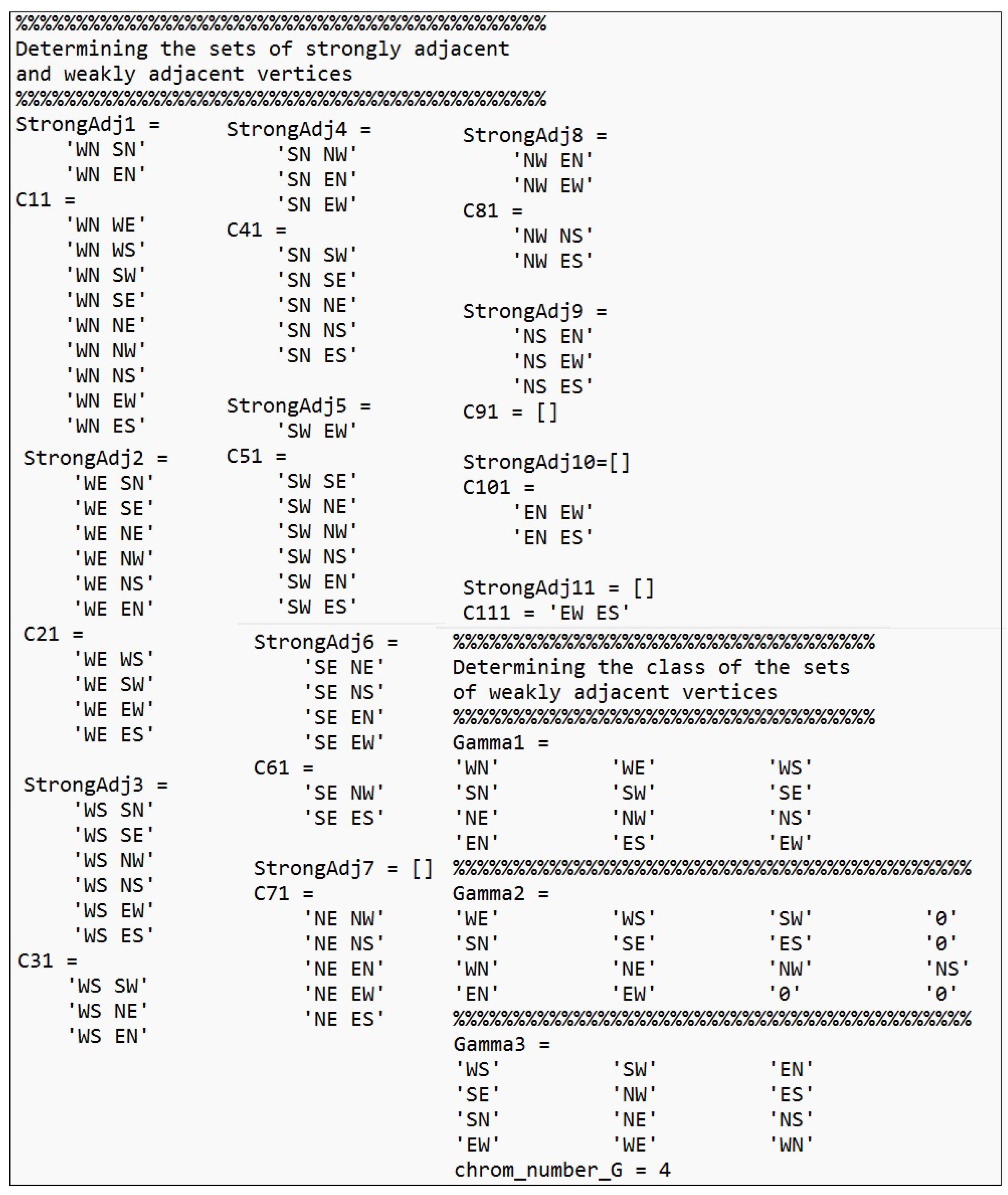
Figure 10.
The fuzzy graph model of traffic flows in the Pingit intersection.
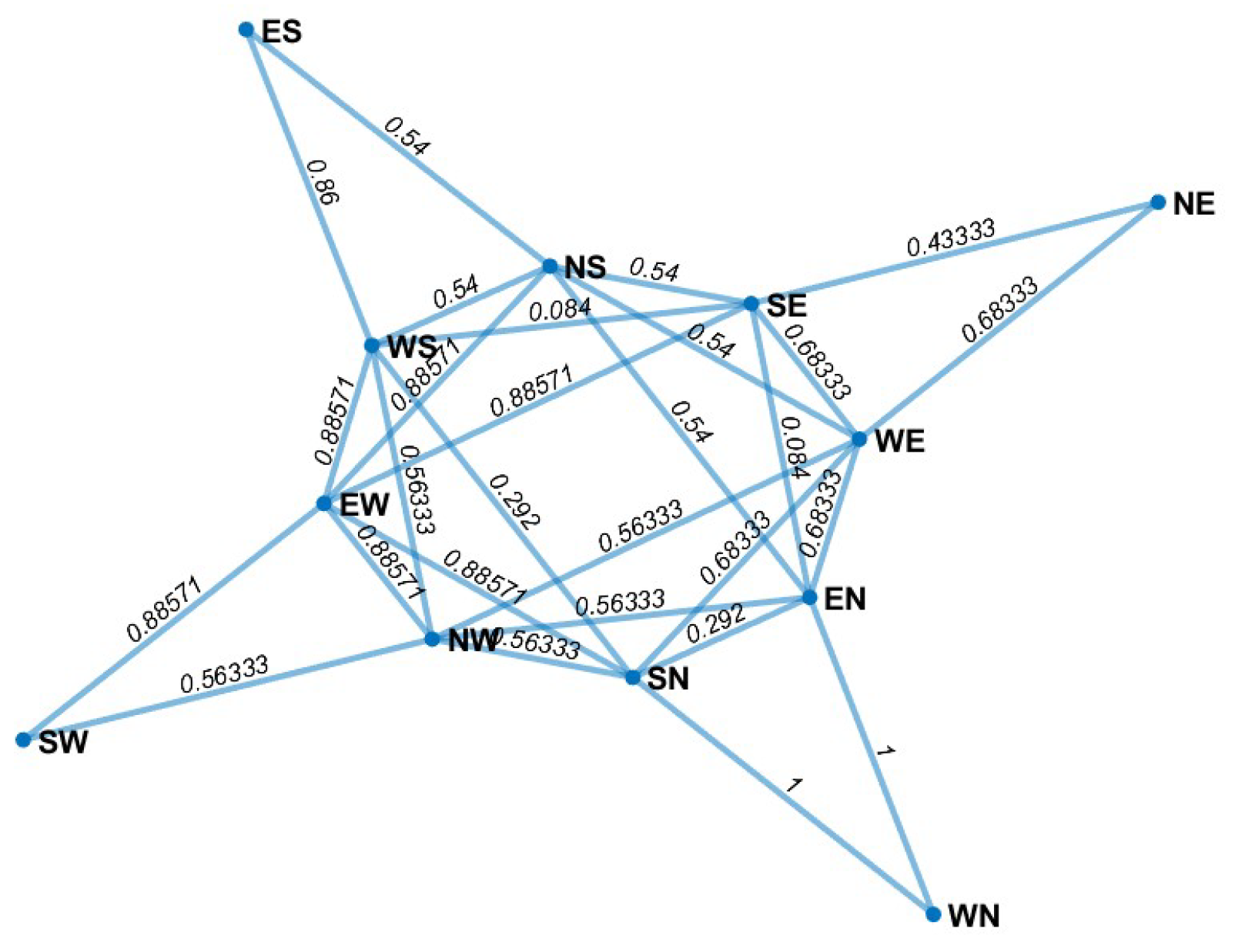

Table 1.
The PFVS of traffic flow data in the Pingit intersection.
| Traffic movements | Traffic flows | Clusters | Degree of vertices |
|---|---|---|---|
| (Vertices) | |||
| WN | 1805 | High | (0.383, 0.083,0) |
| WE | 605 | Medium | (0.262,0.083,0.121) |
| WS | 100 | Low | (0.306,0.083,0.077) |
| SN | 354 | Low | (0.112,0.083,0.271) |
| SW | 32 | Low | (0.359,0.083,0.024) |
| SE | 458 | Low | (0.032,0.083,0.351) |
| NE | 530 | Medium | (0.166,0.083,0.217) |
| NW | 831 | Medium | (0.216,0.083,0.167) |
| NS | 838 | Medium | (0.207,0.083,0.176) |
| EN | 337 | Low | (0.125,0.083,0.258) |
| EW | 1210 | High | (0.339,0.083,0.044) |
| ES | 742 | Medium | (0.329,0.083,0.054) |
Table 2.
The PFES of crossing conflict in the Pingit intersection
| Crossing conflict | Degree of conflict | Crossing conflict | Degree of conflict |
|---|---|---|---|
| (Edges) | (Degree of edges) | (Edges) | (Degree of edges) |
| WE SN | (0.2675,0.0625,0.6485) | SN NW | (0.2675,0.0625,0.6485) |
| WE NW | (0.6259,0.0625,0.290) | SN EW | (0.2675,0.0625,0.6485) |
| WE NS | (0.6259,0.0625,0.290) | SE NS | (0.0769,0.0625,0.8390) |
| WE EN | (0.2986,0.0625,0.6174) | SE EN | (0.2986,0.0625,0.6174) |
| WS SN | (0.7328,0.0625,0.1832) | SE EW | (0.0769,0.0625,0.839) |
| WS SE | (0.7328,0.0625,0.1832) | NW EN | (0.2986,0.0625,0.6174) |
| WS NW | (0.7328,0.0625,0.1832) | NS EN | (0.2986,0.0625,0.6174) |
| WS EW | (0.7328,0.0625,0.1832) | NS EW | (0.4946,0.0625,0.4214) |
Table 3.
The PFES of merging conflict.
| Merging conflict | Degree of conflict | Merging conflict | Degree of conflict |
|---|---|---|---|
| (Edges) | (Degree of edges) | (Edges) | (Degree of edges) |
| WN SN | (0.2675,0.083,0.6485) | SN EN | (0.2986,0.083,0.6174) |
| WN EN | (0.2986,0.083,0.6174) | SW NW | (0.8574,0.083,0.0586) |
| WE SE | (0.0769,0.083,0.839) | SW EW | (0.8574,0.083,0.0586) |
| WE NE | (0.3969,0.083,0.519) | SE NE | (0.0769,0.083,0.839) |
| WS NS | (0.7328,0.083,0.1832) | EW NW | (0.516,0.083,0.3999) |
| WS ES | (0.7328,0.083,0.1832) | NS ES | (0.7877,0.083,0.1282) |
Table 4.
The traffic signal phasing that can be implemented at the Pingit intersection
| Patterns | Phase 1 | Phase 2 | Phase 3 | Phase 4 |
|---|---|---|---|---|
| 1 | WN, WE, WS | SE, SN, SW | NE, NW, NS | EN, EW, ES |
| 2 | WE,WS,SW | SN,SE,ES | WN,NE,NW,NS | EN,EW |
| 3 | WS,SW,EN | SE,NW,ES | SN,NE,NS | EW,WE,WN |
Disclaimer/Publisher’s Note: The statements, opinions and data contained in all publications are solely those of the individual author(s) and contributor(s) and not of MDPI and/or the editor(s). MDPI and/or the editor(s) disclaim responsibility for any injury to people or property resulting from any ideas, methods, instructions or products referred to in the content. |
© 2023 by the authors. Licensee MDPI, Basel, Switzerland. This article is an open access article distributed under the terms and conditions of the Creative Commons Attribution (CC BY) license (http://creativecommons.org/licenses/by/4.0/).
Copyright: This open access article is published under a Creative Commons CC BY 4.0 license, which permit the free download, distribution, and reuse, provided that the author and preprint are cited in any reuse.


