

Submitted:
16 October 2023
Posted:
17 October 2023
You are already at the latest version
Abstract
In this paper, we give all non splitting bi-unitary superperfect polynomials divisible by one or two irreducible polynomials over the prime field of two elements. We prove the nonexistence of odd bi-unitary superperfect polynomials over F2.
Keywords:
sum of divisors
; bi-unitary divisors
; polynomials
; finite fields
; characteristic 2
1. Introduction
Let n and k be positive integers and let (resp. ) denotes the sum of positive (resp. unitary) divisors of the integer n. A divisor d of n is unitary if d and are coprime. We call the number n a superperfect number if . When , n is called a perfect number. An integer where p is a prime number, is called a Mersenne number. It is also well known that an even integer n is perfect if and only if for some Mersenne prime number M. Suryanarayana [1] considered superperfect numbers in the case . Numbers of the form (p is prime) are 2-superperfect if is a Mersenne prime. It is not known if there are odd k-superperfect numbers. Sitaramaiah and Subbarao [2] studied the unitary superperfect numbers, the integers n satisfying They found all unitary superperfect numbers below The first unitary superperfect numbers are and 238. A positive integer n has a bi-unitary divisor, d, if the greatest common unitary divisor of d and is equal to 1. The arithmetic function denotes the sum of positive bi-unitary divisors of the integer n. Wall [3] proved that there are only three bi-unitary perfect numbers , namely 6, 60 and 90. Yamada [4] proved that 2 and 9 are the only bi-unitary superperfect numbers, that is if and only if .
Now, let A be a nonzero polynomial defined over the prime field . A divisor B of A is unitary (resp. bi-unitary) if (resp. , where denotes the greatest common unitary divisor of B and . We denote by the sum of the monic divisors B of that is, (resp. represents the sum of all unitary (resp. bi-unitary) monic divisors of Note that all the functions and are multiplicative and degree preserving.
A is an even polynomial if it has a linear factor in else it is an odd polynomial. A polynomial M of the form is called Mersenne. The first five Mersenne polynomials over are: Note that all these polynomials are irreducible, so we call them Mersenne primes.
Let denotes the number of distinct irreducible monic polynomials that divide A. The notion of perfect polynomials over was introduced first by Canaday [5]. A polynomial A is perfect if Canaday studied the case of even perfect polynomials with . In the past few years, Gallardo and Rahavandrainy [6,7,8] showed the non-existence of odd perfect polynomials over with either or with in the case where all exponents of the irreducible factors of A are equal to 2. A polynomial A is said to be a unitary (resp. a bi-unitary) perfect if (resp. ). Also, A is called a unitary (resp. a bi-unitary) superperfect if (resp. .
Note that the function is degree preserving but not multiplicative, and this is the main challenge in this work. So, working on bi-unitary superperfect polynomial over is not an easy task especially when A is divisible by more than 2 irreducible factors.
Many researchers studied the unitary perfect polynomials over . The authors in [7,9,10] list the unitary perfect polynomials over with They list others that are divisible by P is a Mersenne polynomial, raised to certain powers, see [7]). Beard [11] found many bi-unitary perfect polynomials over , some of which are neither perfect nor unitary perfect. He conjectured a characterization of the bi-unitary perfect polynomials which splits over when Beard gave examples of non-splitting bi-unitary perfect polynomials over when . Rahavandrainy [12] gave all bi-unitary perfect polynomials over the prime field , with at most four irreducible factors (Lemmas 12 and 13). Gallardo and Rahavandrainy [13] classified some unitary superperfect polynomials with a small number of prime divisors under some conditions on the number of prime factors of .
Notations: We use the following notations throughout the article.
- (resp. represents the set of non-negative (resp. positive) integers.
- denotes the degree of the polynomial
- is the polynomial obtained from A with x replaced by , that is .
- P and Q are distinct irreducible non constant polynomials.
- and are distinct odd irreducible non constant polynomials.
In this paper, we prove the non-existence of odd bi-unitary superperfect polynomials A when A is divisible by at least two irreducible factors (Corollary 4). We give a complete classification for all bi-unitary superperfect polynomials over that are divisible by at most two distinct irreducible factors, (Theorem 1). Bi-unitary superperfect polynomials over that are neither unitary perfect nor bi-unitary perfect are found. The polynomials , and are such examples, n is a positive integer.
Our main result is given in the following theorem:
Theorem 1.
If and A is a bi-unitary superperfect over if and only if where
2. Preliminaries
The following two lemmas are helpful.
Lemma 1.
Let A be a polynomial in , then n is a non-negative integer.
Proof.
The result follows since is multiplicative and . □
Lemma 2.
If A is a unitary superperfect polynomial over , then is also a unitary superperfect polynomial over for all non-negative integers n.
Proof.
Let A be a unitary superperfect and let . By Lemma 1, we have . □
Lemma 3.
[Lemma 2.4 in [13]] Let A be a polynomial in
- 1)
- If P is an odd prime factor of then divides
- 2)
- If divides then divides
- 3)
- If A is unitary superperfect that has an odd prime factor, then divides
The following results are needed, and they are a result of Beard [11], and Rahavandrainy [12] works.
Lemma 4.
[Theorem 1 and its Corollary in [11]] If A is a non-constant bi-unitary perfect polynomial, then divides A and
Lemma 5.
[Lemma 2.2 in [12]]
- 1)
- 2)
Corollary 1.
[Corollary 2.3 in [12]] Let be irreducible. Then
i) If , where or is of the form , u odd, then
ii) If is odd, with u odd, then .
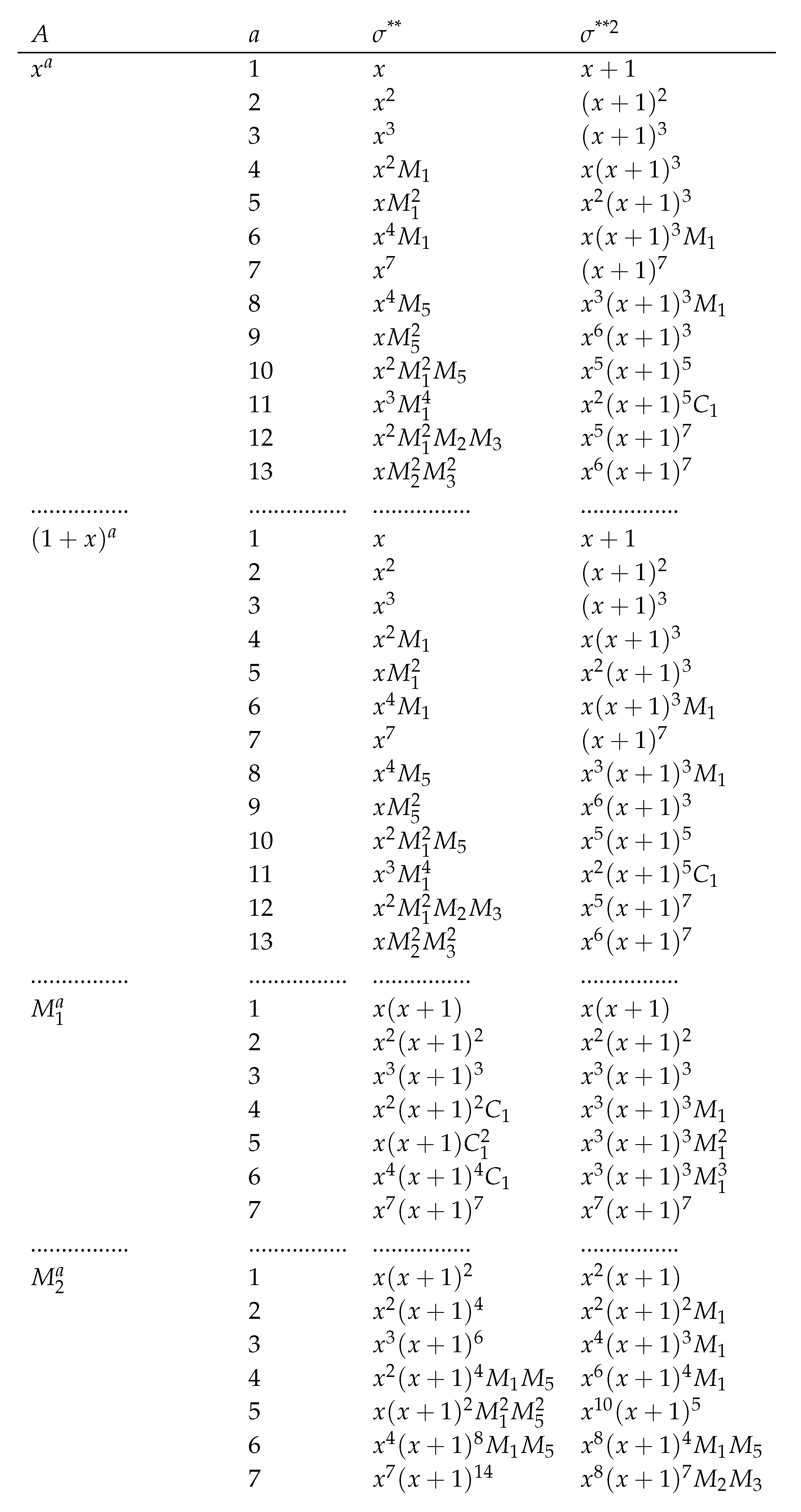
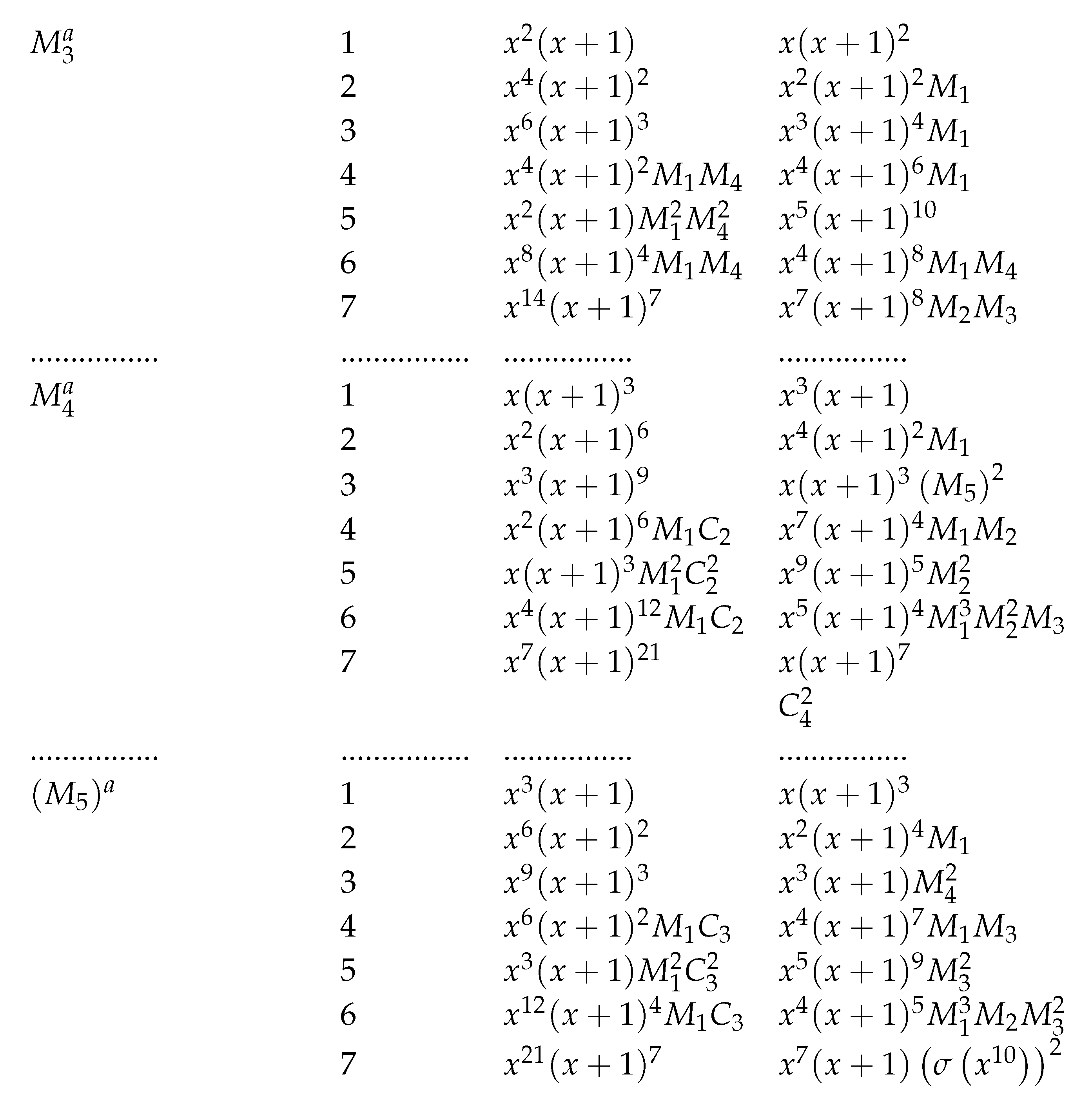
The proof of the below lemma follows from Lemma 5 and the binomial formula. Table Section 6 shows some values of when A is a power of the first five Merssene primes.
Lemma 6.
Let the polynomial be Mersenne prime and be an irreducible polynomial over and let If then
- 1)
- divides
- 2)
- 3)
- 4)
- 5)
- 6)
Lemma 7.
[Corollary 2.4 in [12]]
- 1)
- splits over if and only if or , for some .
- 2)
- splits over if and only if P is Mersenne and or for some .
Lemma 8 summarizes key results taken from Canaday’s paper [5].
Lemma 8.
Let T be irreducible in and let .
i)If T is a Mersenne prime and if , then .
ii)If and , then , , and .
iii)If any irreducible factor of is a Mersenne prime, then .
iv)If is a Mersenne prime, then .
Lemma 9.
[Lemma 2.6 in [14]] Let and M be a Mersenne prime. Then, , and are all odd and squarefree.
3. Bi-unitary superperfect Polynomials
Recall that A is a bi-unitary superperfect polynomial in if The polynomial is a bi-unitary superperfect polynomial over .
The proof of the following lemmas follow directly.
Lemma 10.
If A is a bi-unitary perfect polynomial over , then A is also a bi-unitary superperfect polynomial.
Lemma 11.
If A is a bi-unitary superperfect polynomial over , then is also a bi-unitary superperfect polynomial.
Rahavandrainy (Lemma 2.6 in [12]) proved that if A is a bi-unitary perfect polynomial over where such that , then is a bi-unitary perfect polynomial if and only if is a bi-unitary perfect polynomial. Rahavandrainy’s previous result is not valid in the case of bi-unitary superperfect polynomials because the bi-unitary superperfect polynomial is a counterexample over . In fact, is a bi-unitary superperfect but is not a bi-unitary superperfect.
The following polynomials are considered over
Lemma 12.
[Theorem 1.1 in [12]] Let be bi-unitary perfect polynomial such that . Then
Lemma 13.
[Theorem 1.2 in [12]] Let be bi-unitary perfect polynomial such that . Then
Lemma 14.
If is a bi-unitary superperfect polynomial over , then so is .
4. Proof of Theorem 1
We start this section by the following corollary.
Corollary 2.
If a is a positive integer, then
- 1)
- 1+x divides .
- 2)
- x divides .
Proof.
An immediate result of Lemma 5. □
Lemma 15.
divides , a is a positive integer.
Proof.
Since P is odd, then . If , then . If , then So, x divides for every a. Similarly, divides . Hence, divides . □
Lemma 16.
Let A be a polynomial in .
- 1)
- If P is an odd prime factor of then divides
- 2)
- If divides then divides
Proof.
- 1)
- We write where and such that But, divides and the result follows since divides .
- 2)
- In a similar manner, we write where .
□
Corollary 3.
If and , then divides
Proof.
Let . If divides A, then we are done by Corollary 2. If does not divide A, then A is divisible by an irreducible polynomial { and the result follows by Lemma 15. □
Corollary 4.
Let A be a polynomial in with . If A is a bi-unitary superperfect, then divides
Proof.
Let . Since , then either P or divides A. In both cases, divides (Lemma 16). So, divides . □
The following lemma is similar to Lemma 7.
Lemma 17.
Let , then
- 1)
- If a is even, then and splits over if and only if
- 2)
- If a is odd, then and splits over if and only if for some .
Proof.
- 1)
- If splits, the (Lemma 7) and . Suppose, does not split with , (resp. ), u is odd, . But , so must split. Hence, and since is odd and square free (Lemma 9), then has a Mersenne factor. So, and hence .
- 2)
- Assume , with u is odd. If splits, then , d is positive (Lemma 7). If does not split, then and since splits, . Again, by Lemma 9, has a Mersenne factor. So, and hence For , . Hence, and the same result is obtained when .
The same proof is done for and the proof is compete. □
Lemma 18.
Let a and have the form where and let the polynomial be Mersenne prime over then
Proof.
Let and then
□
4.1. Case w(A)=1
We prove that can not have more than one prime factor when A is a prime power.
Lemma 19.
If and splits over , then A is a bi-unitary superperfect polynomial.
Proof.
Follows from part 1) of Lemma 17. □
Lemma 20.
If , then A is not a bi-unitary superperfect polynomial.
Proof.
Assume is a bi-unitary superperfect. Since P divides A, then divides and by Lemma 16 we have divides . A contradiction. □
In particular, if M is a Mersenne prime polynomial over , then (c is a positive integer) is never a bi-unitary superperfect polynomial.
Corollary 5.
Let and let be a bi-unitary superperfect polynomial over then .
It is clear from the preceding two corollaries that a bi-unitary superperfect polynomial must be even.
Theorem 2.
Let A be a polynomial over with then A is a bi-unitary superperfect polynomial if and only if where
Proof.
By Corollary 5, or Assume and , then Both and split over only when Thus, If , then . The expression splits over when . Then, The sufficient condition follows by a direct computation and the result follows since if A is a bi-unitary superperfect, then so is . □
4.2. Case w(A)=2
We consider the polynomial and Note that and are bi-unitary superperfect polynomials over , see Lemma 10 and (Theorem 5 in [11]
Corollary 6.
If A is a bi-unitary superperfect polynomial over , then .
Proof.
Follows directly from Corollary 4. □
Lemma 21.
[Lemma 3.1 in [12]] If the polynomial does not split, then or and or for any .
Lemma 22.
Let The polynomial is a bi-unitary superperfect over if and only if one of the following is true.
- 1)
- If a and b are odd and splits, then a and b are of the form
- 2)
- If a and b are odd and doe not split, then
- 3)
- If a and b are even, then
- 4)
- If a is odd and b is even, then
Proof.
1) If and , then But and split over when and are of the form (Lemma 7).
2) If and , are odd. We have and , since does not split. By Lemma 21 and or and . Also, and does not split since does not split. So, there exit Merssene primes M(resp. that divides (resp. . Hence, or and we have . If , then . If and , then and . If , then is dismissed.
3) If b even, then such that , is of the form with u is odd and such that , is of the form , v odd. Thus,
If and are Mersenne, then So, If and are not Mersenne, then and a contradiction. For A is bi-unitary perfect and hence A is a bi-unitary superperfect.
4) Now, let and . Since splits over only when , then But splits over if is of the form If and then and The sufficient condition can be easily verified. □
The proof of Theorem 1 is now complete.
5. Conclusion
In conclusion, a non constant bi-unitary superperfect polynomial A over can be divisible by one irreducible polynomial x or and its exponent is 2 or for a positive integer n. Moreover, the only bi-unitary superperfect polynomials over with exactly two prime factors are with , d is a positive integer and if and only if .
6. Table
Consider the polynomials , , , and . The below table lists the values of and for with , .
References
- Suryanarayana, D. Super Perfect Numbers. Elemente der Mathematik 1969, 24, 16–17. [Google Scholar]
- Sitaramaiah, V.; Subbarao, M. On the Equation σ**(n))=2n. Utilitas Mathematica 1998, 53, 101–124. [Google Scholar]
- Wall, C. Bi-unitary perfect numbers. Proceedings of the American Mathematical Society 1972, 33, 39–42. [Google Scholar] [CrossRef]
- Yamada, T. 2 and 9 are the only biunitary superperfect numbers. Annales Univ. Sci. Budapest 2018, 48, 247–256. [Google Scholar]
- Canaday, E.F. The sum of the divisors of a polynomial. Duke Mathematical Journal 1941, 8, 721–737. [Google Scholar] [CrossRef]
- Gallardo, L.H.; Rahavandrainy, O. Odd perfect polynomials over F2. Journal de théorie des nombres de Bordeaux 2007, 19, 165–174. [Google Scholar] [CrossRef]
- Gallardo, L.H.; Rahavandrainy, O. On even (unitary) perfect polynomials over F2. Finite Fields and Their Applications 2012, 18, 920–932. [Google Scholar] [CrossRef]
- Gallardo, L.H.; Rahavandrainy, O. All unitary perfect polynomials over F2 with at most four distinct irreducible factors. Journal of Symbolic Computation 2012, 47, 492–502. [Google Scholar] [CrossRef]
- Gallardo, L.H.; Rahavandrainy, O. Even perfect polynomials over F2 with four prime factors. International Journal of Pure and Applied Mathematics 2009, 52, 301–314. [Google Scholar]
- Gallardo, L.H.; Rahavandrainy, O. There is no odd perfect polynomial over F2 with four prime factors. Portugaliae Mathematica 2009, 66, 131–145. [Google Scholar] [CrossRef]
- Beard, J.T. Bi-unitary perfect polynomials over GF(g). Annali di Matematica Pura ed Applicata 1987, 149, 61–68. [Google Scholar] [CrossRef]
- Rahavandrainy, O. All bi-unitary perfect polynomials over F2 with at most four irreducible factors. arXiv 2022, arXiv:2205.08392 2022. [Google Scholar]
- Gallardo, L.H.; Rahavandrainy, O. Unitary superperfect binary polynomials. Finite Fields: Theory and Applications: Theory and Applications: Ninth International Conference on Finite Fields and Applications, July 13-17, 2009, Dublin, Ireland. American Mathematical Soc., 2010, Vol. 518, p. 155.
- Gallardo, L.H.; Rahavandrainy, O. Characterization of Sporadic perfect polynomials over F2. Functiones et Approximatio Commentarii Mathematici 2016, 55, 7–21. [Google Scholar] [CrossRef]
Disclaimer/Publisher’s Note: The statements, opinions and data contained in all publications are solely those of the individual author(s) and contributor(s) and not of MDPI and/or the editor(s). MDPI and/or the editor(s) disclaim responsibility for any injury to people or property resulting from any ideas, methods, instructions or products referred to in the content. |
© 2023 by the authors. Licensee MDPI, Basel, Switzerland. This article is an open access article distributed under the terms and conditions of the Creative Commons Attribution (CC BY) license (http://creativecommons.org/licenses/by/4.0/).
Copyright: This open access article is published under a Creative Commons CC BY 4.0 license, which permit the free download, distribution, and reuse, provided that the author and preprint are cited in any reuse.


