

Submitted:
10 October 2023
Posted:
11 October 2023
Read the latest preprint version here
Abstract
BACKGROUND: Pre-marital sex is a sexual interest practiced by people who are yet to get married and has ended up being accepted specifically in western countries. Sex before marriage is sexual behavior engaged in by single people. In the past, having sex before getting married is seen as a moral dilemma that many cultures forbade and that many people regarded to be sin in many religions, although it has gained wider acceptance across the board. OBJECTIVES: This study was carried out to determine the perception, practices, and factors associated with pre-marital sex, courtship, and its influences among Osun State University Undergraduates, Osogbo, Osun State. METHODOLOGY: The study was a descriptive study, and respondents were selected using multi-stage sampling technique. Students of Osun State University, Osogbo main campus form the population of the study and its sample size was calculated using Leslie Kish’s formula. A total of 387 responses were validated from the survey. The instrument for data collection was a self-administered semi-structured questionnaire consisting of four sections. The data obtained were collated, examined for completion, coded, imputed, and analyzed using SPSS v21. RESULTS: The mean age of the respondents was between 19.19±2.17, and the majority were between 18 – 24 years. About 52% of the respondents show a positive perception of premarital sex and courtship. Also, in the practice of courtship majority (88.3%) of the respondents think those that go around together are courting and from the responses obtained and analyzed from the factors leading to pre-marital sex, the findings revealed that peer pressure (90.4%), Internet (86.7%), pornography (83.9%) and drugs (82.9%) are the leading factors which contribute to pre-marital sex among undergraduates. CONCLUSION: The study hereby recommends that Parents should as a matter of responsibility monitor and pays regular visits to their children in the universities and provide them with materials that will make them stay comfortable for them not to fall victim to peer pressure.Pre-marital sex is a practice that should be avoided by undergraduate students, though most students consider courtship as a normal practice, it is still used as a normal factor that leads them to practice pre-marital sex.
Keywords:
Pre-Marital Sex
; courtship
; influences
; university
; undergraduates
Introduction
Pre-marital Commonly, this concept "sex before marriage" refers to people who are supposedly not yet of marriageable age or to adults who are having sexual relations before they eventually get married (Ramesh,et al, 2008). Merriam Webster claims that according to the dictionary, courtship is the amount of time when people engage in love activities that potentially result in marriage, or the time frame during which such activities take place. Sex before marriage is sexual behaviour engaged in by single people. In the past, having sex before getting married is seen as a moral dilemma that many cultures forbade and that many people regarded to be sin in many religions, although it has gained wider acceptance across the board since the 1960s, especially in Western nations. Several research have been conducted on how individual perceives courtship considering its impact on pre-marital sex (Bogle, 2008).
According to these research, young adults—both male and female—frequently participate in casual sex, often known as "campus courtship" or "hooking up," as opposed to the traditional courtship model, which forbids pre-marital sex. A sexual contact, including kissing and having intercourse, is widely referred to as "hooking up," especially amongst young men and women, without suggesting a legal commitment. Premarital sex, non-marital pregnancies, and a high rate of divorce each year have all significantly altered the traditional family structure. Due to western education, courtship, a practice that has been prevalent in Nigeria for decades, gained popularity. Undergraduate courtship has changed some of the traditional male and female interactions in African society. Men had to make calls to ladies in the pre-colonial era and be invited to visit the woman's home while being strictly supervised by the family. This kind of courtship followed traditional wooing guidelines that both men and women were required to follow. However, the perception of young men and women about romance and sex before marriage has indeed been completely reshaped by western education. The university setting gives young people the chance to go out and indulge in another type of campus romance known as "hooking up" away from the watchful eyes of their families and neighbors (Hettinger, 2007).
The mass media, social media, the internet, peers, shifting family customs, money, the university setting, and other elements have influenced how young people think and engage in courtship alongside contemporary social changes. Undergraduates' sexual conduct has been influenced by this awareness of courtship, especially in relation to courtship and its relationship to premarital sex.
Material and Method
This was a descriptive cross-sectional study carried out at Osun State University. The study was carried out with the use of a semi-structured questionnaire. The information obtained from the finished instrument was calculated and analyzed using Statistical Product for Service Solutions version 21 software.
Descriptive and inferential statistics were used in this study as data analysis strategies. To examine the data and provide answers to the study objectives, descriptive statistics like frequency distribution and mean will be used. Compound frequency distributions were used to track respondents' replies to each of the instrument's questions.
RESULTS
SOCIO-DEMOGRAPHICS CHARACTERISTICS OF THE RESPONDENTS
Table 1 shows the socio-demographic characteristics of the respondents. The mean age of the respondents is 19.19±2.17, with about 50% of them are between 18-24years. More than two-thirds of the respondents were female, practiced Christianity (69.8%) and are the Yoruba (78.3%) tribe. The majority (98.5%) of the respondents were single and are 100 level (54.5%) students.
RESPONDENTS' PERCEPTION ON PRE-MARITAL SEX, COURTSHIP AND ITS INFLUENCES
Table 2 shows the respondents' perception on pre-marital sex courtship and its influence. About 78% of the respondents agreed that women and men (68.6%) should be a virgin before marriage. More than two-thirds of the respondents agreed that neither man nor woman should not have pre-marital sex. Many (71.2%) of the respondents agreed that pre-marital sex should be prohibited. About 61% of the respondents disagreed that pre-marital sex is normal for biological needs. More than half of the respondents disagreed that pre-marital sex should be acceptable if a couple falls in love and plan to marry. The majority (92.3%) of the respondents agreed that courtship is a process where partners get to know more about each other. About 70% of the respondents agreed courtship sometimes leads to pre-marital and unprotected (61.2%) sex. Many (65.2%) of the respondents agreed that courtship has ruined the lives of some students.
RESPONDENTS PERCEPTION TOWARDS PRE-MARITAL SEX
Figure 4.1.
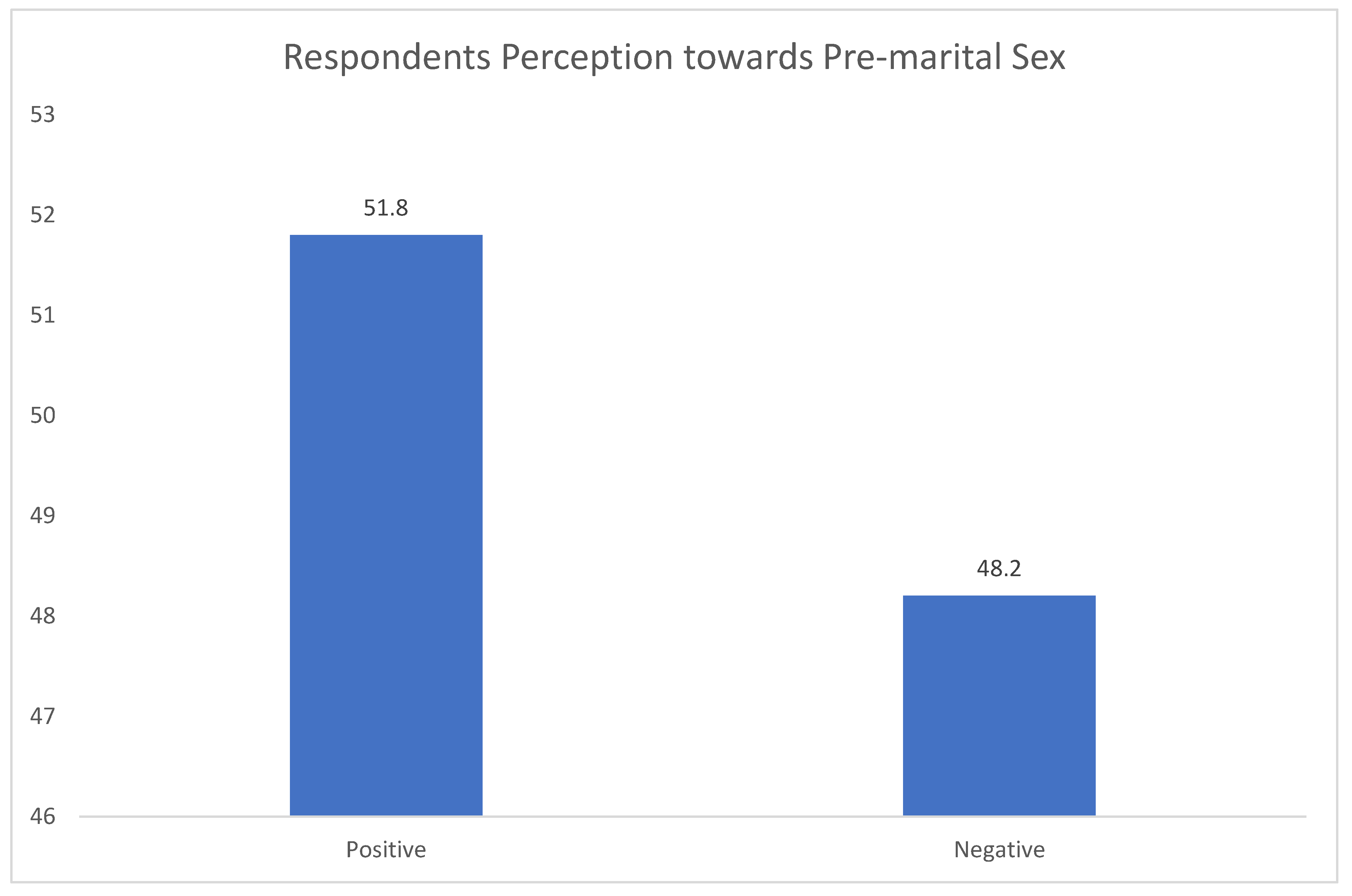
shows respondents’ perceptions towards premarital sex, courtship, and its influence. About 52% of the respondents show a positive perception towards premarital sex and courtship.
Figure 4.1.
shows respondents’ perceptions towards premarital sex, courtship, and its influence. About 52% of the respondents show a positive perception towards premarital sex and courtship.
RESPONDENTS' VIEW ON COURTSHIP PRACTICE
Table 3 shows the respondents' views on courtship practice among them. About 62.9% of the respondents think most of the people living together are courting. The majority (88.3%) of the respondents think those that go around together are courting. More than two-thirds of the respondents believed courting can take place without any form of personal contact with the help of modern technology. Most (84.7%) of the respondents believe singing romantic love songs, reciting poems and writing letters help the courtship building.
FACTOR LEADING TO PRE-MARITAL SEX AMONG UNDERGRADUATE
Figure 4.2.
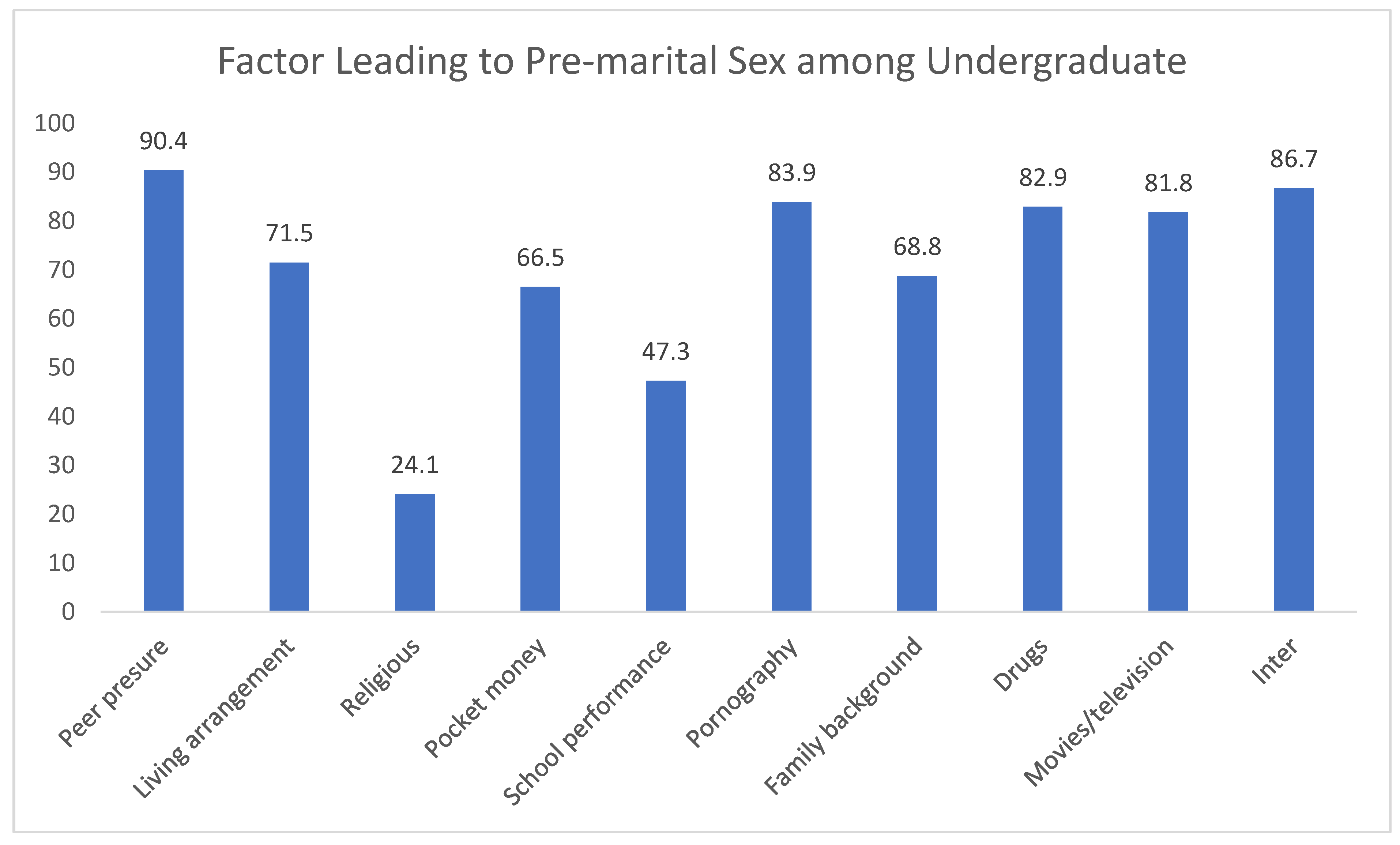
shows respondents' views on factors that lead to pre-marital sex among undergraduates. About 90% of the respondents think peer pressure has led to pre-marital sex among undergraduate students compared to the Internet (86.7%), Pornography (83.9%), Drugs (82.9%), living arrangement (71.5%), family background (68.8%) and Pocket money (66.5%).
Figure 4.2.
shows respondents' views on factors that lead to pre-marital sex among undergraduates. About 90% of the respondents think peer pressure has led to pre-marital sex among undergraduate students compared to the Internet (86.7%), Pornography (83.9%), Drugs (82.9%), living arrangement (71.5%), family background (68.8%) and Pocket money (66.5%).
DISCUSSION
In this study, we examined the undergraduates’ perceptions on courtship and its influence on pre-marital sex, we also ascertained how courtship is being practiced among the undergraduates and lastly, we identified the factors leasing pre-marital sex among undergraduates. A large percentage of the respondents agreed that women and men should be virgins before marriage, neither a man or woman should have pre-marital sex, premarital sex should be prohibited and shouldn’t be normal because it is a biological need, pre-marital sex should not be acceptable if a couple fall in love and plan to marry, courtship sometimes lead to premarital sex and unprotected sex and that courtship has ruined the lives of some students. This means that a higher proportion have a positive perception on premarital sex that it should be avoided.
Meanwhile on the perception of undergraduates on courtship, a higher proportion agreed that courtship sometimes leads to premarital and unprotected sex and courtship leads to the ruin of some students lives, this indicates that although there is an overall positive perception towards pre- marital sex that it should be avoided the perception on courtship indicates that courtship has a big role to play in undergraduates participating in premarital sex. It is obvious from the study that the undergraduate students show a positive perception towards premarital sex and courtship which means that pre-marital sex is a behavior that should be avoided among undergraduates in Osun State University, which is in line with a study conducted by (Hansel Teo Sze Young et. al. 2020) on the perception of premarital sex among students in a faith-based university.
This study also showed that majority of students say that those that hang around together are courting, a particularly large amount of people also says that singing romantic love songs, reciting poems, and writing letters is a method of courtship, while a lesser amount say couples that live together are also practicing courtship.
Results from the factors that influence pre-marital sex showed that peer pressure is the major contributing factor that leads undergraduate into having pre-marital sex. Following that are other factors such as pornography, drugs, internet, living arrangement, movies/television etc. these influencing factors are not peculiar to this study alone, it was also stated in another study that was conducted by (Adegboyega et. al. 2019 & Omoge Adeyemi O. et al. 2022) on the influence of peer pressure on sexual behavior of undergraduates in kwara state.
CONCLUSION
Pre-marital sex is a practice that should be avoided by undergraduate students, though most students consider courtship as a normal practice, it is still used as a normal factor that leads them to practicing pre-marital sex.
Some students especially in their teens, are mainly influenced by their peers, others by the promise of marriage which makes them fall victim of pre-marital sex.
Our respondents have a positive perception on pre-marital sex, which tends to influence their courtship practices in a positive way.
RECOMMENDATIONS
Premarital sexual behavior is a public health issue that affects students in tertiary institutions today at an increasingly young age and compares to most of the psychological, physical, social health, and economic problems. As a result, suggestions for solutions should come from students who are knowledgeable and interested in the problem.
If knowledge is raised in every social institution, especially the tertiary institutions in the nation, premarital sexual activity can be avoided. The prevention of premarital sexual activity should be everyone's responsibility, including parents, the school administration, the government, and our peers. Therefore, we strongly urge that;
- As a matter of obligation, parents should keep an eye on, visit their kids in college frequently, and provide them with supplies to help them feel at home, for them not to fall victim of peer pressure.
- The internet is another major factor that leads undergraduates to have pre-marital sex so we strongly advice that they reduce social media influence in their everyday lives.
- Petition to ban pornography online should be hammered on, to reduce access to it.
- University campus leaders should provide and implement proper punishment for people caught using drugs.
- Parents should strictly monitor the kind of movies that their children watch on television as some may contain content that will influence them to practice pre-marital sex.
LIMITATIONS
Some challenges were noted during the study, like trying to find students on campus, trying to convince students to engage in the study, and the travelling stress.
References
- Ancok, D., Faturocbman, Soetjipto, H.P. (1988). PerananKeluarga, Sekolah, danand Fertility in Kenya: A Survey of Knowledge, Perceptions, and Practices. Studies in Family Planning, 22, 205-216. and Francis.
- Anderson, David. 1994. Towards a more effective policy response to AIDS IUSSP Policy and Research Paper No. 4, Belgium: IUSSP.
- Bender, D., & Leone, B. (2015). Sexual values opposing viewpoints. San Diego: Green Haven Press.
- Berihun H. Assessment of the prevalence of premarital sex and unprotected sexual practices among secondary school adolescent students in Sebeta town, Oromia regional state, Ethiopia. Addis Ababa: Addis Ababa University; 2014.
- Bogle, P.O. Premarital sex involvement: Developmental investigation of relational correlates. Adolescence 2008, 92, 705–987. [Google Scholar]
- Hettinger, R. (2007). Sex isn’t that simple: The new sexuality on campus. Ney York. The Seabury Press.
- Bumroongsook, S. (2013) Love and Marriage: Mate selection in Twentieth-Century Thailand. Bangkok: Chulalongkorn University Press.
- Chan, Wing-Tset (2013) A Sourcebook in Chinese Philosophy. Princeton, NJ: Princeton University Press.
- Chandra-Mouli, V.; Camacho, A.V.; Michaud, P.A. WHO guidelines on preventing early pregnancy and poor reproductive outcomes among adolescents in developing countries. J Adolesc Health. 2013, 52, 517–522. [Google Scholar] [CrossRef] [PubMed]
- Cherlin, A.J. (2012) Public & Private Families. An Introduction. Boston: McGraw Hill.
- Courtship “Merriam-Webster.com dictionary 9 Dem 2021 definition of courtship and premaritalsexretrivedfromhttps://www.merriam-webster.com/dictionary/courtship.
- Coontz, S. (2015) Marriage, a History. How Love Conquered Marriage. New York: Penguin.
- Dr Musa Abdullahi&Abdullahi Umar (2013). Factors Associated With Engaging in Pre-Marital Sex Among The Students of University of Maiduguri.
- Ebrey, P.B. (2012) Women and the Family in Chinese History. London: Routledge.
- Goody, J. (2010) The Oriental, the Ancient, and the Primitive. Systems of Marriage and the Family in the Pre-industrial Societies of Eurasia. Cambridge, UK: Cambridge University Press.
- Jayakody, R. and Vu, T.H. (2019) “Family change in Vietnam’s Red River Delta.” In M. Barbieri and D. Bélanger, eds., Reconfiguring Families in Contemporary Vietnam. Stanford, CA: Stanford University Press, pp. 203-236.
- Jocano, F.L. (2018) Filipino Indigenous Ethnic Communities. Manila: Punlad.
- Jordan, D.K. (2012) “Chinese Matchmakers of Tiānjin&Táoyuán”http://wwwantro.uscd.edu/ ~dkjordan/ meiren/meiren/htlm(accessed 5 Feb 2014).
- Lě, T. (2018) Single Women in Vietnam. Hanoi: ThéGiói Press.
- Lori, S.A. New Perspectives on Populations: Lessons from Cairo. Population Bulletin 1995, 50. [Google Scholar]
- Lye, W F and C Murray 2010. Transformations in the Highveld: The Tswana and Southern Sotho. Cape Town: David Philip.
- M.A. Monto; A.G. Carey (2014)."A new standard of sexual behavior? Are claim associated with the "hookup culture" Beasties and friends with benefit. The Journal of Sex Research.
- Mengistie, Z.; Wolie, E.; Abawa, E.; Ebre, E.; Adera, A. Knowledge attitude and practice towards premarital sex and HIV/AIDS among Mizan-Tepi University students, southwest Ethiopia. Sci J public Health. 2015, 3, 592–529. [Google Scholar] [CrossRef]
- Ministry of Health and Social Welfare 1997. AIDS Epidemiology In Lesotho. Maseru, Lesotho.
- Moore, S. A description of the diversity of kinship and marriage practices in Southeast Asia with a focus on India. The South Asianist 2014, 3, 1–8. [Google Scholar]
- Mullan, B. (2014) The Mating Trade. London: Routledge.
- Omoge Adeyemi O., Adesegun Mobolaji M., Arogundade Ayorinde O., Godfrey Sally G. Obi – Obasi Chiamaka S., Opadele Modurotolu M. (2022). Experiences And Attitudes Towards Sexual Harassment among Hawkers Residing in Ede Township in Osun State, Nigeria. [CrossRef]
- Poulter, S., William McClaim, J. B. K. Kaburise, J. Mugambwa and D. Milazi. 1981. Law and Population Growth in Lesotho, Lesotho: Morija Printing Works.
- Quah, S.R. (2019) Families in Asia. Home and Kin. London: Routledge. Straits Times (2013) “Marry me (please …?)”, Saturday, 17 August, pp. D14-D15.
- Regassa, T.; Chala, D.; Adeba, E. Premarital sex in the last twelve months and its predictors among students of Wollega University, Ethiopia. Ethiop J Health Sci. 2016, 26, 351–359. [Google Scholar] [CrossRef] [PubMed]
- Regnerus, Mark; Uecker, Jeremy (2011). Premarital Sex in America: How Young under graduate Meet, Mate, and Think about Marrying.
- Salih, N.A.; Metaferia, H.; Reda, A.A.; Biadgilign, S. Premarital sexual activity among unmarried adolescents in northern Ethiopia: a cross-sectional study. Sex Reprod Healthcare. 2015, 6, 9–13. [Google Scholar] [CrossRef] [PubMed]
- Teferra, T.B.; Erena, A.N.; Kebede, A. Prevalence of premarital sexual practice and associated factors among undergraduate health science students of Madawalabu university, Bale Goba, south east Ethiopia: institution based cross sectional study. Pan Afr Med J. 2015, 20, 1. [Google Scholar] [CrossRef] [PubMed]
- Thornton, A. The Courtship Process and Adolescent Sexuality. Journal of Family Issues 1990, 11, 239–279. [Google Scholar] [CrossRef]
- Thornton, A.; Camburn, D. Religious Participation and adolescent Sexual Behavior and Attitudes. Journal of Marriage and the Family 1989, 51, 641–653. [Google Scholar] [CrossRef]
- Thornton, A.; Camburn, D. The Influence of the Family on Premarital Sexual Attitudes and Behavior. Demography 1987, 24, 323–340. [Google Scholar] [CrossRef] [PubMed]
- Trlin, A.D., Krishnamoorthy, S. and Khoo, S-E. (1983) Premarital Sex: Differentials.
- Udry, J.R.; Billy, J.O.G. Initiation of Coitus in Early Adolescence. American Sociological Review 1987, 52, 841–855. [Google Scholar] [CrossRef]
- Udry, J.R. Biological Presdispositions and Social Control in Adolescent Sexual Behavior. American Sociological Review 1988, 53, 709–722. [Google Scholar] [CrossRef]
- Uganda, Uganda Virus Research Institute, Entebbe.
- Ukor, B. (1990). Sex in Adolsecen’ looking upwards. Cross River, Cross River State Newspaper Corporation. UNICEF. (2001). A league table for teenage births in rich nations. Retrieved 10th October, 2013.
- UNICEF. Adolescence and youth. 4th ed. Colorado: Harper Collins Publisher; 2016. http://www.unicef.org/adolescence/.
- UN. 1985. Socio-economic Differentials in Child Mortality in Developing Countries ST/ESA/SER.A/97, New York: United Nations.
- U.S. Teenage Women over the Past Three Decades. Family Planning Perspectives, 19, 46-53.
- Vogel, E. (2016) “The go-between in a developing society: The case of the Japanese marriages arranger.” In W.J. Goode, ed., Readings on the Family and Society. Englewood-Cliffs, N.J.: Prentice-Hall, pp. 72- 82.
- White, J.M. and Klein, D.M. (2018) Family Theories. 3rd Ed. Los Angeles: Sage Publications.
- Women, 1982-1 988. Family Planning Perspectives, 22, 206-214.

Table 4.1.
Frequency distribution of respondents’ socio-demographic characteristics.
| Variable | n = (387) | Percentage (%) |
| Age(years) | ||
| <18 | 182 | 47 |
| 18-24 | 193 | 49.9 |
| ≥25 | 12 | 3.1 |
| Mean±SD | 19.19±2.17 | |
| Gender | ||
| Male | 137 | 35.4 |
| Female | 250 | 64.6 |
| Ethnicity | ||
| Yoruba | 303 | 78.3 |
| Igbo | 53 | 13.7 |
| Hausa | 14 | 3.6 |
| Others | 17 | 4.4 |
| Religion | ||
| Islam | 115 | 29.7 |
| Christianity | 271 | 69.8 |
| Traditional | 1 | 0.3 |
| Marital status | ||
| Single | 379 | 98.5 |
| Married | 6 | 1.5 |
| Level | ||
| 100 | 211 | 54.5 |
| 200 | 87 | 22.5 |
| 300 | 64 | 16.5 |
| 400 | 18 | 4.7 |
| 500 | 7 | 1.8 |
| Department | ||
| Anatomy | 23 | 5.9 |
| Pharmacology | 26 | 6.7 |
| Physiology | 33 | 8.5 |
| Public health | 54 | 14 |
| Computer science | 10 | 2.6 |
| Medical laboratory science | 19 | 5 |
| Biochemistry | 8 | 2.1 |
| Law | 7 | 1.8 |
| Mechanical engineering | 8 | 2.1 |
| Nutrition & Dietetics | 19 | 5.1 |
| Radiography & radiation science | 26 | 6.7 |
| Nursing | 12 | 3.2 |
| Others (Zoology, Statistics, Plant Biology, MCB) | 142 | 36.3 |
| Faculty | ||
| Basic and Applied science | 39 | 10.1 |
| Basic Medical science | 63 | 16.1 |
| Engineering | 26 | 6.7 |
| FABAMSA | 29 | 9.4 |
| Health sciences | 43 | 11.1 |
| FBSS | 9 | 2.3 |
| FBMS | 14 | 3.7 |
| Others (BMS,CHS,LAW, College of Health) | 164 | 40.6 |
Table 4.2.
Frequency distribution of respondents’ perception on pre-marital sex, courtship and its influence.
Table 4.2.
Frequency distribution of respondents’ perception on pre-marital sex, courtship and its influence.
| Variable | Agree(%) | Neutral(%) | Disagree(%) |
| Woman should be a virgin before marriage | 296(77.9%) | 15(3.9%) | 69(18.2%) |
| Man should be a virgin before marriage | 260(68.6%) | 21(5.5%) | 98(25.9%) |
| Neither a man or woman should have pre-marital sex | 263(69.7%) | 18(4.8%) | 96(25.5%) |
| Pre-marital sex should be absolutely prohibited | 270(71.2%) | 87(23%) | 22(5.8%) |
| Pre-marital sex normal because it is a kind of biological need | 119(31.4%) | 30(7.9%) | 230(60.7%) |
| Pre-marital sex is acceptable if a couple fall in love | 135(35.6%) | 27(7.1%) | 217(57.3%) |
| Pre-marital sex is acceptable if he/she has only one partner | 125(33.2%) | 30(8%) | 222(58.9%) |
| Pre-marital sex is acceptable if the couple plan to marry in the future | 138(36.3%) | 28(7.4%) | 214(56.3%) |
| Courtship is a process whereby you get to know your partner | 350(92.3%) | 4(1.1%) | 25(6.6%) |
| Courtship sometimes leads to pre-marital sex | 267(70.4%) | 11(2.9%) | 101(26.6%) |
Table 4.3.
Frequency Distribution of Respondents View on Courtship Practice.
| Variables | n=381 | Percentage (%) |
| By doing the live-in couple | ||
| Yes | 246 | 62.9 |
| No | 143 | 37.1 |
| Couples that go together for some activities | ||
| Yes | 342 | 88.3 |
| No | 45 | 11.7 |
| Courting can also take place without personal contact,especially with modern technology | ||
| Yes | 301 | 77.7 |
| No | 86 | 22.3 |
| The practice of singing romantic love songs, reciting poems,writing letters and gift-giving | ||
| Yes | 328 | 84.7 |
| No | 59 | 15.3 |
Disclaimer/Publisher’s Note: The statements, opinions and data contained in all publications are solely those of the individual author(s) and contributor(s) and not of MDPI and/or the editor(s). MDPI and/or the editor(s) disclaim responsibility for any injury to people or property resulting from any ideas, methods, instructions or products referred to in the content. |
© 2023 by the authors. Licensee MDPI, Basel, Switzerland. This article is an open access article distributed under the terms and conditions of the Creative Commons Attribution (CC BY) license (http://creativecommons.org/licenses/by/4.0/).
Copyright: This open access article is published under a Creative Commons CC BY 4.0 license, which permit the free download, distribution, and reuse, provided that the author and preprint are cited in any reuse.