

Submitted:
10 October 2023
Posted:
11 October 2023
You are already at the latest version
Abstract
A two-step, one-pot synthesis of 3-substituted 1H-dibenzo[e,g]indazoles in good to high yields via a LiOtBu-promoted intramolecular cyclization of 2’-alkynyl-biaryl-2-aldehyde N-tosylhydrazones, formed in situ by the reactions of 2’-alkynyl-biaryl-2-aldehydes with p-methylbenzenesulfonohydrazide was developed. Two kinds of hydrogen bonds forming in several products were observed in DMSO-d6 solution in 1H NMR spectroscopic data, which were assigned to the formation of solvated products and dimers of products, supported by the studies of density functional theory (DFT).
Keywords:
N-tosylhydrazones
; 1H-dibenzo[e
; g]indazoles
; intramolecular cycloaddition
; lithium tert-butoxide
; hydrogen bonds
1. Introduction
1,3-dipolar cycloaddition reactions of azides and alkynes as the most important representative reactions in click chemistry and bioorthogonal chemistry, have attracted enormous attention in the past decades [1,2,3,4,5]. Besides azide compounds, diazo compounds as another class of efficient 1,3-dipoles, could also be used in 1,3-dipolar cycloadditions to react with alkynes, providing diverse pyrazole-based skeletons [6,7]. Recently, numerous elegant works involving the cycloadditions between diazo compounds (or their N-tosylhydrazone precursors) and alkynes were reported [8,9,10,11,12,13,14,15,16,17,18]. However, the design of N-tosylhydrazones for intramolecular 1,3-dipolar cycloadditions to construct π-extended pyrazole-based skeletons is rarely reported.
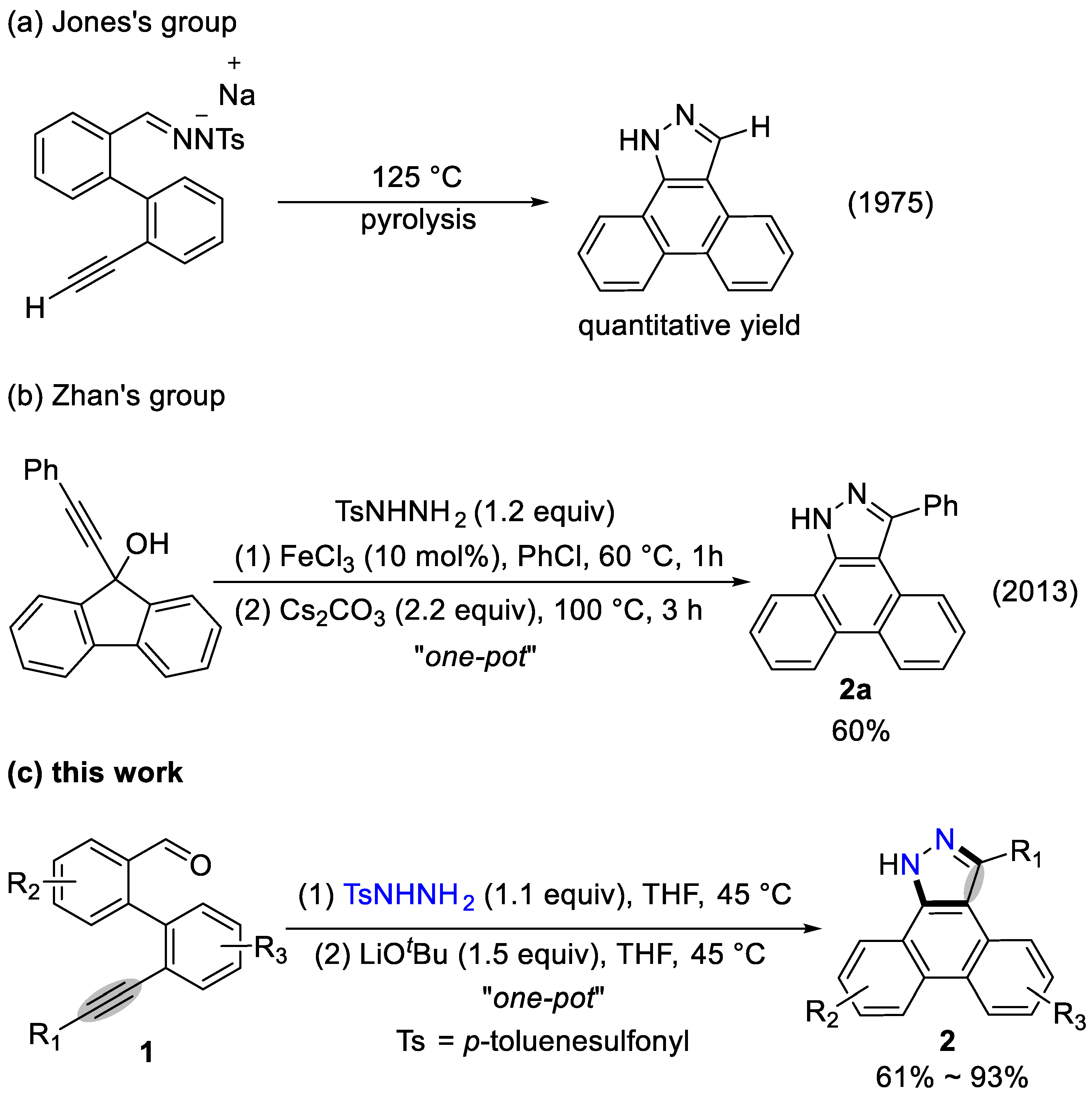
Indazole-containing derivatives comprising a pyrazole ring represent one of the most important heterocyclic scaffolds in pharmaceutical industry [19,20,21], which possess a variety of biological activities, such as antimicrobial [22], anti-inflammatory [23] and antiHIV [24] activities. 1H-indazole as one of the tautomeric forms of indazole, owns more thermodynamic stability than 2H-indazoles. Since the synthesis of 2H-dibenzo[e,g]indazole has been developed [25], we prefer to offer a synthetic method towards 1H-dibenzo[e,g]indazole, the π-extended structure of 1H-indazole, to provide more possibilities of indazole-based derivatives in further exploration of pharmaceutical molecules or larger polycyclic aromatic compounds (PACs). In 1975, Jones’s group reported a pyrolysis method to prepare 1H-dibenzo[e,g]indazole in quantitative yield from 2’-ethynyl-biaryl-2-aldehyde N-tosylhydrazone salt [26] (Scheme 1. a). In 2013, Zhan’s group synthesized 3-phenyl-substituted 1H-dibenzo[e,g]indazole (2a) in 60% yield from a ring-expansion strategy of 9-(phenylethynyl)-9H-fluoren-9-ol [27] (Scheme 1. b). Noted that only one example was reported in each literature, and either high temperature or complicated starting materials were required. Based on our previous studies on the applications of N-tosylhydrazones in the cyclizations [28,29,30], herein we report a one-pot synthetic method towards 3-substituted 1H-dibenzo[e,g]indazoles (2) from 2’-alkynyl-biaryl-2-aldehyde N-tosylhydrazones, which was optimized to a one-pot two step manner starting from 2’-alkynyl-biaryl-2-aldehydes (1) (Scheme 1. c). Also, to clearly explain the 1H NMR result of 2a, two kinds of hydrogen bonds of 2a in DMSO-d6 were proposed, which were supported by the studies of density functional theory (DFT) using Gaussian 09 [31].
Scheme 1.
The construction of 1H-dibenzo[e,g]indazoles via different starting materials.
2. Results and Discussion
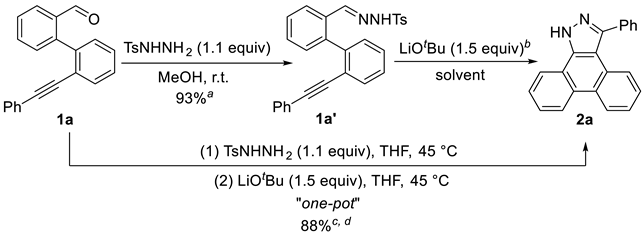
Our investigations started from (E)-4-methyl-N’-((2’-(phenylethynyl)-[1,1’-biphenyl]-2-yl)methylene)benzenesulfonohydrazide (1a’), which is easily prepared from 2’-(phenylethynyl)-[1,1’-biphenyl]-2-carbaldehyde (1a) and p-methylbenzenesulfonohydrazide (TsNHNH2) in methanol at room temperature. When the reaction of 1a’ (1.0 equiv) and LiOtBu (1.5 equiv) in tetrahydrofuran (THF) was heated at 100 °C for 2 h, 3-phenyl-1H-dibenzo[e,g]indazole (2a) could be isolated from the reaction mixture in 89% yield (entry 1). When the reaction was performed at 50 °C, 45 °C, 35 °C or 25 °C, the yields of 2a were not significantly decreased except at 25 °C (entries 2-5). Repeating the reaction in THF at 45 °C for 1 h, the yield of 2a could be maintained in 88% (entry 6). Since 1a’ was prepared in methanol, we examined the reaction of 1a’ in methanol to replace of THF, but the yield of 2a was decreased to 68% (entry 7). While in THF at 45 °C, the condensation of 1a and TsNHNH2 was also examined to explore the possibility to develop a two-step, one-pot procedure from 1a to 2a in THF, and fortunately, it was found that 1a could be totally converted into 1a’ after 1 h (monitored by TLC board). Therefore, when LiOtBu (1.5 equiv) and additional 2.5 mL of THF were added to a reaction mixture of entry 6, 2a could be also obtained in 88% yield after an additional heating for 1 h. In addition, the structure of 2a was confirmed by its X-ray diffraction study [32].

Table 1.
Optimizing Reaction Conditions of 2a
| entry b | solvent | °C / h | yield of 2a (%) d |
|---|---|---|---|
| 1 | THF | 100/2 | 89 |
| 2 | THF | 50/2 | 88 |
| 3 | THF | 45/2 | 88 |
| 4 | THF | 35/2 | 85 |
| 5 | THF | 25/2 | 77 |
| 6 | THF | 45/1 | 88 |
| 7 | MeOH | 45/1 | 68 |
a Reaction conditions: 1a (1.5 mmol), TsNHNH2 (1.1 equiv, 1.65 mmol) in 5.0 mL of MeOH at room temperature. b Reaction conditions: 1a’ (1.0 mmol), LiOtBu (1.5 equiv, 1.5 mmol) in 5.0 mL of solvent. c Reaction conditions: 1a (1.0 mmol), TsNHNH2 (1.1 equiv, 1.1 mmol) in 5.0 mL of THF at 45 °C for 1 h, then LiOtBu (1.5 equiv, 1.5 mmol) and additional 2.5 mL of THF at 45 °C for 1 h. d Isolated yields.
We also examined the formation of 2a with the use of other inorganic bases such as NaOtBu, KOtBu, Li2CO3, K2CO3 and Cs2CO3 from 1a. As shown in Table 2, the use of NaOtBu and KOtBu resulted in the formation of 2a in 81% and 85% yields, respectively (entries 2-3), similar to the yield with the use of LiOtBu (entry 1). However, with the use of Li2CO3, K2CO3 and Cs2CO3, 2a formed in 9%-14% (entries 4-6). These results support the proposed mechanism depicted in Scheme 2 (vide infra), in which tert-butanol anion (-OtBu) is the main contribution to promote the intramolecular cyclization via formation of diazo intermediate A.
Table 2.
Optimizing Base Conditions of 2a
| entry a | base | yield of 2a (%) |
|---|---|---|
| 1 | LiOtBu | 88 |
| 2 | NaOtBu | 81 |
| 3 | KOtBu | 85 |
| 4 | Li2CO3 | 9 |
| 5 | K2CO3 | 11 |
| 6 | Cs2CO3 | 14 |
a Reaction conditions: 1a (1.0 mmol), TsNHNH2 (1.1 equiv, 1.1 mmol) in 5.0 mL of THF at 45 °C for 1 h, then base (1.5 equiv, 1.5 mmol) and additional 2.5 mL of THF at 45 °C for 1 h. The yields were isolated yields.
The scope and limitations of the substrates for the formation of 1H-dibenzo[e,g]indazoles (2) are included in Table 3. The intramolecular cycloaddition from starting materials 2’-alkynyl-biaryl-2-aldehydes (1) with different substituents in alkynyl groups (R1) could afford the desired products in 61%-93% yields (2a-2e, 2i-2l). Aromatic alkynyl substrates bearing either electron-donating groups (p-methoxy (1b), p-methyl (1c)) or electron-withdrawing groups (p-fluoro (1d), p-chloro (1e)) underwent the condensation reactions smoothly to give 2b-2e in 80%-88% yields. Moreover, pyridyl- (1i), thienyl- (1j), and silyl- (1k) substituted substrates showed good tolerance, providing 2i-2k in 78%-93% yields. However, the substrate having an alkyl alkynyl group (1l) showed a slightly lower reactivity, giving 2l in 61% yield. In addition, the introduce of methyl (1f), chloro (1g), and trifluoromethyl (1h) groups at the position of R3 showed the similar reactivity to 1a to produce 2f-2h in 83%-86% yields. In the case of the substrate having chloro and silyl groups (1m), the corresponding product of 10-chloro-3-(triisopropylsilyl)-1H-dibenzo[e,g]indazole (2m) could be also obtained in 82% yield. More interestingly, three pyridyl-fused analogues of 2a, 3-phenyl-1H-benzo[f]pyrazolo[3,4-h]quinoline (2n), 3-phenyl-1H-benzo[f]pyrazolo[3,4-h]isoquinoline (2o), and 3-phenyl-1H-benzo[h]pyrazolo[4,3-f]isoquinoline (2p) were also successfully synthesized in 88%, 90% and 75% yields, respectively.
Table 3.
Substrate scope of 2’-alkynyl-biaryl-2-aldehydes a
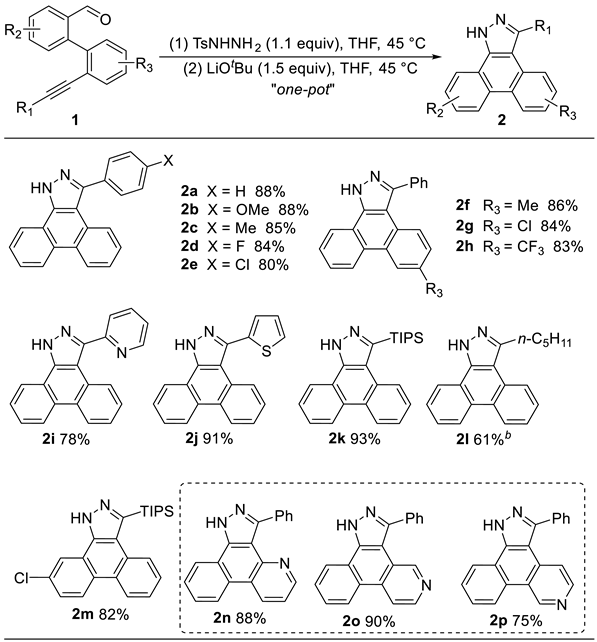
a Reaction conditions: 1 (1.0 mmol), TsNHNH2 (1.1 equiv, 1.1 mmol) in 5.0 mL of THF at 45 °C for 1 h, then LiOtBu (1.5 equiv, 1.5 mmol) and additional 2.5 mL of THF at 45 °C for 1 h. The yields were isolated yields. b Reaction condition: 1l (0.3 mmol), TsNHNH2 (1.1 equiv, 0.33 mmol) in 2.0 mL of THF at 45 °C for 1 h, then LiOtBu (1.5 equiv, 0.45 mmol) and additional 1.0 mL of THF at 45 °C for 1 h. The yields were isolated yields.
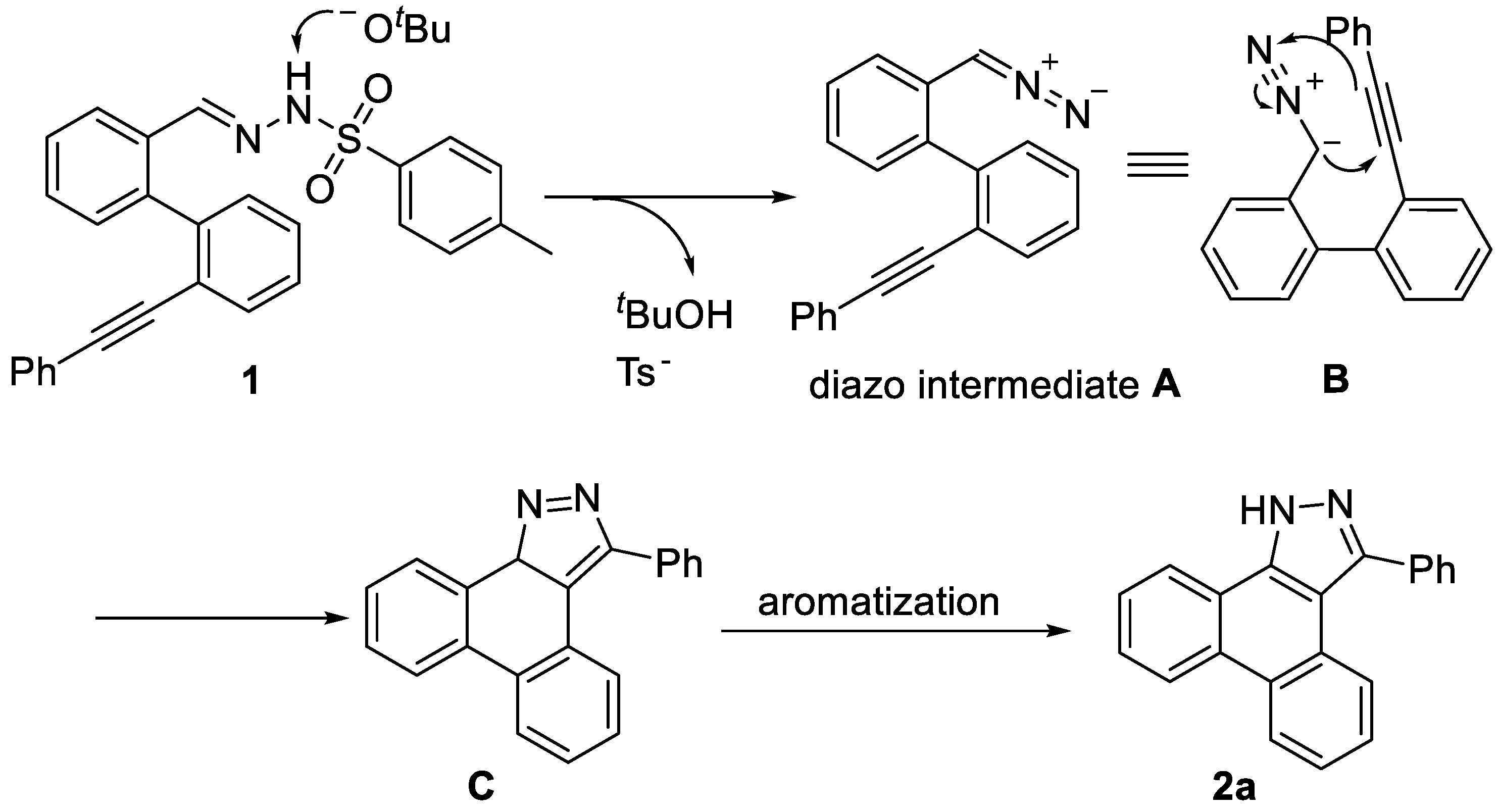
The proposed mechanism of 3-phenyl-1H-dibenzo[e,g]indazole (2a) formation is depicted in Scheme 2. In the presence of base, diazo intermediate A forms from N-tosylhydrazone 1a, the intramolecular nucleophilic cycloaddition of B affords C, which takes place the aromatization to give the final product of 2a.
Scheme 2.
Proposed mechanism of 2a formation.
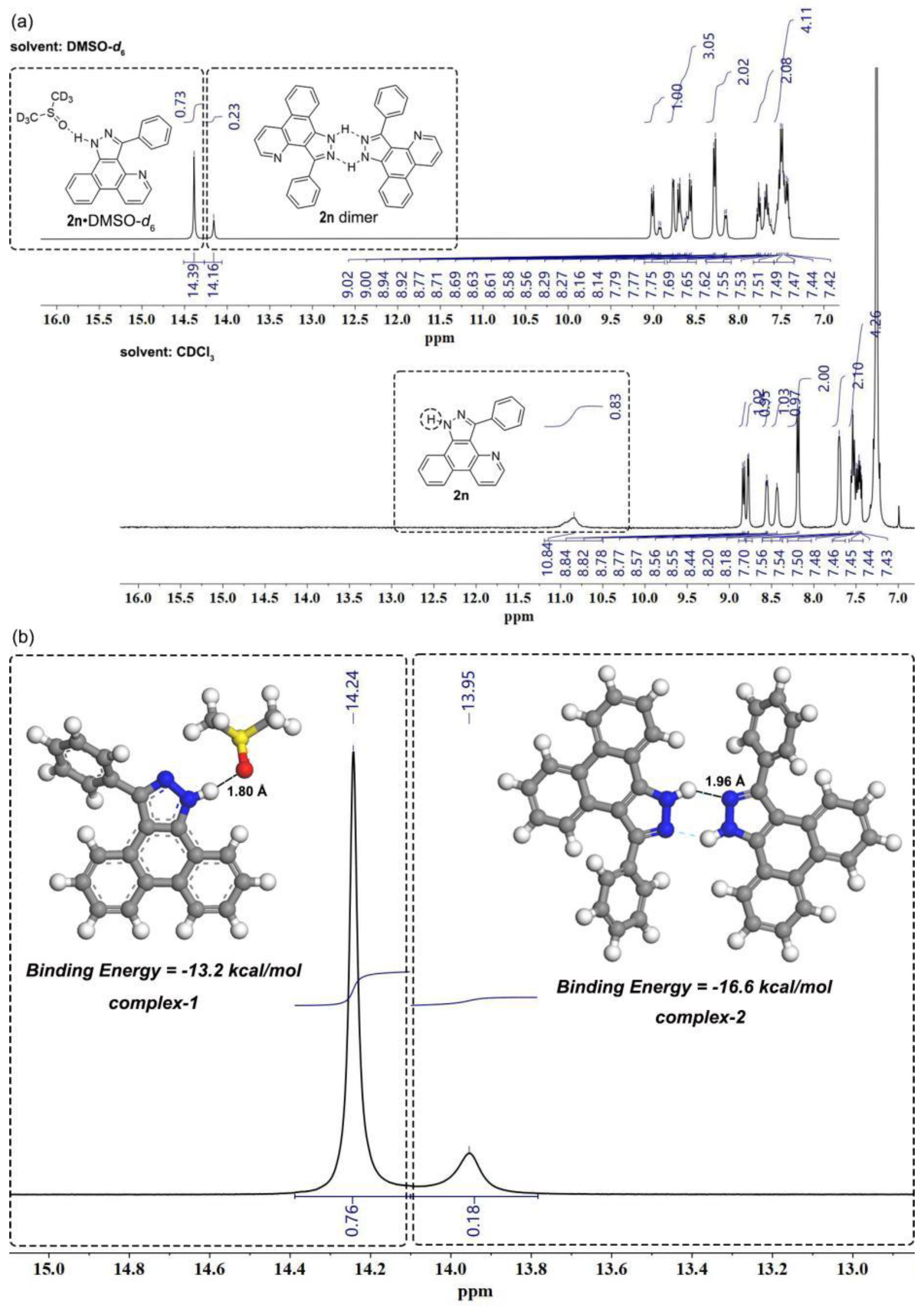
Additionally, in DMSO-d6 solvent, we notice that the proton nuclear magnetic resonance (NMR) spectra of 2a, 2d, 2f, 2h, 2i, 2j, 2l, 2n, 2o and 2p appear two kinds of proton peaks assigned to N-H bond are observed, however when CDCl3 was used as deuterium solvent, only one broaden peak of N-H appears, such as 2n (Figure 1, a). We speculate that 2n’s N-H appearing in relatively lower field of 1H NMR (DMSO-d6) spectrum at 14.39 ppm is the proton of N-H with the hydrogen bond forming between 2n and DMSO-d6, due to the strong electron-withdrawing effect of DMSO-d6, and other one appearing at 14.16 ppm is the proton of N-H of 2n dimer. To clarify and confirm the possibility to easily form 2n.DMSO-d6 and 2n dimer to appear two kinds of N-H signals, we selected 2a as representative sample to calculate the different energy requirements in two kinds of hydrogen bond formation by density functional theory (DFT) using Gaussian 09 at B3LYP-D3(BJ)/ma-TZVP [33,34,35] level. Basis set superposition error (BSSE) was corrected by the counterpoise (CP) method of Boys and Bernardi [36]. The calculation results indicate that two kinds of hydrogen bonds form with binding energies of -13.2 kcal/mol for complex-1 (2a.DMSO-d6) and -16.6 kcal/mol for complex-2 (a dimer of 2a) respectively (Figure 1, b), both are definitely lower than that of the sum of two isolated monomers. Although the formation of 2a dimer with lower energy than 2a.DMSO-d6, the integrated intensity of 2a.DMSO-d6 is stronger, due possible to the better solubility of 2a.DMSO-d6 in DMSO-d6.
Figure 1.
(a) The 1H NMR spectra of 2n in DMSO-d6 and CDCl3 respectively. (b)The calculation results of two kinds of hydrogen bonds formed in DMSO-d6 of 2a. The calculations were performed using Gaussian 09 at B3LYP-D3(BJ)/ma-TZVP level.
Figure 1.
(a) The 1H NMR spectra of 2n in DMSO-d6 and CDCl3 respectively. (b)The calculation results of two kinds of hydrogen bonds formed in DMSO-d6 of 2a. The calculations were performed using Gaussian 09 at B3LYP-D3(BJ)/ma-TZVP level.
3. Materials and Methods
3.1 General Methods
Column chromatography was performed with silica gel. Analytical thin-layer chromatography (TLC) was performed on 0.2 mm silica gel-coated glass sheets. All yields given referred to isolated yields. Nuclear magnetic resonance (NMR) spectra were recorded on JEOL 400 using CDCl3 or DMSO-d6 as solvents at 298 K. 1H NMR (400 MHz) chemical shifts (δ) were referenced to internal standard TMS (δ = 0.00 ppm) or internal solvent DMSO-d6 (δ = 2.50 ppm); 13C{1H} NMR (101 MHz) chemical shifts were referenced to internal solvent CDCl3 (δ = 77.16 ppm) or DMSO-d6 (δ = 39.52 ppm). High Resolution Mass Spectroscopy (HRMS) spectra were obtained by high-resolution mass spectrometers with electrospray ionization (ESI) source. Single-crystal X-ray diffraction data were obtained from SuperNova diffractometer with Cu Kα radiation at low temperature (173.15 K). All the NMR charts for the prepared starting materials, and the products are reported in the Supplementary Materials.
3.2 Characterization Data of Substrates
2’-(Phenylethynyl)-[1,1’-biphenyl]-2-carbaldehyde (1a). Pale yellow oil (355 mg, 1.26 mmol, 84%). Rf = 0.40 (PE/EA = 10/1). 1H NMR (400 MHz, Chloroform-d) δ 9.94 (s, 1H), 8.09 (dd, J = 7.8, 1.5 Hz, 1H), 7.68 – 7.64 (m, 2H), 7.54 (t, J = 7.6 Hz, 1H), 7.46 – 7.38 (m, 4H), 7.25 – 7.22 (m, 4H), 7.17 – 7.15 (m, 2H). 13C NMR (101 MHz, Chloroform-d) δ 191.95, 144.42, 140.40, 134.34, 133.59, 132.10, 131.40, 130.37, 128.55, 128.37, 128.34, 126.98, 123.83, 122.79, 93.90, 88.30.
2’-((4-Methoxyphenyl)ethynyl)-[1,1’-biphenyl]-2-carbaldehyde (1b). Yellow oil (332 mg, 1.07 mmol, 71%). Rf = 0.55 (PE/EA = 10/1). 1H NMR (400 MHz, Chloroform-d) δ 9.93 (s, 1H), 8.08 (dd, J = 7.9, 1.5 Hz, 1H), 7.66 – 7.59 (m, 2H), 7.52 (t, J = 7.5 Hz, 1H), 7.43 – 7.36 (m, 4H), 7.12 – 7.08 (m, 2H), 6.77 – 6.74 (m, 2H), 3.74 (s, 3H). 13C NMR (101 MHz, Chloroform-d) δ 191.92, 159.83, 144.50, 140.08, 134.32, 133.54, 132.83, 131.80, 131.38, 130.27, 128.27, 128.23, 128.18, 126.82, 124.14, 114.85, 114.02, 94.04, 87.12, 55.32. HRMS (ESI IT-TOF) m/z [M + H]+ Calcd for C22H17O2 313.1223, found 313.1223.
2’-(p-Tolylethynyl)-[1,1’-biphenyl]-2-carbaldehyde (1c). Pale yellow oil (417 mg, 1.41 mmol, 94%). Rf = 0.50 (PE/EA = 10/1). 1H NMR (400 MHz, Chloroform-d) δ 9.93 (s, 1H), 8.08 (dd, J = 7.7, 1.5 Hz, 1H), 7.66 – 7.61 (m, 2H), 7.52 (t, J = 7.6 Hz, 1H), 7.44 – 7.36 (m, 4H), 7.07 – 7.02 (m, 4H), 2.29 (s, 3H). 13C NMR (101 MHz, Chloroform-d) δ 191.91, 144.44, 140.25, 138.71, 134.31, 133.53, 131.96, 131.38, 131.26, 130.31, 129.12, 128.34, 128.27, 126.89, 123.99, 119.68, 94.14, 87.70, 21.59.
2’-((4-Fluorophenyl)ethynyl)-[1,1’-biphenyl]-2-carbaldehyde (1d). Pale yellow oil (333 mg, 1.11 mmol, 74%). Rf = 0.40 (PE/EA = 10/1). 1H NMR (400 MHz, Chloroform-d) δ 9.93 (s, 1H), 8.08 (dd, J = 7.8, 1.5 Hz, 1H), 7.67 – 7.61 (m, 2H), 7.53 (t, J = 7.6 Hz, 1H), 7.46 – 7.38 (m, 4H), 7.16 – 7.11 (m, 2H), 6.95 – 6.90 (m, 2H). 13C NMR (101 MHz, Chloroform-d) δ 191.86, 162.65 (d, J = 249.6 Hz), 144.29, 140.33, 134.31, 133.60, 133.27 (d, J = 8.3 Hz), 131.95, 131.36, 130.29, 128.63, 128.34, 126.88, 123.64, 118.84 (d, J = 3.6 Hz), 115.67 (d, J = 22.2 Hz), 92.80, 88.01. HRMS (ESI IT-TOF) m/z [M + H]+ Calcd for C21H14FO 301.1023, found 301.1023.
2’-((4-Chlorophenyl)ethynyl)-[1,1’-biphenyl]-2-carbaldehyde (1e). Pale yellow oil (436 mg, 1.38 mmol, 92%). Rf = 0.40 (PE/EA = 10/1). 1H NMR (400 MHz, Chloroform-d) δ 9.92 (s, 1H), 8.08 (dd, J = 7.8, 1.5 Hz, 1H), 7.69 – 7.62 (m, 2H), 7.55 (t, J = 7.5 Hz, 1H), 7.49 – 7.40 (m, 4H), 7.22 – 7.19 (m, 2H), 7.09 – 7.07 (m, 2H). 13C NMR (101 MHz, Chloroform-d) δ 191.90, 144.27, 140.47, 134.60, 134.33, 133.64, 132.58, 132.06, 131.39, 130.37, 128.82, 128.75, 128.42, 128.40, 126.97, 123.52, 121.26, 92.73, 89.25.
5’-Methyl-2’-(phenylethynyl)-[1,1’-biphenyl]-2-carbaldehyde (1f). Pale yellow oil (404 mg, 1.36 mmol, 91%). Rf = 0.40 (PE/EA = 10/1). 1H NMR (400 MHz, Chloroform-d) δ 9.94 (s, 1H), 8.08 (dd, J = 7.9, 1.6 Hz, 1H), 7.66 – 7.61 (m, 1H), 7.53 – 7.49 (m, 2H), 7.42 (d, J = 7.5 Hz, 1H), 7.23 – 7.20 (m, 5H), 7.16 – 7.14 (m, 2H), 2.41 (s, 3H). 13C NMR (101 MHz, Chloroform-d) δ 192.00, 144.53, 140.25, 138.78, 134.31, 133.50, 131.94, 131.33, 131.28, 131.11, 129.12, 128.30, 128.20, 126.84, 122.97, 120.82, 93.10, 88.45, 21.57.
5’-Chloro-2’-(phenylethynyl)-[1,1’-biphenyl]-2-carbaldehyde (1g). Pale yellow solid (374 mg, 1.18 mmol, 79%). Rf = 0.40 (PE/EA = 10/1). m.p. 83.7 – 84.2 °C. 1H NMR (400 MHz, Chloroform-d) δ 9.93 (s, 1H), 8.09 (dd, J = 7.8, 1.5 Hz, 1H), 7.67 (td, J = 7.4, 1.5 Hz, 1H), 7.58 – 7.54 (m, 2H), 7.42 – 7.39 (m, 3H), 7.26 – 7.21(m, 4H), 7.16 – 7.13 (m, 2H). 13C NMR (101 MHz, Chloroform-d) δ 191.35, 142.86, 142.06, 134.50, 134.25, 133.77, 133.12, 131.39, 131.17, 130.27, 128.83, 128.59, 128.42, 127.30, 122.45, 94.77, 87.27.
2’-(Phenylethynyl)-5’-(trifluoromethyl)-[1,1’-biphenyl]-2-carbaldehyde (1h). Pale yellow solid (483 mg, 1.38 mmol, 92%). Rf = 0.40 (PE/EA = 10/1). m.p. 79.5 – 80.1 °C. 1H NMR (400 MHz, Chloroform-d) δ 9.92 (s, 1H), 8.11 (dd, J = 7.8, 1.5 Hz, 1H), 7.75 – 7.67 (m, 4H), 7.58 (t, J = 7.6 Hz, 1H), 7.41 (d, J = 7.8 Hz, 1H), 7.28 – 7.26 (m, 3H), 7.18 – 7.15 (m, 2H). 13C NMR (101 MHz, Chloroform-d) δ 191.09, 142.68, 141.21, 134.30, 133.87, 132.36, 131.56, 131.27, 130.33 (q, J = 32.7 Hz), 129.14, 128.99, 128.46, 127.60, 127.54, 126.88 (q, J = 3.8 Hz), 125.09 (q, J = 3.5 Hz), 123.85 (q, J = 273.7 Hz), 122.06, 96.35, 87.08. 19F NMR (376 MHz, Chloroform-d) δ -62.53. HRMS (ESI IT-TOF) m/z [M + H]+ Calcd for C22H14F3O 351.0991, found 351.0991.
2’-(Pyridin-2-ylethynyl)-[1,1’-biphenyl]-2-carbaldehyde (1i). Pale yellow solid (378 mg, 1.34 mmol, 89%). Rf = 0.40 (PE/EA = 10/1). m.p. 104.6 – 104.9 °C. 1H NMR (400 MHz, Chloroform-d) δ 9.95 (s, 1H), 8.50 (d, J = 3.3 Hz, 1H), 8.09 (d, J = 7.7 Hz, 1H), 7.74 (dd, J = 7.3, 1.7 Hz, 1H), 7.66 (td, J = 7.5, 1.4 Hz, 1H), 7.55 – 7.39 (m, 6H), 7.15 – 7.11 (m, 1H), 7.00 (d, J = 7.8 Hz, 1H). 13C NMR (101 MHz, Chloroform-d) δ 191.60, 149.85, 143.88, 142.79, 140.57, 136.03, 134.09, 133.50, 132.57, 131.31, 130.26, 129.12, 128.29, 128.26, 127.06, 126.81, 122.83, 122.60, 92.68, 87.76. HRMS (ESI IT-TOF) m/z [M + H]+ Calcd for C20H14NO 284.1070, found 284.1069.
2’-(Thiophen-2-ylethynyl)-[1,1’-biphenyl]-2-carbaldehyde (1j). Pale yellow oil (363 mg, 1.26 mmol, 84%). Rf = 0.40 (PE/EA = 10/1). 1H NMR (400 MHz, Chloroform-d) δ 9.91 (s, 1H), 8.08 (dd, J = 7.7, 1.5 Hz, 1H), 7.67 – 7.59 (m, 2H), 7.52 (t, J = 7.6 Hz, 1H), 7.45 – 7.36 (m, 4H), 7.18 (dd, J = 5.1, 1.2 Hz, 1H), 6.98 (dd, J = 3.7, 1.2 Hz, 1H), 6.88 (dd, J = 5.2, 3.6 Hz, 1H). 13C NMR (101 MHz, Chloroform-d) δ 191.72, 144.11, 140.17, 134.24, 133.56, 132.06, 131.68, 131.32, 130.38, 128.59, 128.33, 128.29, 127.71, 127.14, 127.08, 123.47, 122.63, 92.02, 87.32. HRMS (ESI IT-TOF) m/z [M + H]+ Calcd for C19H13OS 289.0682, found 289.0682.
2’-((Triisopropylsilyl)ethynyl)-[1,1’-biphenyl]-2-carbaldehyde (1k). White solid (391 mg, 1.08 mmol, 72%). Rf = 0.50 (PE/EA = 10/1). m.p. 68.0 – 68.3 °C. 1H NMR (400 MHz, Chloroform-d) δ 9.85 (s, 1H), 8.01 (d, J = 7.7 Hz, 1H), 7.61 – 7.58 (m, 2H), 7.46 (t, J = 7.6 Hz, 1H), 7.41 – 7.34 (m, 3H), 7.31 – 7.28 (m, 1H), 0.91 (s, 21H). 13C NMR (101 MHz, Chloroform-d) δ 191.69, 144.63, 140.73, 134.10, 133.48, 132.78, 131.09, 130.19, 128.36, 128.10, 128.04, 127.07, 123.94, 105.21, 95.72, 18.52, 11.16. HRMS (ESI IT-TOF) m/z [M + H]+ Calcd for C24H31OSi 363.2139, found 363.2138.
2’-(Hept-1-yn-1-yl)-[1,1’-biphenyl]-2-carbaldehyde (1l). Pale yellow oil (99 mg, 0.36 mmol, 24%). Rf = 0.50 (PE/EA = 10/1). 1H NMR (400 MHz, Chloroform-d) δ 9.85 (s, 1H), 8.03 (d, J = 7.7 Hz, 1H), 7.64 – 7.60 (m, 1H), 7.50 – 7.49 (m, 2H), 7.35 – 7.32 (m, 4H), 7.25 (s, 1H), 2.17 – 2.13 (s, 2H), 1.33 – 1.26 (m, 2H), 1.21 – 1.16 (m, 2H), 1.11 – 1.05 (m, 2H), 0.83 – 0.79 (m, 3H). 13C NMR (101 MHz, Chloroform-d) δ 192.01, 144.75, 140.20, 134.19, 133.48, 132.08, 131.21, 130.18, 128.14, 128.04, 127.75, 126.76, 124.57, 95.57, 79.50, 30.83, 27.86, 22.23, 19.34, 14.02. HRMS (ESI IT-TOF) m/z [M + H]+ Calcd for C20H21O 277.1587, found 277.1587.
4-Chloro-2’-((triisopropylsilyl)ethynyl)-[1,1’-biphenyl]-2-carbaldehyde (1m). Pale yellow oil (422 mg, 1.07 mmol, 71%). Rf = 0.50 (PE/EA = 10/1). 1H NMR (400 MHz, Chloroform-d) δ 9.77 (s, 1H), 7.98 (d, J = 2.6 Hz, 1H), 7.62 – 7.56 (m, 2H), 7.44 – 7.37 (m, 2H), 7.34 (d, J = 8.2 Hz, 1H), 7.30 – 7.28 (m, 1H), 0.92 (s, 21H). 13C NMR (101 MHz, Chloroform-d) δ 190.42, 142.86, 139.53, 135.30, 134.74, 133.38, 132.91, 132.64, 130.08, 128.57, 128.46, 126.95, 124.06, 104.90, 96.42, 18.51, 11.19. HRMS (ESI IT-TOF) m/z [M + H]+ Calcd for C21H24ClOSi 355.1279, found 355.1278.
2-(2-(Phenylethynyl)pyridin-3-yl)benzaldehyde (1n). Pale yellow oil (365 mg, 1.29 mmol, 86%). Rf = 0.40 (PE/EA = 10/1). 1H NMR (400 MHz, Chloroform-d) δ 9.96 (s, 1H), 8.69 (dd, J = 4.7, 1.8 Hz, 1H), 8.11 (dd, J = 7.8, 1.4 Hz, 1H), 7.73 – 7.67 (m, 2H), 7.59 (t, J = 7.5 Hz, 1H), 7.43 – 7.36 (m, 2H), 7.30 – 7.19 (m, 5H). 13C NMR (101 MHz, Chloroform-d) δ 190.85, 149.76, 142.85, 141.49, 137.52, 136.68, 134.22, 133.75, 131.74, 131.39, 129.18, 128.95, 128.31, 127.74, 122.65, 121.66, 93.72, 87.72. HRMS (ESI IT-TOF) m/z [M + H]+ Calcd for C20H14NO 284.1070, found 284.1069.
2-(3-(Phenylethynyl)pyridin-4-yl)benzaldehyde (1o). Pale yellow oil (386 mg, 1.36 mmol, 91%). Rf = 0.40 (PE/EA = 10/1). 1H NMR (400 MHz, Chloroform-d) δ 9.93 (s, 1H), 8.86 (s, 1H), 8.65 (d, J = 5.1 Hz, 1H), 8.11 (dd, J = 7.9, 1.5 Hz, 1H), 7.71 (td, J = 7.5, 1.5 Hz, 1H), 7.61 (t, J = 7.7 Hz, 1H), 7.43 – 7.40 (m, 1H), 7.34 (d, J = 5.1 Hz, 1H), 7.31 – 7.20 (m, 6H). 13C NMR (101 MHz, Chloroform-d) δ 190.69, 152.52, 148.75, 147.84, 141.12, 133.85, 131.47, 130.73, 129.36, 129.05, 128.43, 127.84, 124.25, 122.04, 120.65, 96.70, 84.94. HRMS (ESI IT-TOF) m/z [M + H]+ Calcd for C20H14NO 284.1070, found 284.1069.
2-(4-(Phenylethynyl)pyridin-3-yl)benzaldehyde (1p). Pale yellow oil (378 mg, 1.33 mmol, 89%). Rf = 0.40 (PE/EA = 10/1). 1H NMR (400 MHz, Chloroform-d) δ 9.95 (s, 1H), 8.67 – 8.66 (m, 2H), 8.12 (d, J = 7.8 Hz, 1H), 7.71 (td, J = 7.4, 1.4 Hz, 1H), 7.60 (t, J = 7.6 Hz, 1H), 7.49 (d, J = 5.1 Hz, 1H), 7.44 (d, J = 7.6 Hz, 1H), 7.32 – 7.19 (m, 5H). 13C NMR (101 MHz, Chloroform-d) δ 190.88, 150.23, 149.34, 140.16, 135.03, 134.48, 133.81, 131.67, 131.63, 131.42, 129.48, 129.07, 128.45, 127.78, 125.13, 121.52, 98.27, 85.70. HRMS (ESI IT-TOF) m/z [M + H]+ Calcd for C20H14NO 284.1070, found 284.1069.
3.3 General Procedure for the Preparation of 1H-dibenzo[e,g]indazoles 2a-2p
The mixture of H2NNHTs (1.1 equiv.), 2’-alkynyl-biaryl-2-aldehydes (1, 1.0 equiv.) and THF (5.0 mL) in a 25 mL screw-capped thick-walled Pyrex tube was stirred at 45 °C for 1 h. After the reaction was completed (checked by TLC), LiOtBu (1.5 equiv.) and additional 2.5 mL of THF was added and then the mixture was stirred at 45 °C for 1 h. After the reaction was completed (checked by TLC), the crude residue was purified by column chromatography on silica gel, eluting with petroleum ether / ethyl acetate (gradient mixture ratio from 5 / 1 to 2 / 1) as eluent to afford product 2a-2p in 61% - 93% yields.
3.4 Characterization Data of Products
3-Phenyl-1H-dibenzo[e,g]indazole (2a). White solid (259 mg, 0.88 mmol, 88%). Rf = 0.40 (PE/EA = 1/1). m.p. 260.4 – 260.8 °C. 1H NMR (400 MHz, DMSO-d6) δ 14.24 – 13.95 (s, 1H), 8.78 – 8.71 (m, 2H), 8.55 (d, J = 7.8 Hz, 1H), 8.02 (d, J = 8.1 Hz, 1H), 7.74 – 7.69 (m, 4H), 7.59 – 7.54 (m, 3H), 7.50 – 7.40 (m, 2H). 13C NMR (101 MHz, DMSO-d6) δ 147.37, 137.25, 135.45, 129.62, 128.61, 128.32, 127.51, 127.41, 127.13, 124.95, 124.18, 124.07, 122.63, 122.34, 121.00, 112.55.
3-(4-Methoxyphenyl)-1H-dibenzo[e,g]indazole (2b). White solid (285 mg, 0.88 mmol, 88%). Rf = 0.40 (PE/EA = 1/1). m.p. 204.2 – 204.7 °C. 1H NMR (400 MHz, DMSO-d6) δ 13.97 (s, 1H), 8.71 (dd, J = 16.9, 8.1 Hz, 2H), 8.56 (d, J = 7.7 Hz, 1H), 8.05 (d, J = 7.3 Hz, 1H), 7.74 – 7.63 (m, 4H), 7.49 – 7.40 (m, 2H), 7.14 (d, J = 8.4 Hz, 2H), 3.84 (s, 3H). 13C NMR (101 MHz, DMSO-d6) δ 159.34, 147.25, 137.27, 130.91, 129.68, 127.45, 127.31, 127.12, 124.87, 124.09, 123.99, 122.67, 122.40, 121.14, 114.02, 112.64, 55.14. HRMS (ESI IT-TOF) m/z [M + H]+ Calcd for C22H17N2O 325.1335, found 325.1334.
3-(p-Tolyl)-1H-dibenzo[e,g]indazole (2c). White solid (262 mg, 0.85 mmol, 85%). Rf = 0.40 (PE/EA = 1/1). m.p. 199.6 – 200.0 °C. 1H NMR (400 MHz, DMSO-d6) δ 11.79 (s, 1H), 8.71 (dd, J = 17.1, 8.1 Hz, 2H), 8.57 (d, J = 7.7 Hz, 1H), 8.06 (d, J = 7.7 Hz, 1H), 7.73 (t, J = 7.5 Hz, 1H), 7.66 (t, J = 7.5 Hz, 1H), 7.61 (d, J = 7.8 Hz, 2H), 7.48 – 7.36 (m, 4H), 2.40 (s, 3H). 13C NMR (101 MHz, DMSO-d6) δ 145.18, 139.07, 137.85, 131.46, 129.70, 129.49, 129.26, 127.59, 127.49, 127.36, 127.12, 125.64, 124.99, 124.15, 123.99, 122.67, 122.38, 112.36, 20.95. HRMS (ESI IT-TOF) m/z [M + H]+ Calcd for C22H17N2 309.1386, found 309.1385.
3-(4-Fluorophenyl)-1H-dibenzo[e,g]indazole (2d). White solid (262 mg, 0.84 mmol, 84%). Rf = 0.40 (PE/EA = 1/1). m.p. 235.7 – 236.2 °C. 1H NMR (400 MHz, DMSO-d6) δ 14.31 – 14.03 (s, 1H), 8.70 – 8.58 (m, 3H), 8.00 (s, 1H), 7.80 – 7.62 (m, 4H), 7.43 – 7.39 (m, 4H). 13C NMR (101 MHz, DMSO-d6) δ 162.26 (d, J = 245.1 Hz), 146.41, 137.38, 131.89, 131.77, 131.69, 129.66, 127.48, 127.39, 127.17, 124.93, 124.13, 124.01, 122.60, 122.40, 121.04, 115.55 (d, J = 21.5 Hz), 112.66. HRMS (ESI IT-TOF) m/z [M + H]+ Calcd for C21H14FN2 313.1136, found 313.1134.
3-(4-Chlorophenyl)-1H-dibenzo[e,g]indazole (2e). White solid (262 mg, 0.80 mmol, 80%). Rf = 0.40 (PE/EA = 1/1). m.p. 265.3 – 265.9 °C. 1H NMR (400 MHz, DMSO-d6) δ 14.18 (s, 1H), 8.76 (dd, J = 17.0, 8.0 Hz, 2H), 8.53 (dd, J = 7.7, 1.7 Hz, 1H), 7.96 (d, J = 7.5 Hz, 1H), 7.76 – 7.68 (m, 4H), 7.66 – 7.64 (m, 2H), 7.53 – 7.44 (m, 2H). 13C NMR (101 MHz, DMSO-d6) δ 144.83, 138.58, 133.68, 133.32, 131.39, 129.69, 128.73, 127.61, 127.47, 127.40, 127.19, 127.12, 125.05, 124.13, 123.95, 122.64, 122.40, 121.72, 112.52. HRMS (ESI IT-TOF) m/z [M + H]+ Calcd for C21H14ClN2 329.0840, found 329.0838.
6-Methyl-3-phenyl-1H-dibenzo[e,g]indazole (2f). White solid (265 mg, 0.86 mmol, 86%). Rf = 0.40 (PE/EA = 1/1). m.p. 235.6 – 235.9 °C. 1H NMR (400 MHz, DMSO-d6) δ 14.22 – 13.93 (s, 1H), 8.76 – 8.52 (m, 3H), 7.94 (d, J = 8.3 Hz, 1H), 7.76 – 7.52 (m, 7H), 7.19 (d, J = 8.4 Hz, 1H), 2.44 (s, 3H). 13C NMR (101 MHz, DMSO-d6) δ 147.12, 137.04, 135.60, 134.02, 129.61, 129.51, 128.55, 128.40, 128.23, 127.53, 127.30, 127.19, 124.88, 123.99, 122.59, 122.34, 121.16, 112.64, 21.26. HRMS (ESI IT-TOF) m/z [M + H]+ Calcd for C22H17N2 309.1386, found 309.1385.
6-Chloro-3-phenyl-1H-dibenzo[e,g]indazole (2g). White solid (276 mg, 0.84 mmol, 84%). Rf = 0.40 (PE/EA = 1/1). m.p. 286.9 – 287.3 °C. 1H NMR (400 MHz, DMSO-d6) δ 13.77 (s, 1H), 8.73 – 8.69 (m, 2H), 8.51 (d, J = 7.6 Hz, 1H), 7.92 (d, J = 8.6 Hz, 1H), 7.75 – 7.64 (m, 4H), 7.60 – 7.52 (m, 3H), 7.40 (dd, J = 8.6, 2.1 Hz, 1H). 13C NMR (101 MHz, DMSO-d6) δ 129.86, 129.55, 129.22, 128.74, 128.59, 128.12, 127.49, 127.08, 125.86, 124.32, 124.20, 123.65, 122.33, 111.74. HRMS (ESI IT-TOF) m/z [M + H]+ Calcd for C21H14ClN2 329.0840, found 329.0838.
3-Phenyl-6-(trifluoromethyl)-1H-dibenzo[e,g]indazole (2h). White solid (300 mg, 0.83 mmol, 83%). Rf = 0.40 (PE/EA = 1/1). m.p. 276.9 – 277.3 °C. 1H NMR (400 MHz, DMSO-d6) δ 14.29 – 14.10 (s, 1H), 8.88 – 8.84 (m, 1H), 8.72 – 8.65 (m, 1H), 8.55 – 8.47 (m, 1H), 8.07 – 8.02 (m, 1H), 7.71 – 7.51 (m, 8H). 13C NMR (101 MHz, DMSO-d6) δ 147.73, 138.05, 135.04, 129.87, 129.58, 128.80, 128.64, 128.45, 128.15, 127.61, 127.08, 126.02, 125.06 (q, J = 31.7 Hz), 124.14, 123.35 (d, J = 6.7 Hz), 122.84, 122.39, 121.13 (d, J = 15.7 Hz), 111.73. 19F NMR (376 MHz, DMSO-d6) δ -60.08. HRMS (ESI IT-TOF) m/z [M + H]+ Calcd for C22H14F3N2 363.1104, found 363.1102.
3-(Pyridin-2-yl)-1H-dibenzo[e,g]indazole (2i). White solid (230 mg, 0.78 mmol, 78%). Rf = 0.40 (PE/EA = 1/1). m.p. 209.3 – 209.7 °C. 1H NMR (400 MHz, DMSO-d6) δ 14.44 – 14.28 (s, 1H), 9.04 – 9.02 (m, 1H), 8.86 (d, J = 4.9 Hz, 1H), 8.79 – 8.58 (m, 3H), 8.06 – 7.97 (m, 2H), 7.78 – 7.67 (m, 2H), 7.52 – 7.49 (m, 3H). 13C NMR (101 MHz, DMSO-d6) δ 154.35, 148.81, 147.16, 137.80, 137.04, 129.72, 127.58, 127.54, 127.48, 127.30, 127.05, 125.65, 125.24, 124.34, 124.04, 123.71, 123.15, 122.30, 120.92, 113.53. HRMS (ESI IT-TOF) m/z [M + H]+ Calcd for C20H14N3 296.1182, found 296.1181.
3-(Thiophen-2-yl)-1H-dibenzo[e,g]indazole (2j). White solid (273 mg, 0.91 mmol, 91%). Rf = 0.40 (PE/EA = 1/1). m.p. 255.4 – 255.9 °C. 1H NMR (400 MHz, DMSO-d6) δ 14.40 – 14.17 (s, 1H), 8.71 – 8.56 (m, 3H), 8.34 – 8.31 (m, 1H), 7.76 – 7.73 (m, 2H), 7.66 (t, J = 7.7 Hz, 1H), 7.56 (d, J = 3.6 Hz, 1H), 7.52 – 7.46 (m, 2H), 7.32 – 7.30 (m, 1H). 13C NMR (101 MHz, DMSO-d6) δ 140.47, 137.44, 136.12, 129.61, 128.07, 127.72, 127.55, 127.30, 127.10, 126.97, 125.19, 124.11, 124.03, 122.65, 122.36, 120.86, 113.25. HRMS (ESI IT-TOF) m/z [M + H]+ Calcd for C19H13N2S 301.0794, found 301.0793.
3-(Triisopropylsilyl)-1H-dibenzo[e,g]indazole (2k). White solid (348 mg, 0.93 mmol, 93%). Rf = 0.40 (PE/EA = 1/1). m.p. 87.8 – 88.3 °C. 1H NMR (400 MHz, Chloroform-d) δ 12.12 (s, 1H), 8.75 (d, J = 7.6 Hz, 1H), 8.58 – 8.53 (m, 2H), 8.27 (d, J = 7.8 Hz, 1H), 7.64 – 7.46 (m, 4H), 1.78 (hept, J = 7.5 Hz, 3H), 1.12 (d, J = 7.7 Hz, 18H). 13C NMR (101 MHz, Chloroform-d) δ 130.58, 129.10, 128.79, 127.31, 127.26, 126.54, 126.04, 125.39, 124.01, 123.62, 123.40, 123.21, 18.89, 12.74. HRMS (ESI IT-TOF) m/z [M + H]+ Calcd for C24H31N2Si 375.2251, found 375.2251.
3-Pentyl-1H-dibenzo[e,g]indazole (2l). White solid (176 mg, 0.61 mmol, 61%). Rf = 0.40 (PE/EA = 1/1). m.p. 188.5 – 188.9 °C. 1H NMR (400 MHz, DMSO-d6) δ 13.69 – 13.49 (s, 1H), 8.78 – 8.67 (m, 2H), 8.44 (d, J = 7.5 Hz, 1H), 8.24 – 8.15 (m, 1H), 7.69 – 7.52 (m, 4H), 3.19 (t, J = 7.6 Hz, 2H), 1.82 – 1.80 (m, 2H), 1.42 – 1.32 (m, 4H), 0.87 (t, J = 7.1 Hz, 3H). 13C NMR (101 MHz, DMSO-d6) δ 147.37, 137.15, 129.46, 127.67, 127.32, 127.11, 124.40, 124.08, 123.17, 122.21, 121.17, 112.43, 31.20, 28.96, 27.75, 21.97, 13.94. HRMS (ESI IT-TOF) m/z [M + H]+ Calcd for C20H21N2 289.1699, found 289.1698.
10-Chloro-3-(triisopropylsilyl)-1H-dibenzo[e,g]indazole (2m). White solid (335 mg, 0.82 mmol, 82%). Rf = 0.40 (PE/EA = 1/1). m.p. 191.1 – 191.7 °C. 1H NMR (400 MHz, Chloroform-d) δ 11.96 (s, 1H), 8.68 (s, 1H), 8.52 (d, J = 7.9 Hz, 1H), 8.47 (d, J = 9.0 Hz, 1H), 8.23 (d, J = 7.7 Hz, 1H), 7.58 – 7.50 (m, 3H), 1.76 (hept, J = 7.5 Hz, 3H), 1.15 (d, J = 7.6 Hz, 18H). 13C NMR (101 MHz, Chloroform-d) δ 133.34, 129.03, 128.72, 128.55, 127.65, 126.94, 125.72, 125.52, 125.10, 124.01, 123.97, 122.83, 18.93, 12.78. HRMS (ESI IT-TOF) m/z [M + H]+ Calcd for C24H30ClN2Si 409.1861, found 409.1860.
3-Phenyl-1H-benzo[f]pyrazolo[3,4-h]quinoline (2n). White solid (260 mg, 0.88 mmol, 88%). Rf = 0.40 (PE/EA = 1/1). m.p. 265.7 – 266.2 °C. 1H NMR (400 MHz, DMSO-d6) δ 14.39 – 14.16 (s, 1H), 9.02 – 8.92 (m, 1H), 8.78 – 8.56 (m, 3H), 8.29 – 8.14 (m, 2H), 7.79 – 7.62 (m, 2H), 7.55 – 7.42 (m, 4H). 13C NMR (101 MHz, DMSO-d6) δ 148.60, 148.23, 147.43, 145.91, 144.68, 139.95, 139.70, 134.63, 131.70, 130.10, 129.96, 129.66, 128.92, 128.57, 128.08, 127.98, 127.63, 127.49, 126.03, 124.19, 123.89, 123.45, 122.44, 122.31, 120.87, 120.59, 120.16, 113.43, 112.53. 1H NMR (400 MHz, Chloroform-d) δ 10.84 (s, 1H), 8.83 (d, J = 8.3 Hz, 1H), 8.78 (d, J = 4.2 Hz, 1H), 8.57 – 8.55 (m, 1H), 8.44 (s, 1H), 8.19 (d, J = 7.9 Hz, 2H), 7.70 (s, 2H), 7.56 – 7.43 (m, 4H) b. HRMS (ESI IT-TOF) m/z [M + H]+ Calcd for C20H14N3 296.1182, found 296.1181.
3-Phenyl-1H-benzo[f]pyrazolo[3,4-h]isoquinoline (2o). White solid (266 mg, 0.90 mmol, 90%). Rf = 0.40 (PE/EA = 1/1). m.p. 277.9 – 278.4 °C. 1H NMR (400 MHz, DMSO-d6) δ 14.37 – 14.12 (s, 1H), 9.22 (s, 1H), 8.82 – 8.72 (m, 1H), 8.56 – 8.52 (m, 3H), 7.85 – 7.59 (m, 7H). 13C NMR (101 MHz, DMSO-d6) δ 146.96, 145.14, 144.19, 137.71, 135.14, 132.51, 129.63, 129.48, 128.76, 128.57, 127.74, 127.52, 124.76, 122.43, 117.54, 110.61. HRMS (ESI IT-TOF) m/z [M + H]+ Calcd for C20H14N3 296.1182, found 296.1181.
3-Phenyl-1H-benzo[h]pyrazolo[4,3-f]isoquinoline (2p). White solid (221 mg, 0.75 mmol, 75%). Rf = 0.40 (PE/EA = 1/1). m.p. 324.3 – 324.8 °C. 1H NMR (400 MHz, DMSO-d6) δ 14.46 – 14.20 (s, 1H), 10.06 – 9.95 (m, 1H), 9.04 – 8.87 (m, 1H), 8.56 – 8.48 (m, 2H), 7.86 – 7.55 (m, 8H). HRMS (ESI IT-TOF) m/z [M + H]+ Calcd for C20H14N3 296.1182, found 296.1181. The 13C NMR spectroscopic data could not be recorded due to the poor solubility in deuterated solvents, such as DMSO-d6, CDCl3.
4. Conclusion
In conclusion, the syntheses of 3-substituted 1H-dibenzo[e,g]indazoles in good to high yields have been developed via a LiOtBu-promoted intramolecular cyclization of 2’-alkynyl-biaryl-2-aldehyde N-tosylhydrazones under mild conditions, since 2’-alkynyl-biaryl-2-aldehyde N-tosylhydrazones were prepared in situ by the reactions of 2’-alkynyl-biaryl-2-aldehydes with p-methylbenzenesulfono-hydrazide, thus it is a simple and efficient two-step, one-pot procedure. In addition, two kinds of hydrogen bonds were observed in several products in DMSO-d6 solution in their 1H-NMR spectroscopic data, which are proposed to be the complexes of products with DMSO-d6, and the dimer of products, respectively. In the case of 2a, two kinds of hydrogen bonds with different binding energies of -13.2 kcal/mol and -16.6 kcal/mol were disclosed by DFT calculation.
Supplementary Materials
The following supporting information can be downloaded at the website of this paper posted on Preprints.org: the general procedure for the synthesis of starting materials, the copies of NMR charts of new starting materials, and all products, as well as X-ray structural details of 2a.
Author Contributions
Investigation, writing—original draft preparation, J.L.; supervision, writing—review and editing, R.H. All authors have read and agreed to the published version of the manuscript.
Funding
This research was funded by the National Natural Science Foundation of China, grant number 21673124 and 21972072.
Institutional Review Board Statement
Not applicable.
Informed Consent Statement
Not applicable.
Data Availability Statement
Not applicable.
Acknowledgments
We thank the Tsinghua Xuetang Talents Program for computational hardware and software support.
Conflicts of Interest
The authors declare no conflict of interest.
Sample Availability
Samples of the final products are not available from the authors.
References
- Kolb, H.C.; Finn, M.G.; Sharpless, K.B. Click chemistry: Diverse chemical function from a few good reactions. Angew. Chem. Int. Ed. 2001, 40, 2004–2021. [Google Scholar] [CrossRef]
- Rostovtsev, V.V.; Green, L.G.; Fokin, V.V.; Sharpless, K.B. A stepwise huisgen cycloaddition process: Copper(I)-catalyzed regioselective “ligation” of azides and terminal alkynes. Angew. Chem. 2002, 114, 2708–2711. [Google Scholar] [CrossRef]
- Moses, J.E.; Moorhouse, A.D. The growing applications of click chemistry. Chem. Soc. Rev. 2007, 36, 1249–1262. [Google Scholar] [CrossRef]
- Jewett, J.C.; Bertozzi, C.R. Cu-free click cycloaddition reactions in chemical biology. Chem. Soc. Rev. 2010, 39, 1272–1279. [Google Scholar] [CrossRef]
- Thirumurugan, P.; Matosiuk, D.; Jozwiak, K. Click chemistry for drug development and diverse chemical-biology applications. Chem. Rev. 2013, 113, 4905–4979. [Google Scholar] [CrossRef]
- Brown, A.W. Recent developments in the chemistry of pyrazoles. Advances in Heterocyclic Chemistry 2018, vol. 126, pp. 55-107. [CrossRef]
- Mix, K.A.; Aronoff, M.R.; Raines, R.T. Diazo compounds: Versatile tools for chemical biology. ACS Chem. Biol. 2016, 11, 3233–3244. [Google Scholar] [CrossRef]
- Aggarwal, V.K.; Vicente, J.d.; Bonnert, R.V. A novel one-pot method for the preparation of pyrazoles by 1,3-dipolar cycloadditions of diazo compounds generated in situ. J. Org. Chem. 2003, 68, 5381–5383. [Google Scholar] [CrossRef]
- Jiang, N.; Li, C.-J. Novel 1,3-dipolar cycloaddition of diazocarbonyl compounds to alkynes catalyzed by InCl3 in water. Chem. Commun. 2004, 394–395. [Google Scholar] [CrossRef]
- Moran, J.; McKay, C.S.; Pezacki, J.P. Strain-promoted 1,3-dipolar cycloadditions of diazo compounds with cyclooctynes. Can. J. Chem. 2011, 89, 148–151. [Google Scholar] [CrossRef]
- McGrath, N.A.; Raines, R.T. Diazo compounds as highly tunable reactants in 1,3-dipolar cycloaddition reactions with cycloalkynes. Chem. Sci. 2012, 3, 3237–3240. [Google Scholar] [CrossRef]
- Wu, L.-L.; Ge, Y.-C.; He, T.; Zhang, L.; Fu, X.-L.; Fu, H.-Y.; Chen, H.; Li, R.-X. An efficient one-pot synthesis of 3,5-disubstituted 1H-pyrazoles. Synthesis 2012, 44, 1577–1583. [Google Scholar] [CrossRef]
- Friscourt, F.; Fahrni, C.J.; Boons, G.-J. Fluorogenic strain-promoted alkyne-diazo cycloadditions. Chem. Eur. J. 2015, 21, 13996–14001. [Google Scholar] [CrossRef] [PubMed]
- Aronoff, M.R.; Gold, B.; Raines, R. T. 1,3-dipolar cycloadditions of diazo compounds in the presence of azides. Org. Lett. 2016, 18, 1538–1541. [Google Scholar] [CrossRef] [PubMed]
- Gold, B.; Aronoff, M.R.; Raines, R.T. 1,3-dipolar cycloaddition with diazo groups: noncovalent interactions overwhelm strain. Org. Lett. 2016, 18, 4466–4469. [Google Scholar] [CrossRef] [PubMed]
- Li, D.; Qiu, S.; Chen, Y.; Wu, L. K2CO3-promoted pyrazoles synthesis from 1,3-dipolar cycloaddition of N-tosylhydrazones with acetylene gas. ChemistrySelect 2020, 5, 12034–12037. [Google Scholar] [CrossRef]
- Bubyrev, A.; Dar’in, D.; Kantin, G.; Krasavin, M. Synthetic studies towards CH-diazomethane sulfonamides: A novel type of diazo reagents. Eur. J. Org. Chem. 2020, 27, 4112–4115. [Google Scholar] [CrossRef]
- Ruffell, K.; Smith, F.R.; Lewis, W.; Green, M.T.; Hayes, C.J.; Nicolle, S.M.; Moody, C.J. Diazophosphonates: Effective surrogates for diazoalkanes in pyrazole synthesis. Chem. Eur. J. 2021, 27, 13703–13708. [Google Scholar] [CrossRef]
- Thangadurai, A.; Minu, M.; Wakode, S.; Agrawal, S.; Narasimhan, B. Indazole: A medicinally important heterocyclic moiety. Med. Chem. Res. 2012, 21, 1509–1523. [Google Scholar] [CrossRef]
- Denya, I.; Malan, S.; Joubert, J. Indazole derivatives and their therapeutic applications: A patent review (2013-2017). Expert Opinion on Therapeutic Patents 2018, 28, 441–453. [Google Scholar] [CrossRef]
- Zhang, S.-G.; Liang, C.-G.; Zhang, W.-H. Recent advances in indazole-containing derivatives: Synthesis and biological perspectives. Molecules 2018, 23, 2783. [Google Scholar] [CrossRef]
- Minu, M.; Thangadurai, A.; Wakode, S.R.; Agrawal, S.S.; Narasimhan, B. Synthesis, antimicrobial activity and QSAR studies of new 2,3-disubstituted-3,3a,4,5,6,7-hexahydro-2H-indazoles. Bioorg. Med. Chem. Lett. 2009, 19, 2960–2964. [Google Scholar] [CrossRef]
- Cheekavolu, C.; Muniappan, M. In vivo and in vitro anti-inflammatory activity of indazole and its derivatives. Journal of Clinical and Diagnostic Research 2016, 10, FF01–FF06. [Google Scholar] [CrossRef]
- Patel, M.; Rodgers, J.D.; McHugh Jr, R.J.; Johnson, B.L.; Cordova, B.C.; Klabe, R.M.; Bacheler, L.T.; Erickson-Viitanen, S.; Ko, S.S. Unsymmetrical cyclic ureas as HIV-1 protease inhibitors: Novel biaryl indazoles as P2/P2’ substituents. Bioorg. Med. Chem. Lett. 1999, 9, 3217–3220. [Google Scholar] [CrossRef]
- Wang, Q.; Zhang, Z.; Du, Z.; Hua, H.; Chen, S. One-pot synthesis of 2H-phenanthro [9, 10-c] pyrazoles from isoflavones by two dehydration processes. Green Chem. 2013, 15, 1048–1054. [Google Scholar] [CrossRef]
- Mykytka, J.P.; Jones, W.M. Formation of a bicyclo[4.1,0]heptatriene by intramolecular addition of a carbene to a carbon-carbon triple bond. J. Am. Chem. Soc. 1975, 97, 5933–5935. [Google Scholar] [CrossRef]
- Hao, L.; Hong, J.-J.; Zhu, J.; Zhan, Z.-P. One-pot synthesis of pyrazoles through a four-step cascade sequence. Chem. Eur. J. 2013, 19, 5715–5720. [Google Scholar] [CrossRef]
- Liu, H.; Lu, L.; Hua, R. [Cu(maloNHC)]-catalyzed synthesis of 2-aryl pyrazolo[5,1-a]isoquinolines by annulation of N’-(2-((trimethylsilyl)ethynyl)benzylidene)hydrazides with terminal aromatic alkynes. Tetrahedron 2017, 73, 6428–6435. [Google Scholar] [CrossRef]
- Lv, J.; Liu, H.; Lu, L.; Hua, R. Copper(I)-catalyzed syntheses of benzo[b]fluorenes by the cascade reactions of 2-alkynylbenzaldehyde N-tosylhydrazones and aromatic terminal alkynes. J. Org. Chem. 2022, 87, 16011–16018. [Google Scholar] [CrossRef]
- Lv, J.; Hua, R. Copper(I)-catalyzed reactions of 2’-cyano-biaryl-2-aldehyde N-tosylhydrazones with terminal alkynes: An approach towards 9-amino-10-alkynylphenanthrene modules. Adv. Synth. Catal. 2023, (in press). [CrossRef]
- Frisch, M. J.; Trucks, G.W.; Schlegel, H.B.; Scuseria, G.E.; Robb, M.A.; Cheeseman, J.R.; et al. Gaussian 09, 2016, Revision D.01. Wallingford, CT: Gaussian, Inc.
- The Structural Data for 2a Are Available Free of Charge from the Cambridge Crystallographic Data Center with Reference Number CCDC 2270088. Available online: https://www.ccdc.cam.ac.uk.
- Goerigk, L; Grimme, S. Efficient and accurate double-hybrid-meta-GGA density functionals-evaluation with the extended GMTKN30 database for general main group thermochemistry, kinetics, and noncovalent interactions. J. Chem. Theory Comput. 2010, 7, 291–309. [CrossRef]
- Weigend, F; Ahlrichs, R. Balanced basis sets of split valence, triple zeta valence and quadruple zeta valence quality for H to Rn: design and assessment of accuracy. Phys. Chem. Chem. Phys. 3305. [CrossRef]
- Zheng, J.; Xu, X; Truhlar, D.G. Minimally augmented Karlsruhe basis sets. Theor. Chem. Acc. 2011, 128, 295–305. [CrossRef]
- Boys, S.F.; Bernardi, F.d. The calculation of small molecular interactions by the differences of separate total energies. Some procedures with reduced errors. Mol. Phys. 1970, 19, 553–566. [Google Scholar] [CrossRef]
- Bera, K.; Sarkar, S.; Jalal, S.; Jana, U. Synthesis of substituted phenanthrene by iron(III)-catalyzed intramolecular alkyne-carbonyl metathesis. J. Org. Chem. 2012, 77, 8780–8786. [Google Scholar] [CrossRef] [PubMed]
- Hao, L.; Hong, J.-J.; Zhu, J.; Zhan, Z.-P. One-pot synthesis of pyrazoles through a four-step cascade sequence. Chem. Eur. J. 2013, 19, 5715–5720. [Google Scholar] [CrossRef] [PubMed]
Disclaimer/Publisher’s Note: The statements, opinions and data contained in all publications are solely those of the individual author(s) and contributor(s) and not of MDPI and/or the editor(s). MDPI and/or the editor(s) disclaim responsibility for any injury to people or property resulting from any ideas, methods, instructions or products referred to in the content. |
© 2023 by the authors. Licensee MDPI, Basel, Switzerland. This article is an open access article distributed under the terms and conditions of the Creative Commons Attribution (CC BY) license (http://creativecommons.org/licenses/by/4.0/).
Copyright: This open access article is published under a Creative Commons CC BY 4.0 license, which permit the free download, distribution, and reuse, provided that the author and preprint are cited in any reuse.


