

Submitted:
23 September 2023
Posted:
25 September 2023
You are already at the latest version
Abstract
The modern civil engineering and construction sector requires collaborative work environments, learning and trust among all parties involved, qualities that are absent in the Peruvian reality. This research, which is based on an extensive literature review, investigates this challenge. The study reflects upon (i) the current situation of public works procurement in Peru and (ii) the New Engineering Contract (NEC). Comparisons are presented between the characteristics, documentation and roles of these two systems, with the purpose of understanding and representing the advantages, disadvantages and possibilities of integrating tools of NEC4 Engineering and Construction Contract to the Peruvian State Contracting Law (Ley de Contrataciones del Estado: LCE). The research is validated through the case study of a high impact road infrastructure project in the city of Arequipa, Peru; which revealed five main negative impacts on good contractual management and, also, facilitated an initial assessment of challenges and improvement opportunities in public infrastructure procurement. Thus, contribution is made to closing the knowledge gap regarding the implementation of NEC4 ECC in public sector works.
Keywords:
collaborative philosophy
; contractual management
; NEC4 ECC
; public infrastructure procurement
1. Introduction
All stages of the development of an infrastructure project should receive the same levels of effort and thought without detracting from any of them, as is conventionally the case with the procurement process. However, giving it such consideration reduces the chances of disputes during the contractual period of the project [1]. This is the case in developed countries, where due importance is given to the procurement process; for example, the level of concern and subsequent innovation regarding this promatter in the United Kingdom, where the various options for standardised procurement models for engineering and construction projects were created and disseminated, is well known.
The opposite is the case in developing Latin American countries [2], such as Peru, which has recently been promoting this sense of concern and special care that should be given to the contracting processes for infrastructure projects. However, the focus of this concern is directed towards the development and execution of Special Public Infrastructure Projects, which enjoy the power to be regulated under legislations that allow the use of standardised international contracts [3]. The creation of these projects leaves aside the rest of public works, which are still governed by the regulations of the Peruvian State Contracting Law, in Spanish Ley de Contrataciones del Estado (LCE).
Therefore, the objective of the current study is to address this situation by proposing recommendations for the contractual management of public infrastructure projects in Peru; this will be achieved through the implementation of processes and tools considered in the standardised contract New Engineering Contract 4: Engineering and Construction Contract (NEC4 ECC), ideal for the development of a collaborative work environment, which is currently missing due to the lack of collaborative philosophy in general.
The research is based on literature reviews throughout Section 3, with the main objective of understanding and finding similarities or differences between the Peruvian State Contracting Law and NEC4 ECC. In addition, a case study with great social impact in the city of Arequipa, Peru, is developed in Section 4, which presented all the circumstances and inconveniences required by the study during its contractual execution stage. Hence, new contribution is made on the benefit of improving the traditional contracting models and processes used in Peru, thus seeking to contribute to the closing of the knowledge gap of the NEC4 ECC standardized procurement model in a developing country.
2. Methodology
The methodology of the study comprises three (03) stages consisting of (i) an extensive literature review on the current state of public works procurement in Peru, which included the search for legal documents and reports issued by Peruvian government organisms and duly published on public transparency websites, as well as articles by national researchers on the experiences of the use of the NEC in the country. Similarly, ICE's own literature on NEC4 was researched, including the ECC standard contract model; and scientific literature, mostly indexed in Scopus, on the international use of NEC, through keywords such as Collaborative Procurement, NEC, Early Contractor Involvement, Compensation Events, Early Warnings and Dispute Avoidance Boards.
As a result of the literature review, it is proposed (ii) to compare the two contract management systems mentioned above by means of matrices representing the different roles and documentation postulated by both systems. The following procedure begins with the disaggregation of the responsibilities of the parties, in order to then estimate counterparts between the most important roles of both contractual schemes; it was in the same way that the comparison of the documentation was approached, seeking to identify to whom the correct development of each of the intervening deliverables should be attributed. The selection of these criteria was carried out with the purpose of having a preliminary knowledge of their similarities and differences, prior to the development of the case study.
Finally, in order to achieve a full and real understanding of the identified problem, (iii) the development of a case study is undertaken.
3. Literature Review
Over the years, the level of distrust between parties in construction projects has globally increased, making it difficult to resolve disputes between parties and making it necessary to implement a collaborative work philosophy and culture [4,5,6,7]. As a result of the challenges that arise from this, many within the modern civil engineering and construction sector have argued for greater collaborative working, learning and trust environments between all parties involved [8,9,10].
Nowadays, mutual trust is a determining factor in the contractual management of successful infrastructure projects; this is the basic quality of the collaborative philosophy under which the standardised contracting models were designed, which seek to propose collaborative environments between all levels of the project [11].
Such a philosophy opens up the possibility of balanced risk management between the parties involved in a construction contract, a quality identified as the most effective technique for avoiding conflict [12]. Furthermore, Eriksson, et al. [13] and Taylor [14] assert that this philosophy would allow access to modern management mechanisms such as Early Contractor Involvement (ECI), since contract risks are commonly assumed by the contractor, who often does not have the capacity for the aforementioned responsibility. [15].
Table 1 summarises the bibliography consulted in indexed journals, from which the global use of NEC and collaborative procurement tools is highlighted, as well as the recurrent use of the methodologies stipulated in the table for research on this topic.
3.1. The Current State of Public Procurement in Peru
Public works procurement in Peru is governed by the standards of Law No. 30225, State Contracting Law [27], commonly known as LCE, and is in turn regulated by the Supervisory Body for State Contracting, in Spanish Organismo Supervisor de Contrataciones del Estado (OSCE).
First, it should be understood that there are two execution modalities: (1) by Direct Administration, where the, who plays the role of the Client, is in charge of the entire development of the infrastructure project; and (2) By Contract as processes involving a Contractor are sought. The second of these is of primary interest to this research. In turn, it is relevant to understand that in Peru there is a Civil Code, which, unlike the Common Law in the United Kingdom, regulates civil relations, so that contracts of small to medium length and with references to both the LCE and the Civil Code will be found, as stipulated in the pro-forma contract of the Standard Bases for Public Tender for the Contracting of the Execution of Works [28].
However, regardless of the regulations, many procurements, in particular for works, are not actually executed or completed. As a result, Peru has a basic infrastructure access gap estimated at US$110 billion over the long term [29]. In addition, the country ranked 85th out of 140 in infrastructure development, being significantly below neighbouring countries such as Chile, which ranked 41st. [30]. These alarming figures can be explained by the fact that the District, Provincial and Regional Municipalities did not allocate the resources corresponding to 35%, 39% and 42% of the Public Investment Projects, respectively; leaving unknown their final destination [31].
In addition, the General Contralory of the Republic [32], hereafter referred to as the CGR by its name in Spanish Contraloría General de la República, indicated that, by September 2022, a national total of two thousand three hundred and two (2302) public works were paralysed, of which 12.5% were due to breaches of contract and 6.1% to discrepancies, arbitration and disputes. By March 2023 the CGR [33] identified a total of one thousand seven hundred and forty-six (1746) stalled public works, so that the magnitudes of the previously mentioned causes now represent 17.6% and 5.4% respectively.
In this regard, it is not surprising that there is little coordination between levels of government, which leads to interference with public infrastructure works [29]. In addition, the National Policy for the Modernisation of Public Management to 2030 [34] pointed out that one of the causes of the problem of public management is the inappropriate organisational design of the entities to fulfil their missions and the inadequate information and transparency offered by the state to the people.
It is therefore valid to assume that public entities in Peru are currently working with procedures and contractual frameworks that do not respond effectively to the current standards demanded by the construction sector. So much so that the National Infrastructure Plan for Competitiveness, henceforth PNIC, [35] highlighted the weakness of public management in the area of procurement as set out in the LCE, which regulates the Peruvian state's contracting system. Reinforced by the fact that, the CGR [31] has been emphasising the urgent need to use procurement methods other than conventional ones.
3.2. New Engineering Contracts
To lessen the need to seek a change of philosophy, which is not exclusive to Peru and much less to contemporary times, a main exponent for the procurement of infrastructure projects under the provisions of the Institution of Civil Engineers (ICE) emerged in the 20th century, the NEC Contracts, which managed to demonstrate their effectiveness with international success cases, in particular, thanks to its third version, NEC3.
It was in 1993 that the ICE published the first version of the New Engineering Contracts, followed by the second version, commonly referred to as NEC2, in 1995. By 2005, this version had already demonstrated its effectiveness on several infrastructure projects in the UK, which led to the creation of NEC3 in that year. In search of improved collaboration, NEC4 was born in 2017, which is the most recent and complete version of these standardised contracts [36].
Such suite of contracts, popularly misnamed collaborative contracts, are rather stimuli and procurement tools for construction, which propose clauses that allow for collaborative environments between the parties involved [3,8].
In New Zealand, according to Wright and Fergusson [24], NEC ECC contracts demonstrated benefits in terms of project management, clarity and contractual relationships. Yeung, et al. [17] also note that NEC3 ECC construction projects were shown to excel in the following Key Performance Indicators (KPIs): completion time, safety, quality, cost reduction, team satisfaction and most importantly, the equitable sharing of risk management and the development of mutual trust and cooperation.
In this sense NEC4, in its most recent version, proposes innovation in traditional contracts through (1) flexibility, (2) clarity and simplicity; and (3) stimulus to good management, thanks to an extensive family of standardised contracts for engineering and construction [36]. From this range of contracts, consisting of twenty (20) standardised models, particular focus will be given to the ECC for the purposes of this research.
NEC4 ECC is appropriate for use in the procurement of engineering and construction works, operating under any required risk and liability sharing regime, and does not require the use of NEC4 for the inherent sub-contracting of large-scale works requiring this type of contract management. In this way, it is established that it is not intended to make use of the options for subcontracting works, goods or services offered by NEC4.
3.3. NEC in Peru
In Peru there are three crucial precedents that applied the tools proposed by NEC, and for this, it is necessary to understand the different scenarios generated by the inconsistent execution of these infrastructure projects.
On the one hand, there is the successful execution of the Pan American Games 2019 Special Project (PEJP), which was recognised for its efficient optimisation of time, costs and achievement of objectives, thanks to the use of NEC3 tools [35]. On the other hand, there is the questionable and delayed execution of the portfolio of projects of the Reconstruction with Changes Programme [37], projects whose consultancy was carried out under the terms of NEC3; and finally the relatively new execution of the Special Public Investment Project ‘Bicentennial Schools’, whose seventy-five (75) projects were adjudicated under NEC4 standards, of which optimistic results are still expected.
It is therefore pertinent to bear in mind that implementing an internationally successful system in a different political, regulatory and cultural context is a process that must be progressive, careful and objective [2,38]. Complementary to the idea, Shafik, et al. [21], concluded that in order to implement standardised procurement modalities such as FIDIC, to the Egyptian Civil Code, it was necessary to take into account the legal framework of origin, as it requires a meticulous adaptation that does not ignore the regulatory regime of where it will be applied.
Such is the case of Peru, where public procurement, as mentioned above, is regulated under the traditional standards of the LCE, which makes it difficult for procurement models such as NEC to be applied to the legal context of the country, as there is no regulation regarding this, apart from numeral 212.2 of this Law. This is reinforced by the fact that the three aforementioned previous applications were contracted and executed, partially or totally, under special procurement regimes, which allowed the entities to be exent from the standard regulations of the LCE.
On the other side, the recent publication of the National Sustainable Infrastructure Plan for Competitiveness [39] highlighted that there is still no standard contract model for projects developed under the Public Private Partnership modality in Peru, despite this being a key objective of the PNIC [35] which, in turn, identified the importance of the Project Management Office and the contract execution unit NEC3 for the success of the PEJP in 2019. Indeed, these models should have been precedents for the improvement of the pro-forma of the public works tendering and execution contract in Peru.
Thus, the challenge of implementing the use of standardised procurement models for public construction in Peru is evident, even more so considering that the results of the recent incorporation of the NEC4 procurement model are still awaited, however, this implementation, as such, is not impossible to achieve.
3.4. NEC4 ECC’s Contractual Management
This section’s development is based on the references in Table 2.
In order to gain an understanding of how the procurement process of these infrastructure projects with NEC ECC is carried out, it is necessary to make a complete review of some relevant aspects, such as roles, documentation and tools of the standard model, which generate incentives for good project management.
First, it is appropriate to point out that the roles of the ECC have no point of comparison with any traditional model contract, therefore it is necessary to know the roles and responsibilities of those involved in an NEC4 ECC contract. Despite what has been previously said, Table 3 attempts to detail these aspects with a particular focus on the roles that will be part of the object of study and presents their respective counterparts in the LCE.
Similarly, it is necessary to recognise the documentation involved in the procurement and tendering process of an infrastructure project, as these are approved by various levels of management or representatives prior to the signing of the contract, indicating that a professional standard required for quality control must be met. The main documents to be submitted by both parties to a works contract are detailed in Table 4, which compares NEC4 ECC and LCE.
It is of utmost importance to mention that a properly prepared Contract Data minimises any ambiguity and uncertainty regarding important data such as the response periods between the parties, the names of the parties involved, start and end dates of the works, methods of payment and all types of Secondary Option Clauses chosen for a given project. Similarly, an appropriate Scope provides the Contractor with information that specifies and describes the works required by the Client.
On the other hand, the parties involved in the tendering, procurement and execution of a work under NEC4 apply the same responsibilities as indicated in Table 3, regardless of the degree of customisation of the contract. This is because the standardised NEC4 ECC model is based on nine (09) Core Clauses, which are not modifiable and, on their own, provide greater sophistication and detail than the pro-forma presented by the LCE.
Additionally, there are six (06) Main Option Clauses to define the type of payment to the Contractor for the work performed, of which one (01) must be chosen depending on the balance in the desired risk allocation. The Main Option Clauses eligible in an NEC4 ECC contract are:
- Option A, Priced contract with activity schedule;
- Option B, Priced contract with bill of quantities;
- Option C, Target contract with activity schedule;
- Option D, Target contract with bill of quantities;
- Option E, Cost reimbursable contract;
- Option F, Management contract.
Figure 1 shows the distribution of risks according to the type of Main Option chosen, which is shared between the Client and the Contractor.
The basis of the standardised model is sufficient to be able to contract with NEC4, however, the complexity of the infrastructure works, the involvement of the multiple actors in the contract and the variable circumstances that occur in a medium to large project, make it necessary to apply incentives for good project management.
NEC4 proposes stimuli and tools for good project management in its Core and Secondary Option Clauses, starting with the procurement and tendering processes, where these stimuli and tools are specified in documents such as the Contract Data, the Scope, the Programme, etc. Within the wide range of clauses, they stand out as the main drivers of the philosophy of collaborative work:
3.4.1. Communications (Clause 13)
Communications within the framework of a NEC4 ECC contract are the most important basis and tool for establishing collaborative environments.
All parties to the contract are obliged to notify each other by means of a written communication system that is properly established in the contract. There are, therefore, established response times for all types of notifications, be they Early Warning, Compensation Events, ambiguities, inconsistencies, etc.
In order to maintain a proper identification and level of response to communications, it is established that each party has its own record and schedule of communications, which will allow immediate access to the record of events that may facilitate the prevention or resolution of potential problems.
3.4.2. Early Warning (Clause 15)
An Early Warning, on the other hand, is a notification that can be made by either the Project Manager or the Contractor, in order to alert the other party of any event that may increase the price total, delay completion dates and key deliverables or impair the performance of the works.
The generation of an Early Warning should be done as soon as the event becomes known, so that meetings are held to establish and manage the appropriate resolution changes more efficiently.
If the Contractor does not generate an Early Warning that could have foreseen a damaging event for the project, the Contractor will be penalised; however, if the Project Manager does not generate an early warning, the Project Manager will not be penalised. In this way, the Contractor and the Client are encouraged to fulfil their responsibilities diligently.
3.4.3. Compensation Events (Core Clause 6)
Compensation Events refer to a situation that may occur during the execution of the project and that, if not attributable to the Contractor, the latter is entitled to be compensated for the effects that may have been generated.
Failure to be notified by the Contractor within eight (08) weeks from the first instance when such event could have been alerted, shall result in the Contractor being penalised by recognising the value of the work performed as if such Compensation Event had been alerted and foreseen in time by a competent Contractor. A Project Manager has no time limit for notifying Compensation Events.
Considering that, under a philosophy of mutual and cooperative work, such as the one proposed by NEC, it is expected that a Contractor is neither benefited nor harmed by a Compensation Event, he must present the solution and quotation of the Compensation Event to the Project Manager, who will evaluate it and, if necessary, instruct him to reformulate better alternatives that are more practical at the moment of facing the situation.
3.4.4. Incentives
While collaborative actions and tools have been mentioned positively, they could not be carried out in a context where incentives for good working practices are not encouraged. Thus, NEC4 provides some specific clauses to reward the parties for their good performance in achieving objectives.
One example is clause X12, which apart from encouraging a particularised multiparty collaboration, provides incentives to those parties that meet or improve the established KPI. Similarly, and being mutually excludent with clause X12, clause X20 encourages incentives to the Contractor through the obligation to report on KPI set and programmed by the counterpart, which will be evaluated, approved and remunerated by the Project Manager.
There are also incentives for the early completion of the works (clause X6) or incentives from the Main Options C and D that work with Target Contract, where the final price for the works performed is compared with a target price set in the contract, so that, if there is a positive balance of this comparison, this is divided between the parties as contracted.
3.4.5. Dispute Avoidance Board (Clause W3)
NEC4, within its new tools, provides three (03) dispute mitigation and resolution options. Of particular interest is option W3, where a Dispute Avoidance Board is used as the first method of resolution. Board members visit the project site, inspect the works, provide recommendations and resolve potential disputes before they are formally referred to a court.
Most of these tools do not have a similarity in the LCE except for the latter, which was slowly adopted since 2014 under the name of Dispute Resolution Board [44], or JRD by its name in Spanish Junta de Resolución de Disputas, and proved to be a special feature of the PEJP, thus contributing to its consolidation [45]. In turn, the communication mechanisms in NEC4 ECC present a possible similarity in the LCE, being the Electronic Works Notebook [46], where on-site occurrences and consultations of different kinds are registered; however, in practice, the latter does not proceed under a strict formalism as NEC does. Likewise, in terms of Incentives within the LCE, only the concept of Penalties is found as a potential incentive.
4. Case Study
In order to see the true impact of the meagre tools and incentives proposed by the LCE, compared to those consulted in the previous section, it is proposed to study the real case of a Peruvian infrastructure project, which was selected taking into account the number of contractual modifications, control reports, and general problems that it presented during its execution; in addition, the amount of the contract and its level of social impact were considered. Table 5 presents in an organised manner the general data, to date, of the work.
4.1. Technical Characterisation of the Work
Knowing the current state of the work, the need arises to know the defects and problematic events that could have led the case study to its current situation, which will be described hereinafter. It is then proposed to characterise the addenda identified using the CGR's Control Report Finder [47].
As of the date of the study, the work has a total of eleven (11) addenda, including Additional Works Provisions, in Spanish Prestación Adicional de Obra (PAO), binding deductions, greater metrics, reductions and extensions of deadline, which represent an accumulated incidence of 44.01% of the contracted amount.
Table 6 characterises the addenda in order to establish the causes of failure that led to the work defects identified. It should be noted that the CGR categorised all the addenda under the concept of ‘Deficiency in the Technical Works File’, however, knowing the documentation that makes up a technical works file, the authors went deeper into the concept indicated by the CGR, with the purpose of specifying the causes of failure.
Understanding that all the addenda were originated by different types of deficiencies in the technical works file, where five (05) of them were in the Descriptive Memory (scope of work and site information), seven (07) in Drawings and technical specifications, another seven (07) in Costs and budgets; and two (02) in Special studies, it can be intuited that these deficiencies are present in all the stages of the procurement process.
Ideally, this process should meet a professional level of approval by both parties of the contract, especially considering that the Entity hires a specialised external agent for the preparation of this technical works file, and on the other hand, it is the Contractor who accepts it and commits to it at the time of applying for the contract.
However, the suitability of an infrastructure project of the magnitude of the case study is not easily guaranteed and this can be aggravated by an incorrect procurement process, which leads to poor contract execution. Proof of this in the case study is that the CGR has made seven (07) control reports on the work, concerning the three stages of the development of a public works contract. Table 7 characterises the control reports at all stages of the procurement process, in order to understand the causes and potential damage to the work.
The analysis of the Comptroller's reports shows that the three (03) stages of the project were not exempt from situations in which the CGR had to intervene, the most recurrent being the contractual execution stage, which contains five (05) out of a total of seven (07) comptroller's reports.
4.2. Comparison
Therefore, in order to identify the causal processes of the deficient procurement, a comparison and contrast was made between the works contract, adjusted to the OSCE pro-forma, and the international standardised model for the procurement of works NEC4 ECC.
With respect to the works contract, it is understood that, together with the technical works file, they are the main documents presented by the entity in the integrated bidding documents for the opening of a call for tenders for a contract work.
Consequently, and for the purposes of the scope of the investigation, only the comparison with the works contract will be carried out; this is because the technical works file is subject to a works consultancy service contract for the preparation of the same, a form of procurement that does not apply to the ECC, but to other standardised models of the NEC4 family.
Table 8 compares the elements contained in a traditional LCE contract, considering as indicators the incentives and tools recommended by NEC4 ECC in two of its main objectives: (1) clarity and simplicity; and (2) stimulus to good management. In this way, the comparison exposes the shortcomings, failures and possible successes that make up the contract in the case study.
4.3. Diagnosis
In order to establish an objective diagnosis of the state of the procurement of the case study, the sixth clause of the contract for the execution of the work must be taken into account. This establishes the documentation that makes up the contract, such as the integrated bases, the winning bid, plans, technical works file and execution schedules, materials and supplies.
Based on this premise, it is understood that the technical works file is part not only of the contracting process, but also of the contract itself. This reaffirms the fact that there is a set of documents that circulated through the different levels of management and sub-management concerned within the entity, from which it is assumed that these documents were adequately assessed and approved. Therefore, at the macro level, it is possible to appreciate a deficiency in the contracting process on the part of the entity.
Thus, it is not surprising that all the addenda are attributable to errors and deficiencies in the documentation that forms part of the contract. This is justified by facts such as the accumulated incidence of 44.01% increase in the contracted amount, far exceeding the value of 15% established by the LCE as the maximum limit for the CGR to intervene, which is then responsible for approving subsequent addenda. Likewise, if it reaches 50.00%, this percentage gives the entity the power to decide whether or not to terminate the contract [27].
The approval of the 367 calendar days of extension of the execution period of the work, which represents an increase of 94.10% of the contracted execution period, shows a worrying deficiency in the management, prevention and allocation of risks, starting with the scant consideration of potential risks in the contract per se. Thanks to the review of the time extension resolutions, it is possible to establish that three of these are based on the approval of the respective PAO, which require such time to be executed; however, these PAO again show causality in the deficient execution of the technical works file.
Nevertheless, it is important to highlight the appropriate action of the JRD in resolving the two disputes associated with the resolution of their respective extensions, given that it had an appropriate response time and level of quality in its decisions; in short, the JRD considered the award of the extension periods for the execution of the work to the Contractor to be justified, as they were correctly requested, although they had been previously indicated as unfounded by the Supervisor and the Entity.
It is also noted that a large part of the reasons why the CGR had to intervene in the project are attributable to the contractor, who showed shortcomings during his participation in the execution of the contract and was not diligent in allowing the absence of some of his professionals during the execution of the contract. This shows a certain level of disinterest or lack of motivation to carry out the contracted work on the part of the contractor, who, under oath, signed the contract.
Under this last consideration, it should be noted that the supervision team also had repeated absences that could have affected the quality of the works and caused damage to the work. This could also be due to a lack of interest on the part of the works supervision team, who should have been the first to ensure compliance with the scope of the work stipulated in the contract.
For its part, the Entity is responsible for the inadequate approval of the technical works file by the project designer, since the latter prepared it with multiple deficiencies previously identified. Furthermore, the Entity did not contribute to the transparency of public information regarding the contractual execution processes, and in turn, the poor communication between entities led to potential cost risks; which reinforces the problem exposed by the National Policy for the Modernisation of Public Management to 2030 [34] regarding the difficulty of the entities to fulfil their missions, due to their counterproductive organisational design and the poor promotion of transparency.
In summary, it is possible to identify the following as the main negative impacts on good contractual management:
- P1: Weaknesses in tendering processes;
- P2: Poor risk management;
- P3: Lack of professional ethics;
- P4: Lack of clarity in the contract and its parties;
- P5: Lack of incentives for good practice.
It is noteworthy that the points identified as deficient in traditional LCE contract management are, coincidentally, those that NEC considers as pillars for the development of an appropriate construction procurement. This leaves plenty of room for improvement through the adaptation of tools and incentives for good practice, such as those discussed below.
5. Results and Discussion
In an attempt to provide a solution to the five (05) problems identified in the diagnosis, proposals are set out in Table 9 with the aim of improving certain clauses in the OSCE pro-forma, identified as determining factors for the final result of a public works project, as well as proposals for the implementation of new clauses based on NEC4 ECC tools. The justification for these clauses is also presented in narrative form.
Within the large number of modifications to the contract, regardless of whether the responsibilities are attributable to a greater extent to one or the other party to the contract, both parties demonstrated deficiencies during the procurement processes. This can be attributed, from the outset, to the questionable conduct of the preparatory and selection phase, where the parties did not demonstrate the proper care and attention to detail in carrying out their responsibilities. There are thus evident levels of disinterest or lack of motivation for the development of the procurement stages, and it is therefore required that measures be adopted to implement a system of incentives for good practices for the actors in a public works contract.
For example, tools such as Secondary Option X20, which proposes the use of KPI to remunerate performance in meeting targets, or Secondary Option X6, which bonuses early delivery of work, would incentivise both parties to ensure that work is completed even before the contract is signed. Moreover, they go beyond a penalty system, which does not function as an incentive as such, but rather as a mechanism for reprimanding bad practices.
From the bibliographic review and the diagnosis obtained, it can be inferred that the change to a collaborative philosophy presents considerable constraints in the Peruvian civil context, enough so that it cannot ideally be achieved in the short or medium term, this is largely due to the search for the parties' own benefit, so that a change is also needed in the procurement systems proposed by the LCE.
Main Option D could be used to innovate the system of procurement works at unit prices, since it works with a target price where the contractor and the entity can agree on a bonus system for optimisation of resources, time and quality. Likewise, if a methodology such as the ECI, Secondary Option X22, were chosen, it would even be possible to work with a Main Option C, which, apart from working with a target price, establishes greater clarity regarding the development of the works, as it is the Contractor himself who will be a fundamental part of the design of the project.
Remembering also that the contract is made up of supporting documentation, it is important to ensure that it contains all the information necessary for the contractor to be able to carry out the proposed works. To achieve this, a procurement structure such as NEC4 could be adapted, which contains particular documents such as the Site Information, which is provided by the Entity and avoids the Contractor being confronted with unforeseen existing buildings or services; in the same way, the Scope specifies the extent of the works required by the Entity, thus having two documents strictly referring to project information, which would facilitate the delivery of the works to the Contractor.
Finally, to complement the proposal in view of the inherent need to improve the documentation pertaining to procurement processes, implementing a document such as Contract Data would ensure knowledge of the contract in its entirety, as well as the responsibilities of each party and would demand a higher level of collaborative work during its elaboration, in addition, it would allow raising the performance levels of both parties during the execution of the contract.
In any case, as long as the search for a change of philosophy and mentality is not prioritised, in order to achieve higher standards of mutual work among public servants, none of these innovation tools will have a major positive impact on public procurement processes, ergo the clauses and documentation implemented will remain as merely legal formalities.
Authors should discuss the results and how they can be interpreted from the perspective of previous studies and of the working hypotheses. The findings and their implications should be discussed in the broadest context possible. Future research directions may also be highlighted.
6. Conclusions
The neglected public works sector has lately been forgotten and overshadowed by Special Infrastructure Projects, which have received preferential attention in the implementation of new contract management methodologies.
Under such a reason, it is concluded that there is a need for change in the procurement processes, as well as in the way the contract and its parts are used, which, as NEC postulates, should be everyday working documents. The consolidation of the implementation of the JRD in the LCE is nothing but a demonstration of the wide range of possibilities for adapting new and better tools, such as some clauses of the NEC4 ECC, whose effectiveness has been researched and demonstrated internationally.
In addition to the adaptation of these tools to the Peruvian context, the correct use and maximum benefit of these tools requires a collaborative philosophy; a quality that is absent in the Peruvian public works construction sector.
Finally, the identification of existing problems allows for an understanding of the needs of this sector, as well as the possibilities for improvement proposed by NEC4 ECC, thus contributing to the closing of the knowledge gap between these two sectors.
Author Contributions
Conceptualization, C.S. and O.Y.; methodology, C.S. and O.Y.; validation, C.S. and O.Y.; formal analysis, C.S. and O.Y.; investigation, C.S. and O.Y.; resources, C.S. and O.Y.; data curation, C.S. and O.Y.; writing—original draft preparation, C.S. and O.Y.; writing—review and editing, C.S. and O.Y.; visualization, C.S. and O.Y.; supervision, C.S., O.Y., A.J.E.V., M.S.G.M and A.A.M.Z.; project administration, C.S., O.Y., A.J.E.V., M.S.G.M and A.A.M.Z.; funding acquisition, C.S., O.Y., A.J.E.V., M.S.G.M and A.A.M.Z. All authors have read and agreed to the published version of the manuscript.
Funding
This research was funded by Universidad Católica de Santa María, through the project “Evaluación de Proyectos del Concurso Fondo para la Investigación 2022 – II (Tipo 1 y Tipo 2)”, approved under resolution 29002 – R – 2022.
Data Availability Statement
The findings of this research are supported by the data available from the corresponding author, O.Y., upon reasonable request.
Acknowledgments
The authors thank Filiberto Montoya, Martin Zeballos, Neil Carhart and Atilio Bustos for providing useful insights and assistance with the research reported.
Conflicts of Interest
The authors declare no conflict of interest.
References
- Mitchell, B.; Trebes, B. Managing Reality. Book Two: Procuring an Engineering and Construction Contract. Third Edition.; Institution of Civil Engineers: 2017.
- Rullan, S.; Saucedo, E.; Bacaria, J. Public Procurement for Innovation: challenges and prospects for Latin America. 2012 International Symposium on Management of Technology (ISMOT) 2012, 599–601. [Google Scholar] [CrossRef]
- Medina, F.J.C. Los proyectos especiales de inversión pública y el modelo de ejecución de inversiones públicas: revisión de las herramientas que pueden emplearse para mejorar las contrataciones del Estado. IUS ET VERITAS 2021, 62, 131–151. [Google Scholar] [CrossRef]
- Campos, M.A.; Bedoya, A.N. Hacia la administración contractual colaborativa en la obra pública en el Perú: propuestas de aplicación. Derecho & Sociedad 2020, 55, 163–174. [Google Scholar]
- Franco, R.E. La incorporación de procesos colaborativos en el contrato para lograr proyectos de construcción de alto desempeño. Revista Derecho & Sociedad 2020, 55, 175–195. [Google Scholar]
- Lau, C.H.; Mesthrige, J.W.; Lam, P.T.I.; Javed, A.A. The challenges of adopting new engineering contract: a Hong Kong study. Engineering, Construction and Architectural Management 2019, 26, 2389–2409. [Google Scholar] [CrossRef]
- Murphy, S.E.; Spillane, J.P.; Hendron, C.; Bruen, J. NEC Contracting: Evaluation of the Inclusion of Dispute Review Boards in lieu of Adjudication in the Construction Industry in the United Kingdom. Journal of Legal Affairs and Dispute Resolution in Engineering and Construction 2014. [CrossRef]
- Lama, B.J.A.; Becerra, N.I.D. Mecanismos multi-tier y el Dispute Avoidance en el entorno colaborativo de los contratos New Engeneering Contract 4 (NEC4)*. Derecho & Sociedad 2020, 55, 125–144. [Google Scholar]
- Laryea, S. Procurement strategy and outcomes of a new universities project in South Africa. Engineering, Construction and Architectural Management 2019, 2060–2083. [Google Scholar] [CrossRef]
- Rahmani, F. Challenges and opportunities in adopting early contractor involvement (ECI): client’s perception. Architectural Engineering and Design Management 2020. [CrossRef]
- Mitchell, B.; Trebes, B. Managing Reality. Book One: Introduction to the Engineering and Construction Contract. Third Edition.; Institution of Civil Engineers: 2017.
- ARCADIS. Global Construction Disputes Report: Collaborating to achieve project excellence; ARCADIS: 2020.
- Eriksson, P.E.; Volker, L.; Kadefors, A.; Lingegård, S.; Larsson, J.; Rosander, L. Collaborative procurement strategies for infrastructure projects: a multiple-case study. Management, Procurement and Law 2019, 172, 197–205. [Google Scholar] [CrossRef]
- Taylor, F. NEC 4 CONTRACT: EARLY CONTRACTOR INVOLVEMENT (ECI). 2022.
- Figueroa, V.J.E. La distribución de los riesgos en los contratos colaborativos de construcción. Derecho & Sociedad 2020, 55, 197–221. [Google Scholar]
- Nkunda, R.M.; Kazungu, I.; Changalima, I.A. Collaborative Procurement Practices in Public Organizations: A Review of Forms, Benefits and Challenges. Ghana Journal of Development Studies 2023, 20. [Google Scholar] [CrossRef]
- Yeung, J.F.Y.; Chan, D.W.M.; Chan, J.H.L.; Lok, K.L. Development of a Composite Project Performance Index for the New Engineering Contract (NECPPI) of construction projects in Hong Kong: a Delphi study. International Journal of Construction Management 2022. [CrossRef]
- Alhyari, O.H.; Ani, A.R.A. Is the Engineering and Construction Contract Legally Less Competitive than the Red Book in Civil Law Countries? Journal of Legal Affairs and Dispute Resolution in Engineering and Construction 2022. [CrossRef]
- Farrel, A.; Sunindijo, R.Y. Overcoming challenges of early contractor involvement in local government projects. International Journal of Construction Management 2020. [CrossRef]
- Laryea, S. Compensation events in NEC3 contracts: case studies from South Africa. Proceedings of the Institution of Civil Engineers 2016, 169, 49–64. [Google Scholar] [CrossRef]
- Shafik, N.; Qodsi, S.; Serag, E.; Helmi, M. Application of FIDIC Contracts under the Egyptian Civil Code. Journal of Legal Affairs and Dispute Resolution in Engineering and Construction, 2016, 8. [CrossRef]
- Meng, X. Is Early Warning Effective for the Improvement of Problem Solving and Project Performance? JOURNAL OF MANAGEMENT IN ENGINEERING 2014, 30, 146–152. [Google Scholar] [CrossRef]
- Patterson, R. Using NEC contracts to manage risk and avoid disputes. Management, Procurement and Law 2009, 162, 157–167. [Google Scholar] [CrossRef]
- Wright, J.N.; Fergusson, W. Benefits of the NEC ECC form of contract: A New Zealand case study. International Journal of Project Management 2008, 27, 243–249. [Google Scholar] [CrossRef]
- Wilkinson, S.; Farhi, C. Could the NEC be widely used in New Zealand? Management, Procurement and Law 2008, 161, 107–113. [Google Scholar] [CrossRef]
- Rankin, J.; Jameson, P.; Yarwood, N. NEC X12 at the heart of Worcestershire Highways. Proceedings of the Institution of Civil Engineers 2007, 31–36. [Google Scholar] [CrossRef]
- MEF. Reglamento de la Ley N° 30225, Ley de Contrataciones del Estado. 2018.
- OSCE. Bases Estándar de Licitación Pública para la Contratación de la Ejecución de Obras. 2019.
- Bonifaz, J.L.; Urrunaga, R.; Aguirre, J.; Quequezana, P. BRECHA DE INFRAESTRUCTURA EN EL PERÚ. Estimación de la brecha de infraestructura de largo plazo 2019-2038; Bonifaz, J. L., Urrunaga, R., Aguirre, R., & Quequezana, P.: 2020.
- WEF. The Global Competitiveness Report 2019; World Economic Forum: 2019.
- CGR. Efectividad de la inversión pública a nivel regional y local durante el período 2009 al 2014. 2016.
- CGR. Reporte de Obras Paralizadas en el Territorio Nacional a Setiembre 2022. 2022.
- CGR. Reporte de Obras Paralizadas en el Territorio Nacional a Marzo 2023. 2023.
- PCM. Política Nacional de Modernización de la Gestión Pública al 2030. 2022.
- MEF. Plan Nacional de Infraestructura para la Competitividad. 2019.
- ICE. NEC4 Engineering and Construction Contract. Institution of Civil Engineers: 2017.
- CGR. Control Gubernamental a la Reconstrucción con Cambios (2017-2023). 2023.
- Medina, F.J.C. El Acuerdo de Gobierno a Gobierno y los Contratos NEC: ¿Soluciones a las deficiencias de la normativa de contrataciones del Estado que puedan ser replicadas por todas las entidades? IUS ET VERITAS 2019, 58, 110–127. [Google Scholar] [CrossRef]
- MEF. Plan Nacional de Infraestructura Sostenible para la Competitividad 2022 - 2025. 2022.
- ICE. NEC4 Establishing a Procurement and Contract Strategy. Institution of Civil Engineers: 2017.
- ICE. NEC4 Preparing an Engineering and Construction Contract. Institution of Civil Engineers: 2017.
- ICE. NEC4 Managing an Engineering and Construction Contract. Institution of Civil Engineers: 2017.
- Mitchell, B.; Trebes, B. Managing Reality. Book Three: Managing the Contract. Third Edition.; Institution of Civil Engineers: 2017.
- MEF. Reglamento de la Ley N° 30225, Ley de Contrataciones del Estado. 2014.
- Medina, F.J.C. Contratación pública y la experiencia de los Juegos Panamericanos. El modelo de gestión que promueve el gobierno. Revista De Derecho Administrativo 2019, 18, 113–142. [Google Scholar]
- OSCE. Lineamientos para el uso del Cuaderno de Obra Digital. 2020.
- CGR. Buscador de Informes de Servicios de Control. Available online: https://buscadorinformes.contraloria.gob.pe/BuscadorCGR/Informes/inicio.html?utm_source=gobpee&utm_medium=otsbuscador&utm_campaign=buscador (accessed on.
- Congreso de la República. Ley de Transparencia y Acceso a la Información Pública. 2002.
Figure 1.
Risk distribution according to the Main Option Clauses of NEC4.
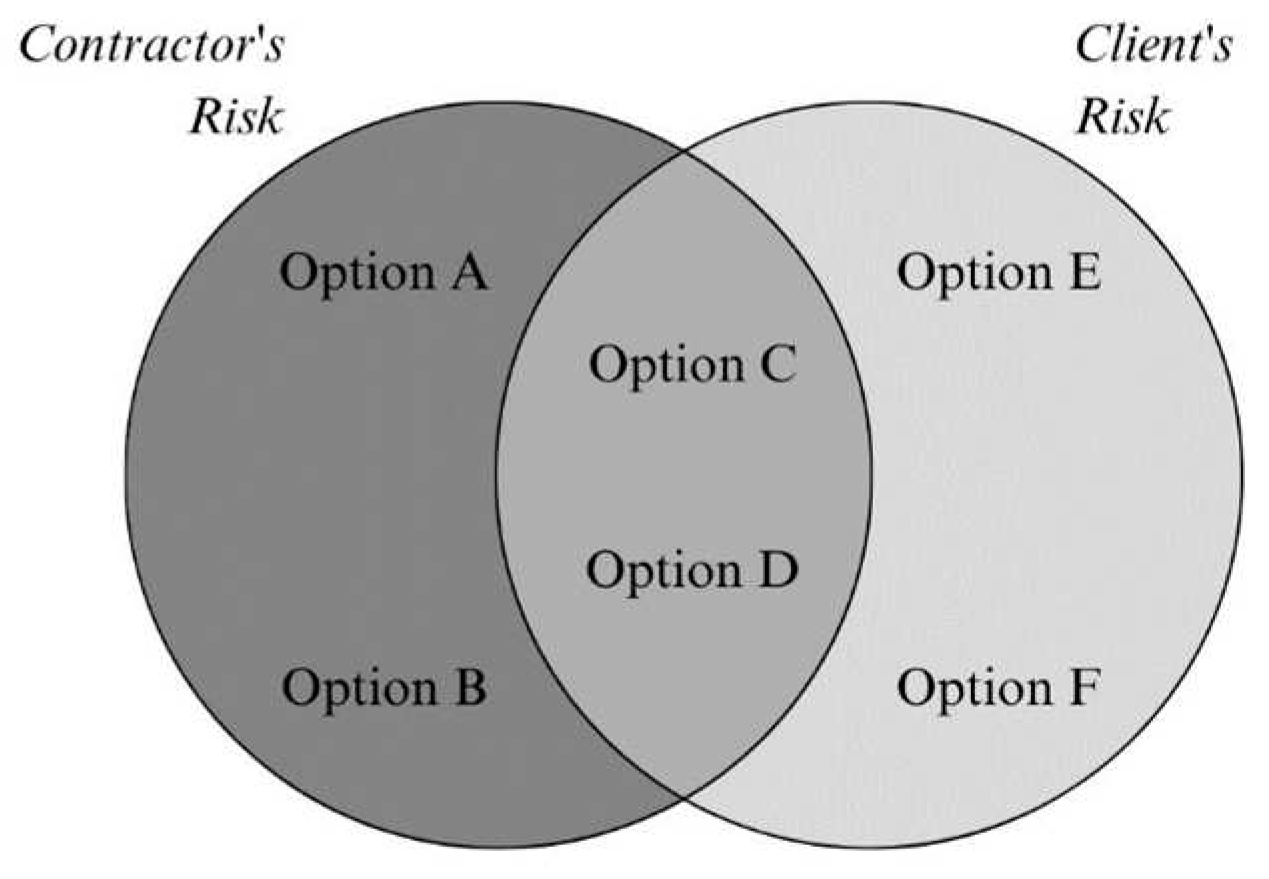

Table 1.
Complementary bibliography.
| Author | Year | Method | Significance or Relevance |
|---|---|---|---|
| Nkunda, et al. [16] | 2023 | Literature review | Identifies benefits, challenges and possibilities of applying collaborative procurement practices in public organisations in Tanzania. |
| Yeung, et al. [17] | 2022 | Case study Delphi survey |
Identification of Key Performance Indicators (KPI) for various NEC construction projects in Hong Kong and other parts of the world. |
| Alhyari and Ani [18] | 2022 | Literature review | Uses the civil code of the United Arab Emirates to define the compatibility of the ECC with countries governed by civil law, comparing it with the FIDIC Red Book. |
| Rahmani [10] | 2020 | Interviews | Explores the potential benefits of applying Early Contractor Involvement (ECI) to public projects in Australia, from the Client's point of view. |
| Farrel and Sunindijo [19] | 2020 | Interviews | Identifies the benefits and challenges of applying Early Contractor Involvement (ECI) in local government projects in Sydney, Australia. |
| Laryea [9] | 2019 | Case study Interviews |
Examines the procurement strategy on an infrastructure project in South Africa to determine its influence on outcomes. |
| Lau, et al. [6] | 2019 | Interviews | Locates the challenges and barriers to NEC implementation in Hong Kong. |
| Eriksson, et al. [13] | 2019 | Case study | Demonstrates the efficiency that would be gained in construction by applying collaborative procurement in public infrastructure projects in Sweden and the Netherlands. |
| Laryea [20] | 2016 | Literature review Case study | Estimation of the four main drivers of Compensation Events in four (04) NEC3 ECC projects in South Africa. |
| Shafik, et al. [21] | 2016 | Literature review | Discusses the application of FIDIC in the context of the Egyptian Civil Code. |
| Meng [22] | 2014 | Interviews | Determines the positive effects Early Warning would have on problem solving and performance on UK construction projects. |
| Murphy, et al. [7] | 2014 | Literature review Interviews | Establishes the feasibility of integrating Dispute Review Boards into NEC3. |
| Rullan, et al. [2] | 2012 | Case study | Demonstrates the weaknesses and obstacles in Latin American countries where innovative practices for the improvement of public procurement are to be applied. |
| Patterson [23] | 2009 | Literature review | Explains how NEC can be used to allocate risks between the parties to a contract. |
| Wright and Fergusson [24] | 2009 | Case study | Highlights the strengths of the NEC ECC compared to traditional procurement (FIDIC), and the changes that need to be made for its adoption into New Zealand's procurement statutes. |
| Wilkinson and Farhi [25] | 2008 | Interviews | Methodology to identify the drivers that New Zealand needs to improve in order to adopt NEC. |
| Rankin, et al. [26] | 2007 | Literature review Case study |
Describes how a UK public entity makes use of NEC and examines the benefits achieved. |
Table 2.
NEC4 ECC bibliography.
| Author | Year | Title |
|---|---|---|
| ICE | 2017 | NEC4 Engineering and Construction Contract [36]. |
| NEC4 Establishing a Procurement and Contract Strategy [40]. | ||
| NEC4 Preparing an Engineering and Construction Contract [41]. | ||
| NEC4 Managing an Engineering and Construction Contract [42]. | ||
| Mitchell y Trebes | 2017 | Managing Reality. Book One: Introduction to the Engineering and Construction Contract. Third Edition [11]. |
| Managing Reality. Book Two: Procuring an Engineering and Construction Contract. Third Edition [1]. | ||
| Managing Reality. Book Three: Managing the Contract. Third Edition [43]. |
Note: Own Elaboration.
Table 3.
NEC4 ECC contract roles and counterparties.
| NEC4 Engineering and Construction Contract | Ley de Contrataciones del Estado | ||
|---|---|---|---|
| Role | Liabilities | Counterparty | Main Differences |
| Client | It is one of the parties to the contract. | Entity (Entidad) |
It has a more active role. |
| To submit the tender proposal in Part 1 of the Contract. | Approves or denies requests submitted by the Contractor. | ||
| To appoint the Project Manager and the Supervisor. | Appointing the Site Supervisor. | ||
| To ensure that the Project Manager meets the required competencies. | |||
| To monitor and record the Project Manager's KPI. | |||
| NEC4 Engineering and Construction Contract | Ley de Contrataciones del Estado | ||
| Role | Liabilities | Role | Liabilities |
| Project Manager | It can only be an individual. | Site Supervisor (Supervisor de Obra) |
Answering queries made by the Contractor. |
| It is the Client's representative on the Site. | It does not have the authority to change the Technical Works File (Expediente Técnico de Obra). | ||
| Responsible for all aspects of the contract until its completion, except for the responsibilities of the Client and the Supervisor. | |||
| To establish a structure, procedures and systems for project development. | |||
| To approve changes to the Scope, defects and delegate responsibilities. | |||
| Supervisor | It can only be an individual. | Site Resident (Residente de Obra) | Individual representing the Contractor. |
| To ensure compliance with the Scope and performance standards. | Approve notifications in conjunction with the Site Supervisor. | ||
| To supervise and to carry out tests and inspections. | Not limited to scope and technical aspects. | ||
| To notify and to file defects on site. | Not designated by the Entity. | ||
| Contractor | It is the other part of the contract. | Contractor (Contratista) | To designate the Site Resident as the on-site representative. |
| To submit its proposal in Part 2 of the Contract, specifying how the work and subcontracting will be carried out. | |||
| To subcontract when deemed appropriate. | |||
Table 4.
Documentation of procurement and tendering processes.
| NEC4 Engineering and Construction Contract | Ley de Contrataciones del Estado | ||
|---|---|---|---|
| Client | Description | Entity | Description |
| Form of Contract | Contract itself. | Pro-forma of the contract | Contract per se. |
| Contract Data Part 1 | Specific complementary information required to operate the contract. Sets out the conditions of all clauses to be fulfilled by the Contractor. | Technical works file | Descriptive memory Drawings and technical specifications Costs and budget Schedule of execution Materials procurement schedule Special studies |
| Site Information |
Information on the construction site, its surroundings, existing buildings and services. | ||
| Scope | Technical Information Obstacles for the Contractor Safety Requirements Drawings and Technical Specifications |
||
| NEC4 Engineering and Construction Contract | Ley de Contrataciones del Estado | ||
| Contractor | Description | Contractor | Description |
| Contract Data Part 2 | Conditions presented by the Contractor to validate the Contract Data, according to the clauses requiring it. | Work execution programme | Schedule and duration of activities. |
| Programme | Execution programme, including resources, labour and equipment used in each activity. | Offer according to contracting system | Disaggregated by activities in lump sum works. Unit price analysis if required. |
| Pricing documents |
Activity schedule (options A and B) and a bill of quantities (options C and D). |
Valued schedule |
Valued activities. |
| Contractor's Scope | Response to the Client's Scope indicating how the work will be carried out. |
Schedules for the procurement of materials, supplies and equipment | Timing of procurement of materials, supplies and equipment according to schedules. |
| Design and risk management | Risk action plan. | ||
Table 5.
General data of the case study.
| Work Case Study | |
|---|---|
| Date of contract subscription | June the 2nd 2021 |
| Contract amount in soles | S/ 59,570,678.98 |
| Contracting system | Unit Prices |
| Execution modality | By Contract |
| Contractual start date | July the 13th 2021 |
| Date of contractual completion | August the 07th 2022 |
| Deadline for execution | 390 calendar days |
| Physical progress | 73.33% |
| Deadline extensions | 18 deadline extensions |
| Suspensions of execution time | 1 suspension |
| Total days of extension | 367 calendar days |
Note: Adapted from the Control Report Finder of the Office of the Comptroller General of the Republic, [47].
Table 6.
Causes of failure of addenda.
| Descriptive Memory | Drawings and technical specifications | Costs and budget | Special studies | |
|---|---|---|---|---|
| Addendum N° 01 | X | X | ||
| Addendum N° 02 | X | X | X | |
| Addendum N° 03 | X | X | ||
| Addendum N° 04 | X | X | ||
| Addendum N° 05 | X | |||
| Addendum N° 06 | X | X | X | |
| Addendum N° 07 | X | X | ||
| Addendum N° 08 | X | X | ||
| Addendum N° 09 | X | |||
| Addendum N° 10 | X | |||
| Addendum N° 11 | X | X | ||
| TOTAL | 5 | 7 | 7 | 2 |
Table 7.
Characterisation of control reports.
| Project phase | Report | Service | Object | CGR warning or conclusion |
|---|---|---|---|---|
| Preparatory actions | Report N° 01 | Ex Officio Orientation | Non-compliance with technical standards and bases integrated by the project designer in the first deliverable of the technical works file. | Potential risks due to deficiencies in the technical works file during execution, hence possible cost overruns. |
| Selection phase | Report N° 02 | Concurrent control | Adjoining entities carried out works that interfered with the area to be intervened due to a lack of communication and misinformation regarding the site of the work between entities. | Possible cost overruns on revaluation of works. |
| Incomplete documentation for the conclusion of the contract by the Contractor, in addition to the accreditation of key persons without the required professional experience. | Possible delays and quality risks during the execution of the work. | |||
| Contractual execution | Report N° 03 | Concurrent control | Absence of key personnel during the execution of certain works on site by both parties to the contract. | Possible interference in the continuity of the process and the achievement of objectives. |
| Report N° 04 | Ex Officio Orientation | Delay in the publication in the transparency systems of the CGR of the relevant documentation regarding the progress of the execution of the work. | Infringement of the Law on Transparency and Access to Public Information. [48]. | |
| Report N° 05 | Additional work services | To refuse the approval of PAO N° 11 | The PAO is dismissed for lack of technical support, calculation memories and failures in metrics. The Entity does not have the necessary budgetary capacity. | |
| Report N° 06 | Additional work services | Partial approval of PAO N° 11 | The PAO is partially approved due to lack of technical support, calculation memories and failures in metrics. The Entity supports the minimum budget capacity. | |
| Report N° 07 | Concurrent control | Delays in the release of existing communication networks that interfere with the work execution area. | Possible impact on the continuity of the works, thus postponing the completion of the work. | |
| Constant absence of key personnel from supervision during the execution of works on site. | Possible interference in the continuity of the process and the achievement of objectives. |
Note: Adapted from the Control Report Finder of the General Contralory of the Republic, [47].
Table 8.
Comparison between the contract for the execution of works and the NEC4 ECC incentives and tools.
Table 8.
Comparison between the contract for the execution of works and the NEC4 ECC incentives and tools.
| Indicator | Case study contract for the execution of works |
|---|---|
| Clarity and simplicity | Specifications |
| Number of clauses | The contract stipulates twenty-three (23) clauses. |
| Cross-referencing | The contract uses twenty-one (21) cross references, three (03) of them to the Peruvian Civil Code and eighteen (18) to the LCE. |
| Language level | The contract uses mostly legal language. |
| Contract actors | The contract only mentions by name the Client, who is the Entity, and the Contractor. There is no direct mention of the other actors in the contract and their responsibilities, they are only mentioned in the Penalties Clause. |
| Procedural detail | The contract only briefly details the deadlines for payments, advances and guarantees. |
|
Stimulus to good management |
Specifications |
| Payment | The contract establishes as the method of payment to the Contractor by the Entity a system of monthly valuation payments using national currency. It establishes, with cross-reference to the LCE and the Civil Code, the mechanisms for delays in payments by the Entity to the Contractor. |
| Incentives | The contract does not stipulate any incentive mechanism for good practice by the Contractor or other actors in the contract, only penalties for bad practice. |
| Communication systems |
The contract makes no mention of any type of communication system or mechanism that obliges the parties to make notifications by means of the contract. Only the Electronic Works Notebook, Art. 191, 192 and 193 of the LCE, is directly mentioned as a system for recording occurrences in the Penalties Clause. |
| Early Warnings | The contract does not stipulate any Early Warning mechanism. |
| Dispute resolution | Two (02) dispute resolution mechanisms, conciliation or arbitration, are provided for. Both parties have the power to initiate either of these mechanisms, without the need to go through a staged resolution process. |
| Risk allocation | The risk allocation and risk management stipulated in the contract is insufficient to address real risks, the descriptions, strategies and actions in the risk response plan do not offer any real solutions and are all assigned to the contractor except for the last one. The risks are: (1) vulnerability to COVID-19 infection, (2) vulnerability from excavation works, (3) exposure to dust and (4) environmental risk, which is shared with the entity. |
| Dispute Resolution Board | It stipulates the faculty to agree on the formation of a JRD composed of three (03) members, however, no specific mention is made of them or their functions, instead, it is stipulated that they will be appointed in the future by the Lima Departmental Council of the College of Engineers of Peru. |
Table 9.
Proposal for improvement and implementation.
| Clauses | Proposal | Problem it solves | ||||
|---|---|---|---|---|---|---|
| Existing in the LCE | For improvement | P1 | P2 | P3 | P4 | P5 |
| Payment | Options C and D, to promote incentives and value for money. | X | X | |||
| Parts of the Contract | Adapt Contract Data, Scope and Site Information to the documentation. | X | X | |||
| Works Contract's Risk Allocation | Range of Main Options Compensation Events |
X | ||||
| Penalties | Clause X17 Low Performance Damages | X | X | |||
| NEC4 ECC suggestions | For implementation | P1 | P2 | P3 | P4 | P5 |
| Communication | Mandatory communication mechanisms under response periods. | X | X | |||
| Early Contractor Involvement | Involvement of the contractor in the pre-execution phase of the project. | X | X | X | ||
| Early Warnings | Early identification of risks. | X | X | |||
| Key Performance Indicators | Incentive for good practice. | X | X | |||
| Bonus for Early Completion | Incentive for time optimisation. | X | X | |||
Disclaimer/Publisher’s Note: The statements, opinions and data contained in all publications are solely those of the individual author(s) and contributor(s) and not of MDPI and/or the editor(s). MDPI and/or the editor(s) disclaim responsibility for any injury to people or property resulting from any ideas, methods, instructions or products referred to in the content. |
© 2023 by the authors. Licensee MDPI, Basel, Switzerland. This article is an open access article distributed under the terms and conditions of the Creative Commons Attribution (CC BY) license (http://creativecommons.org/licenses/by/4.0/).
Copyright: This open access article is published under a Creative Commons CC BY 4.0 license, which permit the free download, distribution, and reuse, provided that the author and preprint are cited in any reuse.