

Submitted:
11 September 2023
Posted:
12 September 2023
You are already at the latest version
Abstract
With the continuous development of digital transformation and upgrading of Chinese construction enterprises, it is becoming increasingly important to measure their digital level, find the problems in the enterprise transformation process, and identify the key factors of enterprise digital capacity enhancement.
This paper constructs a construction enterprise digital transformation maturity evaluation model from six first-level indicators and 20 second-level indicators, including digital strategy, digital business application, digital technology capability, data capability, digital organization capability, and change management. Digital maturity is divided into five levels: business management, process operation, intelligent construction, intelligent scene application, and industrial ecological collaboration. A detailed process of digital maturity evaluation based on the method of Analytic Hierarchy Process (AHP)-Decision Testing and Evaluation Laboratory (DEMATEL) is then developed. A questionnaire survey of 25 experts is used to weight the various parameters in the model, which is then demonstrated with an example construction enterprise.
The model comprehensively reflects digital levels under the background of the digital economy. Its application will help understand the advantages and disadvantages enterprises face in their digital transformation to enable targeted measures to improve their digital transformation capabilities and efficiency, enhance their core competitiveness of enterprises, and promote the development of digital transformation in the construction industry.
Keywords:
construction enterprise
; digital transformation maturity
; AHP-Decision Testing and Evaluation Laboratory (AHP-DEMATEL)
1. Introduction
It is well known that the digital resources of enterprises have great potential for transformation and innovation, which can change their production methods and product forms, maximize the input-output efficiency of production factors, and motivate enterprises [1,2]. As well as improving efficiency and quality, digital transformation creates more business opportunities and competitive advantages for enterprises [3]. Moreover, digital technology has empowered the transformation and upgrading of traditional industries to make systematic deployments [3].
In China, the digital economy has been developing rapidly in recent years. It has become an important driving force for the high-quality development of the country’s economy, with the digital transformation of enterprises gradually becoming a mainstream trend [4]. The digital transformation and management of enterprises is also featured in a group of forward-looking and strategic development directions in the country’s “14th Five-Year Plan.” Facing the new trend of global digital economy development, the state and departments have issued several policies related to digital transformation. As urged in the Proposal of the Central Committee of the Communist Party of China on Formulating the Fourteenth Five-Year Plan for National Economic and Social Development and the Long-term Goals for 2035 adopted by the 5th Plenary Session of the 19th Central Committee of the Communist Party of China, digital development needs to be accelerated. However, various bottlenecks and difficulties are often involved, such as insufficient technology application and lack of talent [5,6].
Similarly, the digital level of the country’s construction industry requires enhancement due to such issues as extensive production methods, low labor efficiency, and high energy/resource consumption. Strengthening forward-looking thinking and strategic deployment for digital transformation is crucial as digital transformation becomes a national strategic need for Chinese construction enterprises [2]. While transformation and upgrading are essential trends for construction companies, careful planning is necessary, considering existing challenges, to create effective digital transformation plans.
Establishing scientific evaluation models is also vital to analyze and improve digital transformation maturity, aiding enterprises’ and governments’ understanding of development status and support efficiency [7]. Constructing a digital transformation maturity assessment model can enhance efficiency and competitiveness, fostering innovation and customer experience. Creating a capability assessment model improves digital transformation strength: knowing weaknesses helps targeted enhancement, furthering industry development [8]. A design for a capability assessment model sets an industry reference standard, boosting digital transformation [9] and enhancing enterprise competitiveness by improving efficiency, quality, and customer satisfaction through targeted measures [10].
With this background, the objective of this study is to develop a digital transformation maturity model for the construction industry to identify the key nodes that affect the digital transformation of construction enterprises and evaluate the digital transformation of enterprises [11,12]. The model consists of six primary indicators and 20 secondary indicators covering digital strategy, technology, data, organization, and change management, while also introducing a five-level digital maturity framework and a process for digital maturity assessment using Analytic Hierarchy Process (AHP) and Decision Testing and Evaluation Laboratory (DEMATEL). A case study is also described in which the model is demonstrated and tested in a case study involving a Chinese construction enterprise.
The remainder of this paper is organized as follows: Section 2 explores digital transformation in construction enterprises, introducing maturity theory, exploring models, and proposing a comprehensive six-dimensional evaluation framework for their digital maturity; Section 3 presents our Digital Transformation Maturity Evaluation Model (DTCMM) alongside the utilization of the AHP and DEMATEL method for comprehensive and accurate analysis of digital transformation maturity; Section 4 uses the AHP-DEMATEL method to analyze digital transformation maturity in construction enterprises, demonstrating progress and need for enhancement through a questionnaire-based assessment; Section 5 explores the influence of digital transformation on construction firms, suggesting strategies for integrating technology, improving quality management, enhancing assessment models, and nurturing digital talent; finally, Section 6 provides our concluding remarks, including the main findings and implications, limitations of the study, and potential prospects for future research.
2. Research review
2.1. Digital transformation of construction enterprises
Digital transformation refers to using digital and information technology to transform traditional business models, products, and services into digital forms to improve efficiency, reduce costs, and enhance customer experience and innovation capabilities [13]. Digital transformation refers to creating a digital world resembling the physical one, utilizing data, artificial intelligence, and cloud services. It involves optimizing and reconstructing organizational processes and talent culture to achieve business innovation and development supported by digital technology at the industry level. At the enterprise level, the focus of digital transformation is not limited to technology but also includes management methods, business models, and customer relationships, which require enterprises to design and implement changes [14]. At present, construction companies are actively promoting the process of digital transformation, which is mainly reflected in the wide application of BIM technology, intelligent equipment and systems, and data analytics and artificial intelligence. Although digital transformation in construction enterprises has made some progress, it still needs to face many challenges. Zhen Jie (2012) [15]and others believe that the key to digital transformation lies in integrating digital technology with the enterprise’s business. Kane et al. point out in the MIT Sloan Management Review that there are currently two explanations for digital transformation: one is implementing and using innovative technologies; the other is that organizations use technology to conduct business in new and different ways. In the early days of enterprise digital transformation, most focused on the relationship between the application of internal management information systems deployed by enterprises and enterprise performance. Today, studies focus on the composition of digital capabilities and the resource pickup and orchestration process required for digital transformation.
Abundant research has taken place in China on the digital transformation of construction enterprises. For example, Zhu Feifei and Yan Xiaoli (2022) [16] propose that the digital transformation of construction enterprises is an in-depth integration of digital technology with enterprise management, production and construction, and project operation and construction. The result is a data-driven and innovative remodeling of strategy, organization, and internal resources in a dynamic external environment. Gong Yinyin, Duan Zongzhi (2022) [17], and others analyze the driving factors of construction enterprises in the initiation, implementation, and synergy stages of digital transformation. They divide enterprises into large, small, and medium-sized categories; refine these factors; and propose key paths for different scales to implement digital transformation successfully. Zhou Zhiming et al. point out that enterprises in different lifecycle stages should adopt different digital transformation models. Taken as a whole, research in this field still focuses on the key factors of digital transformation, while quantitative research into digital-level evaluation methods still needs to be improved.
2.2. Maturity theory
Maturity can be defined as the degree of operational capability and management level of an organization or enterprise in a particular field or aspect (Janicki and Tomasz, 2014) [18]. Usually, maturity assessment evaluates and grades an organization’s or enterprise’s maturity by comparing the business processes, working methods, technology application, personnel quality, and other aspects of a particular field or aspect with best practice, industry, and national standards. Maturity grading is usually divided into five or six levels, which are gradually improved from beginner to advanced. This reflects the different degrees of operational capability and management level of an organization or enterprise in a particular field or aspect. It also provides it with goals and directions for growth and improvement. Maturity is a relatively new evaluation method and has a wide range of applications in many fields. Even within the same professional field, the understanding of maturity varies. Shehzad et al. [19] believe that entities (organizations and human beings) must go through different growth or maturity level stages before reaching full maturity. In particular, an organization’s stages have three main unique attributes: they are continuous, progressing at a level that cannot be easily reversed, and involve a wide range of organizational activities and structures [19]. Mettler et al. [20] point out that maturity means the evolutionary process from the initial to the final stage that is expected or normal. This definition emphasizes the maturation process and introduces another important concept: a growth or maturity stage [20]. The five stages of quality management level proposed by Lahrmann et al. [21] in the U.S. from the perspective of enterprise quality management based on maturity theory lay the theoretical foundation for the maturity model [21]. To summarize, we can identify several basic characteristics of maturity theory: an organization or enterprise’s operational capabilities and management level in a particular field go from the initial stage to achieving expectations or normal occurrence. The final stage is a continuous, non-reversing level evolutionary process (each level stage should be divided according to the stage characteristics of the evolutionary process).
The Capability Maturity Model evolved based on maturity theory, but its practical application originated in the computer software industry [22,23]. The Model, abbreviated as SW-CMM or CMM, was successfully developed by the Software Engineering Institute of Carnegie Mellon University in 1987 [24,25]. It is the world’s most popular and practical software production process standard and software enterprise maturity level certification standard, describing each development stage in the practice of software organizations in defining, implementing, measuring, controlling, and improving their software processes [26]. The core of CMM is to treat software development as a process and, according to this principle, conduct process monitoring and research into software development and maintenance to make it more scientific and standardized and enable enterprises to achieve business goals better [27]. Except for the initial level, the five levels of the model can be decomposed into specific key practice processes at the next level. Each key process contains many common characteristics to guide the organization to achieve project goals in key processes [28]. With the continuous development and evolution of the CMM, its application field has become wider and wider. After many practical applications, experts and scholars in various fields have begun to focus on the model. After the improvement and optimization of experts and scholars in other fields, CMM applications have emerged [29]. For example, Wang Haiqiang of the Harbin Institute of Technology and others proposed their Construction Supply Chain Performance Maturity Model (CSCMM) [30]. To evaluate construction supply chain performance based on the maturity model, an increasing number of industries and fields apply this model. Its purpose is to describe an object’s development direction, development stage, and characteristics. Therefore, the general capability maturity construction process includes selecting the key process areas of the model, constructing an evaluation index system, identifying key activities, and dividing the development stage into 5 to 10 stages.
2.3. Digital maturity models
Major consulting companies worldwide mainly initiated research into enterprise digital maturity at first. In the early days, it was mostly focused on the key factors of digital transformation, centering on qualitative research. For example, in its 2013 digital transformation survey, IBM proposed that there are three main strategic approaches to enterprise digital transformation: reshaping customer experience, focusing on value positioning; reshaping operation models, focusing on value delivery; and combining the first two approaches while transforming customer value propositions and operational delivery methods. The Accenture consulting company also proposed that the digital transformation of enterprises can be divided into three dimensions: digital business innovation, digital marketing, and digital operations. In the Notice on Accelerating the Digital Transformation of State-owned Enterprises issued by the State-owned Assets Supervision and Administration Commission of the State Council, four transformation directions for enterprise digital transformation were proposed: product innovation digitalization, intelligent production and operation, agile user service, and ecologicalization of the industrial system. After the concept of digital transformation has gradually become familiar and applied, some consulting companies and research institutions have successively researched the digital maturity models of enterprises, as summarized in Table 1.
Most studies use the key elements of the classic maturity models, such as strategy, organization, talents, and technology. Most have four to six coverage dimensions, but there are also many differences between them regarding the design of specific key elements. For example, in terms of scope of application, some models are suitable for describing the state level of digital penetration within a single enterprise, and some are suitable for enterprise clusters with common evolutionary characteristics. Most research methods use qualitative methods generally formulated and selected based on interviews. The model’s key process areas and indicators often need more scientific theoretical support, and the problems need to be more comprehensive. However, the possible application value of the evaluation model suitable for a single enterprise is limited to a specific enterprise, and it is not universal. Studies of digital maturity assessment models have achieved much in the theoretical research and application practice of digital maturity. These achievements help understand enterprises’ current positioning and clarify potential action. Therefore, a more theoretical basis for sustainable application may be needed in the subsequent improvement and application process. Second, in most cases, the model’s scope is within the enterprise and only considers the internal perspective, not the business ecosystem and its stakeholders, the relationship between the parties, nor the need for digital measures of the supporting activities of the enterprise value chain. Third, few models consider enterprise digitalization’s performance contribution and digital security’s construction as evaluation dimensions. These deficiencies will be detrimental to the continuous improvement and popularization of the model, greatly reducing its application value.
To summarize, it is apparent that digital transformation is based on emerging technologies such as 5G, the Internet of Things, and cloud computing to optimize, innovate, and reshape construction enterprises’ business processes and process technologies. The purpose of ensuring quality, reducing costs, and increasing efficiency and environmental protection is achieved through optimizing and transforming various processes. Previous research shows that enterprise digital transformation is not limited to the application of digital technology but also involves cultural and organizational changes. The enterprise digital maturity assessment architecture is a method designed by PricewaterhouseCoopers (PwC) in the United Kingdom to assist enterprises in identifying their current digital transformation situation, formulating more effective plans, and enhancing the efficiency and success rate of their digital transformation programs. PwC believes that the leading indicator is the first point, “digital strategy,” the business application result indicator is the second point, and “digital business application” and the remaining four dimensions (3-6) are supporting elements. Each dimension can be subdivided into several sub-dimensions.
Therefore, according to PwC’s enterprise digital maturity assessment framework, the present study evaluates the digital maturity of construction enterprises from six dimensions: strategic guidance, business application results, technical capability support, data capability support, organizational capability support, and digital transformation (Figure 1).
3. Construction of the digital transformation maturity evaluation model (DTCMM) for construction enterprises
3.1. Construction of the DTCMM evaluation model
Following the guidelines from the PwC framework for assessing enterprise digital maturity, the present research develops a digital maturity evaluation model for the construction industry, as illustrated in Figure 1. The model aims to encompass all aspects of digital transformation within construction enterprises. Given the diverse professional fields in Chinese construction companies, specific indicators can be adjusted in practice to achieve optimal outcomes.
3.2. Description of specific indicators
3.2.1. Digital strategy
Digital strategies can be grouped into distinct categories: the alignment level A1 of digital strategic planning, the commitment level A2 to implementing digital transformation, and the extent of government policy support A3. The alignment level A1 assesses whether an enterprise’s digital transformation strategy corresponds to its long-term goals and technical capabilities, emphasizing the need for a tailored strategy to enhance efficiency and clarity [31]. The commitment level of A2 gauges an enterprise’s determination and vigor in executing its digital transformation strategy [32]. As digital transformation is gradual, an enterprise’s support significantly impacts its pace and effectiveness [33]. Greater investment signals stronger commitment, fostering more effective leadership and supervision of the transformation progress [34]. The government’s policy support for A3 reflects the resource allocation for digital transformation by the enterprise’s local government department, indicating government encouragement [35].
3.2.2. Digital business applications
Digital business applications are classified into four groups: human resource planning B1, business contract management B2, production technology management B3, and quality and safety management B4. Human resource planning B1 assesses the existence of a comprehensive human resource information management system, enhancing decision-making, personnel deployment, cost efficiency, and overall human resource structure analysis [36]. Business contract management B2 evaluates material and business proficiency, incorporating contract, cost, material, subcontractor, settlement management, driving productivity, cost reduction, competitive advantage, and overall benefits [37]. Production technology management B3 evaluates the integration of information technology like IoT, big data, digital twins, and BIM with construction site management, enhancing on-site capabilities and competitiveness [38]. Quality and safety management B4 assesses real-time tracking of project quality and safety indicators, spanning monthly quality reports, inspections, analysis, statistics, and safety measures, fostering high-quality development through quality, safety, and facility management [39].
3.2.3. Digital technology capabilities
The digital technology capabilities category is segmented into five sections: new technical personnel C1, digital infrastructure C2, improvement in digital project integration management platform degree C3, degree of integration of digital technology and construction site C4, and digital innovation iteration ability C5. New technical personnel C1 signifies the enterprise’s human resource reservoir, where employees experienced in digital system development or operational processes play a pivotal role in enhancing digital technology capabilities. Digital infrastructure C2 denotes the enhancement of foundational IT infrastructure, including 5G networks, as complete infrastructure expedites digital technology implementation due to high hardware and software prerequisites [40]. The degree of improvement in the digital project integration management platform C3 reflects an enterprise’s familiarity with the project’s entire lifecycle, while an encompassing management platform amplifies productivity [41]. The degree of integration of digital technology and construction site C4 highlights whether digital transformation results suit construction site needs, align with smart construction site functions, and effectively combine digital technology with construction tools. Digital innovation iteration ability C5 underlines R&D innovation competence and adeptness in timely software updates [42].
3.2.4. Data capabilities
The data capability is divided into three sections: data collection and processing D1, data analytics capability D2, and data security D3. Data collection and processing D1 assesses if the enterprise gathers comprehensive and real-time data, while processing obtains the most representative data [43]. Data analytics capability D2 gauges whether the enterprise comprehensively and logically interprets collected data ensures accurate data comprehension, and effectively mines information from the data [44]. Data security D3 signifies the enterprise’s measures to safeguard data securely and legally compliantly, including continuous security maintenance, covering both data source and data protection security [45].
3.2.5. Digital organizational capabilities
Digital organizational capabilities encompass three factors: organizational mechanism and process of enterprise digitalization E1, corporate culture E2, and employees’ commitment to digital transformation E3 [40]. The organizational mechanism and process E1 gauge the alignment of the enterprise’s structure with digital transformation and the feasibility of long-term digital projects. Corporate culture E2 mirrors decision-makers’ stance on innovation, which can range from conservative to innovative. Diverse cultures influence transformation decisions [42]. Employees’ commitment to digital transformation E3 impacts transformation efficiency and progress; heightened employee engagement enhances overall transformation quality and efficiency [46,47].
3.2.6. Change management
Change management encompasses digital transformation management mode F1 and change manager skills F2. The digital transformation management mode F1 evaluates the effectiveness of the enterprise’s oversight and control over digital transformation to address potential issues [48]. Change manager skills F2 assesses whether employees are well-versed in the entire transformation process and capable of identifying and promptly addressing potential or ongoing issues in change management [49].

Table 2.
List of factors influencing the maturity of digital transformation in the construction industry.
Table 2.
List of factors influencing the maturity of digital transformation in the construction industry.
|
Evaluation model of digital transformation maturity of construction enterprises (A) |
First-Level | Number | Second-Level | Number |
| Digital strategy |
B1 |
Digital strategic planning matching degree The intensity of enterprises to promote digital transformation Government department policy incentives and support strength |
C11 C12 C13 |
|
| Digital industry Application |
B2 |
HRM Business contract management Productive technology management Quality and safety management |
C21 C22 C23 C24 |
|
| Digital technology capabilities |
B3 |
New technical personnel Digital infrastructure Digital management platform function degree Digital technology and the construction site integration degree Digital innovation and iteration ability |
C31 C32 C33 C34 C35 |
|
| Data ability |
B4 |
Data collection and processing capacity Data analysis ability Data security |
C41 C42 C43 |
|
| Digital organizational ability |
B5 |
Digital organizational structure and processes Corporate culture The degree of employee digital transformation |
C51 C52 C53 |
|
| Change management |
B6 |
Digital management mode Change management staff skills |
C61 C62 |
3.3. Maturity level
The digital transformation maturity in the construction industry represents an entity’s capacity or third-party evaluation unit’s understanding of its ongoing digital transformation status [50]. It gauges how well an enterprise can define, control, predict, and continuously enhance its digital transformation process. This comprehensive assessment incorporates various indicators of digital transformation [51]. The model, informed by preceding evaluation methods and pre-experiment outcomes, categorizes enterprises with similar digital levels into five stages: business management, process operation, smart construction, intelligent scenario application, and industrial ecological coordination. The business management stage from 0 to 0.8 emphasizes integrating business systems for collaboration and information sharing, though data application remains low [52]. In the range of 0.8 to 1.6, process operation focuses on integrating digital technology to enhance enterprise management, operations, and strategic planning [53]. The interval of 1.6 to 2.4 targets intelligent construction, emphasizing quality, safety, and efficiency improvements through technology integration [54]. From 2.4 to 3.2, the intelligent scenario application level employs data analytics, BIM, and AI to optimize project management. Lastly, the range of 3.2 to 4.0 pertains to industrial ecological collaboration, wherein enterprises leverage their digital capabilities to build an engineering digital ecosystem, fostering efficient coordination across the industry chain and creating a comprehensive digital industry ecology.
3.4. Selection of evaluation methods
The Analytic Hierarchy Process (AHP) and Decision-Making and Trial Evaluation Laboratory (DEMATEL) method is a hybrid approach combining AHP and DEMATEL techniques to tackle multidimensional decision-making and complex system analysis [55]. AHP structures the target into hierarchical layers, decomposing criteria into index factors for a layered model. This approach evaluates the importance and weight of lower-level factors towards upper-level goals through a cascading analysis. For instance, it computes the influence of six aspects at the criterion layer on the construction industry’s digital transformation at the target layer. Then, it gauges the decision-making layer’s impact on the criterion layer’s six aspects. However, AHP lacks accounting for mutual influence among the 20 factors, focusing solely on weighted relationships between layers and disregarding interactions between influencing factors [56]. For instance, the policy incentive support from government departments impacts the intensity of enterprises’ digital transformation and the functionality of digital infrastructure and digital project integration platforms under the digital technology capability criterion layer.
Conversely, integrating digital technology with the construction site and production technology management also affects the policy incentive support from government departments. To address this, the DEMATEL method is employed to refine the influence degrees of the 20 factors on the construction industry’s digital transformation. DEMATEL assesses how each factor in the system impacts others, constructs a system impact matrix, and calculates influence degrees and relationships among factors. Subsequently, these influence and relationship degrees are summed to determine the centrality of each factor. The AHP-DEMATEL approach combines the base weights of the 20 factors with their influence and centrality degrees to yield comprehensive influence weights. This methodology rectifies AHP’s oversight of mutual influence among factors and mitigates DEMATEL’s shortcomings in hierarchical calculations of equivalent weights, thereby ensuring calculation precision [57,58].
4. Analysis of influencing factors of digital transformation maturity of construction enterprises based on AHP-DEMATEL
4.1. Specific steps of the AHP method
4.1.1. Build hierarchical models
This study focuses on large-scale construction enterprises primarily involved in municipal public works and housing construction projects, encompassing areas like roads, bridges, and tunnels. These enterprises are extensively engaged in architectural, structural, and mechanical-electrical design, capable of undertaking diverse construction projects and offering top-notch services and solutions. By organizing indicator relationships and considering enterprise realities and research scope, a digital transformation maturity evaluation model for construction enterprises is established by classifying indicators into target and criterion layers.
4.1.2. Determination of judgment matrix
This study assembles a panel of experienced experts to conduct pairwise comparisons between influencing factors from the criterion and factor layers, assigning importance scores on a scale of 1 to 5 (refer to Table 3). Subsequently, an influence factor judgment matrix A =, i, j = 1, 2,..., n is formulated, where A represents the importance of element i within the same criterion or factor layer relative to element j (as displayed in Table 3). Table 4 serves as the evaluation system judgment matrix A.
4.1.3. Compute eigenvalues and eigenvectors
Use the sum product method to obtain the eigenvalues λ max and eigenvector W of the judgment matrix A. The vector value corresponding to the eigenvector is the weight of each element relative to the upper element. The calculation steps are:
(1) Normalize each column in the judgment matrix to obtain
(2) Add the normalized elements in rows to obtain a vector
(3) The normalization process is performed to obtain the eigenvector
Calculate the eigenvector =
(4) Calculate the characteristic roots
(5) Calculate the maximum eigenvalue of the judgment matrix Aλmax
)=6.034
4.1.4. Level single-order consistency check
The consistency index CI, consistency ratio CR, and average random one-time index RI are introduced. When CR < 0.1, the consistency test of the index is satisfied. The RI values are shown in the Table 5, and n is the order of the judgment matrix.
Table 4 shows that when n = 6, the RI value is 1.26.
Therefore, the random one-time ratio CR = 0.0054 < 0.1 meets the consistency requirement.
4.1.5. Calculation weights
Compute the weight of the criterion layer concerning the target layer and the weight of the factor layer concerning the criterion layer. The index weight of the criterion layer forms a feature vector, and the factor layer’s weight relative to the criterion layer is directly given here. Subsequently, multiply the weights associated with each target layer factor by the criterion layer’s weight to derive the basic weights of each factor in the factor layer, denoted as W1.
Table 6.
Basic weights of primary indicators.
| One-Level Metric |
Digitalize Strategy (B1) | Digitalize Business Application (B2) | Digitalize Technical Capability (B3) | Data Ability (B4) | Figure Organizing Ability (B5) | Transform Management (B6) | Weight (%) |
|---|---|---|---|---|---|---|---|
| Digitalize Strategy (B1) | 1 | 1/3 | 1/2 | 1/2 | 1 | 1 | 9.95 |
| Digitalize Business Application (B2) | 3 | 1 | 1 | 2 | 3 | 3 | 29.53 |
| Digitalize Technical Capability (B3) | 2 | 1 | 1 | 1 | 2 | 2 | 21.50 |
| Data Ability (B4) | 2 | 1/2 | 1 | 1 | 2 | 2 | 19.11 |
| Figure Organizing Ability (B5) | 1 | 1/3 | 1/2 | 1/2 | 1 | 1 | 9.95 |
| Transform Management (B6) | 1 | 1/3 | 1/2 | 1/2 | 1 | 1 | 9.95 |
λ max=6.034 CI=0.0068 RI=1.26 CR=0.0054 <0.1 passed the random consistency test.
4.1.6. Calculate the weight of indicators at all levels
Using the AHP to calculate the weight of the comprehensive evaluation index system.
Table 7.
Weights of the comprehensive evaluation index system
|
Standard Layer (Level I Index) |
Weight (%) |
Index Layer (Secondary Index) |
Weight (%) |
Base Weight (%) |
| B1 | 9.95 | C11 | 49.05 | 4.88 |
| C12 | 19.76 | 1.97 | ||
| C13 | 31.19 | 3.10 | ||
| B2 | 29.53 | C21 | 16.46 | 4.86 |
| C22 | 20.63 | 6.09 | ||
| C23 | 34.17 | 10.09 | ||
| C24 | 28.75 | 8.49 | ||
| B3 | 21.50 | C31 | 13.51 | 2.90 |
| C32 | 7.85 | 1.69 | ||
| C33 | 12.71 | 2.73 | ||
| C34 | 39.60 | 8.51 | ||
| C35 | 26.33 | 5.66 | ||
| B4 | 19.11 | C41 | 31.19 | 5.96 |
| C42 | 49.05 | 9.37 | ||
| C43 | 19.76 | 3.78 | ||
| B5 | 9.95 | C51 | 31.19 | 3.10 |
| C52 | 19.76 | 1.97 | ||
| C53 | 49.05 | 4.88 | ||
| B6 | 9.95 | C61 | 66.67 | 6.63 |
| C62 | 33.33 | 3.32 |
4.2. DEMATEL method-specific steps
4.2.1. Determination of initial impact matrix
Using the list of influencing factors from Table 2 in the construction industry’s digital transformation maturity assessment model, a questionnaire was formulated and distributed to 25 experts engaged in digital transformation within the construction sector and researchers in related fields. The experts scored the degree of interaction between the influencing factors, following a scale of 0—no impact, 1—little impact, 2—moderate impact, 3—large impact, and 4—strong impact. After processing the questionnaire data, the initial direct impact matrix D for the influencing factors within the digital transformation maturity assessment system is established. Table 8 shows the computation results.
4.2.2. Determination of normalized impact matrix
Following the analysis of questionnaire data, the relationship matrix A for the influencing factors in the construction industry’s digital transformation is formulated. The initial direct impact matrix A is normalized to obtain the normative impact matrix B from B = A/max (). Table 9 shows the computation results.
4.2.3. Determination of comprehensive impact matrix
Considering the direct influence and indirect influence between the factors, the operation of accumulating indirect influence and direct influence is adopted, and the formula+ …. When n → ∞, the comprehensive influence matrix T can be approximated as Table 10 shows the results.
4.2.4. Computing centrality and causality
Utilizing the formulae =,(i=1,2,3···,n) and=,(i=1,2,3···,n), the influence degree values D and C for each influencing factor is computed, where D represents the row sum and C represents the column sum. Subsequently, the centrality M (D + C) and the causal degree value D-C were calculated for each influencing factor. Table 11 shows the results.
4.3. Calculate the AHP-DEMATEL combination weights
By incorporating the fundamental weights W1 from each AHP index and the centrality M, the comprehensive impact degree obtained by DEMATEL is multiplied by the basic weights of each index. The combined weight Z of the influencing factors is then computed by
Table 12 shows the resulting combined weights for each index derived from the AHP-DEMATEL method.
Table 12 shows that the indices’ weights signify expert consensus. For instance, among the first-level indicators, digital business applications hold a significant share of up to 29.53%, signifying its importance in representing current supply chain digital maturity. Quality and safety management, crucial aspects in construction, have the highest weight among corresponding second-level indicators. This is due to their direct impact on external performance and ultimate transformation goals. Digital technology capabilities’ weight in first-level indicators follows closely behind digital business applications, owing to new technical personnel, digital infrastructure, integration of digital technology with construction sites, and digital innovation iteration ability. These factors demonstrate how emerging digital technologies align and interact with the construction industry. New technical personnel, ranking first among second-level indicators, notably contribute, reflecting the human resource reservoir and proficiency in digital system development.
4.4. Comprehensive assessment calculation method
To ensure accurate measurement of each domain’s implementation level, the questionnaire comprises 1 to 5 questions per domain, with respondents assigning scores of 0 to 4 to both digital level and importance. Averaging valid questionnaire domain scores yields comprehensive domain scores. For instance, taking domain A1 as a case, the final score of the digital transformation maturity is given by
where is the evaluation value of domain A1, k is the number of questions, is the digital level score of question i, is its importance, and n is the number of indicators in the domain.
Consider a construction company specializing in roads, bridges, tunnels, and housing. The company was among the first to use digital technology due to national policies. Adopting digital methods encountered various challenges, making it a good representation of the construction industry in China. The company’s efforts to enhance its digital capabilities focused on areas like managing construction (including quality, safety, and progress), using smart construction sites, and integrating Building Information Modeling (BIM). The company collaborated with parties like supervisors, builders, and testers. They built a comprehensive digital platform that connected all parts of the construction process from start to finish. This helped digitize and make construction management smarter in controlling costs, tracking progress, ensuring quality, maintaining safety, and monitoring the environment. By combining technologies like BIM, Geographic Information Systems (GIS), the Internet of Things (IoT), and mobile Internet, the company managed on-site personnel, machinery, materials, production processes, and more in real time. They used data collection and analysis to monitor, analyze, and mine information automatically. This enabled real-time monitoring, early warnings, safety checks, performance evaluations, and quick emergency response. The company evaluated and scored various factors across its operations, following the guidelines in Table 13. These scores helped determine the overall performance in different areas.
Table 13.
Example of case enterprise digital maturity evaluation questionnaire.
| Question | Score | The Meaning of the Score |
|---|---|---|
| Do you think the digital strategy designated by your company is suitable for the current development situation of the enterprise? | 0 | Fully not in line with the company’s current development of the situation |
| 1 | This is not in line with the current development situation of the company | |
| 2 | Generally in line with the company’s current development | |
| 3 | In line with the company’s current development of the situation | |
| 4 | This is very much in line with the current development of the company | |
| Do you think your company has designated digitalWhether the strategy can be realized? | 0 | It cannot be achieved at all |
| 1 | It cannot be fully realized | |
| 2 | To be able to implement a part of it | |
| 3 | To achieve the most | |
| 4 | Can be realized |
Table 14.
Weights and scores of each index of the digital maturity evaluation model of case enterprises.
Table 14.
Weights and scores of each index of the digital maturity evaluation model of case enterprises.
| One-Level Metric | Single Layer Weight (%) | Two-Stage Metric | Single Layer Weight (%) | Foundation Weight (%) | Assemble Weight (%) | Synthesize Grade | Assemble Grade |
|---|---|---|---|---|---|---|---|
| Digitalize strategy (B1) | 9.95 | C11 | 49.05 | 4.88 | 4.90 | 2.2 | 0.108 |
| C12 | 19.76 | 1.97 | 2.13 | 1.8 | 0.038 | ||
| C13 | 31.19 | 3.10 | 2.45 | 2.6 | 0.064 | ||
| Digitalize business application (B2) | 29.53 | C21 | 16.46 | 4.86 | 4.88 | 2 | 0.098 |
| C22 | 20.63 | 6.09 | 6.46 | 2.2 | 0.142 | ||
| C23 | 34.17 | 10.09 | 11.10 | 1.2 | 0.133 | ||
| C24 | 28.75 | 8.49 | 9.17 | 1.2 | 0.110 | ||
| Digitalize technical competence (B3) | 19.11 | C31 | 13.51 | 2.90 | 3.41 | 0.8 | 0.027 |
| C32 | 7.85 | 1.69 | 1.86 | 2.0 | 0.037 | ||
| C33 | 12.71 | 2.73 | 3.05 | 1.0 | 0.031 | ||
| C34 | 39.60 | 8.51 | 9.19 | 1.0 | 0.092 | ||
| C35 | 26.33 | 5.66 | 6.01 | 0.8 | 0.048 | ||
| Data ability (B4) | 18.99 | C41 | 31.19 | 5.96 | 6.32 | 0.6 | 0.038 |
| C42 | 49.05 | 9.37 | 10.67 | 0.6 | 0.064 | ||
| C43 | 19.76 | 3.78 | 3.21 | 0.8 | 0.026 | ||
| Digital organization ability (B5) | 9.95 | C51 | 31.19 | 3.10 | 1.97 | 1.6 | 0.032 |
| C52 | 19.76 | 1.97 | 1.10 | 1.4 | 0.015 | ||
| C53 | 49.05 | 4.88 | 5.08 | 1.2 | 0.061 | ||
| Change management (B6) | 9.95 | C61 | 66.67 | 6.63 | 5.12 | 1.0 | 0.051 |
| C62 | 33.33 | 3.32 | 1.92 | 0.8 | 0.015 |
By calculating the overall digital maturity score for the example enterprise as 1.23, it is evident that the enterprise is currently in the stage of process operation level in its digital transformation journey. This implies that the company uses digital technology to integrate property, finance, and taxation aspects, aiming to enhance operational quality and capabilities continuously. The company utilizes intelligent data analysis and risk early warning to support strategic planning, risk management, target setting, performance evaluation, and decision-making. However, there is room for improvement in digital capabilities, limiting the company’s growth potential. To progress further, a deeper and more comprehensive digital transformation is necessary. Within the construction management process, digital technology is employed to reduce construction timelines, lower costs, enhance project quality, and expedite the move toward intelligent construction practices.
5. Evaluation results and analysis
5.1. Comprehensive impact analysis
The weight assigned to each indicator reflects the consensus among experts. For instance, digital business applications hold the largest weight of 29.53% among the primary indicators. This indicator is the most representative of construction enterprises’ digital maturity at this stage compared to other primary indicators. Among its secondary indicators, production technology management and quality safety management receive the highest weight. These aspects are pivotal in the digital transformation of construction firms. Given the complexity and risks inherent in the construction industry, effective production technology management and quality safety management are crucial for project smoothness, timely delivery, and risk mitigation.
Digital transformation enables automation, digitization, and lean management throughout construction. This leads to improved work efficiency, enhanced quality, heightened core competitiveness, and increased enterprise market share. The weight of digital technology capabilities in the primary indicators ranks second, just behind digital business applications. This is due to the significance of new technical personnel, digital infrastructure, the functional completeness of digital project integration management platforms, the level of digital technology integration with construction sites, and the iterative potential of digital innovation. Notably, the degree of integration of digital technology with construction sites, denoted as C34, holds the third position among secondary indices, with a weight of 9.19%.
The application of digital technology within construction enterprises spans various areas, encompassing BIM modeling, virtual reality technology, the Internet of Things, cloud computing, and more. While it offers substantial benefits, implementation can sometimes need to be more consistent between technological advancements and managerial readiness. Moreover, achieving a high level of integration between digital technology and construction sites significantly enhances the efficiency and manageability of the entire production process. This underscores the importance of integrating digital technology and construction sites in enterprise digital transformation.
5.2. Analysis of the interaction between factors
Regarding impact, the key factors are C31 new technical personnel, C32 digital infrastructure, C35 digital innovation ability, and C34 digital technology and construction site integration. These four factors strongly influence other aspects. To start, digital transformation needs skilled technical staff for its success. Having the right people with technical knowledge is crucial. If a company has skilled technical employees, it is easier to achieve successful digital transformation.
Similarly, digital transformation relies on advanced technologies like cloud computing, big data, and AI. However, these need a solid foundation, or infrastructure, to work well. If a company’s digital infrastructure needs to be improved, digital transformation becomes challenging. Moreover, successful digital transformation requires continuous innovation to meet market needs and user expectations. If innovation is lacking, digital transformation stagnates. Also, digital technology must be seamlessly integrated with construction sites for digital transformation to work. If this integration weakens, the digital transformation results will differ from what is expected. These factors – new technical personnel, digital infrastructure, innovation ability, and integration with construction sites – are the most influential in assessing digital transformation maturity in construction companies. To improve digital transformation, these areas need focus.
Regarding the influence degree, the most impactful indicators are C53 employee engagement, C22 business contract management, and C23 production technology management. Other factors greatly influence these three. Employee engagement plays a major role, showing that employees are crucial participants and promoters of digital transformation. This means companies must value employee positivity and involvement and guide them in embracing digital transformation to succeed.
In terms of centrality, the significant indicators are C1 new technical personnel, D2 data analytics capabilities, C3 digital project integration management platform, and C2 digital infrastructure. These four indicators are important for digital transformation in construction and should be given more attention.
Regarding reason degree, the top indicators are C1 new technical personnel, C2 digital infrastructure, C5 digital innovation ability, and C4 digital technology and construction site integration. These four indicators impact other aspects. By analyzing the centrality of these indicators, we realize the need to boost recruitment and training of technical staff so employees can lead continuous improvements. This makes the digital transformation process smoother and better suited to expectations and real-world construction. Strengthening data analytics helps uncover insights from various data sets, improving decision-making. Enhancing the functions of digital project-integrated management platforms significantly improves production efficiency. All these steps are crucial for a successful digital transformation journey.
5.3. Recommendations for digital transformation
- Blend Digital Tech with Construction Sites: While digital technology is vital for transformation, applying it on construction sites is equally important. Using tools like BIM (Building Information Modeling) helps combine digital tech and real-world construction, boosting efficiency and quality across the construction process.
- Advanced Production Tech Digitization: Managing production technology is key in construction. Digital tech can enhance this management’s precision and efficiency. Introducing digital tools such as process planning systems and production planning control systems can greatly improve productivity and product quality.
- Boost Quality and Safety Digitization: Quality and safety management are pivotal for construction businesses. Using digital tech elevates these aspects. Embrace tools like intelligent inspection and safety monitoring systems to digitize quality and safety management, enhancing both levels.
- Enhance Digital Transformation Assessment: Digital transformation is complex. Establishing a sound assessment model guides companies. Constantly improving this model helps evaluate every aspect of transformation, aiding implementation and optimization.
- Nurture Digital Talent Continuously: Achieving digital transformation requires skilled individuals. Building a robust digital talent pool is essential. Companies should foster and recruit digital talent, collaborating with universities and offering in-house training to enhance their quality and capabilities.
6. Conclusion
This study uncovered significant insights using the AHP-DEMATEL method to develop a digital transformation maturity evaluation model tailored to the context of construction enterprises. The analysis has highlighted specific influential factors that substantially impact the digital transformation process within construction enterprises. These factors, encompassing new technical personnel, digital infrastructure, digital innovation iteration ability, and the integration of digital technology with construction sites, serve as crucial determinants for shaping effective digital transformation strategies within the construction industry. Moreover, the study emphasizes the critical importance of integrating digital technology with practical construction sites. This symbiotic relationship not only enhances operational efficiency but also elevates the overall quality of production. This underscores the notion that digital transformation’s success is contingent upon its alignment with the real-world operational complexities of construction sites and the significance of digitizing production technology management and quality and safety management through the incorporation of advanced digital technologies. This includes the adoption of process planning systems and production planning control systems to enhance production efficiency and product quality within construction enterprises.
Furthermore, the research has illuminated the pivotal role of employees in driving the success of digital transformation endeavors. Employees’ positive attitudes and active participation appear as indispensable factors for the effective implementation of digital transformation initiatives. This underscores the critical need for cultivating and engaging digital talent within construction organizations.
Establishing the digital transformation maturity model for the construction industry aims to determine the key nodes that affect the digital transformation of construction enterprises and evaluate the digital transformation of enterprises. This allows project leaders to clarify the maturity stage of the company through the evaluation process and the final score results, providing reference opinions for enterprises to conduct digital transformation and a standardized reference for the entire industry. However, it is necessary to acknowledge the study’s inherent limitations. The reliance on expert opinions and the relatively limited sample size for the questionnaire could introduce potential biases. Additionally, the intricate nature of the AHP-DEMATEL method may pose challenges when applied to more extensive datasets or diverse industry contexts. While this study has successfully addressed its research questions, certain nuances may remain unexplored, calling for further investigation into specific subdomains or variables within the context of digital transformation in construction enterprises.
From a practical standpoint, however, the developed evaluation model provides construction enterprises with a structured framework to navigate the complexities of digital transformation. By considering the critical factors unveiled by this study, construction companies can strategically align their digital initiatives with the unique realities of the construction industry, thus optimizing their digital transformation journey. In summary, this research contributes valuable insights into digital transformation within the construction industry. The findings emphasize the holistic nature of successful digital transformation, requiring the harmonization of technology, processes, and human capital. These insights inform the strategies and approaches of construction enterprises as they navigate the evolving landscape of digital innovation. Furthermore, due to the different business directions of construction enterprises, each company can formulate a trusted evaluation system to determine the digital maturity assessment model most suitable for its situation.
Funding
Scientific Research Project of China Road and Bridge Engineering Co., Ltd. (NO. 2020-zlkj-04); Open Fund of China Academy of Railway Sciences Group Corporation (2021YJ049); The National Social Science Fund projects (No.19FJYB017; No.20BJY010); Fundamental Research for Funds for the Central Universities (No.300102282601); Going Global Partnership: UK-China-ASEAN, Education Partnership Initiative funded by British Council (“Integrated Built Environment Teaching & Learning in the Joint Curriculum Development amid Digital-Driven Industry 4.0 among China, Vietnam, and UK”).
References
- Amanda P, Paavo R, Joona K, et al. Digital transformation of the value proposition: A single case study in the media industry. Journal of Business Research 2022, 150, 311–325. [Google Scholar]
- George B, Florin P, Cosmin T. Digital Transformation of Higher Education System. International conference KNOWLEDGE-BASED ORGANIZATION 2022, 28, 158–168. [Google Scholar]
- Senhao, Z. Digital Transformation, Regional Economic Development and High-quality Development of the Logistics Industry—An Evidence from China. Academic Journal of Business & Management 2022, 4, 41–45. [Google Scholar]
- Antonio L, Giovanni S, Francesco M. Editorial: Entrepreneurial development and digital transformation in creative and cultural industries: trends, opportunities and challenges. International Journal of Entrepreneurial Behavior & Research 2022, 28, 1929–1939. [Google Scholar]
- Chenxi Z, Pengyu C, Yuanyuan H. The impact of digital transformation on corporate sustainability- new evidence from Chinese listed companies. Frontiers in Environmental Science 2022, 10, 1047418. [Google Scholar]
- Ming K H, Lu C T, Shan Y C. The effects of institutional pressures on shipping digital transformation in Taiwan. Maritime Business Review 2022, 7, 175–191. [Google Scholar]
- Guangqiang L, Shenghua W. Digital transformation and trade credit provision: Evidence from China. Research in International Business and Finance 2023, 64, 101805. [Google Scholar]
- Marinko S, María D L M D O, Samuel R-N. Digital transformation and European small and medium enterprises (SMEs): A comparative study using digital economy and society index data. International Journal of Information Management 2023, 68, 102594. [Google Scholar]
- Pengyu C, Yuanyuan H. Digital transformation and corporate environmental performance: The moderating role of board characteristics. Corporate Social Responsibility and Environmental Management 2022, 29, 1757–1767. [Google Scholar]
- YAO Z, XUEMENG G. Digital Transformation of Enterprises and the Governance of Executive Corruption: Empirical Evidence Based on Text Analysis. Journal of Global Information Management (JGIM) 2022, 30, 1–18. [Google Scholar] [CrossRef]
- YU X, ZHEN C, FRANCIS B, et al. How does digital transformation affect agricultural enterprises’ pro-land behavior: The role of environmental protection cognition and cross-border search. Technology in Society 2022, 70, 101991. [Google Scholar]
- YUFENG C, JING X. Digital transformation and firm cost stickiness: Evidence from China. Finance Research Letters 2023, 52, 103510. [Google Scholar]
- YUHAO N, WEN W, SAI W, et al. Breaking barriers to innovation: The power of digital transformation. Finance Research Letters 2023, 51, 103457. [Google Scholar]
- ZHENGYI Z, JUN J, SHIJING L, et al. Digital transformation of incumbent firms from the perspective of portfolios of innovation. Technology in Society 2023, 72, 102149. [Google Scholar]
- JIE Z, ZONG-XIAO X, KUN-XIANG D. The research on the influzence Mechanism of Absorptive Capacity on Organizational Agility in Enterprive Digital Transformation: The Chain Mediation Role of IT innovation and Process Innovation. Journal of Central University of Finance & Economics 2023, 1, 105–214. [Google Scholar]
- FEIEI Z, XIAOLI Y. Research on Influencing Factors of Construction Enterprise Digital Transformation Based on ISM-AHP. Construction Economy 2022, 43, 66–73. [Google Scholar]
- YINYIN G, ZONGZHI D. Research on the Critical Path of Digital Transformation of Construction Enterprises Considering Scale Differences. Construction Economy 2022, 43, 83–90. [Google Scholar]
- JANICKI T, J. Organisational Structures As an Expression of the Maturity of Project Management in the Enterprise. Torun Business Review 2014, 13, 193–208. [Google Scholar]
- SHEHZAD H M F, IBRAHIM R B, YUSOF A F, et al. The role of interoperability dimensions in building information modelling. Computers in Industry 2021, 129, 103444. [Google Scholar] [CrossRef]
- METTLER T, EURICH M. WHAT IS THE RIGHT SERVICE? A MULTI-CRITERIA DECISION MODEL BASED ON ‘STEP’. In Proceedings of the International Conference on e-Business (ICE-B), Seville, Spain, 18–21 July 2011.
- LAHRMANN G, MARX F, METTLER T, et al. Inductive Design of Maturity Models: Applying the Rasch Algorithm for Design Science Research. In Proceedings of the 6th International Conference on Design Science Research in Information Systems and Technology (DESRIST), Milwaukee, WI, 5–6 May 2011.
- ANONYMOUS. Raytheon Company; Raytheon Missile Systems Achieves Capability Maturity Model Integration Level 5. Defense & Aerospace Week, 2009.
- ANONYMOUS. Ducommun’s Miltec Unit Achieves Capability Maturity Model Integration Level 2 Rating. Wireless News, 2011.
- CINDRIĆ, J. ZRELOST ORGANIZACIJE (CMMI—Capability Maturity Model Integration). Magistra Iadertina 2009, 4. [Google Scholar] [CrossRef]
- CINDRIĆ, J. CMMI—Capability Maturity Model Integration. Magistra Iadertina 2009, 4. [Google Scholar] [CrossRef]
- DANIEL D A, RUSS H, DAVID M H, et al. The Capability Maturity Model Integrated as a Market Engineering Maturity Model. International Journal of Service Science, Management, Engineering, and Technology (IJSSMET) 2021, 12, 175–196. [Google Scholar]
- KIM D-Y, GRANT G. E-government maturity model using the capability maturity model integration. Journal of Systems and Information Technology 2010, 12, 230–244. [Google Scholar] [CrossRef]
- SAMALIKOVA J, KUSTERS R J, TRIENEKENS J J M, et al. Process mining support for Capability Maturity Model Integration-based software process assessment, in principle and in practice. Journal of Software: Evolution and Process 2014, 26, 714–728. [Google Scholar]
- YASSIEN, E. The challenges of capability maturity model integration application in the dynamic environment. International Journal of Information Systems and Change Management 2020, 12, 17–34. [Google Scholar] [CrossRef]
- HAIQIANG, W. Performance Measurement of Construction Supply Chain Based on CSCM Maturity Model 2008.
- SINING W, DANDAN L. Applying the post-digital strategy of anexact architecture to non-standard design practices within the challenging construction contexts. Heliyon 2022, 8, e09982. [Google Scholar]
- KOMNINOS, N. Smart environments and smart growth: connecting innovation strategies and digital growth strategies. Int. J. of Knowledge-Based Development 2016, 7, 240–263. [Google Scholar] [CrossRef]
- PRESTON, ROB. Quit Dithering On Digital Business Strategy. Informationweek—Online, 2013.
- FRISHAMMAR J, CENAMOR J, CAVALLI-BJöRKMAN H, et al. Digital strategies for two-sided markets: A case study of shopping malls. Decision Support Systems 2018, 108, 34–44. [Google Scholar] [CrossRef]
- ALIZADEH T, SIPE N. Vancouver’s Digital Strategy: Disruption, New Direction, or Business as Usual? International Journal of E-Planning Research (IJEPR) 2016, 5. [Google Scholar] [CrossRef]
- JOHN O, IFAKA, S. H. A, et al. Modelling human resources management in times of uncertainty in the framing of inter-agency collaboration—an empirical investigation. Dynamics of Public Administration 2022, 39. [Google Scholar] [CrossRef]
- EL-ADAWAY I H, ABOTALEB I S, EID M S, et al. Contract Administration Guidelines for Public Infrastructure Projects in the United States and Saudi Arabia: Comparative Analysis Approach. Journal of Construction Engineering and Management 2018, 144. [Google Scholar] [CrossRef]
- M. Z. V, J.W.M. B. Indicator applied to production technology management in healthcare [Indicador de produção aplicado ao gerenciamento de tecnologia em saúde]. IFMBE Proceedings 2008, 18. [Google Scholar]
- BOGDANOVA I, DYMCHENKO O. Production quality and safety management in the corporate-type integrated structures in the agro-industrial complex. E3S Web of Conferences 2020, 175, 13013. [Google Scholar] [CrossRef]
- LIU H, YU H, ZHOU H, et al. Research on the Influencing Factors of Construction Enterprises’ Digital Transformation Based on DEMATEL-TAISM. Sustainability 2023, 15, 9251. [Google Scholar] [CrossRef]
- HUI L, ZHENGJI H, JINGXIAO Z, et al. Systematic Identification of the Influencing Factors for the Digital Transformation of the Construction Industry Based on LDA-DEMATEL-ANP. Buildings 2022, 12, 1409. [Google Scholar]
- ZHANG G, WANG T, WANG Y, et al. Study on the Influencing Factors of Digital Transformation of Construction Enterprises from the Perspective of Dual Effects—A Hybrid Approach Based on PLS-SEM and fsQCA. Sustainability 2023, 15, 6317. [Google Scholar] [CrossRef]
- NATIONAL ACADEMIES OF SCIENCES E, MEDICINE, ENGINEERING D O, et al. In Building Data Capacity for Patient-Centered Outcomes Research; National Academies Press.
- GOMI S, MASHIKO Y, HIRATA K, et al. Fabrication of perpendicular magnetic recording tape media with a data capacity of over-50TB using Si/NiFe/FeCoB soft magnetic underlayers. Physics Procedia 2011, 16, 63–67. [Google Scholar] [CrossRef]
- NELSON, P. The noise in fiber could be used to increase data capacity. Network World (Online) 2019.
- KONSTANTINA R, IOANNIS P, GEORGIOS S. Investigating the Strategic Role of Digital Transformation Path of SMEs in the Era of COVID-19: A Bibliometric Analysis Using R. Sustainability 2022, 14, 11295. [Google Scholar] [CrossRef]
- JIEPING C, AIJIA W. Research on the Digital Transformation Path of Commercial Banks from the Perspective of “Gyroscope Model”:Taking China Merchants Bank as an example. In Proceedings of the 2022 7th International Conference on Social Sciences and Economic Development (ICSSED 2022); 2022.
- XIAOHUI W, FUMIN W. Research on the Path of Digital Transformation of Chinese Manufacturing Enterprises Under the Backdrop of High-Quality Development. In Proceedings of the 2022 International Conference on Artificial Intelligence, Internet and Digital Economy (ICAID 2022); 2022.
- GALIMOVA M, GILEVA T, MUKHANOVA N, et al. Selecting the path of the digital transformation of business-models for industrial enterprises. IOP Conference Series: Materials Science and Engineering 2019, 497. [Google Scholar] [CrossRef]
- JELONEK D, NOWAKOWSKA-GRUNT J, ZIORA L. The Assessment of Construction Project Management Maturity Level in the Silesian Region in Poland. Advanced Materials Research 2014, 1020, 796–802. [Google Scholar]
- LABRADA A, SIGIFREDO, SIERRA L, et al. Considerations about company project management in Bogota, Colombia maturity level of project management. Revista EAN 2010, 60–87.
- MORAES R D O, KRUGLIANSKAS I. O gerente de projetos de TI em organizações com níveis de maturidade diferenciados The IT project manager in organizations with differentiated levels of maturity. Production 2012, 22, 839–850. [Google Scholar] [CrossRef]
- FAUZI M N H, HASAN A, SAMAD N A, et al. Readiness Level Students in Electrical Engineering from the Aspect Technical Skills on the Formation Workability at Polytechnic. International Journal of Vocational Education and Training Research 2016, 2, 28. [Google Scholar] [CrossRef]
- ERSHADI M J, TAGHIZADEH O Q, MOLANA S M H. Selection and performance estimation of Green Lean Six Sigma Projects: a hybrid approach of technology readiness level, data envelopment analysis, and ANFIS. Environmental Science and Pollution Research 2021, 28, 29394–29411. [Google Scholar] [CrossRef]
- YUXUAN L, RYOSUKE S. Impact of Intellectualization of a Zoo through a FCEM-AHP and IPA Approach. Land 2023, 12, 243. [Google Scholar]
- SRDJEVIC B, LAKICEVIC M, SRDJEVIC Z. Fuzzy AHP Assessment of Urban Parks Quality and Importance in Novi Sad City, Serbia. Forests 2023, 14, 1227. [Google Scholar] [CrossRef]
- SAEED K, YOUSEF A, MOHAMMAD G, et al. Analyzing Green Construction Development Barriers by a Hybrid Decision-Making Method Based on DEMATEL and the ANP. Buildings 2022, 12, 1641. [Google Scholar] [CrossRef]
- Ni, G.; Li, H.; Jin, T.; Hu, H.; Zhang, Z. Analysis of Factors Influencing the Job Satisfaction of New Generation of Construction Workers in China: A Study Based on DEMATEL and ISM. Buildings 2022, 12, 609. [Google Scholar]
Figure 1.
PwC: Enterprise digital maturity assessment architecture.
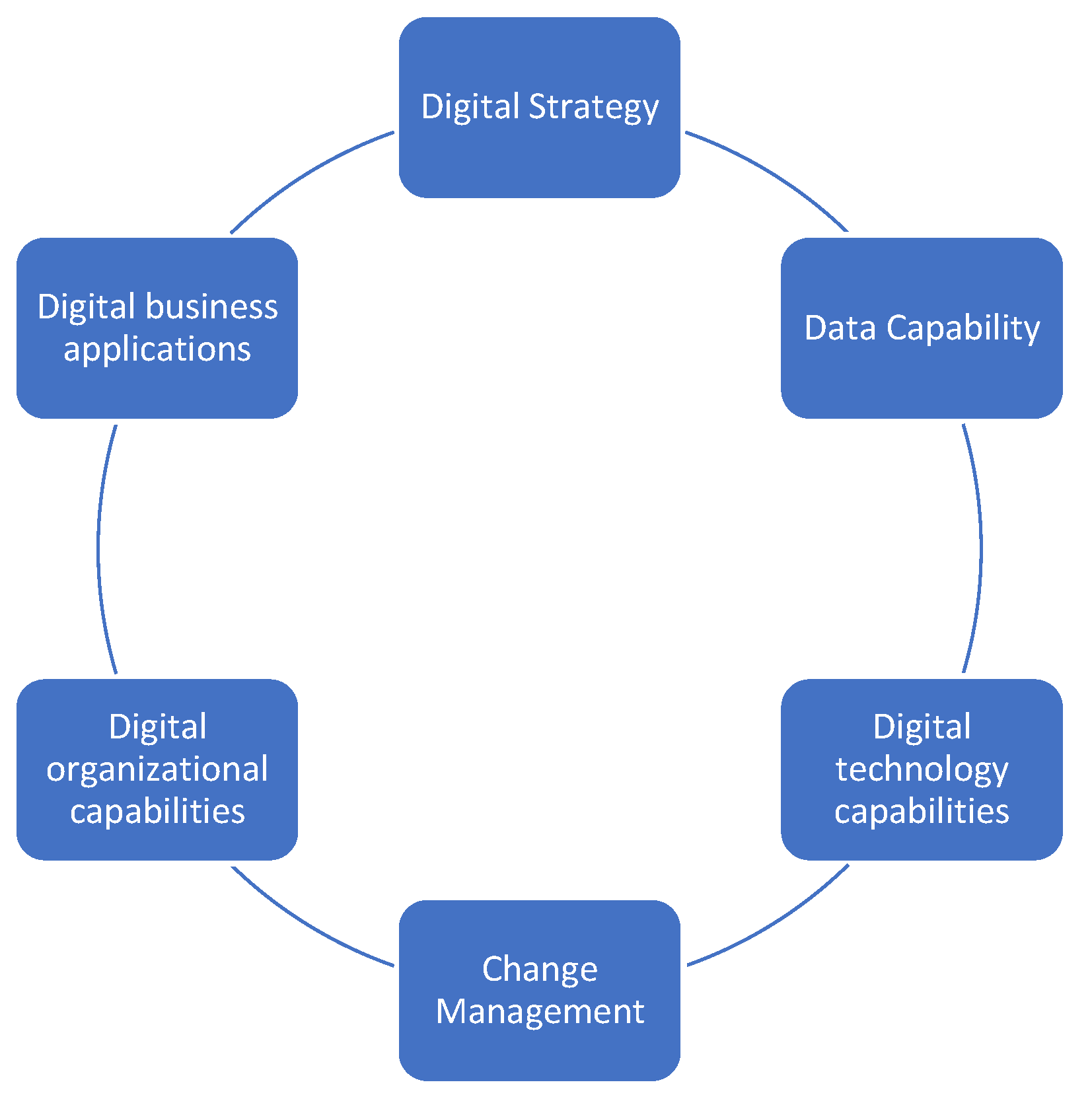
Table 1.
Domestic and international maturity evaluation models.
| Researcher | Model Name | Coverage Dimension | Class Name |
|---|---|---|---|
| China Electronics Standardization Institute | Intelligent Manufacturing Capability Maturity Model | Design, production, logistics, sales, service, resource elements, interconnection, system integration, information integration, emerging business formats | Planned level, specification level, integration level, optimization level, leading level |
| Wang Rui | Digital Maturity Evaluation Model of Manufacturing Enterprises | Strategy, operational technology, cultural organization capability, ecosystem | Digital starter, digital upgrader, digital transformation, digital mature player, digital leader |
| LICHTBLAU K | IMPLUS-Industrie 4.0 Readiness | Strategy and organization, smart factory, efficient operations, smart products, data-driven services, employees | Layperson, beginner, intermediate, experienced, expert, top player |
| Zhu Hongcan, Fang Xinyue | Government data open API ecosystem maturity assessment model | Data quality assessment portal function optimization portal navigation design, map navigation design, data analytics design, information retrieval design, data statistics design |
Construction starts. Function complete Application extension Professional deep cultivation data ecology |
| McKinsey Company | Digital Media Maturity Model | Strategy, IT capabilities, culture, organization, and talent | Evolvers, market matchers, digital strivers, digital disruptors, ecology |
| LEYH C et al. | SIMMI 4.0 | Vertical integration, horizontal integration, digital product development, cross-sectional technical standards | Basic digitization, cross-departmental digitization, horizontal and vertical digitization, full digitization, optimized full digitization |
| Leino et al. | VTT Model of Digimaturity | Strategy, business model, customer impact, organization and process, talent and culture, IT | System shaper beginner, normative level, management level, excellent |
Table 3.
Scaling meanings.
| -Score | Scaling Description |
|---|---|
| 5 | Compared to the i element and the element j, the i element is very important |
| 4 | Element i is important compared to element j |
| 3 | Compared to element i and element j, element i is significantly important |
| 2 | The i element is slightly more important than the j element |
| 1 | The i element has the same degree of influence when compared to the j element |
| 1/2 | The i element is slightly unimportant compared to the j element |
| 1/3 | The i element is significantly insignificant as compared to the j element |
| 1/4 | Elements i compared to element j, element i is very unimportant |
| 1/5 | The i element compared to the j element, the i element is very unimportant |
Table 4.
Judgment matrix A.
| Level 1 Indicators | B1 | B2 | B3 | B4 | B5 | B6 |
|---|---|---|---|---|---|---|
| B1 | 1 | 1/3 | 1/2 | 1/2 | 1 | 1 |
| B2 | 3 | 1 | 1 | 2 | 3 | 3 |
| B3 | 2 | 1 | 1 | 1 | 2 | 2 |
| B4 | 2 | 1/2 | 1 | 1 | 2 | 2 |
| B5 | 1 | 1/3 | 1/2 | 1/2 | 1 | 1 |
| B6 | 1 | 1/3 | 1/2 | 1/2 | 1 | 1 |
Table 5.
Value of different orders RI.
| N-order | 3 | 4 | 5 | 6 | 7 | 8 | 9 | 10 | 11 |
|---|---|---|---|---|---|---|---|---|---|
| RI value | 0.52 | 0.89 | 1.12 | 1.26 | 1.36 | 1.41 | 1.46 | 1.49 | 1.52 |
Table 8.
Initial direct impact matrix D.
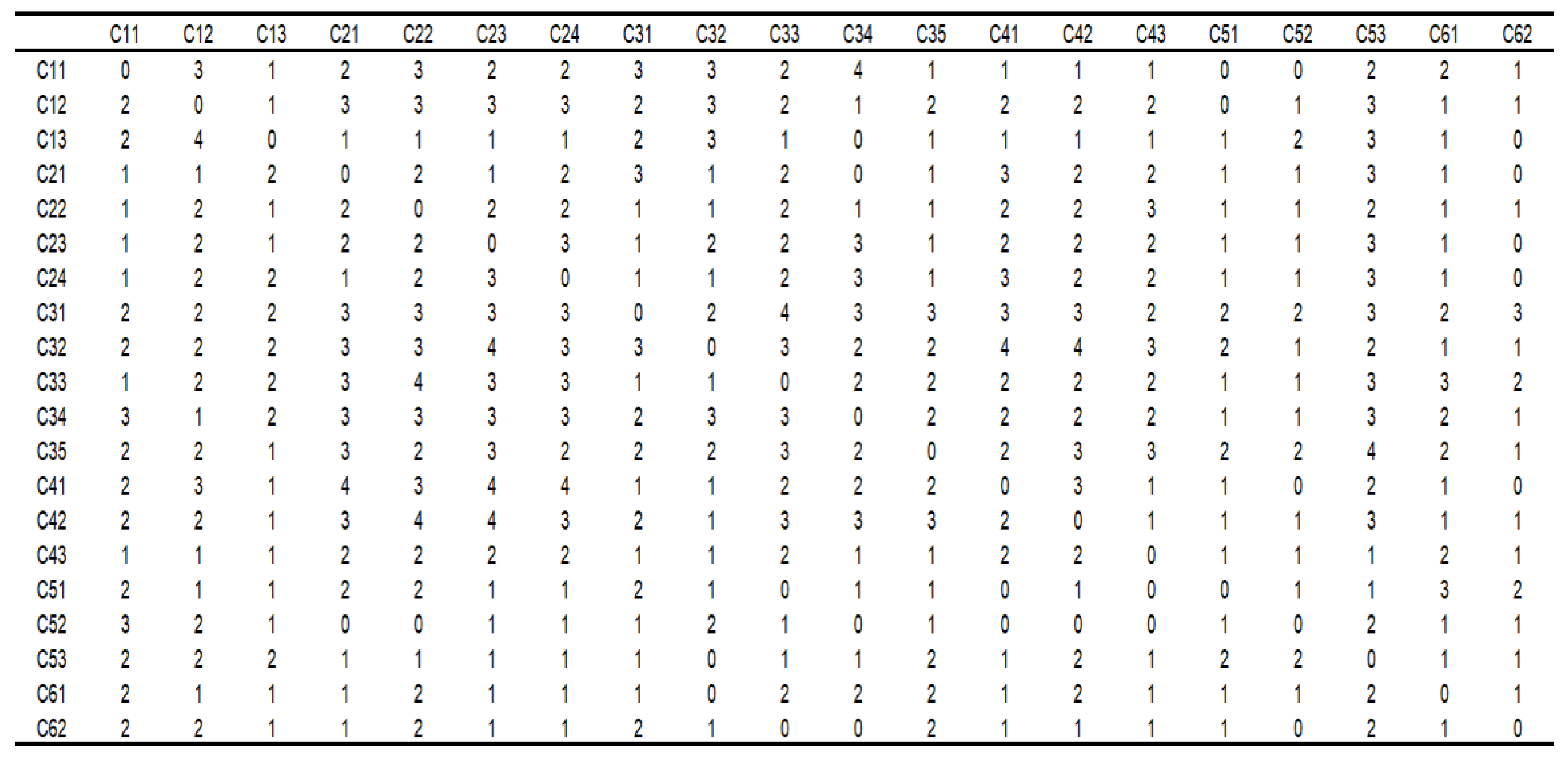
Table 9.
Normative Impact Matrix.
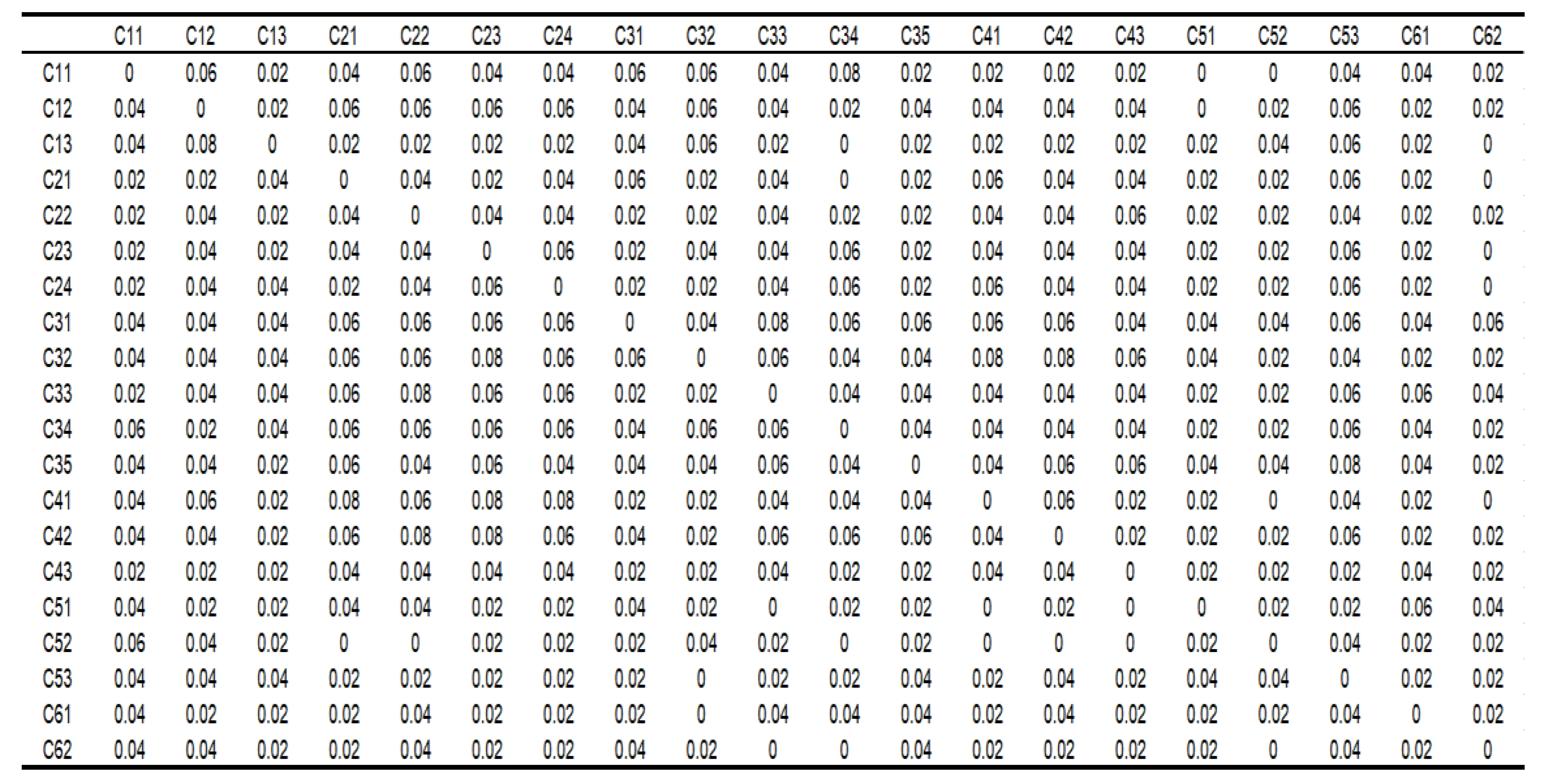
Table 10.
Comprehensive impact matrix T.
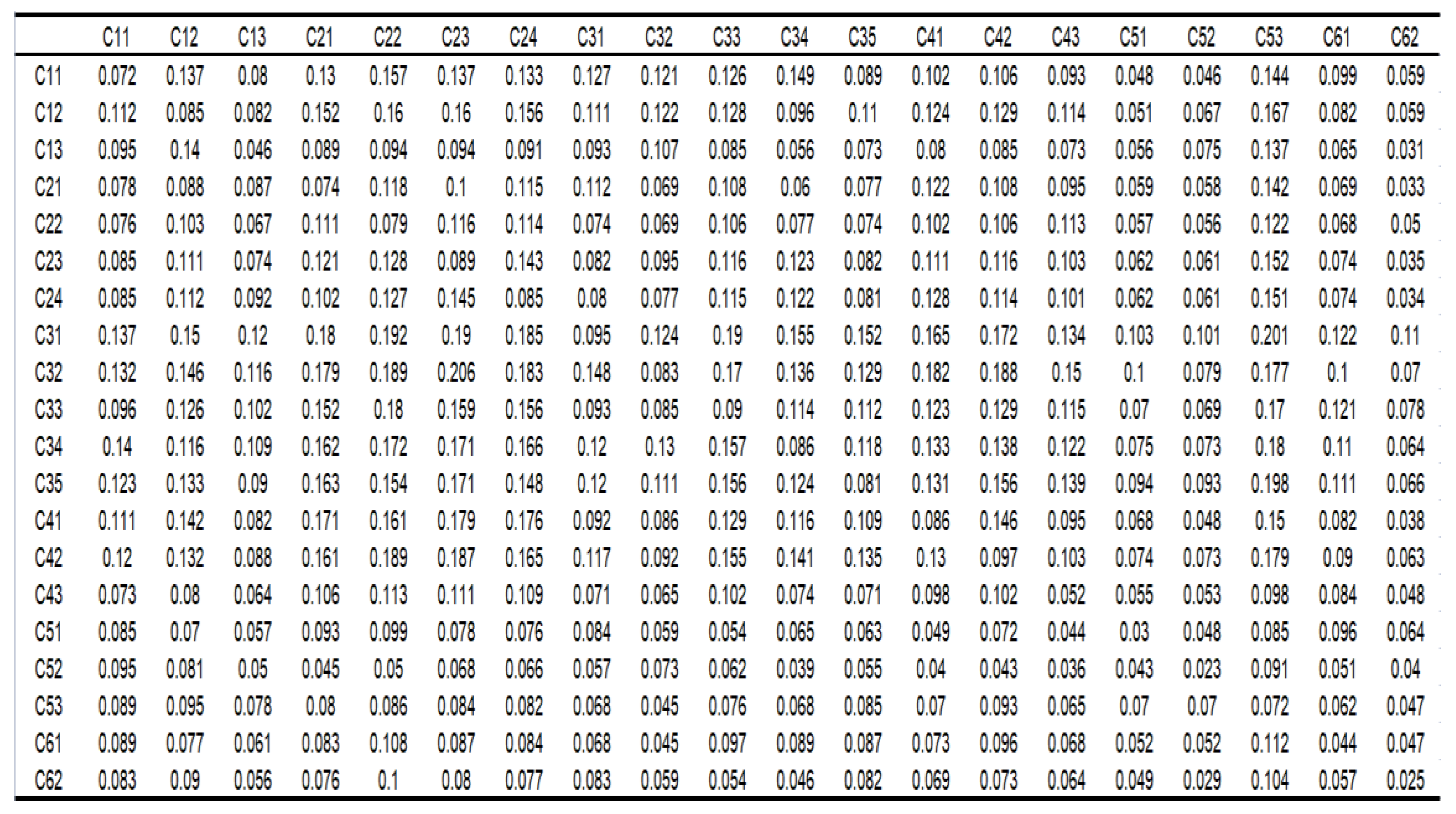
Table 11.
Centrality and weight of each influencing factor.
| Influence Degree d | Influence Degree c | Centra d D+C | Weight | |
|---|---|---|---|---|
| C11 | 2.155 | 1.978 | 4.133 | 0.052 |
| C12 | 2.267 | 2.215 | 4.482 | 0.056 |
| C13 | 1.664 | 1.6 | 3.264 | 0.041 |
| C21 | 1.773 | 2.429 | 4.202 | 0.052 |
| C22 | 1.742 | 2.656 | 4.397 | 0.055 |
| C23 | 1.961 | 2.613 | 4.573 | 0.057 |
| C24 | 1.947 | 2.51 | 4.458 | 0.056 |
| C31 | 2.978 | 1.892 | 4.87 | 0.061 |
| C32 | 2.864 | 1.718 | 4.581 | 0.057 |
| C33 | 2.341 | 2.275 | 4.616 | 0.058 |
| C34 | 2.543 | 1.938 | 4.481 | 0.056 |
| C35 | 2.561 | 1.866 | 4.427 | 0.055 |
| C41 | 2.268 | 2.118 | 4.387 | 0.055 |
| C42 | 2.492 | 2.269 | 4.761 | 0.059 |
| C43 | 1.629 | 1.88 | 3.508 | 0.044 |
| C51 | 1.369 | 1.277 | 2.646 | 0.033 |
| C52 | 1.108 | 1.236 | 2.344 | 0.029 |
| C53 | 1.486 | 2.834 | 4.32 | 0.054 |
| C61 | 1.519 | 1.66 | 3.18 | 0.04 |
| C62 | 1.357 | 1.061 | 2.418 | 0.03 |
Table 12.
Combination weight of each indicator Z.
| (%) | Centra d M (%) | Combination Weight z (%) | |
|---|---|---|---|
| C11 | 4.88 | 5.2 | 4.90 |
| C12 | 1.97 | 5.6 | 2.13 |
| C13 | 3.10 | 4.1 | 2.45 |
| C21 | 4.86 | 5.2 | 4.88 |
| C22 | 6.09 | 5.5 | 6.46 |
| C23 | 10.09 | 5.7 | 11.10 |
| C24 | 8.49 | 5.6 | 9.17 |
| C31 | 2.90 | 6.1 | 3.41 |
| C32 | 1.69 | 5.7 | 1.86 |
| C33 | 2.73 | 5.8 | 3.05 |
| C34 | 8.51 | 5.6 | 9.19 |
| C35 | 5.66 | 5.5 | 6.01 |
| C41 | 5.96 | 5.5 | 6.32 |
| C42 | 9.37 | 5.9 | 10.67 |
| C43 | 3.78 | 4.4 | 3.21 |
| C51 | 3.10 | 3.3 | 1.97 |
| C52 | 1.97 | 2.9 | 1.10 |
| C53 | 4.88 | 5.4 | 5.08 |
| C61 | 6.63 | 4 | 5.12 |
| C62 | 3.32 | 3 | 1.92 |
Disclaimer/Publisher’s Note: The statements, opinions and data contained in all publications are solely those of the individual author(s) and contributor(s) and not of MDPI and/or the editor(s). MDPI and/or the editor(s) disclaim responsibility for any injury to people or property resulting from any ideas, methods, instructions or products referred to in the content. |
© 2023 by the authors. Licensee MDPI, Basel, Switzerland. This article is an open access article distributed under the terms and conditions of the Creative Commons Attribution (CC BY) license (http://creativecommons.org/licenses/by/4.0/).
Copyright: This open access article is published under a Creative Commons CC BY 4.0 license, which permit the free download, distribution, and reuse, provided that the author and preprint are cited in any reuse.