
Submitted:
07 September 2023
Posted:
07 September 2023
You are already at the latest version
Abstract
(1) Background: The social robot interaction design is critical in determining acceptance and user experience. However, few studies have systematically discussed the current focus and future research directions of social robot interaction design from a bibliometric perspective. Therefore, in order to identify the latest research progress and evolution trajectory of research hotspots in social robot interaction design over the last decade. (2) Methods: based on 2416 papers related to social robot interaction design collected in the Web of Science (WOS) database, a comprehensive review was conducted by using bibliometrics to draw a knowledge map using VOSviewer and CiteSpace in an integrated manner. (3) Conclusions: The current research hotspots of social robot interaction design mainly focus on #1the study of human-robot relationships in social robot, #2Research on the Emotional Design of Social Robot, #3research on social robot for children's psychotherapy, #4research on companion robot for elderly rehabilitation, and #5research on educational social robot. The reference co-citation identifies the classic literature that forms the basis of the current research, which provides theoretical guidance and methods for the current research. Finally, we discuss several future research directions and challenges in this field.
Keywords:
social robot
; Interaction design
; Bibliometric
; VOSviewer
; Citespace
1. Introduction
The social robot is a type of robotics technology that interacts with users in a natural and intuitive way by using the same social norms as humans, and typically in an anthropomorphic form [1,2,3,4,5]. In recent years, social robots have become increasingly common in daily life, with more robots being used to perform tasks that used to be done by humans, such as caring for the elderly, accompanying children, providing entertainment resources, and facilitating online education[6,7,8,9]. This transformation of robots from service tools to social partners will profoundly impact economic and social dimensions[6,9]. Therefore, in order to fully integrate into the home and everyday environment, careful consideration of the future roles of robots and ensuring their perfect fulfillment of these roles through human-robot interaction design is of paramount importance[3,10,11]. Social Robot Interaction Design (SRID) is the key to creating a positive user experience, establishing emotional connections, and adding value, which requires comprehensive research into the social behaviors, gestures, body movements, role design, and voice, among other aspects of robots, in a systematic manner[12,13,14,15,16,17]. In the long term, SRID stands as a pivotal factor for user acceptance and continued use of social robot and good interaction design can make robot valuable partners for users, further fostering the development and innovation of human-robot relationships [18,19,20].
The literature review helps to further strengthen the framework of knowledge on a research topic by combing and evaluating relevant literature to identify research gaps[21,22,23,24,25]. However, most current literature reviews on social robots are general and unsystematic or narrow their investigation to specific aspects of social robot research. Fewer studies have conducted a systematic literature review on social robot interaction design (SRID). For example, gesture design for social robots and its impact on human-robot interaction [26], Robotic Vision for Human-Robot Interaction and Collaboration[27],design and evolution of social robots[28],The effect of social robot design features on the quality of human-robot interactions[29],Cultural Influences on User Interaction with Social Robots[30],Human-Robot Emotional Interaction Based on the Perspective of Robot Psychology[31], Empathy in Human-Robot Interaction [32],Facial Anthropomorphic Trustworthiness for Social Robot Design [33], Children’s acceptance of social robots[34]. Furthermore, some studies focus on conducting reviews of specific types of social robots. These include Educational Social Robots [8], Elderly Companion Social Robots [35], Anxiety Intervention Social Robots [36], Child Psychotherapy Social Robots [37], and Robots for Measuring Children’s Mental Health[38]. Therefore, for social robot interaction design (SRID), there is still a lack of systematic literature review to provide an overview of the current research status, theoretical foundations, and future research directions.
In the past decade, SRID research has developed rapidly, and many literature results have been produced [18,26,39]. Such a significant growth in the literature requires new approaches to review and analyze trends within knowledge domains [40,41]. In addition, SRID research exhibits a strong cross-disciplinary nature with a complex and diverse knowledge structure. Relying solely on traditional literature review methods makes it challenging to comprehensively grasp the current state of SRID research and the evolution of research hotspots[42,43,44]. Bibliometrics is an effective method to quantitatively visualize and analyze the existing published literature, which can effectively mine the laws and potential information behind a large number of papers and is now widely used in many necessary scientific research fields[39,45]. Therefore, this paper will use bibliometrics to address the following five research questions to provide a comprehensive overview of SRID:
RQ1: What are the main focuses of SRID’s current research hotspots?
RQ2: How has the research content in SRID evolved over the past decade in terms of temporal development? What are the overall trends?
RQ3: What are the primary knowledge foundations and classical theories of SRID research?
RQ4: Which scholars and institutions worldwide are the research subjects of SRID? What are the collaborative relationships between them?
Clarifying these questions can help relevant scholars grasp the research structure and latest development trends of social robot interaction design, and provide a corresponding knowledge base for further research in this field. Additionally, we explored research directions and applications that have received little attention in previous studies, which remain challenges for future research.
2. Research design
2.1. Data sources
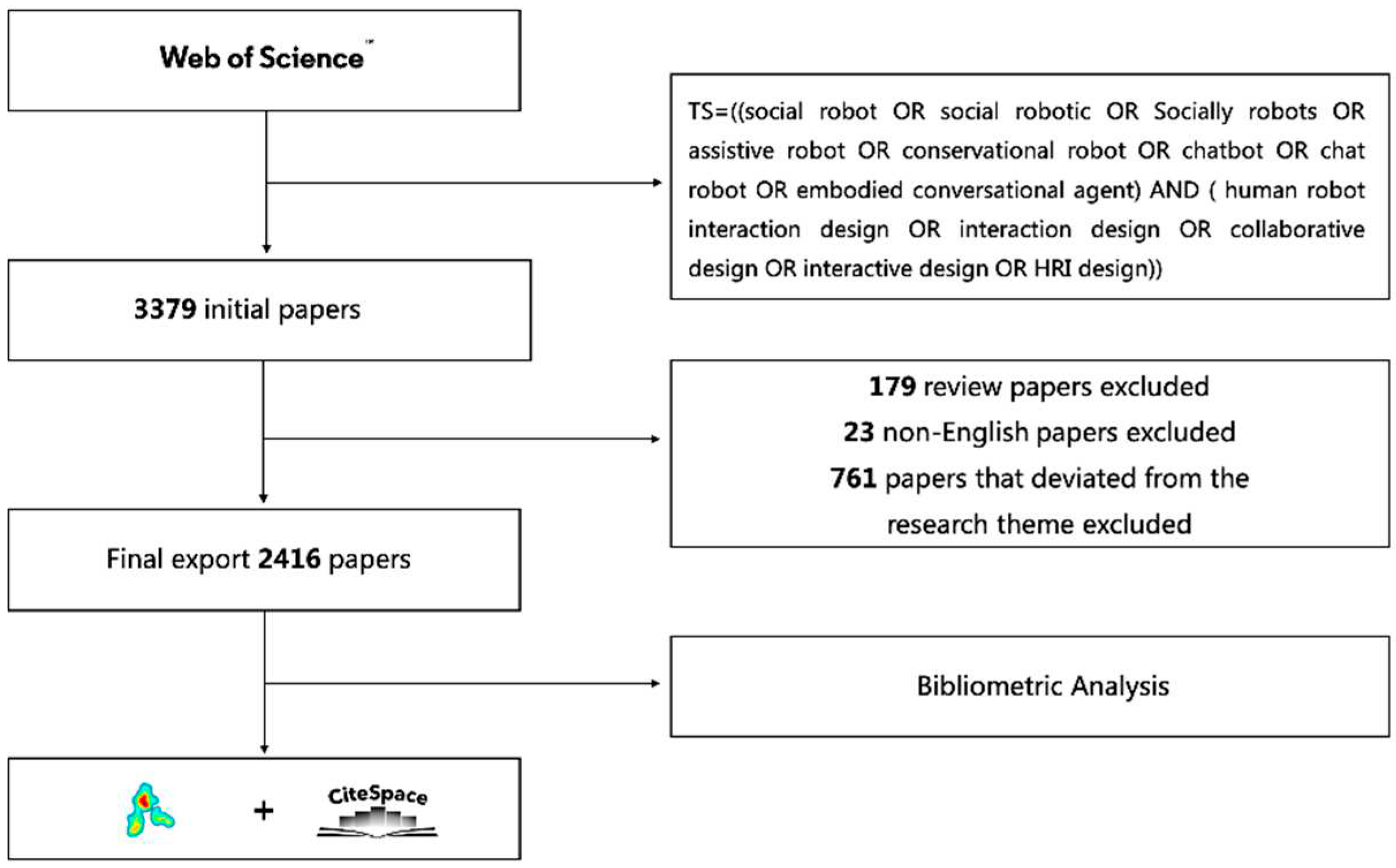
Web of Science is the most comprehensive English-language database in the world, and the literature in the Web of Science Core Collection has undergone peer review and rigorous scrutiny by publishing journals, so it is considered to possess greater disciplinary representativeness[46]. In order to ensure the validity and reliability of the research data, this study chooses the Web of Science Core Collection (WOSCC) as the data source. Our search terms combine "social robot" and "interaction design" to filter and obtain literature relevant to human-robot interaction design for social robots. Since there are many different expressions of relevant keywords in the English context, we list as many expressions as possible and connect these keywords with the Boolean operator symbol "OR." The specific search strategy is TS= ((social robot OR social robotic OR Socially robots OR assistive robot OR conservational robot OR chatbot OR chat robot OR embodied conversational agent) AND (human robot interaction design OR interaction design OR collaborative design OR interactive design OR HRI design)).
To avoid the loss of interdisciplinary literature, the citation index sources were set to "All” (SSCI, SCI, A&HCI, CPCI-S, CPCI-SSH, BKCI-S, BKCI-SSH, and ESCI, among others) and the sources were not streamlined. Setting the time span as nearly 10 years (2014 to 2023), a total of 3379 initial documents were retrieved. As this study primarily focuses on empirical research, 179 review papers were excluded from the analysis. Subsequently, we reviewed the abstract of each paper to determine whether it met the criteria of this study. Among them, 761 papers were excluded due to their deviation from the research topic. Finally, 23 non-English papers were also excluded. As a result, 2,416 relevant papers (from 2014 to 2023) were retained, and these were exported in TXT plain text format for bibliometric analysis. Among them, 1,339 were journal articles, and 1,077 were conference papers.
2.2. Research methods
Bibliometrics is one of the most widely used methods of literature review analysis, and has become a mainstream approach in scientific policy and research management in recent years.[47,48,49]. Bibliometrics refers to the quantitative analysis of various types of literature to discover the patterns and potential information behind the literature data and then provide new insights into the current status and development trends of a specific research field. It was first proposed by Pritchard in 1969[45,50]. Commonly used bibliometric software includes CiteSpace, VOSviewer, HistCite, and BibExcel. Each software has different functions and limitations[42,51,52]. Among them, CiteSpace and VOSviewer are both bibliometric analysis tools running on JAVA programs, which can effectively establish the mapping relationship between the knowledge units of the literature and visualize the macrostructure of the knowledge through knowledge mapping[51]. CiteSpace provides various vital indicators, such as Keyword Burst and Time Zone, which can visually identify the development trend of a specific research area and the evolution process of knowledge[41]. VOSviewer provides text mining function to build knowledge maps based on metrics such as co-occurrence, bibliographic coupling, and co-cited references[52]. In order to obtain more rigorous and comprehensive analytical indicators, the study comprehensively used two bibliometric visualization software, VOSviewer (V1.6.19) and CiteSpace (V6.2.R4), as the research tools to conduct a panoramic review of the SRID research, to explore the knowledge structure and development trend of the SRID research, and further discuss possible future research priorities. Figure 1 illustrates the research framework of this study.
Figure 1.
Research framework.
3. Bibliometric Results and Analysis
3.1. Trend analysis of annual outputs of SRID literature
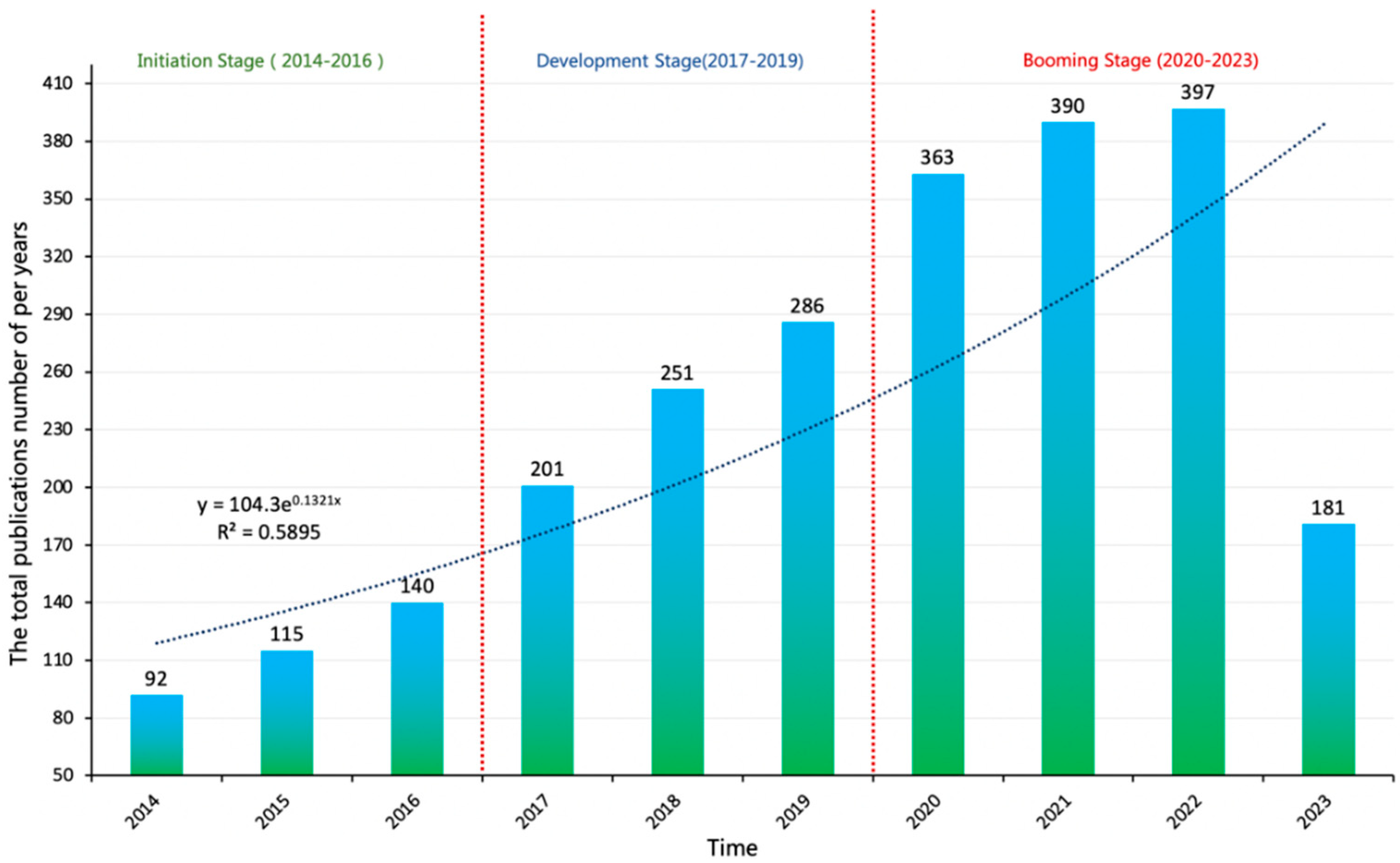
Statistical patterns of change in the output of academic literature over time can effectively assess the accumulation of knowledge, research dynamics, and maturity level of a discipline[25]. The annual distribution curve of literature output in the SRID is shown in Figure 2. The distribution of literature outputs in Figure 2 shows that the overall trend of literature outputs has been steadily increasing, which shows that the research topic of SRID is constantly evolving and has been the focus of researchers’ attention in recent years. Based on the trend of literature output in the last decade, the entire development of SRID research can be categorized into three main stages: the initial stage (2013-2016), the developmental stage (2017-2019), and the booming stage (2020-2023). As shown in Figure 2, the literature production of SRID research was relatively low in the initial stage, with an average annual publication volume of 115 papers per year, and the annual publication count did not exceed 150 papers. Until 2017, this field entered a stage of rapid development, with an average annual publication volume of 246 papers published per year and a rapid growth rate. From 2020 to 2023, with the development and popularization of technologies such as artificial intelligence, affective computing, and cloud computing, the literature output in this field started to experience a sharp increase. By 2023, the average annual number of publications will be as high as 332 per year, and the growth rate will be more stable, and SRID research will enter a prosperous stage.
Figure 2.
A distribution map of the annual publication volume of SRID.
3.2. Research Hotspots of SRID
The paper’s keywords are a high summary of the author’s research results, usually including research objects, research perspectives, and research methods. High frequency co-occurring keywords reflect the long-standing research hotspots of SRID[45]. The 2416 documents within the search contained a total of 6889 keywords. In order to ensure the consistency of keyword expressions and the clarity of homonyms, the keywords were standardized, and the synonyms were merged based on the suggestions of Frey and Dueck, under discussion between the three senior professors and the research team internally[53]. For example, "Customer Experience" was replaced with "User Experience," "ASD" and "Autism Spectrum Disorders" were replaced with "Autism Spectrum Disorder," and "Older Adults," "Elderly-People," "Aging," etc. were replaced with "Elderly." Importing the WOS data into VOSviewer, the co-occurrence frequency was set to more than 8 to ensure the plots’ quality. After merging synonymous keywords, the resulting keyword co-occurrence clustering diagram for SRID research is shown in Figure 3A. There are 288 keyword nodes, 9560 connecting lines in the figure, and keywords with the same color in the graph are the same clusters, which form a total of 5 major clusters. That is, the current research of SRID mainly focuses on #1, the study of human-robot relationships in social robots, #2, research on the emotional design of social robots, #3, research on social robots for children’s psychotherapy, #4 research on companion robot for elderly rehabilitation and #5 research on educational social robot. Figure 3B is a keyword co-occurrence cluster-time overlay diagram reflecting the temporal distribution of these five SRID research clusters. Table 1 provides detailed information about the SRID research clusters, and the following sections outline the specific research content within these clusters.
Figure 3.
(Fig.3A Keyword Co-Occurrence Clustering Fig.3B Keyword Co-Occurrence Clustering).
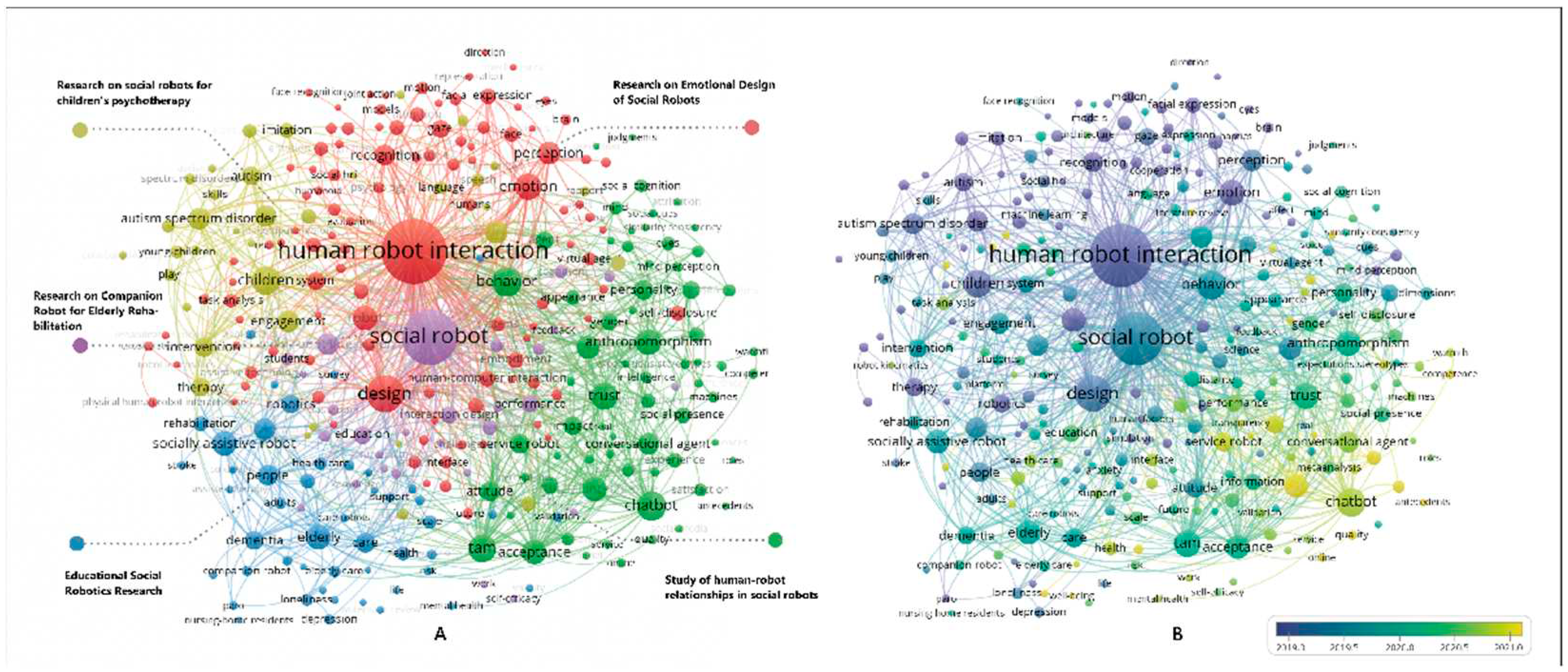
Cluster #1 – the study of human-robot relationships in social robots, which consists of 101 keywords, mainly including Acceptance, Anthropomorphism, Attitude, Trust, Privacy, Self-Disclosure, Satisfaction, TAM (Technology Acceptance Model), Social Presence, Warmth, Transparency, Roles, and Experience and other keywords. The human-robot relationship is an essential topic in SRID research and is an emerging research theme (see Figure 2B). As robots become highly intelligent, people will naturally and unconsciously apply the social rules of interpersonal communication to human-robot interactions, even if the robots are not humans [54]. Scholars such as Nass use the " Computer is a Social Actor (CASA paradigm)" to describe this phenomenon, and social robots are particularly easy to perceive as social behaviors due to their anthropomorphic design and autonomous behaviors[55,56]. The research content of the human-robot relationship mainly includes human-robot trust (Trust), robot acceptance (Acceptance), user self-disclosure willingness (Self-Disclosure), user satisfaction (Satisfaction), and user privacy concerns (Privacy)[10,20,57,58,59]. This direction is mainly based on the user’s psychological cognition, through the use of the model research method (structural equation model) and user experiments to conduct quantitative empirical research, in order to identify the influencing factors affecting human-robot relationships as well as the influence mechanism[14,60,61,62]. From the large number of research results accumulated in the current literature, the influencing factors (antecedent variables) of the human-robot relationship can be broadly categorized into three dimensions: "Human," "Robot," and "Environment."[63,64,65,66]. For example, the keywords "Anthropomorphism," "Roles," "Appearance," "Transparency," "Social Presence," and "Warmth" appearing in the cluster1 are antecedent variables belonging to the "Robot" dimension[65,67,68,69,70]. Combined with the characteristics of high-frequency keywords, the research focus of Cluster #1 can be further summarized as building a more harmonious human-machine social relationship through the interaction design of social robots.
Cluster #2 - Research on Emotional Design of Social Robots. This cluster comprises 60 cluster members, primarily including keywords such as Affective Computing, Affective Robotics, Emotion, Emotion Recognition, Facial Expression, Face, Body Language, EEG, Brain, Eye Contact, Gaze, Gesture Recognition, and more. Emotional design for social robots refers to imbuing robots with emotions, enabling them to recognize better, understand, and respond to users’ emotions through emotional expressions[2,26,57]. A social robot with effective emotional design can enhance the interactive experience of human-robot interaction, improve user satisfaction, and facilitate a more natural and enjoyable communication process[2,71]. Specifically, emotional recognition in social robots refers enables robots to recognize and understand human emotional expressions, allowing the robots to perceive and appropriately respond to users’ emotions during interactions[72]. The emotional expression design for social robots primarily includes two categories: verbal cues and non-verbal cues. Verbal cues encompass the tone, intonation, and conversational style of social robot’s speech, while nonverbal cues encompass facial expressions, gestures, body movements, and gaze, among others[2,61,73]. For example, robots can use gestures, natural language, and even "eye contact" to engage in positive emotional interactions with users[26,60,74]. As shown in Figure 3B, the average occurrence time of keywords in this cluster is relatively early, which belongs to the research basis of human-computer interaction design of social robots. From the perspective of comprehensive keyword characteristics, this cluster mainly discusses how the social clue design and emotional factors of social robots affect the interaction between humans and robots, that is, to study the recognition and expression of social robot emotions and how to integrate them into specific designs and evaluating[2,60,71].
Cluster #3 - Research on social robots for children’s psychotherapy is composed of 51 keywords such as Autism, Therapy Intervention, Children, Anxiety, Training, Social Skills, Spectrum Disorder, Games, and Speech. This cluster focuses on the specific impact of the interaction design of social robots on the effectiveness of children’s psychotherapy and emotional experience[75]. The Psychotherapy Social Robot provides targeted interventions by analyzing children’s psychological needs and emotional states and is specifically designed to alleviate negative emotions such as anxiety and depression.[76,77]. A large number of studies have demonstrated that social robots have advantages in children’s psychotherapy compared with other therapeutic methods[37] , such as avoiding the psychological barriers that may arise from personal emotions and social stigma in traditional psychotherapy scenarios, not being affected by time and location restrictions, not limited by the number of psychologists, higher acceptance and enjoyment in interactions[78,79,80,81]. From the high-frequency keywords in the cluster, social robots are also often used in psychotherapy scenarios, such as therapy for children with autism spectrum disorders and social skills training. Typical psychotherapy social robots include Woebot, Wysa, Joyable, and so on. These robots are used in more than 130 countries around the world and have been shown to be effective through psychological evaluations[81,82,83]. However, overall, this research direction is still in its early stages. In the future, more foundational research questions need to be addressed regarding children’s perception, cognition, behavior, and psychotherapy, among other aspects[28,37,84]. Meanwhile, most current studies lack rigorous quantitative statistical analysis, and the number of child participants in user experiments is also relatively limited[85,86].
Cluster #4 - Research on Companion Robot for Elderly Rehabilitation mainly contains 48 keywords such as Elderly, Health-Care, Loneliness, Mental Health, Assisted Therapy, Co-Design, Depression, User-Centered Design, and others, and at the same time presents a very inclusive perspective. This cluster primarily focuses on the interaction design research of rehabilitation companion robots for supporting the independent living of elderly individuals at home in order to meet the actual needs of real-world older people, promote their physical and mental health, and protect their dignity, privacy, and independence[68,87,88]. Numerous studies have shown that assisting elderly individuals with physical and cognitive training through social robots has a significant positive impact on their cognitive function, overall well-being, and quality of life[89,90]. For instance, it leads to a reduction in diseases such as diabetes, Alzheimer’s disease, and cardiovascular conditions among the elderly population[91]. In this research scenario, the social robot mainly acts as an exercise partner or trainer to provide social interaction and companionship for the elderly[92,93]. To maximize user enthusiasm and engagement, robots need to be user-centered, adapting their interaction strategies based on the personalized needs, actual abilities, and daily habits of the elderly[35,92,94].
Cluster #5 - Educational Social Robotics Research contains a total of 28 cluster members, mainly containing the keywords "Educational Robot," "Performance," "Knowledge," "Teacher," "Classroom," "Child-Robot Interaction," "Cognition," "Empathy," and "Interaction Design and other keywords. Educational social robots are designed to provide educational and learning support by interacting naturally with students, such as developing logical thinking skills, language expression abilities, teamwork ability, creativity, and more[8,95]. In learning environments, these robots typically play roles such as tutoring teachers, learning partners, and information providers[95,96]. The research topics mainly include user interface design, dialogue language design, emotional interaction design, and personalized learning support, among other aspects, and involve interdisciplinary knowledge such as education, psychology, and computer science[8,75,97]. Combining the characteristics of high-frequency keywords, the research hotspots of cluster #5 can be summarized as research on the design strategy of the interaction between social robots and student users in order to provide effective learning support and a more enjoyable user experience.

Table 1.
Specific information on SRID’s 5 research clusters.
| Cluster | Cluster label | Average time | Keywords number | Keywords |
|---|---|---|---|---|
| 1(green) | Study of human-robot relationships in social robots | 2021 | 101 | Acceptance;anthropomorphism;attitude;trust;privacy;self-disclosure ;TAM;warmth;transparency; |
| 2(red) | Research on Emotional Design of Social Robots | 2019 | 60 | Affective computing;affective robotics; emotion;facial expression;body language;eeg; gaze;gesture recognition; |
| 3(yellow) | Research on social robots for children’s psychotherapy | 2019 | 51 | Autism;therapy intervention ;children;anxiety;training ;social skills;spectrum disorder;games;speech |
| 4(biue) | Research on Companion Robot for Elderly Rehabilitation | 2020 | 48 | Elderly;health-care;loneliness;mental health;assisted therapy;co-design;depression;user-centered design |
| 5(purple) | Educational Social Robotics Research | 2020 | 28 | Educational robot;performance;knowledge;teacher;classroom;child-robot interaction; empathy;interaction design |
3.3. The evolution and trend of SRID research hotspots
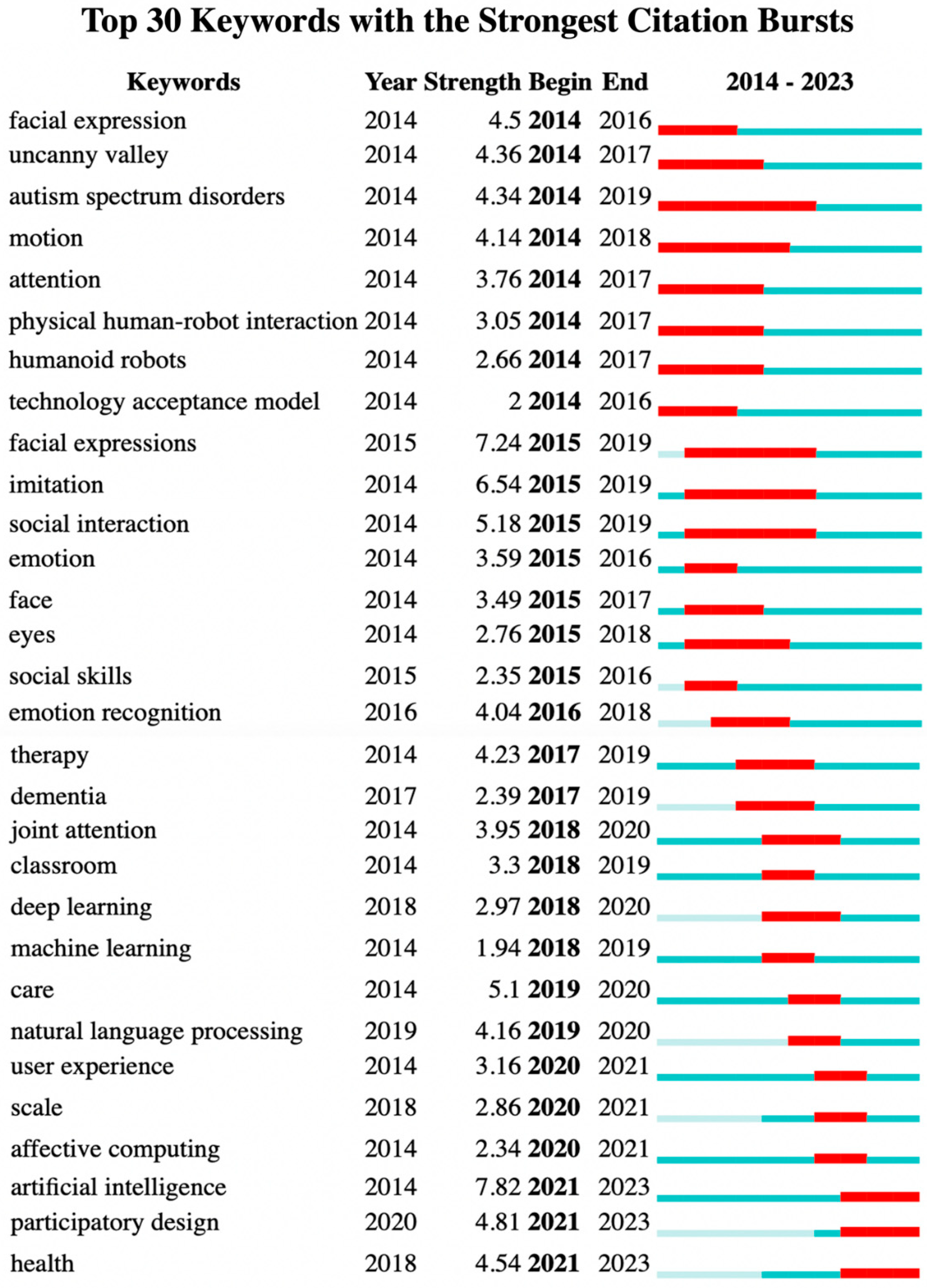
In order to further identify the evolution and overall development trend of SRID research hotspots, the average appearance time of keywords was statistically analyzed to obtain Figure 4 (Keyword Time Zone) and Figure 5 (Burst keyword emergence), respectively. The Time Zone time zone map intuitively reflects the frequency size and first appearance time of keywords within the search range and is often used by scholars to identify the previous trend of research topics. Figure 5 lists the top 30 keywords with emergence intensity in different periods, where the darker parts characterize the intensity of keyword bursts in the literature and the years in which they were relatively prominent. The burst keywords represent the level of attention of research topics in different periods and can also reflect the changing trends and past research hotspots in the field[98]. The Time Zone and Burst keywords combine keywords with the time dimension for analysis. Integrating these two indicators for analysis can obtain more reliable research results[48].
As seen from Figure 4, the early keywords of SRID research mainly focus on the appearance design research of social robots, such as Anthropomorphism, Uncanny Valley, Humanoid Robots, Facial Expressions, etc. Subsequently, the research started to turn to social cues of emotional design, such as Gestures, Body Language, Affective Computing, Face, Eyes, etc. The subsequent research focused more on specific application scenarios, such as psychotherapy, rehabilitation assistance and, companion learning. The keywords after 2020 are Human-Robot Collaboration, Machine Learning, Deep Learning, Natural Language Processing, Satisfaction, Adoption, Individual Differences, Participatory Design, and more. It can be seen that the research focus is gradually shifting to human-computer collaboration and human-computer relationship research, and at the same time, the research methods are also more cutting-edge, and the combination with new technologies such as artificial intelligence is closer. Consistent with the results in Figure 4, sorting the top30 burst keywords in Figure 5 by time shows that the keywords transition from the early Facial Expressions, Uncanny Valley, to Emotion Recognition at the end. Moving on to Affective Computing, Artificial Intelligence, and Participatory Design, still showing a shift from embodied interaction design research to human-robot relationship research. Combining the insights from the Time Zone analysis, burst keywords, and the co-occurrence cluster map, it is evident that the future of SRID research will be centered around several key areas. These include Human-Robot Collaboration, Affective Computing, Artificial Intelligence, Human-Robot Trust, User Self-Disclosure, Emotion Recognition and Expression, and Interaction Design Evaluation. This synthesis of research trends underscores the anticipated focus on advancing the understanding of how social robots can effectively collaborate with humans, integrate emotions, leverage AI capabilities, foster trust, facilitate user self-disclosure, and enhance interaction design evaluation. This holistic perspective provides valuable guidance for researchers, practitioners, and policymakers looking to shape the trajectory of SRID research and its applications in the future.
Figure 4.
Keywords Timezone View of SRID.
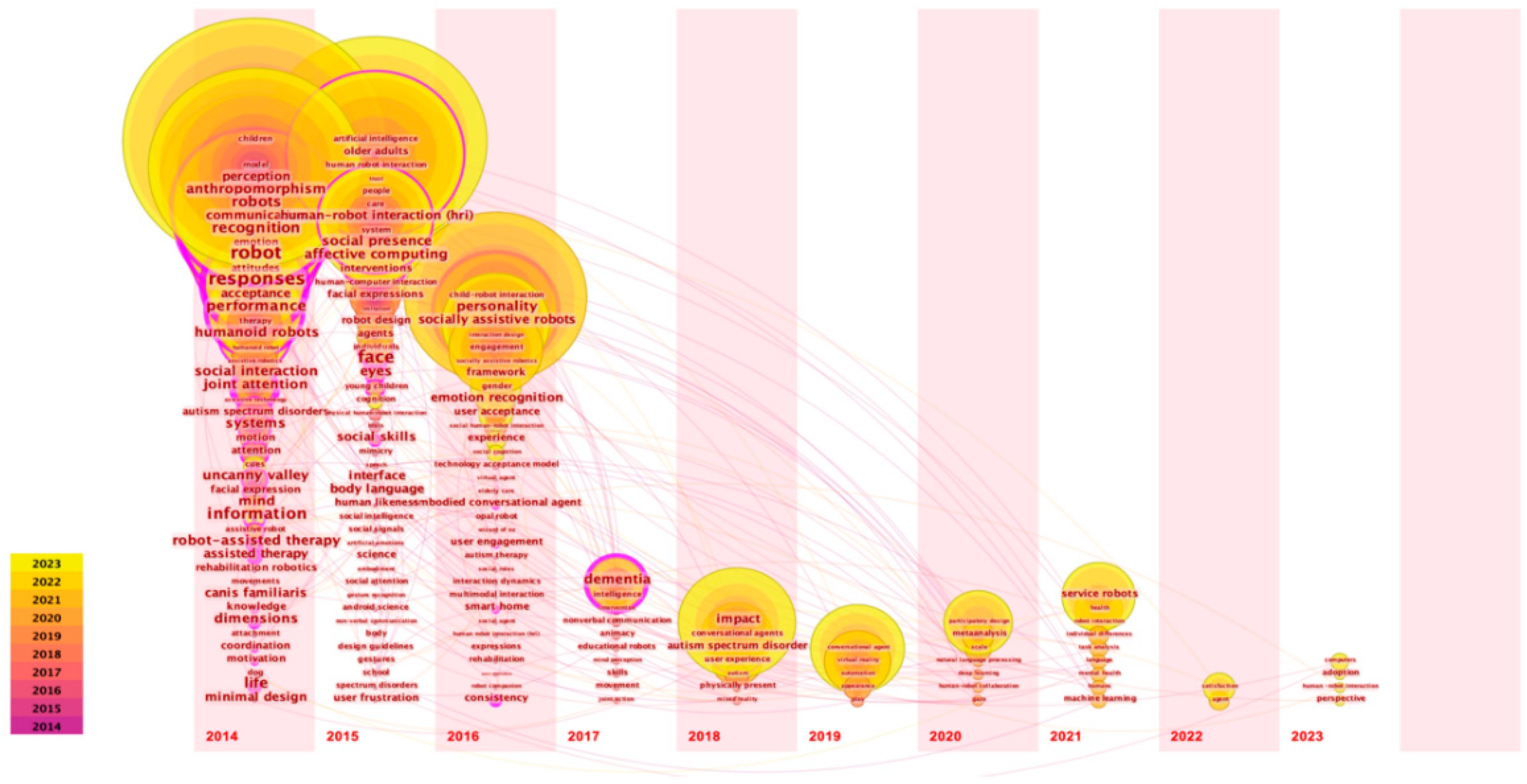
Figure 5.
Keywords Burst.
3.4. Knowledge Base of SR-HRI Research
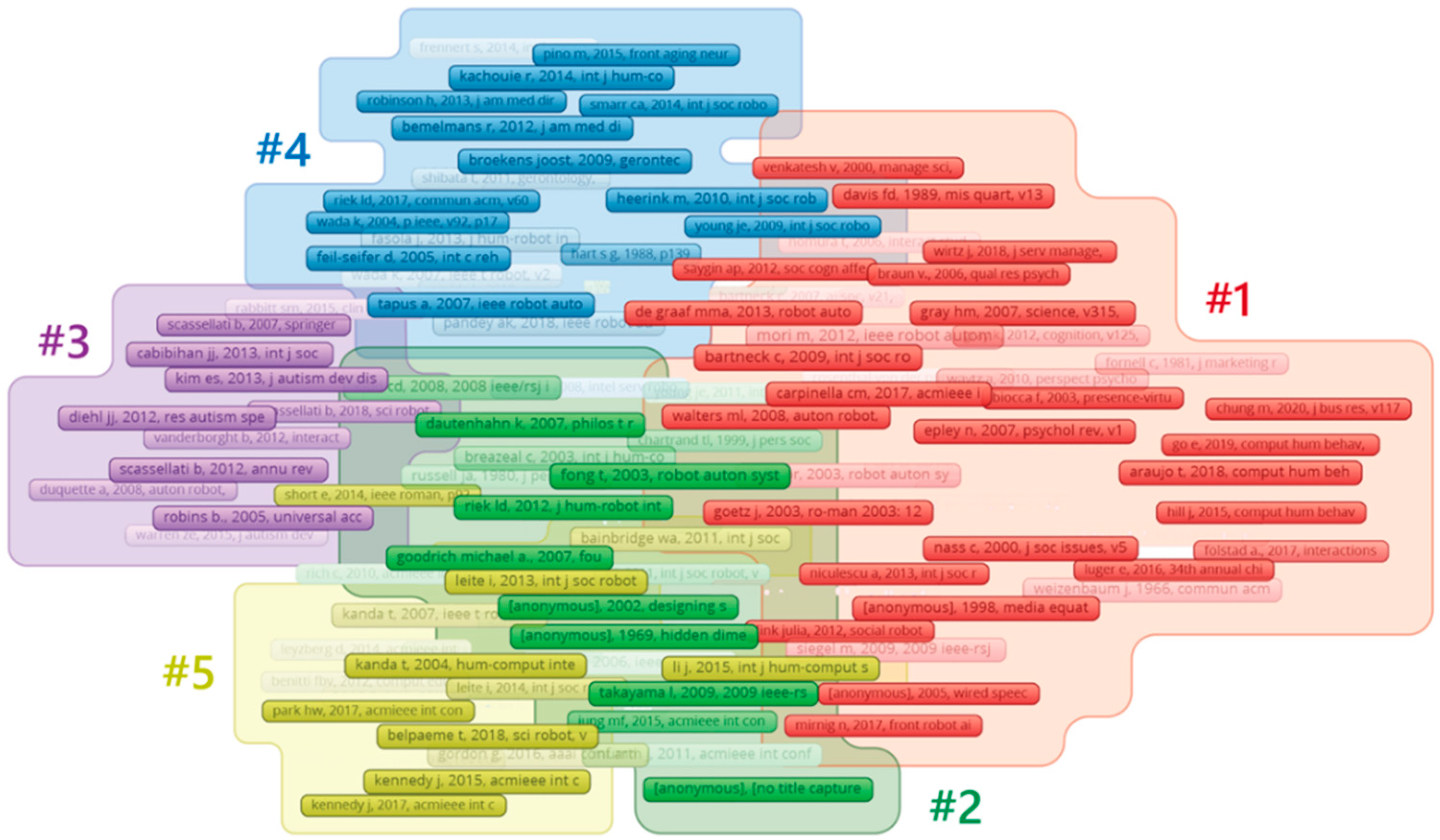
References form a co-citation relationship due to being cited in pairs in the citing documents, and the higher the co-citation strength between two papers, the more significant the correlation between them[99]. The co-citation frequency of a reference indicates its influence and importance in the research field[100,101]. This indicator can be used to understand which papers in a research field have received extensive attention and citations and which works have had a significant impact on the development of the field[39]. In order to further understand the knowledge structure and research foundation of the SRID field, we conducted a reference co-citation analysis. According to statistics, 75022 valid references from 44524 scholars were cited in the 2416 papers within the search scope. Based on VOSviewer, we extracted references with a citation frequency of no less than 20 in 2014-2023. We generated a reference co-citation cluster network of 300 references and 19,944 co-citation relationships, as shown in Figure 6. Consistent with the results of the keyword co-occurrence cluster, the reference co-citation cluster still forms five clusters: #1 The Study of Human-Robot Relationships In Social Robots, #2 Research on Emotional Design of Social Robots, #3 Research on Social Robots For Children’s Psychotherapy, #4 Research on Companion Robot For Elderly Rehabilitation, and #5 Research on Educational Social Robot. The papers in these five clusters constitute the most critical knowledge foundation in the field of SRID, connecting the research contents of different disciplines.
In Cluster #1 (The Study of Human-Robot Relationships In Social Robots), the article "Measurement Instruments For The Anthropomorphism, Animacy, Likeability, Perceived Intelligence, And Perceived Safety Of Robots" published by C Bartneck et al. in 2009 in the International Journal Of Social Robotics received the most attention, with a total of 201 citations in our co-citation network. Different from the traditional review, this study conducted a systematic literature review on Anthropomorphism, Animacy, Likeability, Perceived Intelligence, and Perceived Safety, which are the five key concepts of social robot design, as well as the measurement methodologies, and refined the final results into five semantic difference scales with high internal consistency, and this work provides the conceptual metrics basis for the study of human-robot relationship in social robots[102]. The second most cited paper is "Anthropomorphism and The Social Robot" by BR Duffy, published in Robotics and Autonomous Systems in 2003. The paper explores the mechanisms behind anthropomorphism and introduces the critical social features required for robots to participate in social interactions. Finally, it discusses how anthropomorphic design can be used so that users can more easily understand and rationalize their actions[10]. In addition, the paper "Machines and Mindlessness: Social Responses to Computers," published by Clifford Nass et al. in 2000, has also attracted much attention. This paper further validates the CASA paradigm by reviewing a series of experimental studies, proves that the depth of social response is related to the "personality" of the computer, and explains the psychological cognitive process behind this phenomenon. This paper represents the second generation of research within the CASA paradigm, which focuses on explaining the social responses generated in human-robot interactions to advance further research on human-robot relationships[56].
Cluster #2 (Research on the Emotional Design of Social Robots) consists mainly of classic literature related to emotional design of social robots. At the center of the cluster is “Emotion and Sociable Humanoid Robots,” a 2003 paper by C Breazeal, which focuses on the critical role of emotional expressive behavior in social interactions between users and anthropomorphic social robots. The paper takes the Kismet robot as an example to carry out the development and verification work, puts forward the key principles in the theory of emotion and its expression, and establishes the scientific basis for the emotion model and expression behavior of social robots. LD Riek’s 2012 article (the second most cited, 65 times) systematically reviewed 54 HRI Wizard of Oz experiments and proposed new experimental reporting standards to guide researchers to adopt more rigorous methodology to conduct and report HRI experiments and obtaining more convincing research conclusions[103]. The article "A Circumplex Model Of Affect," published by Prof. Russell, James Ain 1980, was the third most frequently cited article. This article proposed the emotional space model (CMA) to visualize the mechanism and process of emotional generation. In this model, Emotional concepts by: Pleasure (0°), Arousal (45°), Excitement (90°), Distress (135°), Displeasure (180°), Depression (225°), Sleepiness (270°), and Relaxation (315°) are arranged in a circular order. The model provides follow-up researchers with an expressive way to represent and assess the interrelatedness of emotional dimensions[104].
In Cluster #3 (Research on Social Robots for Children’s Psychotherapy), the article Keepon: A Playful Robot for Research, Therapy, And Entertainment is the most influential and is in the center of the co-citation network. The article designs and develops a Keepon Child Psychotherapy Robot and longitudinal field observations of typical preschool children and children with autism spectrum disorder using the modified robot. The results of the qualitative and quantitative analyses suggest that the Keepon robot can help children understand socially meaningful information and motivate them to share it. These findings also emphasize the significance of interaction style in establishing human-robot relationships[105]. Second is the 2005 paper by B Robins et al. in Universal Access in The Information Society, which describes a long-term longitudinal study of four children with autism spectrum disorder. Quantitative analyses showed an increase in the duration of predefined behaviors in the later experiments, while qualitative analyses indicated a further increase in social interaction skills (imitation, turn-taking, and role-switching) and communicative competence demonstrated by children in an interactive setting. The findings also confirm the necessity and benefits of long-term longitudinal studies of HRI[106]. This was followed by a paper by ES Kim et al. published in the Journal of Autism And Developmental Disorders in 2013. This paper examined the effects of interacting with three different objects, (1) an adult, (2) a touch-screen computer game, and (3) a social robot, on interaction outcomes in 4- 12-year-old children with autism spectrum disorders (ASD; N=24). Results indicated that children said more words when the interaction partner was a robot compared to a human or computer game partner, and the study makes a strong case for the great potential of social robots in developing social skills and psychotherapy[107].
In Cluster #4 (Research on Companion Robot for Elderly Rehabilitation), the most highly cited paper is "Assessing Acceptance of Assistive Social Agent Technology By Older Adults: The Almere Model." The article extended the Technology Acceptance Model and the UTAUT model to test the intention of older users to use assistive robots, with the model incorporating function-related variables (such as perceived usefulness and perceived ease of use) and social interaction-related variables to explain the use intention. Three different elderly robots were tested using controlled experiments and longitudinal data, and the results showed strong support for the model, accounting for 59-79% of the variance in intention to use and 49-59% of the variance in actual use[108]. The 2007 paper by K Wada et al. In order to investigate the psychological and social impact of robots, two therapeutic robots were introduced into an elderly care facility for a long-term follow-up experiment. The results showed that interaction with the robots increased their social interactions. In addition, physiological measurements showed that the subjects’ vital organ responses to stress improved after introducting of the robots[109]. The 2013 paper by J Fasola et al. discusses the design methodology and implementation details of a Social Assistive Robot (SAR) system to help older adults participate in physical activity, includes insights from psychological research into intrinsic motivation, and proposes a SAR-based therapy Five clear design principles for interventions. A multi-session user study of the elderly (N=33) also demonstrated the effectiveness of the SAR exercise system in terms of factors such as fun and social attractiveness[110].
In Cluster #5 (Research on Educational Social Robot), the review paper "Social Robots for Education: A Review" by T Belpaeme et al. was the most influential. This paper presents three critical studies by describing (1) What is the effect of robot tutors in achieving learning outcomes? (2) How do the appearance and behavior of robots affect learning outcomes? (3) What are the potential roles of robots in educational settings? The issue provides a comprehensive overview of the application of educational social robots[111]. The second most highly cited paper in cluster #5 is "Interactive Robots as Social Partners and Peer Tutors For Children: A Field Trial." The paper reports an 18-day field experiment in a Japanese elementary school to investigate how educational robots establish relationships with children. Experimental results suggest that robots may be more successful in establishing common ground and influence when children already have some initial proficiency or interest in English. These results suggest that the design of interactive robots should have something in common with their users, providing both social and technical challenges[112]. In addition, C Bartneck’s 2004 paper "A Design-Centered Framework For Social Human-Robot Interaction" has also attracted much attention. The paper proposes a framework for categorizing attributes of social robots such as form, morphology, social norms, autonomy, and interactivity, and provides extensive guidelines for designing social robots[113].
Figure 6.
Reference Co-Citation Cluster Network.
3.5. Distribution of SRID literature sources
Analyzing the citations and the number of papers of the literature sources can help researchers understand which journals/conferences are the literature sources that contribute the most to the SRID research field[43]. According to statistics, the 2416 valid documents within the scope of retrieval were published in 909 journals and conferences. Table 2 lists the top 10 high-impact journals/conferences in terms of total citations in the last decade, which accounted for 17.136% of the total number of publications. Among them, “International Journal of Social Robotics” is the journal with the most papers in this research field, containing 184 papers, and it also has the highest total citations, reflecting its significant influence in the field of human-robot interaction design for social robots. Next is "Computers in Human Behavior," with 39 publications and a total of 1268 citations. Ranked third is "Frontiers in Psychology," with 34 publications and 764 total citations. These journals/conferences come from different research fields, such as robotics, psychology, computer science, management, geriatrics, and more. It can be seen that SRID is a key research topic with solid interdisciplinary characteristics involving knowledge from multiple subject areas. According to the disciplinary statistical analysis of the WOS system, the 2416 documents are related to 83 major disciplines, and the top ten disciplines in terms of the number of publications are Computer Science, Robotics, Engineering, Automated Control Systems, Psychology, Business Economics, Education, Neuroscience, Sociology, and Telecommunications. These disciplinary subjects are important research areas for SRID, providing both theoretical foundations and methodological tools for SRID studies. Furthermore, SRID also provides valuable development opportunities for advancements in these disciplines. In addition, journals such as "International Journal of Human-Computer Studies," "ACM Transactions on Human-Robot Interaction," and "Interaction Studies" also have a high influence on SRID research.
Table 2.
Distribution of SR-HRI literature source (top 10).
| Ranking | Literature source | publisher | number of publications | citations | average number of citations |
|---|---|---|---|---|---|
| 1 | International Journal of Social Robotics | SPRINGER | 4010 | 184 | 21.793 |
| 2 | Computers in Human Behavior | ELSEVIER | 1268 | 39 | 32.512 |
| 3 | Frontiers in Psychology | FRONTIERS | 764 | 34 | 22.470 |
| 4 | International Journal of Human-Computer Studies | ELSEVIER | 734 | 22 | 33.363 |
| 5 | ACM/IEEE International Conference on Human-Robot Interaction(HRI2015) | ACM | 563 | 12 | 46.916 |
| 6 | International Journal of Contemporary Hospitality Management | EMERALD | 544 | 7 | 77.714 |
| 7 | Journal of The American Medical Directors Association | ELSEVIER | 440 | 4 | 110.034 |
| 8 | ACM/IEEE International Conference on Human-Robot Interaction(HRI2018) | ACM | 435 | 13 | 33.461 |
| 9 | Frontiers in Robotics and Ai | FRONTIERS | 388 | 69 | 5.623 |
| 10 | ACM/IEEE International Conference on Human-Robot Interaction(HRI2019) | ACM | 363 | 30 | 12.021 |
3.6. High-impact countries and research institutions
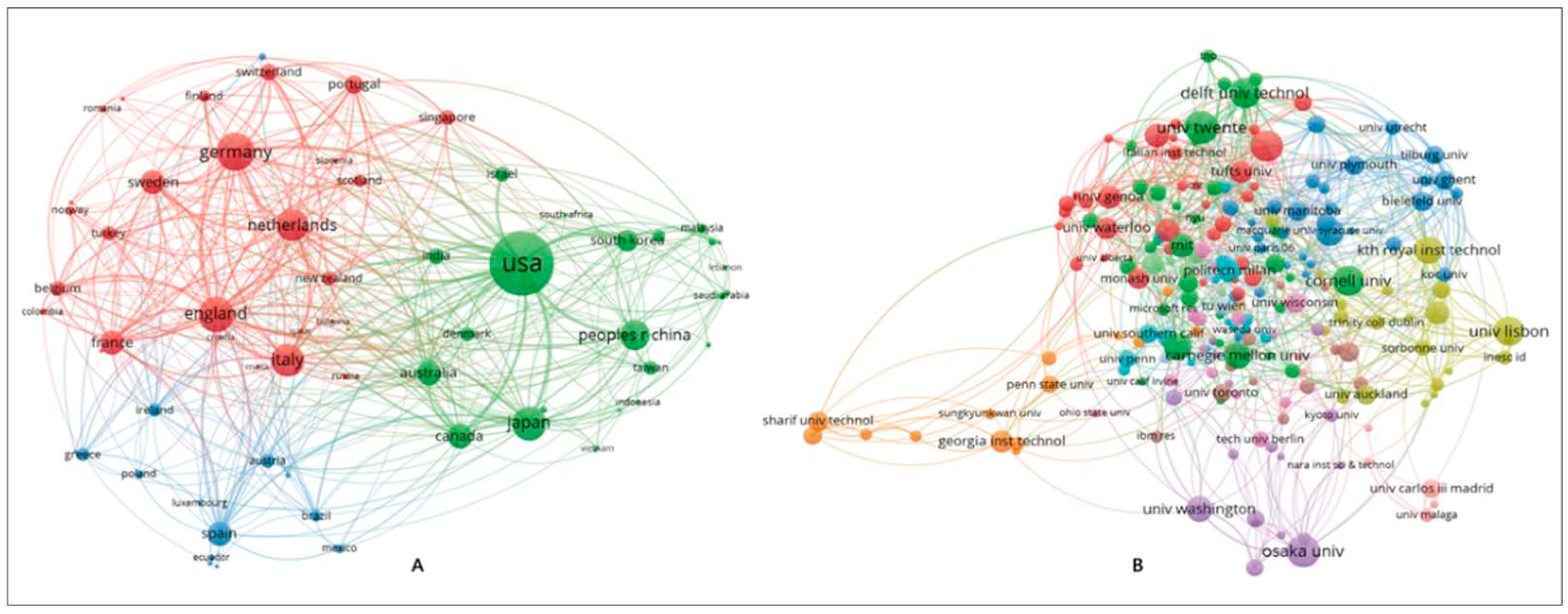
As seen in Figure 7A, a total of 80 countries/regions around the world have contributed to this research field of SRID, and three cooperative communities have been formed in terms of cooperation, dominated by the United States, Germany, and Spain. Among these, the United States is the most influential country, with the highest number of publications and total citations (642 publications, 9398 total citations), Followed by Germany (247 articles and 2,747 citations), the United Kingdom (216 articles and 3,719 citations), China (198 articles and 1,647 citations), Japan (196 articles and 1,791 citations), Italy (186 articles and 1,884 citations), New Zealand (179 articles and 2,535 citations), Australia (114 articles and 1,288 citations), the United States of America (194 articles and 1,688 citations), and Australia (114 articles and 1,288 citations). (198 articles, 1647 citations), Japan (196 articles, 1791 citations), Italy (186 articles, 1884 citations), New Zealand (179 articles, 2535 citations), Australia (114 articles, 1288 citations), and Canada (112 articles, 1491 citations). The publications of the top 10 countries accounted for 63.286% of the total number of publications, and their total citation counts are all above 100, which is an essential source of output for SRID research worldwide.
A total of 1959 research organizations worldwide have conducted SRID-related research in the last decade. Running VOSviewer and selecting Organizations to set the node threshold to 5, yielding a collaborative network of institutions with an annual node count of 218 as shown in Figure 7B. In terms of total citations, the top five research institutions were Stanford University (876 citations), followed by Massachusetts Institute of Technology (MIT) (781 citations), University of Auckland (761 citations), Hertfordshire University (707 citations), and the University of Twente (682 citations). In terms of publications, the top five research institutions are the University of Twente (41 papers), followed by Osaka University (39 papers), Eindhoven University of Technology (38 papers), Cornell University (36 papers), and Delft University of Technology (35 papers).
Figure 7.
7A is National Cooperation Network, 7B is Institutional Cooperation Network.
3.7. High impact author analysis
Through author co-citations, we can study the more active scholars in the field of SRID research around the world. A total of 7053 authors within the search scope have contributed to the research field of SRID. Table 3 lists the top 5 authors with high literature production and their respective total citations. Among them, Professor Paiva, Ana from the Polytechnic University of Lisbon published the most papers, with an H index of 43 and a total of 476 citations, and is ranked first with 30 publications within the search scope. followed by Ishiguro, Hiroshi (Osaka University, 29 papers, total cited 369 citations), Dautenhahn, Kerstin (University of Waterloo, 26 papers, total citations 599), Sabanovic, Selma (Indiana University, 24 papers, total citations 237), and Guy Hoffman (Cornell University, 21 papers, total citations 483). In addition, among the high-yield authors, Professor Broadbent, Elizabeth of the University of Auckland had the highest total citations, with 13 papers published within the search scope and a total of 729 citations, followed by Breazeal, Cynthia (16 papers, a total citation of 654), Dautenhahn , Kerstin (26 papers, total citations 599), Mutlu, Bilge (18 papers, total citations 550) and Guy Hoffman (21 papers, total citations 483). These high-impact authors are considered pioneers and significant contributors to SRH-RID research.
Table 3.
TOP5 high yield authors.
| Ranking | Author | Institution | Number of published papers | Number of citations | H index |
|---|---|---|---|---|---|
| 1 | Paiva, Ana | Polytechnic University of Lisbon | 30 | 476 | 43 |
| 2 | Ishiguro, Hiroshi | Osaka University | 29 | 369 | 54 |
| 3 | Dautenhahn, Kerstin | University of Waterloo | 26 | 599 | 56 |
| 4 | Sabanovic, Selma | Indiana University | 24 | 237 | 32 |
| 5 | Guy Hoffman | Cornell University | 21 | 483 | 33 |
4. Discussion
In the previous section, we identified the hot topics in the field of SRID research, the Classic foundational literature, and the research collaboration network, etc. In this section, we discuss the existing challenges and future research directions.
(1)More Realistic Research Scenarios: Current research is still dominated by laboratory studies, lacking research in real and complex natural interaction scenarios, and the results obtained in laboratory environments may have limitations in real-world applications. Research conducted in close to real-world contexts can help obtain more meaningful results and provide deeper insights of human behavior and robot interactions[114,115].
(2)Effective Measurement of Research Indicators: Current research presents difficulties and challenges in obtaining reliable data to evaluate human-social robot interactions. For example, commonly used questionnaires are not well suited for young children, and the measurement of some variables is easily affected by the state of the subject and the external environment, such as trust, user emotional state[26,37]. Therefore, there are still some challenges in how to effectively and objectively measure the true level of such latent variables and improve the reliability, validity and replicability of the data. This may require larger sample sizes, more diverse approaches for measuring variables, and richer types of data[29,55,116].
(3)Longitudinal Trial: Current research is mainly based on short-term experiments, while the interaction between humans and social robots is often a long-term process. Short-term experiments cannot capture the long-term effects and how human-robot interaction changes over time[117]. For example, in the case of social robots used for psychotherapy and online education, the evaluation of learning and psychotherapy effects is a long-term process. Future research could conduct more long-term longitudinal trials to provide more comprehensive data to support the conclusions, thus providing insights into the phenomenon and its mechanisms changing over time[118,119].
(4)More specific design strategies: Although the interaction design of social robots has accumulated a significant amount of research findings, the current research is relatively scattered and has not yet formed a comprehensive design framework[85,120,121]. Taking the research on psychotherapy social robots as an example, the current research focuses on the acceptance and the effectiveness and feasibility of robot intervention, while the basic research related to the robot interaction design and the user’s emotional experience is relatively weak, and the mapping mechanism between the interaction design factors and the healing effect is unclear. Therefore, in the future, it is necessary to study further the specific design features and specific design strategies of social robot interaction design, especially how the combination effect of different interaction design features will affect the efficiency of human-computer interaction and emotional experience[122].
(5)Uncovering the Psychological Cognitive Mechanisms behind User Behavior: There is a close interplay between the user’s psychological cognitive process, user experience, and user behavior[123,124,125]. Understanding the psychological cognitive process of users can help design social robots that better meet user needs and elicit positive emotions[73,126]. The current empirical research usually only gives general conclusions and lacks empirical studies that explain how the interaction design of social robots affects user perception and user behavioral responses from the perspective of user psychology and cognition[19,127,128]. Therefore, this will also be a future research direction.
5. Conclusions
This paper provides a comprehensive review of the literature related to social robot interaction design research in the last decade based on bibliometrics, with the main contributions of (1) identifying the critical research hotspots and emerging trends in this field over the past decade, (2) identifying the classic literature as well as the leading countries, journals, and authors that make up the knowledge structure of the field, and (3) discussing the challenges that the current social robot interaction design research is facing in terms of more authentic research scenarios, effective metrics for research indicators, longitudinal experimental design, more specific design strategies, and mining the mechanisms behind interaction behaviors, and presents potential research directions and opportunities. These findings can help scholars in this field gain a better understanding of the research structure and latest trends in social robot interaction design, and provide a solid foundation for further development.
6. Limitations and future research
To the best of our knowledge, this is the first scientific bibliometric study on social robot interaction design. Compared to narrative reviews, scientific bibliometric analyses can comprehensively guide HRI scholars in examining the history of development and emerging trends in social robot interaction design. Despite this study’s great potential and has provided valuable new insights, certain limitations must be considered. Firstly, in terms of data sources, although we chose the most representative Web of Science core collection as the data source for our study, relying on a single database may bias our findings. Therefore, in the future, it is necessary to use data from more databases for supplementary research, such as using related publications from other databases such as "Scopus" to make the conclusions more comprehensive[51]. Second, our analysis focused only on journal and conference papers, excluding "books" and "dissertations," and the search was limited to English-language publications. Future research could also revisit SRID with more diverse data types[129]. Finally, more recent trends are not necessarily detected by the various co-cited networks since most recent publications are not sufficiently cited[130]
Author Contributions
methodology, Jianmin Wang.; software, Yongkang Chen.; validation, Fusheng Jia, and Yongkang Chen.; data curation, Jianmin Wang; writing—original draft preparation, Yongkang Chen.; writing—review and editing, Fang You.
Funding
The author(s) received no specific funding for this work.
Disclosure statement
No potential conflict of interest was reported by the authors.
References
- Eyssel, Friederike, and Dieta Kuchenbrandt. "Social Categorization of Social Robots: Anthropomorphism as a Function of Robot Group Membership." British Journal of Social Psychology 51, no. 4 (2012): 724-31. [CrossRef]
- ou, Xiao, Chih-Fu Wu, Kai-Chieh Lin, Senzhong Gan, and Tzu-Min Tseng. "Effects of Different Types of Social Robot Voices on Affective Evaluations in Different Application Fields." International Journal of Social Robotics 13 (2021): 615-28. [CrossRef]
- Alenljung, Beatrice, Jessica Lindblom, Rebecca Andreasson, and Tom Ziemke. "User Experience in Social Human-Robot Interaction." In Rapid Automation: Concepts, Methodologies, Tools, and Applications, 1468-90: IGI Global, 2019. [CrossRef]
- Van Pinxteren, Michelle ME, Ruud WH Wetzels, Jessica Rüger, Mark Pluymaekers, and Martin Wetzels. "Trust in Humanoid Robots: Implications for Services Marketing." Journal of Services Marketing (2019). [CrossRef]
- Rueben, Matthew, Alexander Mois Aroyo, Christoph Lutz, Johannes Schmölz, Pieter Van Cleynenbreugel, Andrea Corti, Siddharth Agrawal, and William D Smart. "Themes and Research Directions in Privacy-Sensitive Robotics." Paper presented at the 2018 IEEE workshop on advanced robotics and its social impacts (ARSO) 2018.
- Christoforakos, Lara, Alessio Gallucci, Tinatini Surmava-Große, Daniel Ullrich, and Sarah Diefenbach. "Can Robots Earn Our Trust the Same Way Humans Do? A Systematic Exploration of Competence, Warmth, and Anthropomorphism as Determinants of Trust Development in Hri." Frontiers in Robotics and AI 8 (2021): 79.
- Chatterjee, Sheshadri, Soumya Kanti Ghosh, Ranjan Chaudhuri, and Bang Nguyen. "Are Crm Systems Ready for Ai Integration?" The Bottom Line 32, no. 2 (2019): 144-57.
- Atman Uslu, Nilüfer, Gulay Öztüre Yavuz, and Yasemin Koçak Usluel. "A Systematic Review Study on Educational Robotics and Robots." Interactive Learning Environments (2022): 1-25.
- Park, Sungjun S, ChunTing D Tung, and Heejung Lee. "The Adoption of Ai Service Robots: A Comparison between Credence and Experience Service Settings." Psychology & Marketing 38, no. 4 (2021): 691-703. [CrossRef]
- Duffy, Brian R. "Anthropomorphism and the Social Robot." Robotics and Autonomous Systems 42, no. 3-4 (2003): 177-90. [CrossRef]
- Chung, Hanna, Hyunmin Kang, and Soojin Jun. "Verbal Anthropomorphism Design of Social Robots: Investigating Users’ Privacy Perception." Computers in Human Behavior 142 (2023): 107640. [CrossRef]
- Khan, Sara, and Claudio Germak. "Reframing Hri Design Opportunities for Social Robots: Lessons Learnt from a Service Robotics Case Study Approach Using Ux for Hri." Future internet 10, no. 10 (2018): 101. [CrossRef]
- Deutsch, Inbal, Hadas Erel, Michal Paz, Guy Hoffman, and Oren Zuckerman. "Home Robotic Devices for Older Adults: Opportunities and Concerns." Computers in Human Behavior 98 (2019): 122-33. [CrossRef]
- Yang, Daseul, Yu-Jung Chae, Doogon Kim, Yoonseob Lim, Dong Hwan Kim, ChangHwan Kim, Sung-Kee Park, and Changjoo Nam. "Effects of Social Behaviors of Robots in Privacy-Sensitive Situations." International Journal of Social Robotics (2021): 1-14. [CrossRef]
- Babel, Franziska, Johannes Kraus, Linda Miller, Matthias Kraus, Nicolas Wagner, Wolfgang Minker, and Martin Baumann. "Small Talk with a Robot? The Impact of Dialog Content, Talk Initiative, and Gaze Behavior of a Social Robot on Trust, Acceptance, and Proximity." International Journal of Social Robotics (2021): 1-14.
- Yang, Yang, Yue Liu, Xingyang Lv, Jin Ai, and Yifan Li. "Anthropomorphism and Customers’ Willingness to Use Artificial Intelligence Service Agents." Journal of Hospitality Marketing & Management (2021): 1-23. [CrossRef]
- Segijn, Claire M, Joanna Strycharz, Amy Riegelman, and Cody Hennesy. "A Literature Review of Personalization Transparency and Control: Introducing the Transparency–Awareness–Control Framework." Media and Communication 9, no. 4 (2021): 120-33. [CrossRef]
- Fronemann, Nora, Kathrin Pollmann, and Wulf Loh. "Should My Robot Know What’s Best for Me? Human–Robot Interaction between User Experience and Ethical Design." AI & SOCIETY 37, no. 2 (2022): 517-33.
- Giger, Jean-Christophe, Nuno Piçarra, Patrícia Alves-Oliveira, Raquel Oliveira, and Patrícia Arriaga. "Humanization of Robots: Is It Really Such a Good Idea?" Human Behavior and Emerging Technologies 1, no. 2 (2019): 111-23.
- Lin, Hongxia, Oscar Hengxuan Chi, and Dogan Gursoy. "Antecedents of Customers’ Acceptance of Artificially Intelligent Robotic Device Use in Hospitality Services." Journal of Hospitality Marketing & Management 29, no. 5 (2020): 530-49. [CrossRef]
- Tranfield, David, David Denyer, and Palminder Smart. "Towards a Methodology for Developing Evidence-Informed Management Knowledge by Means of Systematic Review." British journal of management 14, no. 3 (2003): 207-22. [CrossRef]
- Al-Emran, Mostafa, Vitaliy Mezhuyev, and Adzhar Kamaludin. "Technology Acceptance Model in M-Learning Context: A Systematic Review." Computers & Education 125 (2018): 389-412. [CrossRef]
- Suru, H Umar, and Pietro Murano. "Security and User Interface Usability of Graphical Authentication Systems–a Review." International Journal of Engineering Trends and Technology (IJERT) 67 (2019): 17-36.
- Gunesekera, Asela Indunil, Yukun Bao, and Mboni Kibelloh. "The Role of Usability on E-Learning User Interactions and Satisfaction: A Literature Review." Journal of Systems and Information Technology (2019). [CrossRef]
- Tan, Hao, Jialing Li, Min He, Jiayu Li, Dan Zhi, Fanzhi Qin, and Chen Zhang. "Global Evolution of Research on Green Energy and Environmental Technologies: A Bibliometric Study." Journal of Environmental Management 297 (2021): 113382. [CrossRef]
- de Wit, Jan, Paul Vogt, and Emiel Krahmer. "The Design and Observed Effects of Robot-Performed Manual Gestures: A Systematic Review." ACM Transactions on Human-Robot Interaction 12, no. 1 (2023): 1-62.
- Robinson, Nicole, Brendan Tidd, Dylan Campbell, Dana Kulić, and Peter Corke. "Robotic Vision for Human-Robot Interaction and Collaboration: A Survey and Systematic Review." ACM Transactions on Human-Robot Interaction 12, no. 1 (2023): 1-66. [CrossRef]
- Mahdi, Hamza, Sami Alperen Akgun, Shahed Saleh, and Kerstin Dautenhahn. "A Survey on the Design and Evolution of Social Robots—Past, Present and Future." Robotics and Autonomous Systems (2022): 104193.
- Loveys, Kate, Gabrielle Sebaratnam, Mark Sagar, and Elizabeth Broadbent. "The Effect of Design Features on Relationship Quality with Embodied Conversational Agents: A Systematic Review." International Journal of Social Robotics 12, no. 6 (2020): 1293-312. [CrossRef]
- Lim, Velvetina, Maki Rooksby, and Emily S Cross. "Social Robots on a Global Stage: Establishing a Role for Culture During Human–Robot Interaction." International Journal of Social Robotics 13, no. 6 (2021): 1307-33. [CrossRef]
- Stock-Homburg, Ruth. "Survey of Emotions in Human–Robot Interactions: Perspectives from Robotic Psychology on 20 Years of Research." International Journal of Social Robotics 14, no. 2 (2022): 389-411. [CrossRef]
- Park, Sung, and Mincheol Whang. "Empathy in Human–Robot Interaction: Designing for Social Robots." International journal of environmental research and public health 19, no. 3 (2022): 1889.
- Song, Yao, and Yan Luximon. "Trust in Ai Agent: A Systematic Review of Facial Anthropomorphic Trustworthiness for Social Robot Design." Sensors 20, no. 18 (2020): 5087. [CrossRef]
- de Jong, Chiara, Jochen Peter, Rinaldo Kühne, and Alex Barco. "Children’s Acceptance of Social Robots: A Narrative Review of the Research 2000–2017." Interaction Studies 20, no. 3 (2019): 393-425.
- Gasteiger, Norina, Kate Loveys, Mikaela Law, and Elizabeth Broadbent. "Friends from the Future: A Scoping Review of Research into Robots and Computer Agents to Combat Loneliness in Older People." Clinical interventions in aging (2021): 941-71. [CrossRef]
- Rasouli, Samira, Garima Gupta, Elizabeth Nilsen, and Kerstin Dautenhahn. "Potential Applications of Social Robots in Robot-Assisted Interventions for Social Anxiety." International Journal of Social Robotics 14, no. 5 (2022): 1-32. [CrossRef]
- Kabacińska, Katarzyna, Tony J Prescott, and Julie M Robillard. "Socially Assistive Robots as Mental Health Interventions for Children: A Scoping Review." International Journal of Social Robotics 13 (2021): 919-35. [CrossRef]
- Abbasi, Nida Itrat, Micol Spitale, Peter B Jones, and Hatice Gunes. "Measuring Mental Wellbeing of Children Via Human-Robot Interaction: Challenges and Opportunities." Interaction Studies 23, no. 2 (2022): 157-203.
- Liu, Li, and Vincent G Duffy. "Exploring the Future Development of Artificial Intelligence (Ai) Applications in Chatbots: A Bibliometric Analysis." International Journal of Social Robotics 15, no. 5 (2023): 703-16. [CrossRef]
- Van Eck, Nees, and Ludo Waltman. "Software Survey: Vosviewer, a Computer Program for Bibliometric Mapping." scientometrics 84, no. 2 (2010): 523-38.
- Chen, Chaomei. "Citespace Ii: Detecting and Visualizing Emerging Trends and Transient Patterns in Scientific Literature." Journal of the American Society for Information Science and Technology 57, no. 3 (2006): 359-77. [CrossRef]
- Rheu, Minjin, Ji Youn Shin, Wei Peng, and Jina Huh-Yoo. "Systematic Review: Trust-Building Factors and Implications for Conversational Agent Design." International Journal of Human–Computer Interaction 37, no. 1 (2021): 81-96. [CrossRef]
- Aghimien, Douglas Omoregie, Clinton Ohis Aigbavboa, Ayodeji Emmanuel Oke, and Wellington Didibhuku Thwala. "Mapping out Research Focus for Robotics and Automation Research in Construction-Related Studies: A Bibliometric Approach." Journal of Engineering, Design and Technology 18, no. 5 (2020): 1063-79.
- Li, Jie, Floris Goerlandt, Genserik Reniers, and Bin Zhang. "Sam Mannan and His Scientific Publications: A Life in Process Safety Research." Journal of Loss Prevention in the Process Industries 66 (2020): 104140. [CrossRef]
- Achuthan, Krishnashree, Vinith Kumar Nair, Robin Kowalski, Sasangan Ramanathan, and Raghu Raman. "Cyberbullying Research—Alignment to Sustainable Development and Impact of Covid-19: Bibliometrics and Science Mapping Analysis." Computers in Human Behavior 140 (2023): 107566. [CrossRef]
- Mongeon, Philippe, and Adèle Paul-Hus. "The Journal Coverage of Web of Science and Scopus: A Comparative Analysis." scientometrics 106 (2016): 213-28. [CrossRef]
- Glanzel, Wolfang. Bibliometrics as a Research Field a Course on Theory and Application of Bibliometric Indicators, 2003.
- Bitkina, Olga Vl, Hyun K Kim, and Jaehyun Park. "Usability and User Experience of Medical Devices: An Overview of the Current State, Analysis Methodologies, and Future Challenges." International Journal of industrial ergonomics 76 (2020): 102932.
- Gobster, Paul H. "(Text) Mining the Landscape: Themes and Trends over 40 Years of Landscape and Urban Planning." 21-30: Elsevier, 2014. [CrossRef]
- Chen Yongkang, Jiang Yuhao, He Ke, and Wu Xingting." Research progress, hotspot and trend analysis of emotional design based on bibliometrics." Packaging Engineering 43, no. 06 (2022): 32-40.
- Tan, Hao, Jiahao Sun, Wang Wenjia, and Chunpeng Zhu. "User Experience & Usability of Driving: A Bibliometric Analysis of 2000-2019." International Journal of Human–Computer Interaction 37, no. 4 (2021): 297-307. [CrossRef]
- Van Eck, Nees Jan, and Ludo Waltman. "Software Survey: Vosviewer, a Computer Program for Bibliometric Mapping." scientometrics 84, no. 2 (2010): 523-38.
- Frey, Brendan J, and Delbert Dueck. "Clustering by Passing Messages between Data Points." science 315, no. 5814 (2007): 972-76. [CrossRef]
- Reeves, Byron, and Clifford Nass. "The Media Equation: How People Treat Computers, Television, and New Media Like Real People." Cambridge, UK 10 (1996): 236605.
- Song, Yao, Da Tao, and Yan Luximon. "In Robot We Trust? The Effect of Emotional Expressions and Contextual Cues on Anthropomorphic Trustworthiness." Applied ergonomics 109 (2023): 103967. [CrossRef]
- Nass, Clifford, and Youngme Moon. "Machines and Mindlessness: Social Responses to Computers." Journal of social Issues 56, no. 1 (2000): 81-103. [CrossRef]
- Kirby, Rachel, Jodi Forlizzi, and Reid Simmons. "Affective Social Robots." Robotics and Autonomous Systems 58, no. 3 (2010): 322-32.
- Foehr, Jonas, and Claas Christian Germelmann. "Alexa, Can I Trust You? Exploring Consumer Paths to Trust in Smart Voice-Interaction Technologies." Journal of the Association for Consumer Research 5, no. 2 (2020): 181-205. [CrossRef]
- Pfeifle, Anne. "Alexa, What Should We Do About Privacy: Protecting Privacy for Users of Voice-Activated Devices." Wash. L. Rev. 93 (2018): 421.
- Benke, Ivo, Ulrich Gnewuch, and Alexander Maedche. "Understanding the Impact of Control Levels over Emotion-Aware Chatbots." Computers in Human Behavior 129 (2022): 107122. [CrossRef]
- Li, Xinge, and Yongjun Sung. "Anthropomorphism Brings Us Closer: The Mediating Role of Psychological Distance in User–Ai Assistant Interactions." Computers in Human Behavior 118 (2021): 106680. [CrossRef]
- Chopdar, Prasanta Kr, and Janarthanan Balakrishnan. "Consumers Response Towards Mobile Commerce Applications: Sor Approach." International Journal of Information Management 53 (2020): 102106. [CrossRef]
- Mende, Martin, Maura L Scott, Jenny van Doorn, Dhruv Grewal, and Ilana Shanks. "Service Robots Rising: How Humanoid Robots Influence Service Experiences and Elicit Compensatory Consumer Responses." Journal of Marketing Research 56, no. 4 (2019): 535-56. [CrossRef]
- Lyons, Joseph B, Kevin T Wynne, Sean Mahoney, and Mark A Roebke. "Trust and Human-Machine Teaming: A Qualitative Study." In Artificial Intelligence for the Internet of Everything, 101-16: Elsevier, 2019.
- Liu, Sunny Xun, Qi Shen, and Jeff Hancock. "Can a Social Robot Be Too Warm or Too Competent? Older Chinese Adults’ Perceptions of Social Robots and Vulnerabilities." Computers in Human Behavior 125 (2021): 106942. [CrossRef]
- Bekey, George A. "Current Trends in Robotics: Technology and Ethics." Robot ethics: The ethical and social implications of robotics (2012): 17-34.
- Gnambs, Timo, and Markus Appel. "Are Robots Becoming Unpopular? Changes in Attitudes Towards Autonomous Robotic Systems in Europe." Computers in Human Behavior 93 (2019): 53-61. [CrossRef]
- Broadbent, Elizabeth, Rie Tamagawa, Anna Patience, Brett Knock, Ngaire Kerse, Karen Day, and Bruce A MacDonald. "Attitudes Towards Health-Care Robots in a Retirement Village." Australasian journal on ageing 31, no. 2 (2012): 115-20. [CrossRef]
- Lee, Kwan Min, Wei Peng, Seung-A Jin, and Chang Yan. "Can Robots Manifest Personality?: An Empirical Test of Personality Recognition, Social Responses, and Social Presence in Human–Robot Interaction." Journal of communication 56, no. 4 (2006): 754-72.
- Lutz, Christoph, Aurelia Tamò, and A Guzman. "Communicating with Robots: Antalyzing the Interaction between Healthcare Robots and Humans with Regards to Privacy." Human-machine communication: rethinking communication, technology, and ourselves (2018): 145-65.
- Breazeal, Cynthia. "Emotion and Sociable Humanoid Robots." International Journal of Human-Computer Studies 59, no. 1-2 (2003): 119-55.
- Dautenhahn, Kerstin. "Socially Intelligent Robots: Dimensions of Human–Robot Interaction." Philosophical transactions of the royal society B: Biological sciences 362, no. 1480 (2007): 679-704.
- Park, Jonghwa, Hanbyul Choi, and Yoonhyuk Jung. "Users’ Cognitive and Affective Response to the Risk to Privacy from a Smart Speaker." International Journal of Human–Computer Interaction 37, no. 8 (2021): 759-71. [CrossRef]
- Kontogiorgos, Dimosthenis, Andre Pereira, Olle Andersson, Marco Koivisto, Elena Gonzalez Rabal, Ville Vartiainen, and Joakim Gustafson. "The Effects of Anthropomorphism and Non-Verbal Social Behaviour in Virtual Assistants." Paper presented at the Proceedings of the 19th ACM International Conference on Intelligent Virtual Agents 2019.
- Davison, Daniel P, Frances M Wijnen, Jan van der Meij, Dennis Reidsma, and Vanessa Evers. "Designing a Social Robot to Support Children’s Inquiry Learning: A Contextual Analysis of Children Working Together at School." International Journal of Social Robotics 12 (2020): 883-907. [CrossRef]
- Provoost, Simon, Ho Ming Lau, Jeroen Ruwaard, and Heleen Riper. "Embodied Conversational Agents in Clinical Psychology: A Scoping Review." Journal of Medical Internet Research 19, no. 5 (2017): e151. [CrossRef]
- Guemghar, Imane, Paula Pires de Oliveira Padilha, Amal Abdel-Baki, Didier Jutras-Aswad, Jesseca Paquette, and Marie-Pascale Pomey. "Social Robot Interventions in Mental Health Care and Their Outcomes, Barriers, and Facilitators: Scoping Review." JMIR mental health 9, no. 4 (2022): e36094.
- Pauw, Lisanne S, Disa A Sauter, Gerben A van Kleef, Gale M Lucas, Jonathan Gratch, and Agneta H Fischer. "The Avatar Will See You Now: Support from a Virtual Human Provides Socio-Emotional Benefits." Computers in Human Behavior 136 (2022): 107368. [CrossRef]
- Zhang, Yaoxin, Wenxu Song, Zhenlin Tan, Huilin Zhu, Yuyin Wang, Cheuk Man Lam, Yifang Weng, Sio Pan Hoi, Haoyang Lu, and Bella Siu Man Chan. "Could Social Robots Facilitate Children with Autism Spectrum Disorders in Learning Distrust and Deception?" Computers in Human Behavior 98 (2019): 140-49.
- Schweinberger, Stefan R, Maike Pohl, and Paul Winkler. "Autistic Traits, Personality, and Evaluations of Humanoid Robots by Young and Older Adults." Computers in Human Behavior 106 (2020): 106256. [CrossRef]
- Bendig, Eileen, Benjamin Erb, Lea Schulze-Thuesing, and Harald Baumeister. "The Next Generation: Chatbots in Clinical Psychology and Psychotherapy to Foster Mental Health–a Scoping Review." Verhaltenstherapie (2019): 1-13. [CrossRef]
- David, Daniel, Silviu-Andrei Matu, and Oana Alexandra David. "Robot-Based Psychotherapy: Concepts Development, State of the Art, and New Directions." International Journal of Cognitive Therapy 7, no. 2 (2014): 192-210.
- Riches, Simon, Lisa Azevedo, Alkesh Vora, Ina Kaleva, Lawson Taylor, Peipei Guan, Priyanga Jeyarajaguru, Harley McIntosh, Constantina Petrou, and Sara Pisani. "Therapeutic Engagement in Robot-Assisted Psychological Interventions: A Systematic Review." Clinical Psychology & Psychotherapy 29, no. 3 (2022): 857-73. [CrossRef]
- De’Aira, G Bryant, Jin Xu, Yu-Ping Chen, and Ayanna Howard. "The Effect of Robot Vs. Human Corrective Feedback on Children’s Intrinsic Motivation." Paper presented at the 2019 14th ACM/IEEE International Conference on Human-Robot Interaction (HRI) 2019.
- Zhang, Andong, and Pei-Luen Patrick Rau. "Tools or Peers? Impacts of Anthropomorphism Level and Social Role on Emotional Attachment and Disclosure Tendency Towards Intelligent Agents." Computers in Human Behavior 138 (2023): 107415. [CrossRef]
- Robinson, Nicole L, and David J Kavanagh. "A Social Robot to Deliver a Psychotherapeutic Treatment: Qualitative Responses by Participants in a Randomized Controlled Trial and Future Design Recommendations." International Journal of Human-Computer Studies 155 (2021): 102700. [CrossRef]
- Chattaraman, Veena, Wi-Suk Kwon, Juan E Gilbert, and Kassandra Ross. "Should Ai-Based, Conversational Digital Assistants Employ Social-or Task-Oriented Interaction Style? A Task-Competency and Reciprocity Perspective for Older Adults." Computers in Human Behavior 90 (2019): 315-30. [CrossRef]
- Wu, Ya-Huei, Jérémy Wrobel, Mélanie Cornuet, Hélène Kerhervé, Souad Damnée, and Anne-Sophie Rigaud. "Acceptance of an Assistive Robot in Older Adults: A Mixed-Method Study of Human–Robot Interaction over a 1-Month Period in the Living Lab Setting." Clinical interventions in aging 9 (2014): 801. [CrossRef]
- Morillo-Mendez, Lucas, Martien GS Schrooten, Amy Loutfi, and Oscar Martinez Mozos. "Age-Related Differences in the Perception of Robotic Referential Gaze in Human-Robot Interaction." International Journal of Social Robotics (2022): 1-13. [CrossRef]
- Asgharian, Pouyan, Adina M Panchea, and François Ferland. "A Review on the Use of Mobile Service Robots in Elderly Care." Robotics 11, no. 6 (2022): 127. [CrossRef]
- Sasidharan, Vinod, Laura Payne, Elizabeth Orsega-Smith, and Geoffrey Godbey. "Older Adults’ Physical Activity Participation and Perceptions of Wellbeing: Examining the Role of Social Support for Leisure." Managing Leisure 11, no. 3 (2006): 164-85. [CrossRef]
- Fasola, Juan, and Maja J Mataric. "Using Socially Assistive Human–Robot Interaction to Motivate Physical Exercise for Older Adults." Proceedings of the IEEE 100, no. 8 (2012): 2512-26.
- Li Sijia, Ni Shiguang, Wang Xuqian, and Peng Kaiping." Socially assisted robots: Exploring a new approach to mental health care for the elderly." Chinese Journal of Clinical Psychology, 25, no. 06 (2017): 1191-96.
- Akalin, Neziha, Annica Kristoffersson, and Amy Loutfi. "Do You Feel Safe with Your Robot? Factors Influencing Perceived Safety in Human-Robot Interaction Based on Subjective and Objective Measures." International Journal of Human-Computer Studies 158 (2022): 102744. [CrossRef]
- Chew, Esyin, Umer Sikander Khan, and Pei Hsi Lee. "Designing a Novel Robot Activist Model for Interactive Child Rights Education." International Journal of Social Robotics 13, no. 7 (2021): 1641-55. [CrossRef]
- Reich-Stiebert, Natalia, Friederike Eyssel, and Charlotte Hohnemann. "Exploring University Students’ Preferences for Educational Robot Design by Means of a User-Centered Design Approach." International Journal of Social Robotics 12 (2020): 227-37. [CrossRef]
- Konijn, Elly A, and Johan F Hoorn. "Robot Tutor and Pupils’ Educational Ability: Teaching the Times Tables." Computers & Education 157 (2020): 103970. [CrossRef]
- Kleinberg, Jon. "Bursty and Hierarchical Structure in Streams." Data mining and knowledge discovery 7, no. 4 (2003): 373-97.
- Theodoraki, Christina, Léo-Paul Dana, and Andrea Caputo. "Building Sustainable Entrepreneurial Ecosystems: A Holistic Approach." Journal of Business Research 140 (2022): 346-60. [CrossRef]
- Small, Henry. "Co-Citation in the Scientific Literature: A New Measure of the Relationship between Two Documents." Journal of the American Society for information Science 24, no. 4 (1973): 265-69. [CrossRef]
- Chen, Chaomei, Fidelia Ibekwe-SanJuan, and Jianhua Hou. "The Structure and Dynamics of Cocitation Clusters: A Multiple-Perspective Cocitation Analysis." Journal of the American Society for Information Science and Technology 61, no. 7 (2010): 1386-409. [CrossRef]
- Bartneck, Christoph, Dana Kulić, Elizabeth Croft, and Susana Zoghbi. "Measurement Instruments for the Anthropomorphism, Animacy, Likeability, Perceived Intelligence, and Perceived Safety of Robots." International Journal of Social Robotics 1 (2009): 71-81.
- Riek, Laurel D. "Wizard of Oz Studies in Hri: A Systematic Review and New Reporting Guidelines." Journal of Human-Robot Interaction 1, no. 1 (2012): 119-36. [CrossRef]
- Russell, James A. "A Circumplex Model of Affect." Journal of personality and social psychology 39, no. 6 (1980): 1161.
- Kozima, Hideki, Marek P Michalowski, and Cocoro Nakagawa. "Keepon: A Playful Robot for Research, Therapy, and Entertainment." International Journal of Social Robotics 1 (2009): 3-18.
- Robins, Ben, Kerstin Dautenhahn, R Te Boekhorst, and Aude Billard. "Robotic Assistants in Therapy and Education of Children with Autism: Can a Small Humanoid Robot Help Encourage Social Interaction Skills?" Universal Access in the Information Society 4 (2005): 105-20.
- Kim, Elizabeth S, Lauren D Berkovits, Emily P Bernier, Dan Leyzberg, Frederick Shic, Rhea Paul, and Brian Scassellati. "Social Robots as Embedded Reinforcers of Social Behavior in Children with Autism." Journal of autism and developmental disorders 43 (2013): 1038-49. [CrossRef]
- Heerink, Marcel, Ben Kröse, Vanessa Evers, and Bob Wielinga. "Assessing Acceptance of Assistive Social Agent Technology by Older Adults: The Almere Model." International Journal of Social Robotics 2, no. 4 (2010): 361-75. [CrossRef]
- Wada, Kazuyoshi, and Takanori Shibata. "Living with Seal Robots—Its Sociopsychological and Physiological Influences on the Elderly at a Care House." IEEE transactions on robotics 23, no. 5 (2007): 972-80. [CrossRef]
- Fasola, Juan, and Maja J Matarić. "A Socially Assistive Robot Exercise Coach for the Elderly." Journal of Human-Robot Interaction 2, no. 2 (2013): 3-32. [CrossRef]
- Belpaeme, Tony, James Kennedy, Aditi Ramachandran, Brian Scassellati, and Fumihide Tanaka. "Social Robots for Education: A Review." Science robotics 3, no. 21 (2018): eaat5954. [CrossRef]
- Kanda, Takayuki, Takayuki Hirano, Daniel Eaton, and Hiroshi Ishiguro. "Interactive Robots as Social Partners and Peer Tutors for Children: A Field Trial." Human–Computer Interaction 19, no. 1-2 (2004): 61-84.
- Bartneck, Christoph, and Jodi Forlizzi. "A Design-Centred Framework for Social Human-Robot Interaction." Paper presented at the RO-MAN 2004. 13th IEEE international workshop on robot and human interactive communication (IEEE Catalog No. 04TH8759) 2004.
- Schmidt, Frank L, and John E Hunter. "Measurement Error in Psychological Research: Lessons from 26 Research Scenarios." Psychological methods 1, no. 2 (1996): 199.
- Smeds, Karolina, Florian Wolters, and Martin Rung. "Estimation of Signal-to-Noise Ratios in Realistic Sound Scenarios." Journal of the American Academy of Audiology 26, no. 02 (2015): 183-96. [CrossRef]
- Hancock, Peter A, Theresa T Kessler, Alexandra D Kaplan, John C Brill, and James L Szalma. "Evolving Trust in Robots: Specification through Sequential and Comparative Meta-Analyses." Human factors 63, no. 7 (2021): 1196-229. [CrossRef]
- Lemaignan, Séverin, Charlotte ER Edmunds, Emmanuel Senft, and Tony Belpaeme. "The Pinsoro Dataset: Supporting the Data-Driven Study of Child-Child and Child-Robot Social Dynamics." PloS one 13, no. 10 (2018): e0205999. [CrossRef]
- McCartney, Neil, Audrey L Hicks, Joan Martin, and Colin E Webber. "A Longitudinal Trial of Weight Training in the Elderly: Continued Improvements in Year 2." The Journals of Gerontology Series A: Biological Sciences and Medical Sciences 51, no. 6 (1996): B425-B33. [CrossRef]
- Pickut, Barbara A, Wim Van Hecke, Eric Kerckhofs, Peter Mariën, Sven Vanneste, Patrick Cras, and Paul M Parizel. "Mindfulness Based Intervention in Parkinson’s Disease Leads to Structural Brain Changes on Mri: A Randomized Controlled Longitudinal Trial." Clinical neurology and neurosurgery 115, no. 12 (2013): 2419-25.
- van Straten, Caroline L, Jochen Peter, Rinaldo Kühne, and Alex Barco. "On Sharing and Caring: Investigating the Effects of a Robot’s Self-Disclosure and Question-Asking on Children’s Robot Perceptions and Child-Robot Relationship Formation." Computers in Human Behavior 129 (2022): 107135.
- Holohan, Michael, and Amelia Fiske. "“Like I’m Talking to a Real Person”: Exploring the Meaning of Transference for the Use and Design of Ai-Based Applications in Psychotherapy." Frontiers in Psychology 12 (2021): 720476.
- Naneva, Stanislava, Marina Sarda Gou, Thomas L Webb, and Tony J Prescott. "A Systematic Review of Attitudes, Anxiety, Acceptance, and Trust Towards Social Robots." International Journal of Social Robotics 12, no. 6 (2020): 1179-201.
- Mehrabian, Albert, and James A Russell. An Approach to Environmental Psychology: the MIT Press, 1974.
- Arora, Raj. "Validation of an Sor Model for Situation, Enduring, and Response Components of Involvement." Journal of Marketing Research 19, no. 4 (1982): 505-16.
- Cho, Woo-Chul, Kyung Young Lee, and Sung-Byung Yang. "What Makes You Feel Attached to Smartwatches? The Stimulus–Organism–Response (S–O–R) Perspectives." Information Technology & People 32, no. 2 (2019): 319-43.
- Kumari, Pooja. "How Does Interactivity Impact User Engagement over Mobile Bookkeeping Applications?" Journal of Global Information Management (JGIM) 30, no. 5 (2021): 1-16.
- Lutz, Christoph, and Aurelia Tamó-Larrieux. "The Robot Privacy Paradox: Understanding How Privacy Concerns Shape Intentions to Use Social Robots." Human-Machine Communication 1 (2020): 87-111. [CrossRef]
- Wang, Zilong, and Jian Wang. "Do the Emotions Evoked by Interface Design Factors Affect the User’s Intention to Continue Using the Smartwatch? The Mediating Role of Quality Perceptions." International Journal of Human–Computer Interaction 39, no. 3 (2023): 546-61. [CrossRef]
- Saydam, Mehmet Bahri, Hasan Evrim Arici, and Mehmet Ali Koseoglu. "How Does the Tourism and Hospitality Industry Use Artificial Intelligence? A Review of Empirical Studies and Future Research Agenda." Journal of Hospitality Marketing & Management 31, no. 8 (2022): 908-36. [CrossRef]
- Sabe, Michel, Toby Pillinger, Stefan Kaiser, Chaomei Chen, Heidi Taipale, Antti Tanskanen, Jari Tiihonen, Stefan Leucht, Christoph U Correll, and Marco Solmi. "Half a Century of Research on Antipsychotics and Schizophrenia: A Scientometric Study of Hotspots, Nodes, Bursts, and Trends." Neuroscience & Biobehavioral Reviews 136 (2022): 104608.
Disclaimer/Publisher’s Note: The statements, opinions and data contained in all publications are solely those of the individual author(s) and contributor(s) and not of MDPI and/or the editor(s). MDPI and/or the editor(s) disclaim responsibility for any injury to people or property resulting from any ideas, methods, instructions or products referred to in the content. |
© 2023 by the authors. Licensee MDPI, Basel, Switzerland. This article is an open access article distributed under the terms and conditions of the Creative Commons Attribution (CC BY) license (http://creativecommons.org/licenses/by/4.0/).
Copyright: This open access article is published under a Creative Commons CC BY 4.0 license, which permit the free download, distribution, and reuse, provided that the author and preprint are cited in any reuse.


