

Submitted:
25 August 2023
Posted:
31 August 2023
You are already at the latest version
Abstract
Following on from work already carried out in our laboratory on a new biomass-derived green solvent, eucalyptol, we are now turning our attention to sabinene as a new green solvent. Sabinene is also derived from biomass. We have shown that it can be used as such or distilled to synthesize thiazolo[5,4-b]pyridine heterocycles by thermal or microwave activation. This new solvent was compared with various conventional and green solvents. The conditions were optimized to enable us to carry out the syntheses in good yields, and we were able to show that sabinene, a natural bicyclic monoterpene, could be used effectively as a solvent.
Keywords:
Sustainable chemistry
; Bicyclic N
; S-heterocycles
; Biomass-based Green Solvents
; Sabinene.
1. Introduction
Organic chemistry is mostly using petroleum-based products or solvents which have an important environmental impact. Nowadays, it is important to preserve our non-renewable resources by using new types of solvents made from biomass and to think about atom economy. In 2019, we were able to highlight a new solvent derived from biomass, Eucalyptol [1]. The latter has been compared to conventional known green solvents and has shown an undeniable interest for the organic synthesis of many nitrogenous and sulfur oxygenated heterocyclic compounds via, in particular, nucleophilic substitution, cyclisation, various metallo-catalyzed coupling [2,3,4,5,6] and multicomponent reactions. [2,6]. Although we are still applying this new solvent in various synthetic processes, we are continuing, within the team, our efforts to limit our environmental impact and therefore we are interested in other solvents from biomass. The sabinene is a compound of the family of unsaturated monoterpene hydrocarbons of molecular formula C10H16. Sabinene is its trivial name, its IUPAC name is the 4-methylidene-1-(propan-2-yl)bicyclo[3.1.0]hexane. It is classified as food additive and flavoring agent in perfumes industry and found to itself have anti-inflammatory, antioxidant, antifungal [7,8], antiseptic, antimicrobial [9], and bactericidal activities [10].
Sabinene is either extracted from various plants or biosynthesized by enzymatic reaction [11]. It is naturally present in Juniper (Juniperus Sabina) [12], Marjoram (Origanum majorana L.) [13], Holm oak (Quercus ilex) [14], Norway spruce (Picea abies), Douglas fir (Pseudotsuga menziesii) [15], Spearmint (Mentha spicata L.) [16], Angelica (Angelica archangelica, Apiaceae) [17], Carrots (Daucus Carota) [18], Black pepper (Piperaceae) [19], Clausena anisata (Wild) Hook.f. ex Benth (Rutacea) [20] or Citrus family [8] and others. Sabinene, which is present in some citrus fruits, could therefore be obtained from the waste products of the fruit juice industry. It was therefore interesting to test it for the organic synthesis of compounds for biological purposes, as its use as a solvent would contribute to the recycling of industrial waste.
Sabinene (Figure 1) has also been reported as a starting material for advanced biofuels [21,22]. Here, it is used as a green solvent for synthesis of various thiazolo[5,4-b]pyridines compared to eucalyptol or cyclopentyl methyl ether (CPME), limonene and citral.
On one hand, heterocycles are widely present in many agrochemicals or pharmaceuticals [23,24,25,26,27]. To date, the number of pharmaceutical products containing a heterocyclic part in their skeleton, and in particular bicyclic heterocycles, is estimated at around 70%, hence the importance of mastering synthesis protocols and carrying them out under the safest possible conditions, for the development and elaboration of new environmentally-friendly drugs or agrochemicals compounds [26,28,29,30]. On the other hand, thiazolo[5,4-b]pyridine analogues are known to have promising properties and are therefore the subject of various developments [31,32,33,34,35], notably in oncology, as some analogues show very good inhibition (nanomolar order) of phosphoinositide 3-kinase (PI3K) [36]. It is an important target for survival, proliferation and differentiation and therefore for tumor-targeted therapy [37]. These compounds can be synthesized in a number of ways, depending on the functionalities envisaged, in particular on the 6-membered ring. They can also be synthesized in a single step from a chloronitropyridine and a suitably substituted thioamide or thiourea [38]. We chose to use the one-step method starting from a 3-amino-2-chloropyridine derivative and an isothiocyanate, a synthetic method already used when we investigated laser irradiation as a new activation method in organic synthesis [39]. This reaction was chosen because of the interest of this type of heterocycle, but also because while the reactants are soluble, the product precipitates in the medium, making it easy to visualize its production.
2. Results and Discussion
2.1. Thiazolo-pyridine synthesis in various standard and green solvents :
On the basis of the results obtained in a previous study [39], the synthesis was first carried out in various conventional solvents before being performed in green solvents. To study ranges and limits, the temperature was maintained at a set point of 110°C for an internal temperature of 100°C in a sealed tube for each experiment by conventional heating using a stirring plate. It was found that 4 hours were required at this temperature, in conventional solvents and that increasing the reaction time did not bring any significant improvement. It should be noted that the product obtained is the HCl salt product as already described by [40], which shows a characteristic NMR spectrum. We tried to carry out the reaction in the presence of a base equivalent such as K2CO3, but the reaction was ineffective under these conditions. The solution is to proceed in two stages, forming the product in salt form and then neutralizing it in the presence of a base. We therefore continued our study without a base and formed the products as salts.
As the yields obtained were moderate in both conventional and green solvents, we concentrated on the latter to optimize reaction time using 1 equivalent of each reagent. While citral only led to a disappointing yield of 21% in 16 hours, increasing the reaction time was beneficial for the others green solvents, enabling us to achieve good yields of 58 to 75% (Table 1, entries 7,9,11 and 13). Above 16 hours, we saw no improvement in performance. We used sabinene as a new solvent and obtained encouraging results (Table 1, entries 10 and 11), however, remaining less good than in eucalyptol or CPME (entries 6 to 9). Citral is a compound that doesn't behave very well at this temperature: the medium blackens as soon as the reaction temperature reaches 95°C, whereas its boiling point is 229°C. Given this degradation of the medium, we have not studied this solvent in depth, concentrating instead on sabinene and its comparison with eucalyptol, CPME and limonene.
We therefore continued our optimization, in the previous green solvents, before applying this new solvent (sabinene) to the synthesis of various compounds. The starting 2-chloro-3-aminopyridine (1.5 mmol) was heated in 1 ml of solvent in the presence of phenyl isothiocyanate (Table 2). The yield was improved by increasing the amount of pyridine reagent (Table 2, entries 5, 9 and 12).
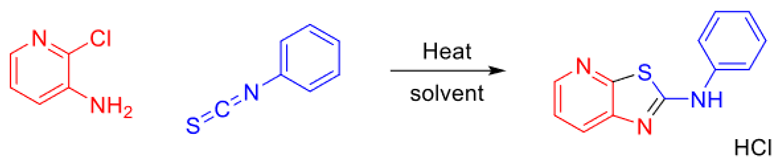

Table 2.
Optimization of reaction in green solvents.
| Entry | 2-chloro-3-amino-pyridine (equiv.) | Isothiocyanate (equiv.) | Reaction time | TP (°C) | Solvent | Yields |
|---|---|---|---|---|---|---|
| 1 | 1 | 1 | 4 | 100 | Eucalyptol | 59% |
| 2 | 1 | 1 | 16 | 100 | Eucalyptol | 75% |
| 3 | 1 | 1 | 4 | 100 | CPME | 63% |
| 4 | 1 | 1 | 16 | 100 | CPME | 71% |
| 5 | 1.1 | 1 | 16 | 100 | CPME | 79% |
| 6 | 1 | 1 | 4 | 100 | Limonene | 65% |
| 7 | 1 | 1 | 16 | 100 | Limonene | 70% |
| 8 | 1 | 1 | 4 | 100 | Sabinene | 36% |
| 9 | 1.1 | 1 | 4 | 100 | Sabinene | 38% |
| 10 | 1 | 1.1 | 4 | 100 | Sabinene | 33% |
| 11 | 1 | 1 | 16 | 100 | Sabinene | 68% |
| 12 | 1.1 | 1 | 16 | 100 | Sabinene | 76% |
| 13 | 1.1 | 1 | 16 | 100 | Sabinene | 61% |
| 14 | 1.1 | 1 | 16 | 100 | Distilled Sabinene | 62% |
| 15 | 1 | 1 | 16 | 100 | Distilled Sabinene | 58% |
Sabinene being commercially available at 75% purity, we distilled it under reduced pressure with a membrane pump at 12 mbar, at 40°C. However, we found that the reactions carried out in distilled or undistilled sabinene were not impacted and yields were equivalent, so we continued our study with commercially available undistilled sabinene.
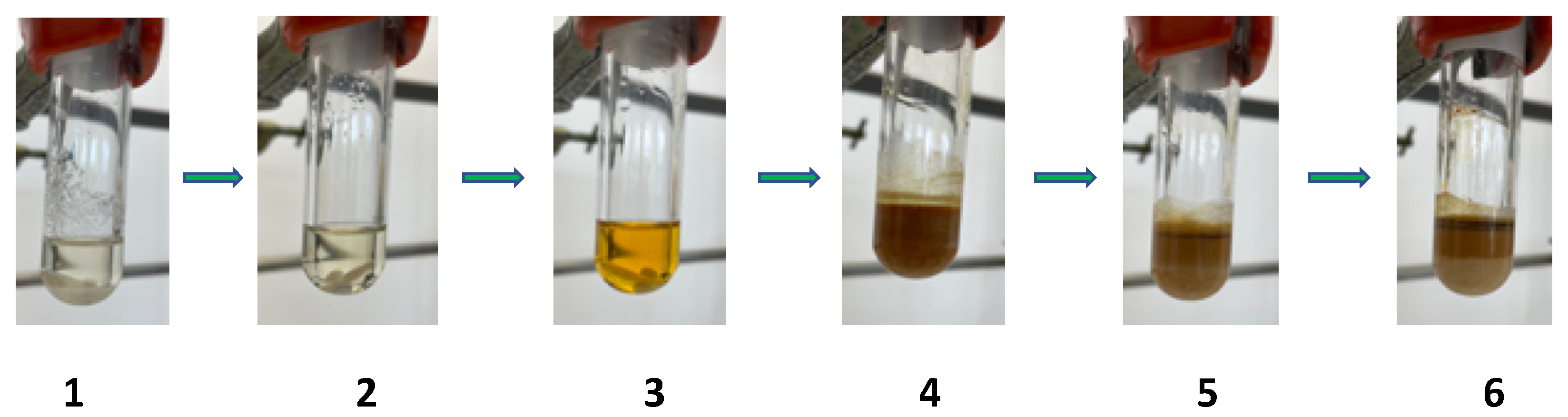
To visualize the progress of the reaction, the different phases, using chloro-3-aminopyridine heated in 1 ml of sabinene in the presence of benzoyl isothiocyanate, were photographed at different reaction times, starting with the control after mixing the compounds, then during the heating period at 60°C, after 5 min at 100°C, 30 min at 100°C, then after 4h, and finally after 24h of reaction at 100°C, where complete precipitation of the product can be seen (Figure 2).
2.2. Optimization of thiazolo-pyridine synthesis in sabinene under microwaves irradiation
Based on these initial results, the reaction was performed under conditions described Table 2, entry 12 to obtain the optimum yield. Then, we tried to reduce time reaction by a microwave activation. The temperature has also been adapted. After completion, the product have been filtered and washed with ethyl acetate and diethyl ether and no further purification was required (Table 3).
Under microwave irradiation, the best results are obtained in 1 hour at 160 degrees, i.e. close to the boiling point of sabinene. However, as this temperature is not compatible with all isothiocyanates, we have tried to reduce the reaction temperature and note that at 130 degrees the time required is 2 hours. As sabinene is not a polar solvent and therefore not the most interesting for microwave reactions, we used 25% of a co-solvent that increases this polarity and chose ethanol or acetonitrile, which proved very interesting as a co-solvent in previous work under microwave irradiation [41]. It turns out that while ethanol doesn't bring any improvement, acetonitrile does halve the reaction time at 130°C, while very slightly increasing the yield (Table 3, entries 4 and 6).
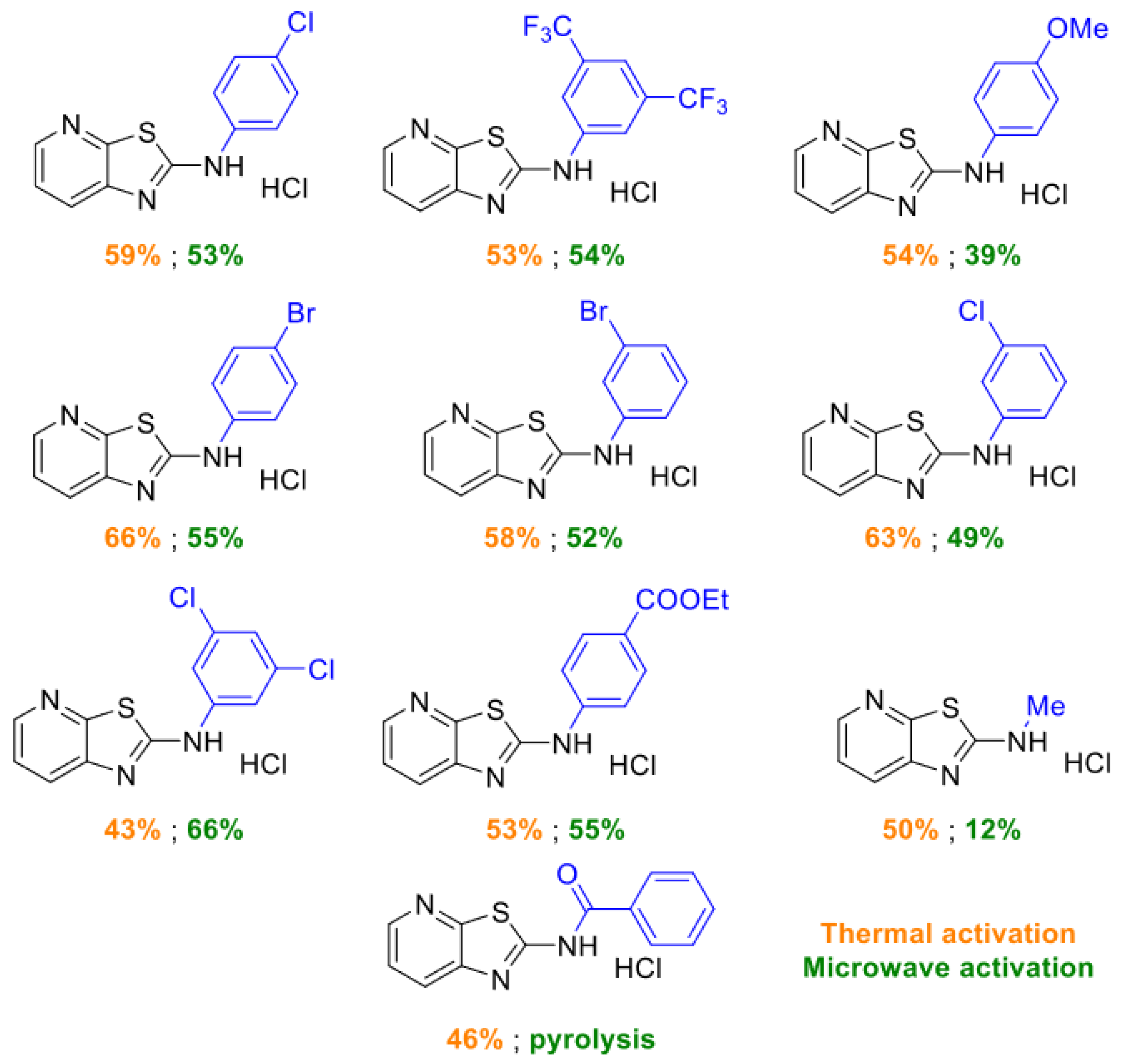
We applied these optimized conditions to some isothiocyanates with, in first, 3-amino-2-chloropyridine in thermal or microwave activation. The results are summarized in Scheme 1.
Six new structures were synthesized and obtained in great yields and pure by thermal and microwave activation, the four others have already been obtained in a previous study [39]. In a second step, we were interested in the use of other pyridine substituted in particular with an electron donor group of the alkyl type.

Table 4.
Optimization under thermal conditions.
| Entry | Reaction time | Pyridine (equiv.) | Isothiocyante (equiv.) | Rinsing solvent | Yield | NMR observation |
|---|---|---|---|---|---|---|
| 1 | 5 h | 1 | 1 | Diethyl ether | 46 % | Clear |
| 2 | 5 h | 1.1 | 1 | Diethyl ether | 55 % | Parasite peak |
| 3 | 5 h | 1 | 1.1 | Diethyl ether | 53 % | Parasite peak |
| 4 | 16 h | 1.1 | 1 | Diethyl ether | 75 % | Parasite peak |
| 5 | 16 h | 1.1 | 1 | Ethyl acetate | 66 % | Clear |
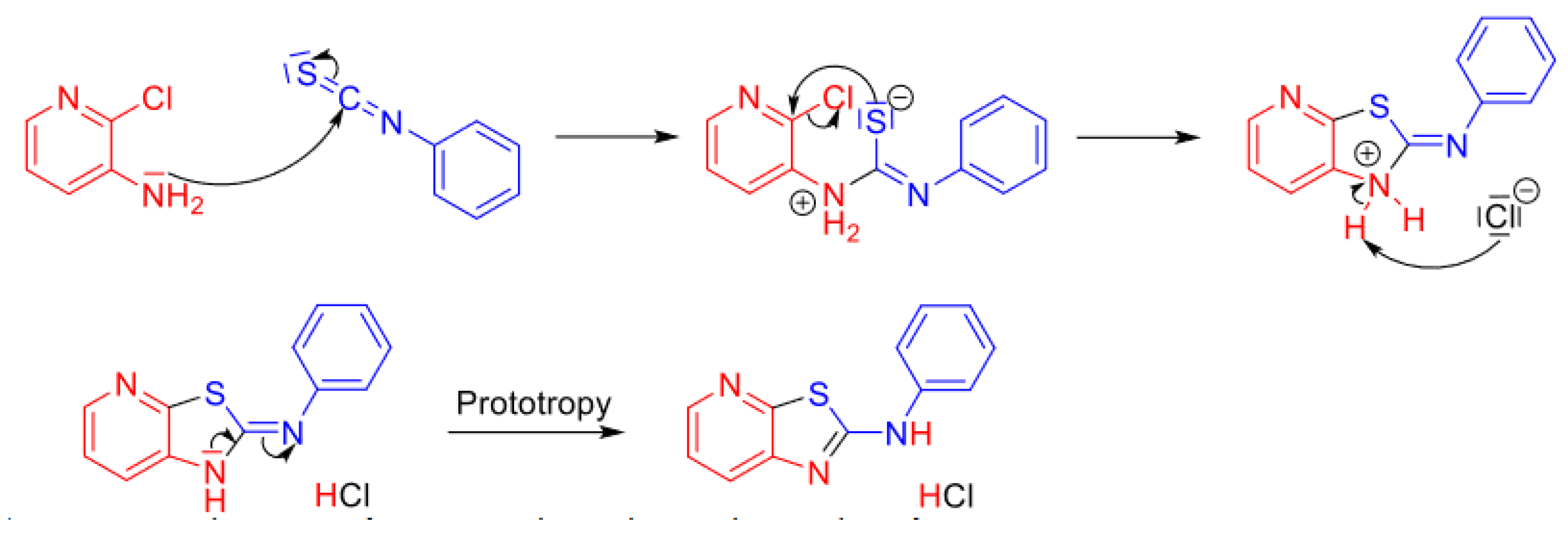
Using 3-amino-2-chloro-5-methylpyridine and isothiocyanate in a sealed tube with 1mL sabinene required heating to 160°C under thermal conditions and took 16 hours to lead to a satisfactory result. After the reaction, the mixture was filtered with ethyl acetate and the desired compound was synthesized in 66% yield (Table 4, entry 5). In this case too, we obtained the product in salt form and the reaction temperature was increased due to the donor effect of methyl in para to chlorine atom, which could explain the lower reactivity of the latter given the mechanism of 2-aminothiazolo[5,4-b]pyridine formation (Scheme 2).
This mechanism was validated by Atland and Molander [40] with the formation of thiourea, in which the tautomeric thione or thiol displaced the chlorine atom.
Under microwave irradiation, the best results were obtained using 1.1 equiv. of methylpyridine and 1 equiv. of isothiocyanate, in a sealed tube with 1mL of sabinene. The reaction was carried out at 130 degrees for 2 hours to give a yield of 64% (Table 5, entry 7). Again, at the end of the reaction, the mixture was filtered and rinsed with ethyl acetate.
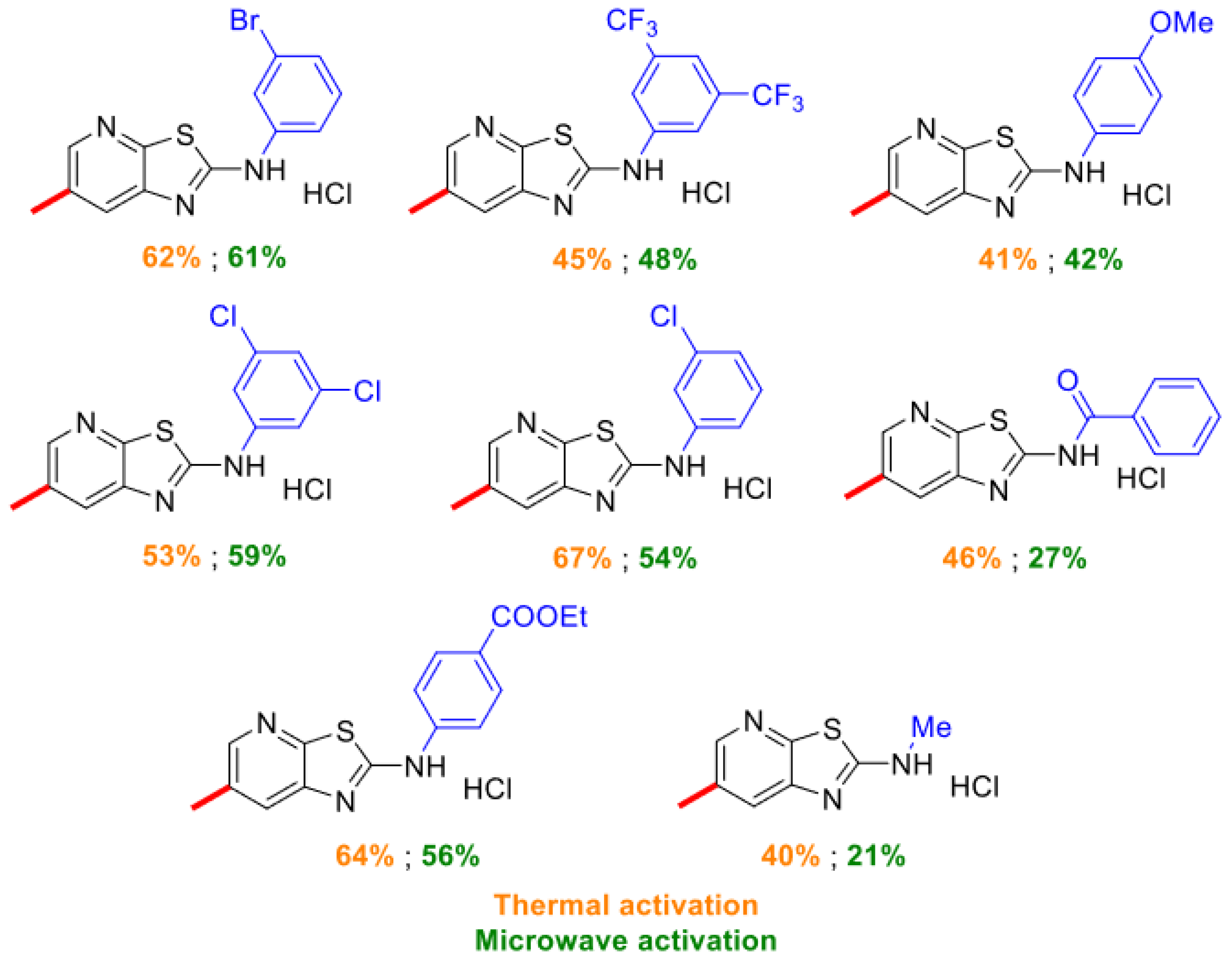
We applied these optimized conditions to some isothiocyanates with, 3-amino-2-chloro-5-methylpyridine in thermal or microwave activation. The results are summarized in Scheme 3.
The use of 3-amino-2-chloro-5-methylpyridine gives good yields when activated by conventional heating. The results remain lower under microwave irradiation, but enable the desired products to be generated more rapidly. We were able to overcome the deactivating effect of methyl in this reaction by adjusting the conditions.
3. Materials and Methods
3.1. General Information
All reagents were purchased from commercial suppliers and used without further purification. 1H and 13C NMR spectra were recorded on a Bruker DPX 250 (13C, 62.9 MHz) (Bruker, Wissembourg, France), Bruker Avance II 250.13 (13C, 63 MHz), Bruker Avance 400.13 (13C, 101 MHz) (Bruker, Wissembourg, France), or on a Bruker Avance III HD nanobay 400.13 (13C, 101 MHz) (Bruker, Wissembourg, France). Chemical shifts are expressed in parts per million (ppm) and were calibrated on deuterated or residual non-deuterated solvent peaks for 1H and 13C spectra. The following abbreviations are used for proton spectra multiplicities: b: broad, s: singlet, d: doublet, t: triplet, q: quartet, p: pentuplet, m: multiplet. Microwave-assisted reactions were carried out in a Biotage Initiator microwave synthesis instrument and temperatures were measured by an IR sensor (Biotage, Uppsala, Sweden). Melting points (p.m. [°C]) were taken on samples placed in open capillary tubes on a Thermo Fisher Melting Point Instrument Digital 9000 Series IA9200X6 and were not corrected. High-resolution mass spectra (HRMS) were performed on a Bruker 4G Maxis UHR-q-TOF mass spectrometer (Bruker, Wissembourg, France), with an electrospray ionization (ESI) mode. The numbering of the atoms on the molecules has been chosen arbitrarily and is indicated on the drawings of the molecules for a better understanding of the NMR spectra.
3.2. General procedure (1)
Substituted 3-amino-2-chloropyridine (1.65 mmol; 1.1 equiv.) and substituted isothiocyanate (1.5 mmol; 1 equiv.) were dissolved in 1mL sabinene and stirred at 100°C for 16 h. The mixture was allowed to cool to room temperature. The mixture was then filtered and washed with ethyl acetate followed by diethyl ether. The product was isolated without further purification.
3.3. General procedure (2)
In a sealed tube, substitued 3-amino-2-chloropyridine (1,65 mmol ; 1,1 equiv.) and substituted isothiocyanate (1,5 mmol ; 1 equiv.) were dissolved in 1.0 mL of sabinene. The mixture is placed under microwave irradiation during 2 h at 130 °C. The mixture was allowed to cool to room temperature. Then, the reaction was filtered and washed with ethyl acetate followed by diethyl ether. The product was isolated without further purification.
3.4. General procedure (3)
In a sealed tube, substituted 3-amino-2-chloropyridine (1.65 mmol; 1.1 equiv.) and substituted isothiocyanate (1.5 mmol; 1 equiv.) were dissolved in the solvent consisting of 0.75 ml sabinene and 0.25 ml acetonitrile. The mixture was placed under microwave irradiation for 2 h at 130°C. After cooling to room temperature, the reaction mixture was filtered and washed with ethyl acetate followed by diethyl ether. The product was isolated without further purification.
N-phenylthiazolo[5,4-b]pyridin-2-amine hydrochloride
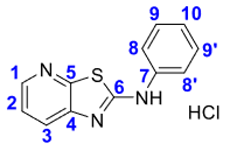
Using general procedure (1) applied to phenyl isothiocyanate and 3-amino-2-chloropyridine. Yield: 65%. Beige solid, m.p. 273 °C. (Lit. 284-285 °C) [40]. 1H NMR (400 MHz, DMSO-d6) δ 7.07 (tt, J = 7.3, 1.2 Hz, 1H, 10HAr), 7.32-7.41 (m, 2H, 9HAr and 9’HAr), 7.42 (dd, J = 8.1, 5.0 Hz, 1H, 2HAr), 7.81 (dd, J = 7.5, 1.3 Hz, 2H, 8HAr and 8’HAr), 7.97 (dd, J = 8.2, 1.5 Hz, 1H, 3HAr), 8.29 (dd, J = 5.0, 1.5 Hz, 1H, 1HAr), 10.94 (bs, 1H, N-H). 13C NMR (101 MHz, DMSO-d6) δ 118.4 (8CHAr and 8’CHAr), 121.7 (2CHAr), 122.8 (10CHAr), 126.2 (3CHAr), 129.0 (9CHAr and 9’CHAr), 140.0 (7CIV), 141.8 (1CHAr), 146.5 (4CIV), 153.2 (5CIV) and 161.1 (6CIV).HR-MS (m/z) (ESI+): calcd for m/z C12H10N3S [M + H+] = 228.0590; found = 228.0588.
N-(4-chlorophenyl)thiazolo[5,4-b]pyridin-2-amine hydrochloride
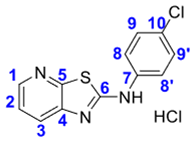
Using general procedure (1) applied to 4-chlorophenyl isothiocyanate and 3-amino-2-chloropyridine. Yied: 59%. Beige solid, m.p. 258 °C. 1H NMR (DMSO-d6, 400 MHz) : δH = 7.39-7.46 (m, 3H, 2HAr + 8HAr + 8’HAr), 7.86 (d, J = 8.0 Hz, 2H, 9HAr and 9’HAr), 7.98 (d, J = 8.2 Hz, 1H, 3HAr), 8.31 (d, J = 5.2 Hz, 1H, 1HAr), 11.23 (bs, 1H, N-H). 13C NMR (DMSO-d6, 101 MHz) : δ 119.8 (9CHAr and 9’CHAr), 121.8 (2CHAr), 126.2 (10CIV), 126.3 (3CHAr), 128.9 (8CHAr and 8’CHAr), 139.0 (7CIV), 142.2 (1CHAr), 146.3 (4CIV), 153.4 (5CIV) and 160.8 (6CIV). HRMS (m/z) (ESI+): calcd for m/z C12H9ClN3S [M + H+] = 262.0200; found = 262.0198.
N-(3,5-bis(trifluoromethyl)phenyl)thiazolo[5,4-b]pyridin-2-amine hydrochloride
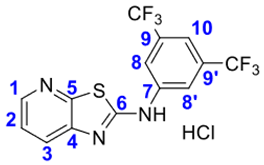
Using general procedure (3) applied to 3,5-Bis(trifluoromethyl)phenylisothiocyanate and 3-amino-2-chloropyridine. Yield:54%. Colorless solid, m.p. 231°C. 1H NMR (DMSO-d6, 400 MHz) : δ 7.43 (dd, J = 8.2, 4.9 Hz, 1H, 2HAr), 7.69 (s, 1H, 10HAr), 8.03 (d, J = 8.1 Hz, 1H, 3HAr), 8.34 (d, J = 4.9 Hz, 1H, 1HAr), 8.51 (s, 2H, 8HAr and 8’HAr), 11.89 (bs, 1H, N-H). 13C NMR (DMSO-d6, 101 MHz) : δ 114.8 (10CHAr), 117.6 (8CHAr and 8’CHAr), 121.8 (2CHAr), 123.3 (q, 1J = 274 Hz, 11CF3 and 11’CF3), 126.7 (3CHAr), 130.9 (q, 2J = 32 Hz, 9CIV and 9’CIV), 141.8 (7CIV), 143.6 (1CHAr), 145.3 (4CIV), 153.8 (5CIV) and 160.4 (6CIV). 19F NMR (DMSO-d6, 376 MHz) : δ 61.66. HRMS (m/z) (ESI+): calcd for m/z C14H8F6N3S [M + H+] = 364.0338; found = 364.0341.
N-(4-methoxyphenyl)thiazolo[5,4-b]pyridin-2-amine hydrochloride
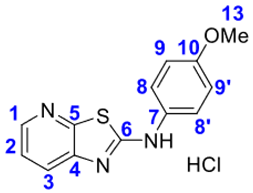
Using general procedure (1) applied to 4-methoxyphenyl isothiocyanate and 3-amino-2-chloropyridine. Yield: 54%. Yellow solid, m.p. 241°C. 1H NMR (DMSO-d6, 400 MHz) : δ 3.74 (s, 3H, 11CH3-O), 6.96 (d, J = 7.0 Hz, 2H, 8CHAr and 8’CHAr), 7.41 (dd, J = 8.1, 5.0 Hz, 1H, 2CHAr), 7.69 (d, J = 7.0 Hz, 2H, 9CHAr and 9’CHAr), 7.93 (d, J = 8.1 Hz, 1H, 3CHAr), 8.27 (d, J = 5.1 Hz, 1H, 1CHAr), 10.93 (bs, 1H, N-H). 13C NMR (DMSO-d6, 101 MHz) : δ 55.3 (11CH3-O), 114.3 (8CHAr and 8’CHAr), 120.5 (9CHAr and 9’CHAr), 121.8 (2CHAr), 125.8 (3CHAr), 133.1 (7CIV), 141.1 (1CHAr), 146.7 (4CIV), 152.8 (5CIV), 155.3 (10CIV) and 161.6 (6CIV). HRMS (m/z) (ESI+): calcd for m/z C13H12N3OS [M + H+] = 258.0695; found = 258.0693.
N-(4-bromophenyl)thiazolo[5,4-b]pyridin-2-amine hydrochloride
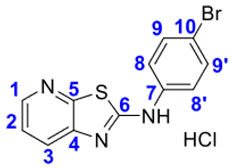
Using general procedure (1) applied to 4-bromophenyl isothiocyanate and 3-amino-2-chloropyridine. Yield: 66%. Beige solid, m.p. 264°C (decomposition). 1H NMR (DMSO-d6, 400 MHz) : δ 7.41 (dd, J = 8.1, 4.9 Hz, 1H, 2HAr), 7.55 (d, J = 8.8 Hz, 2H, 8HAr and 8’HAr), 7.80 (d, J = 8.9 Hz, 2H, 9HAr and 9’HAr), 7.97 (dd, J = 8.2, 1.6 Hz, 1H, 3HAr), 8.30 (dd, J = 4.9, 1.6 Hz, 1H, 1HAr), 11.16 (bs, 1H, N-H). 13C NMR (DMSO-d6, 101 MHz) : δ 114.1 (10CIV), 120.2 (9CHAr and 9’CHAr), 121.7 (2CHAr), 126.1 (3CHAr), 131.8 (8CHAr and 8’CHAr), 139.4 (7CIV), 142.5 (1CHAr), 146.1 (4CIV), 153.6 (5CIV) and 160.6 (6CIV). HRMS (m/z) (ESI+): calcd for m/z C12H9BrN3S [M + H+] = 305.9695; found = 305.9698.
N-(3-chlorophenyl)thiazolo[5,4-b]pyridin-2-amine hydrochloride
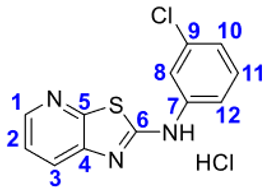
Using general procedure (1) applied to 3-chlorophenyl isothiocyanate and 3-amino-2-chloropyridine. Yield: 63%. Beige solid, m.p. 205°C. 1H NMR (DMSO-d6, 400 MHz) : δ 7.10 (dd, J = 7.8, 2.4 Hz, 1H, 12HAr), 7.39 (t, J = 8.2 Hz, 1H, 11HAr), 7.44 (dd, J = 8.0, 4.9 Hz, 1H, 2HAr), 7.67 (dd, J = 8.2, 2.6 Hz, 1H, 10HAr), 8.03 (dd, J = 8.2, 1.6 Hz, 1H, 3HAr), 8.07 (m, 1H, 8HAr), 8.32 (dd, J = 4.9, 1.6 Hz, 1H, 1HAr), 11.32 (bs, 1H, N-H). 13C NMR (DMSO-d6, 101 MHz) : δ 116.7 (10CHAr), 117.6 (8CHAr), 121.8 (2CHAr), 122.3 (12CHAr), 126.5 (3CHAr), 130.6 (11CHAr), 133.3 (9CIV), 141.4 (7CIV), 142.4 (1CHAr), 146.1 (4CIV), 153.4 (5CIV) and 160.7 (6CIV). HRMS (m/z) (ESI+): calcd for m/z C12H9ClN3S [M + H+] = 262.0200; found = 262.0202.
N-benzamidethiazolo[5,4-b]pyridin-2-amine hydrochloride
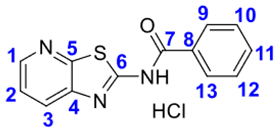
Using general procedure (1) applied to benzoyl isothiocyanate and 3-amino-2-chloropyridine. Yield: 46%. Beige solid, m.p. 183°C. 1H NMR (DMSO-d6, 400 MHz) : δ 7.54 (dd, J = 8.2, 4.6 Hz, 1H, 2HAr), 7.58 (t, J = 7.6 Hz, 2H, 10HAr and 10’HAr), 7.67-7.71 (m, 1H, HAr), 8.11-8.20 (m, 3H, 9HAr + 9’HAr + 3HAr), 8.52 (dd, J = 4.8, 1.4 Hz, 1.0H, 1HAr), 12.95 (bs, 1H, N-H). 13C NMR (DMSO-d6, 101 MHz) : δ 121.8 (2CHAr), 127.6 (3CHAr), 128.4 (9CHAr and 9’CHAr), 128.7 (10CHAr and 10’CHAr), 131.6 (8CIV), 133.1 (11CHAr), 141.8 (4CIV), 145.4 (1CHAr), 154.7 (5CIV), 158.4 (6CIV) and 166.3 (7CIV=O). HRMS (m/z) (ESI+): calcd for m/z C13H10N3OS [M + H+] = 256.0539; found = 256.0541.
N-(3,5-dichlorophenyl)thiazolo[5,4-b]pyridin-2-amine hydrochloride
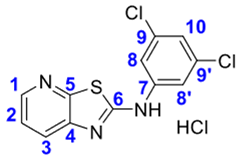
Using general procedure (3) applied to 3,5-dichlorophenyl isothiocyanate and 3-amino-2-chloropyridine. Yield: 66%. Beige solid, m.p. 265°C (decomposition). 1H NMR (DMSO-d6, 400 MHz) : δ 7.22 (t, J = 1.8 Hz, 1H, 10HAr), 7.43 (dd, J = 8.2, 4.9 Hz, 1H, 2HAr), 7.91 (d, J = 1.8 Hz, 2H, 8HAr and 8’HAr), 8.05 (dd, J = 8.2, 1.6 Hz, 1H, 3HAr), 8.33 (dd, J = 4.9, 1.6 Hz, 1H, 1HAr), 11.54 (bs, 1H, N-H). 13C NMR (DMSO-d6, 101 MHz) : δ 116.2 (8CHAr and 8’CHAr), 121.5 (10CHAr), 121.8 (2CHAr), 126.6 (3CHAr), 134.3 (9CIV and 9’CIV), 142.2 (7CIV), 143.2 (1CHAr), 145.6 (4CIV), 153.7 (5CIV) and 160.3 (6CIV). HRMS (m/z) (ESI+): calcd for m/z C12H8Cl2N3S [M + H+] = 295.9811 ; found = 295.9810.
N-(ethyl 4-aminobenzoate)thiazolo[5,4-b]pyridin-2-amine hydrochloride
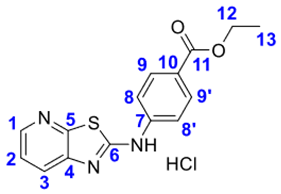
Using general procedure (3) applied to ethyl 4-isothiocyanatobenzoate and 3-amino-2-chloropyridine. Yield: 55%. Beige solid, m.p. 230°C. 1H NMR (DMSO-d6, 400 MHz) : δ 1.31 (t, J = 7.1 Hz, 3H, 13CH3), 4.28 (q, J = 7.1 Hz, 2H, 12CH2), 7.45 (dd, J = 8.1, 4.9 Hz, 1H, 2HAr), 7.96 (s, 4H, HAr), 8.04 (d, J = 8.3 Hz, 1H, 3HAr), 8.34 (d, J = 4.9 Hz, 1H, 1HAr), 11.48 (bs, 1H, N-H). 13C NMR (DMSO-d6, 101 MHz) : δ 14.3 (13CH3), 60.4 (12CH2), 117.6 (2xCHAr), 121.8 (2CH), 123.5 (10CIV), 126.8 (3CH), 130.5 (2xCHAr), 142.6 (1CH), 144.2 (7CIV), 146.1 (4CIV), 153.5 (5CIV), 160.5 (6CIV) and 165.3 (11CIV=O). HRMS (m/z) (ESI+): calcd for m/z C15H14N3O2S [M + H+] = 300.0801 ; found = 300.0801.
N-methylthiazolo[5,4-b]pyridin-2-amine hydrochloride
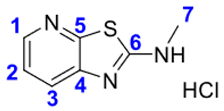
Using general procedure (1) applied to methyl isothiocyanate and 3-amino-2-chloropyridine. Yield: 50%. Beige solid, m.p. 239°C (lit. 264-265) [40]. 1H NMR (DMSO-d6, 400 MHz) : δ 3.06 (s, 3H, 7CH3), 7.43 (dd, J = 8.1, 5.0 Hz, 1H, 2HAr), 7.88 (d, J = 8.1 Hz, 3HAr), 8.27 (d, J = 5.0 Hz, 1H, 1HAr), 9.69 (bs, 1H, N-H). 13C NMR (DMSO-d6, 101 MHz) : δ 30.9 (7CH3), 122.0 (2CHAr), 123.7 (3CHAr), 141.6 (1CHAr), 142.4 (4CIV), 150.6 (5CIV) and 165.9 (6CIV). HRMS (m/z) (ESI+): calcd for m/z C7H8N3S [M + H+] = 166.0433 ; found = 166.0438.
N-(3-bromophenyl)thiazolo[5,4-b]pyridin-2-amine hydrochloride
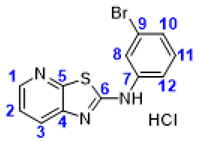
Using general procedure (1) applied to 3-bromophenyl isothiocyanate and 3-amino-2-chloropyridine. Yield: 58%. Yellowish solid, m.p. 231°C. 1H NMR (DMSO-d6, 400 MHz) : δ 7.23 (d, J = 8.1 Hz, 1H, 12HAr), 7.33 (t, J = 8.1 Hz, 1H, 11HAr), 7.41 (dd, J = 8.4, 5.2 Hz, 1H, 2HAr), 7.71 (d, J = 8.2 Hz, 1H, 10HAr), 7.99 (d, J = 8.1 Hz, 1H, 3HAr), 8.18 (s, 1H, 8HAr), 8.29 (d, J = 5.3 Hz, 1H, 1HAr), 11.12 (bs, 1H, N-H). 13C NMR (DMSO-d6, 101 MHz) : δ 117.2 (10CHAr), 120.5 (8CHAr), 121.8 (2CHAr), 121.9 (9CIV), 125.2 (12CHAr), 127.0 (3CHAr), 130.9 (11CHAr), 141.5 (1CHAr), 141.6 (7CIV), 146.5 (4CIV), 152.7 (5CIV) and 160.8 (6CIV). HRMS (m/z) (ESI+): calcd for m/z C12H9BrN3S [M + H+] = 305.9695 ; found = 305.9689.
N-phenylthiazolo[5,4-b]-6-methylpyridin-2-amine hydrochloride
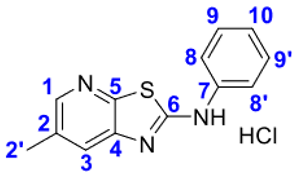
Using general procedure (2) applied to phenyl isothiocyanate and 3-amino-2-chloro-5-methylpyridine. Yield: 64%. Beige solid, m.p. 228°C (decomposition). 1H NMR (DMSO-d6, 400 MHz) : δ 2.38 (s, 3H, 2’CH3), 7.06 (t, J = 7.4 Hz, 1H, 10HAr), 7.38 (t, J = 7.6 Hz, 2H, 9HAr and 9’HAr), 7.80 (d, J = 8.3 Hz, 2H, 8HAr and 8’HAr), 7.88 (s, 1H, 3HAr), 8.20 (s, 1H, 1HAr), 10.93 (bs, 1H, N-H). 13C NMR (DMSO-d6, 101 MHz) : δ 17.8 (2’CH3), 118.5 (8CHAr and 8’CHAr), 122.9 (10CHAr), 127.4 (3CHAr), 129.1 (9CHAr and 9’CHAr), 131.7 (2CIV), 140.0 (7CIV), 141.2 (1CHAr), 146.9 (4CIV), 149.4 (5CIV) and 161.5 (6CIV). HRMS (m/z) (ESI+): calcd for m/z C13H12N3S [M + H+] = 242.0746 ; found = 242.0749.
N-(3,5-bis(trifluoromethyl)phenyl)thiazolo[5,4-b]-6-methylpyridin-2-amine hydrochloride
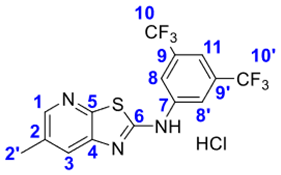
Using general procedure (2) applied to 3,5-Bis(trifluoromethyl)phenyl isothiocyanate and 3-amino-2-chloro-5-methylpyridine. Yield: 48%. Beige solid, m.p. 242°C (decomposition). 1H NMR (DMSO-d6, 400 MHz) : δ 2.37 (s, 3H, 2’CH3), 7.67 (s, 1H, 11HAr), 7.89 (s, 1H, 3HAr), 8.19 (s, 1H, 1HAr), 8.49 (s, 2H, 8CHAr and 8’CHAr), 11.83 (bs, 1H, N-H). 13C NMR (DMSO-d6, 101 MHz) : δ 17.7 (2’CH3), 114.8 (11CHAr), 117.6 (8CHAr and 8’CHAr), 123.3 (q, 1J = 274 Hz, 10CF3 and 10’CF3), 127.3 (3CHAr), 130.9 (q, 2J = 33 Hz, 9CIV and 9’CIV), 131.6 (2CIV), 141.8 (7CIV), 143.9 (1CHAr), 145.3 (4CIV), 150.6 (5CIV) and 160.6 (6CIV). 19F NMR (DMSO-d6, 376 MHz) : δ -61.68. HRMS (m/z) (ESI+): calcd for m/z C15H10F6N3S [M + H+] = 378.0494 ; found = 378.0491.
N-(4-methoxyphenyl)thiazolo[5,4-b]-6-methylpyridin-2-amine hydrochloride
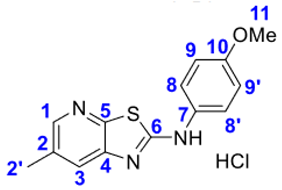
Using general procedure (2) applied to 4-methoxyphenyl isothiocyanate and 3-amino-2-chloro-5-methylpyridine. Yield: 42%. Yellow solid, m.p. 212°C (decomposition). 1H NMR (DMSO-d6, 400 MHz) : δ 2.37 (s, 3H, 2’CH3), 3.75 (s, 3H, 11CH3-O), 6.96 (d, J = 9.0 Hz, 2H, 8HAr and 8’HAr), 7.67 (d, J = 9.0 Hz, 2H, 9HAr and 9’HAr), 7.84 (s, 1H, 3HAr), 8.17 (s, 1H, 1HAr), 10.80 (bs, 1H, N-H). 13C NMR (DMSO-d6, 101 MHz) : δ 17.8 (2’CH3), 55.3 (11CH3-O), 114.3 (8CHAr and 8’CHAr), 120.6 (9CHAr and 9’CHAr), 127.0 (3CHAr), 131.8 (2CIV), 133.1 (7CIV), 140.5 (1CHAr), 147.0 (4CIV), 149.1 (5CIV), 155.4 (10CIV) and 162.1 (6CIV). HRMS (m/z) (ESI+): calcd for m/z C14H14N3OS [M + H+] = 272.0852 ; found = 272.0856.
N-(3-chlorophenyl)thiazolo[5,4-b]-6-methylpyridin-2-amine hydrochloride
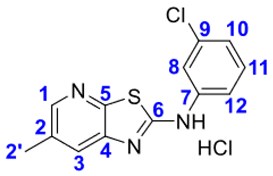
Using general procedure (1) applied to 3-chlorophenyl isothiocyanate and 3-amino-2-chloro-5-methylpyridine. Yield: 67%. Colourless solid, m.p. 214°C. 1H NMR (DMSO-d6, 400 MHz) : δ 2.38 (s, 3H, 2’CH3), 7.09 (dd, J = 8.0, 2.3 Hz, 1H, 10HAr), 7.38 (t, J = 8.0 Hz, 1H, 11HAr), 7.64 (dd, J = 8.2, 2.3 Hz, 1H, 12HAr), 7.93 (s, 1H, 3HAr), 8.08 (s, 1H, 8HAr), 8.21 (s, 1H, 1HAr), 11.34 (bs, 1H, N-H). 13C NMR (DMSO-d6, 101 MHz) : δ 17.8 (2’CH3), 116.7 (12CHAr), 117.6 (8CHAr), 122.2 (10CHAr), 127.6 (3CHAr), 130.6 (11CHAr), 131.7 (2CIV), 133.3 (9CIV), 141.4 (7CIV), 141.9 (1CHAr), 146.4 (4CIV), 149.7 (5CIV) and 161.0 (6CIV). HRMS (m/z) (ESI+): calcd for m/z C13H11ClN3S [M + H+] = 276.0357 ; found = 267.0360.
N-benzamidethiazolo[5,4-b]-6-methyl-2-amine hydrochloride
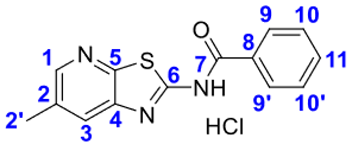
Using general procedure (1) applied to benzoyl isothiocyanate and 3-amino-2-chloro-5-methylpyridine. Yield: 46%. Colourless solid, m.p. 222°C. 1H NMR (DMSO-d6, 400 MHz) : δ 2.43 (s, 3H, 2’CH3), 7.57 (t, J = 7.7 Hz, 2H, 10HAr and 10’HAr), 7.67 (t, J = 7.3 Hz, 1H, 11HAr), 7.97 (s, 1H, 3HAr), 8.13 (d, J = 7.8 Hz, 2H, 9HAr and 9’HAr), 8.35 (s, 1H, 1HAr), 12.91 (bs, 1H, N-H). 13C NMR (DMSO-d6, 101 MHz) : δ 17.9 (2’CH3), 127.7 (3CHAr), 128.4 (9CHAr and 9’CHAr), 128.7 (10CHAr and 10’CHAr), 131.5 (2CIV), 131.7 (8CIV), 133.1 (11CHAr), 141.7 (4CIV), 146.2 (1CHAr), 151.8 (5CIV), 158.6 (6CIV) and 166.2 (7CIV=O). HRMS (m/z) (ESI+): calcd for m/z C14H12N3OS [M + H+] = 270.0696 ; found = 270.0698.
N-(3,5-dichlorophenyl)thiazolo[5,4-b]-6-methylpyridin-2-amine hydrochloride
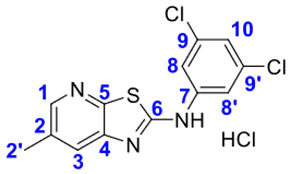
Using general procedure (2) applied to 3,5-dichlorophenyl isothiocyanate and 3-amino-2-chloro-5-methylpyridine. Yield: 59%. Pinkish solid, m.p. 251°C. 1H NMR (DMSO-d6, 250 MHz) : δ 2.37 (s, 3H, 2’CH3), 7.21 (t, J = 1.9 Hz, 1H, 10HAr), 7.89 (d, J = 1.9 Hz, 2H, 8HAr and 8’HAr), 7.93 (d, J = 1.0 Hz, 1H, 3HAr), 8.20 (d, J = 1.2 Hz, 1H, 1HAr), 11.51 (bs, 1H, N-H). 13C NMR (DMSO-d6, 101 MHz) : δ 17.7 (2’CH3), 116.1 (8CHAr and 8’CHAr), 121.4 (10CHAr), 127.4 (3CHAr), 131.6 (2CIV), 134.2 (9CIV and 9’CIV), 142.2 (7CIV), 143.2 (1CHAr), 145.7 (4CIV), 150.3 (5CIV) and 160.6 (6CIV). HRMS (m/z) (ESI+): calcd for m/z C13H10Cl2N3S [M + H+] = 309.9967 ; found = 309.9973
N-(ethyl 4-aminobenzoate)thiazolo[5,4-b]-6-methylpyridin-2-amine hydrochloride
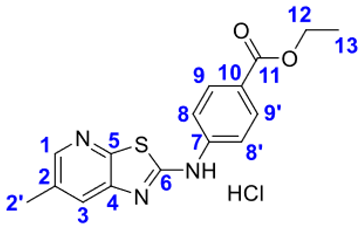
Using general procedure (1) applied to ethyl 4-isothiocyanatobenzoate and 3-amino-2-chloro-5-methylpyridine. Yield: 64%. Beige solid, m.p. 210°C (decomposition). 1H NMR (DMSO-d6, 400 MHz) : δ 1.31 (t, J = 7.0 Hz, 3H, 13CH3), 2.38 (s, 3H, 2’CH3), 4.28 (q, J = 7.0 Hz, 2H, 12CH2), 7.89 (s, 1H, 3HAr), 7.89-7.98 (m, 4H, HAr), 8.20 (s, 1H, 1HAr), 11.41 (bs, 1H, N-H). 13C NMR (DMSO-d6, 101 MHz) : δ 14.2 (13CH3), 17.8 (2’CH3), 60.4 (12CH2), 117.5 (2 x CHAr), 123.4 (10CIV), 127.4 (3CHAr), 130.5 (2 x CHAr), 131.6 (2CIV), 142.7 (1CH), 144.2 (7CIV), 146.1 (4CIV), 150.2 (5CIV), 160.8 (6CIV) and 165.3 (11CIV). HRMS (m/z) (ESI+): calcd for m/z C16H16N3O2S [M + H+] = 314.0958 ; found = 314.0956.
N-methylthiazolo[5,4-b]-6-methylpyridin-2-amine hydrochloride
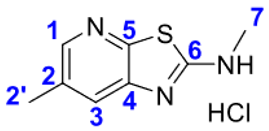
Using general procedure (1) applied to methyl isothiocyanate and 3-amino-2-chloro-5-methylpyridine. Yield: 40%. Colourless solid, m.p. 186°C (decomposition). 1H NMR (D2O, 400 MHz) : δ 2.39 (s, 3H, 2’CH3), 3.13 (s, 3H, 7CH3), 7.60 (s, 1H, 3HAr), 8.12 (s, 1H, 1HAr). 13C NMR (D2O, 101 MHz) : δ 17.5 (2’CH3), 31.4 (7CH3), 124.3 (3CHAr), 134.2 (2CIV), 138.1 (CIV), 142.8 (1CHAr), 143.3 (CIV) and 167.7 (6CIV). HRMS (m/z) (ESI+): calcd for m/z C8H10N3S [M + H+] = 180.0590 ; found = 180.0587.
N-(3-bromophenyl)thiazolo[5,4-b]-6-methylpyridin-2-amine hydrochloride
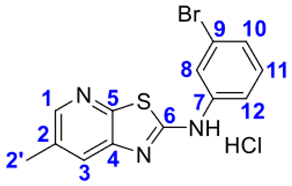
Using general procedure (1) applied to 3-bromophenyl isothiocyanate and 3-amino-2-chloro-5-methylpyridine. Yield: 62%. Beige solid, m.p. 247-248°C. 1H NMR (DMSO-d6, 400 MHz) : δ 2.38 (s, 3H, 2’CH3), 7.23 (d, J = 7.8 Hz, 1H, 12HAr), 7.32 (t, J = 7.9 Hz, 1H, 11HAr), 7.69 (d, J = 8.1 Hz, 1H, 10HAr), 7.91 (s, 1H, 3HAr), 8.20 (s, 2H, 1HAr and 8HAr), 11.26 (bs, 1H, N-H). 13C NMR (DMSO-d6, 101 MHz) : δ 17.8 (2’CH3), 117.0 (10CHAr), 120.4 (8CHAr), 121.8 (9CIV), 125.1 (12CHAr), 127.3 (3CHAr), 130.9 (11CHAr), 131.6 (2CIV), 141.5 (7CIV), 142.5 (1CHAr), 146.2 (4CIV), 150.1 (5CIV) and 160.9 (6CIV). HRMS (m/z) (ESI+): calcd for m/z C13H11BrN3S [M + H+] = 319.9852 ; found = 319.9847.
4. Conclusions
Following our work on eucalyptol as a new green solvent, we show in this article that sabinene is also potentially usable as a new biomass-derived green solvent.
Supplementary Materials
The following supporting information can be downloaded at the website of this paper posted on Preprints.org, Characterization data for obtained products and copies of 1H, 13C NMR and HRMS spectra. References [40] are cited in the supplementary materials.
Author Contributions
Conceptualization, G.M. and S.B-R.; methodology, G.M., V.F., E.C., L.B., A.A. and S.B-R.; validation, G.M. and S.B-R.; formal analysis, G.M., V.F., E.C., L.B., A.A. and S.B-R.; investigation, G.M., V.F., E.C., L.B., A.A. and S.B-R.; resources, G.M., V.F., E.C., L.B., A.A. and S.B-R.; data curation, G.M., V.F., E.C., L.B., A.A. and S.B-R.; writing—original draft preparation, G.M. and S.B-R.; writing—review and editing, G.M. and S.B-R.; visualization, G.M., V.F., E.C., L.B., A.A. and S.B-R.; supervision, G.M. and S.B-R.; project administration, G.M. and S.B-R.; funding acquisition, S.B-R. All authors have read and agreed to the published version of the manuscript.
Funding
This research received no external funding.
Institutional Review Board Statement
Not applicable.
Informed Consent Statement
Not applicable.
Data Availability Statement
All the required data are reported in the manuscript and Supplementary Materials.
Acknowledgments
This work was performed using the equipment of Orleans University and Institute of Organic and Analytical Chemistry and we would like to thank the Centre Val de Loire region for its support.
Conflicts of Interest
The authors declare no conflict of interest.
Sample Availability
Samples of the compounds are available from the authors.
References
- Campos, J.F.; Scherrmann, M.-C.; Berteina-Raboin, S. Eucalyptol : A new solvent for the synthesis of heterocycles containing oxygen, sulfur and nitrogen. Green Chem. 2019, 21, 1531–1539. [Google Scholar] [CrossRef]
- Campos, J. F.; Berteina-Raboin, S. Eucalyptol, an all-purpose product. Catalysts. 2022, 12, 48. [Google Scholar] [CrossRef]
- Loubidi, M.; Moutardier, A.; Campos, J.F.; Berteina-Raboin, S. Pd-catalyzed Suzuki/Sonogashira cross-coupling reaction and the direct sp3 arylation of 7-chloro-5-methyl-[1,2,4]triazolo[1,5-a]pyrimidine. Tetrahedron Lett. 2018, 59, 1050–1054. [Google Scholar] [CrossRef]
- Campos, J.F.; Berteina-Raboin, S. Eucalyptol as bio-based solvent for Migita–Kosugi–Stille coupling reaction on O,S,N-heterocycles. Catal. Today. 2020, 358, 138–142. [Google Scholar] [CrossRef]
- Campos, J.F.; Berteina-Raboin, S. Eucalyptol as a Bio-Based Solvent for Buchwald-Hartwig Reaction on O,S,N-Heterocycles. Catalysts. 2019, 9, 840. [Google Scholar] [CrossRef]
- Campos, J.F.; Ferreira, V.; Berteina-Raboin, S. Eucalyptol: a bio-based solvent for the synthesis of O,S,N-Heterocycles. Application to Hiyama Coupling, Cyanation, and Multicomponent Reactions. Catalysts. 2021, 11, 222. [Google Scholar] [CrossRef]
- Valente, J.; Zuzarte, M.; Gonçalves, M.J.; Lopes, M.C.; Cavaleiro, C.; Salgueiro, L.; Cruz, M.T. Antifungal, antioxidant and anti-inflammatory activities of Oenanthe crocata L. essential oil. Food Chem. Toxicol. 2013, 62, 349–354. [Google Scholar] [CrossRef]
- Yamasaki, Y.; Kunoh, H.; Yamamoto, H.; Akimitsu, K. Biological roles of monoterpene volatiles derived from rough lemon (Citrus Jambhiri Lush) in citrus defense. J. Gen. Plant. Pathol. 2007, 73, 168–179. [Google Scholar] [CrossRef]
- Asili, J.; Emami, A.; Rahimizadeh, M.; Fazli-Bazzaz, B.S.; Hassanzadeh, M. Chemical and Antimicrobial Studies of Juniperus Sabina L. and Juniperus foetidissima Willd. Essential Oils. J. essent. oil-bear. plants. 2013, 13, 25–36. [Google Scholar] [CrossRef]
- Sacchetti, G.; Maietti, S.; Muzzoli, M.; Scaglianti, M.; Manfredini, S.; Radice, M.; Bruni, R. Comparative evaluation of 11 essential oils of different origin as functional antioxidants, antiradicals and antimicrobials in foods. Food. Chem. 2005, 91, 621–632. [Google Scholar] [CrossRef]
- Cao, Y.; Zhang, H.; Liu, H.; Liu, W.; Zhang, R.; Xian, M.; Liu, H. Biosynthesis and Production of Sabinene: Current State and Perspectives. Appl. Microbiol. Biotechnol. 2018, 102, 1535–1544. [Google Scholar] [CrossRef] [PubMed]
- Abdel-Kader, M.S.; Soliman, G.A.; Alqarni, M.H.; Hamad, M.A.; Foudah, A.I.; Alqasoumi, S.I. Chemical composition and protective effect of Juniperus sabina L. essential oil against CCl4 induced hepatotoxicity. Saudi Pharm. J. 2019, 27, 945–951. [Google Scholar] [CrossRef]
- Verma, Ram S. ; Padalia, Rajendra C.; Chauhan, Amit; Verma, Rajesh K.; Ur Rahman, Laiq; Singh, Anand. "Changes in the Essential Oil Composition of Origanum majoranaL. During Post Harvest Drying". J. Essent. Oil-Bear. Plants. 2016, 19, 1547–1552. [Google Scholar] [CrossRef]
- Dallali, S.; Zouaoui, R.; Dallali, D.; Jdidi, S.; Toumi, L. Determination of some biochemical parameters from leaves of Quercus ilexL.(Fagaceae), collected in Djabel Zagouan (Tunisia). Arab. J. Med. Aromat. Plants. 2021, 7, 1–28. [Google Scholar]
- Jirovetz, L.; Buchbauer, G.; Stoyanova, A.; Metodiev, S. Seasonal Depending Variations of the Composition and Biological Activities of Douglas Fir (Pseudotsuga menziesii) Essential Oils from Bulgaria. Sci. Pharm. 2000, 68, 323–328. [Google Scholar] [CrossRef]
- Snoussi, M.; Noumi, E.; Trabelsi, N.; Flamini, G.; Papetti, A.; De Feo, V. Mentha spicata Essential Oil: Chemical Composition, Antioxidant and Antibacterial Activities against Planktonic and Biofilm Cultures of Vibrio spp. Strains. Molecules. 2015, 20, 14402–14424. [Google Scholar] [CrossRef] [PubMed]
- Fraternale, D.; Flamini, G.; Ricci, D. Essential oil composition and antimicrobial activity of. Angelica archangelica L. (Apiaceae) roots. J. Med. Food. 2014, 17, 1043–1047. [Google Scholar] [CrossRef]
- Haq Raees-ul; Prasad, K. Nutritional and processing aspects of carrot (Daucus carota)- A review. South Asian J. Food Technol. Environ. 2015, 1, 1–14. [Google Scholar] [CrossRef]
- Oliveira, G.L.; Moreira, D.L.; Mendes, A.D.R.; Guimaraes, E.F.; Figueiredo, L.S.; Kaplan, M.A.C.; Martins, E.R. Growth study and essential oil analysis of Piper aduncum from two sites of Cerrado biome of Minas Gerais State, Brazil. Rev. Bras. Farmacogn. 2013, 23, 743–753. [Google Scholar] [CrossRef]
- Omara, T.; Kiprop, A.K.; Kosgei, V.J.; Kagoya, S. Clausena anisata (Willd.) Hook.f. ex Benth. (Rutaceae): ethnomedicinal uses,phytochemistry, pharmacological activities, toxicity, and clinical application. Tradit. Med. Res. 2022, 7, 51–74. [Google Scholar] [CrossRef]
- Renninger, N.S.; Ryder, J.A.; Fisher, K.J. Jet fuel compositions and methods of making and using same. US Patent 794 2940.
- Peralta-Yahya, P.P.; Ouellet, M.; Chan, R.; Mukhopadhyay, A.; Keasling, J.D.; Lee, T.S. Identification and microbial production of a terpene-based advanced biofuel. Nat. Commun. 2011, 2, 483. [Google Scholar] [CrossRef] [PubMed]
- Balaban, A.T. Aromaticity as a Cornerstone of Heterocyclic Chemistry. Chem. Rev. 2004, 104, 2777–2812. [Google Scholar] [CrossRef] [PubMed]
- K. A. Scott and J. T. Njardarson, Analysis of US FDA-Approved Drugs Containing Sulfur Atoms. Top. Curr. Chem. 2018, 376, 5. [Google Scholar] [CrossRef] [PubMed]
- M. T. Chhabria, S. Patel, P. Modi and P. S. Brahmkshatriya, Thiazole: A Review on Chemistry, Synthesis and Therapeutic Importance of its Derivatives. Curr. Top. Med. Chem. 2016, 16, 2841–2862. [CrossRef]
- E. Vitaku, D. T. Smith and J. T. Njardarson, Analysis of the structural diversity, substitution patterns, and frequency of nitrogen heterocycles among U.S. FDA approved pharmaceuticals. J. Med. Chem. 2014, 57, 10257–10274. [CrossRef]
- Taylor, R.D.; MacCoss, M.; Lawson, A.D.G. Rings in Drugs. J. Med. Chem. 2014, 57, 5845–5859. [Google Scholar] [CrossRef]
- Gibson, S.; McGuire, R.; Rees, D.C. Principal Components Describing Biological Activities and Molecular Diversity of Heterocyclic Aromatic Ring Fragments. J. Med. Chem. 1996, 39, 4065–4072. [Google Scholar] [CrossRef]
- Kalaria, P.N.; Karad, S.C.; Raval, D.K. A Review on Diverse Heterocyclic Compounds as the Privileged Scaffolds in Antimalarial Drug Discovery. Eur. J. Med. Chem. 2018, 5, 917–936. [Google Scholar] [CrossRef]
- Taylor, A.P.; Robinson, R.P.; Fobian, Y.M.; Blakemore, D.C.; Jones, L.H.; Fadeyi, O. Modern Advances in Heterocyclic Chemistry in Drug Discovery. Org. Biomol. Chem. 2016, 14, 6611–6637. [Google Scholar] [CrossRef]
- Cee, V.J.; Frohn, M.; Lanman, B.A.; Golden, J.; Muller, K.; Neira, S.; Pickrell, A.; Arnett, H.; Buys, J.; Gore, A.; Fiorino, M.; Horner, M.; Itano, A.; Lee, M.R.; McElvain, M.; Middleton, S.; Schrag, M.; Rivenzon-Segal, D.; Vargas, H.M.; Xu, H.; Xu, Y.; Zhang, X.; Siu, J.; Wong, M.; Bürli, R.W. Discovery of AMG 369, a Thiazolo[5,4-b]pyridine Agonist of S1P1 and S1P5. ACS Med. Chem. Lett. 2011, 2, 107–112. [Google Scholar] [CrossRef] [PubMed]
- Rao, A.U.; Palani, A.; Chen, X.; Huang, Y.; Aslanian, R.G.; West, R.E., Jr.; Williams, S.M.; Wu, R.; Hwa, J.; Sondey, C.; Lachowicz, J. Synthesis and Structure–activity Relationships of 2-(1,4′-bipiperidin-1′-yl)thiazolopyridine as H3 Receptor Antagonists. Bioorg. Med. Chem. Lett. 2009, 19, 6176–6180. [Google Scholar] [CrossRef] [PubMed]
- Kale, M.G.; Raichurkar, A.; Hameed, P.S.; Waterson, D.; McKinney, D.; Manjunatha, M.R.; Kranthi, U.; Koushik, K.; Jena, L.K.; Shinde, V.; Rudrapatna, S.; Barde, S.; Humnabadkar, V.; Madhavapeddi, P.; Basavarajappa, H.; Ghosh, A.; Ramya, V.K.; Guptha, S.; Sharma, S.; Vachaspati, P.; Kumar, K.N.; Giridhar, J.; Reddy, J.; Panduga, V.; Ganguly, S.; Ahuja, V.; Gaonkar, S.; Kumar, C.N.; Ogg, D.; Tucker, J.A.; Boriack-Sjodin, P.A.; de Sousa, S.M.; Sambandamurthy, V.K.; Ghorpade, S.R. Thiazolopyridine Ureas as Novel Antitubercular Agents Acting through Inhibition of DNA Gyrase, B. J. Med. Chem. 2013, 56, 8834–8848. [Google Scholar] [CrossRef] [PubMed]
- Xie, X.; Li, H.; Wang, J.; Mao, S.; Xin, M.; Lu, S.; Mei, Q.; Zhang, S. Synthesis and Anticancer Effects Evaluation of 1-alkyl-3-(6-(2-methoxy-3-sulfonylaminopyridin-5-yl)benzo[d]thiazol-2-yl)urea as Anticancer Agents with Low Toxicity. Bioorg. Med. Chem. 2015, 23, 6477–6485. [Google Scholar] [CrossRef] [PubMed]
- Bebernitz, G.R.; Beaulieu, V.; Dale, B.A.; Deacon, R.; Duttaroy, A.; Gao, J.; Grondine, M.S.; Gupta, R.C.; Kakmak, M.; Kavana, M.; Kirman, L.C.; Liang, J.; Maniara, W.M.; Munshi, S. Nadkarni, S.S.; Schuster, H.F.; Stams, T.; St Denny, I.; Taslimi, P.M.; Vash, B.; Caplan, S.L. Investigation of Functionally Liver Selective Glucokinase Activators for the Treatment of Type 2 Diabetes. J. Med. Chem. 2009, 52, 6142–6152. [Google Scholar] [CrossRef]
- Xia, L.; Zhang, Y.; Zhang, J.; Lin, S.; Zhang, K.; Tian, H.; Dong, Y; Xu, H. Identification of Novel Thiazolo[5,4-b]Pyridine Derivatives as Potent Phosphoinositide 3-Kinase Inhibitors. Molecules. 2020, 25, 4630. [Google Scholar] [CrossRef]
- Liu, P.; Cheng, H.; Roberts, T.M.; Zhao, J.J. Targeting the Phosphoinositide 3-kinase Pathway in Cancer. Nat. Rev. Drug Discov. 2009, 8, 627–644. [Google Scholar] [CrossRef]
- Sahasrabudhe, K.P.; Angels Estiarte, M.; Tan, D.; Zipfel, S.; Cox, M.; O'Mahony, D. J. R.; Edwards, W. T.; Duncton, M. A. J. A single-step preparation of thiazolo[5,4-b]pyridine- and thiazolo[5,4-c]pyridine derivatives from chloronitropyridines and thioamides, or thioureas. J. Het. Chem. 2009, 46, 1125–1131. [Google Scholar] [CrossRef]
- Jemili, R.; Campos, J. F.; Dumuis, N.; Rabat, H.; Semmar, N.; Berteina-Raboin, S. Laser Synthesis: A Solvent-Free Approach for the Preparation of Phenylthiazolo[5,4- b ]Pyridine Derivatives. RSC Adv. 2021, 11, 5003–5007. [Google Scholar] [CrossRef]
- Atland, H.W.; Molander, G.A. A facile synthesis of 2-aminothiazolo[5,4-b] and 2-aminothiazolo[4,5-c]pyridines. J. Heteocyclic Chem. 1977, 14, 129–134. [Google Scholar] [CrossRef]
- Fînaru, A.; Berthault, A.; Besson, T.; Guillaumet, G.; Berteina-Raboin, S. Microwave-Assisted Solid-Phase Synthesis of 5-Carboxamido-N-acetyltryptamine Derivatives. Org. Lett. 2002, 4, 16, 2613–2615. [Google Scholar] [CrossRef] [PubMed]
- Xu, D.; Xu, X.; Liu, Z.; Sun, L.-P.; You, Q. A general and efficient synthesis of 2-substituted Oxazolopyridines. Synlett 2009, 7, 1172–1174. [Google Scholar] [CrossRef]
Figure 1.
Sabinene structure.
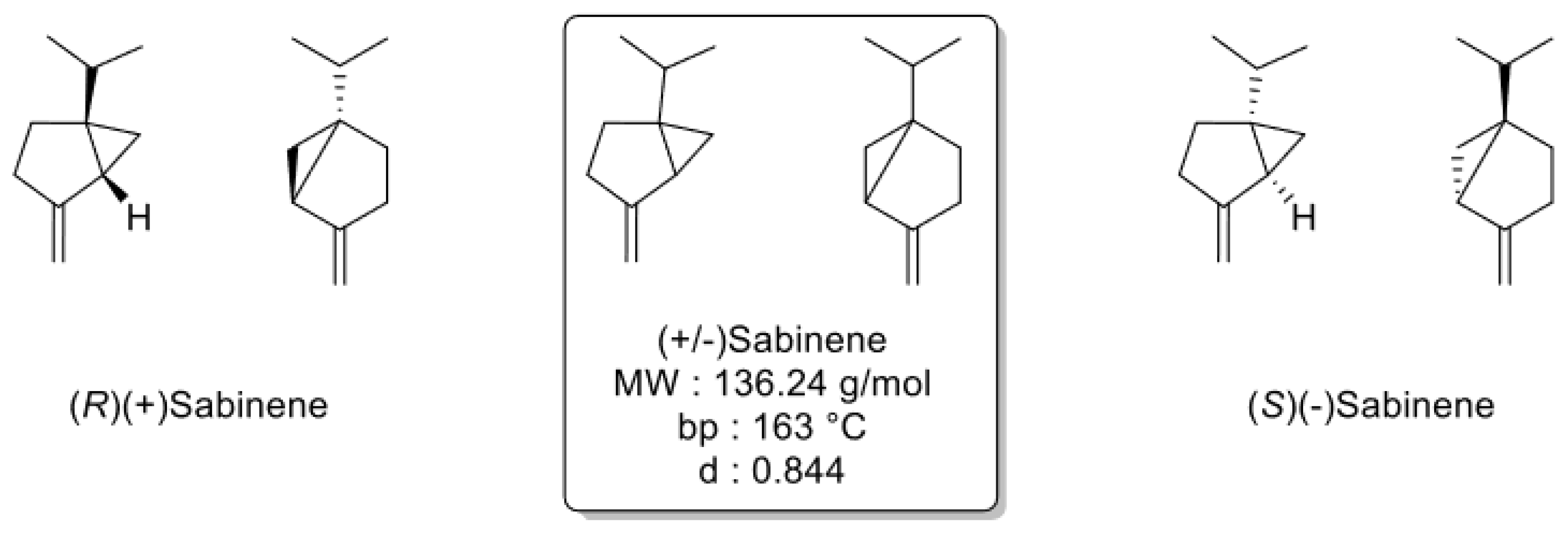
Figure 2.
Visual evolution of a manipulation from time T=0 at r.t. to time T= 24h at 100°C. 1: T=O, reaction medium. 2: T=60°C during heating period. 3: after 5 min at 100°C. 4: after 30 min at 100°C. 5: after 4 h at 100°C. 6: after 24 h at 100°C.
Figure 2.
Visual evolution of a manipulation from time T=0 at r.t. to time T= 24h at 100°C. 1: T=O, reaction medium. 2: T=60°C during heating period. 3: after 5 min at 100°C. 4: after 30 min at 100°C. 5: after 4 h at 100°C. 6: after 24 h at 100°C.
Scheme 1.
Thiazolo-pyridine synthesis in Sabinene under thermal or microwaves activation.
Scheme 2.
Mechanism of 2-amino thiazolo[5,4-b]pyridine formation.
Scheme 3.
6-methyl-thiazolo-pyridine synthesis in sabinene under thermal or microwaves activation.
Scheme 4.
Synthesis of corresponding urea instead of desired oxazolopyridine.
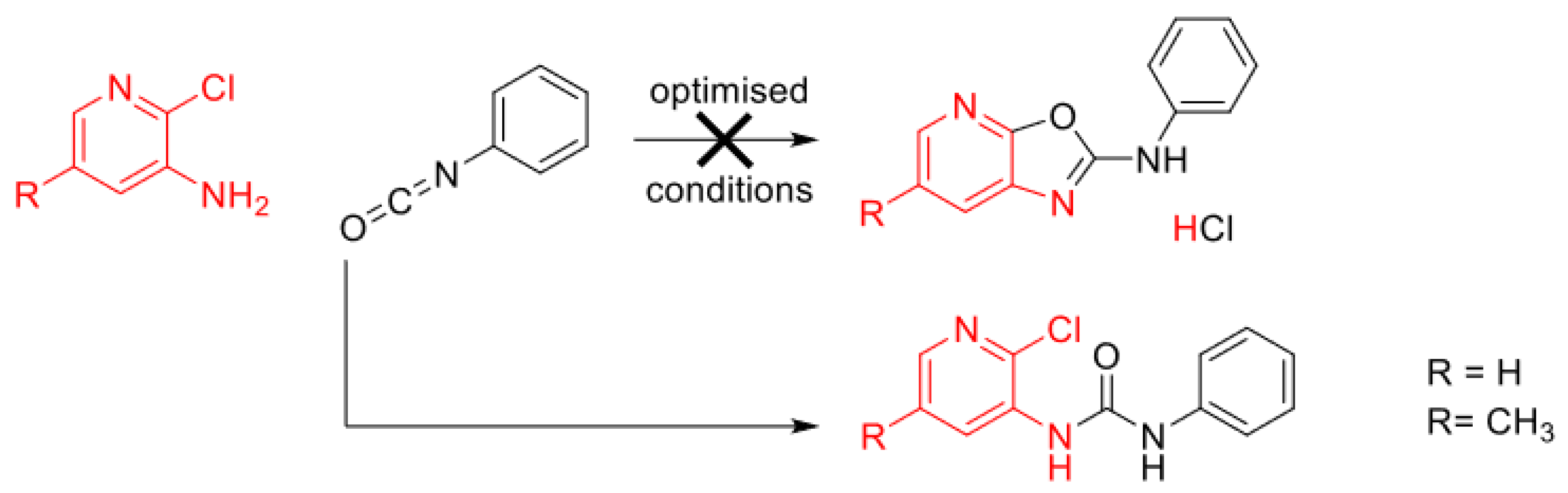
Table 1.
Optimisation time of reaction in various solvents.
| Entry | Solvent | T (°C) | Time (h) | Yield (%) |
|---|---|---|---|---|
| 1 | Acétone | 100 | 4 | 60 |
| 2 | DCM | 100 | 4 | 43 |
| 3 | Toluène | 100 | 4 | 44 |
| 4 | Dioxane | 100 | 4 | 44 |
| 5 | THF | 100 | 4 | 43 |
| 6 | Eucalyptol | 100 | 4 | 59 |
| 7 | Eucalyptol | 100 | 16 | 75 |
| 8 | CPME | 100 | 4 | 63 |
| 9 | CPME | 100 | 16 | 71 |
| 10 | Sabinene | 100 | 4 | 36 |
| 11 | Sabinène | 100 | 16 | 58 |
| 12 | Limonene | 100 | 4 | 65 |
| 13 | Limonene | 100 | 16 | 70 |
| 14 | Citral | 100 | 16 | 21 |
Table 3.
optimization of the reaction conditions under microwaves.
| Entry | Reaction time | Temperature (°C) | Yield (%) | Solvant |
|---|---|---|---|---|
| 1 | 1 h | 160 | 67 | Sabinene |
| 2 | 2 h | 150 | 59 | |
| 3 | 2 h | 130 | 55 | |
| 4 | 4 h | 130 | 62 | |
| 5 | 2 h | 130 | 44 | 75 :25 Sabinene/Ethanol |
| 6 | 2 h | 130 | 64 | 75 :25 Sabinene/ACN |
Table 5.
Optimization under thermal conditions.
| Entry | Reaction time | Temperature | Yield |
|---|---|---|---|
| 1 | 30 mn | 150 °C | 40 % |
| 2 | 1 h | 150 °C | 61% |
| 3 | 1 h | 160 °C | 57 % |
| 4 | 2 h | 150 °C | 63 % |
| 6 | 2 h | 110 °C | 37 % |
| 7 | 2 h | 130 °C | 64 % |
| 8 | 1 h | 130°C | 50 % |
Disclaimer/Publisher’s Note: The statements, opinions and data contained in all publications are solely those of the individual author(s) and contributor(s) and not of MDPI and/or the editor(s). MDPI and/or the editor(s) disclaim responsibility for any injury to people or property resulting from any ideas, methods, instructions or products referred to in the content. |
© 2023 by the authors. Licensee MDPI, Basel, Switzerland. This article is an open access article distributed under the terms and conditions of the Creative Commons Attribution (CC BY) license (http://creativecommons.org/licenses/by/4.0/).
Copyright: This open access article is published under a Creative Commons CC BY 4.0 license, which permit the free download, distribution, and reuse, provided that the author and preprint are cited in any reuse.


