

Submitted:
22 August 2023
Posted:
24 August 2023
You are already at the latest version
Abstract
Logistics industry has been found to be among the key sources of carbon emission. In Vietnam logistics industry, there is a considerable difference between the number of foreign and Vietnamese firms as well as the proportion of markets that they are taking. This study is to research the low-carbon emission measures conducted by domestic and foreign invested logistics service providers (LSPs) and compare the results of the two groups. Both qualitative and quantitative approaches are applied. Literatures in relevant fields are reviewed and expert opinions are taken for structuring a questionnaire which was later distributed to 279 LSPs, with 166 returned and 159 being valid for data calculation. The results imply that there are differences in extension of applications of low-carbon practices between foreign and domestic firms. Except for transport mode switch and energy-saving lighting, the other practices witness that adoption levels of foreign LSPs are higher than their counterparts, which is possibly thanks to their global operation, more comfortable capital resources and awareness level of green initiative necessity. In conclusion, a comparison between the application conducted by foreign-invested firms and domestic ones, which has not been investigated before, was made.
Keywords:
low-carbon emission
; low-carbon measures
; logistics service providers
; foreign invested
; Vietnam
1. Introduction
Nowadays, environment is becoming a growing concern all over the world. According to the Climate Change Knowledge Portal, Vietnam is among the world’s most susceptible nations to the impacts of climate change. Climate change and other environmental issues could pose many challenges to the economy and hinder it from growing sustainably. Fully acknowledging these challenges, Vietnamese authorities have implemented numerous policies and programmes to address these issues, with the central goal of developing a more sustainable and environmentally friendly growth model. In particular, Vietnam ratified the 2016 Paris Agreement on Climate, committing to reduce greenhouse gas emissions by at least 8% by 2030 and striving to achieve the United Nations Sustainable Development Goals (SDGs) by 2030. To oversee climate change and green growth policies, the National Committee on Climate Change was established and is chaired by the Prime Minister, with key ministers playing vital roles. These policies aim to prepare Vietnam more effectively for the future impacts of climate change. Their focus includes reducing the use of fossil fuels in various sectors, investing in climate resilient infrastructure, and providing stronger incentives for businesses to pursue green growth.
Carbon emissions are one of the largest contributors to environmental issues in general and climate change in particular. According to World Bank, Vietnam’s carbon emission in 2018 is 2.699 tons per capita. This number is lower than the average number of the world (4.484), however, still a large number. To achieve a sustainable development, Vietnam should investigate this issue and come up with appropriate solutions to reduce carbon emissions. Among many sectors of the economy, logistics and supply chain are the ones which are rapidly growing. Vietnam’s LPI reached 3.67 in 2018, ranking 39 in 160 countries that participated in the World Bank. The logistics sector is the sector that creates a large amount of carbon emissions and should therefore be focused on when deciding solutions for carbon emission reduction. Furthermore, in a previous study, Cheng et al. highlighted that logistics service providers bear significant responsibility for carbon emissions within the logistics industry [1].
Recognising the importance of studying further the carbon emission reduction practise of logistics providers, in this article the group of authors would look at current practices of Vietnamese logistics service providers to reflect their situations and to some extent assess the effectiveness of their applications. In detail, the following research questions have been formulated:
RQ1. What are the low-carbon emission measures applied by Vietnamese LSPs? To what extent are they applying those measures?
RQ2. What are the low carbon emission measures applied by foreign-invested LSPs in Vietnam? To what extent are they applying those measures?
RQ3. How are the measure applications of Vietnam and foreign invested LSPs different from each other?
In this paper, the term “logistics service providers” encompasses freight transportation, warehousing, distribution centres, forwarding, stations, and other related services. Additionally, in line with conventional terminology, “carbon emissions” refers to emissions of all greenhouse gases (not limited to carbon dioxide), with their volume measured in tons of carbon dioxide equivalents (CO2e).
2. Materials and Methods
2.1. Literature review
2.1.1. Low-carbon emission
As a key component of greenhouse gases, carbon-based fumes are the main cause of environmental problems. Therefore, reduction of carbon emissions has been concerned in order to address the problems.
So far, low-carbon emission has been studied in different specific facets, namely: emission drivers [2,12,22,23], influencing policies [1,3,4,5,6,7], affecting factors [8,9,10,11], low-carbon emission barriers [12,13,14,15,16,17,18,19,20,21], simulating models [24,25], technological innovation promoting low-carbon emission [26], how low-carbon initiatives affect business performance [27], low-carbon household emission [28]. The current literature mainly focusses on assessing links between certain factors such as policies, technologies, and so on with the operations of low-carbon emission practises. Comparisons among participants in the process of applying these initiatives have been relatively limited.
2.1.2. Low-carbon emission in logistics
Logistics activities, particularly logistics services offered by professional logistics providers, have played a huge significance in various businesses, especially global supply chain. In the current context where sustainable development has been increasingly emphasised, sustainable logistics management is critically in need. Consequently, green logistics activities have been adopted by different stakeholders in the supply chain. This study evaluates the adoption of a specific green logistics action, which is low-carbon emission by professional logistics service providers.
According to Lin and Ho (2011) and Evangelista (2014) [12,15], the green logistics application can be promoted through the advantage and compatibility of the practise, organizational assistance, human capability, customer requirements, regulations, and governmental factors, in the case of logistics providers in China and Italy, respectively. Also examining factors driving green practises applications, but more specifically in low-carbon emission and from a wide scope of the entire supply chain, Jabbour et al. (2020) and Ibrahim. Putri and Utama (2020) added other factors, such as green images of participants and profit [12,23]. As a component of green logistics and supply chain management, it can be inherited that low-carbon practises can be driven by competitor pressure, customer requirements, governmental policies, human competence, relative advantage, and related support.
Regarding low-carbon emission initiatives, similarly some studies on green initiatives have been reviewed as references for low-carbon emission measures. According to Lieb and Lieb in their study about sustainability in 3PL companies, there are four main groups of green initiatives applied including administrative, analytical, transportation-related, and a broadly defined “other” category [13]. Administrative initiatives include “setting specific sustainability goals for individual operating units”, “establishing committees to oversee company sustainability efforts”, “developing a formal sustainability statement for a company”, “establishing pilot programs directed at reducing emission levels”. Analytical measures include “investing in evaluation software”, “benchmarking a company’s carbon footprint against other 3PL”, “developing environmental key performance indicators to be monitored on a regular basis”, “measuring the carbon impact of various network designs and transportation strategies”, etc. Some examples of transportation-related initiatives are alternative fuels, “purchasing more fuel-efficient vehicles”, “reducing vehicle mileage operated”, “promoting freight consolidation initiatives within the companies”, “shifting freight to more fuel-efficient modes”, and “limiting the speeds at which company equipment is operated”. Finally, in their research, some initiatives such as “reduce company-printed materials”, “recycle office supplies and packaging materials”, “install solar panels in warehouses” are categorized as “other”. In another research of Perotti et al., green supply chain practices of 3PLs were grouped into eight categories: green supply, distribution strategies and transportation execution, warehousing and green building, reverse logistics, cooperation with customers, investment recovery, eco-design and packaging, and internal management [29]. Some specific initiatives that are related to low-carbon emission in these eight categories include “use of alternative fuels”, “environmentally friendly facility location”, “routing system to minimize travel distances”, “energy-efficient lighting system”, “energy-efficient material handling equipment”, “use of alternative energy sources”, “packaging recycle or reuse”, etc. Another research worth mentioned is the one of Evangelista [12]. In his research, Evangelista has summarized all the environmental sustainability measures applied by his case study companies ranging from vehicle use, transports modes and intramodality, energy efficiency to collaborative planning and environmental control. Almost all of the above-mentioned initiatives in one way or another can directly or indirectly reduce carbon emission application of a 3PL. For the purpose of this paper, we summarized carbon emission related measures into four categories as in the following table.

Table 1.
Green initiatives which have effects on carbon emission.
| Categories | Initiative |
|---|---|
| Transportation | Use of alternative fuels Purchasing more fuel-efficient vehicles Reducing vehicle mileage operated Promoting freight consolidation initiatives within the companies Limiting the speeds at which company equipment is operated Shifting freight to more fuel-efficient modes Using lower energy transport modes Changing vehicle specifications Reduce empty running Improving vehicle loading phase Greater use of intramodality |
| Packaging | Recycle office supplies and packaging materials Packaging recycle or reuse Reducing packaging |
| Warehouse | Install solar panels in warehouses Environmentally friendly facility location Energy-efficient material handling equipment Use of alternative energy sources |
| Information system | Investing in evaluation software Benchmarking a company’s carbon footprint against other 3PL Developing environmental key performance indicators to be monitored on a regular basis Measuring the carbon impact of various network designs and transportation strategies Information on carbon footprint Setting lower GHG targets Transport planning |
(Source: summarized by authors).
2.2. Methods
2.2.1. Research design
This paper aims to study the application of low carbon emission in both Vietnamese logistics service providers and foreign-invested logistics service providers in Vietnam. To construct the framework of low-carbon emission initiatives, the group of authors based on literature on this matter and then conducted some interviews with experts in the logistics service sectors.
According to the results of the literature review, the authors classified low-carbon practises in to four categories: (1) low-carbon emission in transportation, (2) low-carbon emission in warehouses, (3) low-carbon emission in packaging, and (4) low-carbon emission in the information system. Then the framework was adjusted to be appropriate for Vietnamese logistics characteristics through discussion with several experts. The group of authors interviewed managers of popular logistics service providers (2PL and 3PL) in some field trips and 2 conferences: one about the “Logistics service market” in Hanoi and one about “Incorporating to develop logistics service in Haiphong” in Haiphong City, both occurred in April 2021.
With the results of the interviews, a questionnaire was finalised. All variables are measured by Likert scale with 5 levels (1 = no application, 2 = limited application, 3 = moderate application, 4 = usual application, 5 = very usual application). This questionnaire was distributed in mass for data collection for a quantitative calculation and findings. To reach the desired sample size, the authors conducted a survey with 279 2PL and 3PL service providers. According to VLA, there are more than 4,000 LPS of Vietnam, in which 95% are local companies, but mainly small and very small enterprises with limited capital and human resources. The surveys were conducted directly at some logistics conferences and indirectly through Google Forms sent to email from companies.
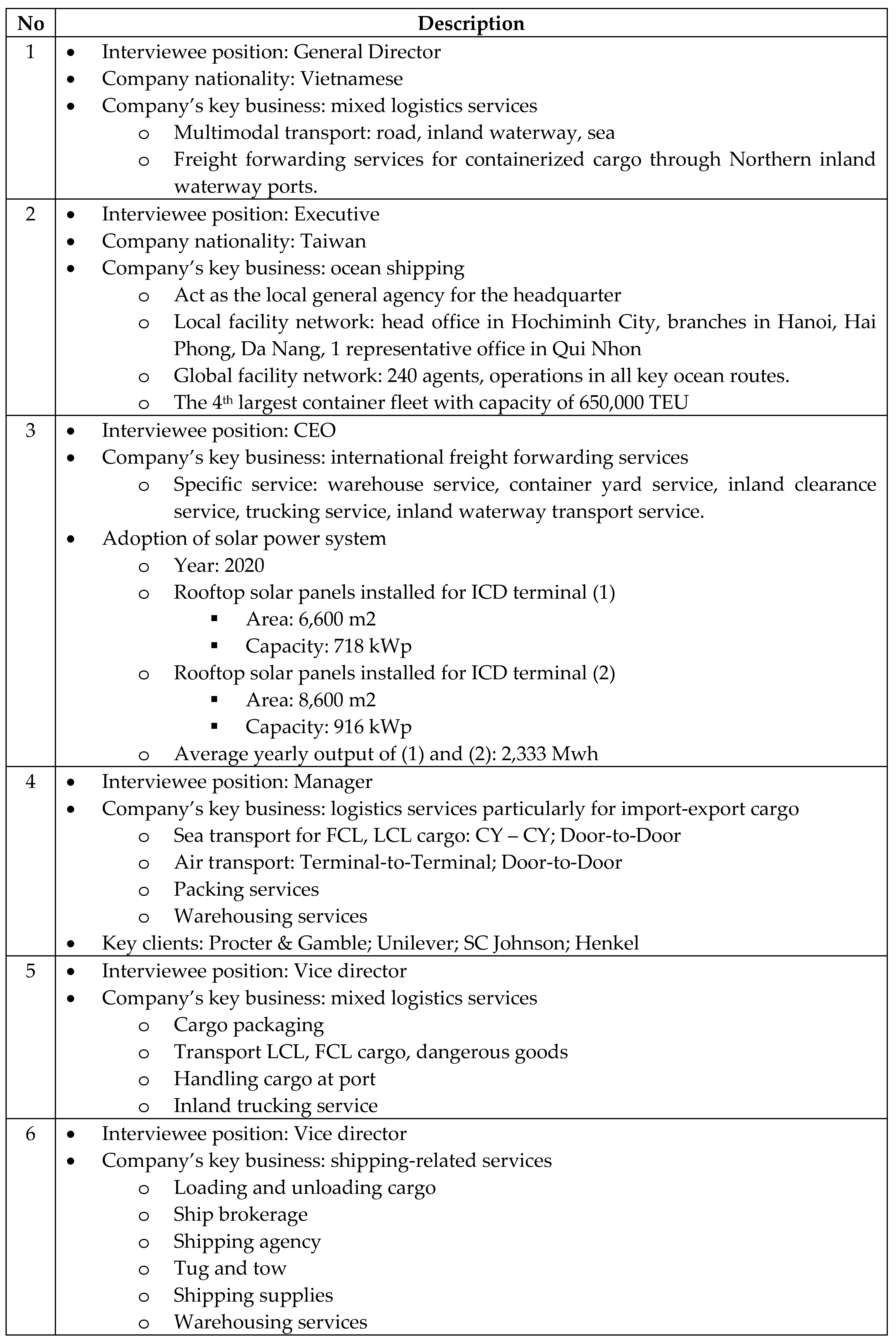
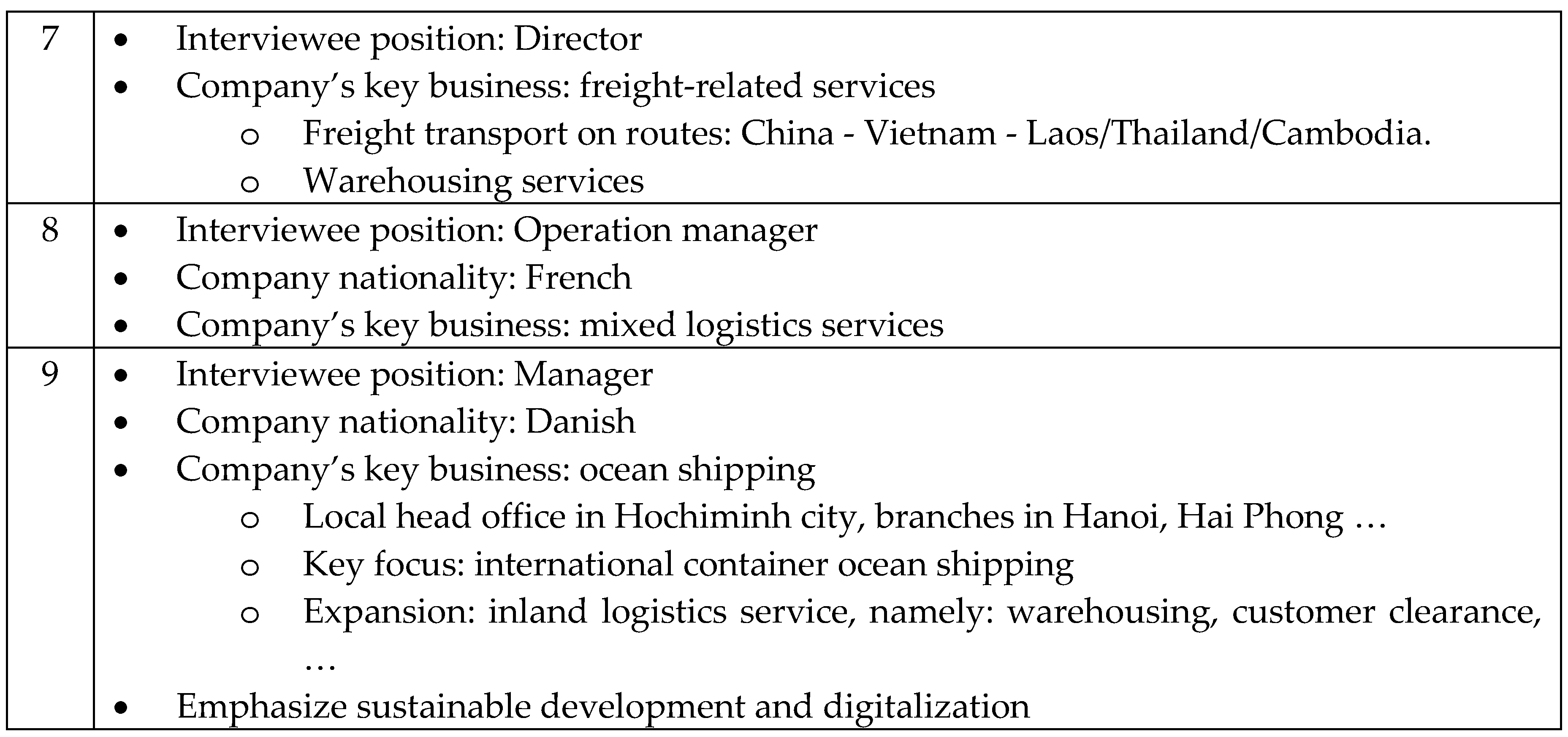
After analysing quantitative data, further in-depth interviews were conducted. Specifically, the authors interviewed managers from 09 companies invested by Vietnamese or foreign investors about their measures to reduce carbon emission in logistics activities and the effectiveness of these measures (Appendix A). The interviews mainly focused on the perspectives of managers regarding current practises and the alignment between the measures being implemented and the demands within Vietnam’s logistics service provider industry.
2.2.2. Data sample
In 279 forms sent out, 166 forms were returned (which accounts for 59.5%, a high return rate with questionnaire survey), in which 159 forms are valid (local companies account for 79.2% and foreign invested companies account for 20.8%). The survey results are carefully and thoroughly summarized and analysed by SPSS 20. Some general statistics can be described as follows.
About main types of services: most of the surveyed LSPs provide road transportation (76.1% and 72.3% in local and foreign invested LSP respectively), 54.7% and 72.7% of the LSPs provide water transportation.
About business period: there is a difference in business period between two groups of LSPs. Local LSPs that have been established for more than 15 years account for 63.6% of the same type, while foreign invested LSPs which were established 10-15 years ago only account for 28.6% of the same type. This is reasonable since the Vietnamese logistics market only opened to the global market and has developed strongly in the recent 10 years. With most LSPs established from more than 10 years of participation in the survey, the results become more reliable, as the LSPs have a lot of experience and have enough time to invest in carbon emission reduction. Regarding labour scale, the samples cover several scale levels. In detail, many LSPs with more than 100 staff members participated in the survey, 35.7% and 90.9% for local and foreign invest LSPs, respectively. Regarding revenue, 42.9% and 81.8% of LSPs earn more than 100 billion VND per year for local and foreign invested LSPs, respectively.
In conclusion, the sample surveyed can be considered representative for the population and can be used for the purpose of this article. The following part of this paper presents detailed results of the analysis of the sample.
3. Results
3.1. Overview of low-carbon emission strategies in Vietnam and over the world
Climate change and environmental degradation are considered the major challenges for the development and existence of humanity in the 21st century. According to the assessment of the Intergovernmental Panel on Climate Change (IPCC), the main cause of global climate change is due to excessive greenhouse gas emissions from human socioeconomic development activities. CO2 accounts for 93% to 95% of total greenhouse gas emissions, the remaining 5% -7% consist of other gases such as nitrogen oxides (NOX) and different sulfur compounds. To deal with greenhouse gas emissions and limit the increase in the average temperature of the Earth, the United Nations Framework Convention on Climate Change (UNFCCC) was signed by 155 countries at the United Nations Conference on the Environment and Development at Rio de Janeiro in 1992 with the goal of stabilising greenhouse gas concentrations in the atmosphere at a level that would prevent dangerous anthropogenic interference with the climate. Since then, reducing greenhouse gas emissions has always been the main topic of negotiations at the Conference of the Parties to the United Nations Framework Convention on Climate Change (COP).
Along with the development of the economy, Vietnam is becoming a significant greenhouse gas emission centre. Although Vietnam’s absolute emissions are still small compared to developed countries, this volume is growing rapidly, even too fast for the size of the economy. Vietnam is the 13th largest carbon-emitting economy in the world, measured by emissions per GDP, and ranks 4th among low-middle income countries in East Asia.
As one of the countries most affected by climate change and realising the importance of reducing carbon emissions, Vietnam always shows responsibility and proactively implements international commitments. Many policies, solutions, research, and practical actions to respond to climate change have been developed and implemented synchronously. Vietnam has supported the United Nations Framework Convention on Climate Change and actively participated in legal agreements related to climate change mitigation, specifically Vietnam signed the 1992 Climate Convention, ratified in 1994; signed the Kyoto Protocol in 1998 and ratified it in 2002; established a National Steering Committee for the Implementation of the Climate Convention and the Kyoto Protocol; Vietnam submitted the Intended Nationally Determined Contributions (INDC) in 2015; signed and approved the 2016 Paris Agreement. Following the approval of the Paris Agreement, Vietnam’s INDC has become a required contribution and is responsible for implementation. On 28 October 2016, the Prime Minister issued the Plan to implement the Paris Agreement with 68 important tasks assigned to ministries, branches, localities, and businesses to implement by 2030.
3.2. Current application of low-carbon measures of LSPs in Vietnam
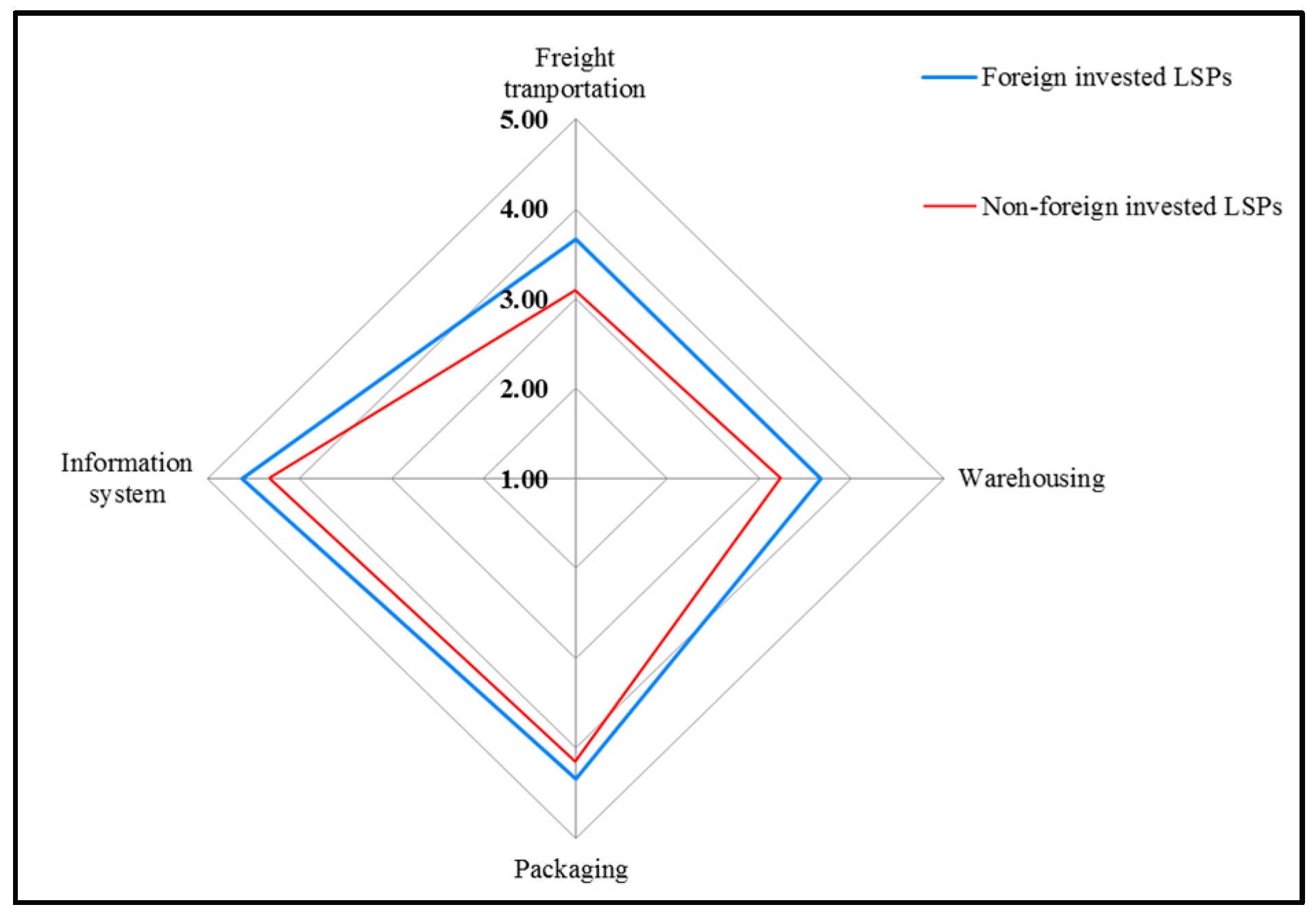
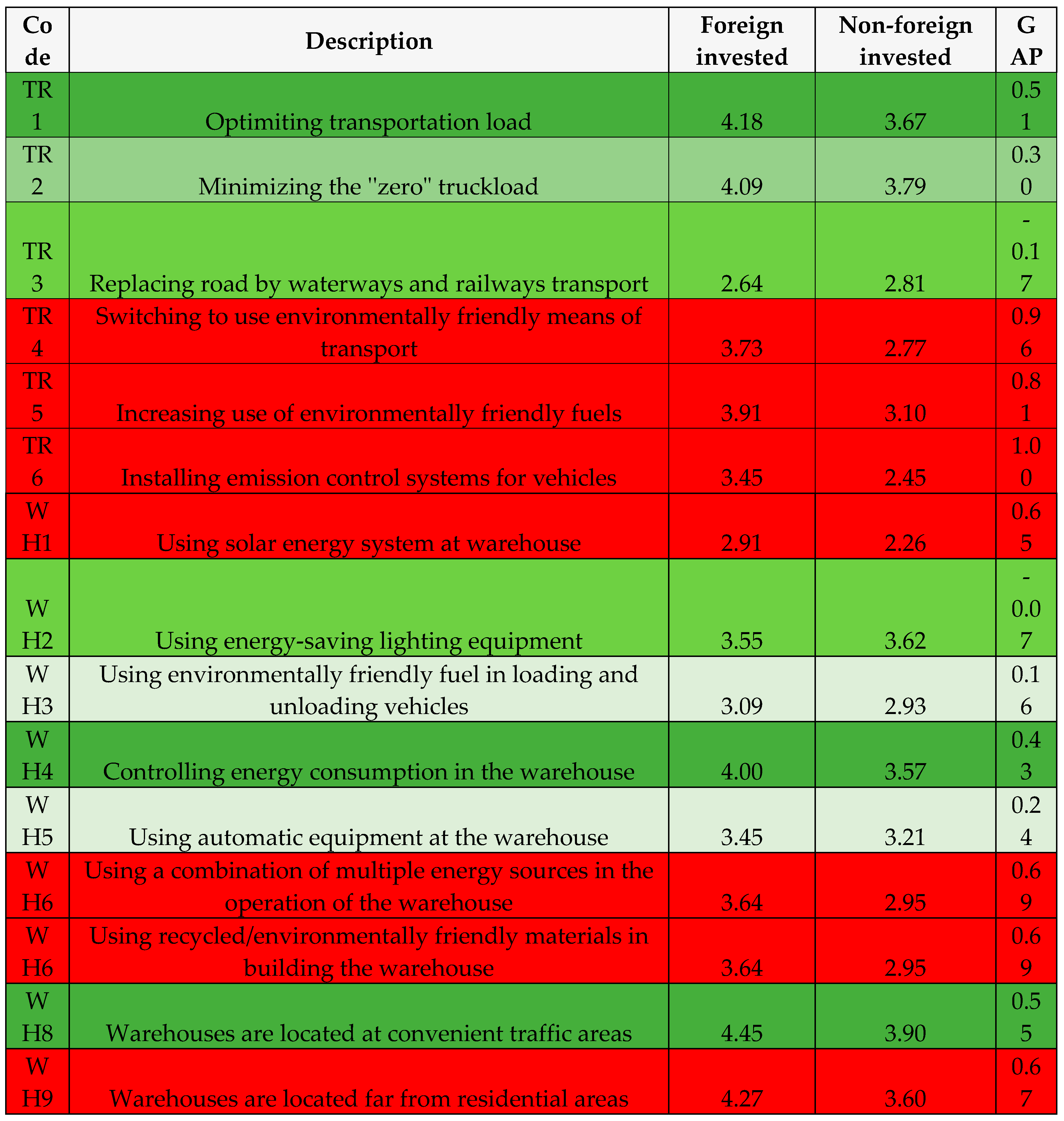
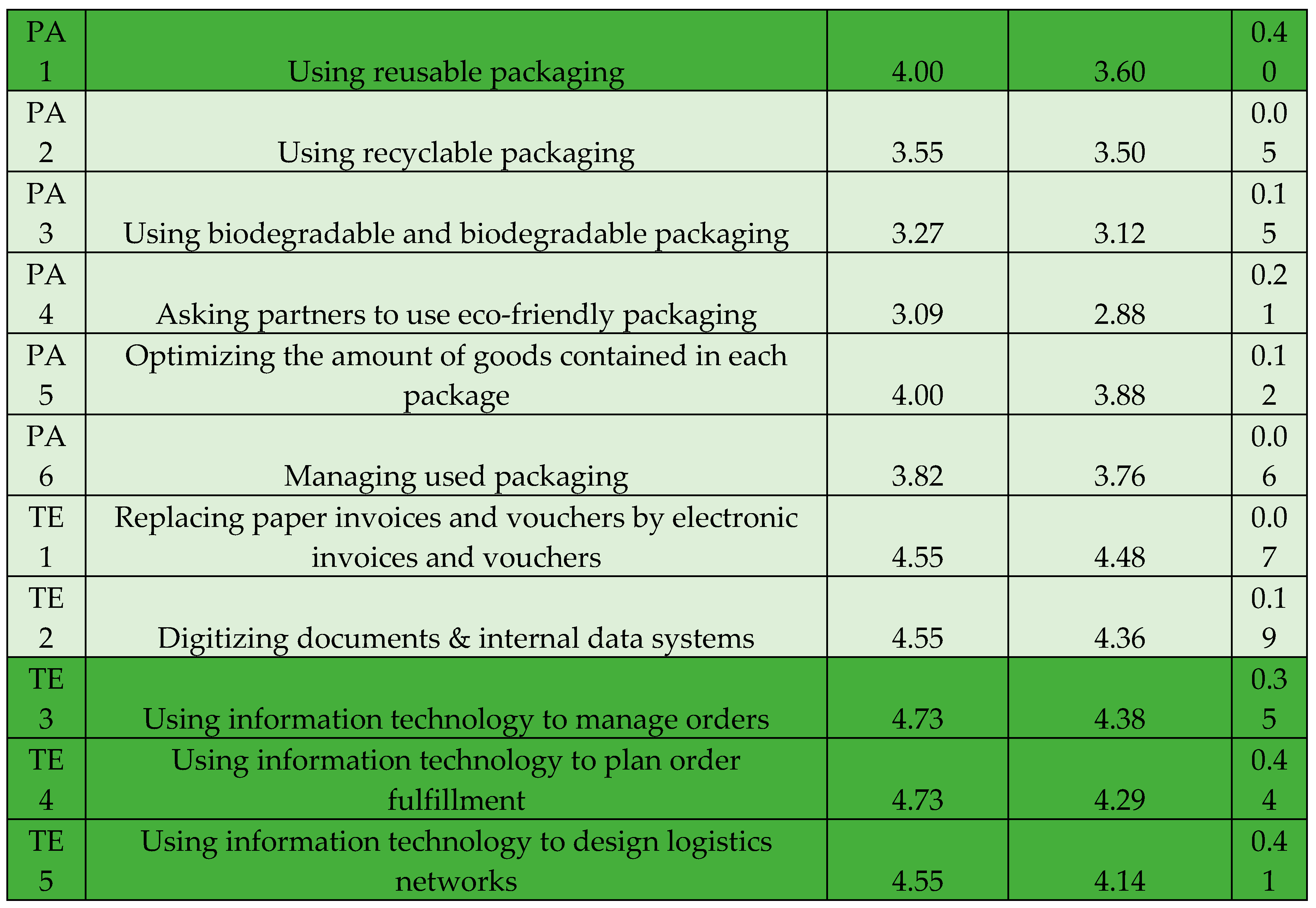
As mentioned in the methodology, we classify the low carbon emission operation in Vietnam into four groups: freight transportation, warehousing, packaging, and information system. By measuring the application of each group in both Vietnam companies and foreign companies, this section focuses on comparing and pointing out the different levels of action to reduce carbon emissions applied in that two types of companies. Some causes will be discussed accordingly. Data from the applied measurement are displayed in four figures, according to four groups of low carbon emission. Besides, Appendix A will be used as an additional source to show the gap between means of adopted level of each activity in foreign and nonforeign invested companies: gap indexes highlighted in red belong to the highest gap group, data in orange is the second group, and pink is the lowest one. Green data dedicate that the gap is negative, meaning Vietnamese LSPs are more active than foreign in applying that initiative.
In general, Figure 1 shows that foreign-invested companies are more likely to adopt operations in freight transportation to reduce carbon emissions than non-foreign-invested companies, with positive mean gaps that are almost ranked from 0.3 to 1 and 50% of those data are marked in red—highest gap’s group (Appendix B). On the one hand, optimising transportation load and minimizing the ‘zero’ truckload are the most common activities used in both types of companies, 100% foreign LSPs and 88.8% Vietnam LSPs applied respectively. Although the act of replacing roads with waterways and rail transport is rarely used. On the other hand, regardless having foreign investment or not, almost standard deviations are higher than one and there is very insignificant difference between those two groups of companies. Hence, there is a strong view that the applied levels are spread among different companies. It can be explained by the variety of company sizes and total income, as mentioned before.
Respondents from companies which invested by foreigners point out that they have higher adoption of reducing carbon emission operation in warehouse, in comparison with those which received capital from Vietnamese only. The average means of Vietnam LSPs is 3.22 while the average means of foreign invested companies is 3.67 with 8 out of 9 indexes higher. In addition, warehouse is the sectors which have the most remarkable differ of adopted levels between two types of companies: 4 out of 9 indexes belong to highest gap group (0.65-1) and highlighted in red (Appendix 2). Furthermore, based on the survey results, almost foreign invested LSPs are likely to apply low-carbon warehouse activities with 6 out of 9 standard deviations lower than one. However, the adopted levels in non-foreign invested companies are more diverse with all standard deviations being higher than 1, in specific, most of the indexes being higher than 1.2. In general, it is clear that low carbon emission operations are both limited and uneven applied in the warehousing sector of domestic LSPs.
Table 3.
The level of low carbon operation in warehousing applied at non-foreign invested and foreign invested LSPs in Vietnam.
Table 3.
The level of low carbon operation in warehousing applied at non-foreign invested and foreign invested LSPs in Vietnam.
| Code | Description | Foreign invested company | Non-foreign invested companies | ||
| Mean | Std.Dev | Mean | Std.Dev | ||
| WH1 | Using solar energy system at warehouse | 2.91 | 1.59 | 2.26 | 1.35 |
| WH2 | Using energy-saving lighting equipment | 3.55 | 1.09 | 3.62 | 1.22 |
| WH3 | Using environmentally friendly fuel in loading and unloading vehicles | 3.09 | 0.91 | 2.93 | 1.32 |
| WH4 | Controlling energy consumption in the warehouse | 4.00 | 1.22 | 3.57 | 1.30 |
| WH5 | Using automatic equipment at the warehouse | 3.45 | 0.79 | 3.21 | 1.32 |
| WH6 | Using a combination of multiple energy sources in the operation of the warehouse | 3.64 | 0.99 | 2.95 | 1.26 |
| WH6 | Using recycled/environmentally friendly materials in building the warehouse | 3.64 | 0.90 | 2.95 | 1.03 |
| WH8 | Warehouses are located at convenient traffic areas | 4.45 | 0.79 | 3.90 | 1.16 |
| WH9 | Warehouses are located far from residential areas | 4.27 | 0.76 | 3.60 | 1.20 |
In packaging sectors, the general adoption level of the company that received capital from oversea sources is still higher than that of domestic firms, a common trend. However, the low-carbon operation in packaging is recorded as the group that has the most consistent adopted measurement in comparison between foreign invested and domestics firms. The gap between means of those two types of company is nearly all marked in pink—the lowest group, with almost figures lower than 0.2. Moreover, the standard deviations of both foreign and non-foreign invested firms are all lower than one for PA1, PA4, and PA5 while higher than one for PA2, PA3, and PA4. Hence, nearly all low-carbon activities in packaging sector are applied under a similar diversity in both types of companies. On the other hand, according to the survey, there are only 3% of 159 companies, which never applied any operation to reduce carbon emission in packaging. There are nearly 60% of the respondents, who use environmentally friendly operations more often in packaging. Therefore, packaging is considered an easy group to adopt low carbon emission operations.
Table 4.
The level of low carbon operation in packaging applied at non-foreign invested and foreign invested LSPs in Vietnam.
Table 4.
The level of low carbon operation in packaging applied at non-foreign invested and foreign invested LSPs in Vietnam.
| Code | Description | Foreign invested company | Non-foreign invested companies | ||
|---|---|---|---|---|---|
| Mean | Std. Dev |
Mean | Std. Dev |
||
| PA1 | Using reusable packaging | 4.00 | 0.75 | 3.60 | 0.88 |
| PA2 | Using recyclable packaging | 3.55 | 1.09 | 3.50 | 1.01 |
| PA3 | Using biodegradable and biodegradable packaging | 3.27 | 1.07 | 3.12 | 1.08 |
| PA4 | Asking partners to use eco-friendly packaging | 3.09 | 1.10 | 2.88 | 1.08 |
| PA5 | Optimizing the amount of goods contained in each package | 4.00 | 0.75 | 3.88 | 0.88 |
| PA6 | Managing used packaging | 3.82 | 0.85 | 3.76 | 1.16 |
Compared with the other three groups of low carbon emission, technology has the highest average mean of adoption level in both types of firm: 4.62 for oversea invested companies and 4.33 for domestic companies. On the scale of 5, nearly all foreign invested LSPs have the application level at 4 or 5, there is only 9.1% of respondents who are often (score 3) applied low carbon emission operation, use electronic invoices and vouchers in specific. For companies, which are invested by Vietnamese only, the mean data are lower, but mostly still higher than 4.3. When comparing the means of applied level of each activity in the technology group, there are no data marked in yellow. It means that the applied level in companies which have capital from foreigners domestic only is similar as in every kind of technology operation. It is reasonable because technology serves as a means to improve the overall effectiveness and efficiency of the logistics system, not only simplifying tasks but also saving time, costs, and reducing the labour required for operations. (Bhandari, 2014). Furthermore, the applied level of reducing carbon emission reduction applied in technology is remarkable consistent among companies. Based on the survey, the standard deviations of Vietnamese companies are all less than 0.84 while the similar indexes of foreign invested companies are even lower than 0.67. Hence, technology is the only one out of four mentioned groups has 100% standard deviation lower than one. All data strongly show that technology is applied widely in reducing carbon emissions, regardless types of business, company size, or history of development.
Table 5.
The level of low carbon operation in technology applied at non-foreign invested and foreign invested LSPs in Vietnam.
Table 5.
The level of low carbon operation in technology applied at non-foreign invested and foreign invested LSPs in Vietnam.
| Code | Description | Foreign invested company | Non-foreign invested companies | ||
|---|---|---|---|---|---|
| Mean | Std. Dev |
Mean | Std. Dev |
||
| TE1 | Replacing paper invoices and vouchers by electronic invoices and vouchers | 4.55 | 0.67 | 4.48 | 0.80 |
| TE2 | Digitizing documents & internal data systems | 4.55 | 0.51 | 4.36 | 0.75 |
| TE3 | Using information technology to manage orders | 4.73 | 0.45 | 4.38 | 0.69 |
| TE4 | Using information technology to plan order fulfillment | 4.73 | 0.45 | 4.29 | 0.63 |
| TE5 | Using information technology to design logistics networks | 4.55 | 0.51 | 4.14 | 0.84 |
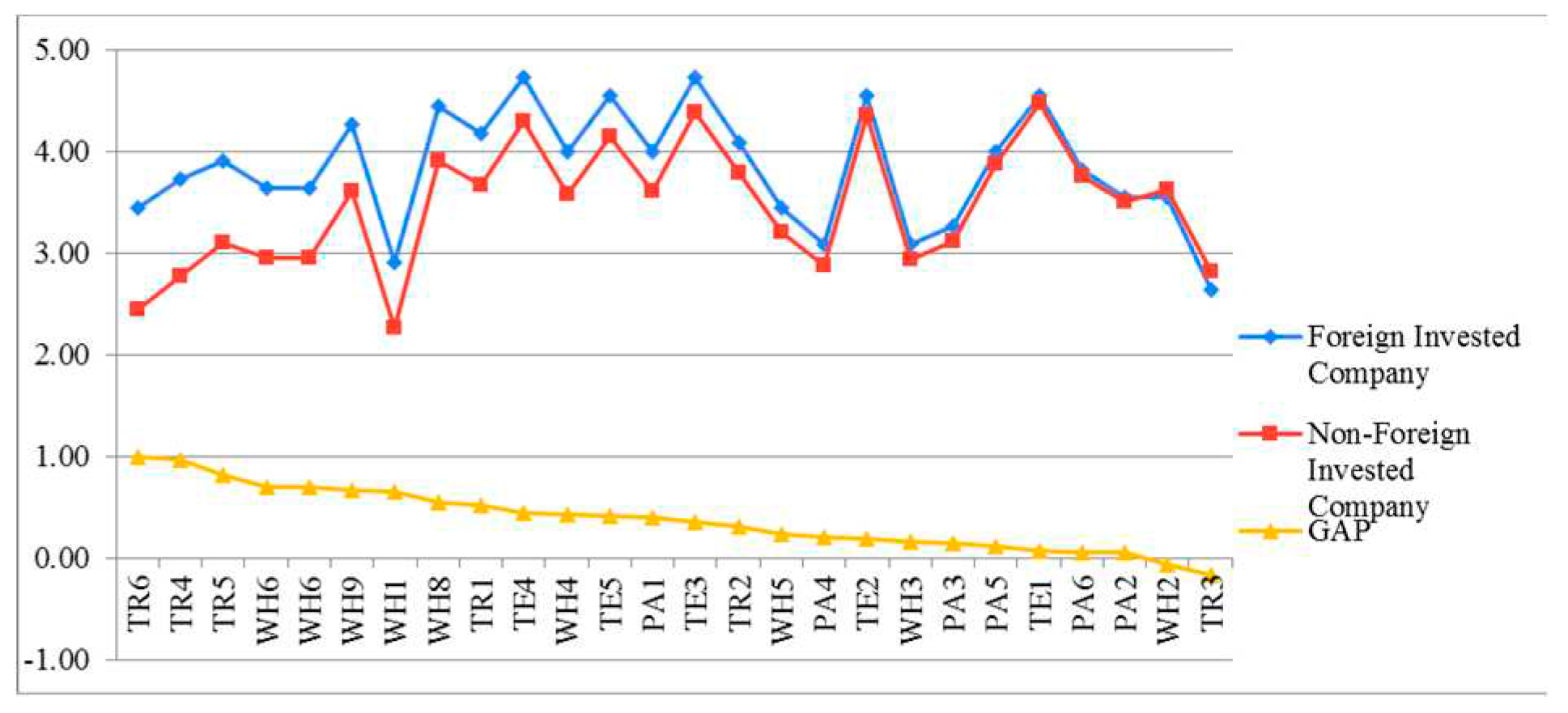
By calculating the gap of 26 indexes of collected adoption levels in foreign and non-foreign invested companies, it can be seen that there are only two negative gaps while the 24 other figures are higher than zero. In general, nearly all companies that received capital from foreigner are applied low carbon emission operation more widely than those that only got domestic investment. In this case, the largest gaps belong to activities, which require significant budget for investment in properties, such as means of transportation, control system, friendly environmental systems, or other kind of long term changing like fuels. In addition, the smallest gaps are about optimising usage of companies owned subjects or low-value things such as lighting equipment.
Figure 2.
Gap between low-carbon initiatives adoption of surveyed LSPs.
The first reason could be explained the difference between two types of companies in adoption of low carbon emission operation is capital background. According to the Vietnam Logistics Report 2019, the financial potential of Vietnamese logistics companies is limited with 80% of established enterprises have a registered capital less than two billion VND. Within the limitation of financial resources, Vietnam LSPs are extremely difficult to be affordable for updating new technology, transferring transportation means, and investing in facilities to enhance effectiveness and reduce greenhouse accordingly.
Figure 3.
Means of adoption level of low-carbon emissions of surveyed LSPs.
Some strong opinions believe that the gap of acknowledgement and effort to cut down carbon emission between developed and developing countries. According to Delgado (2021): “The Paris Agreement acknowledges that efforts toward reducing carbon emissions will be common but not equal among developed and developing countries. The fairness of these contributions will be determined by national circumstances so that there will be equity in the responses and responsibilities to address climate change.’ It means that developing countries will continue to emit more carbon until they are developed enough and independent from the carbon-intensive industry. In addition, Younis (2015) states that developing countries still lack of knowledge about the consequences of emissions and their pursuit of profit and economic growth prevents leaders from making ethical decision to protect the environment. While most of the foreign invested LSPs in Vietnam come from developed countries like Denmark (Maersk), Japan (Yusen), Germany (DHL, DB Schenker), and so on. It is obvious that their awareness of environmental protection is more comprehensive than that of companies originating from developing countries like Vietnam. Consequently, to reduce carbon emissions for each operation group, foreign-invested companies always have higher adoption levels than Vietnam’s government owned ones.
Finally, the dominance of LSPs invested by oversea resources is also considered as one of the most important factors to explain why foreigner invested firms applied a more low carbon emission operation. Logistics experts commented that the number of foreign-invested LSP in Vietnam is quite small compared with total logistics services provider in Vietnam, 25 firms for specific, but they accounted 75%-80% market share (Pham, 2019). Moreover, almost foreigner-invested firms in Vietnam are operating globally. Therefore, foreign companies invested in Vietnam have extraordinary backgrounds, experience, significant financial and a human resources, and comprehensive understanding of the environment. At the same time, worldwide operation also requires that those firms comply with the environmental regulation of each country and area, especially in the cases of countries that signed the Kyoto Protocol. In particular, those countries set goals to reduce C02 by commitment periods: parties committed to reduce GHG emissions by at least 18 percent below 1990 levels in the eight-year period from 2013 to 2020. In order to achieve that goal, nearly all participating countries set up related regulation to low carbon emission accordingly, such as the US released National GHG emission standards for light trucks, The Safer Affordable Fuel Efficient Vehicles (SAFE) for Model Years 2021-2026. (United States Environmental Protection Agency, 2021). Consequently, these regulations force all international LSPs to apply low carbon emission and, obviously, foreigner invested LSPs in Vietnam cannot resist while they are operating as a part of global logistics systems.
4. Discussion
4.1. Contributions & implications
A large number of studies have been conducted on low-carbon emission, yet the number of literatures specifically in the logistics fields is still limited. The current papers mainly discussed the influences of drivers on the application of low-carbon practises in logistics industry in general or particularly in a minor aspect such as warehousing. Although Vietnam is one of the most vulnerable countries to climate change and the logistics segment of this nation is growing fast, the matter of reducing the low carbon emission of logistics service providers has not been properly analysed.
This paper has managed to devote some contributions to fulfil the gaps. A theoretical framework of low-carbon measures that are applicable for logistics service providers in the Vietnam market has been proposed and revised. The level of application has been analysed, revealing that initiatives in information technology are implemented the most. Meanwhile, the adoption of low-carbon practices in warehousing services is more limited among four categories in both Vietnam and foreign LSPs.
A comparison between the application conducted by foreign-invested firms and nonforeign-invested ones, which has not been investigated before, was made. It can be generally concluded that foreign LSPs are averagely more active in applying low-carbon practises, in all sectors: transportation, warehousing, packaging, and information technology. The largest gaps can be observed in initiatives in categories of transportation and warehousing. This implies Vietnamese LSPs pay attention to cutting carbon emission practises in these two activities much less than the foreign competitors, particularly the ones requiring energy switch, investment in equipment like solar system, transportation means and emission controllers.
These findings are relative to what the experts from the in-depth interviews. To be more precise, the more active participation of foreign-invested LSPs in investment-demanding solutions could be a result of the difference in capital background of the two groups. External subjects surveyed are the global logistics companies, which have long budgeted for green initiatives. These applications can not only contribute to their corporate image enhancement, but also allow them to comply with local regulations of any markets they enter. For that reason, it is relevant enough for domestic LSPs to refer to these research results to allocate which low-carbon practices they should invest in the future.
5.2. Limitations and suggestions
As can be extracted from the discussion, the levels of low-carbon adoption of different types of LSPs varied, which can be concretely concluded that there are factors affecting the application. Within the scope of this study, the potential causes have been partially explored via a qualitative approach by in-depth discussion, including financial background, awareness level, and global market participation. Therefore, further empirical studies can dive more into this segment, especially reviewing current literature and numerically the affecting criteria or barriers affecting the application process. These directions have been explored in a few numbers of studies, but this has mainly been for supply chain participants rather than logistics service providers, and not yet for the local case in Vietnam.
In addition, the segment of measuring the performance of these initiatives has been relatively neglected. As discussed above, these measures demand investment and basically add cost burden for the firms. Then, the efficiency of them should be evaluated in order to support LSPs in making decisions of continuing the application or further strengthening any practises. From the interviews, these criteria have been partially explored. Most of the experts interviewed suggested the low-carbon practises can be reflected through level of energy consumption, carbon emission, customer judgement and green image of the firm. However, both groups of LSPs groups hold a quite neutral assessment of these performing factors, ranging from 3.2 and 3.6 on average. Therefore, this leaves room for studies in the future to explore and empirically assess how efficient low-carbon practices are, particularly in the Vietnamese logistics industry.
Author Contributions
All five authors have contributed substantially to the work reported. In detail, Conceptualization, Kiem P.V. and Huong T.T.T.; methodology: Kiem P.V. and Khac Huy Ng.; writing original draft: Thao V.P., Huong T.T.T. and Trang P.T., investigation and software: Khac Huy Ng. and Thao V.P.; validation: Kiem P.V.; writing—review and editting: Kiem P.V. All authors have read and agreed to the published version of the manuscript.
Conflicts of Interest
The authors declare no conflict of interest.
Appendix A
Appendix B
References
- Cheng, B.; Dai, H.; Wang, P.; Xie, Y.; Chen, L.; Zhao, D.; Masui, T. Impacts of low-carbon power policy on carbon mitigation in Guangdong Province, China. Energy Policy 2015, 88, 515–527. [Google Scholar] [CrossRef]
- Shen, L.; Wu, Y.; Lou, Y.; Zeng, D.; Shuai, C.; Song, X. What drives the carbon emission in the Chinese cities?—A case of pilot low carbon city of Beijing. J. Clean. Prod. 2018, 174, 343–354. [Google Scholar] [CrossRef]
- Wang, R., Liu, W., Xiao, L., Liu, J. and Kao, W. Path towards achieving of China's 2020 carbon emission reduction target - A discussion of low-carbon energy policies at province level. Energy Policy 2011, 39, 2740–2747. [Google Scholar] [CrossRef]
- Cao, K.; Xu, X.; Wu, Q.; Zhang, Q. Optimal production and carbon emission reduction level under cap-and-trade and low carbon subsidy policies. J. Clean. Prod. 2017, 167, 505–513. [Google Scholar] [CrossRef]
- Wang, X.; Zhu, Y.; Sun, H.; Jia, F. Production decisions of new and remanufactured products: Implications for low carbon emission economy. J. Clean. Prod. 2018, 171, 1225–1243. [Google Scholar] [CrossRef]
- Lyu, X.; Shi, A.; Wang, X. Research on the impact of carbon emission trading system on low-carbon technology innovation. Carbon Manag. 2020, 11, 183–193. [Google Scholar] [CrossRef]
- Mo, J.-L.; Agnolucci, P.; Jiang, M.-R.; Fan, Y. The impact of Chinese carbon emission trading scheme (ETS) on low carbon energy (LCE) investment. Energy Policy 2016, 89, 271–283. [Google Scholar] [CrossRef]
- Lee, C.T. , Hashim H. , Ho C., Fan, V. and Klemeš, J. Sustaining the low-carbon emission development in Asia and beyond: Sustainable energy, water, transportation and low-carbon emission technology, Journal of Cleaner Production, 2016, 146, 1–13. [Google Scholar] [CrossRef]
- Wang, Q.; Zhao, D.; He, L. Contracting emission reduction for supply chains considering market low-carbon preference. J. Clean. Prod. 2016, 120, 72–84. [Google Scholar] [CrossRef]
- Xia, L.; Hao, W.; Qin, J.; Ji, F.; Yue, X. Carbon emission reduction and promotion policies considering social preferences and consumers' low-carbon awareness in the cap-and-trade system. J. Clean. Prod. 2018, 195, 1105–1124. [Google Scholar] [CrossRef]
- Sun, L.; Cao, X.; Alharthi, M.; Zhang, J.; Taghizadeh-Hesary, F.; Mohsin, M. Carbon emission transfer strategies in supply chain with lag time of emission reduction technologies and low-carbon preference of consumers. J. Clean. Prod. 2020, 264, 121664. [Google Scholar] [CrossRef]
- Evangelista, P. Environmental sustainability practices in the transport and logistics service industry: An exploratory case study investigation. Res. Transp. Bus. Manag. 2014, 12, 63–72. [Google Scholar] [CrossRef]
- Lieb, K.J. and Lieb R. C. Environmental sustainability in the third-party logistics (3PL) industry”, International journal of physical distribution & logistics management, 2010, 40, (7), 524–533. [Google Scholar] [CrossRef]
- Govindan, S. , Kalyiyan, M. , Kannan, D., and Haq, A.N. Barriers analysis of green supply chain management implementation in Indian industries usisng analytic hierarchy process, International journal of production economics, 2014, 147, 555–568. [Google Scholar] [CrossRef]
- Lin, C.-Y.; Ho, Y.-H. Determinants of Green Practice Adoption for Logistics Companies in China. J. Bus. Ethic- 2010, 98, 67–83. [Google Scholar] [CrossRef]
- Zhu, Q.; Geng, Y. Drivers and barriers of extended supply chain practices for energy saving and emission reduction among Chinese manufacturers. J. Clean. Prod. 2013, 40, 6–12. [Google Scholar] [CrossRef]
- Cantor, D.E.; Morrow, P.C.; McElroy, J.C.; Montabon, F. The role of individual and organizational factors in promoting firm environmental practices. Int. J. Phys. Distrib. Logist. Manag. 2013, 43, 407–427. [Google Scholar] [CrossRef]
- Goh, S.H. Barriers to low-carbon warehousing and the link to carbon abatement: A case from emerging Asia, International Journal of Physical Distribution & Logistics Management, 2019, 49, (6), 679-704. [CrossRef]
- Centobelli, P.; Cerchione, R.; Esposito, E. Environmental sustainability in the service industry of transportation and logistics service providers: Systematic literature review and research directions. Transp. Res. Part D: Transp. Environ. 2017, 53, 454–470. [Google Scholar] [CrossRef]
- Foerstl, K.; Azadegan, A.; Leppelt, T.; Hartmann, E. Drivers of Supplier Sustainability: Moving Beyond Compliance to Commitment. J. Supply Chain Manag. 2014, 51, 67–92. [Google Scholar] [CrossRef]
- Abbasi, M. , and Nilsson, F. Developing environmentally sustainable logistics: exploring themes and challenges from a logistics service providers’ perspective, Transportation research part D: Transport and Environment, 2016, 26, 273–283. [Google Scholar] [CrossRef]
- Jabbour, A.B.L.d.S.; Jabbour, C.J.C.; Sarkis, J.; Latan, H.; Roubaud, D.; Filho, M.G.; Queiroz, M. Fostering low-carbon production and logistics systems: framework and empirical evidence. Int. J. Prod. Res. 2020, 59, 7106–7125. [Google Scholar] [CrossRef]
- Ibrahim, M.F.; Putri, M.M.; Utama, D.M. A literature review on reducing carbon emission from supply chain system: drivers, barriers, performance indicators, and practices. IOP Conf. Series: Mater. Sci. Eng. 2020, 722, 012034. [Google Scholar] [CrossRef]
- Sun, Z. , Liu, Y. and Yu, Y. China's carbon emission peak pre-2030: Exploring multi-scenario optimal low-carbon behaviors for China's regions, Journal of Cleaner Production, 2019, 231, 963–979. [Google Scholar] [CrossRef]
- Chuai, X.; Huang, X.; Wang, W.; Zhao, R.; Zhang, M.; Wu, C. Land use, total carbon emissions change and low carbon land management in Coastal Jiangsu, China. J. Clean. Prod. 2015, 103, 77–86. [Google Scholar] [CrossRef]
- Naqi, A.; Jang, J.G. Recent Progress in Green Cement Technology Utilizing Low-Carbon Emission Fuels and Raw Materials: A Review. Sustainability 2019, 11, 537. [Google Scholar] [CrossRef]
- Trivellas, P.; Malindretos, G.; Reklitis, P. Implications of Green Logistics Management on Sustainable Business and Supply Chain Performance: Evidence from a Survey in the Greek Agri-Food Sector. Sustainability 2020, 12, 10515. [Google Scholar] [CrossRef]
- Bo Qin, S. S. H. Planning parameters and household carbon emission: Evidence from high- and low-carbon neighborhoods in Beijing, Habitat International, 2013, 37, pp. 52-60.
- Perotti, S.; Zorzini, M.; Cagno, E.; Micheli, G.J. Green supply chain practices and company performance: the case of 3PLs in Italy. Int. J. Phys. Distrib. Logist. Manag. 2012, 42, 640–672. [Google Scholar] [CrossRef]
- Nguyen, M.N. Annual CO2 emissions of Vietnam from 2010 to 2019, Statista, 2021, available online at: https://www.statista. 1195. [Google Scholar]
Figure 1.
Annual CO2 emissions of Vietnam from 2010 to 2019 (in million metric tons). (Source: [30])
Figure 1.
Annual CO2 emissions of Vietnam from 2010 to 2019 (in million metric tons). (Source: [30])
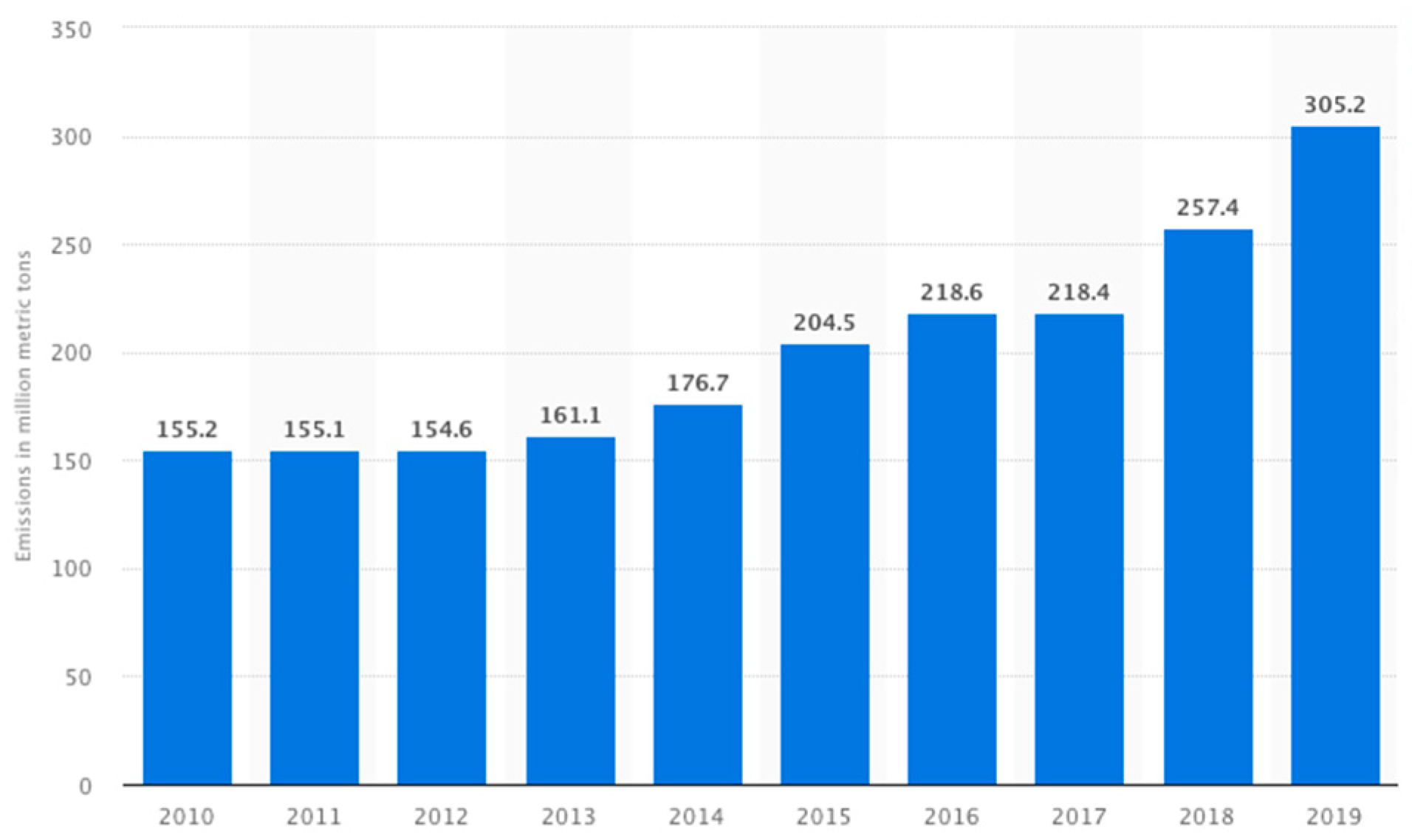
Table 2.
The level of low carbon operation in freight transportation applied at non-foreign invested and foreign invested LSPs in Vietnam.
Table 2.
The level of low carbon operation in freight transportation applied at non-foreign invested and foreign invested LSPs in Vietnam.
| Code | Description | Foreign invested company | Non-foreign invested companies | ||
|---|---|---|---|---|---|
| Mean | Std. Dev |
Mean | Std. Dev |
||
| TR1 | Optimizing transportation load | 4.18 | 0.73 | 3.67 | 1.11 |
| TR2 | Minimizing the “zero” truckload | 4.09 | 1.10 | 3.79 | 1.17 |
| TR3 | Replacing road by waterways and railways transportation | 2.64 | 1.45 | 2.81 | 1.44 |
| TR4 | Switching to use environmentally friendly means of transportation | 3.73 | 1.15 | 2.77 | 1.21 |
| TR5 | Increasing use of environmentally friendly fuels | 3.91 | 1.33 | 3.10 | 1.36 |
| TR6 | Installing emission control systems for vehicles | 3.45 | 1.09 | 2.45 | 1.32 |
Disclaimer/Publisher’s Note: The statements, opinions and data contained in all publications are solely those of the individual author(s) and contributor(s) and not of MDPI and/or the editor(s). MDPI and/or the editor(s) disclaim responsibility for any injury to people or property resulting from any ideas, methods, instructions or products referred to in the content. |
© 2023 by the authors. Licensee MDPI, Basel, Switzerland. This article is an open access article distributed under the terms and conditions of the Creative Commons Attribution (CC BY) license (https://creativecommons.org/licenses/by/4.0/).
Copyright: This open access article is published under a Creative Commons CC BY 4.0 license, which permit the free download, distribution, and reuse, provided that the author and preprint are cited in any reuse.


