

Submitted:
09 August 2023
Posted:
09 August 2023
You are already at the latest version
Preprints on COVID-19 and SARS-CoV-2
Abstract
The COVID-19 virus is spread to the respiratory system by minute airborne particles in contrast to large particle fomite transmission. Yet, an often-repeated health directive during the COVID-19 pandemic was to improve handwashing to limit the spread of the virus. Persistent handwashing can aggravate obsessive-compulsive disorder (OCD), diminishing mental health. Given that handwashing is unlikely to control the spread of COVID-19, it is pertinent to determine if the directive for handwashing to eradicate the COVID-19 virus increased the incidence of OCD and, as such, promoted negative mental health. This scoping review of the parameter, “handwashing, mental health, COVID-19, OCD”, conducted during July 2023, searched six relevant databases. The result was that negative mental health related to increased handwashing was evident both for those already diagnosed with OCD and regarding new cases of OCD throughout the duration of the pandemic. The conclusion is that health officials should update details of their health directives as information becomes available during a pandemic and, concerning COVID-19, the directive to concentrate on handwashing should have been relaxed once it was known that spread of the virus by fomite transmission was improbable. This likely would have reduced the incidence of OCD and improved mental health.
Keywords:
COVID-19
; fomite transmission
; health directive
; handwashing
; OCD
; mental health
; scoping review
1. Introduction
An article published in Nature on 29 January 2021 examined what was then known of the spread of the SARS-CoV-2 virus in relation to the 2020-2023 COVID-19 pandemic [1] indicating that transmission was through airborne aerosolized droplets directly inhaled by contacts [2]. This was in contrast to earlier modeling and epidemiological observations that had implicated the spread of the virus through large respiratory droplets settled on surfaces and transferred to contacts' mucosal membranes (fomite transmission) [3]. Although there is evidence that the COVID-19 virus persists on certain surfaces for up to 72 hours [4], according to the Nature article, this viral RNA “is the equivalent of the corpse of the virus—It’s not infectious”. Furthermore, the article also stressed, “Fomite transmission is possible, but it just seems to be rare—A lot of things have to fall into place for that transmission to happen” [1].
The initial predictions regarding how the COVID-19 virus was spread were based on expectations comparing its transmission to that of other common respiratory viruses [3]. However, each virus type has a different interaction mechanism with fomites and this is affected by several variables [5]. As early as July 2020, an article appearing in The Lancet Infectious Diseases stressed that the risk of transmission of COVID-19 by fomites was exaggerated [6] and this point was supported by further research on transmission by fomites first appearing in the same journal in September of that year [7]. Still, regardless of the unlikeliness of infection as a result of fomite transmission, the Nature article was clear to point out that fomite transmission still could not be ruled out in the spreading of the COVID-19 virus [1].
To state COVID-19 can be spread by fomite transmission is not equivalent to claiming it is likely. Yet, as late as April 2023, the popular publication, Forbes, stressed in a headline, “You Can Get Covid-19 From Coronavirus-Contaminated Surfaces, New Study Confirms” [8] without mentioning to readers that, although the article was published in April 2023, the research was conducted early in the pandemic (and, therefore, wasn’t new) and the authors of the research conclude only that “Contacts were also substantially more likely to have detectable SARS-CoV-2 RNA on their hands if household surfaces were contaminated” [9]. What they did not conclude or imply was that fomite transmission caused infection with the COVID-19 virus.
Yet, without conclusive evidence to demonstrate that fomite transmission is a real cause for concern regarding infection with the COVID-19 virus, the importance of cleansing surfaces and hands to control COVID-19 was stressed in a manner equivalent to improving ventilation [10]—although it was evident that, in reducing aerosolized droplets, enhancing ventilation was the superior method to cleansing in controlling the spread of the virus [11]. Nevertheless, the call from the World Health Organization (WHO) for frequent and better handwashing along with other cleansing was maintained as an excellent method to reduce the incidence of COVID-19 [12].
Handwashing has been demonstrated to be potent in killing viruses if properly completed [13]. For this reason, regardless of how unlikely it is that the COVID-19 virus is transmitted by touching surfaces, handwashing is an easy precaution to take and might be effective [14]. What has not been taken into consideration by authorities who have continued their support of persistent handwashing among the measures to reduce the spread of the virus is those who obsess regarding handwashing diagnosed with obsessive-compulsive disorder (OCD), and those who became newly diagnosed as a result of this health directive—producing negative mental health in those affected [15].
OCD is defined as patterns of unwanted and intrusive thoughts, images, or urges and repetitive behaviors that are intended to decrease the resulting distress from the compulsions [16]. OCD symptoms often include a fear of contamination which then triggers ritualized hand-washing and other cleaning behaviors to neutralize the thought [16]. The widespread public health demands for increased and “proper” hand-washing, cleaning, and use of disinfectants as a result COVID-19 may have been especially problematic for these particular patients with OCD, putting them at risk for developing excessive pandemic-related fears [17] leading to negative mental health.
This is the first paper to consider the role of handwashing alone in both those previously diagnosed with OCD, and those who developed OCD during COVID-19, with respect to the negative mental health they experienced as a result of the health directive to increase handwashing to protect against the transmission of the COVID-19 virus. As such, this paper aims to examine the extent of those with OCD whose mental health was negatively affected as a result of the directive to increase the amount they wash their hands during the COVID-19 pandemic. This examination is undertaken through a scoping review of a parameter with the following keywords, “handwashing, mental health, COVID-19, OCD”. The databases searched include Ovid, PubMed, ProQuest, Scopus, Web of Science, and Google Scholar. The results demonstrate that the unnecessary insistence by health officials that handwashing be increased during COVID-19 because of the unlikely possibility of fomite transmission caused significant negative mental health in the majority of those already diagnosed with OCD and increased negative mental health in all of those newly-diagnosed with OCD. As a result, the suggestion is that future information by health officials regarding the transmission of COVID-19 be more balanced in the details provided so that those susceptible to OCD are informed that there is no requirement for them to increase their already persistent behavior regarding handwashing in protecting themselves from COVID-19 transmission; thus, aiding in maintaining their mental health.
2. Materials and Methods
The methods used by the author in gathering the materials utilized a preferred reporting items for the systematic review and meta-analyses (PRISMA) flow of information diagram specific to scoping reviews. The PRISMA diagram represented in Figure 1 is based on the most recent PRISMA template for scoping reviews from 2020 [18] and indicates the process undertaken for the identification of studies via databases and registers.
2467 individual records were returned from six different database searches. The databases searched and the number of records returned are as follows: Ovid (n = 4), PubMed (n = 4), ProQuest (n = 201), Scopus (n = 1), Web of Science (n = 7), and Google Scholar (n = 2250). There were no registers searched. Of these records, those removed included duplicates (n = 41), not in English (n = 0), not peer reviewed (n = 158), not published between 2020-2024 (n = 330), and missing one keyword per page in the Google Scholar search returns (n = 1580). 358 records remained to be screened with none excluded for lacking COVID-19. Consequently, all 358 reports were sought for retrieval and all were retrieved. The result was 358 reports to be assessed for eligibility. Of these, those excluded were lacking: handwashing (n = 53), mental health (n = 7), and OCD (n = 6). Thus, the studies included in the review were 292.
As a scoping review rather than a systematic review, the number of reports of included studies was reduced to the first 50 returns from all databases in total. Of these, 45 mentioned negative mental health. Of the 46 reports that concerned those diagnosed with OCD before the pandemic, 41 of them found negative mental health in those so diagnosed. Of the 15 reports investigating OCD in those who developed symptoms during COVID-19, all 15 reported negative mental health in these individuals. In contrast, negative mental health was not found in only 5 of the 50 reports included. Of these, all 5 were identified with those who were diagnosed with OCD before COVID-19—0 for those diagnosed during the pandemic.
Along with the Figure 1 flowchart, the required 2020 PRISMA Scoping Review Checklist is available in a supplementary file, Table (S1), detailing the page location where each aspect of the PRISMA process is reported for this study.
As a scoping review conducted in relation to COVID-19, the International Prospective Register of Systematic Reviews (PROSPERO) requirements are relevant and must be considered [19]. Following the content of the video included as part of the requirements webpage of PROSPERO concerning accessing and completing the registration form, this study fulfills the requirements of a scoping review rather than a systematic review. A scoping review is defined on the PROSPERO website as, "a type of knowledge synthesis that follows a systematic approach to map evidence on a particular topic" [18]. The scoping review is typically broader than that of a traditional systematic review and seeks to develop a comprehensive overview of the evidence rather than a synthesis of data [20]. In meeting the definition of a scoping review, therefore, this review, then, is not a systematic review. In contrast to a scoping review, research on the PROSPERO requirements considers a systematic review to represent a “comprehensive, in-depth analyses of research conducted on a particular question designed to inform clinical practice and policy decisions. The review should be a planned, methodical project that aims to uncover all relevant research via a systematic search, analysis and synthesis of results” [21]. In representing a scoping review rather than a systematic review—following the instructions provided on the PROSPERO website—registration with PROSPERO is not required. Nevertheless, the methodology of scoping reviews is continuing to evolve alongside understandings regarding why authors do or do not use particular methodologies [20]. Therefore, in the future, the need to report scoping reviews for PROSPERO may change.
All the databases were accessed through the University of Toronto list of links to databases. The first database searched was Ovid. It was the database accessed in the University of Toronto link for both a search intended for Embase and for Medline. As such, what might have been two searches of two different databases became instead one search on Ovid. The search on this database was conducted on 21 July 2023. The parameter containing the keywords “handwashing, mental health, COVID-19, OCD” was entered with an “and” in between each keyword. The next databases to be searched on 21 July 2023 were PubMed, and ProQuest. Both of these searches were also performed regarding the same keywords as used in the Ovid search. The search process of databases was continued on 23 July 2023 with a search of the same four keywords for the primary databases Scopus, and Web of Science in that order and also for Google Scholar, as the final, supplementary, database search.
Google Scholar was chosen to increase the reach of the search as a 2019 study of twelve academic search engines found it the most comprehensive academic search engine [22], additionally reconfirmed with 2023 research [23]. It was a 2020 article [24] that evaluated Google Scholar as unsuitable for primary review searches, considering it a supplementary source of evidence as Google Scholar does not deliver reproducible results at all times. Still, this same 2020 review continued to acknowledge Google Scholar as the most comprehensive database used by the majority of academics, regardless of its low precision and lack of support for advanced features of systematic searches.
As will be noted in the results to follow, Google Scholar was found to be the most comprehensive search engine and vastly increased the scope of the search found relevant for this study. To eliminate the concern of a lack of reproducibility of the Google Scholar search, the search results were transferred to a Word file immediately after they were returned and are available as Supplementary file 2 (S2) for any further research confirmation.
3. Results
The initial results presented are those specifically regarding the returns to the primary database searches performed. Comments are made comparing the duplications of the primary database returns with the supplementary Google Scholar returns following the presentation of the primary databases results. Finally, the studies included of the unique returns from the Google Scholar search are presented as well as reasons for limiting the studies included in the review of this database to 30, for a total of 50 records.
As per the requirements of the PRIMSA flow of information diagram specific to scoping reviews, once the initial number of returns is indicated for each of the databases searched in the diagram (see Figure 1), all records are then added together to present the total number of records. To provide individual details of the records screened, assessed, and included, these results to follow include the breakdown of the records for each database. For the total of all database returns (that will not be reported in combination in the results), see Figure 1 and the description of the process provided in the Materials and Methods section.
3.1. Returns of the Primary Databases Searched
The returns of the databases searched are divided into the searches performed on 21 July 2023 and those performed on 23 July 2023 of the parameter with the keywords “handwashing, mental health, COVID-19, OCD”. The articles included for each of these database searches undertaken are represented as the groupings of articles in Table 1, delineating each database with heavier black lines dividing the rows.
3.1.1. Searches Performed 21 July 2023
The 21 July search of OVID returned 4 results. These 4 results included: “Handwashing: When Ritual Behavior Protects!” [25], “A Perfect Storm?” [26], “The impact of the Coronavirus (COVID-19) Pandemic” [27], and “COVID-19 Pandemic and Mental Health” [28]. The search of PubMed similarly returned 4 results—one of which was in common with the search of the OVID database, “The Impact of the Coronavirus (COVID-19) Pandemic”, leaving 3 returns to investigate. These articles, returned to be screened, were, “Resilience Predicts Positive Mental Health Outcomes” [29], “Obsessive-Compulsive Disorder Reinforcement” [30], and “Conradi-Hünerman-Happle Syndrome” [31].
There were 201 returns in ProQuest search of “handwashing and mental health and COVID-19 and OCD”. Of these returns, 158 were not in peer reviewed journals and were excluded and 2 were duplicated. In one case, the research reported in the review included only a study that was already reported in the original article returned; in the second, it was a duplicate of “COVID-19 Pandemic and Mental Health” [28]. This left 42 returns to screen from this search alone. There were no articles that lacked the keyword “COVID-19” and all the reports were retrievable. Thus, 42 reports remained to assess for eligibility.
There were 25 reports in the ProQuest search that did not mention “handwashing”, 1 report that wasn’t concerned with “mental health” and 5 that did not include information on OCD, rather, OCD was only found in the references cited of the paper. In assessing these remaining articles regarding “handwashing”, “wash” was also searched in the article if “handwashing” was not found. However, in either case, the information regarding handwashing had to be specific to the role of handwashing in those with OCD as a result of the health directive to increase washing with respect to it affecting their mental health in order to be included. If, instead, handwashing was mentioned merely as a symptom of OCD and not investigated, the article was considered to not mention “handwashing”.
The articles included for review from the ProQuest search were copied to a Word document to facilitate comparison with the returns of the subsequent database searches to follow. This compilation included 10 articles, representing the following topics: “A Review of Effects of the Pandemic” [32], “Contamination Compulsions” [33], “Obsessive-Compulsive Disorder” [34], “Prevalence of Obsessive-Compulsive Disorder” [35], “A Case of New-Onset Obsessive-Compulsive Disorder” [36], “The Impact of COVID-19 Social Distancing” [37], “Impact of COVID-19 ” [38], The Well-Being of Healthcare Workers” [39], “Effects of Strict COVID-19 Lockdown” [40], and “A Case of Obsessive-Compulsive Disorder” [41] (see Table 1).
3.1.2. Searches Performed 23 July 2023
The search of Scopus on 23 July 2023 of the four keywords returned only one result. This was of an article that was a duplicate of the 21 July search of PubMed: “Resilience Predicts Positive Mental Health Outcomes” [29]. The Web of Science search was also conducted on 23 July 2023. This search returned 7 articles, 3 of which were duplicates of the OVID search (Hand Washing: When Ritual Behavior Protects!” [25], “A Perfect Storm?” [23], and “COVID-19 Pandemic and Mental Health” [28]), and 1 was a duplicate of the PubMed search (“Conradi-Hünerman-Happle Syndrome” [31]). Articles that were not returned by the other searches included: “The COVID-19 Pandemic” [42], “Implications of the Coronavirus Pandemic” [43], and “Dealing with Corona Virus Anxiety” [44].
A search of the supplementary database, Google Scholar, was also conducted on 23 July 2023. The number of articles returned for the search of the parameter with the four keywords was 2250. As this represented an unmanageable number to review with respect to whether mental health was found negative as a result of the directive for handwashing for those previously diagnosed with OCD and those diagnosed as a result of COVID-19, two measures were taken to reduce the number of articles to inspect. The first was to ensure that the articles were published between 2020-2024 (there was one article with a publication date of 2024) when data regarding OCD and COVID-19 would be available. This eliminated 330 articles from consideration. Next, for a return of 20 articles per page, each page was examined to determine when a particular page returned articles that did not include any of the keywords. This process took until page 17 to find articles that missed one of the four keywords, equaling 340 articles from the Google Scholar search alone to be screened. In limiting the papers to be screened to the first 17 pages of returns, from a continued inspection following page 17, there remained articles that contained each of the keywords. However, as this is a scoping review and not a systematic review, it was considered sufficient by the author to limit the reports assessed for eligibility to the first 17 pages of 20 returns per page as Google Scholar, a crawler-based web search engine [24], is automatically indexed to present the most relevantly connecting publications first. All 17 pages of returns were copied to a separate Word document (see File (S2)) immediately after the search and then compared with the research topics listed in the first four groupings of Table 1. It was noted that all of the articles returned from the Ovid, PubMed, ProQuest, and Web of Science were duplicated by the Google Scholar search, equaling 20 duplications in the first 17 pages of the Google Scholar returns. 13 additional papers were duplicated in the Google Scholar search of papers that had been previously eliminated from the ProQuest search and were thus eliminated from the Google Scholar search as well. This left 307 records from the Googles Scholar search to be screened. As no records were lacking COVID-19, the reports sought for retrieval from this supplementary search remained at 307.
3.2. Comparing Duplications Regarding the Google Scholar Returns
In comparing the returns from Google Scholar to those of the other databases, it is interesting to note on which page of returns each of the duplicated articles appears (see Supplementary File (S2)). Concerning the Ovid search, two of the duplicated papers appear on page 1 of the Google Scholar search (“Handwashing: When Ritual Behavior Protects!” [25], and “COVID-19 Pandemic and Mental Health” [28]). “The Impact of the Coronavirus (COVID-19) Pandemic” [27] returns on page 2, and “A Perfect Storm?” [25] on page 3. Ovid is the database that comparatively has the highest-ranked duplicates on Google Scholar. The other databases that also had duplicates on page 1 of the Google Scholar are ProQuest (“Contamination Compulsions” [33], and “Impact of COVID-19” [38]), PubMed (“Resilience Predicts Positive Mental Health Outcomes” [29]), and Web of Science (“Dealing with Corona Virus Anxiety” [44]). The next Web of Science duplicates were returned on page 2 (“Implications of Coronavirus Pandemic” [43]) and page 3 of the Google Scholar search (“The COVID-19 Pandemic” [42]). As such, the duplicates of Web of Science also have a high ranking on the Google Scholar search. On page 4 is a duplicate of the PubMed return (“Obsessive-compulsive disorder reinforcement” [30]). A duplicate of the ProQuest return is then found on page 5 (“Prevalence of Obsessive-Compulsive Disorder” [35]). Page 8 returns another duplicate of ProQuest (“A Review of Effects of the Pandemic” [32]). The next duplicate of the PubMed search wasn’t returned until page 9 of the Google Scholar search (“Conradi-Hünerman-Happle Syndrome” [31]). Also appearing on page 9 are “Effects of Strict COVID-19 Lockdown” [40], “A Case of New-Onset Obsessive-Compulsive Disorder” [36], and “Obsessive-Compulsive Disorder” [34], from the ProQuest search. On page 10 are 2 more returns from the ProQuest search “A Case of Obsessive-Compulsive Disorder” [41], and ”The Well-Being of Healthcare Workers” [39]. The last of the duplicated ProQuest returns appears on page 15 of the Google Scholar search (“Impact of COVID-19 Social Distancing” [37]). As such, the ProQuest duplicated returns—as compared to those duplicated with OVID, Pub Med, and Web of Science—were more likely to have a lower rank in the Google Scholar search. Table 2 represents the unique number of returns per page of the Google Scholar search performed 23 July 2023 and indicates those pages with fewer duplicates of the other databases.
3.3. Studies Included of the Unique Returns of Google Scholar
As this is a scoping review and not a systematic review, all of the 307 Google Scholar searched articles need not be examined. A decision was made by the author that, in total, only 50 articles would be investigated from all databases searched. This left 30 articles to be included in the Google Scholar search. To identify these 30 articles, each page of 20 returns was examined. Of those articles considered—ending assessment after 30 articles were reached—articles were excluded for the following reasons: not peer reviewed—3, lacking discussion of handwashing—28, mental health—6, or OCD—1. The following topics of 30 articles were found to meet all the criteria for inclusion for the Google Scholar search results: “Recognising and addressing the impact of COVID-19” [45], “Obsessive Compulsive Disorder During the COVID-19” [46], “COVID-19 and its Mental Health Consequences” [47], “Investigating the Association” [48], “Acute impact of COVID-19 Pandemic” [49], “Obsessive Compulsive Disorder During the COVID-19 Pan.” [50], “OCD and COVID-19: a New Frontier” [51], Perceived Impact of COVID-19” [52], “Acute Exacerbation of OCD Symptoms” [53], “COVID-19 as a 'Nightmare'” [54], “Obsessive Compulsive Disorder During the COVID-19 Pand.” [55], “COVID-19 and Obsessive-Compulsive Symptoms” [56], “The Impact of the COVID-19 Pandemic” [57], “COVID-19 and Obsessive-Compulsive Disorder” [58], “COVID-19 Pandemic and Mental Health in Lebanon” [59], “The COVID-19 Pandemic and Obsessive–Compulsive Dis.” [60], “Psychiatric Comorbidities Among COVID-19 Survivors” [61], “Obsessive–Compulsive Disorder—Contamination Fears” [62], “Impact of COVID-19 on Obsessive–Compulsive Disorder” [63], “How is the COVID-19 Pandemic Affecting Individuals” [64], “Experiences of Mental Distress during COVID-19” [65], “Contamination-Related Behaviors, Obsessions” [66], “Obsessive-Compulsive Disorder During COVID-19” [67], “A Cross-Sectional Study on Cognitive Errors” [68], “Impact of the COVID-19 Pandemic” [69], “Obsessive-Compulsive Symptoms and the COVID-19 Pandem.” [70], “The Impact of COVID-19 Pandemic on Individuals” [71], “The Role of Self-Talk in Predicting Death Anxiety” [72], “Protective Elements of Mental Health Status” [73], “Narrative Review of COVID-19 Impact” [74], and “How is COVID-19 Affecting Patients” [75].
Identifying the 30 required reports from the Google Scholar search required investigation of only the articles returned until reaching page 5 of the 17 pages that might have been relevant to this process. As a result, it should be noted that the remaining pages of returns were not examined for lacking any of handwashing, mental health, or OCD. As such, there were likely significantly more articles that would have been excluded when assessed for eligibility if the process of assessment had been a systematic review rather than a scoping review and continued after page 5, when 30 articles for inclusion had been identified. Therefore, the reports excluded of those assessed for eligibility do not represent the total that would have been excluded had all 17 pages been assessed of the returns.
4. Discussion
With the results of the 50 included reports, a table can be constructed indicating the articles that concern those diagnosed with OCD before COVID-19, those diagnosed during COVID-19, and whether, for either of these, their negative mental health was indicated. Table 3 represents this compilation. What is evident from the table is that although most articles (39 or 78%) focused on either those diagnosed with OCD before or after, there were 11 (22%) that concerned both [26,28,34,35,37,42,51,58,59,66,68]. Interesting to recognize is ,of these 11 articles, where their authors looked at both those previously diagnosed with OCD and those whose OCD symptoms were newly identified during COVID-19, every one of them considered that the directive by health authorities to increase handwashing had a detrimental effect on the mental health of those studied producing negative mental health. Furthermore, of the studies that concerned only those with new symptoms of OCD during COVID-19 brought on by increased handwashing, each also found negative mental health [27,36,61] (3 or 6%). Therefore, the only articles that did not detect negative mental health were some of those that investigated those diagnosed with OCD before the pandemic. 34 articles discussed only those previously diagnosed with OCD. Of these, 5 or 14.7% of them [29,33,38,65,69] stated that there was no negative mental health in those diagnosed with OCD, equaling 10% of the total articles.
Given that the vast majority of the included reports found negative mental health in those previously diagnosed with OCD and, if the report investigated only those who developed symptoms during COVID-19 or both groups then the view was unanimous that the health directive to increase handwashing during COVID-19 exacerbated negative mental health, then it is pertinent to discuss in detail those five articles that found there to be no negative mental health in those already displaying OCD symptoms before COVID-19 concerning the directive to increase handwashing. The articles to be discussed include: “Resilience Predicts Positive Mental Health Outcomes” [29], “A Review of Effects of Pandemic” [33], “Impact of COVID-19” [38], “Experiences of Mental Distress during COVID-19” [65], and “Impact of the COVID-19 Pandemic” [69]. The purpose of this discussion will be to determine why the authors of these papers judged that there was no negative mental health and if this judgment can be considered to be based on the evidence presented in the studies performed for these reports.
4.1. Five Articles Not Finding Negative Mental Health in Those Diagnosed with OCD
“Resilience Predicts Positive Mental Health Outcomes” [29] is the first of the five articles of those already diagnosed with OCD before the pandemic that did not find negative mental health in response to the health directive to increase handwashing. The reason for this finding among these New York City psychiatric patients is that some patients demonstrated resilience with respect to their OCD symptoms. For those who were resilient, these authors found that there was no negative mental health as a result. That said, the authors also point out that, “less resilience was associated with worsening obsessive-compulsive symptoms”. In effect, it was not that this study did not find negative mental health in those already diagnosed with OCD during COVID-19. Instead, it was that the focus of the authors was resilience and OCD. It was only for those with OCD who were resilient that there was no negative mental health. Why these authors concentrated on the resilience demonstrated by only some of those with OCD seems to be that their original hypothesis was that all those with OCD would suffer from negative mental health. They were then surprised to find that not all those with OCD had negative mental health in response to the handwashing directive. The authors had not expected to find high-resilience individuals diagnosed with OCD. The authors speculated that the reasons for some expressing high resilience could be (1) those affected used the pandemic as motivation to confront their OCD symptoms, (2) lockdowns may have permitted those with OCD to avoid situations that would otherwise exacerbate their symptoms, and (3) those with higher resilience were better able to manage their symptoms and persist with treatment regardless of the pandemic. The quantitative data that was gathered seemed to support both the first two possibilities. Yet, there were few of those with OCD studied for this report who fit into this category of resilience. As such, the conclusion of the authors that negative mental health was not found oversteps the information provided in the rest of the article. Most likely the authors directed their attention to those with resilience because, as they note, resilience can be taught. In this way, this article ends with a hopeful message for those with OCD regarding the health directive to increase handwashing. However, that resilience can be taught does not mean it can be taught to those with negative mental health who have OCD symptoms. related to handwashing Further research is needed in this area to make this determination.
The second article that found no negative mental health in those with OCD confronting the directive to increase handwashing during COVID-19 is one regarding patients seen by Australian psychiatrists. The article is “Contamination Compulsions” [33]. Although this one-page letter to the editor admits that some patients with OCD had increased anxiety during the pandemic, others with OCD reported feeling reassured and validated by the strict guidelines about handwashing. Presenting no controlled evidence, the authors conclude, “Our early anecdotal evidence appears to suggest that COVID-19 has had an unexpected positive impact for the mental health of some, but not all, people with OCD”. Even though these authors admit that there is no universal finding regarding the mental health of those with OCD with respect to handwashing during the pandemic, with no validated evidence to present, these authors have made it appear in their conclusion that a positive impact of the handwashing directive for COVID-19 is to be expected in patients with OCD. Based on anecdotal evidence alone, this conclusion is not supported.
“Impact of COVID-19” [38] is a paper regarding those with OCD in West Bengal based on phone interviews with psychiatric patients who had all been prescribed drug treatment for their OCD symptoms. During the time the survey was undertaken to determine if their symptoms had been exacerbated by the handwashing directive, 57 were continuing to take their medication during the pandemic, 13 took them irregularly due to fear of possible unavailability, and 14 had stopped taking their medicines due to unavailability at nearby drug stores. Of this group, only 5 (6%) of the patients reported any negative change in their mental health as a result of the pandemic directive to increase handwashing and, of those 5 patients, all of them were those who had stopped taking their medication. These results would seem to indicate that the reason any person in this study diagnosed with OCD would have negative mental health with respect to the health directive to increase handwashing is that these diagnosed patients were not taking their prescribed medication. Consequently, it might be concluded what is necessary to keep mental health from being negative in this regard is to have the patients on the right medication and ensure that they are continuing to take them. However, two additional points need to be considered in making this assessment. The first is that although all of the 5 patients who experienced negative mental health were those who had stopped taking their medication, this left 9 of those who had stopped taking their medication who claimed they did not experience negative mental health. If being on medication was the reason for not experiencing negative mental health, these 9 patients who stopped their medication also should have reported negative mental health. The second point calling into question the positive role of continuing medication as the reason for not reporting negative mental health relates to a statement made in this article: “Considering the educational background of the patients, we did not perform an online survey”. It is unclear what is the educational background of the patients, but it can be assumed to be low if the educational background is the reason for choosing a phone interview rather than an online survey. As such, if these patients lacked the education to access the internet, they may feel that if an official contacts them to ask questions about the medication they are receiving for their OCD—and they are afraid that they may lose their prescription if they don’t answer the survey to say they feel fine with their medication—this fear may be a reason why only those who weren’t taking their medication because it wasn't available felt safe in saying that their symptoms had got worse, indicating negative mental health. Given that the results of this telephone survey reporting almost no negative mental health in those diagnosed with OCD prior to the pandemic are an anomaly in the research conducted on those with OCD in response to the health directive to increase handwashing during COVID-19, the lack of negative mental health in these patients must be questioned.
The fourth article, “Experiences of Mental Distress during COVID-19” [65], investigated the experiences of those with OCD seeking peer support in discussion forums of a popular social networking discussion forum platform (Reddit) during the COVID-19 pandemic. What is different about this study as compared to others is its focus on discussions those with OCD had with others diagnosed with the same disorder. In other words, these people are making their beliefs known not in relation to coping with what others expect of them who do not suffer from OCD. Instead, they are talking with like-minded individuals. As such, their comments recorded for the study include statements such as, “Being advised to do all the things that I did anyway almost gives me a sense of normality. I haven’t felt normal in years.” and “It’s funny how the same people that made fun of me for not touching doorknobs, only eating off paper or plastic plates and silverware, and washing my hands till they bleed are becoming more and more ‘like me’.” To this extent, this study did not find negative mental health in these Reddit forum users. However, others provided comments to the forum that were less self-assured, demonstrating negative mental health, “Being more conscious about germs and washing hands more regularly isn't necessarily a bad thing at the moment. Arguably we are positioned better than most of the population in terms of protecting ourselves because we already are thinking so much about germs and contamination. But I'm at that point where my increased caution is no longer useful and has begun to hinder my daily functioning again.”, or “The last week COVID has made me worse again. I feel I need to wash my hands or sanitise everything after I touch things, and I'm only in my house. It's driving me crazy, I'm obviously wiping surfaces, taps, door handles etc. down regularly but I still feel as if I need to wash and feel clean otherwise I can't relax.” The point is, although Reddit is a forum that permitted users with OCD the opportunity to express a new feeling of normalcy, this was insufficient for the authors to ignore the increase in negative mental health brought on by the handwashing directive of the pandemic—a point that wasn’t stressed sufficiently in this article.
The final article that did not find negative mental health in those diagnosed with OCD before the pandemic as a result of the health directive to increase handwashing is “Impact of the COVID-19 Pandemic” [69]. This is a report of a study of 240 psychiatric patients who attended an OCD clinic at the hospital in India and were later followed up with two telephone interviews several months apart. All patients were on OCD medication. Similar to the other telephone study of OCD psychiatric patients in India, only 6% of patients reported negative mental health. This was an unexpected result by the investigators, given previous studies in the literature reporting negative mental health. Also similar to the other Indian study, most of the patients were on stable doses of medications, implying that continued treatment with medication may have prevented negative mental health. However, unlike the other study in India, this study did not collect information on the education level of the participants. Furthermore, the information was again collected by telephone and the questions asked are not included in the methods section of the report. It can again be queried if the patients didn’t mention negative changes in their mental health to those conducting the survey for fear that the purpose of the survey was to find a reason to stop medication. As such, there is insufficient information provided on the demographics of the patients and the questions asked of them to determine why the investigators recognized so few instances of negative mental health.
4.2. Limitations
The primary limitation of this research is that the returned results depended on the particular day the author searched Google Scholar, as the articles returned might have been otherwise if the author had chosen another day and, as such, this search may not be able to be duplicated. To reduce this limitation, supplementary File (S2) has been created of the 23 July 2023 Google Scholar search of Keywords “handwashing, mental health, COVID-19, and OCD”. This document provides the details of the first 17 pages of 20 returns each for that search. Furthermore, using a color-coded system, the following are identified: duplicates with each of the primary databases, whether the paper was not peer reviewed, and the reports excluded—divided into those lacking mention of handwashing, mental health, or OCD. The intention of including this file is to permit future researchers to examine the same returned reports for the accuracy of this author’s interpretation.
To this point, an additional limitation is that the evaluation of the articles for their authors’ points of view regarding negative mental health and OCD was contingent on the reading done by this author. Although this author undertook the present study with the aim of objectivity, it is possible that the author had a cognitive bias that was unrecognized [76]. Although various frameworks have been developed to debias research, there remains little research on the efficacy of these models and, as such, how to recognize and reduce cognitive bias is identified as an area in need of additional research [76].
The final limitation is that, as a scoping review, this author could choose to not conduct the meta-analysis of this review and, as such, not complete a critical appraisal of the individual sources of evidence. This author is not a statistician. Therefore, the statistical analysis that would have provided the meta-analysis is not included. Although conducting a meta-analysis is not a PRISMA requirement of scoping reviews [21], that this author was unable to perform the meta-analysis is a limitation that might be rectified through future research by those researchers so statistically inclined.
5. Conclusions
Early in the pandemic, health officials were aware that the COVID-19 virus was transmitted through airborne aerosol droplets in contrast to fomite transmission through large respiratory droplets settled on surfaces. Nevertheless, it was maintained throughout the pandemic that a superior way to halt the transmission of the COVID-19 virus was through proper increased handwashing. Although this directive had a possibility of reducing the transmission of the COVID-19 virus, the unlikelihood was not weighed by health officials in continuing this health directive in relation to the exacerbation of negative mental health that might develop in those diagnosed with OCD pre-COVID-19 and those who developed these symptoms during the pandemic. This scoping review has demonstrated that the great majority of these OCD sufferers sustained negative mental health based on the directive regarding handwashing. As such, for this particular pandemic that was not fueled by fomite transmission, health officials should have relaxed their directive regarding handwashing when the information became available that airborne aerosol droplets were the cause of transmission. For future pandemics, an early effort should be made to determine the method of transmission of these viruses so that health directives can match what is likely to protect populations, thus reducing the possibility that negative mental health in those with OCD will be the result.
Supplementary Materials
The following supporting information can be downloaded at the website of this paper posted on Preprints.org, Table (S1): Preferred Reporting Items for Systematic reviews and Meta-Analyses extension for Scoping Reviews (PRISMA-ScR) Checklist; File (S2): 23 July 2023 Google Scholar Search of Keywords “handwashing, mental health, COVID-19, OCD”.
Funding
This research received no external funding.
Data Availability Statement
No new data were created.
Conflicts of Interest
The author declares no conflict of interest.
References
- Rodriguez-Morales, A.J.; Lopez-Echeverri, M.C.; Perez-Raga, M.F.; Quintero-Romero, V.; Valencia-Gallego, V.; Galindo-Herrera, N.; López-Alzate, S.; Sánchez-Vinasco, J.D.; Gutiérrez-Vargas, J.J.; Mayta-Tristan, P.; Husni, R.; Moghnieh, R.; Stephan, J.; Faour, W.; Tawil, S.; Barakat, H.; Chaaban, T.; Megarbane, A.; Rizk, Y.; Sakr, R.; … Ulloa-Gutiérrez, R. (2023). The global challenges of the long COVID-19 in adults and children. Travel Med. Infect. Diseases 2023, 54, 102606. [Google Scholar] [CrossRef] [PubMed]
- Lewis, D. COVID-19 rarely spreads through surfaces. So why are we still deep cleaning? Nature 2021, 590, 26–28. [Google Scholar] [CrossRef] [PubMed]
- Wang, C.C.; Prather, K.A.; Sznitman, J.; Jimenez, J.L.; Lakdawala, S.S.; Tufekci, Z; Marr, L. C. Airborne transmission of respiratory viruses. Science 2021, 373, eabd9149. [Google Scholar] [CrossRef]
- Arienzo, A.; Gallo, V.; Tomassetti, F.; Pitaro, N.; Pitaro, M.; Antonini, G. A narrative review of alternative transmission routes of COVID 19: what we know so far. Pathogens Glob. Health 2023, 1–15. [Google Scholar] [CrossRef]
- Kwiatkowska, A.; Granicka, L.H. Anti-Viral Surfaces in the Fight against the Spread of Coronaviruses. Membranes 2023, 13, 464. [Google Scholar] [CrossRef] [PubMed]
- Goldman, E. Exaggerated risk of transmission of COVID-19 by fomites. Lancet Infect. Dis. 2020, 20, 892–893. [Google Scholar] [CrossRef]
- Mondelli, M.U.; Colaneri, M.; Seminari, E.M.; Baldanti, F.; Bruno, R. Low risk of SARS-CoV-2 transmission by fomites in real-life conditions. The Lancet Infectious Diseases 2021, 21, e112–e112. [Google Scholar] [CrossRef]
- Lee, B.Y.; You Can Get Covid-19 From Coronavirus-Contaminated Surfaces, New Study Confirms. Forbes 2023, 8 April. Available online: https://www.forbes.com/sites/brucelee/2023/04/08/you-can-get-covid-19-from-coronavirus-contaminated-surfaces-new-study-confirms/?sh=1881b4cc68fd (accessed on 19 July 2023).
- Derqui, N.; Koycheva, A.; Zhou, J.; Pillay, T.D.; Crone, M.A.; Hakki, S.; Fenn, J.; Kundu, R.; Varro, R.; Conibear, E.; Madon, K. J.; Barnett, J.L.; Houston, H.; Singanayagam, A.; Narean, J.S.; Tolosa-Wright, M.R.; Mosscrop, L.; Rosadas, C.; Watber, P. … Ferguson, N.M. (2023). Risk factors and vectors for SARS-CoV-2 household transmission: a prospective, longitudinal cohort study. Lancet Microbe 2023, 4, e397–e408. [Google Scholar] [CrossRef]
- Nembhard, M.D.; Burton, D.J.; Cohen, J.M. Ventilation use in nonmedical settings during COVID-19: Cleaning protocol, maintenance, and recommendations. Toxicol. Indust. Health. 2020, 36, 644–653. [Google Scholar] [CrossRef]
- Morawska, L.; Tang, J.W.; Bahnfleth, W.; Bluyssen, P.M.; Boerstra, A.; Buonanno, G.; Cao, J.; Dancer, S.; Floto, A.; Franchimon, F.; Haworth, C. How can airborne transmission of COVID-19 indoors be minimised? Enviro. Inter. 2020, 142, 105832. [Google Scholar] [CrossRef]
- World Health Organization. Handwashing an effective tool to prevent COVID-19, other diseases World Health Organization: South East Asia 2020, 15 October. Available online: https://www.who.int/southeastasia/news/detail/15-10-2020-handwashing-an-effective-tool-to-prevent-covid-19-other-diseases (accessed on 20 July 2023).
- Rundle, C.W.; Presley, C.L.; Militello, M.; Barber, C.; Powell, D.L.; Jacob, S.E.; Atwater, A.R.; Watsky, K.L.; Yu, J.; Dunnick, C.A. Hand hygiene during COVID-19: recommendations from the American Contact Dermatitis Society. J. Amer. Acad. Dermatol. 2020, 83, 1730–1737. [Google Scholar] [CrossRef]
- Parida, S.P.; Bhatia, V. (2020). Handwashing: a household social vaccine against COVID 19 and multiple communicable diseases. Int. J. Res. Med. Sci. 2020, 8, 2708. [Google Scholar] [CrossRef]
- Kaçar, A.S. Obsessive-compulsive disorder during and after Covid-19 pandemic. In Mental health effects of COVID-19. Moustafa, A.A., Ed; . Academic Press: London, England, U.K, 2021. [Google Scholar]
- American Psychiatric Association. Diagnostic and Statistical Manual of Mental Disorders (DSM-5®); American Psychiatric Association: Washington, DC, U.S.A., 2013. [Google Scholar]
- Van Ameringen, M.; Patterson, B.; Turna, J.; Lethbridge, G.; Goldman Bergmann, C.; Lamberti, N.; Rahat, M.; Sideris, B.; Francisco, A.P.; Fineberg, N.; Pallanti, S.; Grassi, G.; Vismara, M.; Albert, U.; Gedanke Shavitt, R.; Hollander, E.; Feusner, J.; Rodriguez, C.I.; Morgado, P.; Dell'Osso, B. Obsessive-compulsive disorder during the COVID-19 pandemic. J. Psychiat. Res. 2022, 149, 114–123. [Google Scholar] [CrossRef]
- Page, M.J.; Moher, D.; Bossuyt, P.M.; Boutron, I.; Hoffmann, T.C.; Mulrow, C.D.; Shamseer, L.; Tetzlaff, J.M.; Akl, E.A.; Brennan, S.E.; Chou, R.; Glanville, J.; Grimshaw, J.M.; Hróbjartsson, A.; Lalu, M.M.; Li, T.; Loder, E.W.; Mayo-Wilson, E.; McDonald, S.; McGuinness, L.A.; Stewart, L.A.; Thomas, J.; Tricco, A.C.; Welch, V.A.; Whiting, P.; McKenzie, J.E. PRISMA 2020 explanation and elaboration: updated guidance and exemplars for reporting systematic reviews. BMJ, 2021, 372, n160. [Google Scholar] [CrossRef] [PubMed]
- National Institute for Health and Care Research. Accessing and completing the registration form. International Prospective Register of Systematic Reviews (PROSPERO). University of York: York, U.K., 2023. Available online: https://www.crd.york.ac.uk/prospero/#aboutregpage (accessed on 7 July 2023).
- Peters, M.D.J.; Marnie, C.; Colquhoun, H.; … Tricco, A.C. Scoping reviews: reinforcing and advancing the methodology and application. Syst. Rev. 2021, 10, 263. [Google Scholar] [CrossRef] [PubMed]
- Augustus, C.; Long Health Sciences Library. PROSPERO: A registry for systematic review protocols. Columbia University Irving Medical Center: New York, NY, U.S.A. Available online: https://library.cumc.columbia.edu/insight/prospero-registry-systematic-review-protocols#:~:text=Systematic%20Reviews%20are%20comprehensive%2C%20in,analysis%20and%20synthesis%20of%20results. (accessed on 7 July 2023).
- Gusenbauer, M. Google Scholar to overshadow them all? Comparing the sizes of 12 academic search engines and bibliographic databases. Scientometrics 2019, 118, 177–214. [Google Scholar] [CrossRef]
- Healey, M.; Healey, R.L. Searching the Literature on Scholarship of Teaching and Learning (SoTL): An Academic Literacies Perspective: Part 1. Teach. Learn. Inq. 2023, 11, 1–20. [Google Scholar] [CrossRef]
- Gusenbauer, M.; Haddaway, N.R. (2020). Which academic search systems are suitable for systematic reviews or meta-analyses? Evaluating retrieval qualities of Google Scholar, PubMed, and 26 other resources. Res. Synth. Meth. 2020, 11, 181–217. [Google Scholar] [CrossRef]
- Demaria, F.; Pontillo, M.; Di Vincenzo, C.; Di Luzio, M.; Vicari, S. Hand Washing: When Ritual Behavior Protects! Obsessive–Compulsive Symptoms in Young People during the COVID-19 Pandemic: A Narrative Review. J. Clin. Med. 2022, 11, 3191. [Google Scholar] [CrossRef]
- Dennis, D.; Radnitz, C.; Wheaton, M.G. A Perfect Storm? Health Anxiety, Contamination Fears, and COVID-19: Lessons Learned from Past Pandemics and Current Challenges. Int. J. Cognit. Ther. 2021, 14, 497–513. [Google Scholar] [CrossRef]
- Alateeq, D.A.; Almughera, H.N.; Almughera, T.N.; Alfedeah, R.F.; Nasser, T.S.; Alaraj, K.A. The impact of the coronavirus (COVID-19) pandemic on the development of obsessive-compulsive symptoms in Saudi Arabia. Saudi Med. J. 2021, 42, 750–760. [Google Scholar] [CrossRef] [PubMed]
- Abba-Aji, A.; Li, D.; Hrabok, M.; Shalaby, R.; Gusnowski, A.; Vuong, W.; Surood, S.; Nkire, N.; Li, X.-M.; Greenshaw, A.J.; et al. COVID-19 Pandemic and Mental Health: Prevalence and Correlates of New-Onset Obsessive-Compulsive Symptoms in a Canadian Province. Int. J. Environ. Res. Public Health 2020, 17, 6986. [Google Scholar] [CrossRef]
- Hezel, D.M.; Rapp, A.M.; Wheaton, M.G.; Kayser, R.R.; Rose, S.V.; Messner, G.R.; Middleton, R.; Simpson, H.B. Resilience predicts positive mental health outcomes during the COVID-19 pandemic in New Yorkers with and without obsessive-compulsive disorder. J. Psychiatr. Res 2022, 150, 165–172. [Google Scholar] [CrossRef]
- Ornell, F.; Braga, D.T.; Bavaresco, D.V.; Francke, I.D.; Scherer, J.N.; von Diemen, L.; Kessler, F.H.P. Obsessive-compulsive disorder reinforcement during the COVID-19 pandemic. Trends Psychiat. Psychother. 2021, 43, 81–84. [Google Scholar] [CrossRef] [PubMed]
- de Jesus, S.; Costa, A.L.R.; Almeida, M.; Garrido, P.; Alcafache, J. (2023). Conradi-Hünerman-Happle Syndrome and Obsessive-Compulsive Disorder: a clinical case report. BMC Psychiatry 2023, 23, 87. [Google Scholar] [CrossRef] [PubMed]
- Gokhale, M.V.; Swarupa, C. A review of effects of pandemic on the patients of obsessive-compulsive disorder. Cureus 2022, 14. [Google Scholar] [CrossRef]
- Perkes, I.E.; Brakoulias, V.; Lam-Po-Tang, J.; Castle, D.J.; Fontenelle, L.F. Contamination compulsions and obsessive-compulsive disorder during COVID-19. Austra. New Zeal. J. Psychia. 2020, 54, 1137–1138. [Google Scholar] [CrossRef]
- Fiaschè, F.; Kotzalidis, G.D.; Alcibiade, A.; Antonio, D.C. (2023). Obsessive-compulsive disorder during the COVID-19 pandemic. Psychia.Inter. 2023, 4, 102. [Google Scholar] [CrossRef]
- Taher, T.M.J.; Al-fadhul, S.; Abutiheen, A.A.; Ghazi, H.F.; Abood, N.S. Prevalence of obsessive-compulsive disorder (OCD) among iraqi undergraduate medical students in time of COVID-19 pandemic. Middle East Curr. Psychia. 2021, 28. [Google Scholar] [CrossRef]
- Bibawy, D.; Barco, J.; Sounboolian, Y.; Atodaria, P. A case of new-onset obsessive-compulsive disorder and schizophrenia in a 14-year-old male following the COVID-19 pandemic. Case Rep. Psychia. 2023. [Google Scholar] [CrossRef]
- Hassan, S.M.; Ring, A.; Tahir, N.; Gabbay, M. The impact of COVID-19 social distancing and isolation recommendations for muslim communities in north west england. BMC Public Health 2021, 21, 1–11. [Google Scholar] [CrossRef] [PubMed]
- Chakraborty, A.; Karmakar, S. (2020). Impact of COVID-19 on obsessive compulsive disorder (OCD). Iranian J. Psychia. 2020, 15, 256–259. [Google Scholar] [CrossRef]
- Hisham, M.; Shuchita, S.; Mikael, M.; Aysun, T.; Romil, S.; Lundeen, J. . Rahul, K. The well-being of healthcare workers during the COVID-19 pandemic: A narrative review. Cureus 2022, 14. [Google Scholar] [CrossRef]
- Giordano, D.; Magliacano, A.; Bernardo, D.; Lamberti, H.; Luciani, A.; Mariniello, T.S. . de Bartolomeis, A. Effects of strict COVID-19 lockdown on patients with obsessive-compulsive disorder compared to a clinical and a nonclinical sample. Euro. Psychia. 2023, 66. [Google Scholar] [CrossRef]
- Costa, A.; Jesus, S.; Simões, L.; Almeida, M.; Alcafache, J. A case of obsessive-compulsive disorder triggered by the pandemic. Psych 2021, 3, 890. [Google Scholar] [CrossRef]
- Malas, O.; Tolsa, M.-D. The COVID-19 Pandemic and the Obsessive-Compulsive Phenomena, in the General Population and among OCD Patients: A Systematic Review. Euro. J. Mental Health 2022, 17, 132–148. [Google Scholar] [CrossRef]
- Sulaimani, M.F.; Bagadood, N.H. (2021). Implication of coronavirus pandemic on obsessive-compulsive-disorder symptoms. Rev.Environ. Health 2021, 36, 1–8. [Google Scholar] [CrossRef]
- Kumar, A.; Somani, A. Dealing with Corona virus anxiety and OCD. Asian J. Psychia. 2020, 51, 102053–102053. [Google Scholar] [CrossRef]
- Shafran, R.; Coughtrey, A.; Whittal, M. Recognising and addressing the impact of COVID-19 on obsessive-compulsive disorder. Lancet Psychia. 2020, 7, 570–572. [Google Scholar] [CrossRef]
- Van Ameringen, M.; Patterson, B.; Turna, J.; Lethbridge, G.; Goldman Bergmann, C.; Lamberti, N.; Rahat, M.; Sideris, B.; Francisco, A.P.; Fineberg, N.; Pallanti, S.; Grassi, G.; Vismara, M.; Albert, U.; Gedanke Shavitt, R.; Hollander, E.; Feusner, J.; Rodriguez, C.I.; Morgado, P.; Dell’Osso, B. Obsessive-compulsive disorder during the COVID-19 pandemic. J. Psychia. Res. 2022, 149, 114–123. [Google Scholar] [CrossRef]
- Kumar, A.; Nayar, K.R. COVID 19 and its mental health consequences. J. Mental Health 2021, 30, 1–2. [Google Scholar] [CrossRef] [PubMed]
- Hassoulas, A.; Umla-Runge, K; Zahid, A. ; Adams, O.; Green, M.; Hassoulas, A.; Panayiotou, E. Investigating the Association Between Obsessive-Compulsive Disorder Symptom Subtypes and Health Anxiety as Impacted by the COVID-19 Pandemic: A Cross-Sectional Study. Psycholo.Rep. 2022, 125, 3006–3027. [Google Scholar] [CrossRef] [PubMed]
- Matsunaga, H.; Mukai, K.; Yamanishi, K. Acute impact of COVID-19 pandemic on phenomenological features in fully or partially remitted patients with obsessive–compulsive disorder. Psychia. Clinic. Neurosci. 2020, 2020 74, 565–566. [Google Scholar] [CrossRef]
- Linde, E.S.; Varga, T.V.; Clotworthy, A. Obsessive-Compulsive Disorder During the COVID-19 Pandemic-A Systematic Review. Front. Psychia. 2022, 13, 806872–806872. [Google Scholar] [CrossRef] [PubMed]
- Jassi, A.; Shahriyarmolki, K.; Taylor, T.; Peile, L.; Challacombe, F.; Clark, B.; Veale, D. OCD and COVID-19: a new frontier. Cogni. Behav. Thera. 2020, 13, e27–e27. [Google Scholar] [CrossRef] [PubMed]
- Quittkat, H.L.; Düsing, R.; Holtmann, F.-J.; Buhlmann, U.; Svaldi, J.; Vocks, S. Perceived Impact of Covid-19 Across Different Mental Disorders: A Study on Disorder-Specific Symptoms, Psychosocial Stress and Behavior. Front. Psycholo. 2020, 11, 586246–586246. [Google Scholar] [CrossRef]
- French, I.; Lyne, J. Acute exacerbation of OCD symptoms precipitated by media reports of COVID-19. Irish J. Psycholo. Med. 2020, 37, 291–294. [Google Scholar] [CrossRef]
- Sahoo, S.; Bharadwaj, S.; Mehra, A.; Grover, S. COVID-19 as a “nightmare” for persons with obsessive-compulsive disorder: A case report from India. J. Mental Health Human Behav. 2020, 25, 146. [Google Scholar] [CrossRef]
- Maye, C.E.; Wojcik, K.D.; Candelari, A.E.; Goodman, W.K.; Storch, E.A. Obsessive compulsive disorder during the COVID-19 pandemic: A brief review of course, psychological assessment and treatment considerations. J. OCRD 2022, 33, 100722–100722. [Google Scholar] [CrossRef]
- Berman, N.C.; Fang, A.; Hoeppner, S.S.; Reese, H.; Siev, J.; Timpano, K.R.; Wheaton, M.G. COVID-19 and obsessive-compulsive symptoms in a large multi-site college sample. J. OCRD 2022, 33, 100727–100727. [Google Scholar] [CrossRef]
- Davide, P.; Andrea, P.; Martina, O.; Andrea, E.; Davide, D.; Mario, A. (2020). The impact of the COVID-19 pandemic on patients with OCD: Effects of contamination symptoms and remission state before the quarantine in a preliminary naturalistic study. Psychia Res. 2020, 291, 113213. [Google Scholar] [CrossRef] [PubMed]
- Jain, A.; Bodicherla, K.P.; Bashir, A.; Batchelder, E.; Jolly, T.S. (2021). COVID-19 and obsessive-compulsive disorder: the nightmare just got real. Prim. Care Companion CNS Disord. 2021, 23, 29372. [Google Scholar] [CrossRef]
- El Othman, R.; Touma, E.; El Othman, R.; Haddad, C.; Hallit, R.; Obeid, S.; Salameh, P.; Hallit, S. COVID-19 pandemic and mental health in Lebanon: a cross-sectional study. Int. J. Psychia. Clin. Pract. 2021, 25, 152–163. [Google Scholar] [CrossRef] [PubMed]
- Cunning, C.; Hodes, M. , The COVID-19 pandemic and obsessive–compulsive disorder in young people: Systematic review. Clin. Child Psycholo. Psychia. 2022, 27, 18–34. [Google Scholar] [CrossRef] [PubMed]
- Dar, S.A.; Dar, M.M.; Sheikh, S.; Haq, I.; Azad, A.M.U.D.; Mushtaq, M.; Shah, N.N.; Wani, Z.A. Psychiatric comorbidities among COVID-19 survivors in North India: A cross-sectional study. J. Educ. Health Promo. 2021, 10, 309. [Google Scholar] [CrossRef]
- Jalal, B.; Chamberlain, S.R.; Robbins, T.W.; Sahakian, B.J. Obsessive–compulsive disorder—contamination fears, features, and treatment: Novel smartphone therapies in light of global mental health and pandemics (COVID-19). CNS spectrums 2022, 27, 136–144. [Google Scholar] [CrossRef]
- Sowmya, A.V.; Singh, P.; Samudra, M.; Javadekar, A.; Saldanha, D. mpact of COVID-19 on obsessive–compulsive disorder: A case series. Indus. Psychia. J. 2021, 30, S237. [Google Scholar] [CrossRef]
- Wheaton, M.G.; Ward, H.E.; Silber, A.; McIngvale, E.; Björgvinsson, T. How is the COVID-19 pandemic affecting individuals with obsessive-compulsive disorder (OCD) symptoms? J. Anxiety Dis. 2021, 81, 102410. [Google Scholar] [CrossRef]
- Brewer, G.; Centifanti, L.; Caicedo, J.C.; Huxley, G.; Peddie, C.; Stratton, K.; Lyons, M. Experiences of mental distress during COVID-19: Thematic analysis of discussion forum posts for anxiety, depression, and obsessive-compulsive disorder. Illness, Crisis Loss 2022, 30, 795–811. [Google Scholar] [CrossRef]
- Samuels, J.; Holingue, C.; Nestadt, P.S.; Bienvenu, O.J.; Phan, P.; Nestadt, G. Contamination-related behaviors, obsessions, and compulsions during the COVID-19 pandemic in a United States population sample. J. Psychia. Res. 2021, 138, 155–162. [Google Scholar] [CrossRef]
- Jelinek, L.; Moritz, S.; Miegel, F.; Voderholzer, U. Obsessive-compulsive disorder during COVID-19: Turning a problem into an opportunity? J. Anxiety Dis. 2021, 77, 102329. [Google Scholar] [CrossRef] [PubMed]
- Darvishi, E.; Golestan, S.; Demehri, F.; Jamalnia, S. A cross-sectional study on cognitive errors and obsessive-compulsive disorders among young people during the outbreak of coronavirus disease 2019. Act. Nerv. Super. 2020, 62, 137–142. [Google Scholar] [CrossRef] [PubMed]
- Sharma, L.P.; Balachander, S.; Thamby, A.; Bhattacharya, M.; Kishore, C.; Shanbhag, V.; Sekharan, J.T.; Narayanaswamy, J.C.; Arumugham, S.S.; Reddy, J.Y. Impact of the COVID-19 pandemic on the short-term course of obsessive-compulsive disorder. J. Nerv. Mental Dis. 2021, 209, 256–264. [Google Scholar] [CrossRef]
- Grant, J.E.; Drummond, L.; Nicholson, T.R.; Fagan, H.; Baldwin, D.S.; Fineberg, N.A.; Chamberlain, S.R. Obsessive-compulsive symptoms and the Covid-19 pandemic: A rapid scoping review. Neurosci. Biobehav. Rev. 2022, 132, 1086–1098. [Google Scholar] [CrossRef] [PubMed]
- Siddiqui, M.; Wadoo, O.; Currie, J.; Alabdulla, M.; Al Siaghy, A.; AlSiddiqi, A.; Khalaf, E.; Chandra, P.; Reagu, S. The Impact of COVID-19 Pandemic on Individuals With Pre-existing Obsessive-Compulsive Disorder in the State of Qatar: An Exploratory Cross-Sectional Study. Front. Psychia. 2022, 13, 833394. [Google Scholar] [CrossRef]
- Damirchi, E.S.; Mojarrad, A.; Pireinaladin, S.; Grjibovski, A.M. The role of self-talk in predicting death anxiety, obsessive-compulsive disorder, and coping strategies in the face of coronavirus disease (COVID-19). Iran. J. Psychia. 2020, 15, 182. [Google Scholar] [CrossRef]
- Silva Moreira, P.; Ferreira, S.; Couto, B.; Machado-Sousa, M.; Fernández, M.; Raposo-Lima, C.; Sousa, N.; Picó-Pérez, M.; Morgado, P. Protective Elements of Mental Health Status during the COVID-19 Outbreak in the Portuguese Population. Int. J. Environ. Res. Public Health 2021, 18, 1910. [Google Scholar] [CrossRef]
- Zaccari, V.; D'Arienzo, M.C.; Caiazzo, T.; Magno, A.; Amico, G.; Mancini, F. , Narrative review of COVID-19 impact on obsessive-compulsive disorder in child, adolescent and adult clinical populations. Front. Psychia. 2021, 12, 575. [Google Scholar] [CrossRef]
- Alonso, P.; Bertolín, S.; Segalàs, J.; Tubío-Fungueiriño, M.; Real, E.; Mar-Barrutia, L.; Fernández-Prieto, M.; Carvalho, S.; Carracedo, A.; Menchón, J.M. , How is COVID-19 affecting patients with obsessive–compulsive disorder? A longitudinal study on the initial phase of the pandemic in a Spanish cohort. Euro. Psychia. 2021, 64, e45. [Google Scholar] [CrossRef]
- Neal, T.; Lienert, P.; Denne, E.; Singh, J.P. A general model of cognitive bias in human judgment and systematic review specific to forensic mental health. Law and human behavior 2022, 46, 99. [Google Scholar] [CrossRef]
Figure 1.
The prefer red repor ting i tems for systematic review and meta-analyses (PRISMA) flow of 39 information char t (Page et al . 2020 [18]) for a scoping review for a search of the parameter wi th the 40 keywords, “ handwashing, mental heal th, COVID-19, OCD” in the fol lowing databases: Ovid, Pub- 41 Med, ProQuest conducted on 21 July 2023 and of Scopus, Web of Science, and Google Scholar con- 42 ducted 23 July 2023. No registers were searched.
Figure 1.
The prefer red repor ting i tems for systematic review and meta-analyses (PRISMA) flow of 39 information char t (Page et al . 2020 [18]) for a scoping review for a search of the parameter wi th the 40 keywords, “ handwashing, mental heal th, COVID-19, OCD” in the fol lowing databases: Ovid, Pub- 41 Med, ProQuest conducted on 21 July 2023 and of Scopus, Web of Science, and Google Scholar con- 42 ducted 23 July 2023. No registers were searched.
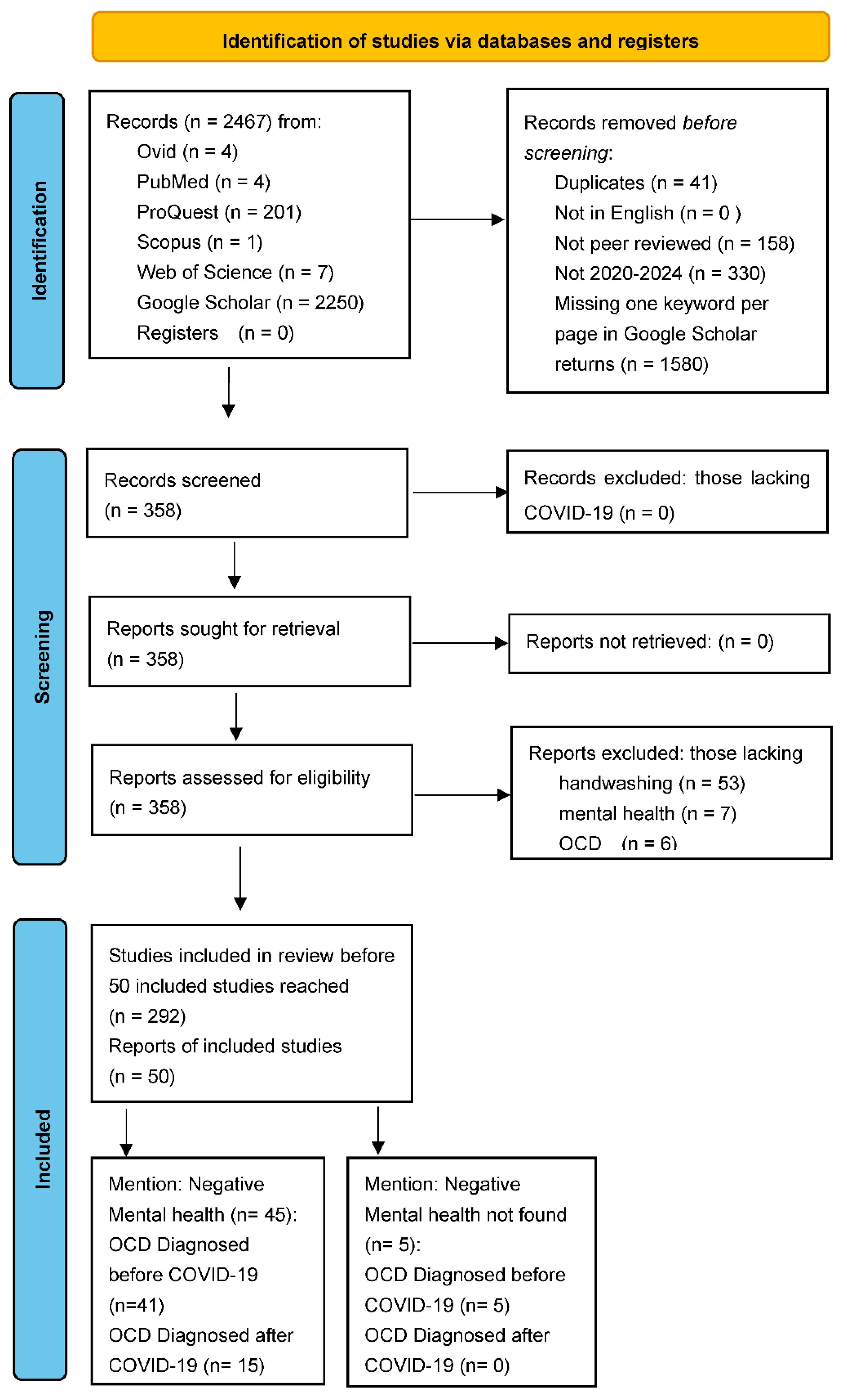

Table 1.
Studies included in the scoping reviews as per PRISMA guidelines of the parameter containing the keywords “handwashing” and “mental health” and “COVID-19” and “OCD” of searches performed on the primary databases (Ovid, PubMed, ProQuest, Scopus, and Web of Science) 21 July 2023 and 23 July 2023. No unique studies were returned regarding Scopus, therefore, it Scopus has no included studies.
Table 1.
Studies included in the scoping reviews as per PRISMA guidelines of the parameter containing the keywords “handwashing” and “mental health” and “COVID-19” and “OCD” of searches performed on the primary databases (Ovid, PubMed, ProQuest, Scopus, and Web of Science) 21 July 2023 and 23 July 2023. No unique studies were returned regarding Scopus, therefore, it Scopus has no included studies.
| Database | Research topic on COVID-19 and OCD |
|---|---|
| Ovid | Hand Washing: When Ritual Behavior Protects! |
| Ovid | A Perfect Storm? |
| Ovid | The Impact of the Coronavirus (COVID-19) Pandemic |
| Ovid | COVID-19 Pandemic and Mental Health |
| PubMed | Resilience Predicts Positive Mental Health Outcomes |
| PubMed | Obsessive-Compulsive Disorder Reinforcement |
| PubMed | Conradi-Hünerman-Happle Syndrome |
| ProQuest | A Review of Effects of Pandemic |
| ProQuest | Contamination Compulsions |
| ProQuest | Obsessive-Compulsive Disorder |
| ProQuest | Prevalence of Obsessive-Compulsive Disorder |
| ProQuest | A Case of New-Onset Obsessive-Compulsive Disorder |
| ProQuest | The Impact of COVID-19 Social Distancing |
| ProQuest | Impact of COVID-19 |
| ProQuest | The Well-Being of Healthcare Workers |
| ProQuest | Effects of Strict COVID-19 Lockdown |
| ProQuest | A Case of Obsessive-Compulsive Disorder |
| Web of Science | The COVID-19 Pandemic |
| Web of Science | Implications of Coronavirus Pandemic |
| Web of Science | Dealing with Corona Virus Anxiety |
Table 2.
Unique number of returns compared to other databases searched of twenty returns per page for the 23 July 2023 Google Scholar search of the parameter containing the keywords “handwashing” and “mental health” and “COVID-19” and “OCD” listing the first 17 pages of the returns.
Table 2.
Unique number of returns compared to other databases searched of twenty returns per page for the 23 July 2023 Google Scholar search of the parameter containing the keywords “handwashing” and “mental health” and “COVID-19” and “OCD” listing the first 17 pages of the returns.
| Page Number of Google Scholar Returns | Number of Unique Returns |
|---|---|
| 1 | 12 |
| 2 | 16 |
| 3 | 18 |
| 4 | 18 |
| 5 | 18 |
| 6 | 20 |
| 7 | 17 |
| 8 | 17 |
| 9 | 16 |
| 10 | 18 |
| 11 | 20 |
| 12 | 19 |
| 13 | 19 |
| 14 | 20 |
| 15 | 19 |
| 16 | 20 |
| 17 | 20 |
Table 3.
Increased handwashing during COVID-19 with respect to the time of participants’ diagnosis (before COVID-19 or during COVID-19) and whether the increase in handwashing was seen by researchers to have caused negative mental health in these participants—Yes = ✓, No = ✕—grouped by the order of searches performed (Ovid, PubMed, ProQuest, Scopus (of which there were no included returns), Web of Science, and Google Scholar) and the returns received of the parameter containing the keywords “handwashing” and “mental health” and “COVID-19” and “OCD”.
Table 3.
Increased handwashing during COVID-19 with respect to the time of participants’ diagnosis (before COVID-19 or during COVID-19) and whether the increase in handwashing was seen by researchers to have caused negative mental health in these participants—Yes = ✓, No = ✕—grouped by the order of searches performed (Ovid, PubMed, ProQuest, Scopus (of which there were no included returns), Web of Science, and Google Scholar) and the returns received of the parameter containing the keywords “handwashing” and “mental health” and “COVID-19” and “OCD”.
| Research topic on COVID-19 and OCD | OCD Diagnosed Before COVID-19 | OCD Diagnosed During COVID-19 | Negative Mental Health |
|---|---|---|---|
| Hand Washing: When Ritual Behavior Protects! | ✓ | ✕ | ✓ |
| A Perfect Storm? | ✓ | ✓ | ✓ |
| The Impact of the Coronavirus (COVID-19) Pandemic | ✕ | ✓ | ✓ |
| COVID-19 Pandemic and Mental Health | ✓ | ✓ | ✓ |
| Resilience Predicts Positive Mental Health Outcomes | ✓ | ✕ | ✕ |
| Obsessive-Compulsive Disorder Reinforcement | ✓ | ✕ | ✓ |
| Conradi-Hünerman-Happle Syndrome | ✓ | ✕ | ✓ |
| A Review of Effects of Pandemic | ✓ | ✕ | ✓ |
| Contamination Compulsions | ✓ | ✕ | ✕ |
| Obsessive-Compulsive Disorder | ✓ | ✓ | ✓ |
| Prevalence of Obsessive-Compulsive Disorder | ✓ | ✓ | ✓ |
| A Case of New-Onset Obsessive-Compulsive Disorder | ✕ | ✓ | ✓ |
| The Impact of COVID-19 Social Distancing | ✓ | ✓ | ✓ |
| Impact of COVID-19 (India) | ✓ | ✕ | ✕ |
| The Well-Being of Healthcare Workers | ✓ | ✕ | ✓ |
| Effects of Strict COVID-19 Lockdown | ✓ | ✕ | ✓ |
| A Case of Obsessive-Compulsive Disorder | ✕ | ✓ | ✓ |
| The COVID-19 Pandemic | ✓ | ✓ | ✓ |
| Implications of Coronavirus Pandemic | ✓ | ✕ | ✓ |
| Dealing with Corona Virus Anxiety | ✓ | ✕ | ✓ |
| Recognising and Addressing the Impact of COVID-19 | ✓ | ✕ | ✓ |
| Obsessive Compulsive Disorder During the COVID-19 | ✓ | ✕ | ✓ |
| COVID-19 and its Mental Health Consequences | ✓ | ✕ | ✓ |
| Investigating the Association | ✓ | ✕ | ✓ |
| Acute impact of COVID-19 Pandemic | ✓ | ✕ | ✓ |
| Obsessive Compulsive Disorder During the COVID-19 Pan. | ✓ | ✕ | ✓ |
| OCD and COVID-19: a New Frontier | ✓ | ✓ | ✓ |
| Perceived Impact of COVID-19 | ✓ | ✕ | ✓ |
| Acute Exacerbation of OCD Symptoms | ✓ | ✕ | ✓ |
| Obsessive Compulsive Disorder During the COVID-19 Pand. | ✓ | ✕ | ✓ |
| COVID-19 and Obsessive-Compulsive Symptoms | ✓ | ✕ | ✓ |
| The Impact of the COVID-19 Pandemic | ✓ | ✕ | ✓ |
| COVID-19 and Obsessive-Compulsive Disorder | ✓ | ✓ | ✓ |
| COVID-19 Pandemic and Mental Health in Lebanon | ✓ | ✓ | ✓ |
| The COVID-19 Pandemic and Obsessive–Compulsive Dis. | ✓ | ✕ | ✓ |
| Psychiatric Comorbidities Among COVID-19 Survivors | ✕ | ✓ | ✓ |
| Obsessive–Compulsive Disorder—Contamination Fears | ✓ | ✕ | ✓ |
| Impact of COVID-19 on Obsessive–Compulsive Disorder | ✓ | ✕ | ✓ |
| How is the COVID-19 Pandemic Affecting Individuals | ✓ | ✕ | ✓ |
| Experiences of Mental Distress during COVID-19 | ✓ | ✕ | ✕ |
| Contamination-Related Behaviors, Obsessions | ✓ | ✓ | ✓ |
| Obsessive-Compulsive Disorder During COVID-19 | ✓ | ✕ | ✓ |
| A Cross-Sectional Study on Cognitive Errors | ✓ | ✓ | ✓ |
| Impact of the COVID-19 Pandemic | ✓ | ✕ | ✕ |
| Obsessive-Compulsive Symptoms and the Covid-19 Pandem. | ✓ | ✕ | ✓ |
| The Impact of COVID-19 Pandemic on Individuals | ✓ | ✕ | ✓ |
| The Role of Self-Talk in Predicting Death Anxiety | ✓ | ✕ | ✓ |
| Protective Elements of Mental Health Status | ✓ | ✕ | ✓ |
| Narrative Review of COVID-19 Impact | ✓ | ✕ | ✓ |
| How is COVID-19 Affecting Patients | ✓ | ✕ | ✓ |
Disclaimer/Publisher’s Note: The statements, opinions and data contained in all publications are solely those of the individual author(s) and contributor(s) and not of MDPI and/or the editor(s). MDPI and/or the editor(s) disclaim responsibility for any injury to people or property resulting from any ideas, methods, instructions or products referred to in the content. |
© 2023 by the authors. Licensee MDPI, Basel, Switzerland. This article is an open access article distributed under the terms and conditions of the Creative Commons Attribution (CC BY) license (http://creativecommons.org/licenses/by/4.0/).
Copyright: This open access article is published under a Creative Commons CC BY 4.0 license, which permit the free download, distribution, and reuse, provided that the author and preprint are cited in any reuse.


