

Submitted:
31 July 2023
Posted:
02 August 2023
You are already at the latest version
Abstract
Bisphenol A (BPA) has been identified as one of endocrine disrupting chemicals (EDCs). Due to its massive production (over 700,000 tons per year) and the extensive use of BPA-based plastics (i.e., polycarbonate and epoxy resin) in Taiwan, it was thus included into a toxic substance by the Ministry of Environment. This work surveyed the updated information about the production of BPA and its environmental distributions in Taiwan over the past decade. Furthermore, the regulatory strategies and countermeasures for managing the environmental risks of BPA by the Taiwan government were summarized to show the cross-ministerial efforts under the relevant acts, including the Toxic and Concerned Chemical Substances Control Act (TCCSCA), the Food Sanitation Management Act (FSMA) and the Commodity Inspection Act (CIA). The findings showed that most of the monitoring data showed far below the acceptable risks. However, the people may pose an adverse threat to the aquatic environment and human health via ecological and food chains. In addition, some countermeasures were further recommended to echo the international actions on environmental endocrine disruptors in recent years.
Keywords:
bisphenol A
; endocrine-disrupting chemical
; environmental distribution
; potential risk
; regula-tory countermeasure
; Taiwan
1. Introduction
Bisphenol A (BPA), 2,2-bis(4-hydroxyphenyl) propane (CAS No.: 80-05-7), is an industrial chemical, which is mainly used in the manufacture of polycarbonate (PC) plastics and epoxy resins, and in many other applications, including polyvinyl chloride (PVC) antioxidant, plastic flame retardant and thermal papers [1]. In this regard, BPA is an important petrochemical substance with an annual global production of over 6.0 million tons in recent years [2]. As depicted in Figure 1, BPA is an organic compound with two phenolic groups, thus indicating its dissociation forms. Table 1 listed the main physicochemical properties of BPA [3,4], showing that it is a hydrophobic solid with high octanol-water partition coefficient (log Kow) value and low solubility in water. Therefore, the organic compound is favorable to its accumulation in sediments and also has a tendency to partition into water. In addition, the BPA-containing dust can create an explosive mixture with air under specific circumstances [5], thus posing a potential risk of exposure to airborne BPA in the workplace environment. It is noteworthy that BPA has been listed as one of endocrine-disrupting chemicals (EDCs) due to its potential hormone-like and health effects [6]. Concerning the toxicity of BPA, there are several reviews on its health impacts [7,8,9,10,11,12]. On the other hand, BPA has been used to produce a variety of daily life products, thus causing potential sources for human exposure. Therefore, the human exposure to BPA may occur mainly through food contamination from PC bottles and cans coated with epoxy resins [12,13,14], as well as through thermal papers [15,16,17]. Since the early 2000s, there has been considerable regulations in the developed countries regarding the restrictions of BPA-derived products and food package materials, especially in infant breeding bottles and baby pacifiers [12]. Thereafter, BPA has been included into a toxic substance according to the related regulations.
With the rapid demand on BPA-derived plastics, over 6,250 thousand tons of raw BPA were produced in 2019 [2]. Furthermore, the global demand for BPA is expected to grow continuously at about 4% during the period of 2020-2030. The Asia Pacific will be the region with the largest BPA production mainly due to the demand on PC and epoxy resin materials for manufacturing electrical/electronic products. Over the past two decades, Taiwan is a key region in the production of BPA and BPA-derived products, accounting for over than 10% of the total global BPA production capacity [2]. Based on the production capacity per capita, Taiwan could be the No. 1 around the world. Therefore, the Taiwan government has begun to establish the cross-ministerial joint venture model to be more deeply involved with the preventive measures of EDCs and its survey on the environmental distributions and intake risks since the early 2000s. For example, the central competent authorities funded the projects for assessing dietary exposure to BPA [18,19,20,21].
Concerning the surveys on the environmental risks of BPA and its regulatory measures for mitigating human health in Taiwan, they were reviewed in the previous studies [1,4]. However, the information about the environmental distributions of BPA and its regulatory measures was progressive in the past decade. As mentioned above, Taiwan may be the most important region for BPA production, having a high potential for environmental and health risks. In the present work, it will focus on an updated survey on the production of BPA and its environmental distributions in Taiwan. Furthermore, the regulatory strategies and countermeasures for managing the environmental risks of BPA by the Taiwan government were addressed to echo the Taiwan’s sustainable development goals (SGDs) on environmental endocrine disruptors [22].
2. Data Mining Methods
In the present study, the main purposes of this survey were to summarize the updated information about the BPA production and consumption (i.e., production capacity, production amounts, exports and imports), the environmental distributions in the air, water and sediment media and regulatory countermeasures of the restricted use on the daily life products derived from BPA. In this regard, this survey work mined the open-accessed database from the official and relevant websites, which were further stated as follows:
- The updated information about the handling status of BPA
The updated data on the statistics of BPA handling (i.e., production capacity, production, export, and import) in Taiwan were mainly accessed on the websites [23,24,25], which were established by the central competent authorities and allied associations. They included the Toxic and Chemical Substances Administration (Ministry of Environment, Taiwan), the Customs Administration (Ministry of Finance, Taiwan), and the Petrochemical Industry Association of Taiwan.
- The updated information about environmental distributions of BPA
Using the well-established websites like Google Scholar and Web of Science, an updated survey on the levels of BPA in the environmental media (i.e., air, water and sediment) of Taiwan was reviewed. Herein, the environmental data during the period of 2013-2022 were collected. It should be noted that these results were published by the academic scholars based on the commissioned projects sponsored by the central competent authorities.
- Environmental policies and regulatory countermeasures for BPA management
To echo the international actions on environmental endocrine disruptors [26,27,28], the Taiwan government established the cross-ministerial platform for the environmental policies and regulatory countermeasures for EDCs management [29]. In addition, the relevant regulations for mitigating health risks from the exposure to BPA, including the Food Safety and Sanitation Act, the Toxic and Concerned Chemical Substances Control Act, and the Commodity Inspection Act, were obtained from the official laws & regulations database [30].
3. Results and discussion
3.1. A survey on bisphenol A (BPA) production in Taiwan
3.1.1. Overview of production processes for bisphenol A (BPA)
BPA (HOC6H4C(CH3)2C6H4OH) is commercially produced by acid catalyzed condensation reaction of two moles of phenol (C6H5OH) and one mole of acetone (CH3COCH3) by the following stoichiometric equation.
2 Phenol + Acetone => BPA + H2O
These chemical feedstocks are produced from cumene (isopropylbenzene, C6H5CH(CH3)2), which is derived from alkylation of benzene with propylene. In this regard, BPA is originally derived from petroleum refining for producing naphtha (a flammable hydrocarbon mixture, or a fraction of crude oil), which is further converted into basic petroleum chemicals, including aromatic hydrocarbons (e.g., benzene) and olefins (e.g., propylene), by fractional distillation. Figure 2 showed the simplified flowsheet of BPA production process and its industrial applications. Regarding the industrial applications or commercial uses of BPA, it will be further addressed in the following section. In the traditional BPA production process, it has been based on a strong mineral acid catalyst, thus causing expensive corrosion-proof materials of construction and waste treatment. However, with the need for environmentally benign processes, cation exchange resin has now widely used as an alternative catalyst [31], thus mitigating equipment corrosion and other waste/wastewater treatment problems. In the commercial plants, the BPA product is typically isolated and purified from the reactor effluent using multiple crystallization processes. To optimize the production efficiency, the solvents and unreacted acetone are further purified using distillation and recycled. Furthermore, an excess of phenol is used to achieve higher BPA selectivity.
3.1.2. Overview of commercial uses of bisphenol A (BPA)
BPA is mainly used as a raw material of polycarbonate (PC) and epoxy resin. Due to its high impact resistance and optical clarity, the former is traditionally achieved by a reaction with phosgene. It should be noted that a modern and environment-friendly PC production plant was operated by the Chi-Mei Company (Tainan, Taiwan) using transesterification route [32]. Based on its excellent physical properties, PC can be made into a variety of common consumer goods, such as water bottles, sports equipment, safety glass (goggle), CD (compact disc) and DVD (digital versatile disc). By contrast, the latter is produced by a reaction with epichlorohydrin under basic conditions. It is used to line water pipes, as coatings on the inside of many food and beverage cans, paints, coatings, adhesives, circuit packaging materials, and printed circuit boards (PCB). The other applications included the productions of thermal paper coated with BPA (as a developing agent) and used in fax machines and sales receipts, tetrabromobisphenol A (a brominated flame retardant), and polyvinyl chloride (PVC) antioxidant in various products (including billboards signs, building materials, furniture, etc.). Therefore, the commonly used items or articles containing BPA, like plastic water bottles, baby bottles and food cans, may face leaching and contamination issues under the abnormal environments like high temperature, acidic and/or basic conditions. The primary sources of exposure to BPA and their human health risks have been extensively reviewed in recent years [7,8,9,10,11,12,13,14], not discussed in this work.
3.1.3. Status of bisphenol A (BPA) production in Taiwan
In Taiwan, there are three BPA production groups (i.e., Nan Ya Plastic Co., Chang Chun Plastics Co. and Taiwan Prosperity Chem. Co.) prior to 2021. Table 2 listed the BPA-manufacturing companies and their production capacities. In recent years, the actual BPA production was about 700,000 tons from the official database [24]. It should be noted that the Taiwan Prosperity Chem. Co. has been merged into the Chang Chun Group in Aug. 2021. On the other hand, the production capacities of BPA plants have been slightly increased by debottlenecking process in recent years. It means that total BPA production capacity in Taiwan exceeded 840,000 tons per year. Table 3 summarized the statistics on the BPA production capacities in 2019 by the countries/regions [2,33]. It showed that Taiwan may be the No. 1 around the world based on the production capacity per capita, implying high risks when exposing to BPA in the environment. However, the actual production of BPA must be lower than its production capacity, depending on the international commodity market (or price) and domestic production demand on BPA and BPA-based plastics (e.g., PC and epoxy resin). Table 4 listed the amounts of import and export for BPA since 2010 in Taiwan [23]. Obviously, as compared to the total BPA production capacity (seen in Table 2), about 30% of BPA production in Taiwan were exported to the Asian countries like China, Thailand and Japan.
3.2. A survey on the levels of BPA in the Taiwan’s environment
Potentially, any item/article that contained BPA or was made from BPA may emit more or less it to the environment, depending on several factors such as article category, service life and environmental stressors. As seen in Table 3, the Taiwanese people, especially for those in the production plants of BPA and BPA-based products (including residents near these factories), may pose high risks of BPA exposure. Due to the large production and use of BPA in Taiwan, the government provided the funding for the academic scholars to monitor the BPA levels in the environment since the early 2000s. Under the cross-ministerial joint venture, the environment, health, agriculture, and industry authorities in the central government, including Ministry of Environment (MOE) [34], Ministry of Health and Welfare (MOHW) [21], Ministry of Economic Affairs (MOEA) [35], Council of Agriculture (COA) [36] and National Science and Technology Council (NSTC) [37,38], shall work together to develop preventive strategies to solve EDC issues like environmental distribution monitoring. In the previous study [1], the levels of BPA in the water and sediment environments prior to 2012 was summarized, indicating higher levels of BPA in river water and sediment samples from heavy industrial parks (e.g., petrochemical zone) and urbauized areas. In the following sections, an updated survey on the levels of BPA in Taiwan was reviewed according to the environmental media (i.e., air, water and sediment).
3.2.1. Ambient atmosphere
According to the physicochemical properties of BPA, the high potential for its presence could be occurred in the particulate matter (PM) of urban atmosphere. However, few studies on the levels of PM-bound BPA in the atmospheric environment were reported in the literature [39,40,41,42]. Although there were no reports of the BPA levels in the ambient atmosphere of Taiwan area, two studies were to determine the ambient BPA levels for workers in the BPA-containing plastic manufacturing industry and to evaluate the workers’ health risk [43,44]. As studied by Chen et al. [43], the ambient BPA levels for workers in the BPA production plant (A) and PVC film manufacturing plants (B, C and D) were determined in the workplace environment. The findings showed that the workers in plant A exposed high BPA levels with ranging from 0.01 to 652.02 μg/m3, while the BPA levels in other plants B/C/D were very low values in the range of 0.00 to 1.78 μg/m3. In another research by Chao et al. [44], the BPA concentrations of the plant from inhalable dusts using optical grade PC material ranged from 32.28 to 44.97 μg/m3, which were significantly higher than those (16.16 to 19.39 μg/m3) of the plant using food grade PC material. Although the results of BPA concentrations in the airborne environment are lower than the maximum workplace concentration (MAK) value (5 mg/m3, measured as the inhalable dust fraction) in Germany, the effective prevention measures and occupational exposure assessments should be established to protect the workers’ health and also reduce the BPA discharge into the outdoor environment [45].
3.2.2. Water environment
As reviewed by the previous studies [1,4], the concentrations of BPA in the Taiwan’s river water bodies seemed to be higher than those in other countries or areas. Concerning the environmental distribution of BPA, Chen et al. performed the concentrations of phenols (including BPA) in water sources (raw water) and treated water from 11 water treatment plants [46], showing that all data were below 60 ng/L. Chen et al. analyzed the concentrations of BPA in the water samples from the Tamsui River (northern Taiwan) [47], indicating 508±634 ng/L (geometric mean = 303 ng/L) for 66 samples. Hsieh et al. investigated the concentrations of emergent contaminants (including BPA) in the Wuluo constructed wetland (southern Taiwan) [48], exhibiting that a maximal concentration of BPA was obtained to be 1733 ng/L. Chen and Chou measured the environmental concentration of BPA in the aquatic environment (i.e., river water and suspended solid samples) in southern Taiwan [37], finding that the concentrations of BPA in the surface water and suspended solid samples were 0.09-392 μg/L and 0.08-58 μg/L, respectively. Cheng et al. assessed the occurrence of BPA in tap water supplied through polyvinyl chloride (PVC), stainless steel, and galvanized pipes [49], verifying that BPA was not detected in most household water samples. Chou et al. explored the potential contributors to endocrine disrupting activities in Taiwan's surface waters from six river water systems [50], having BPA concentration range of < 0.01 - 725 μg/L. Gao et al. determined the concentrations of EDC (including BPA) in the drinking water treatment plants for evaluating their health risks [51], denoting that all data were lower than method detection limit (MDL) value (i.e., 0.74 μg/L) both in raw and drinking water samples. Liu et al. assessed a variety of EDCs (including BPA) with estrogenic activity from the waters of the Wuluo River in southern Taiwan [38], containing BPA at 1384.6 ng/L (the highest concentration) in summer and 682.57 ng/L in spring. Dai et al. investigated the occurrence and treatment of EDCs (e.g., BPA) in Taiwanese drinking water sources (total of 49 samples from 15 water treatment plants) [35]. The findings showed that most of BPA concentrations were lower than 20 ng/L, but a maximum BPA concentration of 150 ng/L was measured. Based on the mentioned results [35,37,46,47,48,49,50,51], the high BPA concentrations in Taiwanese rivers, especially in the rivers by industrial wastewater discharge, may pose an adverse threat to the aquatic environment and human health via ecological chain.
3.2.3. Sediment
Along with the investigations on the environmental distributions of BPA in the aquatic environment, the sediments were often sampled and measured their levels. As studied by Chen et al. [47], the concentrations of BPA in the sediment samples from the Tamsui River (northern Taiwan) were determined to be 62.7±92.2 ng/g w.w. (geometric mean = 26.0 ng/g w.w.) for 66 samples. Lee et al. performed the spatial-temporal distributions of EDCs (including BPA) in sediments from the Tamsui River system (northern Taiwan) for evaluating their risks to aquatic ecosystems and human health [34], showing that the concentrations of BPA in sediments ranged from 1 to 144 mg/kg-dw. The above-mentioned findings of the high BPA levels in river water and sediments were interactively observed in the sampling sites near industrialized and urbanized areas.
3.3. Regulatory countermeasures for managing the environmental risks of BPA in Taiwan
As mentioned above, BPA has been listed as one of EDCs because it has weak estrogen-like activity, thus posing a potential hazard to human health. Based on the intergrated multimedia solutions for the toxic substance, the central governing authorities in Taiwan jointly promulgated the regulatory strategies for managing the environmental risks of BPA under the various regulations in recent years. The following sections will sumarize and discuss these preventive measures with relevance to the issues of exposing to BPA.
3.3.1. Ministry of Environment (MOE)
BPA has been listed as one of the toxic chemical substances under the Toxic and Concerned Chemical Substances Control Act (TCCSCA) on July 31, 2009. The central competent authority relevant to the TCCSCA refers to the Ministry of Environment. This toxic substance has been categorized into the Class 4, which refers to those that have endocrine disruptor properties, or environmental pollutants/chemicals which endanger human health. According to the Article 8 of the TCCSCA, the toxicity and relevant information of the Class 4 toxic chemical substances shall be reported to the local competent authority upon permission prior to the handling, which refers to such activities as the manufacture, import, transportation, use, storage or discarding of the toxic chemical substance. Furthermore, the handlers of toxic chemical substances shall make the reports and regularly report the records concerning the handling amounts of toxic chemical substances and their release quantities in accordance with the Article 11 in the TCCSCA. Table 5 listed the production amounts and release quantities of BPA during the period of 2017-202 [24]. Obviously, BPA may be present in the environment due to various emission sources from the industrial manufacturing activities. In addition, the Ministry of Environment also announced the control concentration standard for BPA as 30 wt% based on the authorization of the Article 11 in the TCCSCA. It means that the BPA-based substance will be recognized as a toxic chemical substance if containing more than 30 wt% BPA.
3.3.2. Ministry of Health and Welfare (MOHW)
Because of the adverse effects of BPA on human health through the food chain, the central competent authority in Taiwan (i.e., (MOHW) stipulated the maximal limits of total BPA (0.6 ppm) from various food containers/utensils (except infant breeding bottles) with making them by PC plastic in the regulation (“Sanitation Standard for Food Utensils, Containers and Packages”) under the authorization of the Food Sanitation Management Act (FSMA) in 2013. According to the Article 5 of the regulation, the infant feeding bottles made of plastics shall not contain BPA, meaning the ban on the use of PC. It should be noted that these requirements were in accordance with the international trends [12]. Although lots of reviews or surveys have found trace amounts of BPA in the food media [11,12], the current BPA dietary exposure in Taiwan for general population should be far below the acceptable risks [18]. For example, the concentration levels in the various food samples were trace amounts of BPA (ranging from the detection limits to parts of billion) based on the studies by Chang et al. [21] and Lee et al. [52].
3.3.3. Ministry of Economic Affairs
The central competent authority for governing the affairs of industry and trade in Taiwan is the Ministry of Economic Affairs (MOEA). Regarding the management of BPA-containing articles and commodities, the implementation agencies under the MOEA is the Bureau of Standards, Metrology & Inspection (BSMI). In response to the national plan for implementing the environmental hormone management since 2010, the survey measures were regularly performed by the central competent bureau. Under the authorizations of the Commodity Inspection Act, the BSMI has issued the National Standards of Republic of China (CNS) for the commodities (e.g., toy) to ensure the consumer rights. The limits of BPA had been set to be 0.04 mg/L and 50 ppm (μg/g) for the toys (CNS 4797) in 2020 and thermal paper (CNS 15477) in 2013, respectively.
4. Conclusions and recommendations
Bisphenol A (BPA) has been widely used in the massive production of plastic products and their additives, but is probably one of the most prevalent synthetic endocrine-disrupting chemicals (EDCs) or xenoestrogens. Therefore, the environmental and health risks from exposing to BPA has become an important issue around the world. This issue is of particular concern to Taiwan because this country/region could be the No. 1 based on the production capacity per capita. The updated information about the production of BPA and its environmental distributions in Taiwan has been surveyed in this work. Furthermore, the regulatory strategies and measures for managing the environmental risks of BPA by the Taiwan government were addressed to echo the international actions on environmental endocrine disruptors. Although most of the monitoring data showed far below the acceptable risks, the high BPA concentrations in Taiwanese rivers, especially in those by industrial wastewater discharge, may pose an adverse threat to the aquatic environment and human health via ecological chain.
Although the Taiwan government has adopted several countermeasures through the cross-ministerial efforts over the past decade, some recommendations for reducing health risks of exposing to BPA were further addressed as follows:
- -
- Expanding the regulatory restrictions on the use of BPA-derived commodities, especially for baby/children products like toys.
- -
- Establishing the monitoring systems for BPA and other EDCs in the atmospheric environment nearby the industrial parks, especially for the production plants of BPA and its derived products like PC and epoxy resin.
- -
- Examining the health risk assessments or occupational exposure assessments for the workers in the production plants of BPA, PC and epoxy resin.
- -
- Promoting the use of BPA-free products, including thermal/carbonless receipts, water bottles and food cans.
Funding
This research received no external funding.
Institutional Review Board Statement
Not applicable.
Informed Consent Statement
Not applicable.
Data Availability Statement
The authors confirm that the data supporting the findings of this study are available within the article.
Conflicts of Interest
The authors declare no conflict of interest.
References
- Tsai, W.T. A review on environmental distributions and risk management of phenols pertaining to the endocrine disrupting chemicals in Taiwan. Toxicol Environ Chem 2013, 95(5), 723–736. [Google Scholar] [CrossRef]
- Data Collection to Support the Restriction of Substances of Very High Concern under REACH for Bisphenol A – BPA Levels in Materials (German Environment Agency). Available online: https://echa.europa.eu/documents/10162/de36f39b-10fe-3e14-439c-d0928bf3e283 (accessed on 25 July 2023).
- Staples, C.A.; Dorn, P.B.; Klecka, G.M.; O’Block, S.T.; Harris, L.R. A review of the environmental fate, effects, and exposures of bisphenol-A. Chemosphere 1998, 36, 2149–2173. [Google Scholar] [CrossRef]
- Tsai, W.T. Human health risk on environmental exposure to bisphenol-A: A review. J Environ Sci Health C 2006, 24, 225-255. [Google Scholar] [CrossRef]
- Celiński, M.; Sankowska, M. Explosibility, flammability and the thermal decomposition of bisphenol A, the main component of epoxy resin. J Loss Prev Process Ind 2016, 44, 125–131. [Google Scholar] [CrossRef]
- Escrivá, L.; Zilliacus, J.; Hessel, E.; Beronius, A. Assessment of the endocrine disrupting properties of bisphenol AF: A case study applying the European regulatory criteria and guidance. Environ Health 2021, 20(1), 48. [Google Scholar] [CrossRef]
- Rochester, J.R. Bisphenol A and human health: a review of the literature. Reprod Toxicol 2013, 42, 132–55. [Google Scholar] [CrossRef]
- Seachrist, D.D.; Bonk, K.W.; Ho, S.M.; Prins, G.S.; Soto, A.M.; Keri, R.A. A review of the carcinogenic potential of bisphenol A. Reprod Toxicol 2016, 59, 167–182. [Google Scholar] [CrossRef]
- Ma, Y.; Liu, H.; Wu, J.; Yuan, L.; Wang, Y.; Du, X.; Wang, R.; Marwa, P.W.; Petlulu, P.; Chen, X.; Zhang, H. The adverse health effects of bisphenol A and related toxicity mechanisms. Environ Res 2019, 176, 108575. [Google Scholar] [CrossRef]
- Abraham, A.; Chakraborty, P. A review on sources and health impacts of bisphenol A. Rev Environ Health 2020, 35(2), 201–210. [Google Scholar] [CrossRef] [PubMed]
- Khan, N.G.; Correia, J.; Adiga, D.; Rai, P.S.; Dsouza, H.S.; Chakrabarty, S.; Kabekkodu, S.P. A comprehensive review on the carcinogenic potential of bisphenol A: clues and evidence. Environ Sci Pollut Res 2021, 28(16), 19643–19663. [Google Scholar] [CrossRef]
- Manzoor, M.F.; Tariq, T.; Fatima, B.; Sahar, A.; Tariq, F.; Munir, S.; Khan, S.; Nawaz Ranjha, M.M.A.; Sameen, A.; Zeng, X.A.; Ibrahim, S.A. An insight into bisphenol A, food exposure and its adverse effects on health: A review. Front Nutr 2022, 9, 1047827. [Google Scholar] [CrossRef]
- Kao, Y.M. A review on safety inspection and research of plastic food packaging materials in Taiwan. J Food Drug Anal 2013, 20(4), 734–743. [Google Scholar] [CrossRef]
- Hahladakis, J.N.; Iacovidou, E.; Gerassimidou, S. An overview of the occurrence, fate, and human risks of the bisphenol-A present in plastic materials, components, and products. Integr Environ Assess Manag 2023, 19(1), 45–62. [Google Scholar] [CrossRef] [PubMed]
- Porras, S.P.; Heinälä, M.; Santonen, T. Bisphenol A exposure via thermal paper receipts. Toxicol Lett 2014, 230(3), 413–420. [Google Scholar] [CrossRef] [PubMed]
- Björnsdotter, M.K.; de Boer, J.; Ballesteros-Gómez, A. Bisphenol A and replacements in thermal paper: A review. Chemosphere 2017, 182, 691–706. [Google Scholar] [CrossRef]
- Akilarasan, M.; Kogularasu, S.; Chen, S.M.; Chen, T.W.; Lou, B.S. A novel approach to iron oxide separation from e-waste and bisphenol A detection in thermal paper receipts using recovered nanocomposites. RSC Adv 2018, 8(70), 39870–39878. [Google Scholar] [CrossRef]
- Chen, W.Y.; Shen, Y.P.; Chen, S.C. Assessing bisphenol A (BPA) exposure risk from long-term dietary intakes in Taiwan. Sci Total Environ 2016, 543(Pt A), 140–146. [Google Scholar] [CrossRef]
- Fu, K.Y.; Cheng, Y.H.; Chio, C.P.; Liao, C.M. Probabilistic integrated risk assessment of human exposure risk to environmental bisphenol A pollution sources. Environ Sci Pollut Res 2016, 23(19), 19897–1910. [Google Scholar] [CrossRef]
- Hsiao, I.L.; Wu, C.; Huang, Y.J.; Chimeddulam, D.; Wu, K.Y. Probabilistic assessment of aggregate risk for bisphenol A by integrating the currently available environmental data. Stoch Environ Res Risk Assess 2016, 30, 1851–1861. [Google Scholar] [CrossRef]
- Chang, W.H.; Liu, S.C.; Chen, H.L.; Lee, C.C. Dietary intake of 4-nonylphenol and bisphenol A in Taiwanese population: Integrated risk assessment based on probabilistic and sensitive approach. Environ Pollut 2019, 244, 143–152. [Google Scholar] [CrossRef]
- Taiwan’s Sustainable Development Goals (National Council for Sustainable Development, Taiwan). Available online: https://ncsd.ndc.gov.tw/Fore/en/Taiwansdg#T-SDGs (accessed on 28 July 2023).
- Trade Statistics (Customs Administration, Ministry of Finance, Taiwan). Available online: https://portal.sw.nat.gov.tw/APGA/GA30 (accessed on 12 July 2023).
- Open Database on Handling Amounts of Toxic Substance (Environmental Protection Administration, Taiwan). Available online: https://www.tcsb.gov.tw/cp-326-3120-f7716-1.html (accessed on 22 July 2023).
- Petrochemical Industry Association of Taiwan. Available online: http://www.piat.org.tw/ (accessed on 22 July 2023).
- Endocrine Disrupting Chemicals (Environmental Protection Agency, USA). Available online: https://www.unep.org/explore-topics/chemicals-waste/what-we-do/emerging-issues/endocrine-disrupting-chemicals (accessed on 29 July 2023).
- Endocrine Disruptors (European Commission). Available online: https://commission.europa.eu/strategy-and-policy/policies/endocrine-disruptors_en (accessed on 29 July 2023).
- Strategic Programs on Environmental Endocrine Disruptors (Ministry of the Environment, Japan). Available online: https://www.env.go.jp/en/chemi/ed/speed98/sp98-1.html (accessed on 29 July 2023).
- Environmental Hormones (Toxic and Chemical Substances Administration, Ministry of Environment, Taiwan). Available online: https://topic.epa.gov.tw/edcs/mp-6.html (accessed on 29 July 2023).
- Laws and Regulation Retrieving System. Available online: https://law.moj.gov.tw/Eng/index.aspx (accessed on 6 July 2023).
- Chruściel, A.; Kiedik, M.; Hreczuch, W. New method of running the bisphenol A synthesis process using the set of two-zone reactors. Chem Eng Res Des 2019, 141, 187–197. [Google Scholar] [CrossRef]
- Deng, W.; Shi, L.; Yao, J.; Zhang, Z. A review on transesterification of propylene carbonate and methanol for dimethyl carbonate synthesis. Carbon Resour Convers 2019, 2(3), 198–212. [Google Scholar] [CrossRef]
- Pison, G. The population of the world (2019). Popul Soc 2019, 569(8), 1–8. [Google Scholar]
- Lee, C.C.; Hsieh, C.Y.; Chen, C.S.; Tien, C.J. Emergent contaminants in sediments and fishes from the Tamsui River (Taiwan): Their spatial-temporal distribution and risk to aquatic ecosystems and human health. Environ Pollut 2020, 258, 113733. [Google Scholar] [CrossRef]
- Dai, Y.D.; Chao, H.R.; Chiang, P.C. Detection, occurrence, and treatment of nonylphenol and bisphenol-A in Taiwanese drinking water sources. J Hazard Toxic Radioact Waste 2019, 23(2), 04018039. [Google Scholar] [CrossRef]
- Lu, I.C.; Chao, H.R.; Mansor, W.N.W.; Peng, C.W.; Hsu, Y.C.; Yu, T.Y.; Chang, W.H.; Fu, L.M. Levels of phthalates, bisphenol-A, nonylphenol, and microplastics in fish in the estuaries of northern Taiwan and the impact on human health. Toxics 2021, 9, 246. [Google Scholar] [CrossRef]
- Chen, K.Y.; Chou, P.H. Detection of endocrine active substances in the aquatic environment in southern Taiwan using bioassays and LC–MS/MS. Chemosphere 2016, 152, 214–220. [Google Scholar] [CrossRef]
- Liu, Y.Y.; Lin, Y.S.; Yen, C.H.; Miaw, C.L.; Chen, T.C.; Wu, M.C.; Hsieh, C.Y. Identification, contribution, and estrogenic activity of potential EDCs in a river receiving concentrated livestock effluent in Southern Taiwan. Sci Total Environ 2018, 636, 464–476. [Google Scholar] [CrossRef]
- Fu, P.; Kawamura, K. Ubiquity of bisphenol A in the atmosphere. Environ Pollut 2010, 158, 3138–3143. [Google Scholar] [CrossRef]
- Salgueiro-González, N.; López de Alda, M.; Muniategui-Lorenzo, S.; Prada-Rodríguez, D.; Barceló, D. Determination of 13 estrogenic endocrine disrupting compounds in atmospheric particulate matter by pressurised liquid extraction and liquid chromatography-tandem mass spectrometry. Anal Bioanal Chem 2013, 405, 8913–8923. [Google Scholar] [CrossRef]
- Liu, X.; Zeng, X.; Dong, G.; Venier, M.; Xie, Q.; Yang, M.; Wu, Q.; Zhao, F.; Chen, D. Plastic Additives in ambient fine particulate matter in the Pearl River Delta, China: High-throughput characterization and health implications. Environ Sci Technol 2021, 55, 4474–4482. [Google Scholar] [CrossRef] [PubMed]
- Munyaneza, J.; Qaraah, F.A.; Jia, Q.; Cheng, H.; Zhen, H.; Xiu, G. Seasonal trends, profiles, and exposure risk of PM2.5-bound bisphenol analogs in ambient outdoor air: A study in Shanghai, China. Aerosol Air Qual Res 2022, 22, 210324. [Google Scholar] [CrossRef]
- Chen, M.L.; Hsu, Y.T.; Mao, I.F.; Chen, Y.J.; Yu, Y.H.; Lee, L.H.; Lin, C.H. Characteristics of bisphenal A exposure for workers in workplaces (in Chinese with English abstract). J Occup Saf Health 2014, 22, 60–72. [Google Scholar]
- Chao, Y.; Chen, J.; Yang, W.; Ho, T.; Yen, F. Exposure hazard to bisphenol A for labor and particle size distribution at polycarbonate molding plants. Iran J Public Health 2015, 44(6), 783–90. [Google Scholar] [PubMed]
- Ribeiro, E.; Ladeira, C.; Viegas, S. Occupational exposure to bisphenol A (BPA): a reality that still needs to be unveiled. Toxics 2017, 5, 22. [Google Scholar] [CrossRef] [PubMed]
- Chen, H.W.; Liang, C.H.; Wu, Z.M.; Chang, E.E.; Lin, T.F.; Chiang, P.C.; Wang, G.S. Occurrence and assessment of treatment efficiency of nonylphenol, octylphenol and bisphenol-A in drinking water in Taiwan. Sci Total Environ 2013, 449, 20–28. [Google Scholar] [CrossRef]
- Chen, W.L.; Gwo, J.C.; Wang, G.S.; Chen, C.Y. Distribution of feminizing compounds in the aquatic environment and bioaccumulation in wild tilapia tissues. Environ Sci Pollut Res 2014, 21, 11349–11360. [Google Scholar] [CrossRef]
- Hsieh, C.Y.; Liaw, E.T.; Fan, K.M. Removal of veterinary antibiotics, alkylphenolic compounds, and estrogens from the Wuluo constructed wetland in southern Taiwan. J Environ Sci Health A 2015, 50(2), 151–160. [Google Scholar] [CrossRef]
- Cheng, Y.C.; Chen, H.W.; Chen, W.L.; Chen, C.Y.; Wang, G.S. Occurrence of nonylphenol and bisphenol A in household water pipes made of different materials. Environ Monit Assess 2015, 188(10), 562. [Google Scholar] [CrossRef]
- Chou, P.H.; Lin, Y.L.; Liu, T.C.; Chen, KY. Exploring potential contributors to endocrine disrupting activities in Taiwan's surface waters using yeast assays and chemical analysis. Chemosphere 2015, 138, 814–820. [Google Scholar] [CrossRef] [PubMed]
- Gou, Y.Y.; Lin, S.; Que, D.E.; Tayo, L.L.; Lin, D.Y.; Chen, K.C.; Chen, F.A.; Chiang, P.C.; Wang, G.S.; Hsu, Y.C.; Chuang, K.P.; Chuang, C.Y.; Tsou, T.C.; Chao, H.R. Estrogenic effects in the influents and effluents of the drinking water treatment plants. Environ Sci Pollut Res 2016, 23(9), 8518–8528. [Google Scholar] [CrossRef] [PubMed]
- Lee, C.C.; Jiang, L.Y.; Kuo, Y.L.; Chen, C.Y.; Hsieh, C.Y.; Hung, C.F.; Tien, C.J. Characteristics of nonylphenol and bisphenol A accumulation by fish and implications for ecological and human health. Sci Total Environ 2015, 502, 417–425. [Google Scholar] [CrossRef] [PubMed]
Figure 1.
Molecular structure of (a) bisphenol A (denoted as H2A) and (b) its dissociation forms.
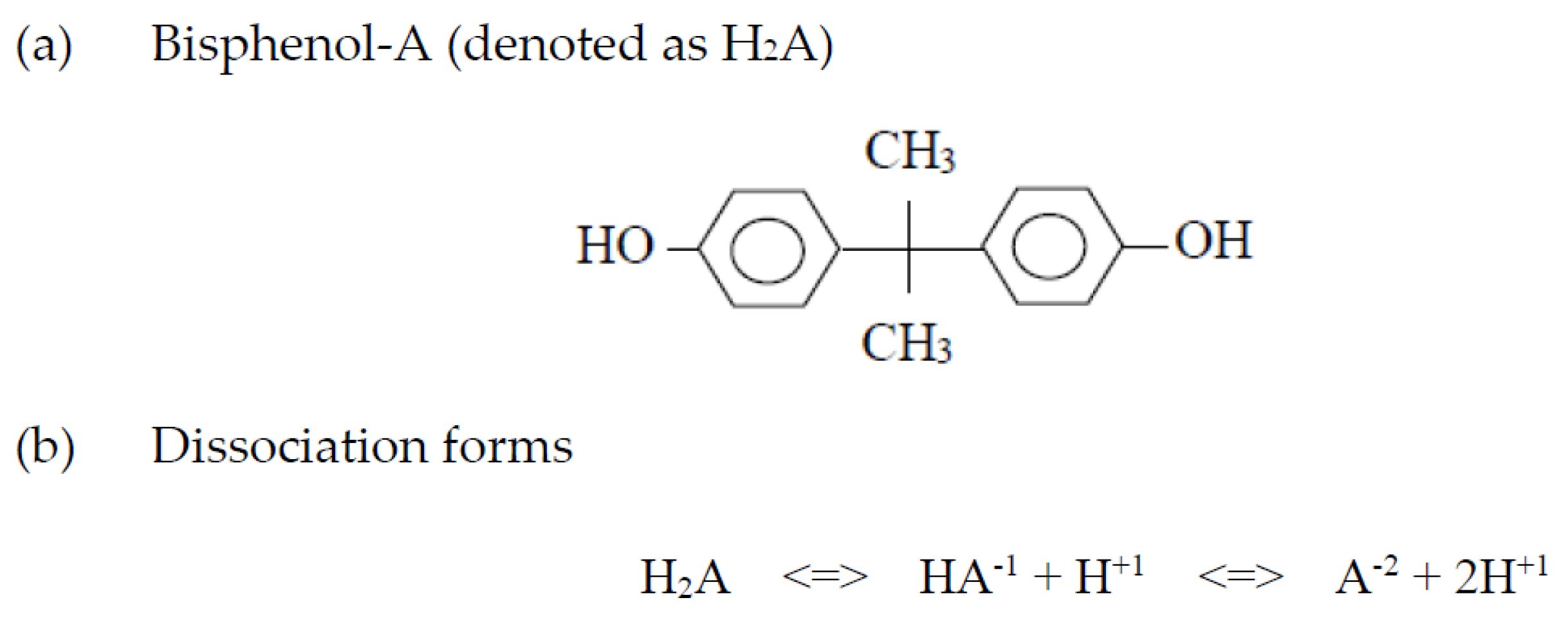
Figure 2.
Flowsheet of BPA production process and its industrial applications
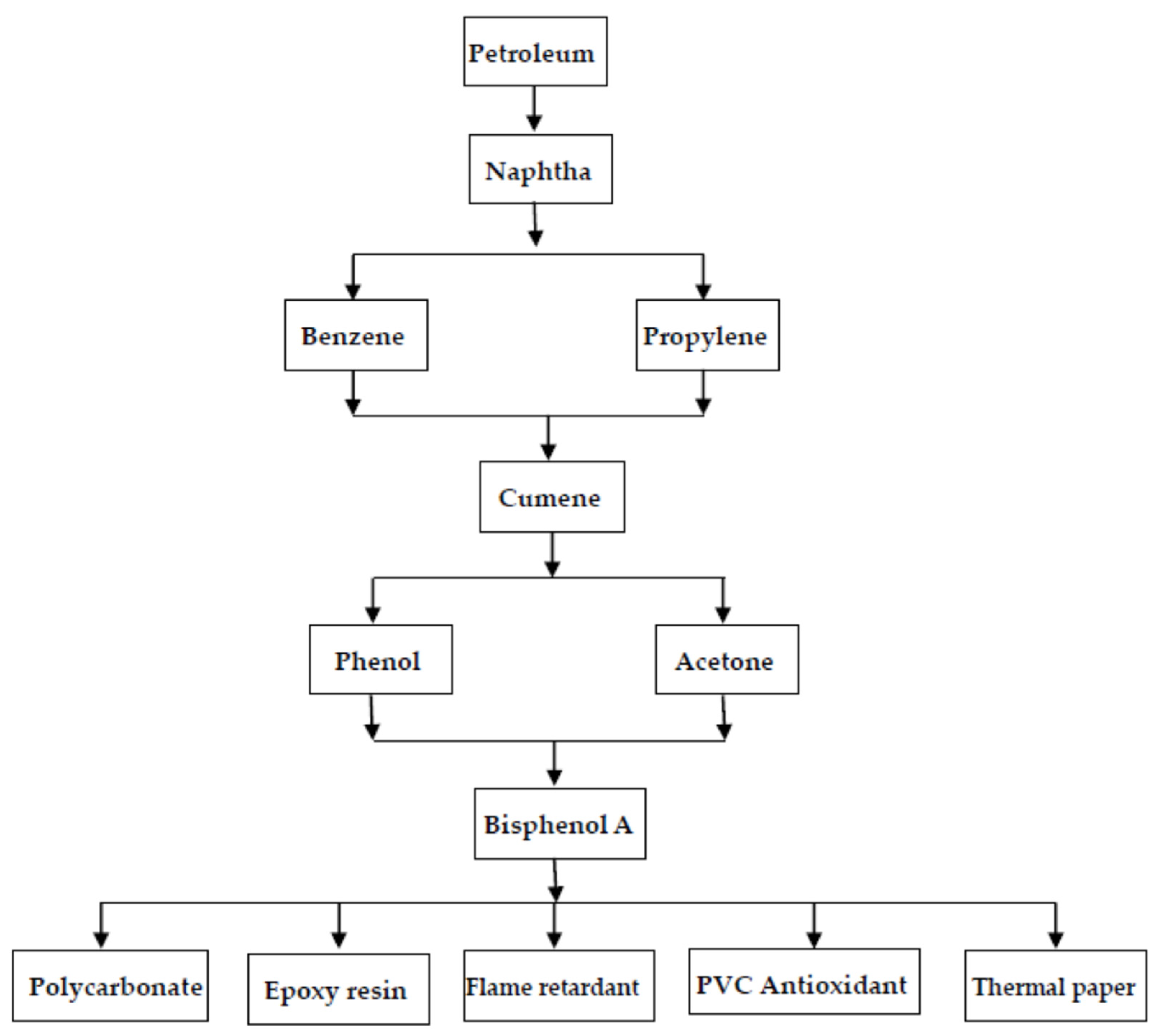

Table 1.
Main physicochemical properties of bisphenol A (BPA).
| Environmental property | Unit | Value | Comment |
| Molecular weight | g/mol | 228.29 | Formula: C15H16O2 |
| Boiling point | °C | 360.5 | at 760 mmHg |
| Melting point | °C | 158.5 | at 760 mmHg |
| Density | g/cm3 | 1.195 | at 25°C |
| Relative density | -- | 1.2 | at 25°C |
| Flash point | °C | 227 | Closed cup |
| Auto-ignition temperature | °C | 510 | at 760 mmHg |
| Water solubility | mg/L | 300 | at 25°C |
| Vapor pressure | mm Hg | 4.0 × 10⁻⁸ | at 25°C |
| log Kow | - | 3.32 | |
| Henry's Law Constant | atm-m3/mol | 4.0 × 10⁻¹¹ (est.) | at 25°C |
| Dissociation constants (pka) | -- | 9.6, 11.3 | at 25°C |
Table 2.
Manufacturing plants of bisphenol A (BPA) in Taiwan.
| Manufacturer | Production location | Production capacity (Kilo tons/year) |
Comment |
| Nan Ya Plastic Co. (One company of Formosa Plastics Group) |
Mailiao (Yunlin, Taiwan) |
420 (460) 1 | Since the late 1990s, there are four production lines for producing BPA in central Taiwan, which was partly used to produce polycarbonate (PC) and epoxy in another company (Formosa Plastics Group). |
| Chang Chun Plastics Co. (One company of Chang Chun Group) |
Daliao (Kaohsiung, Taiwan) |
270 | There are two production lines in southern Taiwan, which were started to produce BPA in 2005 and 2009, respectively. Most of the BPA production is used to produce BPA-based products dometically. |
| Taiwan Prosperity Chem. Co. | Linyuan (Kaohsiung, Taiwan) |
100 (107) 1 | There is one production line for producing BPA in southern Taiwan since 1995. This company has been merged into Chang Chun Group in Aug. 2021. Most of the BPA produced by the company was experted to the Asian countries. |
1 The values in the parenthesis denote the production capacities after debottlenecking process.
Table 3.
Statistics on the BPA production capacity per capita in 2019.
| Region/country | Production capacity 1 (Tons) |
Population 2 (Millions) |
BPA production per capita (kg/capita) |
| Belgium | 225,000 | 11.5 | 19.565 |
| Brazil | 22,000 | 211.0 | 0.104 |
| China | 1,342,000 | 1,433.8 | 0.936 |
| Germany | 351,000 | 83.5 | 4.204 |
| Iran | 26,000 | 82.9 | 0.314 |
| Japan | 364,000 | 126.9 | 2.868 |
| Netherlands | 363,000 | 17.1 | 21.228 |
| Poland | 12,000 | 37.9 | 0.317 |
| Russia | 64,000 | 145.9 | 0.439 |
| Saudi Arabia | 215,000 | 34.3 | 6.268 |
| Singapore | 187,000 | 5.8 | 32.241 |
| South Korea | 779,000 | 51.2 | 15,215 |
| Spain | 306,000 | 46.7 | 6.552 |
| Taiwan |
653,000 (847,000) 3 |
23.8 |
27.437 (35.59) |
| Thailand | 342,000 | 69.6 | 4.914 |
| USA | 983,000 | 329.1 | 2.987 |
Table 4.
Statistics on the values of import and export for BPA since 2010.
| Year | Import (Metric ton) | Export (Metric ton) |
| 2010 | 4,289 | 392,385 |
| 2011 | 2,348 | 320,694 |
| 2012 | 336 | 364,973 |
| 2013 | 1,313 | 293,044 |
| 2014 | 7,404 | 274,680 |
| 2015 | 1,533 | 306,962 |
| 2016 | 710 | 237,384 |
| 2017 | 1,510 | 193,236 |
| 2018 | 48 | 231,610 |
| 2019 | 1,082 | 244,257 |
| 2020 | 414 | 268,320 |
| 2021 | 555 | 248,210 |
| 2022 | 2,040 | 229,062 |
1 Source [23].
Table 5.
Production amounts and release quantities of BPA in Taiwan.1
| Year | Production amount (Metric ton) | Release amount (Metric ton) | ||
| Discharge | Transfer | Total | ||
| 2017 | 663,770.40 | 42.80 | 1.60 | 44.40 |
| 2018 | 712,571.40 | 79.35 | 0.30 | 79.65 |
| 2019 | 663,285.87 | 39.06 | 1.23 | 40.29 |
| 2020 | 663,285.87 | 55.93 | 0.56 | 56.49 |
| 2021 | 745,305.06 | 47.89 | 0.58 | 48.47 |
1 Source [24].
Disclaimer/Publisher’s Note: The statements, opinions and data contained in all publications are solely those of the individual author(s) and contributor(s) and not of MDPI and/or the editor(s). MDPI and/or the editor(s) disclaim responsibility for any injury to people or property resulting from any ideas, methods, instructions or products referred to in the content. |
© 2023 by the authors. Licensee MDPI, Basel, Switzerland. This article is an open access article distributed under the terms and conditions of the Creative Commons Attribution (CC BY) license (http://creativecommons.org/licenses/by/4.0/).
Copyright: This open access article is published under a Creative Commons CC BY 4.0 license, which permit the free download, distribution, and reuse, provided that the author and preprint are cited in any reuse.


