

Submitted:
17 July 2023
Posted:
18 July 2023
You are already at the latest version
Abstract
This article presents the graphical user interface of the ACUX-R mobile recommendation system, tailored for the cultural tourism domain. ACUX-R offers personalized recommendations based on visiting preferences, augmenting the overall user experience. Building upon a comprehensive methodology and recommendation algorithms from previous work, this contribution focuses on the user interface aspects of the ACUX-R by highlighting key design considerations, user interface elements and functionalities that contribute to an effective and engaging user experience. In an effort to evaluate the proposed interface, an initial case study with a dataset consisting of points of interest from the City of Athens, Greece has been performed. In the framework of the aforementioned study, the proposed user interface attained high ratings with respect to inspiring, exciting, interesting, and enthusiastic user experiences.
Keywords:
ACUX-R
; graphical user interface
; mobile application
; cultural tourism
; recommendation systems
; visiting preferences
; personalization
1. Introduction
Cultural tourism is gaining popularity as travelers increasingly seek authentic and immersive experiences. However, with the vast array of cultural attractions available, visitors often face challenges in discovering and selecting the most relevant and engaging experiences. Mobile Recommendation Systems (MRSs) offer a promising solution by leveraging advanced technologies to provide personalized recommendations tailored to individual preferences and context . These systems utilize algorithms that analyze user preferences, historical data, and location-based information to recommend off-the-beaten-path destinations aligned with travelers’ interests [1,2,3,4,5,6,7,8,9,10,11,12]. By making out-of-the-ordinary suggestions, MRSs encourage visitors to explore beyond the popular tourist attractions, fostering a sense of discovery and authenticity in their journeys.
ACUX-R (Augmenting Cultural User eXperience Recommender) is a mobile recommendation system designed to enhance cultural tourism by providing personalized recommendations through its intuitive graphical user interface (GUI) [13]. ACUX-R integrates visiting preferences as a central element in the personalization process. By employing the ACUX typology [14] for assigning profiles to visitors, ACUX-R generates recommendations that align with individual interests, ensuring a more tailored and fulfilling cultural tourism experience.
The ACUX-R algorithm operation is divided in three distinct stages. Initially (classification stage), visitors are categorized under one or more ACUX profiles based on their visiting preferences. The user selects and provides as input a set of five or more distinct preferences. After that, the user is permitted to manually adjust the assigned profile(s), overriding the result of the classification stage, if desired (adjustment stage). Finally (recommendation stage), the set of recommended points of interest (POIs) is computed and returned, based on the user’s final visiting profile
This article discusses the GUI design considerations of ACUX-R by exploring its various elements. It highlights the significance of combining personalization techniques with an intuitive interface, providing travelers with a seamless and engaging platform to discover cultural attractions, events, and destinations. Overall, this article serves as a comprehensive guide to understanding the GUI design of ACUX-R, shedding light on its innovative approach to personalized tourism recommendations. By leveraging the power of personalization and a captivating interface, ACUX-R aims to transform the way travelers engage with cultural experiences, making their journeys more enriching, memorable, and immersive.
The rest of the paper is structured as follows; Section 2 outlines the requirement analysis, discussing the functional and non-functional requirements. Section 3 proceeds with the GUI design consideration and Section 4 presents the results and findings of the case study, including user feedback and satisfaction with the GUI. Finally, conclusions are drawn in Section 5.
2. Requirement Analysis
The first step in GUI design involves the definition of the functional and non-functional user requirements. In this respect, a combination of conversation, observation, and the analytical technique as optimal for the elicitation of both functional and non-functional user requirements has been considered. More specifically, three of the most commonly used techniques in the cultural tourism domain have been combined: literature review as a conversation technique, focus groups as an observation technique, and prototyping as an analytical technique [15,16].
Firstly, through the literature review, we collected contextual information and knowledge of the MRSs [13,14], generating the first set of functional and non-functional requirements. This research includes a thorough review of relevant studies to provide context for the GUI, identify possible tasks that cultural visitors may be engaged in, and identify potential flaws in the evaluation process of the relevant studies.
Following discussions with CH designers during a focus group, the outcomes of the literature review have been evaluated and a number of prototype screens (mockups) have been generated, as shown in Figure 1. The objective was to define how information is organized, structured, and presented in order to achieve the most suitable GUI, generating another set of functional and non-functional user requirements [17,18,19]. The proposed system’s final functional (FR) and non-functional (NFR) requirements are presented in Table 1 and Table 2, respectively.
The mockups combine structural and design elements to provide a high-fidelity representation of the mobile application. Specifically, regarding the structural elements, they define how content is logically and hierarchically organized, as well as how the users will interact with and navigate in the mobile application by specifying the buttons, menus, and connections between the screens. Regarding the design elements, the logo of the ACUX-R has been defined, along with the colors, the form and design of the elements and components, the typography (fonts and font sizes), and the icons that would appear in the final mobile application, by consulting a cartoonist in the focus group.
3. GUI Design
During the user requirements elicitation and implementation phases, the initial assumption was that cultural visitors would be interested in their recommended POIs as soon as the adjustment stage had been completed. However, during an early-stage evaluation, it appeared that visitors were more interested in receiving feedback from their resulting travel profile. For this reason, a separate step that describes the ACUX profiles that have been calculated based on the adjustment stage has been added, as shown in Figure 2.
To express the ACUX profiles in an amusing manner and enhance user enjoyment, the assistance of a cartoonist has been sought, who created eight cartoon characters, representing each of the eight ACUX profiles. Additionally,extra information regarding the ACUX profiles (likes and dislikes) has been provided in order to assist cultural visitors in better understanding each profile’s characteristics and features [20,21]. Regarding the design patterns employed to create the GUI of the ACUX-R, these included the touch tool pattern, thumbnail and text-list pattern, and richly connected apps pattern, as recommended by Tidwell [22].
After installing the application [23], users may simply log in or register as a new user. Once authentication is completed successfully, they proceed to the next step, the ACUX profile creation (or update). On this screen, they make their choices and then proceed to the next phase by taping the “See my profile” button, where the percentage gained for each ACUX profile is displayed. By selecting the arrow, users may see further details about each profile and they can also modify their assignment by pressing the “Adjust your Profile” button. Finally, based on the deduced profile, personalized recommendations of POIs are shown in a detailed list (Recommendations page) or on a map (Map page), depending on the dataset provided. The whole navigation procedure is depicted on a relevant sitemap (Figure 3).
4. Evaluation
According to user experience (UX) studies in the CH domain [24,25,26], the most accurate approach for evaluating a MRS is not by employing a single evaluation methodology but by combining the most commonly used quantitative and qualitative methods, such as questionnaires, interviews, focus groups, user studies, and user observations. To that end, to evaluate the ACUX-R interface through case studies, the user study methodology for qualitative evaluation has been employed, along with an online questionnaire for quantitative evaluation.
In order to evaluate ACUX-R interface through a case study, a dataset of POIs from the City of Athens, Greece has been selected. At first, the application’s database was filled with information related to POIs, such as title, description, longitude, latitude, and image links. Then, the user study and the online questionnaire survey have been conducted, that assess the usefulness of ACUX-R in practice (Figure 4) [13]. Participants received information about ACUX-R before being advised to download and install it on their mobile devices using online instructions [27].
Sixty individuals with diverse ages, educational backgrounds, and current professions were selected to take part in the user study. This group included academic staff and students, Android and iOS developers, as well as members of the local community in Athens, Greece. The participants, who ranged in age from 18 to 65 years, were regular smartphone users with a keen interest in traveling. They had either already visited Athens or had plans to do so in the near future.
During the evaluation process of the user study conducted in Athens, Greece, the ACUX-R interface received high ratings in terms of inspiring, exciting, interesting, and enthusiastic user experiences. A significant number of participants expressed their desire for a diverse range of recommendations at the beginning, especially when the system had limited knowledge about their specific preferences. Another point of discussion was the potential introduction of profile icons for classification, which raised concerns among many participants. They felt that an excessive number of icons could be overwhelming, while some worried that certain cultural features might be overlooked or absent in the process. Regarding the user experience questionnaire, the attractiveness scale was rated as excellent, implying that the icon-based approach and the cartoon images increase the overall enjoyment [28,29,30,31].
Furthermore, participants acknowledged that even the best recommendations could not prevent unexpected events during their cultural visits, such as temporary closures of attractions due to weather conditions or cancellations of outdoor performances. Lastly, participants expressed appreciation for the detailed information provided in the profiles, as it helped them understand the reasoning behind specific recommendation (explainable AI). In this respect, Table 3 summarizes selected user quotes.
5. Conclusions
This paper provides the justification for implementing a personalized GUI for cultural spaces that attempts to satisfy the users’ needs, based upon the ACUX-R methodology. The proposed GUI helps the visitors understand how and to what extend cultural spaces meet and satisfy their individual identity-related needs. In retrospect, the employed research methods and processes can also be used for the UX evaluation of other novel technology concepts. Additionally, it is worth noting that the suggested GUI has additional important benefits for cultural spaces. The satisfaction of high-quality CUX offered by personalized suggestions through the ACUX methodology will potentially stimulate the visitor to come back and reuse the system or encourage other people to try it as well. This can be economically advantageous for cultural spaces, which can expect an increase in virtual and real visitors as a result of the personalization process. So, by changing the cultural space orientation to be more visitor-centric, these spaces can be viewed as an essential cultural service.
In summary, the evaluation results demonstrated that the proposed ACUX-R interface satisfies cultural visitors and is capable of capturing their non-verbal visiting preferences and needs. However, a limitation of the presented approach is that the iconographic structure of the visiting preferences does not necessarily trigger the same emotional reactions to different visitors. To address this issue, a proposed addition is to supplement the predefined icons with multimedia components, such as audio and video, that the visitor may insert.
Finally, regarding the evaluation process, trials and assessments are planned to be performed in other public locations and for various months and tourist seasons throughout the year that would further validate the suggested ACUX-R mobile application.
Author Contributions
Conceptualization, M.K.; methodology, M.K.; software, J.A.; validation, M.K. and J.A.; formal analysis, M.K. and J.A.; investigation, M.K.; resources, M.K. and J.A.; data curation, M.K. and J.A.; writing—original draft preparation, M.K.; writing—review and editing, M.K., G.A. and G.C.; visualization, M.K. and J.A.; supervision, G.A. and G.C.; project administration, M.K.; funding acquisition, M.K. All authors have read and agreed to the published version of the manuscript.
Funding
This research received no external funding.
Institutional Review Board Statement
Not applicable.
Informed Consent Statement
Not applicable.
Data Availability Statement
Not applicable.
Conflicts of Interest
The authors declare no conflict of interest.
Abbreviations
The following abbreviations are used in this manuscript:
| ACUX-R | Augmenting Cultural User eXperience Recommender |
| CH | Cultural Heritage |
| CUX | Cultural User Experience |
| FR | Functional Requirements |
| GUI | Graphical User Interface |
| MRS | Mobile Recommender System |
| NFR | Non-Functional Requirements |
| POI | Point of Interest |
| UX | User Experience |
References
- Konstantakis, M.; Alexandridis, G.; Caridakis, G. A Personalized Heritage-Oriented Recommender System Based on Extended Cultural Tourist Typologies. Big Data and Cognitive Computing 2020, 4. [Google Scholar] [CrossRef]
- Alexandridis, G.; Chrysanthi, A.; Tsekouras, G.E.; Caridakis, G. Personalized and content adaptive cultural heritage path recommendation: an application to the Gournia and Çatalhöyük archaeological sites. User Modeling and User-Adapted Interaction 2019, 29, 201–238. [Google Scholar] [CrossRef]
- Sertkan, M.; Neidhardt, J.; Werthner, H. PicTouRe - A Picture-Based Tourism Recommender. In Proceedings of the Proceedings of the 14th ACM Conference on Recommender Systems, New York, NY, USA, 2020; RecSys ’20; pp. 597–599. [CrossRef]
- Roinioti, E.; Pandia, E.; Konstantakis, M.; Skarpelos, Y. Gamification in Tourism: A Design Framework for the TRIPMENTOR Project. Digital 2022, 2, 191–205. [Google Scholar] [CrossRef]
- Neidhardt, J.; Seyfang, L.; Schuster, R.; Werthner, H. A picture-based approach to recommender systems. Information Technology & Tourism 2015, 15, 49–69. [Google Scholar] [CrossRef]
- Ruotsalo, T.; Haav, K.; Stoyanov, A.; Roche, S.; Fani, E.; Deliai, R.; Mäkelä, E.; Kauppinen, T.; Hyvönen, E. SMARTMUSEUM: A mobile recommender system for the Web of Data. Journal of Web Semantics 2013, 20, 50–67. [Google Scholar] [CrossRef]
- Alves, P.; Carneiro, J.; Marreiros, G.; Novais, P. Modeling a mobile group recommender system for tourism with intelligent agents and gamification. In Proceedings of the International Conference on Hybrid Artificial Intelligence Systems. Springer; 2019; pp. 577–588. [Google Scholar]
- Al Fararni, K.; Nafis, F.; Aghoutane, B.; Yahyaouy, A.; Riffi, J.; Sabri, A. Hybrid recommender system for tourism based on big data and AI: A conceptual framework. Big Data Mining and Analytics 2021, 4, 47–55. [Google Scholar] [CrossRef]
- Noguera, J.M.; Barranco, M.J.; Segura, R.J.; Martínez, L. A mobile 3D-GIS hybrid recommender system for tourism. Information Sciences 2012, 215, 37–52. [Google Scholar] [CrossRef]
- Gavalas, D.; Konstantopoulos, C.; Mastakas, K.; Pantziou, G. Mobile recommender systems in tourism. Journal of network and computer applications 2014, 39, 319–333. [Google Scholar] [CrossRef]
- Ricci, F. Mobile recommender systems. Information Technology & Tourism 2010, 12, 205–231. [Google Scholar]
- Kabassi, K. Personalisation systems for cultural tourism. In Multimedia Services in Intelligent Environments: Recommendation Services; Springer, 2013; pp. 101–111.
- Konstantakis, M.; Christodoulou, Y.; Aliprantis, J.; Caridakis, G. ACUX Recommender: A Mobile Recommendation System for Multi-Profile Cultural Visitors Based on Visiting Preferences Classification. Big Data and Cognitive Computing 2022, 6. [Google Scholar] [CrossRef]
- Konstantakis, M.; Christodoulou, Y.; Alexandridis, G.; Teneketzis, A.; Caridakis, G. ACUX Typology: A Harmonisation of Cultural-Visitor Typologies for Multi-Profile Classification. Digital 2022, 2, 365–378. [Google Scholar] [CrossRef]
- Gregoriades, A.; Pampaka, M.; Georgiades, M. A Holistic Approach to Requirements Elicitation for Mobile Tourist Recommendation Systems. In Proceedings of the Advances in Information and Communication; Arai, K.; Bhatia, R., Eds., Cham; 2020; pp. 857–873. [Google Scholar]
- García-López, D.; Segura-Morales, M.; Loza-Aguirre, E. Improving the quality and quantity of functional and non-functional requirements obtained during requirements elicitation stage for the development of e-commerce mobile applications: an alternative reference process model. IET Software 2020, 14, 148–158. [Google Scholar] [CrossRef]
- Alsaleh, S.; Haron, H. The Most Important Functional and Non-Functional Requirements of Knowledge Sharing System at Public Academic Institutions: A Case Study. Lecture Notes on Software Engineering 2016, 4, 157. [Google Scholar] [CrossRef]
- Mahmoud, A.; Williams, G. Detecting, classifying, and tracing non-functional software requirements. Requirements Engineering 2016, 21, 357–381. [Google Scholar] [CrossRef]
- Tariq, S.; Cheema, S.M. Approaches for non-functional requirement modeling: a literature survey. In Proceedings of the 2021 4th International Conference on Computing & Information Sciences (ICCIS). IEEE, 2021; pp. 1–6. [Google Scholar]
- Delic, A.; Neidhardt, J.; Nguyen, N.; Ricci, F. Research methods for group recommender system. In Proceedings of the RecTour 2016: Workshop on Recommenders in Tourism, Boston, MA, USA, September 15th, 2016, Co-located with the 10th ACM Conference on Recommender Systems (RecSys 2016), Proceedings. CEUR, 2016, Vol. 1685; pp. 30–37.
- Delic, A.; Neidhardt, J.; Nguyen, T.N.; Ricci, F. An observational user study for group recommender systems in the tourism domain. Information Technology & Tourism 2018, 19, 87–116. [Google Scholar]
- Tidwell, J. Designing interfaces: Patterns for effective interaction design; " O’Reilly Media, Inc.", 2010.
- ACUX. online, 2023. (accessed on 2023-06-05).
- Hassenzahl, M.; Tractinsky, N. User experience - a research agenda. Behaviour & Information Technology 2006, 25, 91–97. [Google Scholar] [CrossRef]
- Gunawardana, A.; Shani, G.; Yogev, S. Evaluating recommender systems. In Recommender systems handbook; Springer, 2012; pp. 547–601.
- Ko, H.; Lee, S.; Park, Y.; Choi, A. A survey of recommendation systems: recommendation models, techniques, and application fields. Electronics 2022, 11, 141. [Google Scholar] [CrossRef]
- ACUX-R Evaluation. online, 2023. (accessed on 2023-06-05).
- Laugwitz, B.; Held, T.; Schrepp, M. Construction and Evaluation of a User Experience Questionnaire. In Proceedings of the HCI and Usability for Education and Work; Holzinger, A., Ed., Berlin, Heidelberg; 2008; pp. 63–76. [Google Scholar]
- Schrepp, M.; Thomaschewski, J.; Hinderks, A. Construction of a Benchmark for the User Experience Questionnaire (UEQ). International Journal of Interactive Multimedia and Artificial Intelligence 2017, 4, 40–44. [Google Scholar] [CrossRef]
- Tarantino, E.; De Falco, I.; Scafuri, U. A mobile personalized tourist guide and its user evaluation. Information Technology & Tourism 2019, 21, 413–455. [Google Scholar]
- Brancati, N.; Caggianese, G.; De Pietro, G.; Frucci, M.; Gallo, L.; Neroni, P. Usability evaluation of a wearable augmented reality system for the enjoyment of the cultural heritage. In Proceedings of the 2015 11th International Conference on Signal-Image Technology & Internet-Based Systems (SITIS). IEEE, 2015; pp. 768–774. [Google Scholar]
Figure 1.
Example ACUX-R mockups.
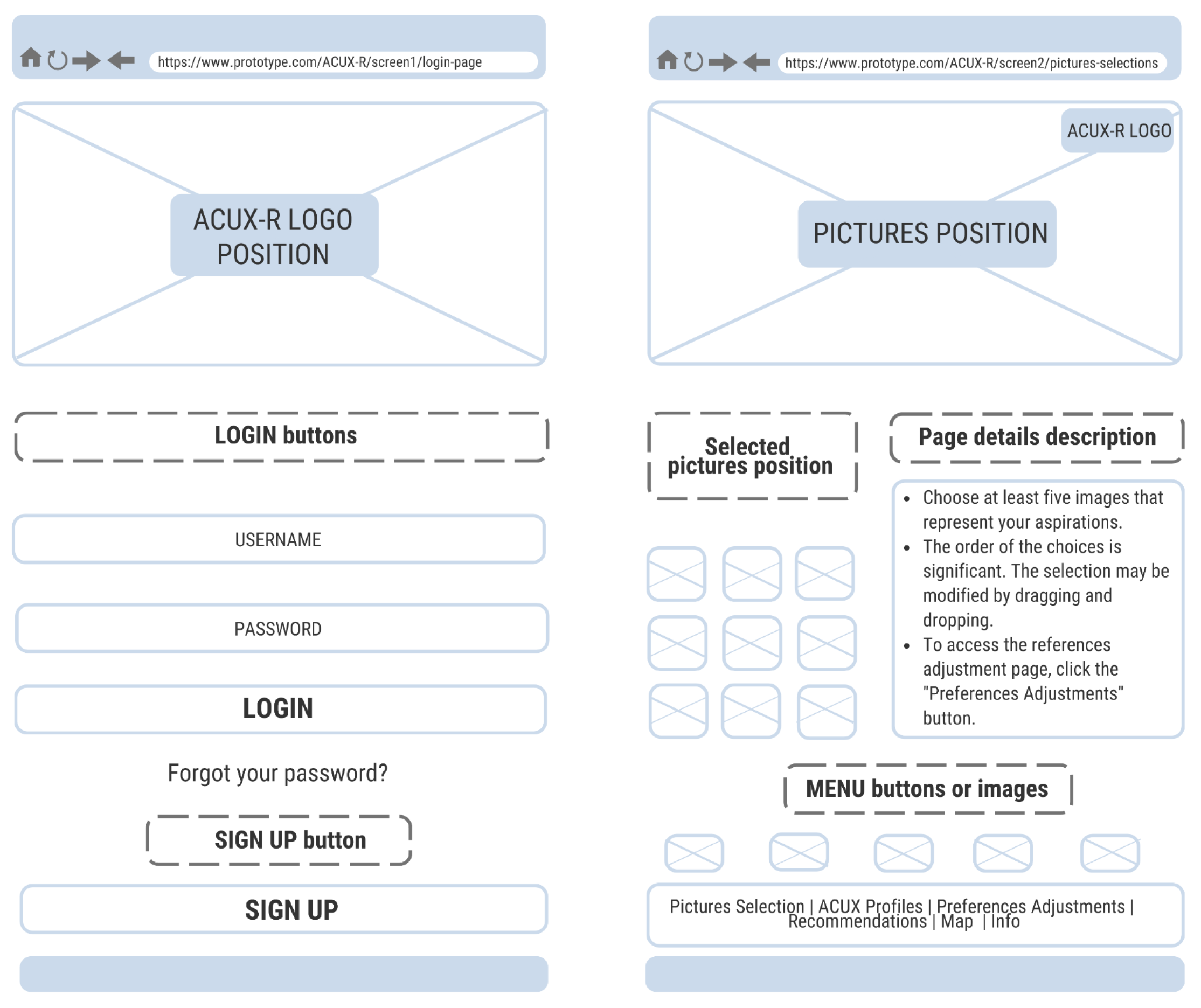
Figure 2.
ACUX-R profiles in the GUI
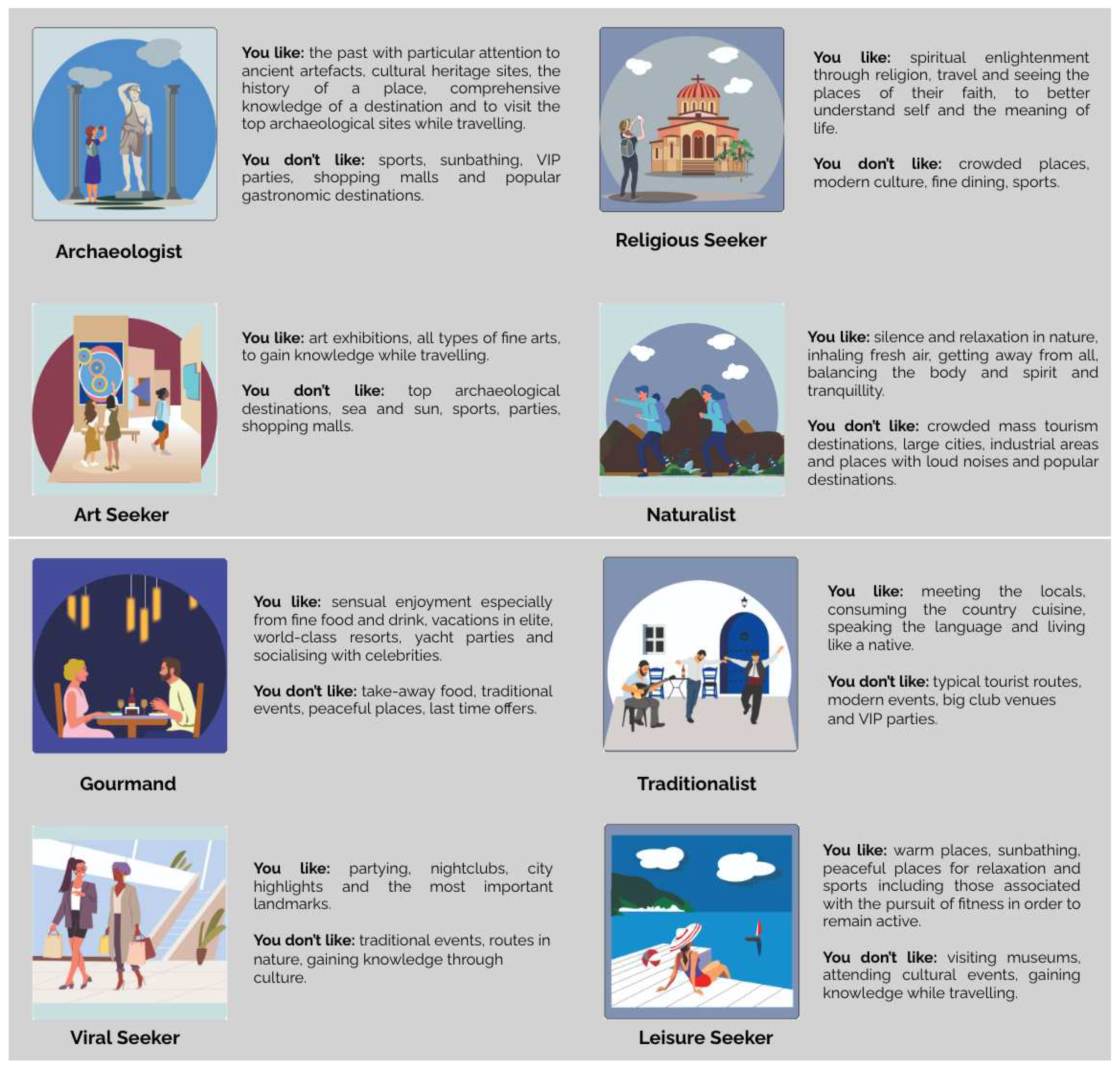
Figure 3.
ACUX-R GUI sitemap
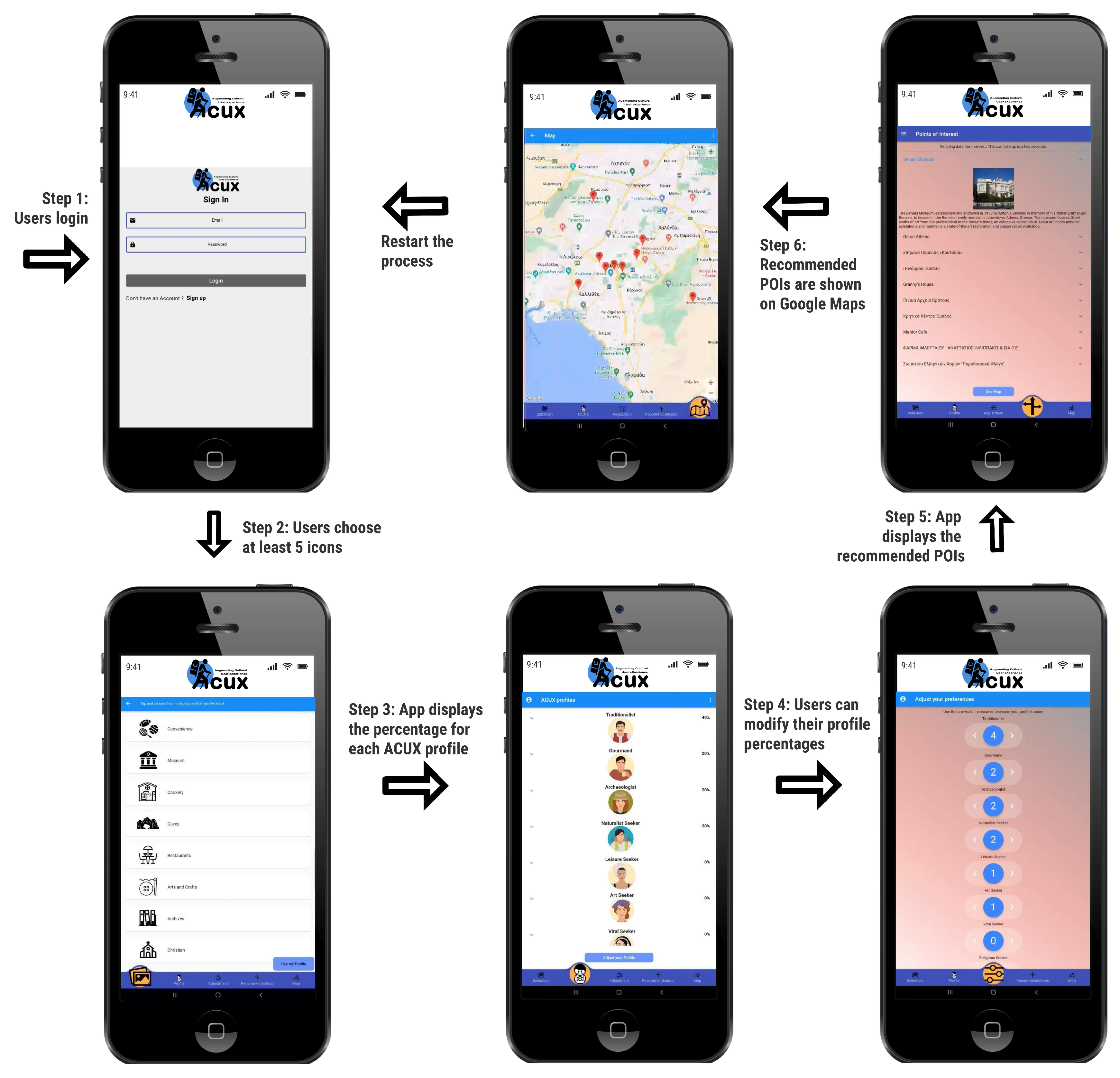
Figure 4.
ACUX-R case study in the city of Athens.
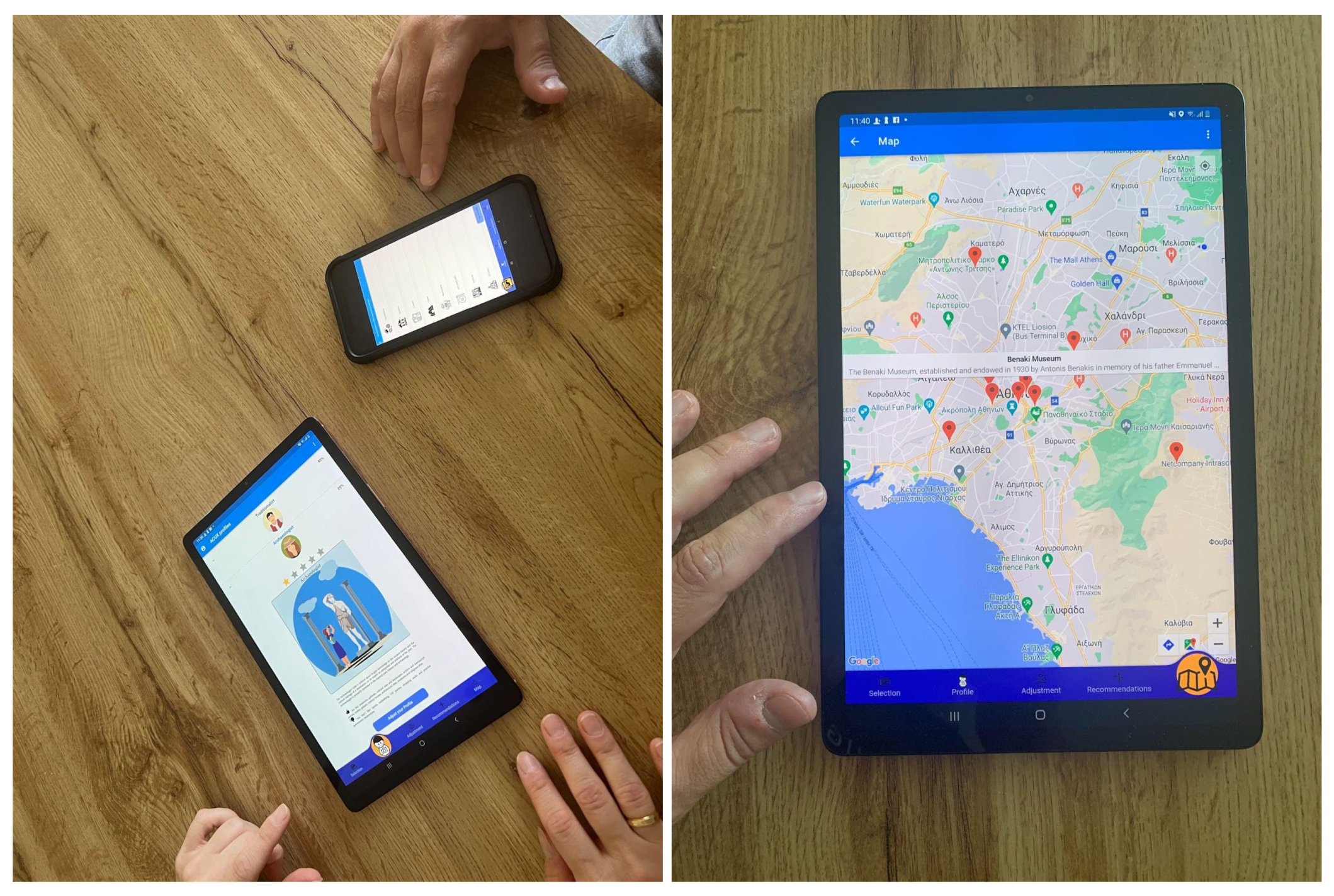

Table 1.
ACUX-R Functional Requirements.
| Functional Requirement |
Description |
|---|---|
| FR1 | Users first need to log in or register to use the GUI. |
| FR2 | The ACUX-R menu will include five menu buttons that, when pressed, will display the pages for each of the three stages of the ACUX-R process: Selection and Profile pages (classification stage), Adjustment page (adjustment stage), Recommendation and Map pages (recommendation stage). |
| FR3 | On the Selection page of the GUI, users will need to select a number of icons representing their preferences and needs during a visit. If they select fewer than five icons, a pop-up window will be displayed to inform them that they must select at least five in order to proceed to the next page (the Adjustment page). |
| FR4 | The number of icons selected in the Selection page will always be visible to the users, and they can select or deselect all icons available by clicking a button at the top of the page |
| FR5 | On the Adjustment page, users may change their ACUX profile via adjustment sliders in order to obtain more personalized and accurate recommendations. At the same time, the ACUX-R will recalculate the recommendations based on the new ACUX-R profile |
| FR6 | On the Profile page, users may pick any of the eight profiles to view additional information (e.g., description, likes, dislikes). By clicking on the title of each profile, an expandable tile containing the aforementioned information and an icon representing each profile will be presented |
| FR7 | On the Recommendation page, users with enabled location services will see their position on the map in relation to the POIs, allowing them to select a nearby destination |
| FR8 | On each page, a back button would allow users to return to the previous page and make modifications |
| FR9 | The ACUX-R menu will also include the Info button, which, when pressed, will show information about the application |
Table 2.
ACUX-R Non-Functional Requirements.
| Non-Functional Requirement |
Description |
|---|---|
| NFR1 | The logo must appear on every page of the GUI |
| NFR2 | The ACUX-R menu will appear at the bottom of each page |
| NFR3 | Icons on the Selection page will correspond to user preferences and needs during their cultural visit and should have a comprehensive and distinct depiction |
| NFR4 | The Profile page will display the user’s multi-profile classification as a percentage rating between the profiles of the ACUX typology, also represented by a star rating system (scale 1 to 5) |
| NFR5 | On the Recommendation page, recommended POIs based on user preferences will be shown as a list with a description on the left and as pins on a Google Map on the right on the Map page |
| NFR6 | The recommended POIs on the Recommendation page must be generated without delay and accurately displayed on the map |
| NFR7 | The system must be able to store its state and return to the same state or page as before the interruption when a call interrupts the mobile application |
| NFR8 | All data should be secured and encrypted with minimal requirements so that it is safe from external and internal attacks |
Table 3.
Selected user quotes.
| User Quote |
|---|
| “I would like to see a list of all POIs regardless |
| of the recommendation process, to see if there’s anything I’m unaware of” |
| “I’m unfamiliar with the city of Athens and unsure of my traveling |
| preferences, so I would like to explore a variety of activities with an |
| emphasis on things that I already like” |
| “Depending on the duration of my visit, |
| I would be interested in a varying number of POIs” |
| “I would like to see what other visitors selected, visited and enjoyed in |
| order to choose the POIs that I would prefer most” |
Disclaimer/Publisher’s Note: The statements, opinions and data contained in all publications are solely those of the individual author(s) and contributor(s) and not of MDPI and/or the editor(s). MDPI and/or the editor(s) disclaim responsibility for any injury to people or property resulting from any ideas, methods, instructions or products referred to in the content. |
© 2023 by the authors. Licensee MDPI, Basel, Switzerland. This article is an open access article distributed under the terms and conditions of the Creative Commons Attribution (CC BY) license (http://creativecommons.org/licenses/by/4.0/).
Copyright: This open access article is published under a Creative Commons CC BY 4.0 license, which permit the free download, distribution, and reuse, provided that the author and preprint are cited in any reuse.


