
Submitted:
09 July 2023
Posted:
11 July 2023
You are already at the latest version
Abstract
The concept of intellectual capital is increasingly recognized as one of the most important strategic assets of organizations. The significance of intellectual resources, which are now critical for every business unit, is underlined in this paper. Thus, this research aims to identify the effectiveness of intellectual capital and its components on the organizational innovation at Sulaimani Polytechnic University in Sulaymaniyah Governorate, from the point of view of the faculty members (academic and administrative staff). The study developed both theoretical and empirical sections. The descriptive approach was used to determine the effectiveness of intellectual capital and the quantities of research methodologies was used to measure this effectiveness. The study aims at investigating the correlations and causal effect between intellectual capital and organizational innovation. Moreover, the study investigates the correlations and causal effect between human capital, structural capital and relational capital on radical and incremental innovation in the organization. To achieve this, the 392 total sample were collected and analyzed by SPSS 22 software. The findings provide evidence that intellectual capital and its components have a positive and statistically significant effect on the organizational innovation and its components.
Keywords:
Intellectual Capital
; Human Capital
; Structural Capital
; Relational Capital
; Innovation
; Incremental Innovation
; Radical Innovation
1. Introduction
In recent times and in an extremely unstable environment, the global economy and modern business organizations have been characterized by rapid changes, transformations, technological and scientific development, revolution in communications as well as massive economic and knowledge development. A new concept of assets that contribute to the production process has emerged, namely intangible assets or cognitive assets which is one of the most important issues that has been radically impacted by global transformation. Human capital along with cognitive resources, reasoning capacity and background information has a vital role for organizational performance. According to Diebolt and Hippe [1], intellectual capital is associated with the development of new ideas or the development of existing ones, and it is the basis of all organizational tasks. With introducing the importance of this subject it is necessary to mention that the key issue is not the method by which knowledge is gained, but the method of utilizing and managing the acquired knowledge [2].
The main characteristic of knowledge is that it is actionable information that can be used to make predictions [3], and it is mostly intangible and implicit and resides in the minds of individuals based on their experience, skills and intellectual abilities. It is also available in the form of meaningful information about the market, customer, communications and technology. According to Sağsan et al. [4], within organization, knowledge is the primary asset that integrates technology, strategy, procedure, and structure. Developed societies would not have achieved their development and progress without their reliance on thinkers, creators and productive minds, which clarifies the importance of intellectual capital, in enhancing creativity in an era characterized by rapid transformations. According to Cavusoglu [9], organizations are capable of creating value by boosting the productivity of their production elements through knowledge-based economic activities. According to Cavusoglu & Sağsan [10], one of the major elements of the knowledge economy appears to be intellectual capital and it can be employed in two directions; the optimal use of the elements of knowledge and intellectual capital and the use of technology in the way that the institution needs to complete the production process.
Education and knowledge generation are two of universities' most significant roles which are conducted out by universities and other higher education institutions, and they play a crucial role in the development of any nation that intends to grow. The educated person has also emerged as a key player in this development. As a result, many nations have particularly acknowledged the value of education in general and higher education because of their close interrelation. As a result, universities consider making a genuine investment in the development of human resources, and it has incorporated into the overall development strategy of them. Modern universities play a crucial role for the creation of a suitable environment for individuals to be able to understand contemporary technologies and innovation. Moreover, knowledge-based economies do not solely depend on the physical factors of production including land, labor and capital they mostly depend on the value of knowledge, like intellectual capital, innovation activities and creativity. The university is one of the most important social institutions for creating and enhancing intellectual capital. The university plays a critical role in leading development activities and sectors, as well as organizational creativity, especially in a world distinguished by knowledge and knowledge-based competition. Rapid global changes have forced global institutions, particularly educational institutions, to endeavor to achieve and maintain their positions in the market with different nature of activities and dynamisms. According to Hama et al. [5], creativity is a crucial aspect of organizations in terms of dealing with adapting to a competitive environment, which occur through improving its performance and raising the level of efficiency. Thus, it has become necessary for institutions to search for modern instruments, methods and techniques that will enable them to achieve organizational goals. Today many firms have realized that their real value is based on the intellectual assets that the organization possesses. Intellectual resources also play a decisive role in achieving competitive advantage in the global [6,7]. Meanwhile, due to the rapid progress that has occurred in the business world today, human capital with its knowledge, experience and skills has become a valuable form of capital. This increased awareness of the importance of human capital made it necessary for organizational performance. The human capital and performance of employees in firms determine productivity [8]. Organizations also need innovation together with intellectual capital that provide them greater competitive advantage which is what they possess and are made by competencies. Creativity and innovation enable success, development and progress to the organization.
One of the main problems that Iraqi universities face is the rigidity of the education and learning style. Intellectual capital is a concept that is growing rapidly among researchers nowadays days. One of the most crucial elements in the growth and development of companies is the intellectual capital. The intangible resources that have been employed by universities to advance their academic performance are referred to as intellectual capital. The main goal of this study is to improve awareness of intellectual capital that allows universities to develop and improve organizational innovation and confirms the significance of innovation as a convenient strategic option for developing a competitive advantage as well as establishing a new culture which pays attention to creativity and innovation. Management style, decision-making process, staffing processes, interpersonal trust and confidence, dedication, control, significance of connection, teamwork, and influence of nature are all factors that contribute to organizational culture. Leadership, employee empowerment, communication, professional growth, purpose, and value are also important aspects of culture. To be able to achieve this aim the study tried to find out the effect and role of intellectual capital in enhancing the organizational innovation in Sulaimani Polytechnic University. The poor connection between intellectual capital and innovation will be analyzed by the help of this research and the gap will be filled by the findings. The study also tried to answer the effect and role of intellectual capital in enhancing the organizational innovation (incremental and radical innovation) specifically at Sulaimani Polytechnic University.
The remaining part of this article is structured as follows. After the introduction a general review of organizational innovation strategy and intellectual capital presented. This section categorizes and discusses the literature review in an original manner. Later, the methodology and data analysis part present the main tools used in the study, information regarding the data collection and the results and findings of the analysis. The final part of the manuscript describes the discussion, limitations, conclusion, and recommendations of the research.
2. Literature Review
An innovation defined as an idea, a product, or process, or a system that is perceived that to be new to an individual, therefor innovation can be observed in product, process and organization. Innovation and intellectual capital are related strong, structural capital allow firms to create suitable conditions to employ human capital and allow it to group its maximum potential and then to promote the firm’s innovation capital and customer capital.
Here are some studies on this topic that attempted to explain how intellectual capital performs a role in developing organizational capital. It can be categorized as follows: The study of Subramanian & Youndt and Dakhil & Clercq [11,12], focused on the influence of the aspects of intellectual capital on innovation capabilities, they found that intellectual capital has a statistically significant impact on innovation capabilities; also, the intellectual capital components have a positive impact on innovation. Zerenler et al. and Yih Wu et al. [13,14] respectively demonstrated the role of Intellectual Capital on Innovation. According to Cheng et al. [15] intellectual capital and company performance have a significant correlation. Furthermore, according to Yitmen, Amiri et al. and Aramburu et al. [16,17,18], intellectual capital is statistically related to innovation. In 2012, studies conducted in the same area by Ghorbani et al., Mariz Pérez et al., AL-Dujaili, Mura et al. and Atalay [19,20,21,22,23], revealed that there is a significant positive relationship and effectiveness between intellectual capital and innovation. Ugalde-Binda et al., Santos-Rodrigues et al. and Sivalogathasan and Wu [24,25,26], also pointed out that intellectual capital which constitutes the elements, structure, system, and strategy in the organization will be the pioneer of the innovation capability of the firms. Cezlan [27], illustrated the impact of intellectual capital on business innovation and business performance. According to Örnek & Ayas and Han & Li. [28,29], increased human capital leads to an increase in innovative ideas, they evaluated that intellectual capital has an impact on innovative business behavior, while innovative ideas increase the objective and subjective performance of firms. In 2016, research conducted by Dost et al., Beşkese and Haktanir, Abbas and Cassol [30,31,32,33], discussed how intellectual capital and its components affect innovation within an organization. In the same way, Kianto et al. [34] investigated the correlation between intellectual capital and innovation. Moreover, according to Barkat et al. and Buenechea Elberdin et al. [35,36], intellectual capital strongly and positively affects organizational performance and the organizational innovation capability. In 2019 Altındağ et al. and Li et al. [37,38], conducted studies to examine the relationship and effectiveness between the intellectual capital and innovation capabilities of firms; the empirical results showed that there was a significant relationship between intellectual capital and innovation. In addition, Huang et al. and Najar & Ben Zammel, El-Gamal and Abou Naem [39,40,41], examined the impact of intellectual capital on organizations’ innovation capabilities, and the empirical outcomes of these studies indicated that intellectual capital and its elements have an effect on organizations’ innovation capabilities.
Moreover Mostafa et al., da Silva et al., Hung, H., Andreeva et al., Rehman et al. [42,43,44,45,46], performed research to assess the correlation, relation, and effect of intellectual capital and innovation, and the empirical findings revealed that there was a substantial connection between the intellectual capital and innovation. In 2022 AL-Khatib and Costa et al. [47,48], demonstrated intellectual capital and innovation have a considerable positive relationship and efficacy.
2.1. Intellectual Capital:
Intellectual capital is an essential source of competitive advantage. According to Leitner et al. [49], “it is a key element in an organization’s future earning potential”. Organizations compete on the basis of knowledge and information advantage. As a result, intellectual capital is in charge of the resource transformation process and distinguished knowledge into a contribution of economic value in the market. Edvinsson and Sullivan [50] defined intellectual capital as “knowledge that can be translated into value”. It is any information that is capable of providing firms with competitiveness. Also, it can be defined as the collection of all sources of knowledge that will enable the organizations to obtain benefits, acquire new customer, develop new appropriate products, services and processes and improve the quality of the business [51]. This concept can be summarized as the experience of employees and the organizational mission. Employee satisfaction is a wide concept used in the human resources (HR) sector to indicate how satisfied or happy employees are with things like their employment, their employee experiences, and the companies they work for. The institution’s intellectual capital is the value that distinguishes it from similar and competitor institutions, and provides organizations with the lead in the event of its superiority over other firms [52]. Stewart [53] defines Intellectual Capital as ”collective brainpower” or ”packaged valuable knowledge”. It is considered as a part of the organizational capital, which includes human, structural and relational capital. It consists of creative human competencies with experience, knowledge and skill, in addition to organizational structures, programs, processes and information bases, as well as its relations with all internal and external parties. The combination of observable and measurable knowledge, skills, talents, and personal characteristics that lead to improved employee performance and, ultimately, organizational success. Intellectual capital improves the performance of the organization and contributes to the development of the market share, thus maximizing its competitive advantage [54].
Edvinsson and Malone [55] defined that intellectual capital is the sum of human capital and structural capital. Stewart [53] extended this definition and indicated that the intellectual capital consists of three parts; human capital, structural capital and relational capital (customer capital).
- i.
- Human Capital:
Human capital is an important part of the huge image of future life and management plans. It is often said that an organization is as good as its employees. “The fundamental intelligence of the organizational member is the essence of human capital” [56]. The leaders, managers, employees and all individuals inside the enterprise are the human capital of the organization and they are a decisive factor in the organizational success. They are individuals with the necessary mental ability, skills, experience and morale as well as depth of expertise [57,58]. That will be attempting to find practical solutions appropriate to the requirements and needs of the beneficiaries and enable their organizations to survive and compete. Human capital is the information, skills, and health that people invest in and collect over the course of their lifetimes, allowing them to reach their maximum potential as responsible members of society. The concept of human capital recognizes that not all employees are equal and there is a difference among individuals’ capability, and each individual can improve his or her capability through continuous education and training. Human capital is an intangible asset, which can be classified as the economic value of the employee’s experience and skills, and it has the importance of being the main source of innovation and renewal in the organization. Education, training, intelligence, and skills are examples of such advantages of the human capital. According to Martin [59] it resides in organization’s employees that their performance will add value to customer’s satisfaction. Corporations may increase the quality of their capital by investing in their employees’ education, experience, and capabilities, all of which are economically valuable to both employers and the economy as a whole. Employees are the most important intangible assets of an organization. Employees, whether at the intermediate or senior levels, operate the organization. They are intangible assets that are of immeasurable worth because of their determination, persistence, and emotional connections to the company. These qualities cannot be measured or valued in terms of money. [60,61]
Structural Capital:
Structural capital is a knowledge developed by an organization that cannot be detached from the entity [62].Structural capital is one of the three basic components of intellectual capital and comprises of the organization’s enabling infrastructure, procedures, and databases that allow human capital to function. Structured capital belongs to a company and remains with it even if employees leave. It is the work or business system which is meant the organizational structure or building of the organization. It includes organizational capabilities such as information systems, copyright, enterprise reputation, patents, processing, databases, documents, organizational structures, ready-made or available programs, organization policies, intellectual property and culture [63,64]. Structural capital means the knowledge that remains in the organization after its employees in different positions leave [65], whether temporarily or permanently. An organization’s primary goal should be to convert human capital into structural capital [52]. In addition to all forms of intellectual property, it may indicate other categories of intellectual capital, the finest illustration of which is the firm's operations and manufacturing operations.
- ii.
- Relational Capital:
Relational capital is primarily focused on the organization's interaction with its consumers which is also known as customer capital [55,66]. It includes all the relationships that organizations have with external sources such as customers, partners, supporters, and relationships with brands. It comes from the quality of services provided by organizations and absorbs suppliers and customers’ conviction and loyalty and customer’s satisfaction (by meeting their needs, desires). Relational capital includes all the resources related to the external environment that contribute to the processes of value addition for the organization, such as the relationships with customers, suppliers, partners in research and development, and the facility’s relationship with some of the beneficiary parties such as shareholders, creditors, suppliers etc. [67,68,69]. Customer capital is also measured by factors such as brands, consumers, distribution channels, partnerships, collaborative research, financial contracts, licensing agreements, customer loyalty, customer happiness, repeat business, and price sensitivity [70].
2.2. Organizational Innovation Strategy:
An organization is a structure that is organized by an individual or a group of individuals with the goal of collaborating to achieve desired goals. According to Jenatabadi [71], organizations perform various activities to accomplish their organizational objectives. Organizations may more clearly see their route to success and the realization of their vision by developing thorough, attainable goals. Setting and achieving objectives may also enable an organization increase its production, efficiency, and profitability. Its components and methods differ from one to an- other depending on a variety of factors including culture, the nature of leadership, the types of needs those individuals seek to meet, and how they work together to achieve common goals. Companies, public organizations, private organizations, political organizations, charitable organizations, non-profit organizations, and public organizations are all different types of organizations that differ in their missions and goals. According to Lunenburg [72], organizations exist to achieve goals. Every public organization has a specific purpose that is meant to benefit the general community. Public organizations, managed and funded by the government, deliver benefits made appropriate for the governed, and the business sector may be classified into two primary groups, such as public and private. Public organizations are a system or group of people that work to govern an organized society. Presidential or semi-presidential republics, parliamentary constitutional monarchies, and absolute monarchies are examples of public institutions that are commonly associated with the state.
Organizations should have a powerful strategy that is capable of achieving organizational goals. Also, this strategy should be written and codified in the organization’s documents, and it should introduce organizations' employee periodically in order to be accompanied by these employees in the implementation process.
Perfect strategies enhance alignment among diverse groups within the organization, illustrate organization's' objectives and priorities, and assist organizations with concentrating on available efforts, while the innovation strategy is the general plan to achieve the organizations' goals. Furthermore, institutions that pursue an innovative strategy are institutions that make innovation as a source of their competitive advantage in the market and the most fundamental dimension of their strategic performance.
The innovation strategy in organizations aims to proceed to a novel stage in which the culture of innovation will be established and disseminate among individuals; an innovation strategy's primary function is to guide resource allocation decisions to achieve an institution's innovation goals [73]. Moreover, the innovation strategy determines the capacity of innovation resources, the quality and levels of innovation, the policy of human resource management (human capital) to enable innovation process sustainability, thus providing services based on advanced technology. Furthermore, it focuses on developing technical industries and scientific research, and creating advanced technological systems for managing production and marketing units. Innovation makes sudden progress that allows the organization to become a disciplined organization. According to Tavassoli and Karlsson [74], there are four main kinds of innovation strategy that consist of product innovation, process innovation, market innovation and organizational innovation.
Innovation:
Innovation is a key strategic factor in modern nations' economic development and it is a key for success for organizations [75]. For it to be effective, an innovation has to be simple and it has to be focused [76]. According to Sen & Ghandforoush [77], innovation in information technology is a primary driver of growth in developed economies. Its development and implementation require substantial resources such as human, financial and organizational resources. According to Košmrlj et al. [78], innovation means action toward discovering new solutions for challenges that faced by organizations and individuals. Likar et al. [79], defined innovation as a factor that increases the value addition process and reduces product and service costs. It encompasses the utilizing new ideas to adapt to change, performing research and development, refining techniques, or upgrading services and goods, along with implementing innovative solutions to situations. According to Trott [80], innovation is an engine of growth. Moreover, it is an individual's perception of a new idea, activity, or object and the production of something new or specific in the field of technological development [81].
- i.
- Radical Innovation:
According to Norman & Verganti [82], radical innovation is a change of frame; i.e., “doing what we did not do before”. A new business model and the power of technology are two components of radical innovation. It is a notion that modifies customer- supplier relationships by replacing existing products and services or generating new product categories. As a result of radical innovation, the parts and the way they interact are combined in a new way to provide a special solution. Results of radical innovation (breakthrough) are usually in relation to major scientific and technical advances, and a strategic transformation that affects a wide variety of products, services, technology, and industries. This type of innovation takes into consideration new forms of real innovations, unique products, services, processes and technology, different from all previous products or processes in its field. The change of this kind of innovation is unexpected and revolutionary. Radical innovation emerges through individual ideas and efforts and innovation through technological developments, new research and scientific studies.
- ii.
- IncrementalInnovation:
Incremental Innovation involves small modifications and advances in characteristics, size, needed procedures, scope of application, and the integration with certain other products or service features. According to Li & Huang [83], incremental innovation is a strategy with low risk and low earnings, such as additions to a product or process, service, or technology. The effect of this kind of innovation lasts for a long time, but it is not radical, its speed path involves small steps, and its time frame is continuous and gradual. Incremental innovation is characterized by gradual and continuous change, and its strategy is based on collaborative efforts with an emphasis on maintenance and improvement. It also requires a traditional technical approximation. In terms of scientific requirements, minimum investments and effort is sufficient to maintain it. In this approach, in terms of evaluation criteria, it is aimed to improve performance and to take initiatives for improve results. Its most important advantage is that it is well-suited to a slow-growing economy.
Conceptual Model:
This study is based on the positivism philosophy, descriptive analytical approach and the quantitative research method that describes the phenomena and events of this study. The unit of measurement is organizations, and this research is longitudinal in the terms of the time horizon. The independent variable is intellectual capital, which is represented by (human capital, structural capital, customer capital), and the dependent variable is an organization's innovation strategy which is represented by (incremental innovation and radical innovation).
The hypothesis of this study configured through emphasizing on previous study that mentioned in the literature review, for the topic of intellectual capital three main aspects that include human capital, relational capital and structural capital have been utilized, moreover for the topic of organizational innovation the subcategories of radical innovation and incremental innovation have been studied. The hypothesis of the study is designed by the help of the knowledge sharing theory, organizational innovation strategy, intellectual capital theory and organizational performance theories. This research proposed the following main hypothesis and sub-hypotheses:
Hypothesis 1 (H1)
: Intellectual capital statistically has an important, considerable and positive influence on the organization’s innovation strategy.
Hypothesis 1a (H1a)
: Human capital statistically has an important, considerable and positive influence on incremental innovation.
Hypothesis 1b (H1b)
: Structural capital statistically has an important, considerable and positive influence on incremental innovation.
Hypothesis 1c (H1c)
: Relational capital statistically has an important, considerable and positive influence on incremental innovation.
Hypothesis H1d (H1d)
: Human capital statistically has an important, considerable and positive influence on radical innovation.
Hypothesis 1e (H1e)
: Structural capital statistically has an important, considerable and positive influence on radical innovation.
Hypothesis H1f (H1f)
: Relational capital statistically has an important, considerable and positive influence on radical innovation.
Figure 1 illustrates the conceptual model of the current study, which presents the numerous relationships between intellectual capital and organization’s innovation strategy and possible relations between their subcategories.
3. Methodology and Data Analysis:
In this research, we aimed to identify the effectiveness of the intellectual capital in enhancing the innovation strategy of organizations. The methodology of this study includes 2591 [84] academic and administrative staff of Sulaimani Polytechnic University in Iraq, respondents consisted of both professional and nonprofessional experts in intellectual capital. But respondents are university’s academic and administrative staffs who are eligible to understand the importance of intellectual capital and organizational innovation and capable of understanding the questions correctly and answer them without question mark. Sulaimani Polytechnic University is a public university and a member of international association of universities (IAU). It’s established in 1996 and located in Sulaimaniah. Sulaimani Polytechnic University is one of the foremost and innovative universities in the Arab region, which offer technical, bachelor and higher degrees. One of the important missions of the university is aiming to improve the skills and technical abilities of its staff which is the main reason that why this study chosen the Sulaimani Polytechnic University as a case. Moreover information technology and management information system is the main part of the study program of this university. This research utilized an empirical approach using a questionnaire as a tool to achieve its objectives. Since there are 2591 participants in the research, 335 measurements or surveys are required to achieve a 95% confidence level. For this research data obtained from 392 questionnaires and analyzed by the SPSS 22 software program. Through simulation modeling and enhanced interaction with other tools, IBM SPSS Statistics V22.0 improves decision making and productivity. It keeps improving its predictive analytics methodologies with better tools, output, and ease-of-use features. Data was collected at random for this research using internet forms. A survey has seven sections and a total of 28 questions based on a 5-point Likert scale, where 5 is the strongest agreement, 4 is agreement, 3 is neutral, 2 is disagreement, and 1 is the strongest disagreement. Additionally, this research contained the part on demographic characteristics, which included things like gender, marital status, age, years of experience, and educational background. Data obtained from this questionnaire were analyzed and seven hypotheses were tested by correlation regression analysis.
Analyses and Results:
First the descriptive statistics test was applied in order to determine the characteristics of the study sample. Gender, marital status, age, year of work experience and academic qualification were considered as the demographic variables. 410 administrative and academic staff of the Sulaimani Polytechnic University members responded the questionnaire but 392 valid responds used for the analysis.
According to the results of the study, the largest group of university employees was females accounting for (%53), as males often tend to work in this sector in proportion to the nature of the male. As for work in ministries, the majority of jobs are suitable for females as they suit their female characteristics, moreover, 62% of respondents were married, while 38% were single, and it is also clear that the largest percentage of the study sample were in the 30-39 years and (less than 30) years age group as they represented three quarters of the study sample. Also 20% of the participants were in the 40-49 age groups and this can be explained by the fact that the nature of work in ministries requires workers to undergo a period of service in order to reach the age of retirement and to benefit from social security. Finally, 13% were in the 50 and over age group. The largest percentage of the study sample members (35.9%) had 10-14 years of experience, while 29.4% of the study sample members had more than 15 years’ experience, and this is in line with the fact that these experiences are commensurate with the nature of the study community, as they are managers who often have more than ten years of practical experience, and the group of 5 years’ experience and the group of 5 years and 9 years of experience represents %11.9 and %22.8 respectively. In terms of employee qualification, 32.1% had a bachelor’s degree, which was slightly more than master’s holders, with 31.6% while diploma and PhD. holders represent 19.2% and 13.9% respectively. Only 0.8% had a high school diploma, and finally, employees with secondary education qualification represents 2.5%.

Table 1.
Demographic analysis of the participants.
| Variable | Description | Responses | Percentage |
|---|---|---|---|
| Gender | Male | 183 | 46.68 |
| Female | 209 | 53.32 | |
| Total | 392 | 100 | |
| Marital status | Single | 149 | 38 |
| Married | 243 | 62 | |
| Total | 392 | 100 | |
| Age | Less than 30 years | 86 | 21.9 |
| 30-39 | 175 | 44.7 | |
| 40-49 | 80 | 20.4 | |
| 50+ | 51 | 13.1 | |
| Total | 392 | 100 | |
| Years of work experience | 5 years | 47 | 11.9 |
| 5-9 years | 89 | 22.8 | |
| 10-14 years | 141 | 35.9 | |
| 15+ | 115 | 29.4 | |
| Total | 392 | 100 | |
| Academic qualification | Secondary education | 10 | 2.5 |
| Diploma | 75 | 19.2 | |
| Bachelor | 126 | 32.1 | |
| Higher diploma | 3 | 0.8 | |
| Master’s | 124 | 31.6 | |
| PhD | 54 | 13.9 | |
| Total | 392 | 100 |
The reliability coefficients for variables are given in Table 2. The fundamental purpose of reliability testing is to evaluate if the variables are internally consistent enough to warrant accurate estimations, and the basic notion is that Cronbach's alpha values are used to do so. After verifying the validity of the study tool by relying on the correlation coefficient (Pearson), it was necessary to ascertain its stability, and the Cronbach’s alpha scale was used for this purpose.
As it can be seen from the Table 2, all dimensions achieved stability considering that the Cronbach’s alpha vales exceeded 60%. Also, an acceptable range for Cronbach's alpha consist of excellent (more than 0.90 to 1.00), very good (0.80-0.89), good and acceptable (0.70-0.79), questionable and moderate (0.60-0.69), poor (0.50-0.59), and unacceptable is less than 0.50 [85]. As the Cronbach’s alpha coefficients for all variables ranged between 0.783 and 0.946, we can say that the stability of the tool is achieved.
The Pearson’s correlation coefficient method was conducted to test the correlations between variables. The results showed that all the variables correlate with organizational innovation. Table 3 shows the results of Pearson correlation coefficient test. According to the results the coefficients of the correlation of each measure with the total score of the scale (all paragraphs of the questionnaire), and that all the correlation coefficients appearing in the table are confined between the two values 0.607 and 0.880. The result indicates that there is a statistically significant correlation between radical innovation and social capital at Sulaimani Polytechnic University, a significance level of 0.880 which is the highest correlation coefficient among all.
The correlations between the elements of intellectual capital and innovation components, including intellectual capital, human capital, structural capital, relational capital, organizational innovation, that include incremental innovation and radical innovation ranges between 0.607 and 0.880 which are positive and highly significant. The highest correlation exists between radical innovation and social capital that indicates a fairly strong positive relationship.
The study's model summary results were generated using SPSS 22 computations and shown in Table 4. The results of the first model show that 58.6% of the changes in Sulaimani Polytechnic University's innovation are described by intellectual capital. This means that variables outside the estimated model account for 41.4% of the variation in Sulaimani Polytechnic University's innovation. Furthermore, the outcomes of the second part imply that Human capital, structural capital, and relational capital are described by 53.9% of the changes in Sulaimani Polytechnic University's incremental innovation, which means that variables outside the estimated model account for a 46.1% of the variation in Sulaimani Polytechnic University's innovation. In the same way, the findings of the last part demonstrate that 80.9% of the changes in Sulaimani Polytechnic University's radical innovation are described by human capital, structural capital, and relational capital. This means that variables outside the estimated model account for a small proportion the variation in Sulaimani Polytechnic University's innovation.
Table 5 shows the analysis of variances (ANOVA) test results. ANOVA is a statistical technique used to compare variations between the mean or average of several groups. It is used in a variety of situations to discover whether there are any differences between the means of various groups. The objective of the test is to determine whether the model is correctly stated or not by checking the significance of p-in the ANOVA table. Because all the p-values are significant at 1% significance level, it may be inferred that the model is appropriately stated. According to significance values, all independent variables have a statistically significant positive impact on the dependent variables.
According to the results of the regression analysis, shown in Table 6, it is clear that there is a statistically significant relationship between the main dimensions of intellectual capital as the independent sub-variables and organizational innovation as a dependent variable, which can be clarified in the following points:
There is a significant positive relationship between intellectual capital and organizational innovation of 0.766, which means that an increase in intellectual capital will lead to an increase in the organizational innovation of the organization by 0.766.
Furthermore, the findings reveal that a 1% increase in human capital contributes to a 0.497 improvement in incremental innovation at Sulaimani Polytechnic University, which is inconsequential, at the same time progressive modifications in structural capital will result in a 0.436 growth in incremental innovation at Sulaimani Polytechnic University for each successive 1% improvement, and the analysis revealed that a 1% boost in Sulaimani Polytechnic University's relational capital will cause 0.280 increase in its net incremental innovation.
Moreover, from the statistical analysis can be observed that human capital has a 0.256 substantial positive relationship with radical innovation. This clarifies that as the development in human capital will increases radical innovation by 0.256. For each 1% increases in structural capital, Sulaimani Polytechnic University will obtain a 0.604 increase in radical innovation. Moreover, a 1% increase in Sulaimani Polytechnic University's relational capital results in a 0.094 increase in radical innovation.
Hypothesis Testing:
The hypothesis testing process for the main hypotheses and its sub-hypotheses is implemented by using the Pearson Correlation Coefficient to verify the presence or absence of a statistically significant relationship at the level of significance 0.05 between the independent variable (intellectual capital) and the dependent variable (organizational innovation).
The results showed in the Table 7 exhibits that there is an existence of a strong and statistically significant correlation between dependent and independent variables. With a correlation coefficient at the significance level of 0.05 all of the hypothesis that the study conduct accepted (see Table 7) and this is in line with what was confirmed by the theoretical framework of the study in term of the availability of intellectual capital requirements in the organization to boost organizational innovation. This is due to the focus of the study institution on embodying the dimensions of: human capital, structural capital, and relational capital within the university under study. The major hypothesis and its sub-hypothesis are therefore verified and accepted, so the university under study must attract qualified human resources, develop them, encourage them to be continuously creative, and realize their ideas in reality.
Based on the overall results, improvements in human, structural, and relational capital can be acknowledged as having a positive substantial link with an organizational innovation. The results indicate that the organization’s approach to human, structural, and relational capital is contributing to the university's innovation in a favorable manner.
The authors implemented and tested a conceptual model by considering the three dimensions of intellectual capital on organizational innovation in this study. Few studies in the knowledge-based literature have examined at how various components of intellectual capital can influence whether or not an organizational radical and incremental innovation.
Human capital allows employees to collaborate, provides a competitive advantage, and introduces new learning opportunities through effective knowledge transfer. Employees are important to the success of innovative businesses, and university is dependent on the vitality and creativity of its members.
The allocation of structural capital to organizational innovation and the creation of new processes have a direct impact on innovation. Clearly, innovation that improves an organization's performance raises structural capitals.
Relational capital has an effect on whether or not an organization's innovation increases or decreases. Support for new techniques within the organization reinforces the desire to provide higher-quality services or expand organizational capabilities, and designate new methods that assist the university to eliminate its obstacles through knowledge sharing.
Discussion:
This article attempts to fill a research gap by examining how various aspects of intellectual capital affect organizational innovation in a developing country. Comparing the findings of this study with similar studies in the literature, components of intellectual capital play important roles that drive innovation in various organizations in almost all studies. However, it is clear from the findings of various studies that some components of intellectual capital are negatively related to organizational innovation and innovative capabilities. Subramanian & Youndt [11] showed that there is a negative relationship between human capital and innovation ability. Additionally, according to AL-Dujaili's [21] study, only structural and human capital have an impact on organizational innovation. Also, Cezlan's study [27] found that structural capital had little effect on business innovation. While all the hypotheses of this research were accepted, it means that all components of intellectual capital have a positive relationship with organizational innovation and its components in the statistical population. As a result, the study rejected the main research hypothesis and similar conclusions were reached with the studies in the literature.
The main contribution of this study is to clearly light up a series of links between strategic human resources and innovation capacity of enterprises and contribute to the establishment of a set of indicators for the management of human capital. The primary theoretical implication of the study is to highlight the need for organizations to provide intellectual capital and to show that institutions can evolve into growing organizations through transformation and innovation. Another result of this research is that employees with academic qualifications such as doctorate or master's degree and employees with many years of experience generally have more strategic importance for the organization than other employees. Therefore, the management team at Sulaymaniyah Polytechnic University should trust such employees to develop all aspects of the university. According to the results, achieving outstanding creative performance depends on a firm's intellectual capital and its capacity to identify opportunities and threats, make important decisions at the right time, and make important changes effectively. Managers should design appropriate management procedures for knowledge acquisition through organizational learning, as well as ensure that the work environment is suitable for tacit knowledge exchange among employees.
The study recommends to the managerial board of the Sulaymaniyah Polytechnic University to use its intellectual capital for the benefit of the institution and to provide all staff and lecturers what they need to perform as efficiently as possible. A high level of performance among employees not only reduces university costs, but also contributes significantly to the productivity of the institution and the success of its programs.
Limitations:
Like all studies this study also has some limitations regarding the comprehensiveness of the scientific research process. The results of this study must be seen in the context of some limitations. Lack of studies conducted on this subject is one of the major limitations of this research. The researchers conducted the study in a public university in the north of Iraq, so they needed the university President's approval for scale and data collection. Additionally, obtaining the total number of employees in this university was very difficult due to the managerial beware of sharing this information. Thus, researchers used their own personal contacts to reach the exact number. Majority of the respondents are not good in English so the questionnaire was designed both in Arabic and Kurdish languages.
Conclusion and Recommendation
The study’s results demonstrate that intellectual capital and its components have a positive and statistically significant effect on the organizational innovation and its components. Through what was presented in the research, it can be concluded that the conceptual management framework lacks many concepts related to intellectual capital and organizational innovation at Sulaimani Polytechnic University, which at the present time constitute additional imperfection in management theory. It is clear that the business world is facing challenges imposed by globalization, alliances and innovations, so organizations have converted into a new economic system and new kinds of capital, which are knowledge economy and intellectual capital. This has become a competitive advantage for organizations, and they can only succeed if they invest in their intellectual capital. The greatest challenge for organizations is to provide competencies and skills that give them competitive excellence and create the right atmosphere for the generation of creative and innovative ideas. Cooperation with the external environment and universities should be made to generate creative ideas, training courses, development activities and their awareness of the concept and importance of innovation for the institution. It is necessary to support lecturers to overcome weaknesses in their performance and enhance their strengths by urging the research organizations to develop the capabilities of academicians and improve their performance through their participation in conferences, scientific seminars, and efficient and distinguished training programs. The knowledge possessed by employees should be exploited and utilized for the benefit of the organization. It is important to provide the necessary material, human and financial resources to create creative ideas, and establish an incentive system in order to motivate employees to innovate. Organization should realize the importance of innovation in reducing their costs in order to provide more competitive prices, they must incorporate innovation within their strategies to face fierce competition and build a competitive advantage. In conclusion, the institution under study should involve various departments in the innovation process which requires concerted efforts in the institution.
Based on the results of this research, there is a strong relationship between independent and dependent variables, and there is also an impact of intellectual capital and its components on organizational innovation. As for comparing this research with previous research (which has already appeared in the literature review), we conducted our research with an innovation style consisting of radical and incremental innovation while other research focused on product and service innovation in processes and adaptation; Adopting innovation or other innovation methods. Furthermore, this research is the first of its kind to be carried out in northern Iraq.
Universities and organizations are required to create a convenient environment for the generation of creative and innovative ideas, and as the most important means to achieve comprehensive development, public and private institutions should encourage the all kinds of innovation. Furthermore, utilizing modern information technology to disseminate information, such as teleconferences, workshops, video conferences, conferences, seminars, discussions and publications for the process of information distribution, will help to disseminate information among administrative and academic staff effectively, which will facilitate the invention process. Moreover, it should be ensured that there is equitable distribution of technological and cognitive capabilities among the university's faculties through the participation of all faculty members with all available technology, and it is possible to overcome the technological shortcomings of the university’s innovation-oriented system. Also, because of its important role in the life of economic units, administrators should be more aware of the notion of intellectual capital, its components, importance, and measurement methodologies. Furthermore, democratic spirit within the university should be encouraged to allow its employees to express their opinions and the problems of the university in order to bring about real development, through real participation in decision-making at the level of departments, colleges and the university. Also, the university should enter into agreements with foreign institutions in the field of innovation and knowledge dissemination. While doing this, to encourage the creation of self-managed teams by organizing research and development groups. In addition to this, the university should develop a strategy of innovation in its organizational culture, which will provide new ideas for changing administrative actions according to environmental changes. Also, the human, organizational and customer capital should be enhanced through establishing high human capacities, idealistic organizational structure, organizational infrastructure and expanding customer relations. Also, cooperation between university units and departments is beneficial for new initiatives.
Author Contributions
Conceptualization, N.O.H and B.Ç; methodology, N.O.H.; formal analysis N.O.H and B.Ç.; investigation, N.O.H.; resources, N.O.H and B.Ç.; writing—original draft preparation, N.O.H; writing—review and editing, N.O.H and B.Ç. All authors have read and agreed to the published version of the manuscript.
Funding
This research received no funding.
Institutional Review Board Statement
The study was conducted in accordance with the Declaration of Helsinki, and approved by the Ethics Committee of NEU Scientific Research Ethics Committee (NEU/SS/2021/1106).
Informed Consent Statement
Informed consent was obtained from all subjects involved in the study.
Data Availability Statement
Data is available upon request from the corresponding author.
Acknowledgments
The authors are grateful to the editor and the anonymous reviewers for providing very constructive and useful comments that enabled us to make additional efforts to improve the clarity and quality of our research.
Conflicts of Interest
The authors declare no conflict of interest.
References
- Diebolt, C. , Hippe R. (2018). The long-run impact of human capital on innovation and economic development in the regions of Europe. Applied Economics. [CrossRef]
- Hama, N. O. , Sağsan, M. (2020). Creating Knowledge Management Policy in Human Resources Management based on Job Satisfaction. ECKM 2020 21st European Conference on Knowledge Management.
- Tiwana, A. (2002). The knowledge management toolkit: orchestrating IT, strategy, and knowledge platforms. Pearson Education India.
- Sağsan, M. Medeni, I. T. Medeni, T. D. (2016). Knowledge management paradigms: implementation through individual fuzzy-based education. Procedia Computer Science 102 (2016) 259 – 266. [CrossRef]
- Hama, N. O. , Cavusoglu, B., Sağsan, M. (2021). Knowledge Sharing and Organizational Creativity: Mediating Role of Employee Empowerment. ECKM 2021 22nd European Conference on Knowledge Management.
- Stewart, A. T. (1991). Brainpower: Intellectual Capital is Becoming Corporate America's Most Valuable Asset and Can Be Its Sharpest Competitive Weapon. The Challenge is To Find What You Have –And Use It. Fortune,http://money.cnn.com/magazines/fortune/fortune_archive/1991/06/03/75096/ access date: 08.02.2015.
- Bontis, N. , Serenko, A. (2004). Meta-Review of Knowledge Management and Intellectual Capital Literature: Citation Impact and Research Productivity Rankings. Knowledge and Process Management, 11, 3,185–198. [CrossRef]
- Cavusoglu, B. (2017). Education and Economic Growth in Turkey. International Journal of Economic Perspectives, Volume 11, Issue 4, 88-100.
- Cavusoglu, B. (2014). Intellectual Capital as an Engine of Growth: Analysis of Causality for North Cyprus Economy. European Conference on Knowledge Management.
- Cavusoglu, B. , Sağsan, M. (2016). Either Economize on Knowledge or Capitalize on Intellectuality: Educational Challenges for Economic Growth in the Turkish Republic of Northern Cyprus. Türk Kütüphaneciliği 30, 2 (2016), 166-184.
- Subramaniam, M. , Youndt, M. A. (2005). The Influence of Intellectual Capital on the Types of Innovative Capabilities. The Academy of Management Journal. [CrossRef]
- Dakhli, M. , De Clercq D. (2004). Human capital, social capital, and innovation: a multi-country study. Entrepreneurship & Regional Development.
- Zerenler, M. , Hasiloglu, S. B., Sezgin, M. (2008). Intellectual Capital and Innovation Performance: Empirical Evidence in the Turkish Automotive Supplier. Journal of Technology Management and Innovation. [CrossRef]
- Yih Wu, W. , Chang, M., Chen, C. (2008). Promoting innovation through the accumulation of intellectual capital, social capital, and entrepreneurial orientation. R& D Management.
- Cheng, M. , Lin, J., Hsiao, T., Lin, T. W. (2010). Invested resource, competitive intellectual capital, and corporate performance. Journal of Intellectual Capital. [CrossRef]
- Yitmen, I. (2011). Intellectual Capital: A Competitive Asset for Driving Innovation In Engineering Design Firms. Engineering Management Journal; EMJ 23(2):3-19. [CrossRef]
- Amiri, A.N. , Jandaghi, G., Remain, M. (2011). An investigation to the impact of intellectual capital on organizational innovation.
- Aramburu, N. , Sáenz, J. (2011). Structural capital, innovation capability, and size effect: An empirical study. Journal of Management & Organization 17(3):307-325.
- Ghorbani M, Mofaredi B, Bashiriyan S. (2012). Study of the relationship between intellectual capital management and organizational innovation in the banks. African Journal of Business Management.
- Mariz-Perez, R.M. , Teijeiro-Alvarez M. M., Garcia-Alvarez M. T. (2012). The relevance of human capital as a driver for innovation. Cuadernos de Economía. [CrossRef]
- AL-DUJAILI, M. A.A. (2012). Influence of Intellectual Capital in the Organizational Innovation. International Journal of Innovation, Management and Technology.
- Mura, M. , Lettieri E., Spiller, N., Radaelli, G. (2012). Intellectual Capital and Innovative Work Behavior: Opening the Black Box. International Journal of Engineering Business Management.
- Atalay, M. (2012). The Relatıonshıp between Intellectual Capital, Innovation and Firm Performance: A Research in Automotive Supplier Industry. Master Thesis, Akdeniz University, Institute of Social Sciences, Antalya.
- Ugalde-Binda, N. , Balbastre-Benavent, F., Canet-Giner, M. T., Carda, N. E. (2013). The Role of Intellectual Capital and Entrepreneurial Characteristics as Innovation Drivers. Innovar: Revista de Ciencias Administrativas y Sociales 24(53):41-60. [CrossRef]
- Santos-Rodrigues, H. , Faria, J., Cranfield, D. and Morais, C. (2013). Intellectual Capital and Innovation: A Case Study of A Public Healthcare Organisation In Europe. Electronic Journal of Knowledge Management, 11(4), pp.361-372.
- Sivalogathasan, V. and Wu, X. (2013). Intellectual Capital for Innovation Capability: A Conceptual Model for Innovation. International Journal of Trade, Economics and Finance, Vol. 4, No. 3, pp. 139-144. [CrossRef]
- Cezlan, E.C. (2014). The Effect of Intellectual Capital on Firm Innovativeness and Firm Performance: A Study in Healthcare. Ph.D. Thesis, Beykent University, Institute of Social Sciences, İstanbul.
- Örnek, A. Ş. , Ayas, S. (2015). The Effect of Intellectual Capital and Innovative Work Behavior on Business Performance: A Practice in Information Technology Sector.Procedia - Social and Behavioral Sciences 195:1387-1395.
- Han, Y. , Li, D. (2015). Effects of intellectual capital on innovative performance. Management Decision 53(1):40-56. [CrossRef]
- Dost, M. , Badir, Y. F., Ali, A., Tariq, A. (2016). The impact of intellectual capital on innovation generation and adoption. Journal of Intellectual Capital 17(4). [CrossRef]
- Beşkese, A. , Haktanir E. (2016). Influence of human capital and organizational capital on organizational innovation. Journal of Trends in the Development of Machinery and Associated Technology.
- Abbas, N. (2016). The role of intellectual capital in achieving organizational innovation. European Journal of Business and Innovation Research Vol.4, No., pp.30-57.
- Cassol, A. , Gonçalo, C. R., Ruas, R. l. (2016). Redefining the Relationship between Intellectual Capital and Innovation: The Mediating Role of Absorptive Capacity. Brazilian Administration Review 13(4):1-25. [CrossRef]
- Kianto, A. , Sáenz, J. and Aramburu, N. (2017). Knowledge-Based Human Resource Management Practices, Intellectual Capital and Innovation. Journal of Business Research, 81, pp. 11-20. [CrossRef]
- Barkat, W. Beh, L., Ahmed, A., Ahmed, R. (2018). Impact of intellectual capital on innovation capability and organizational performance: An empirical investigation. Serbian Journal of Management 13(2).
- Buenechea Elberdin, M. , Sáenz, J., & Kianto, A. (2018). Knowledge management strategies,intellectual capital, and innovation performance: A comparison between high- and low-techfirms. Journal of Knowledge Management, 22(8), 1757–1781.
- Altindağ, O., Fidanbaş, O., & ¡rdan, G. (2019). The impact of intellectual capital on innovation. A literature studies. Business Management Dynamics, 8(12), 01-12.
- Li, Y. , Song, Y., Wang, J., Li, C. (2019). Intellectual Capital, Knowledge Sharing, and Innovation Performance: Evidence from the Chinese Construction Industry. Sustainability 11(9):2713. [CrossRef]
- Huang, H. , Leone, D., Caporuscio, A., Kraus S. (2020). Managing intellectual capital in healthcare organizations. A conceptual proposal to promote innovation. Journal of Intellectual Capital. [CrossRef]
- Najar, T. , Dhaouadi, K. & Ben Zammel, I. (2020). Intellectual Capital Impact on Open Innovation: The Case of Technology-Based Sectors in Tunisia. Journal of Innovation Economics & Management, 32, 75-106. [CrossRef]
- El-Gamal, F. T. D. , Abou Naem, A. M. (2020). The Impact of Intellectual Capital on Organizational Innovation: A Field Study. Innovative Journal of Medical and Health Science.
- Mostafa, A. Ali & Nazimah Hussin & Hossam Haddad & Reem Al-Araj & Ibtihal A. Abed, 2021. "Intellectual Capital and Innovation Performance: Systematic Literature Review," Risks, MDPI, vol. 9(9), pages 1-19, September. [CrossRef]
- Belmonte da Silva, R. , Fernández Jardón, C. M., & Veiga Avila, L. (2021). Effects of Structural Intellectual Capital on The Innovation Capacity of Public Administration. Journal of Technology Management &Amp; Innovation, 16(3), 66–78. [CrossRef]
- Hung, H. (2021). Resolving conflicting results of intellectual capital’s influence on innovative capability. Academy of Management. [CrossRef]
- Andreeva, T. , Garanina, T., Sáenz J., Aramburu, N., Kianto, A., (2021). Does country environment matter in the relationship between intellectual capital and innovation performance? Journal of Business Research, Volume 136.
- Rehman, S.U. , Elrehail, H., Alsaad, A. and Bhatti, A. (2021a), “Intellectual capital and innovativeperformance: a mediation-moderation perspective”, Journal of Intellectual Capital.
- AL-Khatib, A.W. (2022), "Intellectual capital and innovation performance: the moderating role of big data analytics: evidence from the banking sector in Jordan", EuroMed Journal of Business, Vol. ahead-of-print No. ahead-of-print. [CrossRef]
- Costa, T. D. , Barbosa, F. L. S., Bizarria, F. P. D., do Nascimento, J. H. B., Ribeiro, R. M. (2022). The Effect of Intellectual Capital on Innovation and Performance of Companies Listed on B3 S/A. International Journal of Economics and Finance.
- Leitner, K.-. Heinz, Andriessen, D., Edvinsson L., Bounfour A. (2006). RICARDIS: Reporting Intellectual Capital to Augment Research, Development and Innovation in SMEs. European Commission: Directorate-General for Research Support for the coherent development of policies Specific Programme: ‘Integrating and Strengthening the European Research Area’.
- Edvinsson, L. and Sullivan, P. (1996), “Developing a model for managing intellectual capital”, European Management Journal, Vol. 14 No. 2, pp. 356-64. [CrossRef]
- Cohen, S. and Kaimenakis, N. (2007). Intellectual capital and corporate performance in knowledge-intensive SMEs. The Learning Organization Vol. 14 No. 3, pp. 241-262 Emerald Group Publishing Limited. [CrossRef]
- Radjenovic, T. , Krstic, B. (2017). Intellectual Capital in the Theory of the Firm. Original scientific article. [CrossRef]
- Stewart, T.A. (1997), Intellectual Capital: The New Wealth of Organizations, Nicholas Brealey Publishing, London. [CrossRef]
- Andriessen, D. (2001). Weightless wealth. Paper presented at the 4th World Congress on the Management of Intellectual Capital, McMaster University, 17-19, Hamilton, Ontario, 1-10.
- Edvinsson, L. and Malone, M. 1997. Intellectual Capital: Realizing Your Company’s True Value by Finding Its Hidden Brain-power. New York: Harper Collins, New York.
- Bontis, N. (1998), “Intellectual capital: an exploratory study that develops measures and models”, Management Decision, Vol. 36 No. 2, pp. 63-76. [CrossRef]
- Lim, L. L. K. , Chan, C. C. A., & Dallimore, P. (2010). Perceptions of Human Capital Measures: From Corporate Executives and Investors. Journal of Business Psychology, 25, 673–688. [CrossRef]
- MOHTAR, S. , ABDUL RAHMAN, I. S., ABBAS, M. (2015). Intellectual capital and its major components. Journal of Technology and Operations Management 10(1), 15-21.
- Martin, W. J. (2000). Approaches to the measurement of the impact of knowledge management programmes. Journal of Information Science, 26(21), 21-27.
- Ismael, G. Y. , & Saǧsan, M. (2021). The Mediation Effect of Organizational Culture between Knowledge Management Processes and Creative Thinking: A Case of COVID 19 Healthcare Workers in Northern Iraq. Revista Argentina de Clínica Psicológica 2021, Vol. XXX, N°1, 658-667.
- Ismael, G. Y. , & Saǧsan, M. (2020, December). Designing Innovation Strategy in the Context of Competitive Advantage in Telecommunication Industry. In ECKM 2020 21st European Conference on Knowledge Management (p. 352). Academic Conferences International Limited.
- Joshi, M. , Cahill, D., Sidhu, J. (2010). Intellectual capital performance in the banking sector: An assessment of Australian owned banks. Journal of Human Resource Costing & Accounting.
- Joia, L. A. (2007), Strategies for Information Technology and Intellectual Capital: Challenges and Opportunities, Information science reference.
- Roos, G. and Roos, J. (1997), “Measuring your company’s intellectual performance”, Long Range Planning, Vol. 30 No. 3, pp. 413-26.
- Beattie, V., & Thomson, S. J. (2007). Lifting the lid on the use of content analysis to investigate intellectual capital disclosures. Accounting Forum, 31, 129–163.
- Shaari, Jamal Abdul Nassir,Khalique Muhammad and Isa Abu Hassan Bin Md., 2010. Ranking of Public and Domestic Private Sector Commercial Banks in Pakistan on the Basic of the Intellectual Capital Performance. Proceedings of International Borneo Business Conference (BBC2010), Vol.1.
- Bozbura, F. T., & Beskese, A. (2007). Prioritization of organizational capital measurement indicators using fuzzy AHP. International Journal of Approximate Reasoning, 44, 124–147. [CrossRef]
- Martinez-Torres, M.R. (2006). A procedure to design a structural and measurement model of intellectual capital: An exploratory study. Information & Management, 43, 617–626. [CrossRef]
- Lee, S. H. (2010). Using fuzzy AHP to develop intellectual capital evaluation model for assessing their performance contribution in a university. Expert Systems with Applications, 37, 4941–4947. [CrossRef]
- Manzari, M. , Kazemi, M., Nazemi, S., Pooya, A. (2012). Intellectual capital: Concepts, components and indicators: A literature review. Management Science Letters: www.GrowingScience.com/msl.
- Jenatabadi, H. S. (2015). An Overview of Organizational Performance Index: Definitions and Measurements. Electronic copy. Available online: http://ssrn.com/abstract=2599439.
- Lunenburg, F. C. (2012). Organizational Structure: Mintzberg’s Framework. International journal of scholarly, academic, intellectual diversity.
- Jové-Llopis, E., Segarra-Blasco, A. (2016). What is the role of innovation strategies? Evidence from Spanish firms. XREAP2016-03.
- Tavassoli, S. and Karlsson, C. (2015). Firms’ Innovation Strategies Analyzed and Explained. center of excellence for science and innovation studies.
- Tohidi, H. , Jabbari, M. M. (2011). The important of Innovation and its Crucial Role in Growth, Survival and Success of Organizations. Procedia Technology. [CrossRef]
- Drukcer, P. F. , (1985). Innovation and entrepreneurship Practice and Principles.
- Sen, T. K. , Ghandforoush, p. (2015). Radical and Incremental Innovation Preferences in Information Technology: An Empirical Study in an Emerging Economy. Journal of Technology Management & Innovation. [CrossRef]
- Košmrlj, K. , Širok, K., Likar, B. (2015).The Art of Managing Innovation Problems and Opportunities. Published by: Faculty of Management at the University of Primorska, Cankarjeva 5, 6101 Koper.
- Likar, B. , Fatur, P., Mrgole U. (2013).Innovation management. Edition: 1st edition, 2013Publisher: Korona plus d.o.o. - Institute for Innovation and Technology.
- Trott, P. (1998). Innovation management and new product development. Pearson Education Limited.
- Licht, A.H, Tasiopoulou, E., Wastiau, P. (2017). Open Book of Educational Innovation. European Schoolnet, Brussels.
- Norman, D. A. , Verganti, R. (2013). Incremental and Radical Innovation: Design Research vs. Technology and Meaning Change. Massachusetts Institute of Technology. [CrossRef]
- Li, B. , Huang, L. (2019). The Effect of Incremental Innovation and Disruptive Innovation on the Sustainable Development of Manufacturing in China. journals.sagepub.com/home/sgo.
- Annual Statistical Report, Statistics unit, Sulaimani Polytechnic University, 2021.
- Nunnally, J. C. (1978). Psychometric theory (2nd ed.). New York: McGraw-Hill.
Figure 1.
Research Model (Source: authors).
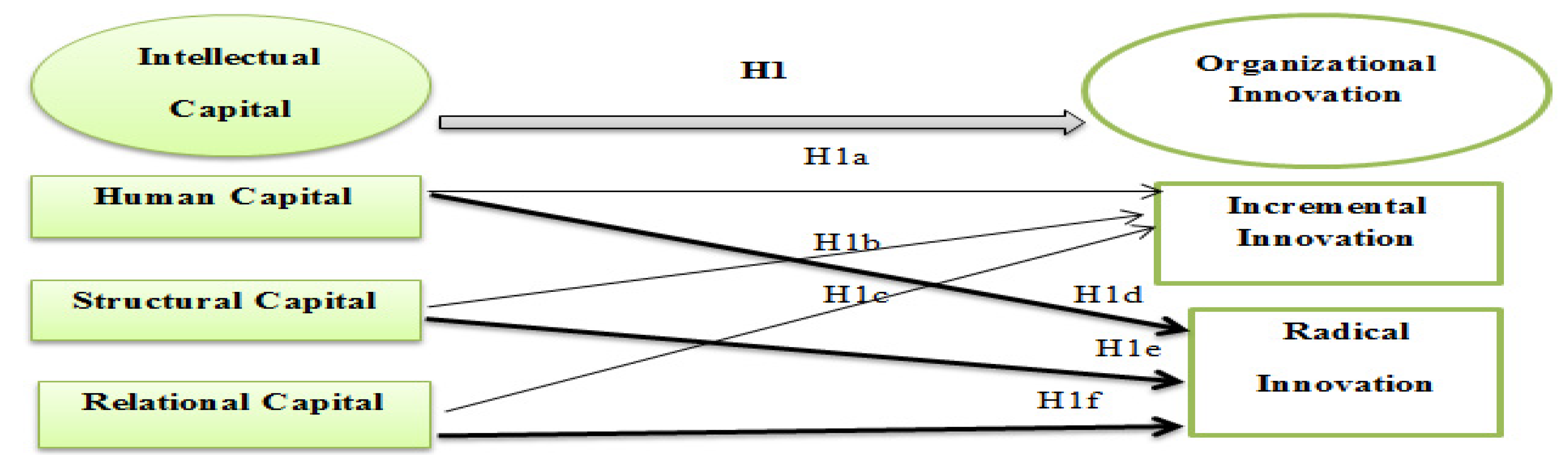
Table 2.
Reliability test results (Cronbach's alpha).
| Variables | NO. sample | NO. of Questions | Values of Cronbach's alpha |
|---|---|---|---|
| IC | 392 | 4 | .946 |
| HC | 392 | 4 | .793 |
| SC | 392 | 4 | .892 |
| RC | 392 | 4 | .783 |
| OIS | 392 | 4 | .793 |
| II | 392 | 4 | .789 |
| RI | 392 | 4 | .886 |
Table 3.
Correlation Coefficient Test.
| Correlations | ||||||||
|---|---|---|---|---|---|---|---|---|
| IC | HC | SC | RC | OIS | II | RI | ||
| IC | Pearson Correlation | 1 | ||||||
| Sig. (2-tailed) | ||||||||
| N | 392 | |||||||
| HC | Pearson Correlation | .723** | 1 | |||||
| Sig. (2-tailed) | .000 | |||||||
| N | 392 | 392 | ||||||
| SC | Pearson Correlation | .689** | .816** | 1 | ||||
| Sig. (2-tailed) | .000 | .000 | ||||||
| N | 392 | 392 | 392 | |||||
| RC | Pearson Correlation | .781** | .775** | .708** | 1 | |||
| Sig. (2-tailed) | .000 | .000 | .000 | |||||
| N | 392 | 392 | 392 | 392 | ||||
| OIS | Pearson Correlation | .766** | .607** | .619** | .772** | 1 | ||
| Sig. (2-tailed) | .000 | .000 | .000 | .000 | ||||
| N | 392 | 392 | 392 | 392 | 392 | |||
| II | Pearson Correlation | .614** | .652** | .699** | .650** | .671** | 1 | |
| Sig. (2-tailed) | .000 | .000 | .000 | .000 | .000 | |||
| N | 392 | 392 | 392 | 392 | 392 | 392 | ||
| RI | Pearson Correlation | .669** | .822** | .880** | .720** | .625** | .787** | 1 |
| Sig. (2-tailed) | .000 | .000 | .000 | .000 | .000 | .000 | ||
| N | 392 | 392 | 392 | 392 | 392 | 392 | 392 | |
| **. Correlation is significant at the 0.01 level (2-tailed). | ||||||||
Table 4.
Model Summary.
| Model Summary | |||||
|---|---|---|---|---|---|
| Model | R | R Square | Adjusted R Square | Std. Error of the Estimate | |
| Model 1 a. Predictors: (Constant), IC b. Dependent Variable: OIS |
.766a | .586 | .585 | 3.274 | |
| Model 2 a. Predictors: (Constant), RC, HC, SC b. Dependent Variable: II |
.734a | .539 | .535 | 3.531 | |
| Model 3 a. Predictors: (Constant), RC, HC, SC b. Dependent Variable: RI |
.900a | .809 | .808 | 2.245 | |
Table 5.
Analysis of Variance (ANOVA).
| Model | Sum of Squares | Df | Mean Square | F | Sig. | |
|---|---|---|---|---|---|---|
| Model 1 a. Predictors: (Constant), IC b. Dependent Variable: OIS |
Regression | 5927.188 | 1 | 5927.188 | 552.947 | .000a |
| Residual | 4180.516 | 390 | 10.719 | |||
| Total | 10107.704 | 391 | ||||
| Model 2 a. Predictors: (Constant), RC, HC, SC b. Dependent Variable: II |
Regression | 5644.353 | 3 | 1881.451 | 150.926 | .000a |
| Residual | 4836.821 | 388 | 12.466 | |||
| Total | 10481.173 | 391 | ||||
| Model 3 a. Predictors: (Constant), RC, HC, SC b. Dependent Variable: RI |
Regression | 8297.245 | 3 | 2765.748 | 548.974 | .000a |
| Residual | 1954.755 | 388 | 5.038 | |||
| Total | 10252.000 | 391 | ||||
Table 6.
Regression Coefficient Analysis.
| Coefficientsa | ||||||
|---|---|---|---|---|---|---|
| Model | Unstandardized Coefficients | Standardized Coefficients | t-stat. | Sig. | ||
| B | Std. Error | Beta | ||||
| 1 Dependent Variable: OIS | (Constant) | 1.886 | .538 | 3.507 | .001 | |
| IC | .835 | .036 | .766 | 23.515 | .000 | |
| 2 Dependent Variable: II | (Constant) | 2.310 | .578 | 3.995 | .000 | |
| HC | .455 | .036 | .497 | 12.501 | .000 | |
| SC | .421 | .059 | .436 | 7.152 | .000 | |
| RC | .299 | .060 | .280 | 5.016 | .000 | |
| 3 Dependent Variable: RI | (Constant) | 1.437 | .368 | 3.910 | .000 | |
| HC | .233 | .040 | .256 | 5.854 | .000 | |
| SC | .577 | .037 | .604 | 15.432 | .000 | |
| RC | .099 | .038 | .094 | 2.607 | .009 | |
Table 7.
Hypothesis Testing.
| Hypothesis | Beta | P. Correlation | Sig. (2-tailed) | Supported/ Not Supported |
|---|---|---|---|---|
| H1: Intellectual capital statistically has an important, considerable and positive influence on organizational innovation. | .766 | .766 | 0.00 | S |
| H1a: Human capital statistically has an important, considerable and positive influence on incremental innovation. | .497 | .652 | 0.00 | S |
| H1b: Structural capital statistically has an important, considerable and positive influence on incremental innovation. | .436 | .699 | 0.00 | S |
| H1c: Relational capital statistically has an important, considerable and positive influence on incremental innovation. | .280 | .650 | 0.00 | S |
| H1d: Human capital statistically has an important, considerable and positive influence on radical innovation. | .256 | .822 | 0.00 | S |
| H1e: Structural capital statistically has an important, considerable and positive influence on radical innovation. | .604 | .880 | 0.00 | S |
| H1f: Relational capital statistically has an important, considerable and positive influence on radical innovation. | .094 | .720 | 0.00 | S |
Disclaimer/Publisher’s Note: The statements, opinions and data contained in all publications are solely those of the individual author(s) and contributor(s) and not of MDPI and/or the editor(s). MDPI and/or the editor(s) disclaim responsibility for any injury to people or property resulting from any ideas, methods, instructions or products referred to in the content. |
© 2023 by the authors. Licensee MDPI, Basel, Switzerland. This article is an open access article distributed under the terms and conditions of the Creative Commons Attribution (CC BY) license (http://creativecommons.org/licenses/by/4.0/).
Copyright: This open access article is published under a Creative Commons CC BY 4.0 license, which permit the free download, distribution, and reuse, provided that the author and preprint are cited in any reuse.


