

Submitted:
07 July 2023
Posted:
10 July 2023
You are already at the latest version
Abstract
To investigate proposed ferromagnetic fluctuations in the single-layer Bi-2201 and La-214 high-Tc cuprates, we performed magnetization and electrical-resistivity measurements using single-layer Tl-2201 cuprates Tl2Ba2CuO6+d as well as La-214 La2-xSrxCuO4 in the heavily overdoped regime. Magnetization of Tl-2201 exhibited the tendency to be saturated in high magnetic fields at low temperatures, suggesting the precursor behavior toward the formation of a ferromagnetic order. It was found that the power of temperature n obtained from the temperature dependence of the electrical resistivity is ~ 4/3 and ~5/3 for Bi-2201 and La-214, respectively, and is ~ 4/3 at high temperatures and ~5/3 at low temperatures in Tl-2201. These results suggest that two-dimensional ferromagnetic fluctuations exist in Tl-2201 at high temperatures and Bi-2201 and that three-dimensional ferromagnetic fluctuations exist in Tl-2201 at low temperatures and La-214. The dimensionality of ferromagnetic fluctuations is understood in terms of the dimensionality of the crystal structure and the bonding of atoms in the blocking layer.
Keywords:
ferromagnetic fluctuation
; Tl-2201 cuprate
; La-214 cuprate
; Bi-2201 cuprate
; electrical resistivity
; magnetization
1. Introduction
In the study of high-Tc cuprate superconductivity, it is important to clarify the link between the magnetism and superconductivity, and therefore huge amounts of study have been performed. In the hole-doped cuprates, the parent compound without carrier doping is an antiferromagnetic (AF) Mott insulator, and a small amount of hole doping causes the AF order to disappear and superconductivity to emerge. AF spin fluctuations have been observed in the hole concentration regime where superconductivity appears, and an idea is that AF fluctuations are related to the formation of superconducting electron pairs. In the La-214 cuprates, the charge-spin stripe order and its fluctuations have also been observed [1]. In other cuprates, the charge order and its fluctuations have been observed from recent X-ray scattering and NMR experiments, and the relation to the so-called pseudogap has been discussed [2].
In the overdoped regime, an anomalous metallic state as well as the disappearance of the pseudogap has been observed [3]. Moreover, the disappearance of the stripe fluctuations [4] and a phase separation into superconducting and normal-state regions [5,6,7] have also been suggested. For spin fluctuations, neutron-scattering experiments in the La-214 cuprate La2-xSrxCuO4 (LSCO) have revealed that AF fluctuations weakens with overdoping and disappears together with superconductivity, suggesting the close relationship between AF fluctuations and superconductivity [8]. On the other hand, resonant inelastic X-ray scattering (RIXS) experiments using LSCO thin films have reported robust AF fluctuations in the non-superconducting heavily overdoped regime [9]. These indicate that the relationship between superconductivity and AF fluctuations is yet to be solved.
Formerly, it has been proposed from theories [10,11] and experiments [12,13] that ferromagnetic order/fluctuations exist in the heavily overdoped regime and are related to the suppression of superconductivity. Calculations by Teranishi et al. using the FLEX approximation with the one-band Hubbard model have suggested that the spin susceptibility approaches q = (0,0) in the heavily overdoped regime [14]. It has been suggested in calculations of the four-band d-p model by Watanabe et al. that the magnetic moment is enhanced in the heavily overdoped regime [15]. Experimentally, measurements of muon spin relaxation (μSR) and the ab-plane electrical resistivity ρab in heavily overdoped LSCO by Sonier et al. [12] have revealed the enhancement of spin fluctuations and the behavior of the resistivity characteristic of three-dimensional ferromagnetic fluctuations by itinerant electrons according to the self-consistent renormalization (SCR) theory [16]. We have also measured ρab, magnetization, specific heat and μSR in the single-layer Bi-2201 cuprate (Bi,Pb)2Sr2CuO6+δ [13] and found that spin fluctuations are enhanced at low temperatures, the magnetization curve saturates at low temperatures in high magnetic fields. Moreover, ρab, specific heat and magnetic susceptibility have showed characteristic behavior of two-dimensional ferromagnetic fluctuations [16]. In Fe-substituted Bi-2201 cuprate Bi1.74Pb0.38Sr1.88Cu1-yFeyO6+δ, we have observed from magnetization measurements that ferromagnetic fluctuations were enhanced by the Fe substitution [17]. RIXS measurements in Bi-2201 have reported the enhancement of spin fluctuations at q ~ (0,0) in the heavily overdoped regime [18]. These results suggest that two-dimensional ferromagnetic fluctuations exist in heavily overdoped Bi-2201.
To gain insight into the difference in the dimensionality of ferromagnetic fluctuations between LSCO and Bi-2201, we investigated the single-layer Tl-2201 cuprate Tl2Ba2CuO6+δ in which the non-superconducting heavily overdoped regime is accessible and the CuO2 plane is rather flat. The electrical resistivity and magnetization were measured in heavily overdoped Tl-2201 as well as in heavily overdoped LSCO for comparison.
2. Experimental
Polycrystals of Tl-2201 and single crystals of LSCO were prepared by the solid-state reaction [19] and floating-zone [20] method, respectively. For Tl-2201, annealing was performed in 1-3 atm oxygen or 1 atm Ar flow to control the hole concentration. LSCO single crystals were annealed in 1 atm oxygen at 900 °C for 50 h, followed by at 500 °C for 50 h to compensate the oxygen deficiency [21].
The Sr concentration of LSCO was found to be x = 0.29 from inductively coupled plasma analysis. The oxygen deficiency d of LSCO estimated from iodometric titration was found to be d = 0.005(10) in La2-xSrxCuO4-d, indicating our LSCO crystals are almost stoichiometric. The hole concentration of Tl-2201 was determined from the empirical formula for Tc and hole concentration by Presland et al. [22]. The electrical resistivity was measured by the dc four-probe method and the magnetization was measured using a superconducting quantum interference device magnetometer (Quantum Design, MPMS) in magnetic fields between ±5 T.
3. Results
Figure 1 shows the magnetization curves of Tl-2201 in the heavily overdoped regime (Tc ~ 6 K). Above 10 K, the magnetization exhibits paramagnetic behavior (linear in the magnetic field). The slope of magnetization increases with decreasing temperature, in agreement with the previous results [23] where the magnetic susceptibility exhibits a Curie-like behavior. It is found that the magnetization is slightly curved in the high-field region at 5 K and it tends to saturate in the high-field region at 2 K. No hysteresis behavior is observed between increasing and decreasing magnetic field, suggesting the absence of an ordered state. These behaviors are similar to those observed in heavily overdoped Bi-2201 [13] and probably indicate the enhancement of ferromagnetic fluctuations.
Figure 2(a) shows the temperature dependence of the electrical resistivity, plotted as the resistivity vs. T4/3, for Tl-2201 as well as our previously reported heavily overdoped Bi-2201 single crystal [13]. In heavily overdoped Bi-2201, ρab follows T4/3 in a wide temperature range below room temperature, suggesting the enhancement of two-dimensional ferromagnetic fluctuations. In Tl-2201, the behavior of resistivity is proportional to T4/3 above ~160 K shown by an arrow, and the resistivity deviates upwards from the linear relationship between the resistivity T4/3 below ~160 K.
A plot of the temperature dependence of the resistivity of Tl-2201 on T5/3 is shown in Figure 2(b), together with the results of LSCO (x = 0.29). A superconducting transition is observed at low temperatures in LSCO, which may be due to the slightly non-uniform Sr distribution in the crystal. The ρab of LSCO is proportional to T5/3 in a wide temperature range above Tc, while for LSCO with x = 0.33 Fermi liquid behavior proportional to T2 was observed below 50 K [12]. The difference in the temperature range of T5/3 may be related to the hole concentration. It is found that the resistivity of Tl-2201 is proportional to T5/3 below ~160 K down to Tc. These results are summarized as that ρab is proportional to T4/3 for Bi-2201 and is proportional to T5/3 for LSCO in a wide temperature range, while the temperature dependence of the resistivity changes between T4/3 and T5/3 around 160 K for Tl-2201.
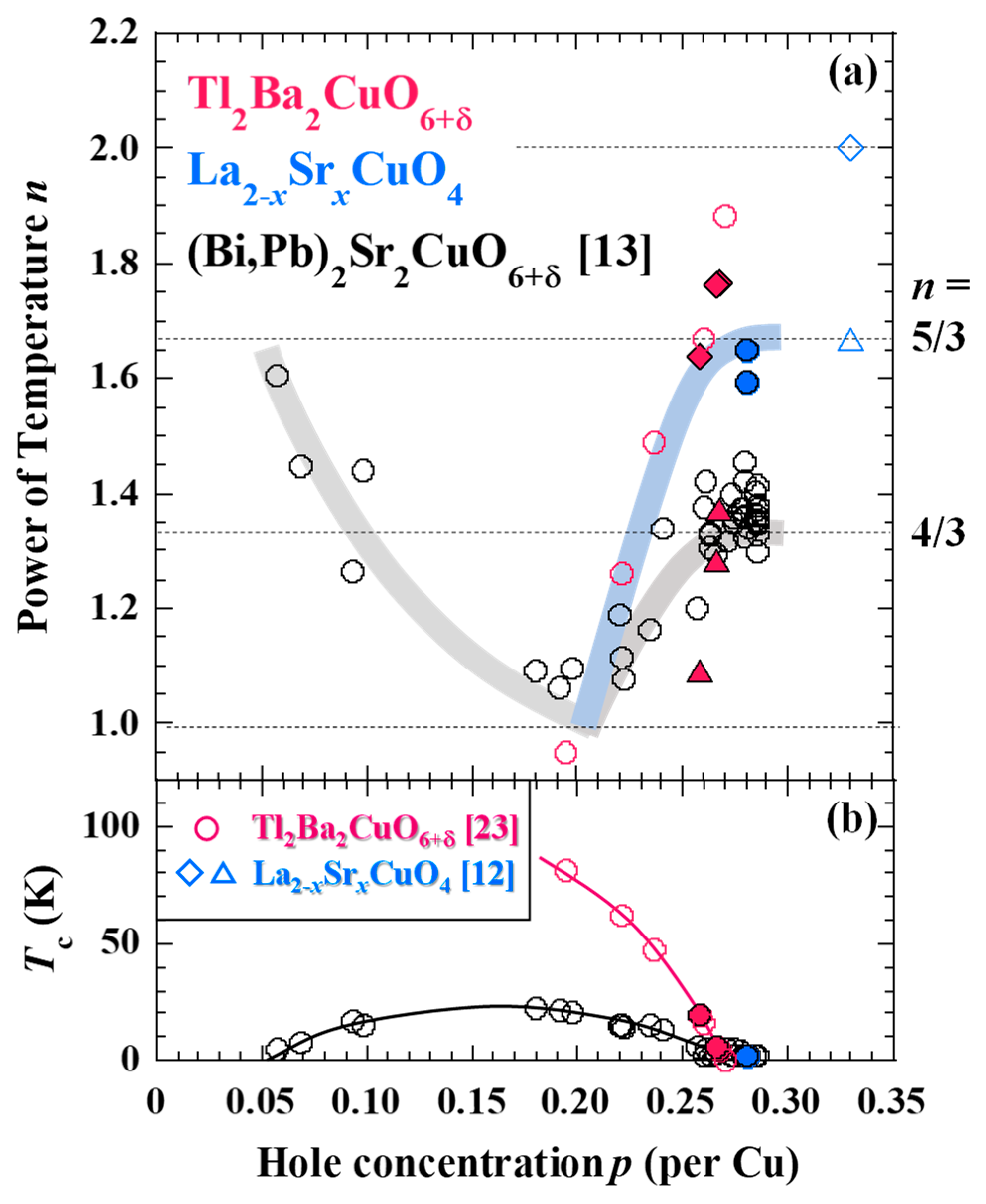
The temperature dependence of the resistivity was fitted by the equation ρ = A + BTn to estimate the power of temperature n. The dependences of n and Tc on the hole concentration in Tl-2201 and LSCO are shown in Figure 3, together with our former results of Bi-2201 [13] and preceding results of Tl-2201 [23] and LSCO [12]. For Tl-2201, both n values obtained above and below ~160 K are shown. For the preceding LSCO [12], both n values obtained at high and low temperatures are shown. Circles indicate the n values obtained by fitting the entire temperature range. For Tl-2201, n obtained above ~160 K is close to 4/3 in the heavily overdoped regime, which is similar to those of Bi-2201. On the other hand, n below ~160 K is close to 5/3. For LSCO with x = 0.29, n ~ 5/3, in agreement with that for x = 0.33 at high temperatures [12].
4. Discussion
The magnetization curves in heavily overdoped Tl-2201 showed that the magnetization tends to saturate at low temperatures in high magnetic fields. Such behavior has also been observed in heavily overdoped Bi-2201 [13] and LSCO [12]. Therefore, it is likely that ferromagnetic fluctuations also develop at low temperatures in Tl-2201, which is consistent with the theoretical indication [10]. The SCR theory suggests that n = 4/3 is characteristic of two-dimensional ferromagnetic fluctuations and n = 5/3 of three-dimensional ferromagnetic fluctuations [16]. Therefore, in the heavily overdoped regime, it is likely that three-dimensional ferromagnetic fluctuations exist in LSCO and two-dimensional ferromagnetic fluctuations in Bi-2201. For heavily overdoped Tl-2201, it is likely that two-dimensional ferromagnetic fluctuations exist at high temperatures and three-dimensional fluctuations at low temperatures.
The difference in the dimensionality of ferromagnetic fluctuations in Tl-2201, LSCO and Bi-2201 may originate from the difference in the strength of the spin correlation of itinerant electrons between the CuO2 planes. As the strength of the spin correlation perpendicular to the CuO2 plane is strongly influenced by the crystal structure, the longer the distance between the CuO2 planes, the more likely it is that two-dimensional ferromagnetic fluctuations will develop. The interplane distances between the CuO2 planes of Bi-2201, Tl-2201 and LSCO are about 12.3 Å, 11.6 Å and 6.6 Å, respectively. The present results indicate that the temperature range where three-dimensional ferromagnetic fluctuations are observed is wider with the shorter interplane distance between the CuO2 plane. The reason for the difference in the dimensionality of the ferromagnetic fluctuations developed in Bi-2201 and Tl-2201 may also be related to the difference in the bonding of atoms in the blocking layer. In Bi-2201, due to the lone pair electrons of Bi in the blocking layer, two overlapping BiO planes are electrically repulsive, so that the coupling between the BiO planes are by the weak van der Waals force. On the other hand, it is known in Tl-2201 that the TlO planes are covalently bonded with each other and the LaO planes in LSCO are bonded with each other by ionic coupling. It is therefore likely that the ferromagnetic correlation crossovers from two to three dimensions with decreasing temperature in Tl-2201 owing to the coupling between the CuO2 planes being stronger at low temperatures, while they are very two-dimensional in Bi-2201 over a wide temperature range.
Anomalous metallic states have been proposed in the overdoped regime of single-layer copper oxides. In the resistivity of LSCO [24] and Tl-2201 [25], it has been suggested that the T linear component observed near the optimally doped regime extends into the overdoped regime and coexists with the Fermi-liquid T2 component. It is a future issue to clarify how they connect and whether they are compatible with the characteristic behavior of ferromagnetic fluctuations in the heavily overdoped cuprates.
5. Summary
Magnetization curves and electrical resistivity of the single-layer Tl-2201, LSCO, Bi-2201 cuprates in the heavily overdoped regime were measured. The magnetization revealed a tendency to saturate at low temperatures in high magnetic fields, which is considered to be a precursor phenomenon to the formation of a ferromagnetic order. The power of temperature n obtained by fitting the temperature dependence of the electrical resistivity was found to be ~ 4/3 for Bi-2201, ~ 5/3 for LSCO. These results suggest the enhancement of two-dimensional and three-dimensional ferromagnetic fluctuations in Bi-2201 and LSCO, respectively. In Tl-2201, n ~ 4/3 at high temperatures and n ~ 5/3 at low temperatures, suggesting that two-dimensional ferromagnetic fluctuations at high temperatures crossover to three-dimensional ones at low temperatures. The differences in dimensionality may be understood in terms of the dimensionality of the crystal structure and bonding strength of atoms in the blocking layer. It is concluded that ferromagnetic fluctuations are universal in the heavily overdoped regime of the single-layer cuprates.
Author Contributions
Conceptualization, T.A., K.K.; methodology, T.A., K.K., T.K., T.N., S.N.; writing, T.A., K.K, T.K., T.N., S.N., Y.K.; supervision, T.A., Y.K.
Funding
This research was partially funded by JSPS KAKENHI Grant No. 23540399.
Informed Consent Statement
Not applicable.
Acknowledgments
We are indebted to M. Ishikuro for his help in the inductively coupled plasma analysis.
Conflicts of Interest
The authors declare no conflict of interest.
References
- Tranquada, J.M.; Sternlieb, B.J.; Axe, J.D.; Nakamura, Y.; Uchida, S. Evidence for stripe correlations of spins and holes in copper oxide superconductors. Nature 1995, 375, 561–563. [Google Scholar] [CrossRef]
- Keimer, B.; Kivelson, S.A.; Norman, M.R.; Uchida, S.; Zaanen, J. From quantum matter to high-temperature superconductivity in copper oxides. Nature 2015, 518, 179–186. [Google Scholar] [CrossRef] [PubMed]
- Ayres, J.; Berben, M.; Čulo, M.; Hsu, Y.-T.; van Heumen, E.; Huang, Y.; Zaanen, J.; Kondo, T.; Takeuchi, T.; Cooper, J.R.; Putzke, C.; Friedemann, S.; Carrington, A.; Hussey, N.E. Incoherent transport across the strange-metal regime of overdoped cuprates. Nature 2021, 595, 661–666. [Google Scholar] [CrossRef] [PubMed]
- Risdiana; Adachi, T.; Oki, N.; Yairi, S.; Tanabe, Y.; Omori, K.; Koike, Y.; Suzuki, T.; Watanabe, I.; Koda, A.; Higemoto, W. Cu spin dynamics in the overdoped regime of La2−xSrxCu1−yZnyO4 probed by muon spin relaxation. Phys. Rev. B 2008, 77, 054516. [Google Scholar] [CrossRef]
- Uemura, Y.J. Superfluid density of high-Tc cuprate systems: implication on condensation mechanisms, heterogeneity and phase diagram. Solid State Commun. 2003, 126, 23–38. [Google Scholar] [CrossRef]
- Tanabe, Y.; Adachi, T.; Noji, T.; Koike, Y. Superconducting volume fraction in overdoped regime of La2-xSrxCuO4: Implication for phase separation from magnetic-susceptibility measurement. J. Phys. Soc. Jpn. 2005, 74, 2893–2896. [Google Scholar] [CrossRef]
- Adachi, T.; Tanabe, Y.; Noji, T.; Sato, H.; Koike, Y. Possible phase separation in the overdoped regime of La2-xSrxCuO4. Physica C 2006, 445-448, 14–16. [Google Scholar] [CrossRef]
- Wakimoto, S.; Zhang, H.; Yamada, K.; Swainson, I.; Kim, H.; Birgeneau, R.J. Direct relation between the low-energy spin excitations and superconductivity of overdoped high-Tc superconductors. Phys. Rev. Lett. 2004, 92, 217004. [Google Scholar] [CrossRef]
- Dean, M.P.M.; Dellea, G.; Springell, R.S.; Yakhou-Harris, F.; Kummer, K.; Brookes, N.B.; Liu, X.; Sun, Y.-J.; Strle, J.; Schmitt, T.; Braicovich, L.; Ghiringhelli, G.; Božović, I.; Hill, J.P. Persistence of magnetic excitations in La2−xSrxCuO4 from the undoped insulator to the heavily overdoped non-superconducting metal. Nat. Mater. 2013, 12, 1019–1023. [Google Scholar] [CrossRef]
- Kopp, A.; Ghosal, A.; Chakravarty, S. Competing ferromagnetism in high-temperature copper oxide superconductors. Proc. Natl. Acad. Sci. USA 2007, 104, 6123–6127. [Google Scholar] [CrossRef]
- Maier, T.A.; Scalapino, D.J. Disappearance of superconductivity in the overdoped cuprates. J. Supercond. Novel Magn. 2020, 33, 15–18. [Google Scholar] [CrossRef]
- Sonier, J.E.; Kaiser, C.V.; Pacradouni, V.; Sabok-Sayr, S.A.; Cochrane, C.; MacLaughlin, D.E.; Komiya, S.; Hussey, N.E. Direct search for a ferromagnetic phase in a heavily overdoped nonsuperconducting copper oxide. Proc. Natl. Acad. Sci. USA 2010, 107, 17131–17134. [Google Scholar] [CrossRef] [PubMed]
- Kurashima, K.; Adachi, T.; Suzuki, K.M.; Fukunaga, Y.; Kawamata, T.; Noji, T.; Miyasaka, H.; Watanabe, I.; Miyazaki, M.; Koda, A.; Kadono, R.; Koike, Y. Development of ferromagnetic fluctuations in heavily overdoped (Bi,Pb)2Sr2CuO6+δ copper oxides. Phys. Rev. Lett. 2018, 121, 057002. [Google Scholar] [CrossRef] [PubMed]
- Teranishi, S.; Nishiguchi, K.; Yunoki, S.; Kusakabe, K. Effect of on-site Coulomb repulsion on ferromagnetic fluctuations in heavily overdoped cuprates. J. Phys. Soc. Jpn. 2021, 90, 094707. [Google Scholar] [CrossRef]
- Watanabe, H.; Shirakawa, T.; Seki, K.; Sakakibara, H.; Kotani, T.; Ikeda, H.; Yunoki, S. Unified description of cuprate superconductors using a four-band d-p model. Phys. Rev. Lett. 2021, 3, 033157. [Google Scholar] [CrossRef]
- Hatatani, Y.; Moriya, T. Ferromagnetic Spin Fluctuations in Two-Dimensional Metals. J. Phys. Soc. Jpn. 1995, 64, 3434–3441. [Google Scholar] [CrossRef]
- Komiyama, Y.; Onishi, S.; Harada, M.; Kuwahara, H.; Kuroe, H.; Kurashima, K.; Kawamata, T.; Koike, Y.; Watanabe, I.; Adachi, T. Magnetic impurity effects on ferromagnetic fluctuations in heavily overdoped (Bi,Pb)2Sr2Cu1−yFeyO6+δ cuprates. J. Phys. Soc. Jpn. 2021, 90, 084701. [Google Scholar] [CrossRef]
- Peng, Y.Y.; Huang, E.W.; Fumagalli, R.; Minola, M.; Wang, Y.; Sun, X.; Ding, Y.; Kummer, K.; Zhou, X.J.; Brookes, N.B.; Moritz, B.; Braicovich, L.; Devereaux, T.P.; Ghiringhelli, G. Dispersion, damping, and intensity of spin excitations in the monolayer (Bi,Pb)2(Sr,La)2CuO6+δ cuprate superconductor family. Phys. Rev. B 2018, 98, 144507. [Google Scholar] [CrossRef]
- Nakajima, S.; Kikuchi, M.; Oku, T.; Kobayashi, N.; Suzuki, T.; Nagase, K.; Hiraga, K.; Muto, Y.; Syono, Y. Over-doping of Tl2Ba2CuO6 due to charge transfer Tl3−t-(Cu-O)p. Physica C 1989, 160, 458–460. [Google Scholar] [CrossRef]
- Kawamata, T.; Adachi, T.; Noji, T.; Koike, Y. Giant suppression of superconductivity at x = 0.21 in the Zn-substituted La2-xSrxCu1-yZnyO4 single crystals. Phys. Rev. B 2000, 62, R11981–R11984. [Google Scholar] [CrossRef]
- Adachi, T.; Noji, T.; Koike, Y. Crystal growth, transport properties, and crystal structure of the single-crystal La2-xBaxCuO4 (x = 0.11). Phys. Rev. B 2001, 64, 144524. [Google Scholar] [CrossRef]
- Presland, M.R.; Tallon, J.L.; Buckley, R.G.; Liu, R.S.; Flower, N.E. General trends in oxygen stoichiometry effects on Tc in Bi and Tl superconductors. Physica C 1991, 176, 95–105. [Google Scholar] [CrossRef]
- Kubo, Y.; Shimakawa, Y.; Manako, T.; Igarashi, H. Transport and magnetic properties of Tl2Ba2CuO6+δ showing a δ-dependent gradual transition from an 85-K superconductor to a nonsuperconducting metal. Phys. Rev. B 1991, 43, 7875–7882. [Google Scholar] [CrossRef] [PubMed]
- Cooper, R.A.; Wang, Y.; Vignolle, B.; Lipscombe, O.J.; Hayden, S.M.; Tanabe, Y.; Adachi, T.; Koike, Y.; Nohara, M.; Takagi, H.; Proust, C.; Hussey, N.E. Anomalous criticality in the electrical resistivity of La2-xSrxCuO4. Science 2009, 323, 603–607. [Google Scholar] [CrossRef] [PubMed]
- Hussey, N.E.; Gordon-Moys, H.; Kokalj, J.; McKenzie, R.H. Generic strange-metal behavior of overdoped cuprates. J. Phys.: Conf. Ser. 2013, 449, 012004. [Google Scholar]
Figure 1.
Magnetization curves of heavily overdoped Tl2Ba2CuO6+δ.
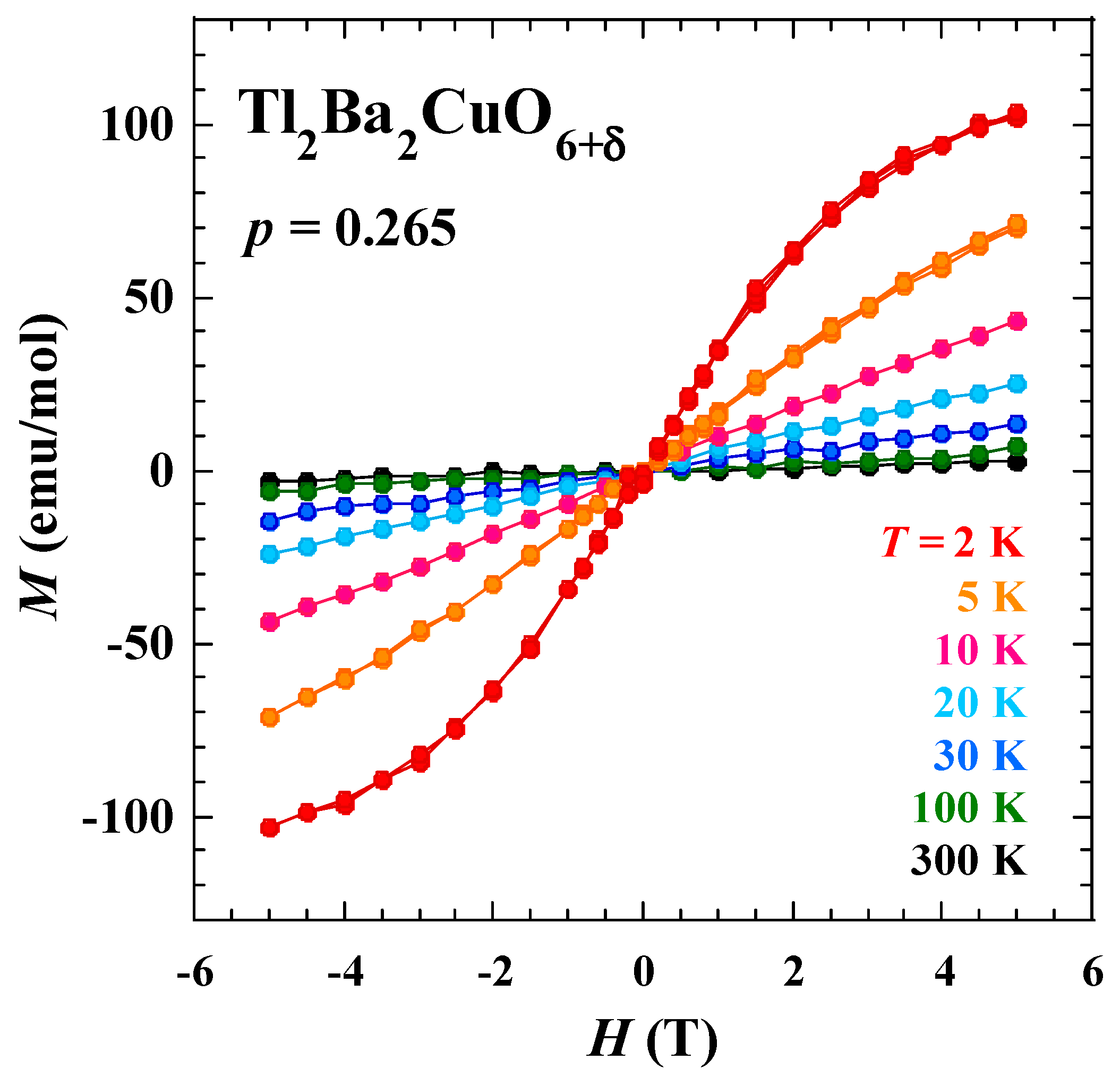
Figure 2.
Temperature dependence of the electrical resistivity plotted against (a) T4/3 and (b) T5/3 in heavily overdoped Tl2Ba2CuO6+δ, La2-xSrxCuO4, Bi1.77Pb0.33Sr1.90CuO6+δ [13]. Arrows indicate the temperature where the resistivity deviates from the linear relation between the resistivity and T4/3 (T5/3). Note that the resistivity of La2-xSrxCuO4 and Bi1.77Pb0.33Sr1.90CuO6+δ is ρab.
Figure 2.
Temperature dependence of the electrical resistivity plotted against (a) T4/3 and (b) T5/3 in heavily overdoped Tl2Ba2CuO6+δ, La2-xSrxCuO4, Bi1.77Pb0.33Sr1.90CuO6+δ [13]. Arrows indicate the temperature where the resistivity deviates from the linear relation between the resistivity and T4/3 (T5/3). Note that the resistivity of La2-xSrxCuO4 and Bi1.77Pb0.33Sr1.90CuO6+δ is ρab.
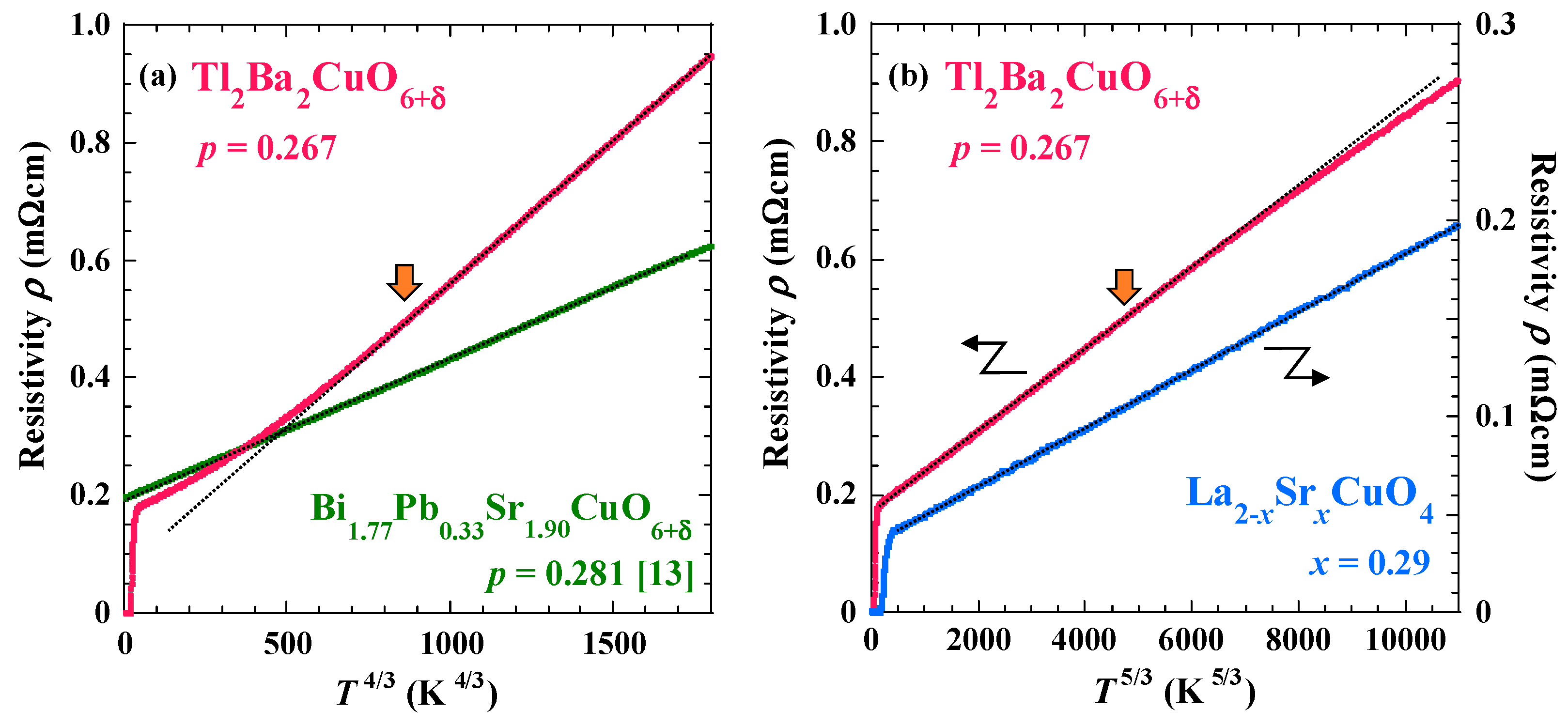
Figure 3.
Hole-concentration p dependence of (a) the power of temperature n of ρ = A + BTn and (b) Tc in Tl2Ba2CuO6+δ and La2-xSrxCuO4. Solid lines are to guide the reader’s eye. Open symbols are preceding results of Tl2Ba2CuO6+δ [23], La2-xSrxCuO4 [12], (Bi,Pb)2Sr2CuO6+δ [13]. In (a), circles indicate n obtained by fitting in a wide temperature range, while diamonds and squares indicate n obtained by fitting at low and high temperatures, respectively.
Figure 3.
Hole-concentration p dependence of (a) the power of temperature n of ρ = A + BTn and (b) Tc in Tl2Ba2CuO6+δ and La2-xSrxCuO4. Solid lines are to guide the reader’s eye. Open symbols are preceding results of Tl2Ba2CuO6+δ [23], La2-xSrxCuO4 [12], (Bi,Pb)2Sr2CuO6+δ [13]. In (a), circles indicate n obtained by fitting in a wide temperature range, while diamonds and squares indicate n obtained by fitting at low and high temperatures, respectively.
Disclaimer/Publisher’s Note: The statements, opinions and data contained in all publications are solely those of the individual author(s) and contributor(s) and not of MDPI and/or the editor(s). MDPI and/or the editor(s) disclaim responsibility for any injury to people or property resulting from any ideas, methods, instructions or products referred to in the content. |
© 2023 by the authors. Licensee MDPI, Basel, Switzerland. This article is an open access article distributed under the terms and conditions of the Creative Commons Attribution (CC BY) license (http://creativecommons.org/licenses/by/4.0/).
Copyright: This open access article is published under a Creative Commons CC BY 4.0 license, which permit the free download, distribution, and reuse, provided that the author and preprint are cited in any reuse.


