

Submitted:
06 July 2023
Posted:
07 July 2023
You are already at the latest version
Abstract
A single paragraph of about 200 words maximum. For research articles, abstracts should give a pertinent overview of the work. We strongly encourage authors to use the following style of structured abstracts, but without headings: (1) Background: place the question addressed in a broad context and highlight the purpose of the study; (2) Methods: describe briefly the main methods or treatments applied; (3) Results: summarize the article’s main findings; (4) Conclusions: indicate the main conclusions or interpretations. The abstract should be an objective representation of the article, it must not contain results which are not presented and substantiated in the main text and should not exaggerate the main conclusions.
Keywords:
air transport management
; transportation
; bibliometric analysis
1. Introduction
Although still recovering from the devastating effects of the COVID-19 pandemic in worldwide mobility, the air transport industry is a relevant actor shaping today’s economy and society. During 2022, the air transport system moved 3.2 million passengers, still far from the 4.5 million passengers transported in 2019 [1]. The air cargo industry has come back to pre-pandemic values, transporting 20 billion of cargo-tonne-kilometers monthly by January 2023, far from the peak of 23 monthly cargo-tonne-kilometers transported in 2021, when the excess of capacity of passenger aircraft was divested to cargo operations [2]. The losses of the air transport industry of 137.7 billion dollars in 2020 have been reduced to 9.7 billion dollars in 2022, and industry incumbents believe that the air transport industry will reach pre-pandemic levels by the end of 2023 [3]. Another challenge for the air transport industry is the growing concern for sustainability and emissions in the air transport industry [4]. Concerns about environmental impact of air transport has led to flight shaming activism [5]. Besides, the volatility of fossil fuel markets has led a higher appeal for sustainable aviation fuels [3]. In spite of the drawbacks coming from environmental concerns and unstable energy markets, the spillovers of the air transport industry are still considerable. In a recent analysis [6], it has been found that air transport has relevant World Economic Benefits (WEBs) related to connectivity, tourism and savings of time.
Air transport research can contribute to foster the benefits of this mean of transportation as long as it is capable of building a more resilient system for disruptive events, being more sustainable and environment-friendly at the same time [7]. Additionally, air transport research needs to be able to respond to new technological challenges. In some countries, like China or Spain, high-speed rail has been strongly introduced. This mean of transportation has a complex relationship with air transport, ranging from competition for specific routes between cities, to collaboration in intermodal transportation networks [8]. New technologies like unmanned air vehicles, are widening the scope of air transport from the airport to other transportation environments like urban air mobility [9]. We believe that it is a good moment to evaluate how the air transport research community is responding to the challenges that the air transport industry is facing.
An examination of recent review studies on air transport research leads to two distinct groups of reviews. The first group deals with airport management, and includes reviews about airport service quality [10], the flexible development of airport terminals [11] and airport capacity management [12]. The second group includes reviews about airline management, covering topics like business aviation [13], the relationship between air transport and tourism [14], air travel demand analysis [15] and airline productivity [16]. While recent reviews of air transport cover specific topics, since a 2012 study [17] we have not found any review examining the research trends in air transportation. Our objective is to fill this gap in the literature identifying the recent research trends in air transport research examining the articles published in top journals on the field of transportation, paying specific attention to journals specifically dedicated to air transport research.
2. Materials and Methods
We are examining the field of air transport research through bibliometric analysis. This technique has gained growing popularity because of the availability of large volumes of research data from scientific databases like Web of Science, Journal Citation Reports and Scopus [18]. Bibliometric analysis is preferred to other review methods like meta-analysis and systematic literature reviews when the scope of the review is large and the resulting dataset is large. Bibliometric analysis has been successfully used in transportation research in fields like airport service quality [10], data envelopment analysis applied to the transportation sector [19], human mobility during COVID-19 [20] or the evolution of a specific journal [21].
The workflow of the bibliometric analysis is presented in Figure 1. Once the research objectives have been defined, the analysis starts with the selection of bibliographical sources and the data retrieval process. In this study, data consists of research articles from relevant transportation journals. In a second stage, we tell the air transport literature from the transportation articles. Once obtained the air transportation literature records, we carry out two different analysis: a keyword analysis (third stage) and the identification of top cited articles in air transport (stage four). The fifth and last stage consists in using the findings of the two previous stages to identify the research trends in air transport research.
2.1. Source Selection and Data Retrieval
Our research objective consists of performing a bibliometric research to evaluate trends in air transport research, so our first job was to identify bibliographical sources of this research. As we are interested in the managerial and organizational aspects of air transport, we turned our attention to the Transportation ranking of journals in the Social Sciences Citation Index, published by Clarivate Analytics in the Journal Citation Reports. From this ranking, we selected two types of sources:
- The journals of the first quartile of the ranking, as of published in 2022 with data from 2021. This was the most recent ranking published at the time of doing this research;
- The Journal of Air Transport Management, a journal focused in addressing “the major economic, management and policy issues facing the air transport industry today”, as presented in its aim and scope.
In Table 1 are presented the nine journals included in the mentioned ranking. JATM is in the second quartile of this ranking, with a Journal Impact Factor of 5.428. JATM’s ISSN is 0969-6997.
To evaluate the trends in transportation research in the last ten years, we retrieved the articles of the selected journals with date of final publication between 2013 and 2022, both inclusive. We retrieved the articles from Web of Science and Scopus, as each bibliometric database provides complementary information. We used Scopus to identify the sources of type Article and Review, which were the only ones that we retrieved for the analysis.
2.2. Identification of Air Transport Articles
While JATM is almost exclusively dedicated to air transport research, the rest of journals accept research articles involving any transportation mean, so the first job to undertake was to select the articles dealing with air transport research published between 2013 and 2022 in the journals listed in Table 1. In previous research, this task was performed by searching for the term “air” and/or “transport” in the title, abstract of keywords of articles [17]. Similarly to other bibliographic analysis [13], We refined this procedure by including additional tokens in the research with the aim of covering the facets of air transport. The retained tokens are listed in Table 2.
Relying solely on the specific search may lead to false positives, that is, articles covered by the search strategy not dealing with air transport. We have carried out an exhaustive false positive detection search, by examining manually the title and abstract of the sample of selected articles.
2.3. Keyword Analysis and Selection of Top Articles
Once obtained the samples of air transport research articles published in Q1 Transportation journals and in JATM, we have analyzed them through two elements:
- Keyword analysis;
- Top cited articles.
Most scientific journals make compulsory for authors to add keywords, which later are retrieved in scientific databases like Scopus and Web of Science. Keywords can be considered tags or tokens selected by authors to identify the subject of their research, the research methodologies used or the theoretical perspectives adopted [22]. We have retrieved the author keywords of all articles of the final samples defined in the previous section. Usually authors are not required to standardize the way they used keywords, so we have defined a keyword normalization procedure. Firstly, we have calculated the distance between all pairs of keywords using the Optimal String Alignment measure. This metric counts the number of insertions, substitutions and deletions necessary to turn a string x into a string y, allowing transposition of adjacent characters. We have retained all pairs of keywords with distance smaller or equal than two, and examined each pair manually. This has allowed us to collapse singulars and plurals (e.g. “accident” and “accidents”), differences of spelling (“airfare” and “air fare”) and British-American English spelling (“air travel behavior” and “air travel behaviour”). Secondly, we have collapsed into a single keyword concepts worded in different ways. A special case were low cost carriers, referred to as “low cost carrier”, “low-cost carrier”, “low-cost-carrier” and “low cost airlines”, among other spellings. This normalization process has allowed to obtain a more consistent set of keywords.
Previous bibliometric research research has used keywords to evaluate citation bursts of top used keywords [23], to explore the map of knowledge with co-citation keyword networks [12] or to examine the keyword frequency distribution through the Herfindahl-Hirschman concentration index [13].
Another valuable source of information about research trends are the top cited articles, as used by [24] in their analysis of the first forty years of TR-B, and by [23] in a similar analysis for JATM. We have ranked the articles of the sample using the number of citations in Web of Science, usually the most authoritative source for article relevance.
Both keyword analysis and top cited articles ranking have been carried out for the Q1-T and JATM samples separatedly. We have done this to compare the research trends on air transport in generalistic transportation journals with the trends observed in JATM, mainly focused on air transport.
3. Results
3.1. Data Retrieval and Identification of Air Transport Articles
We retrieved from the Web of Science databases all items of published between 2013 and 2022 in the Q1 journals of the Transportation ranking presented in Table 1 (Q1-T) and in JATM. From both datasets, we retained the items with the Document Type field equal to Article and Review. Both types of documents will be labelled as articles from now on. We retrieved 14,317 articles from the Q1-T dataset and 1,130 documents from the JATM dataset.
The yearly number of published articles in each journal of the Q1-T dataset is presented in Figure 2. Of the nine journals, we observe that the three top journals of the Transportation ranking publish less than 100 articles each year: TREV, AMAR and JPT. It is noteworthy that JPT, the top journal in the ranking, published no articles in 2019 (this has been double-checked in the journal website, https://www.sciencedirect.com/journal/journal-of-public-transportation/issues). The rest of journals in Q1-T publish more than 100 articles per year. In all journals, we observe that the evolution of the number of published articles is quite stable. Other bibliometric studies of the field, like [21] for trasnportation journals or [24] for TR-B, show an exponential increase of number of articles from 2006, and a stabilization phase from 2015, so the result of our analysis coincide with these previous studies.
The yearly number of publications in JATM is presented in Figure 3. Between 2013 and 2022, JATM has been publishing around 70 articles (in 2013) and 142 articles (2020). Therefore, JATM is in an intermediate position between the “small” and “large” journals of Q1-T. JATM has been very active tracking the impact of COVID-19 in the aviation industry, publishing the special issues Air Transport COVID-19 and COVID-19: Long Term Impact (see https://www.sciencedirect.com/journal/journal-of-air-transport-management/special-issues). The key performance indicators of JATM have been improving in recent years [25], consolidating its role of main forum of air transport management research.
Once obtained the Q1-T and JATM datasets, we proceeded to identify the articles focused on air transport research. The filtering of articles of both datasets looking for any of the tokens in Table 2 resulted in 999 articles out of 14,317 from Q1-T and 1,126 out of 1,130 from JATM. As described in the Methods section, we examined the title and abstracts of the filtered articles to detect false positives. As an example of filtering, we excluded articles using drones to gather spatial data, but retained articles about urban air mobility. Similarly, we did not included articles translating to other transportation means techniques of air transport, like the safety-II concept or revenue management. The final datased retained 943 articles for the Q1-T dataset and the same 1,126 articles for the JATM dataset, representing the 6.59% and 99.64% of articles, respectively.
This 6.59% of air transport articles in top transportation journals is distributed unevenly across journals, as indicates Figure 4, where si depicted the yearly proportion of air transport articles published in each journal. We observe that JPT, the top journal of the listing, has published no air transport articles in the 2013-2022 period. In AMAR and APP the number of air transport articles is quite low, and in TREV no air transport articles were published in 2019 and 2022. This is balanced by the other six journals, which publish a quite high rate of air transport research material. Therefore, we observe that top transportation journals whose aim is to publish research on public transportation (JPT) or accident research (AMAR and AAP) tend to not publishing air transport research contributions. This means that it will be hard for researchers on air transport to publish in the first and second journal of the Transportation category.
3.2. Keyword Analysis
We gathered the author keywords from each of the articles of the Q1-T and JATM samples. Then, we pooled both samples to normalize the keywords, as described in the methods section. The aim of this normalization process is to group similar keywords into a single keyword, so that we can reduce the dispersion of the set of keywords of each sample. In the Table 3 are listed the number of unique keywords and the Herfindahl-Hirschman Index (HHI) for each sample before and after the normalization. We observe that the number of unique keywords and the HHI is significantly reduced after the normalization of keywords.
Once obtained the normalized keywords for each of the articles for both samples, we proceeded to list the keywords used more frequently. As we are interested on examining how most prevalent research topics have changed over time, we have split each of the samples into two sub-samples: one including articles of the 2013-2017 period, and another for articles of the 2018-2022 period. We kept all keywords of the same frequency, cutting each sub-sample in a number of keywords equal or smaller than twenty. For instance, we retained only 17 keywords for the Q1-T sample in the 2013-2017 period, with a maximum frequency of six, as the number of keywords with frequency five was larger than four.
The most frequent keywords for the Q1-T and JATM samples for each of the two periods are presented in Table 4 and Table 5, respectively. The resulting listings of keywords were present in a significant number of articles in each sample. For the Q1-T sample, 428 out of 943 articles of the sample (45.38 %) contained at least one of the keywords. For the JATM sample, 496 out of the 1,126 articles (44.05 %) contained at least one of the keywords.
By assigning keywords to journal articles, authors associate tags or tokens that help to identify their research in a variety of ways. The most frequent keywords for each sample describe the context where the research takes place: “airline” and “airport” represent the two main playgrounds of air transport research, and other contextual keywords are “air transport” and “aviation”. The keywords “China” and “uncertainty” describe specific contexts of the research. Other set of keywords describe the research method used, specially if authors judge it relevant or innovative. The keywords “ahp” (Analytic Hierarchy Process), “data envelopment analysis”, “multi-criteria decision making” and “machine learning” describe research methodologies adopted frequently in air transport research. The rest of keywords describe the research topic of the article, and are the most relevant for our aim. We can group these keywords into categories that describe the research trends that appear more frequently in the sample.
In Table 6 and Table 7 are listed the research topics obtained from the keywords used by authors to describe the context of the research of each article. We observe that top journals in the Transportation category address air transport research differently from the JATM. Both sets of articles share three research topics: Industry Analysis (topics AT1 and JT1), Air Traffic Management (topics AT4 and JT5), and COVID-19 and Air Transport (topics AT5 and JT6).
The other three topics were different for each sample. Transportation journals focus on High-Speed Rail and Air Transport (AT2), Environmental Impact of air Transport (AT3) and UAV and Urban Air Mobility (AT6). On the other hand, JATM focuses on Service Quality (JT2), Marketing (JT3) and Efficiency (JT4). Both sets of topics are related with air transport research, although in a first examinations Q1 transportation journals focus on challenges of the air transport system, while JATM focuses on challenges facing airline and airport managers.
To examine the temporal evolution of the research topics, we have counted the articles including the keywords defining each topic in the normalized keywords, title and abstract. The results are presented in Figure 5 and Figure 6, respectively.
For the Q1-T sample, we can observe in Figure 5 three topics with a stable production in the last ten years: Industry Analysis (AT1), the evolution of Environmental Impact of Air Transport (AT3) and Air Traffic Management (AT4). There is a less prolific, although significant, stream of research on High Speed Rail and Air Transport (AT2). Finally, we can observe two emerging topics: the COVID-19 and Air Transport (AT5) and UAV and Urban Air Mobility (AT6). For obvious reasons, contributions related with COVID-10 start appearing on 2020, although the bulk on contributions is observed in 2021 and 2022. Contributions about use of drones and urban air mobility start to appear in 2018, and they have been increasing steadily since then.
From Figure 6 we observe two important research topics in JATM: Industry Analysis (JT1) and Air Transport Efficiency (JT4). While topic JT1 is maintaining its relevance along time, we observe a slight decrease of contribution on topic JT4. Topics JT2 (Service Quality) and JT3 (Marketing) represent a specific trait of JATM, as they are applications of business administration research topics of quality management and marketing to the air transport sector, not only in airlines but also on airports. Air traffic management (JT5) has been gaining relevance along time, but the topic with a larger increase has been the analysis of impact of COVID-19 on air transport. Articles prior to 2020 related to this topic appear because of the inclusion of the pandemic keyword in this topic. Unlike Q1-T journals, JATM starts reporting contributions about COVID-19 on air transport in 2020, providing with fast insight on this topic academics and practitioners in the air transport management community.
3.3. Top Cited Articles
The aim of the author keywords analysis was to identify the research topics that occur more frequently in air transport research. To complement this analysis, we gathered the citations received in the Web of Science by each of the articles in the sample, so that we can obtain the top 10 most cited articles in each sample. Article listings are presented in Table 8 and Table 9, respectively. In addition to article title and reference, we provided information about number of citations, citations per year and attached (if possible) each of the articles to the research topics described in the previous section.
The most cited articles related with air transport in Q1 Transportation journals, listed in Table 8, cover an heterogeneous listing of topics. The most cited article deals with the impact on travel activity of Australian residents as a result restrictions imposed by the Australian government because of the COVID-19 pandemic [26]. The article covered all kings of restrictions, not only on air travel. Two of the articles in the listing are focused on urban air mobility with drones [29,30], showing the potential for this research trend in the near future. Another relevant topic in this listing is the environmental concerns related to air transport. While [29] presents urban air mobility as a mean to reduce C02 emissions in the urban environment, [31] evaluates the economic and environmental efficiency of airlines. Other relevant research trend is the relationship between high speed rail and air transport [8,32]. The remaining four articles cannot be integrated in the research topics obtained from keyword analysis. [27] is the most cited research article of applications of complex network theory to air transport, and [34] presents a location problem tackled with multi-criteria decision methods. The two remaining articles belong to the areas of research of logistics [28] and accident analysis [33], where air transport is considered as one among several means of transportation.

Table 9.
Top-cited articles of the Journal of Air Transport Management (2013-2022). Cites gathered at 2023-06-27.
Table 9.
Top-cited articles of the Journal of Air Transport Management (2013-2022). Cites gathered at 2023-06-27.
| Rank | Title | Reference | Cites | Cites per year | Topic |
|---|---|---|---|---|---|
| 1 | Service quality and customer satisfaction of a UAE-based airline: An empirical investigation | [35] | 184 | 21.65 | JT2, JT3 |
| 2 | Evaluating service quality of airline industry using hybrid best worst method and VIKOR | [36] | 168 | 30.55 | JT2 |
| 3 | Impact of service quality on customer satisfaction in Malaysia airlines: A PLS-SEM approach | [37] | 147 | 26.73 | JT2, JT3 |
| 4 | A study on the effects of social media marketing activities on brand equity and customer response in the airline industry | [38] | 137 | 24.91 | JT3 |
| 5 | Efficiency and effectiveness in airline performance using a SBM-NDEA model in the presence of shared input | [39] | 119 | 12.53 | JT4 |
| 6 | Service quality and price perception of service: Influence on word-of-mouth and revisit intention | [40] | 118 | 15.73 | JT2, JT3 |
| 7 | An investigation of service quality, customer satisfaction and loyalty in China’s airline market | [41] | 107 | 14.27 | JT2, JT3 |
| 8 | Online drivers of consumer purchase of website airline tickets | [42] | 106 | 10.10 | JT3 |
| 9 | COVID-19 pandemic and prospects for recovery of the global aviation industry | [43] | 106 | 42.40 | JT6 |
| 10 | A cross cultural investigation of airlines service quality through integration of Servqual and the Kano model | [44] | 105 | 12.35 | JT2 |
The most cited articles in JATM listed in Table 9 are more homogeneous regarding research topics: four out of the ten articles explore the relationship between service quality and customer satisfaction, thus contributing to research topics JT2 and JT3. Other two articles explore service quality [36,44] and other two explore airline consumer behaviours, contributing to topic JT3 [38,42]. The two remaining articles explore efficiency of airline performance [39] and the impact of COVID-19 in aviation [43], thus contributing to research topics JT4 and JT6.
4. Discussion
As each article has a set of keywords, it is frequent that an article may belong to more than one stream of research. An article about high speed rail and air transport (topic AT2) may deal with implications about competition in transportation markets (topic AT1) [45,46]. Other articles belong to a single cateogory. It is the case of [47], about the impact of regulation on governance of UK airports. To examine the interactions between research topics, we looked for articles belonging to any pair of research topics for the two samples. We will be presenting the results for the Q1-T and the JATM samples, respectively.
4.1. Research Topics on Q1-T Articles
The Figure 7 presents the relationships among research topics for the Q1-T sample. Edge transparency is inversely proportional to the volume of articles belonging to each pair, so stronger relationships are represented with more opaque edges.
We observe that Industry Analysis (AT1) is related with the rest of research topics described. Examples of those relationships are articles describing trade-offs between environmental regulation and market competition (topics AT1 and AT3) [48], or the effects of liberalisation of air traffic control (AT1 and AT4) [49].
Other topic closely related with other research topics is the Environmental Impact of Air Transport (AT3), which is related with AT2, AT4 and AT6. Among the studies relating environmental impact and high speed and air transport interaction (AT2, AT3), stand out the analysis examining the potential of high speed rail to replace air transport in short-haul routes, as electric high speed rail is presumed to have a smaller environmental footprint than aircraft. Recently, these measures have lead to ban air travel journeys that are possible in less than two-and-a-half hours by train [50]. This ban may have been driven as a result of previous research examining the potential mitigation of C02 emissions via substitution of high speed rail by air travel [51,52]. Studies relating environmental impact (AT3) with air traffic management (AT4) introduce environmental considerations when analysing the effectiveness and efficiency of air traffic. Examples of this kind of research are [53] introducing emission policies in air traffic management, or [54] introducing environmental considerations in the optimization of terminal air space operations. The introduction of environmental issues implies using, explicitly or implicitly, several criteria of optimization of policies and operations. Whence the extensive use of multi-criteria decision making techniques, such as data envelopment analysis or analytic hierarchy process (AHP). The studies of use of UAV and urban air mobility (AT6) are related with the environmental impact of air transport in two ways. Firstly, environmental issues are considered in UAV production. This is illustrated with contributions like [55] for the design of UAV or [56] for UAV lifecycle. Another stream of research is the evaluation of the potential of electric UAV to mitigate carbon emissions in urban air mobility. This is addressed in [29] for the delivery service industry and in [57] for delivery systems using air and ground electric autonomous vehicles.
4.2. Research Topics on JATM Articles
The Q1-T and JATM samples share the prevalence of a research topic of industry analysis (AT1 and JT1, respectively). An interesting finding coming from the observation of the articles on the research topic for both samples is that while Q1-T tend to take the viewpoint of regulators of the air transport system, JATM articles adopt the perspective of airline and airport managers. For instance, a stream of research in JATM from this topic is the viability analysis of different elements of the business model spectrum [58], like the long-haul low cost carriers [59] or airlines-within-airlines. This later model, consisting on the creation of low cost subsidiaries by full-service carriers, is analysed in JATM from a managerial perspective [60], while in an article in TR-E on that business model are discussed the impact on competence in the Australian air transport sector [61]. Other examples of industry analysis from the regulator perspective is the contribution of [62] in Transport Policy on the links between domestic market regulation, dominant airline performance, and international market liberalization in Northeast Asia. An example of research from air transport regulation in the airport market is the yet mentioned contribution from [47] about regulation in airports. Like in the Q1-T sample, the industry analysis topic tends to be related with other topics, in this case service quality (JT2), marketing (JT3), efficiency (JT4) and impact of COVID-19 (JT6). The relationships between research topics for JATM are depicted in Figure 8.
Contrarily to industry analysis, the contributions on air traffic management of both samples (AT4 and JT5) share similar topics. As an illustration, we present some contributions on airport congestion, a source of disruptions of air traffic management leading to delays and cancellations. In a contribution published in TR-A, [63] presents a congestion control strategy for a specific airport (Boston Logan), while a JATM contribution [64] presents a strategy of mitigation of airport congestion combining disruption management with flight planning. If we analyse research on delays, an importance source of air traffic managment vulnerability [65] we observe a similar convergence. Prediction of delays with machine learning has been presented by [66] in TR-E, and by [67] in JATM.
One distinctive pattern of the publications of JATM is the attention payed to the impact of COVID in air transport since the beginning of the pandemic. While journals included in the Q1-T listing began to publish a significative amount of research on COVID-19 and aviation in 2021, JATM started publishing in 2020 (see Figure 5 and Figure 6 for yearly counts). Yet in 2020, JATM published research on the effect of government support to airlines because of COVID-19 [68], the European airlines’ strategic responses to COVID-19 [69] or even the attitudes of ageing passengers to air travel since the coronavirus pandemic [70].
A distinctive line of research of JATM, specially during the period 2013-2017 (see Figure 6) is the analysis of efficiency through data envelopment analysi (JT4). Although some contributions have used this technique to evaluate efficiency of airlines [71], the bulk of contributions has been dedicated to airport efficiency evaluation. In a review on this topic published in JATM, [72] presents the objectives of this research: find antecedents of efficiency, track the temporal evolution of efficiency, to decompose efficiency using network DEA, and evaluate tools alternative to DEA to evaluate efficiency.
Finally, an important stream of research in JATM consists of contributions to airline and airport management from two complementary perspectives: service quality (JT2) and marketing (JT3), this later stream focusing on consumer attitudes and behavior. A fruitful stream of research combines both topics, examining the impact of service quality on consumer behaviour and satisfaction. This is the reason for the thickness of the edge between JT2 and JT3 appearing in Figure 8, suggesting a large commonality of both research topics. Contributions focus on both airlines and airports, usually adopting multi criteria approaches [73]. In the context of airlines, research models can include service quality, passenger satisfaction and passenger intentions [74]. This research profits from the well established relationship between attitudes, intentions and actions in behavioural research. Other contributions focus on how to enhance airline passenger’s satisfaction in a context of different pre-purchase expectations [75]. The examination of the relationship between service quality and passenger’s attitudes is also of interest for airport managers and researchers [76]. For instance, the arrival of passengers of low cost carriers to airports has led researchers to examine their purchase intentions in duty-free shops, an important element for airport’s revenues [77].
5. Conclusions
Our objective in this research was to summarize the recent trends in air transport management research. We examined the articles published between 2013 and 2022 in two samples of journals: the first quartile (Q1) journals of the Transportation listing of the SSCI published in Clarivate’s JCR (Q1-T sample) and the articles published in the Journal of Air Transport Management, the journal of highest impact focused on air transport research. After examining the bibliographical information of both sources, we obtained a sample of 943 articles for Q1-T and 1,136 articles for JATM. One reason for the small size of the Q1-T sample is that several top transportation journals published little, if any, research on air transport. Air transport researchers have few slots, if any, to publish in the two top journals of the Transportation listing: Journal of Public Transportation and Analytic Methods of Accident Research. This leaves Transport Reviews as the only first decile Transportation journal accessible to air transport research.
Examining author keywords of articles we have identified six main research topics for each sample. Three topics are shared by both samples: Industry Analysis (AT1-JT1), Air Traffic Management (AT4-JT5) and COVID-19 and Air Transport (AT6-JT5). The three specific research topics for the Q1-T sample are High Speed Rail and Air Transport (AT2), Environmental Impact of Air Transport (AT3) and UAV and Urban Mobility (AT6). On the other hand, JATM’s topics are Service Quality (JT2), Marketing (JT3) and Efficiency (JT4). A closer examination of the sets of articles in each topic revealed that an article can belong to more than one research topic. In particular, the Industry Analysis topic had strong relationships with most of the other topics in both samples (see Figure 7) and Figure 8). In the JATM sample, we detected a strong relationship between topics JT2 and JT3, as many articles examine service quality as antecedent of consumer behaviour. In the industry analysis topic, we found that Q1-T articles (AT1) tended to adopt the perspective of the air transport regulators, while JATM articles (JT1) adopted the perspective of airline and airport managers. In other research topics, like Air Traffic Management and the COVID-19 and Air Transport, both samples adopted similar approaches.
We believe that our findings are relevant for agents evaluating air transport researchers, air transport researchers themselves and industry agents (regulators and airline and airport managers). Administrators evaluating the research record of academics in air transport research should take into account that the Transportation listing is quite narrow (including 37 journals in the 2021 SSCI edition), and that top journals in this ranking are dedicated to public transportation and accident research, thus having little relationship with air transport. We believe that journals like Journal of Transport Geography or the Journal of Air Transport Management can also be considered top targets of publication for air transport researchers. This study can be also for interests of academics of air transport. We believe that opportunities of successful research projects reside in emerging research topics like urban air mobility, or at the crossroads between two research topics, like service quality and marketing, or the environmental impact of high speed rail and air transport. When selecting target journals, authors must consider that Q1-T are usually focused on problems of air transport regulatory bodies, while JATM is more focused on airport and airline managers. Air transport industry stakeholders must also take this fact into account when looking for quality research to ground political action.
Finally, we must point out the limitations of our research. Unlike other reviews, we have selected a relative narrow time horizon of ten years and a relatively wide research topic like air transport. There is also room for other review studies considering longer time frames and reviewing some of the topics described here.
6. Conclusions
This section is not mandatory, but can be added to the manuscript if the discussion is unusually long or complex.
7. Patents
This section is not mandatory, but may be added if there are patents resulting from the work reported in this manuscript.
Author Contributions
Conceptualization, Jose M Sallan and Oriol Lordan; methodology, Jose M Sallan; software, Oriol Lordan; validation, Jose M Sallan and Oriol Lordan; formal analysis, Jose M Sallan and Oriol Lordan; investigation, Jose M Sallan and Oriol Lordan; resources, Jose M Sallan and Oriol Lordan; data curation, Jose M Sallan; writing—original draft preparation, Jose M Sallan; writing—review and editing, Jose M Sallan; visualization, Jose M Sallan. All authors have read and agreed to the published version of the manuscript.
Funding
This research received no external funding.
Data Availability Statement
Data was obtained from Scopus. Readers with access to Scopus can replicate the process of data extraction with the information provided in the Materials and Methods section.
Conflicts of Interest
The authors declare no conflict of interest.
Abbreviations
The following abbreviations are used in this manuscript:
| AAP | Accident Analysis and Prevention |
| AMAR | Analytic Methods in Accident Research |
| DEA | Data Envelopment Analysis |
| ISSN | International Standard Serial Number |
| HHI | Herfindahl-Hirschman Index |
| JATM | Journal of Air Transport Management |
| JCR | Journal Citation Reports |
| JIF | Journal Impact Factor |
| Q1-T | Air transport published in Q1 Transportation SSCI journals reported in the JCR. |
| SSCI | Social Sciences Citation Index |
| TREV | Transport Reviews |
| TR-A | Transportation Research Part A-Policy and Practice |
| TR-B | Transportation Research Part B-Methodological |
| TR-D | Transportation Research Part D-Transport and Environment |
| TR-E | Transportation Research Part E-Logistics and Transportation Review |
| TRP | Transport Policy |
| UAV | Unmanned Air Vehicle |
References
- ICAO. Effects of novel coronavirus (COVID-19 on Civil Aviation: Economic impact analysis (April 2023). https://www.icao.int/sustainability/Documents/COVID-19/ICAO_Coronavirus_Econ_Impact.pdf, 2022. Accessed: 2023-06-29.
- ICAO. Air cargo market analysis (December 2021). https://www.iata.org/en/iata-repository/publications/economic-reports/air-cargo-market-analysis-march-2023/, 2022. Accessed: 2023-06-29.
- IATA. IATA Annual Review. https://www.iata.org/contentassets/c81222d96c9a4e0bb4ff6ced0126f0bb/annual-review-2022.pdf, 2022. Accessed: 2023-06-29.
- O’Connor, K. Air transport research: The next 25 years. Journal of Transport Geography 2019, 81, 102597. [CrossRef]
- Mkono, M. Eco-anxiety and the flight shaming movement: implications for tourism. Journal of Tourism Futures 2020, 6, 223–226. [CrossRef]
- Forsyth, P. Assessing the wider economic benefits of air transport. Transport Policy 2021, 104, A11–A18. [CrossRef]
- Greer, F.; Rakas, J.; Horvath, A. Airports and environmental sustainability: A comprehensive review. Environmental Research Letters 2020, 15. [CrossRef]
- Zhang, A.; Wan, Y.; Yang, H. Impacts of high-speed rail on airlines, airports and regional economies: A survey of recent research. Transport Policy 2019, 81, A1–A19. [CrossRef]
- Maia, F.D.; Lourenço Da Saúde, J.M. The state of the art and operational scenarios for urban air mobility with unmanned aircraft. Aeronautical Journal 2021, 125, 1034–1063. [CrossRef]
- Bakır, M.; Özdemir, E.; Akan, Ş.; Atalık, Ö. A bibliometric analysis of airport service quality. Journal of Air Transport Management 2022, 104. [CrossRef]
- Magalhães, L.; Reis, V.; Macário, R. A literature review of flexible development of airport terminals. Transport Reviews 2017, 37, 365–382. [CrossRef]
- Dixit, A.; Jakhar, S.K. Airport capacity management: A review and bibliometric analysis. Journal of Air Transport Management 2021, 91, 102010. [CrossRef]
- Pantelaki, E.; Papatheodorou, A. Behind the scenes of glamour: A systematic literature review of the business aviation sector. Journal of Air Transport Management 2022, 105, 102299. [CrossRef]
- Spasojevic, B.; Lohmann, G.; Scott, N. Air transport and tourism – a systematic literature review (2000–2014). Current Issues in Tourism 2018, 21, 975–997. [CrossRef]
- Wang, S.; Gao, Y. A literature review and citation analyses of air travel demand studies published between 2010 and 2020. Journal of Air Transport Management 2021, 97, 102135. [CrossRef]
- Yakath Ali, N.S.; Yu, C.; See, K.F. Four decades of airline productivity and efficiency studies: A review and bibliometric analysis. Journal of Air Transport Management 2021, 96, 102099. [CrossRef]
- Ginieis, M.; Sánchez-Rebull, M.V.; Campa-Planas, F. The academic journal literature on air transport: Analysis using systematic literature review methodology. Journal of Air Transport Management 2012, 19, 31–35. [CrossRef]
- Donthu, N.; Kumar, S.; Mukherjee, D.; Pandey, N.; Lim, W.M. How to conduct a bibliometric analysis: An overview and guidelines. Journal of Business Research 2021, 133, 285–296. [CrossRef]
- Cavaignac, L.; Petiot, R. A quarter century of Data Envelopment Analysis applied to the transport sector: A bibliometric analysis. Socio-Economic Planning Sciences 2017, 57, 84–96. [CrossRef]
- Benita, F. Human mobility behavior in COVID-19: A systematic literature review and bibliometric analysis. Sustainable Cities and Society 2021, 70, 102916. [CrossRef]
- Modak, N.M.; Merigó, J.M.; Weber, R.; Manzor, F.; Ortúzar, J.d.D. Fifty years of Transportation Research journals: A bibliometric overview. Transportation Research Part A: Policy and Practice 2019, 120, 188–223. [CrossRef]
- Uddin, A.; Singh, V.K.; Pinto, D.; Olmos, I. Scientometric mapping of computer science research in Mexico. Scientometrics 2015, 105, 97–114. [CrossRef]
- Tanrıverdi, G.; Bakır, M.; Merkert, R. What can we learn from the JATM literature for the future of aviation post Covid-19? - A bibliometric and visualization analysis. Journal of Air Transport Management 2020, 89, 101916. [CrossRef]
- Jiang, C.; Bhat, C.R.; Lam, W.H. A bibliometric overview of Transportation Research Part B: Methodological in the past forty years (1979–2019). Transportation Research Part B: Methodological 2020, 138, 268–291. [CrossRef]
- Merkert, R. Quo vadis air transport management research? Journal of Air Transport Management 2022, 100. [CrossRef]
- Beck, M.J.; Hensher, D.A. Insights into the impact of COVID-19 on household travel and activities in Australia – The early days under restrictions. Transport Policy 2020, 96, 76–93. [CrossRef]
- Du, W.B.; Zhou, X.L.; Lordan, O.; Wang, Z.; Zhao, C.; Zhu, Y.B. Analysis of the Chinese Airlfields like computers and industrial engineering CANCINO,ine Network as multi-layer networks. Transportation Research Part E: Logistics and Transportation Review 2016, 89, 108–116. [CrossRef]
- Tang, C.S.; Veelenturf, L.P. The strategic role of logistics in the industry 4.0 era. Transportation Research Part E: Logistics and Transportation Review 2019, 129, 1–11. [CrossRef]
- Goodchild, A.; Toy, J. Delivery by drone: An evaluation of unmanned aerial vehicle technology in reducing CO2 emissions in the delivery service industry. Transportation Research Part D: Transport and Environment 2018, 61, 58–67. [CrossRef]
- Wang, Z.; Sheu, J.B. Vehicle routing problem with drones. Transportation Research Part B: Methodological 2019, 122, 350–364. [CrossRef]
- Chang, Y.T.; soo Park, H.; beom Jeong, J.; woo Lee, J. Evaluating economic and environmental efficiency of global airlines: A SBM-DEA approach. Transportation Research Part D: Transport and Environment 2014, 27, 46–50. [CrossRef]
- Zhang, Y.; Zhang, A.; Wang, J. Exploring the roles of high-speed train, air and coach services in the spread of COVID-19 in China. Transport Policy 2020, 94, 34–42. [CrossRef]
- Underwood, P.; Waterson, P. Systemic accident analysis: Examining the gap between research and practice. Accident Analysis and Prevention 2013, 55, 154–164. [CrossRef]
- Sennaroglu, B.; Varlik Celebi, G. A military airport location selection by AHP integrated PROMETHEE and VIKOR methods. Transportation Research Part D: Transport and Environment 2018, 59, 160–173. [CrossRef]
- Hussain, R.; Al Nasser, A.; Hussain, Y.K. Service quality and customer satisfaction of a UAE-based airline: An empirical investigation. Journal of Air Transport Management 2015, 42, 167–175. [CrossRef]
- Gupta, H. Evaluating service quality of airline industry using hybrid best worst method and VIKOR. Journal of Air Transport Management 2018, 68, 35–47. [CrossRef]
- Farooq, M.S.; Salam, M.; Fayolle, A.; Jaafar, N.; Ayupp, K. Impact of service quality on customer satisfaction in Malaysia airlines: A PLS-SEM approach. Journal of Air Transport Management 2018, 67, 169–180. [CrossRef]
- Seo, E.J.; Park, J.W. A study on the effects of social media marketing activities on brand equity and customer response in the airline industry. Journal of Air Transport Management 2018, 66, 36–41. [CrossRef]
- Tavassoli, M.; Faramarzi, G.R.; Farzipoor Saen, R. Efficiency and effectiveness in airline performance using a SBM-NDEA model in the presence of shared input. Journal of Air Transport Management 2014, 34, 146–153. [CrossRef]
- Liu, C.H.S.; Lee, T. Service quality and price perception of service: Influence on word-of-mouth and revisit intention. Journal of Air Transport Management 2016, 52, 42–54. [CrossRef]
- Jiang, H.; Zhang, Y. An investigation of service quality, customer satisfaction and loyalty in China’s airline market. Journal of Air Transport Management 2016, 57, 80–88. [CrossRef]
- Escobar-Rodríguez, T.; Carvajal-Trujillo, E. Online drivers of consumer purchase of website airline tickets. Journal of Air Transport Management 2013, 32, 58–64. [CrossRef]
- Dube, K.; Nhamo, G.; Chikodzi, D. COVID-19 pandemic and prospects for recovery of the global aviation industry. Journal of Air Transport Management 2021, 92, 102022. [CrossRef]
- Basfirinci, C.; Mitra, A. A cross cultural investigation of airlines service quality through integration of Servqual and the Kano model. Journal of Air Transport Management 2015, 42, 239–248. [CrossRef]
- D’Alfonso, T.; Jiang, C.; Bracaglia, V. Air transport and high-speed rail competition: Environmental implications and mitigation strategies. Transportation Research Part A: Policy and Practice 2016, 92, 261–276. [CrossRef]
- Zhang, R.; Johnson, D.; Zhao, W.; Nash, C. Competition of airline and high-speed rail in terms of price and frequency: Empirical study from China. Transport Policy 2019, 78, 8–18. [CrossRef]
- Adler, N.; Forsyth, P.; Mueller, J.; Niemeier, H.M. An economic assessment of airport incentive regulation. Transport Policy 2015, 41, 5–15. [CrossRef]
- Barbot, C.; Betancor, O.; Socorro, M.P.; Viecens, M.F. Trade-offs between environmental regulation and market competition: Airlines, emission trading systems and entry deterrence. Transport Policy 2014, 33, 65–72. [CrossRef]
- Arblaster, M.; Zhang, C. Liberalisation of airport air traffic control: A case study of Spain. Transport Policy 2020, 91, 38–47. [CrossRef]
- Limb, Lottie. It’s official: France bans short-haul domestic flights in favour of train travel. https://www.euronews.com/green/2022/12/02/is-france-banning-private-jets-everything-we-know-from-a-week-of-green-transport-proposals, 2023. Accessed: 2023-07-04.
- Avogadro, N.; Cattaneo, M.; Paleari, S.; Redondi, R. Replacing short-medium haul intra-European flights with high-speed rail: Impact on CO2 emissions and regional accessibility. Transport Policy 2021, 114, 25–39. [CrossRef]
- Robertson, S. The potential mitigation of CO2 emissions via modal substitution of high-speed rail for short-haul air travel from a life cycle perspective – An Australian case study. Transportation Research Part D: Transport and Environment 2016, 46, 365–380. [CrossRef]
- Hamdan, S.; Jouini, O.; Cheaitou, A.; Jemai, Z.; Granberg, T.A.; Josefsson, B. Air traffic flow management under emission policies: Analyzing the impact of sustainable aviation fuel and different carbon prices. Transportation Research Part A: Policy and Practice 2022, 166, 14–40. [CrossRef]
- Tian, Y.; Wan, L.; Han, K.; Ye, B. Optimization of terminal airspace operation with environmental considerations. Transportation Research Part D: Transport and Environment 2018, 63, 872–889. [CrossRef]
- Afonso, F.; Ferreira, A.; Ribeiro, I.; Lau, F.; Suleman, A. On the design of environmentally sustainable aircraft for urban air mobility. Transportation Research Part D: Transport and Environment 2021, 91, 102688. [CrossRef]
- Figliozzi, M.A. Lifecycle modeling and assessment of unmanned aerial vehicles (Drones) CO 2 e emissions. Transportation Research Part D: Transport and Environment 2017, 57, 251–261. [CrossRef]
- Figliozzi, M.A. Carbon emissions reductions in last mile and grocery deliveries utilizing air and ground autonomous vehicles. Transportation Research Part D: Transport and Environment 2020, 85, 102443. [CrossRef]
- Lohmann, G.; Koo, T.T. The airline business model spectrum. Journal of Air Transport Management 2013, 31, 7–9. [CrossRef]
- De Poret, M.; O’Connell, J.; Warnock-Smith, D. The economic viability of long-haul low cost operations: Evidence from the transatlantic market. Journal of Air Transport Management 2015, 42, 272–281. [CrossRef]
- Deveci, M.; Demirel, N.Ç.; Ahmetoğlu, E. Airline new route selection based on interval type-2 fuzzy MCDM: A case study of new route between Turkey- North American region destinations. Journal of Air Transport Management 2017, 59, 83–99. [CrossRef]
- Homsombat, W.; Lei, Z.; Fu, X. Competitive effects of the airlines-within-airlines strategy – Pricing and route entry patterns. Transportation Research Part E: Logistics and Transportation Review 2014, 63, 1–16. [CrossRef]
- Fu, X.; Oum, T.H.; Chen, R.; Lei, Z. Dominant carrier performance and international liberalization – The case of Northeast Asia. Transport Policy 2015, 43, 61–75. [CrossRef]
- Simaiakis, I.; Khadilkar, H.; Balakrishnan, H.; Reynolds, T.G.; Hansman, R.J. Demonstration of reduced airport congestion through pushback rate control. Transportation Research Part A: Policy and Practice 2014, 66, 251–267. [CrossRef]
- Vaaben, B.; Larsen, J. Mitigation of airspace congestion impact on airline networks. Journal of Air Transport Management 2015, 47, 54–65. [CrossRef]
- Voltes-Dorta, A.; Rodríguez-Déniz, H.; Suau-Sanchez, P. Vulnerability of the European air transport network to major airport closures from the perspective of passenger delays: Ranking the most critical airports. Transportation Research Part A: Policy and Practice 2017, 96, 119–145. [CrossRef]
- Yu, B.; Guo, Z.; Asian, S.; Wang, H.; Chen, G. Flight delay prediction for commercial air transport: A deep learning approach. Transportation Research Part E: Logistics and Transportation Review 2019, 125, 203–221. [CrossRef]
- Truong, D. Using causal machine learning for predicting the risk of flight delays in air transportation. Journal of Air Transport Management 2021, 91, 101993. [CrossRef]
- Abate, M.; Christidis, P.; Purwanto, A.J. Government support to airlines in the aftermath of the COVID-19 pandemic. Journal of Air Transport Management 2020, 89, 101931. [CrossRef]
- Albers, S.; Rundshagen, V. European airlines strategic responses to the COVID-19 pandemic (January-May, 2020). Journal of Air Transport Management 2020, 87, 101863. [CrossRef]
- Graham, A.; Kremarik, F.; Kruse, W. Attitudes of ageing passengers to air travel since the coronavirus pandemic. Journal of Air Transport Management 2020, 87, 101865. [CrossRef]
- Omrani, H.; Soltanzadeh, E. Dynamic DEA models with network structure: An application for Iranian airlines. Journal of Air Transport Management 2016, 57, 52–61. [CrossRef]
- Iyer, K.; Jain, S. Performance measurement of airports using data envelopment analysis: A review of methods and findings. Journal of Air Transport Management 2019, 81, 101707. [CrossRef]
- Tsafarakis, S.; Kokotas, T.; Pantouvakis, A. A multiple criteria approach for airline passenger satisfaction measurement and service quality improvement. Journal of Air Transport Management 2018, 68, 61–75. [CrossRef]
- Shah, F.T.; Syed, Z.; Imam, A.; Raza, A. The impact of airline service quality on passengers’ behavioral intentions using passenger satisfaction as a mediator. Journal of Air Transport Management 2020, 85, 101815. [CrossRef]
- Tahanisaz, S.; Shokuhyar, S. Evaluation of passenger satisfaction with service quality: A consecutive method applied to the airline industry. Journal of Air Transport Management 2020, 83, 101764. [CrossRef]
- Sun, K.S.; Huang, H.H. The service quality of travel service centers in international airports in Taiwan. Journal of Air Transport Management 2022, 105, 102293. [CrossRef]
- Choi, J.H.; Park, Y.; Wang, K.; Xia, W. Whether low-cost-carrier passengers spend more on duty-free goods at the airport? Evidence from Incheon International Airport. Journal of Air Transport Management 2020, 86, 101834. [CrossRef]
Figure 1.
Flow chart of the research.
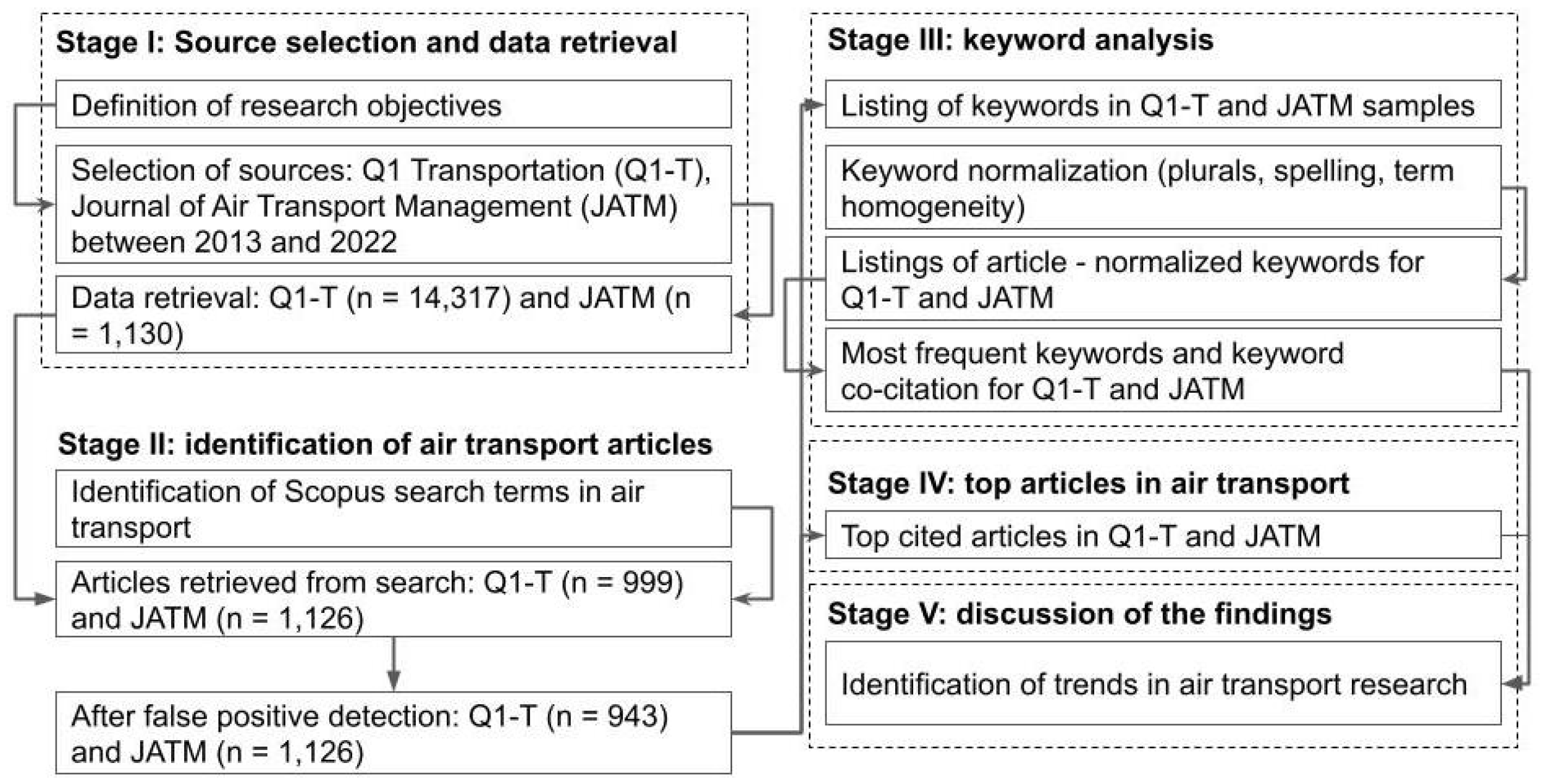
Figure 2.
Number of articles published in the Q1 journals of the Transportation ranking of the Social Sciences Citation Index from 2013 to 2023.
Figure 2.
Number of articles published in the Q1 journals of the Transportation ranking of the Social Sciences Citation Index from 2013 to 2023.
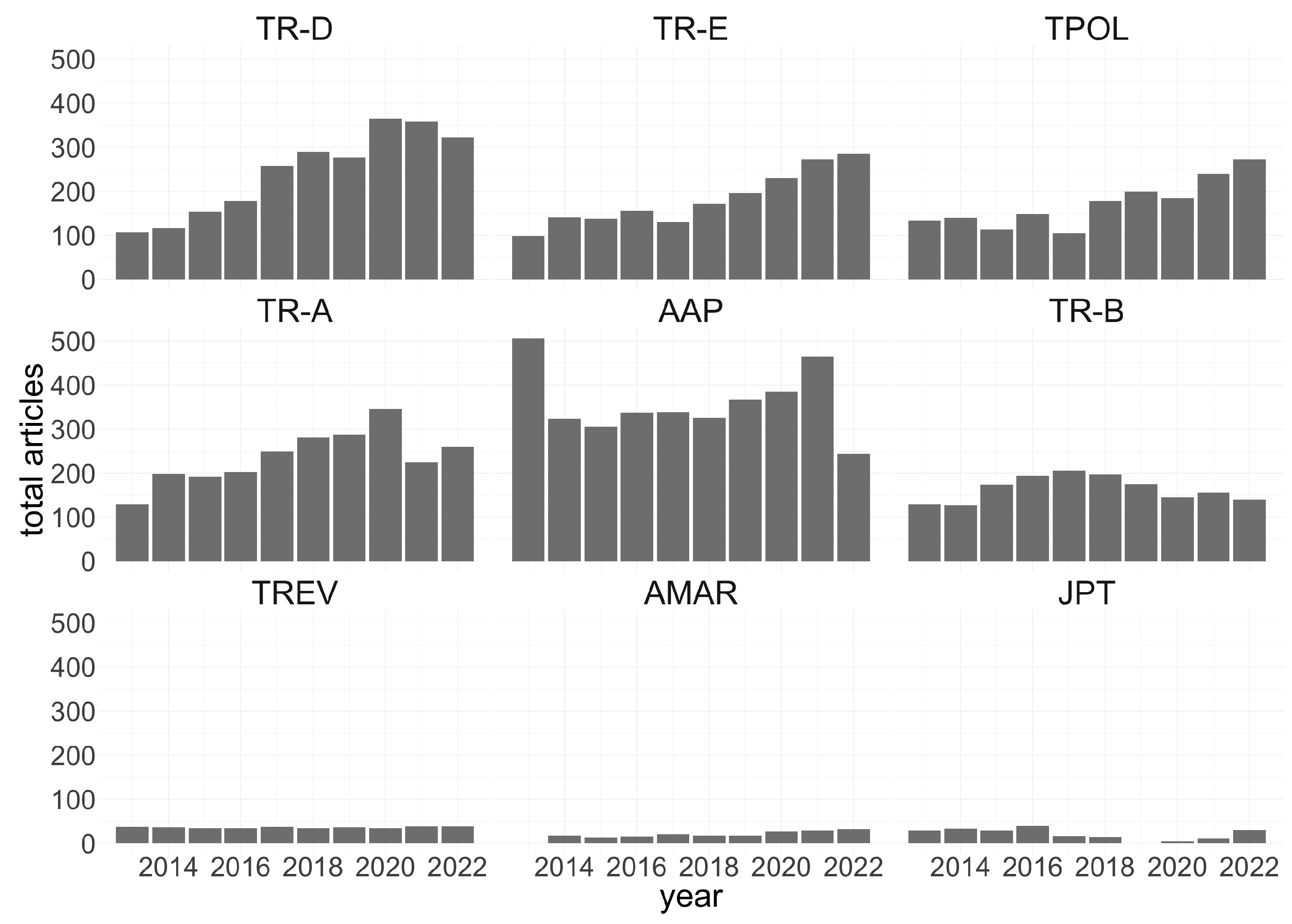
Figure 3.
Number of articles published in the Journal of Air Transport Management from 2013 to 2023.
Figure 3.
Number of articles published in the Journal of Air Transport Management from 2013 to 2023.
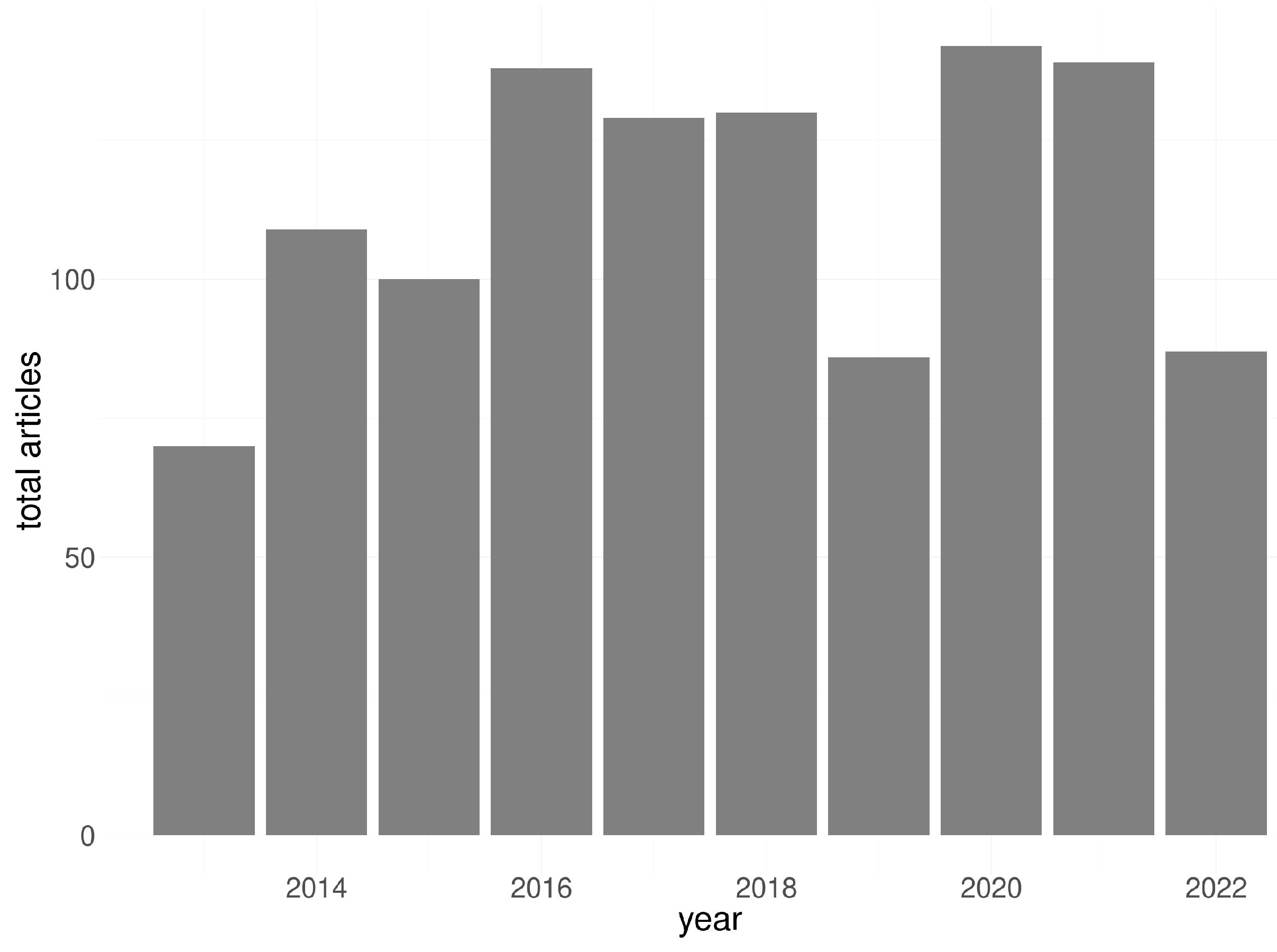
Figure 4.
Proportion of air transport articles published in the Q1 journals of the Transportation ranking of the Social Sciences Citation Index from 2013 to 2023.
Figure 4.
Proportion of air transport articles published in the Q1 journals of the Transportation ranking of the Social Sciences Citation Index from 2013 to 2023.
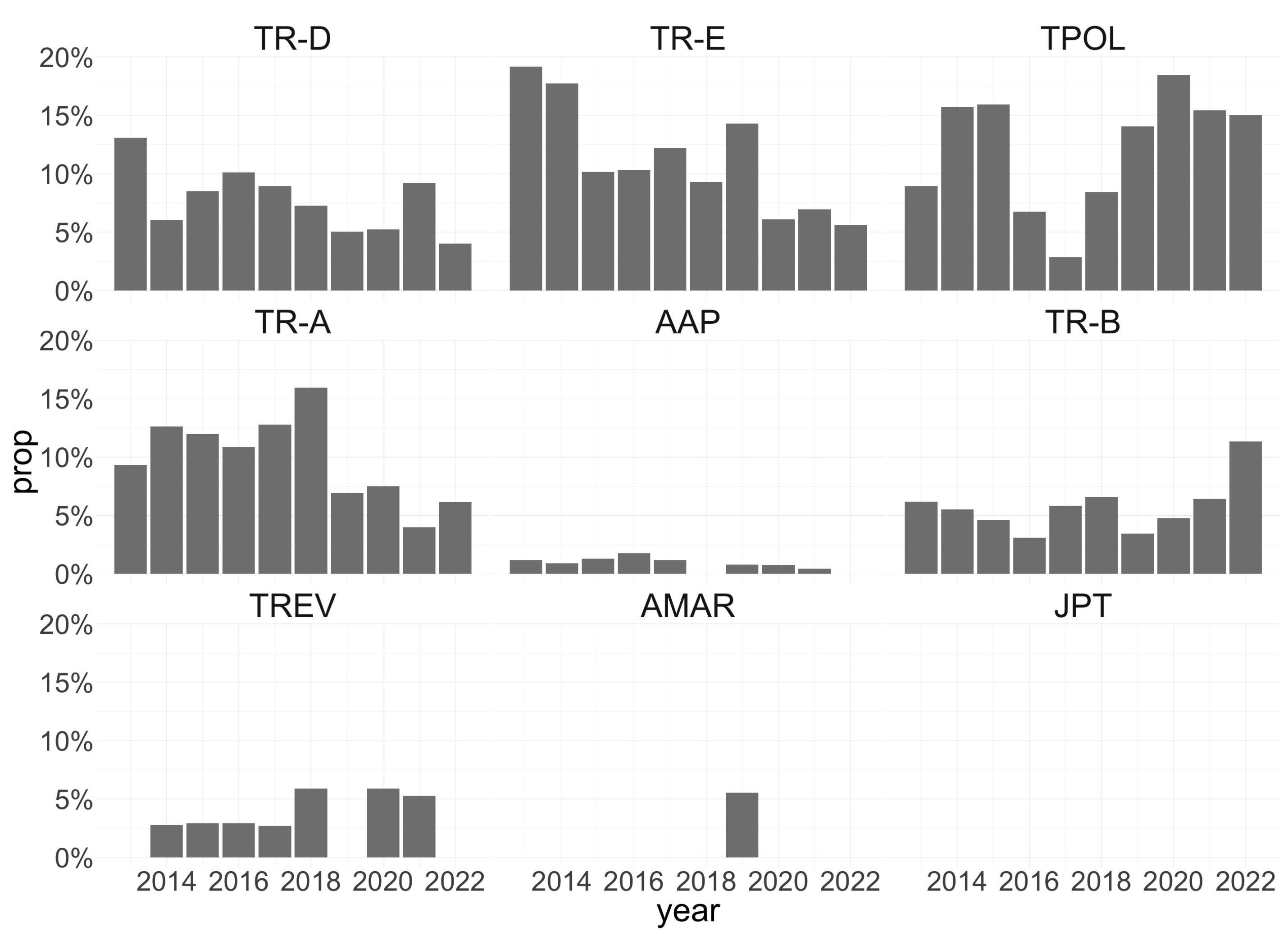
Figure 5.
Articles in the Q1-T sample with research topics included in title, abstract or keywords.
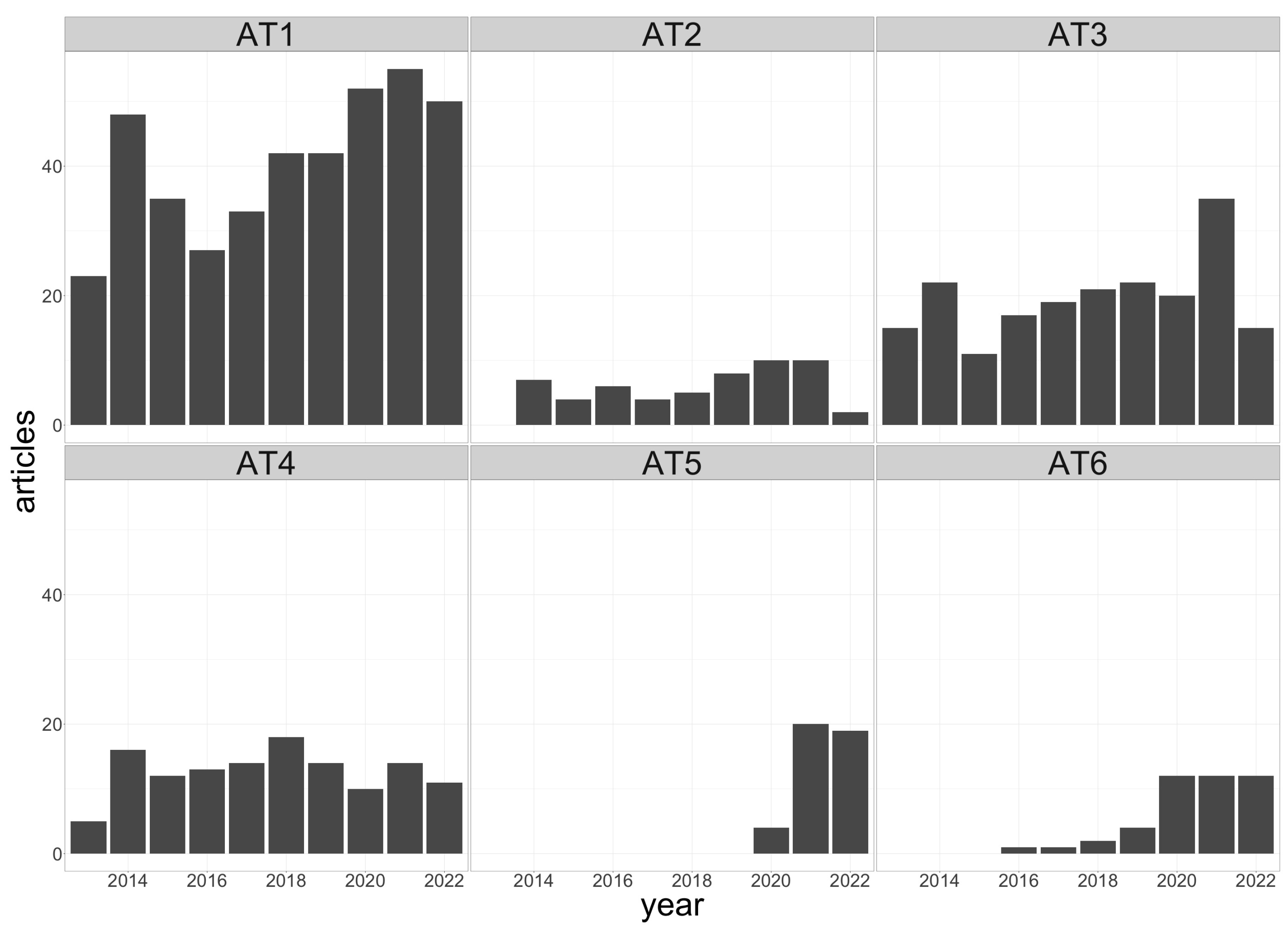
Figure 6.
Articles in the JATM sample with research topics included in title, abstract or keywords.
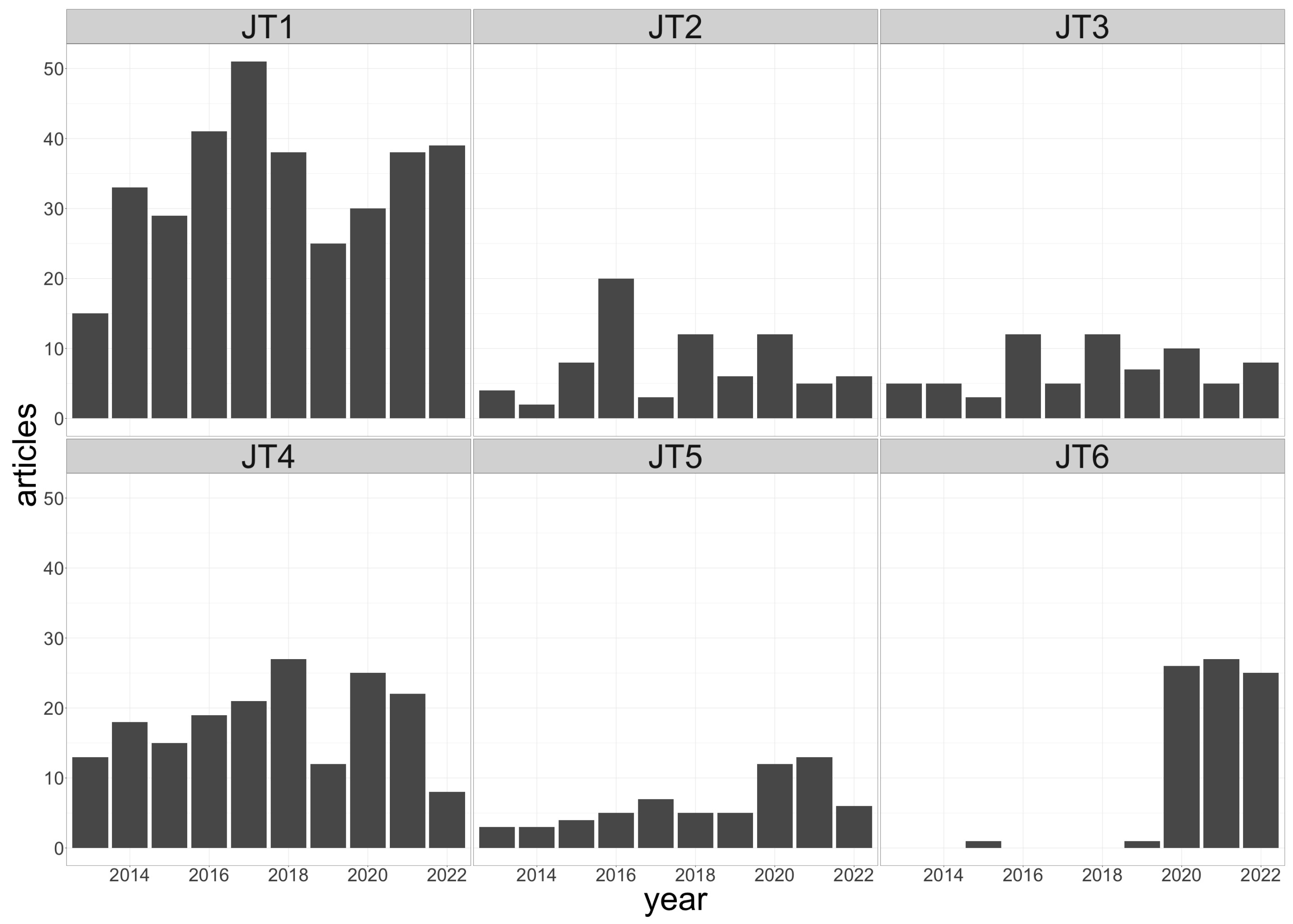
Figure 7.
Relationships between topics on the Q1-T sample. Opaque lines represent relationships with larger number of articles
Figure 7.
Relationships between topics on the Q1-T sample. Opaque lines represent relationships with larger number of articles
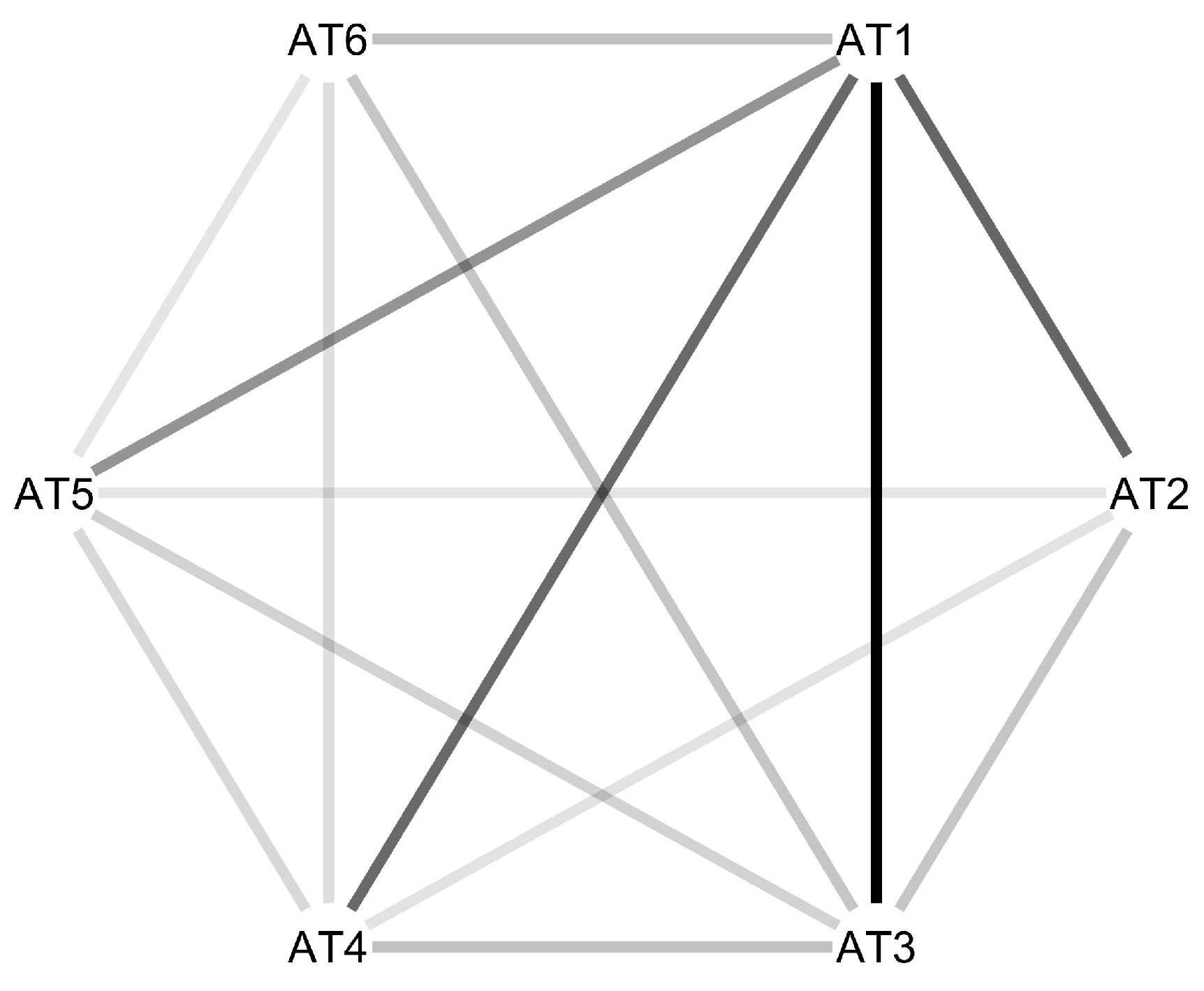
Figure 8.
Relationships between topics on the JATM sample. Opaque lines represent relationships with larger number of articles
Figure 8.
Relationships between topics on the JATM sample. Opaque lines represent relationships with larger number of articles
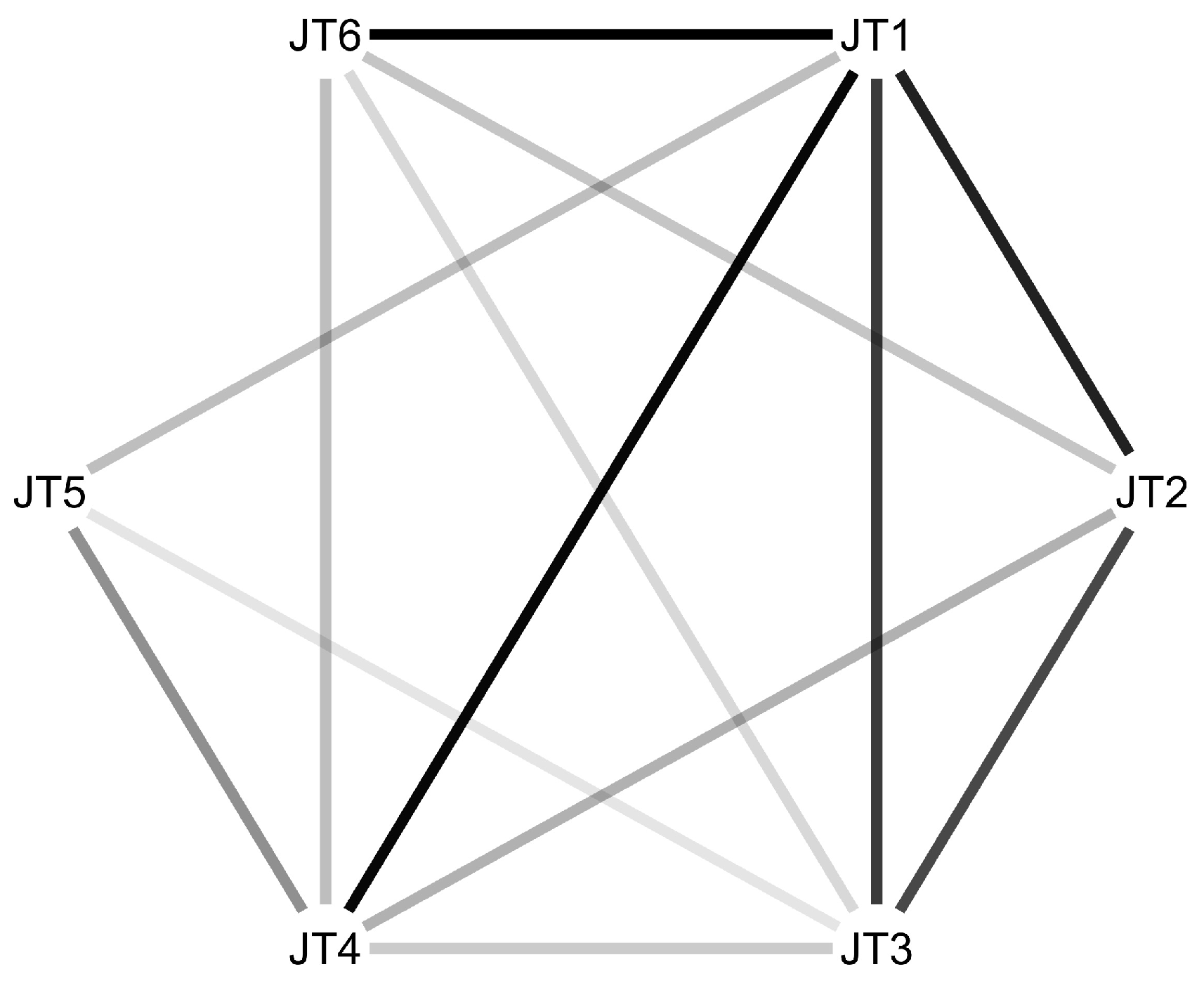
Table 1.
Listing of first quartile journals of the Transportation ranking of the Social Sciences Citation Index (SSCI).
Table 1.
Listing of first quartile journals of the Transportation ranking of the Social Sciences Citation Index (SSCI).
| Journal Name | ISSN | 2021 JIF |
|---|---|---|
| Journal of Public Transportation | 1077-291X | 37.67 |
| Analytic Methods in Accident Research | 2213-6657 | 14.56 |
| Transport Reviews | 0144-1647 | 10.19 |
| Transportation Research Part E-Logistics and Transportation Review | 1366-5545 | 10.05 |
| Transportation Research Part B-Methodological | 0191-2615 | 7.63 |
| Transportation Research Part D-Transport and Environment | 1361-9209 | 7.04 |
| Transportation Research Part A-Policy and Practice | 0965-8564 | 6.62 |
| Accident Analysis and Prevention | 0001-4575 | 6.38 |
| Transport Policy | 0967-070X | 6.17 |
Table 2.
Tokens used in the search of articles of air transport in title, abstract and keywords.
| Tokens | |||
|---|---|---|---|
| air transport | air travel | airport | airline |
| low cost carrier | low-cost carrier | flight | flying |
| aviation | air cargo | air-cargo | cargo air |
| air freight | aerospace | aircraft | airplane |
| air navigation | air traffic | air taxi | drone |
| air passenger | overbooking | cabin attendant | air network |
| hsr-air | air-hsr | air-rail | rail-air |
Table 3.
Number of unique keywords and HHI of the keyword distribution before and after keyword normalization.
Table 3.
Number of unique keywords and HHI of the keyword distribution before and after keyword normalization.
| Q1-T sample | JATM sample | Joint sample | |
|---|---|---|---|
| Number of keywords | 3,450 | 2,953 | 5,763 |
| HHI () | 9.624 | 11.853 | 8.222 |
| Number of keywords after normalization | 3,278 | 2,823 | 5,440 |
| HHI () after normalization | 14.317 | 16.165 | 13.119 |
Table 4.
List of most frequent keywords in articles of the Q1-T sample. Left columns are for the 2013-2017 period, and right columns for the 2018-2022 period.
Table 4.
List of most frequent keywords in articles of the Q1-T sample. Left columns are for the 2013-2017 period, and right columns for the 2018-2022 period.
| Keywords (2013-2017) | Frequency | Keywords (2018-2022) | Frequency | |
|---|---|---|---|---|
| airline | 36 | air transport | 41 | |
| airport | 35 | airline | 35 | |
| air transport | 28 | high speed rail | 31 | |
| aviation | 22 | covid-19 | 29 | |
| low cost carrier | 16 | aviation | 26 | |
| competition | 15 | airport | 23 | |
| high speed rail | 15 | drone | 14 | |
| climate change | 13 | low cost carrier | 13 | |
| data envelopment analysis | 11 | competition | 12 | |
| airline competition | 9 | willingness to pay | 11 | |
| aircraft noise | 8 | china | 11 | |
| policy | 7 | aircraft noise | 10 | |
| co2 emissions | 7 | data envelopment analysis | 9 | |
| general aviation | 6 | emission | 9 | |
| biofuel | 6 | air travel | 9 | |
| air traffic management | 6 | regulation | 8 | |
| delay | 6 | urban air mobility | 8 | |
| — | climate change | 8 | ||
| — | connectivity | 8 |
Table 5.
List of most frequent keywords in articles of the JATM sample. Left columns are for the 2013-2017 period, and right columns for the 2018-2022 period.
Table 5.
List of most frequent keywords in articles of the JATM sample. Left columns are for the 2013-2017 period, and right columns for the 2018-2022 period.
| Keywords (2013-2017) | Frequency | Keywords (2018-2022) | Frequency | |
|---|---|---|---|---|
| low cost carrier | 48 | covid-19 | 50 | |
| airline | 35 | airline | 39 | |
| airport | 35 | air transport | 37 | |
| data envelopment analysis | 23 | airport | 37 | |
| air transport | 17 | low cost carrier | 26 | |
| service quality | 17 | aviation | 22 | |
| efficiency | 11 | service quality | 16 | |
| aviation | 9 | airline industry | 14 | |
| revenue management | 8 | airport management | 14 | |
| air cargo | 8 | air traffic management | 12 | |
| airline industry | 8 | multi-criteria decision making | 10 | |
| competition | 7 | tourism | 9 | |
| multi-criteria decision making | 7 | air travel | 9 | |
| airport performance | 6 | flight delay | 9 | |
| airport capacity | 6 | ahp | 8 | |
| behavioral intention | 6 | data envelopment analysis | 8 | |
| customer satisfaction | 6 | machine learning | 8 | |
| uncertainty | 6 | pandemic | 8 |
Table 6.
Research topics in the Q1-T sample.
| Topic | Keywords (2018-2002) | Keywords (2018-2002) |
|---|---|---|
| AT1: Industry Analysis | low cost carrier, competition, airline competition, policy, general aviation | low cost carrier, competition, connectivity, willingness to pay, regulation, connectivity |
| AT2: High Speed Rail and Air Transport | high speed rail | high speed rail |
| AT3: Environmental impact of Air Transport | climate change, aircraft noise, co2 emissions, biofuel | aircraft noise, emission, climate change |
| AT4: Air Traffic Management | air traffic management, delay | |
| AT5: COVID-19 and Air Transport | covid-19 | |
| AT6: UAV and Urban Air Mobility | drone, urban air mobility |
Table 7.
Research topics in the JATM sample.
| Topic | Keywords (2018-2002) | Keywords (2018-2002) |
|---|---|---|
| JT1: Industry Analysis | low cost carrier, air cargo, airline industry, competitition | low cost carrier, airline industry, tourism, air travel |
| JT2: Service Quality | service quality | service quality |
| JT3: Marketing | revenue management, behavioral intention, customer satisfaction | |
| JT4: Efficiency | efficiency, airport performance, airport capacity | |
| JT5: Air traffic Management | air traffic management, flight delay | |
| JT6: COVID-19 and Air Transport | covid-19, pandemic |
Table 8.
Top-cited air transport articles published in Q1 journals of the Transportation ranking of the Social Sciences Citation Index (2013-2022). Cites gathered at 2023-06-27.
Table 8.
Top-cited air transport articles published in Q1 journals of the Transportation ranking of the Social Sciences Citation Index (2013-2022). Cites gathered at 2023-06-27.
| Rank | Title | Reference | Cites | Cites per year | Topic |
|---|---|---|---|---|---|
| 1 | Insights into the impact of COVID-19 on household travel and activities in Australia - The early days under restrictions | [26] | 219 | 62.57 | AT5 |
| 2 | Analysis of the Chinese Airline Network as multi-layer networks | [27] | 205 | 27.33 | — |
| 3 | The strategic role of logistics in the industry 4.0 era | [28] | 185 | 41.11 | — |
| 4 | Delivery by drone: An evaluation of unmanned aerial vehicle technology in reducing CO2 emissions in the delivery service industry | [29] | 160 | 29.09 | AT3, AT6 |
| 5 | Vehicle routing problem with drones | [30] | 153 | 34 | AT6 |
| 6 | Evaluating economic and environmental efficiency of global airlines: A SBM-DEA approach | [31] | 152 | 16 | AT3 |
| 7 | Exploring the roles of high-speed train, air and coach services in the spread of COVID-19 in China | [32] | 145 | 41.43 | AT2 |
| 8 | Systemic accident analysis: Examining the gap between research and practice | [33] | 137 | 13.05 | — |
| 9 | Impacts of high-speed rail on airlines, airports and regional economies: A survey of recent research | [8] | 132 | 29.33 | AT2 |
| 10 | A military airport location selection by AHP integrated PROMETHEE and VIKOR methods | [34] | 128 | 23.27 | — |
Disclaimer/Publisher’s Note: The statements, opinions and data contained in all publications are solely those of the individual author(s) and contributor(s) and not of MDPI and/or the editor(s). MDPI and/or the editor(s) disclaim responsibility for any injury to people or property resulting from any ideas, methods, instructions or products referred to in the content. |
© 2023 by the authors. Licensee MDPI, Basel, Switzerland. This article is an open access article distributed under the terms and conditions of the Creative Commons Attribution (CC BY) license (http://creativecommons.org/licenses/by/4.0/).
Copyright: This open access article is published under a Creative Commons CC BY 4.0 license, which permit the free download, distribution, and reuse, provided that the author and preprint are cited in any reuse.


