

Submitted:
03 July 2023
Posted:
04 July 2023
You are already at the latest version
Abstract
Without doubt, the social and environmental business impact will become more important as the governments cannot take care about these problems. Thus, launching the EU Green deal rules, World Global Sustainable Development Goals, corporate social responsibility (CSR) activities and strategies are part of this global commitment. Additionally, CSR is strongly connected to the exploration of (social) market awareness and technology development and application as it focusses on social, environmental and economic business impact. The main goal of the paper is to verify that contemporary greener CSR strategies are beneficiary activity for high-tech companies because of better competitive advantages acquisition through management of corporate reputation risk and patenting innovative technologies. The structure of the paper is the next: 1. Introduction – explanation the previous researches that explore the relation: CSR strategy – high-tech company competitiveness; 2. State of art – exploring the corporate reputation and patent rights as factors in CSR strategy; 3. Patent monopoly and CSR – research the connection between reputation risks of patents rights and CSR strategy; 4. Business performance and CSR reporting – briefly research methodology is presented as some results from Bulgarian companies; 5. Discussion and conclusions – summarizing a methodology for patent rights and reputation risk management for better CSR effects.
Keywords:
CSR strategy
; reputation risk
; patent rights
; high-tech companies
1. Introduction
Generally Corporate Social Responsibility (CSR) is looking for shift of some social activities from the Government to the Business as a part of “business – governmental societal” commitment. As the social needs become “on the top” of the market activities and social marketing took the “rule” of the corporations, then the business has to build an image of socially-oriented company in order to have a better market chance. Thus, companies become more competitive on the market (Bernal-Conesa, Briones-Peñalver & Nieves-Nieto,2017; Gallardo-Vázquez & Sánchez-Hernández, 2014; Vilanova, Lozano, & Arenas, 2009). The CSR and competitiveness connection looks like very strong as better to the society means more sells and growth of profitability. As some researchers found (Marín et al., 2012) that the relation depends on the technology development and CSR leads to higher competitiveness if the technology is better.
Furthermore, the “rise” of the Green Economy basis and the acceptance of the EU Green deal force the CSR strategy to “push up” companies to become greener and “ecologically cleaner”. So, once again the high innovative and technology companies, based on principles of the circular economy become more and more competitive. As Bernal-Conesa, Briones-Peñalver & Nieves-Nieto (2017) found that the importance of CSR concerns gained by developing an organization's environmental and social initiatives will help start-ups go beyond just financial gains on the market.
But, how and why we have reports that verify the role of CSR strategies and implications for gaining competitive advantages in variety of sectors and countries?
According to Grabinska et all. (2021) CSR reporting leads to better (and cheap) financial resources that is viable for the start-ups in comparison with the existing traditional business. Additionally, Circular Economy Finance Guide (2018) define some financial rules for management of all financial equity and debts according to accomplishment of circular economy projects. Thus, CSR reporting based on the social and environmental benefits will establish better economic environment for those companies.
Additionally, Chang et al. (2021) connect CSR strategy with risk-management in companies minimizing and mitigating the environmental and ecological impact on the business activities that overtake the economic and corporate governance one. Thus, the CSR is percept as an instrument the minimizes human-impact on environmental change. Not surprisingly, the start-up companies become successful as they reduce the human labor on impart on the corporate governance generally.
Although the CSR reporting and Green Economy connection is not strictly defined, Sterev (2019), Sterew and Ivanova (2019), Sarkis and Zhu (2018), Bai and Sarkis (2017) explain the environmental effect and technology development through: resource efficiency, supply chain sharing models and utilization of resource in advanced manufacturing processes.
Following, we could define our main hypothesis:
H1. Any single company cannot afford to not protect technological solutions because it would lose market positions and competitive advantages as the better technologies that gives better CSR strategy /and reporting results/ build a new “competition brick within the corporate reputation growth. Additionally, patent rights affect the company's reputation, and this influence depends on the company's commitment to using environmental and ecological protected technologies and its surplus to corporate social responsibility.
Following previous researches, a reputational risk assessment methodology will be used to check the hypothesis H1 and to verify whether high-tech companies' patent portfolios can be used to evaluate this reputation risk and affect to the CSR strategy.
2. State of art
Corporate Social Responsibility (CSR), or the idea that businesses are accountable for the economic, social, and environmental effects of their operations, is a relatively recent idea in corporate governance. On the European level, the European Commission released a new commitment on CSR strategy in 2011 with the intention of fostering medium- and long-term conditions that will lead to sustainable growth and the creation of jobs. Within the CSR strategy the European Commission treats that EU goals of sustainable development and a fiercely competitive social market economy could be considerably advanced by businesses through CSR strategy and could be controlled via CSR reporting (Kopeva, Sterev and Blagoev, 2019). As corporate non-financial reporting is defined as a key element of the corporate social responsibility reporting, the European Commission has accepted Directive 2014/95/EU mandatory for non-financial reporting of large companies as well as launch a standard of CSR reporting in 2022 with Directive (EU) 2022/2464 (Bozhinova and Nikolov, 2021; Nikolov, 2016).
2.1. Corporate reputation and reputation risk management
According to previous studies, corporate reputation is crucial for businesses to acquire high competitiveness. By presenting the organization with beautiful, distinctive, consistent, and long-lasting pictures, stakeholders are left with the required good impressions (Wæraas and Dahle, 2020). It is worldwide accepted that a business' reputation is established based on how well-liked it is within a group of potential customers and how desirable it is compared to other comparable businesses with which it competes (Fombrum, 2012). According to Biolcheva (2021) The foundation of a positive business’ reputation is the faith and trust that people have developed for it, as well as its capacity to uphold that faith in the future. Wæraas and Dahle (2020) conclude that frequently, it is developed from the inside out approach, which emphasizes the importance of turning employees into "corporate ambassadors" and fostering reputational behavior on their behalf. Also of critical importance is how co-property disputes are handled. The appearance of substantial hazards and impairment as well as the transformation of obstacles into a strength to improve it can both result from their preventive treatment (Beheshtifa and Korouki, 2013). Due to their complexity and interconnection with all corporate governance and (social) market operations, reputational challenges are too difficult to control. It is influenced by things like financial success, moral character, product quality, security, safety, and crisis management.
Some major categories that characterize the reputation can be identified systematically and are encapsulated in the acronym REPUTE (Table 1).
When discussing a company's reputation, it is important to keep in mind that there are numerous hazards involved. The Basel Committee on Banking Supervision addresses reputational risk in the Basel II framework. (2000) The document states that reputational risk results from all customers', counterparties', and other interested parties' or regulatory authorities' bad perceptions, which may negatively impact the organization's capacity to carry out its business processes. Reputational risk, in the opinion of Banjo et al. (2022), has the potential to transform the corporate environment. They contend that a company's reputational standing has an immediate impact on demand and revenue, taking into consideration customer opinion. Additionally, according to a Deloitte study, reputational risk is frequently brought on by elements like ethics, integrity, physical security, and cyber security, as well as by the calibre of the company's goods and services and its interactions with third parties (Ristuccia, Duchevet, Phaure, 2014).
Based on the above we could conclude that reputational risks are characterized by their difficulty in prediction, measurement, and evaluation. So, the following elements could be distinguished as the key causes of corporate’s reputation risks (Biolcheva, 2021):
- 1)
- A number of factors outside the control of the company, such as competitor and customer behavior, market conditions, etc., affect the extent of harm.
- 2)
- Their chance of occurring is too complex to anticipate, leading to the evaluation becoming meaningless when the quantitative expression of risk is calculated. It is associated with human behavior, which makes it challenging to include in assessment models; t
- 3)
- There is no obvious owner of this risk, making it unclear whose role it is to ensure that it is being monitored.
2.2. Corporate’s reputation and CSR strategy
Given the wide range of variables that affect corporate reputation, we have here restricted our analysis to determining simply the impact of corporate social responsibility (CSR). The decision was motivated by recent trends, which demonstrate an upsurge in corporate interest in taking part in social projects of all shapes and sizes. More company projects promoting sustainable economic development deliberately incorporate social, economic, and environmental aspects (Gallardo-Vázquez et al., 2013). According to a study by McWilliams et al. (2001), the social contract that underpins the relationship between companies and society changes as society develops and society's expectations change.
The positive effects of CSR activities and actions on corporate's reputations which is translate into brand equity, are now widely acknowledged (Creswell, 2013). The reason for this may be found in the fact that stakeholders are interested in how well businesses are performing in terms of economic development and environmental protection (He et al., 2021), both of which are important drivers of sustainable economic development. According to a customer research, perceptions of the business have a 60% influence on consumers' buy intentions and perceptions of the products themselves have a 40% influence. It's interesting that a company's CSR efforts account for 42% of its reputation. (Mahmood and Bashir, 2020).
Following, it can be inferred that corporate social responsibility is a tool that enhances business performance and directly affects corporate’s reputation (jo, Kin and Park, 2015). The state-of art research reveals that social responsibility has a direct impact on a company's ability to compete. Stakeholders are more likely to cooperate and have greater trust in an organization if they have a positive social reputation and CSR performance (Suna et al. 2022). According to Hillenbrand and Money (2007) business factors such as reputation and social responsibility are intimately intertwined, and demonstrating adaptation and flexibility adds value. Companies become more innovative in a variety of ways when they are able to include the interests of stakeholders, the environment, society, and consumers into the implementation of their business processes (Hao and He, 2022).
Companies that adopt socially responsible reporting approach are more likely to innovate, which increases their growth potential, according to Bocquet et al. (2013) and Gallardo-Vázquez et al (2019). European Commission having established policies and environmental initiatives for businesses, within it CSR is introduced and defined at the European level. The general people became more socially and environmentally conscious as a result of this. In addition, it appears to be a requirement for long-term success and a means of securing positions on both domestic and foreign markets (Asiaei and Bontis, 2019).
It should be highlighted that there isn't a single formula that offers specific suggestions for how corporate social responsibility should manifest itself. Different businesses use various strategies. By optimizing production procedures, some of the approaches seek to reduce pollution and harm caused by hazardous productions, while others focus on mechanisms to improve the state of the environment. The application of business innovations in this context frequently involves the creation of new patents, the provision of energy-saving technology, green innovations (Hao and Fe, 2022), resource utilization and recycling innovations, purification plant innovations, etc. According to Hao and Fe (2022) the adoption of CSR innovations satisfies two primary business objectives: the first is focused on individual interests and upholding a favourable reputation, and the second is targeted at boosting the organization's long-term value. Accordingly, the environment mandates that businesses generate sustainable outcomes, be socially and ecologically conscientious, and contribute to public safety and a balanced environment in order to ensure long-term sustainability.
2.3. Patent rights and CSR strategy
The technological development, which is very rapid in the past years puts the focus also on another issue when regarding reputation and corporate social responsibility, namely the balance between patenting (legal protection of technological innovations) and the image of the tech company on the market.
A patent is a document that grants its holder an exclusive right to an invention. A patent enables the owner to prohibit others, without his consent, from commercially exploiting the invention for a specified period of time, in return for which the patent owner discloses to the public the substance of the invention. By granting an exclusive right to the invention, the patent system serves to stimulate investment in innovation and risk-taking in the development of new technologies. It obliges the patent proprietor to disclose the details of his invention to the public in return for the patent. These rights aim to strike a balance between the interests of inventors, those who use their works and society as a whole. The importance of invention in technological development is considered so significant that an entire legislative system of rules was developed to regulate the economic activities of society members with this regard – the intellectual property system. Four theories dominate the theoretical writing about intellectual property: Utilitarianism; Labor Theory; Personality Theory; and Social Planning Theory, but from an economic perspective, each of the theories addresses three main points regarding the creation and use of intellectual products in general and inventions in particular:
- issues related to the reward of inventors - once the creator has put in a lot of effort, money, time, property, talent, etc., he deserves the appropriate reward, namely protection of his invention. This point of view has been advocated in many court decisions commenting on the risk taken by the inventor and his inability to recoup the money and time invested by making his invention freely available for production on the market.
- optimizing productivity models - Harold Demsetz (1967) argued many years ago that copyright and patent systems have an important role to play in enabling potential producers of intellectual products to know what consumers want and thus to direct productive efforts in directions most likely to enhance consumer welfare. Sales and licenses will ensure that goods get into the hands of people who want them and are able to pay for them. Only in the rare situations where transaction costs would prevent such voluntary exchanges could intellectual property owners be denied absolute control over the uses of their works, either through direct privilege (such as the fair use doctrine) or through a system of compulsory licensing.
- competing invention - its purpose is to eliminate or reduce the tendency of intellectual property rights to encourage duplicative or uncoordinated inventive activity. The basis for this approach was laid by a group of economists, led by Yoram Barzel (1997), who studied the ways in which competition among firms compounds the impact of the patent system on inventive activity.
As we can see patents aim to help technological companies get return on their investments, while helping society progress in its technological development. However, one of the major difficulties at the market is for consumers to assess the innovative performance of firms – and “innovation” is one of the main factors in evaluating company’s performance and reputation. Consumers are assessing not just technical properties but also intangible issues regarding the difference between technologies, the future performance of the technology, of the vendor, its behaviour, etc. The latter aspect is particularly complex when the solutions in question are new and emerging. As it was studied (George, J. et.al., 1999), assessing these kinds of uncertainties is proving increasingly difficult and provokes confusion amongst market actors about how to proceed.
Henard and Dacin (2010) developed a specific “reputation for product innovation”, showing that firms yield a specific reputation for introducing product innovations to the market. Additionally, in the 2022 TechRep report (2022) Anna Litvak-Hinenzon says “One of the financial metrics we see influencing the technology industry's reputation is the price-to-earnings ratio. Tech companies may be perceived by stakeholders as rich yet charging high prices, or unfair to their consumers, resulting in a decline in reputation.” So, even if innovation is important, and patents might be regarded as a measure for the innovation capacity of a company consumers do not recognize them as particularly important when it comes to reputation. Henard and Dacin (2010, p.322) in particular state that “one cannot simply rely on a proxy (e.g. number of patents filed, R&D dollars spent) to adequately capture the true measure of an organization’s reputation for product innovation”.
Yet, when it comes to corporate social responsibility, we see very clearly the tension between the objective of maximising shareholder dividends and exploiting rights and powers held by the company. High-tech companies are compelled to enforce its patents, protecting their investments, market, etc. against a competitor trying to take their business, but when it comes to consumer benefit and social welfare patent enforcing is considered as risky for the company reputation as it may make it look greedy and uncaring. An example to illustrate that is the pharma industry during and post pandemic times. Novartis, Johnson & Johnson, Moderna, Pfizer and AstraZeneca are among the worst-perceived companies in the sector (Renfrow, 2023). A new Global Pharma Study (2023) published by Caliber, has found that only 4 out of 10 people are likely to say something positive about a pharma company if given the chance, which shows that many brands are not inspiring strong advocacy from the general public. So the industry must connect products, innovation, and leadership with societal impact to improve trust.
3. Patent monopoly for corporate’s reputation of high-tech companies
3.1. Company benefits from patenting technologies
Patents offer a company's innovations and scientific advancements legal protection. They give the assignee or inventor exclusive rights, barring unauthorized production, use, export, or import of the patented technology. High-tech businesses benefit from this protection by being able to protect their original ideas and keep an edge over rivals. The patent protection provides:
- market exclusivity: patents give high-tech businesses a period of exclusivity, usually 20 years from the date of filing, during which they can make use of their inventions without opposition. This exclusivity enables businesses to profit from the commercialization of their inventions, as well as to recoup their investment in R&D. Further strengthening the patent holder's position in the market, it acts as a barrier to entry for potential rivals.
- revenue generation: opportunities for licensing and monetization - high-tech companies frequently license their patented technologies to other businesses, enabling them to generate additional revenue streams. A business can authorize the use of its patented technology by third parties through licensing agreements in exchange for licensing fees or royalties.- Thus, patents can develop into priceless assets that support a business.
- strategic advantage: a strong patent portfolio can give high-tech companies a strategic advantage and give them more negotiating power. It demonstrates their technological know-how, strengthens their reputation as an innovator, and aids in luring investors and partners. Furthermore, companies can use patents as negotiating tools to obtain advantageous alliances, cross-licensing arrangements, or access to complementary technologies.
- protective mechanism: patents also serve as a protective mechanism in the high-tech sector, which is incredibly fast-paced and competitive. They serve to deter potential infringement allegations and legal actions brought by rivals. A company can create a protective shield with a robust patent portfolio, deterring competitors from filing lawsuits and possibly resulting in cross-licensing agreements that are advantageous to both parties.
- confidence in the potential investors: patents can provide potential investors with confidence in the value and potential of the company’s technologies, so it is easier to raise capital.
- perception of high quality: the perceived quality of an end product and the technological aspects of its components are frequently linked, especially when such features are patented. Patented technology elements frequently reflect unique solutions or improvements in a particular field. When these features are included in a product, they can help it stand out from the competition and suggest a higher degree of quality. Patented technologies are frequently associated with cutting-edge innovation, improved performance, and enhanced functionality, which can positively influence consumers' perceptions of the product's quality. Patented components or technologies may enable greater performance or enhanced functionality in the finished product. A patented technique in a smartphone camera, for example, can result in higher image quality, improved low-light performance, or advanced image stabilization. These outstanding performance attributes add to the product's perceived quality, since consumers value products that deliver excellent performance and effectively meet their needs.
- durability and reliability: patented technological elements can also add to an end product's durability and reliability. When components are patent-protected, it means they have undergone extensive research, development, and testing to assure their effectiveness and endurance. Because consumers want items that are built to last and work consistently over time, this assurance of longevity and reliability can improve the perceived quality of the product.
- better user experience: patented technology features can improve a product's overall user experience. They may provide user-friendly interfaces, seamless connectivity with other devices or platforms, or enhanced ease and usability. A product that provides a superior user experience is frequently seen as being of higher quality because it meets user expectations and makes their engagement with the product more joyful and efficient.
3.2. Corporate’s reputation through patents as reputation signals
Corporate’s reputation can be broadly understood as a signalling process, in which the strategic choices of firms send signals to observers and observers use these signals to form impressions of these firms. Due to information asymmetries, stakeholders often use both actions and symbols to judge a firm’s reputation and quality (Fombrun and Shanley, 1990; Spence, 1973). Thus, a corporate’s reputation is a “cognitive evaluation of the firm’s quality that is socially constructed, but objectively held, by current and prospective constituents” (Reuben and Fischer, 2009). A high-tech corporation can create a reputation for innovation, dependability, and excellence by continually introducing patented technological features that add to product quality. Consumers may come to identify the firm's brand with high-quality items over time, and this brand reputation may have a positive impact on their impression of the quality of new products issued by the company.
While the relationship between patented technological features and perceived product quality is not absolute and can vary depending on a variety of factors, patents are frequently used as an indicator of innovation, performance, durability, and user experience—all of which contribute to an end product's perceived quality. Patents' informational role may be more useful to the rights holder than the rights' substance. Patents can be used as a signalling mechanism to convey information to the market (Long 2002) and thus build reputation.
As Liu et al. (2018) prove significant positive correlation exists between proper intellectual property protection and technological innovation and significant negative correlation exists between excessive intellectual property protection and technological innovation. We would like to further elaborate on that analysing the use of patent monopoly in company’s reputation evaluation and link it to how corporate social responsibility building might be used to minimize the risks of drop in reputation ranking.
3.3. Reputation risks from patenting
As patents can be used for signalling the market about company’s innovation status and opportunities for growth it is not always possible to identify when patents are the real incentive for innovation, and the patent system has flaws and is subject to some abuse for quite some time as Hovenkamp (2013) discusses for example predatory patent litigation.
Some observers assert that influential jurisdictions appear to use their antitrust powers not to protect competition, but to regulate the price of patent rights. Such critics point to Qualcomm’s agreement to pay $975 million and to lower its royalty rates by more than a third to Chinese companies to end China’s antitrust investigation (US Chamber of Commerce, 2014) as well as to the Korean Fair Trade Commission (“KFTC”) action to fine Qualcomm and force it to change its licensing practices (Briggs, 2015).
Other international events also point to diluted IP rights. In August 2015, China adopted an essential-facilities doctrine that may require the compulsory licensing of IP rights by firms considered dominant (US Chamber of Commerce, 2015). The Japanese Fair Trade Commission has promulgated rules prohibiting owners of standard-essential patents (“SEPs”) from seeking injunctive relief, “even if the acts do not substantially restrict competition.” (JFTC, 2015). The Director of the KFTC has opined that “the exercise of IP rights has the potential to become a monster” and that IP rights “can undermine technological development.” (Guniganti, 2015). And the Competition Commission of India has found that charging unreasonably high royalties, or basing royalty calculations on final-product sales, on FRAND-encumbered SEPs abuses a dominant position. (Ghosh and Sokol, 2016)
Research has established that a firm’s corporate social responsibility investments can have a positive effect on external and internal stakeholders’ perceptions, which enhances the firm’s expectations that its innovation activities will increase corporate value. The findings of Im and Song (2022) consistently demonstrate that CSR performance significantly increases the economic value and quantity of innovation, and that the effect is economically significant, so we would like to further elaborate on that showing CSR as an instrument, which can reduce the reputational risk for high-tech companies when patenting.
4. Business performance and CSR reporting of the high-tech companies
Based on the literature analysis, two main constrains could be developed as follows (Figure 1):
- CSR directly affects the Corporate performance and Business competitiveness (see. Bernal-Conesa, Briones-Peñalver, Nieves-Nieto, 2017, p.78). as Competitiveness mediates the relationship between the CSR strategies and performance of technological companies.
- CSR indirectly affects the Corporate performance via mediation of Corporate reputation (Mahmood and Bashir, 2020) and Corporate patenting (Barzel, 1997).
Based on the existing methodologies for CSR reporting (Stefanova et al. 2021) 3 indices are found:
- Innovations, incl. business innovations, social innovations and ecological innovations;
- System for risk management;
- Technology development resource management and resource utilization.
Based on existing methodologies for Corporate reputation measurement defined in Balan (2020, p.152) 3 indices approach could be used based on the social expectations constrain:
- Social trust as good employer;
- Environment responsibility policy;
- Product/service quality.
Patents could be found in 3 aspects:
- Own development of patents (as dummy variable);
- Number of patents’ acquisitions;
- The (average) innovation stage of the patents (between TRL 4 – TRL 9 stage)1
The Corporate performance could be measured by one of three indices:
- Turnover;
- Production;
- Added value at factor costs.
An example of relation analysis could be given by correlation analysis between: CSR activities (measured by: corporate waste; recycling resources and recycling markets) and Business performance (measured by production value) (Figure 2) (Biolcheva and Sterev 2023).
The given two lines affect the green innovation activities, as the green innovations are set as dummy variable: green line is correlation without green innovations and blue line is correlation with green innovations. According to the figures, the overall effect of the CSR activities is higher if there are green innovations applied.
Unfortunately, the annual number of patents in Bulgaria is 80-90 and the innovation activities of Bulgarian companies is set as less than 2%, and these figures do not allow to use them to measure their impact on the business performance as mediators.
5. Discussion and conclusions
Based on the findings for strong relations between corporate reputation (and its reputation management) and patenting activities within the Green economy (environmental and social innovations) we could propose the next methodology for evaluating the corporate’s reputational risk of high-tech companies when patenting new technologies and CSR. As the state of art preview as the methodology research verify that H1 is confirmed and company that did not maintain its technological solutions would lose market share and competitive advantages, as newer technologies that produce better CSR strategy and reporting results will introduce a new "competition brick within the corporate reputation growth." Additionally, a corporate's reputation is impacted by its commitment to corporate social responsibility, its employment of environmentally and ecologically safe technologies, and other reasons.
Thus, a high-tech patented product must be protected by proper and prompt risk management procedure in order to build a long-lasting CSR corporate’s reputation. A management approach built on the premise that risk management can be ensured through various CSR initiatives and projects is shown here to demonstrate this mechanism. Fundamentally, the technique meets with ISO 31000's (2018) requirements for risk management, but it also takes into consideration high-tech businesses' patent portfolios and specifically considers reputational risk. Figure 3 presents the explained methods.
The explanation of the shift between stages in Figure 3 are given the next:
- 1)
- The availability of patentable, high-tech products. The process began when the high-tech company applied for a patent for a novel product;
- 2)
- Identifying and evaluating parties with an interest in the patented product. During this phase, it's important to identify any potential interested parties who have a direct or indirect connection to the patented technique or product and to give as much detail as you can about them. Their study should take into account a number of variables to demonstrate how the stakeholders’ expectations have changed as well as any potential threats to the high-tech company's reputation;
- 3)
- Determining any possible reputational hazards brought on by the interested parties. Reputational risk can be systematized, described, and categorised via early/preventive identification;
- 4)
- Reputational risk analysis and assessment call for a quantitative and qualitative evaluation of the risk, providing instructions for deciding on specific actions to take toward the many involved parties;
- 5)
- The effects of various CSR components on risk. Corporate social responsibility is a factor that affects how reputational risk is handled. Various social and ecological programs and/or activities have an effect on various stakeholder groups. Here, it's crucial to clarify the exact actions in light of the relevant groups. This is decided using the outcomes of the aforementioned stakeholder analysis. The corporate organization must consider the interests of the stakeholders throughout this period and prevent harm to them. The goal of the CSR risk management approach is to minimize negative effects and transform them into assets that will enhance the high-tech company's reputation;
- 6)
- An assessment of persistent reputational risk. Sometimes the threat cannot be totally eliminated, or the measures taken to do so have not been successful. This calls for more CSR effects to produce long-lasting positive trends;
- 7)
- The phase of "building sustainability" is when stakeholders link the CSR performance of the biotech company with certain social and environmental concerns. Their upkeep and expansion support the brand, uphold the image, and boost client satisfaction. It is essential to participate in active communication, conduct CSR events, and make public appearances;
- 8)
- Monitoring reputational risk – As a cyclical process, risk management calls for regular diagnosis and evaluation of all incidents that affect the firm both internally and externally. It is also necessary to conduct an ongoing review of organizational goals and any threats to those goals. During this risk management phase, the high-tech firm must take precautions to preserve the confidence of the general public and its clients and must take action to improve its reputation.
Acknowledgments
The publication contains the results of a study financed with funds from a targeted subsidy for the UNWE Research Fund under contract No. NID NI 5/2023/А.
| 1 | Technology readiness levels |
References
- Asiaei, K., Bontis, N. (2019). Using a balanced scorecard to manage corporate social responsibility, Knowledge and Process Management, 26(4), 371–379. [CrossRef]
- Bai, C.; Sarkis, J. (2017). Improving green flexibility through advanced manufacturing technology investment: Modeling the decision process. Int. J. Prod. Econ. 2017, 188, 86–104. [CrossRef]
- Bălan D. A. (2020). Major Approaches to Measuring Corporate Reputation: An Extensive Literature Review, Revista de Științe Politice. Revue des Sciences Politiques 67/2020: pp.146-158. https://www.ceeol.com/search/article-detail?id=1055606.
- Banjo, K.A., Aduloju, S.A., Ajemunigbohun, S.S. (2022). Environmental Risk, Reputational Risk, and Legal Risk as Determinants of the Performance of Manufacturing Companies in Nigeria. Annals of Spiru Haret University. Economic Series, 22(1), 489-502. [CrossRef]
- Barzel, Y. (1997). Economic Analysis of Property Rights. 2nd ed. Cambridge: Cambridge UP. Print. Political Economy of Institutions and Decisions.
- Basel II Framework, ,2000, Proposed Enhancements to the Basel II Framework. Basel Committee on Banking Supervision Consultative Document. Bank for International Settlement.
- Beheshtifa, M., Korouki, A. (2013). Reputation: An Important Component of Corporations' Value, International Journal of Academic Research in Business and Social Sciences, Vol. 3, No. 7. [CrossRef]
- Bernal-Conesa J.A., Nieves-Nieto C., Briones-Peñalver A.J. (2016). CSR and technology companies: A study on its implementation, integration and effects on the competitiveness of companies, IC, 2016 – 12(5): 1529-1590 – Online ISSN: 1697-9818 – Print ISSN: 2014-3214. [CrossRef]
- Bernal-Conesa, Briones-Peñalver, Nieves-Nieto (2017). Impacts of the CSR strategies of technology companies on performance and competitiveness. Tourism & Management Studies, 13(4), 2017, 73-81. [CrossRef]
- Biolcheva P., Sterev N. (2023). INTELLIGENT SYSTEMS IN THE CIR--CULAR ECONOMY, VIth International Conference on Management and Strategic Decisions (ICGSM), 8-10 June 2023, Bourgas.
- Biolcheva, P. (2021). Upravlenie na Biznes Riska, UNWE, ISBN 978-619-232-524-4 (BG).
- Bocquet, R.; Le Bas, C.; Mothe, C.; Poussing, N. (2012). Are firms with different CSR profiles equally innovative? Empirical analysis with survey data, European Management Journal (2012). [CrossRef]
- Bozhinova, M., Nikolov, E. (2021), INTEGRATION OF NON-FINANCIAL REPORTING IN THE BULGARIAN MOST TRADED COMPANIES, International Multidisciplinary Scientific GeoConference : SGEM; Sofia, Vol. 21, Iss. 5.1, (2021). [CrossRef]
- Briggs M. (2015), KFTC Recommends Fines Against Qualcomm, GLOBAL COMPETITION REVIEW (Nov. 18, 2015) http://globalcompetitionreview.com/news/article/39853/kftcrecommends-fines-against-qualcomm [https://perma.cc/9PAQ-GHLY];
- Chang, C.P. (2009). The relationships among corporate social responsibility, corporate image and economic performance of hightech industries in Taiwan. Quality and Quantity, 43(3), 417-429. [CrossRef]
- Chang, S.C.; Lu, M.T.; Chen, M.J.; Huang, L.H. (2021). Evaluating the Application of CSR in the High-Tech Industry during the COVID-19 Pandemic. Mathematics 2021, 9, 1715. [CrossRef]
- Circular Economy Finance Guidelines (2018), Amsterdam, circular-economy-finance-guidelines-secure-july-2018.pdf (rabobank.com).
- Creswell, J. (2013). Research design: quantitative, qualitative, and mixed methods approaches. Thousand Oaks, CA: Sage.
- Demsetz, H. (1967). Toward a Theory of Property Rights. American Economic Review.
- European Commission (2014). Technology readiness levels (TRL); Extract from Part 19 - Commission Decision C(2014)4995, www.ec.europa.eu.
- European Commission (2023). Corporate social responsibility (CSR), available at: https://commission.europa.eu/business-economy-euro/doing-business-eu/corporate-social-responsibility-csr_en.
- Fombrum, C.J. (2012). The Building Blocks of Corporate Reputation: Definitions, Antecedents, Consequences. The Oxford Handbook of Corporate Reputation, Oxford University Press, 94-113. [CrossRef]
- Fombrun, C., Shanley, M. (1990). What’s in a name? Reputation building and corporate strategy. Academy of Management Journal, 33(2), 233–258. [CrossRef]
- Gallardo-Vázquez, D., Sánchez-Hernández, M. I. (2014). Measuring Corporate Social Responsibility for competitive success at a regional level. Journal of Cleaner Production, 72, 14-22. [CrossRef]
- Gallardo-Vázquez, D., Valdez-Juárez, L., Castuera-Díaz, A. (2019), Corporate Social Responsibility as an Antecedent of Innovation, Reputation, Performance, and Competitive Success: A Multiple Mediation Analysis, Sustainability, 11, 5614. [CrossRef]
- George, J. et.al. (1999). Marketing in Technology-Intensive Markets: Toward a Conceptual Framework, Journal of Marketing, Vol. 63 (Special Issue), pp. 78-91. [CrossRef]
- Ghosh S., Sokol D. D. (2016). FRAND in India 5 (Univ. of Wis., Legal Studies Research Paper No. 1374, 2016) http://papers.ssrn.com/sol3/papers.cfm? abstract_id=2718256&download=yes [https://perma.cc/QWU5-K5XM].
- Global Pharma Study (2023). Reputation Insights on the global pharmaceutical industry, 2023, available at https://www.groupcaliber.com/global-pharma-report-2023/.
- Grabinska, B.; Kedzior, D.;Kedzior, M., Grabinski, K. (2021). The Impact of CSR on the Capital Structure of High-Tech Companies in Poland. Sustainability 2021, 13, 5467. [CrossRef]
- Guniganti P. (2015). KFTC Official: IP Rights Could be “a Monster”, GLOBAL COMPETITION REV. (May 19, 2015) (quoting Seong-Guen Kim, Director, International Cooperation Division, KFTC).
- Hao, J., He, F. (2022). Corporate social responsibility (CSR) performance and green innovation: Evidence from China, Finance Research Letters, vol.48. [CrossRef]
- He, K., Chen, W., Zhang, L. (2021). Senior management's academic experience and corporate green innovation, Technological Forecasting and Social Change, vol.166. [CrossRef]
- Henard, D., Dacin, P. (2010). Reputation for product innovation: Its impact on consumers. Journal of Product Innovation Management, 27(3), 321–335. [CrossRef]
- Hillenbrand, C.; Money, K. (2007). Corporate responsibility and corporate reputation: Two separate concepts or two Sides of the Same Coin?, Corporate Reputation Review 10(4):261-277. [CrossRef]
- Honey, G. (2009). A Short Guide to Reputation Risk. Gower Publishing Company. ISBN 978-0-566-008995-4. рр. 38-59. [CrossRef]
- Hovenkamp, E. (2013). Predatory Patent Litigation: How Patent Assertion Entities Use Reputation to Monetize Bad Patents (August 5, 2013). Available at SSRN: https://ssrn.com/abstract=2308115. [CrossRef]
- Im, H. J., Liu J., Song, K. (2022). Does Doing Good Make Corporate Patents More Valuable? (May 24, 2022). Available at SSRN: https://ssrn.com/abstract=3549827. [CrossRef]
- ISO (2018). ISO 31000:2018 - Risk management — A practical guide.
- Japan Fair Trade Comm’n (2015), Guidelines for The Use of Intellectual Property Under the Antimonopoly Act Part 4(2)(iv) (2015).
- Jo, H.; Kim, H.; Park, K. (2015). Corporate environmental responsibility and firm performance in the financial services sector. J. Bus. Ethics 2015, 131, 257–284. [CrossRef]
- Kimmel L. (2015). Injunctive Relief for Infringement of FRAND-Assured Standard-Essential Patents: Japan and Canada Propose New Antitrust Guidance, CPI ANTITRUST CHRON., Oct. 2015, https://www.competitionpolicyinternational.com/assets/Uploads/KimmelOct-151.pdf [https://perma.cc/Z6PS-XL2Y].
- Kopeva, D., Sterev, N. and Blagoev, D. (2019). Corporate Social Responsibility in Bulgaria: Perspectives and Possibilities, Çalıyurt, KT (Ed.) New Approaches to CSR, Sustainability and Accountability, Volume I içinde (Ss. 141-158). [CrossRef]
- Liu, Z., Mu, R., Hu, Sh., Wang, L. and Wang, S. (2018). Intellectual property protection, technological innovation and enterprise value—An empirical study on panel data of 80 advanced manufacturing SMEs. Cognitive Systems Research 52 (2018) 741-746. [CrossRef]
- Long, C. (2002). Patent Signals. The University of Chicago Law Review, 69(2), 625–679. [CrossRef]
- Mahmood, A., Bashir, J. (2020). How does corporate social responsibility transform brand reputation into brand equity? Economic and noneconomic perspectives of CSR, International Journal of Engineering. [CrossRef]
- Marín, L., Rubio, A., de Maya, S. R. (2012). Competitiveness as a Strategic Outcome of Corporate Social Responsibility: Competitiveness and CSR. Corporate Social Responsibility and Environmental Management, 19(6), 364-376. [CrossRef]
- McWilliams, A., Siegel, D. (2001). Corporate social responsibility: a theory of the firm perspective. Acad Manag Rev. vol.26 pp. 117–127. [CrossRef]
- Nikolov, E. (2016). Global reporting Initiative and its implementation in Bulgarian and Ukrainian enterprise, Екoнoмічний вісник Дoнбасу № 4(46), 2016, UDC 657:005.34:338.24(497.2+477).
- Renfrow, J., 2023, Pharma reputation scores drop to pre-COVID levels as Haleon tops most respected, but it's a huge fall from grace for Pfizer and Moderna, available at: https://www.fiercepharma.com/marketing/pharma-reputation-scores-drop-pre-covid-levels-haleon-tops-most-respected-its-huge-fall.
- RepTrack (2022) Tech Reputation Report, available at: https://ri.reptrak.com/hubfs/_2022%20Tech%20Report/2022%20Tech%20report_X.pdf, accessed 25.06.2023.
- Reuber, A.R., Fischer, E. (2009). Signaling reputation in international online markets. Strategic Entrepreneurship Journal 3 (4), 369–386. [CrossRef]
- Ristuccia, H., Duchevet, M., Phaure, H. (2014). Risk Angles Reputation Risk, Deloitte, available at: https://www2.deloitte.com/content/dam/Deloitte/global/Documents/Governance-Risk-Compliance/gx_grc_riskanglesreputationrisk.pdf.
- Sarkis, J.; Zhu, Q. (2018). Environmental sustainability and production: Taking the road less travelled. Int. J. Prod. Res. 2018, 56, 743–759. [CrossRef]
- Spence, M. (1973). Job market signaling. The Quarterly Journal of Economics, 87(3), 355–374. [CrossRef]
- Stefanova, M., Petrova, V., Atanasov, A., Nikolov, E., Nikol, O., Kambourova, B. (2021), Corporate Transparency. Analytical report Bulgaria 2021, MPRA Paper No. 112363 (BG).
- Sterev, N. (2019). New Industrial Business Models: From Linear to Circular Economy Approach, Trakia Journal of Sciences, Vol. 17, Suppl. 1, pp 511-523, 2019. [CrossRef]
- Sterew N., Ivanova V. (2019). From Sustainability to a Model of Circular Economy - the Example of Bulgaria, Proceedings of INTCESS 2019- 6th International Conference on Education and Social Sciences, 4-6 February 2019- Dubai, U.A.E., 150.pdf (ocerints.org).
- Suna, Y., Yanga, J., Baob, Q., Tuc, H., Lia, H. (2022). Unveiling the nexus between corporate social responsibility, industrial integration, economic growth and financial constraints under the node of firms sustainable performance, ECONOMIC RESEARCH-EKONOMSKA ISTRAŽIVANJA, Vol. 35, No. 1, pp.3788–3813. [CrossRef]
- Telford E. (2015). Is South Korea Practicing Protectionism?, THE HILL (Sept. 18, 2015) http://thehill.com/blogs/ congress-blog/foreign-policy/254045-is-south-korea-practicing-protectionism [https://perma.cc/2LJP-CZRV].
- U.S. Chamber of commerce (2014). Competing interests in china’s competition law enforcement: china’s anti-monopoly law application and the role of industrial policy 62–66 (2014) https://www.uschamber.com/sites/default/files/ aml_final_090814_final_locked.pdf [https://perma.cc/93N6-GBK8].
- U.S. Chamber of commerce (2015). Provisions on the prohibition of the abuse of intellectual property rights to eliminate or restrain competition, Art. 7 (2015), http://www.kangxin.com/en/index.php?optionid=927&auto_id=726 [https://perma.cc/C8DA-GHMD].
- Vilanova, M., Lozano, J. M., Arenas, D. (2009). Exploring the Nature of the Relationship Between CSR and Competitiveness. Journal of Business Ethics, 87(S1), 57-69. [CrossRef]
- Wæraas, A., Dahle, D. (2020), When reputation management is people management: Implications for employee voice, European Management Journal, Vol. 38, Iss, 2, pp. 277-287. [CrossRef]
Figure 1.
Model of relation “CSR – corporate performance” with mediation of: competitiveness (in blue) and corporate reputation and patenting (in black).
Figure 1.
Model of relation “CSR – corporate performance” with mediation of: competitiveness (in blue) and corporate reputation and patenting (in black).
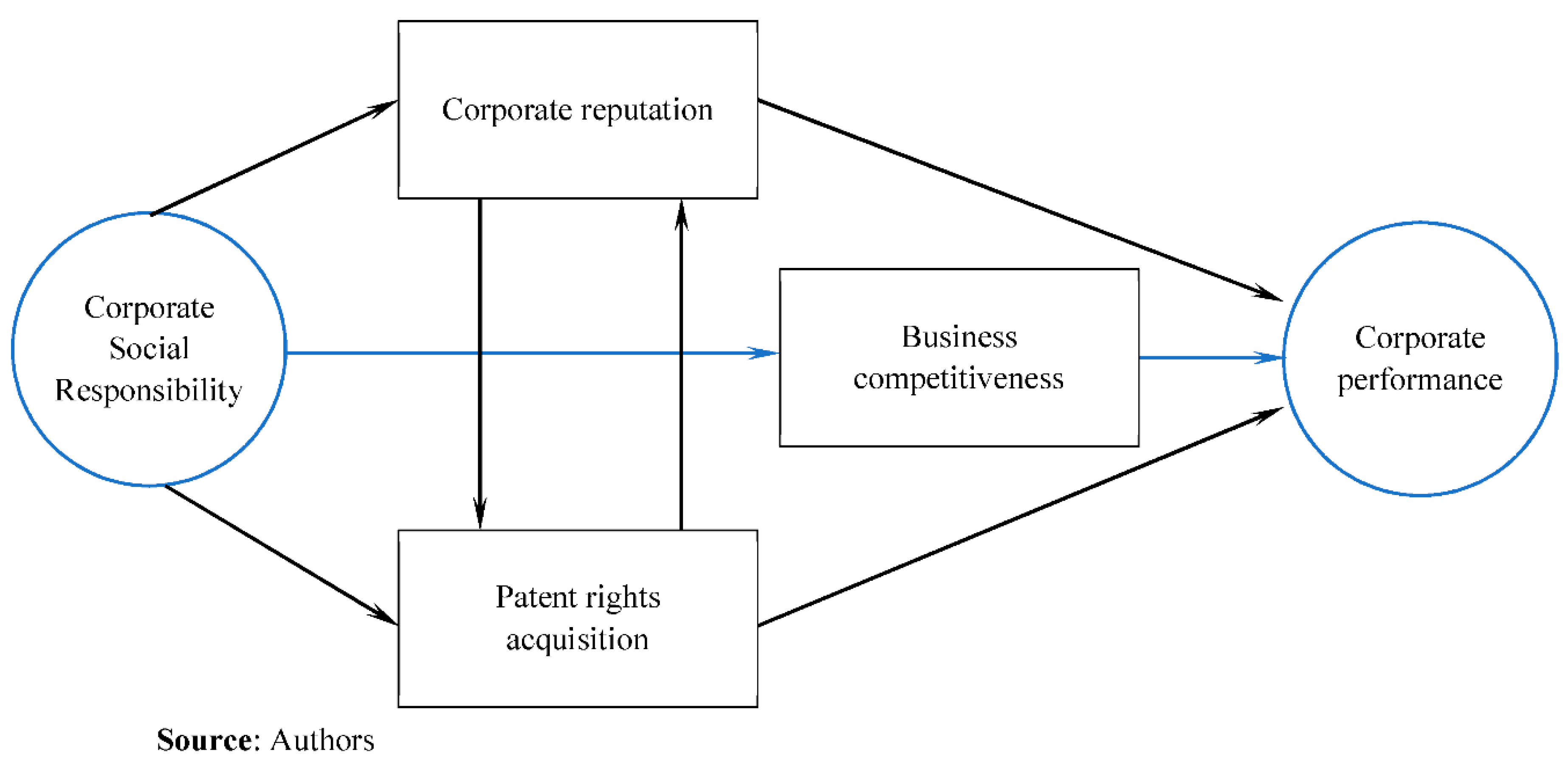
Figure 2.
Correlation between change of the given 3 variables and dependant variable (production value).
Figure 2.
Correlation between change of the given 3 variables and dependant variable (production value).
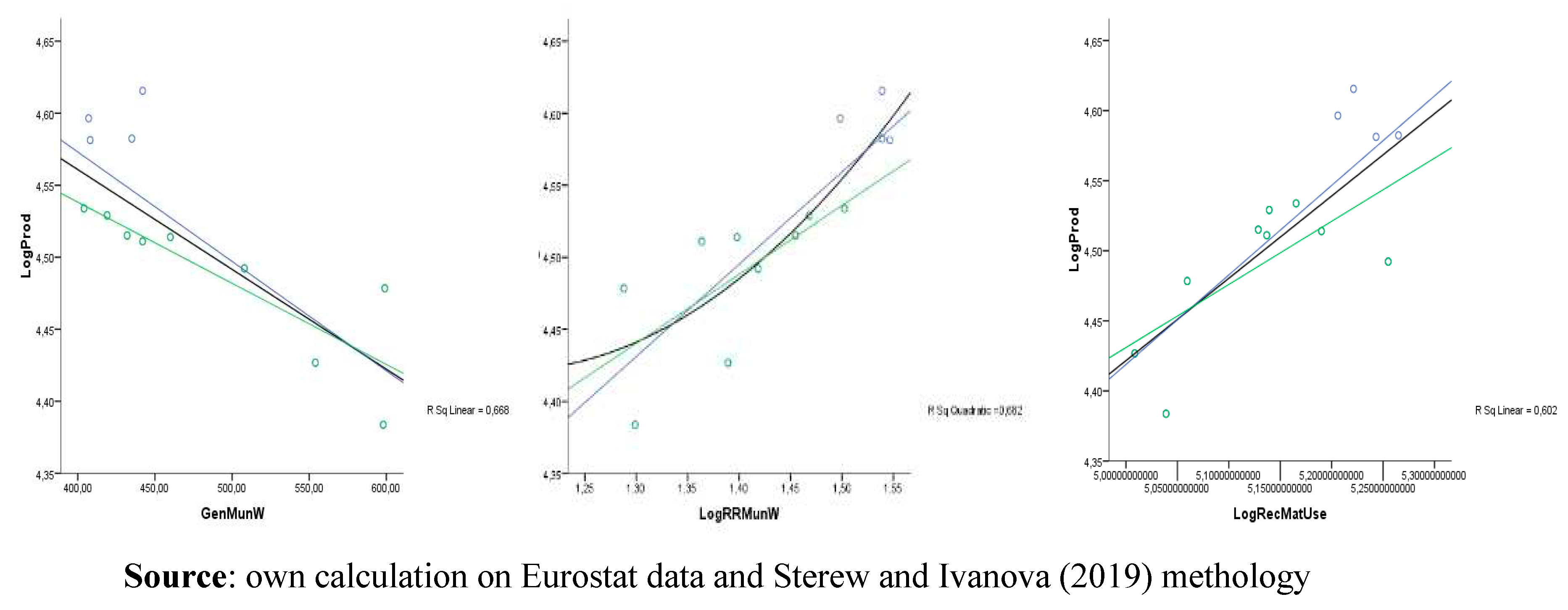
Figure 3.
Methodology for assessing the reputation risk of patented products in high-tech companies.
Figure 3.
Methodology for assessing the reputation risk of patented products in high-tech companies.
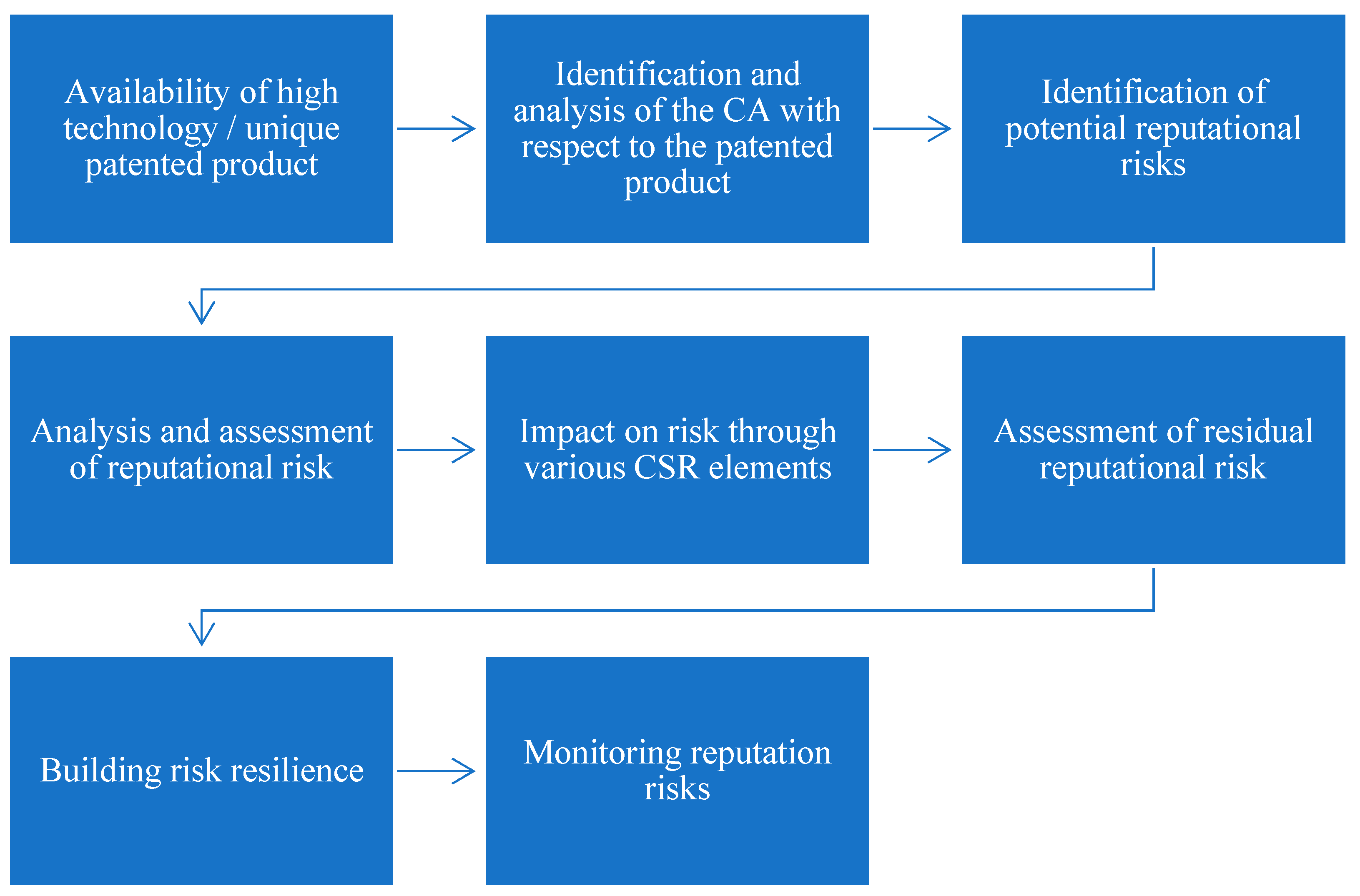

Table 1.
Main characteristics of business reputation.
| Relational Construct | Depending on the corporate's reputation, stakeholders' perspectives on it can vary. |
| Exception Attributed | A corporate’s reputation is based on the qualities that set it apart from other players in the market. |
| Perception Comparison | An corporate’s reputation is how the general public sees it. |
| Unintended Consequences | Reputation may be impacted by unanticipated events or third parties. |
| Track Record | Experience is the foundation upon which reputation is created, and with time |
| Emotional Appeal | Corporate’s reputation is based on trust |
Source: based on Honey, G. 2009. A Short Guide to Reputation Risk. Gower Publishing Company. https://doi.org/10.4324/9781315263618-4. рр.38-59.
Disclaimer/Publisher’s Note: The statements, opinions and data contained in all publications are solely those of the individual author(s) and contributor(s) and not of MDPI and/or the editor(s). MDPI and/or the editor(s) disclaim responsibility for any injury to people or property resulting from any ideas, methods, instructions or products referred to in the content. |
© 2023 by the authors. Licensee MDPI, Basel, Switzerland. This article is an open access article distributed under the terms and conditions of the Creative Commons Attribution (CC BY) license (http://creativecommons.org/licenses/by/4.0/).
Copyright: This open access article is published under a Creative Commons CC BY 4.0 license, which permit the free download, distribution, and reuse, provided that the author and preprint are cited in any reuse.


