
Submitted:
14 June 2023
Posted:
15 June 2023
You are already at the latest version
Abstract
Wood is very susceptible to the action of biotic agents. There is a growing interest in the protection of wood and wood artworks to extend their life, using environmentally friendly preservatives. The aim of this paper was the study of nano/siliconate impregnation system for wood protection to control biological colonization. The biotic agents studied have been wood decay fungi. In conclusion, this paper has shown that all the treatments have presented an excellent protective performance against biotic agents. Is important to mention that a synergistic effect can be observed when generating the siliconate/nanoparticle mixtures, resulting in protective systems with excellent efficiency for all the degrading agents. Moreover, it presents an easy application, which represents not only a watertight protective system, but also a set of systems that may be used and managed according to the availability of the active components, the costs, and, most importantly, without having to modify the form of application.
Keywords:
siliconate
; nanometals
; wood
; protection
1. Introduction
The biodegradation of wood and wood products caused by fungi is recognized as one of the most significant problems worldwide, especially when it comes to heritage objects. Their actions can lead to potential historical losses. As a result, there is a growing interest in the conservation of wood and wood artworks, with a focus on using environmentally friendly preservatives [1,2,3,4].
Silicon compounds are synthetic molecules widely used in wood protection due to their unique bifunctional structure and specific reactivity [5]. They have been utilized for the preservation and conservation of wood and wood-based products, as well as additives for preservatives, with the aim of improving weathering performance, reducing wood hydrophilicity, decreasing flammability, and enhancing decay resistance [6,7,8]. To achieve more durable wood chemical modification, silicon derivatives (such as isocyanate or epoxy) containing chemical groups capable of forming stable covalent bonds with the -OH groups present in wood polymers may also be applied. Functionalized siloxanes can also be used for wood modification, characterized by a stable and flexible siloxane chain that facilitates proper orientation on the modified surface. Additionally, various functional groups can be attached to the siloxane chain, allowing the formation of stable linkages with the substrate, and providing specific properties [9,10,11,12].
The interaction of nanoparticles with biomolecules and microorganisms is an expanding field of research. Recently, there has been a growing interest in silver formulations as wood preservatives. Copper-based formulations have been widely used for several years, particularly in ground contact applications, to treat wood due to their effectiveness as a biocide and relatively low mammalian toxicity. Several research groups have recently studied nano and micronized preparations of copper, zinc, and silver to enhance wood resistance against fungi and termites. Additionally, some nanoparticles provide resistance against UV radiation, scratches, abrasions, and fire properties, among others [13,14,15,16,17,18].
Therefore, the objective of this paper has been to study the application of two technologies, namely nanoparticles and siliconate, as a wood protective system to enhance resistance against decay fungi.
2. Materials and Methods
The study was conducted on samples of Pinus ponderosa Dougl. ex C. Lawson. The cuts had a latewood percentage ranging between 25% and 30%. Before impregnation, the wood samples were dried at 105 ºC. The modifiers or protective agents used included siliconates and nanoparticles.
Impregnant formulation
Synthesis of nanoparticles:
- -
- Nanosilver was synthesized through a chemical process using silver nitrate and sodium citrate as the reducing agent. A solution was prepared by dissolving 0.088 g of silver nitrate (1.061 mM) in 500 mL of water. The solution was then heated to boiling with magnetic stirring at 800 rpm. Once the temperature reached 90 °C, 10 mL of 1% sodium citrate (0.1 g / 10 mL) was added dropwise while maintaining continuous stirring until the solution turned bright yellow. The final dispersion had a concentration of 112 ppm.
- -
- Nanocopper was also prepared by a chemical process. A solution was made by dissolving 0.156 g of Cl2Cu in 150 mL of solution. The solution was then stirred while adding 90 mL of a 1.5 M sodium hydroxide solution (6 g/100 mL) as a hydrolysis agent. Glucose (approximately 7 g) was gradually added to the solution until it turned yellowish-brown. Stirring was stopped, and the solution was placed in a 90 °C bath until it turned black (approximately 20 minutes). The final dispersion had a concentration of 324 ppm.
The chemical composition of the impregnant was as follows: 1% siliconate (10mL/1000mL; 2.4 M postassium methylsiliconate; SILRES BS16; CAS 31795-24-1), 1.6% nanosilver (16mL/1000mL), 0.8% nanocopper dispersion (8mL/1000mL), 70.9% 96° ethanol (CAS 64-17-5; 709 mL/1000mL) and 25.7% distilled water (257 mL/1000mL).
The impregnant agent was applied using a brush, treating the solution as a wood stain.
(i) The first coats were diluted at 50% with 70/30% alcohol.
(ii) The subsequent two coats were applied at 75% and 100% dilution, respectively.
(iii) Finally, the wood samples were exposed in a chamber under controlled conditions of temperature and humidity (20±2 °C and 60±5% RH) for three weeks to allow for gelation and aging (sol-gel).
Decay resistance
Samples treated with the impregnant (sized 20 x 20 x 20 mm) were exposed to Coniophora puteana (brown rot) and Pleurotus ostreatus (white rot) for 16 weeks under controlled conditions (25±5 °C and 60-70% RH), following the general guidelines outlined in ASTM D 2017. Subsequently, the samples were placed in an oven at 100±3 °C until a constant weight was achieved.
The mass loss percentages were determined using the following equation:
WL, % = [(Wo - Wf) / Wo] × 100
Where Wo is the weight of the dried sample without exposure to fungi, and Wf is the weight of the dried sample after exposure to fungi.
The design of the decay test allowed a comparison of the mass loss between treated and untreated samples. Mass loss is directly correlated with wood degradation and was used as a measure of decay resistance. The weights of dried samples were recorded both with and without exposure to decay fungi, and relative weights were calculated. The classification of decay resistance was determined according to Standard EN 350-1(1994), which introduced five durability classes based on the ratio of mass loss of treated samples to untreated control samples. The durability classes are as follows: very durable (ratio ≤ 0.15), durable (ratio > 0.15 to 0.30), moderately durable (ratio > 0.30 to 0.60), slightly durable (ratio > 0.60 to 0.90), and not durable (ratio > 0.90).
Leaching test
The treated wood samples were submerged in water for various durations, ranging from 1 hour to 120 hours. The measurements were taken at regular intervals, starting with hourly measurements for the first 8 hours and then transitioning to measurements taken every 24 hours. The remaining residues in the water were analyzed using UV spectrophotometry, with specific wavelengths determined for each material in the mixture. The blank sample used for comparison was the impregnant solution diluted in water.
3. Results
3.1. Decay resistance and leaching test
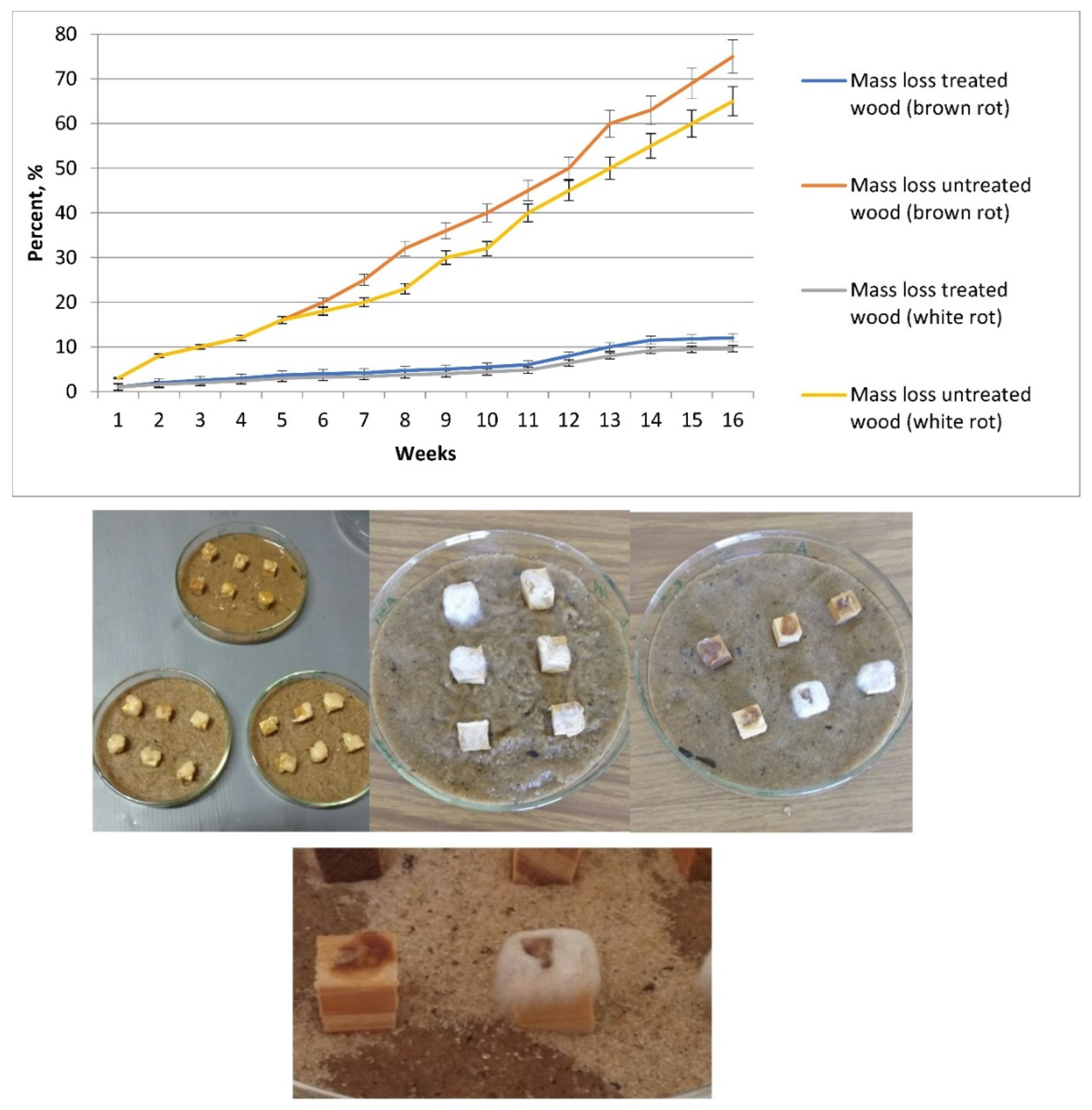
The results of the decay resistance test are shown in Figure 1, which illustrates the percentage of mass loss after 16 weeks of exposure to both types of rot. In the case of the untreated samples, all of them exhibited mass loss values exceeding the minimum threshold specified by the standard (20%), thereby validating the decay test.
The treatment applied to the wood resulted in reduced mass loss, indicating that the treatment could effectively protect the wood from fungal degradation. Based on the criteria outlined in Standard EN 350-1(1994), the ratio of mass loss for the treated wood samples was below 0.15, classifying them as “very durable” wood.
By analyzing the differential weight loss of the control samples based on the species they were exposed to, it is evident that Coniophora puteana (brown or cubic rot, which primarily degrades cellulose) has exhibited the highest level of aggressiveness followed by Pleurotus ostreatus (white rot, which primarily degrades lignin).
Based on the information provided, it can be concluded that the chemical modification occurred in different layers of the cell wall, with the variety of rot being determined by the polymer that the fungi attacks. This can be attributed to the interaction between the impregnant and the cell wall components during the hydrolysis and condensation reactions of the sol-gel process, resulting in the formation of a non-occlusive coating on the wood.
This conclusion is supported by the following observations:
(i) During the impregnation process, the water-repellent substances (siliconate and nanoparticles) are carried by the alcohol and water and deposited on the wood surface, where polymerization occurs through the sol-gel process.
(ii) The alcohol evaporates during the formation of the xerogel film, which occurs during curing and aging.
(iii) The formation of the coating is not uniform and occurs in certain areas surrounding non-coated regions. In other words, the coating is formed around clusters of cells, leaving an untreated core.
This explanation accounts for the effective protection of the wood, even when low levels of impregnant are used.
Silanes and nanoparticles have been found to possess a moderate ability to penetrate the wood cell wall. This property has been demonstrated in various studies. For instance, when Pine wood was impregnated with silver nanoparticles, it exhibited lower weight loss caused by the fungus T. versicolor compared to untreated wood. Similarly, silver nanoparticles dispersed in water were effective in providing strong protection against molds such as A. niger, P. citrinum, and T. viride on the surface of poplar wood. Furthermore, wood treated with a nano silver-copper alloy displayed enhanced resistance against mold compared to untreated wood samples [22,23,24,25].
These findings suggest that the incorporation of silanes and nanoparticles into wood can effectively inhibit the growth of fungi and molds, thereby reducing the extent of decay and surface contamination. The ability of these materials to penetrate the wood cell wall allows them to provide a protective barrier and enhance the overall durability of the wood.
Overall, the studies mentioned support the idea that the use of silanes and nanoparticles in wood treatment can significantly improve its resistance to fungal decay and mold growth, thereby enhancing its longevity and durability.
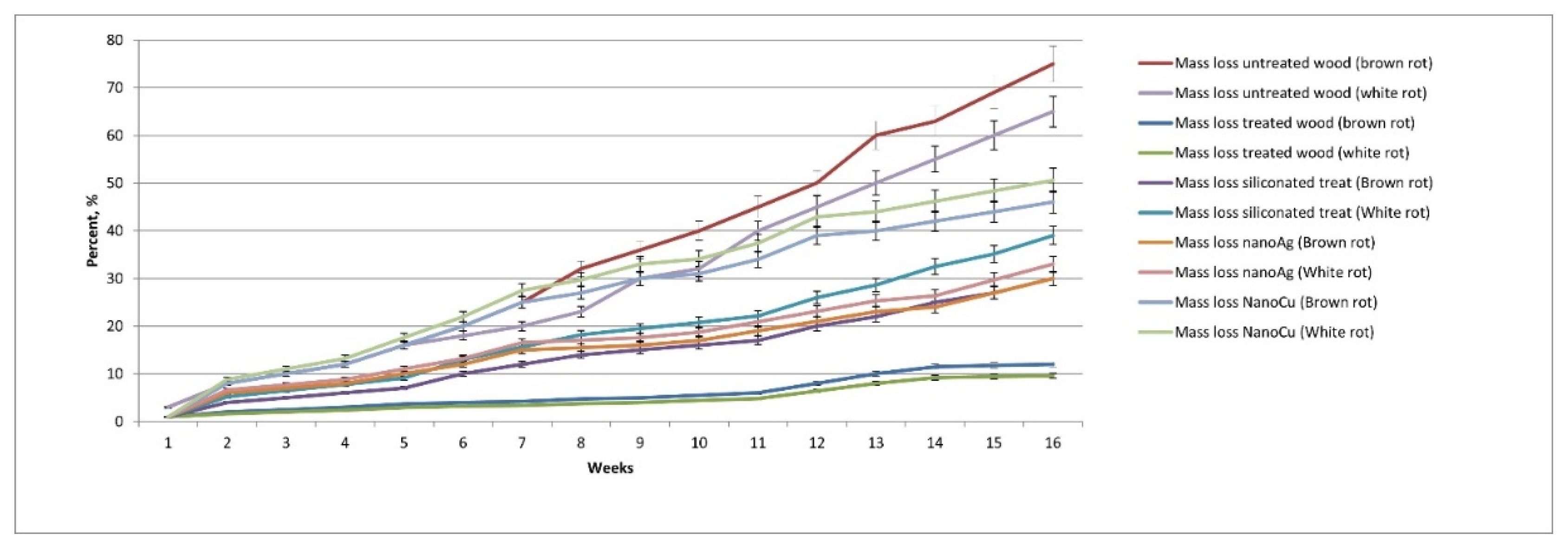
Indeed, in this study, the nanoparticles used in combination with siliconate could be acting as an anchorage, enhancing the wood's chemical modification. The presence of nanoparticles not only contributes to the overall protective effect but also provides additional benefits through their intrinsic properties.
Firstly, the nanoparticles can facilitate the chemical modification of the wood cell wall by serving as anchor points for the siliconate molecules. This improves the adhesion and penetration of the siliconate into the wood structure, resulting in a more effective and durable modification of the cell wall components.
Secondly, the nanoparticles themselves may possess biocidal properties, which further contribute to the protection of the wood. The nanoparticles can inhibit the growth of microorganisms, such as fungi and molds, thus preventing decay and surface contamination. This dual mechanism of action, involving both the chemical modification of the wood and the biocidal effect of the nanoparticles, confirms the performance and effectiveness of the treatment.
By combining the benefits of chemical modification and the biocidal properties of nanoparticles, the treated wood exhibits enhanced resistance against degradation and microbial attack. This approach provides a comprehensive and multifaceted protection strategy for wood preservation, ultimately improving its durability and extending its lifetime.
The results of the leaching test are crucial in assessing the potential environmental impact and residual toxicity risks associated with the impregnant. The absence of migration or leaching of the impregnant or its active components into the water throughout the test duration is a positive finding.
This indicates that the impregnant used in the study did not release any significant amounts of toxic substances into the surrounding environment. The lack of leaching suggests that the impregnant remains bound within the wood matrix and does not pose a risk of contaminating water sources or causing adverse effects on aquatic organisms.
This information is important for evaluating the environmental safety and sustainability of the impregnation treatment. It provides assurance that the treatment is not introducing harmful substances into the ecosystem and can be considered as an environmentally friendly option for wood protection.
It is worth noting that the absence of leaching observed in this specific study does not guarantee the same outcome for different formulations or conditions. Further research and testing may be necessary to assess the leaching potential of impregnants under various scenarios and to ensure their long-term environmental safety.
3.2. Figures, Tables and Schemes
Figure 2.
Synergic effect of treatment.
4. Discussion
The polymerization that occurs in the cell wall because of the impregnation process could indeed contribute to the wood's decay resistance performance. The formation of a polymerized layer within the cell wall can create a steric hindrance, physically blocking the access points that fungi enzymes require to degrade and grow within the wood.
When the impregnant, including siliconates and nanoparticles, undergoes polymerization, it forms a solid coating or matrix within the wood cell wall. This coating acts as a barrier, restricting the movement of the fungi enzymes and preventing them from accessing the carbon sources present in the wood.
By creating a physical hindrance, the polymerized layer impedes the progress of fungal decay, effectively inhibiting the growth and development of fungi within the wood structure. This steric hindrance mechanism adds an additional layer of protection and contributes to the overall decay resistance performance of the treated wood.
It is important to note that the combination of chemical modification, nanoparticle biocide effect, and the steric hindrance created by polymerization collectively enhance the wood's resistance to decay and provide a comprehensive approach to wood preservation.
5. Conclusions
In conclusion, the impregnant treatment proposed in this study proved to be an effective technique for the restoration, protection, and conservation of heritage assets. It offers several advantages over traditional restoration methods, such as the absence of toxic solvents, no formation of an internal polymer structure, and shorter curing time, among others.
One significant advantage of the impregnant treatment is that it does not alter the aesthetics of the wood. This makes it particularly suitable for use as a consolidant for heritage objects, as it allows for the preservation of their original appearance.
The combination of the impregnant with siliconate and nanoparticles resulted in a synergistic effect, enhancing the protective properties of the treatment against biological wood deterioration. This demonstrates the efficacy of combining different treatments to achieve a more efficient and comprehensive protective system.
Overall, the proposed impregnant treatment offers a valuable alternative for the restoration and conservation of heritage assets, providing effective wood protection while considering important factors such as environmental safety, aesthetics preservation, and efficiency. Further research and application in the field of heritage conservation are warranted to validate and expand upon these findings.
Author Contributions
For research articles both authors contributed equally.
Funding
This research was funded by Universidad Tecnológica Nacional and Ministerio de Ciencia y Tecnología de la Nación Argentina.
Institutional Review Board Statement
Not applicable.
Informed Consent Statement
Not applicable.
Acknowledgments
To Universidad Tecnológica Nacional, CONICET y CICPBA.
Conflicts of Interest
The authors declare no conflict of interest.
References
- Embacher, J.; Zeilinger, S.; Kirchmair, M.; Rodriguez-R, L.M.; Neuhauser, S. Wood decay fungi and their bacterial interaction partners in the built environment – A systematic review on fungal bacteria interactions in dead wood and timber. Fungal Biology Reviews. 2023, 45, 100305 ISSN 1749-4613. [CrossRef]
- Broda, M; Dąbek, I.; Dutkiewicz, A.; Dutkiewicz, M.; Popescu, C.M.; Mazela, B.; Maciejewski, H. Organosilicons of different molecular size and chemical structure as consolidants for waterlogged archaeological wood – a new reversible and retreatable method. Scientific Reports, 2020, 10, 2188. [CrossRef]
- Konsa, K. et al. Wooden objects in museums: managing biodeterioration situation International. Biodeterioration & Biodegradation, 2nd International Conference on Biodeterioration of Wood and Wood Products, 2014, Tartu, Estonia. [CrossRef]
- Korb, W. and Avérous, L. Recent developments in the conservation of materials properties of historical wood. Progress in Materials Science. 2019, 102, 167-221. [CrossRef]
- Broda, M.; Plaza, N.Z. Durability of model degraded wood treated with organosilicon compounds against fungal decay. International Biodeterioration & Biodegradation. 2023, 178, 105562. [CrossRef]
- Broda, M.; Dąbek, I.; Dutkiewicz, A. et al. Organosilicons of different molecular size and chemical structure as consolidants for waterlogged archaeological wood – a new reversible and retreatable method. Sci Rep. 2020 ,10, 2188. [CrossRef]
- Yona, A.M.C.; Žigon, J.; Matjaž, P. et al. Potentials of silicate-based formulations for wood protection and improvement of mechanical properties: A review. Wood Science Technology. 2021, 55, 887–918. [CrossRef]
- Salanti, A.; Zoia, L.; Zanini, S.; Orlandi, M. Synthesis and characterization of lignin–silicone hybrid polymers as possible consolidants for decayed wood. Wood Science Technology. 2016, 50(1), 117–134. [Google Scholar] [CrossRef]
- Teaca, C.A.; Ro¸su, D.; Musta¸ta, F.; Rusu, T.; Ro¸su, L.; Ro¸sca, I.; Varganici, C.-D. Natural Bio-Based Products for Wood Coating and Protection against Degradation: A Review. BioResources 2019, 14, 4873–4901. [Google Scholar] [CrossRef]
- Semenzin, E.; Subramanian, V.; Pizzol, L.; Zabeo, A.; Fransman, W.; Oksel, C.; Hristozov, D.; Marcomini, A. Controlling the risks of nano-enabled products through the life cycle: The case of nano copper oxide paint for wood protection and nano-pigments used in the automotive industry. Environment International. 2019, 131, 104901. [Google Scholar] [CrossRef] [PubMed]
- Eduok, U.; Faye, O.; Szpunar, J. Recent developments and applications of protective silicone coatings: A review of PDMS functional materials. Progress in Organic Coatings. 2017, 111, 124–163. [Google Scholar] [CrossRef]
- Liu, W.; Hu, C.; Zhang, W.; Liu, Z.; Shu, J.; Gu, J. Modification of birch wood surface with silane coupling agents for adhesion improvement of UV-curable ink. Progress in Organic Coatings, 148, 2020, 105833. [CrossRef]
- Pour, M.F; Mehdinia, M.; Kiamahalleh, M.V.; Hoseini, K.D.; Hatefnia, H.; Dorieh, A. Biological durability of particleboard: fungicidal properties of Ag and Cu nanoparticles against Trametes versicolor white-rot fungus. Wood Material Science & Engineering, 2022. 17:6, 929-936. [CrossRef]
- Dai, X.; Qi, Y.; Luo, H.; He, Z.; Wei, L.; Dong, X.; Ma, X.; Yang, D.-Q.; Li, Y. Leachability and Anti-Mold Efficiency of Nanosilver on Poplar Wood Surface. Polymers 2022, 14, 884. [Google Scholar] [CrossRef] [PubMed]
- Nair, S., K S, S., R, S. Advancements in Nanotechnological Applications for Wood Protection. In: Sundararaj, R. (eds), 2022, Science of Wood Degradation and its Protection. Springer, Singapore. [CrossRef]
- Khadiran, T., Jasmani, L., Rusli, R. Application of Nanomaterials for Wood Protection. In: Taghiyari, H.R., Morrell, J.J., Husen, A. (eds) 2023, Emerging Nanomaterials. Springer, Cham. [CrossRef]
- Aguayo, M.G.; Oviedo, C.; Reyes, L.; Navarrete, J.; Gómez, L.; Torres, H.; Gaviño, G.; Trollund, E. Radiata Pine Wood Treated with Copper Nanoparticles: Leaching Analysis and Fungal Degradation. Forests 2021, 12, 1606. [Google Scholar] [CrossRef]
- Piętka, J.; Adamczuk, A.; Zarzycka, E.; Tulik, M.; Studnicki, M.; Oszako, T.; Aleksandrowicz-Trzcińska, M. The Application of Copper and Silver Nanoparticles in the Protection of Fagus sylvatica Wood against Decomposition by Fomes fomentarius. Forests, 2022, 13, 1724. [CrossRef]
- Blanchet, P.; Pepin, S. Trends in Chemical Wood Surface Improvements and modifications: A Review of the Last Five Years. Coatings, 2021, 11, 1514. [CrossRef]
- Andriulo, F.; Vespignani, L.; Steindal, C. C.; Bortolini, M.; de Ferri, L. Evaluation of sol-gel hybrid nanocomposites for dry medieval wood. Journal of Cultural Heritage, 2022, 56, 96-107. [CrossRef]
- Spear, M.J.; Curling, S.F.; Dimitriou, A.; Ormondroyd, G.A. Review of Functional Treatments for Modified Wood. Coatings, 2021, 11, 327. [CrossRef]
- Jirouš-Rajković, V.; Miklečić, J. Enhancing Weathering Resistance of Wood—A Review. Polymers, 2021, 13, 1980. [CrossRef]
- Wu, X.; Yang, F.; Gan, J.; Kong, Z.; Wu, Y. A Superhydrophobic, Antibacterial, and Durable Surface of Poplar Wood. Nanomaterials, 2021, 11, 1885. [CrossRef]
- Shilova, O.A.; Tsvetkova, I.N.; Vlasov, D.Y.; Ryabusheva, Y.U.; Sokolov, G.S.; Kychkin, A.K.; Nguyên, C.; Khoroshavina, Y.V. Microbiologically induced deterioration and environmentally friendly protection of wood products, Editor(s): Hafiz M.N. Iqbal, Muhammad Bilal, Tuan Anh Nguyen, Ghulam Yasin, 2022. In Micro and Nano Technologies, Biodegradation and Biodeterioration at the Nanoscale, Elsevier, 283-321. [CrossRef]
- Kozłowski, R.M; Walentowska, J. Prevention of fungi and bacteria growth in natural fibres, Editor(s): Ryszard M. Kozłowski, Maria Mackiewicz-Talarczyk, 2020. In Woodhead Publishing Series in Textiles, Handbook of Natural Fibres (Second Edition), Woodhead Publishing, 693-714. [CrossRef]
Figure 1.
Decay resistance test.
Disclaimer/Publisher’s Note: The statements, opinions and data contained in all publications are solely those of the individual author(s) and contributor(s) and not of MDPI and/or the editor(s). MDPI and/or the editor(s) disclaim responsibility for any injury to people or property resulting from any ideas, methods, instructions or products referred to in the content. |
© 2023 by the authors. Licensee MDPI, Basel, Switzerland. This article is an open access article distributed under the terms and conditions of the Creative Commons Attribution (CC BY) license (http://creativecommons.org/licenses/by/4.0/).
Copyright: This open access article is published under a Creative Commons CC BY 4.0 license, which permit the free download, distribution, and reuse, provided that the author and preprint are cited in any reuse.


