

Submitted:
12 June 2023
Posted:
13 June 2023
You are already at the latest version
Abstract
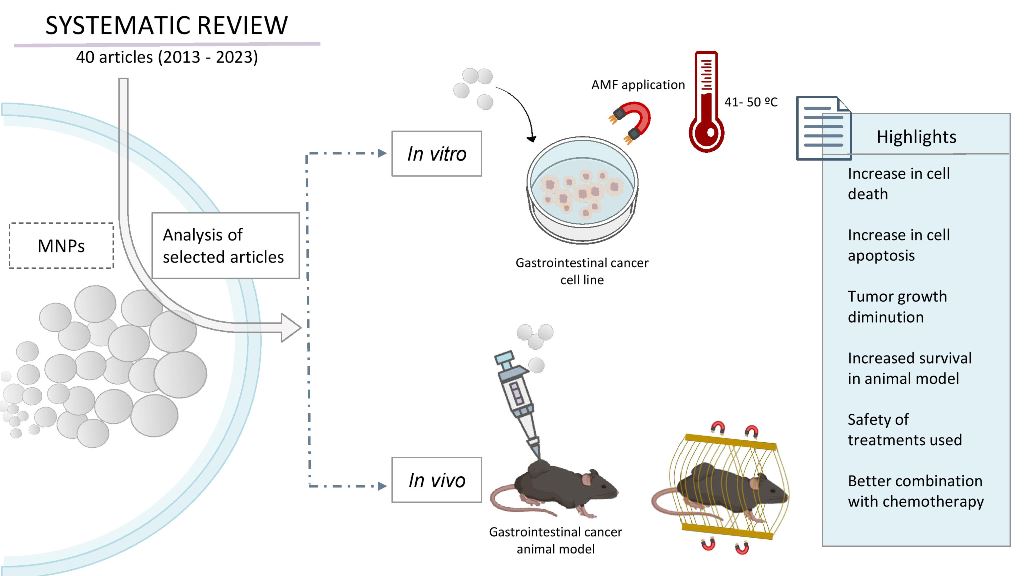
The incidence of gastrointestinal cancers has seen a significant increase in recent years. Current treatments present numerous challenges, including drug resistance, non-specificity, and severe side effects, among others. These issues have necessitated the exploration of new therapeutic strategies. One promising avenue is the use of magnetic nanoparticles, which have gained considerable interest due to their ability to generate heat in tumor regions upon the application of an external alternating magnetic field, a process known as hyperthermia. This review conducted a systematic search of in vitro and in vivo studies published in the last decade that employ hyperthermia therapy mediated by magnetic nanoparticles for treating gastrointestinal cancers. After applying various inclusion and exclusion criteria, a total of 40 articles were analyzed. The results revealed that iron oxide is the preferred material for magnetism generation in the nanoparticles, and colorectal cancer is the most studied gastrointestinal cancer. Interestingly, novel therapies employing nanoparticles loaded with chemotherapeutic drugs demonstrated an excellent antitumor effect. In conclusion, hyperthermia treatments mediated by magnetic nanoparticles appear to be an effective approach for the treatment of gastrointestinal cancers, offering advantages over traditional therapies.
Keywords:
Gastrointestinal cancer
; magnetic nanoparticles
; hyperthermia
; cytotoxic drugs
1. Introduction
The treatment of gastrointestinal cancer poses a significant challenge due to its increasing incidence in the population [1]. For example, colorectal cancer (CRC) ranks third in incidence and second in mortality, while stomach cancer (GC) and esophageal cancer (EC) rank fourth and sixth in mortality, respectively [2]
Current treatments encompass resection surgery along with chemotherapy, radiation therapy, and/or targeted therapies [3,4]. A broad range of drugs are utilized in various types of gastrointestinal cancer. These include 5-fluorouracil (5-FU), oxaliplatin (OXA), and irinotecan (IRI) in CRC; 5-fluorouracil combined with leucovorin, docetaxel, and oxaliplatin (FLOT) in GC [5]; and carboplatin and paclitaxel in EC, among others [6]. However, most drugs and their combinations generate side effects that can lead to treatment failure. For example, neurotoxicity is induced by OXA [7], cardiotoxicity by 5-fluorouracil [8], and severe neutropenia and hypersensitivity reactions follow paclitaxel treatment [9]. Additionally, drug resistance mechanisms induced by cytotoxics lead to poor response to chemotherapy and patient relapse [10]. Therefore, there is an essential need for new strategies to improve the prognosis of these diseases.
In this context, nanomedicine has emerged as a promising approach to cancer treatment and diagnosis. Numerous nanoformulations are available, with sizes ranging from 1 to 100 nm. Their inherent characteristics provide a drug delivery system with several advantages, such as reduced side effects of antitumor agents, improved targeting to the affected region, and increased drug levels in the tumor region, among others [10]. Both organic and inorganic nanoparticles (NPs) [11] have been employed to enhance cancer therapy. In fact, lipid-based nanoparticles have been the first clinically approved therapeutic nanoplatform against cancer by the FDA [12]. A classic example of its application is Doxil, a PEGylated liposome loaded with the drug Doxorubicin (DOXO) [13]. More recently, Onivyde, a liposome encapsulated with irinotecan, was approved by the FDA for the treatment of metastatic pancreatic cancer [14].
In this regard, magnetic NPs, a group of inorganic nanoformulations, have been proposed as an innovative strategy due to their physicochemical properties. They consist of a magnetic core and a polymeric coating, with iron oxide NPs being the most widely utilized. Magnetic NPs have superparamagnetic properties, which means that they are magnetized in the presence of an alternating external magnetic field (AMF), but lose magnetization without it, thereby reducing the potential for aggregation in the body and, consequently, the probability of embolization [15,16]. Among the advantages of these NPs is their ability to diffuse to the tumor region due to the application of a magnetic field near the target tissue [17]. Additionally, magnetic cores are used as contrast agents in various imaging techniques, such as magnetic resonance imaging (MRI), or newer techniques such as magnetic particle imaging. This allows for tracking these nanoformulations as they circulate within the organism, which is an interesting approach in terms of establishing targeted therapy [18].
Another major advantage derived from the use of magnetic NPs is their ability to generate high temperatures when an AMF is applied, which is known as hyperthermia. This property is considered one of the most intriguing and promising applications in the field of cancer nanomedicine, since it offers the possibility of applying a combined treatment, integrating the antitumor capacity of the drug loaded in the NPs and the hyperthermia generated [19]. Promising results have been obtained in various types of cancer after applying hyperthermia treatment alone or in combination with chemotherapy [20,21]. Recently, Narayanaswamy et al. (2022) utilized NPs with a MnFe2O4 core and an Fe3O4 shell against human colon and breast cancer cell lines (MDA-MB-231 and HT-29, respectively), increasing cell death by up to 70% [22]. Furthermore, Piehler et al. (2020) and Rego et al. (2020) demonstrated the applicability of hyperthermia in vivo using DOX-functionalized magnetic NPs and aminosilane-coated iron oxide NPs, respectively [23,24]. Dabaghi et al. (2021) developed 5-FU functionalized chitosan-coated magnetic NPs to deliver hyperthermia specifically against CRC-induced mice, showing a significant reduction in tumor volume and tumor vascularization [25]. In sum, many results support the benefits of hyperthermia therapy in cancer treatment.
In the present systematic review, we analyzed the most recently published studies on the application of hyperthermia based on magnetic NPs in gastrointestinal cancers. The review highlights crucial aspects of the emerging advancements in magnetic nanomaterials and provides a brief overview of the challenges and limitations of this therapeutic strategy.
2. Materials and Methods
2.1. Study eligibility
The purpose of the present systematic review was to analyze the most recent and representative information on studies evaluating the therapeutic efficacy of NPs-mediated hyperthermia in the treatment of various gastrointestinal cancers. This review was conducted following the criteria set out in the PRISMA guidelines [26]. To this end, only studies from the last 10 years were considered, deeming older ones as obsolete. According to the Burton-Kebler index for obsolescence [27], more than half of the publications on this subject were included.
2.2. Inclusion Criteria
This systematic review included scientific publications between January 2013 and January 2023, with full text available and written in English. We also included works where hyperthermia treatment was applied through the use of an AMF on the NPs of interest, as a therapy against any of the known gastrointestinal cancers.
2.3. Exclusion Criteria
Studies were excluded if hyperthermia, defined as an increase in temperature, was applied by any method other than the use of a magnetic field, such as water baths, lasers, ultrasound, etc. Furthermore, reviews, meta-analyses, systematic reviews, book chapters, or editorials were not considered for the review.
2.4. Data Sources
For the bibliographic search, the electronic databases Pubmed, SCOPUS and Web of Science were used. The first established medical subject heading (MeSH) terms included: “Colorectal Neoplasms”, “Gastrointestinal Neoplasms”, “Esophageal Neoplasms”, “Intestinal Neoplasms”, “Stomach Neoplasms”, “Cecal Neoplasms”, “Duodenal Neoplasms”, “Ileal Neoplasms”, “Jejunal Neoplasms”, “Nanoparticles”, “Liposomes” and “Hyperthermia”. The final search equation was (("Colorectal Neoplasms"[MeSH Terms] OR "Gastrointestinal Neoplasms"[MeSH Terms] OR "Esophageal Neoplasms"[MeSH Terms] OR "Intestinal Neoplasms"[MeSH Terms] OR "Stomach Neoplasms"[MeSH Terms] OR "Cecal Neoplasms"[MeSH Terms] OR "Duodenal Neoplasms"[MeSH Terms] OR "Ileal Neoplasms"[MeSH Terms] OR "Jejunal Neoplasms"[MeSH Terms]) OR (("colon"[Title/Abstract] OR "colorectal"[Title/Abstract] OR "colonic"[Title/Abstract] OR "Gastric*"[Title/Abstract] OR “Gastrointestinal”[Title/Abstract] OR "Esophageal*"[Title/Abstract] OR “Intestinal*"[Title/Abstract] OR "Stomach*"[Title/Abstract] OR "Cecal*"[Title/Abstract] OR "Duodenal*"[Title/Abstract] OR "Ileal*"[Title/Abstract] OR “Jejunal*"[Title/Abstract]) AND ("cancer*"[Title/Abstract] OR "tumor*"[Title/Abstract] OR "tumour*"[Title/Abstract] OR "neoplasm*"[Title/Abstract] OR “carcinoma*” [Title/Abstract]))) AND ("nanoparticles"[MeSH Terms] OR "nanoparticle*"[Title/Abstract] OR "nanoconjugate*"[Title/Abstract] OR "liposomes"[MeSH Terms] OR "liposome*"[Title/Abstract]) AND (“hyperthermia”[ MeSH Terms] OR “hyperthermia*”[Title/Abstract]). Some minor modifications were made to adjust the search in the rest of the databases.
2.5. Study Selection
Two of the authors (L.G. and F.Q.) conducted the literature search. Initially, all articles were analyzed by title and abstract, with those meeting the inclusion criteria being selected. Both authors then reviewed all the selected articles through full-text analysis, considering the established inclusion and exclusion criteria.
2.6. Data Extraction
Following the study selection process, the same two authors separately analyzed the selected articles to extract data. Cohen's Kappa statistical test exceeded 0.8 (Cohen, 1968), indicating good agreement between the two authors [28]. All discrepancies were resolved by consensus between authors F.Q. and L.G., and when necessary, two other authors intervened. A specific questionnaire, divided into two evaluation phases, was used to establish the quality of the selected articles; those papers scoring less than 6 points were excluded from the systematic review. Table 1, which presents the data obtained after exhaustive analysis of each article, includes information on the type of nanoformulation used, the antitumor agent transported, the applied magnetic field, and notable in vitro and in vivo results, in addition to the article reference.
3. Results and Discussion
3.1. Study Description
After conducting the bibliographic search in the PubMed, SCOPUS and Web of Science databases, a total of 672 articles were obtained. Subsequently, 193 duplicate articles were excluded and, once analyzed by title and abstract, another 429 articles were excluded, leaving 50 selected. Likewise, 9 of the 50 articles did not meet the inclusion criteria and 1 of them had low quality values. Therefore, a total of 40 articles were finally included in the present systematic review. All the data concerning the search are represented in the flow diagram in Figure 1.
3.2. Characteristics of magnetic nanoformulations
Table 1 shows the different nanoformulations used in each article and some of their main characteristics. Of the 40 articles analyzed, 100% of the nanoformulations were based on the magnetic properties of iron oxide nuclei or derivatives (magnetite or maghemite), indicating that iron was the preferred material for creating magnetic NPs. Furthermore, 36 out of 40 articles utilized an NP-based nanocarrier, while the remaining 4 articles employed more complex systems, including an exosome-based system [29], chitosan nanofibers [30], microrobots [31], and induced pluripotent stem cells [32]. Interestingly, three manuscripts featured antibody-functionalized NPs, including anti-CD133 [33], anti-HER2 [34], and radioactively labeled anti-CC49 [35]. Two articles used AP-1 [36] and TAT [37] peptides for functionalization. Regardless, the objective was to enhance the capabilities of the different nanoformulations (Figure 2). Approximately 47% of manuscripts combined hyperthermia therapy with drug usage. The most widely used chemotherapeutic agents were Doxorubicin (DOXO) and 5-Fluorouracil (5-FU), featured in 8 and 6 articles, respectively. Other drugs included Oxaliplatin (OXA), Irinotecan (Iri), Cisplatin (CDDP), Bortezomib, and Niclosamide. Most of the selected articles analyzed the magnetic characteristics of the nanoformulations. Specifically, 25 articles highlighted the specific absorption rate (SAR) or magnetic saturation point (Ms), both of which are closely related to heat generation capacity after the application of an AMF. The value of the applied magnetic field and the duration of its application vary depending on the hyperthermia system. In fact, 30 of the 40 articles employed a field frequency within the range of 100 to 650 kHz. Conversely, 2 articles applied frequencies below 100 kHz, 5 used high frequencies such as Jahangiri et al. (2021) (13.56 MHz) [38], and 3 did not specify the frequency used. Ha et al. (2020) and Wang et al. (2021) demonstrated that functionalizations such as quantum dots [39] or the inclusion of NPs in gels [40] could impede temperature rise, suggesting that the choice of NPs is very relevant. Finally, concerning cell lines on which the NPs were tested, in vitro or in vivo, 38 articles were conducted on colon lines, notably the CT26 murine colorectal carcinoma line (11 articles) and HT29 human colorectal adenocarcinoma (9 articles). Only 3 of the 40 articles used gastric [32,34] and esophageal [41] cancer lines. Therefore, the scarcity of investigations in some gastrointestinal cancers necessitates new research."
3.3. Biocompatibility of hyperthermia assays
Hyperthermia treatment safety is a major limitation in its clinical application. Interestingly, iron oxide was employed in the generation of NPs in all analyzed articles (40 articles) due to its biocompatibility [42], thereby avoiding damage to healthy cells. Fernández-Álvarez et al. (2021) used a non-tumor fibroblastic line and human blood samples to ensure no effect on normal tissue, erythrocytes, coagulation, and the complement system [43].
In addition, clinically accepted values of magnetic fields have been established, indicating that the product of the frequency and amplitude values must not exceed 5 x 10^9, as higher values can potentially harm DNA [44]. In fact, only 12 out of the 40 articles used magnetic fields within the clinically accepted range [32,35,40,45,46,47,48,49,50,51,52,53]. Conversely, 12 articles did not provide the necessary information to calculate this value [29,30,33,36,38,39,41,54,55,56,57,58]. Some authors have sought alternatives to generate magnetic NPs through a combustion system and varying concentrations of citric acid. These NPs induced high temperatures following an 87 kHz magnetic field, suggesting that a high Fe2+/Fe3+ ratio can enhance the hyperthermic capacity of nanoformulations without the need to increase the field frequency [59]. Ninety-five percent of the selected articles with in vivo tests demonstrated that hyperthermia treatment with NP did not induce damage to healthy tissues. In fact, Shen et al. (2019) generated magnetic solid lipid NPs coated with folic acid (FA) and Dextran and performed biocompatibility assays in CT26 colorectal tumor-bearing mice. Following hyperthermia treatment, they analyzed blood values and potential histological damage, obtaining normal ratios in all cases, thus supporting the apparent safety of these treatments in vivo [58]. Furthermore, Fang et al. (2021) demonstrated that magnetic liposomes functionalized with TAT/CSF1R inhibitor did not cause changes in body weight or histopathological damage following hyperthermia treatment in CT26 tumor-bearing mice [37]. However, new nanoformulation approaches are required that allow for an increase in temperature without increasing the frequency and intensity of the applied AMF
3.4. In vitro assays
Of the 40 articles analyzed, 26 conducted cell viability tests applying hyperthermia treatment with or without chemotherapy (Table 1). All studies displayed better results with AMF than without it. However, significant differences were observed in induced cell death relative to the nanoformulations and the applied hyperthermia protocol.
Castellanos-Rubio et al. (2020) underscored the importance of selecting an optimal iron concentration for generating hyperthermia. They noted that at a concentration of 0.25 mg/ml, no significant cell death was observed in the colorectal cancer cell line HCT116. Conversely, at 0.5 mg/ml, cell survival decreased drastically [60]. Similarly, some NP functionalizations not only enhance heating capabilities but also cytotoxic effects in vitro. For example, Teo et al. (2017) generated SPIONs functionalized with 3-aminopropyltriethoxysilane (APTS) and/or protamine sulfate (PRO) loaded with TNF-α. They demonstrated that PRO increases NP toxicity in tumor cell lines, such as HepG2 and SW480, after AMF application compared to an APTS coating [61].
In certain cases, the molecular characteristics of the tumor cell line enable the selection of the appropriate NP functionalization, as demonstrated by Kagawa et al. (2021), who used anti-HER2 antibodies for treating the NUGC-4 cell line from gastric cancer [34]. Among our selected articles, 4 reported complete cell death derived from the treatment [34,54,62,63]. Interestingly, 3 of these articles applied NP functionalized with carboxydextran. Both Fernandes et al. (2021) and Álvarez-Berríos et al. (2014) employed hyperthermia therapies in combination with chemotherapy, demonstrating the synergy that can result from applying both therapeutic approaches. Specifically, Fernandes et al. (2021) used polymer-coated iron oxide nanocubes loaded with DOXO, applying hyperthermia treatment from 10 to 90 min (3 cycles of 30 min) (182 kHz AMF) on patient-derived tumor stem cells (CSCs) [54]. After 24 hours of exposure to treatment, more than 50% cell death was observed, reaching 100% at 7 days with a significant increase in the percentage of apoptosis and necrosis. These authors demonstrated that the heat generated by AMFs enhanced drug release and stimulated internalization in cells, thereby sensitizing them to chemotherapy. Similarly, five additional articles demonstrated significant drug sensitization, corroborating the enhanced release of some chemotherapeutics, such as 5-FU, OXA, and DOXO, following the use of AMF [36,45,48,49,64].
It has been proposed that the improvement following combined hyperthermia-chemotherapy treatment is due solely to the increase in temperature. However, interestingly, three of the selected articles demonstrated that less cell death was induced when water baths were applied (at the same temperature as those induced by AMF) [45,63]. Specifically, Álvarez-Berríos et al. (2013) used cisplatin-loaded iron oxide NPs and increased the temperature using a water bath or 237 kHz AMF. Hyperthermia generated 50% cell death in the Caco-2 CRC cell line compared to the 40% induced by the water bath. They hypothesized that AMF generates additional cellular stress that enhances membrane fluidity and ultimately results in cell death [51]. Therefore, hyperthermia generated by magnetic NPs appears to be a superior option for improving anticancer therapies compared to other systems.
Finally, hyperthermia associated with chemotherapy was not the only therapeutic approach against gastrointestinal cancer. Mirzaghavami et al. (2021) employed a combined treatment of chemotherapy, hyperthermia, and radiotherapy, inducing a greater decrease in the percentage of cell viability (45%) in the colorectal cancer cell line HT29 compared to individual treatments [52]. Additionally, a significant increase in apoptosis and necrosis was observed in the treated cell lines, increasing the Bax/Bcl2 ratio. Hyperthermia therapies induce more pronounced apoptosis than necrosis (Figure 2). Apoptosis was analyzed in 9 of the 40 selected articles. In fact, Jahangiri et al. (2021) provided an extensive description of this process, noting the overexpression of proapoptotic factor Bax, cleaved caspase-3, cleaved caspase-9, and PARP after treatment on HT29 and HCT116 colorectal cancer cell lines [38]. A similar increase in cleaved caspase-3 was shown in HCT116 by Ahmad et al. (2020) [57]. Moreover, Wydra et al. (2015) observed an increase in the generation of ROS after the application of AMF [65].
3.5. In vivo assays
The 50% (20) of the selected manuscripts carried out in vivo experiments, as shown in Table 1. The most commonly used animals were mice (90%), with CT26 tumor-bearing mice being the cancer model most frequently chosen by the authors. The utilization of magnetic NPs yielded beneficial results in all instances. In fact, Beyk and Tavakoli (2019) utilized nanohybrids of iron oxide and gold NPs, applying a magnet to the tumor region in CT26-tumor bearing mice for 3 hours prior to hyperthermia treatment [55]. The results exhibited a higher temperature increase (49°C) in the tumor area compared to treatment without a magnet (46°C). This temperature increase led to significant inhibition of tumor size (92%). With regard to the generated temperature, most of the experiments achieved temperatures ranging from 41 to 50 º C [32,62]. Garanina et al. (2020) examined the impact of different temperatures on treatment. They noticed effective reduction of tumor growth in CT26 tumor-bearing mice at 42 - 43 º C. However, in 4T1 breast cancer tumor-bearing mice, which have a more resistant cell line, the tumor cells recurred after 20 days. In this case, effective treatment occurred at 46 - 48 ºC. Furthermore, temperatures of 58 - 60 º C were tested, but these caused weight and motility losses, although recovery was observed over time [50]. These findings underscore the importance of personalizing treatments based on the tumors to be treated, whenever feasible and avoiding excessively high temperatures that might lead to adverse effects.
Alternatively, magnetic steering was also reported by Wang et al. (2020) following magnet application (1h) with positive outcomes [66]. Similarly, Beyk and Tavakoli observed MRI targeting due to these NPs' ability to act as contrast agents, as was shown in 7 other articles (Figure 3) [55]. These results hence signify the possibility of externally enhancing in vivo targeting to the tumor thanks to the magnetic capabilities of NPs. Additionally, Kwon et al. introduced the potential of improving targeting by functionalizing NPs. They applied a FA polymer to the shell of their nanoformulations, achieving improved tumor targeting in HT29 colorectal cancer tumor-bearing mice [29]. However, FA receptors are also found in the small intestine. That's why Shen et al. coated their nanoformulations with dextran, circumventing this compound's recognition, thus directing more NPs to the colon region where the dextran was degraded by the dextranase produced there [58].
All analyzed articles demonstrated positive outcomes in terms of tumor volume reduction when applying hyperthermia and NPs together compared to the application of the AMF or the nanoformulation alone. Nonetheless, it's worth noting that Arriortua et al. (2016) displayed highly varied results, as some tumors in the animal models used (CC-531 colon adenocarcinoma tumor-bearing rats) were almost obliterated while in other cases cell death was minor [67]. Moreover, 8 of the 21 articles including in vivo analysis examined the apoptotic and necrotic effect induced by hyperthermia at the histological or genetic level. In fact, Beyk and Tavakoli (2019) and Kwon et al. (2021) revealed increases in the expression of some genes indicating apoptosis (cleaved PARP, Bax or cleaved Caspase-3) (Figure 3) [29,55]. These results were confirmed at the histological level in 3 more articles [35,45,67]. Conversely, Dabaghi et al. (2020) did not demonstrate any modulation in apoptosis gene expression, suggesting a cell death mediated by an increase in ROS [68]. Therefore, the mechanism through which tumor cell death is accomplished could be related to the type of NP and the hyperthermia treatment system. Additionally, 3 articles assessed the decrease of tumor metastases following treatment. Stankovic' et al, (2020) did not exhibit dissemination of tumor cells after treatment in histological sections, while Matsumi et al. (2021) and Shen et al. (2019) observed a significant decrease in the number of metastatic nodules and ascites in murine models [35,58,62]. Finally, Fang et al. (2021) transplanted tumor cells from a mouse to other regions post hyperthermia treatment, but no tumor recurrence was noticed, implying activation of immune memory [37]. These results were validated by Jiang et al. (2022) using a CRC model surrounded by bacteria. In this case, immune system activation occurred after hyperthermia, resulting in an increase of cytokines, re-polarization of macrophages, and an increase of antigen presentation [56]. Therefore, hyperthermia treatments also have the ability to activate the immune response, which is typically suppressed in cancer (Figure 3).
4. Conclusions
Magnetic NP-driven hyperthermia treatment offers an innovative and promising therapeutic strategy for gastrointestinal cancers. Numerous magnetic NPs, capable of inducing heat and exhibiting varying biological properties, have been developed in recent years. These have been applied to some gastrointestinal cancers, although most assays have been conducted in vitro on CRC. As for the magnetic characteristics of NPs, iron oxide has predominantly been used as the magnetic core, with magnetic fields ranging between 100 and 600 kHz. Nearly half of the tests were conducted using combination therapies with drugs (chemotherapy), with DOXO being notably prominent. The outcomes have been very promising both in vitro and in vivo, reducing metastasis and tumor recurrence in certain cases. However, it has become evident that there is a need to broaden studies to encompass other cancers within the gastrointestinal tract. Further investigation will be necessary to affirm the benefits of hyperthermia application using magnetic NPs in the treatment of gastrointestinal cancer and to overcome barriers to clinical application.
Author Contributions
The following statements should be used: Conceptualization, J.P, R.O. and L.C; methodology, L.G. and F.Q.; software, G.P.; validation, C.M and G.P.; formal analysis, L.G. and F.Q.; investigation, L.G., F.Q. and G.P.; data curation, C.M.; writing—original draft preparation, C G., F.Q. and G.P.; writing—review and editing, C.M. and J.P.; visualization, C.M. ; supervision, L.C. and R.O. .; funding acquisition, C.M and J.P. All authors have read and agreed to the published version of the manuscript.
Funding
This work was supported by the PI19/01478 and PMPTA22/00136 (Instituto de Salud Carlos III) (FEDER). In addition, it was partially supported by Project P20_00540, A-CTS-666-UGR20 and PYC20 RE 035 (Proyectos I+D+i Junta de Andalucía 2020) (FEDER). LG acknowledges FP-PRE grant (2021) from the Junta de Andalucia (Spain).
Acknowledgments
We thank Instrumentation Scientific Center (CIC) from University of Granada for technical assistance.
Conflicts of Interest
The authors declare no conflict of interest.
References
- Arnold, M.; Abnet, C.C.; Neale, R.E.; Vignat, J.; Giovannucci, E.L.; McGlynn, K.A.; Bray, F. Global Burden of 5 Major Types of Gastrointestinal Cancer. Gastroenterology 2020, 159, 335–349.e15. [Google Scholar] [CrossRef]
- Sung, H.; Ferlay, J.; Siegel, R.L.; Laversanne, M.; Soerjomataram, I.; Jemal, A.; Bray, F. Global Cancer Statistics 2020: GLOBOCAN Estimates of Incidence and Mortality Worldwide for 36 Cancers in 185 Countries. CA Cancer J Clin 2021, 71, 209–249. [Google Scholar] [CrossRef] [PubMed]
- Huang, F.L.; Yu, S.J. Esophageal Cancer: Risk Factors, Genetic Association, and Treatment. Asian J Surg 2018, 41, 210–215. [Google Scholar] [CrossRef] [PubMed]
- Machlowska, J.; Baj, J.; Sitarz, M.; Maciejewski, R.; Sitarz, R. Gastric Cancer: Epidemiology, Risk Factors, Classification, Genomic Characteristics and Treatment Strategies. Int J Mol Sci 2020, 21, 4012. [Google Scholar] [CrossRef] [PubMed]
- Sexton, R.E.; Al Hallak, M.N.; Diab, M.; Azmi, A.S. Gastric Cancer: A Comprehensive Review of Current and Future Treatment Strategies. Cancer and Metastasis Reviews 2020, 39, 1179–1203. [Google Scholar] [CrossRef]
- Watanabe, M.; Otake, R.; Kozuki, R.; Toihata, T.; Takahashi, K.; Okamura, A.; Imamura, Y. Recent Progress in Multidisciplinary Treatment for Patients with Esophageal Cancer. Surg Today 2020, 50, 12–20. [Google Scholar] [CrossRef]
- Knowlton, C.A.; Mackay, M.K.; Speer, T.W.; Vera, R.B.; Arthur, D.W.; Wazer, D.E.; Lanciano, R.; Brashears, J.H.; Knowlton, C.A.; Mackay, M.K.; et al. Cancer Colon. In Encyclopedia of Radiation Oncology; Springer Berlin Heidelberg: Berlin, Heidelberg, 2013; pp. 77–77. [Google Scholar]
- Shiga, T.; Hiraide, M. Cardiotoxicities of 5-Fluorouracil and Other Fluoropyrimidines. Curr Treat Options Oncol 2020, 21, 27. [Google Scholar] [CrossRef] [PubMed]
- Al-Mahayri, Z.N.; AlAhmad, M.M.; Ali, B.R. Current Opinion on the Pharmacogenomics of Paclitaxel-Induced Toxicity. Expert Opin Drug Metab Toxicol 2021, 17, 785–801. [Google Scholar] [CrossRef]
- Garbayo, E.; Pascual-Gil, S.; Rodríguez-Nogales, C.; Saludas, L.; Estella-Hermoso de Mendoza, A.; Blanco-Prieto, M.J. Nanomedicine and Drug Delivery Systems in Cancer and Regenerative Medicine. Wiley Interdiscip Rev Nanomed Nanobiotechnol 2020, 12, e1637. [Google Scholar] [CrossRef]
- Aghebati-Maleki, A.; Dolati, S.; Ahmadi, M.; Baghbanzhadeh, A.; Asadi, M.; Fotouhi, A.; Yousefi, M.; Aghebati-Maleki, L. Nanoparticles and Cancer Therapy: Perspectives for Application of Nanoparticles in the Treatment of Cancers. J Cell Physiol 2020, 235, 1962–1972. [Google Scholar] [CrossRef]
- Chaudhuri, A.; Kumar, D.N.; Shaik, R.A.; Eid, B.G.; Abdel-Naim, A.B.; Md, S.; Ahmad, A.; Agrawal, A.K. Lipid-Based Nanoparticles as a Pivotal Delivery Approach in Triple Negative Breast Cancer (TNBC) Therapy. Int J Mol Sci 2022, 23, 10068. [Google Scholar] [CrossRef]
- Gonzalez-Valdivieso, J.; Girotti, A.; Schneider, J.; Arias, F.J. Advanced Nanomedicine and Cancer: Challenges and Opportunities in Clinical Translation. Int J Pharm 2021, 599, 120438. [Google Scholar] [CrossRef]
- Milano, G.; Innocenti, F.; Minami, H. Liposomal Irinotecan (Onivyde): Exemplifying the Benefits of Nanotherapeutic Drugs. Cancer Sci 2022, 113, 2224–2231. [Google Scholar] [CrossRef]
- Vurro, F.; Jabalera, Y.; Mannucci, S.; Glorani, G.; Sola-Leyva, A.; Gerosa, M.; Romeo, A.; Romanelli, M.G.; Malatesta, M.; Calderan, L.; et al. Improving the Cellular Uptake of Biomimetic Magnetic Nanoparticles. Nanomaterials 2021, 11, 766. [Google Scholar] [CrossRef]
- Wu, K.; Su, D.; Liu, J.; Saha, R.; Wang, J.-P. Magnetic Nanoparticles in Nanomedicine: A Review of Recent Advances. Nanotechnology 2019, 30, 502003. [Google Scholar] [CrossRef]
- Farzin, A.; Etesami, S.A.; Quint, J.; Memic, A.; Tamayol, A. Magnetic Nanoparticles in Cancer Therapy and Diagnosis. Adv Healthc Mater 2020, 9, 1901058. [Google Scholar] [CrossRef]
- Li, Y.; Xin, J.; Sun, Y.; Han, T.; Zhang, H.; An, F. Magnetic Resonance Imaging-Guided and Targeted Theranostics of Colorectal Cancer. Cancer Biol Med 2020, 17, 307–327. [Google Scholar] [CrossRef] [PubMed]
- Jose, J.; Kumar, R.; Harilal, S.; Mathew, G.E.; Parambi, D.G.T.; Prabhu, A.; Uddin, Md.S.; Aleya, L.; Kim, H.; Mathew, B. Magnetic Nanoparticles for Hyperthermia in Cancer Treatment: An Emerging Tool. Environmental Science and Pollution Research 2020, 27, 19214–19225. [Google Scholar] [CrossRef] [PubMed]
- Acar, M.; Solak, K.; Yildiz, S.; Unver, Y.; Mavi, A. Comparative Heating Efficiency and Cytotoxicity of Magnetic Silica Nanoparticles for Magnetic Hyperthermia Treatment on Human Breast Cancer Cells. 3 Biotech 2022, 12, 313. [Google Scholar] [CrossRef] [PubMed]
- Minaei, S.E.; Khoei, S.; Khoee, S.; Mahdavi, S.R. Sensitization of Glioblastoma Cancer Cells to Radiotherapy and Magnetic Hyperthermia by Targeted Temozolomide-Loaded Magnetite Tri-Block Copolymer Nanoparticles as a Nanotheranostic Agent. Life Sci 2022, 306, 120729. [Google Scholar] [CrossRef] [PubMed]
- Narayanaswamy, V.; Jagal, J.; Khurshid, H.; Al-Omari, I.A.; Haider, M.; Kamzin, A.S.; Obaidat, I.M.; Issa, B. Hyperthermia of Magnetically Soft-Soft Core-Shell Ferrite Nanoparticles. Int J Mol Sci 2022, 23, 14825. [Google Scholar] [CrossRef]
- Piehler, S.; Dähring, H.; Grandke, J.; Göring, J.; Couleaud, P.; Aires, A.; Cortajarena, A.L.; Courty, J.; Latorre, A.; Somoza, Á.; et al. Iron Oxide Nanoparticles as Carriers for DOX and Magnetic Hyperthermia after Intratumoral Application into Breast Cancer in Mice: Impact and Future Perspectives. Nanomaterials 2020, 10, 1016. [Google Scholar] [CrossRef] [PubMed]
- Rego, G.; Nucci, M.; Mamani, J.; Oliveira, F.; Marti, L.; Filgueiras, I.; Ferreira, J.; Real, C.; Faria, D.; Espinha, P.; et al. Therapeutic Efficiency of Multiple Applications of Magnetic Hyperthermia Technique in Glioblastoma Using Aminosilane Coated Iron Oxide Nanoparticles: In Vitro and In Vivo Study. Int J Mol Sci 2020, 21, 958. [Google Scholar] [CrossRef] [PubMed]
- Dabaghi, M.; Rasa, S.M.M.; Cirri, E.; Ori, A.; Neri, F.; Quaas, R.; Hilger, I. Iron Oxide Nanoparticles Carrying 5-Fluorouracil in Combination with Magnetic Hyperthermia Induce Thrombogenic Collagen Fibers, Cellular Stress, and Immune Responses in Heterotopic Human Colon Cancer in Mice. Pharmaceutics 2021, 13, 1625. [Google Scholar] [CrossRef] [PubMed]
- Muka, T.; Glisic, M.; Milic, J.; Verhoog, S.; Bohlius, J.; Bramer, W.; Chowdhury, R.; Franco, O.H. A 24-Step Guide on How to Design, Conduct, and Successfully Publish a Systematic Review and Meta-Analysis in Medical Research. Eur J Epidemiol 2020, 35, 49–60. [Google Scholar] [CrossRef] [PubMed]
- Száva-Kováts, E. Unfounded Attribution of the “Half-Life” Index-Number of Literature Obsolescence to Burton and Kebler: A Literature Science Study. Journal of the American Society for Information Science and Technology 2002, 53, 1098–1105. [Google Scholar] [CrossRef]
- Wanden-Berghe, C.; Sanz-Valero, J. Systematic Reviews in Nutrition: Standardized Methodology. British Journal of Nutrition 2012, 107, S3–S7. [Google Scholar] [CrossRef] [PubMed]
- Kwon, S.-H.; Faruque, H. Al; Kee, H.; Kim, E.; Park, S. Exosome-Based Hybrid Nanostructures for Enhanced Tumor Targeting and Hyperthermia Therapy. Colloids Surf B Biointerfaces 2021, 205, 111915. [Google Scholar] [CrossRef]
- Lin, T.-C.; Lin, F.-H.; Lin, J.-C. In Vitro Characterization of Magnetic Electrospun IDA-Grafted Chitosan Nanofiber Composite for Hyperthermic Tumor Cell Treatment. J Biomater Sci Polym Ed 2013, 24, 1152–1163. [Google Scholar] [CrossRef]
- Park, J.; Jin, C.; Lee, S.; Kim, J.; Choi, H. Magnetically Actuated Degradable Microrobots for Actively Controlled Drug Release and Hyperthermia Therapy. Adv Healthc Mater 2019, 8, 1900213. [Google Scholar] [CrossRef]
- Li, C.; Ruan, J.; Yang, M.; Pan, F.; Gao, G.; Qu, S.; Shen, Y.L.; Dang, Y.J.; Wang, K.; Jin, W.L.; et al. Human Induced Pluripotent Stem Cells Labeled with Fluorescent Magnetic Nanoparticles for Targeted Imaging and Hyperthermia Therapy for Gastric Cancer. Cancer Biol Med 2015, 12, 163. [Google Scholar] [CrossRef]
- Yang, S.-J.; Tseng, S.-Y.; Wang, C.-H.; Young, T.-H.; Chen, K.-C.; Shieh, M.-J. Magnetic Nanomedicine for CD133-Expressing Cancer Therapy Using Locoregional Hyperthermia Combined with Chemotherapy. Nanomedicine 2020, 15, 2543–2561. [Google Scholar] [CrossRef] [PubMed]
- Kagawa, T.; Matsumi, Y.; Aono, H.; Ohara, T.; Tazawa, H.; Shigeyasu, K.; Yano, S.; Takeda, S.; Komatsu, Y.; Hoffman, R.M.; et al. Immuno-Hyperthermia Effected by Antibody-Conjugated Nanoparticles Selectively Targets and Eradicates Individual Cancer Cells. Cell Cycle 2021, 20, 1221–1230. [Google Scholar] [CrossRef] [PubMed]
- Stanković, A.; Mihailović, J.; Mirković, M.; Radović, M.; Milanović, Z.; Ognjanović, M.; Janković, D.; Antić, B.; Mijović, M.; Vranješ-Đurić, S.; et al. Aminosilanized Flower-Structured Superparamagnetic Iron Oxide Nanoparticles Coupled to 131I-Labeled CC49 Antibody for Combined Radionuclide and Hyperthermia Therapy of Cancer. Int J Pharm 2020, 587, 119628. [Google Scholar] [CrossRef] [PubMed]
- Kuo, C.Y.; Liu, T.Y.; Chan, T.Y.; Tsai, S.C.; Hardiansyah, A.; Huang, L.Y.; Yang, M.C.; Lu, R.H.; Jiang, J.K.; Yang, C.Y.; et al. Magnetically Triggered Nanovehicles for Controlled Drug Release as a Colorectal Cancer Therapy. Colloids Surf B Biointerfaces 2016, 140, 567–573. [Google Scholar] [CrossRef] [PubMed]
- Fang, Y.; He, Y.; Wu, C.; Zhang, M.; Gu, Z.; Zhang, J.; Liu, E.; Xu, Q.; Asrorov, A.M.; Huang, Y. Magnetism-Mediated Targeting Hyperthermia-Immunotherapy in “Cold” Tumor with CSF1R Inhibitor. Theranostics 2021, 11, 6860–6872. [Google Scholar] [CrossRef]
- Jahangiri, S.; Khoei, S.; Khoee, S.; Safa, M.; Shirvalilou, S.; Pirhajati Mahabadi, V. Potential Anti-Tumor Activity of 13.56 MHz Alternating Magnetic Hyperthermia and Chemotherapy on the Induction of Apoptosis in Human Colon Cancer Cell Lines HT29 and HCT116 by up-Regulation of Bax, Cleaved Caspase 3&9, and Cleaved PARP Proteins. Cancer Nanotechnol 2021, 12, 34. [Google Scholar] [CrossRef]
- Ha, P.T.; Le, T.T.H.; Ung, T.D.T.; Do, H.D.; Doan, B.T.; Mai, T.T.T.; Pham, H.N.; Hoang, T.M.N.; Phan, K.S.; Bui, T.Q. Properties and Bioeffects of Magneto–near Infrared Nanoparticles on Cancer Diagnosis and Treatment. New Journal of Chemistry 2020, 44, 17277–17288. [Google Scholar] [CrossRef]
- Wang, Y.-J.; Lin, P.-Y.; Hsieh, S.-L.; Kirankumar, R.; Lin, H.-Y.; Li, J.-H.; Chen, Y.-T.; Wu, H.-M.; Hsieh, S. Utilizing Edible Agar as a Carrier for Dual Functional Doxorubicin-Fe3O4 Nanotherapy Drugs. Materials 2021, 14, 1824. [Google Scholar] [CrossRef]
- LIU, J.; LI, N.; LI, L.; LI, D.; LIU, K.; ZHAO, L.; TANG, J.; LI, L. Local Hyperthermia for Esophageal Cancer in a Rabbit Tumor Model: Magnetic Stent Hyperthermia versus Magnetic Fluid Hyperthermia. Oncol Lett 2013, 6, 1550–1558. [Google Scholar] [CrossRef]
- Sharifi, I.; Shokrollahi, H.; Amiri, S. Ferrite-Based Magnetic Nanofluids Used in Hyperthermia Applications. J Magn Magn Mater 2012, 324, 903–915. [Google Scholar] [CrossRef]
- Fernández-Álvarez, F.; Caro, C.; García-García, G.; García-Martín, M.L.; Arias, J.L. Engineering of Stealth (Maghemite/PLGA)/Chitosan (Core/Shell)/Shell Nanocomposites with Potential Applications for Combined MRI and Hyperthermia against Cancer. J Mater Chem B 2021, 9, 4963–4980. [Google Scholar] [CrossRef] [PubMed]
- Liu, X.; Zhang, Y.; Wang, Y.; Zhu, W.; Li, G.; Ma, X.; Zhang, Y.; Chen, S.; Tiwari, S.; Shi, K.; et al. Comprehensive Understanding of Magnetic Hyperthermia for Improving Antitumor Therapeutic Efficacy. Theranostics 2020, 10, 3793–3815. [Google Scholar] [CrossRef] [PubMed]
- Thirunavukkarasu, G.K.; Cherukula, K.; Lee, H.; Jeong, Y.Y.; Park, I.-K.; Lee, J.Y. Magnetic Field-Inducible Drug-Eluting Nanoparticles for Image-Guided Thermo-Chemotherapy. Biomaterials 2018, 180, 240–252. [Google Scholar] [CrossRef] [PubMed]
- Mannucci, S.; Ghin, L.; Conti, G.; Tambalo, S.; Lascialfari, A.; Orlando, T.; Benati, D.; Bernardi, P.; Betterle, N.; Bassi, R.; et al. Magnetic Nanoparticles from Magnetospirillum Gryphiswaldense Increase the Efficacy of Thermotherapy in a Model of Colon Carcinoma. PLoS One 2014, 9, e108959. [Google Scholar] [CrossRef]
- Muñoz de Escalona, M.; Sáez-Fernández, E.; Prados, J.C.; Melguizo, C.; Arias, J.L. Magnetic Solid Lipid Nanoparticles in Hyperthermia against Colon Cancer. Int J Pharm 2016, 504, 11–19. [Google Scholar] [CrossRef] [PubMed]
- Clares, B.; Biedma-Ortiz, R.A.; Sáez-Fernández, E.; Prados, J.C.; Melguizo, C.; Cabeza, L.; Ortiz, R.; Arias, J.L. Nano-Engineering of 5-Fluorouracil-Loaded Magnetoliposomes for Combined Hyperthermia and Chemotherapy against Colon Cancer. European Journal of Pharmaceutics and Biopharmaceutics 2013, 85, 329–338. [Google Scholar] [CrossRef]
- Jabalera, Y.; Garcia-Pinel, B.; Ortiz, R.; Iglesias, G.; Cabeza, L.; Prados, J.; Jimenez-Lopez, C.; Melguizo, C. Oxaliplatin–Biomimetic Magnetic Nanoparticle Assemblies for Colon Cancer-Targeted Chemotherapy: An In Vitro Study. Pharmaceutics 2019, 11, 395. [Google Scholar] [CrossRef]
- Garanina, A.S.; Naumenko, V.A.; Nikitin, A.A.; Myrovali, E.; Petukhova, A.Y.; Klimyuk, S. V.; Nalench, Y.A.; Ilyasov, A.R.; Vodopyanov, S.S.; Erofeev, A.S.; et al. Temperature-Controlled Magnetic Nanoparticles Hyperthermia Inhibits Primary Tumor Growth and Metastases Dissemination. Nanomedicine 2020, 25, 102171. [Google Scholar] [CrossRef]
- Torres-Lugo, M.; Castillo; Mendez, J. ; Rinaldi, C.; Soto, O.; Alvarez-Berrios, M.P. Hyperthermic Potentiation of Cisplatin by Magnetic Nanoparticle Heaters Is Correlated with an Increase in Cell Membrane Fluidity. Int J Nanomedicine 2013, 8, 1003–1013. [Google Scholar] [CrossRef]
- Mirzaghavami, P.S.; Khoei, S.; Khoee, S.; Shirvalilou, S.; Mahdavi, S.R.; Pirhajati Mahabadi, V. Radio-Sensitivity Enhancement in HT29 Cells through Magnetic Hyperthermia in Combination with Targeted Nano-Carrier of 5-Flourouracil. Materials Science and Engineering: C 2021, 124, 112043. [Google Scholar] [CrossRef]
- Pawlik, P.; Blasiak, B.; Depciuch, J.; Pruba, M.; Kitala, D.; Vorobyova, S.; Stec, M.; Bushinsky, M.; Konakov, A.; Baran, J.; et al. Application of Iron-Based Magnetic Nanoparticles Stabilized with Triethanolammonium Oleate for Theranostics. J Mater Sci 2022, 57, 4716–4737. [Google Scholar] [CrossRef]
- Fernandes, S.; Fernandez, T.; Metze, S.; Balakrishnan, P.B.; Mai, B.T.; Conteh, J.; De Mei, C.; Turdo, A.; Di Franco, S.; Stassi, G.; et al. Magnetic Nanoparticle-Based Hyperthermia Mediates Drug Delivery and Impairs the Tumorigenic Capacity of Quiescent Colorectal Cancer Stem Cells. ACS Appl Mater Interfaces 2021, 13, 15959–15972. [Google Scholar] [CrossRef] [PubMed]
- Beyk, J.; Tavakoli, H. Selective Radiofrequency Ablation of Tumor by Magnetically Targeting of Multifunctional Iron Oxide–Gold Nanohybrid. J Cancer Res Clin Oncol 2019, 145, 2199–2209. [Google Scholar] [CrossRef] [PubMed]
- Jiang, H.; Guo, Y.; Yu, Z.; Hu, P.; Shi, J. Nanocatalytic Bacteria Disintegration Reverses Immunosuppression of Colorectal Cancer. Natl Sci Rev 2022, 9, nwac169. [Google Scholar] [CrossRef]
- Ahmad, A.; Gupta, A.; Ansari, Md.M.; Vyawahare, A.; Jayamurugan, G.; Khan, R. Hyperbranched Polymer-Functionalized Magnetic Nanoparticle-Mediated Hyperthermia and Niclosamide Bimodal Therapy of Colorectal Cancer Cells. ACS Biomater Sci Eng 2020, 6, 1102–1111. [Google Scholar] [CrossRef]
- Shen, M.Y.; Liu, T.I.; Yu, T.W.; Kv, R.; Chiang, W.H.; Tsai, Y.C.; Chen, H.H.; Lin, S.C.; Chiu, H.C. Hierarchically Targetable Polysaccharide-Coated Solid Lipid Nanoparticles as an Oral Chemo/Thermotherapy Delivery System for Local Treatment of Colon Cancer. Biomaterials 2019, 197, 86–100. [Google Scholar] [CrossRef] [PubMed]
- Ramirez, D.; Oliva, J.; Cordova-Fraga, T.; Basurto-Islas, G.; Benal-Alvarado, J.J.; Mtz-Enriquez, A.I.; Quintana, M.; Gomez-Solis, C. High Heating Efficiency of Magnetite Nanoparticles Synthesized with Citric Acid: Application for Hyperthermia Treatment. J Electron Mater 2022, 51, 4425–4436. [Google Scholar] [CrossRef]
- Castellanos-Rubio, I.; Rodrigo, I.; Olazagoitia-Garmendia, A.; Arriortua, O.; Gil de Muro, I.; Garitaonandia, J.S.; Bilbao, J.R.; Fdez-Gubieda, M.L.; Plazaola, F.; Orue, I.; et al. Highly Reproducible Hyperthermia Response in Water, Agar, and Cellular Environment by Discretely PEGylated Magnetite Nanoparticles. ACS Appl Mater Interfaces 2020, 12, 27917–27929. [Google Scholar] [CrossRef] [PubMed]
- Teo, P.; Wang, X.; Chen, B.; Zhang, H.; Yang, X.; Huang, Y.; Tang, J. Complex of TNF-α and Modified Fe 3 O 4 Nanoparticles Suppresses Tumor Growth by Magnetic Induction Hyperthermia. Cancer Biother Radiopharm 2017, 32, 379–386. [Google Scholar] [CrossRef]
- Matsumi, Y.; Kagawa, T.; Yano, S.; Tazawa, H.; Shigeyasu, K.; Takeda, S.; Ohara, T.; Aono, H.; Hoffman, R.M.; Fujiwara, T.; et al. Hyperthermia Generated by Magnetic Nanoparticles for Effective Treatment of Disseminated Peritoneal Cancer in an Orthotopic Nude-Mouse Model. Cell Cycle 2021, 20, 1122–1133. [Google Scholar] [CrossRef] [PubMed]
- Alvarez-Berríos, M.P.; Castillo, A.; Rinaldi, C.; Torres-Lugo, M. Magnetic Fluid Hyperthermia Enhances Cytotoxicity of Bortezomib in Sensitive and Resistant Cancer Cell Lines. Int J Nanomedicine 2014, 9, 145–153. [Google Scholar] [CrossRef] [PubMed]
- Hardiansyah, A.; Huang, L.Y.; Yang, M.C.; Liu, T.Y.; Tsai, S.C.; Yang, C.Y.; Kuo, C.Y.; Chan, T.Y.; Zou, H.M.; Lian, W.N.; et al. Magnetic Liposomes for Colorectal Cancer Cells Therapy by High-Frequency Magnetic Field Treatment. Nanoscale Res Lett 2014, 9, 1–13. [Google Scholar] [CrossRef] [PubMed]
- Wydra, R.J.; Rychahou, P.G.; Evers, B.M.; Anderson, K.W.; Dziubla, T.D.; Hilt, J.Z. The Role of ROS Generation from Magnetic Nanoparticles in an Alternating Magnetic Field on Cytotoxicity. Acta Biomater 2015, 25, 284–290. [Google Scholar] [CrossRef]
- Wang, J.T.-W.; Martino, U.; Khan, R.; Bazzar, M.; Southern, P.; Tuncel, D.; Al-Jamal, K.T. Engineering Red-Emitting Multi-Functional Nanocapsules for Magnetic Tumour Targeting and Imaging. Biomater Sci 2020, 8, 2590–2599. [Google Scholar] [CrossRef]
- Arriortua, O.K.; Garaio, E.; Herrero de la Parte, B.; Insausti, M.; Lezama, L.; Plazaola, F.; García, J.A.; Aizpurua, J.M.; Sagartzazu, M.; Irazola, M.; et al. Antitumor Magnetic Hyperthermia Induced by RGD-Functionalized Fe 3 O 4 Nanoparticles, in an Experimental Model of Colorectal Liver Metastases. Beilstein Journal of Nanotechnology 2016, 7, 1532–1542. [Google Scholar] [CrossRef]
- Dabaghi, M.; Quaas, R.; Hilger, I. The Treatment of Heterotopic Human Colon Xenograft Tumors in Mice with 5-Fluorouracil Attached to Magnetic Nanoparticles in Combination with Magnetic Hyperthermia Is More Efficient than Either Therapy Alone. Cancers (Basel) 2020, 12, 2562. [Google Scholar] [CrossRef]
Figure 1.
Flow diagram that represents the articles included in the systematic review.
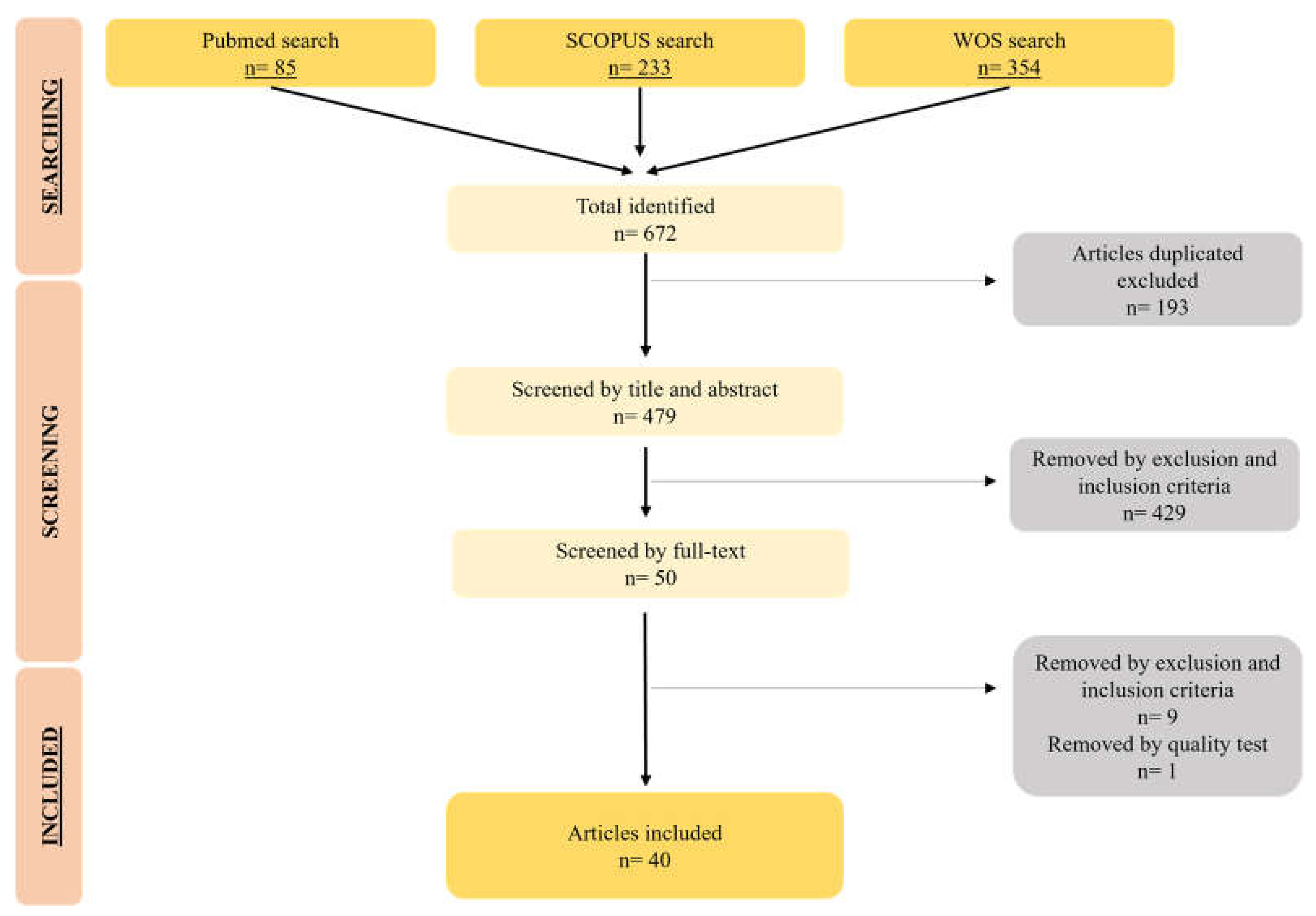
Figure 2.
Use of magnetic nanoparticles in in vitro AMF hyperthermia application experiments. Magnetic nanoparticles, typically composed of iron, can be functionalized with antibodies (against HER2, TAG72, or CD133) or specific peptides to actively target a tumor population. AMF facilitates, in formulations that encapsulate drugs, a greater drug release into the cell and the induction of heightened cellular stress. These factors ultimately result in the death of tumor cells, triggering the activation of PARP and the cleavage of several caspases to activate the apoptotic pathway.
Figure 2.
Use of magnetic nanoparticles in in vitro AMF hyperthermia application experiments. Magnetic nanoparticles, typically composed of iron, can be functionalized with antibodies (against HER2, TAG72, or CD133) or specific peptides to actively target a tumor population. AMF facilitates, in formulations that encapsulate drugs, a greater drug release into the cell and the induction of heightened cellular stress. These factors ultimately result in the death of tumor cells, triggering the activation of PARP and the cleavage of several caspases to activate the apoptotic pathway.
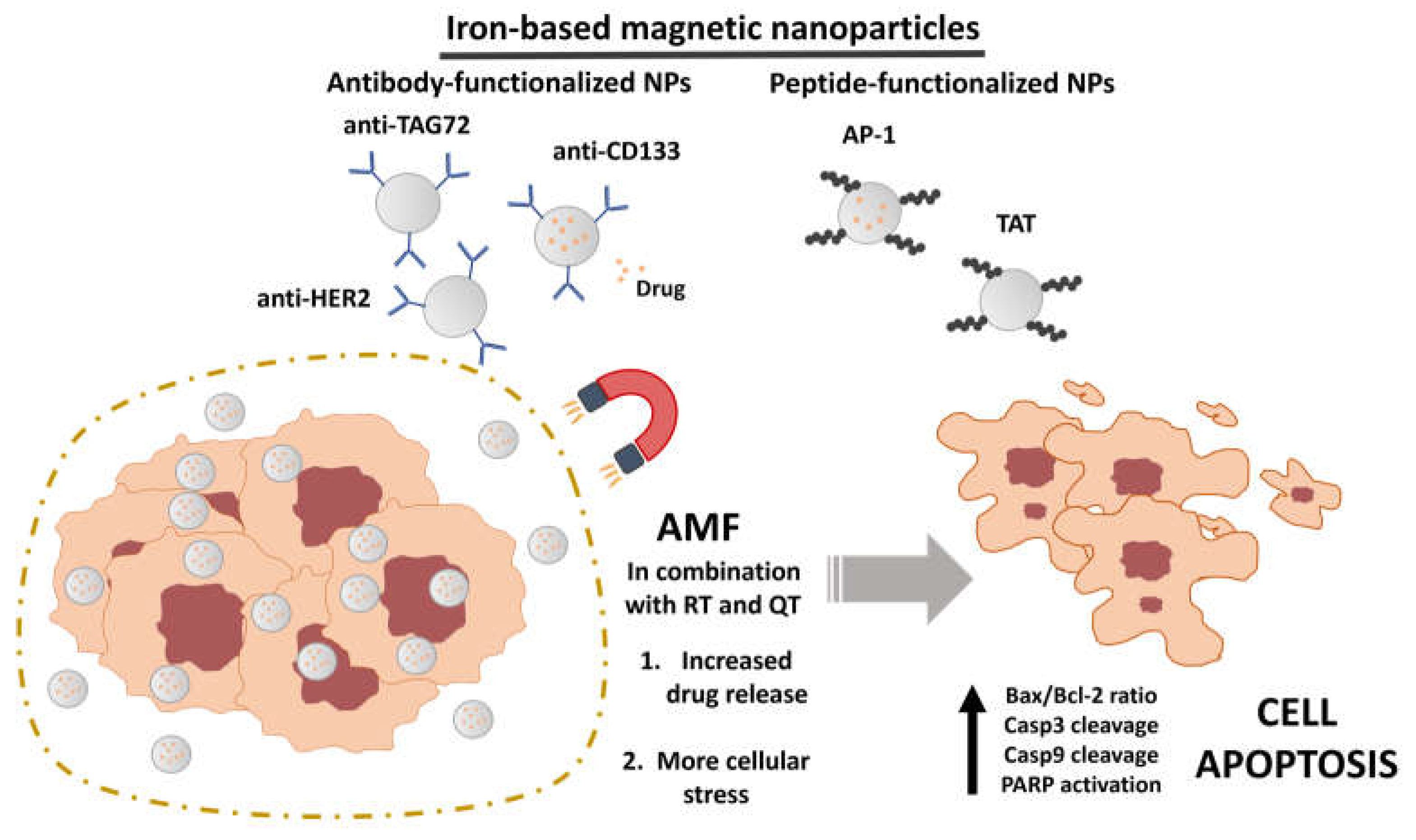
Figure 3.
Use of magnetic hypothermia in in vivo experiments. Typically, the assays involve an intravenous administration of the NPs into the mouse such that once they reach the tumor, they are capable of: 1) generating hyperthermia when exposed to an AMF, serving as an antitumor therapy alone or in combination with chemotherapeutic drugs or 2) acting as contrast agents, creating negative contrast and potentially being used for tumor diagnosis and monitoring. Following the generation of hyperthermia, tumor cell death can occur through several pathways, with apoptosis, necrosis, or extensive oxidative stress being the most notable.
Figure 3.
Use of magnetic hypothermia in in vivo experiments. Typically, the assays involve an intravenous administration of the NPs into the mouse such that once they reach the tumor, they are capable of: 1) generating hyperthermia when exposed to an AMF, serving as an antitumor therapy alone or in combination with chemotherapeutic drugs or 2) acting as contrast agents, creating negative contrast and potentially being used for tumor diagnosis and monitoring. Following the generation of hyperthermia, tumor cell death can occur through several pathways, with apoptosis, necrosis, or extensive oxidative stress being the most notable.
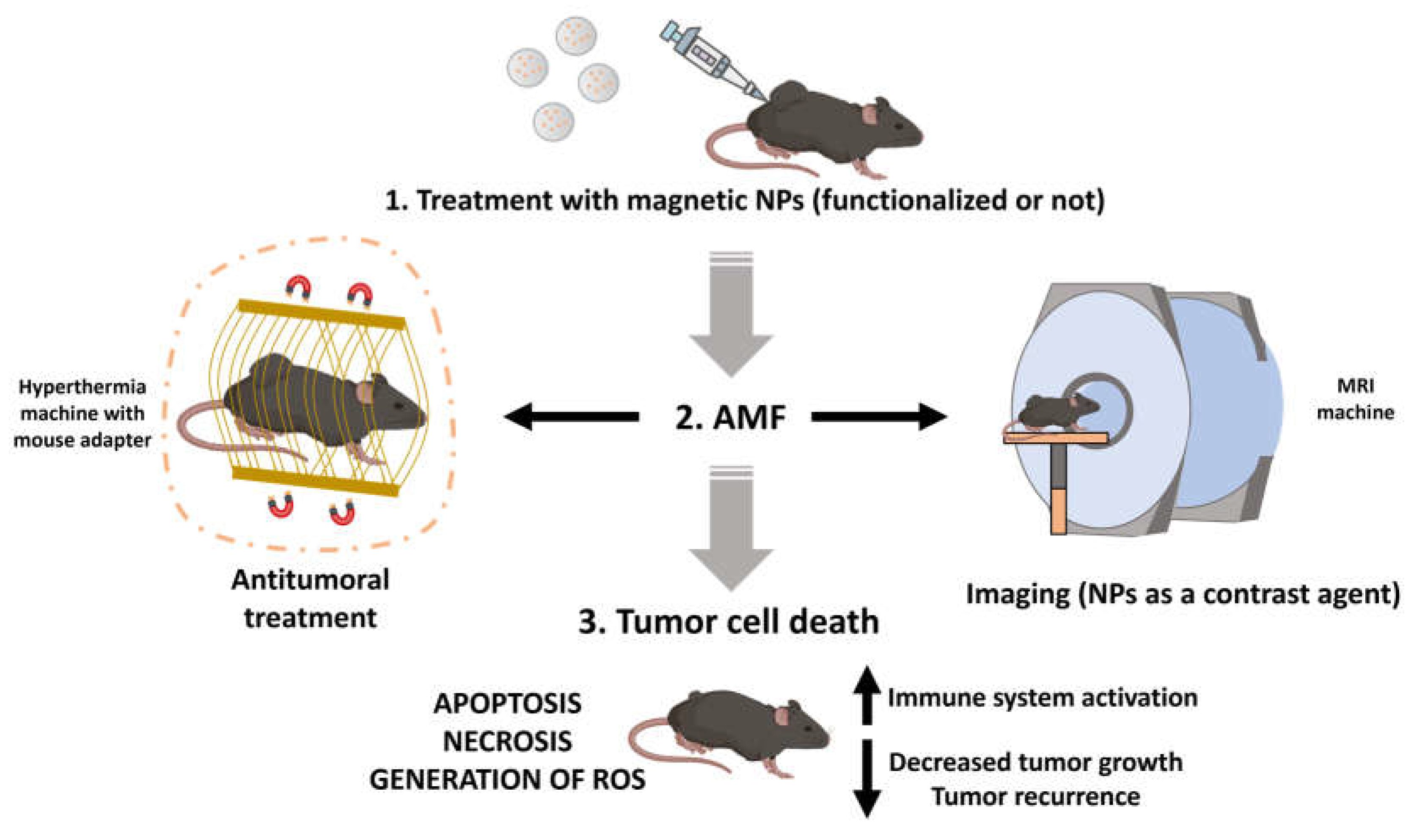

Table 1.
Summary of the most relevant characteristics of the selected articles.
| Nanoformulation | Antitumor agent | AMF | In vitro assay | In vivo assay | Main results | Reference |
| Anti-131I-labeled CC49 SPIONs | - | 252 kHz, 15.9 kA/m | - | LS174T tumor-bearing mice | Decrease in tumor size | [35] |
| PMAO MNPs | - | 606 kHz, 14 kA/m | - | CC-531 tumor-bearing rats | Heterogeneous cytotoxicity results | [67] |
| (maghemite/PLGA)/CS NPs | - | 250 kHz, 4 kA/m | Cytotoxicity assay (T84) | Healthy mice | High cytotoxicity effect and good MRI results | [43] |
| Exosome-FA-MNP | DOXO | 310 kHz | Cytotoxicity assay (HT29) | HT29 tumor-bearing mice | High cytotoxicity effect and decrease in tumor size | [29] |
| PMAO-PEG MNPs | - | 650 kHz, 16.71 kA/m | Cytotoxicity assay (HCT116) | - | High cytotoxicity effect | [60] |
| Fluorescent MNP labeled iPS | - | 63 kHz, 7 kA/m | - | MGC803 tumor-bearing mice | Decrease in tumor size and good MRI results | [32] |
| Carboxydextran coated MNPs | - | 390 kHz, 28 kA/m | Cytotoxicity assay (HCT116) | Peritoneal-dissemination mice | High cytotoxicity effect and metastases decrease | [62] |
| MnFe2O4-Fe3O4 core-shell NPs | - | 384.5 kHz, 27.85 kA/m | Cytotoxicity assay (HT29) | - | High cytotoxicity effect | [22] |
| anti-HER2 carboxydextran and amphiphilic polimer SPIONs | - | 280 kHz, 31 kA/m | Cytotoxicity assay ( NUGC-4) | - | High cytotoxicity effect | [34] |
| APTES coated MNPs | - | 300 kHz | - | VX2 tumor-bearing rabbits | Decrease in tumor size | [41] |
| PLGA SPIONs | DOXO | 205 kHz, 2 kA/m | Cytotoxicity assay (CT26) | CT26 tumor-bearing mice | High cytotoxicity assay, drug release, decrease in tumor size and good MRI results | [45] |
| Liposome encapsulated citric acid-coated MNPs | DOXO | 300 kHz, 59.3 kA/m | Cytotoxicity assay (CT26) | - | High cytotoxicity effect and drug release | [64] |
| SPIO-APTES anti-CD133 MNPs | IRI | 1.3–1.8 kHz | Cytotoxicity (Caco-2, HCT116, DLD1) | HCT116 tumor-bearing mice | High cytotoxicity assay, decrease in tumor size and good MRI results | [33] |
| Iron oxide nanocubes | DOXO | 182 kHz | Patient-derived CSCs | Patient-derived CSCs tumor-bearing mice | High cytotoxicity assay, decrease in tumor size | [54] |
| Bacteria derived MNPs | - | 187 kHz, 23 kA/m | - | HT29 tumor-bearing mice | In vivo apoptotic and necrotic areas and good MRI results | [46] |
| Solid-lipid MNPs | - | 250 kHz, 4 kA/m | Cytotoxicity assay (HT29) | - | High cytotoxicity effect | [47] |
| MPVA-AP1 nanovehicles | DOXO | 50–100 kHz | Liberation assay | - | High drug liberation and drug release | [36] |
| TAT /CSF1R inhibitor functionalized magnetic liposomes | - | 288 kHz, 35 kA/m | - | CT26 tumor-bearing mice | Decrease in tumor size and increased magnetic targeting | [37] |
| Bacteria-derived MNPs | 5-FU | 250 kHz, 4 kA/m | Liberation assay | - | High drug release | [48] |
| Bacteria-derived MNPs | OXA | 197 kHz, 18 kA/m | Liberation assay | - | High drug release | [49] |
| Cobalt ferrite NPs | - | 261 kHz, 8–19.8 kA/m | Cytotoxicity assay (CT26) | CT26 tumor-bearing mice | High cytotoxicity effect and decrease in tumor size | [50] |
| Cs MNPs | 5-FU | 435 kHz, 15.4 kA/m | - | HT29 tumor-bearing mice | Decrease in tumor size | [25] |
| Agar encapsulated MNPs | DOXO | 400 kHz, 0.45 kA/m | Cytotoxicity assay (HT29) | - | High cytotoxicity effect | [40] |
| Acid citric and EDC/NHC functionalized MNPs | - | 87 kHz-340 kHz, 79.57 kA/m | Cytotoxicity assay (not specified) | - | High cytotoxicity effect | [59] |
| MNPs | - | 100 kHz, 4 kA/m | MRI assay | - | Good MRI results | [53] |
| MNPs loaded Cs nanofibers | - | 750–1150 kHz | Cytotoxicity assay (CT26) | - | High cytotoxicity effect | [30] |
| Alginate coated MPNPs and QDs | DOXO | 4-6.3 kA/m | - | CT26 tumor-bearing mice | Good MRI results | [39] |
| Iron oxide NPs/Au NPs core/shell nanohybrid | - | 13560 kHz | Cytotoxicity assay (CT26) | CT26 tumor-bearing mice | High cytotoxicity effect, decrease in tumor size, increased magnetic targeting and good MRI results | [55] |
| PEG-PBA-PEG coated SPIONs | 5-FU | 13560 kHz | Cytotoxicity assay (HT29, HCT116) | - | High cytotoxicity effect | [38] |
| APTS/PRO functionalized SPIONs loaded with TNF-alfa | - | 110 kHz, 8.75 kA/m | Cytotoxicity assay (SW480, HepG2) | - | High cytotoxicity effect | [61] |
| PLGA SPIONs | 930 kHz, 13 kA/m | - | CT26 tumor-bearing mice | Increased magnetic targeting | [66] | |
| Magnetic solid lipid NPs coated with FA and Dextran | DOXO | Not especified | Cytotoxicity assay (CT26) | CT26 tumor-bearing mice | High cytotoxicity effect, decrease in tumor size and metastases | [58] |
| MNPs | CDDP | 237 kHz, 20 kA/m | Cytotoxicity assay (Caco-2) | - | High cytotoxicity effect | [51] |
| Carboxydextran coated MNPs | Bortezomib | 233 kHz, 29.39 kA/m | Cytotoxicity assay (Caco-2) | - | High cytotoxicity effect | [63] |
| SPIONs loaded microrobots | 5-FU | 430 kHz, 45 kA/m | Cytotoxicity assay (HCT116) | - | High cytotoxicity effect | [31] |
| ZnCoFe2O4 and ZnMnFe2O4 NPs | - | 1.35 kA/m | Cytotoxicity assay (CT26) | CT26 tumor-bearing mice | High cytotoxicity effect, decrease in tumor size and better targeting | [56] |
| PEG-PCL-PEG/FA MNPs | 5-FU | 13560 kHz, 0.4 kA/m | Cytotoxicity assay (HT29) | - | High cytotoxicity effect | [52] |
| Monosaccharides coated MNPs | - | 292 kHz, 51.0 kA/m | Cytotoxicity assay (CT26) | - | High cytotoxicity effect | [65] |
| Cs MNPs | 5-FU | 435 kHz, 15.4 kA/m | - | HT29 tumor-bearing mice | Sensitizes cells for further therapies and DNA damage | [68] |
| Polymers functionalized MNPs | Niclosamide | 405 kHz | Cytotoxicity assay (HCT116) | - | High Cytotoxicity effect | [57] |
Disclaimer/Publisher’s Note: The statements, opinions and data contained in all publications are solely those of the individual author(s) and contributor(s) and not of MDPI and/or the editor(s). MDPI and/or the editor(s) disclaim responsibility for any injury to people or property resulting from any ideas, methods, instructions or products referred to in the content. |
© 2023 by the authors. Licensee MDPI, Basel, Switzerland. This article is an open access article distributed under the terms and conditions of the Creative Commons Attribution (CC BY) license (http://creativecommons.org/licenses/by/4.0/).
Copyright: This open access article is published under a Creative Commons CC BY 4.0 license, which permit the free download, distribution, and reuse, provided that the author and preprint are cited in any reuse.


