

Submitted:
31 May 2023
Posted:
01 June 2023
You are already at the latest version
Abstract
Abstract: The need to rapidly reduce GHG has accelerated the adoption of circular models of production. However, this has proved to be a challenging task for SMEs, who lack the financial, organizational and informational capabilities to implement circular business models. In this context, calculating the carbon footprint (CF) of their products could provide the basis for assessing the different circular economy (CE) practices. The aim of this study is to present a CF calculation tool that can be used to calculate the CF of SMEs. The design of the tool was based on the Life Cycle Assessment (LCA) methodology, taking into account the various barriers that SMEs face in adopting CE practices. The tool was tested in a small cheese factory in northern Greece. The pro-duction process was mapped, a GHG inventory was created and the total emissions related to the production of a specific product was estimated. The final aim is to test this tool at a large scale.
Keywords:
Circular Economy
; Life Cycle Assessment
; Carbon Footprint
; Information Systems
1. Introduction
Since the industrial revolution, the concentration of greenhouse gases (GHGs) in the atmosphere has gradually increased beyond Earth’s absorbing capacity, leading to global warming and anthropogenic climate change. In March 2023, the Intergovernmental Panel on Climate Change (IPCC) finalized its Sixth Assessment Report, in which it states that global warming is most likely to exceed 1.5°C during this century. Natural ecosystems and human populations are already experiencing the negative impacts of climate change, which, unless mitigated, they could potentially lead to further environmental, social and economic implications [1]. Moreover, if global warming is to be limited to 1.5°C, large GHG reductions must be achieved during this decade [1].
This immediate need to limit climate change, demands that business reduce their GHG emissions or their carbon footprint (CF). Therefore, calculating the CF has emerged as new business process, necessary for setting GHG emission reduction goals, assessing their performance towards these goals and eventually reducing their GHG emissions. The most common types of CF are the corporate CF, which is calculated based on the GHG emissions produced at company level [2], and the product CF, which is calculated based on the GHGs emitted during the life cycle of a specific product [3].
A product’s CF can be considered as a particular environmental impact category [4], i.e., climate change, of a product’s life cycle assessment (LCA). A product’s LCA is based on the use of methodologies that assess the environmental impact of a particular service or product over the different stages of its life cycle. From acquiring the materials used in the production of the product, producing, distributing and storing the product itself, until its use and final disposal, each step focuses on inputs and outputs, in the form of materials, energy and waste [3,5,6,7].
The aim of this paper is to present a tool developed for calculating the product CF of Small and Medium Enterprises (SMEs). This study is part of a project, which is funded by the Hellenic Ministry of Development and Investments and the European structural and investment funds. The aim of the project is to create a system for collecting and analyzing data for calculating the CF is SMEs.
In 2021, SMEs accounted for 99.8% of all enterprises in the non-financial business sector in the EU-27 while 93.2% of these enterprises were micro-SMEs, i.e., SMEs which employ fewer than 10 staff [8]. Although data are scarce, it has been estimated that the average SME enterprise emits approximately 75 tons of greenhouse gas (GHG) emissions, which is very little compared to the 22,345 tons of GHG emissions for the average large enterprise [8]. However, due to the large number of SMEs in the overall enterprise population, their share of total annual emissions is 63.3 % of all GHG emissions in the enterprise population as a whole [8].
Although large corporations are often those who receive most public attention regarding their environmental performance, SMEs have also been receiving increased pressure to improve their environmental performance. With regard to climate change, in particular, since GHG reductions are often achieved through energy efficiency and since energy efficiency is often associated with reduced production cost, many SMEs have adopted energy efficiency and other GHG reduction strategies. This relationship, i.e., between the adoption of green strategies, environmental performance and corporate performance has been extensively examined in international research [9,10,11,12,13,14]. However, majority of the same international research has also highlighted the internal and external barriers that make SMEs hesitant about adopting environmental strategies.
The vast literature examining sustainability, circular economy (CE) and SMEs has mapped several of these barriers as well as the drivers that push SMEs towards the adoption of sustainable practices. Although we are aware that calculating the carbon footprint does not constitute a direct CE strategy, we believe that the same barriers apply when SMEs have to decide whether to systematically calculate their CP. The rationale behind our claim is based on the fact that CP is a major indicator of both sustainability and circularity and unless companies are able to measure their carbon footprint, they will not be able to assess the CE strategies that they have adopted. Building on the above, we draw on the literature examining 1. the barriers that SMEs face in adopting CE strategies, and 2. the information technologies (IT) that can enhance the adoption of CE strategies, in order to form the theoretical basis for designing a calculation tool, that could overcome some of these barriers and can be easily adopted by SMEs.
In the following sections we provide a framework of analyzing the barriers that SMEs face in adopting CE strategies based on previous academic research. Then, we review the basic IT systems that, according to international research, have the potential of accelerating the transition towards CE. The description of CF calculation tool follows along with a small case study. Finally, we provide a discussion on how the tool can help SMEs overcome some of the adoption barriers regarding CE strategies.
1.1. Barriers in implementing CE strategies in SEMs
This transition towards a low carbon future has been widely examined in light of the broad concept of sustainable development, which, since its initial definition in 1987 by the Brundtland Commission [15], has evolved and been adopted in various social, environmental, economic and technological frameworks [16,17,18]. In this context, the circular economy (CE) model has emerged as the newest approach towards addressing sustainability goals, among which reducing GHG emissions is of utmost importance. Tracing back to the work of Kenneth Boulding [19] and later to that of Pearce and Turner [20], CE has been extensively studied in business [21,22,23,24,25], academic [26,27,28,29,30,31,32,33] and policy context [34,35,36,37,38,39,40,41,42].
The Ellen MacArthur Foundation defines CE as ″ an industrial system that is restorative or regenerative by intention and design‶. This system promotes renewable energy, phases out toxic chemicals, encourages reuse of products and eliminated the production of waste [43]. According to the European Union’s latest annual report on European SMEs, more than two-thirds of SMEs had adopted some resource efficiency related strategy, with minimizing waste and saving energy and materials being the most common strategies adopted [8]. However, in most cases, SMEs were restricted to the implementation of sporadic activities and did not attempt a complete re-design of their products and processes [8].
Exploring the dynamic relationship between CE and SMEs, especially in the EU context [44,45,46,47,48,49,50,51,52,53], has received extensive attention among academics, while there is a substantial body of literature devoted to mapping the barriers that companies face in adopting CE strategies [45,46,47,48,49,50,51,52,53,54,55,56,57,58,59,60,61,62,63,64,65,66,67,68,69]. These barriers can be arranged into two broad categories, based on a company’s level of influence, i.e., internal and external. Internal barriers are those that are inherent to a company’s business practices and values, and external are those associated with stakeholders that are beyond the direct influence of the company. Based on our literature review internal barriers can be classified as financial/economic, technological, organizational, informational and cultural while external barriers can also be classified as institutional/regulatory, supply-chain related and cultural. A summary of these barriers and the respective literature is presented in Table 1. In this study we will focus on the potential internal barriers that companies could face in calculating their carbon footprint. We will elaborate more on this matter in the following sections, as we explain how we tried to mitigate some of these barriers.
1.2. Information Technology and CE
The role of information technology in accelerating the deployment of CE business models has been extensively examined in academic research. Internet of Things (IoT) and other information and communication technologies, such as cloud computing, big data, artificial intelligence (AI), cyber physical systems (CPS), blockchain, augmented and virtual reality (AR and VR), additive manufacturing (3D printing) and 5G, have been examined as enabling technologies that could help the transition of companies from linear to circular business models. A review of the above technologies and their supportive research is present in Table 2. The CF calculation tool that was developed and is presented in the following section, can be classified as a cloud computing technology, since it is a web-based application that allows remote access of business processes, facilitates user interaction and information sharing of all manufacturing resources and processes [89,93]. Moreover, its design can incorporate IoT features such as recording data in real time, e.g. from electricity consumption meters.
2. Materials and Methods
The product CF methodology presented in this paper follows the LCA methodology, which accounts for all inputs and outputs associated with a particular product within defined system boundaries. The LCA methodology has be used as a tool for analyzing and evaluating circular business models [99,100,101]. Recent studies that include both LCA evaluation and circular assessment have been conducted in manufacturing [100,103,104,105,106,108,111], farming and livestock raising [102,107,110] and built environment [109]. This study is based on the LCA methodology provided by the GHG Protocol [3], the ISO 14040, 14044 and 14067 standards [4] and the BSI/DEFRA/Carbon Trust PAS 2050 standard [6]. The emission factors and the emission calculation methodologies used in this study were based on the guidelines and data provided by the IPCC [97] and the EEA [98].
A LCA can be conducted at different levels. The cradle-to-grave LCA examines a product’s life cycle from the acquisition of the raw materials used in the production process to its final disposal, while the cradle-to-gate LCA stops at the point where the product is at the “factory gate”, ready to be shipped either for final consumption or as an input to another life cycle. Finally, the cradle-to-cradle LCA, which is considered to be most complete, besides the life cycle of the product itself, also focuses on the recycling stage. The LCA methodology used in study follows the cradle-to-gate perspective.
The product CF calculation tool was designed based on the needs of SMEs in order to help them
- map their business processes according the LCA method
- calculate the Product CF
- gain a better insight of the carbon impact of their business
- identify carbon-intensive procedures in their business cycle
In the following sections we describe the tool that was developed along with a small case study, in which the tool was applied. First we present our case study, and then proceed with the description of the tool.
2.1. Case study
In this paper we present the case of small cheese manufacturing factory in northern Greece which produces a type of semihard to hard, elastic cheese that is served grilled (similar to the “haloumi” cheese). This type of cheese is popular in restaurants because it can be easily cooked and due to its light taste, it can accompany a variety of dishes. During the production process, whey is produced as a by-product which is sold to an external partner as biofuel.
The environmental impacts of the production of dairy products have been extensively examined in academic literature with research focusing on the production of various dairy products such as milk [112,114,115,117,118,126,128,129], butter [112,114], cheese [112,113,115,119,120,121,122,123,124,125,127,128,129] and yogurt [114,116,118]. Most studies have highlighted the fact that raw milk is responsible for the majority of GHG emissions related to the production of dairy products [112,113,115,117,119,120,121,122,123,124,126], since its production results in GHGs, emitted from animal enteric fermentation, manure management and land use. Further sources that contribute to the CF of dairy products can be traced in dairy processing phase [112,113,119,123,125] and are mainly related to energy consumption.
The tool that is presented in this study does not provide estimates of the carbon footprint of raw milk, therefore in order to estimate the carbon footprint based on the cradle-to-gate methodology, we will use an estimate of the carbon footprint of milk based on the research of Laca et al. [126]. We will use the estimate of 1.22 kg CO2eq per kg of fat and protein corrected milk, that was obtained by semi-confinement dairy farm systems in northern Spain. Since, the company that manufactures the product that we study (cheese) is stationed in northern Greece and its suppliers are also stationed in the same area, we believe that this estimate of the carbon footprint of milk is appropriate for our analysis. The production process of the product is presented in Figure 1.
3. Tool's description and Results
The main interface of the tool consists of four basic modules:
- the dashboard, which provides an overview of the company’s emissions at corporate level
- the company, where the user can map the structure of the company by adding different departments (facilities), equipment used in those departments and company-owned vehicles.
- the QMS (abbreviation for Quality Management System), where the user can design the production process, create an inventory of materials (raw materials, semi-ready products and final products), suppliers, customers and distributors, and manage orders, receipts and storage of the materials.
- the ENV, where the user can manage any energy relate information, i.e., add power sources and their respective emission factors and keep a record of energy related bills.
The mapping of the business processes begins with defining the facilities which will be included in the analysis. Each facility can then be divided into different zones (e.g., production site, offices, parking lots etc.). This categorization facilitates the calculation of the carbon footprint of products, as it makes it possible to separate the processes that are directly attributed to the production of the product from those that are not, a perquisite required by the GHG Protocol Carbon Footprint Standard. In our case study, the main facility is separated into two zones, the PRODUCTION FACILITY and the OFFICES (Figure 2).
The next step is to create an equipment inventory, which should contain all the equipment used in the production process. For each type of equipment the following information is required: the name of the equipment, its categorization (whether it is used in the production process or at the offices), its power source and the respective measurement unit, its status (whether it is functional, under maintenance or malfunctioning), its power source (in our case, all the equipment in the production process are powered by electricity, provided by a power supplier) and the desired conversion method (one can choose to calculate CO2 equivalents, kg of CO2, CH4, N2O etc.). Figure 2 shows the data recorded for a pasteurizer used in the production facility and Figure 3 shows all the equipment that is used in the production process.
The application can be designed to accept any type of conversion method, since the emission factors which are used in the calculation of the desired output are also treated as a separate process which can be created by the user. For example, the company that manufactures the product owns a large truck, which is powered by diesel. The truck is categorized as a EURO 6 heavy duty vehicle (Figure 4). Figure 5 provides a snapshot of how the emission factor related to this particular vehicle, is implemented. The user can create the respective power source (i.e., diesel) and link it to any type of conversion she/he wishes (i.e., kgCO2/km for a EURO 6 heavy duty vehicle). Consequently, when the user enters data regarding the distance travelled with this particular vehicle, the tool automatically calculates the emissions related to this particular travel distance. The same procedure is followed when the user enters data related to the vehicles owned by suppliers or distributors. Each vehicle can be identified by its unique license plate number, which makes it easy for the user to enter data related to the receipt of materials.
Another important stage in mapping the business process is creating the materials inventory (Figure 6). The materials inventory contains all materials that are used in the production process, final products, raw materials, semi-ready products, by-products etc.
The materials are used as input or output of the different production stages when the user creates a production line. For example, when the user creates a production line for the cheese, he creates the different production stages and for each stage he enters the respective inputs (raw materials, semi-ready products), the production equipment and the output of this process. In Figure 7, the coagulation stage of cheese production in presented.
After the production line has been created, the user can then enter data related to different production numbers (which can be identified via their LOT number). For example, a production with the lot number 10002 is presented in Figure 8.
For each stage of production, the user enters the output material (final product, by-product or semi-ready product), its quantity and unit of measurement. Then, he enters the production equipment and the respective hours of operation, the raw materials and the semi-ready products of previous stages. In this way, emissions related to energy consumption are allocated to each production stage. Figure 9 shows the total emissions related to the specific product LOT number as well as the emissions/kg of final product. Emissions related to the operation of each type of equipment are available, as well as emissions related to company, supplier and distributor vehicles. Each batch of product can be identified by its specific LOT number and its unique QR code which is automatically generated for each LOT number.
The results presented in Figure 9 show that 342.7 kg CO2 was emitted during the production of 167 kg of final product. These emissions include transportation of raw materials as well as storage of the raw milk before processing. They do not include emissions related to refrigerants, heating and cooling of premises and packaging. For the production 167kg of cheese, 1350 kg of raw milk was used, which corresponds to approximately to 1647 kg CO2eq based on the research of Laca et al. [126]. Therefore, the total emissions related to the production of this batch of cheese are 1989.7 kg CO2eq, or 11.91kg CO2eq/kg of product. This estimate is similar to the results of other studies which provide estimates of the carbon footprint of cheese production ranging between 10.2 and 16.9 [119,122,123,126,128,129].
4. Discussion and Conclusions
Drawing on the literature examining the barriers that SMEs face in adopting CE strategies, we designed a CF calculation tool taking into account the financial, technological, organizational, informational and cultural barriers that may emerge when SMEs try to create an emissions inventory and calculate their product CF. Regarding the financial and technological barriers, since the tool is a web-based application, it doesn’t require large financial resources to adopt. Moreover, its design is user friendly and does not require specialized technical skills.
In addressing the organizational, informational and cultural barriers towards the adoption of the tool, because most of the SMEs lack specialized knowledge, regarding carbon footprint calculation methodologies, we deliberately avoided using terminology such as scope1,2,3, direct/indirect emissions, purchased energy, organizational/operational boundaries etc., which are used in most carbon accounting standards. One of our aims in developing this tool was to minimize the need for users to be accustomed to the process of identifying and categorizing emission sources, because that would require additional training for the user to be able to use the tool, and in our opinion would discourage the adoption of the tool.
Moreover, we organized the tool based on mainstream operations, i.e., orders, distribution, customers, suppliers etc., since most SMEs are accustomed to them. The users simply have to add some additional information (type of vehicle) when processing mainstream data such as orders, receipts etc., which increases the administrative burden to some degree, but does not require the mapping of emission sources separately from mainstream operations, which would considerably raise the administrative cost.
Finally, the fact that this is a web application, allows for multiple users to have access to the tool. Therefore, each user can record data according to his/her area of expertise. For example, data needed for mapping the production equipment can be entered by personnel that is directly involved in the production process and data related to the distribution of products can be entered by personnel that manages distributions. This procedure facilitates the collection of data, and shares the administrative burden among all participants. However, a necessary condition for this procedure to work, is for all participants to be willing to share this additional burden. Therefore, overcoming the cultural barrier is still a matter to be addressed in each company.
The aim of this research was to develop a CF calculation tool that can be adjusted to the needs of SMEs. The beta version presented in this paper was used to map the production process of small cheese factory and to calculate the CF of one of their products. This version has a number of limitations that are to be addressed at a later stage of the project. First, it doesn’t provide a process for the fugitive emissions, related to the use of refrigerants, to be included to the product’s emission inventory. Second, it doesn’t take into account emissions related to the production of raw materials, the consumption of the final product and its disposal. Regarding the production raw materials, a process should be implemented, that would allow the user to enter emission factors related to the production of specific materials, based on the results of international research. Emissions related to the consumption and disposal of the final product should also be incorporated into the tool based on preestablished patterns of consumption. These elements will be added at a second phase of the project. Future research should focus on testing the CF calculation tool at a large scale and gather data related to the usability of the tool. Moreover, a comparative analysis to other existing CF calculation tools should be conducted.
6. Patents
The software presented in this paper, “Kwattum”, is ownership of Kloni Paraskevi SP.
Funding
Please add: “Hellenic Ministry of Development and Investments and the European structural and investment funds” and “The APC was funded by Hellenic Ministry of Development and Investments and the European structural and investment funds”.
Conflicts of Interest
“The authors declare no conflict of interest.” “The funders had no role in the design of the study; in the collection, analyses, or interpretation of data; in the writing of the manuscript; or in the decision to publish the results”.
References
- IPCC. AR6 Synthesis Report: Climate Change, 2023—IPCC. https://www.ipcc.ch/report/sixth-assessment-report-cycle/.
- The GHG Protocol. Corporate Standard, 2004. https://ghgprotocol.org/corporate-standard.
- The GHG Protocol. Product Standard, 2011. https://ghgprotocol.org/product-standard.
- IDF. Bulletin of the IDF N°520/2022: The IDF global Carbon Footprint... FIL-IDF. 2022. IDF https://shop.fil-idf.org/products/the-idf-global-carbon-footprint-standard-for-the-dairy-sector.
- ISO 14044:2006. Environmental management—Life cycle assessment—Requirements and guidelines, 2006, ISO. https://www.iso.org/standard/38498.html.
- UNEP. Global Guidance Principles for Life Cycle Assessment Databases: A Basis for Greener Processes and Products: ’Shonan Guidance Principles’ /: Produced by the UNEP/SETAC Life Cycle Initiative, 2011. UNEP.
- PAS 2050:2011 Specification for the assessment of the life cycle greenhouse gas emissions of goods and services, 2011. European Standards https://www.en-standard.eu/pas-2050-2011-specification-for-the-assessment-of-the-life-cycle-greenhouse-gas-emissions-of-goods-and-services/.
- Directorate-General for Internal Market; DIW econ; PwC; Gorgels, S.; Priem, M.; Blagoeva, T.; Martinelle, A.; Milanesi, G. Annual Report on European SMEs 2021/2022: SMEs and Environmental Sustainability : Background Document; Publications Office of the European Union: Luxembourg, 2022. [Google Scholar]
- Dangelico, R.M.; Pontrandolfo, P. Being ‘Green and Competitive’: The Impact of Environmental Actions and Collaborations on Firm Performance. Bus. Strategy Environ. 2015, 24, 413–430. [Google Scholar] [CrossRef]
- Revell, A.; Stokes, D.; Chen, H. Small Businesses and the Environment: Turning over a New Leaf? Bus. Strategy Environ. 2010, 19, 273–288. [Google Scholar] [CrossRef]
- Lucas, M.T. Understanding Environmental Management Practices: Integrating Views from Strategic Management and Ecological Economics. Bus. Strategy Environ. 2010, 19, 543–556. [Google Scholar] [CrossRef]
- Brammer, S.; Hoejmose, S.; Marchant, K. Environmental Management in SMEs in the UK: Practices, Pressures and Perceived Benefits. Bus. Strategy Environ. 2012, 21, 423–434. [Google Scholar] [CrossRef]
- Leonidou, L.C.; Christodoulides, P.; Kyrgidou, L.P.; Palihawadana, D. Internal Drivers and Performance Consequences of Small Firm Green Business Strategy: The Moderating Role of External Forces. J. Bus. Ethics 2017, 140, 585–606. [Google Scholar] [CrossRef]
- Madueno, J.H.; Jorge, M.L.; Conesa, I.M.; Martínez-Martínez, D. Relationship between Corporate Social Responsibility and Competitive Performance in Spanish SMEs: Empirical Evidence from a Stakeholders’ Perspective. BRQ Bus. Res. Q. 2016, 19, 55–72. [Google Scholar] [CrossRef]
- Brundtland, G.H. Our Common Future—Call for Action. Environ. Conserv. 1987, 14, 291–294. [Google Scholar] [CrossRef]
- Hajian, M.; Jangchi Kashani, S. 1-Evolution of the Concept of Sustainability. From Brundtland Report to Sustainable Development Goals. In Sustainable Resource Management; Hussain, C.M., Velasco-Muñoz, J.F., Eds.; Elsevier: Amsterdam, The Netherlands, 2021; pp. 1–24. [Google Scholar] [CrossRef]
- Mondini, G. Sustainability Assessment: From Brundtland Report to Sustainable Development Goals. Valori e valutazioni 2019, No. 23.
- Schaltegger, S.; Wagner, M. Sustainable Entrepreneurship and Sustainability Innovation: Categories and Interactions. Bus. Strategy Environ. 2011, 20, 222–237. [Google Scholar] [CrossRef]
- Boulding, K. The Economics of the Coming Spaceship Earth. In Environmental Quality in a Growing Economy; Jarrett, H., Ed.; Johns Hopkins University Press: Baltimore, MD, USA, 1966. [Google Scholar]
- Pearce DW, Turner PK. The economics of natural resources and the environment. Harvester Wheatsheaf, Hemel Hempstead, 1990.
- Lacy, P.; Keeble, J.; McNamara, R.; Rutqvist, J.; Haglund, T.; Cui, M.; Cooper, A.; Pettersson, C.; Kevin, E.; Buddemeier, P. Circular Advantage: Innovative Business Models and Technologies to Create Value in a World without Limits to Growth; Accenture: Chicago, IL, USA 2014; Volume 24. [Google Scholar]
- Steinberg, G.; Rodysill, J. How Closing the Supply Chain Loop Opens the Door to Long-Term Value, 2021. Available online: https://www.ey.com/en_gl/consulting/how-closing-the-supply-chain-loop-opens-the-door-to-long-term-value.
- Gartner. 3 Supply Chain Strategies to Accelerate Circular Economy Outcomes, 2021. Available onlinehttps://www.gartner.com/smarterwithgartner/3-supply-chain-strategies-to-accelerate-circular-economy-outcomes.
- Hannon, E.; Magnin-Mullez, C.; Vanthournot, H. The circular economy: Moving from theory to practice, 2016. Available onlinehttps://www.mckinsey.com/capabilities/sustainability/our-insights/the-circular-economy-moving-from-theory-to-practice.
- Ellen MacArthur Foundation and McKinsey & Company. Towards the Circular Economy: Accelerating the Scale-up Across Global Supply Chains; World Economic Forum: Geneva, Switzerland, 2014; Available online: https://ellenmacarthurfoundation.org/towards-the-circular-economy-vol-3-accelerating-the-scale-up-across-global. [Google Scholar]
- Kirchherr, J.; Reike, D.; Hekkert, M. Conceptualizing the Circular Economy: An Analysis of 114 Definitions. Resour. Conserv. Recycl. 2017, 127, 221–232. [Google Scholar] [CrossRef]
- Geissdoerfer, M.; Savaget, P.; Bocken, N.M.P.; Hultink, E.J. The Circular Economy–A New Sustainability Paradigm? J. Clean. Prod. 2017, 143, 757–768. [Google Scholar] [CrossRef]
- Ghisellini, P.; Cialani, C.; Ulgiati, S. A Review on Circular Economy: The Expected Transition to a Balanced Interplay of Environmental and Economic Systems. J. Clean. Prod. 2016, 114, 11–32. [Google Scholar] [CrossRef]
- Lewandowski, M. Designing the Business Models for Circular Economy—Towards the Conceptual Framework. Sustainability 2016, 8, 43. [Google Scholar] [CrossRef]
- Nußholz, J.L.K. Circular Business Models: Defining a Concept and Framing an Emerging Research Field. Sustainability 2017, 9, 1810. [Google Scholar] [CrossRef]
- Lieder, M.; Rashid, A. Towards Circular Economy Implementation: A Comprehensive Review in Context of Manufacturing Industry. J. Clean. Prod. 2016, 115, 36–51. [Google Scholar] [CrossRef]
- Murray, A.; Skene, K.; Haynes, K. The Circular Economy: An Interdisciplinary Exploration of the Concept and Application in a Global Context. J. Bus. Ethics 2017, 140, 369–380. [Google Scholar] [CrossRef]
- Blomsma, F.; Brennan, G. The Emergence of Circular Economy: A New Framing Around Prolonging Resource Productivity: The Emergence of Circular Economy. J. Ind. Ecol. 2017, 21, 603–614. [Google Scholar] [CrossRef]
- de Melo, T.A.C.; de Oliveira, M.A.; de Sousa, S.R.G.; Vieira, R.K.; Amaral, T.S. Circular Economy Public Policies: A Systematic Literature Review. Procedia Comput. Sci. 2022, 204, 652–662. [Google Scholar] [CrossRef]
- Su, B.; Heshmati, A.; Geng, Y.; Yu, X. A Review of the Circular Economy in China: Moving from Rhetoric to Implementation. J. Clean. Prod. 2013, 42, 215–227. [Google Scholar] [CrossRef]
- McDowall, W.; Geng, Y.; Huang, B.; Barteková, E.; Bleischwitz, R.; Türkeli, S.; Kemp, R.; Doménech, T. Circular Economy Policies in China and Europe. J. Ind. Ecol. 2017, 21, 651–661. [Google Scholar] [CrossRef]
- Mhatre, P.; Panchal, R.; Singh, A.; Bibyan, S. A Systematic Literature Review on the Circular Economy Initiatives in the European Union. Sustain. Prod. Consum. 2021, 26, 187–202. [Google Scholar] [CrossRef]
- Arsova, S.; Genovese, A.; Ketikidis, P.H.; Alberich, J.P.; Solomon, A. Implementing Regional Circular Economy Policies: A Proposed Living Constellation of Stakeholders. Sustainability 2021, 13, 4916. [Google Scholar] [CrossRef]
- Avdiushchenko, A.; Zając, P. Circular Economy Indicators as a Supporting Tool for European Regional Development Policies. Sustainability 2019, 11, 3025. [Google Scholar] [CrossRef]
- Camilleri, M.A. European Environment Policy for the Circular Economy: Implications for Business and Industry Stakeholders. Sustain. Dev. 2020, 28, 1804–1812. [Google Scholar] [CrossRef]
- Ignatyeva, M.; Yurak, V.; Dushin, A.; Strovsky, V.; Zavyalov, S.; Malyshev, A.; Karimova, P. How Far Away Are World Economies from Circularity: Assessing the Capacity of Circular Economy Policy Packages in the Operation of Raw Materials and Industrial Wastes. Sustainability 2021, 13, 4394. [Google Scholar] [CrossRef]
- Ikiz Kaya, D.; Pintossi, N.; Dane, G. An Empirical Analysis of Driving Factors and Policy Enablers of Heritage Adaptive Reuse within the Circular Economy Framework. Sustainability 2021, 13, 2479. [Google Scholar] [CrossRef]
- Macarthur, E. Founding Partners of the towards the Circular Economy Economic and Business Rationale for an Accelerated Transition. 2012.
- Zamfir, A.-M.; Mocanu, C.; Grigorescu, A. Circular Economy and Decision Models among European SMEs. Sustainability 2017, 9, 1507. [Google Scholar] [CrossRef]
- Oncioiu, I.; Căpuşneanu, S.; Türkeș, M.C.; Topor, D.I.; Constantin, D.-M. O.; Marin-Pantelescu, A.; Ștefan Hint, M. The Sustainability of Romanian SMEs and Their Involvement in the Circular Economy. Sustainability 2018, 10, 2761. [Google Scholar] [CrossRef]
- Barón, A.; de Castro, R.; Giménez, G. Circular Economy Practices among Industrial EMAS-Registered SMEs in Spain. Sustainability 2020, 12, 9011. [Google Scholar] [CrossRef]
- Dey, P.K.; Malesios, C.; De, D.; Budhwar, P.; Chowdhury, S.; Cheffi, W. Circular Economy to Enhance Sustainability of Small and Medium-Sized Enterprises. Bus. Strategy Environ. 2020, 29, 2145–2169. [Google Scholar] [CrossRef]
- Dey, P.K.; Malesios, C.; Chowdhury, S.; Saha, K.; Budhwar, P.; De, D. Adoption of Circular Economy Practices in Small and Medium-Sized Enterprises: Evidence from Europe. Int. J. Prod. Econ. 2022, 248, 108496. [Google Scholar] [CrossRef]
- Prieto-Sandoval, V.; Jaca, C.; Santos, J.; Baumgartner, R.J.; Ormazabal, M. Key Strategies, Resources, and Capabilities for Implementing Circular Economy in Industrial Small and Medium Enterprises. Corp. Soc. Responsib. Environ. Manag. 2019, 26, 1473–1484. [Google Scholar] [CrossRef]
- Mura, M.; Longo, M.; Zanni, S. Circular Economy in Italian SMEs: A Multi-Method Study. J. Clean. Prod. 2020, 245, 118821. [Google Scholar] [CrossRef]
- Bassi, F.; Dias, J.G. The Use of Circular Economy Practices in SMEs across the EU. Resour. Conserv. Recycl. 2019, 146, 523–533. [Google Scholar] [CrossRef]
- Bassi, F.; Guidolin, M. Resource Efficiency and Circular Economy in European SMEs: Investigating the Role of Green Jobs and Skills. Sustainability 2021, 13, 12136. [Google Scholar] [CrossRef]
- Madueno, J.H.; Jorge, M.L.; Conesa, I.M.; Martínez-Martínez, D. Relationship between Corporate Social Responsibility and Competitive Performance in Spanish SMEs: Empirical Evidence from a Stakeholders’ Perspective. BRQ Bus. Res. Q. 2016, 19, 55–72. [Google Scholar] [CrossRef]
- Rizos, V.; Behrens, A.; Van der Gaast, W.; Hofman, E.; Ioannou, A.; Kafyeke, T.; Flamos, A.; Rinaldi, R.; Papadelis, S.; Hirschnitz-Garbers, M.; et al. Implementation of Circular Economy Business Models by Small and Medium-Sized Enterprises (SMEs): Barriers and Enablers. Sustainability 2016, 8, 1212. [Google Scholar] [CrossRef]
- de Jesus, A.; Mendonça, S. Lost in Transition? Drivers and Barriers in the Eco-Innovation Road to the Circular Economy. Ecol. Econ. 2018, 145, 75–89. [Google Scholar] [CrossRef]
- Ritzén, S.; Sandström, G.Ö. Barriers to the Circular Economy–Integration of Perspectives and Domains. Procedia CIRP 2017, 64, 7–12. [Google Scholar] [CrossRef]
- Hina, M.; Chauhan, C.; Kaur, P.; Kraus, S.; Dhir, A. Drivers and Barriers of Circular Economy Business Models: Where We Are Now, and Where We Are Heading. J. Clean. Prod. 2022, 333, 130049. [Google Scholar] [CrossRef]
- Hart, J.; Adams, K.; Giesekam, J.; Tingley, D.D.; Pomponi, F. Barriers and Drivers in a Circular Economy: The Case of the Built Environment. Procedia CIRP 2019, 80, 619–624. [Google Scholar] [CrossRef]
- García-Quevedo, J.; Jové-Llopis, E.; Martínez-Ros, E. Barriers to the Circular Economy in European Small and Medium-Sized Firms. Bus. Strategy Environment 2020, 29, 2450–2464. [Google Scholar] [CrossRef]
- Ormazabal, M.; Prieto-Sandoval, V.; Puga-Leal, R.; Jaca, C. Circular Economy in Spanish SMEs: Challenges and Opportunities. J. Clean. Prod. 2018, 185, 157–167. [Google Scholar] [CrossRef]
- Tura, N.; Hanski, J.; Ahola, T.; Ståhle, M.; Piiparinen, S.; Valkokari, P. Unlocking Circular Business: A Framework of Barriers and Drivers. J. Clean. Prod. 2019, 212, 90–98. [Google Scholar] [CrossRef]
- Govindan, K.; Hasanagic, M. A Systematic Review on Drivers, Barriers, and Practices towards Circular Economy: A Supply Chain Perspective. Int. J. Prod. Res. 2018, 56, 278–311. [Google Scholar] [CrossRef]
- Vermunt, D.A.; Negro, S.O.; Verweij, P.A.; Kuppens, D.V.; Hekkert, M.P. Exploring Barriers to Implementing Different Circular Business Models. J. Clean. Prod. 2019, 222, 891–902. [Google Scholar] [CrossRef]
- Sarja, M.; Onkila, T.; Mäkelä, M. A Systematic Literature Review of the Transition to the Circular Economy in Business Organizations: Obstacles, Catalysts and Ambivalences. J. Clean. Prod. 2021, 286, 125492. [Google Scholar] [CrossRef]
- Adams, K.T.; Osmani, M.; Thorpe, T.; Thornback, J. Circular Economy in Construction: Current Awareness, Challenges and Enablers. Proc. Inst. Civ. Eng. -Waste Resour. Manag. 2017, 170, 15–24. [Google Scholar] [CrossRef]
- Kirchherr, J.; Piscicelli, L.; Bour, R.; Kostense-Smit, E.; Muller, J.; Huibrechtse-Truijens, A.; Hekkert, M. Barriers to the Circular Economy: Evidence From the European Union (EU). Ecol. Econ. 2018, 150, 264–272. [Google Scholar] [CrossRef]
- Cantú, A.; Aguiñaga, E.; Scheel, C. Learning from Failure and Success: The Challenges for Circular Economy Implementation in SMEs in an Emerging Economy. Sustainability 2021, 13, 1529. [Google Scholar] [CrossRef]
- Garcés-Ayerbe, C.; Rivera-Torres, P.; Suárez-Perales, I.; Leyva-de la Hiz, D.I. Is It Possible to Change from a Linear to a Circular Economy? An Overview of Opportunities and Barriers for European Small and Medium-Sized Enterprise Companies. Int. J. Environ. Res. Public Health 2019, 16, 851. [Google Scholar] [CrossRef]
- Tan, J.; Tan, F.J.; Ramakrishna, S. Transitioning to a Circular Economy: A Systematic Review of Its Drivers and Barriers. Sustainability 2022, 14, 1757. [Google Scholar] [CrossRef]
- Ardanza, A.; Moreno, A.; Segura, Á.; de la Cruz, M.; Aguinaga, D. Sustainable and Flexible Industrial Human Machine Interfaces to Support Adaptable Applications in the Industry 4.0 Paradigm. Int. J. Prod. Res. 2019, 57, 4045–4059. [Google Scholar] [CrossRef]
- Awan, U.; Sroufe, R.; Shahbaz, M. Industry 4.0 and the Circular Economy: A Literature Review and Recommendations for Future Research. Bus. Strategy Environ. 2021, 30, 2038–2060. [Google Scholar] [CrossRef]
- Bag, S.; Pretorius, J.H.C. Relationships between Industry 4.0, Sustainable Manufacturing and Circular Economy: Proposal of a Research Framework. Int. J. Organ. Anal. 2020, 30, 864–898. [Google Scholar] [CrossRef]
- Beltrami, M.; Orzes, G.; Sarkis, J.; Sartor, M. Industry 4.0 and Sustainability: Towards Conceptualization and Theory. J. Clean. Prod. 2021, 312, 127733. [Google Scholar] [CrossRef]
- Bressanelli, G.; Saccani, N.; Perona, M.; Baccanelli, I. Towards Circular Economy in the Household Appliance Industry: An Overview of Cases. Resources 2020, 9, 128. [Google Scholar] [CrossRef]
- Demestichas, K.; Daskalakis, E. Information and Communication Technology Solutions for the Circular Economy. Sustainability 2020, 12, 7272. [Google Scholar] [CrossRef]
- Jabbour, C.J.C.; de Sousa Jabbour, A.B.L.; Sarkis, J.; Godinho Filho, M. Unlocking the Circular Economy through New Business Models Based on Large-Scale Data: An Integrative Framework and Research Agenda. Technol. Forecast. Soc. Chang. 2019, 144, 546–552. [Google Scholar] [CrossRef]
- Jinil Persis, D.; Venkatesh, V.G.; Raja Sreedharan, V.; Shi, Y.; Sankaranarayanan, B. Modelling and Analysing the Impact of Circular Economy; Internet of Things and Ethical Business Practices in the VUCA World: Evidence from the Food Processing Industry. J. Clean. Prod. 2021, 301, 126871. [Google Scholar] [CrossRef]
- Kerin, M.; Pham, D.T. A Review of Emerging Industry 4.0 Technologies in Remanufacturing. J. Clean. Prod. 2019, 237, 117805. [Google Scholar] [CrossRef]
- Kumar, N.M.; Chopra, S.S. Leveraging Blockchain and Smart Contract Technologies to Overcome Circular Economy Implementation Challenges. Sustainability 2022, 14, 9492. [Google Scholar] [CrossRef]
- Laskurain-Iturbe, I.; Arana-Landín, G.; Landeta-Manzano, B.; Uriarte-Gallastegi, N. Exploring the Influence of Industry 4.0 Technologies on the Circular Economy. J. Clean. Prod. 2021, 321, 128944. [Google Scholar] [CrossRef]
- Lopes de Sousa Jabbour, A.B.; Jabbour, C.J.C.; Godinho Filho, M.; Roubaud, D. Industry 4.0 and the Circular Economy: A Proposed Research Agenda and Original Roadmap for Sustainable Operations. Ann. Oper. Res. 2018, 270, 273–286. [Google Scholar] [CrossRef]
- Mboli, J.S.; Thakker, D.; Mishra, J.L. An Internet of Things-Enabled Decision Support System for Circular Economy Business Model. Softw. Pract. Exp. 2022, 52, 772–787. [Google Scholar] [CrossRef]
- Miaoudakis, A.; Fysarakis, K.; Petroulakis, N.; Alexaki, S.; Alexandirs, G.; Ioannidis, S.; Spanoudakis, G.; Katos, V.; Verikoukis, C. Pairing a Circular Economy and the 5G-Enabled Internet of Things: Creating a Class of ?Looping Smart Assets? IEEE Veh. Technol. Mag. 2020, 15, 20–31. [Google Scholar] [CrossRef]
- Mörth, O.; Emmanouilidis, C.; Hafner, N.; Schadler, M. Cyber-Physical Systems for Performance Monitoring in Production Intralogistics. Comput. Ind. Eng. 2020, 142, 106333. [Google Scholar] [CrossRef]
- Nicolescu, R.; Huth, M.; Radanliev, P.; De Roure, D. Mapping the Values of IoT. J. Inf. Technol. 2018, 33, 345–360. [Google Scholar] [CrossRef]
- Pagoropoulos, A.; Pigosso, D.C.A.; McAloone, T.C. The Emergent Role of Digital Technologies in the Circular Economy: A Review. Procedia CIRP 2017, 64, 19–24. [Google Scholar] [CrossRef]
- Patwa, N.; Sivarajah, U.; Seetharaman, A.; Sarkar, S.; Maiti, K.; Hingorani, K. Towards a Circular Economy: An Emerging Economies Context. J. Bus. Res. 2021, 122, 725–735. [Google Scholar] [CrossRef]
- Ranta, V.; Aarikka-Stenroos, L.; Väisänen, J.-M. Digital Technologies Catalyzing Business Model Innovation for Circular Economy—Multiple Case Study. Resour. Conserv. Recycl. 2021, 164, 105155. [Google Scholar] [CrossRef]
- Rejeb, A.; Suhaiza, Z.; Rejeb, K.; Seuring, S.; Treiblmaier, H. The Internet of Things and the Circular Economy: A Systematic Literature Review and Research Agenda. J. Clean. Prod. 2022, 350, 131439. [Google Scholar] [CrossRef]
- Rocca, R.; Rosa, P.; Sassanelli, C.; Fumagalli, L.; Terzi, S. Integrating Virtual Reality and Digital Twin in Circular Economy Practices: A Laboratory Application Case. Sustainability 2020, 12, 2286. [Google Scholar] [CrossRef]
- Rusch, M.; Schöggl, J.-P.; Baumgartner, R.J. Application of Digital Technologies for Sustainable Product Management in a Circular Economy: A Review. Bus. Strategy Environ. 2023, 32, 1159–1174. [Google Scholar] [CrossRef]
- Sarc, R.; Curtis, A.; Kandlbauer, L.; Khodier, K.; Lorber, K.E.; Pomberger, R. Digitalisation and Intelligent Robotics in Value Chain of Circular Economy Oriented Waste Management–A Review. Waste Manag. 2019, 95, 476–492. [Google Scholar] [CrossRef] [PubMed]
- Tavera Romero, C.A.; Castro, D.F.; Ortiz, J.H.; Khalaf, O.I.; Vargas, M.A. Synergy between Circular Economy and Industry 4.0: A Literature Review. Sustainability 2021, 13, 4331. [Google Scholar] [CrossRef]
- Turner, C.; Oyekan, J.; Garn, W.; Duggan, C.; Abdou, K. Industry 5.0 and the Circular Economy: Utilizing LCA with Intelligent Products. Sustainability 2022, 14, 14847. [Google Scholar] [CrossRef]
- Wang, L.; Törngren, M.; Onori, M. Current Status and Advancement of Cyber-Physical Systems in Manufacturing. J. Manuf. Syst. 2015, 37, 517–527. [Google Scholar] [CrossRef]
- Watanabe, E.H.; da Silva, R.M.; Junqueira, F.; dos Santos Filho, D.J.; Miyagi, P.E. An Emerging Industrial Business Model Considering Sustainability Evaluation and Using Cyber Physical System Technology and Modelling Techniques. IFAC-PapersOnLine 2016, 49, 135–140. [Google Scholar]
- IPCC-TFI. Available online: https://www.ipcc-nggip.iges.or.jp/public/2006gl/index.html (accessed on 22 May 2023).
- EMEP/EEA air pollutant emission inventory guidebook 2019—European Environment Agency. Available online: https://www.eea.europa.eu/publications/emep-eea-guidebook-2019 (accessed on 22 May 2023).
- Peña, C.; Civit, B.; Gallego-Schmid, A.; Druckman, A.; Pires, A.C.-; Weidema, B.; Mieras, E.; Wang, F.; Fava, J.; Canals, L.M.; et al. Using Life Cycle Assessment to Achieve a Circular Economy. Int. J. Life Cycle Assess. 2021, 26, 215–220. [Google Scholar] [CrossRef]
- Bjørnbet, M.M.; Vildåsen, S.S. Life Cycle Assessment to Ensure Sustainability of Circular Business Models in Manufacturing. Sustainability 2021, 13, 11014. [Google Scholar] [CrossRef]
- Rigamonti, L.; Mancini, E. Life Cycle Assessment and Circularity Indicators. Int. J. Life Cycle Assess. 2021, 26, 1937–1942. [Google Scholar] [CrossRef]
- Møller, H.; Lyng, K.-A.; Röös, E.; Samsonstuen, S.; Olsen, H.F. Circularity Indicators and Added Value to Traditional LCA Impact Categories: Example of Pig Production. Int. J. Life Cycle Assess. 2023. [CrossRef]
- Bracquené, E.; Dewulf, W.; Duflou, J.R. Measuring the Performance of More Circular Complex Product Supply Chains. Resour. Conserv. Recycl. 2020, 154, 104608. [Google Scholar] [CrossRef]
- Glocic, E.; Young, S.B.; Sonnemann, G. Confronting Challenges of Combining and Comparing Material Circularity Indicator with Life Cycle Assessment Indicators: A Case of Alkaline Batteries. In SETAC Europe 30th Annual Meeting-Abstract Book; 2020.
- Lonca, G.; Muggéo, R.; Imbeault-Tétreault, H.; Bernard, S.; Margni, M. Does Material Circularity Rhyme with Environmental Efficiency? Case Studies on Used Tires. J. Clean. Prod. 2018, 183, 424–435. [Google Scholar] [CrossRef]
- Pauer, E.; Wohner, B.; Heinrich, V.; Tacker, M. Assessing the Environmental Sustainability of Food Packaging: An Extended Life Cycle Assessment Including Packaging-Related Food Losses and Waste and Circularity Assessment. Sustainability 2019, 11, 925. [Google Scholar] [CrossRef]
- Stanchev, P.; Vasilaki, V.; Egas, D.; Colon, J.; Ponsá, S.; Katsou, E. Multilevel Environmental Assessment of the Anaerobic Treatment of Dairy Processing Effluents in the Context of Circular Economy. J. Clean. Prod. 2020, 261, 121139. [Google Scholar] [CrossRef]
- Mantalovas, K.; Di Mino, G. Integrating Circularity in the Sustainability Assessment of Asphalt Mixtures. Sustainability 2020, 12, 594. [Google Scholar] [CrossRef]
- Saadé, M.; Erradhouani, B.; Pawlak, S.; Appendino, F.; Peuportier, B.; Roux, C. Combining Circular and LCA Indicators for the Early Design of Urban Projects. Int. J. Life Cycle Assess. 2022, 27, 1–19. [Google Scholar] [CrossRef]
- Stillitano, T.; Spada, E.; Iofrida, N.; Falcone, G.; De Luca, A.I. Sustainable Agri-Food Processes and Circular Economy Pathways in a Life Cycle Perspective: State of the Art of Applicative Research. Sustainability 2021, 13, 2472. [Google Scholar] [CrossRef]
- Wrålsen, B.; O’Born, R. Use of Life Cycle Assessment to Evaluate Circular Economy Business Models in the Case of Li-Ion Battery Remanufacturing. Int. J. Life Cycle Assess. 2023, 28, 554–565. [Google Scholar] [CrossRef]
- Djekic, I.; Miocinovic, J.; Tomasevic, I.; Smigic, N.; Tomic, N. Environmental Life-Cycle Assessment of Various Dairy Products. J. Clean. Prod. 2014, 68, 64–72. [Google Scholar] [CrossRef]
- Finnegan, W.; Yan, M.; Holden, N.M.; Goggins, J. A Review of Environmental Life Cycle Assessment Studies Examining Cheese Production. Int. J. Life Cycle Assess. 2018, 23, 1773–1787. [Google Scholar] [CrossRef]
- Mahath, C.S.; Mophin Kani, K.; Dubey, B. Gate-to-Gate Environmental Impacts of Dairy Processing Products in Thiruvananthapuram, India. Resour. Conserv. Recycl. 2019, 141, 40–53. [Google Scholar] [CrossRef]
- Egas, D.; Ponsá, S.; Colon, J. CalcPEFDairy: A Product Environmental Footprint Compliant Tool for a Tailored Assessment of Raw Milk and Dairy Products. J. Environ. Manag. 2020, 260, 110049. [Google Scholar] [CrossRef] [PubMed]
- González-García, S.; Castanheira, É.G.; Dias, A.C.; Arroja, L. Environmental Life Cycle Assessment of a Dairy Product: The Yoghurt. Int. J. Life Cycle Assess. 2013, 18, 796–811. [Google Scholar] [CrossRef]
- Berton, M.; Bovolenta, S.; Corazzin, M.; Gallo, L.; Pinterits, S.; Ramanzin, M.; Ressi, W. Environmental Impacts of Milk Production and Processing in the Eastern Alps: A “Cradle-to-Dairy Gate” LCA Approach. J. Clean. Prod. 2021, 303, 127056. [Google Scholar] [CrossRef]
- Clune, S.; Crossin, E.; Verghese, K. Systematic Review of Greenhouse Gas Emissions for Different Fresh Food Categories. J. Clean. Prod. 2017, 140, 766–783. [Google Scholar] [CrossRef]
- González-García, S.; Hospido, A.; Moreira, M.T.; Feijoo, G.; Arroja, L. Environmental Life Cycle Assessment of a Galician Cheese: San Simon Da Costa. J. Clean. Prod. 2013, 52, 253–262. [Google Scholar] [CrossRef]
- Kim, D.; Thoma, G.; Nutter, D.; Milani, F.; Ulrich, R.; Norris, G. Life Cycle Assessment of Cheese and Whey Production in the USA. Int. J. Life Cycle Assess. 2013, 18, 1019–1035. [Google Scholar] [CrossRef]
- Palmieri, N.; Forleo, M.B.; Salimei, E. Environmental Impacts of a Dairy Cheese Chain Including Whey Feeding: An Italian Case Study. J. Clean. Prod. 2017, 140, 881–889. [Google Scholar] [CrossRef]
- Canellada, F.; Laca, A.; Laca, A.; Díaz, M. Environmental Impact of Cheese Production: A Case Study of a Small-Scale Factory in Southern Europe and Global Overview of Carbon Footprint. Sci. Total Environ. 2018, 635, 167–177. [Google Scholar] [CrossRef] [PubMed]
- Bava, L.; Bacenetti, J.; Gislon, G.; Pellegrino, L.; D’Incecco, P.; Sandrucci, A.; Tamburini, A.; Fiala, M.; Zucali, M. Impact Assessment of Traditional Food Manufacturing: The Case of Grana Padano Cheese. Sci. Total Environ. 2018, 626, 1200–1209. [Google Scholar] [CrossRef] [PubMed]
- Santos, H.C.M.; Maranduba, H.L.; de Almeida Neto, J.A.; Rodrigues, L.B. Life Cycle Assessment of Cheese Production Process in a Small-Sized Dairy Industry in Brazil. Environ. Sci. Pollut. Res. 2017, 24, 3470–3482. [Google Scholar] [CrossRef] [PubMed]
- van Middelaar, C.E.; Berentsen, P.B.M.; Dolman, M.A.; de Boer, I.J.M. Eco-Efficiency in the Production Chain of Dutch Semi-Hard Cheese. Livest. Sci. 2011, 139, 91–99. [Google Scholar] [CrossRef]
- Laca, A.; Gómez, N.; Laca, A.; Díaz, M. Overview on GHG Emissions of Raw Milk Production and a Comparison of Milk and Cheese Carbon Footprints of Two Different Systems from Northern Spain. Environ. Sci. Pollut. Res. 2020, 27, 1650–1666. [Google Scholar] [CrossRef]
- Dalla Riva, A.; Burek, J.; Kim, D.; Thoma, G.; Cassandro, M.; De Marchi, M. Environmental Life Cycle Assessment of Italian Mozzarella Cheese: Hotspots and Improvement Opportunities. J. Dairy Sci. 2017, 100, 7933–7952. [Google Scholar] [CrossRef]
- Kristensen, T.; Søegaard, K.; Eriksen, J.; Mogensen, L. Carbon Footprint of Cheese Produced on Milk from Holstein and Jersey Cows Fed Hay Differing in Herb Content. J. Clean. Prod. 2015, 101, 229–237. [Google Scholar] [CrossRef]
- Capper, J.L.; Cady, R.A. A Comparison of the Environmental Impact of Jersey Compared with Holstein Milk for Cheese Production1. J. Dairy Sci. 2012, 95, 165–176. [Google Scholar] [CrossRef]
Figure 1.
Production process of cheese.
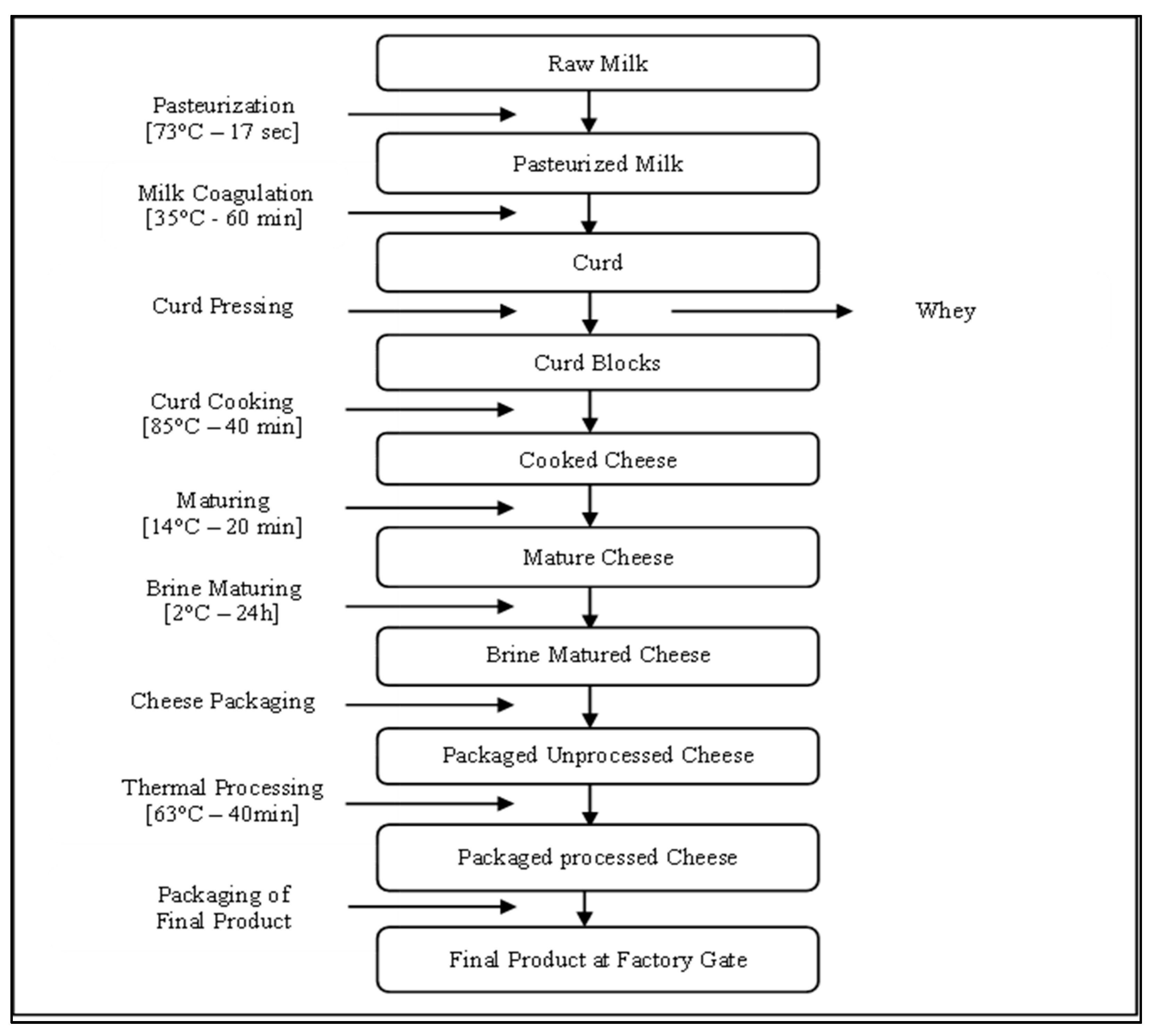
Figure 2.
Data recorded for production equipment (pasteurizer).
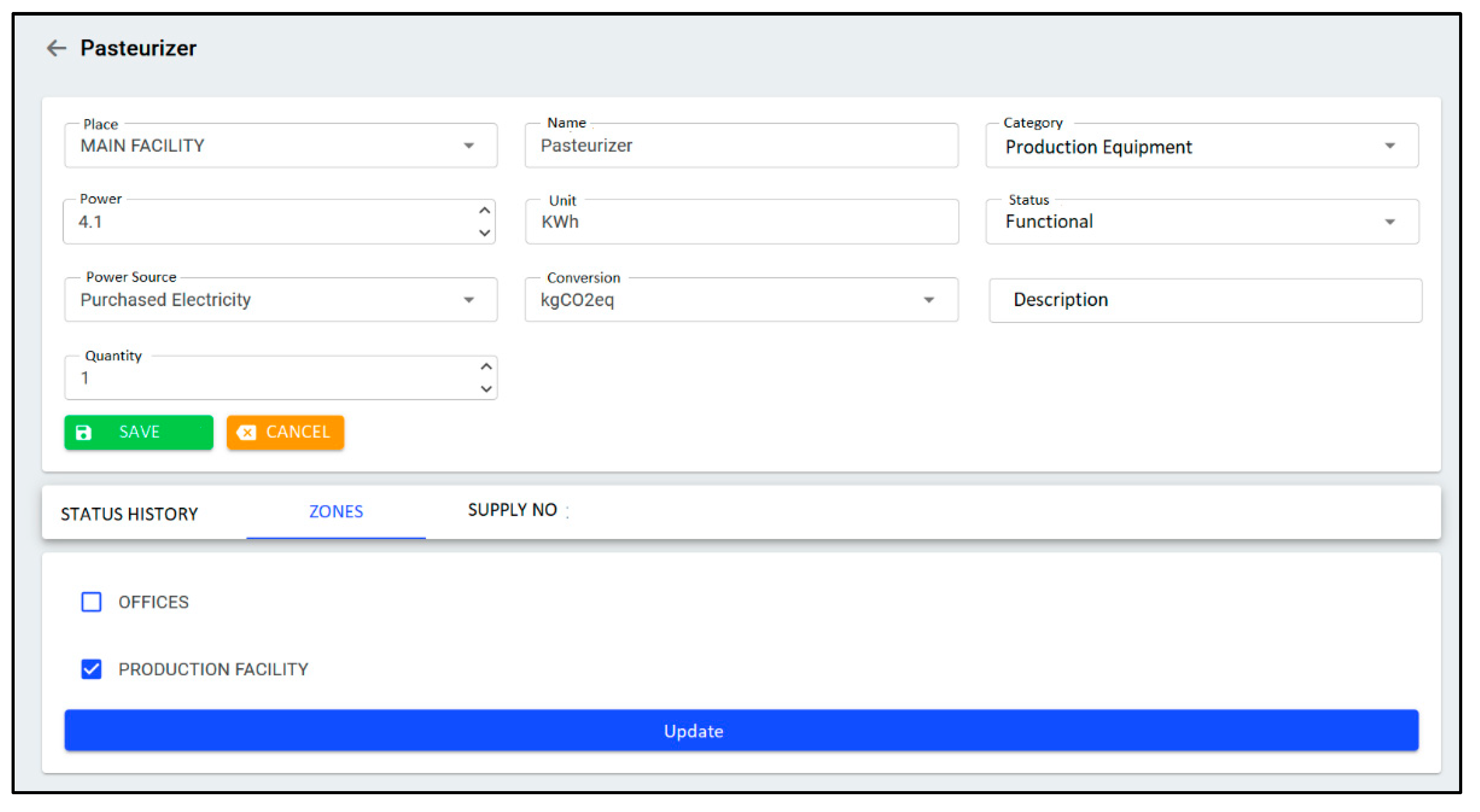
Figure 3.
Equipment participating in the production process.
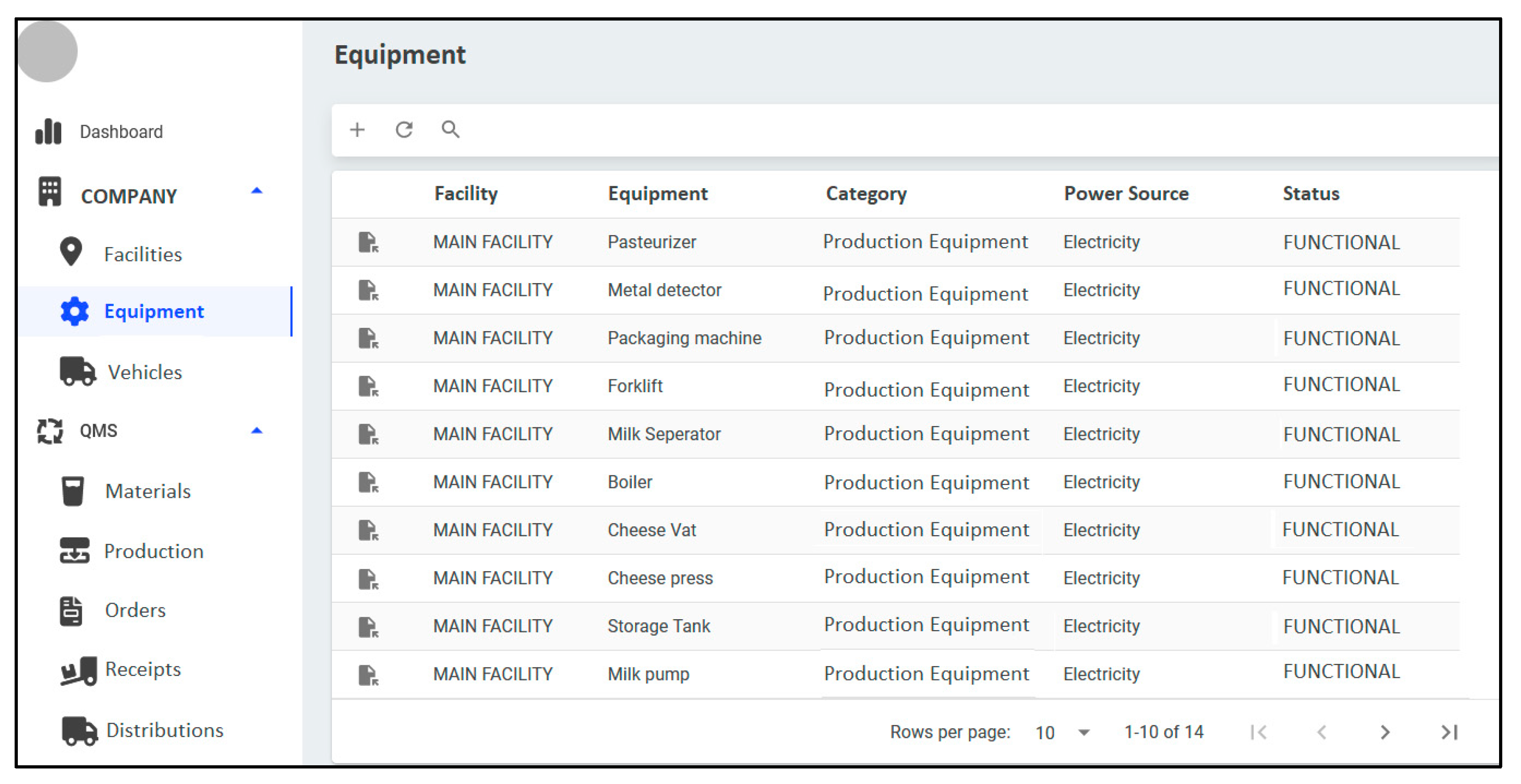
Figure 4.
Adding a company-owned vehicle.
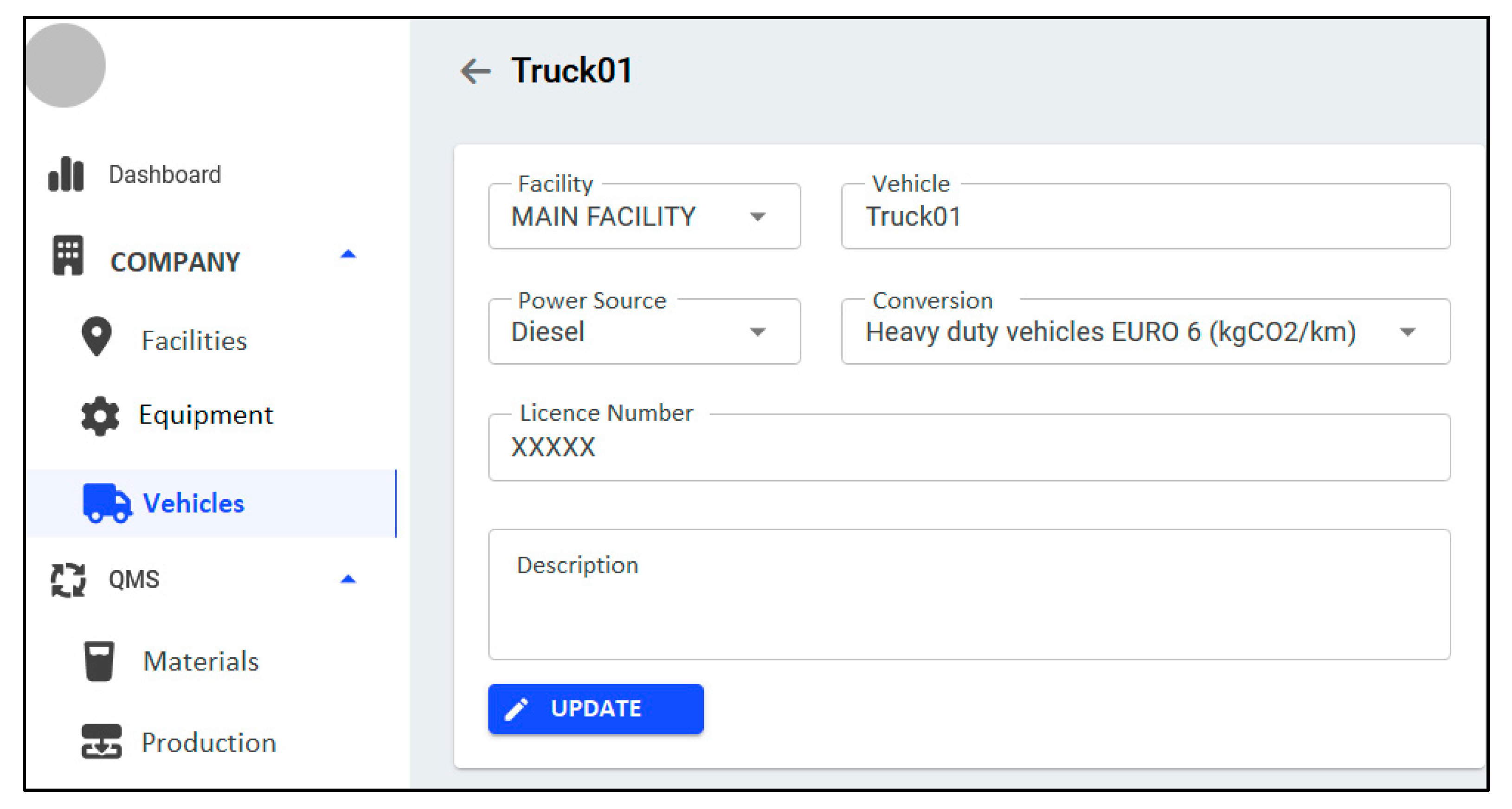
Figure 5.
Adding emission factors.
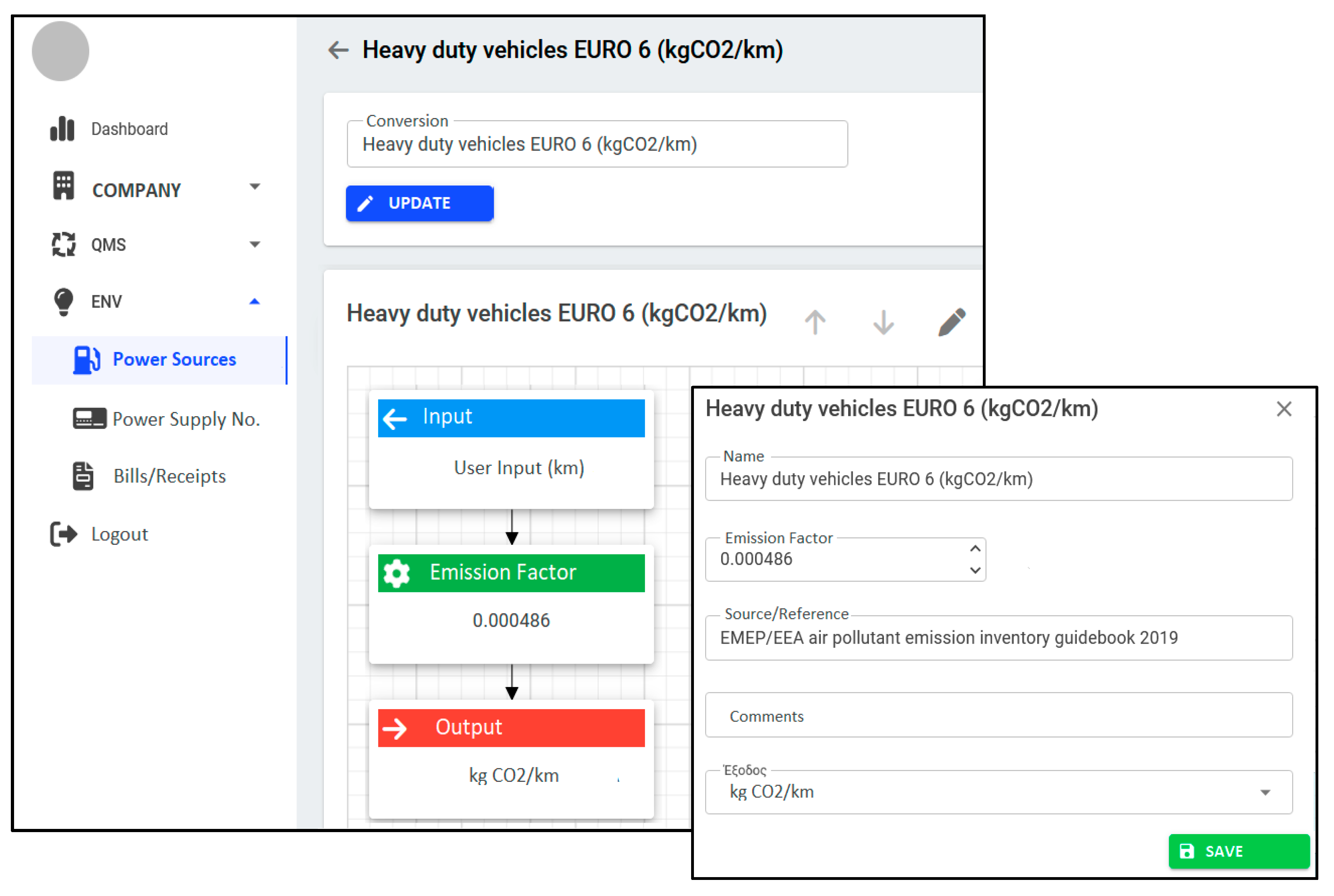
Figure 6.
List of recorded materials.
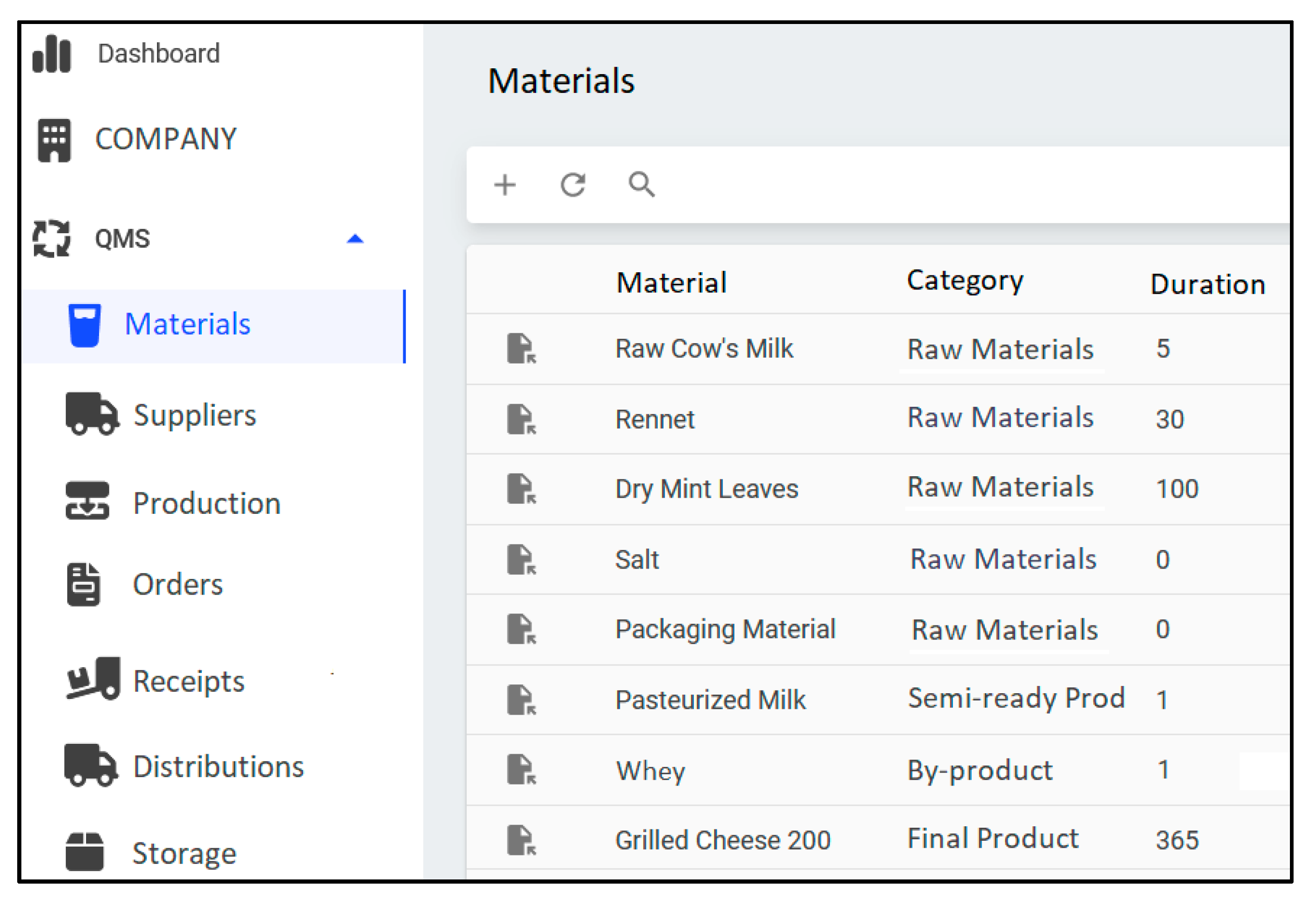
Figure 7.
The coagulation stage of cheese production.
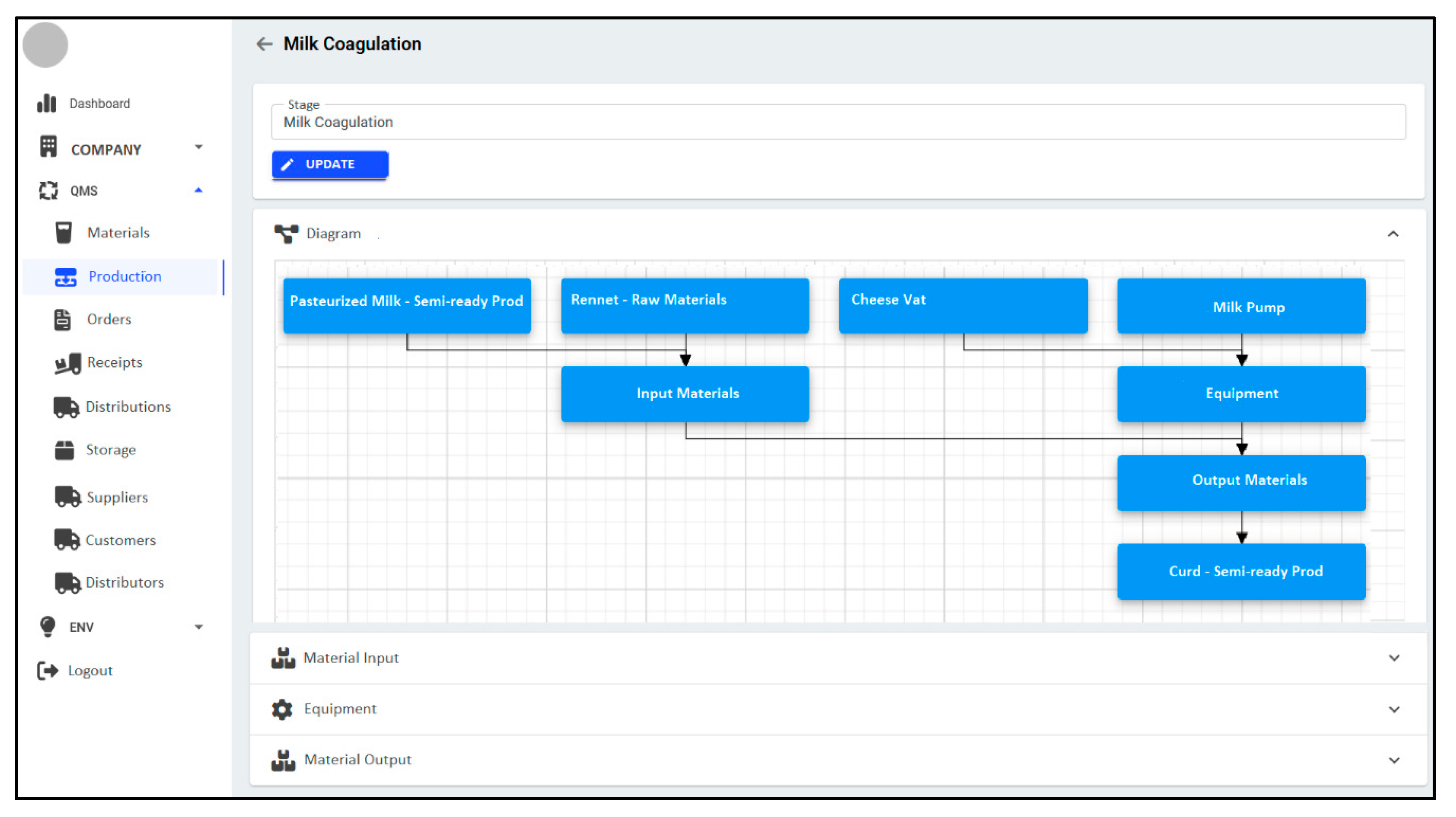
Figure 8.
An overview of the production line.
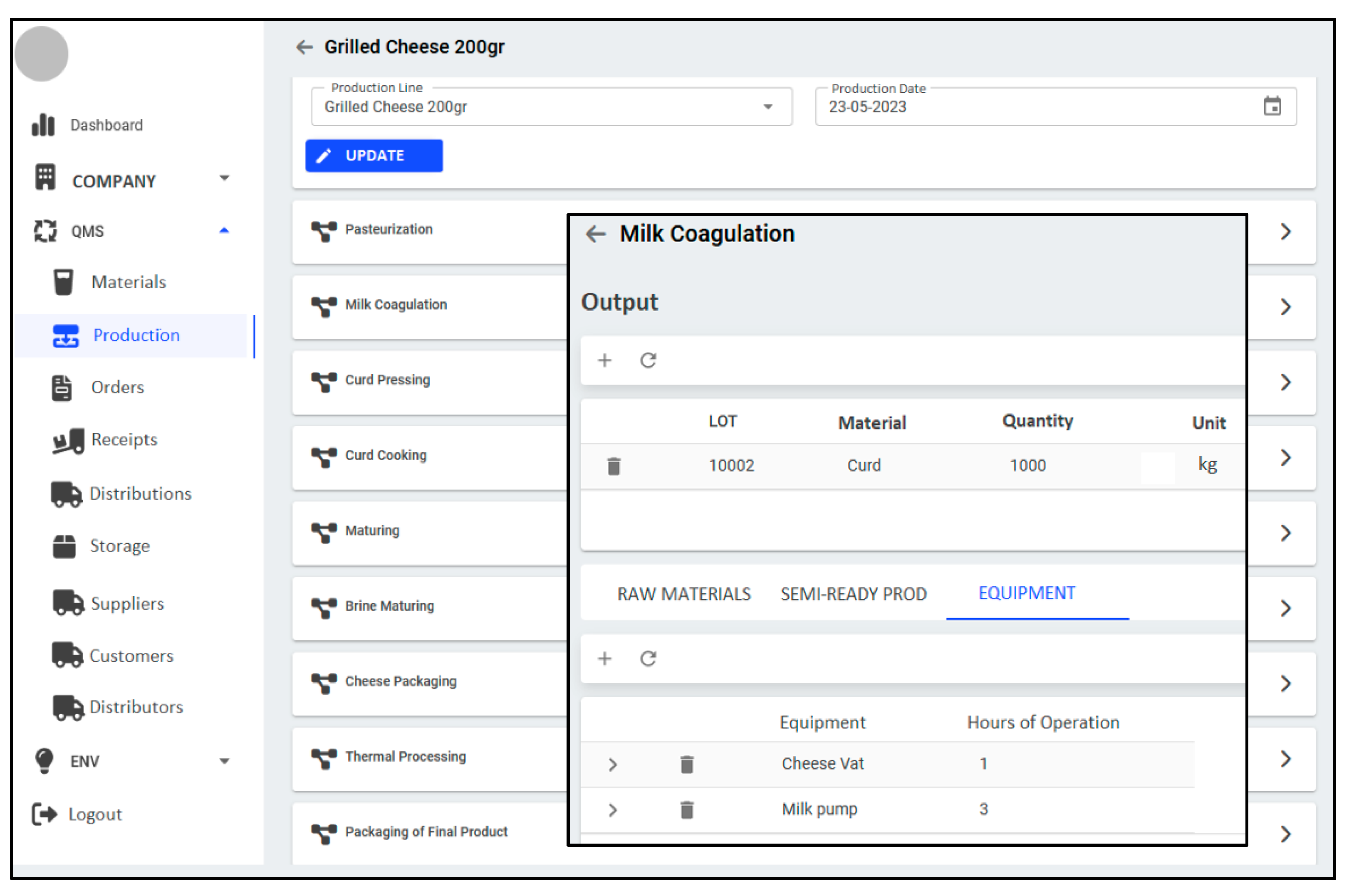
Figure 9.
An overview of the emissions related to a batch of products.
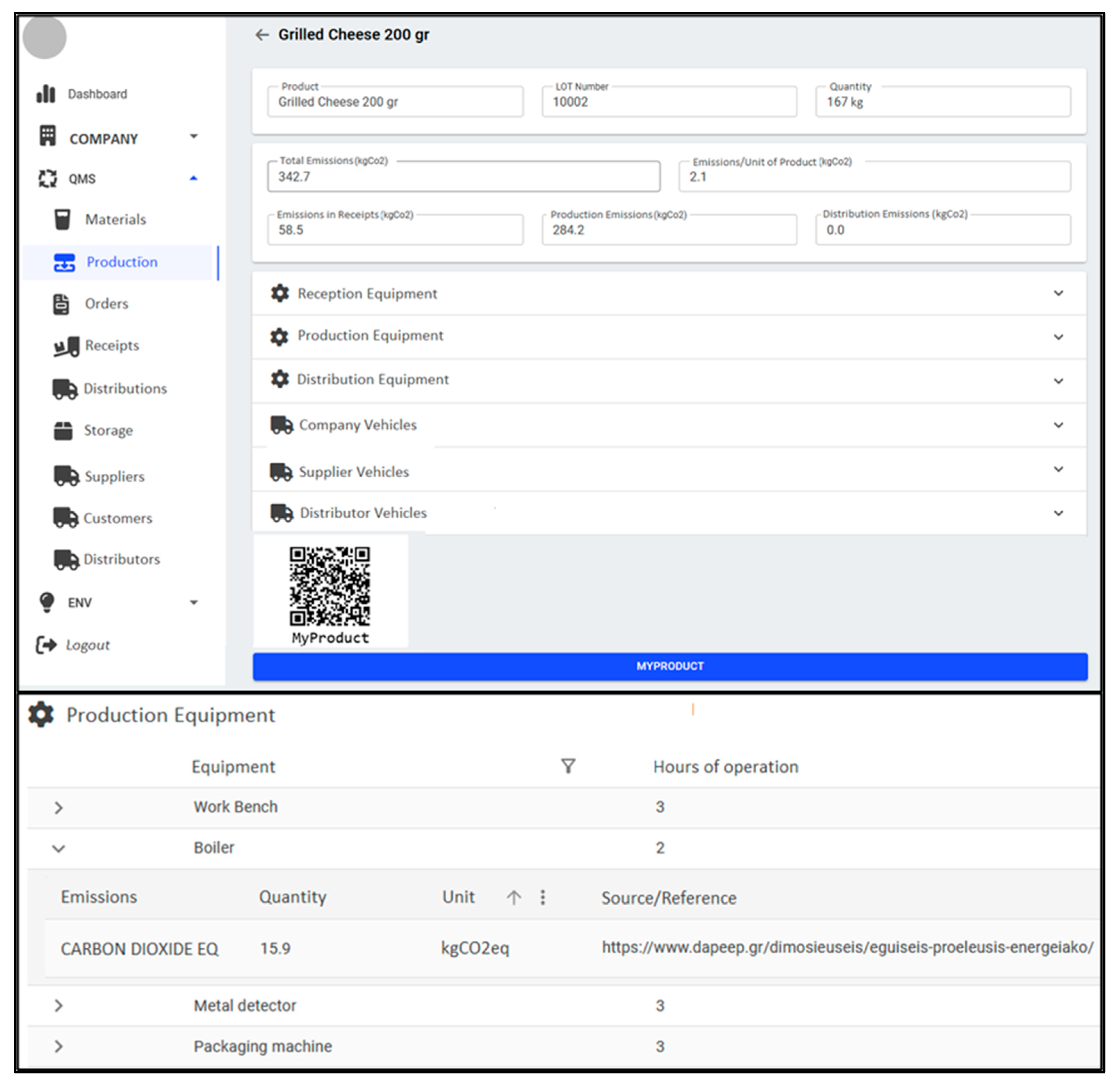

Table 1.
Barriers in the adoption of CE strategies.
| Category | Barriers–Main themes | Relevant Research |
|---|---|---|
| Internal | ||
| Economic/Financial | Large capital requirements Lack of capital/financial resources Unclear financial case/return of investment |
[45,54,55,56,57,58,59,60,61,62,63,64,65,66,67,68] |
| Technological | Product design and quality Lack of technology and technical skills |
[28,54,55,56,57,60,61,62,63,64,65,66,67,68,69] |
| Organizational | Incompatibility with current organizational structure Administrative burden Weak management support |
[54,56,57,60,61,62,63,64,67] |
| Informational | Insufficient information and knowledge, especially regarding the benefits of CE | [54,56,57,58,59,61,62,63,64,67,69] |
| Cultural | Hesitant company culture Attitude towards sustainability and circularity Risk aversion |
[50,54,56,58,61,62,66,67,69] |
| External | ||
| Institutional/Regulatory | Unclear international policy regarding CE Weak government support |
[54,55,57,58,61,62,63,64,66,67,68,69] |
| Supply Chain | Finding appropriate suppliers and partners Failure to collaborate with suppliers and partners |
[54,56,57,58,61,62,63,64,66,67] |
| Cultural | Consumer awareness “Intention-action gap” [69] |
[54,55,57,61,62,63,64,66,67,69] |
Table 2.
IT systems in CE.
| Technology | Definition | Relevant Research |
|---|---|---|
| IoT | A computational system that allows the collection and sharing of products, services, processes and data in real time [81,93] | [70,71,73,74,75,77,78,80,81,82,84,85,86,87,88,89,91,93,94] |
| Cloud Computing | Technology that allows remote access of business processes, facilitates user interaction and information sharing and enables the visualization of all manufacturing resources and processes [89,93] | [73,74,75,81,87,89,93,96] |
| AI | Technology that incorporates machine learning capabilities in manufacturing processes [93] | [72,73,80,86,87,89,92,93,94] |
| Big Data | Technology systems that capture, store, manage and process high volumes of data [93] | [71,72,73,74,76,80,86,90,91,93,95] |
| CPS | Technology that enables automation of industrial operations in real time [89,93] | [73,75,81,84,89,90,93,95,96] |
| Blockchain | A system that enables decentralized data storage and sharing of computational resources [79] | [73,75,79,89,91] |
| AR and VR | Technologies that allow the use of digital tools to access virtual spaces in physical spaces [93] | [75,78,80,90,91,93] |
| Additive manufacturing | Technology that allows prototyping of parts of products (3D printing) [89] | [74,80,81,89,90,93] |
| 5G | Flexible and low energy consumption technology that allows connectivity between systems that rely on IoT devices [82] | [75,82,83,89] |
Disclaimer/Publisher’s Note: The statements, opinions and data contained in all publications are solely those of the individual author(s) and contributor(s) and not of MDPI and/or the editor(s). MDPI and/or the editor(s) disclaim responsibility for any injury to people or property resulting from any ideas, methods, instructions or products referred to in the content. |
© 2023 by the authors. Licensee MDPI, Basel, Switzerland. This article is an open access article distributed under the terms and conditions of the Creative Commons Attribution (CC BY) license (http://creativecommons.org/licenses/by/4.0/).
Copyright: This open access article is published under a Creative Commons CC BY 4.0 license, which permit the free download, distribution, and reuse, provided that the author and preprint are cited in any reuse.


