

Submitted:
17 May 2023
Posted:
01 June 2023
You are already at the latest version
Preprints on COVID-19 and SARS-CoV-2
Abstract
During the Covid 19 pandemic, we saw a huge impact on the lives of individuals in cities. The way people responded was controlled and limited. The lockdown restricted a lot of movements in the cities as well as contained the citizens in their houses. Through a semi-structured interview, the research aims to understand the change in behaviour and response of individuals across various cities. The paper aims to understand how people change their day-to-day life in cities during the pandemic and while the restrictions getting released post the first wave. The paper also understands how the pandemic impacted urban spaces and what value they hold for people. By interviewing individuals from different cities, the data were transcribed and analysed to understand this behavioural change and the attitude of people. The outcome of the research was derived as a concept map through the codes generated during the research.
Keywords:
covid 19
; urban life
; behaviour
; change
; impact
; pandemic
Introduction
The COVID-19 pandemic has drastically changed the world. The virus and the measure to curtail it have made a deep impact on our cities and our lives. We are still facing the immediate impacts and the potential long-term impacts are still unfolding. (Helen V.S.Cole, 2020) One of the most important aspect the virus reminded us of is the inequity in society. The marginalized population were vulnerable to the pandemic due to the inequities in the living and working conditions. The pandemic in the later phases also showed us how the rural areas lack the healthcare infrastructure and hence, have become the centre of the contagion. (Helen V.S.Cole, 2020)
With such issues at the societal level, the pandemic affected the cities deeply. While some could flee to a safer space, it is highly unlikely to assume that the long-standing process of urbanization and the economic role of the city will fade. the city offers more efficient transport and telecommunication technologies which become a part of our daily routine. More the innovation, the more the human interaction increases. Thus, cities have always rebounded from the devastation of epidemics and many other types of catastrophes. (Richard Florida, 2020) Currently, the cities are facing forces such as social distancing, while were interacting for the bare minimum task, there was a fear that continues while people are interacting. Despite this people are in desperate need to meet to socialise. The typology of density also plays a role in the spread. Studies show work density is more responsible for the spread than the residential one. (Richard Florida, 2020)
The following research attempts to investigate these changes in a neighbourhood context, where through semi-structured interviews we try to understand the impacts of the pandemic on an individual’s daily routine and his aspirations for the city. The research focuses to understand these impacts of the pandemic from an urban sociology point of view.
Methodology
The research is primary research carried out using semi-structured interviews and analyzed later to find the answers to the research questions posed. The research aims to understand how people change their day-to-day life in cities during the pandemic and while the restrictions get released post the first wave. Another question which is posed is how the pandemic impacted urban spaces and what value they hold for people. The research was carried out in a group of six people as part of an elective course conducted by Professor Lara Maestripieri. Each one interviewed a working professional. The six interviewers collectively drafted an interview guide and decided on a sampling strategy. The sampling choice was of a critical case sample under the purposive type. (Lara Maestripieri, 2019) The key criteria are working professionals who have experienced a work transition while living in the city for a minimum of three years. The idea behind this sampling is that such an individual will be an ideal choice to tell their stories about the pandemic through their experience through the phases they have transitioned through. (Patton, 2020) Through a common interview guide, semi-structured interviews were carried out. The interviewees were also selected from different countries based on the availability and time convenience during the pandemic. The interviews were carried out online or if possible, in person. Understanding perspectives of cities across the globe gave interesting findings as mentioned later in the paper.
Sampling Procedures
As per the Interview guide, it would be appropriate to interview an individual who is familiar with the concept of “Urban Life”. An individual who has ‘transitioned’ from one phase of life to another would be an ideal candidate for this study. The ‘transition’ can include any change in the personal or professional life ranging from – starting to live with family, change in job or lifestyle, and progress in academic or professional life. This transition must also be considered with respect to the city, as a candidate with different experiences at different phases of life will be able to judge the situation better. Hence, it was decided that the interviewee would be a professional who has lived in the city for at least 3 years and has been working before and throughout the pandemic. This is a purposive strategy based on the emphasis on the said transition in the interviewee’s life/routine. Additionally, they should have used public transport frequently as a part of their work-life or daily routine. Different cities will be studied through interviewees to analyze the varying results obtained and the interview guide may adapt to each city as per its characteristics.
The following table explains in more detail the interviewees.

Table 1.
Data of the Interviewee.
| SR. NO | CITY | AGE | GENDER | PROFESSION | LENGTH OF THE INTERVIEW | DATE CONDUCTED AND MODALITY |
|---|---|---|---|---|---|---|
| 1 | Dublin (DUB) | 26 | Male | Architect | 50mins | 19th April 2021, Online via Zoom |
| 2 | Moscow (MSK) | 25 | Male | Architect | 30mins | 6th May 2021, Online via skype |
| 3 | Mumbai (MUB) | 29 | Male | Investment Banker | 30mins | 24th April 2021, Online via MS Teams |
| 4 | Bogota (BOG) | 29 | Female | Music Teacher | 47 mins | 3rd May 2021, Online via MS Teams |
| 5 | Mersin (MER) | 31 | Female | Quality Assurance for pharmaceutical | 49mins | 27th April 2021, Face to Face. In a park |
| 6 | Milan (MIL) | 20 | Male | Student/ Essential Worker | 60mins | 3rd May 2021, Face to Face. In a park |
The average length of the interviews is around 44 mins. The excellence of the research is based on the quality of the coding done. (Saldana, December 2015) The interviews were coded individually by the researcher first and then the group discussions gave more insights into the coding. Due to limitations of the software, the Lumping coding method is used, and most important data were abstracted. (Saldana, December 2015)
Rational for the sensitizing concepts
The sensitizing concepts act as a framework leading the interviewee in the direction of the final aim of the study and account for the core of the interview. Based on the research questions, the focus was on such concepts as the “Urban Life”, “Daily Routine”, and “Interaction”, altogether leading to the “Changes due to the pandemic”. These terms incorporate different meanings in the perspective of the interviewee, including those the researcher is unaware of. For instance, “Urban life” for an inhabitant can be perceived based on the level of interaction (physical/social) with the city. Similarly, the daily routine can vary as per the city and its inhabitants. Without predefining these terms, the sensitizing concepts chosen will facilitate analysis of the information obtained from the interviewees and their perspectives. Furthermore, certain concepts related to “Aspirations for the city, Expectations for tomorrow” are introduced later, to gain a holistic perspective from the interviewee. The interview guide has been added as an Appendix A at the end of the paper.
Guide of the interview
The goal of this research is to investigate how the city, a densely populated settlement, may have been reevaluated by its inhabitants during/after the pandemic. The interview was structured in a way that the first part establishes a relationship between the interviewee and the city through some general questions. In the second part where we try to understand how the pandemic has affected this relationship; and in the third part where we try to investigate whether this new relationship was a positive or a negative one. Through these questions, the interviewer attempts to understand the city and the role it plays in the lifestyle of its inhabitants. Does the city accommodate the change in the daily routines triggered by the pandemic? What are the physical (infrastructure, services, zoning etc.) and the non-physical aspects (cultural, social) that have been directly affected? How does this change in turn affect the expectations the inhabitants have from the city when compared to the pre-pandemic era?
Conducting a semi-structured Interview
Based on the interview guide that was structured, the sampling can be further classified as a critical case sample under the purposive type, since interviwers are looking for the specific transition of a working professional. (Lara Maestripieri, 2019). Collecting experiences and stories was crucial which will be very interesting data for analysis (Patton, 2020).
The process of identifying such a person for the author was unique. Being in a country under lockdown, meeting people for an interview was difficult, so the author decided to make use of social media. Through social media, the interviewee was approached. The intended interviewee had been posting content about his office life and working from home due to the pandemic. This made the author firm that he would be the right person to be interviewed based on the criteria of the sampling. After Post few conversations, the call for an interview was scheduled. Since the interviewee had been living in Dublin, time zones and other logistics. A little bit of background research about the interviewee helped the author to break the ice. This led a smoother conversation with the interviewee during the actual interview. The whole approach was to have a great conversation with the interviewee to get the best qualitative data (Hermanowicz, 2002). All the interviewers took consent about the research and a consent form was signed by the interviewee The researcher assure to keep the name of the interviewee anonymous (Lichtman, 2013). To make the interviewee aware of the interview, the consent form contained all the necessary information about the research. The interviewer had requested him to be in a place without any distractions so that they can concentrate on the interview. Due attention was taken to avoid any intrusiveness toward the interviewee (Lichtman, 2013). The interview was scheduled in an online mode, with the Zoom platform as the medium of communication since the interviewee was comfortable with it. There were no shortcomings, such as network issues etc. The interviewee was in a place with no disturbance.
The previous calls and correspondence helped the author gain the interviewee’s trust. One of the most important things, to be focussed on was the concept of reflexivity as an interviewer /author his opinions/ beliefs should not influence the research. The interviewer is always in a bias which can be explored through the aspect of axiology. The author while interviewing faced a similar issue, he anticipated a few answers to some questions, but the interviewee surprised him with some interesting answers. The author has to modify some prompts while asking the questions to guide the interviewee towards the sensitizing concepts while adhering to the guidelines of the interview (Leech, 2002). One needs to be a good listener who helps in prompting the interviewee even better.
Post the interview, the author attempted to analyse his conduct and realised some aspects. The recording and how to control it and maintain the ethical code of conduct (Lichtman, 2013) made the author conscious in the beginning. The sense of responsibility towards the interviewee since the author represents his voice also made him a bit nervous in the beginning. Eventually, as the conversation began, things went on smooth.
Process during the interview and reflections on the Interview guide.
According to the author, linking the introductory question about the city with a question about the changes in the city helped the interviewee answer the questions without any specific prompts. The first question helped the author to set the mind-frame of the interviewee and the following question became easy for the interviewee to gauge.
The questions which focused on the reasons to live in the city during the pandemic and expectations from the city were successful. These questions focused on the key sensitizing concept. The interviewee had processed many thoughts on the city prior to these questions which helped him to answer holistically though the questions were a bit tough. The question order as explained in (Leech, 2002) plays a vital role to get the best during a semi-structured interview.
The question related to innovative ideas people used to adapt during the pandemic confused the interviewee. The reason for this might be that the question was very specific born out of the interviewers’ personal experience (Concept of Reflexivity). This is an important aspect which needs to be taken into consideration to be aware while framing the guide of the interview.
The last question began with a context of hope and the interviewee’s hope for the betterment of tomorrow. This question was a bit overwhelming for the interviewee. Even for the author to give a prompt on this question was tough. The reason for this can be a question with deep thinking towards the end might become exhausting for the interviewee.
The overall guide of the interview was very well structured and was successful to make the interviewee start from micro to macro. The interviewee who was interviewed by the author appreciated the way the interview was conducted, and it gave the interviewee many insights into his personal growth. This experience of conducting an interview gives many insights and the key one being, that one needs to practice, practice, practice! (Hermanowicz, 2002).
The sensitizing concepts.
The guide focuses on some general sensitizing concepts such as the daily routine and the changes associated with it, changes in the neighbourhood and the city. This helped me to understand what I should focus on during the interview. Though the interviewee was aligned with the questions asked, the sensitising concepts helped me to keep the interviewee in track. The sensitizing concepts were derived from the main research questions and the interview guide was structured based on them. If our research question is analysed wrt the research conducted by (Bowen, 2006). The “changes due to pandemic” is the empirical area of inquiry while the “change in the city, daily life and future aspirations” become the formal area of inquiry. This helped the author while listening to the interviewee and analysing the formal/ conceptual categories of the sensitizing concepts (Bowen, 2006)
The guide was structured with the concepts from micro to a macro level. This was very helpful for me to prompt the interviewee step by step leading to the second part of the research question about the future aspirations of the city. While the interviewee was answering, I identified the keywords in his answers and their connection to the sensitizing concepts. This helped me to prompt the interviewee based on the guide. While prompting the interviewee I showed curiosity and innocent as mentioned in (Hermanowicz, 2002).
There were some instances where the interviewee spoke on sensitive and personal aspects which were deeply moving. In such cases, the sensitizing concepts helped me to prompt the interviewee to help him recover and to align back to the guide of the interview. I tried my best in such cases to structure my prompts so that the interviewee’s emotions are respected. The question containing the sensitizing concept about the future expectations from the city was the most helpful. The answers by the interviewee on this aspect were profound. As I mentioned about the nervousness in the beginning of my interview, the sensitising concepts helped me structure the interview and gave me confidence.
Table 2.
Second order codes and primary codes done in Atlas.ti (Christina Silver, 2014).
| Second order codes (code groups) | Primary codes related (codes) |
|---|---|
| Aspirations | Expectations, Nature |
| Changes | Adapt, Coping, Daily routine changes, Digital interaction/social media, Restriction, Work from Home, Indoor Recreational Habits |
| Personal Growth | Optimistic, Self-Realisation, Social Service, Value. |
| Urban Life | City Life, Nature, Outdoor Activities, People, Public Spaces. |
| Wellbeing | Frustration, Health, Living Conditions, Loss, Mental and emotional upliftment /challenges. |
Findings
The pandemic impacted all levels of society, the level of impact is different, but each one has fought a barrier. One of the key findings based on the interviews is that of “hope”. Many interviewees spoke about how the pandemic changed their daily routine which in a way affected multiple aspects and their expectations of a better tomorrow.
<<I didn’t think I would face this challenge, but we have been facing it and we managed to make it so far by shifting to different rooms or identifying our meeting times and working around them, but this is a very real problem that we’ve seen.>>(Male,29, Investment Banker, Mumbai)
<<And I feel like actually the pandemic has transformed the private into public. So, for example, my room at home was always just my personal space, but during the pandemic I had to make like a lot of video calls for my work there, so it wasn’t a space for just myself anymore. >>(Male 25,Architect, Moscow)
Most interviewees are working professionals who had to transform their personal space into an online office which became a more public space. As shared by the investment banker from Mumbai, the living spaces had to be adjusted so that the couple could work without disturbing each other. As discussed in the introduction (Richard Florida, 2020), we can observe a very drastic impact on the office and residential typology due to the pandemic. With these restrictions, the public spaces changed many interviewees spoke about the importance of the people in a public space.
<<I don’t know, streets, parks, everything was completely empty, it was so crazy, actually I have a shopping mall at few blocks away from my home and man, the difference before the pandemic and during the lockdown was so crazy!>>(Female,29, Music teacher, Bogota)
The absence of social interaction created adverse effects on mental as well as physical health. Many interviewees spoke about how exercise helped them to manage stress, overthinking, and interacting with family was valued most which also helped them to cope with these aspects. Social media and online meet-ups also show how socialisation was an important aspect during the pandemic.
<<I really started to give importance to my health and I really started to do sports and nowadays I am creating time to do my sports, gym and I re-I understand the importance of uhm... eating clean, that’s it. And of course I understand the importance being with my family.>>(Female,31, Quality assurance for pharmaceutical, Mersin)
<<you just have too much time with yourself and that is something that, that then makes you over think, and overthinking is not good. You know it’s very at some point was very difficult to keep yourself busy. If you do something. How much>>(Male,26, Architect, Dublin)
Many interviewees have tried to be optimistic about the situations. The interviewees showed a lot of concern about how the city should develop post pandemic; with a lot of empathy some even helped the weaker classes of the society. The data collected shows how the citizens value and feel responsible for the cities.
<<…we know we cant live, we can’t sleep well while we knowing our neighborhood- o- our neighbours are hungry or they are in a bad stiu-situation. So my city obtained that this problem as their work and they start giving bread, groceries>>(Female,31, Quality assurance for pharmaceutical, Mersin)
<<more urban furniture pieces now, because people have been preferring to spend time outside rather than inside.>>(Male,26, Architect, Moscow)
I think what activates a space is public and when there is no PUBLIC, the place is, is very silent Obviously its positive and you can hear the birds chirping, then you can hear the leaves, but it also makes a difference when there are people around and you want to balance off both of them and I think that’s the balance that that the pandemic hit.(Male,26, Architect, Moscow)
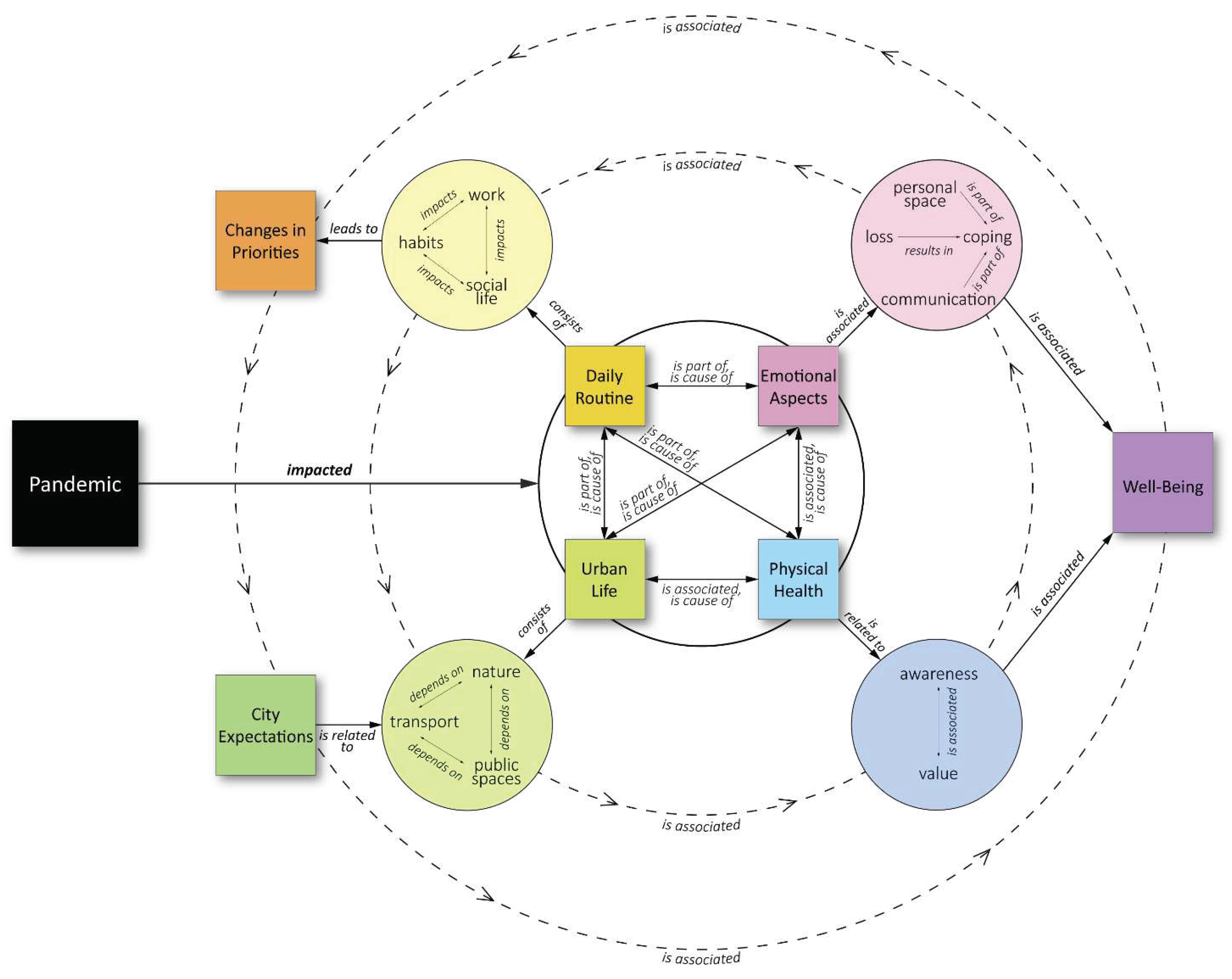
Based on the codes, considering the voice of the interviewee, the concept map in Figure 1 addresses a network of complex aspects which are interlinked in some cases or also offer an alternative viewpoint. (Ian M. Kinchin, 2010) The concept map begins with the deductive sensitizing concepts derived from the research questions in the innermost circle, and with the data, we find some new inductive findings as discussed with the extracts in the outer circle. The links show that the aspects are interrelated, and a holistic approach is required to understand the impacts of the pandemic from the micro to a macro level. The interviewees did not speak much about the transition aspect as considered during the sampling process, but the stories shared portray insights through their experiences. The concept map was prepared collectively by all the interviewers
Conclusions
The literature studied in the first section highlights the issues of social inequity and the issues the urban spaces face due to the pandemic. The research carried out through qualitative data analysis brings into account personal and ground-level facts faced by the people. The research complements the previous studies undertaken and highlights the psychological impacts that public space has on an individual. Although the data collected from the research does not directly connect the social issues in society. The research gives a new perspective from the urban psychological point of view. With the interviewees from different parts of the world, these issues faced are similar which is a very important finding, the author understands the importance of social life the city offers and how devoid of it can impact at different layers. Through this pandemic, it can be understood that a well-designed public space plays a crucial role in an individual’s well-being and the value of the public space the city offers to us.
Acknowledgement
The author would like to thank Prof. Lara Maestripieri for being a guide in conducting this semi-structure interview research methodology. The author also expresses his gratitude to his colleagues Kedar Sharma, Daria Sachek, Deniz Guler, Matteo Gazzola, Joan Contreras Rodriguez for being the interviewers and help to shape the research.
Appendix A
Hello,
Thank you so much for your valuable time for this interaction. I am _____, I am currently studying at the Politecnico di Milano (Some part of the introduction might have also happened during the first conversation). We are carrying out research out the changes caused due to the pandemic in the urban life, and I would be asking you some questions. The research is part of the elective course at the institute. I assure you that all the data will be stored with due caution and respect. Your identity will be kept anonymous. In case you feel uncomfortable or prefer not to answer, please feel free to opt-out. This is a voluntary process, and I will try my best to make you comfortable during this interaction.
- Let us talk something about your city, which are the things that make you relate to your city immediately? It can be a place, food, activities anything. Prompt:- Can you share which places you like to visit in the city? Which places you visit the most for leisure / work?
- The Pandemic changed all our lives and affected our routines, how did you adapt to these? Prompt: - Could you explain more about these changes in your daily routine? Among all the changes in your routine, which changes we given more importance and why?
-
Speaking about changes due to the pandemic in your daily routine, could you share the positive changes which are now part of your daily routine? Prompt /Add on: - What kind you of difficulties did overcome or still face due to the current situation?Any negative changes you had to adapt to? Just to understand your personal development, any habit you got used to being in the lockdown, that you feel you need to avoid?
- The pandemic has been challenging for all for us and there were times when all of us found it difficult to adjust to this new normal/situation. What were the challenges / difficulties that you were able to overcome / adapt to? Prompt: - Thank you so much for sharing, how did you manage to cope with these situations? Were there people who helped you during such moments?
- You shared your thoughts about the city and places you like, what kind of changes do you experience in your neighbourhood due to the pandemic? (Just to introduce the change factor at urban level) Prompt: - How are you adapting to these changes at the city/neighbourhood level (Depending on what answer we get)? These changes have impacted your life greatly, how do you think have these changes impacted your neighbourhood? With the changing situations, how do you think will living in a city add value to your life? Prompt: What are your expectations from the city as its citizen in general?
- With social interaction and connections being an important part of the city-life, the pandemic has affected this part of our life through safety restrictions and lockdowns. How did you keep up with your social life during the pandemic? Add on question depending on the answer - How did the social distancing and other security measures affect your relationship with your family and others?
-
How has the pandemic changed your perspective(s) about the living conditions in a city?Prompt /Add on question – How was your interaction with the outdoor spaces was affected? These days many people used innovative ideas at adapt to the pandemic, did your come across such mind-blowing ideas? What is your perspective about them?
- We have been speaking about the changes and you have been sharing your thoughts, what are your thoughts on how the city has transformed / evolved / adapted because of the pandemic mentioned before / needs of the people. Prompt: - Which changes do you think will have a long-term impact on our cities?
- The world is currently living on hope, we hope for the betterment of the future, how do you see the post-pandemic life for yourself living in the city? Prompt: - Can you share your thoughts with respect to the public spaces? Also, about the new definition of the world we are leading into, what hopes do you have for better tomorrow?
Concluding statements: Thank you so much for your valuable time. Your valuable time is a great contribution for my research. I would once again like to assure you that the data and your identity will not be disclosed.
I would just like to collect few personal details, for my analysis, I assure you to keep it anonymous.
Can you tell me how long have you been staying in this city?
- What is your age?
- Gender? (No need to ask but we need keep it for our record)
- Who do you live with? (Family, Sharing, Partner, Alone)
- Your educational qualifications?
- Your current profession?
- Are your currently employed? |__| Employed |__| Unemployed |__| Inactive.
- If employed? What kind of job? How did you find employment?
- How long have you been working from home?
- How long have you been in a lockdown situation?
In case you have any last concluding remarks that you want to say. Thank you so much! Ciao! Grazie!
References
- Bowen, G.A. Grounded Theory and Sensitizing Concepts. International Jounal of Qualitative Methods. 2006. [CrossRef]
- Christina Silver, A.L. 2014. Using Software in Qualitative Research. [Online] Available at: https://www.doi.org/10.4135/9781473906907 [Accessed 02 06 2021].
- Helen, V.S.Cole, I.A.F.B.M.G.-L. P. K. C. P. d. P. G. S. M. T.-M., 2020. The COVID-19 pandemic: Power and Privelege, gentrification and urban enivironmental justice in the global north. Cities and Health, p. 6.
- Hermanowicz, J.C. The Great Interview: 25 Strategies for Studying. Qualitative Sociology 2002, 25. [Google Scholar]
- Ian, M.; Kinchin, D.S.D.B.H. Using Concept Mapping to Enhance the Reaserch interview. International Journal of Qualitative Methods 2010, 17. [Google Scholar]
- Lara Maestripieri, A.R.E.S. 2019. Methods of Sampling in Qualitative Health Research. In: M. &. A. J. Saks, ed. Researching Health: Qualitative, Quantitative and Mixed Methods. s.l.:Sage.
- Leech, B. l. 2002. Asking Questions: Techniques for Semistructured Interviews. [Online] Available at: http://links.jstor.org/sici?sici=1049-0965%28200212%2935%3A4%3C665%3AAQTFSI%3E2.O.C0%3B2-T.
- Lichtman, M. 2013. Qualitative Research for the Social Sciences. s.l.:Sage Research Methods.
- Male 20, S.W.M., 2021. Semi-Structured Interview [Interview] (03 05 2021).
- Male 25, A.M., 2021. Semi-Structured Interview [Interview] (06 05 2021).
- Male 26, A., 2021. Semi-Structured interview [Interview] (19 04 2021).
- Male 29, I. b. M., 2021. Semi-Structured Interview [Interview] (24 04 2021).
- Patton, M.Q. 2020. Qualitative research and evaluation methods. [Online] Available at: https://www.worldcat.org/title/qualitative-research-and-evaluation-methods/oclc/47844738 [Accessed 01 05 2021].
- Richard Florida, A.R.-P. a. M. S. 2020. Cities in a Post-COVID World. Papers in Evolutionary Economic Geography (PEEG) 2041, Utrecht University, Department of Human Geography and Spatial Planning, Group Economic Geography, p. 29.
- Saldana, J. December 2015. The Coding Manual for Qualitative Researchers. Arizona State, USA: Sage. 20 December.
- Silverman, D. 2013. Doing Qualitative Research. Fouth Edition ed. Los Angeles, London, New Delhi, Singapore, Washington DC: Sage Publication Ltd.
Figure 1.
Concept map done by the group of researchers based on the coding of the interview transcriptions.
Figure 1.
Concept map done by the group of researchers based on the coding of the interview transcriptions.
Disclaimer/Publisher’s Note: The statements, opinions and data contained in all publications are solely those of the individual author(s) and contributor(s) and not of MDPI and/or the editor(s). MDPI and/or the editor(s) disclaim responsibility for any injury to people or property resulting from any ideas, methods, instructions or products referred to in the content. |
© 2023 by the author. Licensee MDPI, Basel, Switzerland. This article is an open access article distributed under the terms and conditions of the Creative Commons Attribution (CC BY) license (http://creativecommons.org/licenses/by/4.0/).
Copyright: This open access article is published under a Creative Commons CC BY 4.0 license, which permit the free download, distribution, and reuse, provided that the author and preprint are cited in any reuse.