
Submitted:
26 May 2023
Posted:
29 May 2023
You are already at the latest version
Abstract
Artificial intelligence, a key technological tool in the era of the 4th Industrial Revolution, is being actively applied to education beyond industry, economy, and culture. In the future society, understanding and using artificial intelligence technology will be considered an essential skill for everyone, and the professionalism of AI education for pre-service teachers nurturing future talents is also important. This study verifies the effectiveness of pre-service teachers after undergoing a 15-week extension program consisting of AI Literacy Education (10 weeks), AI-Linked Subjet Education (3 weeks), and Micro-teaching (2 weeks) which was designed to enhance the AI education professionalism of pre-service teachers. The AI Literacy Education section consisted of understanding AI, AI ethics, and basic programming, and the education was conducted through both experience and practice. After that, the pre-service teachers analyzed the curriculum of the 5th and 6th grades of an elementary school, and developed a subject-related education program using AI tools in three stages. Using the developed program, micro-teaching classes were conducted twice. The study results are as follows. First, there was a change in the positive perception of AI (p<.05). Second, the understanding of AI educational technology tools was improved and the recognition of the usefulness of developing a curriculum-related program was expanded. Third, the importance of teacher competency development was learned through the micro-teaching, and the students' understanding of the learning process was expanded.
Keywords:
AI Literacy
; AI Expertise
; Subject-linked
; Pre-service Teacher
; Micro-teaching
1. Introduction
The importance of ‘artificial intelligence education’ (hereinafter referred to as AI education) is increasing for the nurturing of future talent, and major countries around the world are making efforts in various ways to provide high-level AI education, such as initiatives on understanding AI and using technology. Particularly in the United States, the Artificial Intelligence Advancement Association (AAAI) and the Computer Science Teachers Association (CSTA) have identified five major concepts for AI education in elementary and secondary education courses. These concepts include: Perception, Representation & Reasoning, Learning, Natural Interaction, and Social Impact. Case studies, key concepts, and learning contents by grade group were also suggested for each idea [1].
The Korean Ministry of Education (MoE) (2022) announced a plan to nurture a total of 1 million digital talents by 2026 with the press release of「A Comprehensive Plan for Nurturing Digital Talent」, and information education will be significantly strengthened from the secondary education stage. In addition, according to the Science, Mathematics, Information, and Convergence Education Comprehensive Plan of the Ministry of Education, it was announced that artificial intelligence would be introduced in earnest in the educational field, and that curriculum would be developed and operated so that pre-service teachers would also gain the competency of convergence education [2].
The level of understanding and awareness teachers have about AI greatly affects the future of students preparing for the AI era [3], and the role of teachers is very important to prevent the abuse of AI technology and expand the base of academic knowledge [4]. In other words, the most thorough preparation to achieve the government’s goal is to secure professional teacher resources. However, while AIED education conditions require teacher education to strengthen teacher competency, related studies are lacking [5]. According to AI education trend analysis studies, the number of AI papers has recently increased and is expanding to various fields, but studies on teachers have mainly focused on perception surveys [6]. According to the results of such perception surveys, elementary school teachers recognized the need for conceptual learning and guidance skills related to artificial intelligence and recognized the level of practice, experiential understanding, and performance related to artificial intelligence as a professional standard [7]. Therefore, it is necessary to expand the learning and training opportunities for elementary school teachers to learn the content and practical knowledge that constitutes artificial intelligence teaching competencies, and to acquire various skills for class preparation and practice [8].
On the other hand, AI education expertise can also be improved through many classroom experiences in school, but it must start with the education of pre-service teachers who will guide students, immediately after their graduation and passing the appointment examination. In particular, since the general outline of the 2022 revised curriculum (Sian) also suggests that digital literacy and AI competency can be cultivated in all subjects, it is essential to cultivate the AI competency of pre-service teachers who will be developed for future education.
However, while policies to strengthen artificial intelligence education capabilities for pre-service teachers have recently been actively promoted and research has recently been conducted to strengthen artificial intelligence education capabilities for pre-service teachers, case studies on enhancing expertise based on AI classes have not yet been conducted. In order to have expertise, it is necessary to provide a practical experience of integrating acquired artificial intelligence into classes rather than simply learning AI literacy knowledge. In addition, if the teacher training institution develops AI expertise and discharges it to the field, it can be immediately utilized as a resource that can lead AI education in the field.
Therefore, this paper analyzed the effects of applying a three-stage professional improvement program, which consists of AI Literacy Education, AI-Linked Subjet Education, and Micro-teaching, for pre-service teachers in the first semester.
2. Theoretical Background
2.1. AI education
In general, artificial intelligence in education (AIED) can be divided into two types: ‘learning about AI’ and ‘learning with AI’ [9]. The former is an education on artificial intelligence content aimed at fostering artificial intelligence knowledge or expertise, and the latter is an education focused on using artificial intelligence to achieve learning goals or improve educational administration.
The AI education pursued in this study aims to enhance the AI education expertise of pre-service teachers, so it can be said that it includes both AI literacy education and AI-using education.
In terms of AI literacy education, each researcher has a somewhat different opinion on AI literacy. For example, Long & Magerko (2020) defined AI literacy as the competency necessary for the future society that AI changes, and included both the use of AI for teaching and learning as well as the learning and teaching of AI [10]. Touretzky et al. (2019) defined AI literacy as the cultivation of ethical judgment skills in understanding, developing, and utilizing AI, and classified it into concepts encompassing recognition, expression and reasoning, learning, natural interaction, and social influence. On the other hand, Yoon Hoe-jeong et al. (2021) defined more technical contents such as programming, algorithms, and software as AI literacy education, and defined the use of AI as an auxiliary tool for education, like a technology or platform, as ‘AI utilization education’ [11].
Many studies related to AI literacy have been conducted, including research on learners experiencing artificial intelligence platforms [12], understanding the principles of AI [13], educational program development [14], and teaching-learning models [15]. In addition, research using AI was also conducted in various subjects. For example, there are 15 curriculum convergence artificial intelligence education programs consisting of artificial intelligence, society, technology, and ethics [16], AI-based teaching and learning methods in the math classroom [17], rock classification within the science department [18], biological classification [19], English language chatbot systems [20], and social studies problem solving activities using AI technology [21].
2.2. Research on AI Education for Pre-Service Teachers
For AI research studies targeting pre-service teachers, perception surveys, curriculum development, evaluation tools development, and competency development were conducted.
First, before seeking the development of artificial intelligence education for elementary school pre-service teachers, a perception survey on the metaphorical analysis of artificial intelligence education was conducted [11]. Also, an analysis of the necessity and role of AI [23], and with the development of AI technology, studies on the role of teachers, the number of teachers, the educational environment, and changes in teaching and learning methods were conducted [24].
Second, as a curriculum study, Seongae Kim et al. (2022) developed a content system for cultivating the AI expertise of pre-service teachers by analyzing domestic and foreign literature related to artificial intelligence education and reviewing experts [25]. As a follow-up study, Jun et al. (2022) developed an AI literacy program for each level in a modular form [26].
Third, as a study on evaluation tools, Yi et al (2021) developed a tool to measure the teaching efficacy of AI education targeting pre-service teachers [27], and Kim (2021) conducted an analysis of the effect of artificial intelligence education programs on teaching efficacy and attitudes of pre-service teachers in elementary school [28].
2.3. AI Education Expertise
In general, the professionalism of teachers has been explained through the acquisition of PCK (Pedagogical Content Knowledge) [29], and as the importance of technology has been highlighted, in this context, TPACK (Technological Pedagogical Content Knowledge) emphasized the integration of subject content with pedagogy [30]. From the TPACK point of view, AI is included in TK, but as an academic field, it also corresponds to the content of the curriculum. In order to cultivate TPACK with AI as a technology, it is necessary to emphasize practice. Pre-service teachers who participated in the TPACK training class recognize that TPACK is an important competency in teaching and learning, but the level of practice and performance are low [31]. Therefore, in order to cultivate TPACK, it is necessary for pre-service teachers to understand what TPACK is, observe class demonstrations, practice classes on their own, and cultivate their own TPACK through the process of reflection [32]. In particular, as the current pre-service teacher training course is based on subject and academic curriculum, it is argued that it is necessary to introduce a practical and realistic education program to enhance the pre-service teacher’s positive self-efficacy and teaching competency [33]. Pre-service teachers acquire classroom knowledge and develop teaching skills through practical experiences such as classroom demonstrations [34].
In this context, for pre-service teachers to have expertise in AI education, it can be summarized that practical classroom experience must be followed along with AI literacy knowledge and AI convergence ability.
While various AI literacy programs for pre-service teachers have been developed, research on programs for cultivating pre-service teachers’ AI convergence education competency is insufficient [35]. The studies conducted include the development of an AI convergence education program using drones [36], the development of an AI education program in connection with the science department [27], and research on AI-maker education [37].
Model development and some case studies were conducted in relation to AI-using classes for pre-service teachers. Regarding enhancing instructional expertise, Choi et al. (2022) developed an AI-TPACK model that considers the role, task, and interaction of instructors who guide pre-service teachers as well as tasks to cultivate artificial intelligence convergence instructional expertise of pre-service teachers [38].
In addition, Lee and Park (2022) conducted a study to acquire AI literacy and conduct AI convergence classes in elementary school sites to cultivate AI education capabilities of pre-service teachers [39]. Also, Kim (2021)’s study shows that pre-service teachers’ experience of developing artificial intelligence teaching and learning process plans, and teaching and learning materials directly to elementary school students through mentoring activities by teachers in the field can foster positive self-efficacy and positive attitudes toward the use of artificial intelligence technology. However, there are very few studies that have attempted to be applied in actual class practice [40]. Pre-service teachers recognized that AI convergence education was important, but suggested that their leadership ability was low, and emphasized the educational experience of AI convergence education. In addition, studies on the development of AI education expertise of pre-service teachers were not systematically conducted through regular lectures by teacher training institutes.
A typical opportunity for pre-service teachers to acquire teaching expertise in the course of the teaching profession is educational practice. Educational practice is an opportunity for prospective teachers to acquire the knowledge, skills, and attitudes they need to have as a teacher, and to examine their educator’s qualifications. However, it takes a lot of time to acquire the minimum basic knowledge and skills for classes, understand schools and students in the course of pre-service teachers’ educational practice, and there is a practical limit to designing and trying AI classes even if you have class experiences for each subject. Therefore, it is necessary for pre-service teachers to have various opportunities, such as pre- and post-practicum and micro-teaching, in addition to regular educational practice in order to improve their class expertise while completing the teaching process. Micro-teaching is a relatively easy method to provide practical hands-on experience to pre-service teachers, and its effect is also reported positively [41,42]. Of course, there were no studies related to the enhancement of AI education expertise according to the micro-teaching procedure of pre-service teachers.
3. Research Method
The subjects of this study were a total of 30 sophomore students at the 00 University of Education who were taking ‘Elementary Computer’, as a subject. Of these, 13 were male and 17 were female. The course was run for 15 weeks from March 2nd to June 10th, 2022. The research was conducted in three stages: AI Literacy Education, AI-Linked Subjet Education, and Micro-teaching. Pre-service teachers received AI literacy training on the understanding and practice of AI for 10 weeks. Then, for three weeks, after receiving guidance on the AI-Linked Subjet Education development process, the AI-Linked Subjet Education program in connection with the curriculum of 5th to 6th graders in elementary school was developed for the 3rd time. Finally, using the development program, micro-teaching classes were conducted for colleagues over the course of two weeks. An AI perception survey was conducted before and after the start of the study, and a reflection log was prepared and analyzed in the AI-Linked Subjet Education and Micro-Teaching stages.
3.1. AI Literacy Education
The AI literacy education program of this study utilized 10 basic courses for 10 weeks from among the modular AI literacy education programs developed by Kim et al. (2022) and Jon et al. (2022) to cultivate artificial intelligence capabilities as shown in [Figure 1] below. The ‘AI understanding’ area consisted of four modules: ‘AI Concepts and Social Change’, ‘Awareness of AI’, ‘AI’s Expression and Reasoning’, and ‘AI Interactions’. The ‘AI Ethics’ area consisted of three modules: ‘The Social Impact of AI’, ‘Data Ethics’, and ‘Algorithmic Ethics’. The ‘AI Programming’ (basic) area consisted of three modules: ‘Understanding AI Educational Tools’, ‘Basics of Machine Learning Models’, and ‘Implementation of Machine Learning Models’.
3.2. AI-Linked Subjet Education
After completing AI literacy education, pre-service teachers formed a team of three to develop the third AI-Linked Subjet Education program for fifth and sixth graders in elementary school (Park & Song, 2022) according to the three-stage UPA model in [Figure 2].
The first stage is an activity to understand the technology-related content knowledge (the concepts, principles, examples, etc. of SW, AI, data science, etc.) necessary for curriculum linkage. The second stage is an activity to directly experience and practice tools related to subject learning. For example, activities such as experiencing using text to speech (TTSI) AI blocks, image classification model learning, and collection, analysis, and interpretation of public data correspond to these activities. The third stage is an activity that selects subjects that can create synergy through AI linkage among the 5th to 6th grades of elementary school and apply AI. The developed programs had the opportunity to be presented in front of professors and fellow pre-service teachers, and based on the feedback received from the audience, a reflection log of the development program was written, and the program was revised and supplemented.
3.3. Micro-Teaching Operation
The micro-teaching procedure was conducted in two stages: the first class demonstration for each team and the re-examination class using the previously developed class program. In the first class demonstration stage, a 15-minute mock class video was recorded and uploaded to the Padlet platform, and the professor and fellow pre-service teachers provided evaluation and feedback. The biggest advantage of micro-teaching is that compared to general classroom practice, it is possible to observe the results repeatedly through video recording, so that improvements can be easily identified. In the re-examination class phase, the feedback and evaluation results obtained from the first class demonstration were reflected on, and re-examination classes were conducted in the offline classroom for 15 minutes and re-evaluated. After each class demonstration, the pre-service teachers wrote and submitted a reflection report by referring to the feedback written on the checklist.
3.4. Data Collection and Analysis
In order to develop AI-Linked Subjet Education programs for prospective teachers and explore the effects of micro-teaching, individual AI awareness surveys (before and after) were conducted, and team reflection journals were prepared and analyzed in the program development and micro-teaching process.
First, in order to investigate the perception of AI, Wiebe’s (2003) computer science attitude test tool was modified and adapted to this study[44]. Originally, it consisted of a total of 57 questions, but questions asking about computer science knowledge or gender differences were removed, and AI-related questions were modified and supplemented to fit this study, of which the contents were reviewed by five field teachers and professors majoring in computer education. In the statistical analysis process, negative questions (3) were counted in reverse. A total of 9 items were selected in the areas of confidence, usefulness, and motivation as follows. The test questions were evaluated on the five-step Likert scale, and in this test paper, a higher score meant a more positive response to the question. The reliability Cronbach α of the test questions were found to be .728.
The reflection log can be said to be the most important data for conducting this study because it is a means to specifically organize the details that pre-service teachers felt during the AI-Linked Subjet Education development and micro-teaching processes. The main items of the reflection log were composed of trial, error, and solutions in the AI-Linked Subjet Education development process, the strengths and improvements of the micro-teaching class, the feelings of teachers, and other opinions were allowed to be expressed freely.
4. Results
4.1. AI Awareness Survey Results
<Table 1> shows the results of a pre- and post- AI awareness survey for pre-service teachers and a t-test for statistical analysis.
As a result of statistical analysis, the pre-test showed a mean of M=3.32 and standard devition of SD=0.41, while the post-test was M=4.01 and SD=0.24, which showed an average increase of 0.69 in the post-test (p<.05). This means that a positive change in perception of AI education appeared after participating in this course.
These changes indicate an increase in the joy of acquiring knowledge about various AI technology tools through experience and practice, and the recognition of the usefulness of AI in the classroom through the activities of designing and implementing curriculum-related classes, and completing collaborations and projects with colleagues. Repeated failures and overcoming experiences seem to have influenced the formation of positive perceptions about AI education.
4.2. AI-Linked Subjet Education Case Study
Pre-service teachers developed class programs using AI in subjects such as science (4), math (1), social studies (3), music (1), and practical (1) subjects. Among them, examples of the 3rd class program linked to the practical subjects are presented as follows.
The first stage (understanding stage) was to investigate the use of AI in real life, and dealt with the classification of supervised learning, a type of machine learning. The second stage (practice stage) was to practice the classification of supervised learning with the AI function of the Entry platform (https://playentry.org/en).
The third stage consisted of activities linking AI to the topic of ‘healthy eating’ in the practical subject of ‘Family Life and Safety’.
The learning goal was to ‘evaluate one’s own diet and practice a balanced diet using the food composition bike’.
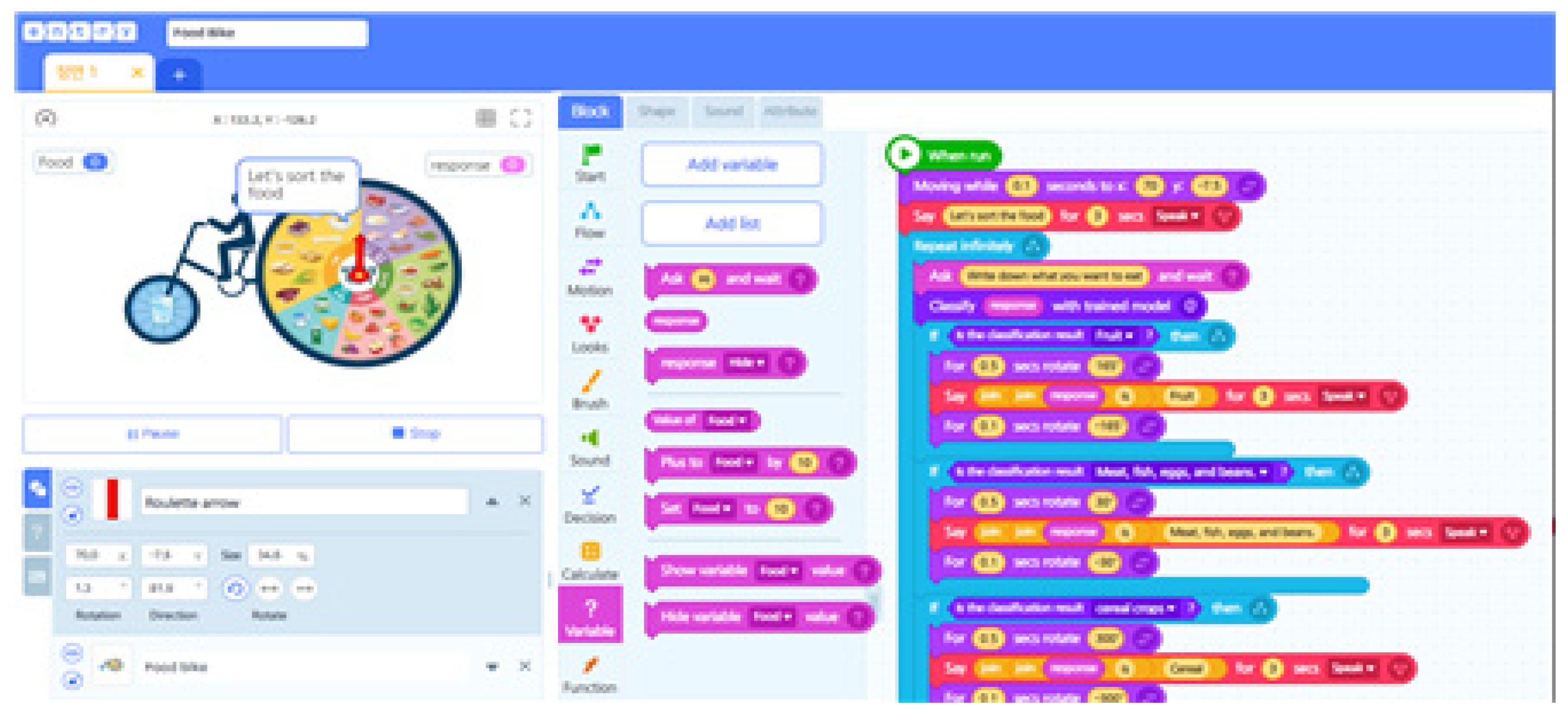
First of all, some of the problems with the handling of the food composition bicycle in the textbook are that students have to find out which groups each food corresponds to, and that the food organizer cannot handle many foods at once because the food composition bicycle is presented as a photograph on the page. In order to improve these problems, the ‘Talking Food Composition Bike’ program was devised by using Entry. First of all, if you enter the name of a food as its title suggests, the food organizer will tell you which food group the food belongs to. In this way, students can immediately learn about the food groups that a food belongs to while also learning about the food composition bike. In addition, many foods can be classified according to food groups by using ‘Classification-Text’ in the ‘Learning Artificial Intelligence Model’ of the Entry program.
In other words, the ‘Talking Food Composition Bike’ program tells you which food group the food belongs to based on the text learned by the food organizer when you enter the name of a food. In addition, arrows are used to indicate the food groups to which the food belongs to aid visual understanding (http://naver.me/FqlCPFen).
Figure 3.
Food Bike Implementation.
4.3. Results of Reflection Log Analysis
4.3.1. AI-Linked Subjet Education
The analysis and summary of the reflection logs recorded during the development of the AI-Linked Subjet Education program are as follows.
First, it can be seen that the understanding of artificial intelligence educational technology tools has expanded. For example, the functional difference between machine learning for kids and scratch and entry AI blocks was learned, and skills in the process of experiencing and solving various problems through trial and error while implementing curriculum-related programs such as coding were improved.
Second, a case where AI convergence education was implemented in the educational field by creating a class guidance plan for the 3rd class with the UPA model was learned. After going through various trials and errors and producing AI programs that can be applied to subject learning contents, the stereotype that artificial intelligence is far from the subject matter disappeared, and the fact that it can be a teaching method that can be performed in actual field classes was learned.
Third, for classes that teach students both learning topics and artificial intelligence, it was discovered what level of perspective should be taught to elementary school students as pre-service teachers through a number of questions about what to expect, such as where and how to use AI blocks, what learning topics should be selected, and what activities to capture students’ interest and learning.
Fourth, the possibility of learning in connection with artificial intelligence technology and subjects was experienced. While developing the class program in the 3rd stage, it was found that a program such as Entry is not limited to only computer subjects, but can also be used to promote the understanding of subject learning, and how to link information between classes in an actual classroom setting. This provided an opportunity to think about what to do and how to make progress toward a more in-depth stage in terms of learning activities.
4.3.2. Micro-Teaching
The analysis and summary of the reflection logs written by pre-service teachers during the micro-teaching process are as follows.
First, it was possible to recognize the importance of classes tailored to the students’ ability.
“We simplified the complex coding as much as possible so that even students with a low knowledge of coding can complete the project.”
Second, interaction with teammates took place throughout the entire process of preparing for class. This was good because it seemed that they were able to learn from various fields such as writing tutorials, mock classes, and coding.
“Before the class, I had never even seen the teaching plan for a SW class, so of course it was natural that it felt difficult. The team members kindly guided me, and they helped me a lot in writing guidelines, inserting coding example images, and writing class organization activities.”
“Based on what I learned from my team members, I learned how to structure SW education in the future and what it takes to make students actively participate in class as purposeful educators.”
Third, through micro-teaching, confidence was gained that curriculum classes using AI could be conducted in the classroom in the future.
“The feedback from my professor and fellow prospective teachers allowed me to reconsider the parts I missed while organizing the class, and as a result, I gained the confidence that I could do better when I make a lesson plan next time. If there is an opportunity, I want to refine the lesson plan I made for this assignment and go to the actual school site to teach.”
“I think it will be a great help to develop SWAI competency as a pre-service teacher in the future because it seemed like a natural opportunity to think about the learning level, reactions, and participation abilities of students in a way that aligned with the teacher’s instructional direction.”
Fourth, in terms of teaching methods, it was recognized that the teacher’s ability to effectively deliver class contents was necessary.
“Through micro-teaching, I learned the process of guiding students with the AI technology that I know, and I also felt the need to have specialized knowledge about it.”
“It is even more disappointing because it was something that could be controlled by anticipating various unexpected situations just before the class demonstration and preparing more thoroughly for the class.”
“The importance of AI and SW education in public education will gradually increase as time goes by. In order to prepare for the future, I will continue to study and work hard to develop software competency as a pre-service teacher.”
Finally, it was found that it is important to have a prior understanding of the class environment before class.
“I thought about the goal of explaining the role of the blocks and the logical reasons for the arrangement to students one by one so that they can understand them and code themselves. However, considering the class time, the number of students, and the level difference, it was regrettable that some students would not understand the coding itself and would just follow the teacher’s demonstration."
5. Conclusions and Recommendations
The importance of ‘artificial intelligence education’ is increasing for nurturing future talent, and the most thorough preparation to achieve the government’s goal is to secure professional teacher resources. Accordingly, various policies are being pursued to strengthen the AI education competency of pre-service teachers. However, research on professional development in actual AI classes for pre-service teachers has not yet been conducted. Therefore, this paper analyzed the effects of applying a three-stage professionalism improvement program, which consisted of AI Literacy Education, AI-Linked Subjet Education, and Micro-Teaching, for pre-service teachers in their first semester.
The main research results are as follows.
First, there was a positive change in AI awareness after taking the course for the first semester (p<.05).
Second, the understanding of AI technology tools was expanded through AI literacy education, and the practical usefulness of AI was experienced in the classroom through the development of the AI-Linked Subjet Education program.
Third, the importance of developing the teacher’s ability to effectively deliver class contents through micro-teaching was recognized, and the understanding of the student’s learning process was expanded. Thus, confidence in the class improved.
Therefore, it was confirmed that the contents developed and treated in this study had a positive effect on the AI education competency of pre-service teachers and their understanding of the learning process. These findings suggest that the three-step courses of AI Literacy Education, AI-Linked Subjet Education, and Micro-teaching can help pre-service teachers understand the learning process even if they do not face elementary school students directly, and at the same time contribute to fostering AI education expertise.
It is believed that if pre-service teachers get both an opportunity to actually apply the knowledge and skills they have learned in college through teacher practice, and also an opportunity to reflect on their own class analysis through the feedback of the instructor, they will be able to get more diverse experiences. If a follow-up study is suggested based on this study, it is necessary to develop an AI professional learning community model consisting of pre-service teachers, experienced teachers, and experts, and to conduct a professional development study in connection with teaching practice.
References
- Touretzky, D.; Martin, F.; Seehorn, D.; Breazeal, C.; Posner, T. Special session: AI for K-12 guidelines initiative. In Proceedings of the 50th ACM Technical Symposium on Computer Science Education; 2019; p. 1244. [Google Scholar] [CrossRef]
- Ministry of Education. 2022. Available online: https://www.moe.go.kr/.
- Ryu, M.; Han, S. . The Educational Perception on Artificial Intelligence by Elementary School Teachers. J. Korean Assoc. Inf. Educ. 2018, 22, 317–324. [Google Scholar] [CrossRef]
- Thierry, K. Artificial Intelligence in Education: The Urgent Need to Prepare Teachers for Tomorrow’s Schools. Form. Et Prof. 2019, 27, 112–116. Available online: https://ssrn.com/abstract=3346658. [CrossRef]
- Jeon, I.-S.; Jun, S.-J.; Song, K.-S. Teacher Training Program and Analysis of Teacher’s Demands to Strengthen Artificial Intelligence Education. J. Korean Assoc. Inf. Educ. 2020, 24, 279–289. [Google Scholar] [CrossRef]
- Park, J.-H. An Analysis of Domestic Research Trend of Artificial Intelligence Education. J. Edutainment 2021, 3, 51–62. [Google Scholar] [CrossRef]
- Ko, B.-C.; Sun-Kwan, H. Achievements in Ai Education of Elementary School Teachers and Awareness of AI Education Training. J. Korean Assoc. Artif. Intell. Educ. 2021, 2, 29–43. [Google Scholar]
- Lee, C.H. Educational Needs of Elementary School Teachers’ Teaching Competency for Artificial Intelligence Education. J. Educ. 2022, 42, 131–148. [Google Scholar]
- Holmes, W.; Bialik, M.; Fadel, C. Artificial intelligence in education: Promises and implications for teaching and learning; The Center for Curriculum Redesign: Boston, MA, USA, 2019. [Google Scholar]
- Duri, L.; Brian, M. What is AI Literacy? Competencies Des. Considerations. 2020. [Google Scholar] [CrossRef]
- Yoon, H.; Park, E.; Kim, J.; Bang, D. Exploring directions of AIED(Artificial Intelligence in EDucation) teacher education based on a review of domestic precedent studies. Educ. Res. 2021, 82, 135–155. [Google Scholar]
- Shon. Development of SW education class plan using artificial intelligence education platform : focusing on upper grade of elementary school. J. Korean Assoc. Inf. Educ. 2020, 24, 453–462. [Google Scholar]
- Kim, J.-S.; Park, N.-J. Development of a board game-based gamification learning model for training on the principles of artificial intelligence learning in elementary courses. J. Korean Assoc. Inf. Educ. 2019, 23, 229–235. [Google Scholar] [CrossRef]
- Lee, H.; Yoo, I. Development and application of supervised learning-centered machine learning education program using micro:bit. J. Korean Assoc. Inf. Educ. 2021, 25, 995–1003. [Google Scholar] [CrossRef]
- Kim, K.; Park, Y. A Development and Application of the Teaching and Learning Model of Artificial Intelligence Education for Elementary Students. J. Korean Assoc. Inf. Educ. 2017, 21, 137–147. [Google Scholar] [CrossRef]
- Lee, Y. Development and effectiveness analysis of artificial intelligence STEAM education program. J. Korean Assoc. Inf. Educ. 2021, 25, 71–79. [Google Scholar]
- Choi, I.-S. Exploring teaching and learning methods using artificial intelligence (AI) in the mathematics classroom : Focusing on the development of middle school statistic scenarios. J. Korean Sch. Math. Soc. 2022, 25, 149–174. [Google Scholar]
- Cho, Y.-S.; Chen, Y.; Kim, J.-B. Development of Elementary AI·Science Convergence Education Program Using An AI Classification Model, Brain, Digital, & Learning. J. Korea Soc. Comput. Inf. 2021, 11, 227–243. [Google Scholar]
- Shin, W.-s. A Case Study on Application of Artificial Intelligence Convergence Education in Elementary Biological Classification Learning. Elem. Ccience Educ. 2020, 39, 284–295. [Google Scholar]
- Lee, D.H. A study for the development of an English learning chatbot system based on Artificial Intelligence. Secondary English Education (SEE). Second. Engl. Educ. 2018, 11, 45–68. [Google Scholar] [CrossRef]
- Nam, H.-Y.; Cho, H.-G. Categories of Social Studies Education with Artificial Intelligence and Ideas for Teaching Practice. Korean J. Elem. Educ. 2020, 31, 119–133. [Google Scholar]
- Kim, J.-O. Pre-service Elementary School Teachers’ Conceptual Metaphors of Artificial Intelligence Education. J. Korean Pract. Arts Educ. 2020, 26, 65–80. [Google Scholar] [CrossRef]
- Shin, D.-j. An Analysis Prospective Mathematics Teachers’ Perception on the Use of Artificial Intelligence(AI) in Mathematics Education. Commun. Math. Educ. 2020, 34, 215–234. [Google Scholar]
- Song, S.-C.; Shim, K.-C. . A Study on the Awareness of Pre-service Science Teachers about Secondary Education in Future Intelligence Information Society. Biol. Educ. 2017, 45, 404–417. [Google Scholar]
- Kim, S.A.; Park, J.H.; Jeon, S.J.; Choi, J.W. Development of a contents system to enhance the professionalism of Artificial Intelligence education for pre-service teachers. J. Korean Inst. Ind. Educ. 2022, 47, 22–44. [Google Scholar] [CrossRef]
- Jun, S.; Choi, J.; Kim, S.; Park, J. Development of Modular Artificial Intelligence Literacy Education Program for Pre-service Teachers. J. Korean Assoc. Comput. Educ. 2022, 25, 35–45. [Google Scholar]
- Yi, S.; Kim, S.-W.; Lee, Y. Development of Teaching Efficacy Belief Instrument about Artificial Intelligence for Pre-service Teachers. J. Korean Assoc. Comput. Educ. 2021, 24, 47–61. [Google Scholar]
- Kim, J.-O. The Effect of an Artificial Intelligence Education Program on Teaching Efficacy and Attitude Toward the Use of AI Technology by Elementary School Pre-service Teachers. Preprints.org 2021, 34, 181–198. [Google Scholar] [CrossRef]
- Shulman, L.S. Knowledge and teaching: Foundations of the new reforms. Harv. Educ. Rev. 1987, 57, 1–22. [Google Scholar] [CrossRef]
- Mishra, P.; Koehler, M.J. Technological pedagogical content knowledge: A framework for the teacher knowledge. Teach. Coll. Rec. 2006, 108, 1017–1054. [Google Scholar] [CrossRef]
- Eom, M.R.; Shin, W.S.; Han, I. A Survey on the Differences of Preservice Teachers’ Perception of the Technology, Pedagogy, and Content Knowledge(TPACK). J. Korean Teach. Educ. 2011, 28, 141–165. [Google Scholar]
- Jang, S.J.; Chen, K.C. From PCK to TPACK: Developing a transformative model for pre-service science teachers. J. Sci. Educ. Technol. 2010, 19, 553–564. [Google Scholar] [CrossRef]
- Leavy, A.; Hourigan, M.; Carroll, C. Exploring the impact of reform mathematics on entry-level pre-service primary teachers attitudes towards mathematics. Int. J. Sci. Math. Educ. 2017, 15, 509–526. [Google Scholar] [CrossRef]
- Erdoğan, F.; Yildiz, F. The Investigation of Prospective Elementary Mathematics Teachers’ Problem Posing Self-Efficacy Beliefs. Education 2021, 9, 228–237. [Google Scholar] [CrossRef]
- Yi, S.; Lee, Y.; Paik, S.-H. Analysis of Effects of Convergence Education Program about State Classification of the Matters using Machine Learning for Pre-service Teachers. J. Converg. Inf. Technol. 2022, 12, 139–149. [Google Scholar]
- Jeon, H.; Kim, Y. Effect of Anchored AI·SW Convergence Program Using Drones for Pre-service Teachers on Creativity and Convergence Capabilities. J. Korean Assoc. Comput. Educ. 2022, 25, 83–92. [Google Scholar]
- Park, J. The Case Study on Artificial Intelligence Based Maker Education for Pre-Service Teacher. J. Digit. Contents Soc. 2020, 21, 701–709. [Google Scholar] [CrossRef]
- Choi, J.; Jun, S.; Kim, S.; Park, J. AI-TPACK Model Design for Cultivating AI Convergency Teaching Professionalism of Pre-service Teachers. J. Korean Assoc. Comput. Educ. 2022, 25, 79–89. [Google Scholar]
- Lee, H.; Park, J. A Case Study on STAMP Operation for Developing Artificial Intelligence Competence of Pre-service Teachers. J. Creat. Inf. Cult. (JCIC) 2022, 8, 123–133. [Google Scholar]
- Lee, S.-W. Convergence Education of Elementary School Teachers and Pre-service Teachers. J. Korean Pract. Arts Educ. 2021, 34, 1–17. [Google Scholar] [CrossRef]
- Kim, W.J. Study of self-reflective process on pre-service physical education teachers` microteaching. Korean J. Sport Pedagog. 2010, 17, 25–52. [Google Scholar]
- Jeon, S.; Hong, A.; Jung, H. Formation Process and Characteristics of Preliminary Physical Education Teachers’ Micro-teaching Experience and Professional Identity. Korean J. Sport Pedagog. 2017, 24, 105–129. [Google Scholar] [CrossRef]
- Park, J.-H.; Song, J.-B. Case of Operating a Curriculum-Linked Artificial Intelligence Education Camp Program. J. Digit. Contents Soc. 2022, 23, 49–56. [Google Scholar] [CrossRef]
- Wiebe, E.N.; Williams, L.; Yang, K.; Miller, C. Computer Science Attitude Survey; Report No.: NCSU CSC TR-2003-1; Dept. of Computer Science, NC State University: Raleigh, NC, USA, 2003. [Google Scholar]
Figure 1.
The modular AI literacy education programs.
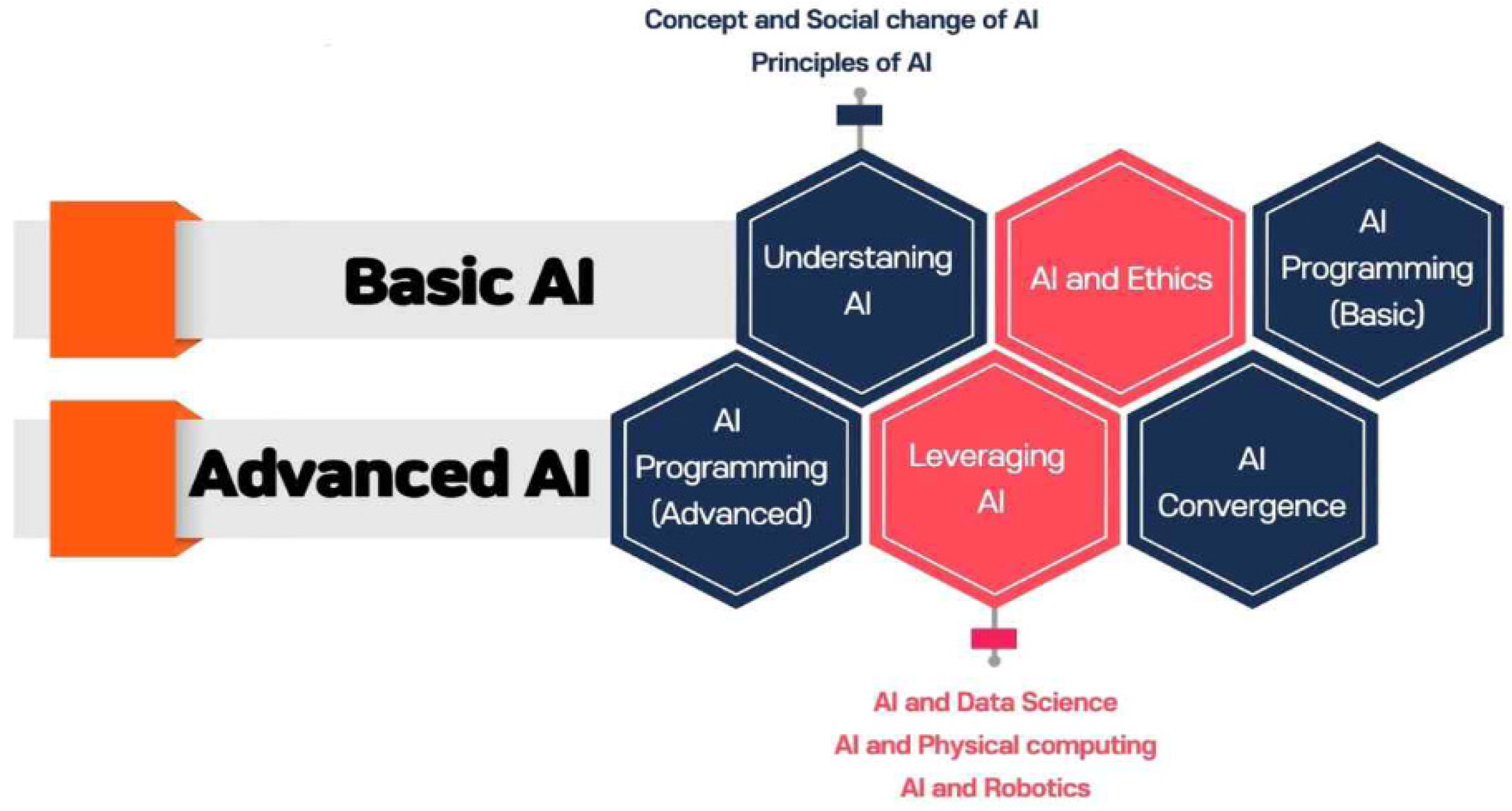
Figure 2.
UPA 3 Level Model for AI Convergence Education [43].
Figure 2.
UPA 3 Level Model for AI Convergence Education [43].
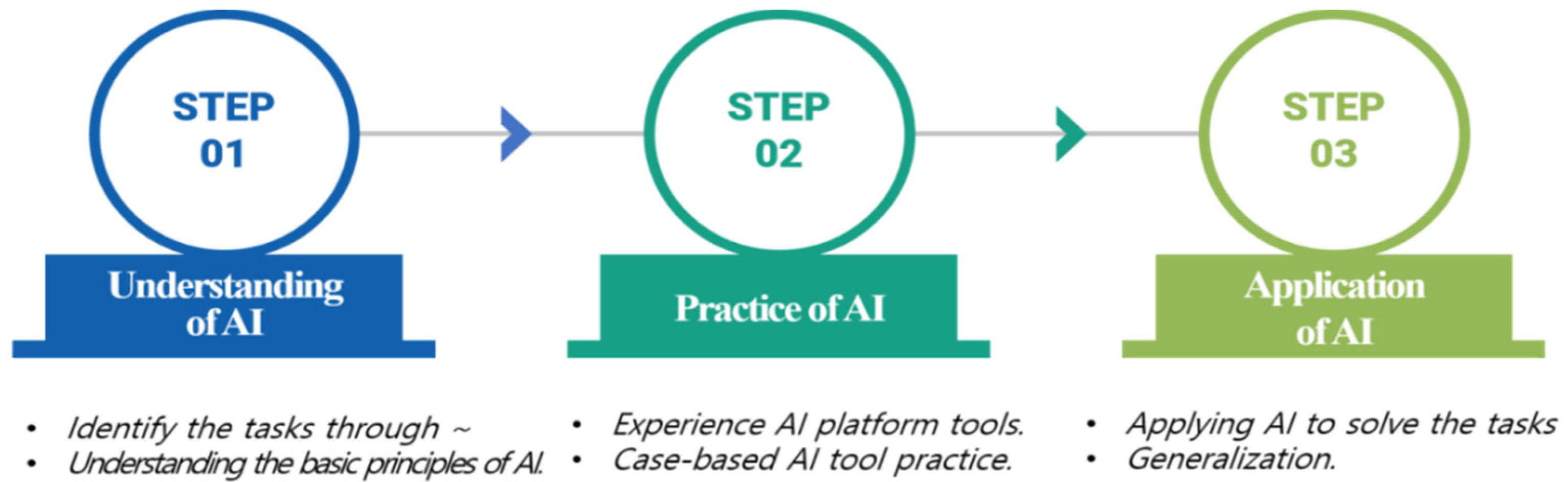

Table 1.
Pre- and post- AI awareness survey.
| Group | Num. Students | Average | St. Dev. | t value | Degrees of Freedom | Significance |
|---|---|---|---|---|---|---|
| Pre- inspection | 30 | 3.32 | 0.41 | -7.52 | 29 | .000 |
| Post- inspection | 30 | 4.01 | 0.24 |
Disclaimer/Publisher’s Note: The statements, opinions and data contained in all publications are solely those of the individual author(s) and contributor(s) and not of MDPI and/or the editor(s). MDPI and/or the editor(s) disclaim responsibility for any injury to people or property resulting from any ideas, methods, instructions or products referred to in the content. |
© 2023 by the authors. Licensee MDPI, Basel, Switzerland. This article is an open access article distributed under the terms and conditions of the Creative Commons Attribution (CC BY) license (http://creativecommons.org/licenses/by/4.0/).
Copyright: This open access article is published under a Creative Commons CC BY 4.0 license, which permit the free download, distribution, and reuse, provided that the author and preprint are cited in any reuse.


