

Submitted:
25 April 2023
Posted:
26 April 2023
You are already at the latest version
Abstract
Today, the world is undergoing a major investment cycle in infrastructure, which is vital for the development and prosperity of countries and society. Management deficiencies in infrastructure projects are well known and some of them concerns weak engagement of project stakeholders. Importance of stakeholder engagement as the key success factors for infrastructure projects is recognized. However, the literature gives very few answers how this process manifests in projects. Some scholars concluded that it is a complex and undertheorized management process which necessitates more empirical research. The research questions seek to identify how practitioners perceive the stakeholder engagement, who implements activities and processes related to engagement and in what way, which organizational aspects influence the process and how success is achieved in infrastructural projects. Interviews were conducted with eight experienced experts who participated in a whole series of (complex) infrastructure projects. The interviews examined all aspects of the engagement of stakeholders in detail, and a thematic analysis was carried out. Based on the analysis, success/failure factors related to the stakeholder engagement process were defined. As a result, a framework model for engaging stakeholders and achieving success in infrastructure projects is presented, which is based on three management levels and three levels of project success.
Keywords:
stakeholder
; engagement
; project success
; factors
; criteria
; governance
; infrastructure
; framework model
1. Introduction
In recent years, large infrastructure projects, which are used as a main vehicle to overcome existing problems of infrastructural capacity or create new business opportunities, have been of great importance for the development of society and economy [1]. Ninan et al. [2] pointed out that infrastructure is vital for the socio-economic development of any region and that there is a strong correlation between the availability of infrastructure and economic growth. Infrastructure projects provide capacities such as transportation, transmission, distribution, collection, and the interaction of goods, services, or people (e.g. pipelines, highways, bridges etc.) [3]. Beside this dominant type of hard or civil infrastructure there is also other type of urban infrastructure called soft or social infrastructure [4] which is necessary for the development of cultural norms and the promotion of a healthy population (e.g. courts, schools, hospitals etc.) [5,6]. Infrastructure projects are being carried out all over the world today, whether it is developed countries upgrading infrastructure capacities or developing countries building vital infrastructure for the first time [7]. The McKinsey Global Institute estimates that the world will need to spend $57 trillion on infrastructure by 2030 [8].
In terms of scale, these projects usually cover broad geographical region; affect multiple jurisdictions and stakeholder groups [3,9]. Mok et al. [10] describes major infrastructure projects as highly complex with high risks, long lead time and involvement of multiple stakeholders at different levels. The uniqueness and the dynamic nature of business environments of large-scale infrastructure projects, such as the construction of a railway network, often come from their distinctive social and environmental requirements [11]. High levels of complexities along with stakeholders with opposing requirements can increase time and cost overruns and there are prominent cases that evidently demonstrate this problem [11]. Many argue the performance of those projects is unsatisfactory: the wrong projects are selected, the costs are underestimated and the benefits are overestimated [12]. More general research shows that about 70% of organizations deliver projects that do not achieve stakeholder satisfaction or meet the planned goals [13,14]. Brunet and Aubry [15] stated that the anatomy of major public projects is shifting, with increasingly complex stakeholders and supply chain linkages and they call for enhanced academic scrutiny into this emerging organizational phenomenon. Luo et al. [16] concluded that traditional approaches for project management are not sufficient to attain successful project outcomes in complex infrastructure projects.
1.1 Multiple stakeholder engagement issue – vague understanding of stakeholder engagement process and organizational enablers in infrastructure projects
Volden [17] argues that infrastructure projects must be assessed in a broad perspective that includes operational, tactical and strategic aspects, and unintended as well as intended project effects. Stakeholder management theory views projects as successful if they consider stakeholder needs and requirements through the process of stakeholder management [18]. The project management approach itself is transforming from a pure “predict-and-control” management strategy to “prepare-and-commit” strategy which encompasses, for instance, broad task definition to encourage cooperation, network steering (bottom-up) and open, unstructured information exchange [19]. There has been a shift for projects and organizations to improve social and environmental responsibility by involving broad and heterogeneous networks of stakeholders to create system-wide benefits [18,20]. The purpose of stakeholder engagement is to attain project values and possible stakeholders’ satisfaction throughout the project’s life cycle [21]. Routines and activities that can be implemented to engage stakeholders at practical and fine-grained level can be defined as practices [22]. Chinyio and Akintoye [23] explained the need to use a combination of various practices to engage with stakeholders successfully. Pascale et al. [18] argues that engagement practices are only sufficiently researched for front-end phases while in delivery and handover phases were scarcely addressed in literature.
Stakeholder involvement in construction projects is the most critical factor in successful project accomplishment [24] and yet little is known on how to facilitate stakeholder involvement in usual project management process [25]. New paradigm of viewing projects as organizations brought the principal shift in project management studies [26] and Hu et al., [7] reported that organization and stakeholder management is joint research topic which is immensely important in research field of complex project management. Similarly Khan et al. [27] argues that project governance and stakeholder management are substantial areas of organizational concern for the successful delivery of public sector infrastructure projects. Some characteristics of good project governance share same principles as stakeholder engagement [28]: achieving active participation (e.g. right decision at the right time); project control in order to achieve strategic goals to meet the satisfaction of all the stakeholders; equality in terms that all parties have the same opportunities to improve and maintain their own well-being.
Many scholars emphasized that there is a need for further investigation into the best practices for success within large scale projects [11] and Klakegg et al. [29] concluded that large public projects are still poorly understood in terms of organization. The developed countries such as Norway and the United Kingdom have even adopted a governance frameworks (i.e phase gates, audits and reviews etc.) to deal specifically with complex nature of major public projects [15]. Some argues that main challenges are largely associated with human skill and competencies, rather than technical issues [11,30] and some argues that (governance) frameworks and procedures can best contribute [28]. Common point on which many agrees is the paramount importance of stakeholder engagement in large infrastructure projects [17,24,27,31]. But there are also many unanswered questions on the nature of engagement process and activities [32]. Collinge [33] concluded that stakeholder engagement is an undertheorized area of construction project management research with its distinctive theoretical and practical complexity. More empirical studies are needed to unpack rationales for timely engagement to achieve systemic outcomes [18] and thus this research will explore the nature of stakeholder engagement and factors for successful management of infrastructure project.
Research questions that this research will address are: 1. How practitioners perceive stakeholder engagement as part of a project management and/or governance mechanism; 2. What are the methods and practices for engaging stakeholders in infrastructure projects, 3. Who conducts stakeholder engagement and what influences stakeholder engagement and project success; 4. How success in infrastructure projects is perceived and achieved.
This research study is organized into five sections. In Section 2, main research topics which encompass the issue of stakeholder engagement in infrastructure projects are described. In Section 3 the methodological approach is explained, In Section 4 research results are presented and conceptual model for stakeholder engagement in infrastructure projects is explained. Finally, Section 5 presents discussion, conclusions, and suggestions for further research.
2. Literature review
In this section three research topics which relate to stakeholder engagement in infrastructure projects will be briefly addressed. The first topic of project success is explored to see where research stands on defining project success criteria and factors for large and infrastructure projects. Second, stakeholder engagement process is introduced with latest development in this research topic. The third topic explores project organizations as part of organizational management systems and the position of stakeholder engagement in this management systems.
2.1. Achieving project success in large construction and infrastructure projects
The results of several studies show that project success is a multidimensional concept: it means different things to different people and context is crucial for assessment of project success [34]. It is often concluded that project success is a complex concept that evolved over time [35]. In the project success field there are two major aspects of success that are explored as separate but related research topics: success factors and success criteria [36]. Success factors according to Muller and Turner [37] are defined as project elements that can be influenced to increase the probability of success and success criteria are basic elements through which we measure success. Important aspect of success is the time in project (or product) lifecycle in which we measure success because it affects our evaluation [38,39]. One of the earlier and best-known models of project success is that of Pinto and Slevin [40]. It consists of two key sets of criteria: success from the project point of view consisting of time, cost and technical performance, and success from the client point of view consisting of use value (usability of project delivery), client satisfaction and effectiveness (usefulness for improving the client's future business) [40]. Newer models share the similar logic i.e. project management success and project success [34] or project success and project product success [35]. Next step in this direction was made by Turner and Zolin [39] which fully embraces stakeholder theory point of view and presented the success model that defines eight key types of project stakeholders (e.g. client/customer, end users, the public, contractors/suppliers...) and elaborates specific success criteria for all of them separately, and additionally distributes them in three distinct time periods of measurement.
Albert et al. [35] defined six different areas of research, i.e. six industries in which success factors and criteria (and their relation), should be examined separately, and one of them is 'planning and construction of construction facilities'. Several specific characteristics are specified for construction projects:
- Unique physical product
- Long planning phase and project duration
- Material costs exceed labor costs
- Stationary place of execution of the project
- Detailed specifications with many standards, norms, and regulations to meet
- Plan-driven approach to design and implementation
There are a number of studies in the field of construction project management that addresses the topic of project success, either by defining success criteria, success factors or by exploring ways and perspectives on how to evaluate project success or project value [38,41,42,43,44,45,46,47]. Table 1 depicts different approaches for defining construction project success from different stakeholders’ perspectives.
Vuorinen and Martinsuo [47] and He et al. [41] research articles shown in Table 1 addresses topic of success in large infrastructure projects, and for this type of projects the concept of success considers the impact of the project on wider societal stakeholders and their satisfaction with the project.
Another aspect of the success research area deals with the question of how to achieve success (i.e. project success factors). Traditional models are few decades old [48] but research topic is still relevant and some models of success factors are very recent, for example Davis [49]. From the very beginning it was discovered that the support of top management, consultation with the client, communication in general and receiving feedback are very important success factors and they remain relevant to this day [48,49]. Also, research related to construction projects shows that the so-called soft aspects of project management, i.e. competence, commitment to the project and coordination are what are ultimately crucial for projects to succeed [50]. Jha and Iyer [50] especially emphasized that the commitment of stakeholders to the project and its goals is what differentiates highly successful projects from less successful ones.
2.2. Engagement of the project stakeholders as critical success factor for infrastructure projects
Westerveld's [51] success model (i.e. The Project Excellence Model) was the first model which systematically linked project success factors with success criteria. This model presented critical success factor called stakeholder management [51] which comprised several mentioned success factors (e.g. consultation, communication etc.) in one management function.
Figure 1.
The Project Excellence Model [51].
Figure 1.
The Project Excellence Model [51].
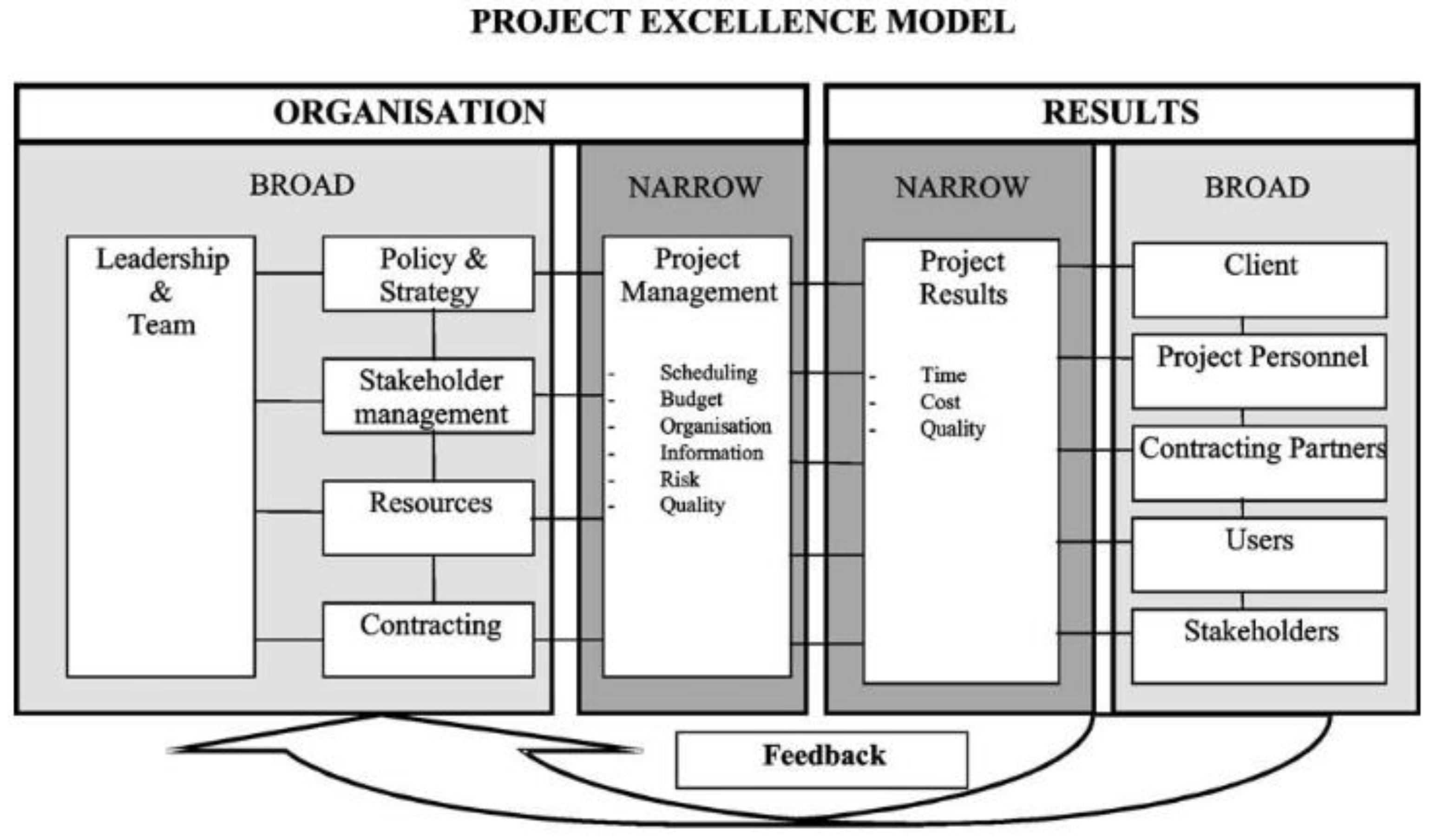
IPMA organization implemented this well-known PEM model in its standards for measuring project success and this model evolved through years [52]. Term stakeholder management was changed in interested parties and later on in people [52] but it still describes the same “soft” management function of dealing with various stakeholders in project. The importance of timely engagement of stakeholders is also recognized in construction research context where following factors are emphasized: consultation with the client [38]; effective communication on the project [53]; and the involvement of stakeholders (i.e contractors) in the front-end phases [54,55]. In UK it was identified that the engagement of local community (e.g external stakeholder) can be the key success factor [56]. In large engineering projects stakeholder engagement is particularly emphasized as a vital management process [25,27,57,58], for example, Heravi et al [25] concluded that the involvement of stakeholders in planning phase is key for achieving quality objectives in the project.
Stakeholder engagement can be defined as “the various communication practices, processes and actions that an organization (or project team) must perform to engage their stakeholders to secure their involvement and commitment, or reduce their indifference or hostility” [59]. In an attempt to conceptualize and clarify the nature of the stakeholder engagement process stakeholder engagement strategies were classified and described [60,61,62] which can be considered as a part of stakeholder engagement planning. The second type of research aimed to determine practical approaches to engage project stakeholders [23] and came up with category of overarching and operational approaches, and listed several. Yang et al. [63] explored operational approaches in stakeholder management and concluded that most of them can be used for stakeholder engagement. Further aspects of stakeholder engagement was pointed out in Yang i Shen model [61] which stated stakeholder engagement levels (used in public projects in Australia) as a core part of the engagement decision making process:
- Inform - provide stakeholders with balanced and objective information that will help them understand problems, alternatives and/or solutions.
- Consult - get feedback from stakeholders about the analysis, alternatives and/or decisions made.
- Involve - work directly with stakeholders throughout the process to ensure that their concerns and aspirations are consistently understood and addressed.
- Collaborate - be in partnership with stakeholders in every aspect of the decision.
- Empower - place the final decision-making in the hands of stakeholders.
The need for systematic engagement of stakeholders continues to intensify [57]. With insights from empirically gathered data on two projects Collinge [33] described stakeholder engagement process as being a complex, entwining process of responsibility, organizational action and work package requirements. Scholars in the field [33,57,64] points toward further applied research to explore and expand understanding and use of the engagement concept in engineering projects.
2.3. Complex context of Infrastructure projects – enabling engagement through specific project governance and management mechanisms
Traditional approach based on technical aspects of the project proves to be relatively ineffective for modern large (mega) engineering projects, which have recently been an increasingly common mechanism for delivering key infrastructure [65]. In large construction projects, as stated earlier, there is a relatively large number of stakeholders who have various roles and engage in different phases of the project [64]. Winch [66] provides a two-level classification of construction project stakeholders based on pre-defined roles (stakes) in the construction project. The first level divide stakeholders on internal which are in legal contract with the client, and external stakeholders which also have a direct interest in the project. Internal can be broken down to those clustered around the client on the demand side (e.g. sponsors, customers of the client...) and those on the supply side (e.g. contractors, designers...), while external stakeholders can be broken down into private (e.g. local community, non-governmental organizations) and public (e.g. regulatory bodies, local government...) [66].
One of the research topics closely related to project management and the proper engagement of key project stakeholders is the “project governance” and this function is also linked with organizational perspective project as part of project portfolios and programs [67,68]. Many authors state that mechanisms from the domain of project governance are what naturally complements the function of project management, that is, what creates the framework and rules for managing (infrastructure) projects [27,65,69]. The following definition of 'project governance' describes its intended purpose as: "…a set of management systems, rules, protocols, relationships and structures that provide a framework within which decisions are made for the development and implementation of projects in order to achieve intended business or strategic motivation" [70]. Klakkeg et al [71] emphasize that understanding the 'governance framework' within which the project takes place is vital for choosing methods and tools for project management.
Certain developed countries, in order to professionalize public project management and rationalize public procurement costs, have developed governance frameworks for public (infrastructural) programs and projects, and one of the first and most significant models is the OGC Gateway Review Process from 2001, developed in the UK [72,73]. This model was adopted (and adapted) by Australia and New Zealand in 2006 and 2007 [72,74]. Klakegg et al. [29] analyses and compares different systems, i.e. frameworks for directing public infrastructure projects from three developed European countries (e.g. Norway, Netherlands, UK) and summarizes the most important characteristics:
- phase gates with documentation requirements and comprehensive audits, especially very early consultations - initial gates (UK, NL) and use of external consultants from the private sector as external auditors (UK, NO)
- focus on needs and a more robust, clearer, and broader basis of planning in the early stages ("front-end planning")
- extensive early involvement of stakeholders (NL)
- active risk management, independent review of cost estimates and use of contingency reserves in budgets to protect against uncertainty and avoid cost overruns (UK, NO)
- professionalization of public project organizations in the management of projects and programs and public procurement by strengthening requirements, systems, training and issuing guidelines.
The European Commission in its project management standard (e.g. the PM'2 standard [75]), states that 'project governance' is the process of developing a strategic approach to projects/programs in order to use resources and investments more effectively and to ensure that business needs are supported by effective tools.
2.3.1. Croatian administrative and organizational context for infrastructure project and engagement of project stakeholders
Since joining the European Union in 2013, thanks primarily to the cohesion policy of the European Union, Croatia has had at its disposal a very large amount of financial resources, a great part of which has been allocated for the construction or reconstruction of infrastructure [76,77]. Public legal acts and bodies are an indispensable component of all EU co-financed (infrastructural) projects, and the roles of individual bodies are defined by the following official documents:
- Act on the establishment of an institutional framework for the implementation of European structural and investment funds in the Republic of Croatia in the financial period 2014-2020 [78]
- Regulations that prescribe the jurisdiction of individual bodies for each European structural instrument (ESI), for example the Regulation on bodies in the management and control systems of the use of the European Social Fund, the European Fund for Regional Development and the Cohesion Fund, in connection with the objective » Investment for growth and jobs" [79].
More than 3 billion euros are available for civil infrastructure, i.e. for transport and utility (communal) infrastructure through the OPKK 2014-2020 program and the projects can be implemented until the end of the year 2023 [76]. Information can be found that Croatia has applied around twenty large projects for co-financing through EU funds, i.e. projects that each have a value greater than 50 million euros, and the list shows that a large part of them are either completed or in the process of implementation [80]. When the public contracting authority (i.e public client for railway infrastructure) applies for EU co-financing, the terminology of the ESI funds recognizes it as a beneficiary of the funds: "The beneficiary is a successful applicant with whom a Grant Agreement is signed, or grants are awarded through a Grant Award Notification. He is directly responsible for the initiation, management, implementation and results of the project...” [81].
The manual (guide) of the SAFU (Central Agency for Financing and Contracting [81]) itself can be considered as part of the project governance framework because it defines the obligations of the ”beneficiary” (i.e. the public client) in relation to the governance and management of the project. Below are some of the most important obligations of public clients related to their own project implementation system [81]:
- …establish its own system of project implementation (execution of activities) and update and, if necessary, detail the project implementation plan foreseen in the project proposal;
- updating and, if necessary, detailing the time plan (schedule) foreseen in the project proposal and updating responsibilities for execution of project activities... ;
-
…areas of project implementation monitoring include:
- ○
- Systematic updating and monitoring of the project implementation plan
- ○
- Project team management
- ○
- Management of outputs and results
- ○
- Project procurement management
- ○
- Human resource management
- ○
- Risk management
- ○
- Management of information dissemination and visibility
Project team management, procurement and human resources management are related to the aspects of engagement of the internal stakeholders, while information dissemination and visibility is related to engagement of external project stakeholders.
The organizational context for large infrastructure projects which was briefly described shows that the engagement of project stakeholders is indeed a complex and multifaceted process. Due to its importance in infrastructure projects, and recognized need to expand understanding and use of the engagement concept in engineering projects it is necessary to investigate how practitioners perceive it, how they implement it in practice, and what are contextual factors that influence stakeholder engagement process and successful delivery of infrastructure projects (detail research questions are listed in section 1).
3. Methodology
Today, it is slowly being recognized that qualitative research can explore more in-depth manifestation of the problems and questions that are the subject of research and thus facilitate the appreciation and understanding of the basic causes and principles [82]. Qualitative research is often conducted through the interview method, which can provide access to the meanings people attribute to their experiences and behaviours [83].
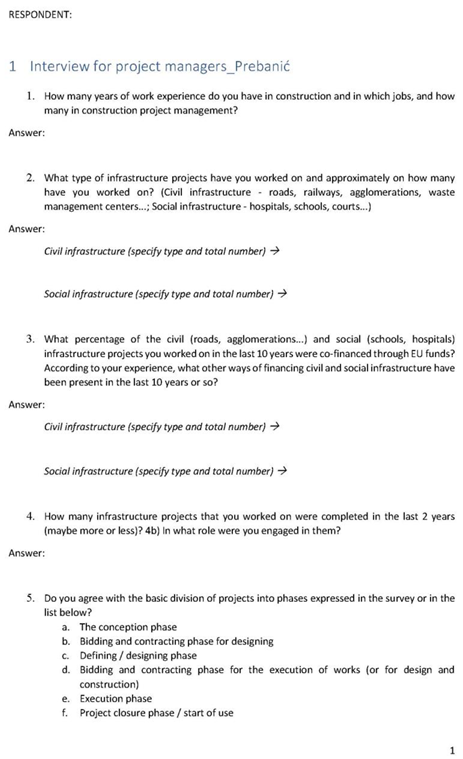
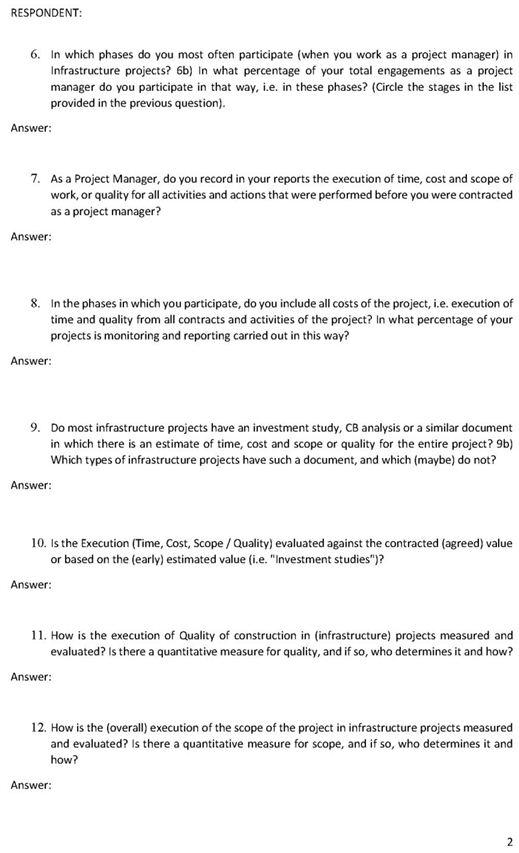
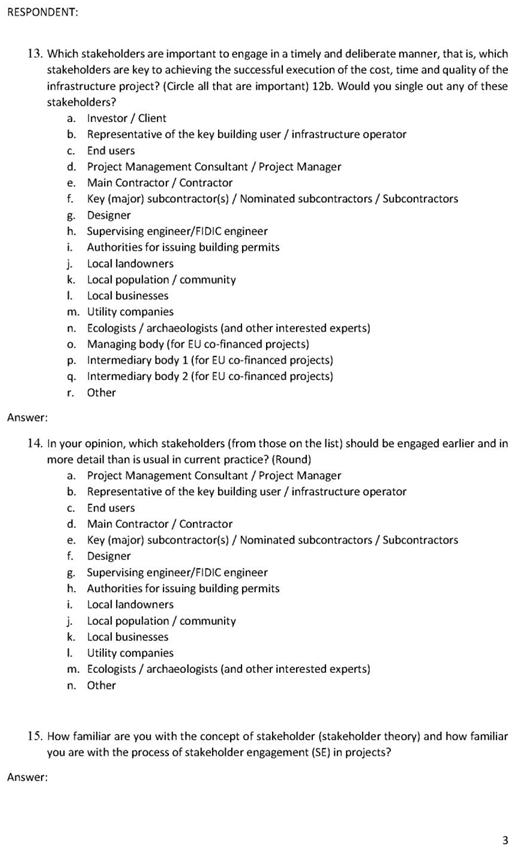
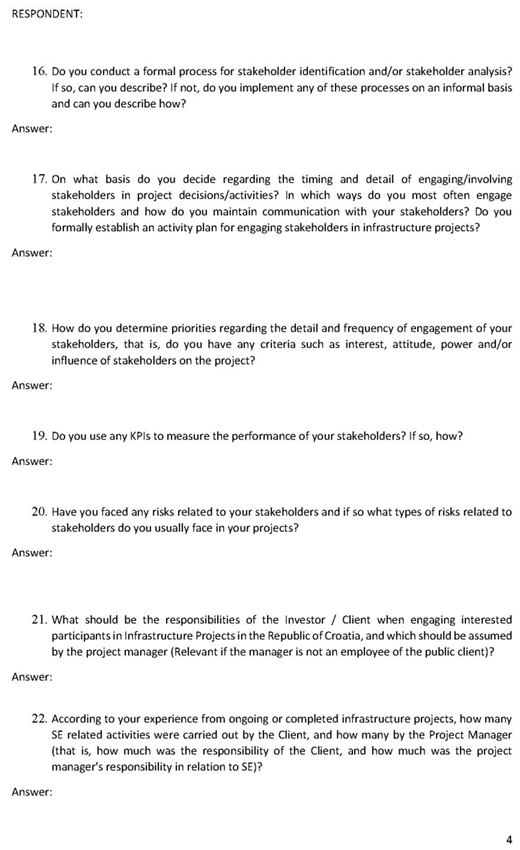
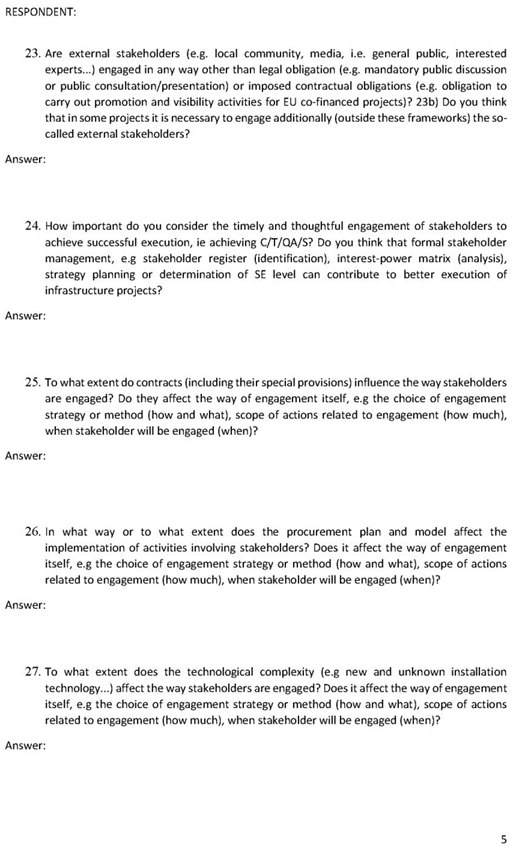
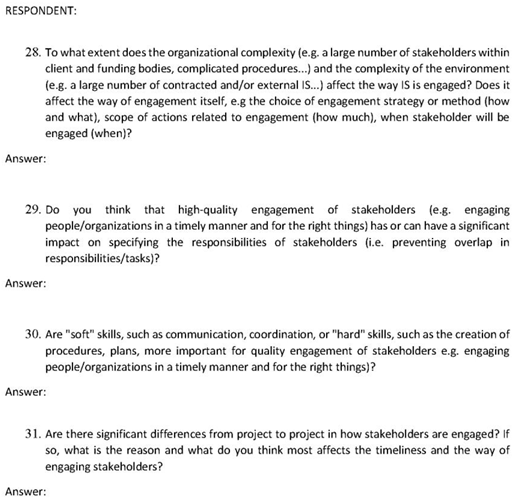
In this research, semi-structured interviews were applied as central method, which were then analysed through thematic analysis, and resulted with devising the framework model. Semi-structured interviews were conducted with experienced practitioners covering all key roles in infrastructure construction projects (defined through a literature review and preliminary interviews with several practitioners). The goal of conducting semi-structured interviews (Appendix A) was to examine the perception of processes and practices related to the engagement of stakeholders in infrastructure projects. Respondents work in senior positions in their companies were selected and each have more than fifteen years of experience in construction and project management. Most of the respondents have completed MBA postgraduate studies and are certified experts in the field of project management (mostly IPMA certificates). Prior contact with respondents ensured that all respondents had sufficient knowledge about the topic, that is, the method of purposive sampling with key informant was used which resulted with respondents who had the knowledge and willingness to participate in the research. A total of eight interviews were conducted with the following profile of experts:
- 3 respondents - construction project manager (as a separate contracting party according to the Act on Works and Activities in Spatial Planning and Construction)
- 1 respondent - public client (planning, monitoring and control; project sponsor - as part of the organization of public clients)
- 1 respondent - public client consultant (consultation and preparation of initial documents and studies for programs and projects e.g. feasibility studies; consulting services and project management)
- 1 respondent - contractor
- 1 respondent - designer
- 1 respondent - professional supervisor/superintendent/FIDIC engineer
The interviews were conducted during January and February 2022, and lasted from 32 minutes to 1 hour and 50 minutes. Permission to record was obtained for 5 of 8 interviews. There were two printed copies of interview, one for interviewer and other for interviewee, extensive notes were taken on each of 31 question (Appendix A) and additional (following) questions. In some cases, short additional contact with the interviewees was made for confirmation and clarification purpose.
Based on the results of the thematic analysis seven different success/failure factors were defined for the stakeholder engagement and in addition three organizational and management levels at which the stakeholder engagement is carried out were identified. This led to development of the framework model for engaging stakeholders and achieving success in infrastructure projects. Then, with the aim to verify the conceptual framework, four additional interviews were conducted with 6 verification questions. In addition to ratings verifiers provided comments on each aspect of newly developed framework model.
4. Results - Multifaceted nature of stakeholder engagement and project success in infrastructure projects
Through thirty-one questions (Appendix A), the interview for project managers examines seventeen topics (17) related to: experience in infrastructure projects, project financing, planning practices and execution monitoring in infrastructure projects, what activities are carried out and how important is the implementation of stakeholder engagement activities, the nature of the wider context which influence on infrastructure projects and stakeholder engagement practices, importance/impact of stakeholder engagement on project execution and on the implementation of stakeholder engagement practices. Minor changes were made to the questions to accommodate each individual role of the interested participant who was interviewed through the semi-structured interview, but these differences are minor, and the questions range from twenty-eight to thirty-one questions.
The first four topics of the interview were related to the clarification of the profile of the respondents to gain an overall insight into the nature of their participation in the management of infrastructure projects. Table 2 below summarizes the profile of the respondents. In the rest of this section, the summary of answers is shown for each addressed topic and mostly one or two citation per topic are stated to show reflections in original unedited state. Two topics addressed in interviews are not listed here because they are only loosely related to article topic.
Summaries made for topics represents key reflections and experiences of practitioners related to the topic. If there are any significant differences in the answers, all the different perspectives are mentioned in following analysis and more citations are brought. Thus, a complete insight from practitioners should be clear.
1. topic is "Monitoring and control of execution in infrastructure projects"
In accordance with the established practice, the respondents answered that the cost and time are monitored on a monthly basis, primarily the cost compliance and the deadline are under the responsibility of the contractor, and his reports are monitored by the project manager and the client who, in the case of EU co-financed projects, prepares a request for compensation and then send them to an intermediary body 2 (of ESI fund). One of the questions is related to what extent project managers perform project monitoring and control. They can assume overall management, or they can act as a consultant to public clients. Also, in EU-co-financed infrastructure projects there is a mandatory feasibility study, and the question was whether the cost control is conducted against estimations from study or amount from the contract:
“…time and cost are monitored based on the (secondary) contract. It is important to distinguish between the so-called primary contract, i.e., the grant award contract (with Managing body of ESI fund) which is based on feasibility study and grant application, and all other contracts for construction project services (e.g., contractor, supervising engineer), which are called secondary contracts. Monitoring and control can be done against both type of contracts if the construction project manager role was procured in that way...”.(Project Manager 1)
2. topic is "How you evaluate the quality and scope of infrastructure projects"
Respondents were asked how quality and scope are measured and whether there are any quantitative measures. For project scope, they mostly agree that it is measured by the amount of the quantity of the main construction works performed. For quality, several different thoughts could be heard:
“...durability, use value, defects in the warranty period (Designer)"; "descriptive through a list of specifications in the tender (Public client consultant)" ; "...the client's requirements, i.e technical specifications, are a measure of quality/scope, that's how the contract was formed... (Contractor)"; "...Quality is a very broad term, it is mostly related to client satisfaction...”.(Project Manager 3)
Opinions about what quality is and how to measure it were relatively different, but there is a majority consensus that it is measured in a process of project technical inspection.
3. topic is "Which stakeholders are key to the execution of the project"
All respondents agreed that the key stakeholders are those defined in the Building Act (client, contractor...) and that they influence all three aspects of the iron triangle (project success). In addition to these internal stakeholders, the others offered in the list (see Appendix A) were mostly mentioned in the context of the impact on time performance, and the authority for issuing permits was specifically mentioned by three respondents. One project manager specified which stakeholders influence on each type of infrastructure:
“…social infrastructure – user representative and project manager are key to quality and scope… civil infrastructure – designer / author of the feasibility study and supervising engineer affect the quality; all stakeholders defined in Building Act influence time and cost in all projects, and in EU co-financed projects intermediary body 2 can have a significant influence on quality and cost, even though this is not good...”(Project manager 3)
4. topic is "Which stakeholders should be engaged earlier compared to the current practice"
All eight respondents agreed that construction project manager should be engaged earlier. The local community was highlighted by one project manager and the public client, and the public client highlighted the largest number listed of stakeholders.
“infrastructure operator, contractor (for technically complex projects), designer, permits authorities, local community, Ministry of Interior Affairs, design supervision... there are many important stakeholders and depending on the project, some of them should definitely be engaged earlier if we want a good story in our project (Public client)”
5. topic is "Knowledge of the concept of stakeholders and the discipline of stakeholder management"
All respondents are well acquainted with the stakeholder concept, they understand what the term means, and which stakes are present in infrastructure projects. The situation is different with the discipline of stakeholder management, according to their own answers, but also concluding from few questions about their use of methods and tools related to the discipline, only the public client and one of the project managers have great knowledge, and they demonstrated this through knowledge of analysis tools (eg 'power-interest-managebility' matrix or stakeholder register).
6. The topic is related to “Usage of the process/activities for stakeholder engagement in projects in which they participated (for project managers additionally how they engage stakeholders)”
All but one respondent mentioned that they do not carry out formal identification and analysis of stakeholders, and as a basis for prioritizing they use their experience (know-how) or established project procedures. Several interviewees noted that in the case of EU-co-financed projects, the feasibility study and initial procurement plan lists all stakeholder, i.e which services should be procured (only internal stakeholders are mentioned). One of the questions related to the topic was about how much work related to engagement is done by the client and how much by the project manager.
“The client is extremely important because he formally has a contract with (internal) stakeholders, the project manager (PM) has quite limited mandate because he is external consultant, but there are situations where the client relies heavily on the PM because the PM, in most cases, has more competences in the field of engagement (at least for internal stakeholders)... ...PM in principle has the responsibility of engaging all stakeholders if he proves capable and if the client needs it, the client sometimes delegates a lot of responsibility to him, which can include communication with intermediary body 1 and 2 (of ESI funds) and certain external stakeholders...”(Project manager 2)
The consultancy role of the project manager, which is legally defined as such in Croatia (PM is not named role in Building Act), was emphasized a lot and some see it as anomaly. Thus, in practice PM often starts with low formal powers and influence. However, the authority and influence of the project manager can be relatively widened throughout the project phases.
7. topic is "The importance of SE for successful project performance and for preventing overlapping responsibilities between various stakeholders"
All respondents answered that high-quality engagement of stakeholders is key to achieving successful performance, and they also agreed that it largely prevents the overlapping of responsibilities among individual stakeholders. Also, the question was raised whether the introduction of formal stakeholder management could contribute, and two answers were highlighted here:
“...it is absolutely important and it is important that it be formalized, i.e. according to the best practices, for example according to the forms in standard PM'2... (Public client)"; "...formal management of stakeholders could bring improvements in management, but a balanced approach should be taken because it consumes energy and time..." (Client consultant)”
Project managers generally carefully approached the topic of formalizing the process regarding the engagement and analysis of interested participants, partly out of ignorance, and partly due to excessive workload, where the first impression is often that they do not need additional work.
8. topic is "The impact of contracts (generally all key contracts in the project) and the procurement model on the engagement of stakeholders”.
As a rule, respondents do not highlight the contract as a key limiting aspect for the stakeholder engagement, but they emphasize that the contractual structure is very important for how formal communication and formal issues will be resolved. One project manager noted that a high-quality contract is very important, but that he is not sure whether it affects how stakeholder will be engaged or that the engagement of stakeholder affects the quality of the contract. That is, he commented on the issue of when and how engagement begins. As for the procurement model, everyone commented that it has a significant impact on when someone will be engaged, as well as on other aspects:
“(The procurement model) affects, directly and indirectly. It directly affects which internal stakeholder will be engaged, when and to what extent, and indirectly it affects how much this procurement model enables project manager and his team to implement their own approach to stakeholders and possibly to influence on some possible shortcomings which came from ill performed procurement procedure...”(Project manager 2)
The procurement plan, which lists all the procurements that will be carried out during the project, was highlighted as an important aspect for the formation of relationships between interested participants, although some of the respondents pointed out that the plan itself can be changed and that in fact what the plan states, that is, itself the implementation of the tender is important and should be approached carefully.
9. topic is "The influence of the complexity of the project environment on the stakeholder engagement"
Questions related to the complexity of the project were divided into what is called in the literature technical complexity (e.g new and unknown technology...) and what is called organizational complexity (e.g number of stakeholders/organizations). Technical complexity was not emphasized too much as a limiting factor, while organizational complexity was highlighted as the one that greatly affects the process of engaging stakeholders. One answer sums up the respondents' views well:
"(technological complexity) It has some influence, and it is mainly related to competences, the more competent individuals and firms should have priority during tender. Sometimes you can influence if you have an incompetent project participant and sometimes you can't, it all depends on whether you can subcontract a part of services or works... (organizational complexity) It greatly affects all aspects, much more than technological complexity, it affects how much you can do and how you can do it and when and what will you do in relation to engagement of crucial stakeholders"(Project Manager 1)
10. The topic is about "Which aspects of management constitute the discipline of stakeholder engagement in construction projects"
The question was asked whether "soft" or "hard" skills are used more when engaging stakeholders, i.e. whether procedures and plans (e.g. "hard") or communication and involvement of stakeholders (e.g. "soft") are more important. Most respondents said it was about equally important, and two responses are highlighted below:
"Soft certainly more... both serve and are very entwined, but if people are not motivated, encouraged in some way, not even the best procedure can help. Of course, the procedures serves it puropse, but sometimes people don't want to submit to the procedures or implement them in the right way... (Project manager 2)" ; "...if the "soft" ones don't work, then „hard“ are very important. First, a "soft" approach is tried e.g. an attempt is made to solve the problem through conversation, and if it does not work, then the defined procedures are strictly followed (if you are lucky enough that they are clearly defined)... if there are no major problems in the project, then the project (and the engagement of stakeholders) depends on "soft" skills..."(Project Manager 3)
11. topic is "How significant are the differences in the implementation of engagement approach from project to project"
In response to this question, most respondents emphasized that much depends on the context, but also emphasized the client as a key figure on which relies how much work will be done on stakeholder engagement. The two responses below show respondents' thoughts on this topic:
„The client decision has the greatest influence. The decision refers to the expertise and desire of whether and how the client will engage an individual stakeholder (Supervising engineer)"; "..all this has a feedback loop, the engagement depends on the recipient (of the engagement) and not only on the one who engages. The combination of contractors, supervising engineer and other stakeholders is important... (Contractor)”
Valuable information is obtained from key experts with extensive experience in the implementation of infrastructure construction projects. All experts agreed that stakeholder engagement and approach to expectations and issues raised by stakeholders is one of the key management aspects in complex infrastructure projects. It is also seen that stakeholder engagement is multifaceted process which is influenced by different factors and layers of management, some which come from client organization, some which are part of regulatory and industry context and some which have a lot to do with project management competencies. These valuable inputs are basis for the formation of the framework model for engaging stakeholders and achieving success in infrastructure projects.
4.1. Identifying factors of success/failure and conceptualizing the framework model for stakeholder engagement in infrastructure projects
The framework model for engaging stakeholders and achieving success in infrastructure projects that will be presented below has a basic structure through three levels:
- Level 3 – The level of the broader industry and regulatory context – factors of success/failure that are related with aspects that are not under client organization or the project management direct influence
- Level 2 – Level of the client's organization (management and procurement) – factors of success/failure that are related with the client's organizational processes/activities and competences
- Level 1 – Level of operational project management – factors of success/failure that are related with activities/processes of the project manager and his core team
There are seven distinct success/failure factors but some of them can be exploited in several ways (e.g., managerial levels) so some factors from level 1 are repeated at level 2 and level 3 and vice versa. The utilization of certain managerial or contextual factors can be approached from the level of operational actions related to the individual but also from the level of organization and its management process and procedures or even level of rules and regulations which steers certain construction or project management area.
4.1.1. Level of operational project management approach (Level 1)
Within the level of operational project management there are many key aspects of successful project delivery. This means that only by using methods, tools, and best practices from the domain of project management we can positively affect how stakeholders are engaged and whether success can will be achieved. Table 3 shows success/failure factors and possible suggestions for exploiting and improving these factors.
The table lists five success factors that can be exploited personally by the project manager or client's employees participating in project management. For the quality implementation of the mentioned success factors, there is a need to raise the competences of the mentioned key stakeholders.
4.1.2. Level of processes and procedures of the client organization (Level 2)
The second level is the level of processes (and procedures) of the client organization. As mentioned, public clients are key in the process of stakeholder engagement because they formally contract all the services, goods and works (e.g. all internal stakeholders) that are necessary for the delivery of the (infrastructure) project. Also, they need to deliver vital infrastructure which will be used by numerous organizations and individuals, and which attracts attention from various interest groups (e.g. external stakeholders).
At the mentioned level, the use of success factors is linked to certain changes in the client's business processes to enable them to engage their (internal) stakeholders successfully but also to enable processes to engage external stakeholders more systematically.
4.1.3. The level of the broader industry and regulatory project context (Level 3)
The third level in which the factors are classified is the level of the wider context of the project and its parent (client) organization. This group includes all the factors that could be influenced in a way to make broader, strategic changes in the construction industry (e.g. change the existing adversarial culture). Again, certain success factors from the previous one or both levels are repeated at this level, and the difference is that the utilization of those success factors can be approached from legislative or industry levels. In Table 5, there are success factors related to the wider context.
Table 5 lists some success factors that could mostly be implemented if there were significant changes in the dominant culture of the industry or changes in legislation and models of financing and procurement of infrastructure projects.
4.2. Sumarry analysis and elaboration the framework model for engaging stakeholders and achieving success in infrastructure projects
Earlier in the paper (Section 2) success factors was defined as project elements that can be influenced in order to increase the probability of success, i.e. those that represent independent variables and make success more likely [51]. Westerveld [51] stated that every good success factor model should separate those factors that are within the authority of the project manager and those that are outside his authority, which was the guiding thread in the development of this framework model.
Activities through which stakeholders are engaged are generally defined in literature as those falling in the domain of project management best practices and this newly developed framework also places most factors in that domain e.g. level 1 (level of operational project management). However, certain success factors are placed in the domain of the organizational, administrative, and regulatory framework because these project aspects greatly affect the delivery of infrastructure construction projects. The client was often highlighted as key for the adequate implementation of the stakeholder engagement process, and there was a certain consensus by the different interviewed experts (e.g. project manager, supervising engineer, client's consultant...) on that matter. Following the notion of client importance and the experiences of the experts, certain factors of success/failure are placed in level 2, which is mostly related to the management and procurement process of public client organizations.
Figure 2.
Graphical presentation of the framework model for engaging stakeholders and achieving success in infrastructure projects.
Figure 2.
Graphical presentation of the framework model for engaging stakeholders and achieving success in infrastructure projects.
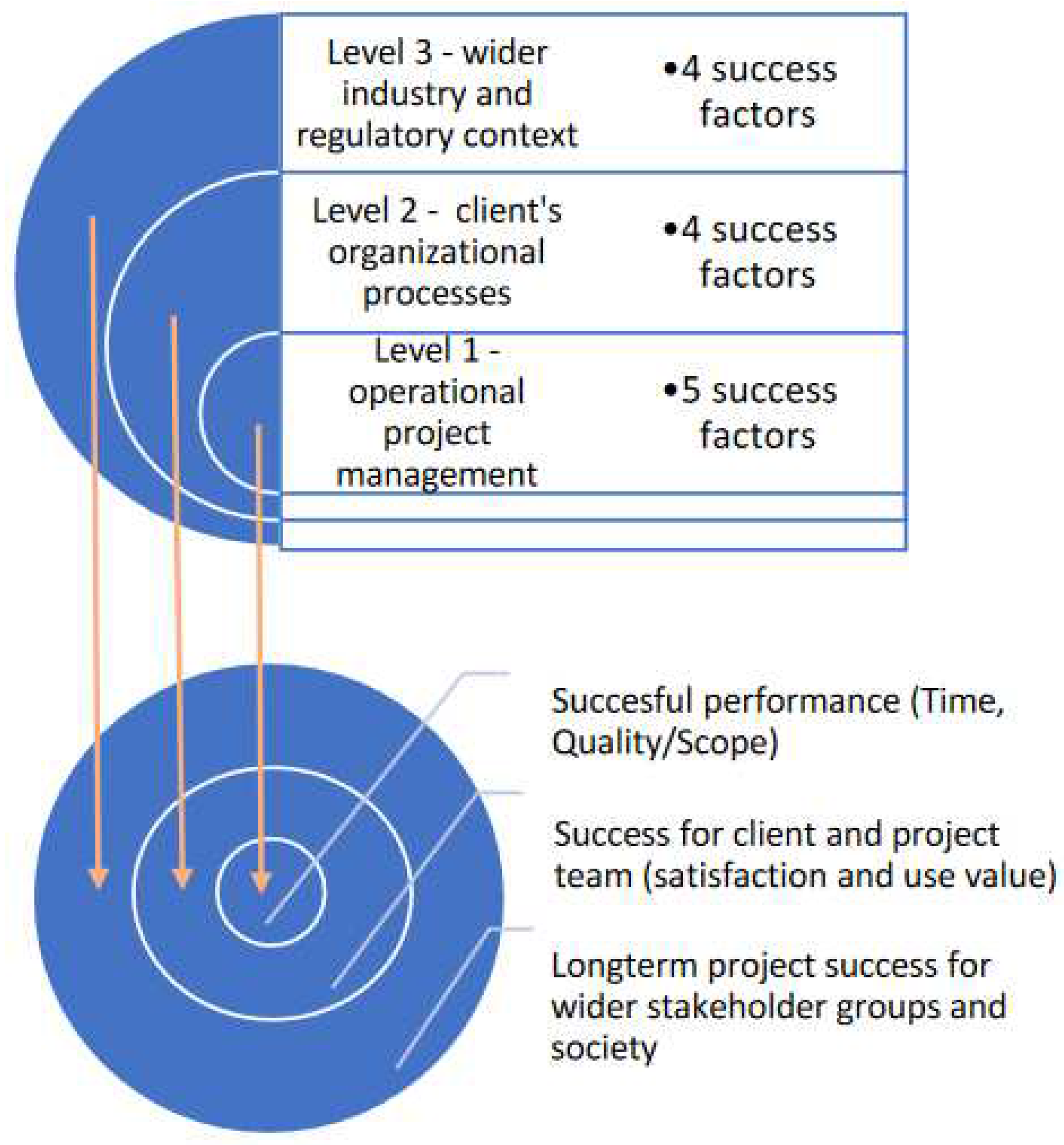
By being proactive with their stakeholders, clients can ensure good use value of delivered infrastructure and ensure at least mid-term benefits for their organization.
The level 3 is related to success/failure factors which fall in domain of the broader context (e.g. industry regulations and acts, available procurement models) of the project and suggested exploitation of those factors could serve as a catalyst for deeper changes in the engagement of stakeholders in infrastructure projects, primarily in ending the rivalry culture that is the result of initially conflicting interests. Problem with traditional procurement and contractual forms is that they poorly predict and distribute risks and benefits and on top creates situation where benefit for one stakeholder is often disbenefit for other. Collaborative procurement arrangements maybe does not always provide the best value for money [84] but such new models can greatly contribute to the reduction of initial organizational complexity and successful infrastructure project delivery [84]. Also, as it was formerly described, governance frameworks, which encompass available rules and models for project procurement, is a good foundation to build elaborate engagement system.
4.3. Verification of developed conceptual framework
Before asking verification questions, each of four verifier was briefly presented with a summary of the entire research that led to the development of the framework. This was followed by an explanation of the conceptual framework which lasted 15 minutes. Next the questions were asked and finally the ratings and explanations of verifiers were recorded. Three of four verifier participated in interview part of the research, and one wasn’t (verifier 4). Table 6 below shows the ratings for the framework model for engaging stakeholders and achieving success in infrastructure projects.
Question 1 (average grade 4,5) – The comments went in the direction that anyone who gets deeper into the problem can think about what to do on a personal level, and if he has passed that level, he can look towards a higher level and consider how to further influence the utilization of factors, i.e. improvements in the form of establishing proper system for engagement of stakeholders. Verifier 3 noted that changing the wider context is less important and less likely it would work in practice which was opposite opinion from verifier 2 who stated that public client won’t change if regulation stay the same.
Question 2 (average grade 4,9) – Everyone agreed that these are indeed two key project roles for stakeholder engagement but verifier 2 raised the question of what is exact responsibility of the construction project manager because he is not named role in Building Act and does not have sufficient influence to engage stakeholders.
Question 3 (average grade 3,9) – Verifier 4 considers the model good and accepts the fact that it is only framework. Due to his relatively good knowledge of the subject, he does not consider it a great contribution to his knowledge. Others were in line with that.
Question 4 (average grade 4,0) – Verifier 1 states that the explanations are relevant, but that it should be additionally graphically/schematically explained when and what to use to be fully usable. Verifier 3 states that in the level 3, more emphasis could be placed on a broader change of the legislative framework. Similarly other two verifier had some suggestions for improvement.
Question 5 (average grade 4,3) – Verifier 1 states that many factors have been mentioned, but he can remember some additional ones. For example, digital competences in projects that where work and collaboration can be done in virtual teams are much higher in younger engineers so older colleagues should learn to digitally cooperate in projects. Verifier 2 stated that more emphasis is needed on the external stakeholders. In the case of large public infrastructure projects, there are a lot of stakeholders from the domain of politics and project financing and the early development stages can be very long, so it is important to have competences to properly engage these external stakeholders.
Question 6 (average grade 3,4) – Verifier 1 stated, as before, that he believes that the framework should be further elaborated in terms of developing methodology on how to improve engagement processes (e.g. workflow chart). In current form he doubts that it could be of great help to the public clients. Verifier 3 explains that it is understandable that framework model did not go into much detail, because at this general level it is valid for any client, and probably more detailed framework would be tailored for a special type of client. Nevertheless, from this framework model clients can only become more aware of some issues, but hardy can make much progress.
5. Conclusions
Today, the world is undergoing a major investment cycle in infrastructure, which is vital for the development and prosperity of countries and society. In the introduction, a brief overview of management deficiencies in infrastructure projects is given, and some of them refer to the weak engagement of stakeholders. Very little research has been done on how stakeholder engagement is manifested in practice. The literature provides an insight into importance of stakeholder engagement as the key success factors for infrastructure projects. The topic of governance frameworks for large public projects emphasizes the importance of stakeholder participation in decisions and project implementation. However, the literature gives very few answers to what is the real nature of stakeholder engagement. It is concluded that it is a complex and undertheorized management process which necessitates more empirical research. The research questions seek to identify how practitioners perceive the stakeholder engagement, who implements activities and processes related to engagement and in what way, which organizational aspects influence the process and how success is achieved in infrastructural projects. Interviews were conducted with eight experienced experts who participated in a whole series of (complex) infrastructure projects. The interviews examined all aspects of the engagement of stakeholders in detail, and a thematic analysis was carried out. Based on the analysis, success factors related to the stakeholder engagement process were defined. As a result, a framework model for engaging stakeholders and achieving success in infrastructure projects is presented, which is based on three management levels and three levels of project success.
First research question addressed practitioner perspectives on the importance and nature of stakeholder engagement process. It is concluded that both soft and hard project management skills constitute practical approaches to engage stakeholders. Also, internal stakeholders are engaged through procurement process conducted by public clients and some external stakeholders are engaged through mandatory process of information dissemination and visibility. Stakeholder engagement is indeed very complex and entwined mechanism to form and maintain relationships in project and for that reason we based our framework model on three different managerial levels. This multiple level modelling approach is similar to that of Brunet [85] which described project governance practical model as multilevel model. Other part of our framework model includes multilevel view on project success which is also not new because Pinto and Slevin [40], Turner and Zolin [39], and Davis [49] all observed project success as complex multilevel concept which includes multiple stakeholder perspectives. Our framework model linked this multiple view on success factors and success criteria by combining various aspects of stakeholder engagement with various aspect of project success and thus brought new perspectives in this field.
These aspects of our framework model are also closely linked to fourth research question on how project success is achieved in infrastructure project. As Volden [17] concluded that some projects scores high on relevance and sustainability, but low on benefit-cost efficiency which is in line with our view point that sometimes there is a trade-off situation between long term success for wider society and short term goal of being efficient in delivery. Thus, it is important to pay attention on definition and weighing of different (levels of) success criteria in public infrastructure projects. Unfortunately in practice iron triangle is still most often way to observe success which is in line with result from UK [86].
Second research question addressed method and practices for engagement. Mostly engagement is done through usual management process and project procedures based on know-how and with very low usage of formal engagement methods, techniques and tools which is in line with research on stakeholder engagement practices from UK [87] and Australia [32]. Even though stakeholder management and engagement is part of the project management best practice standards for more than 10 years it is obviously still immature management function in construction infrastructure projects.
Third research question explored who conducts engagement activities and what factors influence stakeholder engagement process. Our research shows that organizational complexity, which Bosch-Rekveldt et al [88] perceived as one of the three major complexity pillars, greatly influence this process. Furthermore our insight shows that there is logic in measuring complexity aspects solely linked with variety and number of stakeholders which Aaltonen and Kujala [89] framed as complexity of project stakeholder landscape. Other insights shows that public clients are key initiator of stakeholder engagement activities and that there is a great need to involve project manager early and delegate him this responsibility (in Croatia project manager is often external consultant and has no proper mandate).
Most of the success/failure factors and suggestions for improvements from our model could probably be applied to other types of construction projects but there is a need to further explore that before making such conclusions. Part of the success factors related to the engagement of stakeholder can be considered as universal because they are related to operational approaches in project management, but other part is related to the procurement process and broader industrial context that are partially different in some other countries. So, the second limitation is that the developed framework is partly of a local nature and probably needs some adjustments for other infrastructure systems. Third limitation concern number of interviewees. We conducted detail semi-structured interviews with eight experts and four more for verification purpose, but someone might argue that more insights are needed. Nevertheless, our experts jointly have big experience in almost every type of civil and social infrastructure project in which they covered all key roles (e.g. project manager, supervision engineer, public client etc.).
Practical implication of the work is manifested through a newly developed framework for engaging stakeholders in infrastructure projects which can primarily help project managers to improve their competences, even though we acknowledge limitations in relation to framework level of detail. The developed framework can also encourage clients and legislators to make certain changes in (public) procurement and tender processes to enable earlier and more close involvement of both internal and external project stakeholders. We think that this venue of empirical research to unravel practical manifestations of stakeholder engagement best practices is very fruitful and we call for more research that would try to link theory and practice of project management. Further research related to this model will be directed in the creation of a more detailed guidelines for stakeholder engagement for clients and project managers that would explore how to embed best practices for engagement with usual infrastructure project processes.
Author Contributions
For research articles with several authors, a short paragraph specifying their individual contributions must be provided. The following statements should be used “Conceptualization, K.R.P.; methodology, K.R.P.; validation, K.R.P. and M.V.; formal analysis, K.R.P..; investigation, K.R.P.; resources K.R.P. and M.V.; data curation, K.R.P.; writing—original draft preparation, K.R.P.; writing—review and editing K.R.P. and M.V.; visualization, K.R.P.; supervision, M.V.; project administration, K.R.P. and M.V.; funding acquisition, M.V. All authors have read and agreed to the published version of the manuscript.” Please turn to the CRediT taxonomy for the term explanation. Authorship must be limited to those who have contributed substantially to the work reported.
Funding
This research received no external funding.
Conflicts of Interest
The authors declare no conflict of interest.
Appendix A (Interview)
References
- Kumaraswamy, M.; Wong, K. K. W.; Chung, J. Focusing Megaproject Strategies on Sustainable Best Value of Stakeholders. Built Environ. Proj. Asset Manag. 2017, 7 (4), 441–455. [CrossRef]
- Ninan, J.; Mahalingam, A.; Clegg, S. Power and Strategies in the External Stakeholder Management of Megaprojects: A Circuitry Framework. Engineering Project Organization Journal. 2020, pp 1–20. [CrossRef]
- Safa, M.; Sabet, A.; MacGillivray, S.; Davidson, M.; Kaczmarczyk, K.; Haas, C. T.; Gibson, G. E.; Rayside, D. Classification of Construction Projects. World Acad. Sci. Eng. Technol. Int. J. Civil, Environ. Struct. Constr. Archit. Eng. 2015, 9 (6), 721–729.
- Dyer, M.; Dyer, R.; Weng, M.-H.; Wu, S.; Grey, T.; Gleeson, R.; Ferrari, T. G. Framework for Soft and Hard City Infrastructures. Urban Des. Plan. 2019, 172 (6), 219–227.
- Al-Bahar, J. F.; Crandall, K. C. Systematic Risk Management Approach for Construction Projects. J. Constr. Eng. Manag. 1990, 116 (3), 533–546. [CrossRef]
- Henisz, W. J.; Levitt, R.; Scott, W. R. Toward a Unified Theory of Project Governance: Economic, Sociological and Psychological Supports for Relational Contracting. Eng. Proj. Organ. J. 2012. [CrossRef]
- Hu, Y.; Chan, A. P. C.; Le, Y.; Jin, R. From Construction Megaproject Management to Complex Project Management: Bibliographic Analysis. J. Manag. Eng. 2015, 31 (4).
- Agarwal, R.; Chandrasekaran, S.; Sridhar, M. Imagining Construction’s Digital Future. Capital Projects and Infrastructure, McKinsey Productivity Sciences Center, Singapore. 2016, p 13.
- Dunovic, I. B.; Prebanic, K. R.; Durrigl, P. Method for Base Estimation of Construction Time for Linear Projects in Front-End Project Phases. Organ. Technol. Manag. Constr. 2021, 13 (1), 2312–2326. [CrossRef]
- Mok, K. Y.; Shen, G. Q.; Yang, R. J.; Li, C. Z. Investigating Key Challenges in Major Public Engineering Projects by a Network-Theory Based Analysis of Stakeholder Concerns: A Case Study. Int. J. Proj. Manag. 2017, 35.
- Rezvani, A.; Khosravi, P.; Ashkanasy, N. M. Examining the Interdependencies among Emotional Intelligence, Trust, and Performance in Infrastructure Projects: A Multilevel Study. Int. J. Proj. Manag. 2018, 36, 1034–1046. [CrossRef]
- Flyvbjerg, B. What You Should Know about Megaprojects and Why: An Overview. Proj. Manag. J. 2014, 45 (2).
- Nguyen, T. S.; Mohamed, S.; Mostafa, S. Project Stakeholder’s Engagement and Performance: A Comparison between Complex and Non-Complex Projects Using SEM. Built Environ. Proj. Asset Manag. 2021, 11 (5), 804–818. [CrossRef]
- Prebanic, K. R.; Vukomanović, M. Realizing the Need for Digital Transformation of Stakeholder Management: A Systematic Review in the Construction Industry. Sustain. 2021, 13, 27. [CrossRef]
- Brunet, M.; Aubry, M. The Three Dimensions of a Governance Framework for Major Public Projects. Int. J. Proj. Manag. 2016, 34, 1596–1607. [CrossRef]
- Luo, L.; He, Q.; Jaselskis, E. J.; Xie, J. Construction Project Complexity: Research Trends and Implications. J. Constr. Eng. Manag. 2017, 143 (7).
- Volden, G. H. Public Project Success as Seen in a Broad Perspective. Lessons from a Meta-Evaluation of 20 Infrastructure Projects in Norway. Eval. Program Plann. 2018, 69, 109–117. [CrossRef]
- Pascale, F.; Pantzartzis, E.; Krystallis, I.; Price, A. D. F. Rationales and Practices for Dynamic Stakeholder Engagement and Disengagement Evidence from Dementia-Friendly Health and Social Care Environments. Constr. Manag. Econ. 2020, 38 (7), 623–639. [CrossRef]
- Cuppen, E.; Bosch-Rekveldt, M. G. C.; Pikaar, E.; Mehos, D. C. Stakeholder Engagement in Large-Scale Energy Infrastructure Projects: Revealing Perspectives Using Q Methodology. International Journal of Project Management. 2016, pp 1347–1359. [CrossRef]
- Müller, R. Project Governance; Gower Publishing, Ltd: London, 2009.
- Bahadorestani, A.; Karlsen, J. T.; Motahari Farimani, N. Novel Approach to Satisfying Stakeholders in Megaprojects: Balancing Mutual Values. J. Manag. Eng. 2020.
- Lehtinen, J.; Peltokorpi, A.; Artto, K. Megaprojects as Organizational Platforms and Technology Platforms for Value Creation. International Journal of Project Management. 2019, pp 43–58. [CrossRef]
- Chinyio, E. A.; Akintoye, A. Practical Approaches for Engaging Stakeholders: Findings from the UK. Constr. Manag. Econ. 2008, 26 (6), 591–599. [CrossRef]
- Park, H.; Kim, K.; Kim, Y.-W.; Kim, H. Stakeholder Management in Long-Term Complex Megaconstruction Projects: The Saemangeum Project. J. Manag. Eng. 2017, 33 (4). [CrossRef]
- Heravi, A.; Coffey, V.; Trigunarsyah, B. Evaluating the Level of Stakeholder Involvement during the Project Planning Processes of Building Projects. Int. J. Proj. Manag. 2015, 33 (5). [CrossRef]
- Sydow, J.; Braun, T. Projects as Temporary Organizations: An Agenda for Further Theorizing the Interorganizational Dimension. Int. J. Proj. Manag. 2018, 36 (1). [CrossRef]
- Khan, A.; Warris, M.; Panigrahi, S.; Rizwan Sajid, M.; Rana, F. Improving the Performance of Public Sector Infrastructure Projects: Role of Project Governance and Stakeholder Management. J. Manag. Eng. 2021, 37 (2), 20. [CrossRef]
- Khan, A.; Waris, M.; Ismail, I.; Sajid, M.; Ullah, M.; Usman, F. Deficiencies in Project Governance: An Analysis of Infrastructure Development Program. Administrative Sciences. 2019, p 9. [CrossRef]
- Klakegg, O. J.; Williams, T.; Shiferaw, A. T. Taming the ‘Trolls’: Major Public Projects in the Making. Int. J. Proj. Manag. 2016, 34 (2), 282–296. [CrossRef]
- Prebanic, K. R.; Dunović, I. B. Explicit and Implicit Relationship Between Stakeholder Management and Trust Concepts: Construction Project Management Perspective. In 14TH INTERNATIONAL CONFERENCE ORGANIZATION, TECHNOLOGY AND MANAGEMENT IN CONSTRUCTION AND 7TH INTERNATIONAL PROJECT MANAGEMENT ASSOCIATION RESEARCH CONFERENCE; 2019; pp 177–194.
- Mok, K. Y.; Shen, G. Q.; Yang, R. J.; Li, C. Z. Investigating Key Challenges in Major Public Engineering Projects by a Network-Theory Based Analysis of Stakeholder Concerns: A Case Study. Int. J. Proj. Manag. 2017, 35 (1). [CrossRef]
- Yang, R. J.; Jayasuriya, S.; Gunarathna, C.; Arashpour, M.; Xue, X.; Zhang, G. The Evolution of Stakeholder Management Practices in Australian Mega Construction Projects. Eng. Constr. Archit. Manag. 2018, 25 (6), 690–706. [CrossRef]
- Collinge, W. H. Stakeholder Engagement in Construction: Exploring Corporate Social Responsibility, Ethical Behaviors, and Practices. J. Constr. Eng. Manag. 2020.
- Jugdev, K.; Müller, R. A RETROSPECTIVE LOOK AT OUR EVOLVING UNDERSTANDING OF PROJECT SUCCESS. Proj. Manag. J. 2005, 36 (4), 19–31.
- Albert, M.; Balve, P.; Spang, K. Evaluation of Project Success: A Structured Literature Review. International Journal of Managing Projects in Business. 2017, pp 796–821. [CrossRef]
- Cooke-Davies, T. The “Real” Success Factors on Projects. Int. J. Proj. Manag. 2002, 20 (3), 185–190. [CrossRef]
- Müller, R.; Turner, J. R. The Influence of Project Managers on Project Success Criteria and Project Success by Type of Project. European Management Journal. 2007, pp 289–309.
- Gunathilaka, S.; Tuuli, M. M.; Dainty, A. R. J. Critical Analysis of Research on Project Success in Construction Management Journals. Proceedings 29th Annual Association of Researchers in Construction Management Conference, ARCOM 2013. 2013, pp 979–988.
- Turner, R.; Zolin, R. Forecasting Success on Large Projects: Developing Reliable Scales to Predict Multiple Perspectives by Multiple Stakeholders Over Multiple Time Frames. Proj. Manag. J. 2012, 10.
- Pinto, J. K.; Slevin, D. P. Project Success: Definitions and Measurement Techniques. Proj. Manag. J. 1998, 19 (1).
- He, Q.; Wang, T.; Chan, A. P. C.; Xu, J. Developing a List of Key Performance Indictors for Benchmarking the Success of Construction Megaprojects. J. Constr. Eng. Manag. 2021, 147 (2). [CrossRef]
- Koops, L.; Bosch-Rekveldt, M.; Coman, L.; Hertogh, M.; Bakker, H. Identifying Perspectives of Public Project Managers on Project Success: Comparing Viewpoints of Managers from Five Countries in North-West Europe. Int. J. Proj. Manag. 2016, 34 (5), 874–889. [CrossRef]
- Koops, L.; van Loenhout, C.; Bosch-Rekveldt, M. Different Perspectives of Public Project Managers on Project Success. Eng. Constr. Archit. Manag. 2017.
- Williams, T. Identifying Success Factors in Construction Projects: A Case Study. Project Management Journal. 2015, pp 97–112.
- Al-Tmeemy, S. M. H. M.; Abdul-Rahman, H.; Harun, Z. Future Criteria for Success of Building Projects in Malaysia. International Journal of Project Management. 2011, pp 337–348. [CrossRef]
- Bryde, D. J.; Robinson, L. Client versus Contractor Perspectives on Project Success Criteria. International Journal of Project Management. 2005, pp 622–629. [CrossRef]
- Vuorinen, L.; Martinsuo, M. Value-Oriented Stakeholder Influence on Infrastructure Projects. International Journal of Project Management. 2019, pp 750–766. [CrossRef]
- Pinto, J. K.; Slevin, D. P. Critical Factors in Successful Project Implementation. IEEE Trans. Eng. Manag. 1987, 34 (1), 22–27. [CrossRef]
- Davis, K. Reconciling the Views of Project Success: A Multiple Stakeholder Model. Proj. Manag. J. 2018, 49 (5), 38–47. [CrossRef]
- Jha, K. N.; Iyer, K. C. Commitment, Coordination, Competence and the Iron Triangle. Int. J. Proj. Manag. 2007, 25 (5), 527–540. [CrossRef]
- Westerveld, E. The Project Excellence Model®: Linking Success Criteria and Critical Success Factors. Int. J. Proj. Manag. 2003, 21 (6), 411–418. [CrossRef]
- Grau, N. Standards and Excellence in Project Management – In Who Do We Trust? Procedia - Soc. Behav. Sci. 2013, 74, 10–20. [CrossRef]
- Yong, Y. C.; Mustaffa, N. E. Critical Success Factors for Malaysian Construction Projects: An Empirical Assessment. Construction Management and Economics. 2013, pp 959–978. [CrossRef]
- Aapaoja, A.; Haapasalo, H.; Soderstrom, P. Early Stakeholder Involvement in the Project Definition Phase: Case Renovation. ISRN Ind. Eng. 2013, Volume 201, 14.
- Love, P. E. D.; O’Donoghue, D.; Davis, P. R.; Smith, J. Procurement of Public Sector Facilities Views of Early Contractor Involvement. Facilities 2014, 32 (9/10), 460–471.
- Di Maddaloni, F.; Davis, K. The Influence of Local Community Stakeholders in Megaprojects: Rethinking Their Inclusiveness to Improve Project Performance. Int. J. Proj. Manag. 2017, 35 (8). [CrossRef]
- Erkul, M.; Yitmen, I.; Celik, T. Dynamics of Stakeholder Engagement in Mega Transport Infrastructure Projects. Int. J. Manag. Proj. Bus. 2020, 13 (7), 1465–1495.
- Aaltonen, K. Stakeholder Management in International Projects. 2010, p 134.
- Bourne, L. Targeted Communication: The Key to Effective Stakeholder Engagement. Procedia - Soc. Behav. Sci. 2016, 226, 431–438. [CrossRef]
- Aaltonen, K.; Sivonen, R. Response Strategies to Stakeholder Pressures in Global Projects. Int. J. Proj. Manag. 2009, 27 (2), 131–141. [CrossRef]
- Yang, R. J.; Shen, G. Q. P. Framework for Stakeholder Management in Construction Projects. J. Manag. Eng. 2015, 31 (4), 1–14. [CrossRef]
- Aaltonen, K.; Kujala, J. A Project Lifecycle Perspective on Stakeholder Influence Strategies in Global Projects. Scand. J. Manag. 2010, 26 (4), 381–397. [CrossRef]
- Yang, J.; Shen, G. Q.; Bourne, L.; Ho, C. M.; Xue, X. A Typology of Operational Approaches for Stakeholder Analysis and Engagement. Constr. Manag. Econ. 2011, 29 (2), 145–162. [CrossRef]
- Mok, K. Y.; Shen, G. Q.; Yang, J. Stakeholder Management Studies in Mega Construction Projects: A Review and Future Directions. Int. J. Proj. Manag. 2015, 33 (2), 446–457. [CrossRef]
- Li, Y.; Han, Y.; Luo, M.; Zhang, Y. Impact of Megaproject Governance on Project Performance: Dynamic Governance of the Nanning Transportation Hub in China. J. Manag. Eng. 2019, 35 (3).
- Winch, G. M. Managing Construction Projects; Wiley-Blackwell: Chichester, United Kingdom, 2010. [CrossRef]
- Ahola, T.; Ruuska, I.; Artto, K.; Kujala, J. What Is Project Governance and What Are Its Origins? Int. J. Proj. Manag. 2014, 32 (8), 1321–1332.
- Biesenthal, C.; Wilden, R. Multi-Level Project Governance: Trends and Opportunities. International Journal of Project Management. 2014, pp 1291–1308. [CrossRef]
- Too, E. G.; Weaver, P. The Management of Project Management: A Conceptual Framework for Project Governance. Int. J. Proj. Manag. 2014, 32 (8). [CrossRef]
- Bekker, M.; Steyn, H. Defining ‘Project Governance’ for Large Capital Projects. In AFRICON; 2007; pp 1–13. [CrossRef]
- Klakegg, O. J.; Williams, T.; Magnussen, O. M. Design of Innovative Government Frameworks for Major Public Investment Projects: A Comparative Study of Governance Frameworks in UK and Norway. In The International Research Network on Organizing by Projects (IRNOP VIII): Project Research Conference, Sussex, UK; 2007; p 22.
- The State of Queensland. Gateway Review Guidebook for Project Owners and Review Teams. 2013, p 17.
- Office of Government Commerce. The OGC Gateway Process: Gateway to Success. 2004, pp 4–5.
- Burcar Dunović, I. Upravljanje Rizicima Kod Velikih Infrastrukturnih Projekata, PhD Thesis, University of Zagreb. Zagreb, HR, 2012.
- European Commision Centre of Excellence. The PM2 Project Management Methodology Guide. 2016, p 147. [CrossRef]
- Ministry of Regional Development and EU funds. Operational Programmes https://razvoj.gov.hr/o-ministarstvu/djelokrug-1939/eu-fondovi/financijsko-razdoblje-eu-2014-2020/operativni-programi/356.
- The Croatian Chamber of Economy. Cohesion Policy of European Union and Croatia 2014 - 2020: Guide through the Strategic Framework and an Overview of Funding Opportunities; 2015.
- Technical Gazzete NN92/14. Act on the Establishment of an Institutional Framework for the Implementation of European Structural and Investment Funds in the Republic of Croatia in the Period 2014-2020; 2014.
- Technical Gazzete NN 107/2014. Regulation on Bodies in the Management and Control Systems of the Use of the European Social Fund, the European Fund for Regional Development and the Cohesion Fund, in Connection with the Objective “Investment for Growth and Jobs”; 2014.
- European Commission. Europa, Regional Policy, Major projects https://ec.europa.eu/regional_policy/en/projects/major/.
- Central Agency for Financing and Contracting. Handbook for Beneficiaries of Grants; within the Framework of Projects Financed from European Structural and Investment Funds; 2018.
- Fellows, R.; Liu, A. Research Methods for Construction. 2015, p 302.
- Milas, G. Istraživačke Metode u Psihologiji i Drugim Društvenim Znanostima, 2. Izdanje; Naklada Slap: Jastrebarsko, 2009.
- Walker, D. H. T.; Lloyd-Walker, B. M. Understanding the Motivation and Context for Alliancing in the Australian Construction Industry. Int. J. Manag. Proj. Bus. 2016, 9 (1), 74–93. [CrossRef]
- Brunet, M. Governance-as-Practice for Major Public Infrastructure Projects: A Case of Multilevel Project Governing. Int. J. Proj. Manag. 2019, 37, 283–297. [CrossRef]
- Di Maddaloni, F.; Davis, K. Project Manager’s Perception of the Local Communities’ Stakeholder in Megaprojects. An Empirical Investigation in the UK. Int. J. Proj. Manag. 2017.
- Molwus, J. J.; Erdogan, B.; Ogunlana, S. O. A Study of the Current Practice of Stakeholder Management in Construction Projects. Procs 30th Annual ARCOM Conference, 1-3 September 2014. 2014, pp 945–954.
- Bosch-Rekveldt, M.; Jongkind, Y.; Mooi, H.; Bakker, H.; Verbraeck, A. Grasping Project Complexity in Large Engineering Projects: The TOE (Technical, Organizational and Environmental) Framework. Int. J. Proj. Manag. 2010.
- Aaltonen, K.; Kujala, J. Towards an Improved Understanding of Project Stakeholder Landscapes. Int. J. Proj. Manag. 2016, 34 (8), 1537–1552. [CrossRef]

Table 1.
Different success models of construction projects and their key characteristics.
| Name/description of success model (author and year of published article) | Construction stakeholder type which perspective was considered | The category of success criteria and the number of associated success criteria or measures |
|---|---|---|
| Success criteria of buildings projects (Al-Tmeemy et al., 2011) | Contractors (project) perspective | Project management success (3 criteria) Product success (3 criteria) Market success (4 criteria) |
| Project success criteria (Williams 2015) | Contractors (organization) perspective | Was the final product good? (3 measures/criteria) Were the stakeholders satisfied with the project? (5 measures/criteria) Did the project meet its delivery objectives? (3 measures/criteria) Was project management successful? (6 measures/criteria) |
| Dimensions of project value, (Vuorinen and Martinsuo, 2019) | Perspective of public client/government and wider society | Social and environmental value (descriptive) Financial value (descriptive) Systemic value (descriptive) |
| KPIs for assessing construction megaproject success (He et al., 2021) | Perspective of public client/government | Project efficiency (3 KPI) Key stakeholders’ satisfaction (2 KPI) Organizational strategic goals (2 KPI) Comprehensive impact on society (2 KPI) |
Table 2.
Detailed professional profile of interviewees.
| Years of experience in construction and project management; education | The project role(s) they perform in projects | The type of infrastructure projects respondent has experience with | Phases of the project in which they participate (see Appendix A) | |
|---|---|---|---|---|
| Project manager 1 | 20 in construction and 16 in project management; Civil engineer | Construction project management, client consultation and construction supervision | Civil - i.e roads, railroads, water agglomeration… Social – i.e hospitals schools… |
Most often in the last 2 stages, sometimes in the last 3, and there were rare cases from the early stages |
| Project manager 2 | 28 in construction and 20 in project management; Civil engineer | Construction project management, client consultation and construction supervision | Civil - i.e water agglomeration, waste management centers, ports and marines… Social – i.e hospitals schools… |
Most often in the last 2 stages, sometimes in the last 3, and there were rare cases from the early stages |
| Project manager 3 | 20 in construction and 10 in project management; Civil engineer | Consulting in planning and monitoring and control; Construction project management | Civil - i.e roads, water agglomerations Social – i.e schools, courts… |
Most often in the last 2 stages, sometimes in the last 3, and there were rare cases from the early stages |
| Public client consultant | 12 in consultancy (project management), 7 in construction; Economist | Consultations in the preparation of study and tender documentation; project management | Civil - water agglomeration Social - visitor centers, adaptations of cultural buildings… |
Most often early stages in the capacity of consulting, in the case of project management in all stages |
| Public client | 20 in construction and project management; Civil engineer | Consulting in planning, monitoring and control | Civil – i.e roads, waste management centers, power plants, airports … | Most often in the last 4 phases, there are examples in all phases (sometimes only early phases) |
| Supervising engineer/FIDIC engineer | 15 in construction and project management; Civil engineer | Construction supervision and construction project management | Civil – i.e roads, water agglomerations Social – i.e social housing (POS) |
Most often in the last two stages, very rarely earlier |
| Designer | 20 in construction and 15 in project management; Civil engineer | Designing, design supervision; construction supervision; project management | Civil - i.e roads, water, agglomerations… Social – i.e hospitals schools… |
Most often in the last four phases |
| Contractor | 23 in construction and 17 in project management (contractor side); Civil engineer | Contractor | Civil – waste water treatment device Social – school, hospital |
Most often in the last 3 phases, and rarely in the last 5 (within the "design and build" procurement model) |
Table 3.
Success/failure factors and a proposal for their exploitation (level of operational project management).
Table 3.
Success/failure factors and a proposal for their exploitation (level of operational project management).
| Success/failure factors | Suggestions for improvement on these factors (project management level) |
|---|---|
| 1) Some stakeholders must be prioritized because of their influence (those named in Building Act and project manager. In some cases, additional few due to specific complex project environment) | For prioritized stakeholders, it is necessary to systematically approach to the planning and the implementation of the operational engagement approach (i.e use tools and methods). It is proposed to create a separate detailed (formal) approach. Other stakeholders are considered as a lower priority but constantly monitored. If they acquire more influence, set them as a higher priority. |
| 2) There are several key activities/approaches of engagement that must be systematically implemented in the project (e.g. SE1 – enable relevant stakeholders to provide inputs in scope definition for the project and/or phase(s) when starting the project and/or phases…) | The effectiveness of seven stakeholder engagement activities/processes was confirmed (part of other research). It is necessary to pay attention to these processes and systematically carry out related activities. Depending on the project phase, certain activities should be strengthened for the currently engaged (influential) stakeholders. |
| 3) Procurement model and defined responsibilities (through contracts) have great influence on the abilities to properly engage project stakeholders. | Educate the project manager and his team to assist clients in procurement process, especially in elaboration of key roles and responsibilities for internal stakeholders through the 'procurement tender documentation'. It is necessary to ensure that the responsibilities of stakeholders do not overlap or are not overlooked. |
| 4) The complexity of project organization and environment has a significant influence on the stakeholder engagement approach | Acquire/Improve competences and develop methods for evaluating the organizational complexity of the project, namely the complexity and dynamism of project stakeholder landscapes. Also, develop method to tailor engagement strategies according to the level of complexity and dynamism in the project. |
| 5) Great importance of both "soft" and "hard" skills for proper engagement of stakeholders in infrastructure projects. "Soft" are a little more emphasized. | Raising competences related to people, for example in the form of communication, coordination, cooperation, engagement, and negotiation. Also, raising technical competencies such as planning, monitoring and control for key project aspects, ie time, cost, quality, scope, technical performance. |
Table 4.
Success/failure factors and a proposal for their exploitation (level of client’s organization management and procurement).
Table 4.
Success/failure factors and a proposal for their exploitation (level of client’s organization management and procurement).
| Success/failure factors | Suggestions for improvement on these factors (client’s organization management and procurement level) |
|---|---|
| 1) The project manager needs to be engaged earlier than the usual (current) practice to enable proper engagement of other key stakeholders. | Improve the current practice and procedure of giving mandate to the project manager. It is necessary to systematically design the project development process in the early stages, i.e. to clearly define the moment of involvement of the project manager, especially if procurement is carried out for (external) project management services (e.g. develop and implement a project management framework) |
| 2) Procurement model and defined responsibilities (through contracts) have great influence on the abilities to properly engage project stakeholders. | After obtaining the project mandate, refer to the delimitation of the responsibilities of the client team and the project manager regarding the organization of the project procurement process, and the implementation of the procurement plan (i.e a series of public procurements). Also, determine the responsibilities for the process of communication and negotiation in a particular procurement procedure. |
| 3) The complexity of project organization and environment has a significant influence on the stakeholder engagement approach | Plan the number and size of different procurements, e.g. contracts, and control procedures depending on the assessment of the project complexity to enable better conditions for engagement. Try to reduce the number of different procurements depending on the complexity (e.g., to combine certain services into one contracts) or, if necessary, to increase the number of procurements (e.g, one larger contract is separated into a few smaller). This directly affects the final number of stakeholders and their mutual relations. |
| 4) Significant differences in the engagement of external (non-contractual) stakeholders is often a source of unforeseen risks | Educate the employees of public contracting authorities on the importance of the discipline of engaging interested parties and its proper or formal application in the project to establish a uniform and high-quality approach to external interested parties in each project. For example, access to public consultation, i.e. access to the local community that is located in the immediate vicinity (of the works) of the project. |
Table 5.
Success/failure factors and a proposal for their exploitation (broader industry and regulatory context).
Table 5.
Success/failure factors and a proposal for their exploitation (broader industry and regulatory context).
| Success/failure factors | Suggestions for improvement on these factors (level of broader industry and regulatory context) |
| 1) Some stakeholders must be prioritized because of their influence (those named in Building Act and project manager. In some cases, additional few due to specific complex project environment) | Amend the Building Act and name the role of construction project manager and specify its legal responsibility or detail his responsibilities listed in Act on Business and Actions in Spatial Planning and Construction. Other possible way is to provide guideline for the relationship between the construction project manager and other project participants. Also, it is possible to legally introduce "other" stakeholders which represent usual public or private interests (that may or may not appear in the project). |
| 2) The project manager needs to be engaged earlier than the usual (current) practice to enable proper engagement of other key stakeholders. | It is possible to implement special procedures for complex or financially significant projects (the timing and extent of responsibility of key stakeholders can depend on the type of project, the complexity of the project or the size of the largest contract). This aspect is often part of project governance frameworks (i.e. EU and UK both have definition of Major/Critical projects with its specific management framework). Devising the governance framework can also clarify the project early stages and enable better context for proper stakeholder engagement. |
| 3) Procurement model and defined responsibilities (through contracts) have great influence on the abilities to properly engage project stakeholders. | Introduce new types/models of the so-called collaborative contractual arrangements. Adopt the practices tried in some countries (e.g. Australia, UK, Norway, OECD guidelines) to move towards a procurement model that falls within the spectrum of collaborative procurement arrangements. In these collaborative models the most attention is put on the cooperation of the client and the delivery team from the earliest stages. |
| 4) Significant differences in the engagement of external (non-contractual) stakeholders is often a source of unforeseen risks | On a broader level of the entire industry effort is needed to change the perception about involving stakeholders in important project decisions (not only because of their intrinsic value but also because of the risks that arise if certain interests/stakes are neglected). In process of developing the public strategies and programs, new governance frameworks can be introduced. These frameworks should emphasize engagement of infrastructure end users and the local community and thus honestly advocate sustainability and value co-creation. |
Table 6.
Verification of the suitability of the framework model.
| Verification questions (in their short form) | Verifier 1 | Verifier 2 | Verifier 3 | Verifier 4 |
|---|---|---|---|---|
| 1. What do you think about the proposed breakdown of factors into 3 levels… | 4 | 4 | 5 | 5 |
| 2. ...the client and the project manager of the two key stakeholders for the implementation... | 5 | 4,5 | 5 | 5 |
| 3. …the proposed framework enhances your understanding of SE… | 4 | 4,5 | 4 | 3 |
| 4. Suggestions for exploiting and improving factors related to stakeholder engagement are appropriate… | 4 | 4 | 4 | 4 |
| 5. ...the framework model covers most of the factors of successful execution related to SE... | 4 | 4 | 4 | 5 |
| 6. ...the proposed framework can contribute to the organization of the client... | 3 | 4,5 | 3 | 3 |
Disclaimer/Publisher’s Note: The statements, opinions and data contained in all publications are solely those of the individual author(s) and contributor(s) and not of MDPI and/or the editor(s). MDPI and/or the editor(s) disclaim responsibility for any injury to people or property resulting from any ideas, methods, instructions or products referred to in the content. |
© 2023 by the authors. Licensee MDPI, Basel, Switzerland. This article is an open access article distributed under the terms and conditions of the Creative Commons Attribution (CC BY) license (http://creativecommons.org/licenses/by/4.0/).
Copyright: This open access article is published under a Creative Commons CC BY 4.0 license, which permit the free download, distribution, and reuse, provided that the author and preprint are cited in any reuse.


