

Submitted:
23 March 2023
Posted:
24 March 2023
You are already at the latest version
Abstract
The increasing attendance of paediatric emergency departments becomes a serious health issue. To reduce an elevated burden of medical errors, inevitably caused by high level of stress exerted on emergency physicians, we propose potential areas for improvement in regular paediatric emergency departments. In effort to guarantee demanded quality of care to all incoming patients, the workflow in paediatric emergency departments should be sufficiently optimized. The key component remains implementing one of the validated paediatric triage systems upon patient's arrival at emergency department and fast-tracking patients with low level of risk according to the triage system. To ensure the patient's safety, emergency physicians should follow issued guidelines. Cognitive aids, such as well-designed checklists, posters or flow charts, generally improve physicians' adherence to guidelines and should be therefore available in every paediatric emergency department. To sharpen diagnostic accuracy, the use of ultrasound in paediatric emergency department, according to ultrasound protocols, should be targeted to answer specific clinical questions. Combining all mentioned improvements might reduce number of errors linked with overcrowding. The review serves not only as a blueprint for modernizing paediatric emergency departments, but also as a bin of useful literature which can be suitable in the paediatric emergency field.
Keywords:
emergency
; triage
; guidelines
; checklist
; ultrasound
1. Introduction
Recently published papers have outlined the increasing overcrowding in both adult [1] and paediatric [2] emergency departments. High level of stress exerted on emergency physicians, together with an environment full of multitasking and interruption, inevitably lead to elevated rate of task errors [3]. In the light of patient' safety, more attention is now focused on the methods guaranteeing an equal quality of care to all incoming patients, implementing structural thinking to buy a physician's mental space for important decisions and giving more accuracy to discriminate patient's diagnosis.
The present review thus brings possible improvements in the three above-mentioned domains. The aim is to make the improvements easily incorporable into daily clinical routine. We have also highlighted the crucial publications which served us to compile the ideological framework for the proposed improvements.
2. How to optimize workflow in Paediatric Emergency Departments?
Crowding in paediatric emergency departments remain an important public health concern. To estimate a level of overcrowding, investigators traditionally measure retrospective indicators, such as waiting time, i.e. the time interval between arrival at the emergency department and examination by a physician, length of stay, i.e. the total time spent in the emergency department, left without being examined, i.e. the proportion of patients leaving the emergency department without being seen by a physician and patient satisfaction. Beside these unidimensional indicators, two multi-dimensional scores (PEDOCS [4] and SOTU-PED [5]) were designed to obtain data from real-time paediatric emergency department operations and inform staff and administrators if crowding occurs. Both scores were critically evaluated in the recently published review [6] and found to be comparably accurate. In PEDOCS, score is calculated according to the equation 1 and the scale ranges from 0 to 200 (0, not busy; 40, busy; 80, extremely busy but not overcrowded; 120, overcrowded; 160, severely overcrowded; 200, dangerously overcrowded).
PEDOCS = 33.3 * 0.11 + 0.07 * (patients in the waiting room) + 0.04 * (total registered patients)
SOTU-PED is a linear model, defined by the equation 2, to predict global hourly crowding perception on a 10-level Likert scale. Perception of overcrowding among healthcare professionals occurred within the value greater than 5 and corresponded with SOTU-PED of 2 and higher.
SOTU-PED = 0.764 + 0.49 Census-H24 (number of admissions in the past 24 hours) + 0.496 Occ-Rate (occupancy rate) + 0.302 1-year infant (number of patients)
Although overcrowding in paediatric emergency departments has no impact on hospital admission within 7 days or mortality within 14 days after discharge [7], it may negatively influence quality of care (e.g.: delays in antibiotic administration for febrile neonates, analgesia for sickle cell crises and timely treatment of asthma [8,9,10]). Moreover, children coming to crowded paediatric emergency departments also have higher likelihood of being admitted [7,11]. It therefore remains essential to understand the causes of overcrowding. For this purpose, the input-throughput-output model of patient flow in emergency department might help to find gaps for improvement [12].
The most promising way to reduce burden of paediatric patients on the input side remains diverting non-urgent patients at triage (i.e. level 4 and 5 in all routinely used triage systems) to nearby alternative locations [12,13,14]. These units, so-called fast tracks, are urgent care centers or retail clinics, usually staffed by experienced practitioners or physician assistants, respectively. Beside its application in fast tracks, triage systems generally facilitate the prioritization of patients by assigning them to one of predefined levels (usually five in total) of urgency with the dedicated maximum possible waiting time. Triage systems with published evidence of widespread adoption and available paediatric version include the Australasian Triage Scale (ATS), Canadian Triage and Acuity Scale (CTAS), Emergency Severity Index (ESI), Manchester Triage Scale (MTS) and South African Triage Scale (SATS). These triage systems are comparable (Table 1) and share standardized format: deploy a 5-level classification scheme and set targets for timeliness to physician contact per triage level. They were developed through group consensus and universally rely on some level of subjective judgment by trained triage providers to execute [15]. None of the above triage systems emerges as superior and similar performance trends and weaknesses are common to all systems [15,16].
Triage systems usually rely on an experienced triage nurse to undertake triage [17]. Employing primary healthcare professionals (i.e. family physicians/general practitioners, nurse practitioners and nurses with increased authority) may be useful extension of triage team [18]. Discussion about replacing a triage nurse by a physician has no evidence to suggest that physicians are any better or more cost effective at triage than experienced nurses [17,19]. Triage systems may work more smoothly when combined with artificial intelligence. Based on the previously collected data, artificial intelligence learns to predict value of any targeted parameter with certain level of accuracy. For example, timeliness to physician contact per triage level could be accompanied by prediction of real waiting time based on the ongoing level of crowding [20]. This information is essential to make more responsive and proactive actions (i.e., asking the doctor-on-call to be on duty or deploying doctors from other departments) if long waiting time is anticipated. Artificial intelligence may even match patients to triage levels even more accurately than emergency specialists themselves [21]. Further possibilities for implementation of artificial intelligence in the field of emergency medicine was systematically reviewed by Boonstra and Laven [22].
Worster et al. highlighted the importance of triage education since they showed that after 3 hours of triage training, general nurses were able to match experienced nurses in the use of the triage system [23]. The majority of the attainable possibilities for paediatric triage education was recently summarized in the integrative review [24]. Among wide variety of strategies, such as standardized educational programs, patient simulations followed by structured debriefing, computerized paediatric scenarios or lectures, the patients simulations are the most reliable not only in gaining but also in sustaining triage skills [25,26,27]. It was shown that participants of the most well-represented Emergency Triage Assessment and Treatment course, which includes both didactic and hand-on approaches, experienced a decline in triage skills over time [28].
An alternative to triage system is the ‘see and treat’ model, available in UK since 2004 [29]. The aim of the model is to assess and treat patients with minor complaints as soon as they arrive. It works on the principle that the first clinician to see the patient can assess, treat and discharge that patient. Appropriate clinical staff are dedicated to ‘see and treat’ and they see patients as they arrive. Because each patient only takes a short amount of time to treat, queues do not build up. At the same time, another team of clinicians deal with more serious cases as they arrive. Since its introduction, the ‘see and treat’ model has been broadly used in the UK [30] and is probably responsible for the largest overall reduction in waiting times. The clinicians of the first contact with minor illness are physicians or, more often, nurses. As was proved by Sakr et al. [31], nurses with at least 4 years’ experience of working in emergency department can provide care for patients with minor injuries that is equal or in some ways better than that provided by junior doctors. This finding highlights the importance of taking nurses as reliable partners throughout providing paediatric emergency care. It is also necessary to habilitate nurses with adequate training program and procedural competencies. The trained nurse can, for example, successfully place peripheral intravenous catheters under ultrasound control if intravenous access is recognized to be difficult to secure [32].
Pandemic of COVID-19 has brought a strong involvement of virtual meetings to everyday life. With regards to available on-line technologies, Reid et al. [33] conducted a prospective cohort study examining the feasibility, utilization rate and satisfaction of virtual care as an adjunct to in-person emergency care. The authors adapted a secure encrypted video platform (Zoom for Healthcare™). Prior to meeting an emergency physician on-line, patient went through on-line checklist (Figure 1) to determine if virtual care is appropriate for the patient. If the patient was experiencing any of the listed high-acuity complaints (Figure 1), family was directed to present for in-person meeting. The authors found that virtual care could be a safe alternative to traditional paediatric emergency department, with ability to reduce the burden of in-person visits. Teleconsultations had been already known from the past as a helpful tool to facilitate emergency paediatric care [34,35]. Nevertheless, this is the first study on virtual emergency care with the pre-assessment in the form of on-line checklist being successfully employed.
The causes of overcrowding in throughput-output parts of the model differ among emergency departments. Compared to adult emergency departments where overcrowding is caused by delay in transfer of admitted patients, overcrowding in paediatric emergency departments appears to be driven by considerable volume of visits and operational inefficiencies [36,37]. However, the causes can be changeable and workflow model of the patient journey is probably the most helpful tool in identifying bottlenecks in patient flow [38]. In the cited example, the authors presumed that overcrowding might be partially linked to long waits for the results of ordered tests. The optimized workflow model allowed the authors to clarify that the delay on this level of operation was rather caused by missing alert when results were available. Such operational inefficiency might by nowadays effectively solved, for example by the computerized whiteboard system described by Aronsky et al. [39]. The whiteboard system consists of a large, touch-sensitive monitor which displays an overview of all admitted patients and ongoing operations in the emergency department. The delay in transfer of admitted patients, if identified as a possible factor for overcrowding, could be easily overcome by implementing artificial intelligence to predict hospital admission at the time of triage and thus liberate a bed for a coming patient in advance [40,41,42]. Any change toward eliminating the causes of overcrowding might be tested before its institution by a decision support system. Based on discrete-event simulation model, it allows to predict an impact of the intended change on the studied indicators of overcrowding [43].
In the end, the successful application of lean thinking, i.e. focusing on value-adding steps and eliminating non-value-adding steps in every part of the input-throughput-output conceptual model, was demonstrated [44,45] and can, by nature, serve as overall philosophy on how to increase the efficiency of paediatric emergency departments.
3. How to optimize the use of structural approach?
During an emergency, time and cognitive resources are limited. When under stress, clinicians are less able to recall remembered lists and are more likely to become fixated on certain course of action and reluctant to change it, despite the evidence that indicates a need for change [46,47]. In such environment, it becomes easier to follow a structured guidance. For simplicity, the presented look of the guidance may take form of posters, flowcharts, checklists, or even mnemonics, globally named as cognitive aids. Cognitive aids target all three key domains associated with the timely recognition and effective management of ongoing issue: they improve communication [48,49], teamwork and leadership [49,50,51] and the safety culture [51,52,53]. Unsurprisingly, the use of cognitive aids leads to a significant reduction in error rates [54].
Due to the listed evidence, many emergency departments have adopted the globally issued guidelines or at least use them to establish their own recommendations. However, guideline use is less than ideal as shown by population-based studies from several countries [55,56,57]. Considering such findings, more attention should be given during the process of guidelines development, notably on designing their applicability. Evaluations of guidelines showed that they were high in quality for scope and purpose, stakeholder involvement, rigor of development and clarity of presentation, but consistently lacking in applicability [58,59,60,61,62]. It goes together with the results of the recent cross-sectional survey from China where the authors identified guidelines accessibility at the point of care and training of medical staff to better embrace guidelines as two key challenges on the way of successful guidelines implementation [63].
If a local health authorities intend to prepare new guideline, an extensive literature review on subject of guideline development and implementation from Kredo et al. [64] might render useful input. The course of new guideline development is also depicted in Figure 2. Once a gap in available guidelines is detected, there are well-credentialed guideline development manuals, written by the World Health Organization [65], the Scottish Intercollegiate Guidelines Network [66], the National Institute for Health and Care Excellence [67] and the Australian National Health and Medical Research Council [68]. For simplicity, Schünemann et al. itemized all potentially relevant steps on the way of guideline development into the 18-points checklist [69]. Before the initiation of guideline development, available data in the intended area of study need to be gathered and graded according to their quality. Two main approaches have emerged to support systematic and comprehensive evidence synthesis: Grading of Recommendations Assessment, Development and Evaluation (GRADE) [70] and the Australian NHMRC approach, Formulating Recommendations Matrix (FORM) [71]. By the end of guideline development, the implementability of a developed guideline, i.e.: a set of characteristics that predict ease of (and obstacles to) guideline implementation, should by assessed by GuideLine Implementability Appraisal [72]. Regarding guideline presentation, physicians clearly evinced preference for the multilayered presentation format rather than a traditional narrative format [73]. Multilayered format displays recommendations upfront with supporting information as collapsible boxes provided by clicking on the recommendation itself. The strength of the recommendation is communicated by use of text and color coding, and a header describes the population for which the recommendation applies. An ‘user-friendly’ multilayer software tool for guideline presentation was issued by DECIDE consortium [74] and is available on http://www.decide-collaboration.eu/. Rather than preparing new guideline, the local health authorities more often face up to excess of guidelines on the same subject. The main role of the local health authorities then remains to choose the most appropriate guideline to be applied in the local health setting (Figure 2). To facilitate the selection, the Appraisal of Guideline ResEarch and Evaluation (The AGREE II) instrument [75,76] tool might be employed. The AGREE II instrument is a tool that assesses the methodological rigor and transparency in which the guideline has been developed. It comprises six domains with a total of 23 items, each scored 1–7 (Strongly Disagree through to Strongly Agree) and can be applied by any health care providers in effort to identify strong and weak sides of any guideline. The successful application of AGREE II can be demonstrated on comparing seven international guidelines focused on management of fever in children [77]. After having conducted review of literature, the authors selected two appraisers who underwent the online training tools recommended by the AGREE collaboration before conducting appraisals. On completing the 23 items, the appraisers provided the overall assessment of each guideline, and decided which guideline was recommendable, with or without modifications, and which was not recommendable. The selected recommendations were then extracted and summarized in comparative tables focusing on possible gaps and common messages. Thus, any local health authority, furnished with AGREE II instrument, might effectively evaluate the quality of international guidelines, and make synthesis from the most suitable recommendations. New, simplified tool, the iCAHE quality checklist, was recently developed as an alternative to the AGREE II tool [78].
To foster guidelines implementation, cognitive aids should be involved since they improve adherence to guidelines [79,80]. The most frequent form of cognitive aids has become a checklist. However, despite its simplicity, instructiveness and proved positive impact on reducing mortality [81], its use may meet several obstacles, such as the operating theatre staff's reluctance to perform surgical safety checklist before every surgery [82]. The essential part thus remains right development and design of checklists to be effective and harmonious with the flow of emergency tasks. Burian et al. recently provided a comprehensive and evidence-based blueprint for the development or revision of medical checklists [83]. The traditional design of checklist is a form of step-by-step guide, most probably adopted from the field of aviation. However, Burian and his colleagues observed that that physicians often do not respond to critical events in such a linear manner. Instead, many of them first use existing knowledge and refer to a checklist for additional ideas or specific information (e.g., drug dosages) only after starting treatment [84]. Thus, the design of paper critical event checklist, which is adjusted to enable responding to an event already in progress, contains different actions which are grouped into color-coded blocks. This allows users to jump directly to the needed block when accessing the checklist or to jump to Crisis Management actions at any time, even when in the middle of a different block (e.g., Treatment). Some of critical-event checklist for paediatric life-threatening events have been already designed and issued by Society for Pediatric Anesthesia and are freely available on its webpage (https://www.pedsanesthesia.org/).
As with any tool, training in the use of checklist will optimize its successful use [85]. For this purpose, the Society for Pediatric Anesthesia gleaned some principles on training in the use of critical-event checklists [86]. All users should be instructed on how a group of checklists is ordered (e.g., alphabetically), with the goal of enabling users to identify and reach the desired checklist quickly. Familiarizing users with layout, structure, and formatting of the checklists is also part of training. The other necessary parts of training are to specify exactly who is involved in performing the checklist, to make users understand the goal of checklist and expected actions for each event, to expose users to scenarios for which checklist are designed and to maintain proficiency by frequent reviewing.
With the ubiquity of handheld electronic devices such as smartphones and tablets, there is a strong temptation to translate paper-based cognitive aids into electronic ones [87]. It was proved that the provision of a cognitive aid on a mobile phone might render better outcomes [88,89]. Even a simple audio prompt was found to be useful for improving adherence to guidelines [90,91] or to surgical safety checklist [92], most likely because it eliminated the need to read most items when visual attention to other tasks was precious.
The most frequently used structural approach is the ABCDE one. Initially introduced by Safar et al. [93], the ABCDE training was later proved as an important tool for increases both short and long-term survival following cardiac arrest [94]. A cognitive aid tool for the ABCDE approach was recently developed and validated in the simulation study [95]. Even though the ABCDE approach is considered a hallmark of emergency medicine, there is limited knowledge on how often and how completely it is applied to emergency patients. Recent study done by Olgers et al. showed that the ABCDE approach was performed more often and sooner after admission of unstable patients with high triage level [96]. While triage level decreases, the ABCDE approach has been performed more sporadically, despite the medical staff being well-trained in this approach with high completeness score. The main reasons for omitting the ABCDE approach were that the patient seemed stable at a first glance (clinical impression), the reason for visiting the emergency department or the vital signs done by the nurse did not indicate instability. It might look safe enough to use the clinical impression initially and only then to decide if an ABCDE approach is needed. However, since the ABCDE approach itself can be performed within 10 minutes in most patients, its application seems convenient even in the stable patients.
The essential part of the structural approach in emergency department is to have a properly formed resuscitation team. The association between the establishment of the structured resuscitation team and the increased rate of return of spontaneous circulation during cardiopulmonary resuscitation is well-documented [97]. However, delay in identifying team roles still represents a substantial part of system errors in cardiopulmonary resuscitation [98]. Team can be formed from the members of emergency department for purpose of providing immediate cardiopulmonary resuscitation to admitted patients. It is therefore recommended that the members of emergency department should meet at the beginning of each shift for introductions and allocation of roles in the resuscitation team [99]. As suggested by Weng et al., the in-hospital resuscitation team should consist of 6 members: team leader, compressor, recorder, a member for intravenous access, for preparing medication and for keeping airway and ventilation [97] .
4. How to rationalize the use of imaging methods?
Ultrasound can be of diagnostic help in multiple emergency settings. Abdolrazaghnejad et al. brought a comprehensive summary of the ultrasound protocols used in the emergency medicine and proved that the ultrasound decreases the time needed for diagnosis and treatment [100].
Point-of-care ultrasound (POCUS) has become a standard part of examination in emergency department. Several protocols are currently established including extended focused assessment with sonography in trauma (eFAST), Bedside Lung Ultrasound in Emergency (BLUE) and Rapid Assessment of Dyspnea with Ultrasound (RADiUS) for dyspnoea, Rapid Ultrasound in Shock (RUSH) for shock and Focused Echocardiography in Emergency Life support (FEEL) for cardiac arrest [101]. These protocols are mostly standardized for adult population, nevertheless, can be also used in children, bearing in mind anatomical and physiological differences between adult and child patient.
On the other hand, some studies demonstrated either no benefit [102] or deterioration [103] in the outcome if ultrasound was added to the initial emergency management. The evidence brings us to conclusion that routine ultrasound uses in every patient (even with evident diagnosis or in state which is treatable without having the exact diagnosis) does not yield benefits. The use of ultrasound should thus be targeted to answer specific clinical questions (e.g., use of BLUE protocol in patient with clinical sight of respiratory failure to help us differentiate the presence of pulmonary oedema, pneumothorax or other). An overview of the emergent cases where ultrasound was thought to be able to improve outcome was recently done by Goldsmith et al. [104].
Regarding emergency ultrasound education, recommendation for ultrasound training was issued by the American College of Emergency Physicians [105] and also by Vieira et al. as consensus educational guidelines [106]. Blehar et al. determined a minimum of 50 examinations which any learner must perform to reach performance level comparable to expert sonographers, for both image acquisition and interpretation [107]. To experience sufficient number of examinations, simulations and multimedia resources might be involved [108]. Implementing ultrasound training into medical school curricula may also reduce educational burdens for emergency physicians [109,110].
Quantitative assessment of ultrasound image, provided automatically by artificial intelligence, remains nowadays a debatable topic [111]. It was shown that ultrasound examination, augmented by artificial intelligence, increased accuracy and efficiency for diagnosing pneumonia by lung ultrasound [112], interpreting echocardiogram [113] or detecting and predicting prognosis of cancer disease [114]. Ultrasound can be also used for diagnosis of long bone fractures. Very promising is POCUS diagnosis of paediatric forearm fractures with pooled sensitivity of 93.1% and specificity of 92.9% [115]. POCUS can also be used in control of close reduction of fractures in emergency unit as a quick and sensitive diagnostic method. Beside ultrasound, artificial intelligence can be useful for fracture diagnosis on radiographs particularly if specific type of specialist is not available [116].
Talking about imaging methods in paediatric emergency department, the right indication of head imaging in minor head trauma belongs to the tricky tasks for every paediatric emergency physician. Head injury in children is getting more common in last decade, fortunately with low incidence of severe cases requiring neurosurgical or other therapeutic intervention. However, it still represents one of most common causes of disability and death in young age [118]. After clinical examination, the standard diagnostic method for head trauma is computed tomography (CT) scan. With high incidence of minor head trauma, often repeated in the same patient, CT scan might be problematic because of unnecessary and high radiation exposure. In comparison with adults, children are more sensitive to radiation with longer life expectancy than adults. Moreover, if CT setting are not adjusted for children body, they can get unnecessarily higher dose of radiation with the increased risk of malignant disease as tumors or leukemia [119]. For a cumulative dose of 50 to 60 milligray to the head (equivalent of two to three CT scans), a threefold increase in the risk of brain tumors was reported.
Taking together, it is of high importance to have clinical decision rule to select high risk patients of severe head trauma. Three algorithms were validated for this purpose: Pediatric Emergency Care Applied Research Network (PECARN), Children’s Head injury Algorithm for prediction of Clinically Important Events (CHALICE) and Canadian Assessment of Tomography for Childhood Head Injury (CATCH). According to prospective cohort studies [120,121], PECARN showed the highest sensitivity in comparison with two other decision rules. Schonfeld et al. proved that children in very low risk group for brain traumatic injury according to PECARD could safely avoid a CT scan with very low risk of significant head injury [122]. In general, all three decision rules are based on similar premises and are summarized in Figure 3.
Another method using radiation to diagnose head trauma is X-ray. Still to these days it is more accessible and more often used in diagnostic algorithm of head trauma than any other imaging method. Even though it can identify a skull fracture not apparent by clinical examination, it gives us no information about intracranial changes. Up to 50% of intracranial trauma can be present without a skull fracture. For this reason, head X-ray is not recommended for diagnosis of any intracranial injury when CT is available [123].
Very promising method in detection of paediatric skull fractures is becoming ultrasound. According to some studies, bedside emergency ultrasound performs with 100% sensitivity and 95% specificity when compared to CT scan for the diagnosis of skull fractures [124]. This can significantly reduce excessive radiation exposure in children after minor head trauma. Thanks to simplicity of this examination, the emergency physician does not need to have a great experience to get the accurate image.
5. Conclusions
The increasing attendance of paediatric emergency departments evoked the necessity for care optimalisation in effort to guarantee the patient's safety. Hereby we presented the compilation of several strategies whose single use in the emergency setting somehow led to outcome improvement. The idea of potentiating the benefits of the proposed improvements by their combination remains to be elucidated. The review serves not only as a blueprint for modernizing paediatric emergency departments, but also as a pool of useful literature which can be suitable in the paediatric emergency field.
Author Contributions
R.K., S.P. and D.Ch.; writing—original draft preparation, J.K., P.Š., J.D.; writing—review and editing, J.K.; project administration, funding acquisition, P.Š.; supervision, funding acquisition. All authors have read and agreed to the published version of the manuscript.
Funding
This research was supported by Specific University Research provided by MŠMT (MUNI/A/1166/2021, MUNI/A/1178/2021), supported by MH CZ-DRO (FNBr, 6569705).
Institutional Review Board Statement
Not applicable.
Informed Consent Statement
Not applicable.
Data Availability Statement
This review does not report any study data.
Conflicts of Interest
The authors declare no conflict of interest. The funders had no role in the design of the study; in the collection, analyses or interpretation of data; in the writing of the manuscript; or in the decision to publish the results.
References
- Lindner, G.; Woitok, B.K. Emergency Department Overcrowding. Wien Klin Wochenschr 2021, 133, 229–233. [CrossRef]
- Moylan, A.; Maconochie, I. Demand, Overcrowding and the Pediatric Emergency Department. CMAJ 2019, 191, E625–E626. [CrossRef]
- Westbrook, J.I.; Raban, M.Z.; Walter, S.R.; Douglas, H. Task Errors by Emergency Physicians Are Associated with Interruptions, Multitasking, Fatigue and Working Memory Capacity: A Prospective, Direct Observation Study. BMJ Qual Saf 2018, 27, 655–663. [CrossRef]
- Weiss, S.J.; Ernst, A.A.; Sills, M.R.; Quinn, B.J.; Johnson, A.; Nick, T.G. Development of a Novel Measure of Overcrowding in a Pediatric Emergency Department. Pediatr Emerg Care 2007, 23, 641–645. [CrossRef]
- Noel, G.; Jouve, E.; Fruscione, S.; Minodier, P.; Boiron, L.; Viudes, G.; Gentile, S. Real-Time Measurement of Crowding in Pediatric Emergency Department: Derivation and Validation Using Consensual Perception of Crowding (SOTU-PED). Pediatr Emerg Care 2021, 37, e1244–e1250. [CrossRef]
- Abudan, A.; Merchant, R.C. Multi-Dimensional Measurements of Crowding for Pediatric Emergency Departments: A Systematic Review. Global Pediatric Health 2021, 8, 2333794X21999153. [CrossRef]
- Doan, Q.; Wong, H.; Meckler, G.; Johnson, D.; Stang, A.; Dixon, A.; Sawyer, S.; Principi, T.; Kam, A.J.; Joubert, G.; et al. The Impact of Pediatric Emergency Department Crowding on Patient and Health Care System Outcomes: A Multicentre Cohort Study. CMAJ 2019, 191, E627–E635. [CrossRef]
- Kennebeck, S.S.; Timm, N.L.; Kurowski, E.M.; Byczkowski, T.L.; Reeves, S.D. The Association of Emergency Department Crowding and Time to Antibiotics in Febrile Neonates. Academic Emergency Medicine 2011, 18, 1380–1385. [CrossRef]
- Shenoi, R.; Ma, L.; Syblik, D.; Yusuf, S. Emergency Department Crowding and Analgesic Delay in Pediatric Sickle Cell Pain Crises. Pediatr Emerg Care 2011, 27, 911–917. [CrossRef]
- Sills, M.R.; Fairclough, D.; Ranade, D.; Kahn, M.G. Emergency Department Crowding Is Associated with Decreased Quality of Care for Children with Acute Asthma. Ann Emerg Med 2011, 57, 191-200.e1-7. [CrossRef]
- Jung, H.M.; Kim, M.J.; Kim, J.H.; Park, Y.S.; Chung, H.S.; Chung, S.P.; Lee, J.H. The Effect of Overcrowding in Emergency Departments on the Admission Rate According to the Emergency Triage Level. PLOS ONE 2021, 16, e0247042. [CrossRef]
- Oredsson, S.; Jonsson, H.; Rognes, J.; Lind, L.; Göransson, K.E.; Ehrenberg, A.; Asplund, K.; Castrén, M.; Farrohknia, N. A Systematic Review of Triage-Related Interventions to Improve Patient Flow in Emergency Departments. Scand J Trauma Resusc Emerg Med 2011, 19, 43. [CrossRef]
- Weinick, R.M.; Burns, R.M.; Mehrotra, A. Many Emergency Department Visits Could Be Managed at Urgent Care Centers and Retail Clinics. Health Aff (Millwood) 2010, 29, 1630–1636. [CrossRef]
- Hampers, L.C.; Cha, S.; Gutglass, D.J.; Binns, H.J.; Krug, S.E. Fast Track and the Pediatric Emergency Department: Resource Utilization and Patient Outcomes. Academic Emergency Medicine 1999, 6, 1153–1159. [CrossRef]
- Hinson, J.S.; Martinez, D.A.; Cabral, S.; George, K.; Whalen, M.; Hansoti, B.; Levin, S. Triage Performance in Emergency Medicine: A Systematic Review. Ann Emerg Med 2019, 74, 140–152. [CrossRef]
- Ebrahimi, M.; Mirhaghi, A.; Najafi, Z.; Shafaee, H.; Hamechizfahm Roudi, M. Are Pediatric Triage Systems Reliable in the Emergency Department? Emergency Medicine International 2020, 2020, 1–8. [CrossRef]
- FitzGerald, G.; Jelinek, G.A.; Scott, D.; Gerdtz, M.F. Emergency Department Triage Revisited. Emerg Med J 2010, 27, 86–92. [CrossRef]
- Jeyaraman, M.M.; Alder, R.N.; Copstein, L.; Al-Yousif, N.; Suss, R.; Zarychanski, R.; Doupe, M.B.; Berthelot, S.; Mireault, J.; Tardif, P.; et al. Impact of Employing Primary Healthcare Professionals in Emergency Department Triage on Patient Flow Outcomes: A Systematic Review and Meta-Analysis. BMJ Open 2022, 12, e052850. [CrossRef]
- Abdulwahid, M.A.; Booth, A.; Kuczawski, M.; Mason, S.M. The Impact of Senior Doctor Assessment at Triage on Emergency Department Performance Measures: Systematic Review and Meta-Analysis of Comparative Studies. Emerg Med J 2016, 33, 504–513. [CrossRef]
- Kuo, Y.-H.; Chan, N.B.; Leung, J.M.Y.; Meng, H.; So, A.M.-C.; Tsoi, K.K.F.; Graham, C.A. An Integrated Approach of Machine Learning and Systems Thinking for Waiting Time Prediction in an Emergency Department. International Journal of Medical Informatics 2020, 139, 104143. [CrossRef]
- Levin, S.; Toerper, M.; Hamrock, E.; Hinson, J.S.; Barnes, S.; Gardner, H.; Dugas, A.; Linton, B.; Kirsch, T.; Kelen, G. Machine-Learning-Based Electronic Triage More Accurately Differentiates Patients With Respect to Clinical Outcomes Compared With the Emergency Severity Index. Ann Emerg Med 2018, 71, 565-574.e2. [CrossRef]
- Boonstra, A.; Laven, M. Influence of Artificial Intelligence on the Work Design of Emergency Department Clinicians a Systematic Literature Review. BMC Health Serv Res 2022, 22, 669. [CrossRef]
- Worster, A.; Gilboy, N.; Fernandes, C.M.; Eitel, D.; Eva, K.; Geisler, R.; Tanabe, P. Assessment of Inter-Observer Reliability of Two Five-Level Triage and Acuity Scales: A Randomized Controlled Trial. CJEM 2004, 6, 240–245. [CrossRef]
- Recznik, C.T.; Simko, L.M. Pediatric Triage Education: An Integrative Literature Review. Journal of Emergency Nursing 2018, 44, 605-613.e9. [CrossRef]
- Cicero, M.X.; Auerbach, M.A.; Zigmont, J.; Riera, A.; Ching, K.; Baum, C.R. Simulation Training with Structured Debriefing Improves Residents’ Pediatric Disaster Triage Performance. Prehosp Disaster Med 2012, 27, 239–244. [CrossRef]
- Cicero, M.X.; Whitfill, T.; Overly, F.; Baird, J.; Walsh, B.; Yarzebski, J.; Riera, A.; Adelgais, K.; Meckler, G.D.; Baum, C.; et al. Pediatric Disaster Triage: Multiple Simulation Curriculum Improves Prehospital Care Providers’ Assessment Skills. Prehospital Emergency Care 2017, 21, 201–208. [CrossRef]
- Sanddal, T.L.; Loyacono, T.; Sanddal, N.D. Effect of JumpSTART Training on Immediate and Short-Term Pediatric Triage Performance. Pediatr Emerg Care 2004, 20, 749–753. [CrossRef]
- Tuyisenge, L.; Kyamanya, P.; Van Steirteghem, S.; Becker, M.; English, M.; Lissauer, T. Knowledge and Skills Retention Following Emergency Triage, Assessment and Treatment plus Admission Course for Final Year Medical Students in Rwanda: A Longitudinal Cohort Study. Arch Dis Child 2014, 99, 993–997. [CrossRef]
- Alberti, S.G. Transforming Emergency Care in England 2004.
- Lamont, S.S. “See and Treat”: Spreading like Wildfire? A Qualitative Study into Factors Affecting Its Introduction and Spread. Emergency Medicine Journal 2005, 22, 548–552. [CrossRef]
- Sakr, M.; Angus, J.; Perrin, J.; Nixon, C.; Nicholl, J.; Wardrope, J. Care of Minor Injuries by Emergency Nurse Practitioners or Junior Doctors: A Randomised Controlled Trial. Lancet 1999, 354, 1321–1326. [CrossRef]
- Blick, C.; Vinograd, A.; Chung, J.; Nguyen, E.; Abbadessa, M.K.F.; Gaines, S.; Chen, A. Procedural Competency for Ultrasound-Guided Peripheral Intravenous Catheter Insertion for Nurses in a Pediatric Emergency Department. J Vasc Access 2021, 22, 232–237. [CrossRef]
- Reid, S.; Bhatt, M.; Zemek, R.; Tse, S. Virtual Care in the Pediatric Emergency Department: A New Way of Doing Business? Can J Emerg Med 2021, 23, 80–84. [CrossRef]
- Brova, M.; Boggs, K.M.; Zachrison, K.S.; Freid, R.D.; Sullivan, A.F.; Espinola, J.A.; Boyle, T.P.; Camargo, C.A. Pediatric Telemedicine Use in United States Emergency Departments. Acad Emerg Med 2018, 25, 1427–1432. [CrossRef]
- Cotton, J.; Bullard-Berent, J.; Sapien, R. Virtual Pediatric Emergency Department Telehealth Network Program: A Case Series. Pediatr Emerg Care 2020, 36, 217–221. [CrossRef]
- Doan, Q.; Genuis, E.D.; Yu, A. Trends in Use in a Canadian Pediatric Emergency Department. CJEM 2014, 16, 405–410. [CrossRef]
- Stang, A.S.; McGillivray, D.; Bhatt, M.; Colacone, A.; Soucy, N.; Léger, R.; Afilalo, M. Markers of Overcrowding in a Pediatric Emergency Department. Academic Emergency Medicine 2010, 17, 151–156. [CrossRef]
- Ajmi, I.; Zgaya, H.; Gammoudi, L.; Hammadi, S.; Martinot, A.; Beuscart, R.; Renard, J.-M. Mapping Patient Path in the Pediatric Emergency Department: A Workflow Model Driven Approach. Journal of Biomedical Informatics 2015, 54, 315–328. [CrossRef]
- Aronsky, D.; Jones, I.; Lanaghan, K.; Slovis, C.M. Supporting Patient Care in the Emergency Department with a Computerized Whiteboard System. Journal of the American Medical Informatics Association 2008, 15, 184–194. [CrossRef]
- Hong, W.S.; Haimovich, A.D.; Taylor, R.A. Predicting Hospital Admission at Emergency Department Triage Using Machine Learning. PLOS ONE 2018, 13, e0201016. [CrossRef]
- Parker, C.A.; Liu, N.; Wu, S.X.; Shen, Y.; Lam, S.S.W.; Ong, M.E.H. Predicting Hospital Admission at the Emergency Department Triage: A Novel Prediction Model. Am J Emerg Med 2019, 37, 1498–1504. [CrossRef]
- Roquette, B.P.; Nagano, H.; Marujo, E.C.; Maiorano, A.C. Prediction of Admission in Pediatric Emergency Department with Deep Neural Networks and Triage Textual Data. Neural Networks 2020, 126, 170–177. [CrossRef]
- Kadri, F.; Chaabane, S.; Tahon, C. A Simulation-Based Decision Support System to Prevent and Predict Strain Situations in Emergency Department Systems. Simulation Modelling Practice and Theory 2014, 42, 32–52. [CrossRef]
- Mazzocato, P.; Holden, R.J.; Brommels, M.; Aronsson, H.; Bäckman, U.; Elg, M.; Thor, J. How Does Lean Work in Emergency Care? A Case Study of a Lean-Inspired Intervention at the Astrid Lindgren Children’s Hospital, Stockholm, Sweden. BMC Health Serv Res 2012, 12, 28. [CrossRef]
- Murrell, K.L.; Offerman, S.R.; Kauffman, M.B. Applying Lean: Implementation of a Rapid Triage and Treatment System. West J Emerg Med 2011, 12, 184–191.
- Kuhlmann, S.; Piel, M.; Wolf, O.T. Impaired Memory Retrieval after Psychosocial Stress in Healthy Young Men. J Neurosci 2005, 25, 2977–2982. [CrossRef]
- Xiao, Y.; Mackenzie, C.F.; Group, L. Decision Making in Dynamic Environments: Fixation Errors and Their Causes. Proceedings of the Human Factors and Ergonomics Society Annual Meeting 1995, 39, 469–473. [CrossRef]
- Lingard, L.; Espin, S.; Whyte, S.; Regehr, G.; Baker, G.R.; Reznick, R.; Bohnen, J.; Orser, B.; Doran, D.; Grober, E. Communication Failures in the Operating Room: An Observational Classification of Recurrent Types and Effects. Qual Saf Health Care 2004, 13, 330–334. [CrossRef]
- Marshall, S.D.; Sanderson, P.; McIntosh, C.A.; Kolawole, H. The Effect of Two Cognitive Aid Designs on Team Functioning during Intra-Operative Anaphylaxis Emergencies: A Multi-Centre Simulation Study. Anaesthesia 2016, 71, 389–404. [CrossRef]
- Marshall, S.D.; Mehra, R. The Effects of a Displayed Cognitive Aid on Non-Technical Skills in a Simulated “can’t Intubate, Can’t Oxygenate” Crisis. Anaesthesia 2014, 69, 669–677. [CrossRef]
- Hepner, D.L.; Arriaga, A.F.; Cooper, J.B.; Goldhaber-Fiebert, S.N.; Gaba, D.M.; Berry, W.R.; Boorman, D.J.; Bader, A.M. Operating Room Crisis Checklists and Emergency Manuals. Anesthesiology 2017, 127, 384–392. [CrossRef]
- Weller, J.; Boyd, M. Making a Difference Through Improving Teamwork in the Operating Room: A Systematic Review of the Evidence on What Works. Curr Anesthesiol Rep 2014, 4, 77–83. [CrossRef]
- Sacks, G.D.; Shannon, E.M.; Dawes, A.J.; Rollo, J.C.; Nguyen, D.K.; Russell, M.M.; Ko, C.Y.; Maggard-Gibbons, M.A. Teamwork, Communication and Safety Climate: A Systematic Review of Interventions to Improve Surgical Culture. BMJ Qual Saf 2015, 24, 458–467. [CrossRef]
- Hall, C.; Robertson, D.; Rolfe, M.; Pascoe, S.; Passey, M.E.; Pit, S.W. Do Cognitive Aids Reduce Error Rates in Resuscitation Team Performance? Trial of Emergency Medicine Protocols in Simulation Training (TEMPIST) in Australia. Hum Resour Health 2020, 18, 1. [CrossRef]
- McGlynn, E.A.; Asch, S.M.; Adams, J.; Keesey, J.; Hicks, J.; DeCristofaro, A.; Kerr, E.A. The Quality of Health Care Delivered to Adults in the United States. New England Journal of Medicine 2003, 348, 2635–2645. [CrossRef]
- Sheldon, T.A.; Cullum, N.; Dawson, D.; Lankshear, A.; Lowson, K.; Watt, I.; West, P.; Wright, D.; Wright, J. What’s the Evidence That NICE Guidance Has Been Implemented? Results from a National Evaluation Using Time Series Analysis, Audit of Patients’ Notes, and Interviews. BMJ 2004, 329, 999. [CrossRef]
- Runciman, W.B.; Hunt, T.D.; Hannaford, N.A.; Hibbert, P.D.; Westbrook, J.I.; Coiera, E.W.; Day, R.O.; Hindmarsh, D.M.; McGlynn, E.A.; Braithwaite, J. CareTrack: Assessing the Appropriateness of Health Care Delivery in Australia. Med J Aust 2012, 197, 100–105. [CrossRef]
- Sabharwal, S.; Patel, N.K.; Gauher, S.; Holloway, I.; Athanasiou, T.; Athansiou, T. High Methodologic Quality but Poor Applicability: Assessment of the AAOS Guidelines Using the AGREE II Instrument. Clin Orthop Relat Res 2014, 472, 1982–1988. [CrossRef]
- Hogeveen, S.E.; Han, D.; Trudeau–Tavara, S.; Buck, J.; Brezden–Masley, C.B.; Quan, M.L.; Simmons, C.E. Comparison of International Breast Cancer Guidelines: Are We Globally Consistent? Cancer Guideline AGREEment. Curr Oncol 2012, 19, e184–e190. [CrossRef]
- Sabharwal, S.; Patel, V.; Nijjer, S.S.; Kirresh, A.; Darzi, A.; Chambers, J.C.; Malik, I.; Kooner, J.S.; Athanasiou, T. Guidelines in Cardiac Clinical Practice: Evaluation of Their Methodological Quality Using the AGREE II Instrument. J R Soc Med 2013, 106, 315–322. [CrossRef]
- Knai, C.; Brusamento, S.; Legido-Quigley, H.; Saliba, V.; Panteli, D.; Turk, E.; Car, J.; McKee, M.; Busse, R. Systematic Review of the Methodological Quality of Clinical Guideline Development for the Management of Chronic Disease in Europe. Health Policy 2012, 107, 157–167. [CrossRef]
- Brosseau, L.; Rahman, P.; Toupin-April, K.; Poitras, S.; King, J.; De Angelis, G.; Loew, L.; Casimiro, L.; Paterson, G.; McEwan, J. A Systematic Critical Appraisal for Non-Pharmacological Management of Osteoarthritis Using the Appraisal of Guidelines Research and Evaluation II Instrument. PLoS One 2014, 9, e82986. [CrossRef]
- Jin, Y.; Tan, L.-M.; Khan, K.S.; Deng, T.; Huang, C.; Han, F.; Zhang, J.; Huang, Q.; Huang, D.; Wang, D.; et al. Determinants of Successful Guideline Implementation: A National Cross-Sectional Survey. BMC Med Inform Decis Mak 2021, 21, 19. [CrossRef]
- Kredo, T.; Bernhardsson, S.; Machingaidze, S.; Young, T.; Louw, Q.; Ochodo, E.; Grimmer, K. Guide to Clinical Practice Guidelines: The Current State of Play. Int J Qual Health Care 2016, 28, 122–128. [CrossRef]
- World Health Organization WHO Handbook for Guideline Development; World Health Organization, 2014; ISBN 978-92-4-154896-0.
- Scottish Intercollegiate Guidelines Network Sign 50: A Guideline Developer’s Handbook.; Healthcare Improvement Scotland, 2014; ISBN 978-1-909103-30-6.
- National Institute for Health and Care Excellence The Guidelines Manual; NICE Process and Methods Guides; National Institute for Health and Care Excellence (NICE): London, 2012; ISBN 978-1-4731-1906-2.
- National Health & Medical Research Council (Australia), H.A.C. A Guide to the Development, Implementation and Evaluation of Clinical Practice Guidelines.; AGPS: Canberra, 1999; ISBN 978-1-86496-048-8.
- Schünemann, H.J.; Wiercioch, W.; Etxeandia, I.; Falavigna, M.; Santesso, N.; Mustafa, R.; Ventresca, M.; Brignardello-Petersen, R.; Laisaar, K.-T.; Kowalski, S.; et al. Guidelines 2.0: Systematic Development of a Comprehensive Checklist for a Successful Guideline Enterprise. CMAJ 2014, 186, E123–E142. [CrossRef]
- Guyatt, G.H.; Oxman, A.D.; Vist, G.E.; Kunz, R.; Falck-Ytter, Y.; Alonso-Coello, P.; Schünemann, H.J.; GRADE Working Group GRADE: An Emerging Consensus on Rating Quality of Evidence and Strength of Recommendations. BMJ 2008, 336, 924–926. [CrossRef]
- Hillier, S.; Grimmer-Somers, K.; Merlin, T.; Middleton, P.; Salisbury, J.; Tooher, R.; Weston, A. FORM: An Australian Method for Formulating and Grading Recommendations in Evidence-Based Clinical Guidelines. BMC Medical Research Methodology 2011, 11, 23. [CrossRef]
- Shiffman, R.N.; Dixon, J.; Brandt, C.; Essaihi, A.; Hsiao, A.; Michel, G.; O’Connell, R. The GuideLine Implementability Appraisal (GLIA): Development of an Instrument to Identify Obstacles to Guideline Implementation. BMC Med Inform Decis Mak 2005, 5, 23. [CrossRef]
- Brandt, L.; Vandvik, P.O.; Alonso-Coello, P.; Akl, E.A.; Thornton, J.; Rigau, D.; Adams, K.; O’Connor, P.; Guyatt, G.; Kristiansen, A. Multilayered and Digitally Structured Presentation Formats of Trustworthy Recommendations: A Combined Survey and Randomised Trial. BMJ Open 2017, 7, e011569. [CrossRef]
- Treweek, S.; Oxman, A.D.; Alderson, P.; Bossuyt, P.M.; Brandt, L.; Brożek, J.; Davoli, M.; Flottorp, S.; Harbour, R.; Hill, S.; et al. Developing and Evaluating Communication Strategies to Support Informed Decisions and Practice Based on Evidence (DECIDE): Protocol and Preliminary Results. Implement Sci 2013, 8, 6. [CrossRef]
- Brouwers, M.C.; Kho, M.E.; Browman, G.P.; Burgers, J.S.; Cluzeau, F.; Feder, G.; Fervers, B.; Graham, I.D.; Hanna, S.E.; Makarski, J.; et al. Development of the AGREE II, Part 1: Performance, Usefulness and Areas for Improvement. CMAJ 2010, 182, 1045–1052. [CrossRef]
- Brouwers, M.C.; Kho, M.E.; Browman, G.P.; Burgers, J.S.; Cluzeau, F.; Feder, G.; Fervers, B.; Graham, I.D.; Hanna, S.E.; Makarski, J.; et al. Development of the AGREE II, Part 2: Assessment of Validity of Items and Tools to Support Application. CMAJ 2010, 182, E472-478. [CrossRef]
- Chiappini, E.; Bortone, B.; Galli, L.; Martino, M. de Guidelines for the Symptomatic Management of Fever in Children: Systematic Review of the Literature and Quality Appraisal with AGREE II. BMJ Open 2017, 7, e015404. [CrossRef]
- Grimmer, K.; Dizon, J.M.; Milanese, S.; King, E.; Beaton, K.; Thorpe, O.; Lizarondo, L.; Luker, J.; Machotka, Z.; Kumar, S. Efficient Clinical Evaluation of Guideline Quality: Development and Testing of a New Tool. BMC Medical Research Methodology 2014, 14, 63. [CrossRef]
- Ben-Haddour, M.; Colas, M.; Lefevre-Scelles, A.; Durand, Z.; Gillibert, A.; Roussel, M.; Joly, L.-M. A Cognitive Aid Improves Adherence to Guidelines for Critical Endotracheal Intubation in the Resuscitation Room: A Randomized Controlled Trial With Manikin-Based In Situ Simulation. Simul Healthc 2021. [CrossRef]
- Koers, L.; van Haperen, M.; Meijer, C.G.F.; van Wandelen, S.B.E.; Waller, E.; Dongelmans, D.; Boermeester, M.A.; Hermanides, J.; Preckel, B. Effect of Cognitive Aids on Adherence to Best Practice in the Treatment of Deteriorating Surgical Patients: A Randomized Clinical Trial in a Simulation Setting. JAMA Surgery 2020, 155, e194704. [CrossRef]
- Haynes, A.B.; Weiser, T.G.; Berry, W.R.; Lipsitz, S.R.; Breizat, A.-H.S.; Dellinger, E.P.; Herbosa, T.; Joseph, S.; Kibatala, P.L.; Lapitan, M.C.M.; et al. A Surgical Safety Checklist to Reduce Morbidity and Mortality in a Global Population. New England Journal of Medicine 2009, 360, 491–499. [CrossRef]
- Bergs, J.; Lambrechts, F.; Simons, P.; Vlayen, A.; Marneffe, W.; Hellings, J.; Cleemput, I.; Vandijck, D. Barriers and Facilitators Related to the Implementation of Surgical Safety Checklists: A Systematic Review of the Qualitative Evidence. BMJ Qual Saf 2015, 24, 776–786. [CrossRef]
- Burian, B.K.; Clebone, A.; Dismukes, K.; Ruskin, K.J. More Than a Tick Box: Medical Checklist Development, Design, and Use. Anesthesia & Analgesia 2018, 126, 223–232. [CrossRef]
- Goldhaber-Fiebert, S.N.; Pollock, J.; Howard, S.K.; Bereknyei Merrell, S. Emergency Manual Uses During Actual Critical Events and Changes in Safety Culture From the Perspective of Anesthesia Residents: A Pilot Study. Anesthesia & Analgesia 2016, 123, 641–649. [CrossRef]
- Watkins, S.C.; Anders, S.; Clebone, A.; Hughes, E.; Patel, V.; Zeigler, L.; Shi, Y.; Shotwell, M.S.; McEvoy, M.D.; Weinger, M.B. Mode of Information Delivery Does Not Effect Anesthesia Trainee Performance During Simulated Perioperative Pediatric Critical Events: A Trial of Paper Versus Electronic Cognitive Aids. Simulation in Healthcare 2016, 11, 385–393. [CrossRef]
- Clebone, A.; Burian, B.K.; Watkins, S.C.; Gálvez, J.A.; Lockman, J.L.; Heitmiller, E.S.; Members of the Society for Pediatric Anesthesia Quality and Safety Committee (see Acknowledgments) The Development and Implementation of Cognitive Aids for Critical Events in Pediatric Anesthesia: The Society for Pediatric Anesthesia Critical Events Checklists. Anesth Analg 2017, 124, 900–907. [CrossRef]
- Marshall, S.D. Lost in Translation? Comparing the Effectiveness of Electronic-Based and Paper-Based Cognitive Aids. Br J Anaesth 2017, 119, 869–871. [CrossRef]
- Grundgeiger, T.; Hahn, F.; Wurmb, T.; Meybohm, P.; Happel, O. The Use of a Cognitive Aid App Supports Guideline-Conforming Cardiopulmonary Resuscitations: A Randomized Study in a High-Fidelity Simulation. Resusc Plus 2021, 7, 100152. [CrossRef]
- Lelaidier, R.; Balança, B.; Boet, S.; Faure, A.; Lilot, M.; Lecomte, F.; Lehot, J.-J.; Rimmelé, T.; Cejka, J.-C. Use of a Hand-Held Digital Cognitive Aid in Simulated Crises: The MAX Randomized Controlled Trial. BJA: British Journal of Anaesthesia 2017, 119, 1015–1021. [CrossRef]
- McEvoy, M.D.; Hand, W.R.; Stoll, W.D.; Furse, C.M.; Nietert, P.J. Adherence to Guidelines for the Management of Local Anesthetic Systemic Toxicity Is Improved by an Electronic Decision Support Tool and Designated ‘Reader.’ Reg Anesth Pain Med 2014, 39, 299–305. [CrossRef]
- Burden, A.R.; Carr, Z.J.; Staman, G.W.; Littman, J.J.; Torjman, M.C. Does Every Code Need a “Reader?” Improvement of Rare Event Management with a Cognitive Aid “Reader” during a Simulated Emergency: A Pilot Study. Simul Healthc 2012, 7, 1–9. [CrossRef]
- Reed, S.; Ganyani, R.; King, R.; Pandit, M. Does a Novel Method of Delivering the Safe Surgical Checklist Improve Compliance? A Closed Loop Audit. International Journal of Surgery 2016, 32, 99–108. [CrossRef]
- Safar, P.; Brown, T.C.; Holtey, W.J.; Wilder, R.J. Ventilation and Circulation with Closed-Chest Cardiac Massage in Man. JAMA 1961, 176, 574–576. [CrossRef]
- Moretti, M.A.; Cesar, L.A.M.; Nusbacher, A.; Kern, K.B.; Timerman, S.; Ramires, J.A.F. Advanced Cardiac Life Support Training Improves Long-Term Survival from in-Hospital Cardiac Arrest. Resuscitation 2007, 72, 458–465. [CrossRef]
- Peran, D.; Kodet, J.; Pekara, J.; Mala, L.; Truhlar, A.; Cmorej, P.C.; Lauridsen, K.G.; Sari, F.; Sykora, R. ABCDE Cognitive Aid Tool in Patient Assessment – Development and Validation in a Multicenter Pilot Simulation Study. BMC Emergency Medicine 2020, 20, 95. [CrossRef]
- Olgers, T.J.; Dijkstra, R.S.; Drost-de Klerck, A.M.; Ter Maaten, J.C. The ABCDE Primary Assessment in the Emergency Department in Medically Ill Patients: An Observational Pilot Study. Neth J Med 2017, 75, 106–111.
- Weng, T.-I.; Huang, C.-H.; Ma, M.H.-M.; Chang, W.-T.; Liu, S.-C.; Wang, T.-D.; Chen, W.-J. Improving the Rate of Return of Spontaneous Circulation for Out-of-Hospital Cardiac Arrests with a Formal, Structured Emergency Resuscitation Team. Resuscitation 2004, 60, 137–142. [CrossRef]
- Ornato, J.P.; Peberdy, M.A.; Reid, R.D.; Feeser, V.R.; Dhindsa, H.S. Impact of Resuscitation System Errors on Survival from In-Hospital Cardiac Arrest. Resuscitation 2012, 83, 63–69. [CrossRef]
- Soar, J.; Böttiger, B.W.; Carli, P.; Couper, K.; Deakin, C.D.; Djärv, T.; Lott, C.; Olasveengen, T.; Paal, P.; Pellis, T.; et al. European Resuscitation Council Guidelines 2021: Adult Advanced Life Support. Resuscitation 2021, 161, 115–151. [CrossRef]
- Abdolrazaghnejad, A.; Banaie, M.; Safdari, M. Ultrasonography in Emergency Department; a Diagnostic Tool for Better Examination and Decision-Making. Adv J Emerg Med 2017, 2, e7. [CrossRef]
- Valle Alonso, J.; Turpie, J.; Farhad, I.; Ruffino, G. Protocols for Point-of-Care-Ultrasound (POCUS) in a Patient with Sepsis; An Algorithmic Approach. BEAT 2019, 7, 67–71. [CrossRef]
- Atkinson, P.R.; Milne, J.; Diegelmann, L.; Lamprecht, H.; Stander, M.; Lussier, D.; Pham, C.; Henneberry, R.; Fraser, J.M.; Howlett, M.K.; et al. Does Point-of-Care Ultrasonography Improve Clinical Outcomes in Emergency Department Patients With Undifferentiated Hypotension? An International Randomized Controlled Trial From the SHoC-ED Investigators. Annals of Emergency Medicine 2018, 72, 478–489. [CrossRef]
- Mosier, J.M.; Stolz, U.; Milligan, R.; Roy-Chaudhury, A.; Lutrick, K.; Hypes, C.D.; Billheimer, D.; Cairns, C.B. Impact of Point-of-Care Ultrasound in the Emergency Department on Care Processes and Outcomes in Critically Ill Nontraumatic Patients. Critical Care Explorations 2019, 1, e0019. [CrossRef]
- Goldsmith, A.J.; Shokoohi, H.; Loesche, M.; Patel, R.C.; Kimberly, H.; Liteplo, A. Point-of-Care Ultrasound in Morbidity and Mortality Cases in Emergency Medicine: Who Benefits the Most? West J Emerg Med 2020, 21, 172–178. [CrossRef]
- Ultrasound Guidelines: Emergency, Point-of-Care and Clinical Ultrasound Guidelines in Medicine. Ann Emerg Med 2017, 69, e27–e54. [CrossRef]
- Vieira, R.L.; Hsu, D.; Nagler, J.; Chen, L.; Gallagher, R.; Levy, J.A. Pediatric Emergency Medicine Fellow Training in Ultrasound: Consensus Educational Guidelines. Academic Emergency Medicine 2013, 20, 300–306. [CrossRef]
- Blehar, D.J.; Barton, B.; Gaspari, R.J. Learning Curves in Emergency Ultrasound Education. Academic Emergency Medicine 2015, 22, 574–582. [CrossRef]
- Lewiss, R.E.; Hoffmann, B.; Beaulieu, Y.; Phelan, M.B. Point-of-Care Ultrasound Education. Journal of Ultrasound in Medicine 2014, 33, 27–32. [CrossRef]
- Rao, S.; van Holsbeeck, L.; Musial, J.L.; Parker, A.; Bouffard, J.A.; Bridge, P.; Jackson, M.; Dulchavsky, S.A. A Pilot Study of Comprehensive Ultrasound Education at the Wayne State University School of Medicine. Journal of Ultrasound in Medicine 2008, 27, 745–749. [CrossRef]
- Bahner, D.P.; Royall, N.A. Advanced Ultrasound Training for Fourth-Year Medical Students: A Novel Training Program at The Ohio State University College of Medicine. Acad Med 2013, 88, 206–213. [CrossRef]
- Boccatonda, A. Emergency Ultrasound: Is It Time for Artificial Intelligence? JCM 2022, 11, 3823. [CrossRef]
- Nti, B.; Lehmann, A.S.; Haddad, A.; Kennedy, S.K.; Russell, F.M. Artificial Intelligence-Augmented Pediatric Lung POCUS: A Pilot Study of Novice Learners. Journal of Ultrasound in Medicine n/a. [CrossRef]
- Zhang, J.; Gajjala, S.; Agrawal, P.; Tison, G.H.; Hallock, L.A.; Beussink-Nelson, L.; Lassen, M.H.; Fan, E.; Aras, M.A.; Jordan, C.; et al. Fully Automated Echocardiogram Interpretation in Clinical Practice. Circulation 2018, 138, 1623–1635. [CrossRef]
- Zheng, X.; Yao, Z.; Huang, Y.; Yu, Y.; Wang, Y.; Liu, Y.; Mao, R.; Li, F.; Xiao, Y.; Wang, Y.; et al. Deep Learning Radiomics Can Predict Axillary Lymph Node Status in Early-Stage Breast Cancer. Nat Commun 2020, 11, 1236. [CrossRef]
- Chartier, L.B.; Bosco, L.; Lapointe-Shaw, L.; Chenkin, J. Use of Point-of-Care Ultrasound in Long Bone Fractures: A Systematic Review and Meta-Analysis. CJEM 2017, 19, 131–142. [CrossRef]
- Ozkaya, E.; Topal, F.E.; Bulut, T.; Gursoy, M.; Ozuysal, M.; Karakaya, Z. Evaluation of an Artificial Intelligence System for Diagnosing Scaphoid Fracture on Direct Radiography. Eur J Trauma Emerg Surg 2022, 48, 585–592. [CrossRef]
- McGraw, M.; Way, T. Comparison of PECARN, CATCH, and CHALICE Clinical Decision Rules for Pediatric Head Injury in the Emergency Department. CJEM 2019, 21, 120–124. [CrossRef]
- Harjai, M.M.; Sharma, A.K. HEAD INJURIES IN CHILDREN : ROLE OF X-RAY SKULL, CT SCAN BRAIN AND IN-HOSPITAL OBSERVATION. Medical Journal Armed Forces India 1998, 54, 322–324. [CrossRef]
- Radiation Risks and Pediatric Computed Tomography - NCI Available online: https://www.cancer.gov/about-cancer/causes-prevention/risk/radiation/pediatric-ct-scans (accessed on 18 July 2022).
- Easter, J.S.; Bakes, K.; Dhaliwal, J.; Miller, M.; Caruso, E.; Haukoos, J.S. Comparison of PECARN, CATCH, and CHALICE Rules for Children with Minor Head Injury: A Prospective Cohort Study. Ann Emerg Med 2014, 64, 145–152, 152.e1-5. [CrossRef]
- Babl, F.E.; Borland, M.L.; Phillips, N.; Kochar, A.; Dalton, S.; McCaskill, M.; Cheek, J.A.; Gilhotra, Y.; Furyk, J.; Neutze, J.; et al. Accuracy of PECARN, CATCH, and CHALICE Head Injury Decision Rules in Children: A Prospective Cohort Study. Lancet 2017, 389, 2393–2402. [CrossRef]
- Schonfeld, D.; Bressan, S.; Da Dalt, L.; Henien, M.N.; Winnett, J.A.; Nigrovic, L.E. Pediatric Emergency Care Applied Research Network Head Injury Clinical Prediction Rules Are Reliable in Practice. Arch Dis Child 2014, 99, 427–431. [CrossRef]
- Chawla, H.; Malhotra, R.; Yadav, R.K.; Griwan, M.S.; Paliwal, P.K.; Aggarwal, A.D. Diagnostic Utility of Conventional Radiography in Head Injury. J Clin Diagn Res 2015, 9, TC13–TC15. [CrossRef]
- Parri, N.; Crosby, B.J.; Glass, C.; Mannelli, F.; Sforzi, I.; Schiavone, R.; Ban, K.M. Ability of Emergency Ultrasonography to Detect Pediatric Skull Fractures: A Prospective, Observational Study. J Emerg Med 2013, 44, 135–141. [CrossRef]
Figure 1.
Screening checklist to determine if virtual care is appropriate for the paediatric patient. Adopted from Reid et al. [33]. The checklist is done on-line, prior to meeting an emergency physician. If the patient experiences none of the stated high-acuity complaints, the required care and follow-up can be provided virtually.
Figure 1.
Screening checklist to determine if virtual care is appropriate for the paediatric patient. Adopted from Reid et al. [33]. The checklist is done on-line, prior to meeting an emergency physician. If the patient experiences none of the stated high-acuity complaints, the required care and follow-up can be provided virtually.
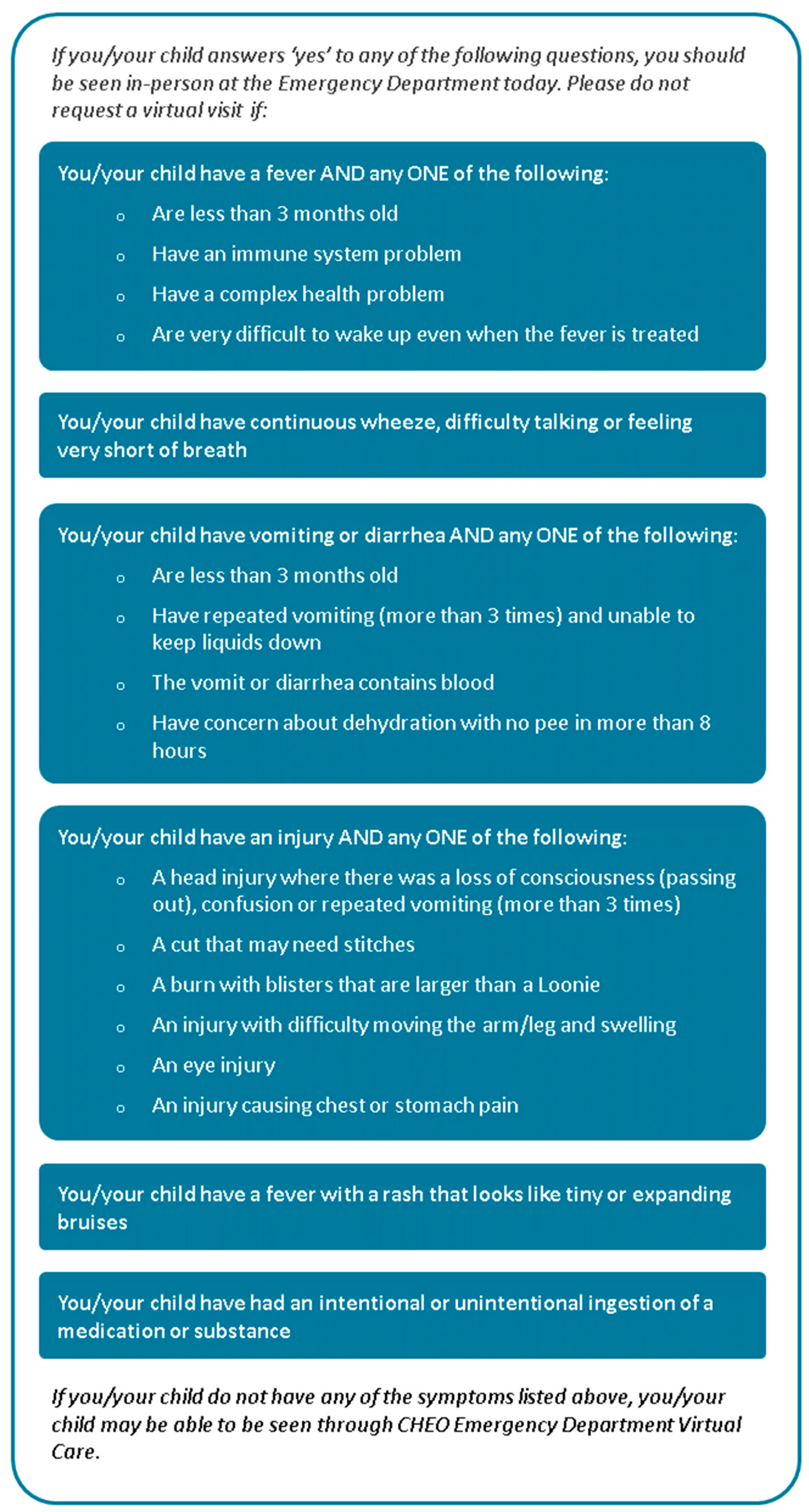
Figure 2.
The possible step-by-step manual for the new guideline development or for the adoption of already developed guideline.
Figure 2.
The possible step-by-step manual for the new guideline development or for the adoption of already developed guideline.
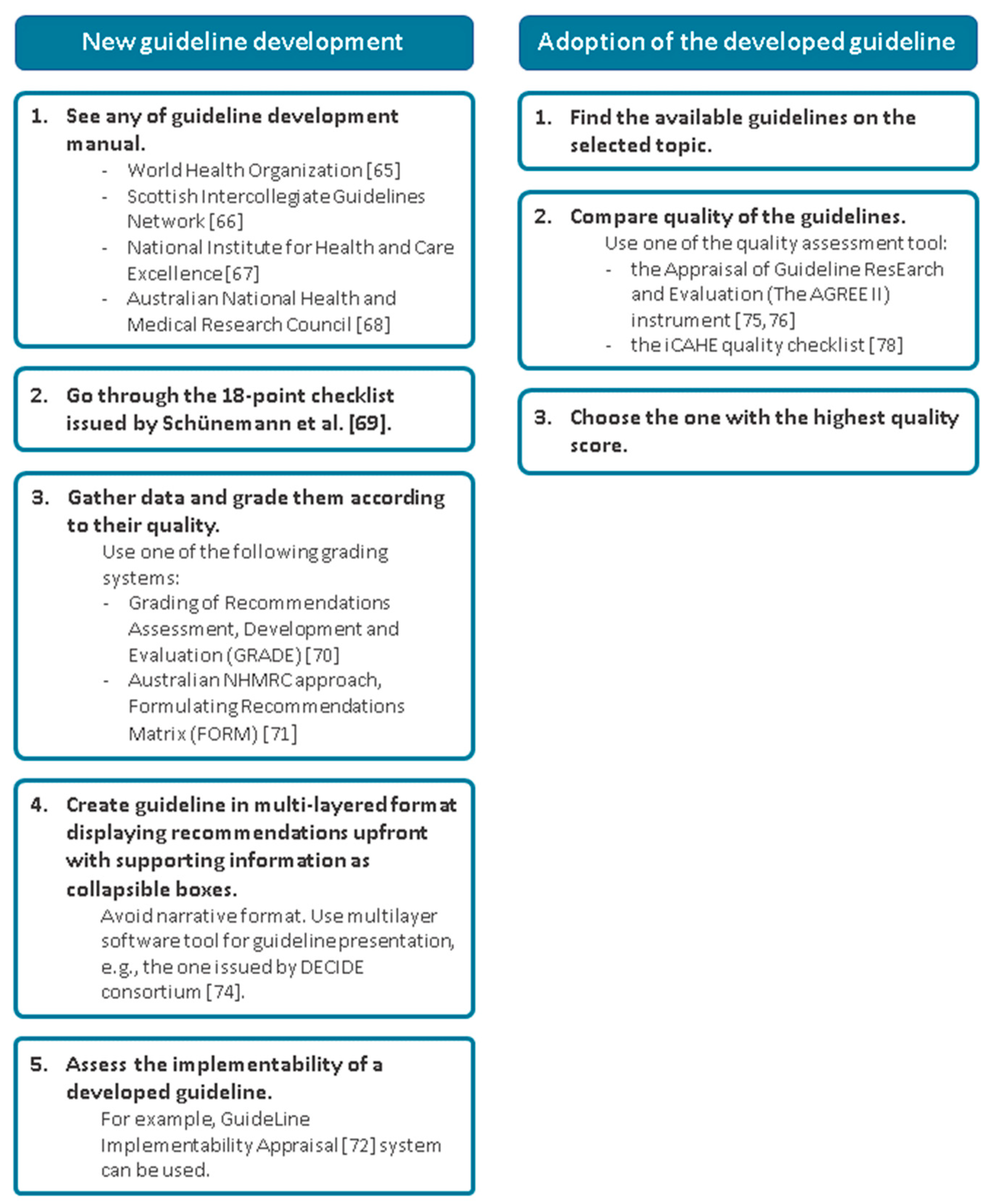
Figure 3.
Summary of Clinical Decision Rules (CHALICE, CATCH and PECARN) to identify candidates with minor head trauma for head CT scan. Adopted from McGraw and Way [117]; LOS – loss of consciousness, MVA – motor vehicle accident, mph – miles per hour.
Figure 3.
Summary of Clinical Decision Rules (CHALICE, CATCH and PECARN) to identify candidates with minor head trauma for head CT scan. Adopted from McGraw and Way [117]; LOS – loss of consciousness, MVA – motor vehicle accident, mph – miles per hour.
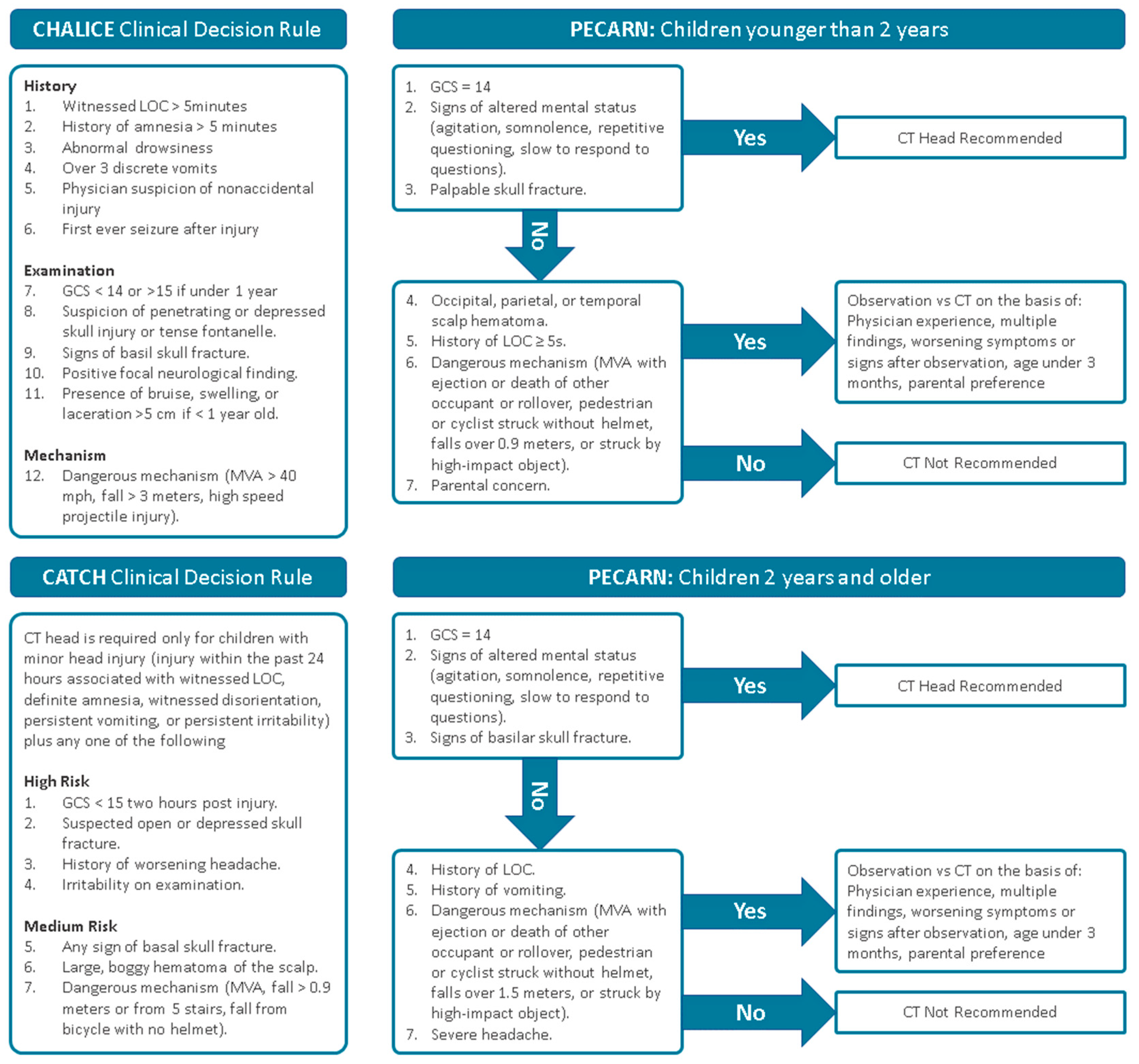

Table 1.
Triage system characteristics. Table is adopted from Hinson et al. [15].
| Triage system | CTAS | ESI | MTS | ATS | SATS |
|---|---|---|---|---|---|
| Stated objective | Provide patients with timely care | Prioritize patients by immediacy of care needs and resource | Rapidly assess a patient and assign a priority based on clinical need | Ensure patients are treated in order of clinical urgency and allocate patients to the most appropriate treatment area | Prioritize patients based on medical urgency in contexts where there is a mismatch between demand and capacity |
| Recommended time to physician contact, min | 1: immediate 2: ≤ 15 3: ≤ 30 4: ≤ 60 5: ≤ 120 |
1: immediate 2: ≤ 15 3: none 4: none 5: none |
Red: immediate Orange: ≤ 10 Yellow: ≤ 60 Green: ≤ 120 Blue: ≤ 240 |
1: immediate 2: ≤ 15 3: ≤ 30 4: ≤ 60 5: ≤ 120 |
Red: immediate Orange: ≤ 10 Yellow: ≤ 60 Green: ≤ 120 Blue: ≤ 240 |
|
Discriminators Clinical Vital signs Pain score Resource use |
Yes Yes Yes (10-point) No |
No Yes Yes (visual scale) Yes |
Yes Yes Yes (3-point) No |
Yes Yes No No |
Yes Yes Yes (4-point) No |
| Paediatrics | Separate version | Separate vital sign differentiators | Considered within algorithm | Considered within algorithm | Separate flowchart |
Disclaimer/Publisher’s Note: The statements, opinions and data contained in all publications are solely those of the individual author(s) and contributor(s) and not of MDPI and/or the editor(s). MDPI and/or the editor(s) disclaim responsibility for any injury to people or property resulting from any ideas, methods, instructions or products referred to in the content. |
© 2023 by the authors. Licensee MDPI, Basel, Switzerland. This article is an open access article distributed under the terms and conditions of the Creative Commons Attribution (CC BY) license (http://creativecommons.org/licenses/by/4.0/).
Copyright: This open access article is published under a Creative Commons CC BY 4.0 license, which permit the free download, distribution, and reuse, provided that the author and preprint are cited in any reuse.


