

Submitted:
17 March 2023
Posted:
20 March 2023
You are already at the latest version
Abstract
The agricultural sector provides employment and income to the majority of Myanmar's population. The sector, however, is extremely susceptible to severe weather, rising temperatures, and changes in precipitation. This paper aims to analyze how vulnerable Myanmar's agricultural sector is to climate change and highlights the key sectors that are most at risk. This report also examines historical climate information, and the anticipated effects of climate change on Myanmar's agricultural sectors. In-depth literature reviews and summaries of Myanmar's climate change adaptation efforts are included in the report, along with recom-mendations for targeted, locally appropriate actions to strengthen the country's agricultural sector's resilience. Additionally, the study reviews Myanmar's in-stitutional framework for climate action and government priorities for adaptation measures, emphasizes the urgent need for climate action in Myanmar's agricul-ture sectors and calls for more research and development efforts on the effects of climate change on rural livelihoods and agriculture.
Keywords:
Climate Change
; Agriculture
; Myanmar
; Adaptation Measures
; Resilience
1. Introduction
Myanmar is particularly vulnerable due to extreme weather events, which have increased in frequency and intensity over the past 60 years (MONREC 2019, MONREC 2021). According to the Global Climate Risk Index, Myanmar was ranked second on the list of countries vulnerable to severe weather between 2000 to 2019 (Eckstein et al. 2021). Because it relies on hydro-climatic conditions, agriculture is particularly sensitive to extreme weather events, rising temperatures, and changes in precipitation (Yi et al. 2012, NAPA 2012, Tun Oo et al. 2018).
Myanmar has an abundance of natural resources and its 676,575 km2 of land area includes a wide variety of topographic features and ecological zones. Due to its rich natural resources (land and water), agriculture sector plays a key role in economic growth and income for the majority of the population. Nearly 60% of the labor force is employed in the agriculture, livestock, and fishing sectors, which contributes around 30% of the GDP (Diao et al. 2020).
Myanmar's three major agroecological zones are the delta and coastal zone, the dry zone, and the highland areas. Highland regions feature more tree and horticulture crops, even though agricultural output and population are concentrated predominantly in the Delta and Central Dry Zones (Haggblade et al. 2013, Raitzer et al. 2015). The Central Dry Zone (CDZ), which makes up about 60% of all croplands in Myanmar, is susceptible to extreme heat, water scarcity, and drought. The coastal regions to the south are regularly threatened by tropical cyclones, floods, and other storm-surge effects, which also pose a threat to the highly populated delta regions (HPM 2009, NAPA 2012, MONREC 2019).
The agriculture sector in Myanmar is dominated by small landholder farmers, with an average landholding of 6.2 acres (2.5 hectares), as a result of continuous fragmentation of land (JICA, 2013; Henley, 2014, DAP 2019). Myanmar’s agriculture is labor-intensive, unproductive, and under-mechanized (Belton et al. 2017). In addition to this, climate change poses additional threats to agriculture and rural livelihoods in Myanmar. Due to climate variability across the country, Myanmar is confronted with numerous challenges and difficulties, including lowered crop yields and higher crop losses, food insecurity, malnutrition, and poverty (FAO 2011). Through a systematic review of studies on climate change impacts, vulnerability, and adaptation measures in the agriculture sector, this study attempts to provide precise, regionally tailored recommendations for improving the resilience of the agriculture sector in Myanmar.
2. Climate Change Impacts and Vulnerability
2.1. Historic Weather and Climate
According to historical data on weather and climate patterns, Myanmar is currently experiencing increasing temperatures, irregular or erratic rainfall, and a progressive alteration in monsoon patterns. The Department of Meteorology and Hydrology (DMH) of Myanmar claims that climate change has been noticeable over the past 60 years. Over the past three decades (1981-2010), the mean temperature has risen by around 0.08 °C per decade, with significant regional variations. Inland regions experienced a greater average temperature increase (0.35 °C per decade) than coastal regions (0.14 °C per decade). In the Central Dry Zone, even more, extreme temperature changes (an increase of 2.4°C on the baseline temperature data in 30 years), water scarcity, droughts, etc., were observed.
The intensity and distribution of rainfall patterns have also changed. In recent years, the southwest monsoon has arrived later and departed earlier with heavier rainfall and more harsh weather. Annual rainfall increased in the northern hilly region between 2001 and 2020 by 228 millimeters (mm) but fell in the Ayeyarwaddy, Tanintharyi, and Yangon Regions, as well as Rakhine State, by 58 mm. Sea levels are rising in coastal areas, and there has also apparently been an increase in saltwater intrusion onto farmlands (Tun Oo et al. 2018, NAPA 2012, MONREC 2019).
In Myanmar, cyclones now occur almost annually since the year 2000, up from one every three years in the preceding decades. The livelihoods and food security of farm households in the Delta region and coastal regions of Myanmar are particularly at risk from cyclones and strong storms. Between 1968 and 2008, Myanmar was hit by seven severe cyclones. The worst was Cyclone Nargis in 2008, which destroyed 9.88 million acres of rice (or 57 percent of the total annual rice-producing areas), killed approximately 140,000 people, and resulted in a loss of 10 billion USD (HPM 2009, MoSWRR 2017). Twelve significant floods affected the nation between 1910 and 2000. The flooding happened more frequently than in previous decades (NAPA 2012). In Myanmar, 12 out of 14 regions/states were affected by the flood in 2015, which was a more devastating impact on agriculture and resulted in 132 fatalities (Tun Oo et al. 2018, MONREC 2019).
2.2. Projected Weather and Climate
According to recent climate change forecasts, extreme weather events will occur more frequently in Myanmar, certainly in terms of temperature, rainfall, and sea level rise (Tun Oo et al. 2018, MONREC 2012, MONREC 2019). In Myanmar, rising precipitation and a shorter monsoon season may create unexpected, heavy precipitation that could result in flash floods, riverine floods, and pluvial floods. According to projections, annual average temperatures between 2011 and 2040 will be 0.7 to 1.1 °C warmer than they were between 1980 and 2005. Temperature increases of 1.1 °C by 2040 and 2.7 °C by 2070 are anticipated. After 2040, the Central Dry Zone is expected to experience temperature increases of up to 3 °C (Horton et al 2017, MCCS 2019, Nortajuddin 2020).
Inland regions are expected to experience an increase in temperature of 0.3 to 0.4°C. During the hot season, it may also increase by up to 3°C in the eastern and northern hilly regions (Horton et al. 2017). Likewise, it is anticipated that precipitation would rise by 11% in 2040 and by 23% in 2070, increasing the possibility of flash floods and riverine floods. Along with that, it is forecasted that the sea level will increase by 5 to 13 cm in 2020, 20 to 41 cm in 2050, and 37 to 83 cm in 2080 (Horton et al. 2017). This will cause more saltwater intrusion farther inland (FAO and GEF 2019, Tun Oo 2018, Tun Oo et al. 2020, Nortajuddin 2020). Myanmar's agriculture sectors are likely to be impacted by the projected impacts of climate change, and significant investment in agricultural resilience to climate change is required.
3. Key Sector Vulnerability
3.2. Agro-Ecological Features and Agri-Food System Vulnerability
Nearly 70% of Myanmar's population resides in rural areas and is primarily dependent on small- and medium-sized businesses in the agriculture, fishing, and aquaculture sectors. Since agriculture accounts for a large portion of Myanmar's economy, the country's food production and security may be adversely affected by the unprecedented effects of climate change in Myanmar (HPM 2009, NAPA 2012). Climate change affects agriculture productivity through changes in agroecological conditions. The Delta Region is the center of rice production in Myanmar among the agroecological zones because of its rich alluvial soil, favorable climatic conditions, and ample water supply. Although rice farming is popular in its lowlands, perennial crops, mainly rubber, oil palm, and tropical fruit trees, dominate the lower part of the Coastal Region such as the Tanintharyi and Mon Regions.
The Central Dry Zone consists of the western and central parts of the Mandalay Region and the lower parts of the Sagaing and Magway Regions. While Magway Region is the fifth-largest rice-growing region, Sagaing Region is the third-largest region for rice production. In Sagaing, Mandalay, and Magway regions, agriculture employs 70%, 80%, and 95% of the total cropland (Herridge et al. 2019). Upland farming of crops including pulses, sesame, and cotton is prevalent in the Central Dry Zone, and there is extensive cropping everywhere (Belton et al. 2017). The CDZ is considered one of the most climate-sensitive regions due to its increasing temperature, decreasing water availability, increased frequency of droughts, and severe weather effects (Tun Oo et al. 2020, UNEP DTU 2020).
Because rice is a staple food crop in Myanmar and a major export, it continues to dominate the agricultural sector. Rice production is dependent on precipitation and is concentrated in disaster-prone areas, especially the Delta Region and the upper parts of the Central Dry Zone. This makes rice production particularly vulnerable to the effects of climate change, such as temperature changes, variations in rainfall, an increase in the frequency of delayed monsoon rains, a decrease in the duration of the monsoon season, and an increase in the severity of extreme weather events such as droughts, floods, and heat waves (MONREC 2019, MONREC 2021).
3.2. Water Resources
The Ayeyarwaddy, Chindwin, Sittaung, and Thanlwin rivers flow from north to south in Myanmar and provide abundant water resources for crop production. Depending on seasonal fluctuations in water discharge and water surface level between wet and dry seasons, these principal rivers supply significant water resources with catchment areas of close to 737 000 km2 (MONREC 2021). About half of Myanmar or six states out of 14 regions/states are located in river basins where water is available all year (Fodor and Ling 2019, Karim and Ali 2021). Freshwater and marine waters, among others, are abundant in Myanmar. There are 8.2 million hectares of inland water bodies and 0.5 million hectares of interchange areas, respectively (UNEP DTU 2020). A considerable groundwater resource exists in Myanmar in addition to the availability of rivers and streams. As previously mentioned, groundwater cycles are also threatened by climate change-related water availability, rising temperatures, precipitation, and saltwater intrusion 1. Precipitation patterns, particularly during the monsoon, determine the availability of water in the Dry Zone. Fresh water shortages are brought on by decreasing rainfall, which directly threatens groundwater replenishment, rivers, and water reservoirs.
The country's water supplies were reduced by the severe 2010 drought, which also influenced crop production across the country, most notably in the central dry zone (Yi et al. 2012, MOAI 2015, Tun Oo et al. 2018). However, during the past three decades, groundwater irrigation and river pumping systems have increased more quickly in the dry zone (Belton et al. 2017). Besides, Myanmar has 132 dams across the country. Due to the deterioration of the watersheds, only 25% of these dams could function properly for either agriculture purposes or the generation of electricity. Recent investigations question the lack of access to water from irrigation projects despite the abundance of water resources and irrigation dams across the country (Win 2014, Tun Oo et al. 2017a).
4. Major Ecosystem Vulnerabilities
4.1. Upland
The geography of Myanmar is diverse, ranging from the lowland Central Dry Zone and Delta Region to upland plateaus and hilly regions in the eastern, northern, and northwestern regions. With a wide range of farming practices, the proportion of suitable agricultural land in hilly and mountainous areas is relatively low. There are several different ways to grow rice, including terraced paddy in valleys, shifting rice farming, and lowland paddy culture at the bottom of small basins (Matsuda 2009). Fruits and vegetables, including tea leaves, avocados, cabbage, and cauliflower, as well as perennial crops like coffee and avocado, are the main upland crops (see details in Table 1). In upland plateaus and hilly areas, where around 10% of the nation's total cultivated land is considered to be vulnerable to severe soil erosion. For example, Shan and Chin states as well as the upper section of the Sagaing region are especially sensitive to land degradation and severe soil erosion due to the rolling terrain and high elevation. High deforestation, subpar farming methods, and shifting cultivation are just some contributing factors to soil erosion and land degradation in upland regions (MONREC 2019, MONREC 2021).
4.2. Lowland
The Central Dry Zone of Myanmar is a huge valley that is 600 km long, 110 km wide, and covered in silt and clay-rich alluvial soils. These deep soil layers create a fertile area that is ideal for the growth of highland crops like rice (Tun Oo et al. 2018, MOALI 2019). The CDZ climate is a hot, humid climate. While, on the other hand, the delta region, has a long coastline of about 2400 km and is bordered to the south by the Bay of Bengal and the Andaman Sea. More than 95% of the crops produced in the region are rice (DAP 2019). Floods and droughts can have devastating effects on the lowlands and the Central Dry Zone. The lowlands and flat terrains located in the river basins are particularly vulnerable to catastrophic flooding during the monsoon season (MONREC 2020). Lowland regions of the country are mostly known for their high production of rice, peas and beans, groundnuts, onions, lettuce, watermelons, bitter gourds, tomatoes, and various other fruit and vegetable crops (MONREC 2021).
5. National Strategies, Plans, and Institutions Relevant to Climate Change
In recent years, the government of Myanmar has developed a number of climate-related plans for the agricultural industry. To lessen the effects of natural disasters and climate change, various Myanmar Government departments have worked to introduce drought-resistant seed varieties, flood and saltwater-tolerant varieties and other cropping practices. The Myanmar National Adaptation Plan (NAPA), which was put into effect by the government in 2012, enlists eight priority sectors as being particularly vulnerable to climate change. These sectors include agriculture, early warning systems, forests, public health, water resources, the coastal lowlands, energy and industry, and biodiversity. Achieving food and nutrition security, the Myanmar Climate-Smart Agriculture Strategy (MCSA) was launched in 2015. Its goal is to increase agricultural productivity and climate resiliency by adopting a diversity of crop varieties and corresponding farming technology (Hom et al. 2015). The MSDP (2018-2030) was created in 2019 and is by the 2030 Sustainable Development Goals (SDGs), which call for mainstreaming climate action into all pertinent short-, medium-, and long-term national development plans and policies. The Myanmar Climate Change Policy (2019), Myanmar Climate Change Strategy (MCCS) (2018-2030), and Myanmar Climate Change Master Plan (MCCMP) (2018-2030) were all also adopted in 2019. Myanmar's comprehensive response to hazards associated with climate change is outlined in the Myanmar Climate Change Strategy and Action Plan (MCCSAP), a 15-year road map. The objective of MCCASP is to generate and optimize opportunities for low-carbon and climate-resilient development in the nation, as well as to strengthen the adaptive capacity of vulnerable people and livelihood sectors (MCCS 2019).
5.1. Institutional Framework
To incorporate climate change into all pertinent short-, medium-, and long-term development plans and strategies, Myanmar has built an institutional framework. The Ministry of Natural Resources and Environmental Conservation (MONREC), the focal ministry, supported the establishment of the National Environmental Conservation and Climate Change Central Committee (NECCCCC) in 2016 to address and tackle environmental and climate change issues at the national/union level. Twenty representatives from 18 ministries, including the Ministry of Agriculture, Irrigation and Livestock (MOALI), one Non-Governmental Organization (NGO), one private sector, and one Civil Society Organization (CSO) make up the NECCCCC. There are also six working advisory groups (see Figure 1).
The organizations established to integrate climate change adaptation measures into Myanmar's development plans and policies are described in Table 2. To ensure Myanmar fulfills its obligations within the Paris Agreement's framework for increased transparency, a monitoring, reporting, and verification (MRV) system was established. To better comprehend top-level data and information systems required to establish the national MRV systems for complying with the standards of the enhanced transparency framework, MRV intends to develop institutional monitoring and reporting frameworks. For an MRV system of the Nationally Determined Contribution (NDC), MONREC is strengthening institutional and human capacity. The institutional coordination and multi-stakeholder engagement frameworks were established for the implementation of climate-smart actions in the agricultural, fisheries, and livestock sectors (MCCS 2019). It will allocate domestic financial resources to meet its NDCs' conditional targets. However, Myanmar still needs financial assistance from the international community to achieve all of its NDC conditional goals, implement mitigation and adaptation strategies, and pursue the goal of promoting green recovery beyond COVID-19 (MONREC 2021).
5.2. Key Players and Stakeholders
To efficiently implement climate change mitigation and adaptation actions in the agriculture, fishery, and livestock sectors, institutional coordination and a multi-stakeholder engagement framework have been established. Table 3 depicts the important stakeholders by organizational type.
5.2. Government Adaptation Priorities
Six prioritized sectors related to adaptation, mitigation, and cross-cutting challenges are described in the MCCS and Master Plan to accomplish two goals. The first involves making vulnerable communities and sectors more adaptable so they can resist the impact of climate change, and the second entails creating and maximizing opportunities for potential sectors to pursue low-carbon development pathways in order to ensure that households and all economic sectors will benefit from this development.
According to the MCCS, adaptation, and mitigation concerning food security include climate-smart agriculture, fisheries, and livestock. The adaptation mechanism's goal is to encourage climate-resilient productivity and climate-smart responses in the agriculture, fisheries, and livestock sectors to support food and nutrition security while also encouraging resource-efficient and low-carbon practices that might improve the development of new markets and products. The MCCS strategy encourages a highly productive and competitive agriculture sector and aims to create a climate-resilient, food, water, and nutrition-secure Myanmar by 2030 (MONREC 2019, MONREC 2021).
The climate change action plans have been incorporated into the pertinent policies, planning, and budgeting processes of the agriculture, fishery, and livestock sectors in order to promote climate-resilient productivity and climate-smart actions. Additionally, with the aid of local and international financing, many sectors have embraced adaptation techniques and technology that are both environmentally responsible and climate resilient. Through livelihood diversification, climate-smart agriculture (CSA), climate and weather monitoring, and knowledge-sharing interventions, MOALI has collaborated with multiple stakeholders and organizations to advance climate-smart adaptation practices in the agriculture, fisheries, and livestock sectors (MOALI 2019, MONREC 2021).
6. Summarizing Climate Change Adaptation Measures of Farm Households in Myanmar
The main objective of climate change adaptation is to reduce vulnerability and enhance resilience to climate change. Annex (Table A) summarizes significant farm-level adaptation measures in Myanmar based on the previous research findings and literature surveys. As earlier stated, farming systems differ in each agroecology zone in Myanmar. For example, farming systems in the lower parts of Myanmar, Mon State, and Tanintaryi Region are dominated by perennial crops such as rubber and palm oil, but the Central Dry Zone employs a mixed cropping pattern dominated by annual crops. There are also differences in the adoption of climate change adaptation measures by farm households in different agroecological zones. Some climate-smart agriculture practices and technologies are used in various agroecological zones, while others are used in relation to crop types and weather patterns. Traditional climate change adaptation practices have also been observed to lessen the effects of climate change on crop productivity, and there has been a gradual transition of traditional adaptation methods to recommended agricultural practices in Myanmar over the past year (Tun Oo et al. 2017).
Socioeconomic and institutional factors, particularly at the farm level, influence the adoption of climate change adaptation methods (Tun Oo et al. 2017 and 2019). Some measures will necessitate significant investment from the government, private sector, and individuals. Because modifying the existing agricultural system incurs some costs related to crop management and labor, the necessity to promote and scale up climate change adaptation measures for farm households in Myanmar is highlighted and suggested in Annex (Table A).
7. Challenges and Constraints for Addressing Vulnerability and Increasing Resilience
In Myanmar, there is a growing assessment of farm level adaptation constraints, farmer perceptions about climate change, and farm household adoption of adaptive strategies. Table 4 shows the primary constraints to the adoption of climate change adaptation methods as well as the institutional challenges associated with the implementation of climate change adaptation measures, particularly in agriculture sector.
8. Discussions
According to historical weather and climate data, Myanmar is extremely vulnerable to the effects of rising temperatures, erratic rainfall, and extreme weather events. Agriculture, livestock, and fisheries are the key sectors most vulnerable to climate change extremes. Different agroecological zones in Myanmar are especially vulnerable to the negative effects of climate change. While the delta region is vulnerable to floods, cyclones, and saltwater intrusion into farmlands, agriculture in the CDZ is vulnerable to the effects of rising temperatures, drought, water scarcity, and groundwater depletion. The upland farming system is low to moderately vulnerable to the negative effects of climate change, whereas lowland areas such as the CDZ, delta, and coastline areas are vulnerable from high to extremely high to the negative effects of climate change and natural hazards. Because farming systems differ in each agroecology zone in Myanmar, the adoption of climate change adaptation measures varies significantly by farming system and crop type. Socioeconomic and institutional factors influence farm household adaptation decisions and the implementation of climate change adaptation measures in Myanmar. Farm level adaptation constraints and barriers limit farmers' ability to choose climate change adaptation measures in Myanmar. There is a need to remove farm household’s bottlenecks and barriers in order to achieve increased adoption of climate change adaptation measures at the farm level and increased resilience of agro-food systems to climate change in Myanmar. In light of climate change in Myanmar, it is becoming increasingly important to understand the current state of climate change vulnerability in agro-food systems, the adoption of climate change adaptation measures, as well as the barriers or challenges that limit farmers' ability to choose adaptation measures. In this review paper, we present a set of recommendations aimed at improving the resilience of Myanmar's agro-food systems to climate change, which are detailed in the following section.
9. Recommendations
Investment: Promoting Climate Smart Agriculture (CSA) practices and adaptation strategies necessitates significant financial investment from both the private and public sectors. Some CSA and adaptation measures require investment in research and extension services so that successive governments may provide updated climate adaptation solutions to farmers in places where farmers can extensively use these practices.
Policy and Incentives: The Myanmar government should establish a more conducive environment for better farming system resilience and farm household adoption of CSA practices through policy and incentive initiatives. Farmers, for example, should be compensated for the value of their environmental contributions as well as the value of their physical production in environmentally appropriate methods.
Private sectors and Key Stakeholders: Better regional and national planning and management mechanisms should be put in place to ensure improved networking and coordination between key stakeholders in Myanmar's government and private sectors. Climate change adaptation and mitigation actions, including the implementation of CSA initiatives, can be carried out more efficiently and effectively with these improved mechanisms. Implementing Climate Smart Villages (CSV) initiative also requires extensive collaboration among individual farmers, government agencies, and other stakeholders.
Capacity building training and extension services: It is also necessary to empower and strengthen the adaptive capacity of key stakeholders, policymakers, development planners, communities, and farmers. This can be accomplished by launching regular training programs, field-based extensions, services, and knowledge-sharing events in collaboration with both the public and private sectors. The Farmer Field School (FFS) is indeed a platform for farmers to learn innovative agricultural management practices and build new skills and knowledge.
Improving climate change education and awareness: Improving education and awareness on climate change is crucial to building public support for climate action. There is still needed to identify effective education and awareness strategies and to evaluate their effectiveness in promoting climate action in Myanmar.
Community-based resilience planning: It is also advised to strengthen farmers' and communities' adaptive capacity and resilience through the community-based resilience planning process and farmers-to-farmers knowledge-sharing initiatives. It is also recommended that local Civil Society Organizations (CSOs), Community-Based Organizations (CBOs), and Non-Governmental Organizations (NGOs) work more collaboratively and cooperatively on community-based resilience planning. Indigenous climate change adaption methods and community-based resource management practices should also be supported and encouraged.
Early Warning and Early Action System (EWEAs): Lack of knowledge on climate change and extreme weather events has negative effects on agricultural yield and farm income as well as the loss of farm equipment and household possessions. The government of Myanmar needs to speed up the early warning and response system so that it can educate the public as soon as weather and climate conditions change and increase awareness of natural disasters and climate change-related occurrences. Early weather and climate change information will, in the end, help farmers in taking early actions and lessening agricultural losses.
Enhancing climate data and monitoring: High-quality climate data is essential for effective climate change planning and decision-making. Further research is needed to improve climate data and monitoring systems in Myanmar, including improving data collection and analysis, and developing effective climate modeling tools.
Development projects and programs: Scaling up and broadening the adoption of CSA initiatives is essential for farm households to become more climate resilient. Along with recent political instability and civil turmoil, projects promoting climate resilience and development programs are being phased out. Therefore, more development programs and efforts need to be supported in order to enhance capabilities for climate change resilience and adaptation. Myanmar must act quickly and genuinely to implement its planned climate policies because the country is experiencing a worsening climate crisis.
10. Conclusions
Myanmar is one of the countries in the world that is most sensitive to climate change, and a climate crisis is unfolding. It will unavoidably have an impact on livelihoods, agriculture, fishery, and livestock sectors. There is no single solution that can reverse the increasing effects of climate change in Myanmar. Although certain steps have been done, there is still a need for increased and more extensive collaboration and coordination across government institutions and between public and private organizations. Therefore, it is crucial to create an environment that promotes coordination and collaboration among various stakeholders.
Climate change adaptation methods should be integrated into societal norms and fulfill community needs. Promoting CSA practices and CSV activities will eventually result in sustainable agriculture-food systems by enhancing agricultural productivity and mitigating the effects of climate change from agriculture sectors. In order to maximize the benefits of CSA and CSV initiatives in agro-food systems, the government ministries and agencies such as MONREC, MOALI and NECCCCC should foster collaboration among various stakeholders.
Given the increasing occurrence of climate change in Myanmar, this study makes several recommendations to successive Myanmar governments, as well as stakeholders from private and public organizations. It is becoming increasingly important to strengthen the adaptive capacity and resilience of various stakeholders and farm households in Myanmar. And, there is a huge potential for agriculture sector development in Myanmar in the face of climate change. However, the COVID-19 pandemic, as well as continuous civil turmoil and political crisis, has made addressing climate challenges more complicated. Myanmar must take immediate and concerted action to address the mounting impacts of climate change on agriculture and food systems. Priority should be given to creating actionable settings, reviewing feasible action plans, and taking immediate actions. In addition, rules and policies must be helpful rather than restrictive so that Myanmar's climate change adaptation actions could be taken effectively and promptly. Therefore, in order to lessen the negative effects of climate change on agro-food systems in Myanmar, the government should support more initiatives and projects that increase adaptive capacity of stakeholders and individuals, and support climate-smart agriculture initiatives, as well as implement community-based resilience planning throughout Myanmar.
11. Patents
Funding
This research received no external funding.
Acknowledgments
The authors would like to thank the International Food Policy Research Institute (IFPRI) and Dr. Bart Minten, senior research fellow/program leader of the IFPRI's Myanmar Strategy Support Program, for their generous support and guidance in writing this manuscript.
Conflicts of Interest
This review paper's author declares that there is no conflict of interest.
Annex (Table A). Farm-level climate change adaptation measures categorized by type of adaptation strategies
| Farming systems and major crop production | Indigenous adaptation measures | Recommended or Introduced adaptation measures | Agro-Ecological Zone | Remarks |
| Mix cropping and diversification of farming systems as an adaptation to climate change for crops including rice, peas and beans, sesame, groundnut, maize, and other cash crops like onion, melon, chili, etc | Crop and livestock relate strategies (e.g sowing seeds from neighboring farmers, livestock breed from friends, or nearby villages) Double cropping (Summer paddy program on irrigated paddy land) |
Recommended strategies by the Department of Agriculture (DOA) (i.e Good agricultural practices (GAP)) Climate Change related changes to cropping systems (stress-resistant varieties, adjustment to farming practices) Hybrid rice production technology Good Agriculture Practice (GAP) |
Mostly in Central Dry Zone (Sagaing, Mandalay, Magwe region) | Need additional investment in research and extension services to achieve higher adoption of these adaptation technologies |
| Adaptation through farm management practices for rice, peas and beans, groundnut and sunflower, etc | Adjusting planting time Cultural-related strategies such as fumigation, cleaning bushes, hand weeding, etc |
Adjusting of cultivation methods (i.e adjusting sowing dates with broadcasting methods, different forms of seedling methods, and transplanting) Utilization of fertilizers, chemical herbicides, and weedicides |
Mostly in CDZ (Sagaing, Mandalay, Magwe regions), Bago and Yangon regions | Unsystematic application of chemical fertilizers and pesticides lead to soil structural deterioration and harm to both human and ecosystems Need additional capacity-building training for private sectors, farm households, and public sectors |
| Crop-related adaptation strategies | Crop diversification | Crop diversification and rotation (i.e a mix of crop types/varieties and crop rotation techniques) to improve farmer’s income and livelihoods | Mostly in Central Dry Zone (Sagaing, Mandalay, Magwe region) | Need additional research on which crops should be rotated and diversified |
| Soil and water management practices |
Soil-related strategies such as manure application, cow-dung application, soil tillage practices, shallow plowing, etc) | Advanced soil and plant management (organic manure application, plant pest protection, mulching, weeding techniques introduced by Government Department, deep plowing with machines, etc) | Mostly in Central Dry Zone (Sagaing, Mandalay, Magwe region), Bago, and Ayeyarwaddy region | Need to strengthen the adaptive capacity of stakeholders from both private and public sectors as well as farm households |
| Banding practices | Improved variety application (i.e drought resistant varieties, high-yielding varieties, short-duration varieties) | Ayeyarwaddy and Bago Region | Department of Agriculture and Research (DAR) (DAR developed eight varieties of deep-water rice and one submergence-tolerant rice variety for flood-prone areas) but there is a need for investment for further research and development | |
| Hand weeding and mulching practices | Combination of improved variety and recommended agricultural strategies | CDZ, Bago, and Ayeyarwaddy regions | A combination of variety selection and good agricultural practices produces better outcomes on crop production than one farm management practice | |
| Agroforestry production systems |
Production of rice and annual crops Agroforestry practices Mangrove forestation |
Introduction of cash crops, fruit trees/ intensification of perennial crop production (i.e oil palm and rubber) in Tanintharyi Region and Mon State | Coastline areas, particularly in Rakhine and Ayeyarwaddy region Chin, Kayin, Kachin and Shan Tanintaryi and Mon states |
Need additional investment in processing technologies Mangrove forests and a number of agroforestry practices to retard flooding, tidal surge, and further saltwater intrusion to fish ponds, and rice fields |
| Crop management system | Conventional seedling practices | Brine seeds or soak rice seeds in salt water before planting to resist saltwater intrusion problems System of Rice Intensification (SRI) |
Mostly at coastline areas like Ayeyarwaddy Mostly at Bago, Mandalay, and Sagaing |
DAR developed eight varieties of deep-water rice and one submergence-tolerant rice variety for the flood-prone areas |
| Other technology as adaptation Agricultural development for food security, and poverty reduction |
Conventional crop production with a heavy amount of fertilization application Rice-based farming systems Cultivation of rain-fed crops Production of vegetables like home gardening and household consumption |
Climate Smart Agriculture (CSA) would contribute to regional food security and environmental protection. - Community-level nutrition education and awareness building |
In several parts of the country | Need to scale up these good practices throughout Myanmar |
| Climate Smart and Nutrition Smart Villages (CSVs) | In several parts of the country | Need to scale up these good practices throughout Myanmar | ||
| Organic farming technology | In several parts of the country | Need to scale up these good practices throughout Myanmar | ||
| Biochar Technology and other organic compost-making practices | In several parts of the country | Need to scale up these good practices throughout Myanmar | ||
| Hydroponic Vegetable production | Mostly in Central Dry Zone (Sagaing, Mandalay, Magwe region) and Shan State | Need to scale up these good practices throughout Myanmar | ||
| Conservation agriculture technology | Mostly in Central Dry Zone (Sagaing, Mandalay, Magwe region), Shan, Kachin, and Chin State | Provide more public awareness training for conservation agriculture practices, particularly for Inlay lakes in Shan State and Indawgyi Lake in Kachin State | ||
| Sun-dried practices | Paddy dryers (post-harvest management) | Ayeyarwaddy, Bago, Mandalay, and Sagaing | Need additional investment for good post-harvesting and food processing practices | |
| Water management practices | Traditional Rainwater harvesting practice | Weather index-based crop insurance | Mostly in Central Dry Zone and Nay Pyi Taw areas | Need additional investment from private sectors |
| Submerged irrigation method | Alternative wetting and drying irrigation | Sagaing, Mandalay and Bago Region | Need additional investment for drainage water management system | |
| Rainwater irrigation system | Improved water management and Irrigation practices through building water-resilient infrastructure | Mandalay, Magwe, Sagaing, Bago and Yangon regions | Need additional investment for irrigation and drainage systems |
| 1 | |
| 2 | Author evaluation of vulnerability indices based on existing literature and research findings |
| 3 | National Adaptation Programme of Action (NAPA) (2012) |
| 4 | Hom et al. (2015) |
| 5 | Hom et al. (2015) |
| 6 | MONERC (2019) |
| 7 | Hom et al. (2015) |
| 8 | MONERC (2021) |
| 9 | MONERC (2021) |
| 10 | Union of Myanmar Federation of Chambers of Commerce and Industry |
| 11 | Tun Oo, A et al. 2017 |
| 12 | Tun Oo, A et al. 2019 |
References
- Belton, B., Filipski, M., Chaoran H., Oo. A. T. and Htun, A. (2017). ‘Rural Transformation in Central Myanmar: Results from the rural economy and agriculture dry zone community survey’, Food Security Policy Project (FSPP), Working paper, MDI_CESD, 2017. www.foodsecuritylab.msu.edu.
- Department of Agricultural Planning (DAP) (2019). Myanmar Agriculture at a Glance, Publishing by Ministry of Agriculture, Livestock and Irrigation (MOALI), Nay Pyi Taw, Myanmar 2019.
- FAO (2011). Managing climate change risks for food security in Myanmar, Technical report, Food and Agriculture Organization, Bangkok.
- Fodor, M. and Ling, S. (2019). Myanmar Country Environmental Analysis.
- Haggblade, S, Boughton, D, Denning, G, Todd, R.K, Cho, K. M., Wilson, S., Wong, L.C.Y., Zaw Oo, Than, T. M., Mwee, N.E., Win, N.W., and Sandar, T. M. (2013). A Strategic Agricultural Sector and Food Security Diagnostic for Myanmar, Prepared for USAID/Burma, 99 pp.
- Hazard Profile of Myanmar (HPM) (2009). ‘MES, MGS, MIMU, ADPC, DMH, and Union of Myanmar. Institutional Arrangements for disaster management in Myanmar’, Ministry of Social Welfare, Relief, and Resettlement, the Republic of the Union of Myanmar.
- Hazard Profile of Myanmar (HPM) (2009). ‘MES, MGS, MIMU, ADPC, DMH, and Union of Myanmar. Institutional Arrangements for disaster management in Myanmar”. Ministry of Social Welfare, Relief, and Resettlement, the Republic of the Union of Myanmar.
- Henley, G. (2014). ‘Case study on Land in Burma, Evidence on Demand, Climate and Environment, Infrastructure, and Livelihoods’, Professional Evidence and Applied Knowledge Services, 24 pp. [CrossRef]
- Herridge, D.F., Win, M.M., Nwe, K.M.M., Kyu, K.L., Win, S.S., Shwe, T., Min, Y.Y., Denton, M.D. and Cornish, P.S., (2019). The cropping systems of the Central Dry Zone of Myanmar: Productivity constraints and possible solutions. Agricultural Systems, 169, pp.31-40.
- Hom, N.H., Htwe, N.M., Hein, Y., Than, S.M., Kywe, M. and Htut, T., 2015. Myanmar Climate-Smart Agriculture Strategy, Ministry of Agriculture and Irrigation, Jointly published by CGIAR, CCAFS and IRRI. Available at: https://cgspace.cgiar.org.
- Horton, R., De Mel, M., Peters, D., Lesk, C., Bartlett, R., Helsingen, H., Bader, D., Capizzi, P., Martin, S. and Rosenzweig, C. (2017). Assessing Climate Risk in Myanmar: Summary for Policymakers and Planners. New York, NY, USA: Center for Climate Systems Research at Columbia University, WWF-US and WWF-Myanmar, UN-Habitat Myanmar.
- Japan International Cooperation Agency (JICA) (2013). ‘Data collection survey on the agricultural sector in the Republic of the Union of Myanmar’, Final report, SANYU consultants INC, 167 pp. http://open_jicareport.jica.go.jp/pdf/12080982.pdf.
- Karim, M. and Ali, S.A. (2021). Small-Scale Aquaculture Investments for Livelihoods in Myanmar. Annual report (Oct 2020-Mar 2021). The WorldFish Center Working Papers.
- Matsuda, M. (2009). Dynamics of rice production development in Myanmar growth centers, technological changes, and driving forces. Tropical Agriculture and Development, 53(1), pp.14-27.
- Ministry of Natural Resources and Environmental Conservation (MONREC) (2021). Nationally Determined Contributions, the Republic of the Union of Myanmar, July 2021.
- Ministry of Natural Resources and Environmental Conservation (MONREC) (2019). Myanmar Climate Change Strategy (2018-2030), the Republic of the Union of Myanmar, 2019.
- Ministry of Social Warfare, Relief, and Resettlement (MoSWRR) (2017). “Myanmar Action Plan on Disaster Risk Reduction”, Ministry of Social Welfare, Relief and Resettlement, Nay Pyi Taw, Myanmar, 100 pp.
- National Adaptation Programme of Action (NAPA) (2012). “The Myanmar National Adaptation Programme of Action (NAPA) to Climate Change”, Nay Pyi Taw, Myanmar. Available from: http://unfccc.int/resource/docs/napa/mmr01.pdf.
- Nortajuddin, A. (2020). Myanmar is at risk from an extreme climate. The ASEAN Post.
- Raitzer, D. A., Wong, L.C.Y and Samson J. N.G (2015). Myanmar’s Agriculture sector: Unlocking the potential for inclusive growth, Asian Development Bank (ADB) Economics working paper series No. 470.
- Tun Oo, A., Minh, D.D and Sovandara KY (2019). “Farming system with the adaptation to climate change: case study focus on lowland areas in Cambodia, Myanmar, and Vietnam”, Technical Report No. CLIANDHH NO.1, International Foundation of Science (IFS).
- Tun Oo, A., Van Huylenbroeck, G. and Speelman, S. (2017). Determining factors for the application of climate change adaptation strategies among farmers in Magwe District, dry zone region of Myanmar. Int. J. Clim. Chang. Strategy. Manag., Vol. 9 (1), pp. 36-55. [CrossRef]
- Tun Oo, A., Van Huylenbroeck, G. and Speelman, S. (2017a). Differential impacts of an irrigation project: A case study of the Swar Dam Project in Yedashe, Bago region of Myanmar, Journal of Development and Agricultural Economics, Vol. 9 (7), pp: 178-189. [CrossRef]
- Tun Oo, A., Van Huylenbroeck, G. and Speelman, S. (2018). Assessment of climate change vulnerability of farm households in Pyapon District, a delta region in Myanmar. Int. J. Disaster Risk Reduct, Vol. 28, pp. 10–21. [CrossRef]
- Tun Oo, A., Van Huylenbroeck, G. and Speelman, S. (2020). Measuring the economic impacts of climate change on crop production in the dry zone of Myanmar: A Ricardian Approach, Climate, Vol. 8 (1), 9p. [CrossRef]
- Tun Oo. A. (2018). “Characterizing farm households’ vulnerability and adaptation to climate change in Myanmar. Ph.D. thesis dissertation, Ghent University, Belgium.
- UNEP DTU (2020). Technology needs an assessment report for adaption, Myanmar.
- Win., T.L. (2014). Water shortages growing in Myanmar – activist. Thomson Reuters Foundation, Yangon. https://news.trust.org/item/20140310161158-gkc58.
- Yi, T., Hla, W. M. and Htun, A. K. (2012). ‘Drought conditions and Management Strategies in Myanmar’, Report prepared for United Nations-Water, Department of Meteorology and Hydrology, Yangon, Myanmar, 9 pp.
Figure 1.
Working committees under the NECCCCC (source: MONREC 2021).
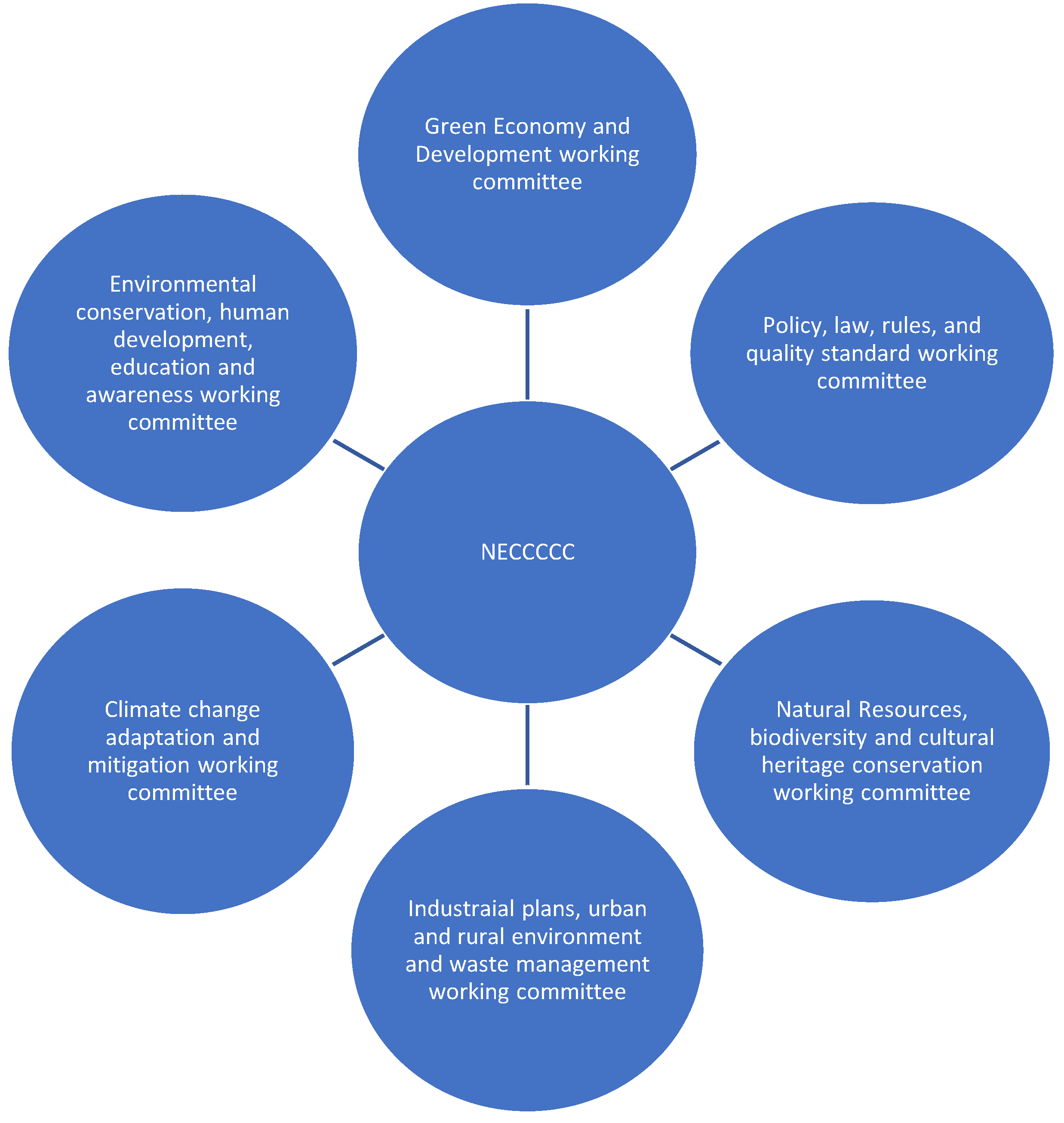

Table 1.
Major agro-climate zones in Myanmar (source: authors).
| Agro-climate zones | Geographical Description | Vulnerable Regions and States | Major crops/ livelihood activities | Climate Hazards and Vulnerability Status 2 |
|---|---|---|---|---|
| Delta Region | The Ayeyarwaddy River runs 1,200 kilometers (750 miles) from Upper Myanmar to the Andaman Sea. 50,400 km2 of land areas 2500-5500 mm of annual rainfall 3 |
Delta areas of Ayeyarwaddy and Yangon Riverine areas of the Bago region (i.e Sittaung Riverine Areas) |
Rice and pulses | Cyclone, storm surges, intense rain, saltwater intrusion, Tsunami, and riverine flood Vulnerability status: High |
| Central Dry Zone | 87,198 km2 or 12.8% of Myanmar’s land area 500-1000 mm of annual rainfall 4 |
Sagaing, Mandalay and Magway Regions | Upland crops, oilseeds, pulses, rice, cotton, irrigated agriculture, and Kaing-Kyun (Silty land) cultivation | Drought, extremely high temperatures, flash floods, riverine floods, Deficit rainfall, and water scarcity Vulnerability status: Extremely High |
| Coastal (Upland and lowland) | 10-15% of the land area of Myanmar The average annual rainfall is highest in Myanmar at 3,300 mm. 5 |
Tanintharyi, Mon Kayin, the Rakhine States, and some parts of the Ayeyarwaddy region | Orchards, rice, pulses, upland agriculture, oilseeds, and nipa palm Fishing, fish-farming, fish processing |
Cyclone/strong winds, Intense rain, sea level rise Vulnerability status: Moderate to High |
| Hilly and mountainous Area | Hilly, uneven topography, sloping land, moderate to heavy rainfall | Shan, Kayin, Kachin, and Chin States Some parts of Kayin and Mon State |
Upland crops, horticultural crops, and shifting cultivation | Intense rains, landslides Vulnerability status: Low to Moderate |
Table 2.
National-level climate change implementation institutions and their roles.
| Institution | Roles and Responsibility |
|---|---|
| National Environmental Conservation and Climate Change Central Committee (NECCCCC) 6 | The NECCCCC serves as the focal point for various international environmental conventions and provides oversight on all environmental and climate change activities. |
| Ministry of Agriculture, Irrigation and Livestock (MOALI) 7 | Under the NECCCC, MOALI is responsible for some climate-resilient technologies to reach the aims of food security policy. |
| Department of Agriculture (DOA), MOALI carries out projects related to traditional cultivation practices such as GAP, the System of Rice Intensification (SRI), resistant crop varieties, organic farming, and cropping patterns the climate change adaption. | |
| MONREC- secretary 8 | MONREC plays the secretarial role for the NECCCCC and coordinates climate change-related activities, and reports on these activities to NECCCC. |
| It serves as the government focal point for the UNFCCC and its climate financing, the Green Climate Fund. | |
| Global Stock-taking process by submitting its Biennial Update 9 | A report in 2022 and Biennial Transparency Report (BTR) not later than 2024, as mandated by the Paris Agreement Rule Book. |
Table 3.
Key players and stakeholders for climate change adaptation in Myanmar.
| Government | Private sectors/ Institutes | Community |
|---|---|---|
|
|
|
| Farm-level Constraints | Institutional challenges | Others (specify) |
|---|---|---|
|
|
|
|
|
|
|
|
|
|
|
|
|
|
|
|
|
|
|
|
|
Disclaimer/Publisher’s Note: The statements, opinions and data contained in all publications are solely those of the individual author(s) and contributor(s) and not of MDPI and/or the editor(s). MDPI and/or the editor(s) disclaim responsibility for any injury to people or property resulting from any ideas, methods, instructions or products referred to in the content. |
© 2023 by the authors. Licensee MDPI, Basel, Switzerland. This article is an open access article distributed under the terms and conditions of the Creative Commons Attribution (CC BY) license (http://creativecommons.org/licenses/by/4.0/).
Copyright: This open access article is published under a Creative Commons CC BY 4.0 license, which permit the free download, distribution, and reuse, provided that the author and preprint are cited in any reuse.