

Submitted:
13 March 2023
Posted:
14 March 2023
You are already at the latest version
Abstract
Chronic pain is a source of major alterations in quality of life. It represents significant costs for health systems, and reduces the competitiveness of the working population. Vulnerability can drive the incidence of chronic pain, through its influence on modifiable risk factors, and reduced utilization of health care systems. But vulnerability can also be the consequence of a chronic pain: illness can push people into precariousness. We analysed the factors associated with pain intensity among vulnerable persons with a chronic condition, in five European countries (N=1,364). Pain was, among the whole set of variables, the main predictor of sleep problems, fatigue, depression, self-perceived health, physical and mental quality of life. This is in line with other studies showing the major impact of pain on an individual’s health and life. Multivariable analyses, adjusting for the whole set of variables, showed that women had more intense pain, as well as participants with a lower education level. These results confirm the social component in the complex etiology of pain and clearly plaid in favor of integrated care, taking into account individual characteristics and environment.
Keywords:
chronic pain
; patient education
; vulnerable populations
; low income
; quality of life
1. Introduction
Pain is a subjective multidimensional experience inducing multiple repercussions on quality of life, sleep, mood, physical activity, self-perceived health, social relations, work, and income. Indeed, pain imposes a significant emotional and physical burden on those affected, and leads to physical, psychological, social, and economic vulnerabilities [1,2,3]. Pain intensity depends on sensitivity, but is also modulated by emotional states, and mental processes (such as attention, interpretation, memorization and anticipation). Pain is closely linked to psychological distress, with reciprocal influences [4,5,6]. It also depends on demographic and socioeconomic factors: it is more frequent in elderly, women, and persons with a lower level of education or income [7].
Pain is a very frequent reason for medical visit [8], and constitutes an important workload for health systems [9]. For example, spinal pain is experienced by 80% of individuals at some point in their life in the United States [10], and the prevalence in the elderly is estimated at 49% [11]. In France, 54% of adults had suffered from pain in the past two years [12], and 25% had experienced physical pain that was difficult to bear in the past year [13]. Patients who reported pain consulted healthcare professionals twice as often as the others [14].
In several chronic diseases, pain is one of the main symptoms affecting the daily life of patients. The general adult population in the European Union reported an average chronic pain prevalence of around 20% [15,16]. The etiology of chronic pain is complex, and influenced by biochemical, psychosocial and behavioral factors [17]. Chronic pain is a source of disability, and major alterations in quality of life. It represents significant costs for health systems [18,19], including direct costs (medical visits, analgesics), but also indirect costs (depression, addictions). The annual additional medical cost is estimated at more than one billion euros in France [14]. In addition, chronic pain represents a very significant proportion of the causes of sick leave, early retirement, and permanent disability [20]. According to data from the National Health and Wellbeing Survey in five European countries, the presence of severe daily pain is associated with a reduced likelihood of being employed full time (25% against 45% for people with no pain) [20]. Chronic pain induces a decrease in productivity at work. Thus, in addition to its considerable impact on the quality of life of individuals, it reduces the competitiveness of the working population.
Vulnerable people are more likely to be affected by chronic conditions [21]. The prevalence of chronic conditions reaches 60% among beneficiaries of the Medicaid program in the United States (low-income people aged 18 to 64 years) against 50% in the general population (yet including people over 65 years) [22]. In low-income countries, death rates from chronic diseases in 2005 were 54% higher for men and 86% higher for women compared to both men and women in high-income countries [23]. Vulnerability can drive the incidence of chronic disease, through its influence on modifiable risk factors [24,25,26,27], and reduced utilization of health care systems, due to barriers such as geographical isolation, scarcity of public transport, or lack of social ties [28,29,30]. People with low incomes find it less easy to adhere to a healthy lifestyle, and have poorer general health [31,32]. They generally happen to suffer most from the fragmentation of care services [33]. But vulnerability can also be the consequence of a chronic condition: illness aggravates social vulnerability and can push people into precariousness through job loss [34].
Although there is enough evidence to make it a high priority, as well as to conduct more research, chronic pain appears to have received few specific public health policy responses, especially in vulnerable populations. The research project EFFICHRONIC is a prospective and multicentric study, where socio-economically vulnerable participants with a chronic condition participate to the "Chronic Disease Self-Management Programme" (CDSMP) [35].
In this article, we explore, at baseline i.e. before the beginning of the programme, the relation between pain intensity and: (1) socio-demographic variables (country, sex, age, education, income, and social network); (2) sedentary behaviour and physical exercise; (3) quality of life (mental and physical), and its components (sleep problems, fatigue, psychological distress, and general perceived health); (3) work absenteeism.
2. Materials and Methods
2.1. Study design
This study focusses on the baseline questionnaire that was initially filled by the participants to the EFFICHRONIC programme [36,37], in which the CDSMP [35] intervention was implemented in five European regions (Occitanie in France, province of Genoa in Italy, principality of Asturias in Spain, region of Rotterdam in the Netherlands, and the region of London in the United Kingdom). The baseline questionnaire included socio-demographics (age; sex; education level (primary or lower, secondary, tertiary or higher); household composition (living alone or not)), and various validated self-assessed scales (Table 1).
2.2. Sample
Participants have been recruited to receive the 6 sessions of the CDSMP intervention with the following inclusion criteria:
- -
- Aged at least 18;
- -
- At least one chronic condition (according to the International Classification of Primary Care-2 [47]), that has been present for at least six months;
- -
- At least one vulnerability criteria among the following: older people (over 65) living alone or in retirement homes, or in a situation of social or family isolation; persons receiving a disability pension or allowance; ethnic minorities; legal immigrants, refugees and asylum seekers (whose residence has been known for at least 6 months), and low-income (defined as below the poverty line at 60% of the median standard of living for the year 2015 [48]).
The development of EFFICHRONIC´s recruitment approach combined population-based and individual recruitment strategies [49]. Firstly, vulnerability maps were developed to detect areas with higher vulnerability, based on specific deprivation indices, employing different methodologies. The maps are based on Population Census data in Spain (the MEDEA index [50] and an ad hoc rural index), France (the FDep index [51]) and Italy (the Crevari and Caranci indices [52]). In the United Kingdom, the national Index of Multiple Deprivation [53] (IMD) produces an overall relative measure of deprivation and was consulted online. In the Netherlands, most vulnerable areas at this study site were identified by stakeholders working in the community. Secondly, within those areas, potential participants were individually recruited following a variety of recruitment strategies. To reach the vulnerable population, alliances with local and regional authorities, health services, social care organizations and civil society were generated across the EFFICHRONIC sites. The recruitment process was adapted to the socio-economic context, the health system and cultural singularities of each country.
2.3. Outcomes
In the questionnaire at baseline, three questions were directly related to pain assessment:
- Pain intensity in the EQ-5D-5L instrument (0: I have no pain or discomfort; 1: I have slight pain or discomfort; 2: I have moderate pain or discomfort; 3: I have severe pain or discomfort; 4: I have extreme pain or discomfort);
- Interference of pain with work and daily activities in the SF-12 instrument (During the past 4 weeks, how much did pain interfere with your normal work or other regular daily activities? 0: Not at all, 1: A little bit, 2: Moderately, 3: Quite a bit, 4: Extremely);
- Self-management of pain in the Chronic Disease Self-Efficacy (CDSE-6) instrument (How sure are you that you can keep any physical discomfort or pain of your condition from interfering with the things you want to do? Visual analogic 0-10 scale).
2.4. Data analysis
All data have been handled confidentially, and scientific data were stored anonymously. Statistical analyses have been performed using R version 4.0.3 [54].
Correlations between the three pain variables (pain intensity, interference of pain with work and daily activities, and self-management of pain) were assessed using Person’s correlations.
Associations between the intensity of pain and other variables were evaluated using multinomial ordinal regression models (pain intensity being an ordered factor outcome). These multivariable models were built with only those variables that had a significant effect in univariable models (p<0.05, p-values being corrected for multiple testing using the BH procedure [55]). We used proportional-hazards, because the sample size were insufficient in some levels of factor variables to be able to fit a non-proportional hazards model.
To further describe the relations between the variables, we also used another multivariable regression, with only the variables that we expected to be rather causes than consequences of pain (among the variables that were significant in the univariable models), namely country, sex, education level, income, social relations, physical exercise, and sedentary behaviour.
We have then repeated these analyses using as outcome a binary variable: “no pain” versus “non-null pain”.
We also conducted other analyses, for each variable of interest, where pain was an explanatory variable instead of the outcome (adjusting for all other available variables, when significant in univariable models). For these models, we used either logistic regression models, multinomial ordinal regression models, or general linear models, depending on the nature of the outcome.
Given the high rate of missing data for the probability of having missed work during the past 4 weeks, multiple imputation was performed using the R package ‘missRanger’ [56,57], which combines random forest imputation with predictive mean matching. Each imputation was weighted by the degree of missing data for each participant, such that the contribution of data from participants with higher proportions of missingness was weighted down in the imputation. We set the maximum number of trees for the random forest to 200 but left all other random forest hyperparameters at their default. Parameter estimates for all five datasets were pooled to provide more accurate estimates.
3. Results
3.1. Study population
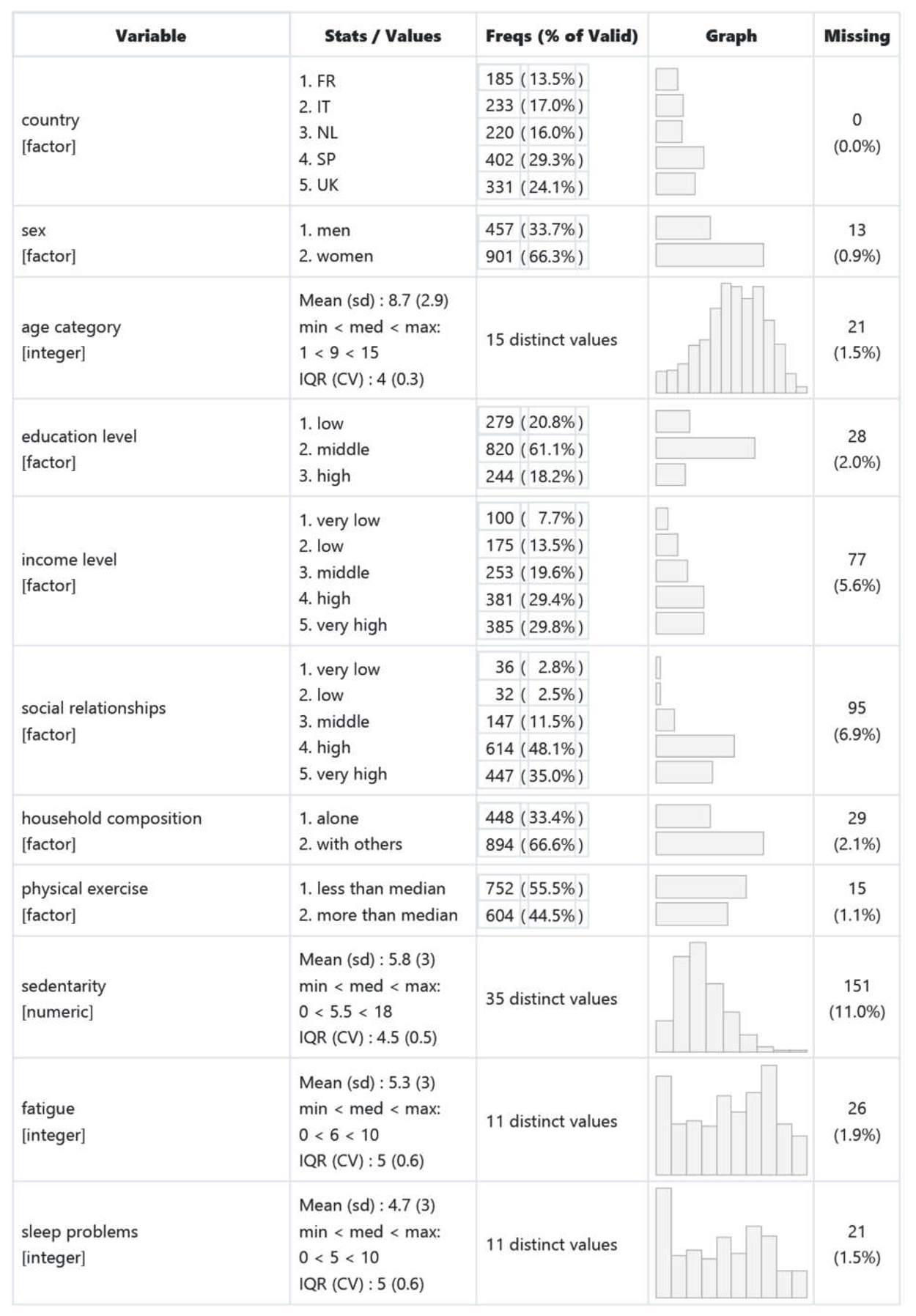
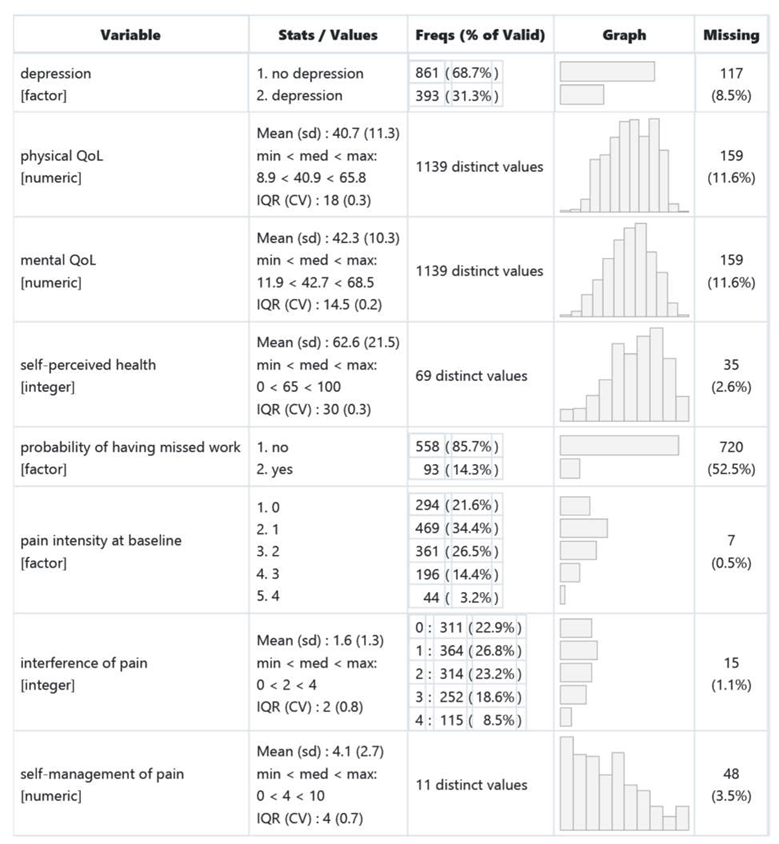
A total number of 2.951 vulnerable participants distributed over the 5 European countries have been engaged. After removing caregivers (who did not have a chronic disease) and participants who attended less than four sessions or who had missing or aberrant data for the variable pain intensity (Figure 1), data were analysed for a total of 1371 participants with at least one chronic condition (FR 185, IT 233, NL 220 SP 402, UK 331). The average proportion of missing values across all variables in the dataset was 4.1% (excluding the probability of having missed work during the past 4 weeks, for which the proportion of missing values was 52.5%) (Table 2).
3.2. Correlation between the different pain scales
The 2x2 Pearson’s correlation tests between the three pain variables showed that they are all significantly correlated (pain intensity with interference: p<10-15, correlation coefficient = 0.70; pain intensity with self-management: p<10-15, correlation coefficient = -0.44; interference with self-management: p<10-15, correlation coefficient = -0.48). Because of the tight link between these pain variables, the following analyses have been performed on only one of them: pain intensity. Pain intensity varied across countries (Figure 2a). The 2x2 correlations between quantitative variables are represented in Figure 2b.
3.3. Association between pain intensity and vulnerability factors
Average income was significantly lower in participants with highest pain intensity (pain level 3 or 4; N=240; income = 3.27±1.13), than in participants without pain (pain level 0; N=294; income = 3.66±1.31) (Wilcoxon rank test W=25,187, p<0.0001). Participants with highest pain intensity also had less social relationships than participants without pain (pain level 3 or 4: social relationships = 3.63±1.00; pain level 0: social relationships = 4.32±0.80; W=18,251, p<0.0001). Besides, participants with pain were on average older than those without pain (5-year-age category : 8.81±2.89 versus 8.32±3.16; W=164839, p=0.01), and women had on average a higher level of pain than men (1.50±1.06 versus 1.29±1.09; W=181006, p=0.0002).
3.4. Multivariable analysis with pain intensity as the outcome (multinomial ordinal regression)
Using a multinomial ordinal regression with pain intensity as the response variable, the multivariable regression (variables being previously selected using univariable models, if p<0.05) showed that pain significantly depended on country (p<0.0001), sedentary behaviour (p<0.0001), fatigue (p<0.003), sleep problems (p<0.0001), physical quality of life (p<0.0001), mental quality of life (p<0.0001), and self-perceived health (p<0.0001) (Figure 3a). The results were qualitatively similar when we used general linear models instead of multinomial ordinal regression, and imputing the missing data for all variables did not significantly change the results either.
A simplified model was also built that included only the variables country, sex, education level, income, social relations, physical exercise, and sedentary behaviour. All these variables were significant (with p<0.0001), except income (marginally), and sedentary behaviour (Figure 3b). The intensity of pain was higher in France and lower in Spain than in the three other countries. Women reported more pain than men. Participants with a high education level reported less intense pain. Those with a high level of social relationships reported less intense pain. Finally, participants had less pain if they performed more physical exercise (and tended to have less pain if they had a less sedentary behaviour).
3.5. Multivariable analysis with a binary pain variable as the outcome (logistic regression)
We then compared the participants according to whether they reported some non-null level of pain (N=1070) or not (N=294). Among participants with pain, 69.0% were women (against 56.7% among those without pain), 20.0% had a low education level (against 23.3% among those without pain), and 22.0% had a very low or low income (against 18.8% among those without pain).
Using a multivariable logistic regression, we found that participants suffering from pain significantly differed according to country (p<0.0001), had more sleep problems (p=0.03), as well as a lower physical quality of life (p<0.0001), and a lower mental quality of life (p<0.05) (Figure S1).
3.6. Multivariable analyses with pain as an explanatory variable
The models where pain was considered as an explanatory variable showed that it was significantly associated with: sleep problems (p<0.0001, Figure S2), fatigue (p<0.0001, Figure S3), probability of depression (p<0.0001, Figure S4), self-perceived health (p<0.0001, Figure S5), physical quality of life (p<0.0001, Figure S6), and mental quality of life (p<0.0001, Figure S7).
Concerning the probability of having missed work during the past 4 weeks, our logistic regression analyses showed that the intensity of pain was not significantly associated with the risk of missing work, although marginally (p=0.06) (Figure S8). If the intensity of pain was considered as a continuous variable, the intensity of pain was positively associated with the risk of missing work, but this effect was not significant either (p=0.07). Finally, running the model on imputed datasets did not reveal a significant association with pain either.
3.7. Figures and tables
- Figure 1. Flow chart of sample selection.
- Figure 2. a) Pain intensity across countries (kernel density estimate). b) Correlations’ matrice (Pearson’s coefficients) between pain intensity and quantitative variables reflecting quality of life. The areas and colors of circles represent the absolute value of correlation coefficients.
- Figure 3. Multivariable multinomial ordinal regression model, with pain intensity as the outcome. More pain on the right of the dashed line, less pain on the left of the dashed line. a) Model including all the variables that were significant in univariable models; b) Model including a restricted number of variables.
- Table 1. The instruments used in this study
- Table 2. The variables used in this study
4. Discussion
This multicentric study allowed a thorough characterization of the factors associated with pain and its intensity in a large sample of persons with a chronic condition among vulnerable populations in five European countries (N=1,364).
In raw data, average income was lower in participants with higher pain intensity, and they had fewer social relationships, as compared to participants without pain. Besides, participants with pain were on average older than those without pain. Finally, women had on average a higher level of pain than men. Multivariable analyses, adjusting for the whole set of variables that were significant in univariable models, showed that women had more intense pain as well as participants with a lower education level. Although the participants had been included with vulnerability criteria, these results suggest an association of pain with low education level and low income even within vulnerable populations, and confirm the impact of socio-economic status among the determinants of pain.
There is a rather abundant literature on the link between pain and vulnerability. Significant inverse associations have been found between a more severe pain and a lower educational achievement [58,59,60]. Similarly, pain prevalence, intensity, and functional interference, were repeatedly found to be higher in people with a lower income [1,59,61,62]. This was also observed when comparing people living in the most deprived areas with those living in the most affluent ones [63]. Low income and manual work seem to have cumulative effects on the odds of experiencing severe pain [61]. Sickness absence at work due to pain is also inversely related to socio-economic status [60].
In the Austrian Health Interview Survey [7] (with more than 15,000 respondents), socio-economic status (based on education, income and profession) was inversely and gradually associated with the prevalence of severe pain, with the number of indicated painful body sites, with the intensity of pain, and with the subjective level of feeling disabled through pain. Moreover, even at the same intensity of pain and the same number of painful body sites, people in the lowest socio-economic class were twice to three times more likely to feel disabled through pain than people in the highest socio-economic class. Similarly, other studies have shown that people in deprived socio-economic situation not only run a higher pain and chronic pain risk, but also experience their pain as more severe/disabling than their more privileged counterparts [64,65]. The mechanisms underlying the association between socio-economic status and pain are not yet elucidated. Firstly, low income dramatically increases risk factors of chronic diseases that can induce chronic pain. Secondly, depressive symptoms could be one of the mediators of this relationship, in terms of limiting the individual’s strategies to manage pain [66]. Indeed, higher levels of subjective socio-economic status significantly predicted lower odds of participants having been prescribed at least one analgesic drug in the previous six months, and this was true even after controlling for objective socio-economic status variables [67].
Vulnerable people with chronic conditions should be a priority of health policy and interventions. Over the last decades, literature on both chronic care [68] and integrated care [69] have gradually recognised the importance of the social determinants in shaping people´s health. Both fields acknowledge that healthcare strategies and interventions should not only consider individual factors, but also people’s environment (including socio-economic determinants). It is precisely the most vulnerable people with chronic conditions who most need social and community support as well as effective and integrated care [70]. Consequently, integrated healthcare strategies should prioritize them. However, individuals from vulnerable groups are usually hard-to-reach [24,28,71,72]. They are often reluctant to attend the care system and do not seek support through the usual channels [73]. Areas with higher vulnerability are often left out from policy innovations and experiences due to their socio-economic complexity.
Another interesting finding of this study is that participants had less pain if they performed more physical exercise, and tended to have less pain if they had a less sedentary behaviour (i.e. a smaller number of hours sitting per day). This distinction between sedentary behaviour and physical exercise has already been highlighted by studies of metabolic diseases: epidemiological data showed that high volumes of sedentary behaviour are detrimental to metabolic health, even in the presence of regular exercise [74], suggesting that the health effects of sedentary behaviour are independent from those of exercise, and that daily living physical activity is beneficial.
Finally, it is remarkable that pain was the main predictor of sleep problems, fatigue, depression, self-perceived health, physical and mental quality of life. This is in line with other studies showing the major impact of pain on an individual’s health and life [1,3]. Pain is frequent in persons with a chronic condition [75], but the causal relation is not necessarily unidirectional. Chronic pain can increase the risk for metabolic diseases and cardiovascular diseases [3], through an impact on physical exercise and sedentary behavior, and through the influence of pain on blood pressure [76]. Chronic pain can also induce depression and anxiety [4,6], either directly or through negative consequences on social and professional interactions [20], and on sleep [3]. Anxiety can in turn be involved in immune diseases and cancers through an impact on inflammation [77].
A strength of this study is the rather large sample size of 1,364 participants from five countries. However, the use of vulnerability maps and targeted recruitment strategies may introduce bias into the sample, impacting the representativeness of the sample. In addition, the use of individual recruitment strategies may introduce confounding variables. Finally, our results may not be generalizable outside the European context.
The three questionnaire items on pain were significantly correlated between them, we can therefore consider that our measure of pain intensity is reliable. Persons with any chronic condition have been included indiscriminately, as well as persons with diverse vulnerability criteria, and this is an originality of this research: the vast majority of other pain studies focus on a specific disease or a specific population, and are therefore difficult to generalize. At the same time, the absence of information on the type of chronic condition (articular, digestive, metabolic, etc.) is a weakness of this protocol, because these entities encompass a great diversity. Furthermore, other useful information is missing, such as the height and body weight of participants, their ethnic/cultural background, or the use of painkillers.
5. Conclusions
Overall, our results confirm the social component in the complex etiology of pain. Decreasing social inequalities and vulnerability could clearly reduce the prevalence of pain [22,23], whereas managing pain would also reduce the risk of vulnerability [20]. Taken globally, these considerations clearly plaid in favor of integrated care, taking into account the patients individual characteristics and environment.
Supplementary Materials
The following supporting information can be downloaded at the website of this paper posted on Preprints.org. Figure S1: Logistic regression model, with a binary variable no-pain versus pain as the outcome. Pain more likely on the right of the vertical line (OR=1); Figure S2. Multinomial ordinal multivariable regression model, with sleep problems as the outcome (variables being included if significant in univariable models). More sleep problems on the right of the dashed line; Figure S3. Multinomial ordinal multivariable regression model, with fatigue as the outcome (variables being included if significant in univariable models). More fatigue on the right of the dashed line; Figure S4. Logistic regression with probability of depression as the outcome (variables being included if significant in univariable models). * p<0.05, ** p<0.01, *** p<0.001; Figure S5. Linear model with probability of self-perceived health as the outcome (variables being included if significant in univariable models); Figure S6. Linear model with probability of physical quality of life as the outcome (variables being included if significant in univariable models); Figure S7. Linear model with probability of mental quality of life as the outcome (variables being included if significant in univariable models); Figure S8. Multivariable logistic regression model, with the probability of missing work as the outcome (variables being included if significant in univariable models).
Funding
This research was supported by the European Union’s Health Program (2014-2020) (EFFICHRONIC 738127).
Institutional Review Board Statement
The study was conducted in accordance with the Declaration of Helsinki and the corresponding ethical regulations are being respected at each study site. The protocol was approved by the French ethics committee (CPP SOOM I, study number 9788), by the Regional Ethics Committee of Liguria (study number 152-2018), by the Medical Ethics Review Committee of the Erasmus MC University Medical Center, Rotterdam (MEC-2017-1116), and by the Research ethics committee of the Principality of Asturias (study number 20/17). In the United Kingdom, the Health Research Authority was consulted, and it was concluded that approval from an ethics committee was not necessary. Written consent was obtained from all participants. The study was registered at ClinicalTrials.gov (ISRCTN70517103).
Informed Consent Statement
Informed consent was obtained from all subjects involved in the study. Written informed consent has been obtained from the patients to publish this paper.
Data Availability Statement
No new data were created or analyzed in this study. Data sharing is not applicable to this article.
Conflicts of Interest
The authors declare no conflict of interest. The funders had no role in the design of the study; in the collection, analyses, or interpretation of data; in the writing of the manuscript; or in the decision to publish the results.
References
- van Hecke, O.; Torrance, N.; Smith, B.H. Chronic pain epidemiology and its clinical relevance. Br. J. Anaesth. 2013, 111, 13–18. [Google Scholar] [CrossRef]
- Dassieu, L.; Pagé, M.G.; Lacasse, A.; Laflamme, M.; Perron, V.; Janelle-Montcalm, A.; Hudspith, M.; Moor, G.; Sutton, K.; Thompson, J.M.; et al. Chronic pain experience and health inequities during the COVID-19 pandemic in Canada: qualitative findings from the chronic pain & COVID-19 pan-Canadian study. Int. J. Equity Health 2021, 20, 147. [Google Scholar] [CrossRef]
- Fine, P.G. Long-Term Consequences of Chronic Pain: Mounting Evidence for Pain as a Neurological Disease and Parallels with Other Chronic Disease States. Pain Med. 2011, 12, 996–1004. [Google Scholar] [CrossRef]
- Gureje, O.; Simon, G.E.; Von Korff, M. A cross-national study of the course of persistent pain in primary care. Pain 2001, 92, 195–200. [Google Scholar] [CrossRef]
- Davies, K.A.; Silman, A.J.; Macfarlane, G.J.; Nicholl, B.I.; Dickens, C.; Morriss, R.; Ray, D.; McBeth, J. The association between neighbourhood socio-economic status and the onset of chronic widespread pain: Results from the EPIFUND study. Eur. J. Pain 2009, 13, 635–640. [Google Scholar] [CrossRef]
- Korff, M.V.; Simon, G. The Relationship Between Pain and Depression. Br. J. Psychiatry 1996, 168, 101–108. [Google Scholar] [CrossRef]
- Dorner, T.E.; Muckenhuber, J.; Stronegger, W.J.; Ràsky, É.; Gustorff, B.; Freidl, W. The impact of socio-economic status on pain and the perception of disability due to pain. Eur. J. Pain 2011, 15, 103–109. [Google Scholar] [CrossRef]
- Mäntyselkä, P.; Kumpusalo, E.; Ahonen, R.; Kumpusalo, A.; Kauhanen, J.; Viinamäki, H.; Halonen, P.; Takala, J. Pain as a reason to visit the doctor: a study in Finnish primary health care. Pain 2001, 89, 175–180. [Google Scholar] [CrossRef]
- European Pain Management; Eccleston, C. , Wells, C., Morlion, B., Eds.; Oxford University Press: Oxford, New York, 2017; ISBN 978-0-19-878575-0. [Google Scholar]
- Frymoyer, J.W.; Cats-Baril, W.L. An Overview of the Incidences and Costs of Low Back Pain. Orthop. Clin. North Am. 1991, 22, 263–271. [Google Scholar] [CrossRef]
- Bressler, H.B.; Keyes, W.J.; Rochon, P.A.; Badley, E. The Prevalence of Low Back Pain in the Elderly: A Systematic Review of the Literature. Spine 1999, 24, 1813. [Google Scholar] [CrossRef]
- SERRIE, A.; QUENEAU, P. Livre blanc de la douleur; COEGD (Comité d’Organisation des Etats Généraux de la Douleur): Paris, 2005. [Google Scholar]
- Baromètre santé 2010 Available online:. Available online: https://www.santepubliquefrance.fr/etudes-et-enquetes/barometres-de-sante-publique-france/barometre-sante-2010 (accessed on Oct 19, 2022).
- Mick, G.; Perrot, S.; Poulain, P.; Serrie, A.; Eschalier, A.; Langley, P.; Pomerantz, D.; Ganry, H. Impact sociétal de la douleur en France : résultats de l’enquête épidémiologique National Health and Wellness Survey auprès de plus de 15 000 personnes adultes. Douleurs Eval. - Diagn. - Trait. 2013, 14, 57–66. [Google Scholar] [CrossRef]
- Leadley, R.M.; Armstrong, N.; Lee, Y.C.; Allen, A.; Kleijnen, J. Chronic Diseases in the European Union: The Prevalence and Health Cost Implications of Chronic Pain. J. Pain Palliat. Care Pharmacother. 2012, 26, 310–325. [Google Scholar] [CrossRef]
- Breivik, H.; Collett, B.; Ventafridda, V.; Cohen, R.; Gallacher, D. Survey of chronic pain in Europe: prevalence, impact on daily life, and treatment. Eur. J. Pain Lond. Engl. 2006, 10, 287–333. [Google Scholar] [CrossRef]
- Turk, D.C.; Okifuji, A. Psychological factors in chronic pain: Evolution and revolution. J. Consult. Clin. Psychol. 2002, 70, 678–690. [Google Scholar] [CrossRef]
- Sambamoorthi, U.; Tan, X.; Deb, A. Multiple Chronic Conditions and Healthcare Costs among Adults. Expert Rev. Pharmacoecon. Outcomes Res. 2015, 15, 823–832. [Google Scholar] [CrossRef]
- Stanaway, J.D.; Afshin, A.; Gakidou, E.; Lim, S.S.; Abate, D.; Abate, K.H.; Abbafati, C.; Abbasi, N.; Abbastabar, H.; Abd-Allah, F.; et al. Global, regional, and national comparative risk assessment of 84 behavioural, environmental and occupational, and metabolic risks or clusters of risks for 195 countries and territories, 1990–2017: a systematic analysis for the Global Burden of Disease Study 2017. The Lancet 2018, 392, 1923–1994. [Google Scholar] [CrossRef]
- Langley, P.; Müller-Schwefe, G.; Nicolaou, A.; Liedgens, H.; Pergolizzi, J.; Varrassi, G. The societal impact of pain in the European Union: health-related quality of life and healthcare resource utilization. J. Med. Econ. 2010, 13, 571–581. [Google Scholar] [CrossRef]
- Social Determinants of Health; Marmot, M. , Wilkinson, R., Eds.; 2nd ed.; Oxford University Press: Oxford, 2005; ISBN 978-0-19-856589-5. [Google Scholar]
- Chapel, J.M.; Ritchey, M.D.; Zhang, D.; Wang, G. Prevalence and Medical Costs of Chronic Diseases Among Adult Medicaid Beneficiaries. Am. J. Prev. Med. 2017, 53, S143–S154. [Google Scholar] [CrossRef]
- Abegunde, D.O.; Mathers, C.D.; Adam, T.; Ortegon, M.; Strong, K. The burden and costs of chronic diseases in low-income and middle-income countries. The Lancet 2007, 370, 1929–1938. [Google Scholar] [CrossRef]
- Thompson, S.; Phillips, D. Reaching and Engaging Hard-to-Reach Populations With a High Proportion of Nonassociative Members. Qual. Health Res. 2007, 17, 1292–1303. [Google Scholar] [CrossRef]
- Teuscher, D.; Bukman, A.J.; van Baak, M.A.; Feskens, E.J.M.; Renes, R.J.; Meershoek, A. A lifestyle intervention study targeting individuals with low socioeconomic status of different ethnic origins: important aspects for successful implementation. BMC Public Health 2017, 18, 54. [Google Scholar] [CrossRef]
- de Munter, J.S.L.; Agyemang, C.; van Valkengoed, I.G.M.; Bhopal, R.; Zaninotto, P.; Nazroo, J.; Kunst, A.E.; Stronks, K. Cross national study of leisure-time physical activity in Dutch and English populations with ethnic group comparisons. Eur. J. Public Health 2013, 23, 440–446. [Google Scholar] [CrossRef]
- Marshall, S.J.; Jones, D.A.; Ainsworth, B.E.; Reis, J.P.; Levy, S.S.; Macera, C.A. Race/Ethnicity, Social Class, and Leisure-Time Physical Inactivity. Med. Sci. Sports Exerc. 2007, 39, 44–51. [Google Scholar] [CrossRef]
- Ejiogu, N.; Norbeck, J.H.; Mason, M.A.; Cromwell, B.C.; Zonderman, A.B.; Evans, M.K. Recruitment and retention strategies for minority or poor clinical research participants: lessons from the Healthy Aging in Neighborhoods of Diversity across the Life Span study. The Gerontologist 2011, 51 Suppl 1, S33–45. [Google Scholar] [CrossRef]
- Christensen, N.I.; Drejer, S.; Burns, K.; Lundstrøm, S.L.; Hempler, N.F. A Qualitative Exploration of Facilitators and Barriers for Diabetes Self-Management Behaviors Among Persons with Type 2 Diabetes from a Socially Disadvantaged Area. Patient Prefer. Adherence 2020, 14, 569–580. [Google Scholar] [CrossRef]
- Clark, D.O.; Frankel, R.M.; Morgan, D.L.; Ricketts, G.; Bair, M.J.; Nyland, K.A.; Callahan, C.M. The meaning and significance of self-management among socioeconomically vulnerable older adults. J. Gerontol. B. Psychol. Sci. Soc. Sci. 2008, 63, S312–319. [Google Scholar] [CrossRef]
- World Health Organization Global action plan for the prevention and control of noncommunicable diseases 2013-2020; Geneva, 2013.
- Haslbeck, J.; Zanoni, S.; Hartung, U.; Klein, M.; Gabriel, E.; Eicher, M.; Schulz, P.J. Introducing the chronic disease self-management program in Switzerland and other German-speaking countries: findings of a cross-border adaptation using a multiple-methods approach. BMC Health Serv. Res. 2015, 15, 576. [Google Scholar] [CrossRef]
- Potvin, L.; Moquet, M.-J.; Jones, C.M. Réduire les inégalités sociales en santé; Inpes, 2010.
- Robles-Silva, L. The Caregiving Trajectory Among Poor and Chronically Ill People. Qual. Health Res. 2008, 18, 358–368. [Google Scholar] [CrossRef]
- Lorig, K.R.; Sobel, D.S.; Stewart, A.L.; Brown, B.W.; Bandura, A.; Ritter, P.; Gonzalez, V.M.; Laurent, D.D.; Holman, H.R. Evidence Suggesting That a Chronic Disease Self-Management Program Can Improve Health Status While Reducing Hospitalization: A Randomized Trial. Med. Care 1999, 37, 5–14. [Google Scholar] [CrossRef]
- Tan, S.S.; Pisano, M.M.; Boone, A.L.; Baker, G.; Pers, Y.-M.; Pilotto, A.; Valsecchi, V.; Zora, S.; Zhang, X.; Fierloos, I.; et al. Evaluation Design of EFFICHRONIC: The Chronic Disease Self-Management Programme (CDSMP) Intervention for Citizens with a Low Socioeconomic Position. Int. J. Environ. Res. Public. Health 2019, 16. [Google Scholar] [CrossRef]
- Boone, A.L.D.; Pisano-Gonzalez, M.M.; Valsecchi, V.; Tan, S.S.; Pers, Y.-M.; Vazquez-Alvarez, R.; Peñacoba-Maestre, D.; Baker, G.; Pilotto, A.; Zora, S.; et al. EFFICHRONIC study protocol: a non-controlled, multicentre European prospective study to measure the efficiency of a chronic disease self-management programme in socioeconomically vulnerable populations. BMJ Open 2019, 9, e032073. [Google Scholar] [CrossRef]
- Lorig, K.R.; Sobel, D.S.; Ritter, P.L.; Laurent, D.; Hobbs, M. Effect of a self-management program on patients with chronic disease. Eff. Clin. Pract. ECP 2001, 4, 256–262. [Google Scholar]
- Herdman, M.; Gudex, C.; Lloyd, A.; Janssen, M.; Kind, P.; Parkin, D.; Bonsel, G.; Badia, X. Development and preliminary testing of the new five-level version of EQ-5D (EQ-5D-5L). Qual. Life Res. Int. J. Qual. Life Asp. Treat. Care Rehabil. 2011, 20, 1727–1736. [Google Scholar] [CrossRef]
- Brooks, R. EuroQol: the current state of play. Health Policy 1996, 37, 53–72. [Google Scholar] [CrossRef]
- Booth, M. Assessment of Physical Activity: An International Perspective. Res. Q. Exerc. Sport 2000, 71, 114–120. [Google Scholar] [CrossRef]
- Kroenke, K.; Strine, T.W.; Spitzer, R.L.; Williams, J.B.W.; Berry, J.T.; Mokdad, A.H. The PHQ-8 as a measure of current depression in the general population. J. Affect. Disord. 2009, 114, 163–173. [Google Scholar] [CrossRef]
- Ware, J.E.; Kosinski, M.; Keller, S.D. A 12-Item Short-Form Health Survey: Construction of Scales and Preliminary Tests of Reliability and Validity. Med. Care 1996, 34, 220–233. [Google Scholar] [CrossRef]
- Alarcón, T.A.; Montalvo, J.I.G. La Escala Socio-Familiar de Gijón: instrumento útil en el hospital general. Rev. Esp. Geriatría Gerontol. Organo Of. Soc. Esp. Geriatría Gerontol. 1998, 33, 179. [Google Scholar]
- García González, J.V.; Díaz Palacios, E.; Salamea García, A.; Cabrera González, D.; Menéndez Caicoya, A.; Fernández Sánchez, A.; Acebal García, V. [An evaluation of the feasibility and validity of a scale of social assessment of the elderly]. Aten. Primaria 1999, 23, 434–440. [Google Scholar]
- Bouwmans, C.; Krol, M.; Severens, H.; Koopmanschap, M.; Brouwer, W.; Hakkaart-van Roijen, L. The iMTA Productivity Cost Questionnaire: A Standardized Instrument for Measuring and Valuing Health-Related Productivity Losses. Value Health J. Int. Soc. Pharmacoeconomics Outcomes Res. 2015, 18, 753–758. [Google Scholar] [CrossRef]
- O’Halloran, J.; Miller, G.C.; Britt, H. Defining chronic conditions for primary care with ICPC-2. Fam. Pract. 2004, 21, 381–386. [Google Scholar] [CrossRef]
- Bilan démographique 2017 - Insee Première - 1683 Available online:. Available online: https://www.insee.fr/fr/statistiques/3305173 (accessed on Apr 30, 2022).
- Rosete, A.A.; Pisano-González, M.M.; Boone, A.L.; Vazquez-Alvarez, R.; Peñacoba-Maestre, D.; Valsecchi, V.; Pers, Y.-M.; Zora, S.; Pilotto, A.; Tan, S.-S.; et al. Crossing intersectoral boundaries to reach out to vulnerable populations with chronic conditions in five European regions. Arch. Community Med. Public Health 2021, 7, 182–190. [Google Scholar]
- Esnaola, S. Desigualdades socioeconómicas en la mortalidad en el País Vasco y sus capitales: un análisis de áreas geográficas pequeñas (Proyecto MEDEA).
- CHALLIER, B.; VIEL, J.F.; FRA, D. de S.P.F. de M. et de P. de B.B. Pertinence et validité d’un nouvel indice composite français mesurant la pauvreté au niveau géographique. Rev. Dépidémiologie Santé Publique RESP 2001, 41–50. [Google Scholar]
- Costa, N.C. , Annibale Biggeri, Laura Grisotto, Barbara Pacelli, Teresa Spadea, Giuseppe L’indice di deprivazione italiano a livello di sezione di censimento: definizione, descrizione e associazione con la mortalità Available online:. Available online: www.epiprev.it. (accessed on Apr 19, 2022).
- Peters, S. 2015 English Indices of Deprivation: map explorer Available online:. Available online: http://dclgapps.communities.gov.uk/imd/http;//dclgapps.communities.gov.uk/imd/idmap.html (accessed on Apr 19, 2022).
- Crawley, M.J. The R Book; Wiley–Blackwell: Chichester, West Sussex, UK, 2012; ISBN 978-0-470-97392-9. [Google Scholar]
- Benjamini, Y.; Hochberg, Y. Controlling the False Discovery Rate: A Practical and Powerful Approach to Multiple Testing. J. R. Stat. Soc. Ser. B Methodol. 1995, 57, 289–300. [Google Scholar] [CrossRef]
- Sterne, J.A.C.; White, I.R.; Carlin, J.B.; Spratt, M.; Royston, P.; Kenward, M.G.; Wood, A.M.; Carpenter, J.R. Multiple imputation for missing data in epidemiological and clinical research: potential and pitfalls. BMJ 2009, 338, b2393. [Google Scholar] [CrossRef]
- Mayer, M. , & Mayer, M. M. Package ‘missRanger’. In; 2019.
- Roth, R.S.; Punch, M.R.; Bachman, J.E. Educational achievement and pain disability among women with chronic pelvic pain. J. Psychosom. Res. 2001, 51, 563–569. [Google Scholar] [CrossRef]
- Portenoy, R.K.; Ugarte, C.; Fuller, I.; Haas, G. Population-based survey of pain in the united states: Differences among white, african american, and hispanic subjects. J. Pain 2004, 5, 317–328. [Google Scholar] [CrossRef]
- Mittendorfer-Rutz, E.; Dorner, T.E. Socio-economic factors associated with the 1-year prevalence of severe pain and pain-related sickness absence in the Austrian population. Wien. Klin. Wochenschr. 2018, 130, 4–13. [Google Scholar] [CrossRef]
- Schurer, S.; Shields, M.A.; Jones, A.M. Socio-economic inequalities in bodily pain over the life cycle: longitudinal evidence from Australia, Britain and Germany. J. R. Stat. Soc. Ser. A Stat. Soc. 2014, 177, 783–806. [Google Scholar] [CrossRef]
- Morgan, C.Ll.; Conway, P.; Currie, C.J. The relationship between self-reported severe pain and measures of socio-economic disadvantage. Eur. J. Pain 2011, 15, 1107–1111. [Google Scholar] [CrossRef]
- Aggarwal, V.R.; Macfarlane, T.V.; Macfarlane, G.J. Why is pain more common amongst people living in areas of low socio-economic status? A population-based cross-sectional study. Br. Dent. J. 2003, 194, 383–387. [Google Scholar] [CrossRef]
- Jablonska, B.; Soares, J.J.F.; Sundin, Ö. Pain among women: Associations with socio-economic and work conditions. Eur. J. Pain 2006, 10, 435–447. [Google Scholar] [CrossRef]
- Saastamoinen, P.; Leino-Arjas, P.; Laaksonen, M.; Lahelma, E. Socio-economic differences in the prevalence of acute, chronic and disabling chronic pain among ageing employees. Pain 2005, 114, 364–371. [Google Scholar] [CrossRef]
- Thomtén, J.; Soares, J.J.F.; Sundin, Ö. Pain among women: Associations with socio-economic factors over time and the mediating role of depressive symptoms. Scand. J. Pain 2012, 3, 62–67. [Google Scholar] [CrossRef]
- Wakefield, J.R.H.; Sani, F.; Madhok, V.; Norbury, M.; Dugard, P. The pain of low status: the relationship between subjective socio-economic status and analgesic prescriptions in a Scottish community sample. Psychol. Health Med. 2016, 21, 27–37. [Google Scholar] [CrossRef]
- Dalstra, J. a. A.; Kunst, A.E.; Borrell, C.; Breeze, E.; Cambois, E.; Costa, G.; Geurts, J.J.M.; Lahelma, E.; Van Oyen, H.; Rasmussen, N.K.; et al. Socioeconomic differences in the prevalence of common chronic diseases: an overview of eight European countries. Int. J. Epidemiol. 2005, 34, 316–326. [Google Scholar] [CrossRef]
- Kodner, D.L.; Spreeuwenberg, C. Integrated care: meaning, logic, applications, and implications – a discussion paper. Int. J. Integr. Care 2002, 2. [Google Scholar] [CrossRef]
- Hébert, R. Canada: Application of a Coordinated-Type Integration Model for Vulnerable Older People in Québec: The PRISMA Project. In Springer Books; Springer, 2021; pp. 1075–1087. [Google Scholar]
- Bonevski, B.; Randell, M.; Paul, C.; Chapman, K.; Twyman, L.; Bryant, J.; Brozek, I.; Hughes, C. Reaching the hard-to-reach: a systematic review of strategies for improving health and medical research with socially disadvantaged groups. BMC Med. Res. Methodol. 2014, 14, 42. [Google Scholar] [CrossRef]
- Horrell, L.N.; Kneipp, S.M. Strategies for recruiting populations to participate in the chronic disease self-management program (CDSMP): A systematic review. Health Mark. Q. 2017, 34, 268–283. [Google Scholar] [CrossRef]
- Flanagan, S.M.; Hancock, B. “Reaching the hard to reach” - lessons learned from the VCS (voluntary and community Sector). A qualitative study. BMC Health Serv. Res. 2010, 10, 92. [Google Scholar] [CrossRef]
- Le Roux, E.; De Jong, N.P.; Blanc, S.; Simon, C.; Bessesen, D.H.; Bergouignan, A. Physiology of physical inactivity, sedentary behaviours and non-exercise activity: insights from the space bedrest model. J. Physiol. 2022, 600, 1037–1051. [Google Scholar] [CrossRef]
- Butchart, A.; Kerr, E.A.; Heisler, M.; Piette, J.D.; Krein, S.L. EXPERIENCE AND MANAGEMENT OF CHRONIC PAIN AMONG PATIENTS WITH OTHER COMPLEX CHRONIC CONDITIONS. Clin. J. Pain 2009, 25, 293–298. [Google Scholar] [CrossRef]
- Bruehl, S.; Chung, O.Y.; Jirjis, J.N.; Biridepalli, S. Prevalence of Clinical Hypertension in Patients With Chronic Pain Compared to Nonpain General Medical Patients. Clin. J. Pain 2005, 21, 147–153. [Google Scholar] [CrossRef]
- Salim, S.; Chugh, G.; Asghar, M. Chapter One - Inflammation in Anxiety. In Advances in Protein Chemistry and Structural Biology; Donev, R., Ed.; Inflammation in Neuropsychiatric Disorders; Academic Press, 2012; Volume 88, pp. 1–25. [Google Scholar]
Figure 1.
Flow chart of sample selection.
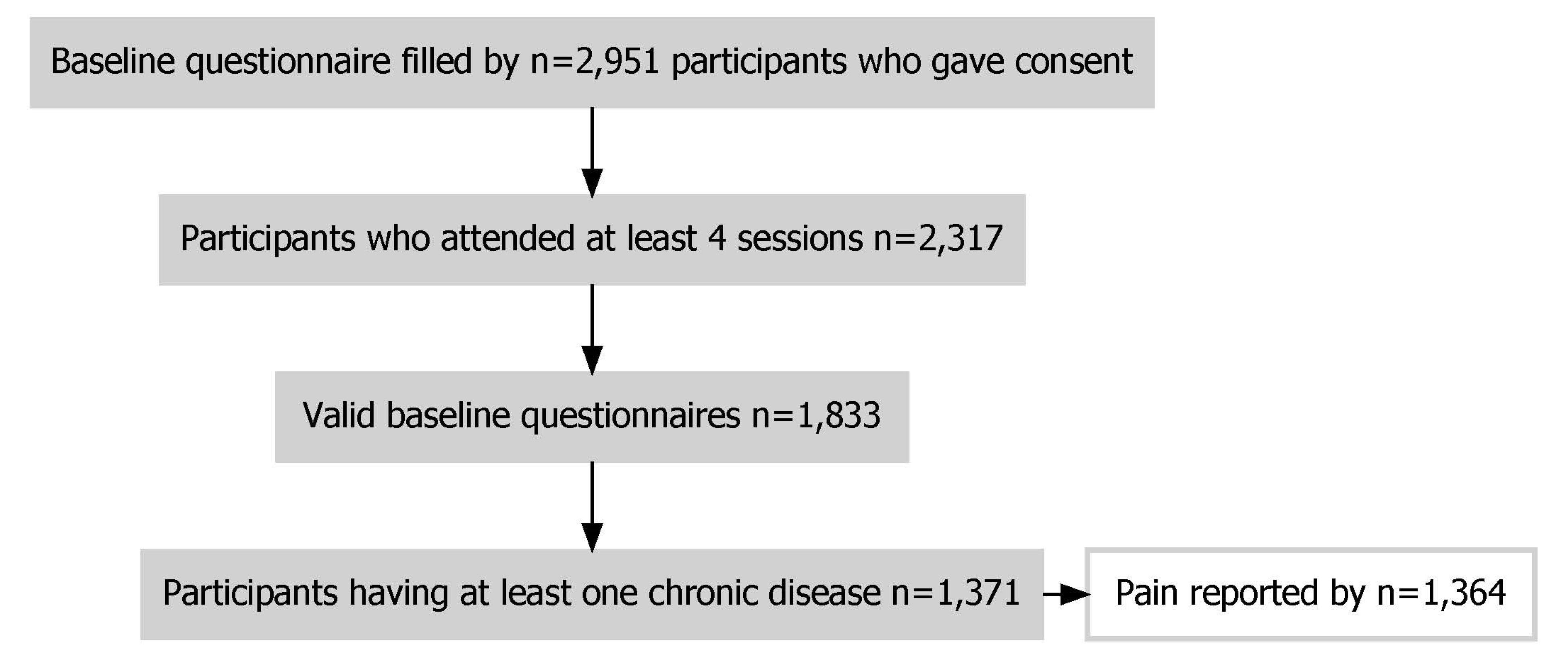
Figure 2.
a) Pain intensity across countries (kernel density estimate). b) Correlations’ matrice (Pearson’s coefficients) between pain intensity and quantitative variables reflecting quality of life. The areas and colors of circles represent the absolute value of correlation coefficients.
Figure 2.
a) Pain intensity across countries (kernel density estimate). b) Correlations’ matrice (Pearson’s coefficients) between pain intensity and quantitative variables reflecting quality of life. The areas and colors of circles represent the absolute value of correlation coefficients.
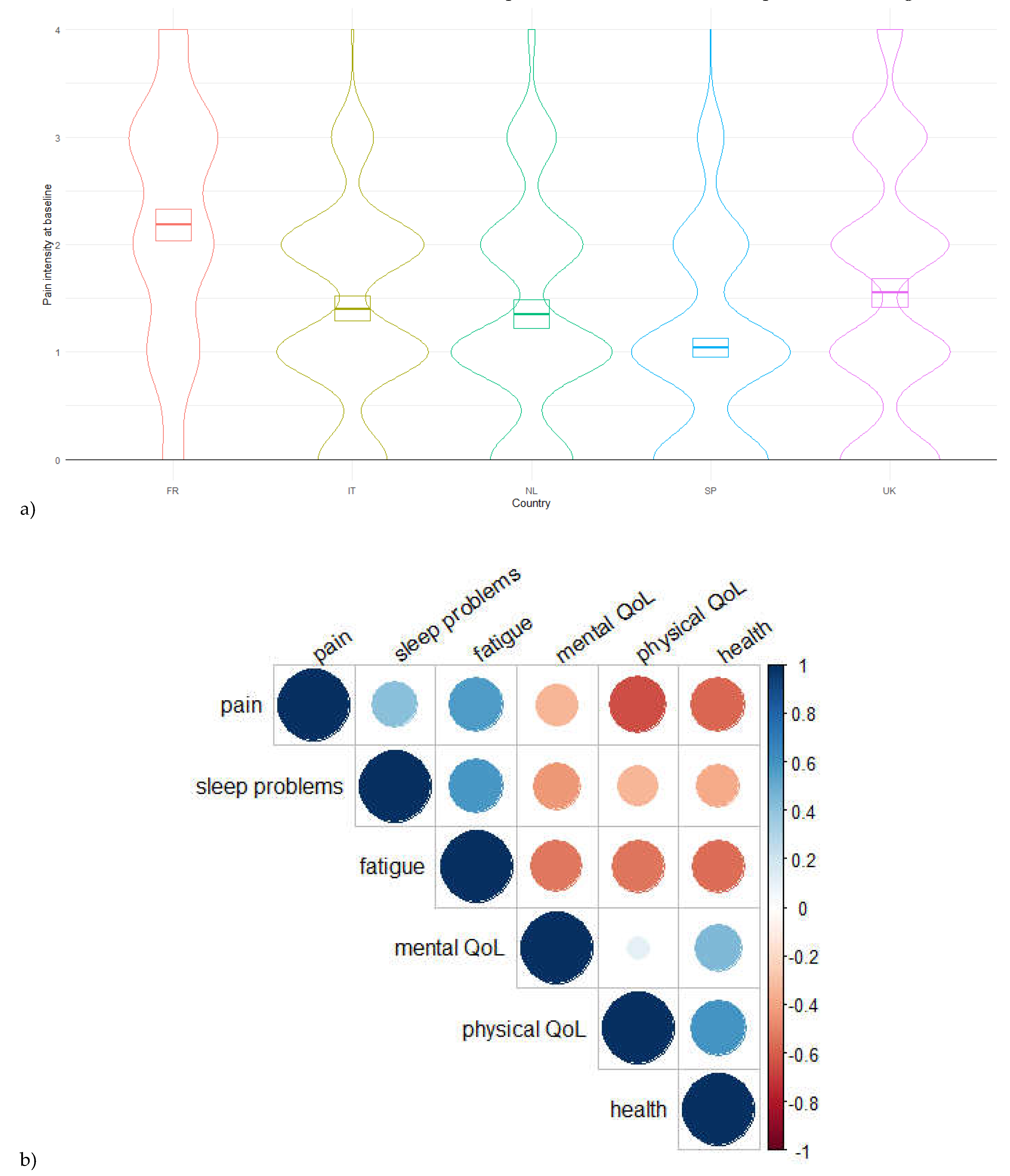
Figure 3.
Multivariable multinomial ordinal regression model, with pain intensity as the outcome. More pain on the right of the dashed line, less pain on the left of the dashed line. a) Model including all the variables that were significant in univariable models; b) Model including a restricted number of variables.
Figure 3.
Multivariable multinomial ordinal regression model, with pain intensity as the outcome. More pain on the right of the dashed line, less pain on the left of the dashed line. a) Model including all the variables that were significant in univariable models; b) Model including a restricted number of variables.
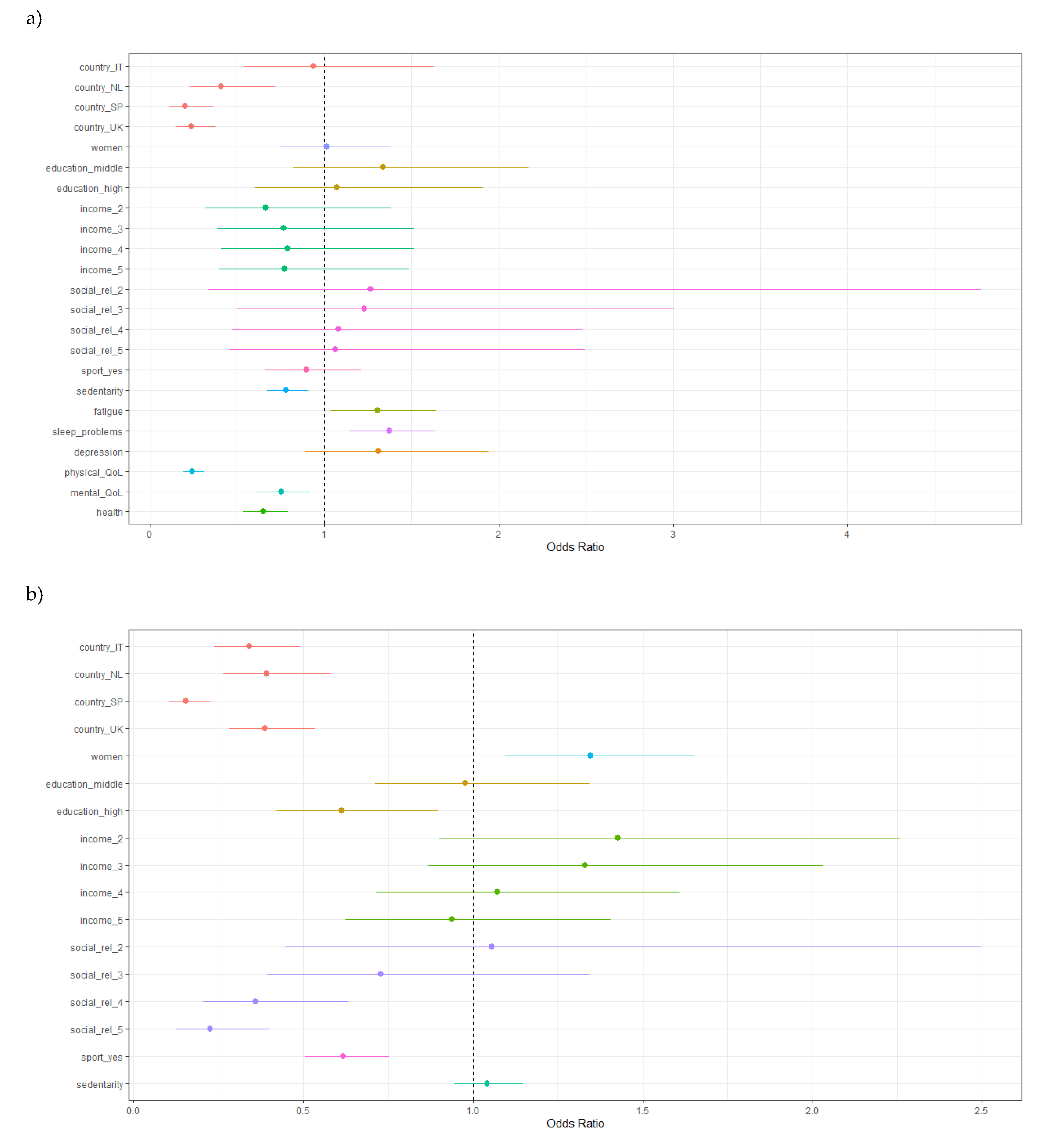

Table 1.
The instruments used in this study.
| Name of instrument and reference | Description | Simplified variable | Number of items |
|---|---|---|---|
| Chronic Disease Self-Efficacy (CDSE) [38] | ability to deal with fatigue, pain, emotional distress, health problems | 6 | |
| EQ-5D-5L [39] | mobility, self-care, activity, pain, anxiety | 5 | |
| Euro-Qol visual analogue scale (EQ VAS) [40]: experienced current health | 100-level visual analogue scale, where the endpoints are labelled ‘The best health you can imagine’ and ‘The worst health you can imagine’ | 1 | |
| Physical exercise (developed specifically for the CDSMP) | time spent weekly on various activities such as walking, swimming, cycling, and aerobics | dichotomous variable (0: score below the median, 1: score above) | 6 |
| International Physical Activity Questionnaire (IPAQ) [41] | sedentary behavior: week and week-ends’ numbers of hours sitting daily | standardised variable combining weeks and week-ends | 2 |
| Patient Health Questionnaire (PHQ-8) [42] | depression scale | dichotomous variable (0: PHQ-8 < 10, 1: PHQ-8 >=10) | 8 |
| Sleeping problems and fatigue (developed specifically for the CDSMP) | 10-level visual analog scales | 2 | |
| SF-12 [43] | health-related quality of life | 0-100 continuous scores: Mental Component Summary, Physical Component Summary | 12 |
| Gijon’s socio-familial evaluation scale [44,45]: income | 1) no income or less than minimum pension allowance, 2) minimum pension (social welfare or disability pension), 3) from the minimum pension to the minimum wage, 4) from the minimum wage to 1.5 times the minimum wage, 5) more than 1.5 times the minimum wage (income scales were adjusted to the local situation in each country) | 1 | |
| Gijon’s socio-familial evaluation scale [44,45]: social relationships | 1) doesn’t leave the house and doesn’t receive visits, 2) doesn’t leave the house but receives visits, 3) only relates to family or neighbours/friends, 4) relates to family and neighbours/friends, 5) has social relationships | 1 | |
| Productivity Costs Questionnaire (PCQ) [46]: work absenteeism | Have you missed work in the last 4 weeks as a result of being sick: yes I have missed X days / no | 1 |
Table 2.
The instruments used in this study.
 |
 |
Disclaimer/Publisher’s Note: The statements, opinions and data contained in all publications are solely those of the individual author(s) and contributor(s) and not of MDPI and/or the editor(s). MDPI and/or the editor(s) disclaim responsibility for any injury to people or property resulting from any ideas, methods, instructions or products referred to in the content. |
© 2023 by the authors. Licensee MDPI, Basel, Switzerland. This article is an open access article distributed under the terms and conditions of the Creative Commons Attribution (CC BY) license (http://creativecommons.org/licenses/by/4.0/).
Copyright: This open access article is published under a Creative Commons CC BY 4.0 license, which permit the free download, distribution, and reuse, provided that the author and preprint are cited in any reuse.


