

Submitted:
02 March 2023
Posted:
06 March 2023
You are already at the latest version
Abstract
The basis of this project is a health literacy cohort study (LISA) being developed in the county of Leiria. The study aims to reach and monitor the adult population of the county over time. Counting with a multidisciplinary team, the study stakeholders asked the designers to develop the study’s brand so it could be more advertisable to the population, turning the communication between the stakeholders and the public easier. The development of the brand identity and elements of communication used some graphic design approaches. These approaches were reinforced by the opinions given by the interviewed sample of the population, that answered some of the study’s questions. The interviews held by designers allowed the team to receive information about what was expected the study to be, and how and where to better communicate the LISA’s Study. Trough the aforementioned process resulted in the current finalized outcomes of the study’s brand and communication materials. Both printable and digital communication elements (i.e., roll-up, id cards, flyers, QR Code, and website) were developed and disseminated according to the brand's strategy. Concluding, the communication elements created are seen as the first phase of this project, leaving a second phase related to the design and structuration of the Study to be developed, and published in future articles.
Keywords:
Communication Processes
; Graphic Design
; Communication Design
; Cohort Study
; Branding.
1. Background
This project came to life as a complementing factor to a cohort study being developed in the county of Leiria. A cohort study is a type of observational study that proposes to observe and monitor a group of people over time (Hulley et al., 2007; Vandenbroucke et al., 2007), and according to the time of outcome occurrence can be prospective or retrospective. In a prospective cohort study, the researcher collects the information about an expected outcome from the present into the future, being able to define the population that is addressed and what information is gathered (Hulley et al., 2007). On the other hand, a retrospective cohort study can’t define the population or the outcomes, since the information was previously gathered and the follow-ups and outcome had already occurred (Hulley et al., 2007). Cohort Studies can also be defined according to the method used in follow-ups. If the members of the study’s population are the same, from the beginning to the end, the study is closed (Vandenbroucke et al., 2007). If during the follow-ups the population of the study adds new members, then the study is considered open (Vandenbroucke et al., 2007).
1.1. Lisa Cohort Study
In this particular case, the cohort study in development has a closed and prospective typology, meaning it will collect information throughout the duration of the study with a closed pool of participants. Intended to last ten years, the LISA Cohort Study aims to observe the health literacy level of the adult population of the county of Leiria and compare it to their life habits (Câmara Municipal de Leiria et al., 2021). The need for this observation and monitorization arose when institutions in Leiria, such as ACES Pinhal Litoral (headquarters of healthcare facilities in the region) and the city hall, found that a considerable number of people were using the emergency services with day-to-day issues, flooding essential services and causing delays.
To develop this study, a multidisciplinary team was assembled, composed of public health doctors from ACES Pinhal Litoral, researchers from ciTechCare - Center for Innovative Care and Health Technology -, employees from the Leiria City Hall, and designers from the XXX -, sponsored by XXX. This team of “stakeholders”- without the designers - is the validation point for every communication support.
One of the key factors in this study will be the use of interviewers since the chosen methodology for the cohort study was a door-to-door approach. This contact will be made through an interviewer script and a survey that measures health literacy, smoking habits, drinking habits, lifestyle choices, and basic and non-invasive health records (i.e., if the person has any medical condition or hereditary predisposition).
Another factor, worthy of mention, is that one of the biggest hurdles the conception of this study has is the ability to get a sample large enough to be representative of the Leira’s county population. Besides gathering this representative sample, its crucial to maintain it throughout all the follow-ups, occurring every two years.
1.2. The Project
By defining the study’s objectives, the stakeholders set the mold of what was expected of the multidisciplinary team and consequently of the designers. However, the path to finding the designer’s role in this type of study still had to be made, since there were some preconceived notions of what a designer could contribute to in the LISA’s study. For this, several team meetings were held to clarify this question. The resulting answer was the role of streamlining the study’s development using design methodologies and communication strategies.
To comply with these aforementioned roles the designers made use of multiple design methodologies. The development of the cohort study’s communication, spanning from the physical communication elements to the digital ones, is the role we will be focusing on.
2. Development Process
2.1. Interviews
One of the methodologies that assisted in the definition and decision of which communication elements to use was the interviews, made with a sample of the adult population resident in the county of Leiria and people with previous experience working in other cohort studies. These interviews allow the understanding of the interviewee’s experiences and the preconceptions they have according to those experiences (Seidman, 2006).
The interviewees with the population’s sample were divided based on different groups of age, gender, level of education, and place of residence (city, outskirts, rural), and selected by the stakeholders of the study. We interviewed eight people, (Table 1). The questions made ranged from demographics to which printable communication elements were more suitable, and where to use them to maximize their effect. With these interviews, we expected to understand what the preconceived notion of the population was on what a cohort study is, and then what their expectations were for the upcoming cohort study.
Regarding the interviews with the experts, the designer’s objective was to understand what has happened in previous studies of similar nature and what hurdles those teams had to cross. The interviewed cohort experts answered questions related to their experience, from the employed communication strategy to the data collection methodology.
2.2. Graphic Design
Graphic Design is “the business of making or choosing marks and arranging them on a surface to convey an idea” (Hollis, 1994). This type of communication allowed the designers to develop a brand identity and the LISA Cohort Study communication supports. Graphic design has two functions that can be applied in this project, the function of Inform and the function of persuasion (Barnard, 2005). Based on these, the design team tried to use the first function so that the information given to the population would bring new knowledge and would be perceptible, legible and reliable (Barnard, 2005). Concerning persuasion, this would be used to appeal to participation in the study and to change lifestyle habits (Barnard, 2005).
Brand Development
According to Ellis (2019) the design of a logo - or in this case, a brand - depends on the designer’s experience and approach. Since the LISA Study is a new brand, the design team used as procedure for the logo the following seven steps: 1) the definition of the name, 2) research the industry, 3) choice of colors and typeface, 4) draw sketches, 5) digital sketches, 6) feedback of stakeholders, 7) presentation.
The definition of the name was done with the multidisciplinary team. Some ideas were brought to the table during a meeting, and in the next one, the name “LISA - Estudo Longitudinal de Literecia em Saúde no Concelho de Leiria”, which translated means “Longitudinal Study of Health Literacy in the Leiria county”, was chosen.
The second step in the development of the brand was the collection of logos from similar studies and from the infrastructures and services of Leiria’s County. Then, and to create a more defined connection of the study to Leiria, the team searched for emblematic structures and incorporated their essence into the brand of the LISA study. The chosen structures were the floor pattern of the central square, the second was the ceiling of the cathedral of Leiria, and finally the third was the arches of the city’s castle (Figure 1). These structures were chosen for their representative potential in the region.
With the completion of these stages, three representative icons were obtained, and the logo was assembled with the chosen typeface, and the study’s signature. The signature was developed with the study’s multidisciplinary team, so that it could in a short sentence convey the purpose of the study.
2.3. Other Methodologies
There are other methodologies used in this project and, even though they are not this paper’s focus they should be mentioned so that the structure of the project and consequently of the cohort study can be better understood. During the aforementioned interviews, a map of the population was created through the employment of the user groups definition method. This method was used so that the team could understand the distribution of the population by age group, education, and geographic placement (i.e. city, outskirts, rural) (Kumar, 2013), the expectation was that by understanding this distribution the communication could be better targeted. Another method used, worthy of note, is the development of personas that will allow the creation of the personality model of the people that will perform the study (Ferreira et al., 2015; Miaskiewicz & Kozar, 2011). This is important because the interviewers will also be communication agents of the study, since they will be the ones working face to face with the population. Lastly, workshops on Service Blueprint were developed in order to foresee the need to use communication materials throughout the study and the necessity to create a communication strategy (Stickdorn et al., 2018). The strategy is envisioned to be created by the marketing team and its purpose is to understand the most likely places of contact between the population and the study.
3. Outcomes
Flowing with the progress of the study the following topic is about the current outcomes, they are the result of the decisions previously made regarding the communication strategy of our project. The main distinction of these outcomes is that some are digital, and others are printable, aside from that all the developed elements follow the developed LISA brand.
3.1. LISA Brand
The LISA’s identity brand, as previously described is a logo that join a symbol, the name of the study and its signature (Figure 2). The logo’s name uses the lowercase of Poppins typeface, in order to be legible and eye-catching, and that transmits the idea of being institutional and at the same time accessible to the population. By using the colours blue and yellow, the designers aim to reinforce this idea, since blue is associated with trust, information, and health, and yellow as a warm colour is associated with the relationship of proximity that the study intends to have with the population.
After the logo was completed, a pattern incorporating the icons, created previously, was developed (Figure 3). This was done to create a cohesion component throughout the several communications supports. Additionally, the pattern intends to allude to the traditional Portuguese tile work.
3.2. Printable Communication
The communication of the LISA Cohort Study used printable elements to interact with the population of the county of Leiria. These printable elements have the purpose of communicating with people from different backgrounds, not depending on their digital literacy or access to technology to get information about the Cohort Study.
Roll-Up (Figure 4) is an element that was displayed in the official presentation of the Cohort Study, in Leiria at “Aldeia da Saúde” (a fair where health projects are disseminated).
The ID Cards (Figure 5) were initially created as an obligatory element that the interviewers had to wear, using their picture, so the population can trust them. At the moment the ID Cards can be worn by interviewers, and by staff members of LISA. These last one’s don’t need a picture since they won’t interact with the population in their houses.
Flyers (Figure 6) were another element used in the fair, and they have the purpose of being spread through the county so people can have easy access to the study information.
3.3. Digital Communication
Besides using printable elements for communication, the team also created digital ones in order to reach more people. The connection between the printable and digital occurs when a QR Code (Figure 6) is used. This element is included in the Flyers and Roll-up, allowing people to access more information about the study digitally, besides the one shown in the printable elements. In this case, the QR Code is linked to the LISA website (Figure 7). The website is being developed so anyone that is interested in the Cohort Study can have access to the information from anywhere.
Visually the website has been created according to the developed brand, it contains all the written information available to the public and some graphs and tables not presented in the printable elements.
4. Final Considerations
Although we have physical and digital results of the communication elements, we do not have impact results at this time. These impact results will only be accessible after the questionnaire to the adult population of the county of Leiria has been carried out. At the end of the questionnaire, the study population will be asked about the format through which they learned about the study, whether digitally, through printouts, or if they did not know about the questionnaire a priori.
As mentioned before, some communication elements are being developed (i.e. website), and others are already developed (i.e. posters, t-shirts, participants cards, mupi, and stationary), but weren’t disseminated to the population yet.
In conclusion, the communication phase was crucial for the development of the Lisa Cohort Study and the project itself. The multidisciplinary team’s intention is to employ the design team to work and develop the communication of the Study. This started with the development of the entire graphic identity, going all the way to the aforementioned communication supports. In addition, the team also used other design methodologies to assist in structuring LISA, as if it was a service that is provided to the population. This second phase, although indirectly related to communication is not fully mentioned in this article, since it’s still under development.
Acknowledgments
The authors would like to acknowledge that the present article is part of two master’s thesis being developed to obtain a master’s degree in Design for Health and Well- being, conducted in the School of Arts and Design - Caldas da Rainha, Polytechnic of Leiria. These master’s thesis constitute an integral part of a Cohort Study taking place in the county of Leiria that involves CML, ciTechCare, ACES Pinhal Litoral, and LIDA.Also, the authors would like to acknowledge the assistance and financing from Fundação para a Ciência e a Tecnologia (FCT) (UIDB/05468/2020) and Laboratório de Investigação em Design e Artes (LIDA) that made the participation in the event possible.
References
- Barnard, M. (2005). Graphic Design as Communication. Routledge. https://scholarscompass.vcu.edu/etd/2117/.
- Câmara Municipal de Leiria, Politécnico de Leiria, Agrupamento de Centros de Saúde - Pinhal Litoral, & Centro Hospitalar de Leiria. (2021). Estratégia Municipal de Saúde do Município de Leiria.
- Ellis, M. (2019, August 6). Logo design process: a guide to professional logo development. 99 Designs. https://99designs.pt/blog/tips/logo-design-process-how-professionals-do-it/.
- Ferreira, B., Silva, W., Oliveira, E., & Conte, T. (2015). Designing Personas with Empathy Map. 27th International Conference on Software Engineering and Knowledge Engineering, 501–505. [CrossRef]
- Hollis, R. (1994). Graphic design: A concise History. Thames & Hudson.
- Hulley, S. B., Cummings, S. R., Browner, W. S., Grady, D. G., & Newman, T. B. (2007). Designing Clinical Research. In S. Seigafuse & N. Winter (Eds.), Retina (3rd ed., Vol. 10, Issue 4). Lippincott Williams & Wilkins. [CrossRef]
- Kumar, V. (2013). 101 Design Methods - A Structured Approach for Driving Innovation in Your Organization. John Wiley & Sons, Inc.
- Miaskiewicz, T., & Kozar, K. A. (2011). Personas and user-centered design: How can personas benefit product design processes? Design Studies, 32(5), 417–430. [CrossRef]
- Seidman, I. (2006). Interviewing as Qualitative Research: A Guide for Researchers in Education and the Social Sciences (3rd ed.). Teachers College Press.
- Stickdorn, M., Lawrence, A., Hormess, M., & Schneider, J. (2018). This is Service Design Doing: Applying Service Design Thinking in the Real World: a practicioner’s handbook (M. Treseler, A. Rufino, M. Yarbrough, & J. Kwityn (eds.); 4th ed.). O’Reilly Media, Inc.
- Vandenbroucke, J. P., von Elm, E., Altman, D. G., Gøtzsche, P. C., Mulrow, C. D., Pocock, S. J., Poole, C., Schlesselman, J. J., & Egger, M. (2007). Strengthening the Reporting of Observational Studies in Epidemiology (STROBE): Explanation and Elaboration. PLoS Medicine, 4(10), 1628–1654. [CrossRef]
Figure 1.
Symbols resulted from the chosen emblematic structures.

Figure 2.
LISA logo representation with symbol and signature.
Figure 3.
LISA’s background pattern.
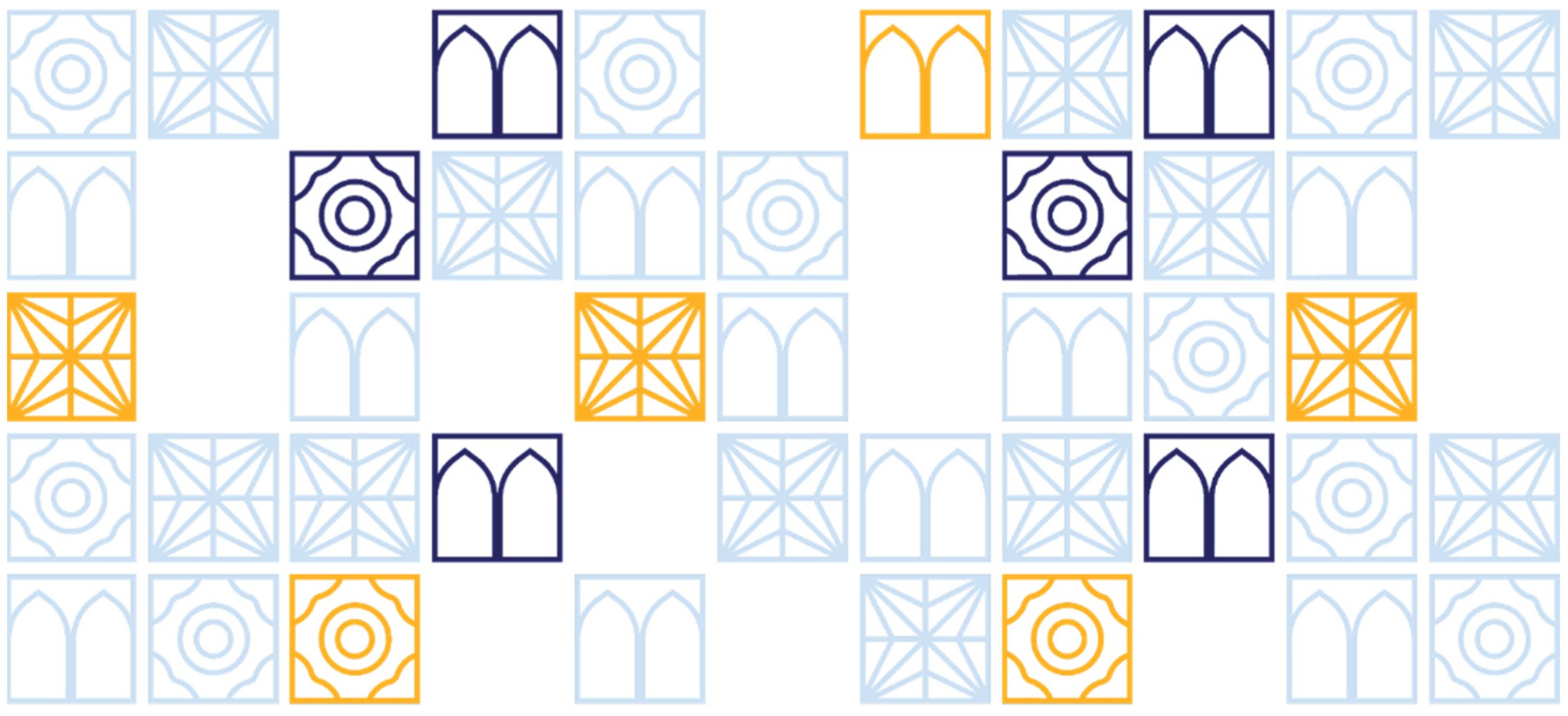
Figure 4.
Roll-up of LISA Cohort Study to be displayed on the “Aldeia da Saúde”.

Figure 5.
ID Cards for interviewers and for staff of the LISA Cohort Study.
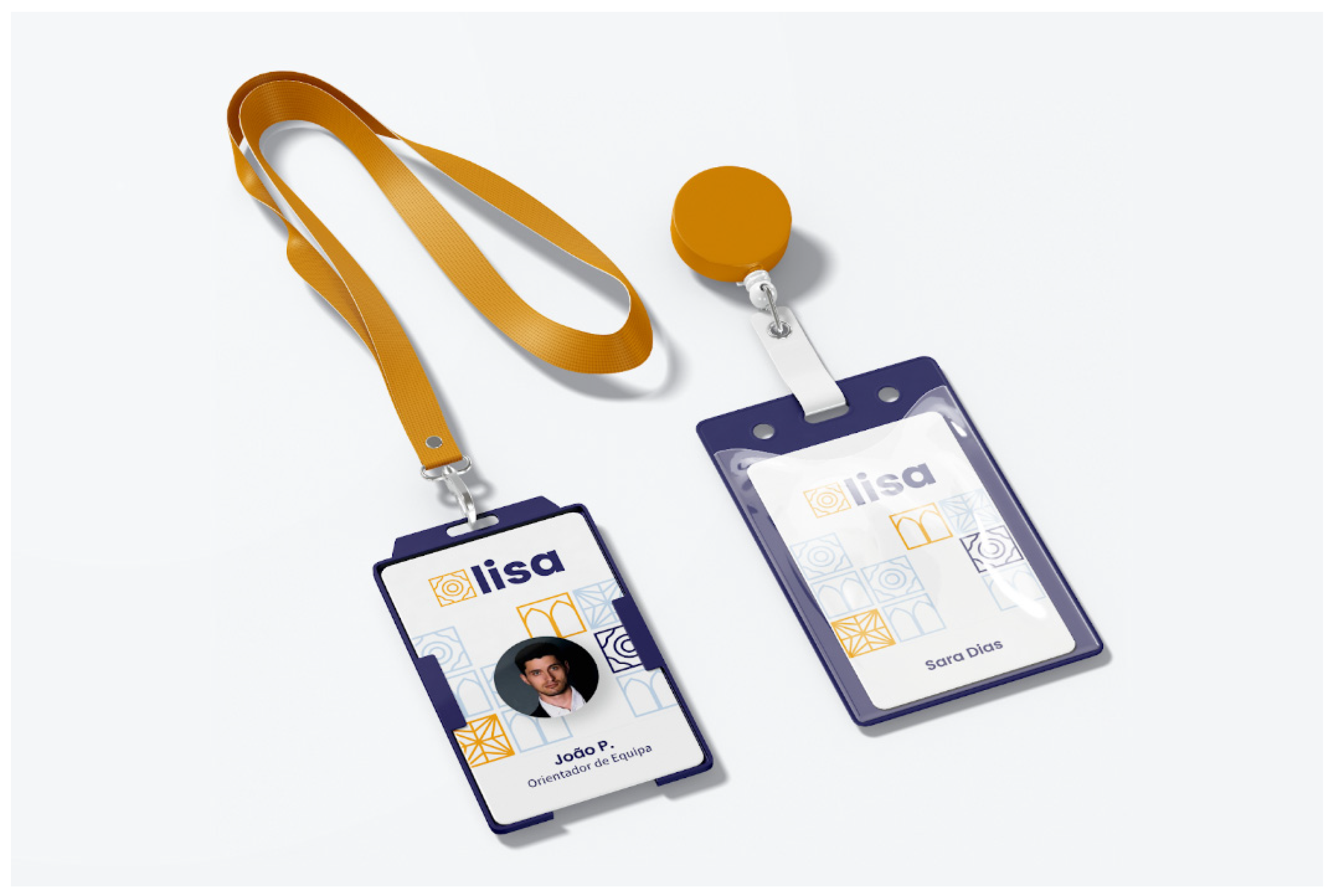
Figure 6.
Flyer of the LISA Cohort Study.
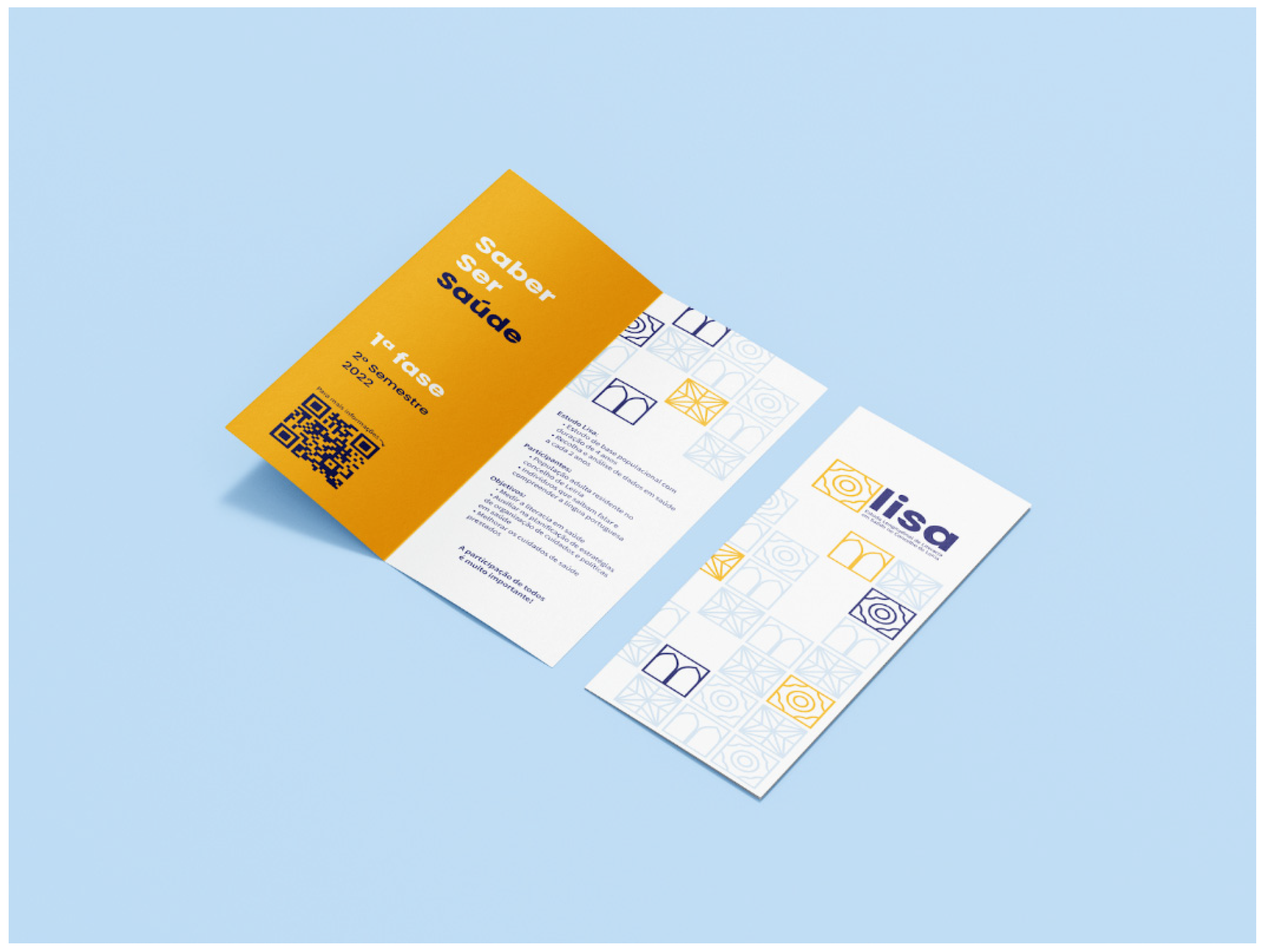
Figure 7.
LISA’s Website prototype: landing page.
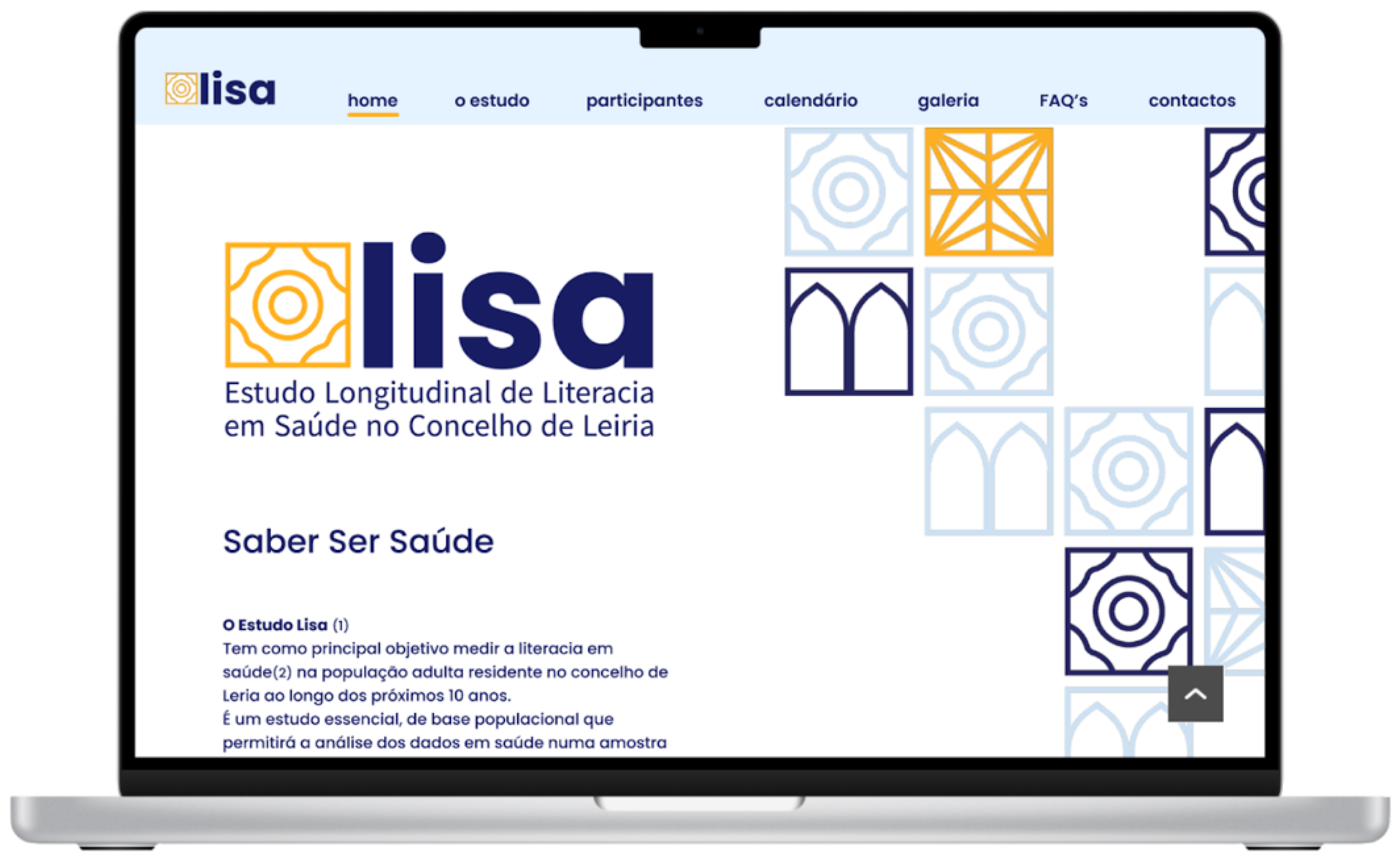

Table 1.
Interviewed members of the Population’s Sample.
| Gender | Age(years) | Geographic Placement | Education level |
|---|---|---|---|
| Female | 24 | City | Master’s Degree |
| Female | 62 | Village | 6th grade |
| Female | 43 | Outskirts | 12th grade |
| Female | 55 | City | 12th grade |
| Female | 78 | Village | 4th grade |
| Male | 24 | Outskirts | TESP (Professional Higher Technical Course) |
| Male | 22 | Village | Bachelor’s Degree |
| Male | 41 | City | PhD |
Disclaimer/Publisher’s Note: The statements, opinions and data contained in all publications are solely those of the individual author(s) and contributor(s) and not of MDPI and/or the editor(s). MDPI and/or the editor(s) disclaim responsibility for any injury to people or property resulting from any ideas, methods, instructions or products referred to in the content. |
© 2023 by the authors. Licensee MDPI, Basel, Switzerland. This article is an open access article distributed under the terms and conditions of the Creative Commons Attribution (CC BY) license (https://creativecommons.org/licenses/by/4.0/).
Copyright: This open access article is published under a Creative Commons CC BY 4.0 license, which permit the free download, distribution, and reuse, provided that the author and preprint are cited in any reuse.