

Submitted:
08 February 2023
Posted:
13 February 2023
You are already at the latest version
Abstract
There are few published studies assessing dental students' and faculty's perception regarding environmental sustainability in dentistry (ESD), its existence within the dental curricula, along with barriers and enablers for its integration. As far as the authors know, no published study looked into this in Saudi Arabia, and this is what the current study aims to explore. A cross-sectional survey using validated online questionnaires for dental students and faculty was carried out in 26 dental schools in Saudi Arabia. The validated questionnaire utilized 25 questions using Qualtrics (XM) software. Both descriptive statistics and thematic analysis were included in the data analysis. ESD content is not formally embedded within the dental curricula in all 26 included universities in Saudi Arabia. Although the majority of students and faculty members agreed or strongly agreed on the importance of ESD as a whole and the importance of teaching it, more than 82% and 81% of students and faculty, respectively, demonstrated a lack of basic knowledge concerning ESD. There is a high demand for incorporating ESD content in dental education in Saudi Arabia. To achieve this, resources and policy changes are necessary. A top-down approach is needed, including incorporating ESD into dental education standards, using evidence-based practices in revising infection control regulations and providing institutional support through training, materials, and incentives. National dental associations and governments should provide practical solutions and actively support dental professionals in implementing ESD.
Keywords:
sustainable dentistry
; environment
; sustainable development goals
; education
1. Introduction
Climate change and environmental pollution are considered the greatest health threats affecting the planet, humanity, and biodiversity [1]. Healthcare sectors negatively impact the environment through various aspects such as travel, waste, energy and procurements, with the oral health sector being a great contributor [2,3,4]. In the United Kingdom, the healthcare sector accounts for 5% of the total carbon emission produced in the country [5]. In the United States, the healthcare sector produces 10% of the total carbon emissions [6]. Although the focus on oral healthcare delivery has always been aimed toward providing optimal care to patients, the environmental impact of the profession has been marginalised. The dental profession significantly contributed to the healthcare sector’s carbon footprint [7]. Changing how dentistry is delivered has the potential to significantly contribute to the reduction of the environmental footprint, improve the quality of life of individuals, and the quality of healthcare delivered, and help reach a circular economy throughout the entire healthcare sector [8].
The United Nations Agenda for Sustainable Development 2030 recognised that there is “an urgent call for action through all healthcare sectors” [9]. This was followed by ambitious goals and plans set by numerous countries around the globe, for example, those which followed the Paris Agreement in 2016 [10]. In April 2016, the Saudi Vision 2030 was first announced by Crown Prince Mohammed Bin Salman [11]. Various environmentally sustainable initiatives in healthcare have been actioned in the Kingdom of Saudi Arabia (KSA), such as the National Healthcare Sector Digital Transformation [12], with leading actions such as the establishment of the first Virtual Hospital (SEHA Virtual Hospital) [13].
Collectively, there is a call for dentistry as a profession to incorporate and integrate sustainable development goals in pursuit of healthy lives and well-being for all. To practice sustainable healthcare, healthcare professionals must become abreast with environmentally sustainable dentistry (ESD) concepts early on during their training. During the Association for Dental Education in Europe (ADEE) workshop in Berlin in 2019, a lack of teaching materials for instructors related to ESD was noted. Following the ADEE conference proceedings, there has been a growing interest in environmental sustainability in dental education [14].
Indeed, dental schools in the KSA have yet to develop ESD curricula. The Commission on Dental Accreditation (CODA) are yet to specify requirements for ESD in the dental training curricula. Although healthcare sustainability is of paramount importance within the Saudi Vision 2030, the authors are not aware of any ESD materials being taught in the dental school’s curricula in the Kingdom. To our knowledge, no national study has been conducted in Saudi Arabia to explore current knowledge and drivers among dental students and faculty regarding ESD. Thus, this study aims to determine the presence of ESD in the dental curricula of all dental schools around the Kingdom, explore the perception of dental students and faculty members regarding ESD and identify possible barriers and enablers to its integration.
2. Materials and Methods
A cross-sectional survey using validated online questionnaires for dental students and faculty was carried out in 26 dental schools in Saudi Arabia. The questionnaire was adopted from a previous study, which was conducted at Queen Mary University London and Harvard School of Dental Medicine, surveying both dental undergraduate students and faculty members [15]. The validated questionnaire utilized 25 questions including (Demographics, perception of dental undergraduate students and faculty on environmental sustainability and additional comment and feedback) using Qualtrics (XM) software. Inclusion criteria were undergraduate dental students and faculty belonging to one of the 26 universities who agreed to participate. Questionnaires were distributed from April 7th, 2022, till October 18th, 2022. Invitations to participate were sent by email to undergraduate dental students and faculty members in the dental departments of all the universities and colleges. Ethical approval was obtained from Biomedical Research Ethics Committee at Umm Al-Qura University (IRB HAPO-02-K-012). Consent was obtained from all participants and individual responses were anonymous, and any personal information was kept confidential. Both descriptive statistics and thematic analysis were included in the data analysis.
Only responses that have completed and submitted the survey were analysed. In questions where more than one response is applicable the response number was not reported as it will not be representative of the overall respondents' number.
The following attempts were utilized to enhance the response rate: the respondents were informed about the purpose of the research and how their feedback will be used. The respondents were informed about the duration to complete the survey. A progress bar was used. Reminders were used at different intervals. The survey was optimized for all devices – desktop PCs, laptops, tablets and mobile phones.
3. Results
All 26 dental schools and colleges in Saudi Arabia are presented in Table 1.
The total number of included responses of participants who have completed and submitted the survey was 579 (353 students and 226 faculty members). 343 participants were excluded due to incomplete or missing information.
Regarding demographics, the academic positions of faculty members were 15 demonstrators (6.75%), 47 lecturers (20.91%), 116 assistant professors (50.56%), 31 associate professors (13.83%) and 17 professors (7.64%). As for students’ academic year, the highest number of responses were from students in their 6th and final year (35.69%), followed by 5th year (18.41%), 3rd year (11.33%), 2nd year (10.20%) and the least number of responses were from 1st-year students (6.80%). Regarding age, the majority of students were less than 25 years old (80.17%), followed by 25-34 (18.98%), 35-44 (0.57%) and 45-54 (0.28%). Among faculty, the majority of participants were between 35-44 years old (43.36%), followed by 25-34 (29.20%), 45-54 (17.70%), 55-64 (5.31%), less than 25 (3.10%) and 1.33% were members more than 65 years of age. For gender, female students were slightly more than males with 54.67% and 42.78% respectively, with 2.55% preferred not to disclose their age. However, for faculty, more responses were from males (60.62%), than from females (37.17%) and 2.21% of respondents preferred not to say.
Concerning familiarity with ESD content, the majority of students were ‘unfamiliar’ to ‘somewhat familiar’, while faculty members, on the other hand, were ‘unfamiliar’ to ‘moderately familiar’ with ESD content (Table 2). The vast majority of students and faculty members thought that the dental profession as a whole has a responsibility to become environmentally sustainable. Moreover, the overwhelming majority of both students (87.17%) and faculty members (83.29%) ‘agreed’ or ‘strongly agree’ on the importance of ESD as a whole, along with the importance of teaching it (82.3%) and (81%) respectively (Table 2).
Regarding ESD policies, protocols or initiatives, the majority of students and faculty members demonstrated a lack of awareness (Figure 1). Nonetheless, few students and faculty members shared comments on some policies and protocols embedded within their institutions such as that on travel, equipment, energy, waste and biodiversity. Regarding travel, few schools provide electric scooters and bicycles for students and faculty to commute around the campus, few students however mentioned that it is provided in a limited number. Furthermore, others stated that their university encourages the utilisation of public transport. As for equipment, the main theme revolved around utilising reusable items in particular stainless steel impression trays. More comments on the energy aspect were mentioned by students and faculty such as turning off lights after lectures and clinical sessions (dental chair units) using motion sensor light switches. As for waste management, a few comments stated that recycling bins are placed in all campus buildings, however, few stated that they are not used as intended. One student commented that they have the policy to recycle typodont teeth (artificial teeth) after using them. Additionally, others mentioned that computer-based exams are utilised instead of paper-based ones. Concerning biodiversity, a few students and faculty members stated that they do have green spaces as communal areas within the campus.
The overwhelming majority of students agreed on the relevance of ESD content for future dental practice and were interested in learning it (Table 3). Moreover, more than 81% of all faculty members expressed interest in introducing ESD content into the dental curriculum (Table 3).
Although few students and faculty members responded ‘yes’ in being aware of ESD content included in their dental curriculum, the majority were not aware of a designated person or a department responsible for teaching it (Table 4). Only a few students mentioned that dental public health departments are responsible for delivering indirect content concerning environmental sustainability, nonetheless, it is not integrated into the curriculum. As for the topics covered, the majority of students and faculty were not aware of any specific ESD topics covered in their curriculum.
The majority of faculty members thought that the main barrier to embedding ESD content into the curriculum was a lack of knowledge about ESD content, followed by a lack of curriculum space, and a lack of educational material resources for ESD content (Figure 2). Few faculty members considered the lack of time in preparing ESD content as a barrier to embedding them. One faculty member stated that integrating a stand-alone subject into the curriculum will be difficult due to the existing policies and the required number of credits by the school.
The most noted enabler in embedding ESD content by faculty members was training courses for teaching ESD content, followed by examples of learning outcomes and time given to teaching staff to prepare ESD content (Figure 3). Some faculty members stated that integrating ESD contents into existing modules such as within infection control will facilitate the integration process.
The majority of both students (51.27%) and faculty members (72.12%) emphasised the need to teach ESD in both classrooms and clinical settings. One faculty member suggested that experimental learning “teach by example” would be an effective teaching opportunity for ESD content.
4. Discussion
ESD content is not formally embedded within the dental curricula in all 26 included universities and dental colleges in Saudi Arabia. Although more than 87% of students and 83% of faculty members agreed or strongly agreed on the importance of ESD as a whole and the importance of teaching it, more than 82% and 81% of students and faculty, respectively, demonstrated a lack of basic knowledge concerning ESD.
The findings were consistent with previously published studies in the literature who has explored this topic [15,16]. Gershberg et al. conducted a cross-sectional study including 378 dental students from 17 dental schools in the United States [16]. Despite the low response rate (5%), they found that although the majority of students thought that ESD is important, the majority of them were ‘slightly’ to ‘not at all’ knowledgeable about it. Meanwhile, similar results were demonstrated by another cross-sectional study assessing ESD content knowledge, enablers and barriers in both UK and US dental curricula [15]. In this study, the questionnaires were directed towards dental students and educators at both Queen Mary University in London (QMUL) and Harvard School of Dental Medicine (HSDM). Similar to the current study, they have found that ESD content was not formally integrated within the school’s curricula and despite the interest of both students and educators for ESD content to be taught and embedded within the curricula, the majority demonstrated poor knowledge of the topic.
The barriers and enablers regarding ESD content, expressed by faculty members in the current study, were also consistent with the previous work done by Joury et al [15]. Identified enablers were the need for resources such as educational materials, training courses and examples of learning outcomes and objectives. Barriers, on the other hand, were mainly focused on the lack of knowledge, curricula space, education materials and time.
Dental undergraduate students are mainly focused on the clinical aspect of the profession, and they lack the knowledge concerned with providing evidence-based information supporting and revolving around the environmental impact. This might be a consequence of reports such as that of the WHO-UNEP, report on The Future Use of Materials for Dental Restoration [17]. The report highlighted that it is not a requirement for dental undergraduate students to be taught environmental and occupational health-related topics, subsequently, graduating dental professionals are not equipped with the proper knowledge to conduct, implement or engage in research or practices related to environmental sustainability.
Currently, there is a compounding acknowledgement across various sectors (stakeholders and supply chains) concerning the need for sustainable educational programmes. Universities, colleges, dental societies and associations have both the responsibility and the opportunities to embed sustainable practices into their pedagogical curricula. Ongoing, rapidly evolving developments are being investigated to integrate sustainability within dental curricula in a broader context. Recently, the World Dental Federation (FDI) launched a Joint Stakeholder Statement for Consensus on Environmentally Sustainable Oral Healthcare. Through this, the consensus statement stressed the significance of involving all stakeholders in the interests of sustainability and advocated that dentistry as a profession should integrate Sustainable Development Goals (SDGs) into daily practice and support a move to a circular economy [18]. For these goals to be achieved, ESD must be integrated formally into the curricula for Oral Health Providers (OHPs).
Key aspects regarding the inclusion of ESD in an undergraduate dental curriculum were addressed in this Consensus Statement, which includes that:
- Sustainability and prevention should be integrated into paid-for healthcare systems.
- Disease prevention should be promoted as a continuous strand in education and professional development.
- Sustainability should be a key aspect of running dental practices.
- Sustainable and effective use of materials and alternatives should be emphasized.
- Education for smart procurement, including bulk buying and making informed choices, is essential.
- Policymakers should be educated on appropriate governance and legislation.
- Patient education should include information on personal choices that may have a detrimental impact.
- Promoting sustainable travel, such as public transportation or bike storage, is advisable.
During the annual meeting of the Association for Dental Education in Europe (ADEE) in 2019, a Special Interest Group (SIG) published a consensus view shedding light on how essential is ESD in dental education and that awareness should be raised concerning the need for educator’s support in developing ESD curricula [14]. Following the recent annual ADEE meeting of the SIG, in 2021, a consensus article was published [19], reporting the European consensus on suggested learning outcomes for ESD concerning the Graduating European Dentist (GED) curricula, providing recommendations for teaching ESD within existing Oral Health Professional (OHP) programmes including methods of teaching and assessment.
Following were the key outcomes of the ADEE SIG consensus meeting [19], which suggested that:
- There are challenges to incorporating ESD into OHP education due to the already overloaded curriculum.
- A student-centred approach with resources and materials would be practical to help students and educators develop a basic understanding of ESD.
- ESD should be integrated longitudinally into the OHP program, both vertically (across clinical and basic science stages) and horizontally (across subjects in a given year and program).
- The following teaching methods can be utilised, including Case-based learning (CBL), Simulation-based learning (SBL), Reflective writing (RW), Collaborative learning (CL), and Problem-based learning (PBL).
- Curriculum leads should regularly review content and practice to ensure relevance.
- It is essential to involve students in all processes of ESD incorporation into the curriculum.
It is widely recognized that dental professionals rely on national associations and government regulations for guidance on changes in behaviour. Therefore, it is important for national dental associations and governments to provide oral healthcare professionals with achievable and practical solutions and to actively engage, evaluate, and support them.
The current study targeted all dental schools in Saudi Arabia to obtain a representative sample of ESD. However, the response rate varied between the schools. Also, potential biases that might emerge from no-response cannot be excluded, although attempts were made to reduce them. In addition, relating ESD awareness, opinion or interest to a specific factor was beyond the scope of the current study.
5. Conclusions
Environmental sustainability is not currently included in the dental curricula at any of the 26 universities and colleges in the Kingdom of Saudi Arabia. However, there is a strong desire among students and educators to incorporate ESD into the curricula. Factors that would facilitate this include providing resources and implementing policy changes. A top-down approach, including incorporating ESD into dental education standards, using evidence-based practices in revising infection control regulations, and institutional support through training, materials, and incentives, are needed to effectively integrate ESD into dental curricula in Saudi Arabia. It is widely recognized that dental professionals rely on national associations and government regulations for guidance on changes in behaviour. Therefore, it is important for national dental associations and governments to provide oral healthcare professionals with achievable and practical solutions and to actively engage and support them.
Author Contributions
The conceptualization of the study was initiated by the main author, H.J.; the methodology H.J., A.M.; formal analysis H.J.; investigation, H.J.; resources, H.J.; data curation, H.J.; writing—original draft preparation, H.J.; writing—review and editing, H.J., A.M., M.A., A.S., B.G., G.B.; visualization, H.J.; supervision, H.J.; project administration, H.J. All authors have read and agreed to the published version of the manuscript.
Funding
This research received no external funding.
Institutional Review Board Statement
Ethical approval was obtained from Biomedical Research Ethics Committee at Umm Al-Qura University (IRB HAPO-02-K-012).
Informed Consent Statement
Not applicable.
Data Availability Statement
Not applicable.
Acknowledgments
The authors express their gratitude to all students and educators who participated in the survey and facilitated the process at all institutions. Additionally, the authors thank the administrative staff who supported circulating invitations and reminder emails.
Conflicts of Interest
The authors declare no conflict of interest.
References
- McLennan, M. The Global Risks Report 2021 16th Edition.
- Watts, N.; et al. The 2019 report of The Lancet Countdown on health and climate change: ensuring that the health of a child born today is not defined by a changing climate. The Lancet 2019, 394(10211), 1836–1878. [Google Scholar] [CrossRef] [PubMed]
- Karliner, J.; et al. Health care’s climate footprint: the health sector contribution and opportunities for action. European Journal of Public Health 2020, 30 (Supplement_5), ckaa165. 843. [Google Scholar] [CrossRef]
- Wilson, G.J.; Shah, S.; Pugh, H. What impact is dentistry having on the environment and how can dentistry lead the way? Faculty Dental Journal 2020, 11(3), 110–113. [Google Scholar] [CrossRef]
- Torjesen, I. NHS aims to become world’s first “net zero” health service by 2040. 2020, British Medical Journal Publishing Group.
- Eckelman, M.J.; Sherman, J. Environmental impacts of the US health care system and effects on public health. PloS one 2016, 11(6), e0157014. [Google Scholar] [CrossRef] [PubMed]
- England, P.H. Carbon modelling within dentistry: Towards a sustainable future. 2018. [Google Scholar]
- Duane, B.; et al. An estimated carbon footprint of NHS primary dental care within England. How can dentistry be more environmentally sustainable? British Dental Journal 2017, 223(8), 589–593. [Google Scholar] [CrossRef] [PubMed]
- Nino, F.S. Sustainable Development Goals—United Nations. United Nations Sustainable Development, 2015. 2.
- Agreement, P. Unfccc. Adoption of the Paris Agreement, fccc/cp/2015/L, 2015. 9.
- Rashad, M. Saudis await prince's vision of future with hope and concern. Reuters. com (24 April 2016). 2016. Available online: http://www. reuters. com/article/us-saudi-plan-idUSKCN0XL0B2 (accessed on 3 May 2019).
- Vision2030, H.S.T.P. Health Sector Transformation Program.
- Health, S.V.H.-M.o. Seha Virtual Hospital - Ministry of Health. 2022. [Google Scholar]
- Duane, B.; et al. Embedding environmental sustainability within the modern dental curriculum—Exploring current practice and developing a shared understanding. European Journal of Dental Education 2021, 25(3), 541–549. [Google Scholar] [CrossRef] [PubMed]
- Joury, E.; et al. Exploring environmental sustainability in UK and US dental curricula and related barriers and enablers: a cross-sectional survey in two dental schools. British Dental Journal 2021, 230(9), 605–610. [Google Scholar] [CrossRef] [PubMed]
- Gershberg, N.C.; et al. US students’ perceptions on environmental sustainability in dental school. Journal of Dental Education 2022, 86(4), 482–488. [Google Scholar] [CrossRef] [PubMed]
- Petersen, P.E.; et al. Future use of materials for dental restoration: Report of the meeting convened at WHO HQ, Geneva, Switzerland 16th to 17th November 2009. 20 November 2010. [Google Scholar]
- Shellard, I.J.; et al. Consensus on Environmentally Sustainable Oral Healthcare: A Joint Stakeholder Statement. White Rose University Press, 2022. [Google Scholar]
- Field, J.; et al. Embedding environmental sustainability within oral health professional curricula—Recommendations for teaching and assessment of learning outcomes. European Journal of Dental Education 2022. [Google Scholar] [CrossRef] [PubMed]
Figure 1.
Awareness of existing policies, protocols, initiatives or events concerning environmentally sustainable dentistry (ESD).
Figure 1.
Awareness of existing policies, protocols, initiatives or events concerning environmentally sustainable dentistry (ESD).
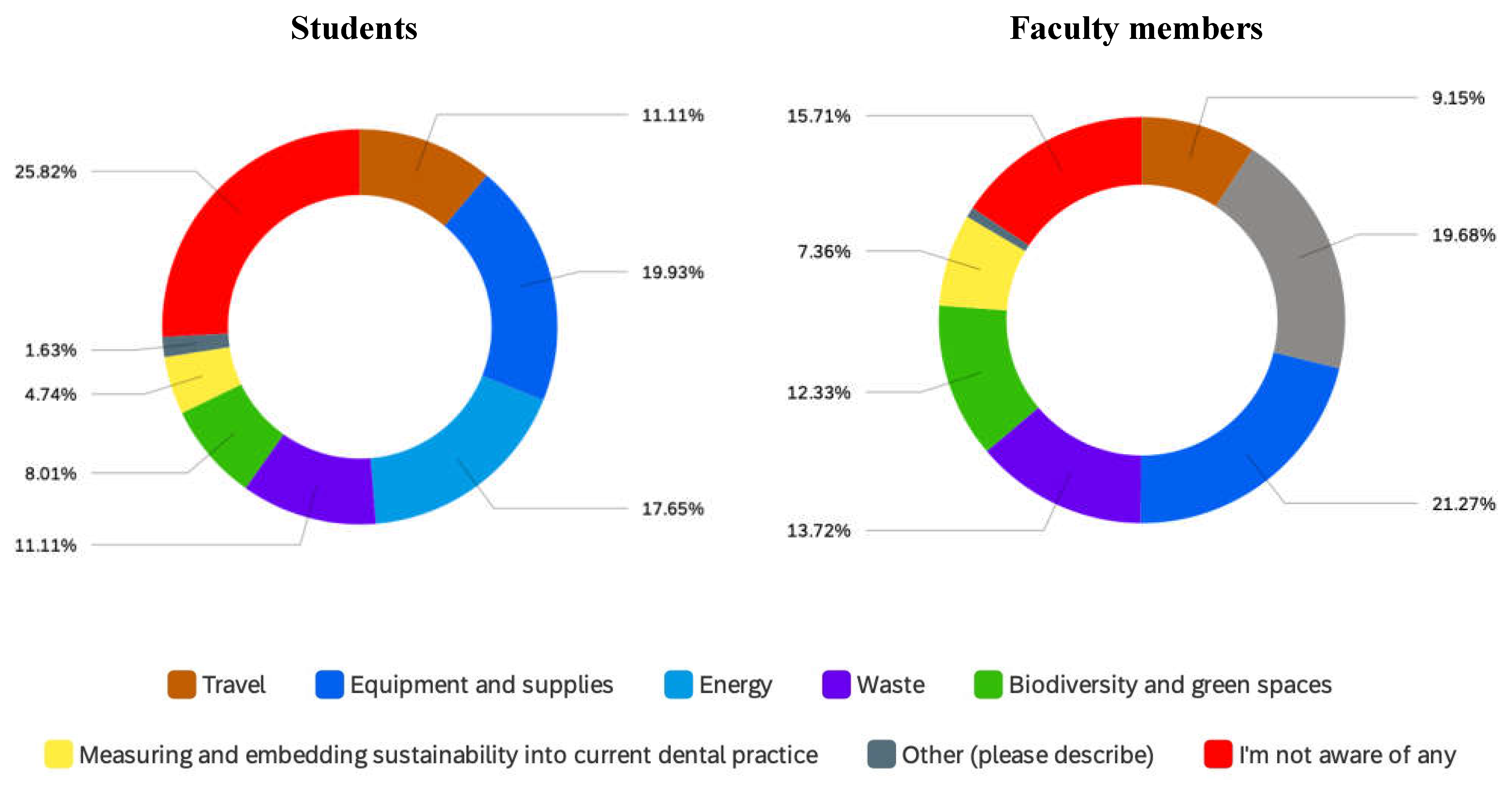
Figure 2.
Faculty’s barriers to embedding environmentally sustainable dentistry (ESD) in the dental curricula.
Figure 2.
Faculty’s barriers to embedding environmentally sustainable dentistry (ESD) in the dental curricula.
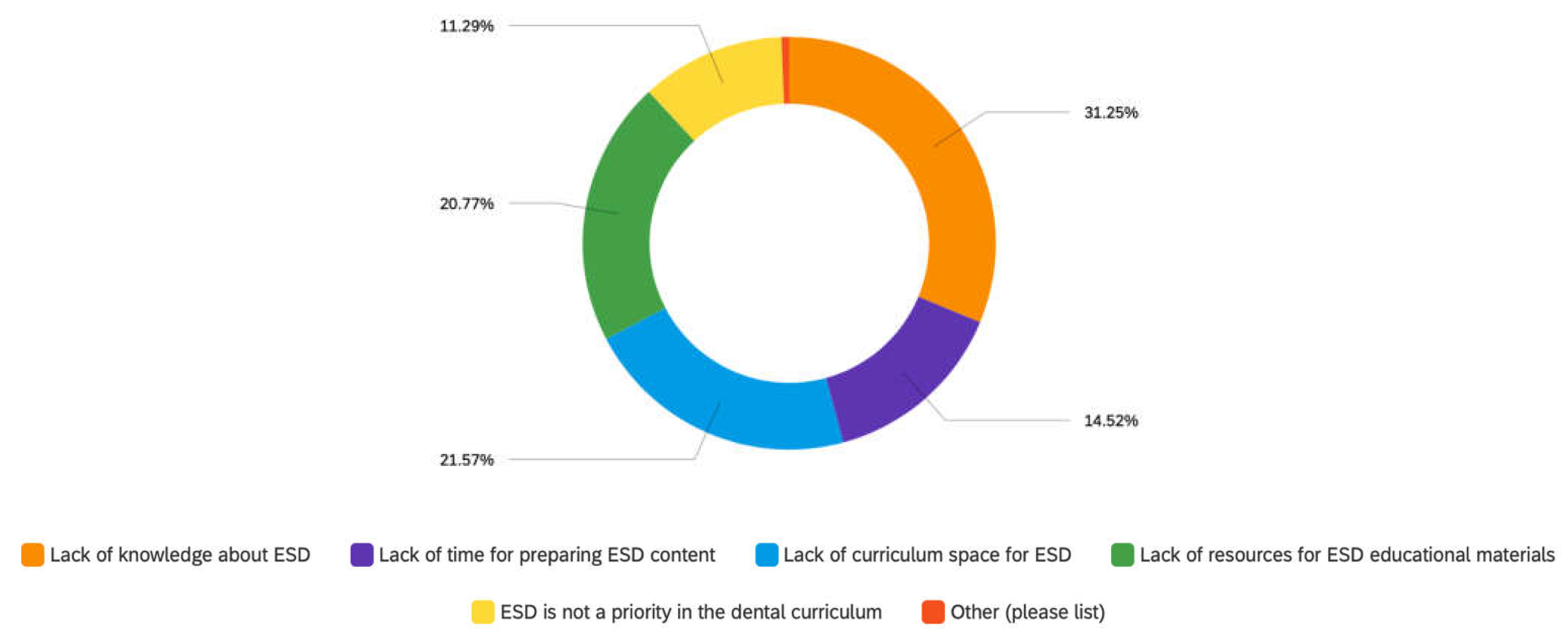
Figure 3.
Faculty’s enablers to embedding environmentally sustainable dentistry (ESD) in the dental curricula.
Figure 3.
Faculty’s enablers to embedding environmentally sustainable dentistry (ESD) in the dental curricula.
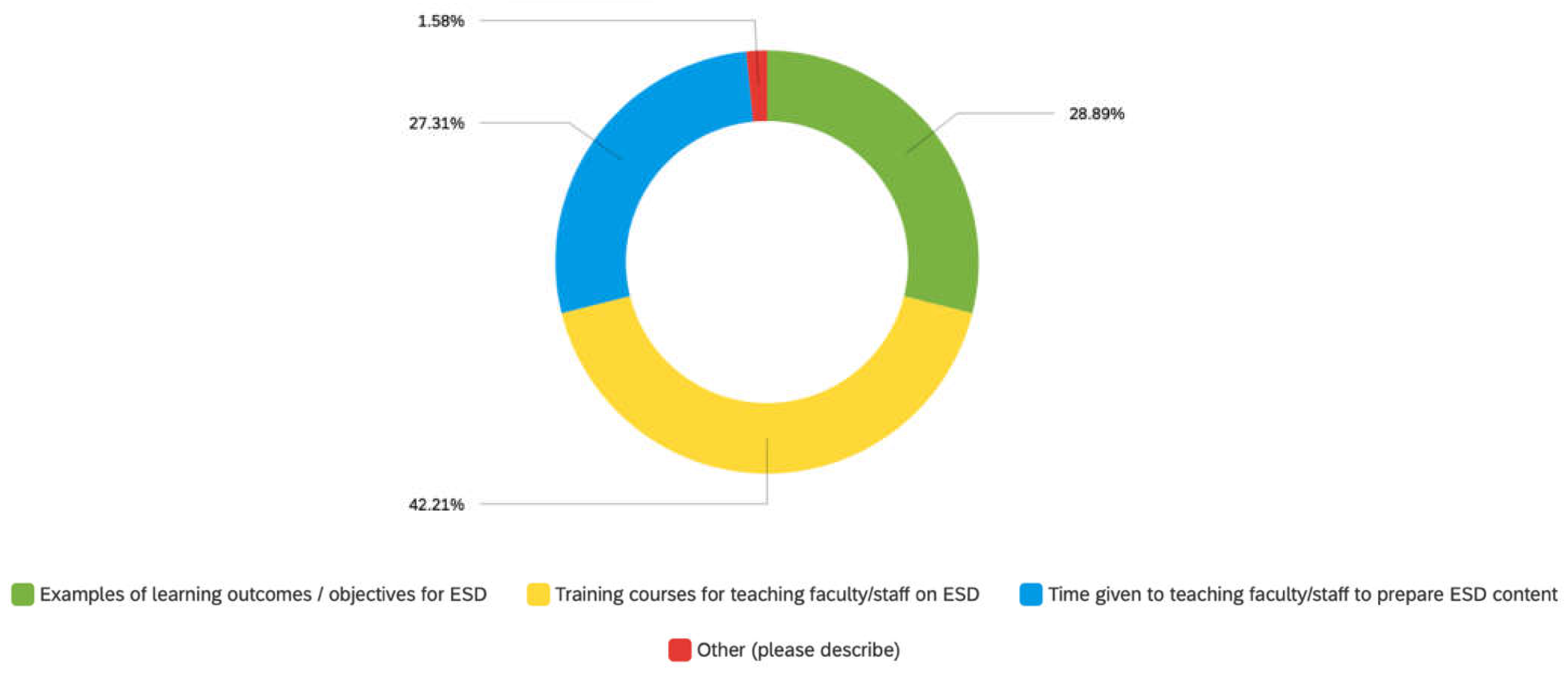

Table 1.
The dental school included in the survey.
| Table 1. Dental schools included in the survey (n=26) |
|---|
|
Table 2.
Students’ and faculty's familiarity with environmentally sustainable dentistry (ESD) and their opinions about the importance and professional responsibilities towards ESD.
Table 2.
Students’ and faculty's familiarity with environmentally sustainable dentistry (ESD) and their opinions about the importance and professional responsibilities towards ESD.
| Table 2 Students’ and facultys’ familiarity with ESD and their opinions about the importance and professional responsibility for ESD | ||
|---|---|---|
| Component | Overall | |
| Students N (%) | Faculty N (%) | |
| Familiarity with ESD | ||
| Not at all | 57 (25.22) | 88 (24.93) |
| Slightly | 38 (16.81) | 64 (18.13) |
| Somewhat | 57 (25.22) | 80 (22.66) |
| Moderately | 53 (23.45) | 88 (24.93) |
| Extremely | 21 (9.29) | 33 (9.35) |
| Profession’s responsibility for ESD | ||
| Strongly agree | 115 (50.88) | 122 (35.56) |
| Agree | 73 (32.30) | 161 (45.61) |
| Neither agree nor disagree | 31 (13.72) | 60 (17) |
| Disagree | 4 (1.77) | 7 (1.98) |
| Strongly disagree | 3 (1.33) | 3 (0.85) |
| ESD is important | ||
| Strongly agree | 144 (50.44) | 136 (38.53) |
| Agree | 83 (36.73) | 158 (44.76) |
| Neither agree nor disagree | 26 (11.50) | 55 (15.58) |
| Disagree | 1 (0.44) | 3 (0.85) |
| Strongly disagree | 2 (0.88) | 1 (0.28) |
| ESD teaching is important | ||
| Strongly agree | 97 (42.92) | 149 (42.21) |
| Agree | 89 (39.38) | 137 (38.81) |
| Neither agree nor disagree | 28 (12.39) | 59 (16.71) |
| Disagree | 8 (3.54) | 6 (1.70) |
| Strongly disagree | 4 (1.77) | 2 (0.57) |
Table 3.
Students’ and faculty’s interest in environmentally sustainable dentistry (ESD) learning and teaching.
Table 3.
Students’ and faculty’s interest in environmentally sustainable dentistry (ESD) learning and teaching.
| Table 3 Students’ and faculty’s interest in ESD teaching and learning | ||
|---|---|---|
| Component | Overall | |
| Students N (%) | Faculty N (%) | |
| ESD relevance for future dental practice | ||
| Strongly agree | 117 (33.14) | - |
| Agree | 145 (41.08) | - |
| Neither agree nor disagree | 78 (22.10) | - |
| Disagree | 8 (2.27) | - |
| Strongly disagree | 5 (1.42) | - |
| Interested in learning ESD | ||
| Strongly agree | 141 (39.94) | - |
| Agree | 137 (38.81) | - |
| Neither agree nor disagree | 64 (18.13) | - |
| Disagree | 8 (2.27) | - |
| Strongly disagree | 3 (0.85) | - |
| Interested in introducing ESD into the dental curriculum | ||
| Strongly agree | - | 111 (49.12) |
| Agree | - | 73 (32.30) |
| Neither agree nor disagree | - | 31 (12.72) |
| Disagree | - | 8 (3.54) |
| Strongly disagree | - | 3 (1.33) |
Table 4.
Students’ and faculty’s awareness of any environmentally sustainable dentistry (ESD) content included in the dental undergraduate-level curriculum.
Table 4.
Students’ and faculty’s awareness of any environmentally sustainable dentistry (ESD) content included in the dental undergraduate-level curriculum.
| Table 4 Students’ and faculty’s awareness of any ESD content included in the dental undergraduate-level curriculum | ||
|---|---|---|
| Component | Overall | |
| Students N (%) | Faculty N (%) | |
| Yes | 93 (26.35) | 37 (16.37) |
| No | 260 (73.65) | 189 (83.63) |
Disclaimer/Publisher’s Note: The statements, opinions and data contained in all publications are solely those of the individual author(s) and contributor(s) and not of MDPI and/or the editor(s). MDPI and/or the editor(s) disclaim responsibility for any injury to people or property resulting from any ideas, methods, instructions or products referred to in the content. |
© 2023 by the authors. Licensee MDPI, Basel, Switzerland. This article is an open access article distributed under the terms and conditions of the Creative Commons Attribution (CC BY) license (http://creativecommons.org/licenses/by/4.0/).
Copyright: This open access article is published under a Creative Commons CC BY 4.0 license, which permit the free download, distribution, and reuse, provided that the author and preprint are cited in any reuse.