

Submitted:
31 January 2023
Posted:
02 February 2023
You are already at the latest version
Abstract
Sustainability is essential for every business and organization, but how can it be achieved? This work is a study of sustainability based on the sufficiency economy philosophy, a valuable concept introduced by the Thai people. We apply it to the notion of sustainability in 400 agricultural community enterprise owners in Thailand, who participated in the study. An oblique rotation component analysis was performed, finding that the variables on the same side are related, and a confirmative component analysis with structural equation models was conducted. The results showed that the approach to applying the sufficiency economy philosophy among community enterprises consists of 11 components, as follows: 1) financial control, 2) planning, 3) member management, 4) morals, 5) prevention plan, 6) moderation, 7) knowledge and expertise, 8) market development, 9) care, 10) quality control and 11) value of investment. The confirmative component analysis with structural equation modeling was consistent with the empirical data. Agricultural community enterprises and entrepreneurs focus on the moral component, conduct business with honesty and avoid causing problems for others, value justice without taking advantage with diligence and adhere to moral principles in life, because all of the above will lead to sustainability in the future.
Keywords:
sufficiency economy philosophy
; community enterprises
; sustainability
1. Introduction
Nowadays, sustainability is crucial, and every firm is seeking a means to steer management in the direction of sustainability. Due to limited natural resources and the growth of the population, this desire has increased even further. In particular, developing countries should find ways to manage their businesses towards sustainability [1]. Sustainability is considered important for every organization around the world and strives to develop their practices towards sustainability. In particular, in 2015, the United Nations General Assembly adopted an agenda for the development of organizations towards sustainability. Sustainable development is an action plan for people around the world to allow growth to occur. Efforts to promote global peace and sustainable organizational development are key issues in modern times [2]. Environmental sustainability and management towards sustainability are still a major human problem faced today. The size of the population is increasing every day. Many people use resources in an uninformed way, and many human activities lead to the destruction of the environment and prevent sustainability [3]. Sustainability and the circular economy are concepts that governments, investors, corporations and community enterprises should pay attention to, because sustainability involves the balanced integration of resources, economy and society, and a focus on environmental sustainability will benefit present and future generations [4]. Sustainability is a fundamental factor in building a competitive advantage. In particular, applying innovation to businesses or applying different ideas to suit the business will lead to sustainability [5]. From the foregoing discussion, sustainability is a concept that every organization should pay attention to, and they should use it to develop their organization. Most of the past sustainability studies were conducted in large corporations or in small and medium-sized enterprises (SMEs) only, such as the study of Balance Score Cards with SMEs or the development of a culture in SMEs that are sustainable through management [6,7]. Most of them focus mainly on studying SMEs. What is the situation for community enterprises that are based in the community? Is sustainability an important concept in this case?
Sustainability studies in community enterprises indicate that community enterprises should play an important role in local development [8]. A community enterprise is a small organization that gathers individuals within the community to produce goods and services, by using their knowledge to generate income for the community, improving the community inhabitants’ lives by using the social costs that exist in the community and with the support of government policies [9]. At present, community enterprises face many problems, such as a lack of effective management, a lack of control over the use of resources, a lack of commitment to operations, financial problems and a lack of suitable technologies for market expansion [10,11,12]. The sustainability of the organization should apply the sufficiency economy philosophy for good development, and this should be applied to practices throughout the organization [7]. The stability and sustainability of community enterprises stems from the adoption of the sufficiency economy philosophy for self-development, such as knowledge, rationality, morality, immunity and moderation [13]. The sufficiency economy philosophy is based on the notion of living a balanced life based on three principles: moderation, reasonableness and self-immunity. It is used in conjunction with the condition of knowledge and morality. The sufficiency economy philosophy can be applied to every society, and the sufficiency economy is a new paradigm in human development for well-being and self-development, aiming to achieve self-sufficiency [14]. The sufficiency economy philosophy is a valuable philosophy, but the research related to the philosophy of the sufficiency economy involves scholars studying many aspects, and the perspective of community enterprises or grassroots communities with little education is lacking. This study leads to a new concept in applying the sufficiency economy philosophy for sustainability. Which factors should it consist of? The sufficiency economy philosophy is the key to community enterprises in helping them to escape from the trap of luxury. As a result, they become satisfied with their present circumstances. The aim of this research is to provide a guideline for the application of the concepts or factors derived from the research to other communities in order to achieve sustainability.
2. Literature Review
2.1. The Concept of Community Enterprises
A community enterprise is a business established by individuals living in the community or working in the community that is an independent, non-profit organization. It is owned by members of the community and maintained via self-management in the community to produce goods or services and generate profits to be shared internally [15]. A community enterprise is a form of local administration, managed by members or residents. It is an established representative of the local people, who manage and cooperate with other agencies or organizations around the community [16]. Community enterprises operate by using the talent of the citizens in the community. In order to operate the business to achieve its objectives and respond to the needs of people in the community, the use of resources is controlled so as to achieve economic and financial efficiency with the group and considering the social efficiency of people in the community by providing jobs and contributing to a well-being [17]. A community enterprise is an enterprise run by the community, applying the Buddhist economic development approach. The key success factor of community enterprises is the process of good thinking and the creative use of intelligence. Leaders and group members understand each other correctly. An important internal factor of community enterprises is that members help each other to think and to analyze human capital, by managing human capital to achieve the maximum value [18]. A community enterprise is also a business wherein people in the community work together. They invest money together, create products together and jointly take responsibility for the business that they operate together. The characteristics of community enterprises include the following: 1) they are owned by people in the community, 2) production takes place in the community, 3) ideas and innovations come from people in the community, 4) they rely on local wisdom combined with universal wisdom, 5) local villagers work together and carry out activities together as a network, 6) operations are based on knowledge-based practices, and 7) they apply the sufficiency economy philosophy. Moreover, community enterprises face many problems, such as marketing challenges and the inability to transfer the business to the next generation, but some community enterprises have strengths, such as being supported by government agencies [19].
The administration of community enterprises should be continuously developed, consisting of 1) enhancing the knowledge of management and technical skills and production for entrepreneurs and members, 2) improving products and packaging, 3) developing relationships between members, 4) continuous training for members, and 5) self-reliance and the conservation of local wisdom and resources within the community [20]. Administration within the community enterprise should determine how the profits and benefits are divided among the members. Building relationships with each other, such as kinship, trust and honesty with each other, is important for successful collaboration [21]. It is important to formulate a community enterprise strategy, which should be carried out with a SWOT analysis to identify strengths, weaknesses, opportunities and challenges, so as to form a strategic plan. The SWOT analysis method is a form of self-analysis used to assess the competition within the market. Taking into account the stakeholders in the market and positioning oneself within the market for the benefit of one’s group is a good practice in business [22,23,24]. The management of community enterprises should aim to develop knowledge and skills through promotion by government agencies. Government agencies should be involved in the organization of training programs for community groups, so that they can acquire knowledge and increase their incomes. In particular, supporting low-interest funding sources, creating investment alliances and providing access to funding sources are essential to the management of community enterprises [25], [26]. Quality control is an important aspect that community enterprises should implement as a standard. Quality control is the core task of the organization. It is important to use effective tools to monitor product quality. Quality certification, obtaining the standard mark, is important to the success of community enterprises [27,28]. The control of the community enterprise includes the control of the performance appraisal of its members and control to carry out the planned action [29]. Controlling the resources in the community to ensure the efficient use of resources is important for sustainability [30].
2.2. Sufficiency Economy Philosophy
The sufficiency economy philosophy is a concept introduced by His Majesty King Bhumibol Adulyadej of the Kingdom of Thailand. It was first introduced in 1974, and, in 1997, it become a philosophy of sustainability and has been popular ever since. The sufficiency economy philosophy is a tool for sustainable development. It consists of three main components: moderation (avoiding extremeness and overindulgence), reasonableness (the causal link between actions and consequences) and prudence (adequate protection to be prepared for potential impacts). It also consists of two conditions: knowledge (knowledge or empirical evidence) and virtues (positive personal values) [31]. The sufficiency economy philosophy is a tool for dealing with economic diversity. It is a guideline for the development of good community enterprises. Meanwhile, the importance of the sufficiency economy philosophy is its emphasis on the fact that each individual should act with rationality and moderation, with a focus on conducting oneself with morality. The sufficiency economy philosophy can be applied to business operations, such as by exercising moderation in doing business and achieving self-immunity by adopting methods to prevent future risks [32]. Applying the sufficiency economy philosophy to a business to ensure success relies on five factors: 1) modesty, expansion or investment depending on the skills of the business owner; 2) reasonableness, as assessed by SWOT analysis to identify the strengths, weaknesses, opportunities and challenges of the business in order to formulate a strategy; 3) self-immunity, e.g., avoiding unnecessary borrowing or borrowing too much; 4) knowledge, which is an important factor that involves initiative and the use of creativity to develop the business; and 5) honesty, operating in accordance with the principles of good governance [33]. The main tenets of the sufficiency economy philosophy emphasize moderation in many aspects. Rational thinking, desire, happiness, wealth, fame and being virtuous will bring success and satisfaction in life, especially among those who follow the principle of moderation and develop self-esteem [34].
Moderation
Modesty is one of the main components of the sufficiency economy philosophy. Satisfaction with what one has, not being overly greedy in doing business and conducting self-assessment, including a prudence assessment of the household [35]. Moderation, if adopted by community enterprises, will result in sustainability, because moderation has a direct influence on self-reliance as well [36]. Modesty is a matter of management within the community enterprise, ensuring that resources are used appropriately and creating a balance to ensure growth in moderation [37]. Modesty is a variable that influences the security management of community enterprises; the focus should be on educating the group, pursuing business goals and promoting the careers of community members and improving employment in the community to distribute income [38]. Thus, we can encourage the community to acquire knowledge in accordance with the sufficiency economy philosophy in terms of moderation, e.g., considering earnings and expenditures in the family or in community enterprises, with a focus on honesty. Resources within the community are also available and are allocated appropriately [39].
Reasonableness
The reasonable use of resources is important for sustainability in the management of community enterprises. In particular, through the rationality of intra-group spending and the management of cash or cash flow, the manager or supervisor should assess the reasonableness of the cash distribution [40]. Moreover, remuneration payments to members or employees should be evaluated with reasonableness. The assessment system should be fair [41]. The basis of the community enterprise group is love and unity within the group, e.g., listening to each other’s concerns and listening to the group leader, which is important to foster unity within the group; the use of reasoning in any discussion between members of the group will help to build good relationships within the group [42]. Rationality is related to the degree of sufficiency; one should consider the relevant factors, including taking into account the expected consequences of careful action. Rationality in production, cost-effective management and consideration of the various factors of production should be implemented reasonably [43].
Prudence
Prudence is one of the core principles of corporate management towards sustainability. Financial prudence is important to community enterprises, and organizations should focus on exercising caution in spending money. Due diligence in bookkeeping should be followed in order to carefully examine the expenditure of money. Enterprises may rely on bookkeeping via other companies or consult with knowledgeable individuals to help with accounting, so as to ensure prudence and obtain financial reports with integrity, which contributes to financial sustainability [44,45,46]. Financial efficiency in production is important, including prudence in the manager’s actions and in the management of spending [47]. In addition, prudence can be applied to self-immunity and career progression. Self-immunity consists of a good spirit, professional pride, professional morality, helping others and self-sacrificing, aiming to develop technology and pursuing self-reliance [48]. Due diligence must be taken in building immunity in the field of the knowledge and understanding of operations. Integrity in marketing and the interaction with customers is the key to good self-defense [49]. Diligence is important in building immunity for life; life immunity for people of working age consists of 7 aspects: emotional management, perseverance, creativity, problem solving, social skills, self-awareness and courage to face problems [50].
Knowledge Principles
Knowledge and knowledge management are the most important processes in community enterprise development. Building the skills and knowledge of members serves to crystallize new knowledge in designing services according to customer requirements. Preserving knowledge and passing on knowledge to the next generation ensures the sustainability of the community [51]. In preserving knowledge and wisdom, traditional knowledge should be culturally transmitted from one generation to the next in indigenous communities. It is the knowledge of the spirit and from which the local skills are passed on [52,53]. Knowledge management is an important tool in creating competitive advantages for an organization. This may be achieved by using information technology to aid in knowledge management. Using IT to facilitate the dissemination of knowledge is one of the key strategies of the organization [54], e.g., creating knowledge through the social networks of organizations by sharing information via the internet, which is an effective tool for the sharing of knowledge among community members. Knowledge connection, knowledge creation and business results are essential to the formation of a learning platform, thus engaging members in learning [55,56].
Moral Principles
Morality represents the notion of conducting business with honesty and integrity. There is a work ethic or moral energy that drives work rationally and morally, treating one another with honesty [57]. Regarding morality and economic rationality, this is a moral practice that is economically beneficial. Business operations should be ethical and should reduce conflicts; they should also be economically rational. There should be no economic sanctions among individuals, as bullying of one’s peers is an unethical economic act [58]. Expression of business involvement sympathy can enhance one’s self-motivation, which benefits the community through the fair presentation of a wide range of products and services. This is especially important during the COVID-2019 pandemic, as many businesses face problems and should be sympathetic to each other and use morality in business operations [59]. Morality has a long history, originating in Ancient Greece, and is still important in modern times. The basis of morality is the objectivity of human life [60]. Integrity or morality refers to caring and concern for others [61]. Trusting one’s customers by complying with business ethics and conducting business with integrity are crucial; business integrity is essential to the sustainability of the business in the future [62,63]. Economic morality can be viewed as a state of mind that allows an individual to maintain standard managerial behaviors, carrying out their mission, caring for others, having patience, respecting others, respecting the rights and equality of individuals, maintaining honesty and conducting an ethical life; all of these constitute the morality of an individual and contribute to sustainability [64].
3. Materials and Methods
Sample and Data Collection
This research was quantitative. We collected data from entrepreneurs and agricultural community enterprises in Sakon Nakhon province, including all 18 districts, with 400 people. The samples used in the analysis of the project equation model, as recommended by Hair [65], mentioned the number of observed variables. There should be 10-20 times the number of samples, or at least 200 respondents. However, in this study, a sample of 400 people was sufficient to analyze the data. Stratified sampling was conducted in each district of Sakon Nakhon province. The research tool was a questionnaire that included a reliability confidence test, applied among a group of 30 agricultural community enterprise entrepreneurs in Udon Thani province. The confidence value was calculated, with an Alpha Coefficient between 0.701 and 0.954, as shown in Table 3; a value greater than 0.70 indicates that the questionnaire has sufficient confidence [65]. The questionnaire consisted of 3 parts. Part 1, the general questionnaire for the respondents, consisted of gender, age, status, educational level and current income. Part 2, a questionnaire on the adoption of the sufficiency economy philosophy in business, consisted of moderation, reasonableness and knowledge and moral conditions. Finally, part 3, a questionnaire on the operation of agricultural community enterprises, consisted of marketing practices, productivity management, financial management and group management.
Data analysis was performed using the mean score and standard deviation, and we conducted a corroborative component analysis of the application of the sufficiency economy philosophy to the management of community enterprises towards sustainability. We rotated the axis using Oblique Rotation, in which the variables of the factors on the same side must be related. Using the Varimax method, it was found that the grouping of variables in each component was clear, and in order to obtain a true representation of each element, each element must have a weight of 0.30 or higher [66]. Commonality value h2, or the variance of all elements described by a variable, should be at least 0.50 [67]. This shows how much each element of a variable has in common with other elements. The eigenvalue should not be less than 1.00, and a factor weight of 0.30 or higher indicates a true component.
We performed structural equation model analysis on the application of the sufficiency economy philosophy to community enterprise management towards sustainability. We performed a component analysis and verified the model’s validity with chi-square statistics, and the relative chi-square value was less than 3.0 [68]. The comparative fit index (CFI) and Tucker–Lewis index (TLI) should be greater than 0.95 [69]. The root mean square error of approximation (RMSEA) should be lower than 0.05 [70]. The standardized root mean square residual (SRMR) should be lower than 0.05 [71]. Composite reliability (CR) checks were conducted, where the CR value should be greater than 0.60 [72]. Finally, we performed an analysis of mean variance extracted (Average Variance Extracted: AVE), where the AVE should be 0.50 or higher [65].
4. Results
Most of the respondents were female, amounting to 71.50 percent. Most of them were over 50 years old, amounting to 63.20 percent; most of them were married, amounting to 90.20 percent; and the most prevalent educational level was primary school, with 68.50 percent. Average monthly income was 5,001–10,000 baht, with 30.50 percent. A study of the corroborative components involved in applying the sufficiency economy philosophy to community enterprise management towards sustainability was performed by analyzing elements and oblique rotation using the Varimax method, as shown in Table 1
In Table 1, KMO is the statistical value used to measure the suitability of the data, where KMO ≥ 0.90 indicates that the data set can be very useful for analyzing the data [73]. From the test, the KMO = 0.911; a value greater than 0.90 indicates that the data set can be used to analyze the data. Moreover, in the analysis of Bartlett’s Sphericity, Chi-square = 8845.540, sig. = 0.000, and a value less than 0.50 indicates the correlation of the data. Thus, the data can be used for factor analysis. We performed an analysis of the composition of the variables considered in this research. The extraction results of 11 elements were obtained, as shown in Table 2.
As seen in Table 2, 11 elements can be identified, with a range of eigenvalues between 1.024 and 13.178; each element can describe the variation between 2.276 and 29.285.
As seen in Table 3, the composition can be organized into a total of 11 elements. The variable with the highest mean score was (E1). Agricultural community enterprise entrepreneurs in Sakon Nakhon province conduct business with honesty and do not create problems for others in the community; in this case, the highest mean is 4.45, S.D. = 0.747. The next variable was (E2). The agricultural community enterprise entrepreneurs in Sakon Nakhon province operated their businesses with fairness and did not take advantage of others; the average was 4.44, S.D. = 0.756. Finally, we considered (E3). Agricultural community enterprise entrepreneurs in Sakon Nakhon province were diligent and adhered to their moral principles in their business operations, with an average of 4.43, S.D. = 0.749. The loading analysis result was between 0.490 and 0.822, indicating that the element weights were 0.30 or higher, making the grouping of variables in each component clear and representing each element well.
The Composite Reliability (CR) was checked and the Average Variance Extracted (AVE) was calculated; see Table 3. AVE is the mean variance of the latent variables that describe the observed variables by the total confidence value of the latent variable. CR was greater than 0.60. The results of the analysis showed that the value was between 0.656 and 0.846; thus, it was greater than 0.60 for all variables. The AVE should be greater than 0.50. The results showed that the AVE values were between 0.418 and 0.574; some values were below 0.50, but were close to 0.50. This shows that each latent variable could well describe the variance of the observed variable. This indicates that the measurement model is clear, accurate and reliable. Regarding the reliability of Cronbach’s Alpha, the alpha coefficient was found to be between 0.701 and 0.954; all values were greater than 0.70, indicating that the questionnaire had sufficient confidence.
The research analyzed the structural equation model in terms of applying the sufficiency economy philosophy to community enterprise management by using a package program to compare the harmony between the developed model and the empirical data. Given the criteria to evaluate the consistency, the researchers considered the following statistical values. The relative Chi-square should be less than 3.00. As seen in Figure 1, Chi-square = 1479.667 and Df = 851. From the analysis, Chi-square/df= 1.738, which is a value less than 3.00. CFI = 0.959, TLI = 0.968, which is a value greater than 0.95; RMSEA = 0.041 and SRMR = 0.047, which is lower than 0.05. These results show that the structural equation model in terms of applying the sufficiency economy philosophy to community enterprise management towards sustainability is consistent with the empirical data, as shown in Figure 1.
5. Discussion
Regarding the approach to applying the sufficiency economy philosophy in community enterprise management towards sustainability, from the corroborative component analysis, it was found that there were 11 elements. The study leads to a new concept in applying the sufficiency economy philosophy for sustainability, based on the following factors: 1) financial control, 2) planning, 3) member management, 4) morals, 5) prevention plan, 6) moderation, 7) knowledge and expertise, 8) market development, 9) care, 10) quality control and 11) value of investment. If entrepreneurs or farmers apply these to their own business, it will lead to sustainability. From past research, there are many aspects involved in applying the applying the sufficiency economy philosophy; for example, SMEs have applied the sufficiency economy principle to their businesses. It has been found that there are 6 important components: 1) moral management, 2) labor management, 3) financial and accounting management, 4) immunity management, 5) business network integration and 6) ability to read financial statements [74]. The research mentioned above is similar to the present research, especially in the aspect of morality or management; according to the principles of morality, it is necessary to operate the business with honesty, not cause problems for others in the community, be fair, not take advantage of others and be diligent. It is also necessary to adhere to the principles of morality in the operation of the business by using resources appropriately on the basis of honesty and self-development. In order to be an entrepreneur with diligence, one should work without taking advantage of others [75,76,77]. This is an important factor for the sustainability of farmers.
Some research on the sufficiency economy philosophy has also found that good immunity involves knowledge and integrity, which is the approach that farmers have applied within the community [78]. Risk is the main element of each body that should be paid sufficient attention, and one should aim to prevent it. The risk factors mentioned above are consistent with this research, because risk prevention planning serves to build immunity for the organization. In addition, the context of risk under the sufficiency economy philosophy is the cause of the risk and the type of risk [79]. Guidelines for applying the sufficiency economy philosophy for community enterprises focus on applying the sufficiency economy philosophy as a business tool, as well as its application in daily life. Living a harmonious life, being honest and altruistic and living a life based on moral principles will help to foster well-being and increase farmers’ happiness; thus, they can pass on their happiness to others, ensuring a good attitude and contributing to a sufficient current income [80,81]. This finding is similar to this research in terms of the self-estimation factor. Self-estimation, based on the Buddhist Dharma, helps to ensure good behavior. Religion helps to improve the well-being of farmers and enhance their treatment of others. Being kind and happy is beneficial for oneself and others. Applying the sufficiency of economy philosophy to SMEs, in particular, the knowledge factor has a direct influence on morality, moderation, rationality and self-immunity, and moral factors directly influence the moderation and reasonableness of SMEs [82]. The use of the Dharma, according to Buddhist principles, will help to maintain the 5 precepts [83], resulting in morality in life, being prudent and having moral principles, which is consistent with this research. Most farmers adhere to the five precepts and regularly attend temples to listen to the Dharma, which is a unique social and cultural characteristic of farmers, resulting in sustainability and ensuring that the success factor of the modern business is sustainable. There should be a strategy for financial control, planning, knowledge and expertise control and market development; these factors should all be integrated into a strategy, aiding members to gain expertise in order to achieve competitive sustainability [84]. The most important aspect of agricultural community enterprises is the application of strategies to integrate the sufficiency economy philosophy, which results in careful strategic planning that considers every point of view, helping to create competitive sustainability. The investment factors that were studied in this work are important, but there is very little existing research. Given this issue, agricultural community enterprises have adopted a cost-effective approach as well, because investment in agriculture should use capital that is worthwhile. Spending large amounts of money can lead to a waste of investment that is not worthwhile and does not lead to sustainability.
6. Conclusions
This study focuses on the approach to applying the sufficiency economy philosophy in the management of community enterprises towards sustainability. We focused on agricultural community enterprises in Thailand, analyzing the main elements; the approach to the application consists of 11 components, namely, 1) financial control, 2) planning, 3) member management, 4) morals, 5) prevention plan, 6) moderation, 7) knowledge and expertise, 8) market development, 9) care, 10) quality control and 11) value of investment. This is the approach that community enterprises have adopted in the organization. In particular, in terms of morality, this is an important factor that farmers have applied along with the sufficiency economy philosophy and the application of Buddhism, and the researchers analyzed the structural equation model in terms of applying the sufficiency economy philosophy to the management of community enterprises towards sustainability, in order to assess the harmony between the development model and the empirical data. The results showed that it is consistent with the observational data; in particular, the concept of the sufficiency economy philosophy is very popular among farmers, who apply the sufficiency economy philosophy in terms of moderation, rationality and good immunity. They emphasize knowledge along with virtue. The results of this research are consistent with the sufficiency economy philosophy, because, if farmers implement it, it will bring sustainability for the next generation. Another factor that is interesting is investment value. This factor is a new factor, which probably emerged due to the current circumstances of the COVID-19 pandemic. The economy is experiencing a downtrend and the baht is in decline; as a result, farmers should carefully consider whether it is reasonable to make investments at present. This factor could be considered in future research, particularly if the Thai economy continues to slow down.
Author Contributions
Conceptualization, J.M.; methodology, J.M. and P.U.; validation, P.U.; formal analysis, J.M. and S.D.; data curation, P.U. and S.D.; writing-original draft preparation, J.M.; writing-review and editing, J.M.; visualization, S.D.; supervision, J.M. All authors have read and agreed to the published version of the manuscript.
Funding
This research received no external funding.
Institutional Review Board Statement
The study was conducted in accordance with the Declaration of Helsinki, and approved by the Chairman of human research ethics committee, Rajamangala University of Technology Isan, Thailand. Project code: HEC-04-65-098 and date of approval, November,9, 2022.
Informed Consent Statement
Not applicable.
Data Availability Statement
Not applicable.
Conflicts of Interest
The authors declare no conflict of interest.
References
- Cavaleri, S.; Shabana, K. Rethinking sustainability strategies. Journal of Strategy Management 2018, 11, 2–17. [Google Scholar] [CrossRef]
- Assembly, G. Resolution adopted by the General Assembly on 11 September 2015. 2015, A/RES/69/315 15 September 2015. New York: United Nations.
- Arora, N.K. Environmental Sustainability—necessary for survival. Environ. Sustain. 2018, 1, 1–2. [Google Scholar] [CrossRef]
- Geissdoerfer, M.; Savaget, P.; Bocken, N.M.; Hultink, E.J. The Circular Economy–A new sustainability paradigm? Journal of cleaner production. 2017, 143, 757–768. [Google Scholar] [CrossRef]
- Pieroni, M.P.; McAloone, T.C.; Pigosso, D.C. Business model innovation for circular economy and sustainability: A review of approaches. J. Clean. Prod. 2019, 215, 198–216. [Google Scholar] [CrossRef]
- Suttipun, M.; Arwae, A. The influence of sufficiency economy philosophy practice on smes’ performance in Thailand. Entrepreneurial Business Economics Review. 2020, 8, 179–198. [Google Scholar] [CrossRef]
- Ketprapakorn, N.; Kantabutra, S. Culture development for sustainable SMEs: Toward a behavioral theory. Sustainability. 2019, 11, 2629. [Google Scholar] [CrossRef]
- Plirdpring, P.; Ruangrajitpakorn, T. Using Ontology to Represent Cultural Aspects of Local Products for Supporting Local Community Enterprise in Thailand. J. Inf. Sci. Theory Pract. 2022, 10, 45–58. [Google Scholar] [CrossRef]
- Mongkhonchairoek, J.; Raksamueng, S. Knowledge management of communities enterprise for one tambon one product in thailand. J. MCU Humanit. Rev. 2019, 5, 181–188. https://so03.tci-thaijo.org/index.php/human/article/view/175797.
- Chamnanpon, K.; Boonkoum, W.; Sungragsa, N. A Development model of tourism market network managementin the small and micro community enterprise in thailandto prepare for asean economic community. Ratchaphruek J. 2016, 14, 80–86. https://so05.tci-thaijo.org/index.php/Ratchaphruekjournal/article/view/90858/71323.
- Thititananont, W. The community enterprise operation model of ancient mon national earthenware for sustainable self-sufficiency. Phranakhon Rajabhat Res. J. 2013, 18, 67–75. https://so05.tci-thaijo.org/index.php/PNRU_JHSS/article/view/41765/34717.
- Romprasert, S.; Trivedi, A. Sustainable economy on community enterprise and digital marketing. ABAC Journal. 2021, 41, 62–80. http://www.assumptionjournal.au.edu/index.php/abacjournal/article/view/4195.
- Anantanatorn, A. The philosophy of sufficiency economy in thailand: an innovative approach for development poor countries. J. Politics Adm. Law 2019, 9, 297–323. http://ojslib3.buu.in.th/index.php/law/article/view/5559.
- Mongsawad, P. The philosophy of the sufficiency economy: a contribution to the theory of development. Asia Pac. Dev. J. 2010, 17, 123–143. https://www.unescap.org/sites/default/d8files/knowledge-products/apdj-17-1-fulltext_0.pdf. [CrossRef]
- Kleinhans, R. False promises of co-production in neighbourhood regeneration: the case of Dutch community enterprises. Public Manag. Rev. 2017, 19, 1500–1518. [Google Scholar] [CrossRef]
- Bailey, N. The role, organisation and contribution of community enterprise to urban regeneration policy in the UK. Prog. Plan. 2012, 77, 1–35. [Google Scholar] [CrossRef]
- Bagnoli, L.; Megali, C. Measuring performance in social enterprises. Nonprofit Volunt. Sect. Q. 2011, 40, 149–165. [Google Scholar] [CrossRef]
- Prayukvong, W. A Buddhist economic approach to the development of community enterprises: a case study from Southern Thailand. Camb. J. Econ. 2005, 29, 1171–1185. [Google Scholar] [CrossRef]
- Naipinit, A.; Sakolnakorn, T.P.N.; Kroeksakul, P. Strategic management of community enterprises in the upper northeast region of Thailand. J. Enterprising Communities: People Places Glob. Econ. 2016, 10, 346–362. [Google Scholar] [CrossRef]
- Wajirum, W.; Inwang, K. Development of business strategies of community enterprise entrepreneurs: a case study on herbal product business in lower central region 1. ABAC ODI J. Vision. Action. Outcome 2018, 5, 117–133. https://core.ac.uk/download/pdf/233620883.pdf.
- Utaranakorn, P.; Kiatmanaroach, T. Key characteristics for sustainable sugarcane: A community enterprise in Khon Kaen Province, Thailand. Kasetsart Journal of Social Sciences. 2021, 42, 495–500. [Google Scholar] [CrossRef]
- Cavite, H.J.M.; Kerdsriserm, C.; Suwanmaneepong, S. Strategic guidelines for community enterprise development: a case in rural Thailand. J. Enterprising Communities: People Places Glob. Econ. 2021. [CrossRef]
- Santipolvut, S. Developing a sustainable community via community enterprise: approaches and case studies in Thailand. Asian Social Science. 2015, 11, 150–156. [Google Scholar] [CrossRef]
- Kongtanajaruanun, R. Environmental Factor Analysis in Marketing Competition of Food Processing Community Enterprises in Chiang Mai Province. in The 9th ASAE International Conference: Transformation in agricultural and food economy in Asia. 2017. https://ageconsearch.uSmn.edu/record/284826.
- Somswasdi, C.; Thongsukhowong, A.; Nakapaksin, S. The guidelines for management of community enterprises: A case study of Don Chang sub-district, Khon Kaen province, Thailand. Asian Soc. Sci. 2015, 11, 91–96. [Google Scholar] [CrossRef]
- Jaroenwanit, P.; Siriyota, K.; Yanakittkul, P. The Creation of Distribution Channel, Marketing Activities, and Partnership Networks for Community Enterprises in Thailand. in Proceedings of the 2nd Borobudur International Symposium on Humanities and Social Sciences, BIS-HSS 2020, 18 November 2020, Magelang, Central Java, Indonesia. 2021. [CrossRef]
- Ruengdet, K.; Wongsurawat, W. Extension, Characteristics of successful small and micro community enterprises in rural Thailand. J. Agric. Educ. Ext. 2010, 16, 385–397. [Google Scholar] [CrossRef]
- Liu, Q.; Yi, C.; Zhou, J.; Ding, Y.; Chu, X. Application of control chart in quality control of dairy enterprises. Journal of Food Safety Quality. 2018, 9, 5772–5780. https://www.cabdirect.org/cabdirect/abstract/20193003195.
- Mettathamrong, J.; Promket, C.; Vichasilp, K. How community enterprises of Thailand managed to become Thailand 4.0. Int. J. Oper. Quant. Manag. 2022, 28, 121–133. https://submissions.ijoqm.org/index.php/ijoqm/article/view/36.
- Vega, D.E.C.; Keenan, R. Situating community forestry enterprises within New Institutional Economic theory: What are the implications for their organization? J. For. Econ. 2016, 25, 1–13. [Google Scholar] [CrossRef]
- Bergsteiner, H.; Piboolsravut, P.D. The sufficiency economy philosophy process, in Sufficiency Thinking. 2020, Routledge. p. 32-52. https://www.taylorfrancis.com/chapters/edit/10.4324/9781003117605-5/sufficiency-economy-philosophy-process-harald-bergsteiner-priyanut-dharmapiya-piboolsravut.
- Mongsawad, P.; Thongpakde, N. Sufficiency economy philosophy: A holistic approach to economic development and mainstream economic thought. Asian Soc. Sci. 2016, 12, 136–142. [Google Scholar] [CrossRef]
- Silpcharu, T.; Thaisom, R. Fuidelines in applying sufficiency economy philosophy to enhance sustainable success in business. Acad. Strateg. Manag. J. 2020, 19, 1–6. https://www.proquest.com/openview/26402ebe4cf9250009ed876ec8d46041/1?pq-origsite=gscholar&cbl=38745.
- Abdullah, F.; Adnan, A. Hamka’s concept of moderation: an analysis. J. Islam Asia 2011, 8, 357–375. [Google Scholar] [CrossRef]
- Kansuntisukmongkol, K. Philosophy of sufficiency economy for community-based adaptation to climate change: Lessons learned from Thai case studies. Kasetsart J. Soc. Sci. 2017, 38, 56–61. [Google Scholar] [CrossRef]
- Suttisong, S. Relationship between small and micro community enterprise management and sufficiency economy principles on Thai Silk producer group, in the Northeastern of Thailand. 2013, Rajamangala University Of Technology Rattanakosin. http://repository.rmutr.ac.th/123456789/1400.
- Jitpetch, P. Management of community enterprises by applying the sufficiency economic philosophy effectively. J. Manag. Sci. Nakhon Pathom Rajabhat Univ. 2021, 8, 39–49. [Google Scholar] [CrossRef]
- Anantanatorn, A. The Security Management of Community Enterprises According to the Royal Sufficiency Economy Philosophy. J. Politics Adm. Law 2021, 11, 683–703. https://so03.tci-thaijo.org/index.php/polscilaw_journal/article/view/244072.
- Donbuntao, U.; Saikham, S. Knowledge management based on the sufficiency economy philosophy to the community at Sribunrueang District in Nongbualamphu. Phimoldhamma Res. Inst. J. 2020, 7, 201–210. https://so06.tci-thaijo.org/index.php/prij/article/view/240063/164890.
- Ni, J.; Sun, X. Research on the Optimal Management of Cash Holding in Mature Period of Smes in China. in 2021 2nd Asia-Pacific Conference on Image Processing, Electronics and Computers. 2021. [CrossRef]
- Su, X. Analysis on the measures to improve compensation management in SMEs in China. in 2014 International Conference on Global Economy, Commerce and Service Science (GECSS-14). 2014. Atlantis Press. [CrossRef]
- Sa-nguanpauk, K.; Rodploy, J. approaches for potential development of a local herb processing community enterprise in Ban Sai Subdistrict, Ban Mi District, Lop Buri Province. journal of Bus. Adm. Soc. Sci. Ramkhamhaeng Univ. 2021, 4, 64–84. https://so02.tci-thaijo.org/index.php/ibas/article/view/249340.
- Boonraeng, S.; Supraditareporn, W.; Boontranurak, K.; Jencharoenpokai, A.; Phonpannawit, A.; Norsuwan, T.; Suwannalert, P.; Panyoyai, N. The roles of food science and technology in inducing the king’s philosophy to food education and food product development for community economy. Ganesha J. 2020, 16, 17–26. https://so01.tci-thaijo.org/index.php/pikanasan/article/view/218751/164575.
- Mohamed, M.A.; Jaffar, N.; Mohd Faizal, S. Financial well-being of small medium enterprises through stimulus organism theory. Financial Well-Being of Small Medium Enterprises Through Stimulus Organism Theory. In: Postgraduate Social Science Colloquium 2022, 1 - 2 June 2022. 2022. http://shdl.mmu.edu.my/id/eprint/10325.
- Paseková, M.; Strouhal, J.; Müllerová, L. Auditor’s insight on prudence principle application in Czech SMEs. Proceedings of the World Multiconference on Applied Economics, Business and Development. 2011, p. 139-144. 2011. https://publikace.k.utb.cz/handle/10563/1004715.
- Hanum, Z.; Silalahi, A.D., The role of prudence in financial reporting: ifrs versus directive 34 (a theory study with reality). In: The 1st Unimed International Conference On Economics And Business 2017 (UNICEB), 12 Dec 2017, Medan. 2017. http://digilib.unimed.ac.id/id/eprint/28198.
- Khan, U.; Zhang, Y.; Salik, M. The financial performance of Korean manufacturing SMEs: Influence of human resources management. J. Asian Financ. Econ. Bus. 2020, 7, 599–611. [Google Scholar] [CrossRef]
- Atcharoek, B.; Purimart, P. The sufficient occupation immunity of community entrepreneurs in northeastern Thailand. J. MCU Nakhondhat 2019, 6, 1570–1585. https://so03.tci-thaijo.org/index.php/JMND/article/view/188146.
- Khewpairee, V. Risk assessment compatible with sufficiency economy philosophy of community enterprise in Bangkok. J. Humanit. Soc. Sci. Thonburi Univ. 2017, 11, 43–55. https://so03.tci-thaijo.org/index.php/trujournal/article/view/85660.
- Suthiphan, K.; Rattanaubon, A.; Amatayakul, K. The life resilience level of working age adults. J. Educ. Stud. 2016, 44, 1–13. https://so02.tci-thaijo.org/index.php/EDUCU/article/view/105771/83906.
- Kar, S.K. Knowledge process of rural handloom community enterprise: A narrative study of Sambalpuri Bastralaya in India. Soc. Bus. Rev. 2012, 7, 114–133. [Google Scholar] [CrossRef]
- Mearns, M.; Du Toit, A.; Mukuka, G. Conservation of indigenous knowledge at cultural villages: An exploratory study. Mousaion. 2006, 24, 23–50. https://hdl.handle.net/10520/EJC78900.
- Manik, H.F.G.G.; Christanti, R.; Setiawan, W. Knowledge management and community-based enterprise: an initiative to preserve the shadow puppet traditional knowledge in Yogyakarta, Indonesia. VINE J. Inf. Knowl. Manag. Syst. 2022, ahead-of-print. [CrossRef]
- Indrajit, R.E.; Saide, S.; Trialih, R.;Wei, H.-L.; Herzavina, H. A brief review: The roles in triggering knowledge management scheme adoption to increase enterprise performance. in 2018 International Conference on Information and Communication Technology Convergence (ICTC). 2018. 10.1109/ICTC.2018.8539520. IEEE. [CrossRef]
- Aboelmaged, M.G. Knowledge sharing through enterprise social network (ESN) systems: motivational drivers and their impact on employees’ productivity. J. Knowl. Manag. 2018, 22, 362–383. [Google Scholar] [CrossRef]
- Jussila, J.J.; Kärkkäinen, H.; Aramo-Immonen, H. Social media utilization in business-to-business relationships of technology industry firms. Comput. Hum. Behav. 2014, 30, 606–613. [Google Scholar] [CrossRef]
- Uygur, S.; Spence, L.J.; Simpson, R.; Karakas, F. Work ethic, religion and moral energy: the case of Turkish SME owner-managers. Int. J. Hum. Resour. Manag. 2017, 28, 1212–1235. [Google Scholar] [CrossRef]
- Minnameier, G. Minnameier, G., Reconciling morality and rationality, in Positive Learning in the Age of Information. 2018, Springer. p. 347-361. https://link.springer.com/chapter/10.1007/978-3-658-19567-0_20.
- Ishak, S.; Omar, A.R.C.; Osman, L.H. Sympathy and benevolence of business entities: evidence during the COVID-19 pandemic outbreak. Int. J. Acad. Res. Bus. Soc. Sci. 2020, 10, 102–113. [Google Scholar] [CrossRef]
- Bajrami, D.; Demiri, B. Ethical relativism and morality. ILIRIA Int. Rev. 2019, 9, 221–230. https://scholar.google.com/scholar_lookup?title=Ethical%20relativism%20and%20morality&publication_year=2019&author=D.%20Bajrami&author=B.%20Demiri.
- Sunstein, C.R., “Better off, as judged by themselves”: bounded rationality and nudging, in Routledge Handbook of Bounded Rationality. 2020, Routledge. p. 563-569. https://ssrn.com/abstract=3059310.
- Ferrell, O.; Harrison, D.E.; Ferrell, L.; Hair, J.F. Business ethics, corporate social responsibility, and brand attitudes: An exploratory study. J. Bus. Res. 2019, 95, 491–501. [Google Scholar] [CrossRef]
- Madhani, P.M. Customer-focused supply chain strategy: developing 4Rs framework for enhancing competitive advantages. Int. J. Serv. Oper. Manag. 2020, 36, 505–530. https://ssrn.com/abstract=4002470. [CrossRef]
- Etzioni, A., Moral dimension: Toward a new economics. 2010: Simon and Schuster. https://books.google.co.th/books?hl=th&lr=&id=_x96QivoyvsC&oi=fnd&pg=PR9&dq=Moral+Dimension:+toward+a+New+Economics+Simon+and+Schuster&ots=1JwX1SGoSl&sig=DagS94ahQZZ_Jc4HleLm4lyadLI&redir_esc=y#v=onepage&q=Moral%20Dimension%3A%20toward%20a%20New%20Economics%20Simon%20and%20Schuster&f=false.
- Hair Jr, J.F.; Babin, B.J.; Anderson, R.E. A global p-erspect-ivie. Kennesaw: Kennesaw State University. 2010. http://sutlib2.sut.ac.th/sut_contents/H139232.pdf.
- Hair, J.F.; Anderson, R.; Tatham, R.; Black, W. Factor analysis. Multivariate data analysis. Vol. 3. 1998, NJ Prentice-Hall. 98-99.
- Costello, A.B.; Osborne, J. Best practices in exploratory factor analysis: Four recommendations for getting the most from your analysis. Pract. Assess. Res. Eval. 2005, 10, 7. [Google Scholar] [CrossRef]
- Cole, M.; Griffin, P. Contextual factors in education: Improving science and mathematics education for minorities and women. 1987. https://books.google.co.th/books?hl=th&lr=&id=78DaAAAAMAAJ&oi=fnd&pg=PP11&dq=Contextual+Factors+in+Education:+Improving+Science+and+Mathematics+Education+for+Minorities+and+Women.&ots=jKQu3HkcJg&sig=UMNAUtcXLq80aIhROMh1CapKTQ8&redir_esc=y#v=onepage&q&f=false.
- Hu, L.t.; Bentler, P.M. Cutoff criteria for fit indexes in covariance structure analysis: Conventional criteria versus new alternatives. Structural equation modeling: a multidisciplinary journal. 1999, 6, 1–55. [CrossRef]
- Jöreskog, K.G.; Sörbom, D., LISREL 8: Structural equation modeling with the SIMPLIS command language. 1993: Scientific software international.
- Diamantopoulos, A.;Siguaw, J., Introducing LISREL. London: Sage Publications. 2000. [CrossRef]
- Fornell, C.; Larcker, D.F. Structural equation models with unobservable variables and measurement error: Algebra and statistics. 1981, Sage Publications Sage CA: Los Angeles, CA. [CrossRef]
- Kaiser, H.F. A second generation little jiffy. Psychometrika. 1970, 35, 401–415. [Google Scholar] [CrossRef]
- Srirayup, C. Exploratory component analysis of success factors of Small and Medium Sized construction business management according the sufficiency economy philosophy. J. Soc. Sci. Buddhistic Anthropol. 2022, 7, 539–554. https://so04.tci-thaijo.org/index.php/JSBA/article/view/257529.
- Pradipahatnaruemol, C.; Srisuksai, N.; Rattanapong, S.; Kodkong, N. Knowledge management and improvement coffee farmers potential for local economy development. A case study of Chompoo District, Amphoe NoenMaprang, Phitsanulok. J. Adm. Soc. Sci. Rev. 2021, 4, 97–108. https://so01.tci-thaijo.org/index.php/stouagjournal/article/view/246606/166670.
- Phithuk, A.; Rungkunakorn, B. The guidelines for farmer development towards the smart agripreneurship. ARU Res. J. 2021, 8, 17–24. https://so01.tci-thaijo.org/index.php/rdi-aru/article/view/241897/167092.
- Sainet, P.S.; Thammacharo, P.S.; Khanthawichai, S.; Sornchai, P. Models and lessons learned in mixed Farming of Agriculturists in Amnatcharoen Province. J. MCU Ubon Rev. 2019, 4, 101–118. https://so06.tci-thaijo.org/index.php/mcjou/article/view/241951/164410.
- Klinkhajon, S.; Donkwa, K. Efficiency of cassava industry operations in the Northeast by applying the philosophy of sufficiency econom. J. Humanit. Soc. Sci. Nakhon Phanom Univ. 2017, 7, 1–9. https://so03.tci-thaijo.org/index.php/npuj/article/view/85930/76050.
- Pannipa, A.; Ngamsnit, S. Risk administration of insurance business under the office of insurance commission direction according to the sufficiency economy philosophy. Acad. J. Humanit. Soc. Burapha Univ. 2016, 24, 265–289. http://ojslib3.buu.in.th/index.php/huso2/article/view/4132.
- Sarapirom, K.; Sarkar, H. Study of sufficiency economy philosophy and its impact on individuals, communities and organizations. Interdiscip. Res. Rev. 2018, 13, 8–12. https://ph02.tci-thaijo.org/index.php/jtir/article/view/126179.
- Leerattanakorn, M.; Wiboonpongse, A. Sufficiency economy philosophy and happiness of farmers in Thailand. 2017. 10.22004/ag.econ.284846. [CrossRef]
- Songsom, A. structural equation model of small and medium enterprise management based on the philosophy of sufficiency economy. WMS J. Manag. 2014, 3, 51–56. https://so06.tci-thaijo.org/index.php/wms/article/view/52772.
- Suriyankietkaew, S.; Kantamara, P. Business ethics and spirituality for corporate sustainability: A Buddhism perspective. J. Manag. Spiritual. Relig. 2019, 16, 264–289. [Google Scholar] [CrossRef]
- Haseeb, M.; Hussain, H.I.; Kot, S.; Androniceanu, A.; Jermsittiparsert, K. Role of social and technological challenges in achieving a sustainable competitive advantage and sustainable business performance. Sustainability 2019, 11, 3811. [Google Scholar] [CrossRef]
Figure 1.
The structural equation model applying sufficiency economy philosophy to community enterprise management toward sustainability.
Figure 1.
The structural equation model applying sufficiency economy philosophy to community enterprise management toward sustainability.
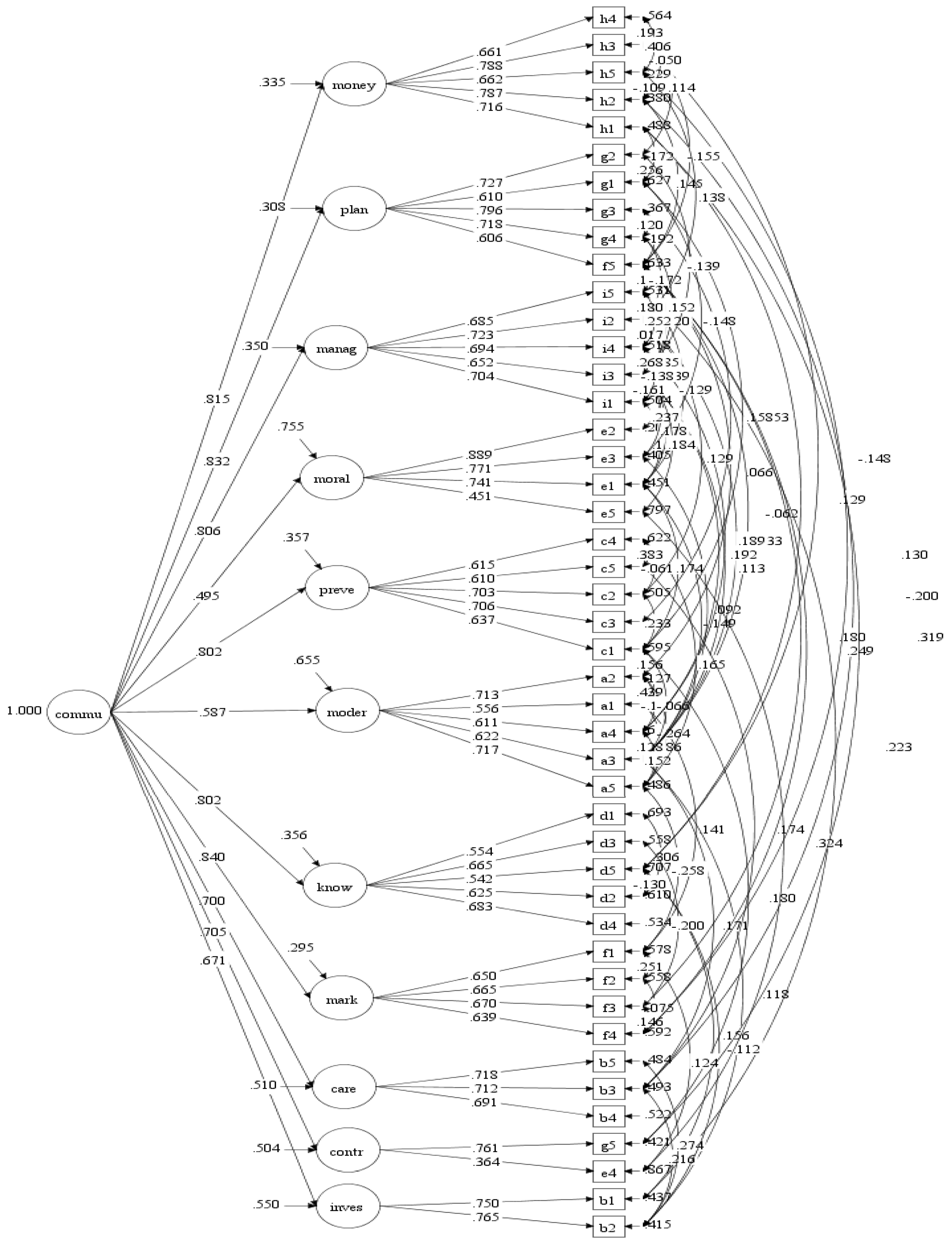

Table 1.
KMO and Bartlett’s Test.
| Kaiser–Meyer–Olkin Measure of Sampling Adequacy | Bartlett’s Test of Sphericity | ||
|---|---|---|---|
| Approx. Chi-Square | df | Sig. | |
| .911 | 8845.540 | 990 | .000* |
* Sig .05.
Table 2.
Show eigenvalues and elements factor.
| Component | Eigenvalues | ||
|---|---|---|---|
| Total | % Of Variance | Cumulative% | |
| 1. Financial control (MONEY) | 13.178 | 29.285 | 29.285 |
| 2. Planning (PLAN) | 2.838 | 6.306 | 35.591 |
| 3. Member management (MANAG) | 2.265 | 5.034 | 40.625 |
| 4. Moral (MORAL) | 2.006 | 4.458 | 45.083 |
| 5. Prevention plan (PREVE) | 1.560 | 3.466 | 48.549 |
| 6. Moderation (MODER) | 1.488 | 3.306 | 51.856 |
| 7. Knowledge and expertise (KNOW) | 1.383 | 3.072 | 54.928 |
| 8. Market development (MARK) | 1.343 | 2.985 | 57.913 |
| 9. Care (CARE) | 1.166 | 2.592 | 60.505 |
| 10. Quality control (CONTR) | 1.086 | 2.412 | 62.917 |
| 11. Value of investment (INVES) | 1.024 | 2.276 | 65.193 |
Table 3.
Mean, Standard Deviation, Loading, CR, AVE, and Cronbach’s Alpha.
| Construct Validity | Item | Mean | S.D. | Item Loading | CR | AVE | Cronbach’s Alpha |
|---|---|---|---|---|---|---|---|
| 1. Financial control (MONEY) | .846 | .526 | .920 | ||||
| H4 | 3.95 | .873 | .739 | ||||
| H3 | 4.14 | .777 | .720 | ||||
| H5 | 3.97 | .814 | .680 | ||||
| H2 | 4.13 | .823 | .638 | ||||
| H1 | 4.12 | .769 | .615 | ||||
| 2. Planning (PLAN) | .822 | .430 | .877 | ||||
| G2 | 4.03 | .754 | .735 | ||||
| G1 | 3.99 | .785 | .711 | ||||
| G3 | 4.06 | .809 | .674 | ||||
| G4 | 4.09 | .816 | .602 | ||||
| F5 | 3.91 | .864 | .490 | ||||
| 3. Member management (MANAG) | .821 | .479 | .954 | ||||
| I5 | 4.15 | .853 | .741 | ||||
| I2 | 4.09 | .836 | .728 | ||||
| I4 | 4.20 | .787 | .711 | ||||
| I3 | 4.25 | .796 | .586 | ||||
| I1 | 4.18 | .775 | .557 | ||||
| 4. Moral (MORAL) | .814 | .534 | .932 | ||||
| E2 | 4.44 | .756 | .822 | ||||
| E3 | 4.43 | .749 | .795 | ||||
| E1 | 4.45 | .747 | .703 | ||||
| E5 | 4.41 | .744 | .558 | ||||
| 5. Prevention plan (PREVE) | .790 | .430 | .856 | ||||
| C4 | 3.88 | .849 | .770 | ||||
| C5 | 3.94 | .838 | .726 | ||||
| C2 | 3.97 | .732 | .539 | ||||
| C3 | 3.96 | .808 | .531 | ||||
| C1 | 4.09 | .777 | .529 | ||||
| 6. Moderation (MODER) | .781 | .418 | .755 | ||||
| A2 | 4.05 | .791 | .714 | ||||
| A1 | 4.24 | .767 | .708 | ||||
| A4 | 4.02 | .833 | .692 | ||||
| A3 | 4.10 | .820 | .673 | ||||
| A5 | 4.08 | .744 | .567 | ||||
| 7. Knowledge and expertise (KNOW) | .830 | .507 | .838 | ||||
| D1 | 4.12 | .735 | .674 | ||||
| D3 | 4.01 | .799 | .633 | ||||
| D5 | 4.03 | .834 | .571 | ||||
| D2 | 4.11 | .741 | .565 | ||||
| D4 | 4.02 | .818 | .511 | ||||
| 8. Market development (MARK) | .751 | .530 | .832 | ||||
| F1 | 4.11 | .772 | .751 | ||||
| F2 | 4.07 | .743 | .671 | ||||
| F3 | 4.06 | .802 | .554 | ||||
| F4 | 3.97 | .789 | .515 | ||||
| 9. Care (CARE) | .750 | .500 | .841 | ||||
| B5 | 4.09 | .778 | .657 | ||||
| B3 | 4.20 | .750 | .655 | ||||
| B4 | 4.06 | .769 | .634 | ||||
| 10. Quality control (CONTR) | .656 | .491 | .701 | ||||
| G4 | 4.09 | .816 | .653 | ||||
| E4 | 4.07 | .848 | .507 | ||||
| 11. Value of investment (INVES) | .729 | .574 | .720 | ||||
| B1 | 4.08 | .744 | .798 | ||||
| B2 | 4.10 | .790 | .709 |
* Sig .05.
Disclaimer/Publisher’s Note: The statements, opinions and data contained in all publications are solely those of the individual author(s) and contributor(s) and not of MDPI and/or the editor(s). MDPI and/or the editor(s) disclaim responsibility for any injury to people or property resulting from any ideas, methods, instructions or products referred to in the content. |
© 2023 by the authors. Licensee MDPI, Basel, Switzerland. This article is an open access article distributed under the terms and conditions of the Creative Commons Attribution (CC BY) license (http://creativecommons.org/licenses/by/4.0/).
Copyright: This open access article is published under a Creative Commons CC BY 4.0 license, which permit the free download, distribution, and reuse, provided that the author and preprint are cited in any reuse.


