

Submitted:
21 January 2023
Posted:
26 January 2023
You are already at the latest version
Preprints on COVID-19 and SARS-CoV-2
Abstract
Each injection of any known vaccine results in a strong expression of pro-inflammatory cytokines. This is the result of the innate immune system activation, without which no adaptive response to the injection of vaccines is possible. COVID-19 mRNA vaccines would not escape this rule. Unfortunately, the degree of inflammation produced by these vaccines is variable, probably depending on the genetic background and previous immune experiences, which through epigenetic modifications, could have made the innate immune system of each individual tolerant or reactive to subsequent immune stimulations.We hypothesize that we can move from a limited pro-inflammatory condition to conditions of increasing expression of pro-inflammatory cytokines that can culminate in multisystem hyperinflammatory syndromes following COVID-19 mRNA vaccines (MIS-V). We have graphically represented this idea in a hypothetical inflammatory pyramid (IP) and we have correlated the time factor to the degree of inflammation produced after the injection of vaccines. Furthermore, we have placed the clinical manifestations within this hypothetical IP, correlating them to the degree of inflammation produced. Surprisingly, excluding the possible presence of an early MIS-V, the time factor and the complexity of clinical manifestations are correlated to the increasing degree of inflammation: symptoms, heart disease and syndromes (MIS-V).
Keywords:
COVID-19 mRNA vaccines
; Myo-pericarditis and COVID-19 mRNA vaccines
; Multisystem-Inflammatory-Syndrome and COVID-19 mRNA vaccines
; arrhythmias and COVID-19 mRNA vaccines
; Pathogenesis of myocarditis following COVID-19 mRNA vaccines
; MIS-A
; MIS-C
; MIS-V
; Myocarditis
; COVID-19 mRNA vaccine Adverse Events.
1. Introduction
In the post-marketing period, some adverse events (AEs) were temporally associated with the injection of COVID-19 mRNA vaccines. Starting from the evidence that up to now no studies have been published on the pathogenetic mechanisms that could determine cardiac AEs, we have conducted a research focused on the molecular effects determined by the Spike protein that have allowed us to propose a unifying mechanism that includes at least four groups of AEs: 1- Systemic Symptoms; 2- Arrhythmias; 3- Mio-pericarditis; 4- Multisystemic Hyperinflammatory Syndromes (MIS).
Considering the clinical relevance of cardiac AEs (arrhythmias, myo-pericarditis), in this study we have devoted ample space to a series of pathophysiological mechanisms that can be influenced by the administration of lipid nanoparticles (LNPs) containing mRNA encoding Spike protein.
2. Human heart
In the human heart there are several cell types: cardiomyocytes (CMs), cardiac fibroblasts (CFs), cardiac endothelial cells (CECs), macrophages, smooth muscle cells, pericytes and other cells [1,2,3,4], but CMs are about one third of the entire cell population [4,5,6,7,8]. In CMs there is an axis Toll-Like Receptor 4 (TLR4) / Nuclear Factor kappa B (NF-kB) which is important in cardiac inflammation [9]. TLR4 activation triggers inflammatory immune response via TLR4 / MyD88 / NF-κB signaling pathway [10]. SARSCoV-2 Spike protein S1 subunit (CoV-2-S1) induces high levels of NF-κB activation [11].
CFs are the primary cell type responsible for deposition of extracellular matrix (ECM) in the heart, providing support to the contracting myocardium and contributing to a myriad of physiological signaling processes [12]. CFs contributes to both electrical and structural remodeling of the heart, which ultimately leads to decreased cardiac function, heart failure, and arrhythmias [13,14,15,16]. Myocardial interstitium is a complex and dynamic microenvironment [17], and ECM synthesis contributes to myocardial fibrosis [18]. When ECM expands, the extracellular space expands and signals a process of myocardial fibrosis which can be detected with Cardiac Magnetic Resonance (CMR) imaging, where an excess of gadolinium is retained and deposited in the extracellular space [19], producing the phenomenon of Late Gadolinium Enhancement (LGE).
CECs form a barrier to the movement of fluids and molecules [20] and during inflammation the junctional proteins of the paracellular pathway are modified with subsequent interruption of the integrity of this barrier [21]. CECs organize recruitment of immune cells and regulate leukocyte extravasation at places of inflammation by inducible expression of adhesion molecules, and maintain appropriate hemostasis or coagulation.
3. Systemic Symptoms
In our representation of the hypothetical IP, at the first level we have placed the systemic symptoms that arise after the injection of the vaccine (muscle aches, chills, asthenia, fever, headache, pain at the injection site), symptoms generated by the strong production of pro-inflammatory cytokines, species interleukin (IL)-1 IL-1β, IL-6 and Tumor Necrosis Factor (TNF)-α. In our previous studies we have described the mechanism of action of common infant vaccines and found that there is no adaptive immune response to vaccine injection if the innate immune system is not activated, which also leads to strong expression and secretion of various pro-inflammatory cytokines, such as IL-1β, IL-6 and TNF-α [24,25].
4. Inflammatory cardiac channelopathies and arrhytmias
5. The cardiac Action Potential (AP)
Normally, a cardiac muscle cell, in a resting state, has a negative electric charge of about 90 mV on the inner side of its cell membrane, compared to the surrounding medium. When an electrical stimulus excites a ventricular cell, the cell membrane rapidly depolarizes and the potential difference now becomes positive inside with a value of about 20mV (positive overshoot). Now we are at the 0 phase of Action Potential (AP). This is followed by phase 1 which consists of a short phase of partial repolarization that is followed by phase 2, which is that of the plateau that signals a period of intense and sustained depolarization of the membrane. The repolarization process starts at stage 3 and it is a slower process. The interval from the end of repolarization until the beginning of the next AP is designated as phase 4 [30].
6. The ionic basis of AP
The changes in the permeability of the cellular membrane are associated with the various phases of the AP and essentially involve three ions: Na+, K+, and Ca2+. These permeability changes alter the rate of ionic movements across the membrane [30]. Apart from the movement of sodium of the 0 phase of AP, the movements of potassium and calcium can be influenced by pro-inflammatory cytokines which act precisely on certain ion channels. In Table 1, we present a series of characteristics of some channels of the cardiac muscle fibrocells, relating them to the specific AP phase and we indicate the documented interferences that pro-inflammatory cytokines produce on ion channels and currents.
Several studies have demonstrated the importance of Voltage-Gated Potassium Channels in the genesis of cardiac arrhythmias [31,32,33,34,35]. Loss-of-function mutations in Kv 7.1 channel, lead to long-QT syndrome type 1 (LQTS1), which is the most frequent type of the long-QT syndromes [36]. The link to physiology is exemplary: patients with LQTS1 most frequently have arrhythmic events during exercise, where the sympathetic drive increases heart rate but fails to reduce repolarization time, because Kv 7.1 channel is dysfunctional [37]. Furthermore, TNF-α causes a functional inhibition of the Kv 7.1 channel which reduces the current Ik [38]. KV11.1 is essential for normal cardiac electrical activity and rhythm [39]. IL-6 produces an inhibition on the rapid delayed rectifier current Ikr. The consequent prolongation of the duration of AP results in QT interval prolongation [40]. Finally, Kir 2.1 / 2.3 channels also determine effects on AP [41,42,43].
Voltage-activated Ca2+ channels represent the major route of Ca2+ entry into CMs in response to depolarizations of the cellular membrane potential [44]. These channels are important in the AP plateau phase and are important for the electrical and mechanical properties of the heart [45,46,47,48,49,50].
7. Proinflammatory cytokines
Inflammatory factors can cause cardiac K+ channel dysfunction and arrhythmias in the setting of a structurally normal heart [51]. Emerging experimental evidence has shown that inflammatory responses, mainly via IL-1β, IL-6 and TNF-α, regulate CMs electrophysiological properties [51,52,53,54,55,56]. Proinflammatory cytokines can be arrhythmogenic and cytokines can promote the development of LQTS [27]. Some studies report in detail the effects of proinflammatory cytokines on cardiac ion currents [29,40,46,57,58,59].
8. Myo-pericarditis
The mean monthly number of cases of myocarditis or myopericarditis during the pre-vaccine period was 16.9 vs 27.3 during the vaccine period [60]. Although it doesn’t seem like it, the monthly increase in cases is statistically significant, practically doubling. Myocarditis incidence after RNA vaccines is very rare (0.0035%) and has a very favorable clinical course [61]. But not all cases are benign and critical or fatal cases have been reported [62,63,64,65]. There is an excess of cases with a substantial burden of both myocarditis and pericarditis in all ages [66]. Increased risk of myocarditis / pericarditis has been associated with the second dose of BNT162b2 and both doses of mRNA-1273 [67]. In one study the highest risks were observed in males of 12 to 39 years [67], while Wong and colleagues [68], demonstrated that an increased risk of myocarditis or pericarditis was observed after COVID-19 mRNA vaccination and was highest in men aged 18–25 years after a second dose of the vaccine.
8.1. Probable pathogenesis of myocarditis
Husby and Kober [69], argue that the disease mechanism is specific neither to the newly developed mRNA vaccines nor to exposure to the SARS-CoV-2 Spike protein. However, we try in this study to elaborate a pathogenetic hypothesis on the basis of extensive scientific documentation in support of our thesis.
Before proceeding it is necessary to understand that the two vaccines have a partly different composition, both in the quantity of Lipid Nanoparticles (LNPs) and in the excipients. There is a difference in the amount of LNPs contained in the two vaccines: in the dose of Comirnaty (BNT162b2—Pfizer / Biontech), to be administered to subjects aged> 12 years, there are 30 micrograms / dose [70]; while in the Moderna vaccine (mRNA-1273) there are 100 micrograms / dose [71]. As it is evident, the content of LNPs is three times higher in the Moderna vaccine, compared to Pfizer / Biontech, and could probably affect the timeline of the onset of these adverse events (AEs). In addition, the vaccination schedule provides an interval between the first and second dose of 21 days for the Pfizer / Biontech vaccine [70]; while this interval is 28 days if the Moderna vaccine is used [71].
8.1.1. One or two shots?
In several studies, myocarditis / pericarditis are more frequent after injection of the second dose of Pfizer / Biontech mRNA vaccine; while myocarditis / pericarditis can occur both after the first and second injection of Moderna’s mRNA vaccine. Considering the time interval between the two vaccine doses; one would think that it takes less than 28 days to produce this AEs (about 23-27 days for the BNT162b2 vaccine).
We must develop our hypotheses starting from the fact that there are two different formulations of COVID-19 mRNA vaccines and two different vaccination schedules. Furthermore, our immune system must produce dose-dependent inflammatory responses after the administration of two different doses of LNPs (30 micrograms / dose vs 100 micrograms / dose). In addition, the immune response is complex and affects the entire LNP.
It was demonstrated that if the antigenic stimulus persists for over a week at low levels cause chronic low-level stimulation of T cells, keeping them in a partially activated state and leading to their accumulation over time [72,73,74].
Li and colleagues [75] conducted a study in a Balb / c mouse model and found that intravenous injection of a COVID-19 mRNA vaccine rapidly resulted in multifocal myopericarditis, while intramuscular injection produced signs 7 days after injection. (myocardial edema, and occasional foci of cardiomyocyte degeneration). However, these histopathological changes worsened after the second dose. Since the injected vaccine was BNT162b2, this study may indicate that two shots are needed with this vaccine to produce myopericarditis, as occurs predominantly in humans.
8.1.2. Inflammatory infiltration of myocardium
Verma and colleagues [64] described two cases (one fatal) with multifocal myocardial damage (biopsy and autopsy) associated with mixed inflammatory infiltration. The surviving subject presented at the endomyocardial biopsy (EMB) an infiltration of T cells, macrophages, eosinophils, B cells and plasma cells. Conversely, the fatal case presented at the autopsy an infiltrate that was similar but did not contain plasma cells. Oka and colleagues [78] described a case of fulminant myocarditis after the second dose of COVID-19 mRNA vaccination. The inflammatory infiltrate was identical to the non-fatal case described by Verma and colleagues [64]. Kazama and colleagues [79] described the case of a woman with fulminant myocarditis following the second dose of Moderna COVID-19 vaccine. Again, EMB revealed lymphocytic infiltration with predominant immunostaining for CD8 and CD68-positive cells (macrophages). Two other cases with acute myocarditis following COVID-19 mRNA vaccination, at EMB analysis, have elevated CD3 T cells and CD68 macrophages [80]. The activation of T lymphocytes and macrophages [81,82,83,84,85] is believed to play a fundamental role in myocardial inflammation [81], and cardiac macrophage populations are markedly perturbed by inflammation [82].
Since COVID-19 mRNA vaccine-related myocarditis develops rapidly in 3 to 4 days after vaccination, innate immunity more likely contributes to the pathogenesis of vaccine-related myopericarditis than adaptive immunity [76]. It is useful to remember that any vaccine determines a strong expression of proinflammatory cytokines (including IL-18) by DCs, which is associated with an evident activation of NFκB [24,25]. In an inflammatory microenvironment, caspase-1 is regulated by NF-κB [77], and this enzyme facilitates the conversion of pro-IL-18 in IL-18. Patient with myo-pericarditis following COVID-19 vaccination had excessive Th1-type immune responses over vaccine-induced immune activation. Diffuse myocardial macrophages infiltration in the patient biopsy sample, suggest an increased level of IL-18 produced by monocytes and macrophages in the heart with COVID-19 vaccine-related myo-pericarditis [76].
8.1.3. Who opens the gate?
Now it is necessary to understand how the injection of the vaccine determines a series of immune events that can open a passage in the endothelial line of the heart vessels through which inflammatory cells will then infiltrate and can cause damage to the myocardium. We have identified at least 4 main actors: 1- DCs derived exosomes; 2- proinflammatory cytokines; 3- Adhesion molecules; 4- Spike protein. The framework is then integrated by the activation of the TLRs and the TLR4 / NFκB axis.
8.1.4. Exosomes
Exosomes are cell-derived small extracellular membrane vesicles, with 50–100 nm in diameter, that are actively secreted and released both in physiological and pathological conditions. Exosomes contain and transport multiple types of biological macromolecules that maintain their whole activity when delivered to target cells. This bioactive cargo, include nucleic acids, lipids, and soluble or membrane-bound proteins [86]. Exosomes, produced by mature DCs, can produce inflammation in endothelial cells through their TNF-α content in their membrane, via transcription factor NF-κB, which also induces the transcription of adhesion molecules such as Vascular Cell Adhesion Protein 1 (VCAM-1), Intercellular Adhesion Molecule 1 (ICAM-1) and E-selectin in endothelial cells (ECs) [87]. Furthermore, DCs-derived exosomes contain major histocompatibility complex (MHC) Class I and II molecules and T cell co-stimulatory molecules, which determine direct antigen presentation and CD4 and CD8 T cell activation [21,88]. There is important crosstalk between CMs and CECs that is ensured by means of the cardiomyocytes-derived exosomes that are up-taken by CECs. ECs can also actively collaborate with the underlying CMs and modulate cardiac function, both under physiological conditions and under proinflammatory conditions [21,89,90,91,92,93,94,95,96].
In summary, after injection of COVID-19 mRNA vaccines, DCs-derived exosomes may contain a variable amount of what is found in their cytosol: Spike protein-encoding mRNA, Spike protein, Spike protein peptides, proinflammatory cytokines, MHC Class I and II molecules, and T cell co-stimulatory molecules that make the particle capable of initiating and maintaining an inflammatory process in the target tissue.
8.1.5. Spike protein induces endothelial cells (ECs) dysfunction
Spike protein of SARS-CoV-2 alone activates ECs inflammatory phenotype in a manner dependent on integrin ⍺5β1 signaling and induced the nuclear translocation of NF-κB and subsequent expression of leukocyte adhesion molecules (VCAM-1 and ICAM-1), coagulation factors, proinflammatory cytokines (TNF-α, IL-1β, and IL-6), and ACE2. Furthermore, in vivo, intravenous injection of the protein Spike increases expression of ICAM-1, VCAM-1, CD45, TNF-α, IL-1β, and IL-6 in the lung, liver, kidney, and eye [97].
Therefore, it emerges with extreme clarity that the protein Spike alone, is able to induce the secretion of pro-inflammatory cytokines (via NF-κB) and adhesion molecules (ICAM-1, and VCAM-1) in ECs.
Spike Protein and cardiomyocytes (CM)
CoV-2-S1 interacts with the extracellular leucine rich repeats-containing domain of TLR4 and activates NF-κB [98]. TLR4 initiates the expression of several pro-inflammatory genes, cell surface molecules, and chemokines through the MyD88-dependent pathway, which exacerbates the damage to myocardium [99]. The circulating CoV-2-S1 is a TLR4-recognizable alarmin that may harm the CMs by triggering their innate immune responses [98]. In CMs there is an axis TLR4 / NF-kB [9] and unmitigated TLR4 activation may lead to increased risk for cardiac inflammation [100]. Thus, the TLR4 / NF-kB axis in CMs can also cause cardiac inflammation and myocardial damage, and the Spike protein alone is able of activating this axis in CMs.
Spike protein alone can easily reach the myocardium through these routes: 1- via DCs derived exosomes; 2- via ECs that have ACE2 receptors, and, after uptake, they can produce exosomes to be exported to CMs; 3- via transmigration through the endothelium.
Baumeier and colleagues [101], studied 15 cases of myocarditis after COVID-19 mRNA vaccine using EMB and immunohistochemical analysis. In 9 of these patients the Spike protein was found in CMs. Furthermore, CoV-2-S1 activates TLR4 signaling to induce pro-inflammatory responses in murine and human macrophages [102]. Finally, SARS-CoV-2-induced myocarditis and multiple-organ injury may be due to TLR4 activation, aberrant TLR4 signalling and hyperinflammation in COVID-19 patients [103].
8.1.6. Young males: the favorite target.
Adolescence is accompanied by increased exposure to stressors [104,105] and it is a time of many psychosocial and physiological changes [106]. Change also the stress response system (SRS). Acute stress prepares the body for the stressful situation [107]. Briefly, autonomic nervous system (ANS) responding to stress within milliseconds to minutes and the HPA axis responding over minutes to hours following stressor onset [108,109]. The stress response to physical and / or psychological stressors is initially produced by ANS which introduces the catecholamines epinephrine (E) and nor-epinephrine (NE) into the circulation [110].
Acute stress induces inflammatory response and raises the circulatory levels of inflammatory cytokines [111], such as IL-6 and TNF-α, also results in platelet activation and endothelial stimulation [112]. Mental stress induces prolonged endothelial dysfunction [113]. Adrenaline released during acute stress greatly increases both the inotropic and chronotropic effects in the heart via the β2 receptors [114]. Β2-receptor activation has effects on a calcium current (ICaL) and a potassium current (IKs) which exert opposite effects on the AP. When IKs is dysfunctional, as in LQT1, the resulting unbalanced ICaL effect causes excess AP prolongation [115].
Overall, acute stress creates a pro-inflammatory and pro-arrhythmic condition that can worsen if eating disorders (typical of adolescents) coexist. For example, repeated vomiting leads to a loss of potassium and consequent hypokalemia, resulting in effects on other potassium ion currents, delays repolarization and promote LQTS by suppressing K+ currents like IKr and the background inward rectifier IK1 [116]. Chronic stress is more harmful, and in an animal under chronic stress, a new stressful stimulus determines a strong response of the ANS with high secretion of catecholamines [117,118].
Stress reactions in Italian adolescents in response to the COVID-19 pandemic during the peak of the outbreak seem to be considerable [119]. Furthermore, we must not forget that young people practice sports of varying intensity. Combined stress (psychological and physical) can exacerbate cardiovascular responses to stress [121].
8.1.7. Other pathological mechanisms triggered by the Spike protein
ACE2 is expressed throughout the cardiovascular system [122]. When the Spike protein binds to the ACE2 receptor, the typical enzymatic function (carboxypeptidase) is replaced by a receptor function which activates intracellular signaling pathways [123,124,125]. As a result, normal ACE2 activity in the Renin—Angiotensin—Aldosterone System (RAAS) is lost and excess angiotensin II occurs.
Renin–Angiotensin–Aldosterone System (RAAS)
Renin, angiotensin, and aldosterone represent the core of a complex hormonal axis, referred to as RAAS, which contributes to blood pressure control, sodium reabsorption, inflammation, and fibrosis [126]. The renin enzyme degrades angiotensinogen producing angiotensin I (Ang I). ACE catalyzes the transformation of Ang I to Ang II. Ang II, the primary physiological product of the RAAS system, is a potent vasoconstrictor [127]. ACE2 converts Ang II into Ang-(1–7) and activates the protective axis AT2R. Conversely, if the action of ACE2 is reduced, the AT1R axis is enhanced, which is pro-inflammatory, pro-apoptosis and pro-fibrosis. The Ang II / AT1R axis is also involved in oxidative stress that stimulates endothelial dysfunction, inflammation of the vessels and thrombosis [128,129,130]. Furthermore, the upregulated expression of AT1R is linked with arrhythmias [131] and cardiac remodeling [132].
It is interesting to remember that the Ang II / AT1R axis mediates a cascade of signals that induce transcriptional regulatory molecules NF-κB and AP-1 / c-Fos via MAPK activation, and increased IL-6 release [133]. In addition, Angiotensin II also promotes the expression and production of adhesive and proinflammatory molecules (VCAM-1, ICAM-1, monocyte chemoattractant protein-1, macrophage inflammatory protein-1α, and IL-8) on the endothelial and vascular smooth muscle cells [134,135,136,137,138,139]. The functional deficit of the Ang II / AT2R / Mas receptors axis does not produce the normal beneficial effects during stressful situations, lacking the ability to effectively modify sympathetic nervous activity during stressful conditions [139].
Toxicity of lipid nanoparticles (LNPs)
LNPs are composed of cholesterol, a helper lipid, a Polyethylene glycol (PEG) lipid and an ionizable amine-containing lipid [140]. Some cationic / ionizable lipids contained in the LNPs of COVID-19 mRNA vaccines, pose toxicity problems [141]. Overall, LNPs exhibit a powerful proinflammatory action [142,143]. Small amounts of double-stranded RNA (dsRNA) can occasionally get packaged within mRNA vaccines [144]. LNPs evoke a strong proinflammatory response by activating TLR pathways [143,144,145,146,147], and the inflammatory milieu induced by the LNPs could be partially responsible for reported side effects of COVID-19 mRNA vaccines in humans [148]. Furthermore, the Spike protein present on plasma membranes could expose these cells to attack by anti-Spike antibodies, generating an antibody-dependent cellular cytotoxicity (ADCC) [149].
BioNTech / Pfizer Comirnaty vaccine contains two novel LNP-excipients: ALC-0315 (aminolipid) and a Polyethylene glycol lipid (PEG) ALC-0159 [150]. Saadati and colleagues [151] have recently described a new and clean way to produce ALC-0315, which contrary to the public-domain route, does not use dangerous reagents, such as hexavalent chromium Cr (VI) which is cardiotoxic [152,153].
8.1.8. TCD8, TCD3/CD45R0 and Macrophages CD68 in Myo-pericarditis
Human T-cell differentiation should be delineated using a minimum set of canonical markers, i.e., CD45R0 (or CD45RA), CCR7, CD28, and CD95 [154]. CD45RA−CD8+ memory T cells expressing CD27 produce both IL-2 and IFN-γ but lack immediate killing activity (T memory cells); while effector T cells (CD45RA−CD8+CD27−) produce mostly IFN-γ and TNF-α, but not IL-2 and are capable of immediate cytotoxicity ex vivo [155]. CD45R0 being preferentially expressed on memory cells [156,157].
Under normal conditions, T lymphocytes also exercise immune surveillance on the heart with a continuous trafficking of T cells through blood, lymphoid organs, and the heart [158]. Human CD8 T cell subset contains two distinct and separate entities: memory- and effector-type T cells, and the degree of systemic inflammation produced by vaccination affects the phenotype of secondary memory CD8 T cells [159]. Upon the second encounter with the cognate antigen, memory T cells are ready to proliferate and perform cytotoxic functions [160].
8.2. Diagnostic Items
The definition of myocarditis has been more recently enumerated by the ESC Working Group on Myocardial and Pericardial Diseases [161]. In patients with myocarditis main inflammatory populations consisted of macrophages and T cells [162,163,164]. Diagnostic tools include clinical signs and symptoms (difficulty breathing, chest pain), auscultation, ECG, echocardiography, cardiac MRI (to detect late gadolinium enhancement or LGE) and EMB, when indicated. Among the laboratory markers are useful: creatine kinase MB, troponin I and PCR [165]. For all the details, see the position statements [161,165].
Autoimmune forms of myocarditis excluded [166,167], immunohistochemical examinations [168,169] uniformly confirm that the inflammatory infiltrate is composed of activated CD3 T lymphocytes and CD68 macrophages (human heart contains distinct macrophage subsets) [170]. Conversely, in the autoimmune forms cardiac antigen-specific CD8 T lymphocytes could also be produced due to the molecular mimicry between Spike peptide and myocardial antigens [171].
8.3. Trans-endothelial migration towards heart tissue
8.4. Immune Black Hole
We presume to know a series of events following the injection of the vaccine and to predict reasonably enough what happens after the second injection; while we do not know how the immune system behaves in the period of time between the injection of the vaccine and the clinical onset of myo-pericarditis. We know that a few hours after the injection of the vaccine there is a strong production of pro-inflammatory cytokines and the synthesis of adhesion molecules is enhanced. All this makes it easy for T lymphocytes and macrophages to migrate towards the myocardium. Memory CD8 T cells, upon reinfection and antigenic stimulation, they have the capacity to rapidly proliferate and differentiate into secondary effector CD8 T cells [175,176,177].
8.5. Experimental myocarditis
There are two different study models of myocarditis: infectious and non-infectious. In non-infectious models, myocarditis is typically triggered by an autoimmune response against heart-specific antigens [178]. α-isoform of cardiac myosin heavy chain (α-MyHC) is not expressed in cells implicated in T cell tolerance. This results in undisturbed development of α-MyHC-specific T cells in human [179] due to the molecular mimicry between Spike protein and α-MyHC. In fact, antibodies directed to SARS-CoV-2 Spike glycoproteins might cross-react with structurally similar human protein sequences, including myocardial α-MyHC [179].
In summary, these two experimental models do not add contributions to our understanding because the cases following the injection of vaccines are not of an infectious nature and there are few cases of autoimmune etiology.
9. Multisystem Inflammatory Syndromes (MIS)
Multisystem Inflammatory Syndrome in children (MIS-C) is a new pediatric illness that is a late complication of SARS-CoV-2 infection. Myocardial dysfunction with or without mild coronary artery dilation can occur in MIS-C [180]. MIS-C is characterized by fever, systemic inflammation, and multisystem organ involvement [181,182,183] with particular interest in the gastrointestinal, cardiovascular and neurological system, associated with elevated markers of inflammation and altered coagulation [184]. MIS in adult (MIS-A) is a serious hyperinflammatory condition that presents approximately 4 weeks after onset of acute COVID-19 with extrapulmonary multiorgan dysfunction [185].
MIS following COVID-19 vaccination (MIS-V) remain rare event [186], but it is a serious adverse event. There have been identified 12 cases of hyper-inflammatory syndrome following COVID-19 mRNA vaccines (now MIS-V) in 12-17-year-old children in France, with multisystemic involvement [187], and two pediatric cases with neurological involvement in Italy [186]. Two other cases have recently been described and both children presented with MIS-V within 4 and 5 weeks of receiving their first and only dose of Pfizer/BioNTech’s SARS-CoV-2 vaccine [188]. There are other MIS-V case reports and case series.
It follows that the cases of hyperinflammatory syndromes triggered by the injection of the COVID-19 mRNA vaccines must now be indicated by the acronym MIS-V.
10. Discussion
The injection of COVID-19 mRNA vaccines results in a strong expression and secretion of pro-inflammatory cytokines associated with a wide and variable cellular activation, both immune and vascular. In relation to the degree of inflammation produced by each subject, depending on its genetic status and the acquired condition of epigenetic modification of the innate immune system; systemic symptoms, heart disease and hyperinflammatory syndromes can be produced as AEs.
In Table 2, some effects determined by the injection of COVID-19 mRNA vaccines are listed.
Different levels of expression of pro-inflammatory cytokines over time, after COVID-19 mRNA vaccination [189], the persistence of the Spike protein in circulation for a prolonged period of time [190], the prolonged immune and inflammatory response against the Spike protein [189,190], the strong pro-inflammatory activity of LNP [141,142,143,144,145,146,147,148], the actions of the Spike protein on the Angiotensin II / AT1 axis [127,128,129,130,131,132,133,134,135,136,137,138], the activation of TLR4 and the TLR4 / NFκB axis in cardiomyocytes by the Spike protein [11], the endothelial dysfunctions produced by the Spike protein [97], all together represent a series of subsets that can contribute with variable expression, especially to the pathogenesis of myocarditis and multisystem syndromes.
Biochemical studies revealed that Spike protein triggers inflammation via activation of the NF-κB pathway and induction of proinflammatory cytokines, such as IL-6, TNF-α, and IL-1β [189]. Furthermore, the expression of cytokines and chemokines, in response to Spike protein, was dose dependent and this agrees with the different timeline of myo-pericarditis following COVID-19 mRNA vaccines (onset after second dose of Pfizer vaccine or at first and second dose of Moderna vaccine). After the first dose of BNT162b2 vaccine, the human organism produces systemic inflammation which is accompanied by upregulation of TNF-α and IL-6 after the second dose [191].
Furthermore, the S1 subunit of the Spike protein produces an endothelial lesion that is amplified by simultaneous exposure to the inflammatory cytokine TNF-α and the male hormone dihydrotestosterone [192]. This condition of endothelial lesion, amplified by simultaneous exposure to TNF-α and androgens, may allow us to resolve some controversies. There is growing evidence that suggests that males have a higher risk of outcomes in case of myocarditis [193], despite the fact that they are able to suppress the production of pro-inflammatory cytokines (IL-1β, IL-6, and TNF-α) and increasing the production of anti-inflammatory cytokines [194]. Since the effects of testosterone may be different under normal physiological conditions and in pathological states [195], in the presence of an endothelial lesion and/or myocarditis these effects may be different from the physiological conditions. Indeed, generally, androgens have been found to increase Th1 responses [196] and, in acute myocarditis, testosterone promotes the pro-inflammatory Th1 and/or Th17-type immune response [197] and increases the activity of the inflammasome and TLR4 signaling pathways [198].
This synergy of effects could explain why myo-pericarditis is more frequent in males; while the concomitant proinflammatory action of stress and its ability to induce endothelial dysfunction could explain why young males are more affected by myo-pericarditis.
Exosomes with Spike protein, Abs to SARS-CoV-2 Spike, and T cells secreting IFN-γ and TNF-α increased following the booster dose [190]. Miyashita and colleagues [189] investigated the correlation between proinflammatory cytokine levels in sera and AEs after COVID-19 vaccination, and they found that systemic TNF-α levels were connected with the systemic scores after the second dose. This observation also supports the notion that proinflammatory cytokines are a cause of AEs after vaccination [199,200,201,202]. Furthermore, Miyashita and colleagues [189], in the same study, measured serum proinflammatory cytokine levels after vaccination. IL-6 levels one day after the first dose were elevated compared with the levels before vaccination, and the levels were further elevated after the second dose. Serum TNF-α levels did not increase after the first dose but increased significantly after the second dose. It follows that after the second dose of vaccine there are markedly increased concentrations of IL-6 and TNF-α, in the serum, already only after the first day following the second vaccine dose. Finally, there would be a significant linear correlation (p <0.05) between the level of proinflammatory cytokine TNF-α and the degree of symptoms (Systemic Scores) occurring one day after the second dose of BNT162b2 vaccine. For these authors, these data suggest that proinflammatory cytokines (IL-6 and TNF-α) were produced in response to BNT162b2 vaccination, especially after the second dose. Murata and colleagues [203] published a study reporting that four subjects died after receiving a second dose of COVID-19 vaccine, with no obvious cause identified at autopsy. RNA sequencing revealed that genes involved in neutrophil degranulation and cytokine signaling were upregulated in these cases, suggesting that immune dysregulation occurred after vaccination.
Flego and colleagues [204] demonstrated that administration of the mRNA-based vaccine BNT162b2 determines, in some subjects, a rapid increase in the systemic concentration of a series of proinflammatory cytokines (including IL-1β, TNF-α and IL-18) within 3- 10 days after the first injection and 10 days after the second dose. Thus, one month after the first dose we have a second wave of pro-inflammatory cytokines expression which coincides with the timeline of the onset of myo-pericarditis. The result of the increase in the serum concentration of IL-18 is relevant, since myo-pericarditis following COVID-19 mRNA vaccination may be associated with increased IL-18-mediated immune responses and cardiotoxicity [76].
Furthermore, anyway, COVID-19 vaccines were associated with rhythm disorders (inflammatory cardiac channelopathies) [205], and vaccination fear, as an acute stress situation, could lead to atrial arrhythmias [206]. Lazzerini and Colleagues [26,27,28,29,38] have studied inflammatory cardiac channelopathies in the past and the role of pro-inflammatory cytokines in producing arrhythmias is now well established. Esposito and colleagues [207] believe that among the main mechanisms associated with the development of myocarditis after vaccination with COVID-19 mRNA vaccines, these elements could be considered: activation of natural killer lymphocytes and macrophages and a massive release of cytokines leading to massive damage to the heart tissue.
Acute myocarditis is an inflammatory myocardial disease, which can be complicated by adverse cardiac events, including sudden cardiac death and heart failure [208].
From a series of epidemiological studies [60,61,62,66,67,68,69] it emerges that there is an evident excess of myo-pericarditis in all ages, especially in young people who have been vaccinated with COVID-19 mRNA vaccines, compared to the pre-vaccination period. Oster and colleagues [209] studied 1626 cases of myocarditis reported in a national passive reporting system. The rates of myocarditis cases were highest after the second vaccination dose in males aged 12 to 24 years with the highest incidence in the age group 16-17 years (105.9 per million doses of the BNT162b2 vaccine). In Israel, 136 cases of definite or probable myocarditis were recorded that had occurred in temporal proximity to the receipt of two doses of the BNT162b2 mRNA vaccine, a risk that was more than twice that among unvaccinated persons. This association was highest in young male recipients within the first week after the second dose. Approximately 1 case in every 6637 male recipients occurred over the age range 16-19 years [210]. Buchan and colleagues [211] found that vaccine products and interdose intervals, in addition to age and sex, may be associated with the risk of myocarditis or pericarditis after receipt of these vaccines. Vaccine effectiveness may be higher with an interdose interval for mRNA vaccinations of 6 to 8 weeks compared with the 3- to 4-week interval [212]. It follows that the intervals adopted between the first and second dose, on the one hand, reduce the effectiveness of the vaccine; while on the other hand they increase the risk of myo-pericarditis, respect to greater intervals between the two doses.
Hence, the number of myo-pericarditis is important and undiagnosed cases could be numerically more important and clinically insidious, since an increase in extracellular matrix deposition could lead to electrical destabilization of the heart [213].
Husby and Kober [69] argue that the disease mechanism of myo-pericarditis is specific neither to the newly developed mRNA vaccines nor to exposure to the SARS-CoV-2 spike protein. However, we have found a number of elements that do not move in the same direction indicated by Husby and Kober [69]. Furthermore, it does not appear from the published statistics that there are such an important number of cases of myo-pericarditis after the injection of a traditional vaccine [214,215]. Myocarditis associated with COVID-19 mRNA vaccines in adult males occurs with significantly higher incidence than in the background population. [216]. The incidence of myo-pericarditis following COVID-19 mRNA vaccines varies from case to case, starting from the lowest data of Das and colleagues [217], which is 0.32 / 100,000, to arrive at the highest data of Nygaard and colleagues [218], which is equal to 5.74 / 100,000.
In a series of report cases of myocarditis following COVID-19 mRNA vaccination [64,78,79,80], studied with EMB, there is a mixed inflammatory infiltrate in which CD3 T lymphocytes and macrophages CD68 are always present. While CD4+ and CD8+ cell infiltration prevails in typical inflammatory myocarditis, CD68+ cell infiltration is prevalent in SARS-CoV-2 induced myocarditis [219]. The activation of T lymphocytes and macrophages is believed to play a fundamental role in myocardial inflammation [81].
Established that the activation of the innate immune system follows the injection of COVID-19 mRNA vaccines and that the migration of T lymphocytes and macrophages is a real fact in myocarditis; we will now examine the fundamental role of the Spike protein in modifying certain cell physiology events. After injection of COVID-19 mRNA vaccines, the Spike protein is expressed in DCs at the level of the axillary lymph nodes ipsilateral to the injection site (deltoid muscle) [120]. These DCs produce exosomes that circulate in the blood for a long time [190]. Spike protein induces ECs dysfunction. Spike protein of SARS-CoV-2 alone activates ECs inflammatory phenotype and induced the nuclear translocation of NF-κB and subsequent expression of leukocyte adhesion molecules (VCAM-1 and ICAM-1), coagulation factors, proinflammatory cytokines (TNF-α, IL-1β, and IL-6), and ACE2 [97]. CoV-2-S1 interacts with the extracellular leucine rich repeats-containing domain of TLR4 and activates NF-κB [98]. TLR4 initiates the expression of a number of pro-inflammatory genes, cell surface molecules, and chemokines through the MyD88-dependent pathway, which exacerbates the damage to myocardium [99]. The circulating CoV-2-S1 is a TLR4-recognizable alarmin that may harm the CMs by triggering their innate immune responses [98]. In CMs there is an axis TLR4 / NF-κB, and unmitigated TLR4 activation may lead to increased risk for cardiac inflammation [100]. Thus, the TLR4 / NF-kB axis in CMs can also cause cardiac inflammation and myocardial damage, and the Spike protein alone is capable of activating this axis in CMs. We have already indicated four different pathways that allow the Spike protein to reach the myocardium.
In summary, the Spike protein is not a mere spectator but the main protagonist in myocarditis. In fact, it causes endothelial dysfunction [97], and activates TLR4 and the TLR4 / NFκB axis in CMs with often unhealthy consequences [98,99,100]. The concreteness of all these scientific works has been validated by clinical practice. Indeed, Baumeier and colleagues [101] studied 15 cases of myocarditis after COVID-19 mRNA vaccine using EMB and immunohistochemical analysis. In 9 of these patients the Spike protein was found in CMs.
Finally, vaccinated mice showed signs of myocarditis 2 days after injection of the second dose of BNT162b2 vaccine [75].
We are now confident that Spike-specific activated T lymphocytes, macrophages and Spike protein can reach the myocardium after vaccination, but the “Immune Black Hole” prevents us from knowing any interactive modalities between these, and possibly other, cellular components.
Since the natural history of myocarditis does not end after the immediate period following diagnosis, but it can also evolve silently creating the preliminary conditions that could lead to dangerous arrhythmias and sudden death; we would like to bring you some important elements.
If we use CRM images we can monitor the LGE pattern over time. In the acute phase, CMR allows to verify if there is inflammation / edema, increased interstitial space, and LGE [220]. LGE on CMR imaging signifies myocardial fibrosis or scar [221]. LGE presence is a strong risk marker in patients with suspected myocarditis [222], and LGE-assessed myocardial fibrosis has been shown to be a predictor for outcome in same patients [223]. Georgiopoulos and colleagues [208] conducted a meta-analysis and demonstrates that the presence and location of LGE may identify a subgroup of patients with acute myocarditis who warrant more intensive clinical surveillance for adverse cardiac events. Indeed, anteroseptal location but not LGE extent was also associated with the clinical outcome. Finally, LGE in basal and mid lateral segments have a better prognosis than cases with LGE localized to the septal segments [208,224,225]. Indeed in milder cases of myocarditis, the subepicardial layer, especially in the posterolateral wall, presents LGE; while in the most severe cases LGE can be more diffuse and circumferential [224,225]. LGE is present in many cases of myocarditis following COVID-19 mRNA vaccine [226,227,228] and is likely a robust prognostic marker in children and adults with myocarditis [208].
Among the patients studied by Kracalik et collegues [229], a subgroup of 151 patients were investigated with MRI and over 50% presented abnormal results (LGE and / or edema), after 90 days from the onset of myocarditis. Additionally, two patients with LGE also had atrial or ventricular arrhythmias. Although there are few cases of arrhythmia associated with the LGE phenomenon, this data reinforces our concern as it demonstrates that scarring can be arrhythmogenic. Furthermore, LGE is a strong and independent predictor of cardiac mortality in patients with myocarditis [222]. It must always be remembered that in clinical practice there can be complete healing with restitutio ad integrum (complete restoration of the initial conditions) and healing with scarring results and the two types are not superimposable.
Finally, myocarditis can be a potentially lethal complication following mRNA-COVID-19 vaccination [230], but inflammatory infiltration of the myocardium may be different in autopsy examinations (predominantly composed of lymphocytes CD4), than data provided by the EMB (predominantly composed of macrophage CD68+).
Multisystem Inflammatory Syndrome in children (MIS-C) and adult (MIS-A) are late complication of SARS-CoV-2 infection [181,182,183,184,185]. MIS following COVID-19 mRNA vaccines (MIS-V) it is a serious adverse event and there are many pediatric case reports that begin 4-6 weeks after the first vaccine dose [186,187,188].
We always remember that each vaccination determines a strong production and secretion of proinflammatory cytokines [24,25]. What happens next also depends on how strong this proinflammatory response was. Unfortunately, in many cases of MIS-V the markers of inflammation used are few and often include only C-reactive protein, ferritin and procalcitonin [231]. We have not been able to find MIS-V studies that test the three main pro-inflammatory cytokines (IL-1β, IL-6 and TNF-α), although we did find a case report in which serum IL-6 values were of 566.0 pg / mL [232], while an IL-6 concentration higher 37.65 pg / mL was predictive of in-hospital death, in patients with SARS-CoV-2 infection [233]. In 16 cases of MIS-C, levels of 14 of 37 cytokines / chemokines (including IL-6, IL-18 and TNF-α), were significantly higher in children with MIS-C compared to those without, irrespective of age or sex [234].
11. Conclusions
We think that a series of post-vaccination adverse events (early systemic reactions, arrhythmias, myo-pericarditis and multisystem syndromes) can be integrated into a new paradigm that we have called “Inflammatory Pyramidis (IP)”, following COVID-19 mRNA Vaccines (Figure 1). The different degrees of IP, express the levels of inflammation determined by vaccination which persist over time due to a prolonged antigenic stimulation by the Spike protein that determines a prolonged and differentiated production of cytokines associated with an immune and non-immune cellular activity that now we will describe in detail.
In our hypothesized IP, the level of pro-inflammatory cytokine production and secretion underlies the correlation between the time elapsed since the injection of the vaccine and the progressive level of inflammation, which starts from the base (low-grade inflammation), where we find the common systemic reactions to the injection, to its apex where MIS (high-grade inflammation) are located. The progression of the degree of inflammation over time, starting from the date of injection of the first vaccine dose, is related to the severity of the disease, as MIS begin one month after the initial stimulus (infection or vaccination). In this IP, we compared the times of clinical onset of the syndromes with the theoretical level of production and secretion of pro-inflammatory cytokines. For this reason we believe that systemic reactions are the result of the production of pro-inflammatory cytokines which are also capable of triggering inflammatory channelophaties even at a low-grade of inflammation.
Conversely, we believe that cytokines production alone is not sufficient to generate myo-pericarditis without the participation of an immune and non-immune cell population. At this level, pro-inflammatory cytokines and immune cells collaborate since the former prepare the cellular infiltration of the myocardium by the latter. All this manifests itself clinically after about a month from the initial event.
Finally, MIS are characterized by a hyperinflammatory condition involving various organs and systems and begin clinically 4-6 weeks after the initial event (infection or vaccination). It would seem that with the passage of time the continuous immune stimulation due to the vaccine Spike protein, which remains circulating even in the exosomes, is able to evoke increasing degrees of inflammation which in hyperinflammatory syndromes do not seem to need a second hit; while the second shot seems to be decisive in the case of myo-pericarditis which begins essentially a few days after the second dose of the vaccine (about one month after the first dose).
Finally, we have attributed the cause to the systemic symptoms (pro-inflammatory cytokines), the cause to arrhythmias (pro-inflammatory cytokines), the presumed cause and concomitant causes to myo-pericarditis (pro-inflammatory cytokines and immune cells); while to the various forms of MIS we must attribute cause and contributing cause. All this growing clinical complexity takes time to complete its progression, as represented in our hypothesis of IP.
Author Contributions
G.G., A.M., and N.G. contributed equally to the manuscript. All authors have read and agreed to the published version of the manuscript.
Funding
This research received no external funding.
Institutional Review Board Statement
Not applicable.
Informed Consent Statement
Not applicable.
Data Availability Statement
All the data can be requested from the corresponding author.
Acknowledgments
We want to thank Author/Creator: Massimiliano Falduto -Infographic Title: Inflammatory Pyramid -Company: Nous Web Solutions Agency- Version: 2.1.- Createdon: August 10 2022.
Conflicts of Interest
The authors declare no conflict of interest.
Abbreviations
| ACE | Angiotensin-Converting Enzyme |
| ACE2 | Angiotensin-Converting Enzyme 2 |
| AEs | Adverse Events |
| ANS | Autonomic Nervous System |
| AP | Action Potential |
| AT1R axis | Angiotensin II/ AT1R axis |
| AT2R axis | Angiotensin II /AT2R axis |
| CECs | Cardiac Endothelial Cells |
| CD | Cluster of Differentiation Molecules |
| CFs | Cardiac Fibroblasts |
| CMR | Cardiac Magnetic Resonance |
| CMs | Cardiomyocytes |
| CoV-2-S1 | S1 Subunit of CoV-2 Spike Protein |
| DCs | Dendritic Cells |
| ECM | Extracellular Matrix |
| ECs | Endothelial cells |
| EMB | Endomyocardial Biopsy |
| HPA axis | Hypothalamic–Pituitary–Adrenal axis |
| ICAM-1 | Intercellular Adhesion Molecule 1 |
| IL-1β | Interleukin-1β |
| IL-6 | Interleukin-6 |
| IP | Inflammatory Pyramid |
| LGE | Late Gadolinium Enhancement |
| LNPs | Lipid Nanoparticles |
| LQT1 | Long QT syndrome type 1 |
| MIS-A | Multisystem-Inflammatory-Syndrome in adult |
| MIS-C | Multisystem-Inflammatory-Syndrome in children |
| MIS-V | Multisystem-Inflammatory-Syndrome following COVID-19 mRNA vaccines |
| MHC | Major Histocompatibility Complex |
| MSCs | Mesenchymal Stem Cells |
| NF-κB | Nuclear Factor- κB |
| RAAS | Renin—Angiotensin—Aldosterone System |
| SAM axis | Sympathetic-Adreno-Medullar axis |
| SRS | Stress Response System |
| TLR4 | Toll-Like Receptor 4 |
| TNF-α | Tumor Necrosis Factor-α |
| VCAM-1 | Vascular Cell Adhesion Protein 1 |
References
- Wang, L.I.; Yu, P.; Zhou, B.; Song, J.; Li, Z.; Zhang, M.; Guo, G.; Wang, Y.; Chen, X.; Han, L.; et al. Single-cell reconstruction of the adult human heart during heart failure and recovery reveals the cellular landscape underlying cardiac function. Nat Cell Biol. 2020, 22, 108–119. [Google Scholar] [CrossRef] [PubMed]
- Banerjee, I.; Fuseler, J.W.; Price, R.L.; Borg, T.K.; Baudino, T.A. Determination of cell types and numbers during cardiac development in the neonatal and adult rat and mouse. Am J Physiol Heart Circ Physiol. 2007, 293, H1883–H1891. [Google Scholar] [CrossRef] [PubMed]
- Tucker, N.R.; Chaffin, M.; Fleming, S.J.; Hall, A.W.; Parsons, V.A.; Bedi KCJr Akkad, A.D.; Herndon, C.N.; Arduini, A.; Papangeli, I.; et al. Transcriptional and cellular diversity of the human heart. Circulation. 2020, 142, 466–482. [Google Scholar] [CrossRef] [PubMed]
- Litviňuková, M.; Talavera-López, C.; Maatz, H.; Reichart, D.; Worth, C.L.; Lindberg, E.L.; Kanda, M.; Polanski, K.; Heinig, M.; Lee, M.; et al. Cells of the adult human heart. Nature. 2020, 588, 466–472. [Google Scholar] [CrossRef] [PubMed]
- Zhou P, Pu WT. Recounting cardiac cellular composition. Circ Res. 2016, 118, 368–370. [Google Scholar] [CrossRef] [PubMed]
- Nag, AC. Study of non-muscle cells of the adult mammalian heart: a fine structural analysis and distribution. Cytobios. 1980, 28, 41–61. [Google Scholar] [PubMed]
- Vliegen, H.W.; van der Laarse, A.; Cornelisse, C.J.; Eulderink, F. Myocardial changes in pressure overload-induced left ventricular hypertrophy: a study on tissue composition, polyploidization and multinucleation. Eur Heart J. 1991, 12, 488–494. [Google Scholar] [CrossRef] [PubMed]
- Bergmann, O.; Zdunek, S.; Felker, A.; Salehpour, M.; Alkass, K.; Bernard, S.; Sjostrom, S.; Szewczykowska, M.; Jackowska, T.; dos Remedios, C.; et al. Dynamics of cell generation and turnover in the human heart. Cell. 2015, 161, 1566–1575. [Google Scholar] [CrossRef]
- Yang, Y.; J Lv, S. Jiang, Z. Ma, D. Wang, W. Hu, C. Deng, C. Fan, S. Di, Y. Sun, and W. Yi. The emerging role of Toll-like receptor 4 in myocardial inflammation. Cell Death Dis. 2016, 7, e2234. [CrossRef]
- Su, Q.; Lv, X.; Sun, Y.; Ye, Z.; Kong, B.; Qin, Z. Role of TLR4/MyD88/NF-κB signaling pathway in coronary microembolization-induced myocardial injury prevented and treated with nicorandil. Biomed Pharmacother. 2018, 106, 776–784. [Google Scholar] [CrossRef] [PubMed]
- Kircheis, R.; Planz, O. Could a Lower Toll-like Receptor (TLR) and NF-κB Activation Due to a Changed Charge Distribution in the Spike Protein Be the Reason for the Lower Pathogenicity of Omicron? Int J Mol Sci. 2022, 23, 5966. [Google Scholar] [CrossRef] [PubMed]
- Hall, C.; Gehmlich, K.; Denning, C.; Pavlovic, D. Complex Relationship Between Cardiac Fibroblasts and Cardiomyocytes in Health and Disease. J Am Heart Assoc. 2021, 10, e019338, Epub 2021 Feb 15. PMID: 33586463, PMCID: PMC8174279. [Google Scholar] [CrossRef] [PubMed]
- Li J, Philip JL, Xu X, Theccanat T, Razzaque MA, Akhter SA.β-arrestins regulate human cardiac fibroblast transformation and collagen synthesis in adverse ventricular remodeling. J Mol Cell Cardiol. 2014, 76, 73–83. [CrossRef]
- Ongstad, E.; Kohl, P. Fibroblast-myocyte coupling in the heart: potential relevance for therapeutic interventions. J Mol Cell Cardiol. 2016, 91, 238–246. [Google Scholar] [CrossRef] [PubMed]
- Wu, T.-J.; Ong, J.J.C.; Hwang, C.; Lee, J.J.; Fishbein, M.C.; Czer, L.; Trento, A.; Blanche, C.; Kass, R.M.; Mandel, W.J.; et al. Characteristics of wave fronts during ventricular fibrillation in human hearts with dilated cardiomyopathy: role of increased fibrosis in the generation of reentry. J Am Coll Cardiol. 1998, 32, 187–196. [Google Scholar] [CrossRef] [PubMed]
- Azevedo PS, Polegato BF, Minicucci MF, Paiva SA, Zornoff LA.Cardiac remodeling: concepts, clinical impact, pathophysiological mechanisms and pharmacologic treatment. Arq Bras Cardiol. 2016, 106, 62–69. [CrossRef]
- Eckhouse, S.R.; Spinale, F.G. Changes in the myocardial interstitium and contribution to the progression of heart failure. Heart Fail Clin. 2012, 8, 7–20. [Google Scholar] [CrossRef] [PubMed]
- Liu, T.; Song, D.; Dong, J.; Zhu, P.; Liu, J.; Liu, W.; Ma, X.; Zhao, L.; Ling, S. Current Understanding of the Pathophysiology of Myocardial Fibrosis and Its Quantitative Assessment in Heart Failure. Front Physiol. 2017, 8, 238. [Google Scholar] [CrossRef] [PubMed]
- Karamitsos, T.D., Francis J. M., Myerson S., Selvanayagam J. B., Neubauer S. The role of cardiovascular magnetic resonance imaging in heart failure. J. Am. Coll. Cardiol. 2009, 54, 1407–1424. [CrossRef]
- Brutsaert, D.L. Cardiac endothelial-myocardial signaling: its role in cardiac growth, contractile performance, and rhythmicity. Physiol. Rev. 2003, 83, 59–115. [Google Scholar] [CrossRef]
- Chatterjee, V.; Yang, X.; Ma, Y.; et al. Extracellular vesicles: new players in regulating vascular barrier function. American Journal of Physiology-Heart and Circulatory Physiology 2020, 319, H1181–H1196. [Google Scholar] [CrossRef]
- Chen, L.; Li, X.; Chen, M.; Feng, Y.; Xiong, C. The ACE2 expression in human heart indicates new potential mechanism of heart injury among patients infected with SARS-CoV-2. Cardiovasc Res. 2020, 116, 1097–1100, Erratum in: Cardiovasc Res. 2020 Oct 1;116(12):1994. PMID: 32227090; PMCID: PMC7184507. [Google Scholar] [CrossRef]
- Stark, K.; Eckart, A.; Haidari, S.; Tirniceriu, A.; Lorenz, M.; von Brühl, M.-L.; Gärtner, F.; et al. Capillary and arteriolar pericytes attract innate leukocytes exiting through venules and ‘instruct’ them with pattern-recognition and motility programs. Nat Immunol. 2012, 14, 41–51. [Google Scholar] [CrossRef]
- Giannotta, G.; N Giannotta. Vaccines and neuroinflammation. Int J Pub Health Safe 2018, 163, 2.
- Giannotta G and Giannotta, N. Post-vaccination inflammatory syndrome: a new syndrome. Clin Case Rep Rev 2019, 5. [Google Scholar] [CrossRef]
- Lazzerini, P.E.; et al. Autoimmune channelopathies as a novel mechanism in cardiac arrhythmias. Nat. Rev. Cardiol. 2017, 14, 521–535. [Google Scholar] [CrossRef] [PubMed]
- Lazzerini, P.E.; Capecchi PL &Laghi-Pasini, F. Systemic inflammation and arrhythmic risk: lessons from rheumatoid arthritis. Eur. Heart J. 2017, 38, 1717–1727.
- Lazzerini, P.E.; et al. Emerging arrhythmic risk of autoimmune and inflammatory cardiac channelopathies. J. Am. Heart Assoc. 2018, 7, e010595. [Google Scholar] [CrossRef]
- Lazzerini, P.E.; Laghi-Pasini, F.; Boutjdir, M. Cardioimmunology of arrhythmias: the role of autoimmuneand inflammatory cardiacchannelopathies. Nat Rev Immunol 2019, 19, 63–64. [Google Scholar] [CrossRef]
- Pappano, A.J.; Wier, W.G. Excitation: The Cardiac Action Potential. In Cardiovascular physiology, 11th ed.; Elsevier: Philadelphia, 2019; pp. 10–48. [Google Scholar]
- Gutman, G.A.; Chandy, K.G.; Grissmer, S.; et al. International Union of Pharmacology L. III. Nomenclature and molecular relationships of voltage-gated potassium channels. Pharmacol Rev. 2005, 57, 473–508. [Google Scholar] [CrossRef] [PubMed]
- Bertaso, F.; Sharpe, C.C.; Hendry, B.M.; James, A.F. Expression of voltage-gated K+ channels in human atrium. Basic Res Cardiol. 2002, 97, 424–433. [Google Scholar] [CrossRef] [PubMed]
- Thomsen, M.B. Potassium Channels in the Heart. In Channelopathies in Heart Disease; Dierk, T., Remme, C.A., Eds.; Springer Nature: 2018; chapter 3, pp. 47–75.
- Sanguinetti, M.C.; Jurkiewicz, N.K. Two components of cardiac delayed rectifier K+ current. Differential sensitivity to block by class III antiarrhythmic agents. J Gen Physiol. 1990, 96, 195–215. [Google Scholar] [CrossRef]
- Lundby, A.; Andersen, M.N.; Steffensen, A.B.; et al. In vivo phosphoproteomics analysis reveals the cardiac targets of beta-adrenergic receptor signaling. Sci Signal. 2013, 6, rs11. [Google Scholar] [CrossRef] [PubMed]
- Wang, Q.; Curran, M.E.; Splawski, I.; et al. Positional cloning of a novel potassium channel gene: KVLQT1 mutations cause cardiac arrhythmias. Nat Genet. 1996, 12, 17–23. [Google Scholar] [CrossRef]
- Schwartz, P.J.; Priori, S.G.; Spazzolini, C.; et al. Genotype-phenotype correlation in the long-QT syndrome: gene-specific triggers for life-threatening arrhythmias. Circulation. 2001, 103, 89–95. [Google Scholar] [CrossRef]
- Lazzerini, P.E.; Capecchi, P.L.; Laghi-Pasini, F. Long QT Syndrome: An Emerging Role for Inflammation and Immunity. Front Cardiovasc Med. 2015, 2, 26. [Google Scholar] [CrossRef]
- Yu, P.S.; Thouta, S.; Claydon, T.W. Modulation of hERG K+ Channel Deactivation by Voltage Sensor Relaxation Frontiers in Pharmacology. Available online: https://www.frontiersin.org/article/10.3389/fphar.2020.00139.
- Aromolaran, A.S.; Srivastava, U.; Alí, A.; et al. Interleukin-6 inhibition of hERG underlies risk for acquired long QT in cardiac and systemic inflammation. PLoS One. 2018, 13, e0208321. [Google Scholar] [CrossRef]
- de Boer, T.P., Houtman M. J., Compier M., van der Heyden M. A.The Mammalian K(IR)2.X Inward Rectifier Ion Channel Family: Expression Pattern and Pathophysiology. Acta Physiol. 2010, 199, 243–256. [CrossRef]
- Melnyk, P.; Zhang, L.; Shrier, A.; Nattel, S. Differential distribution of Kir2.1 and Kir2.3 subunits in canine atrium and ventricle. Am J Phys Heart Circ Phys. 2002, 283, H1123–33. [Google Scholar] [CrossRef]
- Hager, N.A.; McAtee, C.K.; Lesko, M.A.; O’Donnell, A.F. Inwardly Rectifying Potassium Channel Kir2.1 and its “Kir-ious” Regulation by Protein Trafficking and Roles in Development and Disease. Front Cell Dev Biol. 2022, 9, 796136. [Google Scholar] [CrossRef] [PubMed]
- Rose, RA.; Backx, PH. Calcium channels in the heart. In Cardiac electrophysiology—from cell to bedside, vol. 6; Zipes, D.P., Jalife, J., Eds.; Elsevier: New York, 2014; pp. 13–22. [Google Scholar]
- Shah, K.; Seeley, S.; Schulz, C.; Fisher, J.; Gururaja Rao, S. Calcium Channels in the Heart: Disease States and Drugs. Cells 2022, 11, 943. [Google Scholar] [CrossRef] [PubMed]
- Betzenhauser, M.J.; Pitt, G.S.; Antzelevitch, C. Calcium Channel Mutations in Cardiac Arrhythmia Syndromes. Curr. Mol. Pharmacol. 2015, 8, 133–142. [Google Scholar] [CrossRef] [PubMed]
- Weiss, S.; Oz, S.; Benmocha, A.; Dascal, N. Regulation of cardiac L-type Ca²⁺ channel CaV1.2 via the β-adrenergic-cAMP-protein kinase A pathway: old dogmas, advances, and new uncertainties. Circ Res. 2013, 113, 617–631. [Google Scholar] [CrossRef] [PubMed]
- Nargeot, J.; Lory, P.; Richard, S. Molecular basis of the diversity of calcium channels in cardiovascular tissues. Eur. Heart J. 1997, 18, 15–26. [Google Scholar] [CrossRef] [PubMed]
- Bers, D.M. Calcium cycling and signaling in cardiac myocytes. Annu Rev Physiol. 2008, 70, 23–49. [Google Scholar] [CrossRef] [PubMed]
- Bers, D.M.; Perez-Reyes, E. Ca channels in cardiac myocytes: Structure and function in Ca influx and intracellular Ca release. Cardiovasc. Res. 1999, 42, 339–360. [Google Scholar] [CrossRef] [PubMed]
- Capecchi, P.L.; Laghi-Pasini, F.; El-Sherif, N.; Qu, Y.; Boutjdir, M.; Lazzerini, P.E. Autoimmune and inflammatory K+channelopathies in cardiac arrhythmias: Clinical evidence and molecular mechanisms. Heart Rhythm. 2019, 16, 1273–1280. [Google Scholar] [CrossRef] [PubMed]
- Wang J, Wang H, Zhang Y, Gao H, Nattel S, Wang Z.Impairment of HERG K(+) channel function by tumor necrosis factor-alpha: role of reactive oxygen species as a mediator. The Journal of biological chemistry. 2004, 279, 13289–13292.
- Fernandez-Velasco M, Ruiz-Hurtado G, Hurtado O, Moro MA, Delgado C.TNF-alpha downregulates transient outward potassium current in rat ventricular myocytes through iNOS overexpression and oxidant species generation. American journal of physiology Heart and circulatory physiology. 2007, 293, H238–45. [CrossRef] [PubMed]
- Kawada, H.; Niwano, S.; Niwano, H.; Yumoto, Y.; Wakisaka, Y.; Yuge, M.; et al. Tumor necrosis factor-alpha downregulates the voltage gated outward K+ current in cultured neonatal rat cardiomyocytes: a possible cause of electrical remodeling in diseased hearts. Circulation journal: official journal of the Japanese Circulation Society. 2006, 70, 605–609. [Google Scholar] [CrossRef]
- Li YH, Rozanski GJ.Effects of human recombinant interleukin-1 on electrical properties of guinea pig ventricular cells. Cardiovascular research. 1993, 27, 525–530. [CrossRef]
- Petkova-Kirova, P.S.; Gursoy, E.; Mehdi, H.; McTiernan, C.F.; London, B.; Salama, G. Electrical remodeling of cardiac myocytes from mice with heart failure due to the overexpression of tumor necrosis factor-alpha. American journal of physiology Heart and circulatory physiology. 2006, 290, H2098–107. [Google Scholar] [CrossRef] [PubMed]
- Monnerat, G.; Alarcon, M.L.; Vasconcellos, L.R.; Hochman-Mendez, C.; Brasil, G.; Bassani, R.A.; et al. Macrophage-dependent IL-1beta production induces cardiac arrhythmias in diabetic mice. Nature communications. 2016, 7, 13344. [Google Scholar] [CrossRef] [PubMed]
- El Khoury, N.; Mathieu, S.; Fiset, C. Interleukin-1beta reduces L-type Ca2+current through protein kinase C activation in mouse heart. J Biol Chem. 2014, 289, 21896–21908. [Google Scholar] [CrossRef] [PubMed]
- Sawaya, S.E.; et al. Downregulation of connexin40 and increased prevalence of atrial arrhythmias in transgenic mice with cardiac-restricted overexpression of tumor necrosis factor. Am. J. Physiol. Heart Circ. Physiol. 2007, 292, H1561–H1567. [Google Scholar] [CrossRef] [PubMed]
- Diaz, G.A.; Parsons, G.T.; Gering, S.K.; Meier, A.R.; Hutchinson, I.V.; Robicsek, A. Myocarditis and Pericarditis After Vaccination for COVID-19. JAMA. 2021, 326, 1210–1212. [Google Scholar] [CrossRef] [PubMed]
- Alberto Cordero,D.C., Escribano David, Quintanilla Maria Amparo, López-Ayala José Maria, Berbel Patricio Pérez, Bertomeu-González Vicente. Myocarditis after RNA-based vaccines for coronavirus. Int. J. Cardiol. 2022, 353, 131–134. [PubMed]
- Moroni, F.; Mbualungu, J.; Abbate, A. Myocarditis after RNA-based COVID-19 vaccines: Where do we stand? Int J Cardiol. 2022, 356, 81–82. [Google Scholar] [CrossRef] [PubMed]
- Abbate, A.; Gavin, J.; Madanchi, N.; Kim, C.; Shah, P.R.; Klein, K.; et al. Fulminant myocarditis and systemic hyperinflammation temporally associated with BNT162b2 mRNA COVID-19 vaccination in two patients. Int. J. Cardiol. 2021, 340, 119–121. [Google Scholar] [CrossRef]
- Verma, A.K.; Lavine, K.J.; Lin, C.Y. Myocarditis after Covid-19 mRNA vaccination. N. Engl. J. Med. 2021, 385, 1332–1334. [Google Scholar] [CrossRef]
- Lim Y, Kim MC, Kim KH, Jeong I-S, Cho YS, Choi YD and Lee JE. Case Report: Acute Fulminant Myocarditis and Cardiogenic Shock After Messenger RNA Coronavirus Disease 2019 Vaccination Requiring Extracorporeal Cardiopulmonary Resuscitation. Front. Cardiovasc. Med. 2021, 8, 758996. [Google Scholar] [CrossRef]
- Le Vu, S.; Bertrand, M.; Jabagi, M.J.; et al. Age and sex-specific risks of myocarditis and pericarditis following COVID-19 messenger RNA vaccines. Nat Commun 2022, 13, 3633. [Google Scholar] [CrossRef] [PubMed]
- Massari M, SpilaAlegiani S, Morciano C, Spuri M, Marchione P, Felicetti P, Belleudi V, Poggi FR, Lazzeretti M, Ercolanoni M, Clagnan E, Bovo E, Trifirò G, Moretti U, Monaco G, Leoni O, Da Cas R, Petronzelli F, Tartaglia L, Mores N, Zanoni G, Rossi P, Samez S, Zappetti C, Marra AR, Menniti Ippolito F; TheShinISS-Vax|COVIDSurveillance Group. Postmarketing active surveillance of myocarditis and pericarditis following vaccination with COVID-19 mRNA vaccines in persons aged 12 to 39 years in Italy: A multi-database, self-controlled case series study. PLoS Med. 2022, 19, e1004056. [Google Scholar] [CrossRef]
- Hui-Lee Wong, Mao Hu, Cindy Ke Zhou, Patricia C Lloyd, Kandace L Amend, Daniel C Beachler, Alex Secora, Cheryl N McMahill-Walraven, Yun Lu, Yue Wu, Rachel P Ogilvie, Christian Reich, Djeneba Audrey Djibo, Zhiruo Wan, John D Seeger, Sandia Akhtar, Yixin Jiao, Yoganand Chillarige, Rose Do, John Hornberger, Joyce Obidi, Richard Forshee, Azadeh Shoaibi, Steven A Anderson. Risk of myocarditis and pericarditis after the COVID-19 mRNA vaccination in the USA: a cohort study in claims databases. Lancet 2022, 399, 2191–2199. [Google Scholar] [CrossRef] [PubMed]
- Husby A, and Kober L. COVID-19 mRNA vaccination and myocarditis or pericarditis. Comment. Vol 399. Available online: www.thelancet.com (accessed on 11 June 2022).
- EMA. Available online: www.ema.europa.eu/en/documents/product-information/comirnaty-epar-product-information_it.pdf (accessed on 2 August 2022).
- EMA. Available online: www.ema.europa.eu/en/documents/product-information/Spikevax-previously-covid-19-vaccine-moderna-epar-product-information_it.pdf (accessed on 2 August 2022).
- Bachmann, M.F.; Beerli, R.R.; Agnellini, P.; Wolint, P.; Schwarz, K.; Oxenius, A. Long-lived memory CD8+ T cells are programmed by prolonged antigen exposure and low levels of cellular activation. Eur J Immunol. 2006, 36, 842–854. [Google Scholar] [CrossRef] [PubMed]
- Karrer, U.; Sierro, S.; Wagner, M.; Oxenius, A.; Hengel, H.; Koszinowski, U.H.; Phillips, R.E.; Klenerman, P. Memory inflation: Continuous accumulation of antiviral CD8+T cells over time. J. Immunol. 2003, 170, 2022–2029. [Google Scholar] [CrossRef] [PubMed]
- Karrer, U.; Wagner, M.; Sierro, S.; Oxenius, A.; Hengel, H.; Dumrese, T.; Freigang, S.; et al. Expansion of protective CD8 (+) T-cell responses driven by recombinant cytomegaloviruses. J. Virol. 2004, 78, 2255–2264. [Google Scholar] [CrossRef] [PubMed]
- Li, C.; Chen, Y.; Zhao, Y.; Lung, D.C.; Ye, Z.; Song, W.; Liu, F.F.; Cai, J.P.; Wong, W.M.; Yip, C.C.; Chan, J.F.; To, K.K.; Sridhar, S.; Hung, I.F.; Chu, H.; Kok, K.H.; Jin, D.Y.; Zhang, A.J.; Yuen, K.Y. Intravenous Injection of Coronavirus Disease 2019 (COVID-19) mRNA Vaccine Can Induce Acute Myopericarditis in Mouse Model. Clin Infect Dis. 2022, 74, 1933–1950, Erratum in: Clin Infect Dis. 2021, 73, 2372–2373. PMID: 34406358, PMCID: PMC8436386. [Google Scholar] [CrossRef]
- Won,T., Gilotra, N. A., Wood, M. K., Hughes, D. M., Talor, M. V., Lovell, J., Milstone, A. M., Steenbergen, C., &Čiháková, D. Increased Interleukin 18-Dependent Immune Responses Are Associated With Myopericarditis After COVID-19 mRNA Vaccination. Frontiers in immunology 2022, 13, 851620. [CrossRef] [PubMed]
- Dai-Jen Lee, Fei Du, Shih-Wei Chen, Manando Nakasaki, Isha Rana, Vincent F. S. Shih, Alexander Hoffmann, Colin Jamora. Regulation and Function of the Caspase-1 in an Inflammatory Microenvironment. Journal of Investigative Dermatology 2015, 135, 2012–2020. [Google Scholar] [CrossRef]
- Oka, A.; Sudo, Y.; Miyoshi, T.; Ozaki, M.; Kimura, Y.; Takagi, W.; Ugawa, S.; Okada, T.; Nosaka, K.; Doi, M. Fulminant myocarditis after the second dose of COVID-19 mRNA vaccination. Clin Case Rep. 2022, 10, e05378. [Google Scholar] [CrossRef]
- Kazama, S.; Okumura, T.; Kimura, Y.; Ito, R.; Araki, T.; Mizutani, T.; Oishi, H.; Kuwayama, T.; Hiraiwa, H.; Kondo, T.; Morimoto, R.; Saeki, T.; Murohara, T. Biopsy-Proven Fulminant Myocarditis Requiring Mechanical Circulatory Support Following COVID-19 mRNA Vaccination. CJC Open. 2022, 4, 501–505. [Google Scholar] [CrossRef] [PubMed]
- Kiblboeck, D.; Klingel, K.; Genger, M.; Traxler, S.; Braunsteiner, N.; Steinwender, C.; Kellermair, J. Myocarditis following mRNA COVID-19 vaccination: call for endomyocardial biopsy. ESC Heart Fail. 2022, 9, 1996–2002. [Google Scholar] [CrossRef] [PubMed]
- Nakayama, T., Sugano, Y., Yokokawa, T., Nagai, T., Matsuyama, T.-a., Ohta-Ogo, K., Ikeda, Y., Ishibashi-Ueda, H., Nakatani, T., Ohte, N., Yasuda, S. and Anzai, T. Clinical impact of the presence of macrophages in endomyocardial biopsies of patients with dilated cardiomyopathy. Eur J Heart Fail 2017, 19, 490–498. [CrossRef]
- Angus, T. Stock, Nicholas Collins, Gordon K. Smyth, Yifang Hu, Jacinta A. Hansen, Damian B. D’Silva, Hamdi A. Jama, X, Andrew M. Lew, Thomas Gebhardt, Catriona A. McLean, and Ian P. Wicks. The Selective Expansion and Targeted Accumulation of Bone Marrow–Derived Macrophages Drive Cardiac Vasculitis. The Journal of Immunology 2019, 202, 3282–3296. [Google Scholar]
- Betjes, M.G.; Haks, M.C.; Tuk, C.W.; et al. Monoclonal antibody EBM11 (anti-CD68) discriminates between dendritic cells and macrophages after short-term culture. Immunobiology 2010, 183, 79–87. [Google Scholar] [CrossRef]
- Kim, Y.; Nurakhayev, S.; Nurkesh, A.; Zharkinbekov, Z.; Saparov, A. Macrophage Polarization in Cardiac Tissue Repair Following Myocardial Infarction. Int. J. Mol. Sci. 2021, 22, 2715. [Google Scholar] [CrossRef]
- Fleisher, TA.; Shearer, WT.; Schrieder HW., Jr; Frew, AJ.; Weyand, CM. Appendix 1. Selected CD Molecules and Their Characteristics. In Clinical Immunology, 5nd ed.; Editor Rich RR., Eds.; Elsevier Limited. 2019, pp. 1311–1315.
- Conigliaro, A.; Corrado, C.; Fontana, S.; Alessandro, R. Exosomebasicmechanisms. In Exosomes A Clinical Compendium. Eds.; Academic Press, Elsevier. 2020, Chapter 1, pp 1-21.
- Gao, W., Liu, H., Yuan, J., Wu, C., Huang, D., Ma, Y., Zhu, J., Ma, L., Guo, J., Shi, H., Zou, Y. and Ge, J. Exosomes derived from mature dendritic cells increase endothelial inflammation and atherosclerosis via membrane TNF-α mediated NF-κB pathway. J. Cell. Mol. Med. 2016, 20, 2318–2327. [CrossRef]
- Pitt, J.M.; André, F.; Amigorena, S.; et al. Dendritic cell-derived exosomes for cancer therapy. J Clin Invest. 2016, 126, 1224–1232. [Google Scholar] [CrossRef]
- Varikuti, S.; Kumar, J.B.; Holcomb, E.A.; et al. The role of vascular endothelium and exosomes in human protozoan parasitic diseases. Vessel Plus 2020, 4, 28. [Google Scholar] [CrossRef]
- Wan, A.; Rodrigues, B. Endothelial cell-cardiomyocyte crosstalk in diabetic cardiomyopathy. Cardiovasc. Res. 2016, 111, 172–183. [Google Scholar] [CrossRef]
- Pizzirani, C.; Ferrari, D.; Chiozzi, P.; Adinolfi, E.; Sandona, D.; et al. Stimulation of P2 receptors causes release of IL-1beta-loaded microvesicles from human dendritic cells. Blood 2007, 109, 3856–3864. [Google Scholar] [CrossRef]
- Gulinelli, S.; Salaro, E.; Vuerich, M.; Bozzato, D.; Pizzirani, C.; et al. IL-18 associates to microvesicles shed from human macrophages by a LPS/TLR-4 independent mechanism in response to P2X receptor stimulation. Eur J Immunol 2012, 42, 3334–3345. [Google Scholar] [CrossRef] [PubMed]
- Cossett, i.C.; Iraci, N.; Mercer, T.R.; Leonardi, T.; Alpi, E.; et al. Extracellular vesicles from neural stem cells transfer IFN-gamma via Ifngr1 to activate Stat1 signaling in target cells. Mol Cell 2014, 56, 193–204. [Google Scholar] [CrossRef]
- Zhang, H.G.; Liu, C.; Su, K.; Yu, S.; Zhang, L.; et al. A membrane form of TNF-alpha presented by exosomes delays T cell activation-induced cell death. J Immunol 2006, 176, 7385–7393. [Google Scholar] [CrossRef]
- Perez, P.S.; Romaniuk, M.A.; Duette, G.A.; Zhao, Z.; Huang, Y.; et al. Extracellular vesicles and chronic inflammation during HIV infection. J Extracell Vesicles 2019, 8, 1687275. [Google Scholar] [CrossRef]
- Chen, Z.; Larregina, A.T.; Morelli, A.E. Impact of extracellular vesicles on innate immunity. CurrOpinOrganTransplant 2019, 24, 670–678. [Google Scholar] [CrossRef]
- Robles, J.P.; Zamora, M.; Martinez, G.; et al. The Spike protein of SARS-CoV-2 induces endothelial inflammation through integrin, α.5.β.1.; NF-κB signaling. J. Biol. Chem. 2022, 298, 101695. [Google Scholar] [CrossRef]
- Negron, S.G.; Kessinger, C.W.; Xu, B.; et al. Selectively expressing SARS-CoV-2 Spike protein S1 subunit in cardiomyocytes induces cardiac hypertrophy in mice. bioRxiv preprint. [CrossRef]
- Yang, Y.K.; Lv, S.; Jiang, Z.; Ma, D.; Wang, W.; Hu, C.; Deng, C.; Fan, S.; Di, Y.; Sun, W.Y. The emerging role of Toll-like receptor 4 in myocardial inflammation. Cell Death Dis. 2016, 7, e2234. [Google Scholar] [CrossRef]
- Katare, P.B.; Nizami, H.L.; Paramesha, B.; et al. Activation of toll like receptor 4 (TLR4) promotes cardiomyocyte apoptosis through SIRT2 dependent p53 deacetylation. Sci Rep 2020, 10, 19232. [Google Scholar] [CrossRef] [PubMed]
- Baumeier, C.; Aleshcheva, G.; Harms, D.; Gross, U.; Hamm, C.; Assmus, B.; Westenfeld, R.; Kelm, M.; Rammos, S.; Wenzel, P.; Münzel, T.; Elsässer, A.; Gailani, M.; Perings, C.; Bourakkadi, A.; Flesch, M.; Kempf, T.; Bauersachs, J.; Escher, F.; Schultheiss, H.-P. Intramyocardial Inflammation after COVID-19 Vaccination: An Endomyocardial Biopsy-Proven Case Series. Int. J. Mol. Sci. 2022, 23, 6940. [Google Scholar] [CrossRef] [PubMed]
- Shirato K, Kizaki T. SARS-CoV-2 Spike protein S1 subunit induces pro-inflammatory responses via toll-like receptor 4 signaling in murine and human macrophages. Heliyon. 2021, 7, e06187. [Google Scholar] [CrossRef]
- Aboudounya MM, Heads RJ. COVID-19 and Toll-Like Receptor 4 (TLR4): SARS-CoV-2 May Bind and Activate TLR4 to Increase ACE2 Expression, Facilitating Entry and Causing Hyperinflammation. Mediators Inflamm. 2021, 2021, 8874339. [Google Scholar] [CrossRef]
- Larson, R, Ham, M. Stress and “storm and stress” in early adolescence: the relationship of negative events with dysphoric affect. Dev Psychol. 1993, 29, 130–140. [Google Scholar] [CrossRef]
- Seidman, E.; Allen, L.; Aber, J.L.; Mitchell, C.; Feinman, J. The impact of school transitions in early adolescence on the self-system and perceived social context of poor urban youth. Child Dev. 1994, 65, 507–522. [Google Scholar] [CrossRef]
- Romeo, R.D. The Teenage Brain: The Stress Response and the Adolescent Brain. Curr Dir Psychol Sci. 2013, 22, 140–145. [Google Scholar] [CrossRef]
- Schroeder, A.; Notaras, M.; Du, X.; Hill, R.A. On the Developmental Timing of Stress: Delineating Sex-Specific Effects of Stress across Development on Adult Behavior. Brain Sci. 2018, 8, 121. [Google Scholar] [CrossRef]
- Glier, S.; Campbell, A.; Corr, R.; Pelletier-Baldelli, A.; Yefimov, M.; Guerra, C.; Scott, K.; Murphy, L.; Bizzell, J.; Belger, A. Coordination of autonomic and endocrine stress responses to the Trier Social Stress Test in adolescence. Psychophysiology 2022, e14056. [Google Scholar] [CrossRef]
- Engert, V.; Vogel, S.; Efanov, S.I.; Duchesne, A.; Corbo, V.; Ali, N.; Pruessner, J.C. Investigation into the cross-correlation of salivary cortisol and alpha-amylase responses to psychological stress. Psychoneuroendocrinology 2011, 36, 1294–1302. [Google Scholar] [CrossRef]
- Godoy, L.D.; Rossignoli, M.T.; Delfino-Pereira, P.; Garcia-Cairasco, N.; Umeoka, E.H.L. A Comprehensive Overview on Stress Neurobiology: Basic Concepts and Clinical Implications. Front. Behav. Neurosci. 2018, 12, 127. [Google Scholar] [CrossRef] [PubMed]
- Steptoe, A., Hamer, M., and Chida, Y. The effects of acute psychological stress on circulating inflammatory factors in humans: a review and meta-analysis. Brain Behav. Immun. 2007, 21, 901–912. [CrossRef] [PubMed]
- Musumeci, V.; Baroni, S.; Cardillo, C.; Zappacosta, B.; Zuppi, C.; Tutinelli, F.; Folli, G. Cardiovascular reactivity, plasma markers of endothelial and platelet activity and plasma renin activity after mental stress in normals and hypertensives. J Hypertens 1987, (Suppl. S5), s1–s4. [Google Scholar]
- Spieker, L.E.; Hürlimann, D.; Ruschitzka, F.; Corti, R.; Enseleit, F.; Shaw, S.; Hayoz, D.; Deanfield, J.E.; Lüscher, T.F.; Noll, G. Mental stress induces prolonged endothelial dysfunction via endothelin-A receptors. Circulation. 2002, 105, 2817–2820. [Google Scholar] [CrossRef] [PubMed]
- Geir Stene-Larsen, John A. Ask, Karen B. Helle, Resch Fin. Activation of cardiac beta2adrenoceptors in the human heart. American Journal of Cardiology. 1986, 57, PF7–F10. [CrossRef]
- Han, W.; Wang, Z.; Nattel, S. Am J Physiol Heart Circ Physiol.2001, 280, H1075–H1080.
- Wu, C.T.; Nattel, S. Triggering of cardiac arrhythmic events in long QT syndrome: lessons from funny bunnies. J Physiol. 2012, 590, 1311–1312. [Google Scholar] [CrossRef]
- McCarty, R., Horwatt, K., &Konarska, M. Chronic stress and sympathetic-adrenal medullary responsiveness. Social science & medicine 1988, 26, 333–341.
- Konarska, M., Stewart, R. E., & McCarty, R. Sensitization of sympathetic-adrenal medullary responses to a novel stressor in chronically stressed laboratory rats. Physiology&behavior 1989, 46, 129–135.
- Nocentini, A.; Palladino, B.E.; Menesini, E. Adolescents’ Stress Reactions in Response to COVID-19 Pandemic at the Peak of the Outbreak in Italy. Clinical Psychological Science. 2021, 9, 507–514. [Google Scholar] [CrossRef]
- Giannotta, G.; Giannotta, N. mRNA COVID-19 Vaccines and Long-Lived Plasma Cells: A Complicated Relationship. Vaccines 2021, 9, 1503. [Google Scholar] [CrossRef]
- Huang, C.J.; Webb, H.E.; Zourdos, M.C.; Acevedo, E.O. Cardiovascular reactivity, stress, and physical activity. Front Physiol. 2013, 4, 314. [Google Scholar] [CrossRef]
- Li, M.Y.; Li, L.; Zhang, Y.; Wang, X.S. Expression of the SARS-CoV-2 cell receptor gene ACE2 in a wide variety of human tissues. Infect. Dis. Poverty 2020, 9, 45. [Google Scholar] [CrossRef]
- Suzuki YJ, Gychka SG. SARS-CoV-2 Spike Protein Elicits Cell Signaling in Human Host Cells: Implications for Possible Consequences of COVID-19 Vaccines. Vaccines (Basel). 2021, 9, 36. [Google Scholar] [CrossRef] [PubMed]
- Suzuki, Y.J., Nikolaienko S.I., Dibrova V.A., Dibrova Y.V., Vasylyk V.M., Novikov M.Y., Shults N.V., Gychka S.G. SARS-CoV-2 Spike protein-mediated cell signaling in lung vascular cells. Vascul. Pharmacol. 2020; 106823. [CrossRef]
- Patra T., Meyer K., Geerling L., Isbell T.S., Hoft D.F., Brien J., Pinto A.K., Ray R.B., Ray R. SARS-CoV-2 Spike protein promotes IL-6 trans-signaling by activation of angiotensin II receptor signaling in epithelial cells. PLoSPathog. 2020, 16, e1009128. [CrossRef]
- Ghazi, L.; Drawz, P. Advances in understanding the renin-angiotensin-aldosterone system (RAAS) in blood pressure control and recent pivotal trials of RAAS blockade in heart failure and diabetic nephropathy. F1000Research 2017, 6, F1000. [Google Scholar] [CrossRef] [PubMed]
- Ingraham, N.E.; Barakat, A.G.; Reilkoff, R.; Bezdicek, T.; Schacker, T.; Chipman, J.G.; Tignanelli, C.J.; Puskarich, M.A. Understanding the renin-angiotensin-aldosterone-SARS-CoV axis: a comprehensive review. Eur Respir J. 2020, 56, 2000912. [Google Scholar] [CrossRef]
- Dandona, P.; Dhindsa, S.; Ghanim, H.; et al. Angiotensin II and inflammation: the effect of angiotensin-converting enzyme inhibition and angiotensin II receptor blockade. J Hum Hypertens 2007, 21, 20–27. [Google Scholar] [CrossRef] [PubMed]
- Mehta, P.K.; Griendling, K.K. Angiotensin II cell signaling: Physiological and pathological effects in the cardiovascular system. Am. J. Physiol. Cell Physiol. 2007, 292, C82–C97. [Google Scholar] [CrossRef] [PubMed]
- Dai, D.F.; Johnson, S.C.; Villarin, J.J.; Chin, M.T.; Nieves-Cintrón, M.; Chen, T.; Marcinek, D.J.; Dorn, G.W.; Kang, Y.J.; Prolla, T.A.; et al. Mitochondrial oxidative stress mediates angiotensin II-induced cardiac hypertrophy and Gαq overexpression-induced heart failure. Circ. Res. 2011, 108, 837–846. [Google Scholar] [CrossRef] [PubMed]
- Cooper, S.L.; Boyle, E.; Jefferson, S.R.; Heslop, C.R.A.; Mohan, P.; Mohanraj, G.G.J.; Sidow, H.A.; Tan, R.C.P.; Hill, S.J.; Woolard, J. Role of the Renin–Angiotensin–Aldosterone and Kinin–Kallikrein Systems in the Cardiovascular Complications of COVID-19 and Long COVID. International Journal of Molecular Sciences. 2021, 22, 8255. [Google Scholar] [CrossRef]
- Cong, H.; Li, X.; Ma, L.; Jiang, H.; Mao, Y.; Xu, M. Angiotensin II receptor type 1 is upregulated in atrial tissue of patients with rheumatic valvular disease with atrial fibrillation. J. Thorac. Cardiovasc. Surg. 2010, 140, 298–304. [Google Scholar] [CrossRef]
- Chan, Y.C.; Leung, P.S. Angiotensin II type 1 receptor-dependent nuclear factor-kappaB activation-mediated proinflammatory actions in a rat model of obstructive acute pancreatitis. J Pharmacol Exp Ther 2007, 323, 10–18. [Google Scholar] [CrossRef]
- Hsu, Y.H.; Chen, J.J.; Chang, N.C.; Chen, C.H.; Liu, J.C.; Chen, T.H.; Jeng, C.J.; Chao, H.H.; Cheng, T.H. Role of reactive oxygen species-sensitive extracellular signal-regulated kinase pathway in angiotensin II-induced endothelin-1 gene expression in vascular endothelial cells. J Vasc Res 2004, 41, 64–74. [Google Scholar] [CrossRef] [PubMed]
- Liu, H.Q.; Wei, X.B.; Sun, R.; Cai, Y.W.; Lou, H.Y.; Wang, J.W.; Chen, A.F.; Zhang, X.M. Angiotensin II stimulates intercellular adhesion molecule-1 via an AT1 receptor/nuclear factor-kappaB pathway in brain microvascular endothelial cells. Life Sci 2006, 78, 1293–1298. [Google Scholar] [CrossRef] [PubMed]
- Pueyo, M.E.; Gonzalez, W.; Nicoletti, A.; Savoie, F.; Arnal, J.F.; Michel, J.B. Angiotensin II stimulates endothelial vascular cell adhesion molecule-1 via nuclear factor-kappaB activation induced by intracellular oxidative stress. Arterioscler Thromb Vasc Biol 2000, 20, 645–651. [Google Scholar] [CrossRef]
- Ruiz-Ortega, M.; Lorenzo, O.; Ruperez, M.; Suzuki, Y.; Egido, J. Angiotensin II activates nuclear transcription factor-kappaB in aorta of normal rats and in vascular smooth muscle cells of AT1 knockout mice. Nephrol Dial Transplant 2001, 16, S27–S33. [Google Scholar] [CrossRef] [PubMed]
- Suzuki, Y.; Ruiz-Ortega, M.; Lorenzo, O.; Ruperez, M.; Esteban, V.; Egido, J. Inflammation and angiotensin II. Int J Biochem Cell Biol 2003, 35, 881–900. [Google Scholar] [CrossRef] [PubMed]
- Golbidi, S.; Frisbee, J.C.; Laher, I. Chronic stress impacts the cardiovascular system: animal models and clinical outcomes. Am J Physiol Heart Circ Physiol. 2015, 308, H1476–H1498. [Google Scholar] [CrossRef] [PubMed]
- Eygeris, Y.; Gupta, M.; Kim, J.; Sahay, G. Chemistry of Lipid Nanoparticles for RNA Delivery. Acc. Chem. Res. 2022, 55, 2–12. [Google Scholar] [CrossRef] [PubMed]
- Hongtao Lv, Shubiao Zhang, Bing Wang, Shaohui Cui, Jie Yan. Toxicity of cationic lipids and cationic polymers in gene delivery. Journal of Controlled Release 2006, 114, 100–109. [Google Scholar] [CrossRef]
- Ndeupen, S.; Qin, Z.; Jacobsen, S.; Bouteau, A.; Estanbouli, H.; Igyártó, B.Z. The mRNA-LNP platform’s lipid nanoparticle component used in preclinical vaccine studies is highly inflammatory. iScience. 2021, 24, 103479. [Google Scholar] [CrossRef]
- Verbeke, R.; Lentacker, I.; De Smedt, S.C.; Dewitte, H. Three decades of messenger RNA vaccine development. Nano Today. Comprehensive review on mRNA vaccines. 2019, 28, 1–17. [Google Scholar] [CrossRef]
- Chung YH, Beiss V, Fiering SN, Steinmetz NF. COVID-19 Vaccine Frontrunners and Their Nanotechnology Design. ACS Nano. 2020, 14, 12522–12537. [Google Scholar] [CrossRef] [PubMed]
- Lonez, C.; Bessodes, M.; Scherman, D.; Vandenbranden, M.; Escriou, V.; Ruysschaert, J.M. Cationic lipid nanocarriers activate Toll-like receptor 2 and NLRP3 inflammasome pathways. Nanomedicine. 2014, 10, 775–782. [Google Scholar] [CrossRef] [PubMed]
- Tanaka, T.; Legat, A.; Adam, E.; Steuve, J.; Gatot, J.S.; Vandenbranden, M.; Ulianov, L.; Lonez, C.; Ruysschaert, J.M.; Muraille, E. DiC14-amidine cationic liposomes stimulate myeloid dendritic cells through toll-like receptor 4. Eur J Immunol. 2008, 38, 1351–1357. [Google Scholar] [CrossRef] [PubMed]
- Lonez, C.; Vandenbranden, M.; Ruysschaert, J.M. Cationic lipids activate intracellular signaling pathways. Adv Drug Deliv Rev. 2012, 64, 1749–1758. [Google Scholar] [CrossRef] [PubMed]
- Igyártó, B.Z.; Jacobsen, S.; Ndeupen, S. Future considerations for the mRNA-lipid nanoparticle vaccine platform. CurrOpinVirol. 2021, 48, 65–72. [Google Scholar] [CrossRef] [PubMed]
- Gómez Román, V.R., Murray J.C., Weiner L.M. Antibody Fc: Linking Adaptive and Innate Immunity.2013. Antibody-Dependent Cellular Cytotoxicity (ADCC).
- EMA Assessment report: Comirnaty 19 February 2021. Committee for Medicinal Products for Human Use (CHMP). Metabolism of the two novel LNP-excipients ALC-0315 and ALC-0159, pages 47-48. Available online: https://www.ema.europa.eu/en/documents/assessment-report/comirnaty-epar-public-assessment-report_en.pdf (accessed on 21 July 2022).
- Saadati, F.; Cammarone, S.; Ciufolini, M.A. A Route to Lipid ALC-0315, a Key Component of a COVID-19 mRNA Vaccine. Chemistry. 2022, e202200906. [Google Scholar] [CrossRef] [PubMed]
- Soudani, N.; Troudi, A.; Bouaziz, H.; Ben Amara, I.; Boudawara, T.; Zeghal, N. Cardioprotective effects of selenium on chromium (VI)-induced toxicity in female rats. Ecotoxicol Environ Saf. 2011, 74, 513–520. [Google Scholar] [CrossRef] [PubMed]
- Li, H.; Shi, J.; Gao, H.; Yang, X.; Fu, Y.; Peng, Y.; Xia, Y.; Zhou, D. Hexavalent Chromium Causes Apoptosis and Autophagy by Inducing Mitochondrial Dysfunction and Oxidative Stress in Broiler Cardiomyocytes. Biol Trace Elem Res. 2022, 200, 2866–2875. [Google Scholar] [CrossRef] [PubMed]
- Mahnke, Y.D.; Brodie, T.M.; Sallusto, F.; Roederer, M.; Lugli, E. The who’s who of T-cell differentiation: human memory T-cell subsets. Eur J Immunol. 2013, 43, 2797–2809. [Google Scholar] [CrossRef] [PubMed]
- Hamann, D.; Baars, P.A.; Rep, M.H.; Hooibrink, B.; Kerkhof-Garde, S.R.; Klein, M.R.; van Lier, R.A. Phenotypic and functional separation of memory and effector human CD8+ T cells. J. Exp. Med. 1997, 186, 1407–1418. [Google Scholar] [CrossRef]
- Akbar, A.N.; Terry, L.; Timms, A.; Beverley, P.C.; Janossy, G. Loss of CD45R and gain of UCHL1 reactivity is a feature of primed T cells. J. Immunol. 1988, 140, 2171–2178. [Google Scholar] [CrossRef]
- Merkenschlager, M.; Terry, L.; Edwards, R.; Beverley, P.C. Limiting dilution analysis of proliferative responses in human lymphocyte populations defined by the monoclonal antibody UCHL1, implications for differential CD45 expression in T cell memory formation. Eur. J. Immunol. 1988, 18, 1653–1661. [Google Scholar] [CrossRef]
- Wiedle, G.; Dunon, D.; Imhof, B.A. Current concepts in lymphocyte homing and recirculation. Crit Rev Clin Lab Sci 2001, 38, 1–31. [Google Scholar] [CrossRef]
- Wirth, T.C.; Martin, M.D.; Starbeck-Miller, G.; Harty, J.T.; Badovinac, V.P. Secondary CD8+ T-cell responses are controlled by systemic inflammation. Eur J Immunol. 2011, 41, 1321–1333. [Google Scholar] [CrossRef]
- Martin, M.D.; Badovinac, V.P. Defining Memory CD8 T Cell. Front Immunol. 2018, 9, 2692. [Google Scholar] [CrossRef]
- Caforio, A.L.; Pankuweit, S.; Arbustini, E.; Basso, C.; Gimeno-Blanes, J.; Felix, S.B.; et al. Current state of knowledge on aetiology, diagnosis, management, and therapy of myocarditis: a position statement of the European Society of Cardiology Working Group on Myocardial and Pericardial Diseases. Eur Heart J. 2013, 34, 2636–2648. [Google Scholar] [CrossRef]
- Kubin N, Manfred Richter, Bedriye Sen-Hild, Hakan Akintürk, Markus Schönburg, Thomas Kubin, Ayse Cetinkaya. Macrophages represent the major pool of IL-7Rα expressing cells in patients with myocarditis. Cytokine 2020, 130, 155053. [Google Scholar] [CrossRef]
- Fox SE, Lacey Falgout, Richard S. Vander Heide. COVID-19 myocarditis: quantitative analysis of the inflammatory infiltrate and a proposed mechanism. Cardiovascular Pathology 2021, 54, 107361. [Google Scholar] [CrossRef]
- Bracamonte-Baran, W.; Čiháková, D. Cardiac Autoimmunity: Myocarditis. Adv Exp Med Biol. 2017, 1003, 187–221. [Google Scholar] [CrossRef]
- Law YM, Lal AK, Chen S, Čiháková D, Cooper LT Jr, Deshpande S, Godown J, Grosse-Wortmann L, Robinson JD, Towbin JA; American Heart Association Pediatric Heart Failure and Transplantation Committee of the Council on Lifelong Congenital Heart Disease and Heart Health in the Young and Stroke Council. Diagnosis and Management of Myocarditis in Children: A Scientific Statement From the American Heart Association. Circulation. 2021, 144, e123–e135, Epub 2021 Jul 7. Erratum in: Circulation. 2021 Aug 10;144(6):e149. PMID: 34229446. [CrossRef] [PubMed]
- Grabie, N.; 1 Michael, W. Delfs,1 Jason R. Westrich,1 Victoria A. Love,1 George Stavrakis,2 Ferhaan Ahmad,3 Christine E. Seidman,3 Jonathan G. Seidman,3 and Andrew H. Lichtman1,2. IL-12 is required for differentiation of pathogenic CD8+ T cell effectors that cause myocarditis. J. Clin. Invest. 2003, 111, 671–680. [CrossRef]
- Hayward SL, NormaBautista-Lopez, KunimasaSuzuki, AlexeyAtrazhev, PeterDickie, John F. Elliott. CD4 T Cells Play Major Effector Role and CD8 T Cells Initiating Role in Spontaneous Autoimmune Myocarditis of HLA-DQ8 Transgenic IAb Knockout Nonobese Diabetic Mice. The Journal of Immunology 2006, 176, 7715–7725. [Google Scholar] [CrossRef] [PubMed]
- Wenzel P, Sabrina Kopp, Sebastian Göbel, Thomas Jansen, Martin Geyer, Felix Hahn, Karl-Friedrich Kreitner, Felicitas Escher, Heinz-Peter Schultheiss, Thomas Münzel, Evidence of SARS-CoV-2 mRNA in endomyocardial biopsies of patients with clinically suspected myocarditis tested negative for COVID-19 in nasopharyngeal swab. Cardiovascular Research 2020, 116, 1661–1663. [CrossRef]
- Hu, G.; Wang, S. Tumor-infiltrating CD45RO+Memory T Lymphocytes Predict Favorable Clinical Outcome in Solid Tumors. Sci Rep 2017, 7, 10376. Vojdani, A., Kharrazian, D. Potential antigenic cross-reactivity between SARS-CoV-2 and human tissue with a possible link to an increase in autoimmune diseases. Clin. Immunol. 2020, 217, 108480. [CrossRef]
- Blanton RM, Carrillo-Salinas FJ, Alcaide P. T-cell recruitment to the heart: friendly guests or unwelcome visitors? Am J Physiol Heart Circ Physiol. 2019, 317, H124–H140. [CrossRef]
- Bajpai, G.; Schneider, C.; Wong, N.; Bredemeyer, A.; Hulsmans, M.; Nahrendorf, M.; Epelman, S.; Kreisel, D.; Liu, Y.; Itoh, A.; Shankar, T.S.; Selzman, C.H.; Drakos, S.G.; Lavine, K.J. The human heart contains distinct macrophage subsets with divergent origins and functions. Nat Med. 2018, 24, 1234–1245. [Google Scholar] [CrossRef] [PubMed]
- Ley, K.; Laudanna, C.; Cybulsky, M.I.; Nourshargh, S. Getting to the site of inflammation: the leukocyte adhesion cascade updated. Nat. Rev. Immunol. 2007, 7, 678–689. [Google Scholar] [CrossRef]
- von Andrian, U.H., Mackay, C. R.,T-cell function and migration. Two sides of the same coin. N. Engl. J. Med. 2000, 343, 1020–1034. [CrossRef]
- Harty, J.T.; Badovinac, V.P. Shaping and reshaping CD8+T-cell memory. NatRevImmunol. 2008, 8, 107–119. [Google Scholar] [CrossRef]
- Kaech, S.M.; Wherry, E.J. Heterogeneity and cell-fate decisions in effector and memory CD8+T cell differentiation during viral infection. Immunity. 2007, 27, 393–405. [Google Scholar] [CrossRef]
- Surh, C.D.; et al. Homeostasis of memory T cells. Immunol Rev. 2006, 211, 154–163. [Google Scholar] [CrossRef] [PubMed]
- Błyszczuk, P. Myocarditis in Humans and in Experimental Animal Models. Front Cardiovasc Med. 2019, 6, 64. [Google Scholar] [CrossRef] [PubMed]
- Lv, H.; Havari, E.; Pinto, S.; Gottumukkala, R.V.; Cornivelli, L.; Raddassi, K.; et al. Impaired thymic tolerance to alpha-myosin directs autoimmunity to the heart in mice and humans. J Clin Invest. 2011, 121, 1561–1573. [Google Scholar] [CrossRef] [PubMed]
- Vella, L.A.; Rowley, A.H. Current Insights Into the Pathophysiology of Multisystem Inflammatory Syndrome in Children. Curr Pediatr Rep. 2021, 9, 83–92. [Google Scholar] [CrossRef] [PubMed]
- Feldstein, L.R.; EBRose SMHorwitz et, a.l. Multisystem inflammatory syndrome in U.S. children and adolescents. N Engl J Med 2020, 383, 334–346. [Google Scholar] [CrossRef] [PubMed]
- Riphagen S, XGomez, CGonzalez-Martinez, NWilkinson, PTheocharis Hyperinflammatory shock in children during COVID-19 pandemic. Lancet 2020, 395, 1607–1608. [CrossRef] [PubMed]
- Feldstein, L.R.; Tenforde, M.W.; Friedman, K.G.; et al. Characteristics and outcomes of US children and adolescents with multisystem inflammatory syndrome in children (MIS-C) compared with severe acute COVID-19. JAMA 2021, 325, 1074–1087. [Google Scholar] [CrossRef] [PubMed]
- Vogel, T.P.; Top, K.A.; Karatzios, C.; Hilmers, D.C.; Tapia, L.I.; Moceri, P.; Giovannini-Chami, L.; Wood, N.; Chandler, R.E.; Klein, N.P.; et al. Multisystem inflammatory syndrome in children and adults (MIS-C/A): Case definition & guidelines for data collection, analysis, and presentation of immunization safety data. Vaccine 2021, 39, 3037–3049. [Google Scholar] [PubMed]
- Patel, P.; DeCuir, J.; Abrams, J.; Campbell, A.P.; Godfred-Cato, S.; Belay, E.D. Clinical Characteristics of Multisystem Inflammatory Syndrome in Adults: A Systematic Review. JAMA Netw Open. 2021, 4, e2126456. [Google Scholar] [CrossRef]
- Santilli, V.; Manno, E.C.; Giancotta, C.; Rossetti, C.; Cotugno, N.; Amodio, D.; Rotulo, G.A.; Deodati, A.; Bianchi, R.; Lucignani, G.; Longo, D.; Valeriani, M.; Palma, P. Two Pediatric Cases of Multisystem Inflammatory Syndrome with Overlapping Neurological Involvement Following SARS-CoV-2 Vaccination and Unknown SARS-CoV2 Infection: The Importance of Pre-Vaccination History. Vaccines 2022, 10, 1136. [Google Scholar] [CrossRef]
- Ouldali, N.; Bagheri, H.; Salvo, F.; et al. Hyper inflammatory syndrome following COVID-19 mRNAvaccine in children: A national post-authorization pharmacovigilance study. The Lancet Regional Health- Europe 2022, 17, 100393. [Google Scholar] [CrossRef] [PubMed]
- Karatzios, C.; Scuccimarri, R.; Chédeville, G.; Basfar, W.; Bullard, J.; Stein, D.R. Multisystem Inflammatory Syndrome Following SARS-CoV-2 Vaccination in Two Children. Pediatrics. 2022. [Google Scholar] [CrossRef] [PubMed]
- Nune, A.; Iyengar, K.P.; Goddard, C. Multisystem inflammatory syndrome in an adult following the SARS-CoV-2 vaccine (MIS-V). BMJ Case Reports CP, 2021; 14, e243888. [Google Scholar]
- Miyashita, Y.; Yoshida, T.; Takagi, Y.; et al. Circulating extracellular vesicle microRNAs associated with adverse reactions, proinflammatory cytokine, and antibody production after COVID-19 vaccination. npj Vaccines 2022, 7, 16. [Google Scholar] [CrossRef] [PubMed]
- Bansal, S.; Perincheri, S.; Fleming, T.; Poulson, C.; Tiffany, B.; Bremner, R.M.; Mohanakumar, T. Cutting Edge: Circulating Exosomes with COVID Spike Protein Are Induced by BNT162b2 (Pfizer-BioNTech) Vaccination prior to Development of Antibodies: A Novel Mechanism for Immune Activation by mRNA Vaccines. J Immunol. 2021, 207, 2405–2410. [Google Scholar] [CrossRef] [PubMed]
- Bergamaschi, C.; Terpos, E.; Rosati, M.; Angel, M.; Bear, J.; Stellas, D.; Karaliota, S.; Apostolakou, F.; Bagratuni, T.; Patseas, D.; Gumeni, S.; Trougakos, I.P.; Dimopoulos, M.A.; Felber, B.K.; Pavlakis, G.N. Systemic IL-15, IFN-γ, and IP-10/CXCL10 signature associated with effective immune response to SARS-CoV-2 in BNT162b2 mRNA vaccine recipients. Cell Rep. 2021, 36, 109504. [Google Scholar] [CrossRef] [PubMed]
- Kumar N, Zuo Y, Yalavarthi S, Hunker KL, Knight JS, Kanthi Y, Obi AT, Ganesh SK. SARS-CoV-2 Spike Protein S1-Mediated Endothelial Injury and Pro-Inflammatory State Is Amplified by Dihydrotestosterone and Prevented by Mineralocorticoid Antagonism. Viruses. 2021, 13, 2209. [Google Scholar] [CrossRef] [PubMed]
- Barcena, M.L.; Jeuthe, S.; Niehues, M.H.; Pozdniakova, S.; Haritonow, N.; Kühl, A.A.; Messroghli, D.R.; Regitz-Zagrosek, V. Sex-Specific Differences of the Inflammatory State in Experimental Autoimmune Myocarditis. Front Immunol. 2021, 12, 686384. [Google Scholar] [CrossRef] [PubMed]
- Fairweather, D.; Petri, M.A.; Coronado, M.J.; Cooper, L.T. Autoimmune heart disease: role of sex hormones and autoantibodies in disease pathogenesis. Expert Rev Clin Immunol. 2012, 8, 269–284. [Google Scholar] [CrossRef] [PubMed]
- Diaconu, R.; Donoiu, I.; Mirea, O.; Bălşeanu, T.A. Testosterone, cardiomyopathies, and heart failure: a narrative review. Asian J Androl. 2021, 23, 348–356. [Google Scholar] [CrossRef]
- Girón-González, J.A.; Moral, F.J.; Elvira, J.; García-Gil, D.; Guerrero, F.; Gavilán, I.; Escobar, L. Consistent production of a higher TH1, TH2 cytokine ratio by stimulated T cells in men compared with women. Eur J Endocrinol. 2000, 143, 31–36. [Google Scholar] [CrossRef] [PubMed]
- Onyimba, J.A.; Coronado, M.J.; Garton, A.E.; Kim, J.B.; Bucek, A.; et al. The innate immune response to coxsackievirus B3 predicts progression to cardiovascular disease and heart failure in male mice. Biol Sex Differ. 2011, 2, 2. [Google Scholar] [CrossRef] [PubMed]
- Di Florio, D.N.; Sin, J.; Coronado, M.J.; Atwal, P.S.; Fairweather, D. Sex differences in inflammation, redox biology, mitochondria and autoimmunity. Redox Biol. 2020, 31, 101482. [Google Scholar] [CrossRef]
- Dinarello, C.A. Infection, fever, and exogenous and endogenous pyrogens: some concepts have changed. J. Endotoxin. Res. 2004, 10, 201–222. [Google Scholar]
- Dinarello, C.A. Cytokines as endogenous pyrogens. J. Infect. Dis. 1999, 179, S294–S304. [Google Scholar] [CrossRef] [PubMed]
- Christian, L.M.; Porter, K.; Karlsson, E.; Schultz-Cherry, S. Proinflammatory cytokine responses correspond with subjective side effects after influenza virus vaccination. Vaccine 2015, 33, 3360–3366. [Google Scholar] [CrossRef] [PubMed]
- Oshiumi, H. Circulating extracellular vesicles carry immune regulatory miRNAs and regulate vaccine efficacy and local inflammatory response after vaccination. Front. Immunol. 2021, 12, 685344. [Google Scholar] [CrossRef] [PubMed]
- Murata, K.; Nakao, N.; Ishiuchi, N.; Fukui, T.; Katsuya, N.; Fukumoto, W.; Oka, H.; Yoshikawa, N.; Nagao, T.; Namera, A.; Kakimoto, N.; Oue, N.; Awai, K.; Yoshimoto, K.; Nagao, M. Four cases of cytokine storm after COVID-19 vaccination: Case report. Front Immunol. 2022, 13, 967226. [Google Scholar] [CrossRef] [PubMed]
- Flego D, Cesaroni S, Romiti GF, Corica B, Marrapodi R, Scafa N, Maiorca F, Lombardi L, Pallucci D, Pulcinelli F, Raparelli V, Visentini M, Cangemi R, Piconese S, Alvaro D, Polimeni A, Basili S, Stefanini L; Vax-SPEED-IT Study Group. Platelet and immune signature associated with a rapid response to the BNT162b2 mRNA COVID-19 vaccine. J Thromb Haemost. 2022, 20, 961–974. [Google Scholar] [CrossRef] [PubMed]
- Patone, M.; Mei, X.W.; Handunnetthi, L.; et al. Risks of myocarditis, pericarditis, and cardiac arrhythmias associated with COVID-19 vaccination or SARS-CoV-2 infection. Nat Med 2022, 28, 410–422. [Google Scholar] [CrossRef]
- Theodorou, A.; Bakola, E.; Chondrogianni, M.; et al. Covid-vaccine-fear-induced paroxysmal atrial fibrillation causing multiple acute arterial infarctions: a case report. Ther Adv Neurol Disord. 2022, 15, 17562864221094714. [Google Scholar] [CrossRef]
- Esposito, S.; Caminiti, C.; Giordano, R.; Argentiero, A.; Ramundo, G.; Principi, N. Myocarditis Following COVID-19 Vaccine Use: Can It Play a Role for Conditioning Immunization Schedules? Front Immunol. 2022, 13, 915580. [Google Scholar] [CrossRef] [PubMed]
- Georgiopoulos, G.; Figliozzi, S.; Sanguineti, F.; Aquaro, G.D.; di Bella, G.; Stamatelopoulos, K.; Chiribiri, A.; Garot, J.; Masci, P.G.; Ismail, T.F. Prognostic Impact of Late Gadolinium Enhancement by Cardiovascular Magnetic Resonance in Myocarditis: A Systematic Review and Meta-Analysis. Circ Cardiovasc Imaging. 2021, 14, e011492. [Google Scholar] [CrossRef] [PubMed]
- Oster, M.E.; Shay, D.K.; Su, J.R.; et al. Myocarditis Cases Reported After mRNA-Based COVID-19 Vaccination in the US From December 2020 to August 2021. JAMA. 2022, 327, 331–340. [Google Scholar] [CrossRef] [PubMed]
- Mevorach, D.; Anis, E.; Cedar, N.; Bromberg, M.; Haas, E.J.; Nadir, E.; Olsha-Castell, S.; Arad, D.; Hasin, T.; Levi, N.; Asleh, R.; Amir, O.; Meir, K.; Cohen, D.; Dichtiar, R.; Novick, D.; Hershkovitz, Y.; Dagan, R.; Leitersdorf, I.; Ben-Ami, R.; Miskin, I.; Saliba, W.; Muhsen, K.; Levi, Y.; Green, M.S.; Keinan-Boker, L.; Alroy-Preis, S. Myocarditis after BNT162b2 mRNA Vaccine against Covid-19 in Israel. N Engl J Med. 2021, 385, 2140–2149. [Google Scholar] [CrossRef]
- Buchan, S.A.; Seo, C.Y.; Johnson, C.; et al. Epidemiology of myocarditis and pericarditis following mRNA vaccination by vaccine product, schedule, and interdose interval among adolescents and adults in Ontario, Canada. JAMA Netw Open. 2022, 5, e2218505. [Google Scholar] [CrossRef] [PubMed]
- Weintraub, E.S.; Oster, M.E.; Klein, N.P. Myocarditis or Pericarditis Following mRNA COVID-19 Vaccination. JAMA Netw Open. 2022, 5, e2218512. [Google Scholar] [CrossRef]
- Rohr, S. Myofibroblasts in diseased hearts: New players in cardic arrhythmias? Available online: https://www.heartrhythmjournal.com/article/S1547-5271(09)00230-6/fulltext.
- Su, J.R.; McNeil, M.M.; Welsh, K.J.; Marquez, P.L.; Ng, C.; Yan, M.; Cano, M.V. Myopericarditis after vaccination, Vaccine Adverse Event Reporting System (VAERS), 1990-2018. Vaccine. 2021, 39, 839–845. [Google Scholar] [CrossRef]
- Kuntz J, Crane B, Weinmann S, Naleway AL; Vaccine Safety Datalink Investigator Team. Myocarditis and pericarditis are rare following live viral vaccinations in adults. Vaccine. 2018, 36, 1524–1527. [Google Scholar] [CrossRef] [PubMed]
- Perez, Y.; Levy, E.R.; Joshi, A.Y.; et al. Myocarditis Following COVID-19 mRNA Vaccine: A Case Series and Incidence Rate Determination [published online ahead of print, 2021 Nov 3]. Clin Infect Dis. 2021, ciab926. [Google Scholar] [CrossRef]
- Das, B.B.; Kohli, U.; Ramachandran, P.; Nguyen, H.H.; Greil, G.; Hussain, T.; Tandon, A.; Kane, C.; Avula, S.; Duru, C.; Hede, S.; Sharma, K.; Chowdhury, D.; Patel, S.; Mercer, C.; Chaudhuri, N.R.; Patel, B.; Ang, J.Y.; Asmar, B.; Sanchez, J.; Khan, D. Myopericarditis after messenger RNA Coronavirus Disease 2019 Vaccination in Adolescents 12 to 18 Years of Age. J Pediatr. 2021, 238, 26–32.e1. [Google Scholar] [CrossRef]
- Nygaard, U.; Holm, M.; Bohnstedt, C.; Chai, Q.; Schmidt, L.S.; Hartling, U.B.; Petersen, J.J.H.; Thaarup, J.; Bjerre, J.; Vejlstrup, N.G.; Juul, K.; Stensballe, L.G. Population-based Incidence of Myopericarditis After COVID-19 Vaccination in Danish Adolescents. Pediatr Infect Dis J. 2022, 41, e25–e28. [Google Scholar] [CrossRef] [PubMed]
- Fox SE, Falgout L, Vander Heide RS. COVID-19 myocarditis: quantitative analysis of the inflammatory infiltrate and a proposed mechanism. Cardiovasc Pathol. 2021, 54, 107361. [Google Scholar] [CrossRef] [PubMed]
- Gräni, C.; Eichhorn, C.; Bière, L.; et al. Comparison of myocardial fibrosis quantification methods by cardiovascular magnetic resonance imaging for risk stratification of patients with suspected myocarditis. J Cardiovasc Magn Reson 2019, 21, 14. [Google Scholar] [CrossRef] [PubMed]
- Kramer, C.M.; Barkhausen, J.; Bucciarelli-Ducci, C.; et al. Standardized cardiovascular magnetic resonance imaging (CMR) protocols: 2020 update. J Cardiovasc Magn Reson 2020, 22, 17. [Google Scholar] [CrossRef] [PubMed]
- Grun, S.; Schumm, J.; Greulich, S.; et al. Long-term follow-up of biopsy-proven viral myocarditis: predictors of mortality and incomplete recovery. J Am Coll Cardiol. 2012, 59, 1604–1615. [Google Scholar] [CrossRef] [PubMed]
- Schumm, J.; Greulich, S.; Wagner, A.; et al. Cardiovascular magnetic resonance risk stratification in patients with clinically suspected myocarditis. J Cardiovasc Magn Reson. 2014, 16, 14. [Google Scholar] [CrossRef] [PubMed]
- Aquaro, G.D.; Perfetti, M.; Camastra, G.; et al. Cardiac MR with late gadolinium enhancement in acute myocarditis with preserved systolic function: ITAMY study. J Am Coll Cardiol. 2017, 70, 1977–1987. [Google Scholar] [CrossRef] [PubMed]
- Satoh, H.; Sano, M.; Suwa, K.; et al. Distribution of late gadolinium enhancement in various types of cardiomyopathies: Significance in differential diagnosis, clinical features and prognosis. World J Cardiol. 2014, 6, 585–601. [Google Scholar] [CrossRef]
- Schauer J, MD1, Sujatha Buddhe, MD, MS1, Avanti Gulhane, MD, DNB, FSCMR2, Eyal Sagiv, MD, PhD1, Matthew Studer, MD1, Jessica Colyer, MD, MBA1, Sathish Mallenahalli Chikkabyrappa, MD1, Yuk Law, MD1, and Michael A. Portman, MD. Persistent Cardiac Magnetic Resonance Imaging Findings in a Cohort of Adolescents with Post-Coronavirus Disease 2019 mRNA Vaccine Myopericarditis. J Pediatr 2022, 245, 233–237. [Google Scholar] [CrossRef]
- Abu Mouch, S.; Roguin, A.; Hellou, E.; Ishai, A.; Shoshan, U.; Mahamid, L.; Zoabi, M.; Aisman, M.; Goldschmid, N.; Berar Yanay, N. Myocarditis following COVID-19 mRNA vaccination. Vaccine. 2021, 39, 3790–3793. [Google Scholar] [CrossRef]
- Kim, H.W.; Jenista, E.R.; Wendell, D.C.; et al. Patients With Acute Myocarditis Following mRNA COVID-19 Vaccination. JAMA Cardiol. 2021, 6, 1196–1201. [Google Scholar] [CrossRef] [PubMed]
- Kracalik I, Oster ME, Broder KR, Cortese MM, Glover M, Shields K, Creech CB, Romanson B, Novosad S, Soslow J, Walter EB, Marquez P, Dendy JM, Woo J, Valderrama AL, Ramirez-Cardenas A, Assefa A, Campbell MJ, Su JR, Magill SS, Shay DK, Shimabukuro TT, Basavaraju SV; Myocarditis Outcomes After mRNA COVID-19 Vaccination Investigators and the CDC COVID-19 Response Team. Outcomes at least 90 days since onset of myocarditis after mRNA COVID-19 vaccination in adolescents and young adults in the USA: a follow-up surveillance study. Lancet Child Adolesc Health. 2022, 6, 788–798, Erratum in: Lancet Child Adolesc Health. 2022 Dec;6(12):e28. [Google Scholar] [CrossRef] [PubMed]
- Schwab, C.; Domke, L.M.; Hartmann, L.; et al. Autopsy-based histopathological characterization of myocarditis after anti-SARS-CoV-2-vaccination. Clin Res Cardiol 2022. [Google Scholar] [CrossRef] [PubMed]
- Park, J.W.; Yu, S.N.; Chang, S.H.; Ahn, Y.H.; Jeon, M.H. Multisystem Inflammatory Syndrome in an Adult after COVID-19 Vaccination: a Case Report and Literature Review. J Korean Med Sci. 2021, 36, e312. [Google Scholar] [CrossRef] [PubMed]
- Jo, K.J.; Kim, T.; Lim, J.K.; Kim, Y.A.; Park, S.E. Multisystem Inflammatory Syndrome in Children Following COVID-19 Vaccine (Pfizer-BioNTech BNT162b2): A Case Report. Ann Clin Case Rep. 2022, 7, 2199. [Google Scholar]
- Zhang, J.; Hao, Y.; Ou, W.; et al. Serum interleukin-6 is an indicator for severity in 901 patients with SARS-CoV-2 infection: a cohort study. J Transl Med 2020, 18, 406. [Google Scholar] [CrossRef] [PubMed]
- Peart Akindele, N.; Kouo, T.; Karaba, A.H.; et al. Distinct Cytokine and Chemokine Dysregulation in Hospitalized Children With Acute Coronavirus Disease 2019 and Multisystem Inflammatory Syndrome With Similar Levels of Nasopharyngeal Severe Acute Respiratory Syndrome Coronavirus 2 Shedding. J Infect Dis. 2021, 224, 606–615. [Google Scholar] [CrossRef]
- Yonker, L.M.; Swank, Z.; Bartsch, Y.C.; Burns, M.D.; Kane, A.; Boribong, B.P.; Davis, J.P.; Loiselle, M.; Novak, T.; Senussi, Y.; Cheng, C.A.; Burgess, E.; Edlow, A.G.; Chou, J.; Dionne, A.; Balaguru, D.; Lahoud-Rahme, M.; Arditi, M.; Julg, B.; Randolph, A.G.; Alter, G.; Fasano, A.; Walt, D.R. Circulating Spike Protein Detected in Post-COVID-19 mRNA Vaccine Myocarditis. Circulation. 2023. [Google Scholar] [CrossRef] [PubMed]
Figure 1.
Inflammatory Pyramid (IP) following COVID-19 mRNA Vaccines. In our hypothesis, we correlated the timeline of COVID-19 mRNA vaccines adverse events to the degree of inflammation that can occur after their injection. On the left side, we have diversified the time of onset of adverse events, based on the scientific literature presented here. On the right side, we stratified the degree of inflammation into three progressive levels starting from the base of the IP to reach its apex: low-grade, low-medium grade and high grade of inflammation. The levels of the pyramid are occupied by adverse events, which start from the base and lead to the apex with this increasing degree of clinical complexity: systemic symptoms, heart disease, hyperinflammatory multisystemic syndromes (MIS). The timeline correlates with the degree of inflammation and both relate to the different severity of the clinical manifestations temporally associated with the first injection of COVID-19 mRNA vaccines.
Figure 1.
Inflammatory Pyramid (IP) following COVID-19 mRNA Vaccines. In our hypothesis, we correlated the timeline of COVID-19 mRNA vaccines adverse events to the degree of inflammation that can occur after their injection. On the left side, we have diversified the time of onset of adverse events, based on the scientific literature presented here. On the right side, we stratified the degree of inflammation into three progressive levels starting from the base of the IP to reach its apex: low-grade, low-medium grade and high grade of inflammation. The levels of the pyramid are occupied by adverse events, which start from the base and lead to the apex with this increasing degree of clinical complexity: systemic symptoms, heart disease, hyperinflammatory multisystemic syndromes (MIS). The timeline correlates with the degree of inflammation and both relate to the different severity of the clinical manifestations temporally associated with the first injection of COVID-19 mRNA vaccines.
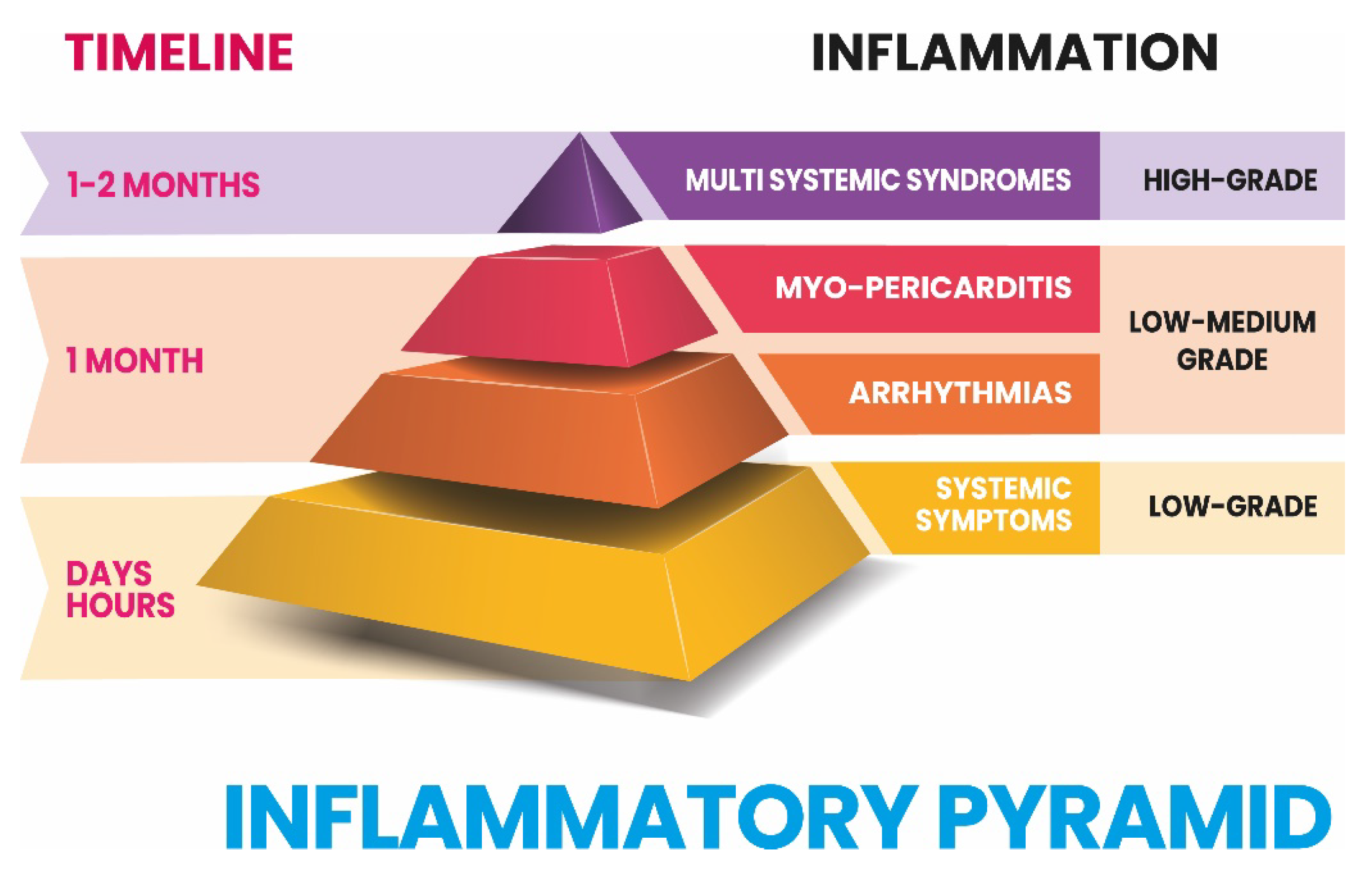

Table 1.
Kv 4.3, Kv 11.1 or hERG, and Kv 7.1 are Voltage-Gated Potassium Channels. They produce three outward currents of K+: one in AP 1 (Ito), and two in AP 3 (IKr,IKs). Conversely, Kir 2.1 / 2.3 channels produce inward current in AP 4 (IK1). Proinflammatory cytokines interfere with the physiological function of all the currents represented here, excluding the inward current IK1.
Table 1.
Kv 4.3, Kv 11.1 or hERG, and Kv 7.1 are Voltage-Gated Potassium Channels. They produce three outward currents of K+: one in AP 1 (Ito), and two in AP 3 (IKr,IKs). Conversely, Kir 2.1 / 2.3 channels produce inward current in AP 4 (IK1). Proinflammatory cytokines interfere with the physiological function of all the currents represented here, excluding the inward current IK1.
| Channel | Current | Current type | Ion | AP phase | Interference |
|---|---|---|---|---|---|
| Kv 4.3 | Ito | Outward | K+ | 1 | IL-1β, TNF-α |
| L-type | ICa,L | Inward | Ca2+ | 2 | IL-1β, IL-6 |
| Kv 11.1 hERG | IKr | Outward | K+ | 3 | IL-6, TNF-α |
| Kv 7.1 | IKs | Outward | K+ | 3 | TNF-α |
| Kir 2.1/2.3 | IK1 | Inward | K+ | 4 |
Table 2.
Summary of some effects determined by the injection of COVID-19 mRNA vaccines.
| Potential effects after COVID-19 mRNA vaccination. | Ref. |
|---|---|
| Endothelial dysfunctions produced by the Spike protein. | [97] |
| Actions of the Spike protein on the Angiotensin II / AT1 axis. | [127,128,129,130,131,132,133,134,135,136,137,138] |
| Excessive Th1-type immune responses. | [199] |
| Persistence of the Spike protein in circulation for a prolonged period of time. | [190] |
| Prolonged immune and inflammatory response against the Spike protein. | [189,190] |
| Strong pro-inflammatory activity of LNPs. | [141,142,143,144,145,146,147,148] |
| Spike protein alone can easily reach the myocardium. | [98,101] |
| Spike protein was found in Cardiomyocytes (CMs). | [101] |
| Different levels of expression of pro-inflammatory cytokines over time. | [189,198] |
| Circulating CoV-2-S1 is a TLR4-recognizable alarmin that may harm the CMs by triggering their innate immune responses. | [98] |
| TLR4 initiates the expression of several pro-inflammatory genes, cell surface molecules, and chemokines through the MyD88-dependent pathway, which exacerbates the damage to myocardium. | [99] |
| Activation of TLR4 and the TLR4 / NFκB axis in cardiomyocytes by the Spike protein. | [11] |
| Unmitigated TLR4 activation may lead to increased risk for cardiac inflammation. | [100] |
| CoV-2-S1 activates TLR4 signaling to induce pro-inflammatory responses in murine and human macrophages. | [102] |
| Diffuse myocardial macrophages infiltration in the patient biopsy sample, suggest an increased level of IL-18 produced by monocytes and macrophages in the heart with COVID-19 vaccine-related myo-pericarditis. | [76] |
| In an inflammatory microenvironment, caspase-1 is regulated by NF-κB, and this enzyme facilitates the conversion of pro-IL-18 in IL-18. | [77] |
| Lymphocytic infiltration with predominant immunostaining for CD8 and CD68-positive cells (macrophages) is present in myocarditis following COVID-19 mRNA vaccines. | [79] |
| Vaccinated mice showed signs of myocarditis 2 days after injection of the second dose of BNT162b2 vaccine. | [75] |
| Free spike antigen was detected in the blood of adolescents and young adults who developed post-mRNA vaccine myocarditis. | [235] |
Disclaimer/Publisher’s Note: The statements, opinions and data contained in all publications are solely those of the individual author(s) and contributor(s) and not of MDPI and/or the editor(s). MDPI and/or the editor(s) disclaim responsibility for any injury to people or property resulting from any ideas, methods, instructions or products referred to in the content. |
© 2023 by the authors. Licensee MDPI, Basel, Switzerland. This article is an open access article distributed under the terms and conditions of the Creative Commons Attribution (CC BY) license (http://creativecommons.org/licenses/by/4.0/).
Copyright: This open access article is published under a Creative Commons CC BY 4.0 license, which permit the free download, distribution, and reuse, provided that the author and preprint are cited in any reuse.


