

Submitted:
17 February 2022
Posted:
21 February 2022
You are already at the latest version
Preprints on COVID-19 and SARS-CoV-2
Abstract
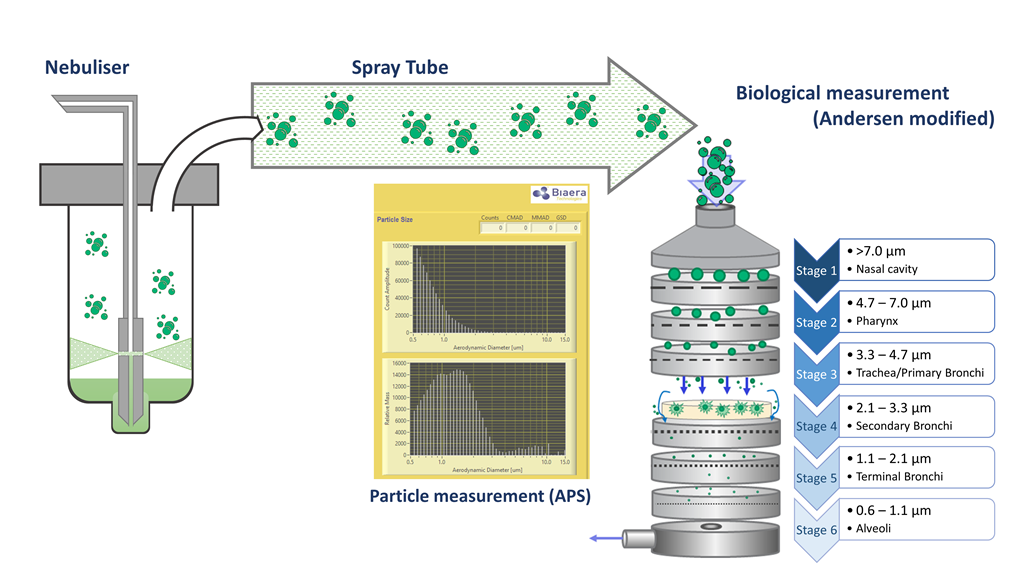
Little is understood about the impact of nebulisation on the viability of SARS-CoV-2. In this study, a range of nebulisers with differing methods of aerosol generation were evaluated to determine SARS-CoV-2 viability following aerosolisation. The aerosol particle size distribution was assessed using an aerosol particle sizer (APS) and SARS-CoV-2 viability was determined after collection into liquid media using All-Glass Impingers (AGI). Viable particles of SARS-CoV-2 were further characterised using the Collison 6-jet nebuliser in conjunction with novel sample techniques in an Andersen size-fractioning sampler to predict lung deposition profiles. Results demonstrate that all the tested nebulisers can generate stable, polydisperse aerosols (Geometric standard deviation (GSD) circa 1.8) in the respirable range (1.2 to 2.2µm). Viable fractions (PFU/particle, the virus viability as a function of total particles produced) were circa 5x10^-3 and were not significantly affected by relative humidity. The novel Andersen sample collection methods successfully captured viable virus particles across all sizes; with most particle sizes below 3.3µm. MMADs (Mass Median Aerodynamic Diameters) were calculated from linear regression of log10-log10 transformed cumulative PFU data, and calculated MMADs accorded well with APS measurements and did not differ across collection method types. This data will be vital in informing animal aerosol challenge models, and infection prevention and control policies.
Keywords:
SARS-CoV-2
; aerosols
; particles
; viable
; respirable
; sizing
; sampling
Copyright: This open access article is published under a Creative Commons CC BY 4.0 license, which permit the free download, distribution, and reuse, provided that the author and preprint are cited in any reuse.


