

Submitted:
08 September 2026
Posted:
09 September 2026
Read the latest preprint version here
Preprints.org 2023 Most Popular Preprints Award Winner Collection
Abstract
This paper presents a proof of the Riemann Hypothesis (RH), in which the divisibility of entire functions arising from the symmetric functional equation, the uniqueness of zero multiplicities, and the Euler product (which guarantees the divisibility of entire functions by confining all non-trivial zeros of the completed Riemann zeta function \(\xi(s)\) to the critical strip) play pivotal roles. We first develop a new absolutely and uniformly convergent expression for \(\xi(s)\) by pairing the conjugate zeros \(\rho_i\) and \(\bar{\rho}_i\), counted with their multiplicities, in the Hadamard product, i.e. \[ \xi(s)=\xi(0)\prod_{\rho}\Bigl(1-\frac{s}{\rho}\Bigr) =\xi(0)\prod_{i=1}^{\infty}\Bigl(1-\frac{s}{\rho_i}\Bigr)\Bigl(1-\frac{s}{\bar{\rho}_i}\Bigr) =\xi(0)\prod_{i=1}^{\infty}\Bigl(\frac{\beta_i^2}{\alpha_i^2+\beta_i^2}+\frac{(s-\alpha_i)^2}{\alpha_i^2+\beta_i^2}\Bigr)^{m_{i}} \] where \(\rho\) ranges over all zeros of \(\xi(s)\), \((\rho_i, \bar\rho_i)\) range over all conjugate zero pairs of \(\xi(s)\), \(\rho_i=\alpha_i+j\beta_i\) with \(0<\alpha_i<1\), \(0<|\beta_1|\leq|\beta_2|\leq \cdots\), \(\sum_{i=1}^{\infty} \frac{1}{\beta_i^{2}}<\infty\), and \(m_i\geq 1\) is the multiplicity of the \(i\)-th quadruplet of zeros \((\rho_i, \bar\rho_i, 1-\rho_i, 1-\bar\rho_i)\). Then, according to the symmetric functional equation \(\xi(s)=\xi(1-s)\), we obtain \[\prod_{i=1}^{\infty}\Big{(}1+\frac{(s-\alpha_i)^2}{\beta_i^2}\Big{)}^{m_{i}}=\prod_{i=1}^{\infty}\Big{(}1+\frac{(1-s-\alpha_i)^2}{\beta_i^2}\Big{)}^{m_{i}}\] which, owing to the divisibility of entire functions, uniqueness of \(m_i\), and the irreducibility of each real quadratic polynomial factor, is finally equivalent to \[\alpha_i=\frac{1}{2}, 0<|\beta_1|<|\beta_2|<|\beta_3|<\cdots, i=1, 2, 3, \dots\] \noindent Thus, we conclude that the RH is true.
Keywords:
Riemann Hypothesis
; Hadamard product
; symmetric functional equation
; divisibility of entire functions
; uniqueness of zero multiplicities
; Euler product
; irreducibility of real quadratic polynomial factor
1. Introduction
The Riemann zeta function is originally defined in the half-plane by the absolutely convergent series
The connection between the above-defined Riemann zeta function and prime numbers was discovered by Euler, i.e., the famous Euler product
where p runs over the prime numbers.
Riemann showed in his paper in 1859 how to extend the zeta function to the whole complex plane by analytic continuation [1]
where is the symbol adopted by Riemann to represent the contour integral from to around a domain which includes the value 0 but no other point of discontinuity of the integrand in its interior, ’j’ is the imaginary unit ().
Or equivalently,
where is the Jaccobi theta function, is the Gamma function in the following Weierstrass expression
where is the Euler-Mascheroni constant.
As shown by Riemann, extends to as a meromorphic function with only a simple pole at , with residue 1, and satisfies the following functional equation
The Riemann zeta function has zeros at the negative even integers: , , , , … and one refers to them as the trivial zeros. The other zeros of are complex numbers, i.e., non-trivial zeros.
In 1896, Hadamard [2] and Poussin [3] independently proved that no zeros could lie on the line , together with the functional equation and the fact that there are no zeros with real part greater than 1, this showed that all non-trivial zeros must lie in the interior of the critical strip. Later on, Hardy (1914) [4], Hardy and Littlewood (1921) [5] showed that there are infinitely many zeros on the critical line .
To give a summary of the related research works on the RH, we have the following results on the properties of the non-trivial zeros of [2,3,4,5,6].
Lemma 1: Non-trivial zeroes of , noted as , have the following properties
1) The number of non-trivial zeroes is infinity;
2) ;
3) ;
4) are all non-trivial zeroes.
As further study, the completed zeta function is proposed, i.e.
It is well-known that is an entire function of order 1. This implies is analytic, and can be expressed as infinite product of polynomial factors, in the whole complex plane . In addition, replacing s with in Eq.(6), and combining Eq.(5), we obtain the following functional equation
According to the definition of , and recalling Eq.(4), the trivial zeros of are canceled by the poles of . The zero of and the pole of cancel; the zero and the pole of cancel [7,8,9]. Thus, all the zeros of are exactly the nontrivial zeros of . Then we have the following Lemma 2.
Lemma 2: The zeros of coincide with the non-trivial zeros of .
Consequently, the following two statements are equivalent.
Statement 1: All the non-trivial zeros of have real part equal to .
Statement 2: All zeros of have real part equal to .
To prove the RH, a natural thinking is to estimate the numbers of non-trivial zeros of inside or outside some certain areas according to Argument Principle. Along this train of thought, there are many research works. Let denote the number of non-trivial zeros of inside the rectangle: , and let denote the number of non-trivial zeros of on the line . Selberg proved that there exist positive constants c and , such that [10], later on, Levinson proved that [11], Lou and Yao proved that [12], Conrey proved that [13], Bui, Conrey and Young proved that [14], Feng proved that [15], Wu proved that [16].
On the other hand, many non-trivial zeros have been calculated by hand or by computer programs. Among others, Riemann found the first three non-trivial zeros [17]. Gram found the first 15 zeros based on Euler-Maclaurin summation [18]. Titchmarsh calculated the 138th to 195th zeros using the Riemann-Siegel formula [19,20]. Here are the first three (pairs of) non-trivial zeros: .
The idea of this paper originates from Euler’s work on proving the famous equality
This result was deduced by comparing the coefficients of two infinite expressions of : one as a power series and the other as an infinite product,
Motivated by this approach, we infer that can be factored into factors of the form , which is achieved by pairing and in the Hadamard product representation of , i.e. .
The Hadamard product expansion of , first proposed by Riemann and later rigorously justified by Hadamard [21], is given by
where , runs over all zeros of .
Hadamard showed that to ensure the absolute convergence of this infinite product expansion, and must be paired. Later in Section 4, we will demonstrate that pairing with (together with the boundedness of guaranteed by the Euler product) also ensures the absolute and uniform convergence of the infinite product on compact subsets of .
2. Preliminary Lemmas
This section provides preliminary lemmas supporting the proof of the key lemma - Lemma 6 in the next section.
We begin with the ring of real polynomials , defined as
and equipped with the operations + (addition) and · (multiplication).
The ring of real polynomials is a subset of the ring of entire functions, which is defined as the set of all holomorphic functions on the whole complex plane , together with the operations of addition and multiplication, denoted as [22,23].
Both rings possess properties of divisibility, coprimality, and the greatest common divisor, denoted as "gcd". There are also differences between these two rings. Among others, the polynomial ring is a unique factorization domain (UFD), while the ring of entire functions is not a UFD. For entire functions, their divisibility, coprimality and common factors are determined by the relationships between their zero sets [23,24].
Lemma 3: Let be an entire function on with . Suppose converges absolutely and uniformly on compact subsets of , where each is irreducible of degree . If is irreducible of degree d and divides , then divides for some .
Proof: Let be a root of , i.e., . Since , we have . By absolute convergence of at , there exists at least one index such that , otherwise for all i, then converges to a non-zero limit, contradicting .
As and are irreducible in with , they share the root . Thus:
- If , then and for , so .
- If , then both and have roots , so for , hence .
In both cases, divides .
That completes the proof of Lemma 3.
Remark: Although the uniform convergence is not used directly in the proof of Lemma 3, it guarantees (by Weierstrass’s theorem) that the infinite product defines an entire function.
The following Lemma 4 and Lemma 5 help to understand the finiteness and uniqueness of the multiplicities of zeros of .
Lemma 4: Let be a non-zero entire function, and let be a zero of . Then the multiplicity of is a finite positive integer.
Proof: Let , be an entire function, which means it is holomorphic on the whole complex plane. Suppose has a zero at of multiplicity m, then , where is also an entire function and .
Assume for contradiction that m is infinite, which implies there exists an accumulation point of zeros in the neighbor of . Then, by Identity Theorem for holomorphic functions, and considering "0" is also an entire function, we have , which contradicts the given condition that . Thus, the assumption is false, i.e., m must be a finite positive integer.
That completes the proof of Lemma 4.
Remark: Statements similar to Lemma 4 can be found in Ref.[25] and other related textbooks/monographs.
Lemma 5: Let be a non-zero entire function, and let be a zero of . Then the multiplicity of is unique.
Proof: Let , be an entire function, which has a multiple zero at of multiplicity m. We can write: , where is also an entire function and .
Assume for contradiction that there exists another integer such that n is also a multiplicity of the zero . This means we can also write: , where is an entire function and .
Since both expressions for must be equal, we then obtain . Without loss of generality, consider , then we have: , which is a contradiction to . Thus, the assumption is false, i.e., the multiplicity of a zero of any non-zero entire function is unique.
That completes the proof of Lemma 5.
Remark: Based on Lemma 4 and Lemma 5, the multiplicity of the i-th quadruplet of zeros of is finite and uniquely determined.
3. Key Lemma
In this section, we prove the key lemma - Lemma 6, which is substantial for the proof of the RH. The entire function considered in Lemma 6, has the same zero set as . In fact, they differ only by a constant (see Eq.(29) in Section 4 for more details).
Lemma 6: Given a symmetric entire function with the infinite product representation absolutely and uniformly convergent on compact subsets of :
where is an irreducible quadratic polynomial in with zeros and ranging over all conjugate zero pairs, and are real numbers with , , and is the uniquely determined multiplicity of the i-th quadruplet of zeros of : .
Then we have
Remark: It is worth pointing out that the absolute and uniform convergence on compact subsets of serves two purposes here: absolute convergence justifies the rearrangement of factors in the infinite product, while uniform convergence guarantees that the infinite product defines an entire function.
Proof: Considering
we have from and Eqs.(11)-(12) that
where the factor appears times in any order.
Based on the conditions , and the Weierstrass M-Test, both sides of Eq.(15) are infinite products absolutely and uniformly convergent on compact subsets of , see the next section for relevant details. Hence each side of Eq.(15) can be rearranged into any quadratic polynomial times the remaining product, which also converges absolutely and uniformly on compact subsets of (This reduces to the fact that omitting finitely many terms does not affect the convergence of an infinite product.), thus defines an entire function. Then by the divisibility property of entire functions [23,24], each quadratic factor on one side divides the product on the other side, i.e.,
where "∣" is the divisible sign, .
Both polynomials and have discriminant . Hence they are irreducible in . By Lemma 3, Eq.(16) yields (Eq.(16a) plays the same role as Eq.(16) and can be ignored):
For the special kind of polynomials in Eq.(17), "divisible" means "equal", which can be verified by comparing the like terms in the following equation to get .
Further, due to the uniqueness of the multiplicity , the only solution to Eq.(17) is
i.e.,
since otherwise we have
i.e.,
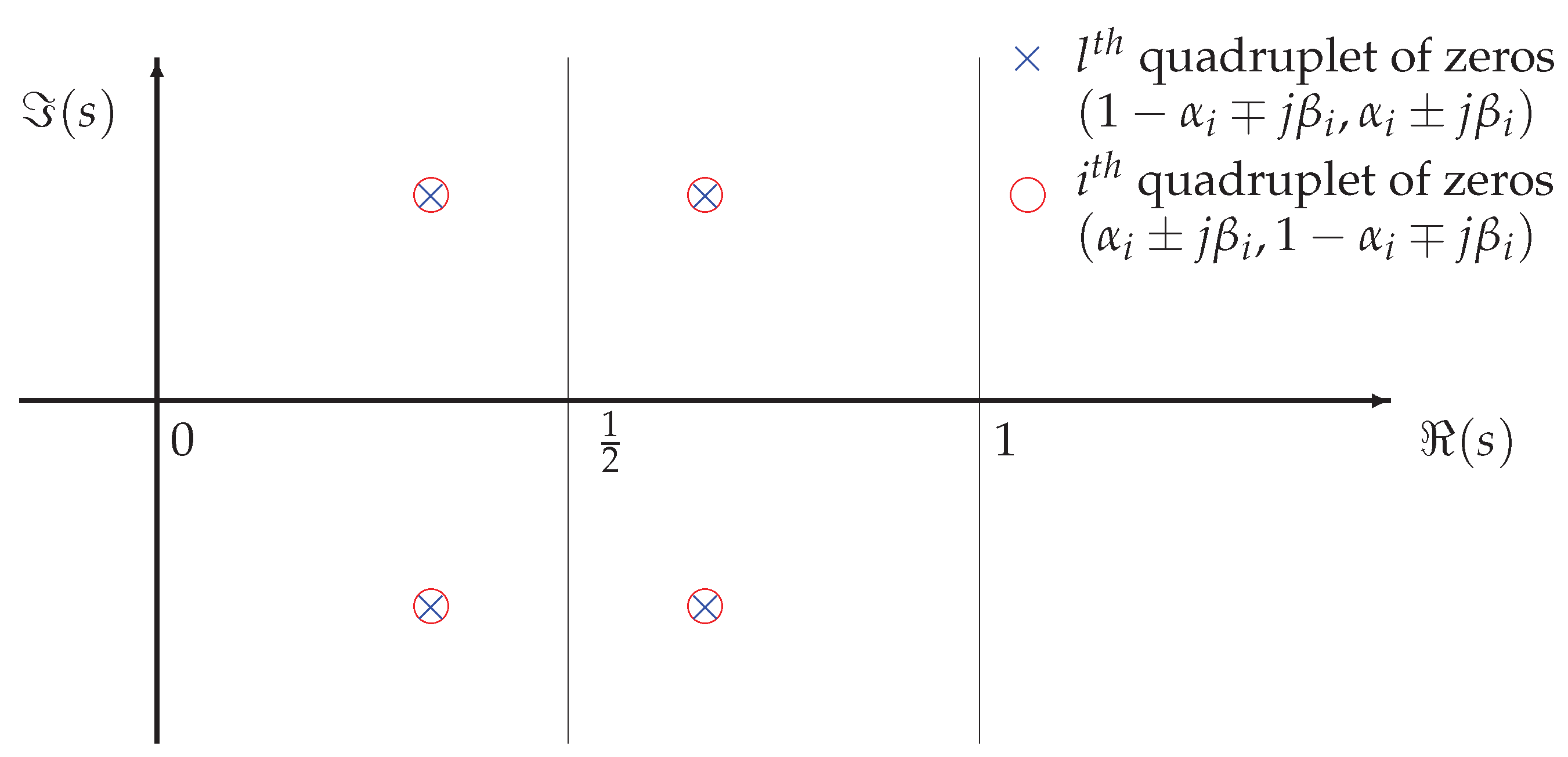
Eq.(19c) leads to , which means the i-th and l-th quadruplets of zeros coincide on the complex plane (see Figure 1 for illustration), violating the uniqueness of .
Therefore, by comparing the like terms in Eq.(19a), we obtain . Further, to ensure the uniqueness of while , we need to restrict the values to be distinct, i.e., . Thus, we obtain
On the other hand, we have the following fact.
From Eqs.(20) and (21), we finally get Eq.(13).
That completes the proof of Lemma 6.
Remark: In Lemma 6 and similar situations, the condition with (where each appears times) is equivalent to with , where is the multiplicity of the i-th quadruplet of zeros .
Remark: Lemma 6 is not applicable to the Davenport-Heilbronn counterexample. That is because, in the proof of Lemma 6, we need the conditions and to guarantee the divisibility of the special kind of entire functions expressed as . Unfortunately, the Davenport-Heilbronn counterexample does not have the property that all its zeros lie inside the critical strip since it possesses no Euler product; therefore, one cannot deduce that from without .
In addition, Lemma 7 will also be used in the proof of the RH in the next section.
Lemma 7: The infinite product converges to a non-zero constant, given the conditions: , and is the multiplicity of the i-th quadruplet of zeros of .
Proof: Let , then . Since and , we have . By the given condition (with each appearing times), we have equivalently (with ). Hence , which guarantees that the product converges to a non-zero constant.
That completes the proof of Lemma 7.
4. A Proof of the RH
This section presents a proof of the Riemann Hypothesis. We first prove that Statement 2 of the RH is true, and then by Lemma 2, Statement 1 of the RH is also true. To be brief, to prove the Riemann Hypothesis, it suffices to show that in the new expression of as shown in Eq.(25).
Proof of the RH: The proof proceeds in three steps.
Step 1:
It is well-known that zeros of always come in complex conjugate pairs. Then by pairing and in the Hadamard product as shown in Eq.(10), we have
where (according to Lemma 1) are real numbers with , ranges over all zeros of , range over all conjugate zero pairs of .
The absolute convergence of the infinite product in Eq.(22) in the form
depends on the convergence of infinite series (since ), which is a well-known fact according to Theorem 2 in Section 2, Chapter IV of Ref.[9] (also listed in Appendix for convenience). Thus, the infinite products as shown in Eq.(23) and Eq.(22) are absolutely convergent on the whole complex plane .
According to the Weierstrass M-test, these two infinite products as shown in Eq.(23) and Eq.(22) are also uniformly convergent on any compact subset of . Indeed, let be an arbitrary compact set and let . Then for all and all i, since , we have
Hence
Therefore, both infinite products as shown in Eq.(23) and Eq.(22) converge absolutely and uniformly on K.
Further, considering the absolute convergence of
we have the following new expression of by putting all the possible multiple factors (zeros) together:
where is the multiplicity of the i-th quadruplet of zeros , .
Step 2: Replacing s with in Eq.(25), we obtain the infinite product expression of , i.e.,
Step 3: According to the functional equation , and considering Eq.(25) and Eq.(26), we have
which is equivalent to
Since , then .
Further we have , that means and have the same convergence, i.e., . Thus, the infinite products on both sides of Eq.(28) are absolutely and uniformly convergent on compact subsets of , with reference to the analysis of Eqs. (22) and (23) in Step 1.
Furthermore, both sides of Eq.(28) converge to entire functions, because they differ with the entire functions and respectively by a non-zero multiplicative constant, i.e.
where c is a non-zero constant according to Lemma 7.
In addition, the polynomial factors in both sides of Eq.(28), i.e., and have discriminant . Hence they are irreducible real polynomials of degree 2 in .
Finally, according to Lemma 6, Eq.(28) is equivalent to
Thus, we conclude that all the zeros of the completed zeta function have real part equal to , i.e., Statement 2 of the RH is true. According to Lemma 2, Statement 1 of the RH is also true, i.e., all the non-trivial zeros of the Riemann zeta function have real part equal to .
That completes the proof of the RH.
Funding
Finally, with this manuscript, the author pays tribute to Bernhard Riemann and other predecessor mathematicians. They are the shining stars in the sky of human civilization.
Data Availability Statement
This manuscript has no associated data.
Acknowledgments
I’d like to thank the following people, who helped illuminate issues in earlier drafts: Prof. Steven J. Miller (Department of Mathematics, Williams College), Prof. Thierry Robart (retired from Howard University), Dr. Victor Ignatov (Independent Researcher), Prof. Mark Kisin (Harvard University), Prof. Yingmin Jia (Beihang University), Prof. Tianguang Chu (Peking University), Prof. Guangda Hu (Shanghai University), Prof. Jiwei Liu (University of Science and Technology Beijing), Dr. Shangwu Wang (Beijing 99view Technology Limited, my classmate in Tsinghua University), and Mr. Jiajun Wang (Dali University, Yunnan Province, China). The author is also grateful to the editors and referees of PNAS for their constructive comments and suggestions. Special gratitude is extended to the preprint platform preprints.org for making this work permanently available and citable.
Conflicts of Interest
On behalf of all authors, the corresponding author states that there is no conflict of interest.
Appendix A
Theorem 2. [9] The function is an entire function of order one that has infinitely many zeros such that . The series diverges, but the series converges for any . The zeros of are the nontrivial zeros of .
References
- Riemann, B. Über die Anzahl der Primzahlen unter einer gegebenen Grösse. Monatsberichte Der Dtsch. Akad. Der Wiss. Zu Berl. 1859, 2, 671–680. [Google Scholar]
- Hadamard, J. Sur la distribution des zeros de la fonction ζ(s) et ses conseequences arithmetiques. In Bulletin de la Societe Mathematique de France; Reprinted in Borwein, et al.; 1896; Volume 14, pp. 199–220. [Google Scholar] [CrossRef]
- de la Vallee-Poussin, Ch. J. Recherches analytiques sur la theorie des nombers premiers. Ann. Soc. Sci. Brux. 1896, 20, 183–256. [Google Scholar]
- Hardy, G. H. Sur les Zeros de la Fonction ζ(s) de Riemann. In C. R. Acad. Sci. Paris; JFM 45.0716.04 Reprinted in; Borwein, et al., Eds.; 1914; Volume 158, pp. 1012–1014. [Google Scholar]
- Hardy, G. H.; Littlewood, J. E. The zeros of Riemann’s zeta-function on the critical line. Math. Z. 1921, 10(3-4), 283–317. [Google Scholar] [CrossRef]
- Pan, C. D.; Pan, C. B. Basic Analytic Number Theory, 2nd Edition; (in Chinese). Harbin Institute of Technology Press: Harbin, China, 2016; p. 160. ISBN 978-7-5603-6004-1. [Google Scholar]
- Ahlfors, L. V. Complex Analysis – An Introduction to the Theory of Analytic Functions of One Complex Variable, Third Edition; McGraw-Hill: New York, 1979; p. 217. [Google Scholar]
- Apostol, Tom M. Introduction to Analytic Number Theory; Springer: New York, 1998; p. 260. [Google Scholar]
- Karatsuba, A. A.; Nathanson, M. B. Basic Analytic Number Theory, Springer, Berlin, Heidelberg. Chapter IV. Section 2; 1993; pp. pages 56–57. [Google Scholar]
- Selberg, A. On the zeros of the zeta-function of Riemann. In Der Kong. Norske Vidensk. Selsk. Forhand.; Collected Papers; also, Ed.; Springer- Verlag, Berlin - Heidelberg - New York 1989, 1942; 15 Vol. I, p. 59-62 156-159. [Google Scholar]
- Levinson, N. More than one-third of the zeros of the Riemann zeta function are on σ=12. Adv. Math. 1974, 13, 383–436. [Google Scholar] [CrossRef]
- Lou, Shituo; Yao, Qi. A lower bound for zeros of Riemann’s zeta function on the line σ=12. Acta Math. Sin. (in Chinese). 1981, 24, 390–400. [Google Scholar]
- Conrey, J. B. More than two fifths of the zeros of the Riemann zeta function are on the critical line. J. Reine angew. Math. 1989, 399, 1–26. [Google Scholar] [CrossRef]
- Bui, H. M.; Conrey, J. B.; Young, M. P. More than 41% of the zeros of the zeta function are on the critical line. 2011. Available online: http://arxiv.org/abs/1002.4127v2.
- Feng, S. Zeros of the Riemann zeta function on the critical line. J. Number Theory 2012, 132(4), 511–542. [Google Scholar] [CrossRef]
- Wu, X. The twisted mean square and critical zeros of Dirichlet L-functions. Math. Z. 2019, 293, 825–865. [Google Scholar] [CrossRef]
- Siegel, C. L. Über Riemanns Nachlaß zur analytischen Zahlentheorie. In Quellen Studien zur Geschichte der Math. Astron. Und Phys. Abt. B: Studien; Reprinted in Gesammelte Abhandlungen; Springer-Verlag: Berlin, 1932; 2 Vol. 1, pp. 45–80. [Google Scholar]
- Gram, J. P. Note sur les zéros de la fonction ζ(s) de Riemann. Acta Math. 1903, 27, 289–304. [Google Scholar] [CrossRef]
- Titchmarsh, E. C. The Zeros of the Riemann Zeta-Function. In Proceedings of the Royal Society of London. Series A, Mathematical and Physical Sciences; The Royal Society, 1935; Volume 151, 873, pp. 234–255. [Google Scholar]
- Titchmarsh, E. C. The Zeros of the Riemann Zeta-Function. In Proceedings of the Royal Society of London. Series A, Mathematical and Physical Sciences; The Royal Society, 1936; Volume 157, 891, pp. 261–263. [Google Scholar]
- Hadamard, J. Étude sur les propriétés des fonctions entières et en particulier d’une fonction considérée par Riemann. J. De Mathématiques Pures Et. Appliquées 1893, 9, 171–216. [Google Scholar]
- Rudin, W. Real and Complex Analysis; McGraw-Hill: New York, 1987; p. 197. [Google Scholar]
- Helmer, Olaf. Divisibility properties of integral functions. Duke Math. J. 1940, 6(2), 345–356. [Google Scholar] [CrossRef]
- Conway, J. B. Functions of One Complex Variable I, Second Edition; Springer-Verlag: New York, 1978; p. 174. [Google Scholar]
- Markushevich, A. I. Entire Functions, Translated version in Chinese; Elsevier: New York, 1966; p. 41. [Google Scholar]
Figure 1.
Illustration of the coincided quadruplets of zeros.
Disclaimer/Publisher’s Note: The statements, opinions and data contained in all publications are solely those of the individual author(s) and contributor(s) and not of MDPI and/or the editor(s). MDPI and/or the editor(s) disclaim responsibility for any injury to people or property resulting from any ideas, methods, instructions or products referred to in the content. |
© 2026 by the authors. Licensee MDPI, Basel, Switzerland. This article is an open access article distributed under the terms and conditions of the Creative Commons Attribution (CC BY) license (http://creativecommons.org/licenses/by/4.0/).
Copyright: This open access article is published under a Creative Commons CC BY 4.0 license, which permit the free download, distribution, and reuse, provided that the author and preprint are cited in any reuse.