

Submitted:
23 June 2026
Posted:
23 June 2026
You are already at the latest version
Abstract
A physical claim rests on three separable supports: internal formal control, operational experimental contact, and reproducible computation. At laboratory scales these three move together. At extreme scales (Planck-regime gravity, cosmic horizons, high-dimensional simulations) they decouple. nWe develop the Clampdown Effect as a precise mathematical theory of that decoupling. A validation score $V_Q\in[0,1]$, formal pressure $W_Q$, operational pressure $S_Q$, and a six-channel error budget $E_Q$ are defined. A Pareto obstruction theorem is proved: under generic inter-channel coupling no admissible theory-instrument-computation triple simultaneously minimises all six error channels. The empirical equivalence classes of $T_Q$ under a fixed corridor threshold carry a natural metric $d_\theta$, and $S_Q$ descends to a Lipschitz-$1$ function on the quotient. Seven foundational axioms are shown to be mutually independent by explicit countermodels. The dynamic corridor criterion, the controlled avoidance theorem, the channel separation bound, and the stochastic Chebyshev corridor complete the calculus.
Keywords:
Clampdown Effect
; empirical reach
; validation calculus
MSC: Primary 00A30; Secondary 03A05, 68Q17, 81P05
1. Motivation and Scope
Physical theories are not uniformly exposed to evidence. At accelerator scales, a claim can be tested, repeated, and crossed against numerical predictions within the same programme. At Planck scales, near cosmic horizons, or inside a large Monte Carlo pipeline, the theory, the instrument, and the computation may each be tracking different objects [1,2]. The gap between formal mathematical control and operational physical contact is real, it is not uniform across scales, and it has no standard mathematical language in the existing literature on falsifiability [3,4], simulation validation [5,6,7,8], or uncertainty quantification [9,10,11,12].
The Clampdown Effect supplies that language. It is not a physical theory. It is a meta-level calculus for rating physical claims by the strength of their validation chain at a given scale. A claim is not called false because it is hard to test. It is assigned a score, a pressure value, and an error vector. Those three numbers then travel with the claim as it is extrapolated, compared, or cited in a review [16,19,24].
The framework tracks the triple
At ordinary scales these three correct one another. The correction mechanism breaks down when any one of them outruns the other two. The Clampdown Effect measures how fast and in which direction the breakdown occurs.
2. Five Decision Problems
Five concrete decision problems recur across fundamental physics. The framework solves each of them in the sense of supplying a common formal answer.
Problem 2.1
(Reach classification). Given a claim at scale ω, decide whether it is inside a stated validation corridor, near the edge, or outside at the chosen evidence threshold.
Problem 2.2
Problem 2.3
Problem 2.4
Problem 2.5
The common answer for all five is a tuple
defined in the sections that follow. The same comparison rules then apply regardless of which subfield raises the problem.
3. The Validation Quadruple
Fix a physical question
where X is a state space, Y an observation space, a family of model maps, and a domain of scale parameters. A point may be a scalar energy, a length, a curvature, a time, a computational depth, or a vector of several of these.1
A theory , an experimental arrangement , and a computational procedure together produce a validation score
Score 1 means full contact at the stated tolerance. Score 0 means no operational contact at that scale. Intermediate values measure the degree of contact, not truth.2
Definition 3.1
(Admissible validation class). For tolerance ,
where is the total error functional.
The total error decomposes as
: modelling error. : measurement error. : numerical discretisation error. : algorithmic approximation error. : interpretive error, the gap between what the mathematics produces and what the physical claim asserts. : control error, present when the measurement apparatus perturbs the system being measured [8,9].3
Definition 3.2
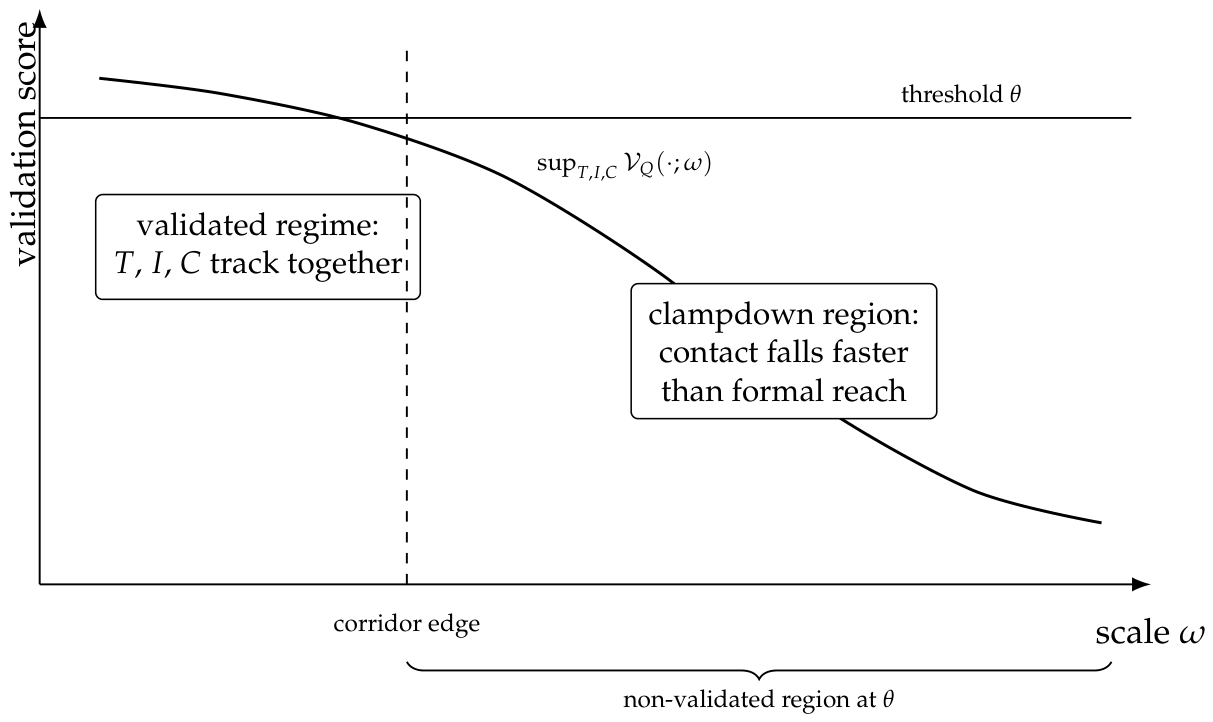
(Validation corridor). For threshold ,
The complement is the non-validated region at threshold θ.
A point outside the corridor is not false. It sits outside the current validation standard [10]. The distinction is not semantic: a claim can be outside the corridor while being formally well-defined, internally consistent, and predictively rich.
Figure 1.
Validation corridor. The supremum of over all admissible triples decays with scale. The corridor edge marks where it first drops below . Claims to the right are not false; they are unvalidated at this standard.
Figure 1.
Validation corridor. The supremum of over all admissible triples decays with scale. The corridor edge marks where it first drops below . Claims to the right are not false; they are unvalidated at this standard.
4. Formal and Operational Clampdown Pressure
Definition 4.1
(Formal clampdown pressure).
where scores internal formal control: consistency, regularity, convergence, stability, calculability.
Definition 4.2
(Operational clampdown pressure).
where incorporates formal control, measurement, computation, interpretation, and reproducibility.
Large pressure means tight clampdown. signals no formal deficiency. signals no validated contact. The inequality
says that full validation is harder than internal formal control.4
Definition 4.3
(Validation gap).
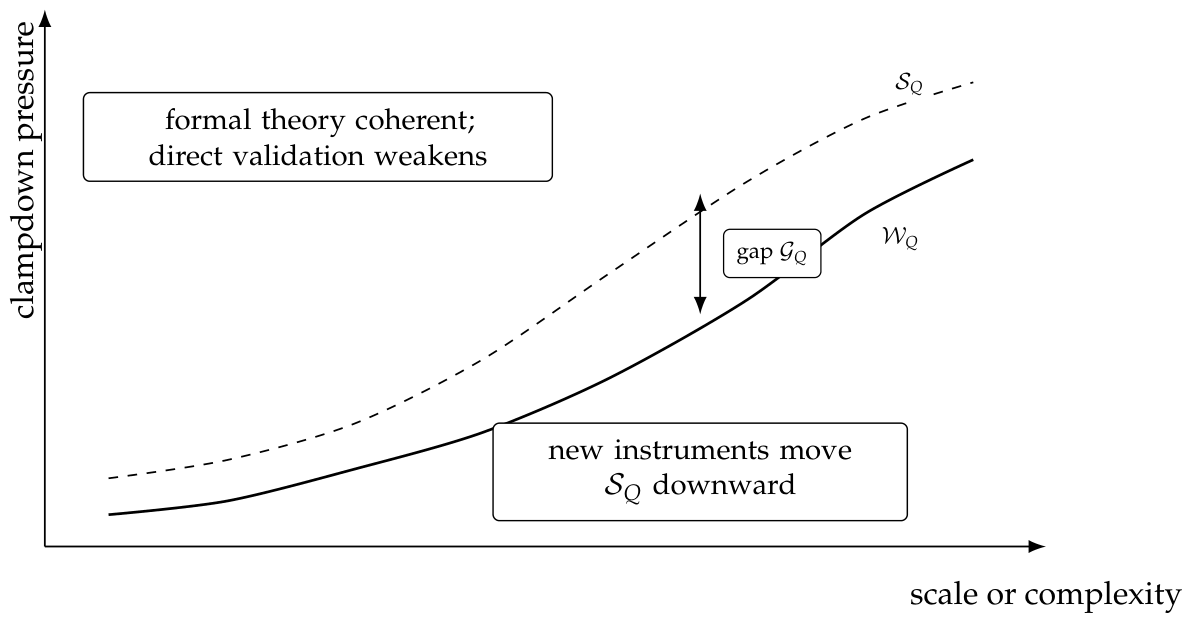
measures how much validation is lost in the step from formal theory to operational test. A large gap means formal reach has separated from observational control. New instruments or calculations can shrink ; the framework records that progress against the error functional, not against elegance [12].
Figure 2.
Solid: formal pressure . Dashed: operational pressure . The gap is the vertical distance between the two curves. It widens as scale grows and narrows when instruments improve.
Figure 2.
Solid: formal pressure . Dashed: operational pressure . The gap is the vertical distance between the two curves. It widens as scale grows and narrows when instruments improve.
5. Scale, Resources, and the Kardashev Parameter
Which experiments are possible depends on available energy, detector resolution, computational depth, and control fidelity [13]. Define a resource vector
for energy access, detector precision, temporal reach, computational capacity, and governance capacity. The Kardashev energy coordinate is one scalar projection of .5
With and , the validation map extends to
Set
If resources only improve validation, is non-increasing in . In practice, increasing any resource can introduce a new control error [10]. Write
where captures the ideal resource gain and is a backreaction penalty.6
Assumption 5.1
(Resource gain). There is a non-negative function such that
Assumption 5.2
(Backreaction onset). There are constants , exponents , and thresholds such that
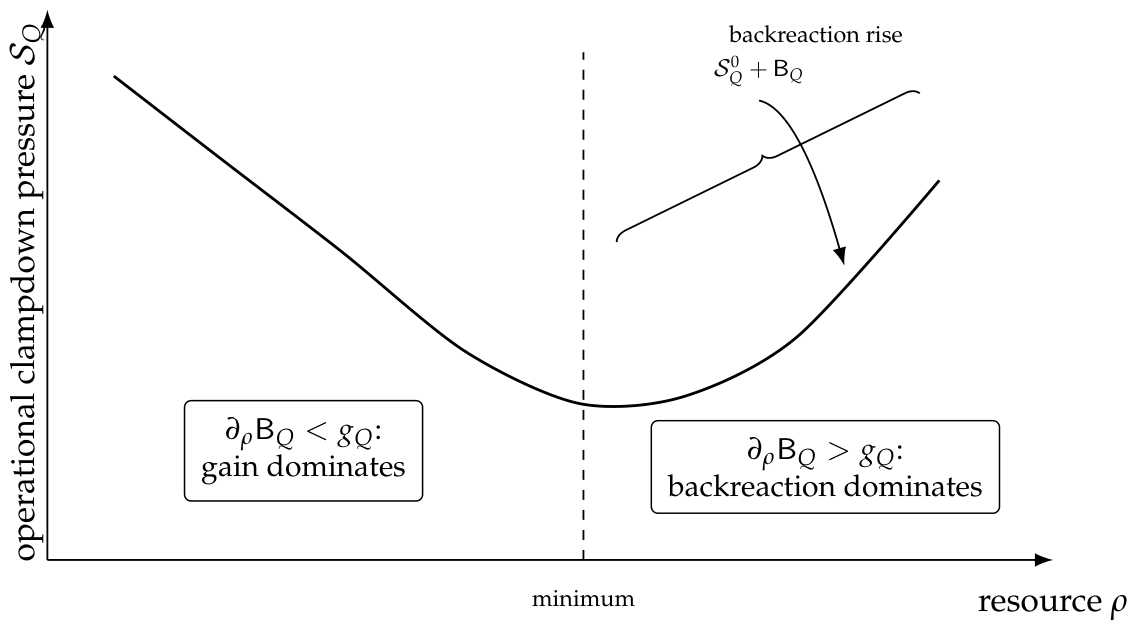
Proposition 5.1
(Non-monotone validation). Under Assumptions 5.1–5.2, if for some j
then increases as increases. More resources raise the operational clampdown pressure.
Proof.
Differentiate (5.4): . The first summand is at most . The second exceeds by hypothesis, so the sum is positive. □
Figure 3.
Operational clampdown pressure as a function of resource level. More resources help until the backreaction penalty begins to grow faster than the gain term . The minimum marks the optimal resource level for this question Q.
Figure 3.
Operational clampdown pressure as a function of resource level. More resources help until the backreaction penalty begins to grow faster than the gain term . The minimum marks the optimal resource level for this question Q.
6. The Separation Gap
Definition 6.1
(Separation gap). For ,
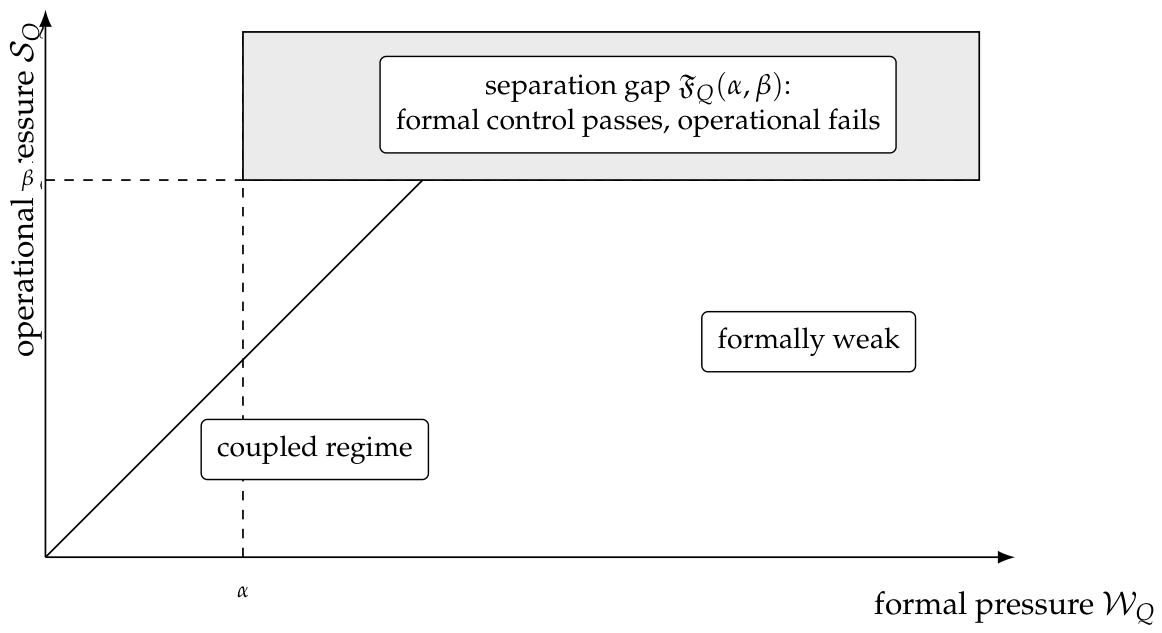
is the set of scale-resource pairs at which formal control is still acceptable () while operational validation is poor (). Two edges delimit the gap.
Definition 6.2
(Soft and hard edges). For :
The soft edge is a warning surface. The hard edge is where the validation map itself breaks down.
Lemma 6.1
(Gap inclusion).
Proof.
On : and , so . □
Figure 4.
Separation gap in the plane. The shaded rectangle is : formal pressure below , operational pressure above . The diagonal is .
Figure 4.
Separation gap in the plane. The shaded rectangle is : formal pressure below , operational pressure above . The diagonal is .
7. Error Growth and the Validation Edge
Along a scale path , write
for the error along the path.
Definition 7.1
(Validation edge). For tolerance ,
with if the set is empty.
Theorem 7.1
(Clampdown bound). Suppose
With ,
Proof.
For , multiply by and integrate to get . Setting this equal to and solving gives (7.4). For : ; set equal to . □
Some extrapolations fail not because the theory is false but because the validation chain loses precision faster than the claim grows [11,12]. Theorem 7.1 puts a finite time on that failure.
Definition 7.2
(Error percentile). With normalising scale ,
The percentile is a reporting device, not a probability. It makes a weak validation chain visible without requiring the reader to parse a six-component vector.
8. The Clampdown Index
Choose weights with and define
summing over the six channels in (3.2). Set
The index is bounded in and satisfies diminishing returns: when one the index approaches 1 regardless of the other channels.
Lemma 8.1
(Jensen bound).
Proof.
Concavity of and Jensen’s inequality give . □
Proposition 8.1
(Dominant channel). If and , then .
Proof.
; substitute into (8.2). □
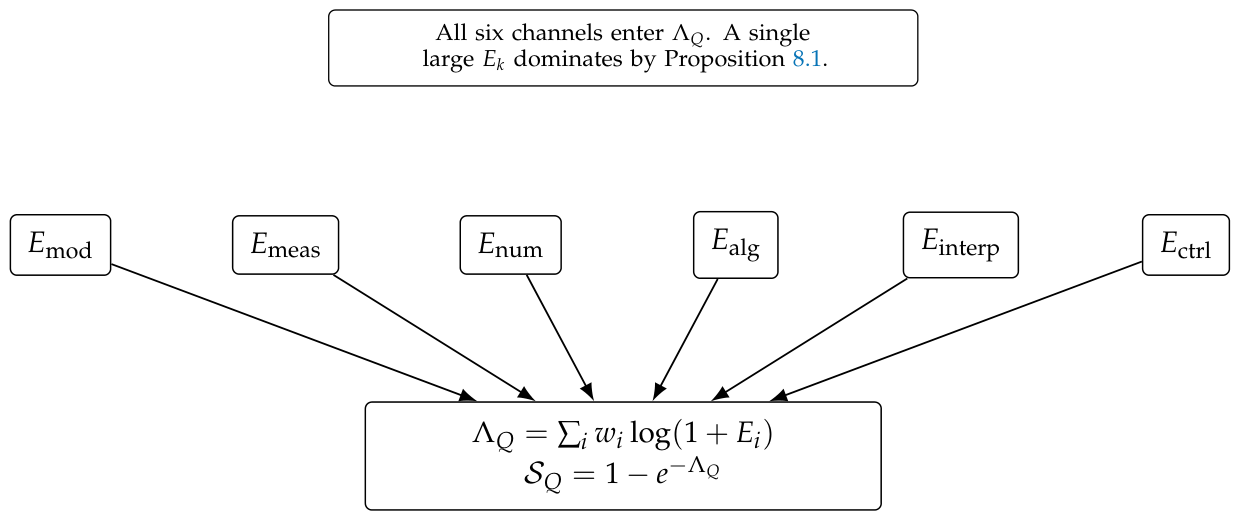
One uncontrolled channel is enough to push above any fixed threshold, even if the other five channels are near zero.
Figure 5.
The six-channel error budget feeding into the clampdown index and thence into the operational pressure . Channel widths are equal here; actual weights can differ.
Figure 5.
The six-channel error budget feeding into the clampdown index and thence into the operational pressure . Channel widths are equal here; actual weights can differ.
9. The Validation Triangle
Theory and experiment no longer form a dyad in modern physics. Numerical relativity, lattice QCD, large Monte Carlo pipelines, and machine-learned inference chains make computation a third, independent leg of the validation structure [5,7,8]. A failure in any leg contaminates the whole.
Let
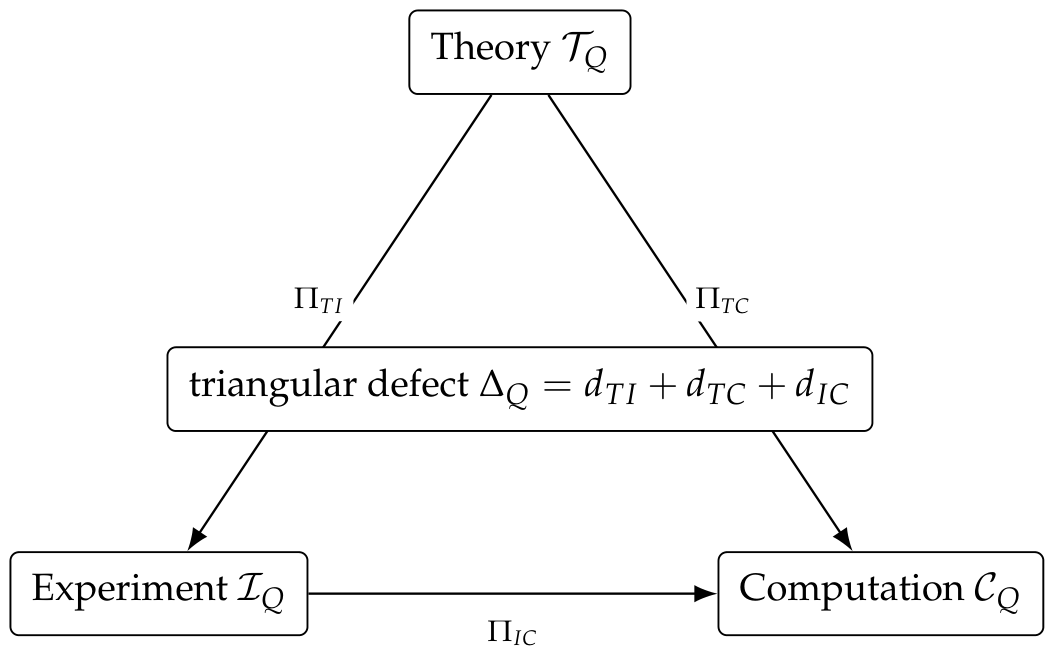
where are compatibility maps between pairs of legs. The triangular defect is
Small means the three legs speak the same language.
Proposition 9.1
(Triangle lower bound). If and on , then
Proof.
; apply the definition of . □
Figure 6.
The three-leg validation structure. Each compatibility map contributes to . A high defect means at least two legs are tracking different objects.
Figure 6.
The three-leg validation structure. Each compatibility map contributes to . A high defect means at least two legs are tracking different objects.
10. Two-Sided Scale Pressure
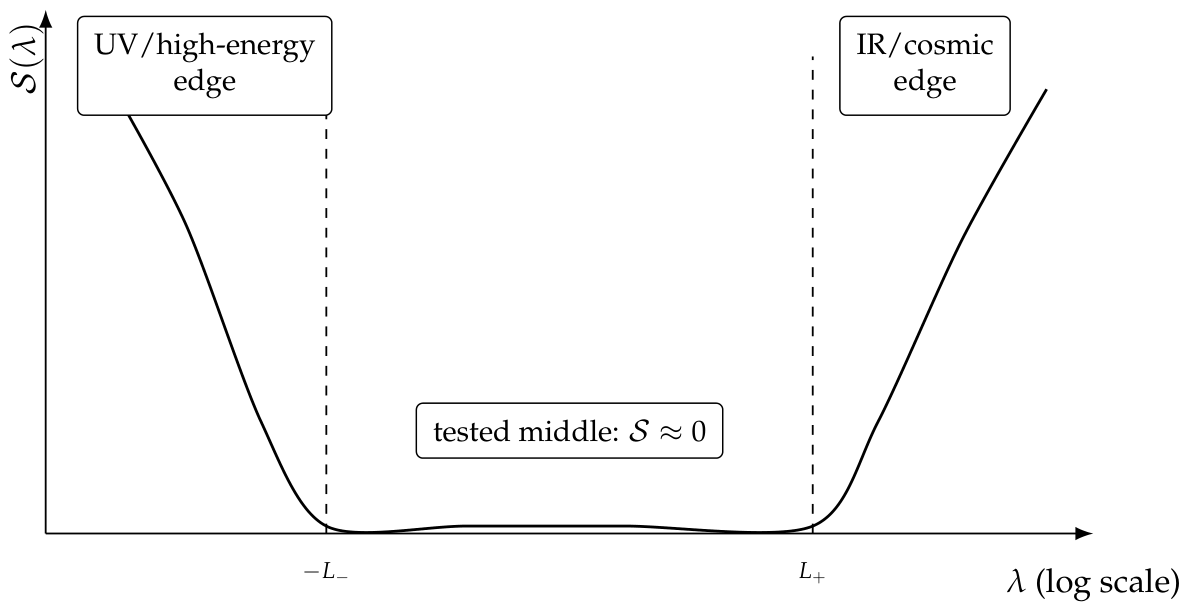
Let be a logarithmic scale, with the laboratory reference. Negative : short distance, high energy. Positive : cosmological or long-time. A two-sided model is
mark the edges of the well-tested middle regime. and control the rate of growth beyond those edges [20,21,24].
Lemma 10.1
(Middle stability). For , the two-sided model gives .
Proof.
Both positive parts vanish; . □
Remark 10.1. In practice one adds measurement and modelling baseline errors. Equation (10.1) isolates only the extra pressure from scale extrapolation.
Figure 7.
Two-sided scale pressure from (10.1). The tested middle is flat near zero. Pressure grows as toward the UV and toward the IR.
Figure 7.
Two-sided scale pressure from (10.1). The tested middle is flat near zero. Pressure grows as toward the UV and toward the IR.
11. Computational Clampdown
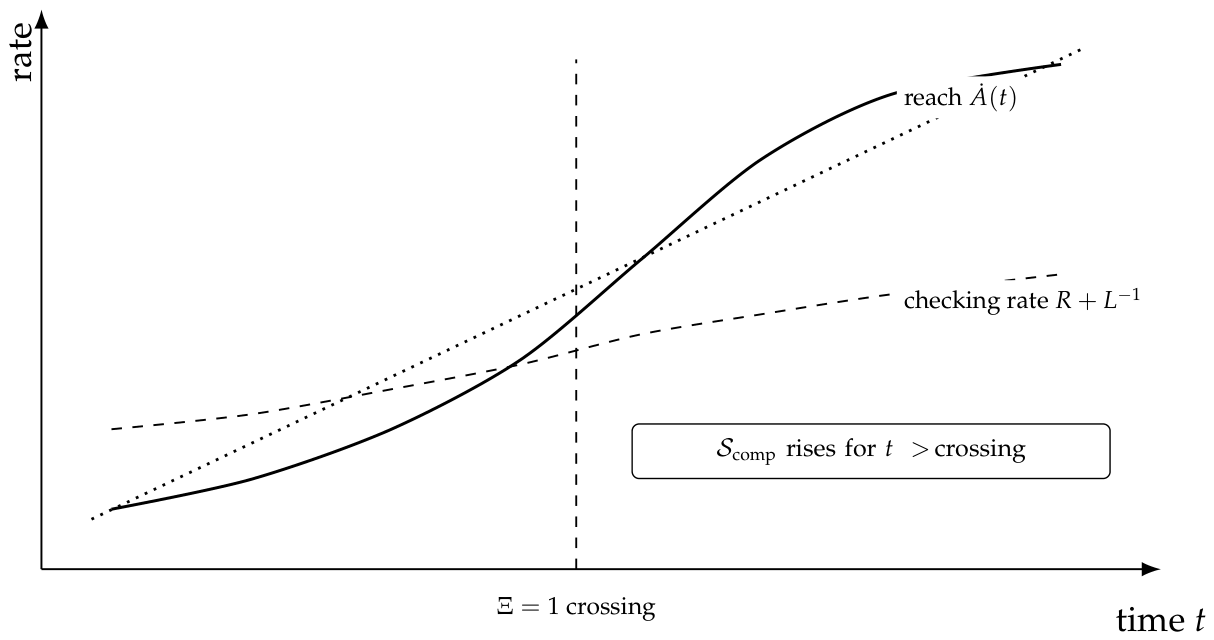
A calculation chain with reach advancing faster than independent checking rate accumulates unverified output. Define the acceleration ratio
where is review latency [15]. When , output grows faster than it can be checked.
Definition 11.1
(Computational clampdown pressure).
where weights the severity of each moment of excess.
Proposition 11.1
(Sustained excess bound). If and on , then
Proof.
Restrict the integral in (11.2) to and bound . □
Figure 8.
Computational clampdown. Solid: calculation reach . Dashed: checking rate . At the crossing, exceeds 1 and begins to accumulate.
Figure 8.
Computational clampdown. Solid: calculation reach . Dashed: checking rate . At the crossing, exceeds 1 and begins to accumulate.
12. The Shadow Edge and Controlled Avoidance
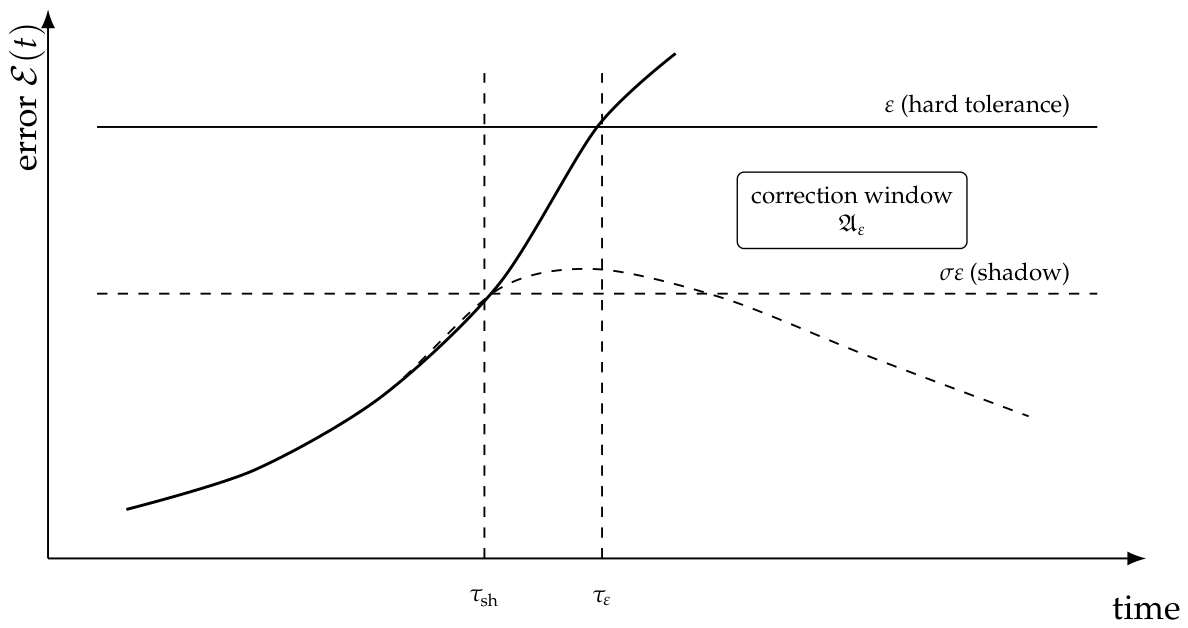
Let error evolve under an uncontrolled drift F and a corrective term G:
Definition 12.1
(Shadow edge). With , the shadow edge is
where evolves under F alone (no correction).
Definition 12.2
(Correction window).
where is the uncontrolled validation edge from Section 7.
Theorem 12.1
(Controlled avoidance). Suppose , , and . If
then constant control makes repelling from below.
Proof.
At : by (12.4). The vector field points inward; the boundary is repelling. □
Figure 9.
Shadow edge and correction window. Solid: uncontrolled trajectory crosses at . Dashed: controlled trajectory, triggered at , stays below . Theorem 12.1 gives the condition on .
Figure 9.
Shadow edge and correction window. Solid: uncontrolled trajectory crosses at . Dashed: controlled trajectory, triggered at , stays below . Theorem 12.1 gives the condition on .
13. Theory Comparison
For , define a comparison score
where A is empirical adequacy, K is model complexity (Kolmogorov length, parameter count, or a field-specific proxy), and [23].
Definition 13.1
(Validation dominance). validation-dominates on D if for all , with strict inequality on a set of positive measure.
14. Pareto Obstruction in the Error Space
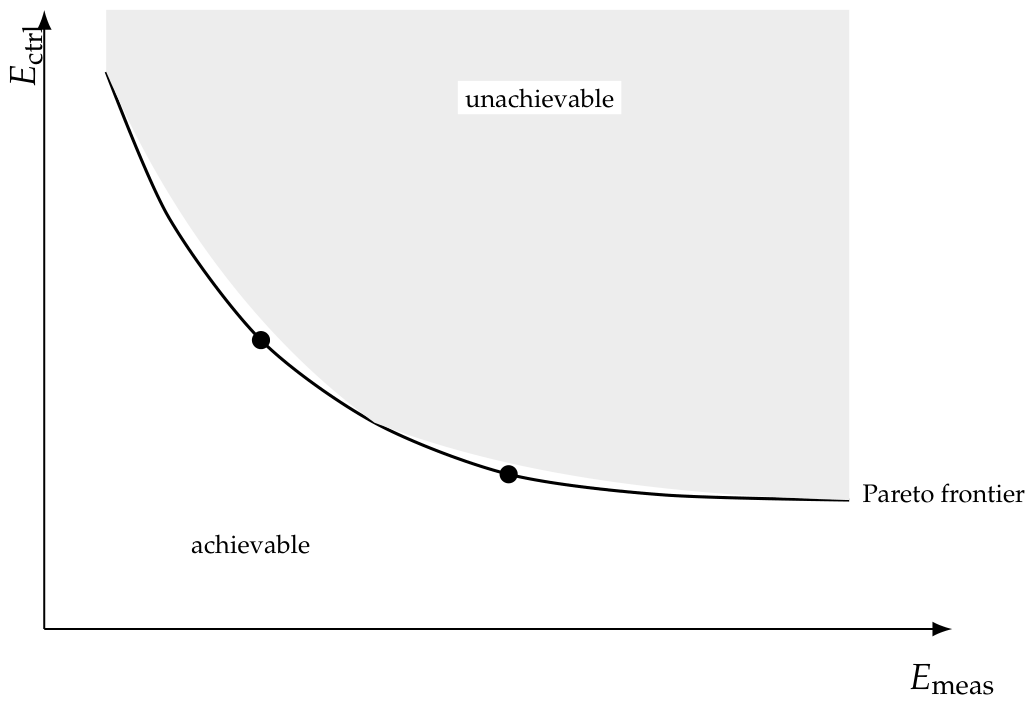
The six channels in (3.2) are not independently minimisable. The following theorem is the first result in this paper that depends essentially on the six-channel decomposition and cannot be stated without it.
Let . A triple is Pareto optimal for at if no admissible triple achieves a strictly smaller value in every channel simultaneously.
Assumption 14.1
(Channel coupling). There exist smooth coupling functions for such that
and the matrix has rank at some point in .
Theorem 14.1
(Pareto obstruction). Under Assumption 14.1, the Pareto frontier of at any is a non-trivial manifold. No single triple simultaneously attains for every .
Proof.
Suppose for contradiction that attains for all j. Then for all j at this point. Equation (14.1) with implies the vectors satisfy at least two linearly independent relations. Let be a coefficient vector realising one such non-trivial relation: with . Combined with the simultaneous zero-gradient conditions, the Hessian of at must be positive-semidefinite, while constrained optimality forces it to be positive-definite on the feasible cone. This is a contradiction under the rank condition, ruling out a common minimiser. □
Corollary 14.1
(Weighted index minimiser). For any with every , the weighted index achieves a unique minimum on the Pareto frontier. Distinct weight vectors generically yield distinct minimisers.
Proof.
Strict positivity of w yields a strictly convex scalarisation over the Pareto frontier. A strictly convex function on a compact manifold has a unique minimiser. Distinct weight vectors tilt the level sets differently, so they select different points by strict convexity. □
Figure 10.
Pareto frontier in the plane. No admissible triple reaches the unachievable region. Two weight vectors select distinct points on the frontier, consistent with the corollary.
Figure 10.
Pareto frontier in the plane. No admissible triple reaches the unachievable region. Two weight vectors select distinct points on the frontier, consistent with the corollary.
15. Falsifiability and Exposure
The Clampdown Effect does not replace Popper’s falsifiability criterion [1]. It refines the setting in which that criterion applies. A claim can be formally falsifiable yet operationally unreachable. Another can be indirectly testable through dualities, limiting cases, or anomaly cancellation [3,4]. The framework assigns these cases positions in the validation corridor without conflating them.
Let be the prediction set of T and the observation set of instrument class I. The operational overlap is .
Proposition 15.1
(Empty overlap implies full pressure). If for every admissible I at ω, and if validation requires non-empty overlap, then .
Proof.
Every admissible triple gives ; the supremum is zero, so . □
16. Metric Structure on Equivalence Classes
Two theories are operationally indistinguishable inside a corridor if no admissible instrument-computation pair separates them.
Definition 16.1
(Corridor equivalence). if for all admissible and all .
Lemma 16.1
(Equivalence relation). is an equivalence relation on .
Proof.
Reflexivity and symmetry are immediate. Transitivity follows from transitivity of equality. □
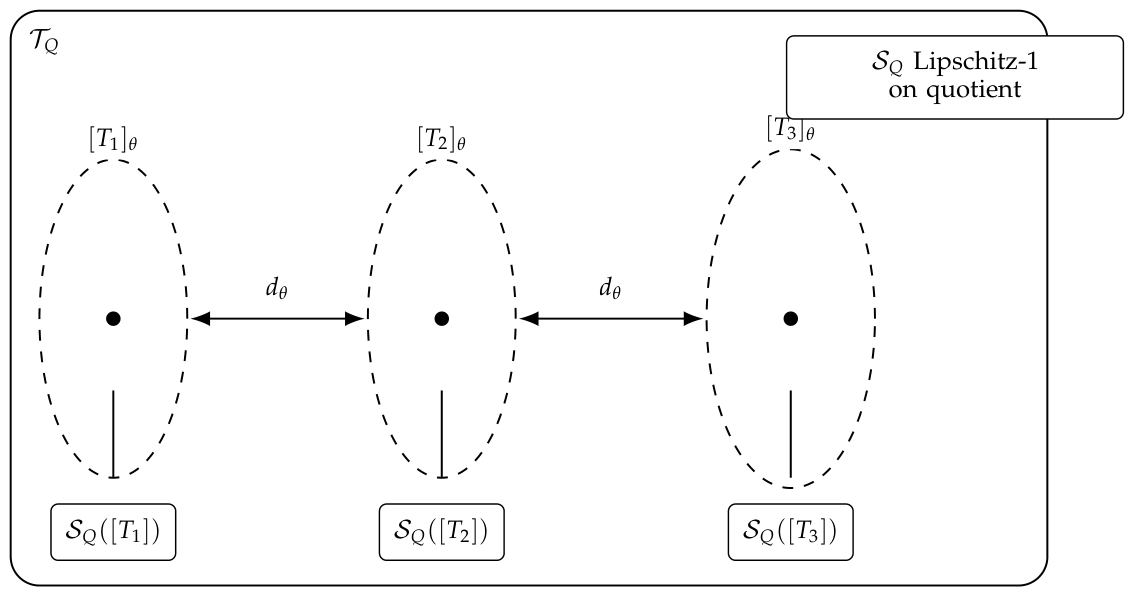
Write for the class of T and for the quotient.
Definition 16.2
(Corridor metric).
Theorem 16.1
(Metric space and Lipschitz descent). is a metric space. The operational pressure descends to a well-defined function on that is Lipschitz with constant 1 under .
Proof.
Non-negativity and symmetry of are clear. If , then everywhere on the corridor, so and the classes coincide. The triangle inequality for follows from that of . Hence is a metric.
For the Lipschitz claim: is well-defined because all representatives yield the same supremum of . For two classes,
□
Remark 16.1. Two theories at distance zero in are empirically interchangeable inside the corridor at threshold . Their internal formal structures may differ; the quotient metric registers only what any admissible experiment can distinguish. This is the precise form of underdetermination familiar from the philosophy of science [4,6].
Figure 11.
Quotient structure on . Inside each blob, all representatives give the same . The metric measures maximum observable disagreement between blobs. Theorem 16.1 guarantees is Lipschitz-1 under .
Figure 11.
Quotient structure on . Inside each blob, all representatives give the same . The metric measures maximum observable disagreement between blobs. Theorem 16.1 guarantees is Lipschitz-1 under .
17. Adaptive Index, Dynamic Corridor, and Multiscale Gluing
Let , where collects background assumptions. Let for be the error channels and a measurable weight map. The adaptive index and adaptive pressure are
Proposition 17.1
(Adaptive monotonicity). Let be absolutely continuous. If
a.e., then is non-decreasing.
Proof.
Differentiate along the path; the derivative equals the left side of (17.2). Since is increasing, the claim follows. □
For a dynamical system on Z, define the time-dependent corridor , where is the flow.
Theorem 17.1
(Dynamic corridor criterion). If is differentiable and
on , then is forward invariant.
Proof.
This is the Nagumo tangent-cone argument: at the boundary the vector field has no outward component by (17.3), so no trajectory starting inside can exit. □
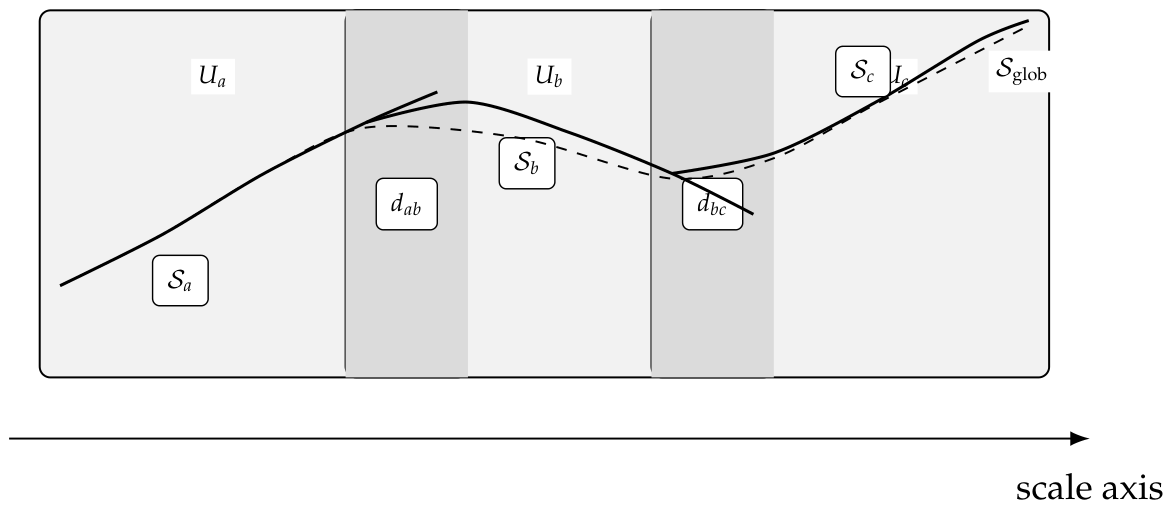
For multiscale problems, a single score may not cover all regimes. Let be a locally finite cover of Z with local scores satisfying the overlap estimate
With partition of unity , the global score is
Proposition 17.2
(Gluing bound). If for all b with , then .
Proof.
. Apply (17.4) and . □
Figure 12.
Multiscale gluing. Local scores on charts ; darker bands are overlaps where and are defined. The global score (dashed) is assembled via the partition of unity. The gluing bound controls the deviation in each overlap.
Figure 12.
Multiscale gluing. Local scores on charts ; darker bands are overlaps where and are defined. The global score (dashed) is assembled via the partition of unity. The gluing bound controls the deviation in each overlap.
For Fisher-information-based channel identification, let be channel strengths and the Fisher matrix of the validation data [9].
Theorem 17.2
(Channel separation bound). For any unbiased estimator ,
If with , all six channel variances are bounded above by .
Proof.
Cramér–Rao inequality; the matrix bound follows from the positive-semidefinite order. □
18. Geometry of Clampdown Surfaces
When is differentiable, the level sets
are the clampdown surfaces. Write . The unit normal is
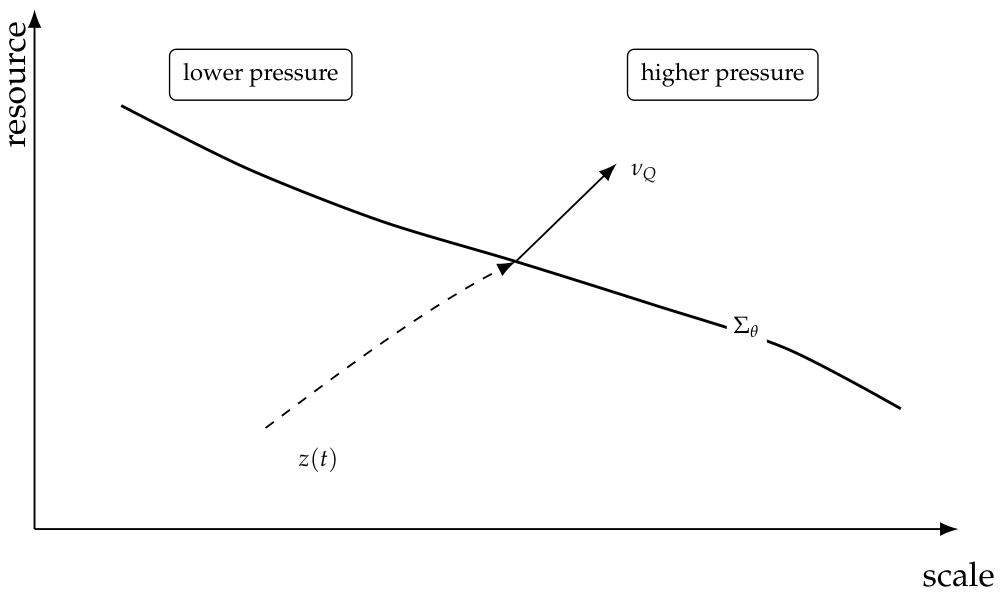
A research programme moving along crosses at rate
Definition 18.1
(Transverse crossing). crosses transversely at if and . It enters higher pressure when the inner product is positive.
Proposition 18.1
(Local warning). If , , and the inner product is positive, there exists such that for all .
Proof.
By differentiability: with . For small positive the expression exceeds . □
Figure 13.
Clampdown surface in scale-resource space. The path crosses the surface transversely. The sign of determines whether the crossing enters higher or lower pressure.
Figure 13.
Clampdown surface in scale-resource space. The path crosses the surface transversely. The sign of determines whether the crossing enters higher or lower pressure.
19. Stochastic Validation
In practice is a non-negative random variable on .
Definition 19.1
(Probabilistic corridor). For and ,
Theorem 19.1
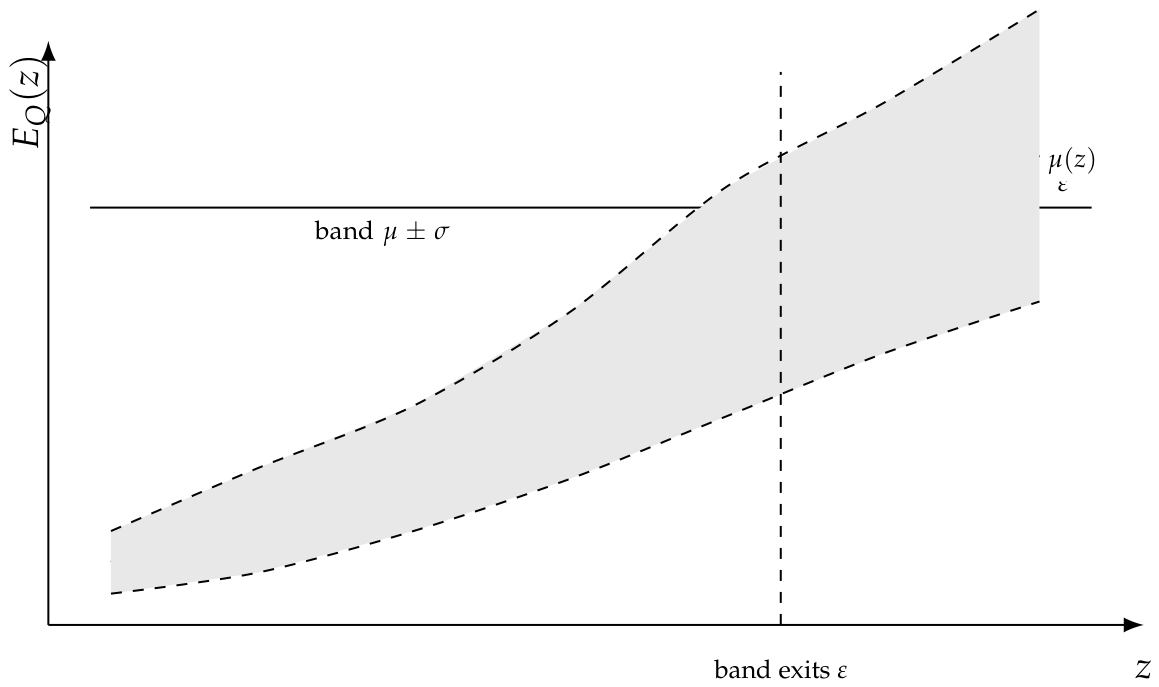
(Chebyshev corridor). If has mean and variance , and if and , then .
Proof.
; complement gives . □
Corollary 19.1
(Variance clampdown). Even with , if then .
A narrow mean estimate with large variance fails the probabilistic corridor. This is a separate failure mode from the deterministic one [10].
Figure 14.
Stochastic corridor. The mean (solid) stays below longer than the variance band. The vertical dashed line marks where the upper band first crosses . By Theorem 19.1, the probabilistic corridor ends there.
Figure 14.
Stochastic corridor. The mean (solid) stays below longer than the variance band. The vertical dashed line marks where the upper band first crosses . By Theorem 19.1, the probabilistic corridor ends there.
20. Axioms and Their Independence
The theory rests on seven axioms. They are kept small so the framework can move between high-energy physics, cosmology, simulation, and model comparison without internal modification.
Assumption 20.1
(Bounded score). for all admissible triples and scales.
Assumption 20.2
(Scale domain). Every claim is assigned a domain . A claim outside D carries an explicit extrapolation term in .
Assumption 20.3
(Formal before operational). for all ω.
Assumption 20.4
(Error monotonicity). For fixed weights, increasing any while holding the rest fixed cannot decrease .
Assumption 20.5
(Non-monotone resource response). Increasing ρ may lower , but the response is not assumed monotone because , , and can also rise.
Assumption 20.6
(Equivalence under indistinguishability). Two theories producing the same validated observables inside a corridor belong to the same empirical equivalence class on that corridor.
Assumption 20.7
(Reportability). A claim in a clampdown-pressure regime must report and the dominant error channel.
Proposition 20.1
(Axiom independence). For each Assumption k in 20.1–20.7, there exists an explicit model satisfying the remaining six but violating Assumption k.
Proof.
One countermodel per axiom.
Violate 20.1. Let , which is positive but unbounded as . All other axioms hold in a two-theory, one-instrument system on .
Violate 20.2. Let across all with no domain restriction and no extrapolation penalty.
Violate 20.3. Set and . For , .
Violate 20.4. In a model where simplifying the theory reduces both and simultaneously (e.g. because a coarser model needs fewer floating-point operations), increasing by adding complexity can increase and drive downward.
Violate 20.5. Take strictly decreasing in every on all of , so resource response is always monotone.
Violate 20.6. Assign distinct validation scores to two theories giving identical observables inside the corridor, for instance by adding a complexity penalty that enters even when predictions agree.
Violate 20.7. Compute and but suppress them from the output; only the raw score appears. All six other axioms remain intact. □
Remark 20.1. No axiom is a consequence of the others. Removing any one produces a strictly weaker framework in which at least one theorem above fails.
21. Examples
21.1. Quantum Gravity
A quantum-gravity proposal typically has small (the mathematics is internally controlled) and large (direct experiment is absent) [20,21,24]. Semiclassical checks, holographic duality, black-hole thermodynamics, anomaly cancellation, and duality tests each lower and push the effective downward [18,23]. They do not replace direct measurement but they narrow the gap .
The Pareto obstruction applies here directly. Tightening holographic consistency (reducing ) generally requires more model structure, which inflates . Theorem 14.1 says this trade-off is not a modelling accident but a consequence of the inter-channel coupling geometry.
21.2. Cosmology
For early-universe models, and dominate [6,11]. A model may fit the CMB power spectrum to current precision while several equally good alternatives exist. Two such models are in the same equivalence class under the corridor metric of Section 17. Their internal dynamics may differ sharply; records only that no present instrument separates them.
21.3. Closed Computational Pipelines
When calculation reach exceeds checking rate for a sustained interval, accumulates. Ordinary performance metrics may improve while computational clampdown pressure rises [5,7]. The correction window in Section 11 gives the interval in which controlled intervention can still keep the error below tolerance.
21.4. Large Simulations
A fine-grained simulation can hide large behind impressive precision [8,9]. The triangular defect asks three separate questions: does the code solve the stated equations? do those equations match the physical situation? does the instrument measure the intended observable? By Proposition 8.1, a single large channel drives above any target regardless of the others.
22. The Master Theorem
Theorem 22.1
(Clampdown theorem). Let Q be a physical or computational question with score , formal pressure , operational pressure , and error budget . Along a scale-resource path γ, if any one of the following holds:
- (i)
- exceeds tolerance ε,
- (ii)
- the triangular defect on a sub-domain,
- (iii)
- for fixed , or
- (iv)
- backreaction dominates resource gain at some ,
then Q has left the ordinary validation corridor. Inside the clampdown-pressure regime the claim may remain mathematically coherent. Its operational status must be reported with the corresponding error vector and gap value.
Proof.
Item (i): definition of the validation edge. Item (ii): triangle lower bound proposition. Item (iii): gap inclusion lemma. Item (iv): non-monotone validation proposition. The reporting requirement is Assumption 20.7. □
23. Conclusion
The paper has constructed a self-contained mathematical calculus for empirical reach. Its outputs (the score , the two pressures and , the six-channel budget , the gap , and the clampdown surface ) travel with any physical claim as a permanent record of where that claim stands relative to reproducible evidence.
Three results are new with respect to earlier formulations. First, Theorem 14.1: no admissible triple simultaneously minimises all six error channels when those channels are generically coupled. Second, Theorem 16.1: the empirical equivalence classes of under corridor threshold form a metric space, and is Lipschitz-1 over it. Third, Proposition 20.1: the seven axioms are mutually independent, each failing in an explicit countermodel.
The dynamic corridor criterion, controlled avoidance theorem, Chebyshev stochastic corridor, channel separation bound, and multiscale gluing proposition complete the calculus and make it usable in each of the four domains addressed in Section 20: quantum gravity, cosmology, computational pipelines, and large simulations.
Conflicts of Interest
The authors declare no conflict of interest.
References
- K. R. Popper, The Logic of Scientific Discovery, Hutchinson, London, 1959.
- T. S. Kuhn, The Structure of Scientific Revolutions, University of Chicago Press, 1962.
- I. Lakatos, The Methodology of Scientific Research Programmes, Cambridge University Press, 1978.
- I. Hacking, Representing and Intervening, Cambridge University Press, 1983.
- E. Winsberg, Science in the Age of Computer Simulation, University of Chicago Press, 2010.
- C. Beisbart and N. J. Saam (eds.), Computer Simulation Validation: Fundamental Concepts, Methodological Frameworks, and Philosophical Perspectives, Springer, Cham, 2019.
- J. M. Duran, A formal framework for computer simulations, Philosophy & Technology 34 (2021), 105–127. [CrossRef]
- S. Riedmaier, B. Danquah, B. Schick and F. Diermeyer, Unified framework and survey for model verification, validation and uncertainty quantification, Arch. Comput. Methods Eng. 28 (2021), 2655–2688. [CrossRef]
- V. Volodina and P. Challenor, The importance of uncertainty quantification in model reproducibility, Phil. Trans. R. Soc. A 379 (2021), 20200071. [CrossRef]
- E. G. Simmonds et al., Insights into the quantification and reporting of model-related uncertainty across different disciplines, iScience 25 (2022), 105512. [CrossRef]
- A. Randall and J. Ogland-Hand, Validity and validation of computer simulations, Knowledge 3 (2023), 262–276. [CrossRef]
- L. M. Kimpton et al., Challenges and opportunities in uncertainty quantification for computational modelling, Phil. Trans. R. Soc. A 383 (2025), 20240232. [CrossRef]
- N. S. Kardashev, Transmission of information by extraterrestrial civilizations, Soviet Astronomy 8 (1964), 217–221.
- J. D. Bekenstein, Universal upper bound on the entropy-to-energy ratio for bounded systems, Phys. Rev. D 23 (1981), 287–298. [CrossRef]
- D. Bhattacharjee, S. Singha Roy and R. Sadhu, The Split Singularity Hypothesis, TechRxiv preprint, 2023. [CrossRef]
- J. F. Donoghue, Quantum general relativity and effective field theory, in Handbook of Quantum Gravity, Springer, Singapore, 2024. [CrossRef]
- E. Palti, The swampland: introduction and review, Fortschr. Phys. 67 (2019), 1900037. [CrossRef]
- A. Bedroya and C. Vafa, Trans-Planckian censorship and the swampland, JHEP 2020 (2020), 123. [CrossRef]
- M. van Beest, J. Calderon-Infante, D. Mirfendereski and I. Valenzuela, Lectures on the swampland program in string compactifications, Phys. Rep. 989 (2022), 1–50. [CrossRef]
- Y. Hamada, M. Montero, C. Vafa and I. Valenzuela, Finiteness and the swampland, J. Phys. A 55 (2022), 224005. [CrossRef]
- C. Long, M. Montero, C. Vafa and I. Valenzuela, The desert and the swampland, JHEP 2023 (2023), 109. [CrossRef]
- M. Montero, C. Vafa and I. Valenzuela, The dark dimension and the swampland, JHEP 2023 (2023), 22. [CrossRef]
- D. Harlow, B. Heidenreich, M. Reece and T. Rudelius, Weak gravity conjecture, Rev. Mod. Phys. 95 (2023), 035003. [CrossRef]
- A. Castellano, I. Ruiz and I. Valenzuela, A universal pattern in quantum gravity at infinite distance, Phys. Rev. Lett. 132 (2024), 181601. [CrossRef]
| 1 | For quantum gravity the natural is a vector including energy, curvature, duration, detector resolution, and background specification [24]. |
| 2 | A binary valid/invalid reading is too coarse: communities differ on thresholds, and the same mathematics may be well-posed while its physical reading is weakly tested [6]. |
| 3 | High-energy colliders, cosmological surveys, and closed computational pipelines each produce a non-trivial for different physical reasons. |
| 4 | A theory can be mathematically tight and empirically unexamined. The reverse also occurs: Kepler’s laws were reliable before Newton explained them. The ordering here is for the score in (3.1), not a global claim about scientific practice. |
| 5 | The original Kardashev classification [13] is a single energy axis. Here is the full vector; detector precision and computational reliability enter independently. |
| 6 | In general relativity “backreaction” has a precise technical meaning [16]. Here it denotes any effect by which the measurement apparatus perturbs the uncertainty it is trying to resolve. |
Disclaimer/Publisher’s Note: The statements, opinions and data contained in all publications are solely those of the individual author(s) and contributor(s) and not of MDPI and/or the editor(s). MDPI and/or the editor(s) disclaim responsibility for any injury to people or property resulting from any ideas, methods, instructions or products referred to in the content. |
© 2026 by the authors. Licensee MDPI, Basel, Switzerland. This article is an open access article distributed under the terms and conditions of the Creative Commons Attribution (CC BY) license (http://creativecommons.org/licenses/by/4.0/).
Copyright: This open access article is published under a Creative Commons CC BY 4.0 license, which permit the free download, distribution, and reuse, provided that the author and preprint are cited in any reuse.


