

Submitted:
28 February 2020
Posted:
29 February 2020
You are already at the latest version
Abstract
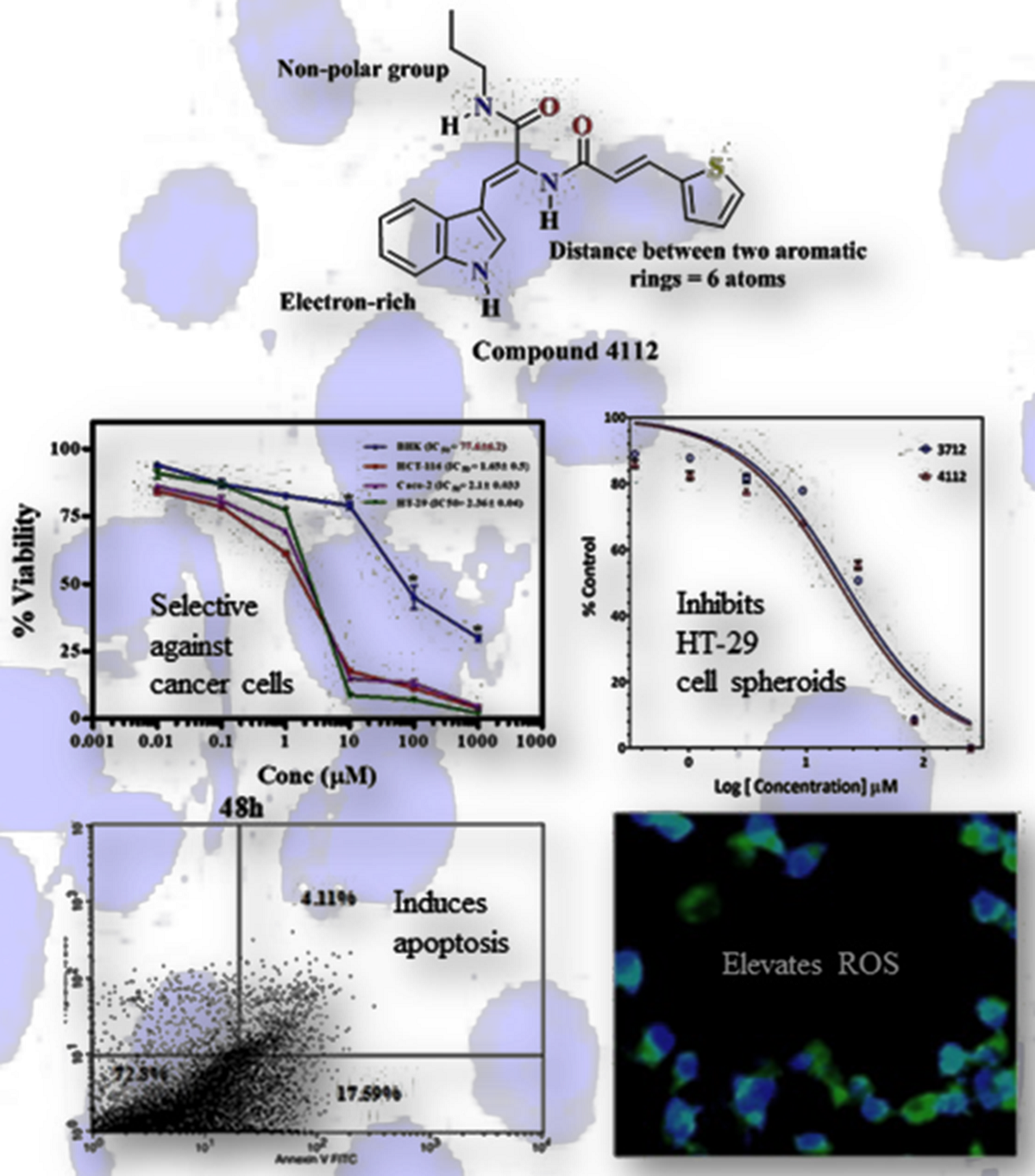
Curcumin and trans-cinnamaldehyde are acrolein-based Michael acceptor compounds that are commonly found in domestic condiments, and known to cause cancer cell death via redox mechanisms. Based on the structural features of these compounds we designed and synthesized several 2-cinnamamido-N-substituted-cinnamamide (bis-cinnamamide) compounds. One of the derivatives, (Z)-2-[(E)-cinnamamido]-3-phenyl-N-propylacrylamide 1512 showed a moderate antiproliferative potency (HCT-116 cell line inhibition of 32.0 µM), good selectivity profile (no inhibition of normal cell lines), and proven cellular activities leading to apoptosis. SAR studies led to more than 10-fold increase in activity. Our most promising compound, [(Z)-3-(1H-indol-3-yl)-N-propyl-2-[(E)-3-(thien-2-yl)propenamido)propenamide] 4112 killed colon cancer cells at IC50 = 0.89 µM (Caco-2), 2.85 µM (HCT-116) and 1.65 µM (HT-29), while exhibiting much weaker potency on C-166 and BHK normal cell lines (IC50 = 71 µM and 77.6 µM, respectively). Cellular studies towards identifying the compounds mechanism of cytotoxic activities revealed that apoptotic induction occurs in part as a result of oxidative stress. Importantly, the compounds showed inhibition of cancer stem cells that are critical for maintaining the potential for self-renewal and stemness. The results presented here show discovery of covalently-acting Michael addition compounds that potently kill cancer cells by a defined mechanism, with minimal effect on normal noncancerous cell.
Keywords:
Michael acceptor
; safe covalent drugs
; oxidative stress inducers
; trans-cinnamaldehyde
; curcumin
; colorectal cancer
Copyright: This open access article is published under a Creative Commons CC BY 4.0 license, which permit the free download, distribution, and reuse, provided that the author and preprint are cited in any reuse.


