

Submitted:
09 August 2019
Posted:
11 August 2019
You are already at the latest version
Abstract
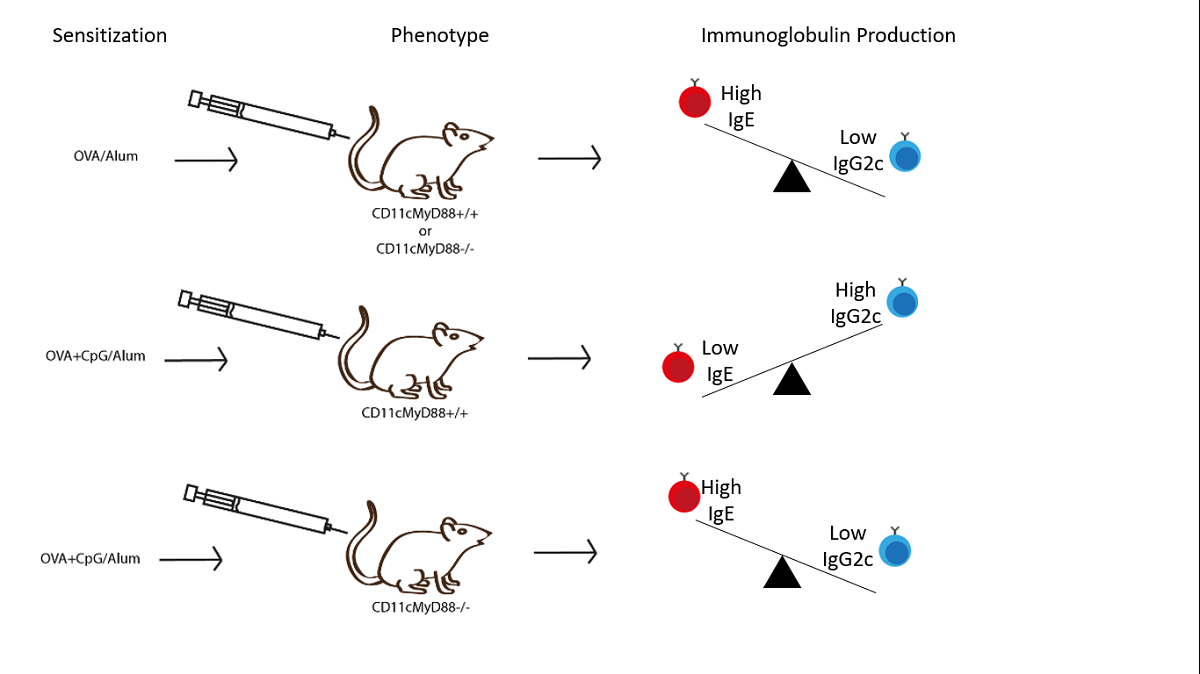
Elevated levels of immunoglobulin E (IgE) are associated with allergies and other immunological disorders. Experimentally, sensitization with alum adjuvant favors IgE production while CpG-ODN adjuvant, a synthetic toll-like receptor 9 (TLR9) agonist, inhibits it. The cellular mechanisms underlying TLR-regulation of immunoglobulin production are still controversial. Specifically, TLR-mediated IgE regulation in vivo is not yet known. We show that augmented levels of IgE induced by sensitizations to OVA with or without alum adjuvant or with OVA-pulsed dendritic cells (DCs) were inhibited when sensitization to OVA was performed in the presence of CpG. Notably, CpG-mediated suppression of IgE production required MyD88-expression on DCs but not on B-cells. This contrasts with previous reports of in vitro regulation IgE where CpG acted directly on B cells via MyD88 pathway. In addition, CpG also inhibited IgE production in a MyD88-dependent manner when sensitization was performed with OVA-pulsed DCs. Finally, CpG signaling through MyD88 pathway was also necessary and sufficient to prevent anaphylactic antibody production involved in active cutaneous anaphylaxis.
Keywords:
allergy
; IgE
; IgG2c
; anaphylaxis
; dendritic cells
Copyright: This open access article is published under a Creative Commons CC BY 4.0 license, which permit the free download, distribution, and reuse, provided that the author and preprint are cited in any reuse.