

Submitted:
17 July 2019
Posted:
18 July 2019
You are already at the latest version
Abstract
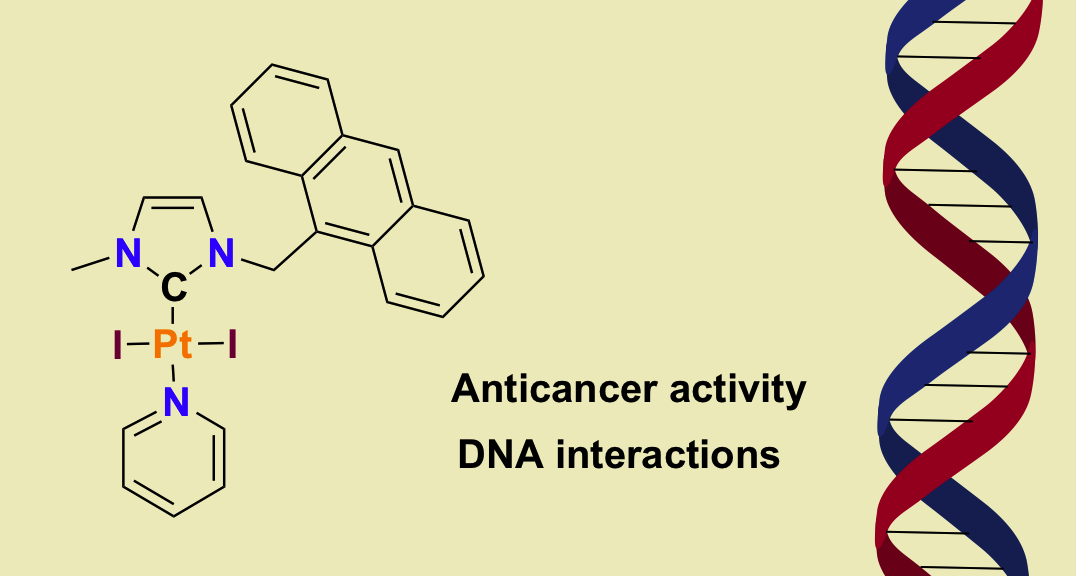
A platinum (II) complex stabilized by a pyridine and a N-heterocyclic carbene ligand featuring an anthracenyl moiety was prepared. The compound was fully characterized and its molecular structure was determined by single-crystal X-ray diffraction. The compound demonstrated high in vitro antiproliferative activities against cancer cell lines with IC50 ranging from 10 to 80 nM. The presence of the anthracenyl moiety on the NHC Pt complex was used as a luminescent tag to probe the metal interaction with the nucleobases of the DNA through a pyridine-nucleobase ligand exchange. Such interaction of the platinum complex with DNA was corroborated by optical tweezers techniques and liquid phase AFM microscopy. The results revealed a two-state interaction between the platinum complex and the DNA strands. This two-state behaviour was quantified from the different experiments due to contour length variations. At 24h incubation, the stretching curves revealed multiple structural breakages, and AFM imaging revealed a highly compact and dense structure of platinum complexes bridging the DNA strands.
Keywords:
Platinum
; N-heterocyclic carbene ligand
; anticancer activity
; DNA interaction
; optical tweezers technique
; liquid phase AFM microscop
Copyright: This open access article is published under a Creative Commons CC BY 4.0 license, which permit the free download, distribution, and reuse, provided that the author and preprint are cited in any reuse.