

Submitted:
25 October 2018
Posted:
25 October 2018
You are already at the latest version
Abstract
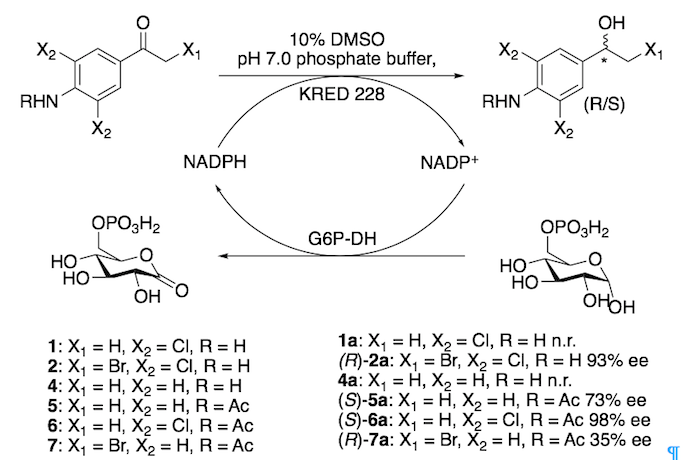
(R)-1-(4-Amino-3,5-dichlorophenyl)-2-bromoethan-1-ol has been synthesised in 93% enantiomeric excess (ee) by asymmetric reduction of the corresponding ketone catalysed by a ketoreductase and NADPH as the co-factor in DMSO. (S)-N-(2,6-Dichloro-4-(1-hydroxyethyl)phenyl)acetamide has been synthesised in >98% ee by the same system. Both synthons are potential precursors for clenbuterol enantiomers. Clenbuterol is a β2-agonist used in veterinary treatment of asthma in several countries. The drug is listed on the World Anti-doping Agency’s Prohibited list due to its effect on increased protein synthesis in the body. However, racemic clenbuterol has recently been shown to reduce the risk of Parkinson’s disease. In order to reveal which one (or both) of the enantiomers that cause this effect, the pure enantiomers need to be studied separately. Our biocatalytic approach in order to obtain enantiopure clenbuterol should be applicable to industrial scale.
Keywords:
(R)-1-(4-Amino-3
; 5-dichlorophenyl)-2-bromoethan-1-ol
; (S)-N-(2
; 6-dichloro-4-(1-hydroxyethyl)phenyl)acetamide
; clenbuterol
; ketoreductase
; chiral chromatography
Copyright: This open access article is published under a Creative Commons CC BY 4.0 license, which permit the free download, distribution, and reuse, provided that the author and preprint are cited in any reuse.


