

Submitted:
13 March 2018
Posted:
13 March 2018
You are already at the latest version
Abstract
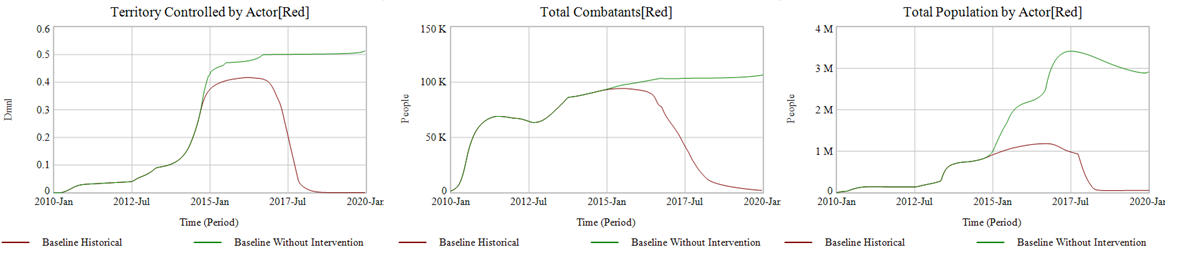
This paper seeks to explain the rapid growth of the Islamic State of Iraq & Syria (ISIS) and approach the question of “what is” the Islamic State? The paper offers several contributions. First is the proposal of a dynamic hypothesis that ISIS is an emerging-state actor and differs notably from traditional non-state actors and insurgencies. The theory consists of both a causal loop diagram and key propositions. A detailed system dynamics simulation (E-SAM) was constructed to test the theory. The propositions of emerging-state actor theory are constructed as synthetic experiments within the simulation and confirm evidence of emerging-state actor behavior. E-SAM’s novelty is its combination of combat simulation with endogenous geospatial feedback, ethnographic behavior in choosing sides in conflict, and details internal simulation of key actor mechanisms such as financing, recruiting and governance. E-SAM can be loaded with scenarios to simulate non-state actors in different geospatial domains: ISIS in Libya, Boko Haram in Nigeria, Taliban in Afghanistan and even expatriated ISIS fighters returning to pursue new conflicts such as in Indonesia.
Keywords:
ISIS
; ISIL
; DAESH
; insurgency
; conflict
; security
; non-state actor
; emerging-state actor
; combat simulator
; geospatial
; national security.
Copyright: This open access article is published under a Creative Commons CC BY 4.0 license, which permit the free download, distribution, and reuse, provided that the author and preprint are cited in any reuse.


