

Submitted:
27 September 2017
Posted:
27 September 2017
You are already at the latest version
Abstract
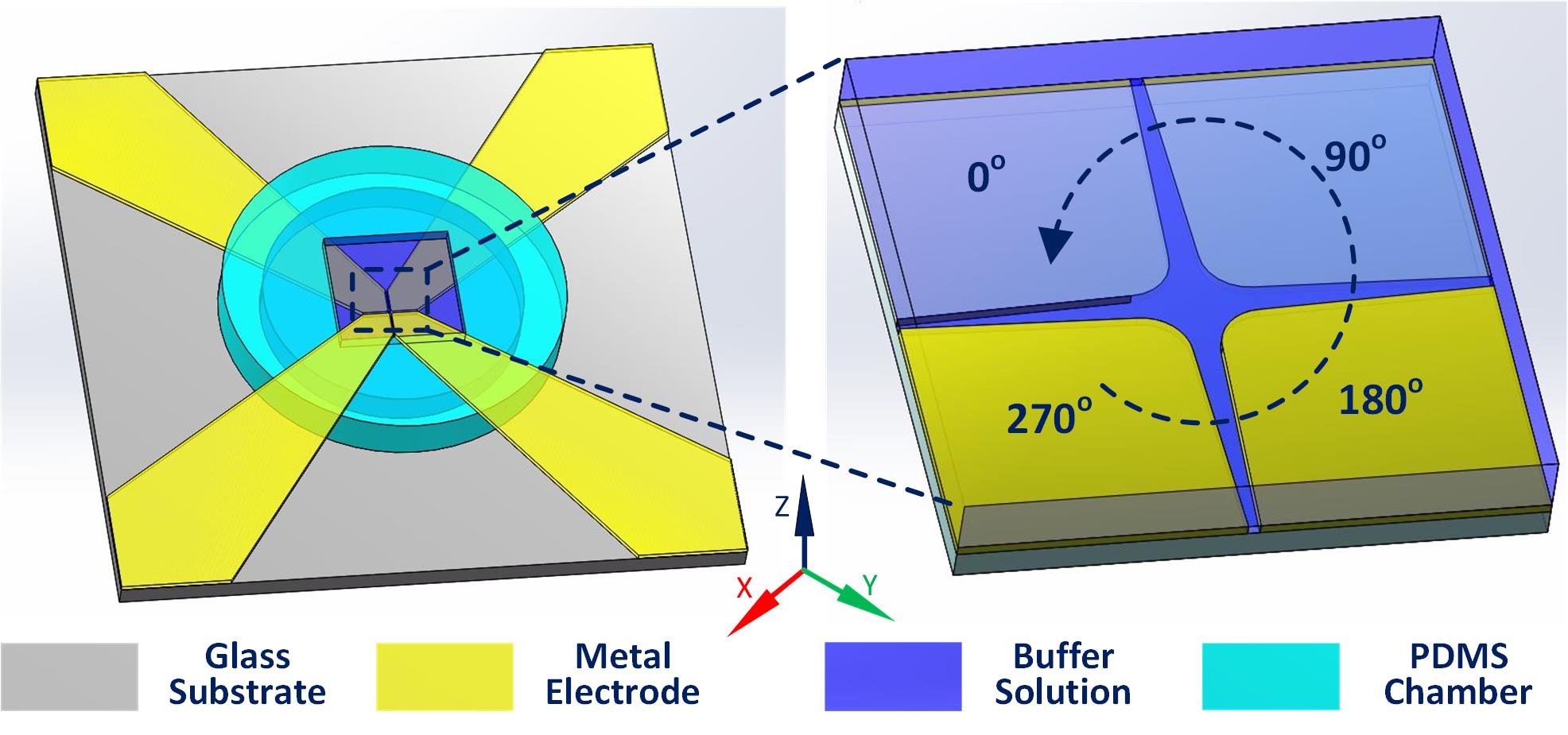
In this work, we focus on investigating electrothermal flow in a rotating electric field (ROT-ETF), with primary attention paid to the horizontal traveling-wave electrothermal (TWET) vortex induced at the center of the electric field. The frequency-dependent flow profiles in the microdevice are analyzed using different heat transfer models. Accordingly, we address in particular the importance of electrode cooling in ROT-ETF as metal electrodes of high thermal conductivity while substrate material of low heat dissipation capability are employed to develop such microfluidic chips. Under this circumstance, cooling of electrode array due to external natural convection on millimeter-scale electrode pads for external wire connection occurs and makes the internal temperature maxima shift from the electrode plane to a bit of distance right above the cross-shaped interelectrode gaps, giving rise to reversal of flow rotation from a typical repulsion-type to attraction-type induction vortex, which is in good accordance with our experimental observations of co-field TWET streaming at frequencies on the order of reciprocal charge relaxation time of the bulk fluid. These results point out a way to make a correct interpretation of out-of-phase electrothermal streaming behavior, which holds great potential for handing high-conductivity analytes in modern microfluidic systems.
Keywords:
electrothermal flow
; rotating electric field
; out-of-phase smeared structural polarization
; electrode cooling
; external natural convection
; co-field flow rotation
Copyright: This open access article is published under a Creative Commons CC BY 4.0 license, which permit the free download, distribution, and reuse, provided that the author and preprint are cited in any reuse.