
Submitted:
25 November 2026
Posted:
26 November 2026
You are already at the latest version
Abstract
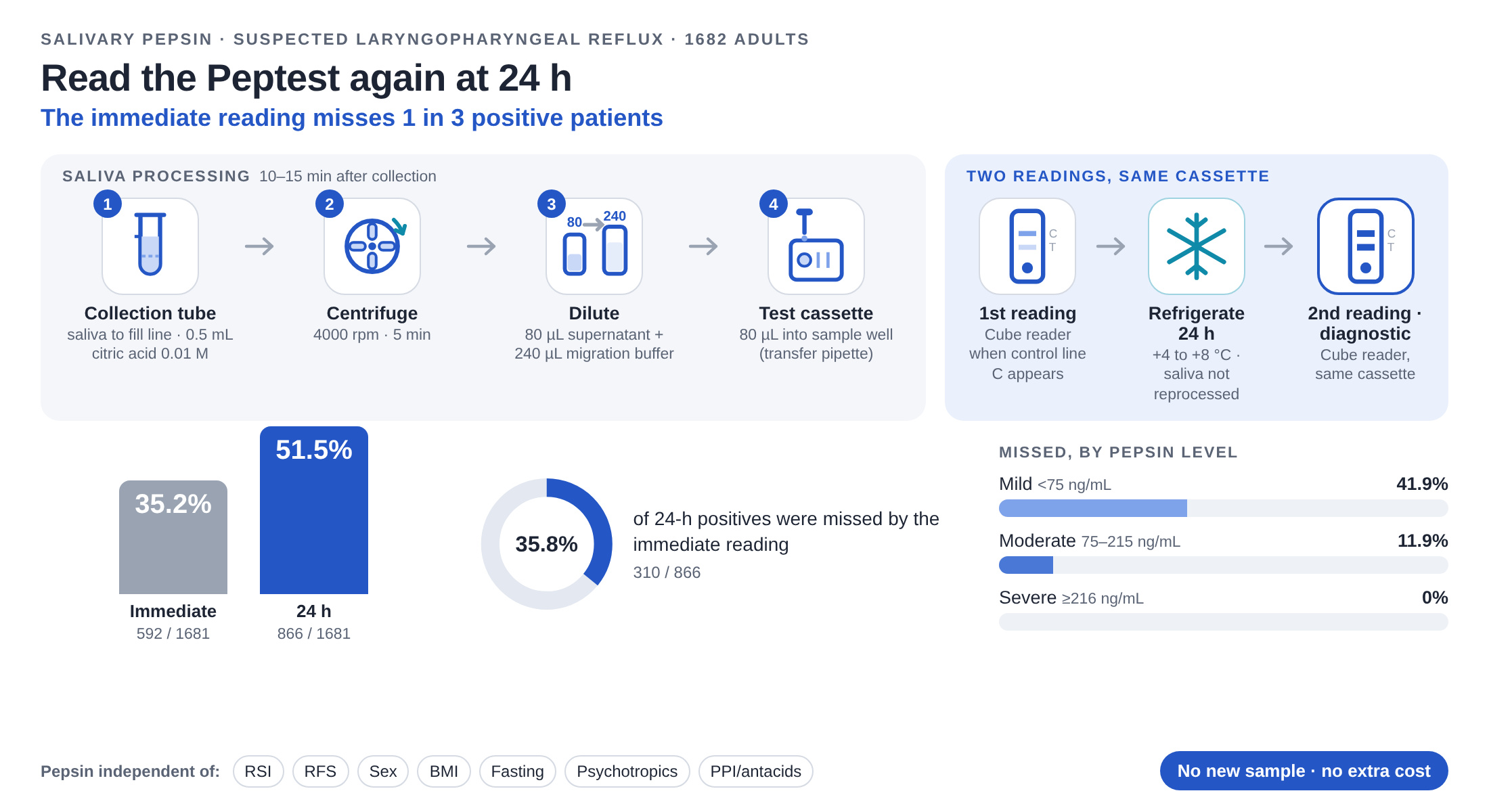
Background/Objectives: Salivary pepsin is a non-invasive marker of laryngopharyngeal reflux (LPR), but its analytical conditions are poorly standardized. In our laboratory, each Peptest cassette is read as soon as the control line appears and again after 24 h of refrigerated storage. We compared both readings and explored associations with clinical variables. Methods: This retrospective study included 1682 adults with suspected LPR tested between December 2015 and November 2026. The test cassette was read with the Cube reader once the control line appeared (immediate reading) and after 24 h at +4 to +8 °C. The Reflux Symptom Index (RSI), Reflux Finding Score (RFS), sex, body mass index (BMI), fasting status, psychotropic drugs and proton pump inhibitor (PPI) or antacid use were recorded. Pepsin was graded as mild (<75 ng/mL), moderate (75–215 ng/mL) or severe (≥216 ng/mL). Results: Positivity rose from 35.2% at the immediate reading to 51.5% at 24 h (p < 0.001). The immediate reading missed 310 of 866 positive patients (35.8%; 95% CI 32.7–39.0); kappa was 0.59. In doubly positive tests, concentration was 1.34-fold higher at 24 h. Missed positives were 41.9% at mild, 11.9% at moderate and 0% at severe levels. Pepsin was not associated with RSI (AUC 0.50), RFS (AUC 0.53), sex, BMI, fasting or psychotropic drugs; only RFS > 7 showed a weak adjusted association (OR 1.29; 95% CI 1.01–1.65). PPI or antacid use (28.1%) did not modify positivity (adjusted OR 1.10; 95% CI 0.85–1.43) or the false-negative rate. Conclusions: A single reading taken immediately after processing underestimates salivary pepsin, mainly at low and moderate concentrations. Re-reading the same cassette after 24 h increases diagnostic yield at no cost; its specificity should be confirmed against impedance-pH monitoring. Salivary pepsin is independent of symptom and sign scores.
Keywords:
laryngopharyngeal reflux
; pepsin
; saliva
; Peptest
; lateral flow immunoassay
; non-acid reflux
; Reflux Symptom Index
; Reflux Finding Score
Copyright: This open access article is published under a Creative Commons CC BY 4.0 license, which permit the free download, distribution, and reuse, provided that the author and preprint are cited in any reuse.