
Submitted:
24 November 2026
Posted:
26 November 2026
You are already at the latest version
Abstract
This study compares YOLO-based instance segmentation architectures with Mask R-CNN using a ResNet-101 backbone for early fire and smoke detection in drone imagery. Experiments utilized separately annotated image datasets and evaluated both bounding-box detection and instance segmentation performance. Initially, YOLO11m-Seg and YOLO26m-Seg were trained and compared under identical experimental conditions. Results indicate that YOLO26m-Seg achieves a relative improvement of approximately 2% and 3% in fire mask and bounding-box mAP@0.5, respectively, compared with YOLO11m-Seg. Conversely, YOLO11m-Seg achieves approximately 1% higher mask and bounding-box mAP@0.5 for smoke. In terms of inference performance, YOLO26m-Seg requires approximately 3.5% more processing time than YOLO11m-Seg. Compared with YOLO26m-Seg, Mask R-CNN with a ResNet-101 backbone achieves higher bounding-box detection accuracy, with relative improvements of approximately 8% for smoke and 7% for fire. However, YOLO26m-Seg achieves higher mask mAP@0.5, improving smoke and fire segmentation by approximately 6% and 23%, respectively. Based on these findings, a hybrid approach was evaluated, employing YOLO26m-Seg for smoke detection and instance segmentation and Mask R-CNN with a ResNet-101 backbone for fire detection and segmentation. The hybrid framework was further extended by integrating the transformer-based SwinIR model with ×2 and ×4 super-resolution to assess its potential contribution to detecting small and distant fire regions. The results demonstrate that both super-resolution configurations enabled the detection of an additional fire region that was difficult to distinguish in the original-resolution image.
Keywords:
fire detection
; smoke detection
; instance segmentation
; computer vision
; object detection
; deep learning
1. Introduction
Forest fires are among the most pressing environmental and socioeconomic challenges worldwide, significantly affecting public health, environmental integrity, and economic stability [1,2]. Vegetation combustion releases carbon dioxide and other atmospheric pollutants, harming human respiratory health and exacerbating climate change [3]. Beyond these immediate ecological and health consequences, wildfires cause considerable economic losses, particularly in countries such as Greece, where tourism is a major economic sector. Destroying tourism sites reduces revenue and impedes local and national economic activity [4]. Moreover, the repercussions extend beyond tourism and the economy to secondary environmental effects, including an increased risk of flooding in burned forests due to the loss of vegetation that would otherwise absorb rainwater [5]. Given the complex and far-reaching nature of this issue, substantial research efforts have been directed toward enhancing wildfire prevention and early detection to enable prompt suppression and mitigate overall impact.
Researchers have developed and evaluated a variety of wildfire detection techniques in recent years, including traditional sensors, satellite monitoring systems, thermal cameras, and deep learning-based tools, which can be deployed individually or in combination [6,7]. Satellite-based approaches enable monitoring of large geographic regions [8]; however, their limited temporal and spatial resolution reduces effectiveness and often delays identification of small-scale hotspots [6]. Thermal cameras can detect thermal anomalies in low light, but their high installation costs [6] and vulnerability to false alarms from unrelated heat sources [9] limit their practical use. Traditional sensors provide limited coverage and are sensitive to environmental variables [6,10]. In contrast, deep learning methods are increasingly used for rapid, accurate detection [7,9]. These approaches are also less susceptible to external influences, such as topography or atmospheric gases, which can undermine the reliability of conventional smoke detection sensors [6,11].
Deep learning has emerged as a promising approach for early fire detection and is increasingly adopted in this field [7,9]. Both object detection models, which localize flames and smoke using bounding boxes, and instance segmentation models, which generate pixel-level masks for more precise delineation of fire regions, have been extensively studied [7]. YOLO models [12] offer rapid and accurate detection, making them suitable for both standard and instance segmentation applications [13]. In addition, two-stage architectures such as Faster R-CNN [14] for object detection and Mask R-CNN [15] for instance segmentation are widely used. Mask R-CNN typically employs ResNet backbones [16] with residual blocks to process complex visual features [15]. Overall, YOLO models tend to provide a favorable balance between speed and accuracy, supporting their use in real-time scenarios [13]. Nevertheless, their comparative performance is influenced by the specific dataset and model version implemented.
Expanding upon the FireVision system introduced in [17], this study developed additional YOLO instance segmentation models to extend the evaluation of various model architectures within existing systems. To determine optimal performance, we compared two YOLO segmentation architectures, YOLO11 and YOLO26, to assess which current YOLO architecture delivers superior results. The findings were then benchmarked against Mask R-CNN models with a ResNet-101 backbone, which had exhibited strong performance in prior research.
Sensor-based fire detection has undergone significant re-examination in recent years. Despite these advances, point sensors still face fundamental limitations, even in the latest proposals. Emerging chemical sensing devices, such as gasistors, offer rapid response times, often detecting combustion products before visible flames, and provide higher sensitivity and lower power consumption compared to traditional sensors. However, their effectiveness is limited because combustion products must physically reach the sensor, and atmospheric humidity can cause false positives [18]. Beyond environmental influences, on-site sensors are susceptible to intentional blinding or triggering through electromagnetic interference (EMI), leading to false alarms or undetected smoke events [19]. Recent AI-assisted solutions, including optical smoke sensors operating local models [20] and smart fire-safety systems performing on-device inference [21], indicate a transition toward intelligent sensing technologies.
Moreover, these systems are typically stationary and primarily intended for enclosed, controlled environments. Recent studies continue to utilize classical smoke sensor arrays for indoor applications [22] or implement time-of-day sensitivity adjustments to reduce false positives [23], underscoring the persistent need for more robust solutions. In forest settings, wireless networks of carbon monoxide and temperature sensors must be deployed in remote locations, cannot provide visual information about fire extent, and remain prone to both false positives and negatives [24]. Comprehensive reviews of sensing technologies indicate that ground-based sensors are generally unsuitable for forest environments, whereas image-based methods address many of these shortcomings [9,25]. Nonetheless, challenges such as low image resolution and the weight, battery, and memory requirements of deep learning models on unmanned aerial vehicles (UAVs) persist [9,25], and individual sensing modalities are typically inadequate on their own [26]. These limitations support adopting a hybrid approach that combines real-time detection with high-resolution imagery, as proposed in this study.
Integrating multispectral and hyperspectral satellite data with deep learning techniques has significantly advanced fire and smoke detection capabilities. In multispectral applications, shortwave infrared (SWIR) bands have improved pixel-level active fire detection in both Landsat-8 [27] and Sentinel-2 imagery [28], as well as in VIIRS data, where attention mechanisms dynamically reweight spectral bands to improve fire progression prediction [29]. Next-generation geostationary satellites, such as Meteosat Third Generation, enable near-real-time detection using unsupervised models [30]. Hyperspectral PRISMA data have been employed with one-dimensional convolutional neural networks (1D-CNNs) for autonomous fire detection, with models executed directly on satellite hardware [31]. Comparative studies of fully connected (FC), 1D, 2D, and 3D convolutional neural network (CNN) architectures have evaluated generalization across diverse regions, with 3D CNNs providing more refined classifications; however, issues such as false fire detections and confusion between smoke and shadows persist [32]. For smoke detection, an early indicator of fire, multispectral Landsat-8 imagery utilizing SWIR2 and the aerosol optical depth (AOD) index enables discrimination through Smoke-U-Net segmentation [33]. Similarly, hyperspectral imaging combined with lightweight CNNs, band selection, and onboard processing reduces the volume of data transmitted to Earth and supports early warning systems [34]. At the image level, reconstructing hyperspectral information from RGB images using MST++ enhances the separability of fire and smoke from the background [35]. Despite these advancements, early smoke typically occupies a very small area in low-resolution satellite imagery, necessitating the integration of super-resolution and smoke segmentation techniques [36].
Thermal cameras are a primary optical sensor option on drone platforms for fire detection because they capture infrared radiation emitted by objects based on temperature, enabling visualization of thermal differences within a scene [37]. In environments where dense vegetation and variable illumination constrain RGB cameras, thermal imaging enables more accurate localization of fire hotspots [37]. More recent approaches integrate thermal and high-resolution cameras with gas sensors, analyzing images in real time to identify indicators such as temperature changes, smoke, or fire [38]. Researchers have also applied deep learning to UAV thermal imagery, including saliency maps for early detection [39]. Comparative studies of Mask R-CNN and YOLO (v5, v7, v8) on RGB and thermal images indicate that results on thermal images are nearly comparable to those on RGB, despite a smaller dataset. Mask R-CNN achieves the highest accuracy but is the slowest model, while YOLOv8 detects in about 3.8 ms per image [37]. Weather conditions, infrared radiation, and the distance between the object and the camera affect the quality and accuracy of thermal images [37]. Additionally, thermal data remains limited: the authors combined a small number of online thermal images with simulated fire images, resulting in 1,250 images after augmentation, compared to 4,236 in the RGB dataset [37]. At the review level, challenges for UAV-based detection systems include adverse weather conditions, cost-effective sensor integration, and the need for comprehensive datasets [40].
This study compares YOLO architectures for early fire and smoke segmentation in drone imagery and develops a hybrid deep learning framework that leverages their complementary strengths. Specifically, YOLO11m-Seg and YOLO26m-Seg are comparatively assessed, while Mask R-CNN with a ResNet-101 backbone is additionally considered to investigate its performance in fire and smoke detection. Based on the experimental findings, a hybrid detection approach is proposed, employing YOLO26m-Seg for smoke detection and instance segmentation, and Mask R-CNN with a ResNet-101 backbone for fire detection and segmentation. The proposed approach is evaluated through three experimental scenarios, examining the performance of the individual architectures and their combination under different configurations. In the third scenario, the hybrid framework is further extended by integrating super-resolution to investigate its potential contribution to detecting small or distant fire regions. The remainder of this paper is organized as follows: Section 2 reviews related work; Section 3 describes the materials and methods; Section 4 presents the experimental scenarios and discusses the results; and Section 6 concludes the paper.

Table 1.
Comparative evaluation of wildfire and smoke detection technologies.
| Method Category | Fire and Smoke Detection | Distance and Resolution | Cost and Requirements | Datasets and Performance |
|---|---|---|---|---|
| Terrestrial and Traditional Sensors (Gasistors, WSN) | Gas (e.g., CO) and temperature sensors; no visual information on fire extent. Gasistors respond rapidly, often before flames appear. | Point-based: combustion products must reach the device; limited coverage; difficult installation in inaccessible areas. | Gasistors: higher sensitivity and lower power consumption than conventional sensors. Vulnerable to intentional electromagnetic interference (EMI). | Environmental sensitivity causes false positives and false negatives. Datasets not discussed. |
| Satellite Monitoring (Landsat-8, Sentinel-2, VIIRS, MTG, PRISMA) | Fire: SWIR-based detection with Landsat-8, Sentinel-2 and VIIRS (attention for fire progression); unsupervised models for MTG hyperspectral PRISMA. Smoke: Landsat-8 SWIR2 and AOD with Smoke-U-Net; lightweight hyperspectral CNNs. | Large-area monitoring, but limited spatial and temporal resolution delays detection of small fires (MTG: near-real-time). Early smoke covers a very small area. | Onboard processing (lightweight CNNs, band selection) reduces transmitted data. Infrastructure costs not discussed. | Low resolution requires super-resolution and smoke segmentation; false detections and smoke–shadow confusion persist. Datasets not discussed. |
| Thermal Cameras and UAVs | Capture infrared radiation and temperature differences; better hotspot localization in dense vegetation and variable lighting. Combined with high-resolution cameras and gas sensors, they identify temperature changes, smoke, or fire. Early smoke detection with thermal cameras is underexplored. | Image quality and accuracy depend on the object–camera distance. | High installation cost. On UAVs, weight, battery, and memory limit deep learning models. | Limited thermal data: 1,250 images after augmentation (online and simulated) vs. 4,236 RGB; accuracy nearly comparable to RGB. Weather, infrared radiation, and external heat sources affect reliability and cause false alarms. |
| Deep Learning / Computer Vision Models (YOLO, Mask R-CNN, Faster R-CNN) | Bounding-box detection (YOLO, Faster R-CNN) and instance segmentation (YOLO-seg, Mask R-CNN with ResNet) of flames and smoke. | Applied to UAV and satellite imagery. | Mask R-CNN is the slowest; YOLOv8 takes about 3.8 ms per image. YOLO offers the best speed–accuracy balance for real-time use. UAV deployment is limited by payload, battery, and memory. | Fast, accurate detection; less affected by topography and atmospheric gases than conventional sensors. Mask R-CNN is the most accurate; relative performance depends on dataset and model version. |
2. Related Work
Automated fire and smoke detection has been extensively investigated within the computer vision community, driven by the imperative to reduce response times and minimize damage from uncontrolled fires. Initial research primarily utilized handcrafted descriptors, while recent advancements have focused on deep learning architectures. For systematic comparison, the relevant literature is categorized into three areas: fire detection, smoke detection, and combined fire and smoke detection.
2.1. Smoke Detection
Smoke typically appears before visible flames, making smoke detection critical for fire detection. However, this task is particularly challenging because smoke lacks a fixed shape, color, or density. Its boundaries are often poorly defined, and its appearance varies depending on lighting conditions, viewing distance, and the surrounding environment. Additionally, smoke can be easily confused with fog and clouds [41,42,43]. Initial methods utilized handcrafted features such as color, texture, motion, and morphology, with performance highly dependent on acquisition conditions. The advent of deep learning enabled models to learn smoke-related features, exemplified by DeepSmoke [41]. Subsequently, YOLO-based detectors were adapted for smoke detection, emphasizing the identification of small or distant plumes and challenging backgrounds. In the context of UAV imagery, enhanced versions of YOLOv8 [44] and YOLOv5 with transfer learning [45] have been developed to detect small smoke regions from aerial perspectives. These detectors use bounding boxes to localize smoke, which is challenging because smoke is diffuse and often covers large areas. Furthermore, multimodal wildland fire smoke detection approaches, such as extensions of SmokeyNet, integrate visual imagery with meteorological and satellite data to enhance early smoke detection [46].
Segmentation provides more accurate smoke delineation by identifying its extent at the pixel level. Recent studies have incorporated Transformer mechanisms to capture both local and global image features. For example, VTrUNet integrates a UNet architecture with a transformer to leverage long-range spatial correlations in multispectral Landsat data [42]. At the same time, EGNL-FAT combines convolutional neural network and transformer features and utilizes smoke boundary information for complex real-world scenarios [43]. Additionally, because early smoke typically occupies a small area in low-resolution imagery, researchers have combined super-resolution techniques with smoke segmentation on multi-source satellite data [36]. However, based on the reviewed literature, the integration of super-resolution with smoke segmentation on drone RGB imagery remains unaddressed.
2.2. Fire Detection
Object detection approaches, particularly YOLO-based methods, currently dominate fire detection research. The Smart Fire Detection System, an enhanced YOLOv8 model, integrates Internet of Things (IoT), fog, and cloud layers for smart-city applications and reports 97.1% precision across all classes [47]. Additionally, a lightweight YOLOv8 variant that uses a compact feature extraction network and a mixed local channel attention mechanism reduces model size and parameter count, facilitating deployment on resource-constrained devices [48].
In forest environments, a hybrid model that combines YOLOv4, EfficientNetV2, and an efficient channel attention mechanism has been proposed for unmanned aerial vehicle (UAV)-based early forest fire detection [49]. A Detectron2-based approach demonstrated higher accuracy on specialized fire image datasets [50]. Integrating UAVs with transformer architectures has enabled pixel-level wildfire segmentation, as Transformers can capture long-range dependencies and contextual information in complex aerial imagery [51].
Computational cost remains a significant challenge for drone-based fire detection. Filter pruning applied to a convolutional neural network (CNN) fire detector reduced computational cost by up to 83.60% and memory consumption by up to 83.86%, without compromising detection performance; the optimized model was successfully deployed on a Raspberry Pi 4 device [52]. A comparative analysis of Mask R-CNN and YOLO (versions 5, 7, and 8) on RGB and thermal drone imagery showed that Mask R-CNN achieves the highest accuracy but runs more slowly. Meanwhile, YOLOv8 processes images in about 3.8 milliseconds per frame [37]. This study focuses on the trade-off between accuracy and speed, particularly between two-stage segmentation and one-stage detection methods. However, most existing studies address only the fire class and utilize bounding boxes, which do not precisely delineate the spatial extent of fire.
2.3. Fire and Smoke Detection
Joint detection of fire and smoke is critical for early recognition, as these phenomena are complementary. Smoke often appears in the initial stages of a fire, whereas visible flames provide additional confirmation of its presence. However, reliable detection remains challenging because shape, size, and appearance vary widely under different lighting conditions and viewing distances [53].
YOLO architectures represent the most extensively explored solutions, with various modifications designed to address challenging conditions. For example, an improved YOLOv5 has been proposed for forest fire detection [54], while FA-YOLOv10 targets fire and smoke in complex scenes [55]. Techniques such as multi-scale feature fusion, attention mechanisms, and complementary feature extraction strategies help preserve information across scales and guide models to relevant regions, as shown in dual-track YOLO-based networks [56], attention- and anchor-free detectors [57], and multi-source data fusion methods [58]. These multi-scale approaches address the primary challenge of detecting small, distant flames alongside faint smoke, although all produce bounding box outputs. Optimized YOLO-based models have also been developed for indoor environments, where background objects and lighting variations complicate detection, improving accuracy while maintaining real-time performance [59]. Vision-based early fire detection has also been validated in indoor settings: a CCTV-based system achieved an mAP@0.5 of 0.96, detecting fire within 8 seconds during real fire experiments. It issued warnings up to 307 seconds earlier than conventional detectors [60]. Video-based methods further leverage the motion and temporal dynamics of fire and smoke, either by integrating deep networks with model-based motion analysis [61] or through real-time CNN-based detection in surveillance systems [62]. Real-time processing and low computational cost remain essential for early warning systems deployed on devices with limited computing resources [57,59,62].
Instance segmentation for both fire and smoke has received considerably less attention. To the best of our knowledge, FireVision [17] is the first platform to integrate two Mask R-CNN models with ResNet backbones: one for smoke detection and the other for fire detection within smoke contours. Additionally, it incorporates a fire criticality index for automated drone path planning. However, its limitations, including low mask mAP@0.5 for small fire regions and high inference time on drone edge devices, motivate the present study.
Table 2.
Comparative analysis of segmentation models, architecture types, speed, mask accuracy, and real-time suitability.
Table 2.
Comparative analysis of segmentation models, architecture types, speed, mask accuracy, and real-time suitability.
| Model | Architecture Type | Speed | Mask mAP@0.5 | Real-Time Suitability / Notes |
|---|---|---|---|---|
| Mask R-CNN (ResNet-101) | Two-stage instance segmentation with a deep residual backbone | Low | High | Approximately 1% higher smoke and 1.5% higher fire accuracy than YOLO26m-Seg, with 40% longer cloud inference and 3-4× longer edge inference. Also used in FireVision [17]. |
| YOLO11m-Seg | One-stage, anchor-free segmentation with box, classification, DFL, and mask losses | High | Medium | Optimized for real-time inference, but achieves lower segmentation accuracy than YOLO26m-Seg. |
| YOLO26m-Seg | One-stage, anchor-free segmentation without DFL, incorporating auxiliary semantic loss | High | Medium-High | Achieves 2–3% higher mask mAP@0.5 than YOLO11m-Seg, at 4–5% higher inference time. Suitable for edge deployment. |
| Transformer-based segmentation (VTrUNet, EGNL-FAT) | CNN-Transformer hybrid with a UNet-style encoder–decoder [42,43] | Low-Medium | High | Captures long-range context in complex scenes. Mainly evaluated on satellite imagery and smoke-only datasets; computational demands may limit edge deployment. |
| Proposed hybrid framework | YOLO26m-Seg followed by SwinIRx2 and Mask R-CNN (ResNet-101) | Medium-Low | High | Combines initial segmentation, super-resolution, and two-stage refinement. Fire detection within smoke-detected bounding boxes achieves 2–3.5% higher mask mAP@0.5 than ResNet-101 and higher Fire Criticality Index values. |
3. Materials and Methods
This section outlines the methodological framework adopted in the present study. It first introduces the evaluation metrics employed to assess object detection and instance segmentation performance, alongside computational efficiency. Subsequently, the preprocessing procedures applied to the input images are described, followed by an overview of the deep learning architectures considered in the comparative evaluation. The proposed hybrid detection framework is then presented, together with the rationale underlying its design, as informed by the experimental findings. Finally, the integration of super-resolution is examined as an additional image-processing approach, with the aim of investigating its potential to enhance the detection of small and distant fire regions.
3.1. Evaluation Metrics Used
The detection, segmentation, and computational performance of all evaluated architectures are assessed with the metrics defined in this Section. We evaluate localization quality at two levels: bounding boxes and pixel-wise instance masks, since bounding boxes may enclose considerable background regions, particularly for diffuse smoke. The metrics used in this study were selected based on commonly adopted definitions in the literature [63,64,65]
- Intersection over Union:
-
The Intersection over Union (IoU) quantifies the spatial agreement between a predicted region and the corresponding ground-truth annotation. For bounding boxes, the IoU is given by Equation (1).where and denote the predicted and the ground-truth bounding box, respectively, and denotes area.For instance segmentation, the network outputs a spatial probability map , which is binarized with a pixel-wise threshold of according to Equation (2).Given the binary ground-truth mask , the mask IoU is calculated by Equation (3).The IoU serves as the matching criterion between predictions and ground truth: is used for mask-based metrics and for box-based metrics.
- Precision, Recall, and F1-score:
-
Each prediction is assigned to one of the categories defined in Table 3. A prediction is counted as a true positive only if its class is correct and its IoU with an unmatched ground-truth object value at least 0.5.At a given confidence threshold, precision and recall are computed by Equation (4) and Equation (5), respectively.Precision reflects the reliability of the detections, whereas recall measures the ability of the system to identify all actual fire and smoke instances. Recall is of particular importance in early fire detection, where missing an ignition event may have severe consequences. The trade-off between the two is summarized by the F1-score, defined using Equation (6).Precision, recall, and F1-score are reported at the confidence threshold that maximizes the F1-score.
- Mean Average Precision and Aggregated Metric:
-
Varying the confidence threshold yields a precision–recall curve for each class. The Average Precision (AP) of class c is the area under this curve, as given by Equation (7).where, denotes the precision at recall r. For C object classes (fire and smoke, with the background excluded), the box and mask mean Average Precision are obtained from Equation (8).The per-class AP values are computed separately using and , corresponding to bounding-box detection and instance segmentation, respectively. Furthermore, the box mAP is used to evaluate object detection performance, whereas mask mAP assesses instance segmentation performance at the pixel level. Both mAP@50, calculated at an IoU threshold of 0.50, and the COCO-style mAP@50:95 metric, averaged over ten distinct IoU thresholds ranging from 0.50 to 0.95 in increments of 0.05, are reported. Because smoke and fire differ markedly in visual appearance, their detection performance may vary considerably, and an arithmetic mean can conceal a severe failure in one class when the other performs well. We therefore combine the per-class scores into an aggregated metric, , defined as their weighted harmonic mean in Equation (9).Here, and are the mAP@50 values for fire and smoke, and are task-specific weights, set to one for balanced evaluation. This metric penalizes disparities between classes more strongly than the arithmetic mean, and a high value is attained only if both hazard types are detected reliably.
- Computational Performance:
-
The computational performance of the edge or cloud system is quantified in frames per second (FPS), which is the inverse of the total processing time of one still image acquired by the drone-mounted camera, comprising smoke detection followed by fire detection, as given by Equation (10).Here, and are the inference times of the smoke and fire segmentation models, respectively. The term applies only to cloud-based inference and is zero for edge inference. It accounts for uploading the compressed imagery to the cloud. For a typical 8 MB JPEG transmitted over a 4G/LTE network, the upload takes approximately 3 to 6 seconds per image. Adopting the worst case and noting that one smoke image and one fire image are transmitted, s.For cloud inference, the input images have a resolution of 5472 × 3648 pixels (20 megapixels), corresponding to approximately 57.1 MiB of uncompressed 8-bit RGB data and 6 to 8 MB after JPEG compression. For edge inference, images are resized to 1280 × 768 pixels to sustain real-time performance, since image tiling is not employed.
- Fire Criticality Index (FCI):
-
Following detection and instance segmentation of fire and smoke regions by FireVision, the proposed algorithm quantifies event severity using the acquired images. The algorithm also estimates the spatial extent of the event by utilizing the drone’s GPS latitude and longitude values, which are stored in the EXIF metadata of each image. Severity is quantified by the Fire Criticality Index (FCI), an aggregate metric that treats fire and smoke contours as independent masked detections and normalizes them relative to the original drone image.Let the input image have width W and height H, so that its pixel area is . Let i index the detected smoke contours and j the detected fire contours. For each contour, and denote the bounding-box areas of smoke and fire, and and the corresponding Mask R-CNN mask areas [15], all in pixels. The total mask and bounding-box areas are described in Equations (11) and (12).where the image-normalized smoke and fire coverages, are calculated using Equation (13) and Equation (14) accordingly.where both coverage metrics from (13) and Equation (14) are required to satisfy the constraint provided by Equation (15).Values greater than or equal to 1 indicate overlapping contours, duplicated detections, or erroneous mask predictions. When such a violation occurs, the largest contour by mask area is removed iteratively, and and are recomputed until Equation (15) is satisfied. In practice, this process is equivalent to discarding all contours larger than approximately 30 to 70 percent of the image area. This range was determined empirically, as accepting smaller contour sizes resulted in more accurate detections.To measure how densely each detected region is filled by its mask, the following density (fill-ratio) terms are defined using Equation(16).with so as to avoid division by zero. Following the previously defined coverage metrics and fill-ratio terms the Fire Criticality Index (FCI) measure is quantified by Equation (17).whre are weighting coefficients. Typically, is set greater than because active flames represent a more immediate hazard than smoke alone. Indicative values include , , and , while in this study, , , and were used. When , the index satisfies , making it resolution-invariant and comparable across different scenes, and enabling separation of incipient, developing, and severe events.The interaction term reflects that simultaneous presence of flames and smoke indicates active combustion and an increased likelihood of fire spread, resulting in severity that exceeds the sum of individual contributions. This term transforms the index from a linear to a quadratic model and is non-zero only when both fire and smoke are detected, thereby distinguishing isolated fire detections from coupled fire and smoke events, which typically correspond to more advanced scenarios. Without this term, the index would treat independent and interacting detections similarly, potentially underestimating evolving events. The coefficients serve as physically motivated scaling factors rather than arbitrary tuning parameters. The interaction term is relevant when fire contours are nested within smoke contours; for parallel (non-nested) detections, only and are applied.A criticality threshold , typically in the range of 3 to 5 percent, marks the onset of a fire event. During an automated mission along a predefined GPS path A predefined GPS trajectory transformed from geographic coordinates (latitude, longitude) into projected cartesian coordinates (x,y), from point A to point B, separated by the Euclidean distance , the FCI is evaluated at anchor point A. If , a secondary exploration mode is activated. In this mode, the drone deviates from its nominal path and follows a piecewise square-spiral trajectory along the direction, enabling estimation of the affected area in physical units (m2 or km2). This adaptive, event-driven area-expansion assessment constitutes a core component of the algorithm.Each spiral revolution consists of four directional moves (north, east, south, and west) that form a square. New images are acquired and the FCI is re-evaluated at every vertex. If the FCI at a vertex falls below , exploration terminates and the drone resumes its flight to B. Otherwise, the spiral is repeated to refine the area estimate. The same step length is used for both the edge of the spiral square and the forward advance toward B. The initial step is defined in Equation (18)where k is a user-defined control coefficient. Two policies are considered [17]:
- Fixed-step policy:
- In this policy the term k is constant, so every revolution uses the same step .
- Adaptive-step policy:
- starting from a large value , k is decreased by one after each complete revolution and forward move, . Therefore the step , grows strictly monotonically (), with .
For the process of aerial surveilance termination near B, let be the remaining distance to B before revolution n. An increasing step becomes infeasible when this distance is small, so the exploration is terminated and nominal flight to B resumes whenever . In that case, a fixed margin is allowed to enable one final square revolution without a forward step.For the process of calculating the coverage area, each revolution defines a closed square coverage polygon whose four checkpoints lie at distance from the current anchor, so its area isThe fixed policy produces identical polygons and uniform sampling along the path, which is suitable for spatially homogeneous fire spread but may result in excessive coverage of low-risk areas. In contrast, the adaptive policy maintains fine resolution near the triggering location and expands the surveyed area as severe conditions persist. This approach provides a better balance between local detail and large-scale coverage, enhancing fire-front mapping and real-time fire area-expansion estimation. - Loss Functions:
-
Table 4 summarizes the loss functions monitored during model training for the evaluated architectures. Both YOLO11-seg and YOLO26-seg are anchor-free models that integrate box regression, classification, and instance mask terms. YOLO26-seg omits the Distribution Focal Loss and incorporates an auxiliary semantic segmentation loss.The total training loss, denoted by , is formulated as the sum of the loss components associated with each architecture. These components jointly optimize object localization, classification, and instance segmentation. Although all three architectures address the same prediction tasks, their loss formulations differ according to their underlying detection and segmentation mechanisms.For YOLO11, the total loss combines bounding-box regression, object classification, Distribution Focal Loss (DFL), and instance mask prediction according to Equation (20).For YOLO26, the DFL component is not used, while an additional semantic segmentation loss is incorporated to improve mask learning and convergence according to Equation (21).where the coefficients , , and correspond to the training hyperparameter gains employed by the Ultralytics framework [63,65]. In this implementation, the instance segmentation and semantic segmentation losses are both scaled using the bounding-box gain .In contrast, Mask R-CNN with a ResNet-101 backbone employs a two-stage detection and segmentation framework. Its total training loss consists of five components according to Equation (22).where the terms and correspond to the object classification and bounding-box refinement losses computed for the selected Regions of Interest (RoIs). Finally, represents the pixel-wise binary segmentation loss used to optimize the instance mask predictions.Unlike YOLO11 and YOLO26, Mask R-CNN does not employ Distribution Focal Loss or the auxiliary semantic segmentation loss described above. Instead, its optimization explicitly separates region proposal generation from object classification, bounding-box refinement, and instance mask prediction. The ResNet-101 backbone provides hierarchical feature representations and does not introduce an additional independent loss term.
3.2. Dataset Used and Preprocessing Steps
As described in FireVision [17], the available data comprised two distinct datasets: One for the fire class and one for the smoke class, containing a total of 4,200 and 8,500 images, respectively. Each dataset is systematically partitioned into training (70%), validation (15%), and testing (15%) subsets, yielding 2,940 training, 630 validation, and 630 test images for fire detection, and 5,950 training, 1,275 validation, and 1,275 test images for smoke detection. Both datasets have been annotated using COCO annotations, as required for training Mask R-CNN models. In each dataset, the single object class was assigned index 1, while index 0 represents the background. The Ultralytics framework includes a built-in function that automatically converts COCO annotations to the YOLO format [64], which YOLO models use. This conversion was performed for instance segmentation, ensuring that mask polygons were preserved rather than only bounding boxes. The default COCO class mapping (91 to 80 classes) was not applied, as the fire and smoke classes are custom. During conversion, index 1 of the single class in each dataset was mapped to index 0 in the YOLO format, since the background is not treated as a class. Consequently, each YOLO model was trained as a single-class model.
To ensure a fair comparison between models, we applied the conversion separately to each split (train, validation, and test) of each dataset, preserving the same images and partitioning. This procedure enabled a direct comparison of YOLO and Mask R-CNN on identical training, validation, and test data, eliminating result variation due to differences in training data. This approach was necessary because the available data are highly heterogeneous; otherwise, one model could be trained on a disproportionate share of nighttime or distant images compared to another.
3.3. Proposed Detection System
The proposed detection system is based on the concept of integrating different deep learning architectures to exploit their complementary capabilities in fire and smoke detection and instance segmentation. Although individual models can provide satisfactory performance across multiple detection tasks, their effectiveness may vary depending on the target class, the visual characteristics of the objects, and the evaluation criteria considered. These observations motivate the investigation of hybrid detection approaches in which different models are assigned to specific detection tasks according to their respective strengths. The proposed detection system is presented in Figure 1.
The proposed approach selects the most suitable model for each target class rather than relying on a single architecture for both fire and smoke detection. In this context, the selection process considers each model’s performance in bounding-box detection, instance segmentation, and inference time. By examining these complementary performance characteristics, models that perform better for a particular class can be combined to form a unified detection framework.
Another consideration in designing the proposed system is balancing detection accuracy and computational efficiency. The objective is to investigate whether assigning different detection tasks to specialized models can improve detection and segmentation results while maintaining acceptable inference time. This consideration is particularly relevant for fire and smoke monitoring applications, where accurate identification of both classes and timely processing of incoming images are important requirements.
Based on this concept, the proposed framework adopts a class-specific detection strategy in which the selected models’ predictions are combined to produce a unified representation of fire and smoke regions within the input image. Each model processes the original image independently and generates its corresponding detection and segmentation results. These predictions are subsequently integrated into a common output, allowing the detected fire and smoke regions to be represented together. The effectiveness of this approach is investigated experimentally by evaluating different model configurations and examining their detection performance, segmentation accuracy, and computational requirements.
For the proposed detection system, as illustrated in Figure 1, (a) represents the drone camera capturing the input images, which are transmitted via HTTP to the cloud-based processing environment (b). The input image is then processed independently by two detection models: the smoke detection model (c) and the fire detection model (d). The outputs generated by the two models are subsequently combined to produce a unified visual representation of the detected fire and smoke regions (e).
4. Experimental Scenarios
The authors conducted a series of experiments to evaluate the selected deep learning models for fire and smoke detection and instance segmentation under different configurations. First, the performance of two YOLO-based segmentation architectures was comparatively evaluated (Section 4.1). Subsequently, their performance was assessed in comparison with Mask R-CNN (Section 4.2). Based on the findings of these experiments, a third scenario was designed to investigate the effectiveness of a hybrid approach combining the complementary capabilities of YOLO26m-Seg and Mask R-CNN. This scenario also examined the potential contribution of super-resolution techniques to improving the detection of small and distant fire regions (Section 4.3).
4.1. Experimental Scenario I
To evaluate the performance of segmentation YOLO models for fire and smoke detection, we evaluated YOLO11m-Seg and YOLO26m-Seg under Experimental Scenario I. The experimental setup was designed to compare the two models under consistent training conditions. Both models were trained for up to 100 epochs on an NVIDIA Quadro M4000 GPU, using a batch size of 4 and the Stochastic Gradient Descent (SGD) optimizer. We employed a CosineAnnealingLR scheduler, with an initial learning rate of 0.005. Dataset preparation and partitioning followed those described in Section 3.2. The resulting performance was assessed using standard detection and segmentation metrics, as presented in Table 5, while the corresponding validation losses are also reported in Table 5.
Regarding fire detection, YOLO26m-Seg demonstrated a modest performance advantage over YOLO11m-Seg across the evaluated metrics. This advantage was reflected in both bounding-box detection and mask segmentation, although the magnitude of the improvement varied across the evaluation criteria. For mask segmentation, mAP@0.5 increased from 0.519 with YOLO11m-Seg to 0.527 with YOLO26m-Seg, corresponding to a relative improvement of approximately 1.54%. A similar trend was observed in bounding-box detection, where mAP@0.5 increased from 0.545 to 0.561, corresponding to an improvement of approximately 2.94%. This tendency was also reflected in the F1-scores: the bounding-box F1-score increased from 0.563 to 0.571, while the mask F1-score increased from 0.535 to 0.548, corresponding to relative improvements of approximately 1.42% and 2.43%, respectively. Overall, these results suggest that YOLO26m-Seg offers a slight advantage for fire detection and segmentation under the evaluated experimental conditions.
In contrast to the fire results, the smoke evaluation showed a modest advantage for YOLO11m-Seg across several metrics. For mask segmentation, YOLO11m-Seg achieved an mAP@0.5 of 0.690, slightly exceeding the 0.683 obtained by YOLO26m-Seg, representing a relative improvement of approximately 1.02%. A similar tendency was observed for bounding-box detection, where YOLO11m-Seg achieved an mAP@0.5 of 0.721, compared with 0.712 for YOLO26m-Seg, corresponding to a relative improvement of approximately 1.26%. Furthermore, YOLO11m-Seg yielded higher F1-scores for both bounding-box detection and mask segmentation, reaching 0.714 and 0.697, respectively, compared with 0.703 and 0.687 for YOLO26m-Seg, corresponding to relative gains of approximately 1.56% and 1.46%, respectively. Taken together, these findings indicate that YOLO11m-Seg offers a slight advantage in smoke detection and segmentation, particularly in terms of mAP@0.5 and F1-score. Thus, neither model can be considered uniformly superior across all metrics and target classes.
The validation losses of YOLO26m-Seg further highlight the differences between the two classes. The best-performing epochs were 64 for smoke and 71 for fire, with total validation losses of 5.1156 and 6.1115, respectively. The Total loss for fire was approximately 19.5% higher than that for smoke. This difference was more pronounced in the box and classification components: box loss was 36.4% higher for fire (1.9058 versus 1.3968), while classification loss was 25.4% higher (1.5573 versus 1.2414). The difference in mask loss was smaller, at approximately 6.9% (2.6484 versus 2.4774). Mask loss was the largest component for both classes, accounting for approximately 48.4% of the total loss for smoke and 43.3% for fire. The semantic loss remained zero throughout training because no auxiliary semantic segmentation branch was used. For YOLO11m-Seg, the total validation losses were 6.422 for smoke and 7.358 for fire, so the loss was again higher for fire (by approximately 14.6%), with the same pattern in the mask loss (2.769 versus 2.519) and classification loss (1.344 versus 1.101). YOLO11m-Seg yielded higher total and mask losses than YOLO26m-Seg for both classes, but a lower classification loss (1.101 versus 1.241 for smoke and 1.344 versus 1.557 for fire).
The harmonic mean of the per-class mAP@0.5 values was also calculated to summarize performance across fire and smoke. For bounding-box detection, the values were 0.7120 for smoke and 0.5610 for fire, resulting in a harmonic mean of 0.6276. For mask segmentation, the corresponding values were 0.6830 and 0.5278, yielding a harmonic mean of 0.5955. The lower mask segmentation score reflects weaker results for this task across both classes. The difference between the box and mask scores was also greater for fire than for smoke, suggesting that flame segmentation is particularly challenging in this dataset. The harmonic mean gives greater weight to lower scores and therefore highlights the effect of the weaker-performing class on the overall result.
Figure 2 and Figure 3 present two representative detection examples. For each example, (a) shows the original input image, (b) shows the detection results obtained using YOLO11m-Seg, and (c) shows the corresponding results obtained using YOLO26m-Seg.
In addition to detection and segmentation accuracy, we measured each model’s inference time to assess computational efficiency. This measurement provides a complementary basis for comparing YOLO11m-Seg and YOLO26m-Seg, particularly for their potential suitability for real-time fire and smoke detection. The measured inference times are summarised in Table 6, enabling a direct comparison of the models’ processing speed under the evaluated experimental conditions.
A comparison of results across the two target classes shows a larger performance gap between fire and smoke than between the two model architectures. Both models achieved higher mAP@0.5 and F1-scores for smoke than for fire, particularly in mask segmentation, indicating that flame segmentation remains the more challenging task under the experimental conditions considered. This difference may be due to irregular contours and substantial variations in flame appearance, which can complicate accurate delineation of object boundaries. However, dataset-related factors, including instance size, sample distribution, and the representation of challenging examples, cannot be ruled out. The validation losses provide additional insight into the training outcomes: YOLO26m-Seg achieved a lower total validation loss than YOLO11m-Seg for both smoke and fire, whereas YOLO26m-Seg had a higher classification loss in both cases. The mask loss also exhibited a class-dependent pattern, with YOLO26m-Seg obtaining a lower value for smoke but a higher value for fire. These differences indicate that the aggregate validation loss alone does not fully characterize the relative performance of the models, and should therefore be interpreted alongside the detection and segmentation metrics. Overall, the results suggest that the choice between YOLO11m-Seg and YOLO26m-Seg depends on the target class and the evaluation criterion, rather than demonstrating a consistent advantage for either architecture.
4.2. Experimental Scenarios II
To evaluate YOLO26m-Seg’s performance in fire and smoke detection and segmentation, we compared its results with those of Mask R-CNN with a ResNet-101 backbone, as reported in the FireVision study [17]. ResNet-101 was selected because it provided a favorable balance between detection performance and inference time, whereas the ResNet-152 variant incurred a substantially higher computational cost and longer inference time. The ResNet-101 results were obtained from Experimental Scenario I of the FireVision study, in which the model was trained for up to 100 epochs with a batch size of 16 and an initial learning rate of 0.005. A CosineAnnealingLR scheduler was also employed, reducing the learning rate to over the first 50 epochs, after which it remained constant. The comparison focuses on bounding-box detection and instance segmentation performance, using mAP@0.5 for fire and smoke, as summarised in Table 6.
For bounding-box detection, Mask R-CNN with ResNet-101 achieved higher mAP@0.5 values than YOLO26m-Seg for both target classes. For smoke, the respective values were 0.770 and 0.712, while for fire, they were 0.600 and 0.561. These results correspond to relative improvements of approximately 8.15% and 6.95%, respectively, for ResNet-101. The aggregated bounding-box metric, , followed the same trend, reaching 0.674 for ResNet-101 compared with 0.627 for YOLO26m-Seg, a relative difference of approximately 7.50%. Overall, these results indicate that Mask R-CNN with ResNet-101 achieved better bounding-box detection performance for both fire and smoke under the reported experimental settings.
In contrast, YOLO26m-Seg achieved higher mask mAP@0.5 values than Mask R-CNN with ResNet-101 for both classes. For smoke, YOLO26m-Seg obtained a value of 0.683, compared with 0.646 for ResNet-101, corresponding to a relative improvement of approximately 5.73%. The difference was more pronounced for fire, where YOLO26m-Seg achieved 0.527 compared with 0.430, a relative improvement of approximately 22.56%. The aggregated mask metric also favored YOLO26m-Seg, with an of 0.595 compared with 0.516 for ResNet-101, corresponding to a relative improvement of approximately 15.31%. These findings indicate that, although Mask R-CNN with ResNet-101 performed better in bounding-box detection, YOLO26m-Seg achieved stronger instance segmentation results, particularly for fire. The comparison therefore highlights differences in the relative strengths of the two models across detection and segmentation tasks.
Inference time was also evaluated to compare the computational efficiency of YOLO11m-Seg, YOLO26m-Seg, and Mask R-CNN with a ResNet-101 backbone. In this study, we compared the inference times of YOLO11m-Seg and YOLO26m-Seg with the results reported for Mask R-CNN with ResNet-101 in the FireVision study. Since all three models were evaluated on the same hardware, the comparison provides a more consistent basis for assessing their relative inference speed. This analysis complements the detection and segmentation results by examining the trade-off between predictive performance and processing speed, which is particularly relevant for real-time fire and smoke detection applications. The measured inference times for the YOLO-seg models are presented in Table 6.
For the example image shown in Figure 2(a), Mask R-CNN with a ResNet-101 backbone required 5846 ms to perform inference, with the result presented in Figure 4. Although Mask R-CNN achieved more accurate detection results in this example, the relatively long inference time highlights a potential trade-off between detection performance and computational efficiency. This consideration is particularly important for real-time fire and smoke monitoring applications, where rapid predictions are essential for timely warning and response.
4.3. Experimental Scenarios III
To investigate the potential of combining different deep learning architectures for fire and smoke detection and instance segmentation, a hybrid framework integrating YOLO26m-Seg and Mask R-CNN with a ResNet-101 backbone was evaluated in Experimental Scenario III. As discussed in Section 3.3, the selection of each model was guided by its class-specific detection performance and computational requirements. The results of the preceding experimental scenarios indicated that the YOLO-based architectures exhibited comparatively greater limitations in fire detection than in smoke detection. Therefore, YOLO26m-Seg was selected for smoke detection and instance segmentation, as it matched ResNet-101 performance while requiring substantially less inference time. In contrast, Mask R-CNN with a ResNet-101 backbone was assigned to fire detection and segmentation because it more accurately and precisely identifies smaller fire instances. Although this choice involved a higher computational cost, the additional processing time was justified by the importance of reliable fire detection, particularly for small or distant instances. This configuration was therefore designed to exploit the complementary strengths of the two architectures while balancing detection accuracy and computational efficiency.
Initially, the hybrid framework was evaluated using the original images at a resolution of 639 × 428 pixels. The first example uses the same input image as in Section 4.2, allowing the hybrid detection results to be compared with the previously evaluated individual models. The corresponding inference results are presented in Figure 5. Figure 6 presents a second example, based on a different input image, to further illustrate the operation of the hybrid framework.
Regarding computational requirements, in the first example, YOLO26m-Seg required 1513.36 ms for smoke detection, while Mask R-CNN required 4525.90 ms for fire detection, for a combined inference time of 6039.26 ms. In the second example, the framework identified one smoke instance and six fire instances. The corresponding inference times were 1430.45 ms for YOLO26m-Seg and 4348.13 ms for Mask R-CNN, yielding a combined inference time of 5778.58 ms. Including the additional 72.15 ms required to draw and save the results, the overall processing time for the second example reached 5850.73 ms, corresponding to an effective throughput of approximately 0.171 images per second. These measurements illustrate the computational cost of the proposed hybrid configuration. In both examples, Mask R-CNN accounted for the larger share of the total inference time.
In addition to evaluating the hybrid framework at the original image resolution, an investigation was conducted to examine whether increasing the input resolution could facilitate the detection of smaller or more distant fire regions. For this purpose, the SwinIR transformer [66] was employed to generate super-resolution versions of the input images using two upscaling factors: ×2, resulting in a resolution of 1280 × 864 pixels, and ×4, resulting in a resolution of 2560 × 1728 pixels. Super-resolution was applied to the entire input image prior to inference, and the resulting enhanced images were subsequently processed by both detection models.
Figure 7 presents a visual comparison of the hybrid detection results obtained using the original image and its corresponding × 2 and × 4 super-resolution versions. In the example shown, the framework identified an additional fire region in both super-resolution configurations, which was difficult to distinguish in the original-resolution image. Figure 8 provides a closer illustration of the detection results obtained using the × 2 upscaled image. For this example, the framework identified one smoke instance and six fire instances. The corresponding inference times were 1430.45 ms for YOLO26m-Seg and 4348.13 ms for Mask R-CNN, yielding a combined inference time of 5778.58 ms. Including the additional 72.15 ms required to draw and save the results, the overall processing time was 5850.73 ms, corresponding to a throughput of approximately 0.171 images per second. Similarly, Figure 9 illustrates the detection results obtained using the × 4 upscaled image, providing another example of the hybrid framework operating at increased input resolution.
Identifying additional fire regions under both upscaling factors suggests that super-resolution may improve the visibility of small or distant fire regions, potentially providing detection models with additional visual information. However, this observation is based on the specific example presented and does not establish that increasing image resolution consistently improves detection performance across the entire dataset. Furthermore, the computational implications of processing higher-resolution images should be considered when assessing the practical benefits of this approach.
The results of Experimental Scenario III demonstrate the feasibility of combining YOLO26m-Seg for smoke detection and instance segmentation with Mask R-CNN for fire detection and segmentation, exploiting the complementary capabilities of the two architectures. The inference-time measurements indicate that Mask R-CNN accounted for the majority of the processing time in the evaluated examples. In addition, the super-resolution experiments showed that both ×2 and ×4 upscaling enabled the identification of an additional fire region that was difficult to distinguish in the original image.
5. Results Summary
YOLO26m-Seg performed best among the evaluated YOLO models, achieving higher fire-detection accuracy, with mask mAP@0.5 of 0.527 compared to 0.519, and lower total validation losses (see Table 7). YOLO11m-Seg provided only a marginal improvement for smoke, with a mask mAP@0.5 of 0.690 compared to 0.683 (see Table 7), and both models demonstrated similar inference times of approximately 1.14 to 1.18 seconds (see Table 6). Compared to Mask R-CNN with a ResNet-101 backbone, YOLO26m-Seg delivered stronger instance segmentation, with mask mAP@0.5 values of 0.683 versus 0.646 for smoke and 0.527 versus 0.430 for fire, as well as substantially faster processing (see Table 8). In contrast, Mask R-CNN achieved higher bounding-box accuracy (0.770 versus 0.712 for smoke and 0.600 versus 0.561 for fire) and more precise identification of small fire instances (see Table 8). These complementary strengths guided the development of a hybrid framework: YOLO26m-Seg was assigned to smoke detection, where it matched ResNet-101 performance at lower inference time, while Mask R-CNN was designated for fire detection, where its capacity to identify small or distant instances justified the increased computational cost (see Table 9). The framework required approximately 5.8 to 6.0 seconds per image, corresponding to 0.171 images per second, with Mask R-CNN responsible for the majority of processing time (see Table 9). This computational expense is warranted by the need for reliable fire detection. The application of SwinIR super-resolution enabled identification of an additional fire region that was indistinct at the original resolution (see Table 10). Both ×2 and ×4 upscaling detected this region. Nevertheless, ×2 upscaling is preferable due to its lower computational overhead (see Table 10). The main limitations of this study include exclusive reliance on RGB imagery, potential annotation inconsistencies affecting evaluation, and the absence of testing on local edge hardware. Assessing performance on edge devices is a logical next step, particularly since YOLO models are considerably lighter than Mask R-CNN.
Despite the promising performance of the proposed framework, certain limitations remain to be addressed in future work. Specifically, accurately segmenting small-scale or low-contrast fire regions continues to pose a challenge. While our preliminary super-resolution experiments demonstrated potential in recovering such hard-to-detect fire instances, further large-scale validation is required to establish their consistent generalizability across diverse datasets. Additionally, although the hybrid integration of YOLO26m-Seg and Mask R-CNN (with a ResNet-101 backbone) effectively decouples smoke and fire segmentation, the computational overhead and inference latency introduced by Mask R-CNN currently constrain the overall processing efficiency, highlighting the need for model optimisation in real-time applications.
6. Conclusions
Fast detection of fire and smoke is imperative to curtail the severe consequences of wildfires. Applying deep learning to RGB imagery offers a viable alternative to traditional sensors, satellites, and thermal cameras, each of which faces limitations in coverage, resolution, cost, or vulnerability to false alarms. Prior studies show that YOLO models are widely used for fire and smoke detection, primarily producing bounding boxes, while instance segmentation for both classes remains underexplored. Building on FireVision [17], which uses two Mask R-CNN models with ResNet backbones, this study evaluated recent YOLO segmentation models. It examined super-resolution for drone-based RGB imagery, a combination not previously explored in the literature.
Among the evaluated YOLO architectures, YOLO26m-Seg demonstrated the most balanced overall performance, outperforming YOLO11m-Seg in fire detection and segmentation while achieving lower total validation losses at a comparable inference speed of approximately 1.18 s per image. When benchmarked against Mask R-CNN with a ResNet-101 backbone, YOLO26m-Seg achieved superior instance segmentation accuracy across both classes and operated nearly five times faster, however, Mask R-CNN retained an advantage in bounding-box localisation and sensitivity to small or distant fire instances, albeit at a substantially higher computational cost (∼5.85 sec per image). Leveraging these complementary strengths, the proposed hybrid framework, combining YOLO26m-Seg for smoke with Mask R-CNN (ResNet-101) for fire, proved an effective trade-off, achieving reliable detection of critical fire regions while reducing total inference time compared to a dual Mask R-CNN pipeline. Furthermore, preliminary integration of SwinIR super-resolution confirmed that upscaling enables the recovery of indistinct fire regions without incurring the excessive overhead of upscaling.
Future research should prioritize evaluating the YOLO-based components on local edge devices rather than the cloud, and focus on reducing the cost of the hybrid framework through model optimization and parallel execution of both models. Because the fire class was the primary weakness across all models, improving data quality for this class by increasing the quantity and consistency of annotated fire samples is the most promising avenue for improvement. Incorporating complementary modalities such as thermal imagery, along with the integration of the fire criticality index and drone path planning from FireVision, could further extend the framework for operational monitoring. These results collectively demonstrate the feasibility of class-specific hybrid frameworks that leverage the complementary strengths of different architectures for accurate fire and smoke detection and segmentation.
Author Contributions
Conceptualization, S.K.; methodology, S.K., K.S., M.T.; software, K.S., M.T., N.K.; validation, K.S, M.T. and S.K. and N.K.; formal analysis, K.S. and M.T., N.K.; investigation, K.S., M.T. and N.K.; resources, S.K.; data curation, K.S. and M.T.; writing—original draft preparation, K.S., M.T. and N.K.; review and editing, S.K.; visualization, K.S., M.T. and N.K.; supervision, S.K. ; project administration, K.S., M.T., S.K. and N.K. All authors have read and agreed to the published version of the manuscript.
Funding
This research received no external funding.
Institutional Review Board Statement
Not applicable.
Informed Consent Statement
Not applicable.
Data Availability Statement
Part of the annotated dataset is available online through the Microcomputer Systems Laboratory (MCSL) repository [67].
Conflicts of Interest
The authors declare no conflicts of interest.
Abbreviations
The following abbreviations are used in this manuscript:
| AS | application server |
| CNN | convolutional neural network |
| CPU | central processing unit |
| GPU | graphics processing unit |
| EXIF | exchangeable image file format |
| GPS | Global Positioning System |
| R-CNN | Regions with CNN features |
| ResNet | Residual Neural Network |
| RPN | Region Proposal Network |
| UAV | unoccupied aerial vehicle |
| YOLO | You Only Look Once object detection algorithm |
| DFL | Distribution Focal Loss |
| seg | segmentation |
| Bbox | Bounding Box |
| mAP | mean Average Precision |
| IoU | Intersection over Union |
References
- Rizzo, L.V.; Rizzo, M.C.F.V. Wildfire smoke and health impacts: a narrative review. J. De Pediatr. 2025, 101, S56–S64. [Google Scholar] [CrossRef] [PubMed]
- Meier, S.; Elliott, R.J.R.; Strobl, E. The regional economic impact of wildfires: Evidence from Southern Europe. J. Environ. Econ. Manag. 2023, 118, 102787. [Google Scholar] [CrossRef]
- Gajendiran, K.; Kandasamy, S.; Narayanan, M. Influences of wildfire on the forest ecosystem and climate change: A comprehensive study. Environ. Res. 2024, 240, 117537. [Google Scholar] [CrossRef] [PubMed]
- Abrhám, J.; Soukupova, J.; Prochazka, P. Wildfires and Tourism in the Mediterranean: Balancing Conservation and Economic Interests. BioResources 2025, 20, 500–526. [Google Scholar] [CrossRef]
- Evelpidou, N.; Tzouxanioti, M.; Spyrou, E.; Petropoulos, A.; Karkani, A.; Saitis, G.; Margaritis, M. GIS-Based Assessment of Fire Effects on Flash Flood Hazard: The Case of the Summer 2021 Forest Fires in Greece. GeoHazards 2022, 4, 1–22. [Google Scholar] [CrossRef]
- Chan, C.C.; Alvi, S.A.; Zhou, X.; Durrani, S.; Wilson, N.; Yebra, M. A Survey on IoT Ground Sensing Systems for Early Wildfire Detection: Technologies, Challenges, and Opportunities. IEEE Access 2024, 12, 172785–172819. [Google Scholar] [CrossRef]
- Ghali, R.; Akhloufi, M.A. Deep Learning Approaches for Wildland Fires Remote Sensing: Classification, Detection, and Segmentation. Remote Sens. 2023, 15, 1821. [Google Scholar] [CrossRef]
- Wooster, M.J.; Roberts, G.J.; Giglio, L.; Roy, D.P.; Freeborn, P.H.; Boschetti, L.; Justice, C.; Ichoku, C.; Schroeder, W.; Davies, D.; et al. Satellite remote sensing of active fires: History and current status, applications and future requirements. Remote Sens. Environ. 2021, 267, 112694. [Google Scholar] [CrossRef]
- Elhanashi, A.; Essahraui, S.; Dini, P.; Saponara, S. Early Fire and Smoke Detection Using Deep Learning: A Comprehensive Review of Models, Datasets, and Challenges. Appl. Sci. 2025, 15, 10255. [Google Scholar] [CrossRef]
- Hassan, A.; Audu, A.I. Traditional Sensor-Based and Computer Vision-Based Fire Detection Systems: A Review. Arid Zone J. Eng. Technol. Environ. 2022, 18, 469–492. [Google Scholar]
- Wang, C.; Grau, A.; Guerra, E.; Shen, Z.; Hu, J.; Fan, H. Semi-supervised wildfire smoke detection based on smoke-aware consistency. Front. Plant Sci. 2022, 13. [Google Scholar] [CrossRef] [PubMed]
- Ultralytics. YOLOv4 Real-Time Object Detection. Available online: https://docs.ultralytics.com/models/yolov4 (accessed on 15 September 2025).
- Al-Smadi, Y.; Alauthman, M.; Al-Qerem, A.; Aldweesh, A.; Quaddoura, R.; Aburub, F.; Mansour, K.; Alhmiedat, T. Early Wildfire Smoke Detection Using Different YOLO Models. Machines 2023, 11, 246. [Google Scholar] [CrossRef]
- PyTorch. Faster R-CNN — Torchvision Main Documentation. Available online: https://docs.pytorch.org/vision/main/models/faster_rcnn.html. (accessed on 10 April 2025).
- He, K.; Gkioxari, G.; Dollár, P.; Girshick, R. Mask R-CNN. arXiv 2018, arXiv:cs. [Google Scholar]
- Yu, H. A Detailed Introduction to ResNet and Its Implementation in PyTorch, 2022. [PubMed]
- Spanoudaki, K.; Tsoumani, M.; Kontogiannis, S.; Konstantinidou, M.; Karolos, I.A.; Kokkonis, G. FireVision: An Early Fire and Smoke Detection Platform Utilizing Mask R-CNN Deep Learning Inferences. Algorithms 2026, 19, 169. [Google Scholar] [CrossRef]
- Ali, M.; Ahmad, I.; Geun, I.; Hamza, S.A.; Ijaz, U.; Jang, Y.; Koo, J.; Kim, Y.G.; Kim, H.D. A Comprehensive Review of Advanced Sensor Technologies for Fire Detection with a Focus on Gasistor-Based Sensors. Chemosensors 2025, 13, 230. [Google Scholar] [CrossRef]
- Liu, S.; Liu, K.; Yan, C.; Pan, K.; Ji, X.; Xu, W. Invisible Smoke: Analyzing and Enhancing the Security of Smoke Detectors Under Intentional Electromagnetic Interference. Sensors 2026, 26, 4678. [Google Scholar] [CrossRef] [PubMed]
- Carletti, V.; Greco, A.; Saggese, A.; Vento, B. A Smart Visual Sensor for Smoke Detection Based on Deep Neural Networks. Sensors 2024, 24, 4519. [Google Scholar] [CrossRef] [PubMed]
- Lee, S.J.; Yun, H.S.; Sim, Y.B.; Lee, S.H. Design and Validation of an Edge-AI Fire Safety System with SmartThings Integration for Accelerated Detection and Targeted Suppression. Appl. Sci. 2025, 15, 8118. [Google Scholar] [CrossRef]
- Akonjom, N.A.; Ettah, E.B.; Ishaje, M.E. Design and Implementation of an Early Smoke Detection System for Fire Safety. Phys. Sci. Int. J. 2026, 30, 55–68. [Google Scholar] [CrossRef]
- Almeria, S.A.P.; Baytan, A.M.V.; Panes, S.S.; Reyes, M.R.S.; Tugelida, A.T.; Jr., J.C.F. Development of a Time-Sensitive Smoke Detection System with Dynamic Threshold Scheduling Using Real-Time Clock on Arduino. Int. J. Res. Sci. Innov. 2026, 13, 4067–4089. [Google Scholar] [CrossRef]
- Pan, L. Preventing forest fires using a wireless sensor network. J. For. Sci. 2020, 66, 97–104. [Google Scholar] [CrossRef]
- Khan, A.H.; Bahar, A.N.; Wahid, K. A Review on Forest Fire Detection Techniques: Past, Present, and Sustainable Future. Sensors 2026, 26, 1609. [Google Scholar] [CrossRef] [PubMed]
- Alkhatib, R.; Sahwan, W.; Alkhatieb, A.; Schütt, B. A Brief Review of Machine Learning Algorithms in Forest Fires Science. Appl. Sci. 2023, 13, 8275. [Google Scholar] [CrossRef]
- Rostami, A.; Shah-Hosseini, R.; Asgari, S.; Zarei, A.; Aghdami-Nia, M.; Homayouni, S. Active Fire Detection from Landsat-8 Imagery Using Deep Multiple Kernel Learning. Remote Sens. 2022, 14, 992. [Google Scholar] [CrossRef]
- Zhang, Q.; Ge, L.; Zhang, R.; Metternicht, G.I.; Liu, C.; Du, Z. Towards a Deep-Learning-Based Framework of Sentinel-2 Imagery for Automated Active Fire Detection. Remote Sens. 2021, 13, 4790. [Google Scholar] [CrossRef]
- Mavros, N.; Katsaros, D. SpaSE-UNet3D: Sensor-Driven Wildfire Detection and Progression Prediction from VIIRS Multispectral Imagery. Sensors 2026, 26, 5116. [Google Scholar] [CrossRef] [PubMed]
- Mercatini, A.; Tartaglione, N. Unsupervised Wildfire Detection Using Multispectral MTG-FCI Data: A Feasibility Study. J. Imaging 2026, 12, 229. [Google Scholar] [CrossRef] [PubMed]
- Thangavel, K.; Spiller, D.; Sabatini, R.; Amici, S.; Sasidharan, S.T.; Fayek, H.; Marzocca, P. Autonomous Satellite Wildfire Detection Using Hyperspectral Imagery and Neural Networks: A Case Study on Australian Wildfire. Remote Sens. 2023, 15. [Google Scholar] [CrossRef]
- Spiller, D.; Carbone, A.; Amici, S.; Thangavel, K.; Sabatini, R.; Laneve, G. Wildfire Detection Using Convolutional Neural Networks and PRISMA Hyperspectral Imagery: A Spatial-Spectral Analysis. Remote Sens. 2023, 15, 4855. [Google Scholar] [CrossRef]
- Wang, Z.; Yang, P.; Liang, H.; Zheng, C.; Yin, J.; Tian, Y.; Cui, W. Semantic Segmentation and Analysis on Sensitive Parameters of Forest Fire Smoke Using Smoke-Unet and Landsat-8 Imagery. Remote Sens. 2021, 14, 45. [Google Scholar] [CrossRef]
- Lu, S.; Jones, E.; Zhao, L.; Sun, Y.; Qin, K.; Liu, J.; Li, J.; Abeysekara, P.; Mueller, N.; Oliver, S.; et al. Onboard AI for Fire Smoke Detection Using Hyperspectral Imagery: An Emulation for the Upcoming Kanyini Hyperscout-2 Mission. IEEE J. Sel. Top. Appl. Earth Obs. Remote Sens. 2024, 17, 9629–9640. [Google Scholar] [CrossRef]
- Tang, S.; Xu, J.; Zhang, L. Research on Forest Fire Detection and Segmentation Based on MST++ Hyperspectral Reconstruction Technology. Fire 2026, 9, 139. [Google Scholar] [CrossRef]
- Liang, H.; Zheng, C.; Liu, X.; Tian, Y.; Zhang, J.; Cui, W. Super-Resolution Reconstruction of Remote Sensing Data Based on Multiple Satellite Sources for Forest Fire Smoke Segmentation. Remote Sens. 2023, 15, 4180. [Google Scholar] [CrossRef]
- Yandouzi, M.; Berrahal, M.; Grari, M.; Boukabous, M.; Moussaoui, O.; Azizi, M.; Ghoumid, K.; Kerkour Elmiad, A. Semantic segmentation and thermal imaging for forest fires detection and monitoring by drones. Bull. Electr. Eng. Inform. 2024, 13, 2784–2796. [Google Scholar] [CrossRef]
- Rivera Paredes, H.H.; Muños Suazo, W.C.; Acero Calderón, J.G.; Chamorro Quijano, S.A. Design of a Drone that Applies Multisensor Information for the Early Detection of Forest Fires. In Proceedings of the 2023 3rd International Conference on Robotics, Automation and Artificial Intelligence (RAAI), Singapore, Singapore, Dec 2023; pp. 20–26. [Google Scholar] [CrossRef]
- Dilli, B.; Suguna, M. Early Thermal Forest Fire Detection using UAV and Saliency map. In Proceedings of the 2022 5th International Conference on Contemporary Computing and Informatics (IC3I), Uttar Pradesh, India, Dec 2022; pp. 1523–1528. [Google Scholar] [CrossRef]
- Patel, J.; Bhusnoor, M.; Patel, D.; Mehta, A.; Sainkar, S.; Mehendale, N. Unmanned Aerial Vehicle-Based Forest Fire Detection Systems: A Comprehensive Review. SSRN 2023. [Google Scholar] [CrossRef]
- Khan, S.; Muhammad, K.; Hussain, T.; Ser, J.D.; Cuzzolin, F.; Bhattacharyya, S.; Akhtar, Z.; Albuquerque, V.H.C.d. DeepSmoke: Deep learning model for smoke detection and segmentation in outdoor environments. Expert Syst. With Appl. 2021, 182, 115125. [Google Scholar] [CrossRef]
- Liu, J.; Li, J.; Peters, S.; Zhao, L. A transformer boosted UNet for smoke segmentation in complex backgrounds in multispectral LandSat imagery. Remote Sens. Appl. Soc. Environ. 2024, 36, 101283. [Google Scholar] [CrossRef]
- Fu, Y.; Li, H.; Wang, Y.; Lv, W.; He, B.; Yu, P. EGNL-FAT: An Edge-Guided Non-Local network with Frequency-Aware transformer for smoke segmentation. Expert Syst. With Appl. 2025, 280, 127621. [Google Scholar] [CrossRef]
- Saydirasulovich, S.N.; Mukhiddinov, M.; Djuraev, O.; Abdusalomov, A.; Cho, Y.I. An Improved Wildfire Smoke Detection Based on YOLOv8 and UAV Images. Sensors 2023, 23, 8374. [Google Scholar] [CrossRef] [PubMed]
- Yang, H.; Wang, J.; Wang, J. Efficient Detection of Forest Fire Smoke in UAV Aerial Imagery Based on an Improved Yolov5 Model and Transfer Learning. Remote Sens. 2023, 15, 5527. [Google Scholar] [CrossRef]
- Bhamra, J.K.; Anantha Ramaprasad, S.; Baldota, S.; Luna, S.; Zen, E.; Ramachandra, R.; Kim, H.; Schmidt, C.; Arends, C.; Block, J.; et al. Multimodal Wildland Fire Smoke Detection. Remote Sens. 2023, 15, 2790. [Google Scholar] [CrossRef]
- Talaat, F.M.; ZainEldin, H. An improved fire detection approach based on YOLO-v8 for smart cities. Neural Comput. Appl. 2023, 35, 20939–20954. [Google Scholar] [CrossRef]
- Ma, S.; Li, W.; Wan, L.; Zhang, G. A Lightweight Fire Detection Algorithm Based on the Improved YOLOv8 Model. Appl. Sci. 2024, 14. [Google Scholar] [CrossRef]
- Mamadmurodov, A.; Umirzakova, S.; Rakhimov, M.; Kutlimuratov, A.; Temirov, Z.; Nasimov, R.; Meliboev, A.; Abdusalomov, A.; Cho, Y.I. A Hybrid Deep Learning Model for Early Forest Fire Detection. Forests 2025, 16. [Google Scholar] [CrossRef]
- Abdusalomov, A.B.; Islam, B.M.S.; Nasimov, R.; Mukhiddinov, M.; Whangbo, T.K. An Improved Forest Fire Detection Method Based on the Detectron2 Model and a Deep Learning Approach. Sensors 2023, 23. [Google Scholar] [CrossRef] [PubMed]
- Ghali, R.; Akhloufi, M.A.; Mseddi, W.S. Deep Learning and Transformer Approaches for UAV-Based Wildfire Detection and Segmentation. Sensors 2022, 22. [Google Scholar] [CrossRef] [PubMed]
- de Venâncio, P.V.A.B.; Lisboa, A.C.; Barbosa, A.V. An automatic fire detection system based on deep convolutional neural networks for low-power, resource-constrained devices. Neural Comput Applic 2022, 34, 15349–15368. [Google Scholar] [CrossRef]
- Gragnaniello, D.; Greco, A.; Sansone, C.; Vento, B. Fire and smoke detection from videos: A literature review under a novel taxonomy. Expert Syst. With Appl. 2024, 255, 124783. [Google Scholar] [CrossRef]
- Shi, P.; Lu, J.; Wang, Q.; Zhang, Y.; Kuang, L.; Kan, X. An Efficient Forest Fire Detection Algorithm Using Improved YOLOv5. Forests 2023, 14, 2440. [Google Scholar] [CrossRef]
- Wang, D.; Peng, Y.; Lu, J.; Wu, Y. FA-YOLOv10: Fire smoke detection method based on YOLOv10 for complex scenes. Process Saf. Environ. Prot. 2026, 216, 109254. [Google Scholar] [CrossRef]
- Shinde, N.S.; Sharma, T.; R, K. A dual track YOLO-based network with multi-scale feature fusion for fire and smoke detection. Digit. Signal Process. 2026, 172, 105875. [Google Scholar] [CrossRef]
- Sun, Y.; Feng, J. Fire and smoke precise detection method based on the attention mechanism and anchor-free mechanism. Complex Intell. Syst. 2023, 9, 5185–5198. [Google Scholar] [CrossRef]
- Wang, S.; Wu, M.; Wei, X.; Song, X.; Wang, Q.; Jiang, Y.; Gao, J.; Meng, L.; Chen, Z.; Zhang, Q.; et al. An advanced multi-source data fusion method utilizing deep learning techniques for fire detection. Eng. Appl. Artif. Intell. 2025, 142, 109902. [Google Scholar] [CrossRef]
- Sozol, M.S.S.; Mondal, M.R.H.; Thamrin, A.H. Indoor fire and smoke detection based on optimized YOLOv5. PLoS ONE 2025, 20, 1–21. [Google Scholar] [CrossRef] [PubMed]
- Ahn, Y.; Choi, H.; Kim, B.S. Development of early fire detection model for buildings using computer vision-based CCTV. J. Build. Eng. 2023, 65, 105647. [Google Scholar] [CrossRef]
- Gragnaniello, D.; Greco, A.; Sansone, C.; Vento, B. FLAME: fire detection in videos combining a deep neural network with a model-based motion analysis. Neural Comput. Appl. 2025, 37, 6181–6197. [Google Scholar] [CrossRef]
- Saponara, S.; Elhanashi, A.; Gagliardi, A. Real-time video fire/smoke detection based on CNN in antifire surveillance systems. J. Real.-Time Image Process. 2021, 18, 889–900. [Google Scholar] [CrossRef]
- Jocher, G.; Qiu, J.; Liu, M.; Lyu, S.; Akyon, F.C.; Kalfaoglu, M.E. Ultralytics YOLO26: Unified Real-Time End-to-End Vision Models, 2026. arXiv arXiv:2606.03748. [CrossRef]
- Ultralytics. Instance Segmentation Datasets. Ultralytics documentation on instance segmentation datasets. 2023. Available online: https://docs.ultralytics.com/datasets/segment (accessed on 15 September 2025).
- Ultralytics. Ultralytics YOLO11. Available online: https://docs.ultralytics.com/models/yolo11 (accessed on 20 August 2025).
- Liu, Z.; Lin, Y.; Cao, Y.; Hu, H.; Wei, Y.; Zhang, Z.; Lin, S.; Guo, B. Swin Transformer: Hierarchical Vision Transformer using Shifted Windows, 2021. arXiv arXiv:2103.14030. [CrossRef]
- Microcomputer Systems Laboratory Team. Pixel Annotated Dataset for Smoke and Fire Events. 2025. Available online: https://sensors.math.uoi.gr:3002/MCSL_Team/FireAI.
Figure 1.
Proposed detection system using hybrid inference for smoke and fire detection.
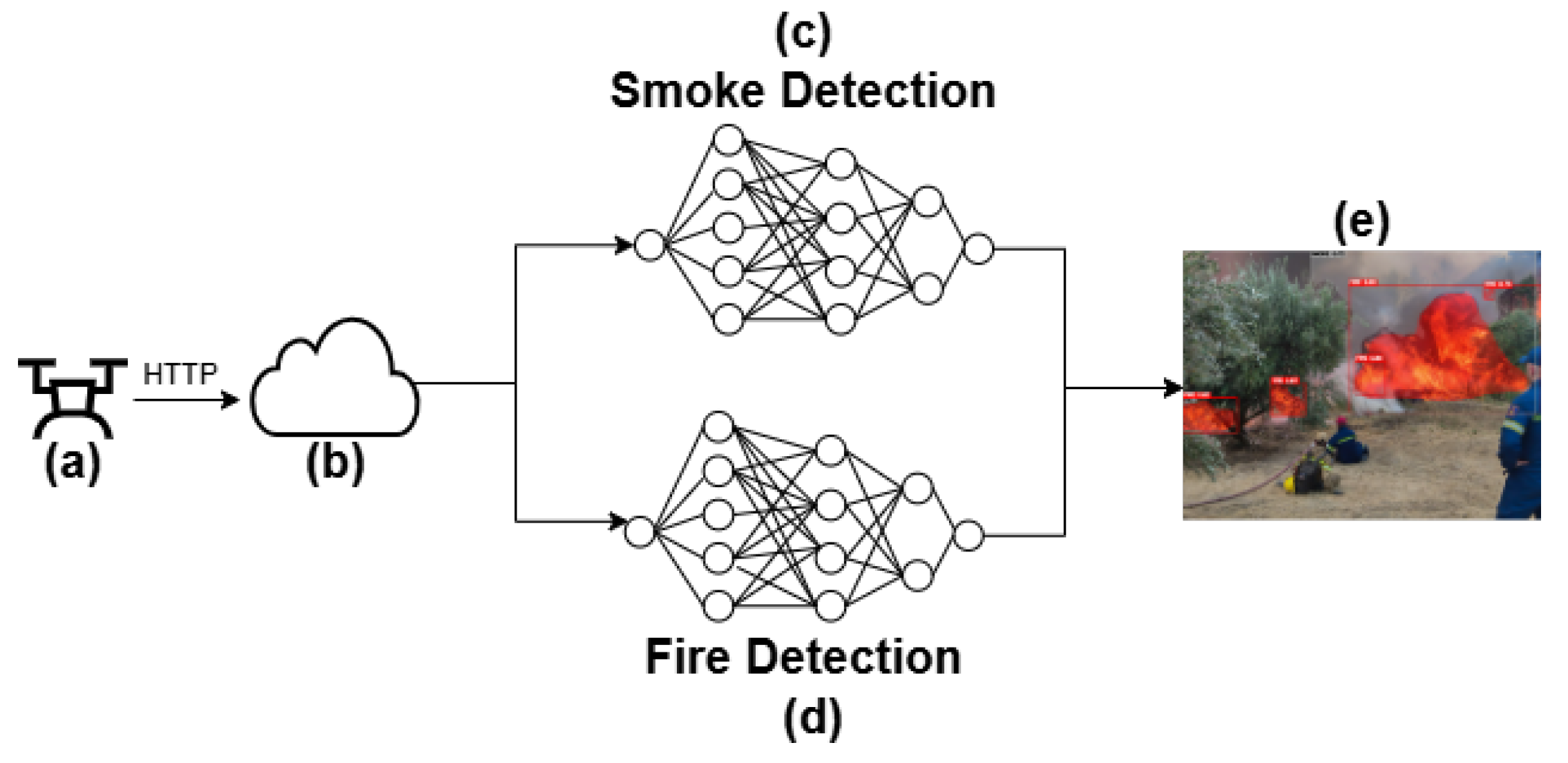
Figure 2.
Fire and Smoke Inference example using (i)YOLO11m-seg and (ii)YOLO26m-seg.
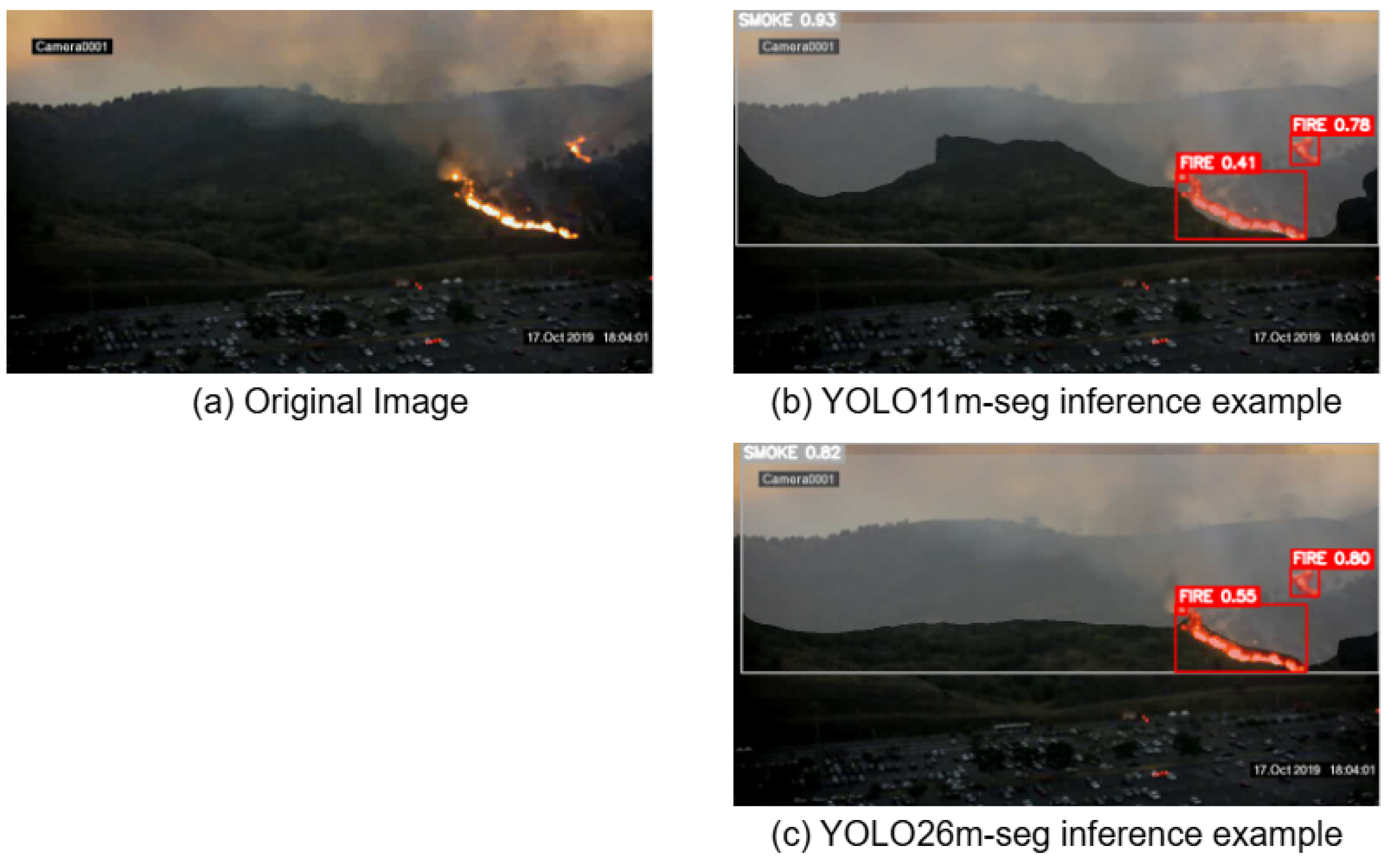
Figure 3.
Smoke Inference example using (i)YOLO11m-seg and (ii)YOLO26m-seg
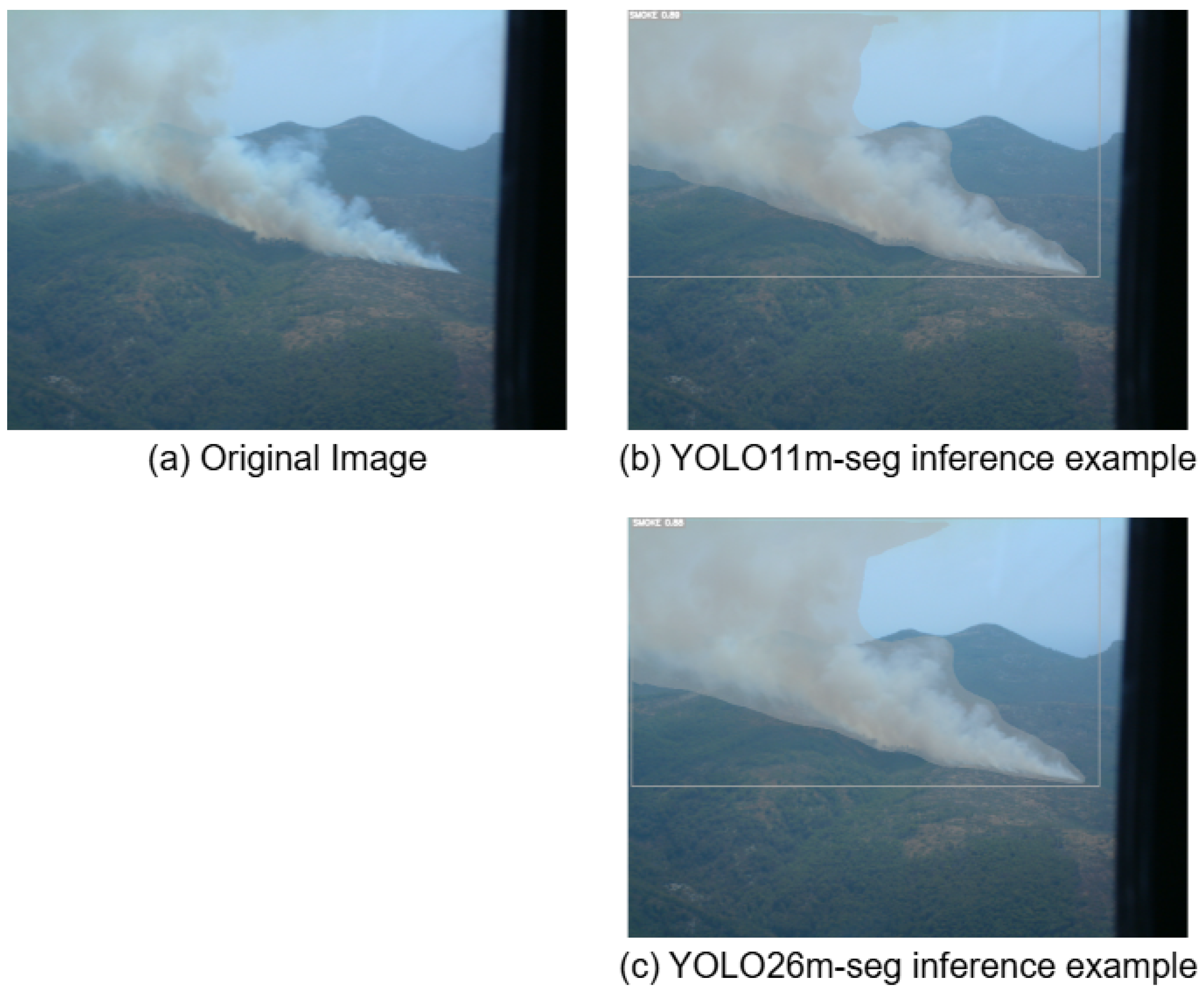
Figure 4.
Fire and Smoke Inference example using Mask R-CNN with a ResNet-101 backbone
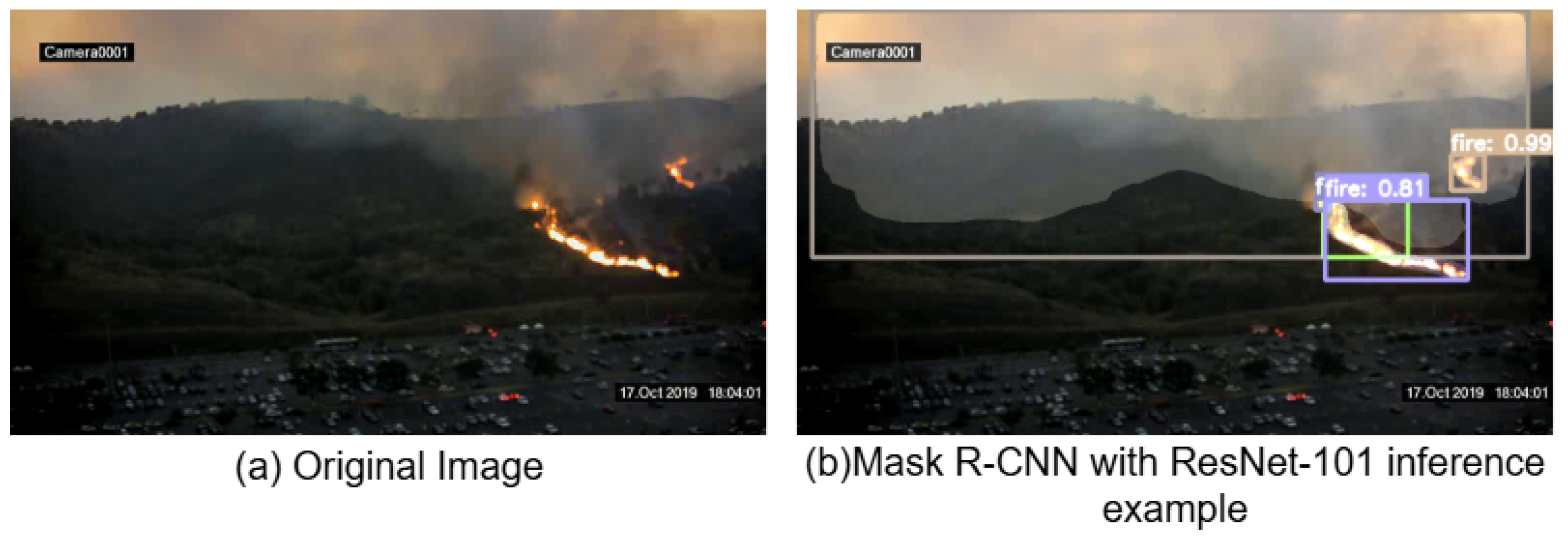
Figure 5.
Hybrid detection results obtained using YOLO26m-Seg for smoke detection and Mask R-CNN with a ResNet-101 backbone for fire detection, using the same input image as in Experimental Scenario II.
Figure 5.
Hybrid detection results obtained using YOLO26m-Seg for smoke detection and Mask R-CNN with a ResNet-101 backbone for fire detection, using the same input image as in Experimental Scenario II.
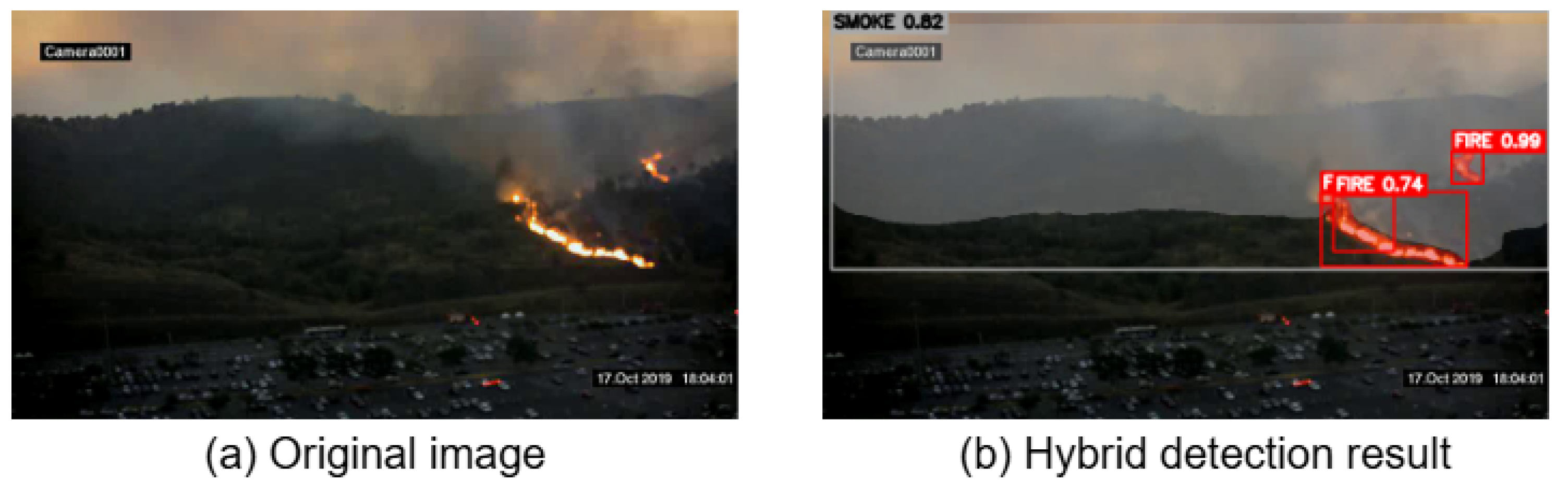
Figure 6.
Hybrid detection results obtained using YOLO26m-Seg for smoke detection and Mask R-CNN with a ResNet-101 backbone for fire detection on a different input image.
Figure 6.
Hybrid detection results obtained using YOLO26m-Seg for smoke detection and Mask R-CNN with a ResNet-101 backbone for fire detection on a different input image.
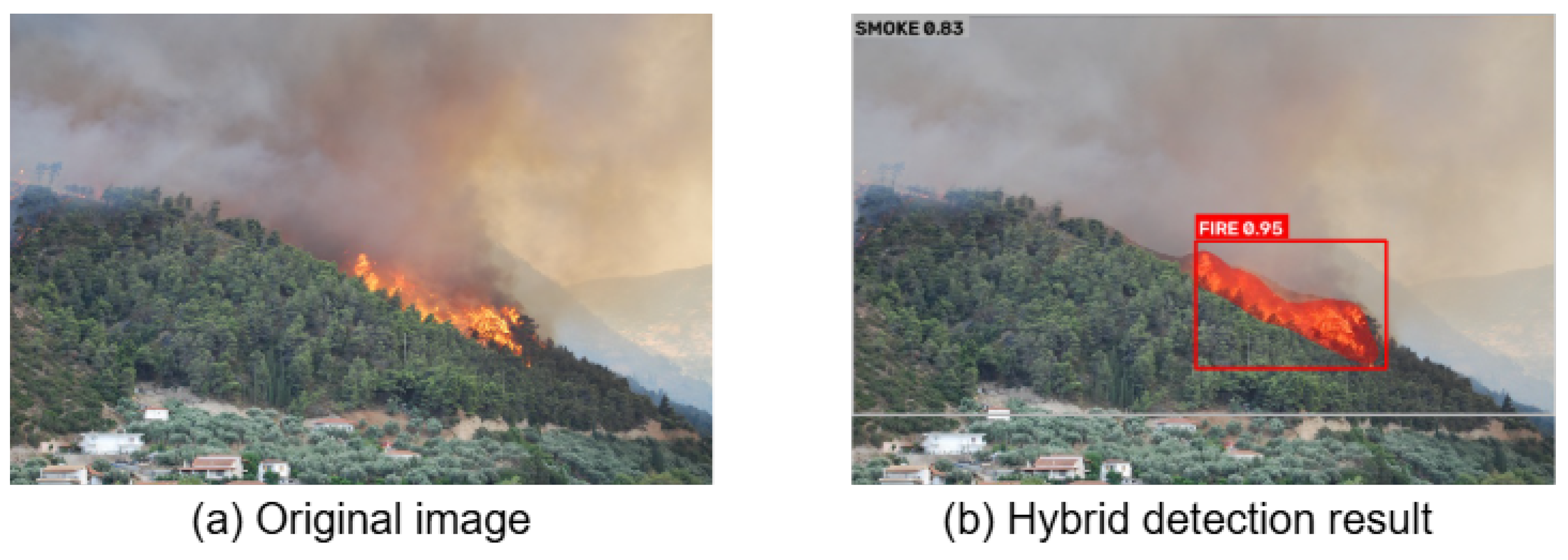
Figure 7.
Hybrid detection results obtained using YOLO26m-Seg for smoke detection and Mask R-CNN with a ResNet-101 backbone on (a)Input image upscaled x2 using the SwinIR transformer and (b)Input image upscaled x4 using the SwinIR transformer.
Figure 7.
Hybrid detection results obtained using YOLO26m-Seg for smoke detection and Mask R-CNN with a ResNet-101 backbone on (a)Input image upscaled x2 using the SwinIR transformer and (b)Input image upscaled x4 using the SwinIR transformer.
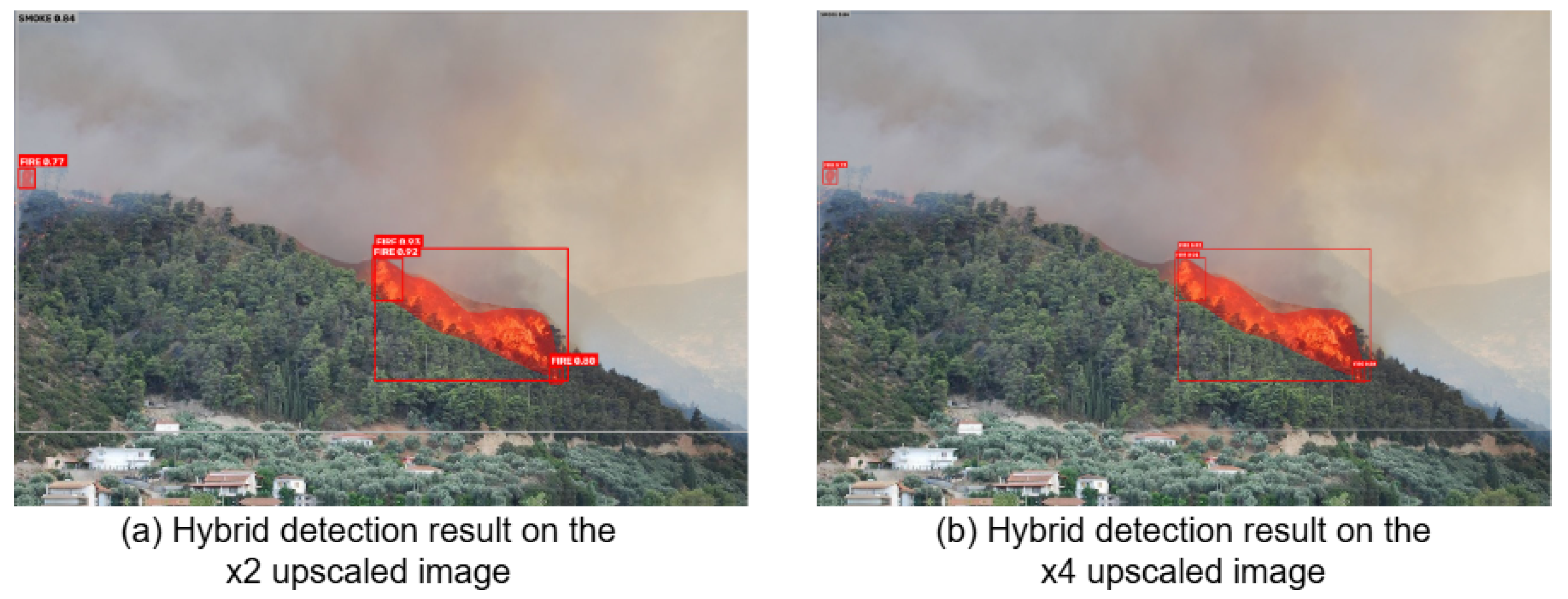
Figure 8.
Inference result of the upscaled ×2 image.
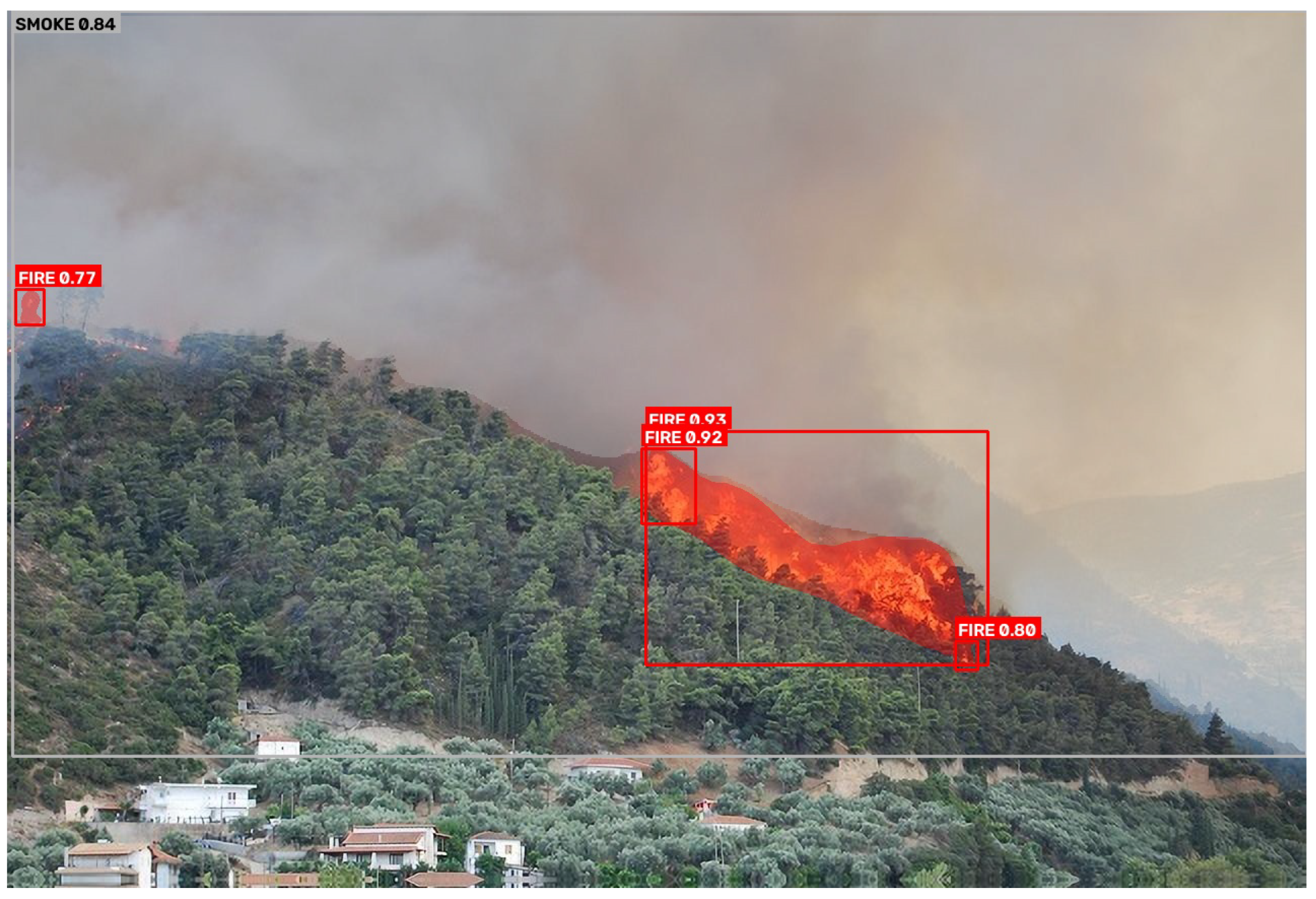
Figure 9.
Inference result of the upscaled ×4 image.
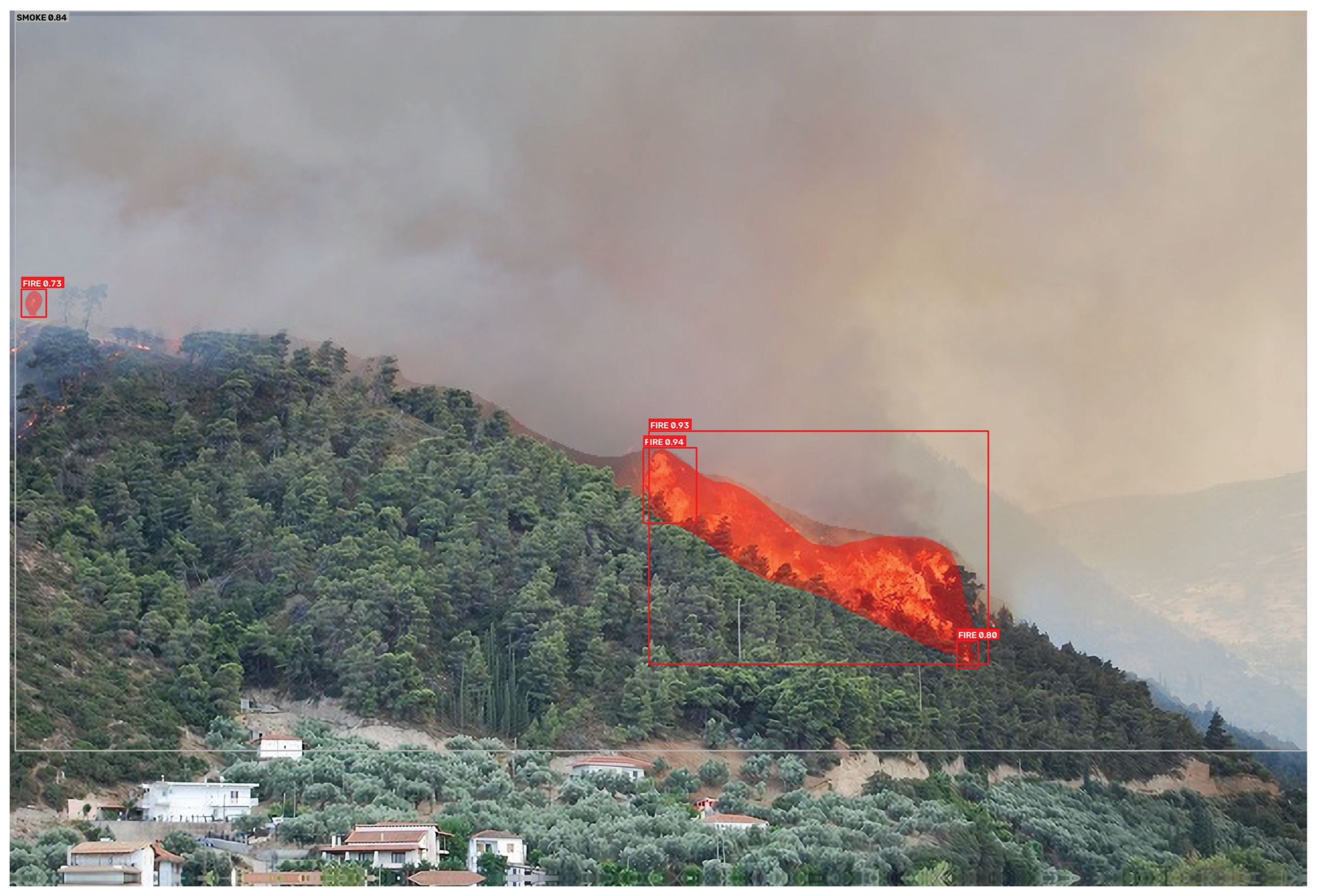
Table 3.
Definitions of true positives, false positives, and false negatives.
| Term | Definition |
|---|---|
| True Positive (TP) | A correctly classified detection matched to a ground-truth object at the required IoU threshold. Each ground-truth object and each detection can be matched at most once. |
| False Positive (FP) | A detection that does not match any ground-truth object at the required IoU threshold, is misclassified, or duplicates an already matched detection. |
| False Negative (FN) | A ground-truth object that is not detected, either because no matching detection is produced or because it is misclassified. |
Table 4.
Loss functions employed during the training of YOLO11-seg, YOLO26-seg, and Mask R-CNN with a ResNet-101 backbone.
Table 4.
Loss functions employed during the training of YOLO11-seg, YOLO26-seg, and Mask R-CNN with a ResNet-101 backbone.
| Loss Function | Description | Models |
|---|---|---|
| Classification Loss () | Measures the discrepancy between predicted object classes and ground-truth labels. YOLO uses binary cross-entropy, whereas Mask R-CNN employs categorical cross-entropy for RoI classification. | All |
| Bounding Box Regression Loss () | Measures the discrepancy between predicted and ground-truth bounding boxes. YOLO employs Complete IoU (CIoU), whereas Mask R-CNN typically uses Smooth L1 loss for bounding-box refinement. | All |
| Distribution Focal Loss () | Improves bounding-box localization by modeling the distances to box boundaries as discrete probability distributions. This component is removed in YOLO26. | YOLO11-seg |
| Instance Mask Loss () | Pixel-wise binary cross-entropy between predicted and ground-truth instance masks. YOLO constructs masks from learned prototypes and instance coefficients, whereas Mask R-CNN predicts masks independently for positive RoIs. | All |
| Semantic Segmentation Loss () | Auxiliary segmentation objective combining cross-entropy and Dice loss to improve mask learning, convergence, and segmentation accuracy. | YOLO26-seg |
| RPN Classification Loss () | Binary cross-entropy loss that evaluates the objectness of candidate regions generated by the Region Proposal Network (RPN). | Mask R-CNN |
| RPN Bounding Box Loss () | Smooth L1 regression loss that optimizes the coordinates of region proposals generated by the RPN. | Mask R-CNN |
| RoI Classification Loss () | Categorical cross-entropy loss that assigns object categories or background labels to selected Regions of Interest (RoIs). | Mask R-CNN |
| RoI Bounding Box Loss () | Smooth L1 regression loss that refines bounding-box coordinates for positive RoIs. | Mask R-CNN |
Table 5.
Evaluation Metrics and Validation Loss of YOLO11m-Seg and YOLO26m-Seg for Fire and Smoke Detection.
Table 5.
Evaluation Metrics and Validation Loss of YOLO11m-Seg and YOLO26m-Seg for Fire and Smoke Detection.
| Smoke Detection Model | Fire Detection Model | |||
|---|---|---|---|---|
| Measure | YOLO26-seg | YOLO11-seg | YOLO26-seg | YOLO11-seg |
| Bbox mAP@0.5 | 0.712 | 0.721 | 0.561 | 0.545 |
| Mask mAP@0.5 | 0.683 | 0.690 | 0.527 | 0.519 |
| Bbox | 0.627 | 0.620 | 0.627 | 0.620 |
| Mask | 0.595 | 0.592 | 0.595 | 0.592 |
| Bbox F1-score | 0.703 | 0.714 | 0.571 | 0.563 |
| Mask F1-score | 0.687 | 0.697 | 0.548 | 0.535 |
| Total Loss | 5.115 | 6.422 | 6.111 | 7.358 |
| Mask Loss | 2.477 | 2.519 | 2.648 | 2.769 |
| Classification Loss | 1.241 | 1.101 | 1.557 | 1.344 |
Table 6.
Average total inference time of fire and smoke detection.
| Model | Total Inference Time |
|---|---|
| YOLO11m-seg | 1140.44 ms |
| YOLO26m-seg | 1180.17 ms |
Table 7.
Comparative Evaluation of YOLO11m-Seg and YOLO26m-Seg across Detection, Segmentation and Validation Loss.
Table 7.
Comparative Evaluation of YOLO11m-Seg and YOLO26m-Seg across Detection, Segmentation and Validation Loss.
| Smoke | Fire | ||||
|---|---|---|---|---|---|
| Measure | YOLO11m | YOLO26m | YOLO11m | YOLO26m | Comparative Summary |
| Bbox | 0.721 | 0.712 | 0.545 | 0.561 | Smoke: +1.26% (YOLO11m) Fire: +2.94% (YOLO26m) |
| Mask | 0.690 | 0.683 | 0.519 | 0.527 | Smoke: +1.02% (YOLO11m) Fire: +1.54% (YOLO26m) |
| Bbox | 0.620 | 0.627 | 0.620 | 0.627 | +1.13% for YOLO26m (Harmonic mean) |
| Mask | 0.592 | 0.595 | 0.592 | 0.595 | +0.51% for YOLO26m (Harmonic mean) |
| Bbox F1-score | 0.714 | 0.703 | 0.563 | 0.571 | Smoke: +1.56% (YOLO11m) Fire: +1.42% (YOLO26m) |
| Mask F1-score | 0.697 | 0.687 | 0.535 | 0.548 | Smoke: +1.46% (YOLO11m) Fire: +2.43% (YOLO26m) |
| Total Val Loss | 6.422 | 5.115 | 7.358 | 6.111 | Lower in YOLO26m (-20.4% Smoke, -16.9% Fire) |
| Mask Val Loss | 2.519 | 2.477 | 2.769 | 2.648 | Lower in YOLO26m for both classes |
| Class. Loss | 1.101 | 1.241 | 1.344 | 1.557 | Lower in YOLO11m for both classes |
Table 8.
Performance and Inference Time Comparison between YOLO26m-Seg and Mask R-CNN (ResNet-101).
| Measure | YOLO26m-Seg | Mask R-CNN (ResNet-101) | Comparative Gain |
|---|---|---|---|
| Bbox (Smoke) | 0.712 | 0.770 | +8.15% (Mask R-CNN) |
| Bbox (Fire) | 0.561 | 0.600 | +6.95% (Mask R-CNN) |
| Bbox | 0.627 | 0.674 | +7.50% (Mask R-CNN) |
| Mask (Smoke) | 0.683 | 0.646 | +5.73% (YOLO26m-Seg) |
| Mask (Fire) | 0.527 | 0.430 | +22.56% (YOLO26m-Seg) |
| Mask | 0.595 | 0.516 | +15.31% (YOLO26m-Seg) |
| Inference Time | 1180.17 ms (avg) | 5846.00 ms | faster (YOLO26m-Seg) |
| Small Fire Sensitivity | Lower | Higher | Better loc. (Mask R-CNN) |
Table 9.
Computational Breakdown and Throughput of the Proposed Hybrid Framework (YOLO26m-Seg + Mask R-CNN ResNet-101) on Original Resolution Images ( px).
Table 9.
Computational Breakdown and Throughput of the Proposed Hybrid Framework (YOLO26m-Seg + Mask R-CNN ResNet-101) on Original Resolution Images ( px).
| Metric / Component | Example Image 1 | Example Image 2 |
|---|---|---|
| Assigned Smoke Model | YOLO26m-Seg () | |
| Assigned Fire Model | Mask R-CNN ResNet-101 () | |
| YOLO26m-Seg Inference Time | 1513.36 ms (25.1%) | 1430.45 ms (24.8%) |
| Mask R-CNN Inference Time | 4525.90 ms (74.9%) | 4348.13 ms (75.2%) |
| Combined Model Inference Time | 6039.26 ms | 5778.58 ms |
| Total Pipeline Time | ∼6039.26 ms | 5850.73 ms |
| Effective Throughput | ∼0.166 img/s | 0.171 img/s |
Table 10.
Impact of SwinIR Super-Resolution Upscaling Factors on Small/Distant Fire Detection within the Hybrid Framework.
Table 10.
Impact of SwinIR Super-Resolution Upscaling Factors on Small/Distant Fire Detection within the Hybrid Framework.
| Configuration | Input Resolution | Extra Fire Detected | Computational Trade-off |
|---|---|---|---|
| Original Resolution | px | No (Indistinct) | Baseline (∼5.85 s/image) |
| SwinIR () | px | Yes | Lower overhead (Preferred) |
| SwinIR () | px | Yes | Higher computational cost |
Disclaimer/Publisher’s Note: The statements, opinions and data contained in all publications are solely those of the individual author(s) and contributor(s) and not of MDPI and/or the editor(s). MDPI and/or the editor(s) disclaim responsibility for any injury to people or property resulting from any ideas, methods, instructions or products referred to in the content. |
© 2026 by the authors. Licensee MDPI, Basel, Switzerland. This article is an open access article distributed under the terms and conditions of the Creative Commons Attribution (CC BY) license (http://creativecommons.org/licenses/by/4.0/).
Copyright: This open access article is published under a Creative Commons CC BY 4.0 license, which permit the free download, distribution, and reuse, provided that the author and preprint are cited in any reuse.