
Submitted:
23 November 2026
Posted:
25 November 2026
You are already at the latest version
Abstract
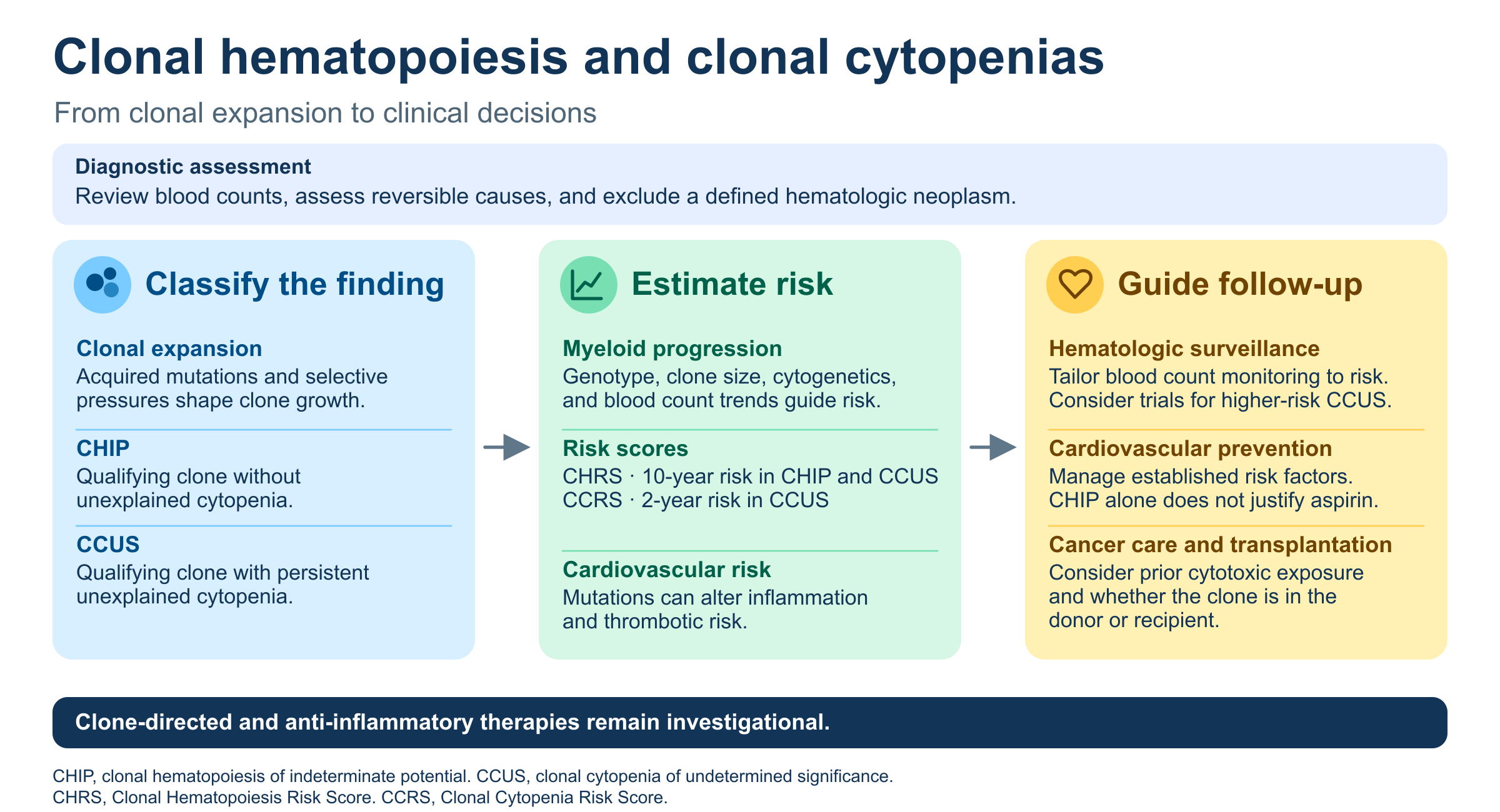
Clonal hematopoiesis of indeterminate potential (CHIP) is often found incidentally in older adults. The first step is to review the blood counts and determine whether the patient has an isolated clone, an unexplained cytopenia, or a defined hematologic disorder. Progression risk varies with the mutation profile, variant allele frequency (VAF), chromosomal changes, and blood count trends. This narrative review examines diagnosis, prognosis, cardiovascular risk, and management, including implications for cancer therapy and transplantation. The fifth World Health Organization classification and the International Consensus Classification differ in how they distinguish clonal cytopenia of undetermined significance (CCUS) from myelodysplastic neoplasms. The Clonal Hematopoiesis Risk Score estimates 10-year risk in people with CHIP or CCUS, while the Clonal Cytopenia Risk Score estimates 2-year risk in patients with CCUS. CHIP has been associated with cardiovascular events in some cohorts, raising the question of whether it should change preventive care. In the ASPREE substudy, there was no clear evidence that CHIP modified the cardiovascular or bleeding effects of aspirin. Current care includes hematologic follow-up based on progression risk, cardiovascular prevention based on established indications, and patient counseling. Treatments directed at the clone or its inflammatory effects remain investigational.
Keywords:
clonal hematopoiesis
; CHIP
; CCUS
; mosaic chromosomal alterations
; myeloid neoplasms
; cardiovascular disease
; hematopoietic cell transplantation
; risk stratification
Copyright: This open access article is published under a Creative Commons CC BY 4.0 license, which permit the free download, distribution, and reuse, provided that the author and preprint are cited in any reuse.